sensor TOYOTA SIENNA 2007 Service Repair Manual
[x] Cancel search | Manufacturer: TOYOTA, Model Year: 2007, Model line: SIENNA, Model: TOYOTA SIENNA 2007Pages: 3000, PDF Size: 52.26 MB
Page 816 of 3000

ES–362GR-FE ENGINE CONTROL SYSTEM – SFI SYSTEM
ES
M+ (E9-5) - ME01 (E10-3) B - W-BThrottle drive motor
operation signal (positive
terminal)Idling with warm enginePluse generation
(see waveform 9)
E02 (E9-6) - Body ground W-B - -Earth (ground) circuit of
ECMAlways Below 1 V
E01 (E9-7) - Body ground W-B - -Earth (ground) circuit of
ECMAlways Below 1 V
IGT1 (E9-8) - E1 (E11-1)
IGT2 (E9-9) - E1 (E11-1)
IGT3 (E9-10) - E1 (E11-1)
IGT4 (E9-11) - E1 (E11-1)
IGT5 (E9-12) - E1 (E11-1)
IGT6 (E9-13) - E1 (E11-1)R-L - BR
P - BR
Y- B - B R
L-Y - BR
G-Y - BR
L-R - BRIgnition coil with igniter
(ignition signal)IdlingPulse generation
(see waveform 6)
GE01 (E9-17) - E1 (E11-1) - - BRShielded earth (ground)
circuit of throttle drive
motorAlways Below 1 V
OX1B (E9-18) - E2 (E9-28)
OX2B (E10-33) - E2 (E9-28)W - BR
B - BRHeated oxygen sensor
signalWith engine speed at 2500 rpm
for 2 minutes after warming upPulse generation
(see waveform 2)
VTA2 (E9-19) - E2 (E9-28) B-R - BRThrottle position sensor
signal (for sensor
malfunction detection)Ignition switch ON, Accelerator
pedal fully released2.1 to 3.1 V
VTA2 (E9-19) - E2 (E9-28) B-R - BRThrottle position sensor
signal (for sensor
malfunction detection)Ignition switch ON, Accelerator
pedal fully depressed4.5 to 5.0 V
VTA1 (E9-20) - E2 (E9-28) LG - BRThrottle position sensor
signal (for engine control)Ignition switch ON, Throttle valve
fully closed0.5 to 1.2 V
VTA1 (E9-20) - E2 (E9-28) LG - BRThrottle position sensor
signal (for engine control)Ignition switch ON, Throttle valve
fully open3.2 to 4.8 V
THW (E9-21) - E2 (E9-28) G-B - BREngine coolant
temperature sensor signalIdling, Engine coolant
temperature 80
C (176F)0.2 to 1.0 V
THA (E9-22) - E2 (E9-28) L-B - BRIntake air temperature
sensor signalIdling, Intake air temperature
20
C (68F)0.5 to 3.4 V
VC (E9-23) - E2 (E9-28) Y - BRPower source of sensors
(specific voltage)Ignition switch ON 4.5 to 5.0 V
IGF1 (E9-24) - E1 (E11-1) W-R - BRIgnition coil with igniter
(ignition confirmation
signal)Ignition switch ON 4.5 to 5.0 V
IGF1 (E9-24) - E1 (E11-1) W-R - BRIgnition coil with igniter
(ignition confirmation
signal)IdlingPulse generation
(see waveform 6)
AICV (E9-27) - E1 (E11-1) W - BRVSV for Air intake control
system operation signalIgnition switch ON 9 to 14 V
E2 (E9-28) - E1 (E11-1) BR - BREarth (ground) circuit of
sensors for ETCSAlways Below 1 V
E2G (E9-29) - E1 (E11-1) L-W - BREarth (ground) circuit of
sensor for mass air flow
meterAlways Below 1 V
VG (E9-30) - E2G (E9-29) R - L-WMass Air Flow (MAF)
meter signalIdling, Shift lever position P or N,
A/C switch OFF0.5 to 3.0 V
ACIS (E9-33) - E1 (E11-1) R-Y - BRVSV for ACIS (Acoustic
Control Induction System)
operation signalIgnition switch ON 9 to 14 V
PRG (E9-34) - E1 (E11-1) G - BRPurge VSV for EVAP
system operation signalIgnition switch ON 9 to 14 V
PRG (E9-34) - E1 (E11-1) G - BRPurge VSV for EVAP
system operation signalIdlingPulse generation
(see waveform 7)
HA2A (E10-1) - E05 (E10-6) Y - W-BA/F sensor heater
operation signalIdling Below 3.0 V Symbols (Terminal No.) Wiring Colors Terminal Descriptions ConditionsSpecified
Condition
Page 817 of 3000
2GR-FE ENGINE CONTROL SYSTEM – SFI SYSTEMES–37
ES
*1: The ECM terminal voltage is constant regardless of
the output voltage from the sensor.
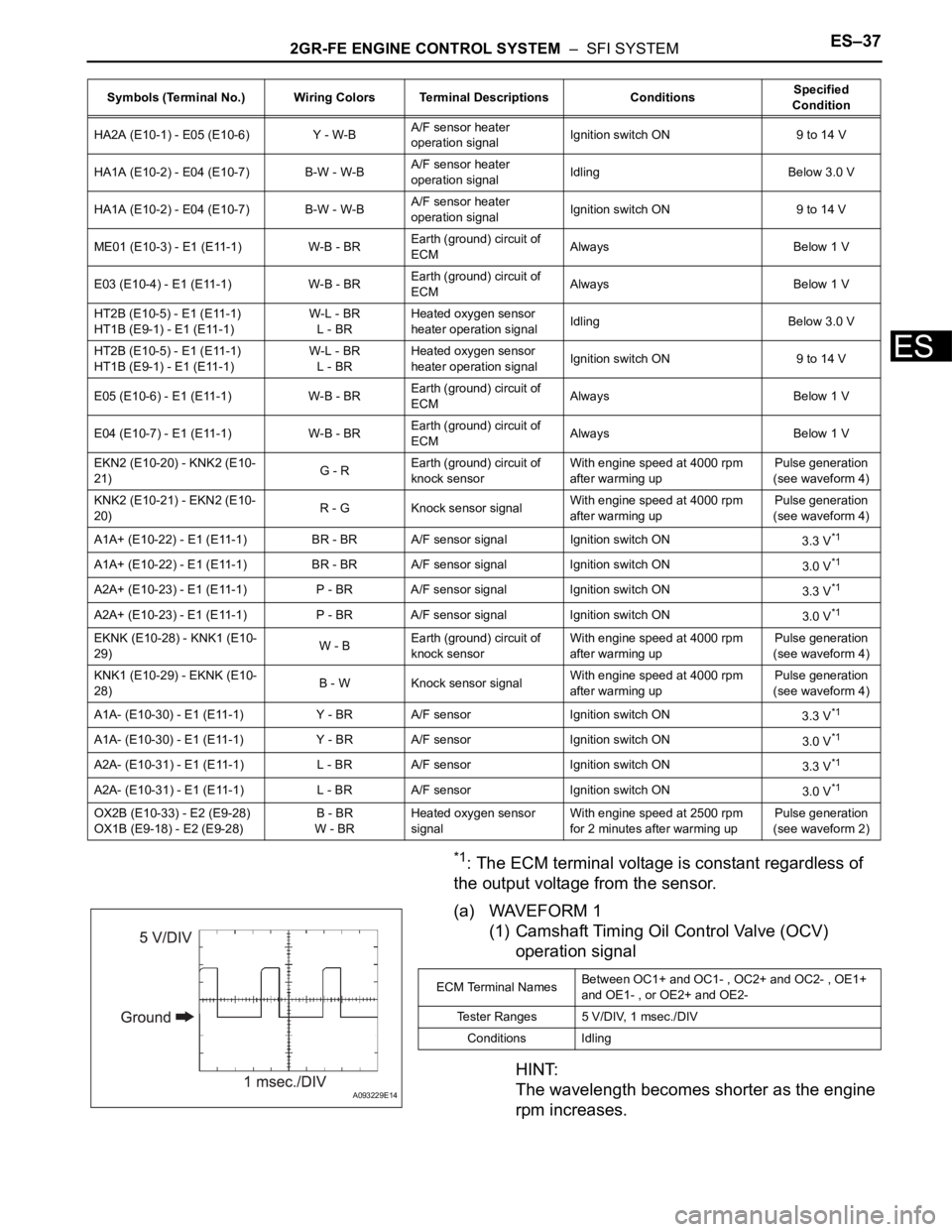
(a) WAVEFORM 1
(1) Camshaft Timing Oil Control Valve (OCV)
operation signal
HINT:
The wavelength becomes shorter as the engine
rpm increases.
HA2A (E10-1) - E05 (E10-6) Y - W-BA/F sensor heater
operation signalIgnition switch ON 9 to 14 V
HA1A (E10-2) - E04 (E10-7) B-W - W-BA/F sensor heater
operation signalIdling Below 3.0 V
HA1A (E10-2) - E04 (E10-7) B-W - W-BA/F sensor heater
operation signalIgnition switch ON 9 to 14 V
ME01 (E10-3) - E1 (E11-1) W-B - BREarth (ground) circuit of
ECMAlways Below 1 V
E03 (E10-4) - E1 (E11-1) W-B - BREarth (ground) circuit of
ECMAlways Below 1 V
HT2B (E10-5) - E1 (E11-1)
HT1B (E9-1) - E1 (E11-1)W-L - BR
L - BRHeated oxygen sensor
heater operation signalIdling Below 3.0 V
HT2B (E10-5) - E1 (E11-1)
HT1B (E9-1) - E1 (E11-1)W-L - BR
L - BRHeated oxygen sensor
heater operation signalIgnition switch ON 9 to 14 V
E05 (E10-6) - E1 (E11-1) W-B - BREarth (ground) circuit of
ECMAlways Below 1 V
E04 (E10-7) - E1 (E11-1) W-B - BREarth (ground) circuit of
ECMAlways Below 1 V
EKN2 (E10-20) - KNK2 (E10-
21)G - REarth (ground) circuit of
knock sensorWith engine speed at 4000 rpm
after warming upPulse generation
(see waveform 4)
KNK2 (E10-21) - EKN2 (E10-
20)R - G Knock sensor signalWith engine speed at 4000 rpm
after warming upPulse generation
(see waveform 4)
A1A+ (E10-22) - E1 (E11-1) BR - BR A/F sensor signal Ignition switch ON
3.3 V
*1
A1A+ (E10-22) - E1 (E11-1) BR - BR A/F sensor signal Ignition switch ON
3.0 V*1
A2A+ (E10-23) - E1 (E11-1) P - BR A/F sensor signal Ignition switch ON
3.3 V*1
A2A+ (E10-23) - E1 (E11-1) P - BR A/F sensor signal Ignition switch ON
3.0 V*1
EKNK (E10-28) - KNK1 (E10-
29)W - BEarth (ground) circuit of
knock sensorWith engine speed at 4000 rpm
after warming upPulse generation
(see waveform 4)
KNK1 (E10-29) - EKNK (E10-
28)B - W Knock sensor signalWith engine speed at 4000 rpm
after warming upPulse generation
(see waveform 4)
A1A- (E10-30) - E1 (E11-1) Y - BR A/F sensor Ignition switch ON
3.3 V
*1
A1A- (E10-30) - E1 (E11-1) Y - BR A/F sensor Ignition switch ON
3.0 V*1
A2A- (E10-31) - E1 (E11-1) L - BR A/F sensor Ignition switch ON
3.3 V*1
A2A- (E10-31) - E1 (E11-1) L - BR A/F sensor Ignition switch ON
3.0 V*1
OX2B (E10-33) - E2 (E9-28)
OX1B (E9-18) - E2 (E9-28)B - BR
W - BRHeated oxygen sensor
signalWith engine speed at 2500 rpm
for 2 minutes after warming upPulse generation
(see waveform 2) Symbols (Terminal No.) Wiring Colors Terminal Descriptions ConditionsSpecified
Condition
A093229E14
ECM Terminal NamesBetween OC1+ and OC1- , OC2+ and OC2- , OE1+
and OE1- , or OE2+ and OE2-
Tester Ranges 5 V/DIV, 1 msec./DIV
Conditions Idling
Page 818 of 3000
ES–382GR-FE ENGINE CONTROL SYSTEM – SFI SYSTEM
ES
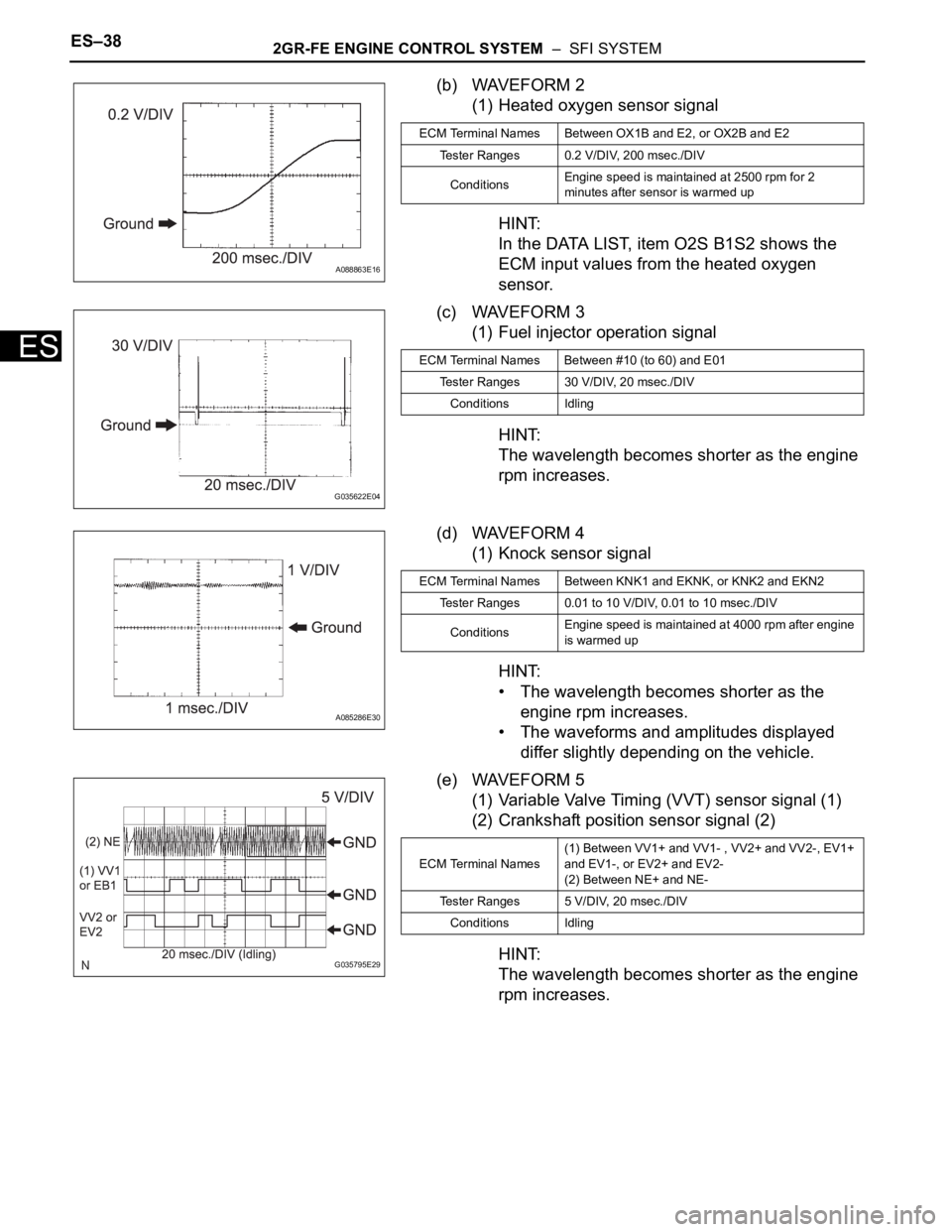
(b) WAVEFORM 2
(1) Heated oxygen sensor signal
HINT:
In the DATA LIST, item O2S B1S2 shows the
ECM input values from the heated oxygen
sensor.
(c) WAVEFORM 3
(1) Fuel injector operation signal
HINT:
The wavelength becomes shorter as the engine
rpm increases.
(d) WAVEFORM 4
(1) Knock sensor signal
HINT:
• The wavelength becomes shorter as the
engine rpm increases.
• The waveforms and amplitudes displayed
differ slightly depending on the vehicle.
(e) WAVEFORM 5
(1) Variable Valve Timing (VVT) sensor signal (1)
(2) Crankshaft position sensor signal (2)
HINT:
The wavelength becomes shorter as the engine
rpm increases.
A088863E16
ECM Terminal Names Between OX1B and E2, or OX2B and E2
Tester Ranges 0.2 V/DIV, 200 msec./DIV
ConditionsEngine speed is maintained at 2500 rpm for 2
minutes after sensor is warmed up
G035622E04
ECM Terminal Names Between #10 (to 60) and E01
Tester Ranges 30 V/DIV, 20 msec./DIV
Conditions Idling
A085286E30
ECM Terminal Names Between KNK1 and EKNK, or KNK2 and EKN2
Tester Ranges 0.01 to 10 V/DIV, 0.01 to 10 msec./DIV
ConditionsEngine speed is maintained at 4000 rpm after engine
is warmed up
G035795E29
ECM Terminal Names(1) Between VV1+ and VV1- , VV2+ and VV2-, EV1+
and EV1-, or EV2+ and EV2-
(2) Between NE+ and NE-
Tester Ranges 5 V/DIV, 20 msec./DIV
Conditions Idling
Page 821 of 3000
2GR-FE ENGINE CONTROL SYSTEM – VVT SENSORES–509
ES
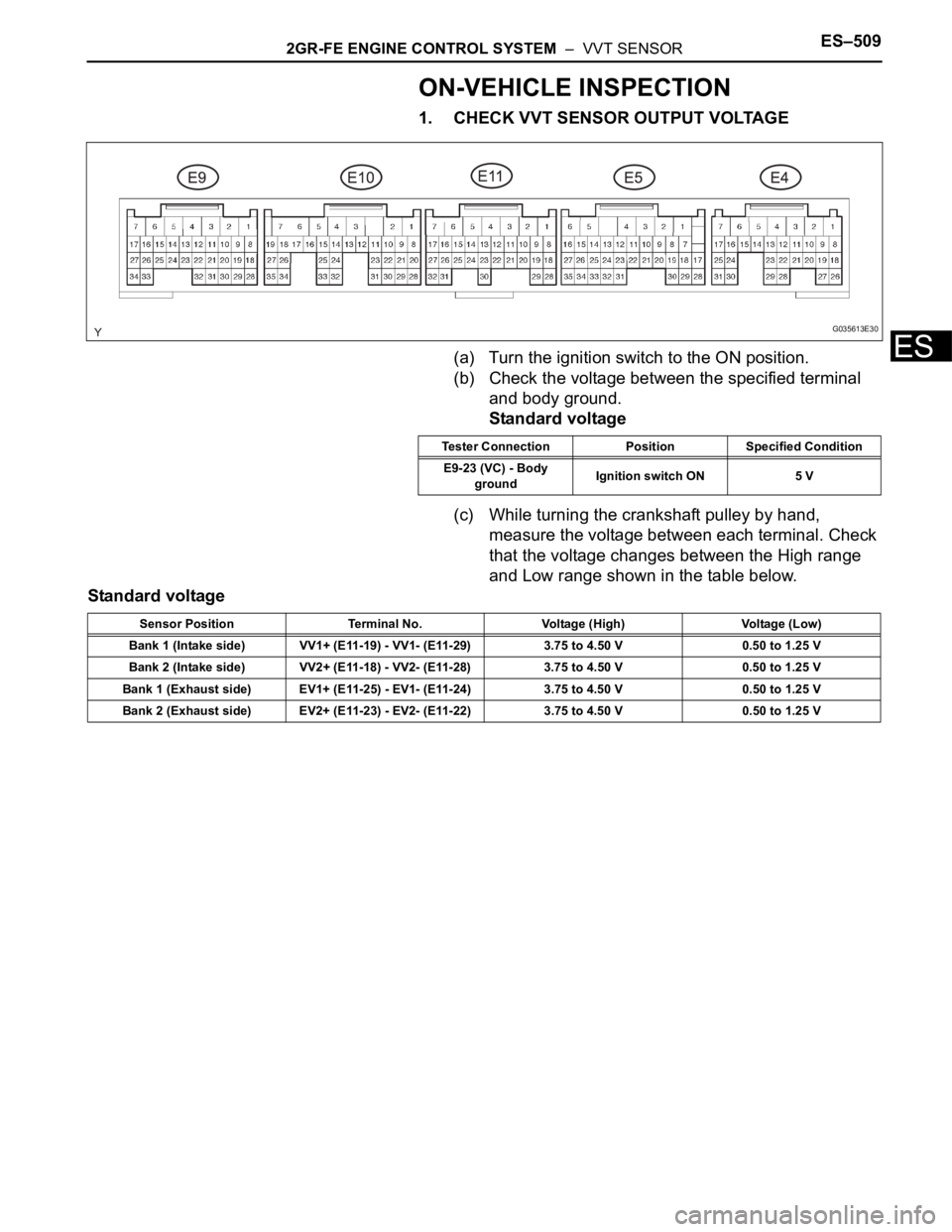
ON-VEHICLE INSPECTION
1. CHECK VVT SENSOR OUTPUT VOLTAGE
(a) Turn the ignition switch to the ON position.
(b) Check the voltage between the specified terminal
and body ground.
Standard voltage
(c) While turning the crankshaft pulley by hand,
measure the voltage between each terminal. Check
that the voltage changes between the High range
and Low range shown in the table below.
Standard voltage
G035613E30
Tester Connection Position Specified Condition
E9-23 (VC) - Body
groundIgnition switch ON 5 V
Sensor Position Terminal No. Voltage (High) Voltage (Low)
Bank 1 (Intake side) VV1+ (E11-19) - VV1- (E11-29) 3.75 to 4.50 V0.50 to 1.25 V
Bank 2 (Intake side) VV2+ (E11-18) - VV2- (E11-28) 3.75 to 4.50 V0.50 to 1.25 V
Bank 1 (Exhaust side) EV1+ (E11-25) - EV1- (E11-24) 3.75 to 4.50 V 0.50 to 1.25 V
Bank 2 (Exhaust side) EV2+ (E11-23) - EV2- (E11-22) 3.75 to 4.50 V 0.50 to 1.25 V
Page 822 of 3000
ES–5102GR-FE ENGINE CONTROL SYSTEM – VVT SENSOR
ES
REMOVAL
1. REMOVE WINDSHIELD WIPER MOTOR ASSEMBLY
HINT:
(See page WW-4)
2. REMOVE FRONT OUTER COWL TOP PANEL SUB-
ASSEMBLY (See page EM-27)
3. DRAIN ENGINE COOLANT (See page CO-6)
4. REMOVE V-BANK COVER SUB-ASSEMBLY (See
page EM-28)
5. REMOVE NO. 2 AIR CLEANER INLET (See page EM-
28)
6. REMOVE NO. 1 AIR CLEANER INLET (See page EM-
28)
7. REMOVE AIR CLEANER CAP SUB-ASSEMBLY (See
page ES-493)
8. REMOVE AIR CLEANER CASE SUB-ASSEMBLY (See
page EM-28)
9. REMOVE INTAKE AIR SURGE TANK ASSEMBLY
(See page ES-521)
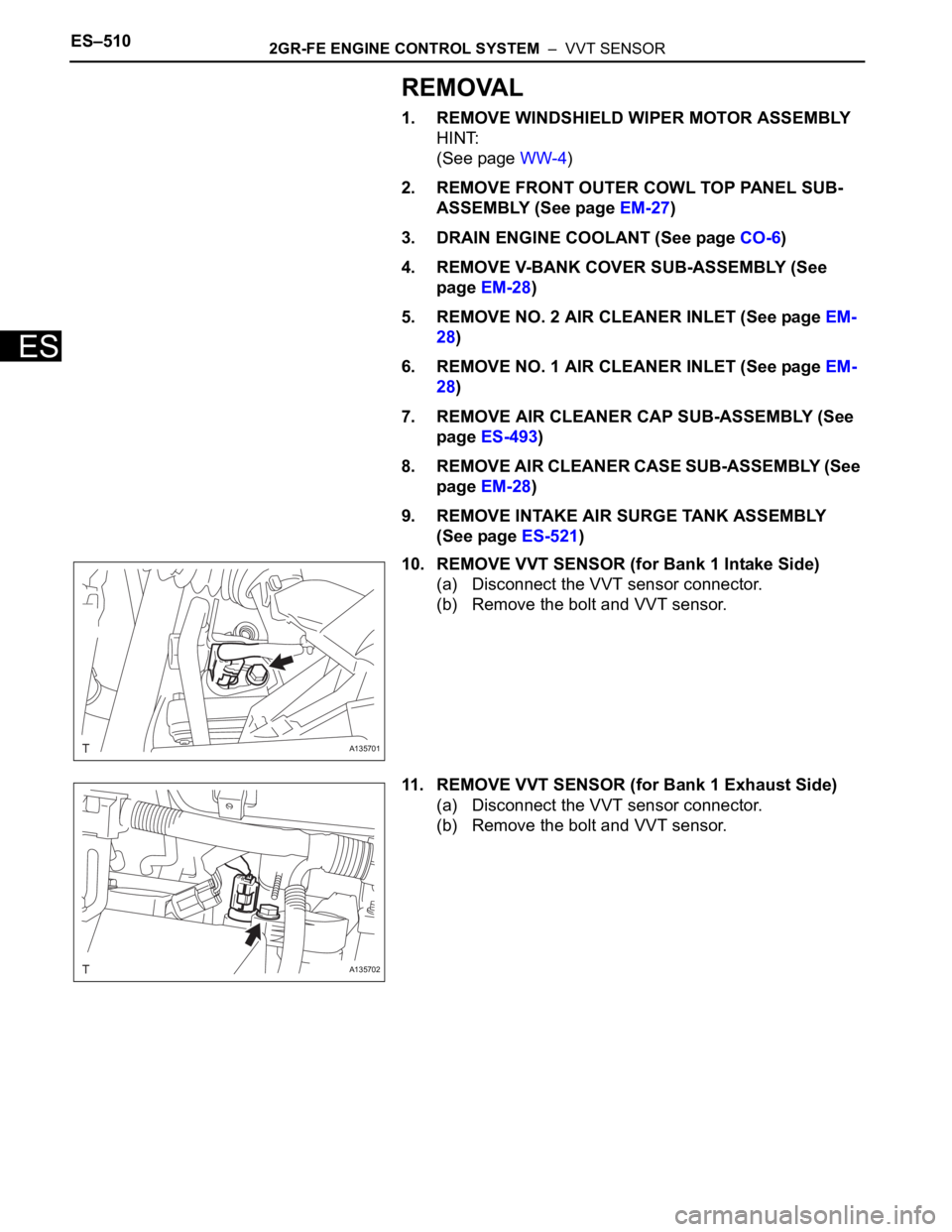
10. REMOVE VVT SENSOR (for Bank 1 Intake Side)
(a) Disconnect the VVT sensor connector.
(b) Remove the bolt and VVT sensor.
11. REMOVE VVT SENSOR (for Bank 1 Exhaust Side)
(a) Disconnect the VVT sensor connector.
(b) Remove the bolt and VVT sensor.
A135701
A135702
Page 824 of 3000
ES–422GR-FE ENGINE CONTROL SYSTEM – SFI SYSTEM
ES
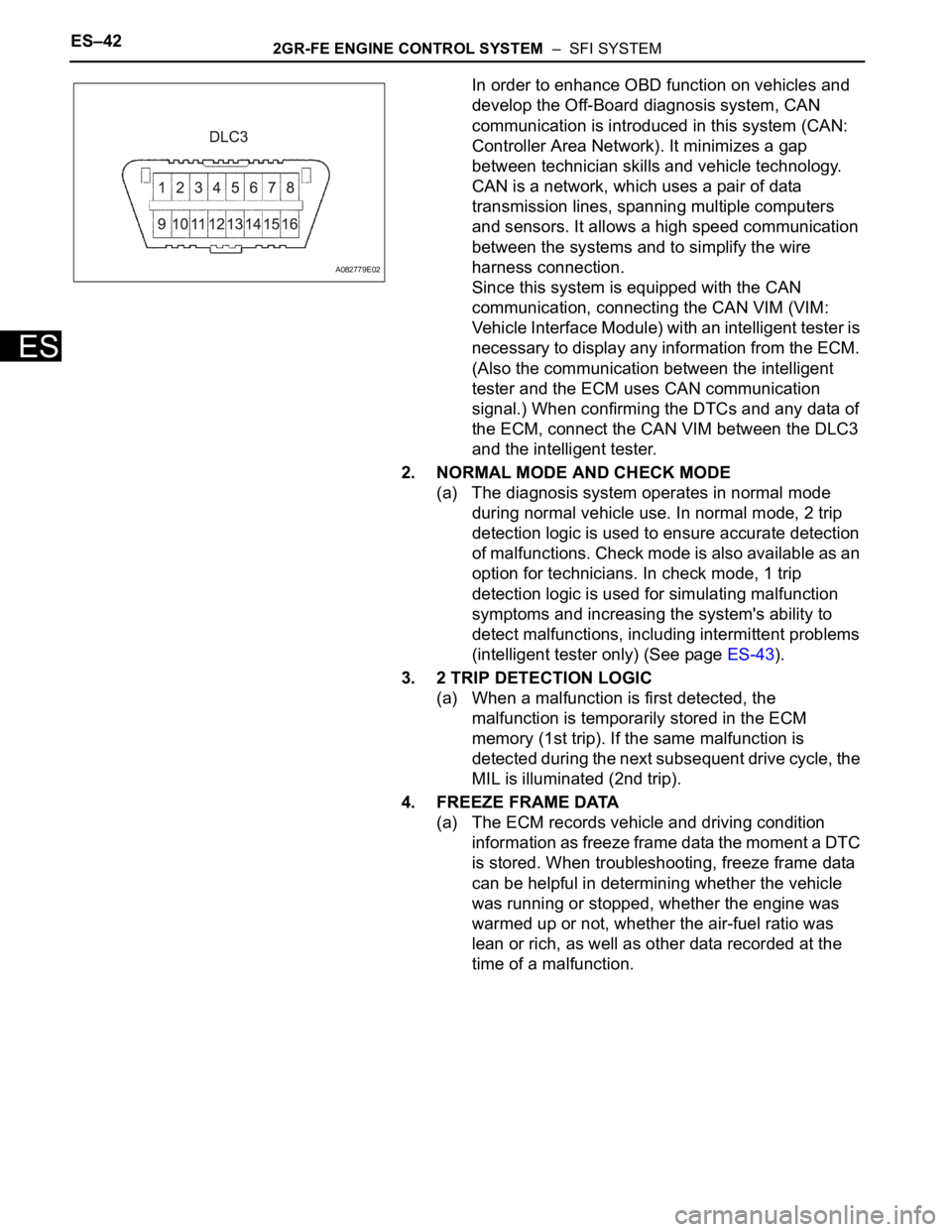
In order to enhance OBD function on vehicles and
develop the Off-Board diagnosis system, CAN
communication is introduced in this system (CAN:
Controller Area Network). It minimizes a gap
between technician skills and vehicle technology.
CAN is a network, which uses a pair of data
transmission lines, spanning multiple computers
and sensors. It allows a high speed communication
between the systems and to simplify the wire
harness connection.
Since this system is equipped with the CAN
communication, connecting the CAN VIM (VIM:
Vehicle Interface Module) with an intelligent tester is
necessary to display any information from the ECM.
(Also the communication between the intelligent
tester and the ECM uses CAN communication
signal.) When confirming the DTCs and any data of
the ECM, connect the CAN VIM between the DLC3
and the intelligent tester.
2. NORMAL MODE AND CHECK MODE
(a) The diagnosis system operates in normal mode
during normal vehicle use. In normal mode, 2 trip
detection logic is used to ensure accurate detection
of malfunctions. Check mode is also available as an
option for technicians. In check mode, 1 trip
detection logic is used for simulating malfunction
symptoms and increasing the system's ability to
detect malfunctions, including intermittent problems
(intelligent tester only) (See page ES-43).
3. 2 TRIP DETECTION LOGIC
(a) When a malfunction is first detected, the
malfunction is temporarily stored in the ECM
memory (1st trip). If the same malfunction is
detected during the next subsequent drive cycle, the
MIL is illuminated (2nd trip).
4. FREEZE FRAME DATA
(a) The ECM records vehicle and driving condition
information as freeze frame data the moment a DTC
is stored. When troubleshooting, freeze frame data
can be helpful in determining whether the vehicle
was running or stopped, whether the engine was
warmed up or not, whether the air-fuel ratio was
lean or rich, as well as other data recorded at the
time of a malfunction.
A082779E02
Page 828 of 3000
2GR-FE ENGINE CONTROL SYSTEM – CRANKSHAFT POSITION SENSORES–513
ES
ENGINE
2GR-FE ENGINE CONTROL SYSTEM
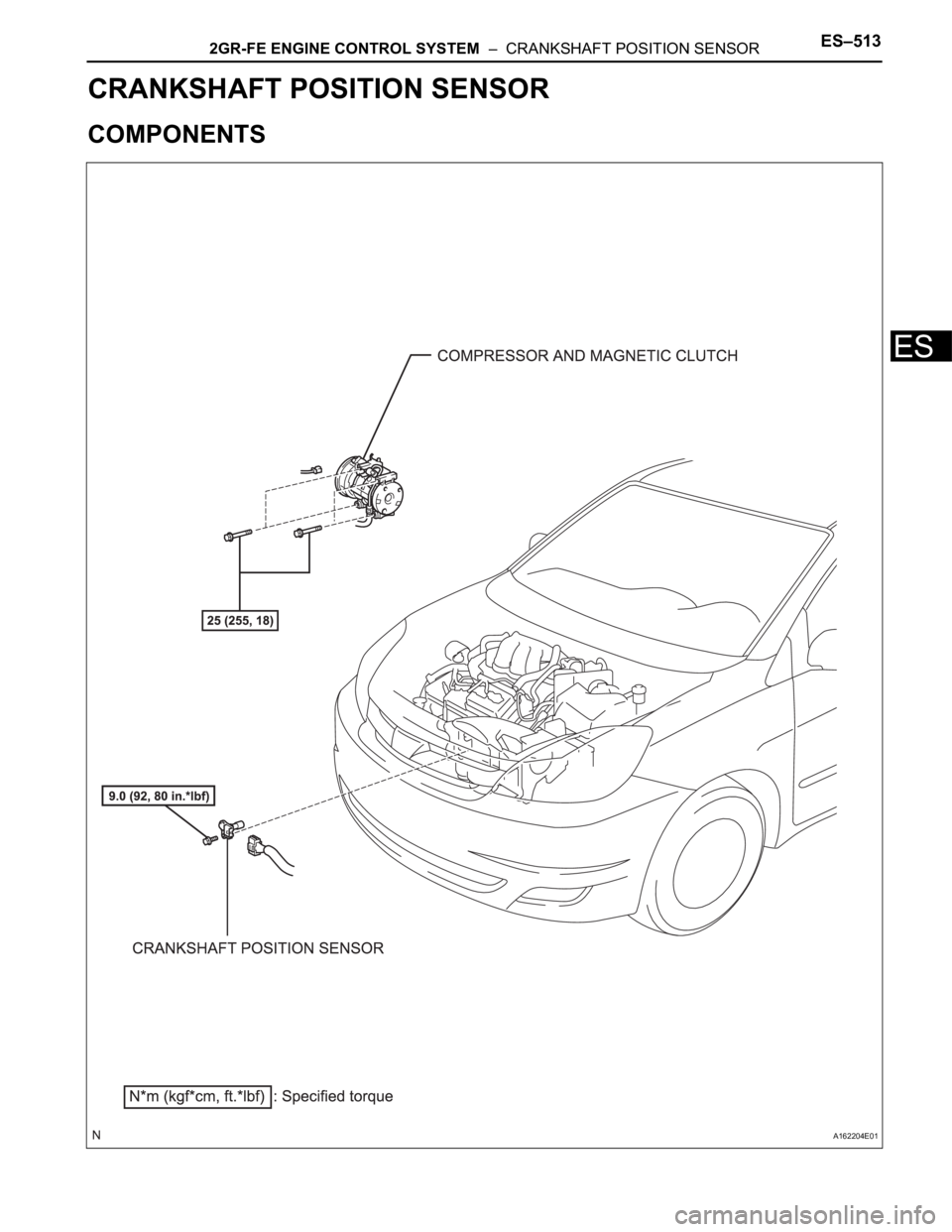
CRANKSHAFT POSITION SENSOR
COMPONENTS
A162204E01
Page 829 of 3000
ES–5142GR-FE ENGINE CONTROL SYSTEM – CRANKSHAFT POSITION SENSOR
ES
REMOVAL
1. REMOVE COMPRESSOR AND MAGNETIC CLUTCH
HINT:
(See page AC-227 )
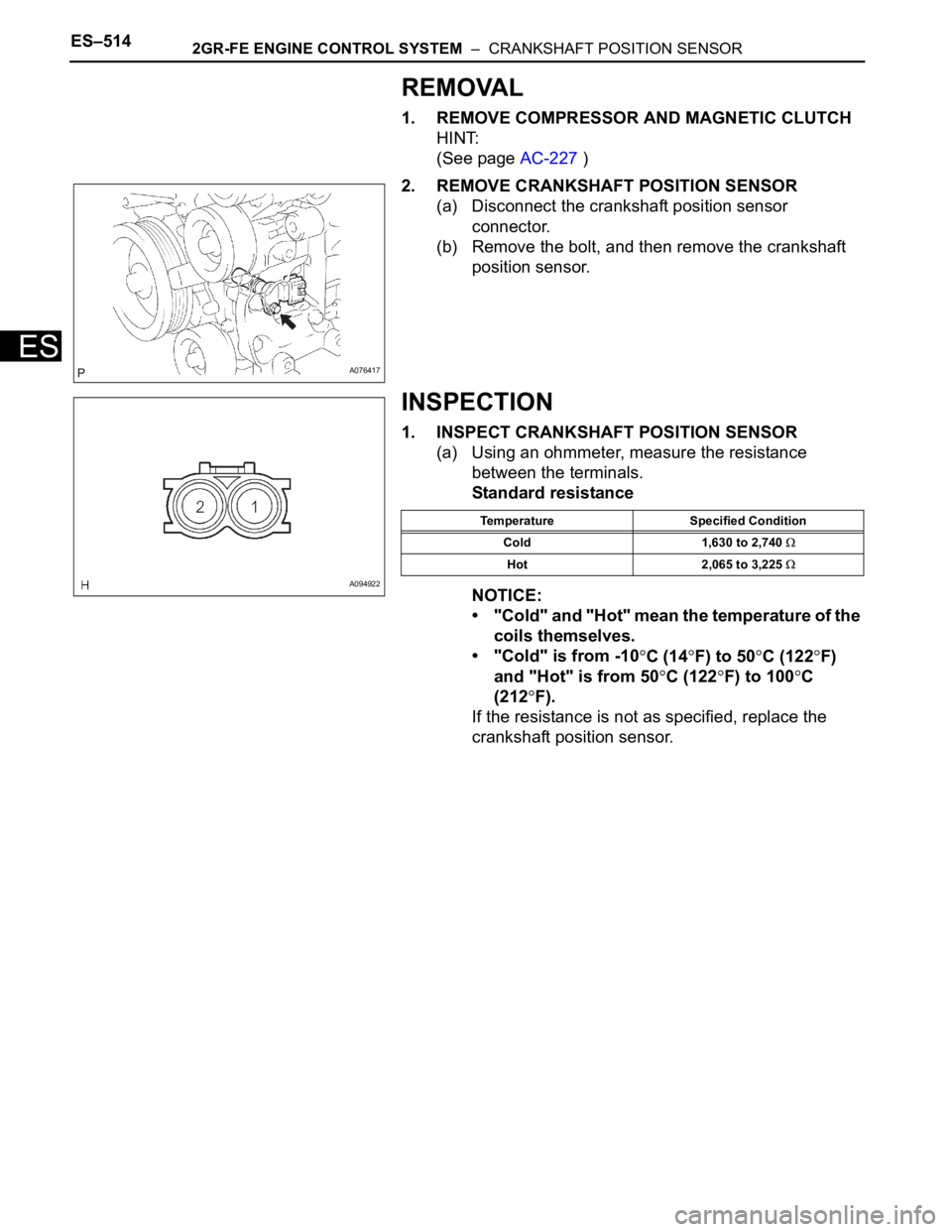
2. REMOVE CRANKSHAFT POSITION SENSOR
(a) Disconnect the crankshaft position sensor
connector.
(b) Remove the bolt, and then remove the crankshaft
position sensor.
INSPECTION
1. INSPECT CRANKSHAFT POSITION SENSOR
(a) Using an ohmmeter, measure the resistance
between the terminals.
Standard resistance
NOTICE:
• "Cold" and "Hot" mean the temperature of the
coils themselves.
• "Cold" is from -10
C (14F) to 50C (122F)
and "Hot" is from 50
C (122F) to 100C
(212
F).
If the resistance is not as specified, replace the
crankshaft position sensor.
A076417
A094922
Temperature Specified Condition
Cold 1,630 to 2,740
Hot 2,065 to 3,225
Page 830 of 3000
ES–462GR-FE ENGINE CONTROL SYSTEM – SFI SYSTEM
ES
FREEZE FRAME DATA
1. DESCRIPTION
(a) The ECM records vehicle and driving condition
information as freeze frame data the moment a DTC
is stored. When troubleshooting, freeze frame data
can be helpful in determining whether the vehicle
was running or stopped, whether the engine was
warmed up or not, whether the air-fuel ratio was
lean or rich, as well as other data recorded at the
time of a malfunction.
HINT:
If it is impossible to duplicate the problem even
though a DTC is detected, confirm the freeze frame
data.
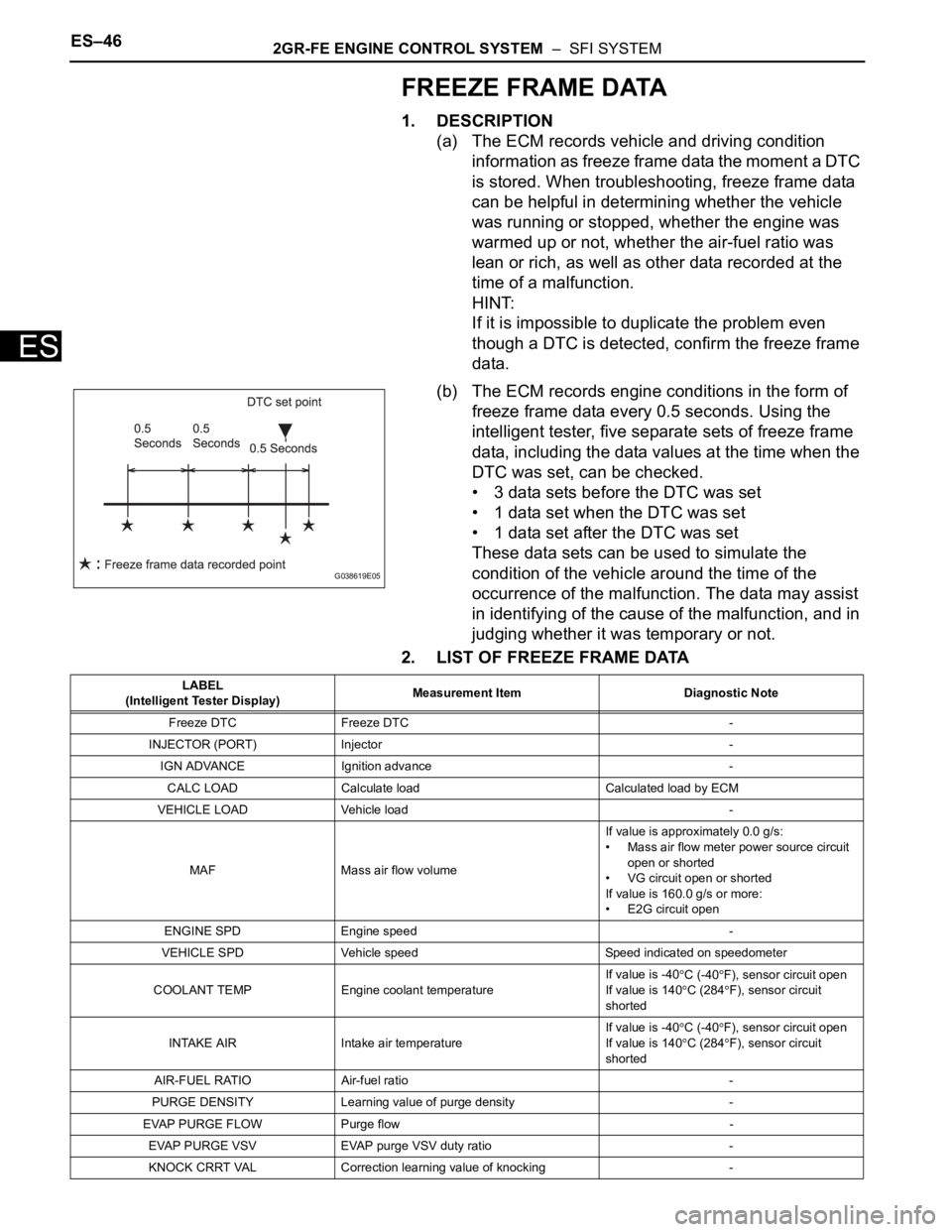
(b) The ECM records engine conditions in the form of
freeze frame data every 0.5 seconds. Using the
intelligent tester, five separate sets of freeze frame
data, including the data values at the time when the
DTC was set, can be checked.
• 3 data sets before the DTC was set
• 1 data set when the DTC was set
• 1 data set after the DTC was set
These data sets can be used to simulate the
condition of the vehicle around the time of the
occurrence of the malfunction. The data may assist
in identifying of the cause of the malfunction, and in
judging whether it was temporary or not.
2. LIST OF FREEZE FRAME DATA
G038619E05
LABEL
(Intelligent Tester Display)Measurement Item Diagnostic Note
Freeze DTC Freeze DTC -
INJECTOR (PORT) Injector -
IGN ADVANCE Ignition advance -
CALC LOAD Calculate load Calculated load by ECM
VEHICLE LOAD Vehicle load -
MAF Mass air flow volumeIf value is approximately 0.0 g/s:
• Mass air flow meter power source circuit
open or shorted
• VG circuit open or shorted
If value is 160.0 g/s or more:
• E2G circuit open
ENGINE SPD Engine speed -
VEHICLE SPD Vehicle speed Speed indicated on speedometer
COOLANT TEMP Engine coolant temperatureIf value is -40
C (-40F), sensor circuit open
If value is 140
C (284F), sensor circuit
shorted
INTAKE AIR Intake air temperatureIf value is -40
C (-40F), sensor circuit open
If value is 140C (284F), sensor circuit
shorted
AIR-FUEL RATIO Air-fuel ratio -
PURGE DENSITY Learning value of purge density -
EVAP PURGE FLOW Purge flow -
EVAP PURGE VSV EVAP purge VSV duty ratio -
KNOCK CRRT VAL Correction learning value of knocking -
Page 831 of 3000

2GR-FE ENGINE CONTROL SYSTEM – SFI SYSTEMES–47
ES
KNOCK FB VAL Feedback value of knocking -
ACCEL POS #1Absolute Accelerator Pedal Position (APP)
No. 1-
ACCEL POS #2 Absolute APP No. 2 -
THROTTLE POS Throttle positionRead value with ignition switch on (Do not
start engine)
THROTTLE POS Throttle sensor positioningRead value with ignition switch on (Do not
start engine)
THROTTLE POS#2 Throttle sensor positioning #2Read value with ignition switch on (Do not
start engine)
THROTTLE MOT Throttle motor -
O2S B1 S2 Heated oxygen sensor outputPerforming INJ VOL or A/F CONTROL
function of ACTIVE TEST enables technician
to check voltage output of sensor
O2S B2 S2 Heated oxygen sensor outputPerforming INJ VOL or A/F CONTROL
function of ACTIVE TEST enables technician
to check voltage output of sensor
AFS B1 S1 A/F sensor outputPerforming INJ VOL or A/F CONTROL
function of ACTIVE TEST enables technician
to check voltage output of sensor
AFS B2 S1 A/F sensor outputPerforming INJ VOL or A/F CONTROL
function of ACTIVE TEST enables technician
to check voltage output of sensor
TOTAL FT #1 Total fuel trim of bank 1 -
TOTAL FT #2 Total fuel trim of bank 2 -
SHORT FT #1 Short-term fuel trim of bank 1Short-term fuel compensation used to
maintain air-fuel ratio at stoichiometric air-fuel
ratio
LONG FT #1 Long-term fuel trim of bank 1Overall fuel compensation carried out in long-
term to compensate for a continual deviation
of short-term fuel trim from central valve
SHORT FT #2 Short-term fuel trim of bank 2Short-term fuel compensation used to
maintain air-fuel ratio at stoichiometric air-fuel
ratio
LONG FT #2 Long-term fuel trim of bank 2Overall fuel compensation carried out in long-
term to compensate for a continual deviation
of short-term fuel trim from central valve
FUEL SYS #1 Fuel system status (bank 1)• OL (Open Loop): Has not yet satisfied
conditions to go closed loop
• CL (Closed Loop): Using heated oxygen
sensor as feedback for fuel control
• OL DRIVE: Open loop due to driving
conditions (fuel enrichment)
• OL FAULT: Open loop due to detected
system fault
• CL FAULT: Closed loop but heated
oxygen sensor, which used for fuel control
malfunctioning
FUEL SYS #2 Fuel system status (bank 2)• OL (Open Loop): Has not yet satisfied
conditions to go closed loop
• CL (Closed Loop): Using heated oxygen
sensor as feedback for fuel control
• OL DRIVE: Open loop due to driving
conditions (fuel enrichment)
• OL FAULT: Open loop due to detected
system fault
• CL FAULT: Closed loop but heated
oxygen sensor, which used for fuel control
malfunctioning
O2FT B1 S2 Fuel trim at heated oxygen sensor Same as SHORT FT #1LABEL
(Intelligent Tester Display)Measurement Item Diagnostic Note