brake TOYOTA SIENNA 2007 Service Service Manual
[x] Cancel search | Manufacturer: TOYOTA, Model Year: 2007, Model line: SIENNA, Model: TOYOTA SIENNA 2007Pages: 3000, PDF Size: 52.26 MB
Page 1123 of 3000
FU–22GR-FE FUEL – FUEL SYSTEM
FU
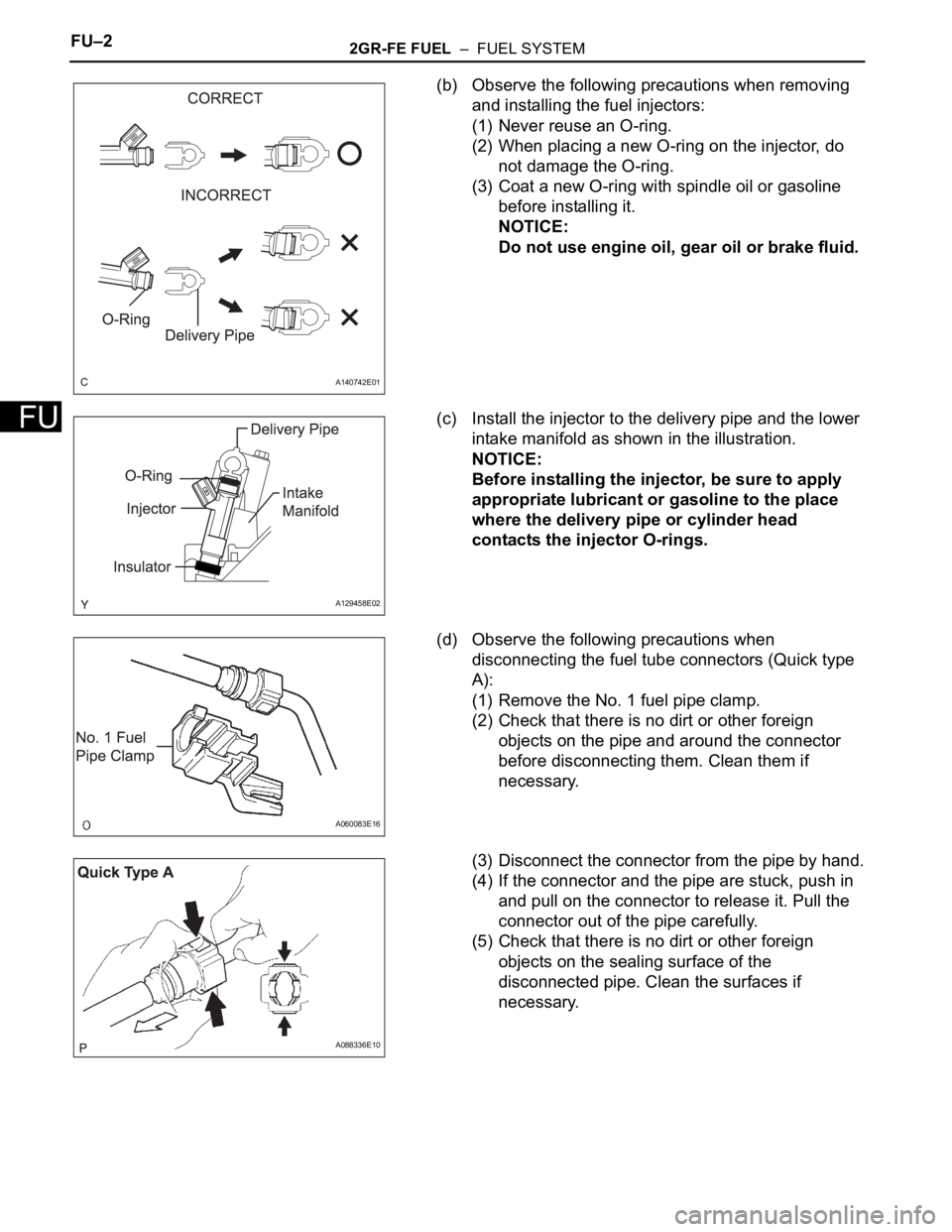
(b) Observe the following precautions when removing
and installing the fuel injectors:
(1) Never reuse an O-ring.
(2) When placing a new O-ring on the injector, do
not damage the O-ring.
(3) Coat a new O-ring with spindle oil or gasoline
before installing it.
NOTICE:
Do not use engine oil, gear oil or brake fluid.
(c) Install the injector to the delivery pipe and the lower
intake manifold as shown in the illustration.
NOTICE:
Before installing the injector, be sure to apply
appropriate lubricant or gasoline to the place
where the delivery pipe or cylinder head
contacts the injector O-rings.
(d) Observe the following precautions when
disconnecting the fuel tube connectors (Quick type
A):
(1) Remove the No. 1 fuel pipe clamp.
(2) Check that there is no dirt or other foreign
objects on the pipe and around the connector
before disconnecting them. Clean them if
necessary.
(3) Disconnect the connector from the pipe by hand.
(4) If the connector and the pipe are stuck, push in
and pull on the connector to release it. Pull the
connector out of the pipe carefully.
(5) Check that there is no dirt or other foreign
objects on the sealing surface of the
disconnected pipe. Clean the surfaces if
necessary.
A140742E01
A129458E02
A060083E16
A088336E10
Page 1387 of 3000
AX–10U151E AUTOMATIC TRANSAXLE – AUTOMATIC TRANSAXLE SYSTEM
AX
ROAD TEST
1. PROBLEM SYMPTOM CONFIRMATION
(a) Based on the result of the customer problem
analysis, try to reproduce the symptoms. If the
problem is that the transaxle does not shift up, shift
down, or the shift point is too high or too low,
conduct the following road test referring to the
automatic shift schedule and simulate the problem
symptoms.
2. ROAD TEST
NOTICE:
Perform the test at the ATF temperature 50 to 80
C
(122 to 176
F) in the normal operation.
(a) D position test:
Shift into the D position and fully depress the
accelerator pedal and check the following points.
(1) Check up-shift operation.
Check that 1
2, 2 3, 3 4 and 4 5th up-
shifts take place, and that the shift points
conform to the automatic shift schedule (See
page SS-24).
HINT:
5th Gear Up-shift Prohibition Control
• Engine coolant temperature is 55
C (131F)
or less and vehicle speed is at 80 km/h (176
mph) or less.
• ATF temperature is -2
C (28F) or less.
4th Gear Up-shift Prohibition Control
• Coolant temperature is 47
C (117F) or less
and vehicle speed is at 55 km/h (34 mph) or
less.
5th and 4th Gear Lock-up Prohibition Control
• Brake pedal is depressed.
• Accelerator pedal is released.
• Coolant temperature is 60
C (140F) or less.
(2) Check for shift shock and slip.
Check for shock and slip at the 1
2, 2 3, 3
4 and 4 5th up-shifts.
(3) Check for abnormal noise and vibration.
Drive in the D position lock-up or 5th gear, and
check for abnormal noises and vibration.
HINT:
The check for the cause of abnormal noise and
vibration must be done very thoroughly as it
could also be due to loss of balance in the
differential, torque converter clutch, etc.
(4) Check kick-down operation.
Check that the possible kick-down vehicle speed
limits for 2nd to 1st, 3rd to 2nd, 4th to 3rd, 5th to
4th kick-downs conform to those indicated on
the automatic shift schedule while driving
through all gears with the shift lever in the D
position (See page SS-24).
(5) Check abnormal shock and slip at kick-down.
Page 1389 of 3000
AX–12U151E AUTOMATIC TRANSAXLE – AUTOMATIC TRANSAXLE SYSTEM
AX
(d) 2 position test:
Shift into the 2 position and fully depress the
accelerator pedal and check the following points.
(1) Check up-shift operation.
Check that the 1
2 up-shift takes place and
that the shift point conforms to the automatic
shift schedule (See page SS-24).
HINT:
There is no 3rd up-shift and lock-up in the 2
position.
(2) Check engine braking.
While running in the 2 position and 2nd gear,
release the accelerator pedal and check the
engine braking effect.
(3) Check for abnormal noise during acceleration
and deceleration, and for shock at up-shift and
down-shift.
(e) L position test:
Shift into the L position and fully depress the
accelerator pedal and check the following points.
(1) Check no up-shift.
While running in the L position, check that there
is no up-shift to 2nd gear.
HINT:
There is no lock-up in the L position.
(2) Check engine braking.
While running in the L position, release the
accelerator pedal and check the engine braking
effect.
(3) Check for abnormal noise during acceleration
and deceleration.
(f) R position test:
Shift into the R position and fully depress the
accelerator pedal and check for slipping.
CAUTION:
Before conducting this test ensure that the test
area is free from people and obstruction.
(g) P position test:
Stop the vehicle on the grade (more than 5
) and
after shifting into the P position, release the parking
brake. Then, check that the parking lock pawl holds
the vehicle in place.
(h) Uphill/downhill control function test:
(1) Check that the gear does not up-shift to the 4th
or 5th gear while the vehicle is driving uphill.
(2) Check that the gear automatically down-shifts
from 5th to 4th or from the 4th to 3rd gear when
brake is applied while the vehicle is driving
downhill.
Page 1390 of 3000

U151E AUTOMATIC TRANSAXLE – AUTOMATIC TRANSAXLE SYSTEMAX–13
AX
MECHANICAL SYSTEM TESTS
1. PERFORM MECHANICAL SYSTEM TESTS
(a) Measure the stall speed.
The object of this test is to check the overall
performance of the transaxle and engine by
measuring the stall speeds in the D position.
NOTICE:
• Driving test should be done on a paved road
(a nonskid road).
• Perform the test at the normal operating ATF
(Automatic Transmission Fluid) temperature
50 to 80
C (122 to 176F).
• Do not continuously run this test for longer
than 10 seconds.
• To ensure safety, do this test in a wide, clear
level area which provides good traction.
• The stall test should always be carried out in
pairs. One technician should observe the
conditions of wheels or wheel stoppers
outside the vehicle while the other is doing
the test.
(1) Chock the 4 wheels.
(2) Connect the intelligent tester together with the
CAN VIM (controller area network vehicle
interface module) to the DLC3.
(3) Fully apply the parking brake.
(4) Keep your left foot pressed firmly on the brake
pedal.
(5) Start the engine.
(6) Shift into the D position. Press all the way down
on the accelerator pedal with your right foot.
(7) Quickly read the stall speed at this time.
Stall speed:
2,300 +- 150 rpm
Evaluation:
Problem Possible cause
(a) Stall engine speed is low in D position• Engine power output may be insufficient
• Stator one-way clutch not operating properly
HINT:
If the value is less than the specified value by 600 rpm or more, the
torque converter could be faulty.
(b) Stall engine speed is high in D position• Line pressure is too low
• Forward clutch slipping
• U/D (Underdrive) brake slipping
• U/D (Underdrive) one-way clutch is not operating properly
• No.1 one-way clutch not operating properly
• Improper fluid level
Page 1391 of 3000
AX–14U151E AUTOMATIC TRANSAXLE – AUTOMATIC TRANSAXLE SYSTEM
AX
(b) Measure the time lag.
(1) When the shift lever is shifted while the engine is
idling, there will be a certain time lapse or lag
before the shock can be felt. This is used for
checking the condition of the clutch and brake.
NOTICE:
• Perform the test at the normal operating
ATF (Automatic Transmission Fluid)
temperature: 50 to 80
C (122 to 176F).
• Be sure to allow 1 minute interval between
tests.
• Perform the test three times, and measure
the time lags. Calculate the average value
of the three time lags.
• When conducting stall test, do not
continue more than 10 seconds.
(2) Connect the intelligent tester together with the
CAN VIM (controller area network vehicle
interface module) to the DLC3.
(3) Fully apply the parking brake.
(4) Start and warm up the engine and check idle
speed.
Idle speed:
approx. 700 rpm (In N position and A/C
OFF)
(5) Shift the lever from N to D position. Using a stop
watch, measure the time from when the lever is
shifted until the shock is felt.
Time lag:
N
D less than 1.2 seconds
(6) In the same way, measure the time lag for N
R.
Time lag:
N
R less than 1.5 seconds
Evaluation (If N
D or N R time lag is longer than the specified):
Problem Possible cause
N
D time lag is longer• Line pressure is too low
• Forward clutch worn
• No.1 one-way clutch is not operating properly
• U/D (Underdrive) one-way clutch is not operating
• U/D (Underdrive) brake worn
N
R time lag is longer• Line pressure is too low
• Reverse clutch worn
• 1st and reverse brake worn
• U/D (Underdrive) brake worn
Page 1393 of 3000
AX–16U151E AUTOMATIC TRANSAXLE – AUTOMATIC TRANSAXLE SYSTEM
AX
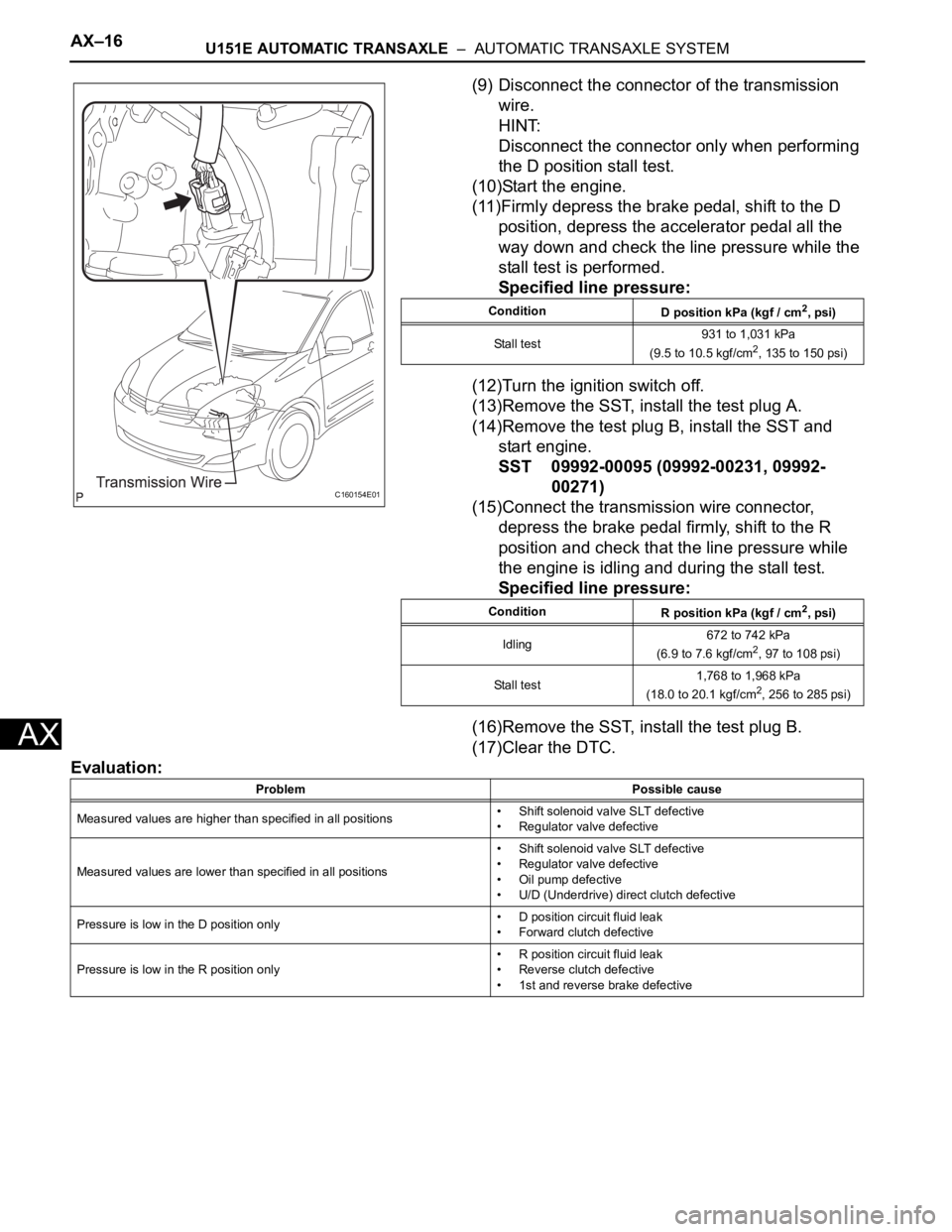
(9) Disconnect the connector of the transmission
wire.
HINT:
Disconnect the connector only when performing
the D position stall test.
(10)Start the engine.
(11)Firmly depress the brake pedal, shift to the D
position, depress the accelerator pedal all the
way down and check the line pressure while the
stall test is performed.
Specified line pressure:
(12)Turn the ignition switch off.
(13)Remove the SST, install the test plug A.
(14)Remove the test plug B, install the SST and
start engine.
SST 09992-00095 (09992-00231, 09992-
00271)
(15)Connect the transmission wire connector,
depress the brake pedal firmly, shift to the R
position and check that the line pressure while
the engine is idling and during the stall test.
Specified line pressure:
(16)Remove the SST, install the test plug B.
(17)Clear the DTC.
Evaluation:
C160154E01
Condition
D position kPa (kgf / cm2, psi)
Stall test931 to 1,031 kPa
(9.5 to 10.5 kgf/cm
2, 135 to 150 psi)
Condition
R position kPa (kgf / cm
2, psi)
Idling672 to 742 kPa
(6.9 to 7.6 kgf/cm
2, 97 to 108 psi)
Stall test1,768 to 1,968 kPa
(18.0 to 20.1 kgf/cm
2, 256 to 285 psi)
Problem Possible cause
Measured values are higher than specified in all positions• Shift solenoid valve SLT defective
• Regulator valve defective
Measured values are lower than specified in all positions• Shift solenoid valve SLT defective
• Regulator valve defective
• Oil pump defective
• U/D (Underdrive) direct clutch defective
Pressure is low in the D position only• D position circuit fluid leak
• Forward clutch defective
Pressure is low in the R position only• R position circuit fluid leak
• Reverse clutch defective
• 1st and reverse brake defective
Page 1400 of 3000
U151E AUTOMATIC TRANSAXLE – AUTOMATIC TRANSAXLE SYSTEMAX–23
AX
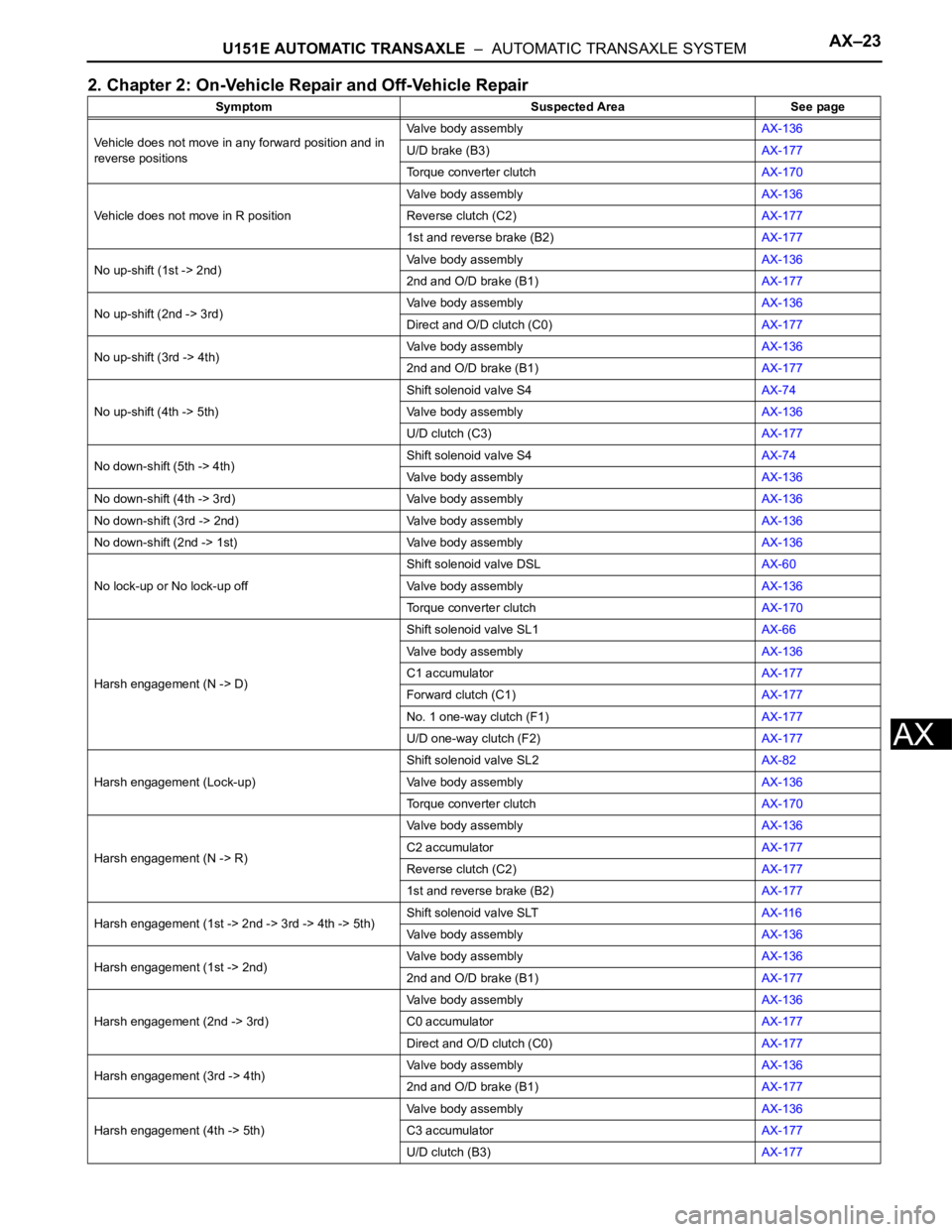
2. Chapter 2: On-Vehicle Repair and Off-Vehicle Repair
Symptom Suspected Area See page
Vehicle does not move in any forward position and in
reverse positionsValve body assemblyAX-136
U/D brake (B3)AX-177
Torque converter clutchAX-170
Vehicle does not move in R positionValve body assemblyAX-136
Reverse clutch (C2)AX-177
1st and reverse brake (B2)AX-177
No up-shift (1st -> 2nd)Valve body assemblyAX-136
2nd and O/D brake (B1)AX-177
No up-shift (2nd -> 3rd)Valve body assemblyAX-136
Direct and O/D clutch (C0)AX-177
No up-shift (3rd -> 4th)Valve body assemblyAX-136
2nd and O/D brake (B1)AX-177
No up-shift (4th -> 5th)Shift solenoid valve S4AX-74
Valve body assemblyAX-136
U/D clutch (C3)AX-177
No down-shift (5th -> 4th)Shift solenoid valve S4AX-74
Valve body assemblyAX-136
No down-shift (4th -> 3rd) Valve body assemblyAX-136
No down-shift (3rd -> 2nd) Valve body assemblyAX-136
No down-shift (2nd -> 1st) Valve body assemblyAX-136
No lock-up or No lock-up offShift solenoid valve DSLAX-60
Valve body assemblyAX-136
Torque converter clutchAX-170
Harsh engagement (N -> D)Shift solenoid valve SL1AX-66
Valve body assemblyAX-136
C1 accumulatorAX-177
Forward clutch (C1)AX-177
No. 1 one-way clutch (F1)AX-177
U/D one-way clutch (F2)AX-177
Harsh engagement (Lock-up)Shift solenoid valve SL2AX-82
Valve body assemblyAX-136
Torque converter clutchAX-170
Harsh engagement (N -> R)Valve body assemblyAX-136
C2 accumulatorAX-177
Reverse clutch (C2)AX-177
1st and reverse brake (B2)AX-177
Harsh engagement (1st -> 2nd -> 3rd -> 4th -> 5th)Shift solenoid valve SLTAX-116
Valve body assemblyAX-136
Harsh engagement (1st -> 2nd)Valve body assemblyAX-136
2nd and O/D brake (B1)AX-177
Harsh engagement (2nd -> 3rd)Valve body assemblyAX-136
C0 accumulatorAX-177
Direct and O/D clutch (C0)AX-177
Harsh engagement (3rd -> 4th)Valve body assemblyAX-136
2nd and O/D brake (B1)AX-177
Harsh engagement (4th -> 5th)Valve body assemblyAX-136
C3 accumulatorAX-177
U/D clutch (B3)AX-177
Page 1401 of 3000
AX–24U151E AUTOMATIC TRANSAXLE – AUTOMATIC TRANSAXLE SYSTEM
AX
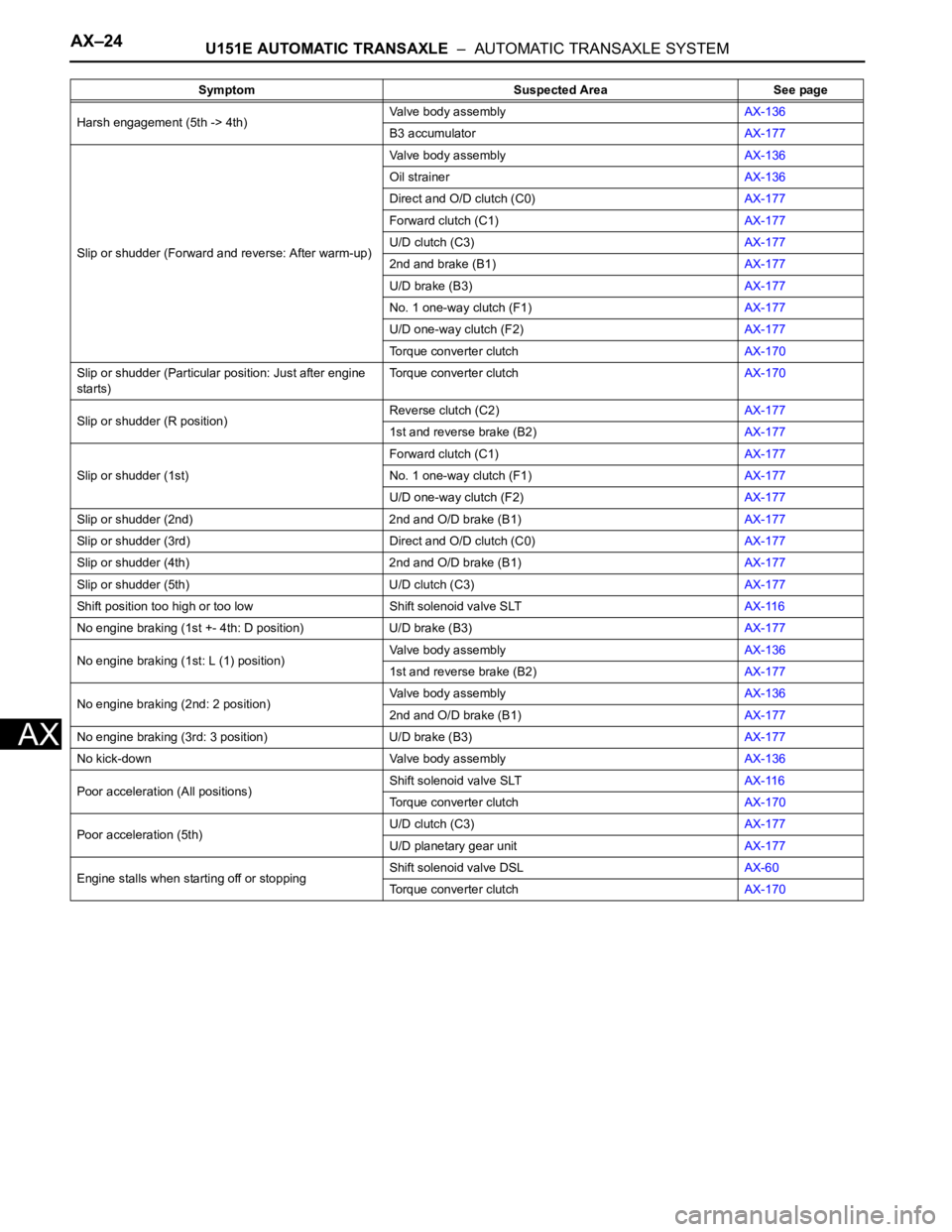
Harsh engagement (5th -> 4th)Valve body assemblyAX-136
B3 accumulatorAX-177
Slip or shudder (Forward and reverse: After warm-up)Valve body assemblyAX-136
Oil strainerAX-136
Direct and O/D clutch (C0)AX-177
Forward clutch (C1)AX-177
U/D clutch (C3)AX-177
2nd and brake (B1)AX-177
U/D brake (B3)AX-177
No. 1 one-way clutch (F1)AX-177
U/D one-way clutch (F2)AX-177
Torque converter clutchAX-170
Slip or shudder (Particular position: Just after engine
starts)Torque converter clutchAX-170
Slip or shudder (R position)Reverse clutch (C2)AX-177
1st and reverse brake (B2)AX-177
Slip or shudder (1st)Forward clutch (C1)AX-177
No. 1 one-way clutch (F1)AX-177
U/D one-way clutch (F2)AX-177
Slip or shudder (2nd) 2nd and O/D brake (B1)AX-177
Slip or shudder (3rd) Direct and O/D clutch (C0)AX-177
Slip or shudder (4th) 2nd and O/D brake (B1)AX-177
Slip or shudder (5th) U/D clutch (C3)AX-177
Shift position too high or too low Shift solenoid valve SLTAX-116
No engine braking (1st +- 4th: D position) U/D brake (B3)AX-177
No engine braking (1st: L (1) position)Valve body assemblyAX-136
1st and reverse brake (B2)AX-177
No engine braking (2nd: 2 position)Valve body assemblyAX-136
2nd and O/D brake (B1)AX-177
No engine braking (3rd: 3 position) U/D brake (B3)AX-177
No kick-down Valve body assemblyAX-136
Poor acceleration (All positions)Shift solenoid valve SLTAX-116
Torque converter clutchAX-170
Poor acceleration (5th)U/D clutch (C3)AX-177
U/D planetary gear unitAX-177
Engine stalls when starting off or stoppingShift solenoid valve DSLAX-60
Torque converter clutchAX-170 Symptom Suspected Area See page
Page 1408 of 3000
AX–42U151E AUTOMATIC TRANSAXLE – AUTOMATIC TRANSAXLE SYSTEM
AX
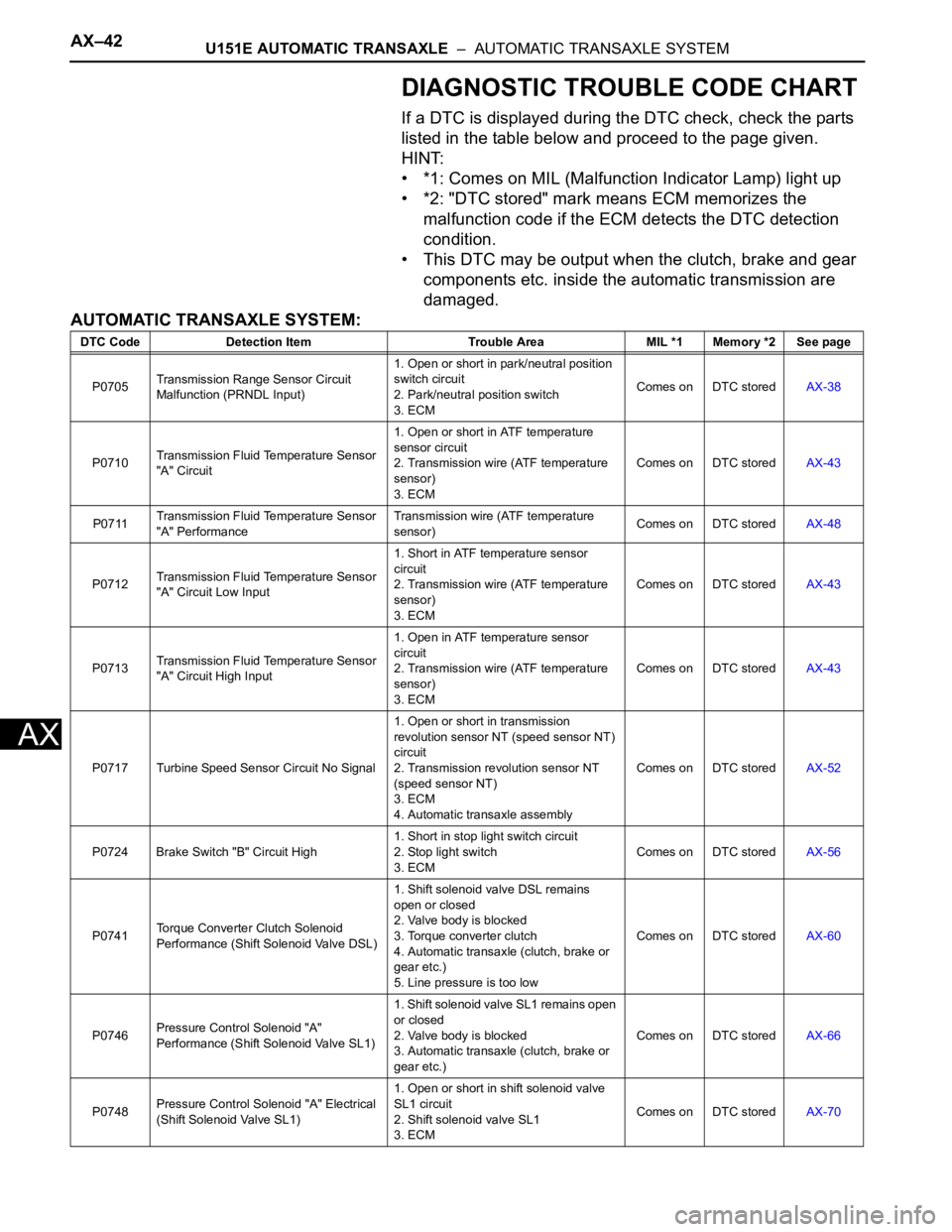
DIAGNOSTIC TROUBLE CODE CHART
If a DTC is displayed during the DTC check, check the parts
listed in the table below and proceed to the page given.
HINT:
• *1: Comes on MIL (Malfunction Indicator Lamp) light up
• *2: "DTC stored" mark means ECM memorizes the
malfunction code if the ECM detects the DTC detection
condition.
• This DTC may be output when the clutch, brake and gear
components etc. inside the automatic transmission are
damaged.
AUTOMATIC TRANSAXLE SYSTEM:
DTC Code Detection Item Trouble Area MIL *1 Memory *2 See page
P0705Transmission Range Sensor Circuit
Malfunction (PRNDL Input)1. Open or short in park/neutral position
switch circuit
2. Park/neutral position switch
3. ECMComes on DTC storedAX-38
P0710Transmission Fluid Temperature Sensor
"A" Circuit1. Open or short in ATF temperature
sensor circuit
2. Transmission wire (ATF temperature
sensor)
3. ECMComes on DTC storedAX-43
P0711Transmission Fluid Temperature Sensor
"A" PerformanceTransmission wire (ATF temperature
sensor)Comes on DTC storedAX-48
P0712Transmission Fluid Temperature Sensor
"A" Circuit Low Input1. Short in ATF temperature sensor
circuit
2. Transmission wire (ATF temperature
sensor)
3. ECMComes on DTC storedAX-43
P0713Transmission Fluid Temperature Sensor
"A" Circuit High Input1. Open in ATF temperature sensor
circuit
2. Transmission wire (ATF temperature
sensor)
3. ECMComes on DTC storedAX-43
P0717 Turbine Speed Sensor Circuit No Signal1. Open or short in transmission
revolution sensor NT (speed sensor NT)
circuit
2. Transmission revolution sensor NT
(speed sensor NT)
3. ECM
4. Automatic transaxle assemblyComes on DTC storedAX-52
P0724 Brake Switch "B" Circuit High1. Short in stop light switch circuit
2. Stop light switch
3. ECMComes on DTC storedAX-56
P0741Torque Converter Clutch Solenoid
Performance (Shift Solenoid Valve DSL)1. Shift solenoid valve DSL remains
open or closed
2. Valve body is blocked
3. Torque converter clutch
4. Automatic transaxle (clutch, brake or
gear etc.)
5. Line pressure is too lowComes on DTC storedAX-60
P0746Pressure Control Solenoid "A"
Performance (Shift Solenoid Valve SL1)1. Shift solenoid valve SL1 remains open
or closed
2. Valve body is blocked
3. Automatic transaxle (clutch, brake or
gear etc.)Comes on DTC storedAX-66
P0748Pressure Control Solenoid "A" Electrical
(Shift Solenoid Valve SL1)1. Open or short in shift solenoid valve
SL1 circuit
2. Shift solenoid valve SL1
3. ECMComes on DTC storedAX-70
Page 1409 of 3000
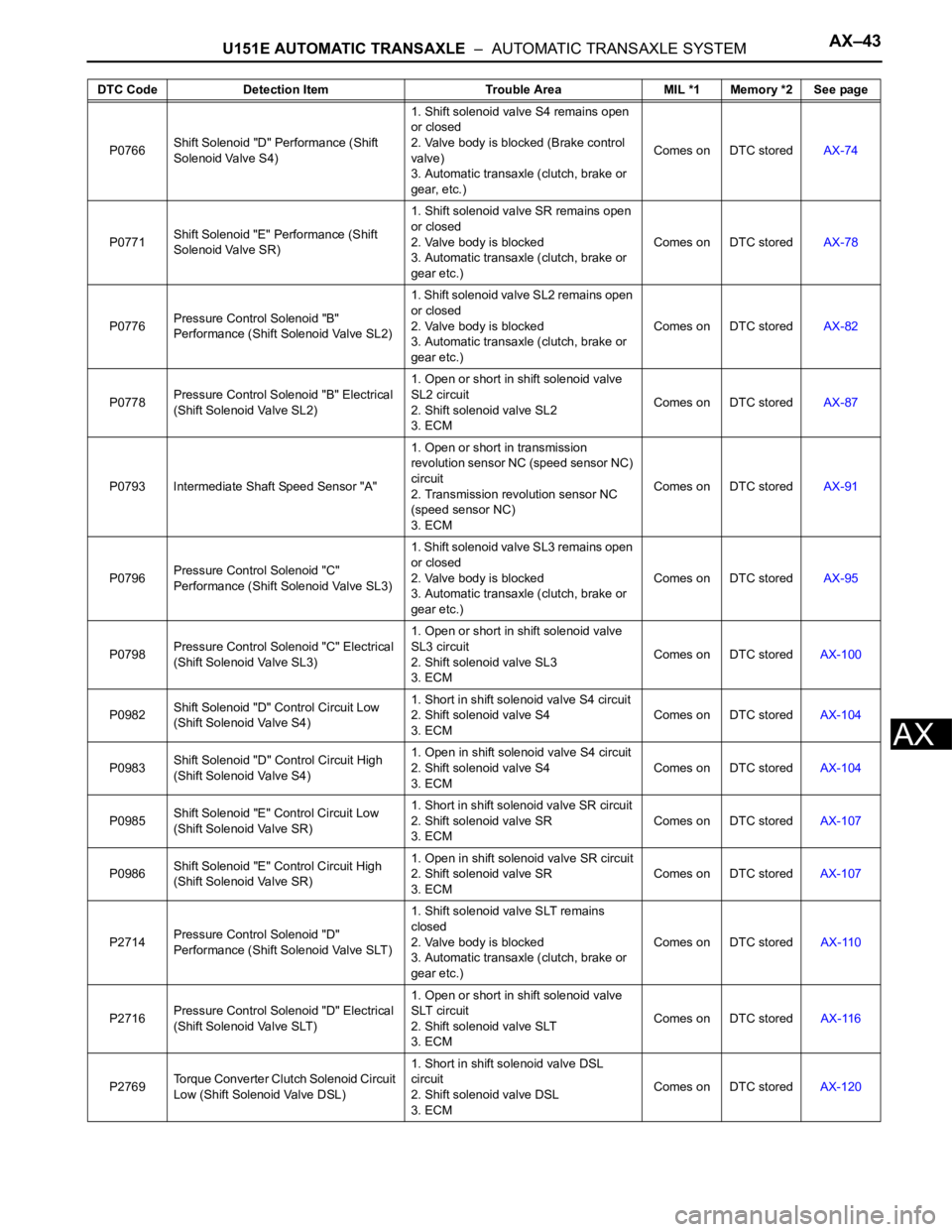
U151E AUTOMATIC TRANSAXLE – AUTOMATIC TRANSAXLE SYSTEMAX–43
AX
P0766Shift Solenoid "D" Performance (Shift
Solenoid Valve S4)1. Shift solenoid valve S4 remains open
or closed
2. Valve body is blocked (Brake control
valve)
3. Automatic transaxle (clutch, brake or
gear, etc.)Comes on DTC storedAX-74
P0771Shift Solenoid "E" Performance (Shift
Solenoid Valve SR)1. Shift solenoid valve SR remains open
or closed
2. Valve body is blocked
3. Automatic transaxle (clutch, brake or
gear etc.)Comes on DTC storedAX-78
P0776Pressure Control Solenoid "B"
Performance (Shift Solenoid Valve SL2)1. Shift solenoid valve SL2 remains open
or closed
2. Valve body is blocked
3. Automatic transaxle (clutch, brake or
gear etc.)Comes on DTC storedAX-82
P0778Pressure Control Solenoid "B" Electrical
(Shift Solenoid Valve SL2)1. Open or short in shift solenoid valve
SL2 circuit
2. Shift solenoid valve SL2
3. ECMComes on DTC storedAX-87
P0793 Intermediate Shaft Speed Sensor "A"1. Open or short in transmission
revolution sensor NC (speed sensor NC)
circuit
2. Transmission revolution sensor NC
(speed sensor NC)
3. ECMComes on DTC storedAX-91
P0796Pressure Control Solenoid "C"
Performance (Shift Solenoid Valve SL3)1. Shift solenoid valve SL3 remains open
or closed
2. Valve body is blocked
3. Automatic transaxle (clutch, brake or
gear etc.)Comes on DTC storedAX-95
P0798Pressure Control Solenoid "C" Electrical
(Shift Solenoid Valve SL3)1. Open or short in shift solenoid valve
SL3 circuit
2. Shift solenoid valve SL3
3. ECMComes on DTC storedAX-100
P0982Shift Solenoid "D" Control Circuit Low
(Shift Solenoid Valve S4)1. Short in shift solenoid valve S4 circuit
2. Shift solenoid valve S4
3. ECMComes on DTC storedAX-104
P0983Shift Solenoid "D" Control Circuit High
(Shift Solenoid Valve S4)1. Open in shift solenoid valve S4 circuit
2. Shift solenoid valve S4
3. ECMComes on DTC storedAX-104
P0985Shift Solenoid "E" Control Circuit Low
(Shift Solenoid Valve SR)1. Short in shift solenoid valve SR circuit
2. Shift solenoid valve SR
3. ECMComes on DTC storedAX-107
P0986Shift Solenoid "E" Control Circuit High
(Shift Solenoid Valve SR)1. Open in shift solenoid valve SR circuit
2. Shift solenoid valve SR
3. ECMComes on DTC storedAX-107
P2714Pressure Control Solenoid "D"
Performance (Shift Solenoid Valve SLT)1. Shift solenoid valve SLT remains
closed
2. Valve body is blocked
3. Automatic transaxle (clutch, brake or
gear etc.)Comes on DTC stored
AX-110
P2716Pressure Control Solenoid "D" Electrical
(Shift Solenoid Valve SLT)1. Open or short in shift solenoid valve
SLT circuit
2. Shift solenoid valve SLT
3. ECMComes on DTC storedAX-116
P2769Torque Converter Clutch Solenoid Circuit
Low (Shift Solenoid Valve DSL)1. Short in shift solenoid valve DSL
circuit
2. Shift solenoid valve DSL
3. ECMComes on DTC storedAX-120 DTC Code Detection Item Trouble Area MIL *1 Memory *2 See page