height TOYOTA SUPRA 2022 Owner's Manual
[x] Cancel search | Manufacturer: TOYOTA, Model Year: 2022, Model line: SUPRA, Model: TOYOTA SUPRA 2022Pages: 498, PDF Size: 104.06 MB
Page 139 of 498
137
3
3-1. CONTROLS
CONTROLS
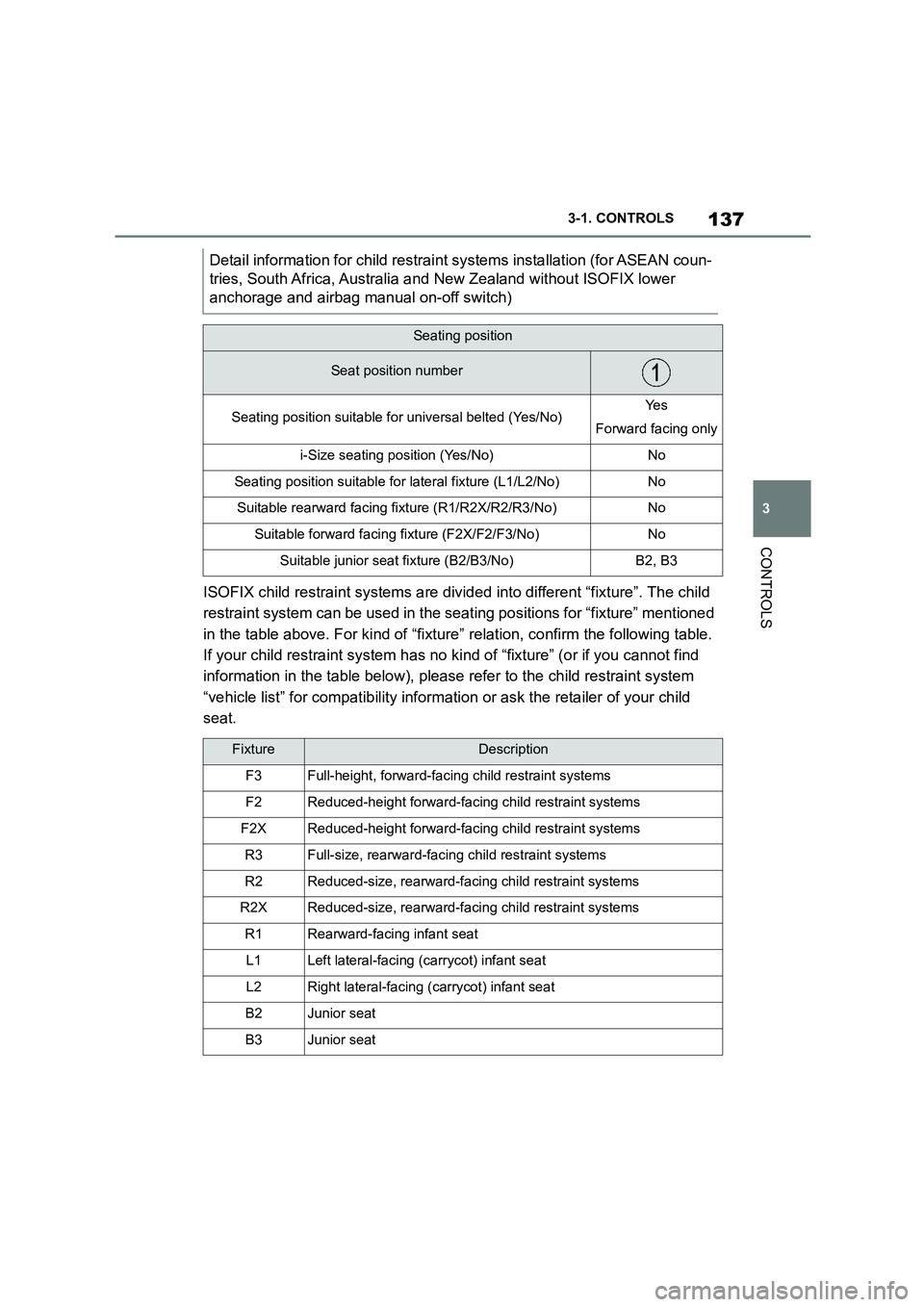
ISOFIX child restraint systems are divid ed into different “fixture”. The child
restraint system can be used in the se ating positions for “fixture” mentioned
in the table above. For kind of “fixtu re” relation, confirm the following table.
If your child restraint system has no ki nd of “fixture” (or if you cannot find
information in the table below), please refer to the child restraint system
“vehicle list” for compatib ility information or ask the retailer of your child
seat.
Detail information for chil d restraint systems installation (for ASEAN coun-
tries, South Africa, Australia and New Zealand without ISOFIX lower
anchorage and airbag manual on-off switch)
Seating position
Seat position number
Seating position suitable for universal belted (Yes/No)Ye s
Forward facing only
i-Size seating position (Yes/No)No
Seating position suitable for lateral fixture (L1/L2/No)No
Suitable rearward facing fixture (R1/R2X/R2/R3/No)No
Suitable forward facing fixture (F2X/F2/F3/No)No
Suitable junior seat fixture (B2/B3/No)B2, B3
FixtureDescription
F3Full-height, forward-faci ng child restraint systems
F2Reduced-height forward-facing child restraint systems
F2XReduced-height forward-facing child restraint systems
R3Full-size, rearward-facing child restraint systems
R2Reduced-size, rearward-facing child restraint systems
R2XReduced-size, rearward-facing child restraint systems
R1Rearward-facing infant seat
L1Left lateral-facing (carrycot) infant seat
L2Right lateral-facing (carrycot) infant seat
B2Junior seat
B3Junior seat
Page 141 of 498
139
3
3-1. CONTROLS
CONTROLS
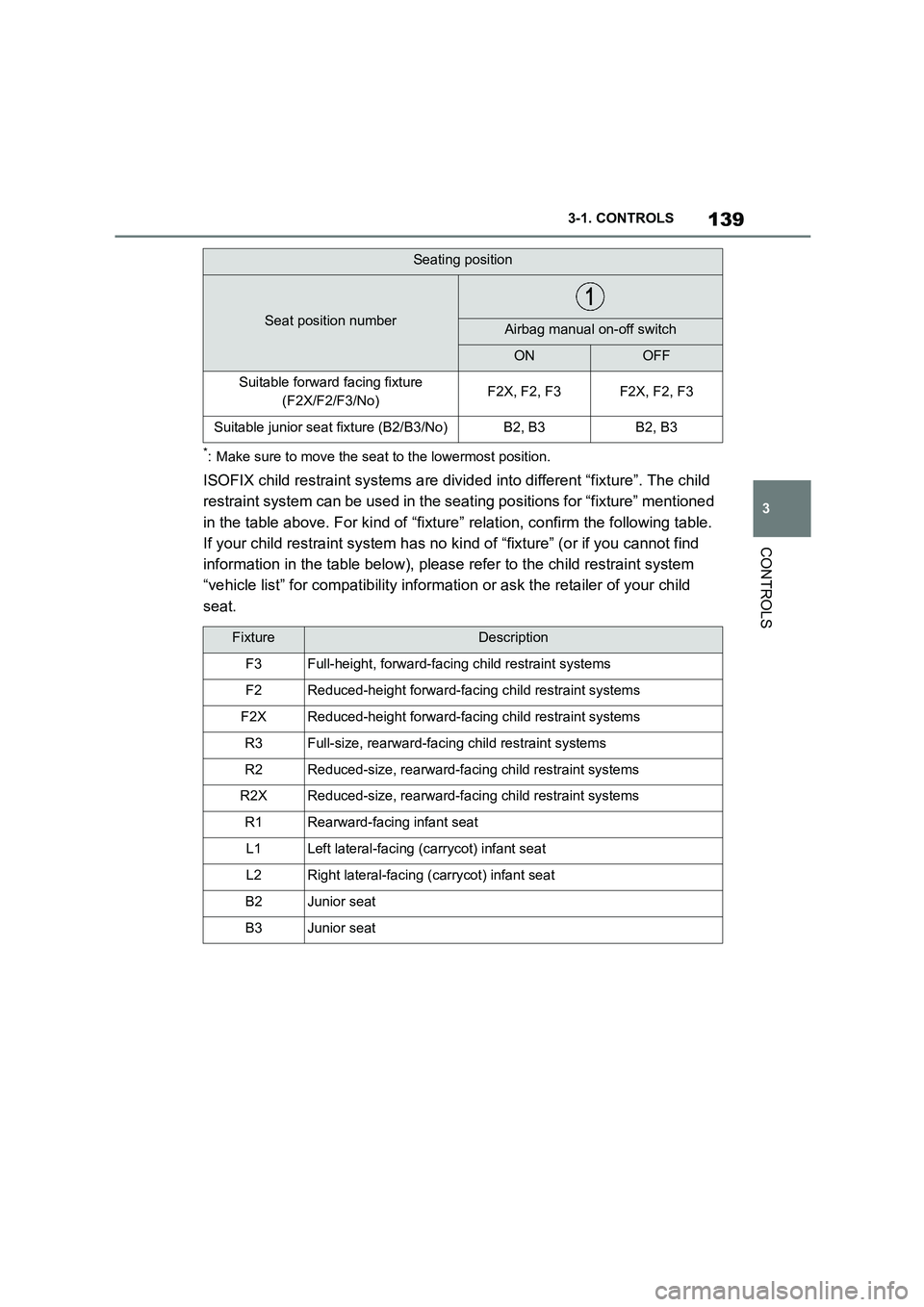
*: Make sure to move the seat to the lowermost position.
ISOFIX child restraint systems are divid ed into different “fixture”. The child
restraint system can be used in the se ating positions for “fixture” mentioned
in the table above. For kind of “fixtu re” relation, confirm the following table.
If your child restraint system has no ki nd of “fixture” (or if you cannot find
information in the table below), please refer to the child restraint system
“vehicle list” for compatib ility information or ask the retailer of your child
seat.
Suitable forward facing fixture
(F2X/F2/F3/No)F2X, F2, F3F2X, F2, F3
Suitable junior seat fixture (B2/B3/No)B2, B3B2, B3
FixtureDescription
F3Full-height, forward-faci ng child restraint systems
F2Reduced-height forward-facing child restraint systems
F2XReduced-height forward-facing child restraint systems
R3Full-size, rearward-facing child restraint systems
R2Reduced-size, rearward-facing child restraint systems
R2XReduced-size, rearward-facing child restraint systems
R1Rearward-facing infant seat
L1Left lateral-facing (carrycot) infant seat
L2Right lateral-facing (carrycot) infant seat
B2Junior seat
B3Junior seat
Seating position
Seat position numberAirbag manual on-off switch
ONOFF
Page 143 of 498
141
3
3-1. CONTROLS
CONTROLS
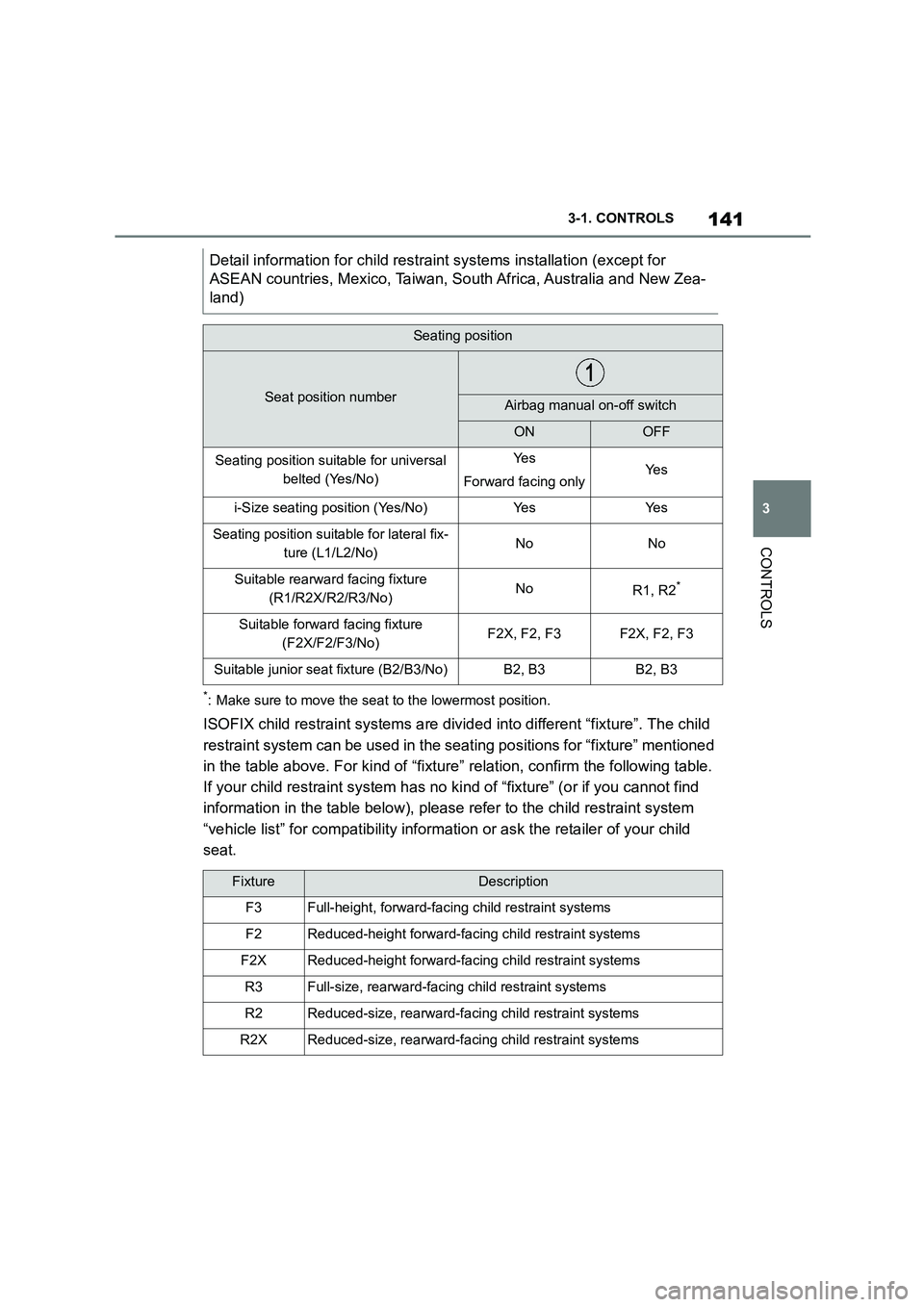
*: Make sure to move the seat to the lowermost position.
ISOFIX child restraint systems are divid ed into different “fixture”. The child
restraint system can be used in the se ating positions for “fixture” mentioned
in the table above. For kind of “fixtu re” relation, confirm the following table.
If your child restraint system has no ki nd of “fixture” (or if you cannot find
information in the table below), please refer to the child restraint system
“vehicle list” for compatib ility information or ask the retailer of your child
seat.
Detail information for ch ild restraint systems installation (except for
ASEAN countries, Mexico, Taiwan, So uth Africa, Australia and New Zea-
land)
Seating position
Seat position numberAirbag manual on-off switch
ONOFF
Seating position suitable for universal
belted (Yes/No)
Ye s
Forward facing onlyYe s
i-Size seating position (Yes/No)Ye sYe s
Seating position suitable for lateral fix-
ture (L1/L2/No)NoNo
Suitable rearward facing fixture
(R1/R2X/R2/R3/No)NoR1, R2*
Suitable forward facing fixture
(F2X/F2/F3/No)F2X, F2, F3F2X, F2, F3
Suitable junior seat fixture (B2/B3/No)B2, B3B2, B3
FixtureDescription
F3Full-height, forward-faci ng child restraint systems
F2Reduced-height forward-facing child restraint systems
F2XReduced-height forward-facing child restraint systems
R3Full-size, rearward-facing child restraint systems
R2Reduced-size, rearward-facing child restraint systems
R2XReduced-size, rearward-facing child restraint systems
Page 185 of 498
183
3
3-1. CONTROLS
CONTROLS
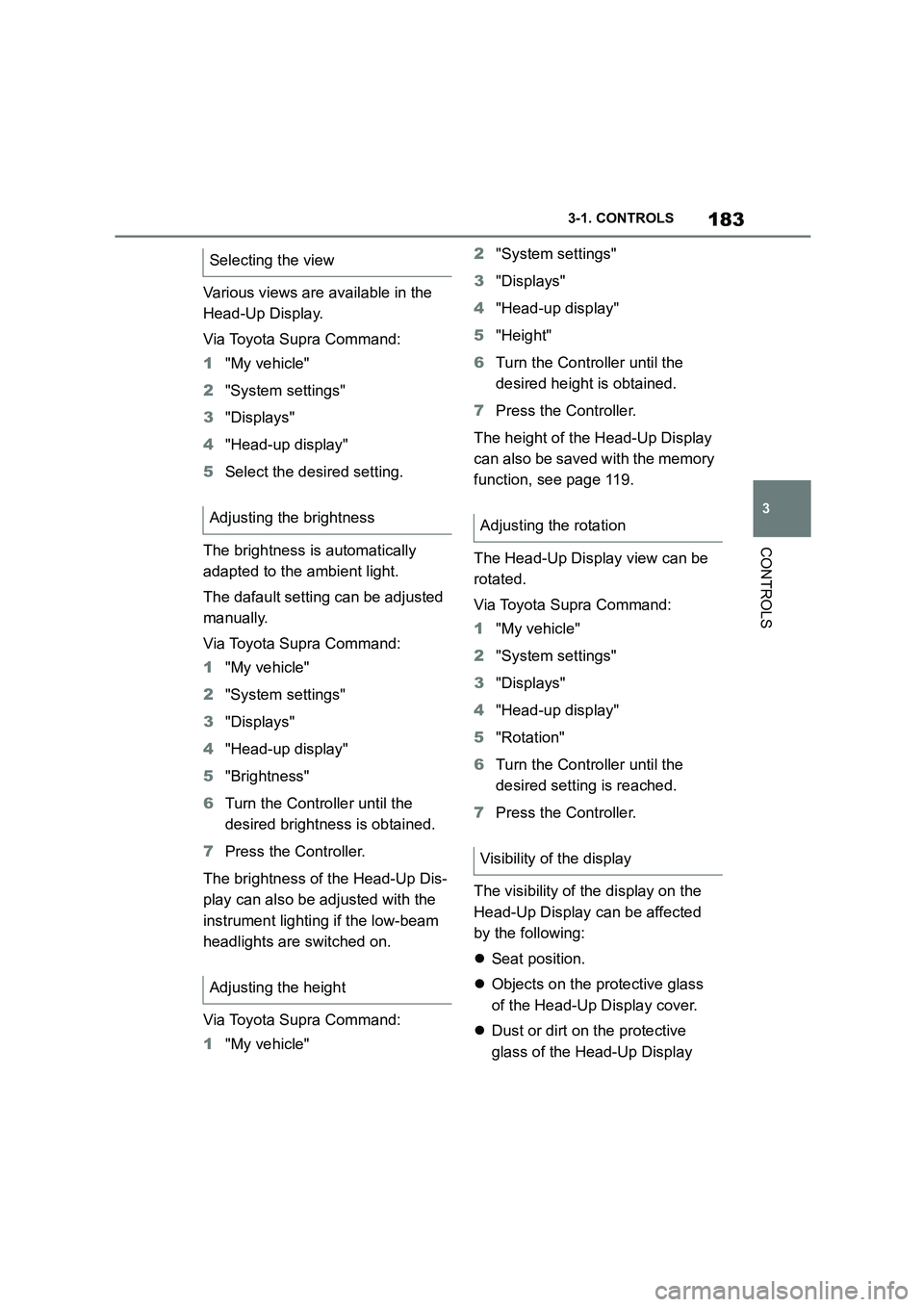
Various views are available in the
Head-Up Display.
Via Toyota Supra Command:
1 "My vehicle"
2 "System settings"
3 "Displays"
4 "Head-up display"
5 Select the desired setting.
The brightness is automatically
adapted to the ambient light.
The dafault setting can be adjusted
manually.
Via Toyota Supra Command:
1 "My vehicle"
2 "System settings"
3 "Displays"
4 "Head-up display"
5 "Brightness"
6 Turn the Controller until the
desired brightness is obtained.
7 Press the Controller.
The brightness of the Head-Up Dis-
play can also be adjusted with the
instrument lighting if the low-beam
headlights are switched on.
Via Toyota Supra Command:
1 "My vehicle"
2 "System settings"
3 "Displays"
4 "Head-up display"
5 "Height"
6 Turn the Controller until the
desired height is obtained.
7 Press the Controller.
The height of the Head-Up Display
can also be saved with the memory
function, see page 119.
The Head-Up Display view can be
rotated.
Via Toyota Supra Command:
1 "My vehicle"
2 "System settings"
3 "Displays"
4 "Head-up display"
5 "Rotation"
6 Turn the Controller until the
desired setting is reached.
7 Press the Controller.
The visibility of the display on the
Head-Up Display can be affected
by the following:
Seat position.
Objects on the protective glass
of the Head-Up Display cover.
Dust or dirt on the protective
glass of the Head-Up Display
Selecting the view
Adjusting the brightness
Adjusting the height
Adjusting the rotation
Visibility of the display
Page 297 of 498
295
5
5-1. MOBILITY
MOBILITY
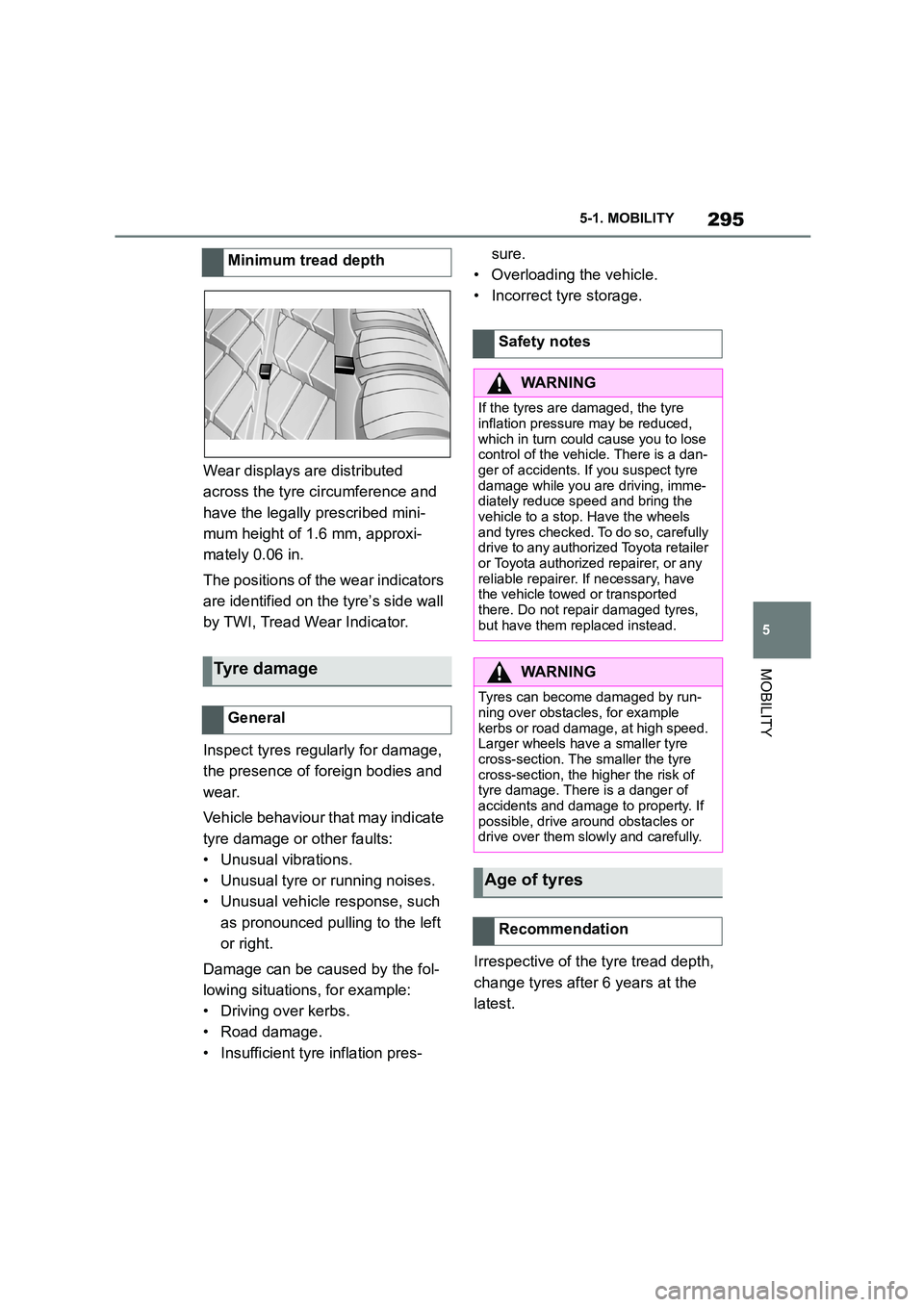
Wear displays are distributed
across the tyre circumference and
have the legally prescribed mini-
mum height of 1.6 mm, approxi-
mately 0.06 in.
The positions of the wear indicators
are identified on the tyre’s side wall
by TWI, Tread Wear Indicator.
Inspect tyres regularly for damage,
the presence of foreign bodies and
wear.
Vehicle behaviour that may indicate
tyre damage or other faults:
• Unusual vibrations.
• Unusual tyre or running noises.
• Unusual vehicle response, such
as pronounced pu lling to the left
or right.
Damage can be caused by the fol-
lowing situations, for example:
• Driving over kerbs.
• Road damage.
• Insufficient tyre inflation pres-
sure.
• Overloading the vehicle.
• Incorrect tyre storage.
Irrespective of the tyre tread depth,
change tyres after 6 years at the
latest.
Minimum tread depth
Tyre damage
General
Safety notes
WA R N I N G
If the tyres are damaged, the tyre
inflation pressure may be reduced,
which in turn could cause you to lose control of the vehicle. There is a dan-
ger of accidents. If you suspect tyre
damage while you are driving, imme- diately reduce speed and bring the
vehicle to a stop. Have the wheels
and tyres checked. To do so, carefully drive to any authorized Toyota retailer
or Toyota authorized repairer, or any
reliable repairer. If necessary, have the vehicle towed or transported
there. Do not repair damaged tyres,
but have them replaced instead.
WA R N I N G
Tyres can become damaged by run-
ning over obstacles, for example
kerbs or road damage, at high speed. Larger wheels have a smaller tyre
cross-section. The smaller the tyre
cross-section, the higher the risk of tyre damage. There is a danger of
accidents and damage to property. If
possible, drive around obstacles or drive over them slowly and carefully.
Age of tyres
Recommendation
Page 315 of 498
313
5
5-1. MOBILITY
MOBILITY
any reliable repairer.
For run-flat tyres or when using a
flat tyre kit, it is not always neces-
sary to change a wheel immedi-
ately if tyre inflatio n pressure is lost
due to a flat tyre.
If required, the tools for changing
wheels are available as special
accessories from any authorized
Toyota retailer or Toyota authorized
repairer, or any reliable repairer.
Wheel change
General
Safety notes
WA R N I N G
The jack is only intended for raising
the vehicle briefly during a wheel
change. Even if the safety measures are complied with, there is a risk of
the raised vehicle falling over due to
the jack slipping. There is a danger of injury or even death. If the vehicle is
raised with the jack, do not lie under-
neath the vehicle and do not start the engine.
WA R N I N G
Supports such as wooden blocks
under the vehicle jack can prevent it from achieving its load capacity due
to the restricted height. The load
capacity of the wooden blocks may be exceeded, causing the vehicle to tip
over. There is a danger of injury or
even death. Do not place supports under the vehicle jack.
WA R N I N G
The jack, issued by the vehicle manu-
facturer, is provided in order to per-
form a wheel change in the event of a breakdown. The jack is not designed
for frequent use; for example, chang-
ing from summer to winter tyres. Using the jack frequently may cause it
to become jammed or damaged.
There is a danger of injury and dam-
age to property. Only use the jack to change an emergency wheel or a
spare wheel in the event of a flat tyre.
WA R N I N G
On soft, uneven or slippery ground,
for example, snow, ice, tiles or similar,
the jack may slip. There is a danger of injury. Perform the wheel change on a
level, firm and non-slip surface if at all
possible.
WA R N I N G
The jack is only optimised for raising
the vehicle and for use with the jack-
ing points on the vehicle. There is a danger of injury. Do not lift another
vehicle or other items with the jack.
WA R N I N G
If the jack has not been guided into the jacking point provided, the vehicle
might be damaged when the jack is
extended, or the jack could slip. There is a danger of injury or damage to
property. When extending, make sure
that the jack is guided into the jacking point adjacent to the wheelhouse.
Page 323 of 498
321
5
5-1. MOBILITY
MOBILITY
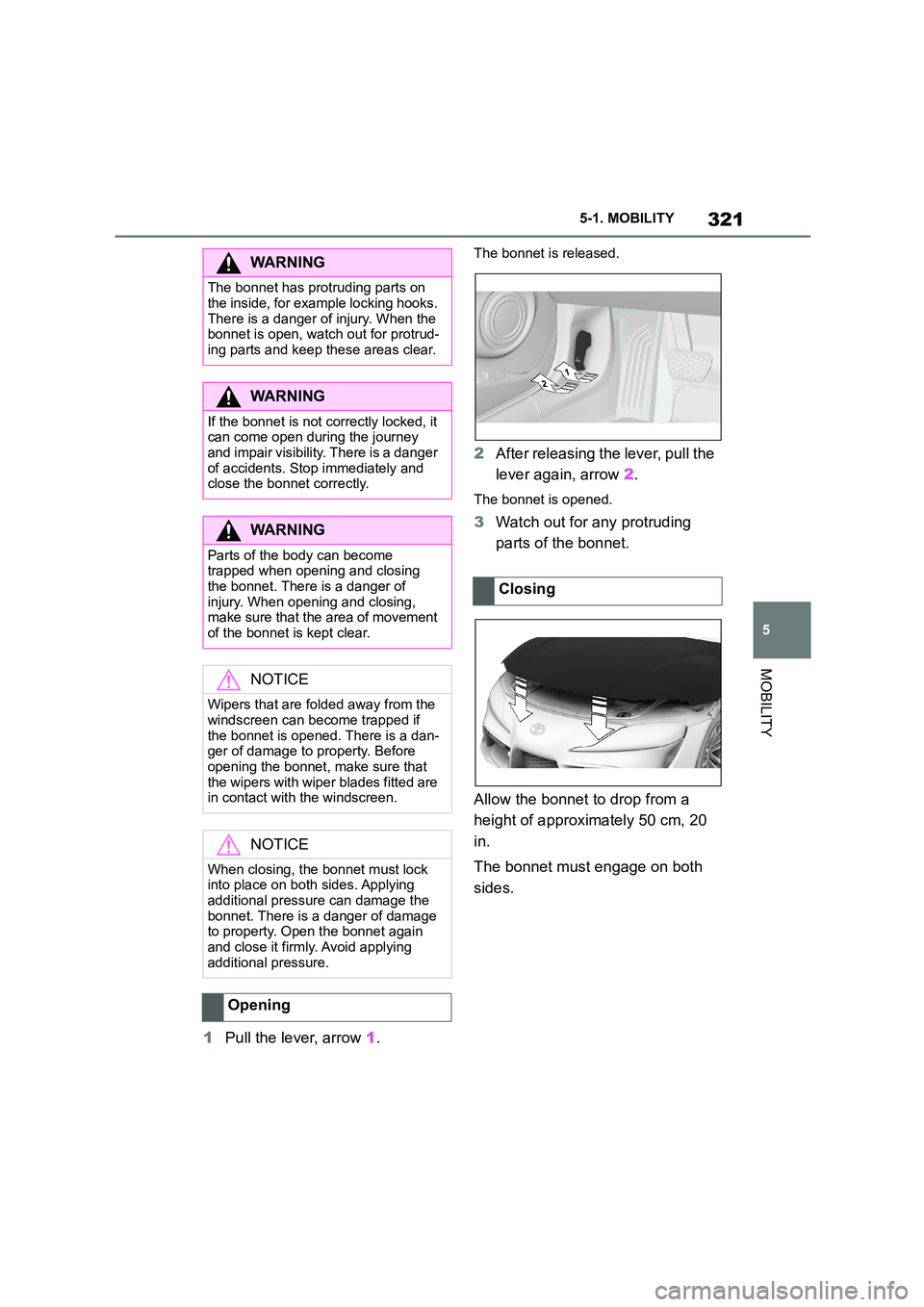
1 Pull the lever, arrow 1.
The bonnet is released.
2After releasing the lever, pull the
lever again, arrow 2.
The bonnet is opened.
3Watch out for any protruding
parts of the bonnet.
Allow the bonnet to drop from a
height of approximately 50 cm, 20
in.
The bonnet must engage on both
sides.
WA R N I N G
The bonnet has protruding parts on
the inside, for example locking hooks.
There is a danger of injury. When the bonnet is open, watch out for protrud-
ing parts and keep these areas clear.
WA R N I N G
If the bonnet is not correctly locked, it can come open during the journey
and impair visibility. There is a danger
of accidents. Stop immediately and close the bonnet correctly.
WA R N I N G
Parts of the body can become
trapped when opening and closing the bonnet. There is a danger of
injury. When opening and closing,
make sure that the area of movement of the bonnet is kept clear.
NOTICE
Wipers that are folded away from the
windscreen can become trapped if the bonnet is opened. There is a dan-
ger of damage to property. Before
opening the bonnet, make sure that the wipers with wiper blades fitted are
in contact with the windscreen.
NOTICE
When closing, the bonnet must lock into place on both sides. Applying
additional pressure can damage the
bonnet. There is a danger of damage to property. Open the bonnet again
and close it firmly. Avoid applying
additional pressure.
Opening
Closing
Page 372 of 498
3706-1. REFERENCE
6-1.REFERENCE
This chapter describes all standard,
country-specific and special equip-
ment available for the model series.
It may therefore describe equip-
ment and functions which are not
installed in your vehicle, for exam-
ple on account of the special equip-
ment selected or the country
specification. This also applies to
safety-relevant functions and sys-
tems. Please comply with the rele-
vant laws and regulations when
using the corresponding functions
and systems.
The technical data and specifica-
tions in the Owner's Manual are ref-
erence figures. The vehicle-specific
data can deviate from this, for
example, due to selected special
equipment, country variants or
country-specific measurement
methods. Detailed values can be
found in the permit documents, on
information plates on the vehicle or
can be requested from any author-
ized Toyota retailer or Toyota
authorized repairer, or any reliable
repairer.
The information in the vehicle docu-
ments always takes precedence
over the information in this Owner's
Manual.
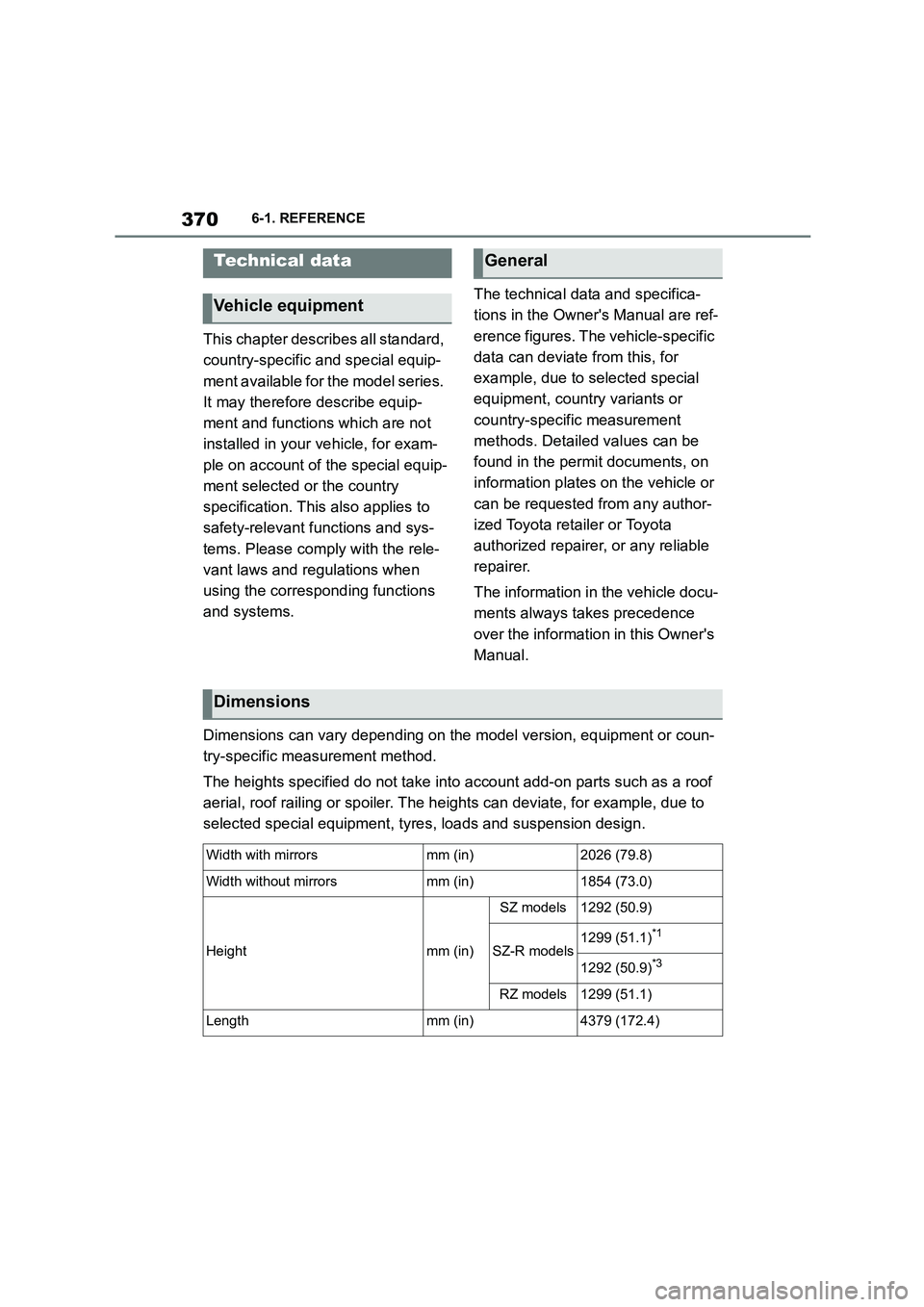
Dimensions can vary depending on the model version, equipment or coun-
try-specific m easurement method.
The heights specified do not take into account add-on parts such as a roof
aerial, roof railing or spo iler. The heights can deviate, for example, due to
selected special equipment, tyre s, loads and suspension design.
Technical data
Vehicle equipment
General
Dimensions
Width with mirrorsmm (in)2026 (79.8)
Width without mirrorsmm (in)1854 (73.0)
Heightmm (in)
SZ models1292 (50.9)
SZ-R models1299 (51.1)*1
1292 (50.9)*3
RZ models1299 (51.1)
Lengthmm (in)4379 (172.4)
Page 490 of 498
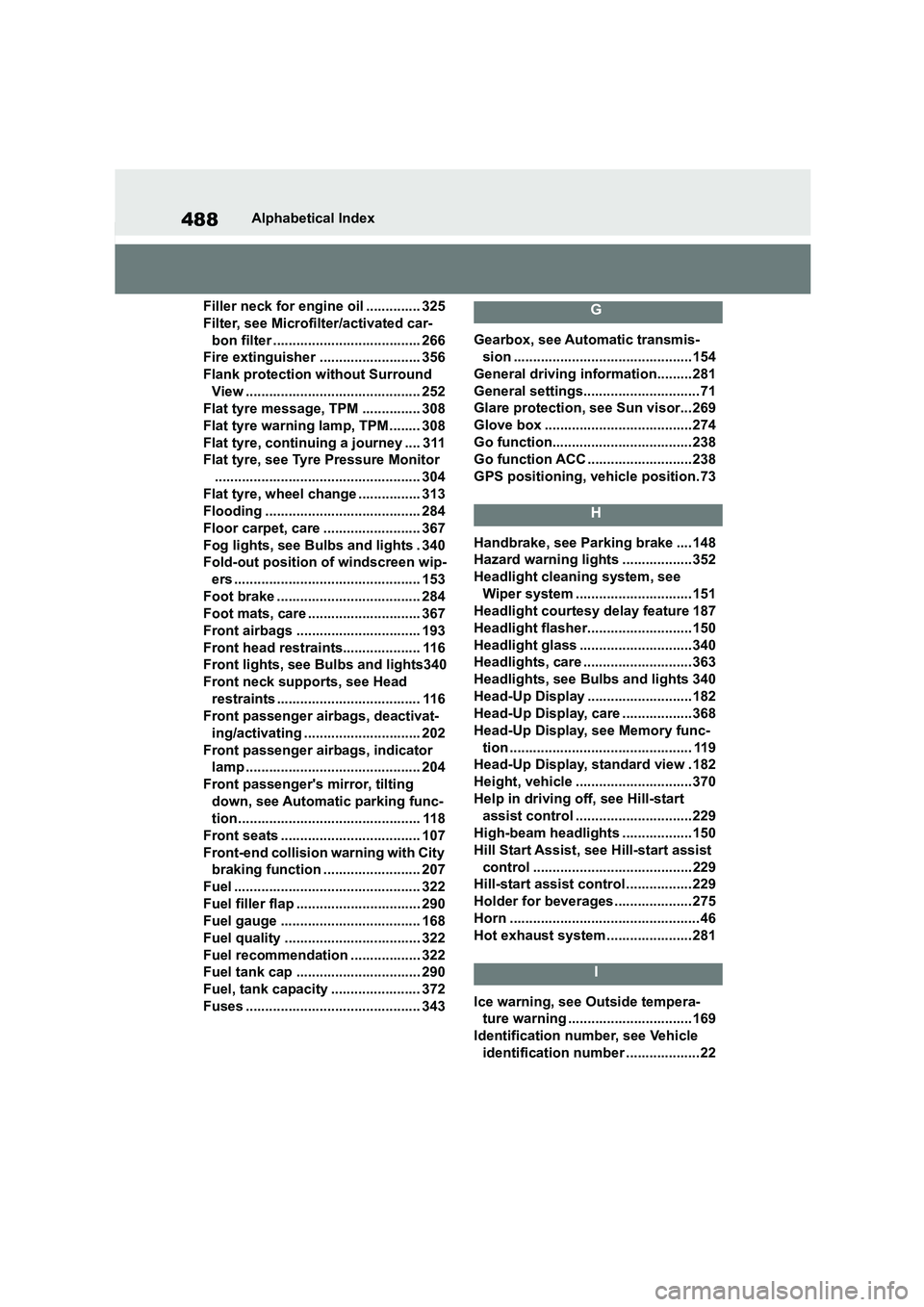
488Alphabetical Index
Filler neck for engine oil .............. 325
Filter, see Microfilter/activated car-
bon filter ...................................... 266
Fire extinguisher .......................... 356
Flank protection without Surround
View ............................................. 252
Flat tyre message, TPM ............... 308
Flat tyre warning lamp, TPM ........ 308
Flat tyre, continuing a journey .... 311
Flat tyre, see Tyre Pressure Monitor
..................................................... 304
Flat tyre, wheel change ................ 313
Flooding ........................................ 284
Floor carpet, care ......................... 367
Fog lights, see Bulbs and lights . 340
Fold-out position of windscreen wip-
ers ................................................ 153
Foot brake ..................................... 284
Foot mats, care ............................. 367
Front airbags ................................ 193
Front head restraints.................... 116
Front lights, see Bulbs and lights340
Front neck supports, see Head
restraints ..................................... 116
Front passenger airbags, deactivat-
ing/activating .............................. 202
Front passenger airbags, indicator
lamp ............................................. 204
Front passenger's mirror, tilting
down, see Automati c parking func-
tion............................................... 118
Front seats .................................... 107
Front-end collision warning with City
braking function ......................... 207
Fuel ................................................ 322
Fuel filler flap ................................ 290
Fuel gauge .................................... 168
Fuel quality ................................... 322
Fuel recommendation .................. 322
Fuel tank cap ................................ 290
Fuel, tank capacity ....................... 372
Fuses ............................................. 343
G
Gearbox, see Automatic transmis-
sion ..............................................154
General driving information.........281
General settings.............................. 71
Glare protection, see Sun visor... 269
Glove box ......................................274
Go function.................................... 238
Go function ACC ...........................238
GPS positioning, vehicle position. 73
H
Handbrake, see Parking brake .... 148
Hazard warning lights ..................352
Headlight cleaning system, see
Wiper system ..............................151
Headlight courtesy delay feature 187
Headlight flasher...........................150
Headlight glass .............................340
Headlights, care ............................ 363
Headlights, see Bulbs and lights 340
Head-Up Display ...........................182
Head-Up Display, care ..................368
Head-Up Display, see Memory func-
tion ............................................... 119
Head-Up Display, standard view . 182
Height, vehicle ..............................370
Help in driving off, see Hill-start
assist control .............................. 229
High-beam headlights ..................150
Hill Start Assist, see Hill-start assist
control .........................................229
Hill-start assist control ................. 229
Holder for beverages .................... 275
Horn ................................................. 46
Hot exhaust system ...................... 281
I
Ice warning, see Outside tempera-
ture warning ................................169
Identification number, see Vehicle
identification number ................... 22