lock TOYOTA SUPRA 2022 Repair Manual
[x] Cancel search | Manufacturer: TOYOTA, Model Year: 2022, Model line: SUPRA, Model: TOYOTA SUPRA 2022Pages: 498, PDF Size: 104.06 MB
Page 293 of 498
291
5
5-1. MOBILITY
MOBILITY
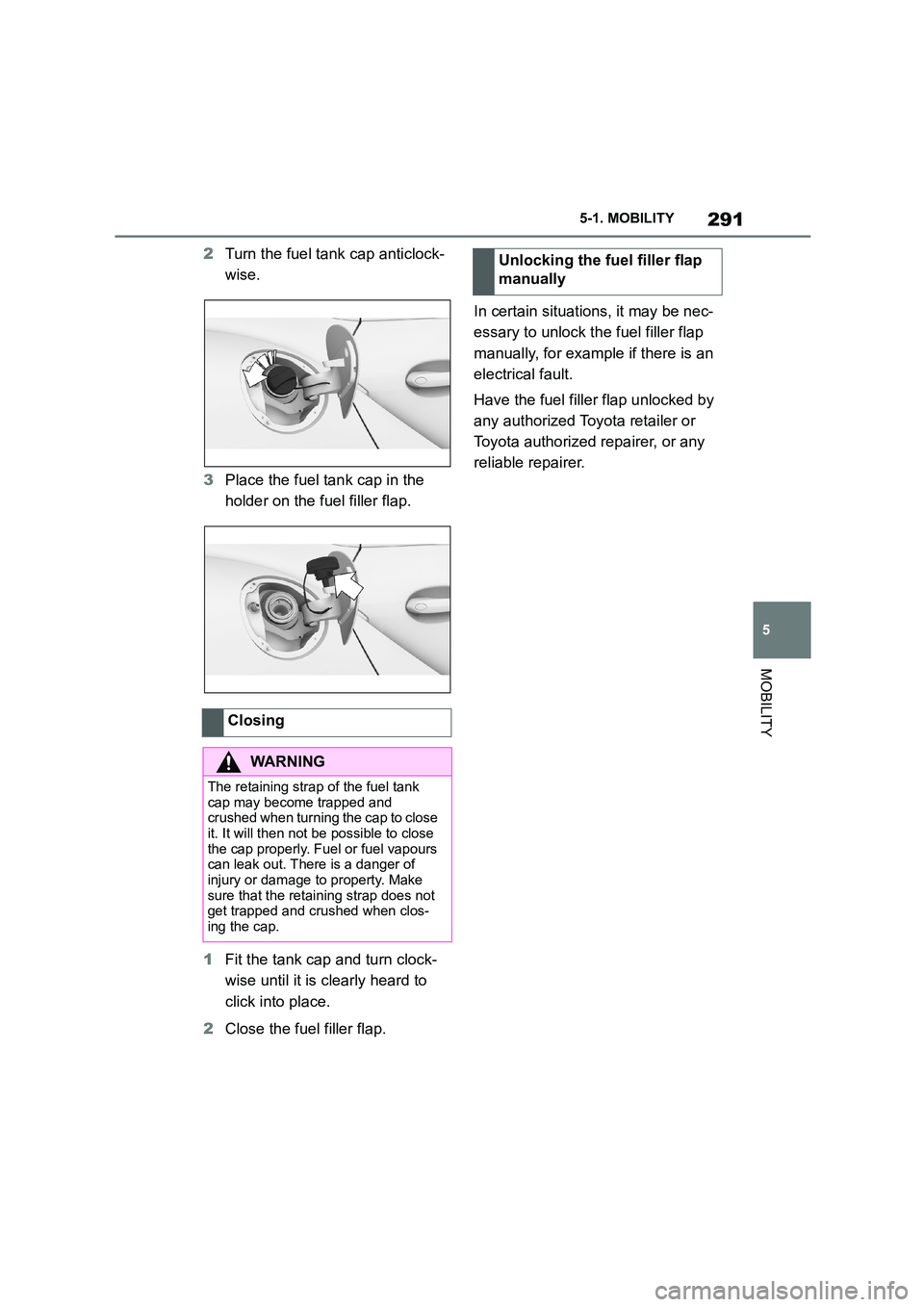
2 Turn the fuel tank cap anticlock-
wise.
3 Place the fuel tank cap in the
holder on the fuel filler flap.
1 Fit the tank cap and turn clock-
wise until it is clearly heard to
click into place.
2 Close the fuel filler flap.
In certain situations, it may be nec-
essary to unlock th e fuel filler flap
manually, for example if there is an
electrical fault.
Have the fuel filler flap unlocked by
any authorized Toyota retailer or
Toyota authorized repairer, or any
reliable repairer.
Closing
WA R N I N G
The retaining strap of the fuel tank
cap may become trapped and crushed when turning the cap to close
it. It will then not be possible to close
the cap properly. Fuel or fuel vapours can leak out. There is a danger of
injury or damage to property. Make
sure that the retaining strap does not get trapped and crushed when clos-
ing the cap.
Unlocking the fuel filler flap
manually
Page 298 of 498
2965-1. MOBILITY
The date of manufacture of the tyre
is indicated on the tyre sidewall.
Have the wheel fitted and balanced
by any authorized Toyota retailer or
Toyota authorized repairer, or any
reliable repairer.
The following properties are recom-
mended and approved by the man-
ufacturer of the vehicle for the
approved wheels and tyres per
vehicle type and special equipment:
• Wheel and tyre combinations.
•Rim designs.
• Tyre sizes.
• Tyre makes.
You can ask any authorized Toyota
retailer or Toyota authorized
repairer, or any reliable repairer
about the approved wheels and
tyres for the vehicle and the special
equipment.
Date of manufacture
DesignationDate of manufac-
ture
DOT … 382038th week of 2020
Replacement of wheels and
tyres
Fitting and balancing
Permissible wheels and tyres
General
Safety notes
WA R N I N G
Wheels and tyres that are not suitable
for your vehicle can damage parts of the vehicle. For example they could
come into contact with the bodywork
on account of their dimensional toler- ances, despite having the same nomi-
nal size. There is a danger of
accidents. The manufacturer of the
vehicle recommends using wheels and tyres that have been categorised
as suitable for the respective vehicle
type.
WA R N I N G
Mounted steel wheels can lead to
technical problems, for example wheel studs may work loose and
brake discs may be damaged. There
is a risk of accident. Do not install steel wheels.
WA R N I N G
Incorrect wheel/tyre combinations
impair the vehicle's handling charac- teristics and interfere with the proper
functioning of various systems, such
as the Anti-lock Brake System or Vehicle Stability Control. There is a
danger of accidents. To maintain good
vehicle handling, always fit tyres of the same make and tread pattern to
all wheels. The manufacturer of the
vehicle recommends using wheels and tyres that have been categorised
as suitable for the respective vehicle
type. After a tyre has been damaged, refit the same wheel/tyre combination
as the original.
Page 301 of 498
299
5
5-1. MOBILITY
MOBILITY
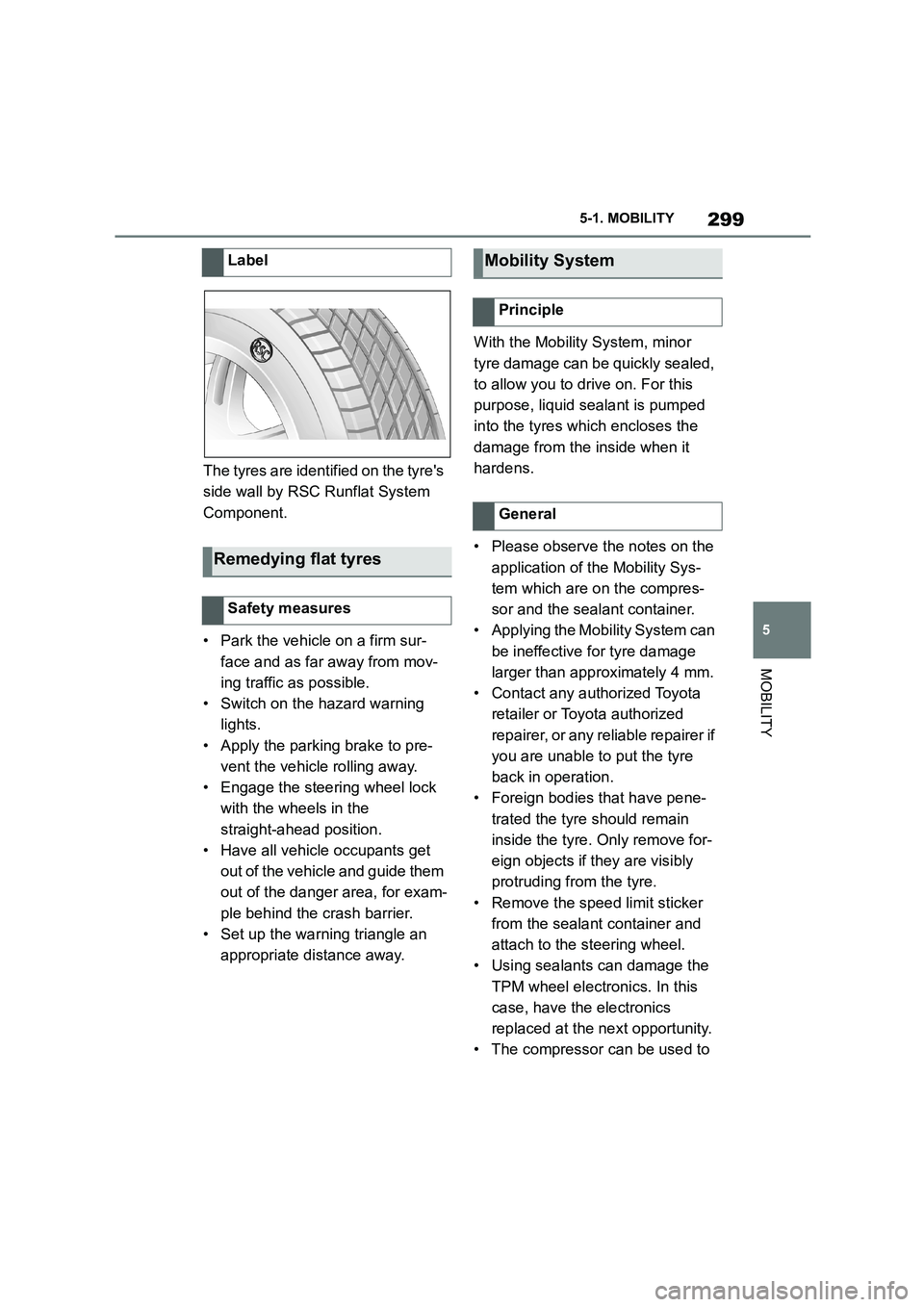
The tyres are identified on the tyre's
side wall by RSC Runflat System
Component.
• Park the vehicle on a firm sur-
face and as far away from mov-
ing traffic as possible.
• Switch on the hazard warning
lights.
• Apply the parking brake to pre-
vent the vehicle rolling away.
• Engage the steering wheel lock
with the wheels in the
straight-ahead position.
• Have all vehicle occupants get
out of the vehicle and guide them
out of the danger area, for exam-
ple behind the crash barrier.
• Set up the warning triangle an
appropriate distance away.
With the Mobility System, minor
tyre damage can be quickly sealed,
to allow you to drive on. For this
purpose, liquid sealant is pumped
into the tyres which encloses the
damage from the inside when it
hardens.
• Please observe the notes on the
application of the Mobility Sys-
tem which are on the compres-
sor and the sealant container.
• Applying the Mobility System can
be ineffective for tyre damage
larger than approximately 4 mm.
• Contact any authorized Toyota
retailer or Toyota authorized
repairer, or any reliable repairer if
you are unable to put the tyre
back in operation.
• Foreign bodies that have pene-
trated the tyre should remain
inside the tyre. Only remove for-
eign objects if they are visibly
protruding from the tyre.
• Remove the speed limit sticker
from the sealant container and
attach to the steering wheel.
• Using sealants can damage the
TPM wheel electronics. In this
case, have the electronics
replaced at the next opportunity.
• The compressor can be used to
Label
Remedying flat tyres
Safety measures
Mobility System
Principle
General
Page 302 of 498
3005-1. MOBILITY
check the tyre inflation pressure.
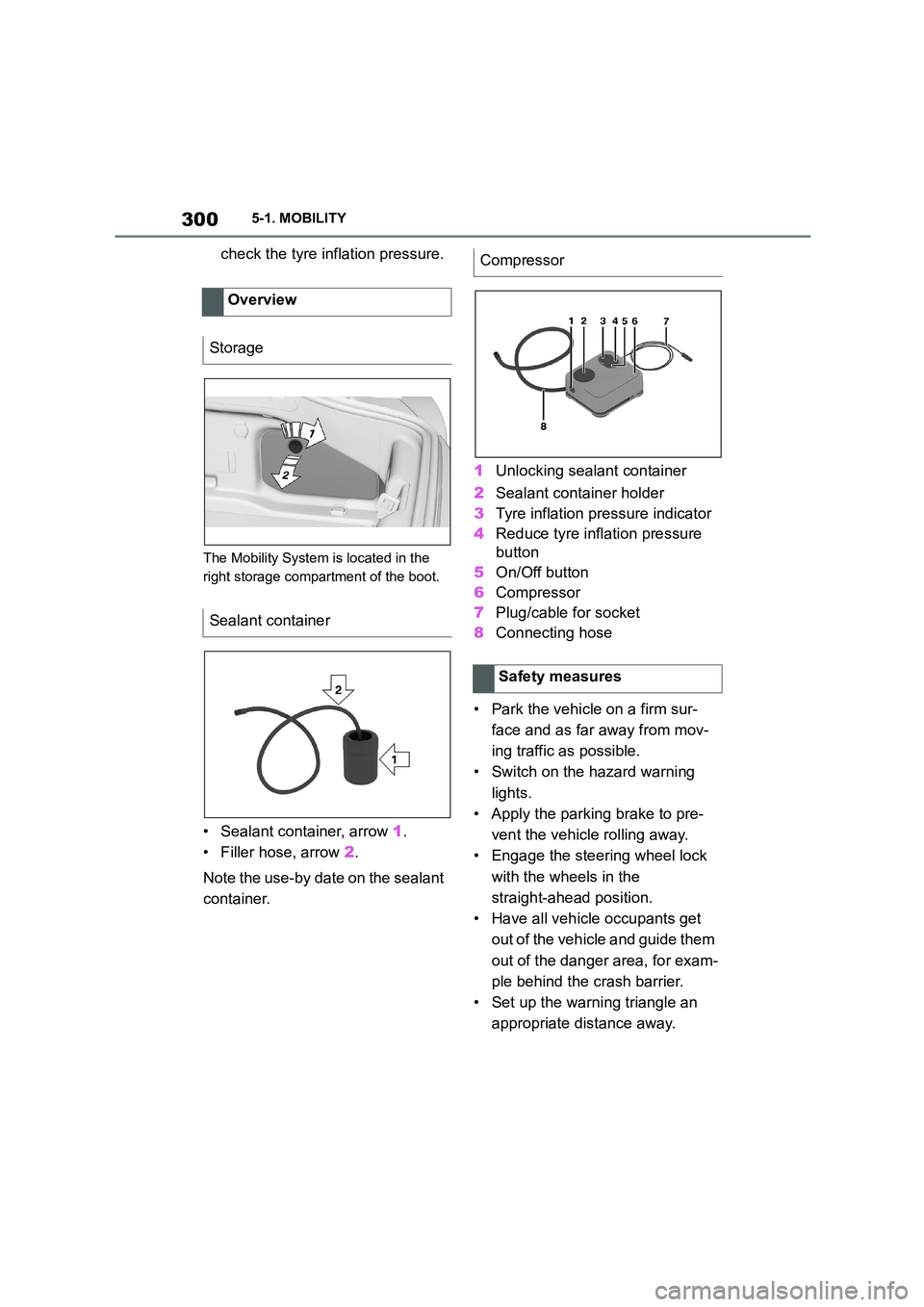
The Mobility System is located in the
right storage compartment of the boot.
• Sealant container, arrow 1.
• Filler hose, arrow 2.
Note the use-by date on the sealant
container.
1 Unlocking sealant container
2 Sealant container holder
3 Tyre inflation pressure indicator
4 Reduce tyre inflation pressure
button
5 On/Off button
6 Compressor
7 Plug/cable for socket
8 Connecting hose
• Park the vehicle on a firm sur-
face and as far away from mov-
ing traffic as possible.
• Switch on the hazard warning
lights.
• Apply the parking brake to pre-
vent the vehicle rolling away.
• Engage the steering wheel lock
with the wheels in the
straight-ahead position.
• Have all vehicle occupants get
out of the vehicle and guide them
out of the danger area, for exam-
ple behind the crash barrier.
• Set up the warning triangle an
appropriate distance away.
Overview
Storage
Sealant container
Compressor
Safety measures
Page 303 of 498
301
5
5-1. MOBILITY
MOBILITY
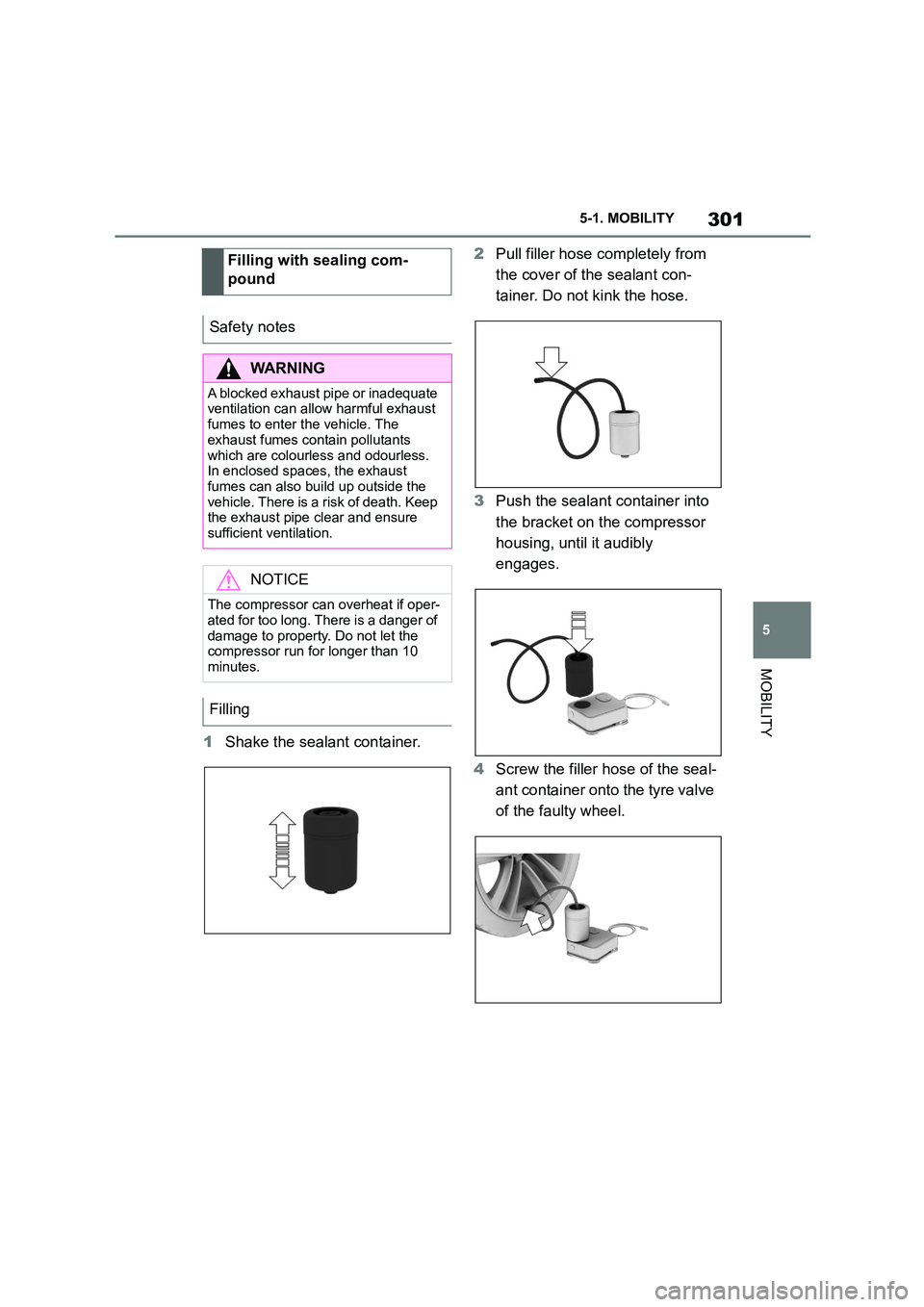
1 Shake the sealant container.
2 Pull filler hose completely from
the cover of the sealant con-
tainer. Do not kink the hose.
3 Push the sealant container into
the bracket on the compressor
housing, until it audibly
engages.
4 Screw the filler hose of the seal-
ant container onto the tyre valve
of the faulty wheel.
Filling with sealing com-
pound
Safety notes
WA R N I N G
A blocked exhaust pipe or inadequate ventilation can allow harmful exhaust
fumes to enter the vehicle. The
exhaust fumes contain pollutants
which are colourless and odourless. In enclosed spaces, the exhaust
fumes can also build up outside the
vehicle. There is a risk of death. Keep the exhaust pipe clear and ensure
sufficient ventilation.
NOTICE
The compressor can overheat if oper-
ated for too long. There is a danger of
damage to property. Do not let the compressor run for longer than 10
minutes.
Filling
Page 304 of 498
3025-1. MOBILITY
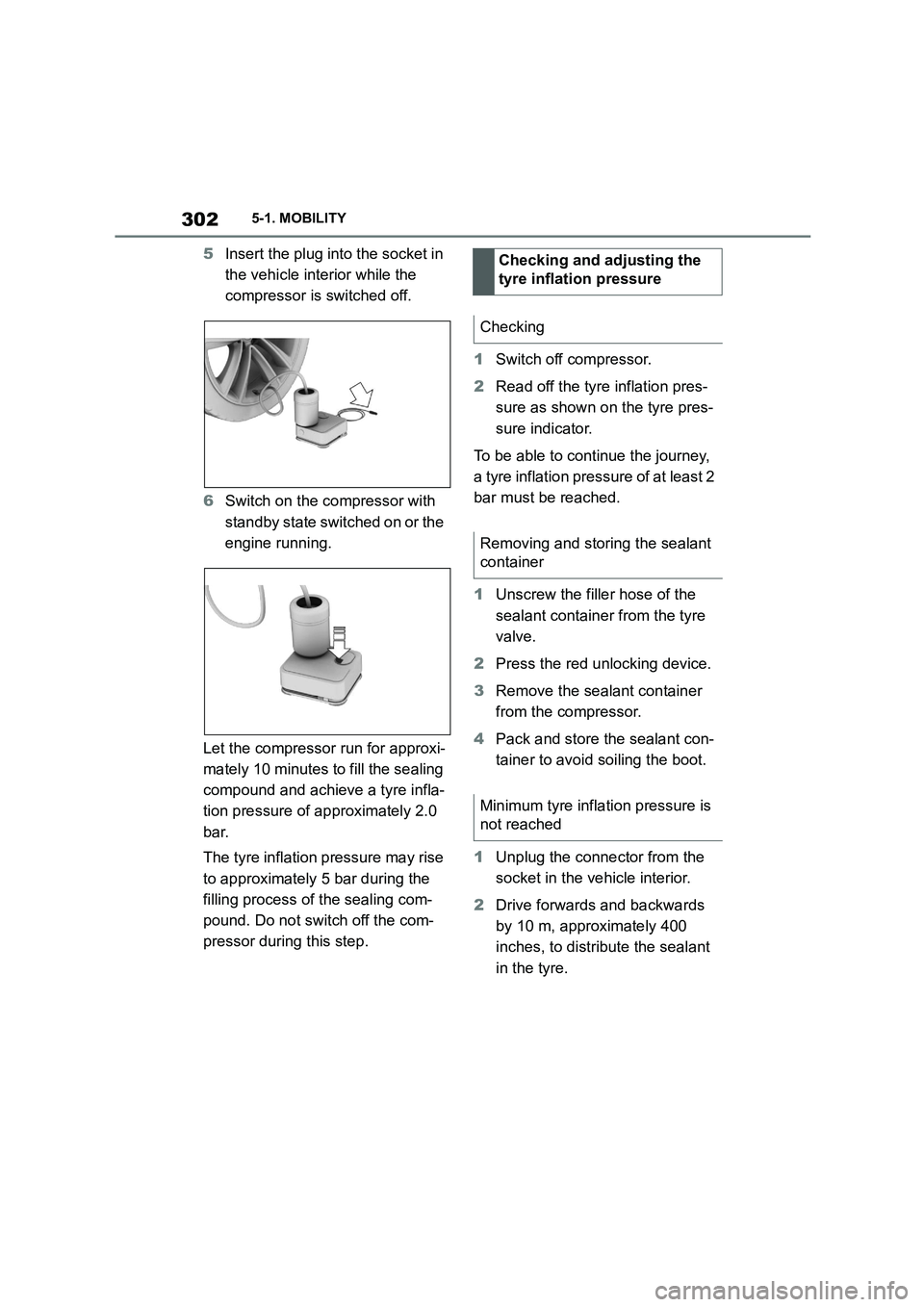
5Insert the plug into the socket in
the vehicle interior while the
compressor is switched off.
6 Switch on the compressor with
standby state switched on or the
engine running.
Let the compressor run for approxi-
mately 10 minutes to fill the sealing
compound and achieve a tyre infla-
tion pressure of approximately 2.0
bar.
The tyre inflation pressure may rise
to approximately 5 bar during the
filling process of the sealing com-
pound. Do not switch off the com-
pressor during this step.
1 Switch off compressor.
2 Read off the tyre inflation pres-
sure as shown on the tyre pres-
sure indicator.
To be able to continue the journey,
a tyre inflation pressure of at least 2
bar must be reached.
1 Unscrew the filler hose of the
sealant container from the tyre
valve.
2 Press the red unlocking device.
3 Remove the sealant container
from the compressor.
4 Pack and store the sealant con-
tainer to avoid soiling the boot.
1 Unplug the connector from the
socket in the vehicle interior.
2 Drive forwards and backwards
by 10 m, approximately 400
inches, to distribute the sealant
in the tyre.
Checking and adjusting the
tyre inflation pressure
Checking
Removing and storing the sealant
container
Minimum tyre inflation pressure is
not reached
Page 315 of 498
313
5
5-1. MOBILITY
MOBILITY
any reliable repairer.
For run-flat tyres or when using a
flat tyre kit, it is not always neces-
sary to change a wheel immedi-
ately if tyre inflatio n pressure is lost
due to a flat tyre.
If required, the tools for changing
wheels are available as special
accessories from any authorized
Toyota retailer or Toyota authorized
repairer, or any reliable repairer.
Wheel change
General
Safety notes
WA R N I N G
The jack is only intended for raising
the vehicle briefly during a wheel
change. Even if the safety measures are complied with, there is a risk of
the raised vehicle falling over due to
the jack slipping. There is a danger of injury or even death. If the vehicle is
raised with the jack, do not lie under-
neath the vehicle and do not start the engine.
WA R N I N G
Supports such as wooden blocks
under the vehicle jack can prevent it from achieving its load capacity due
to the restricted height. The load
capacity of the wooden blocks may be exceeded, causing the vehicle to tip
over. There is a danger of injury or
even death. Do not place supports under the vehicle jack.
WA R N I N G
The jack, issued by the vehicle manu-
facturer, is provided in order to per-
form a wheel change in the event of a breakdown. The jack is not designed
for frequent use; for example, chang-
ing from summer to winter tyres. Using the jack frequently may cause it
to become jammed or damaged.
There is a danger of injury and dam-
age to property. Only use the jack to change an emergency wheel or a
spare wheel in the event of a flat tyre.
WA R N I N G
On soft, uneven or slippery ground,
for example, snow, ice, tiles or similar,
the jack may slip. There is a danger of injury. Perform the wheel change on a
level, firm and non-slip surface if at all
possible.
WA R N I N G
The jack is only optimised for raising
the vehicle and for use with the jack-
ing points on the vehicle. There is a danger of injury. Do not lift another
vehicle or other items with the jack.
WA R N I N G
If the jack has not been guided into the jacking point provided, the vehicle
might be damaged when the jack is
extended, or the jack could slip. There is a danger of injury or damage to
property. When extending, make sure
that the jack is guided into the jacking point adjacent to the wheelhouse.
Page 316 of 498
3145-1. MOBILITY
The vehicle manufacturer recom-
mends that the vehicle should addi-
tionally be protec ted against rolling
away during a wheel change.
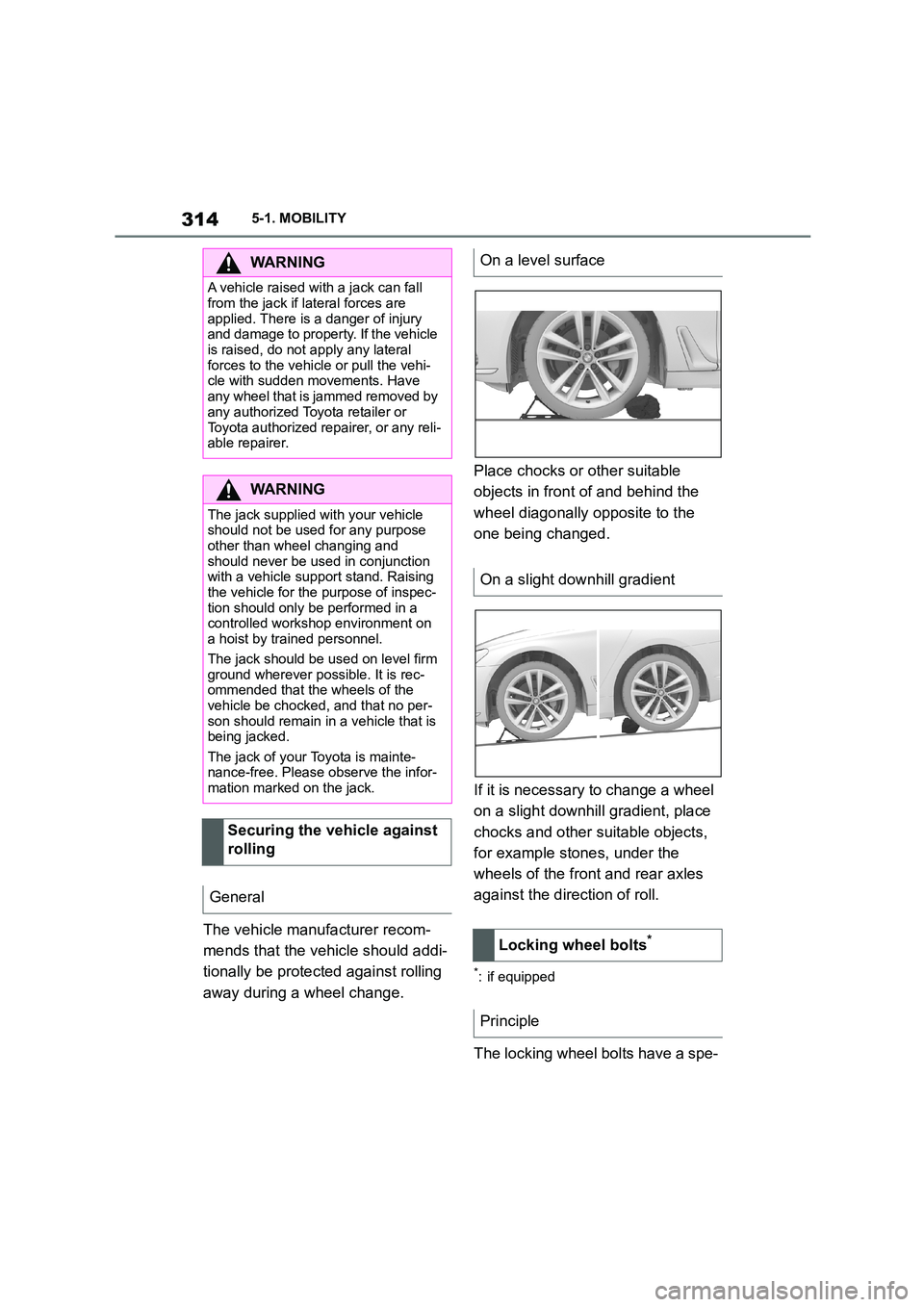
Place chocks or other suitable
objects in front of and behind the
wheel diagonally opposite to the
one being changed.
If it is necessary to change a wheel
on a slight downh ill gradient, place
chocks and other suitable objects,
for example stones, under the
wheels of the front and rear axles
against the direction of roll.
*: if equipped
The locking wheel bolts have a spe-
WA R N I N G
A vehicle raised with a jack can fall
from the jack if lateral forces are
applied. There is a danger of injury and damage to property. If the vehicle
is raised, do not apply any lateral
forces to the vehicle or pull the vehi- cle with sudden movements. Have
any wheel that is jammed removed by
any authorized Toyota retailer or
Toyota authorized repairer, or any reli- able repairer.
WA R N I N G
The jack supplied with your vehicle should not be used for any purpose
other than wheel changing and
should never be used in conjunction with a vehicle support stand. Raising
the vehicle for the purpose of inspec-
tion should only be performed in a controlled workshop environment on
a hoist by trained personnel.
The jack should be used on level firm ground wherever possible. It is rec-
ommended that the wheels of the
vehicle be chocked, and that no per-
son should remain in a vehicle that is being jacked.
The jack of your Toyota is mainte-
nance-free. Please observe the infor- mation marked on the jack.
Securing the vehicle against
rolling
General
On a level surface
On a slight downhill gradient
Locking wheel bolts*
Principle
Page 317 of 498
315
5
5-1. MOBILITY
MOBILITY
cial coding. The bolts can only be
released with the adapter that
matches the coding.
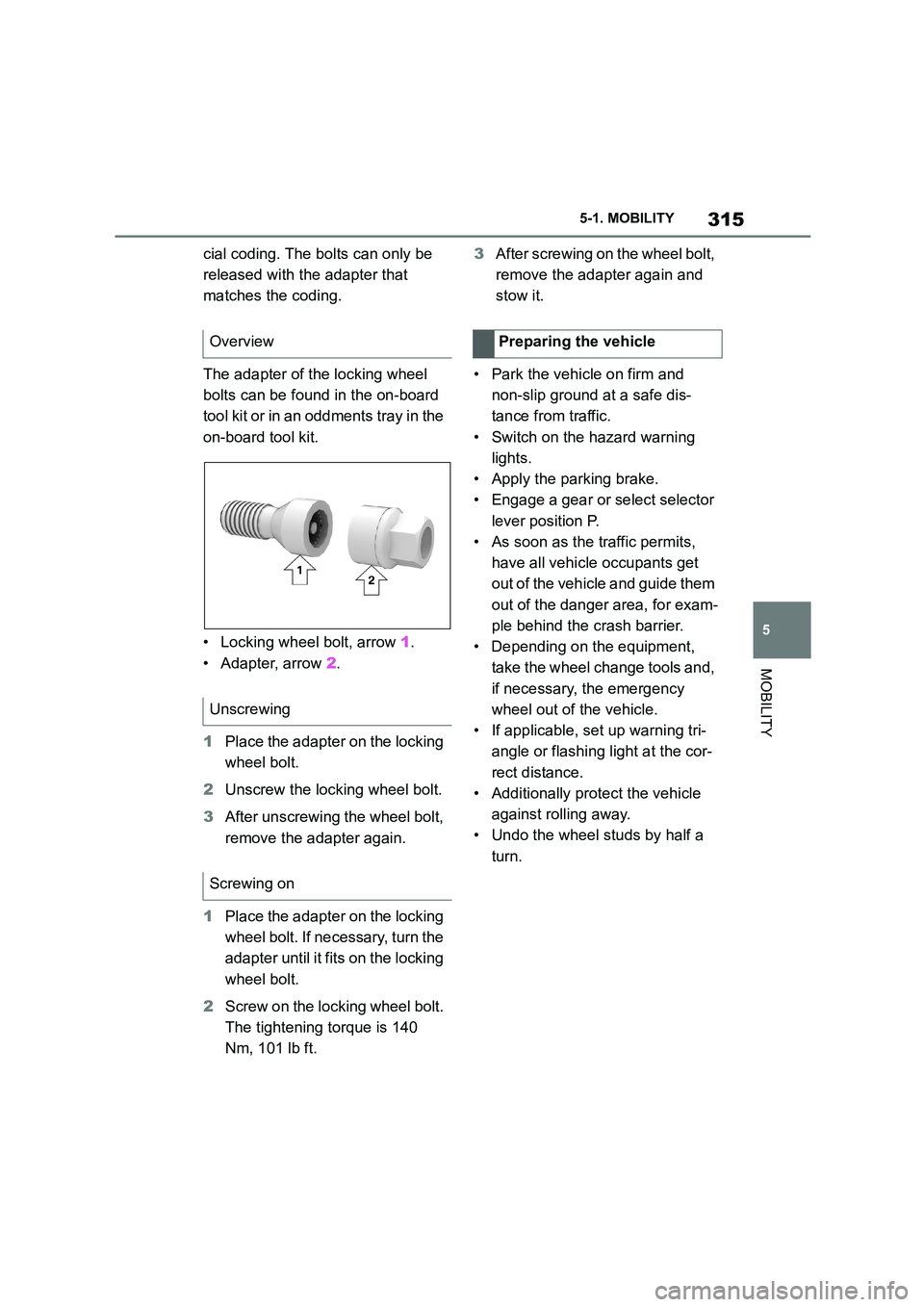
The adapter of the locking wheel
bolts can be found in the on-board
tool kit or in an oddments tray in the
on-board tool kit.
• Locking wheel bolt, arrow 1.
• Adapter, arrow 2.
1 Place the adapter on the locking
wheel bolt.
2 Unscrew the locking wheel bolt.
3 After unscrewing the wheel bolt,
remove the adapter again.
1 Place the adapter on the locking
wheel bolt. If necessary, turn the
adapter until it fi ts on the locking
wheel bolt.
2 Screw on the locking wheel bolt.
The tightening torque is 140
Nm, 101 lb ft.
3 After screwing on the wheel bolt,
remove the adapter again and
stow it.
• Park the vehicle on firm and
non-slip ground at a safe dis-
tance from traffic.
• Switch on the hazard warning
lights.
• Apply the parking brake.
• Engage a gear or select selector
lever position P.
• As soon as the traffic permits,
have all vehicle occupants get
out of the vehicle and guide them
out of the danger area, for exam-
ple behind the crash barrier.
• Depending on the equipment,
take the wheel change tools and,
if necessary, the emergency
wheel out of the vehicle.
• If applicable, set up warning tri-
angle or flashing light at the cor-
rect distance.
• Additionally protect the vehicle
against rolling away.
• Undo the wheel studs by half a
turn.
Overview
Unscrewing
Screwing on
Preparing the vehicle
Page 318 of 498
3165-1. MOBILITY
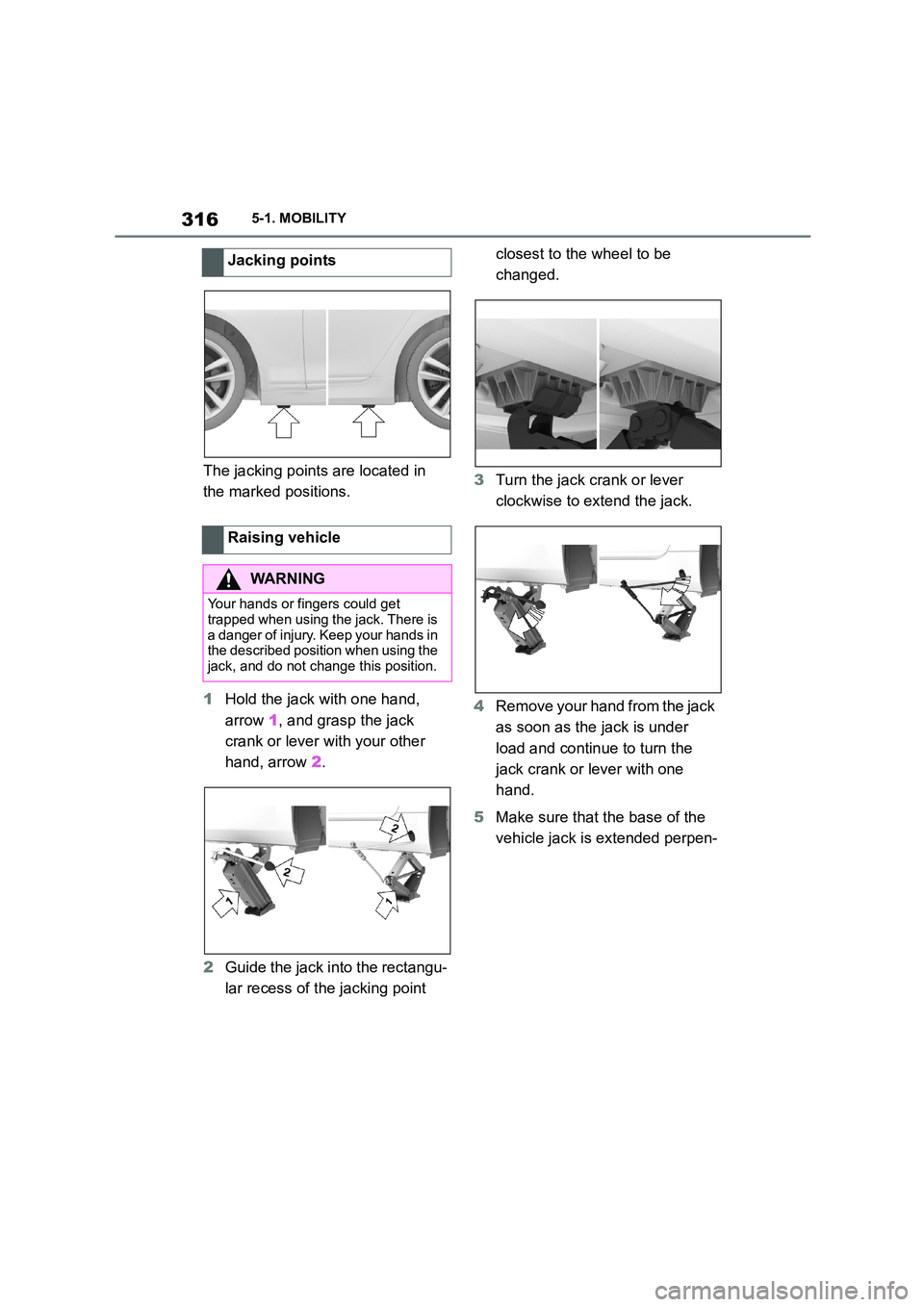
The jacking points are located in
the marked positions.
1 Hold the jack with one hand,
arrow 1, and grasp the jack
crank or lever with your other
hand, arrow 2.
2 Guide the jack into the rectangu-
lar recess of the jacking point
closest to the wheel to be
changed.
3 Turn the jack crank or lever
clockwise to extend the jack.
4 Remove your hand from the jack
as soon as the jack is under
load and continue to turn the
jack crank or lever with one
hand.
5 Make sure that the base of the
vehicle jack is extended perpen-
Jacking points
Raising vehicle
WA R N I N G
Your hands or fingers could get
trapped when using the jack. There is a danger of injury. Keep your hands in
the described position when using the
jack, and do not change this position.