belt TOYOTA SUPRA 2022 Owners Manual
[x] Cancel search | Manufacturer: TOYOTA, Model Year: 2022, Model line: SUPRA, Model: TOYOTA SUPRA 2022Pages: 498, PDF Size: 104.06 MB
Page 13 of 498
11
1
1-1. NOTES
NOTES
or the driver's behaviour.
These include, for example:
• Status reports relating to the
vehicle and its individual compo-
nents, for example wheel speed,
wheel circumferential velocity,
deceleration, lateral accelera-
tion, fastened seat belts.
• Ambient conditions, for example
temperature, rain sensor signals.
The data is processed within the
vehicle and is usually transient. It is
only saved for longer than the oper-
ating period if it is required in order
to perform services agreed with the
customer.
Electronic parts, for example con-
trol devices and vehicle keys, con-
tain components for storing
technical informat ion. Information
about the vehicle's condition, com-
ponent use and wear, maintenance
requirements, events or errors can
be stored temporarily or perma-
nently.
This information generally docu-
ments the condition of a compo-
nent, a module, a system or the
vehicle surroundings, including:
• Operating states of system com-
ponents, for examp le fill levels,
tyre inflation pr essure, battery
status.
• Malfunctions and faults of impor-
tant system components, for
example lights and brakes.
• Responses of the vehicle to par-
ticular driving situations, for
example triggering of an airbag,
activation of th e drive stability
control systems.
• Information on vehicle-damag-
ing events.
The data is required so that the
control units can perform their func-
tions. It is also used for detecting
and rectifying malfunctions, as well
as to optimise vehicle functions.
Most of this data is transient and is
only processed within the vehicle
itself. Only a small proportion of the
data is stored in event or error
memories in response to specific
circumstances.
Convenience functions, such as
seat, climate or light settings, make
every journey even more pleasant.
The personal settings for these
functions can be saved in a profile
within the vehicle and retrieved on
request, for example if the settings
have been changed by another
driver. Depending on the equip-
ment, these profiles can be saved
in the vehicle manufacturer's
secure data systems. When the
driver changes vehicle, these
saved profiles can simply be
applied to a different vehicle.
The vehicle settings saved in the
vehicle profile can be changed or
deleted at any time.
Electronic components
Personal settings
Page 23 of 498
21
1
1-1. NOTES
NOTES
The owner of a vehicle equipped
with an automatic emergency call
system and the eCall statutory
emergency call system has the
right to use the on-board eCall sys-
tem instead of the automatic emer-
gency call function.
For deactivation requests, contact
any authorized Toyota retailer or
Toyota authorized repairer, or any
reliable repairer.
The eCall statutory emergency call
system is always on standby in
addition to the automatic emer-
gency call system. The eCall statu-
tory emergency call system takes
over the emergency call function if
the automatic emergency call sys-
tem is not functional for technical
reasons, for example if the emer-
gency call centre appointed by the
vehicle manufacturer cannot be
reached.
The eCall statutory emergency call
system uses the infrastructure of
the 112 public emergency call num-
ber.
The system can be configured so
that emergency calls are always
made via the eCall statutory emer-
gency call system and not via the
automatic emergency call system.
Have the setting configured by any
authorized Toyota retailer or Toyota
authorized repairer, or any reliable
repairer.
This vehicle is equipped with an
event data recorder EDR. The main
function of this EDR is to record
data in the event of crash or
near-miss situations, such as trig-
gering of an airbag or collision with
a road obstacle; this data helps to
understand how the vehicle's sys-
tems behaved. EDR serves to
record data for a short period, typi-
cally 30 seconds or less, relating to
driving dynamics and the vehicle's
safety systems.
The EDR installed in this vehicle is
used for recording the following
data:
The operating behaviour of vari-
ous vehicle systems.
Whether the driver and front-seat
passenger had fastened their
seat belts.
How far the driver had pressed
the accelerator and/or brake
pedals, if at all.
What speed the vehicle was trav-
elling at.
This data can help to gain a better
understanding of the circumstances
leading to crashes and injuries.
EDR data is only recorded by the
vehicle if there is a severe accident;
under normal driving conditions, no
data is recorded by the EDR and no
personal data is saved either, for
example no data about name, gen-
der, age or accident location.
Statutory emergency call systemEvent data recorder EDR
Page 38 of 498
362-1. QUICK REFERENCE
1Depress the brake pedal.
2 Press the start/stop button.
1 With the vehicle at a standstill,
engage selector lever position P.
2 Press the start/stop button.
The engine is switched off.
3Apply the parking brake.
The Auto Start/St op switches the
engine off automatically at a stand-
still to save fuel. For driving off, the
engine automatically starts under
the following conditions:
• By releasing the brake pedal.
LED and indicator lamp turn off.
The parking brake is released.
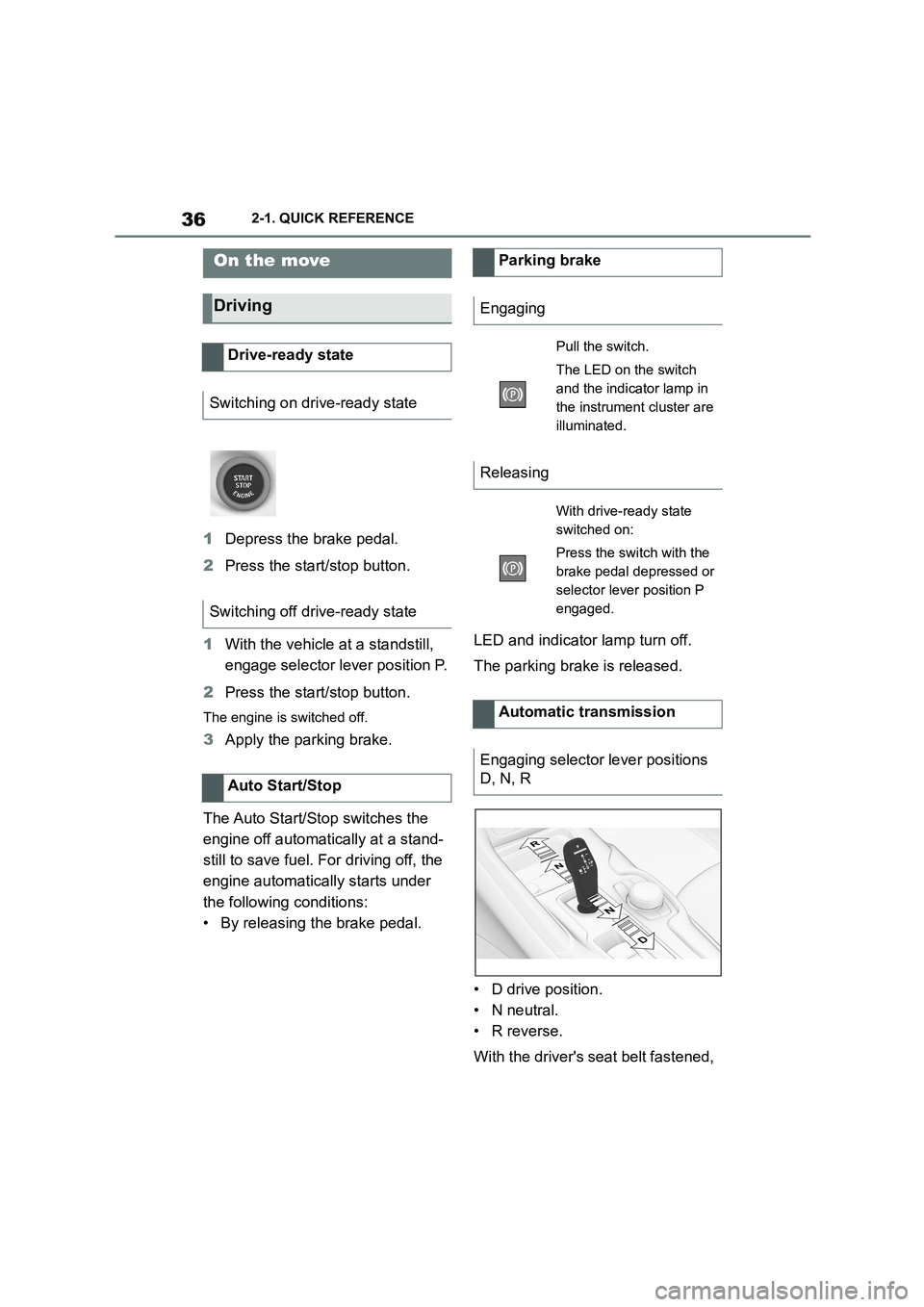
• D drive position.
• N neutral.
• R reverse.
With the driver's seat belt fastened,
On the move
Driving
Drive-ready state
Switching on drive-ready state
Switching off drive-ready state
Auto Start/Stop
Parking brake
Engaging
Pull the switch.
The LED on the switch
and the indicator lamp in
the instrument cluster are
illuminated.
Releasing
With drive-ready state
switched on:
Press the switch with the
brake pedal depressed or
selector lever position P
engaged.
Automatic transmission
Engaging selector lever positions
D, N, R
Page 109 of 498
107
3
3-1. CONTROLS
CONTROLS
This chapter describes all standard,
country-specific and special equip-
ment available for the model series.
It may therefore describe equip-
ment and functions which are not
installed in your vehicle, for exam-
ple on account of the special equip-
ment selected or the country
specification. This also applies to
safety-relevant functions and sys-
tems. Please comply with the rele-
vant laws and regulations when
using the corresponding functions
and systems.
A seating position that suitably
reflects the requirements of the
occupants is essential for relaxed
driving with minimum fatigue.
In an accident, the correct seating
position plays an important role.
Comply with the notes in the follow-
ing chapters:
• Seats, see page 107.
• Seat belts, see page 111.
• Head restraints, see page 116.
• Airbags, see page 192.
Seats, mirrors and steer-
ing wheel
Vehicle equipment
Safe seating position
Seats
Safety notes
WA R N I N G
Adjusting the seat during a journey
could cause the seat to move unex-
pectedly. You could lose control of the
vehicle. There is a danger of acci- dents. Only adjust the seat on the
driver's side when at a standstill.
WA R N I N G
If the backrest is angled back too far,
the protective effect of the seat belt
will no longer be guaranteed. There is a danger of sliding under the seat belt
in the event of an accident. There is a
danger of injury or even death. Adjust the seat before starting the journey.
Adjust the backre st to the most
upright position possible, and do not change it during the journey.
WA R N I N G
There is a risk of entrapment when
the seats are being moved. There is a danger of injury or damage to prop-
erty. Before making any adjustment,
make sure that the area of movement of the seat is clear.
Page 113 of 498
111
3
3-1. CONTROLS
CONTROLS
For the safety of the vehicle occu-
pants, the vehicle is equipped with
two seat belts. However, they can
only provide effective protection
when worn correctly.
Before a journey, always make sure
that all occupants have fastened
their seat belts. The airbags sup-
plement the seat belts as an addi-
tional safety device. The airbags
are not a substitute for the seat
belts.
All belt fastening points are
designed to achieve the best possi-
ble protective effe ct of the seat
belts with proper use of the seat
belts and correct seat setting.
Notes on sitting safely, see page
P.107.
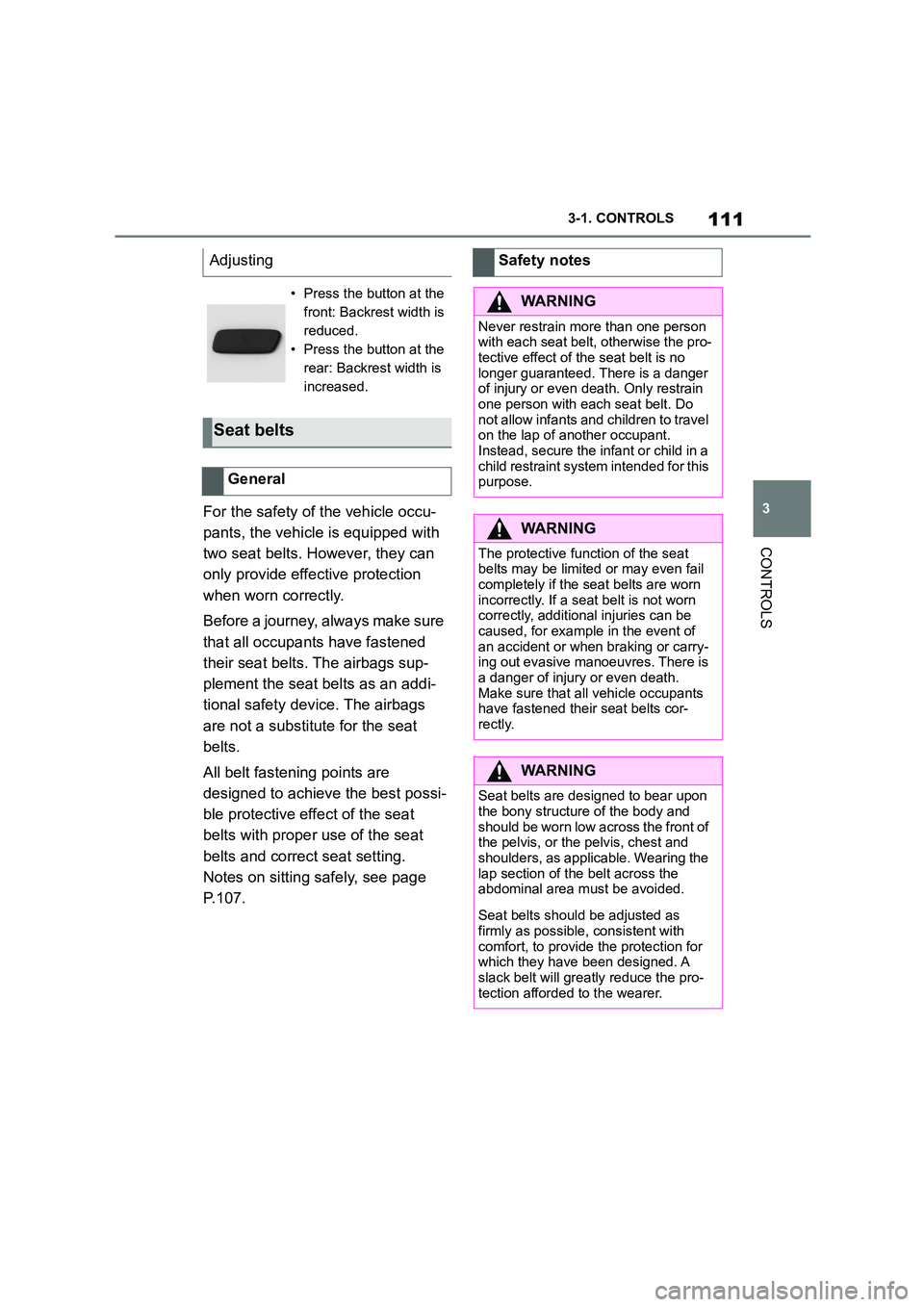
Adjusting
• Press the button at the
front: Backrest width is
reduced.
• Press the button at the
rear: Backrest width is
increased.
Seat belts
General
Safety notes
WA R N I N G
Never restrain more than one person
with each seat belt, otherwise the pro- tective effect of the seat belt is no
longer guaranteed. There is a danger
of injury or even death. Only restrain one person with each seat belt. Do
not allow infants and children to travel
on the lap of another occupant.
Instead, secure the infant or child in a child restraint system intended for this
purpose.
WA R N I N G
The protective function of the seat
belts may be limited or may even fail
completely if the seat belts are worn incorrectly. If a seat belt is not worn
correctly, additional injuries can be
caused, for example in the event of an accident or when braking or carry-
ing out evasive manoeuvres. There is
a danger of injury or even death.
Make sure that al l vehicle occupants have fastened their seat belts cor-
rectly.
WA R N I N G
Seat belts are designed to bear upon
the bony structure of the body and
should be worn low across the front of the pelvis, or the pelvis, chest and
shoulders, as applicable. Wearing the
lap section of the belt across the abdominal area must be avoided.
Seat belts should be adjusted as firmly as possible, consistent with
comfort, to provide the protection for
which they have been designed. A
slack belt will greatly reduce the pro- tection afforded to the wearer.
Page 114 of 498
1123-1. CONTROLS
• Insert the seat belt into the belt
guide.
• Place the seat belt tightly over
the pelvis and shoulder, close to
the body and without twisting.
• Make sure that the seat belt is
positioned low at the hip in the
area of the pelvis. The seat belt
must not press on the abdomen.
• The seat belt must not be rubbed
on sharp edges, be routed over
solid or breakable objects or be
trapped.
• Avoid wearing bulky clothing.
• Keep the seat belt taut by occa-
sionally pulling upwards on the
upper section.
WA R N I N G
Care should be taken to avoid con-
tamination of the webbing by pol-
ishes, oils and chemicals and particularly battery acid. Cleaning
may safely be carried out using a mild
soap and water solution. The belt should be replaced if webbing
becomes frayed, contaminated or
damaged. Seat belts should not be
worn with straps twisted. Each seat belt assembly must only be used by
one occupant; it is forbidden to put a
belt around a child being carried on the occupant’s lap.
It is essential to replace the entire assembly after it has been worn in a
severe impact even if damage to the
assembly is not obvious.
WA R N I N G
No modifications or additions should
be made by the user that will either
prevent the seat belt adjusting
devices from operating to remove slack, or prevent the seat belt assem-
bly from being adjusted to remove
slack.
WA R N I N G
If the rear backrest is not locked, the
protective effect of the middle seat belt is not ensured. There is a danger
of injury or even death. Lock the wider
rear seat backrest when using the middle seat belt.
WA R N I N G
The protective function of the seat
belts may be limited or may even fail completely in the following situations:
• The seat belts or belt buckles are damaged, dirty or have been modi-
fied in another way.
• The seat belt tensioners or belt retractors have been modified.
Seat belts can be damaged in an accident without the damage neces-
sarily being apparent. There is a dan-
ger of injury or danger to life. Do not modify seat belts, seat belt buckles,
seat belt tensioners, belt retractors
and belt anchor points and ensure that they are kept clean. After an acci-
dent, have the seat belts inspected at
any authorized Toyota retailer or Toyota authorized repairer, or any reli-
able repairer.
Correct seat belt use
Page 115 of 498
113
3
3-1. CONTROLS
CONTROLS
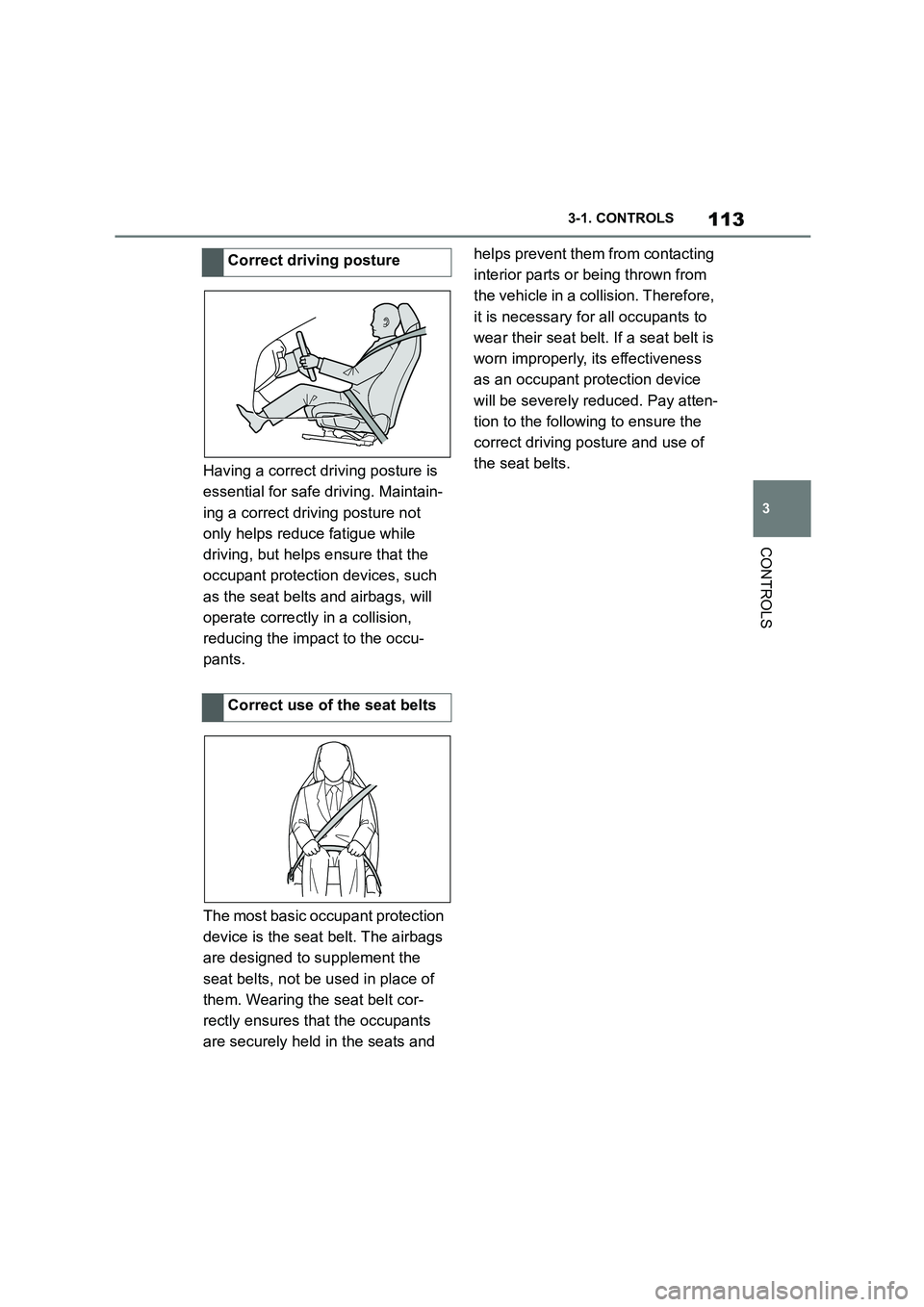
Having a correct driving posture is
essential for safe driving. Maintain-
ing a correct driving posture not
only helps reduce fatigue while
driving, but helps ensure that the
occupant protection devices, such
as the seat belts and airbags, will
operate correctly in a collision,
reducing the impact to the occu-
pants.
The most basic occupant protection
device is the seat belt. The airbags
are designed to supplement the
seat belts, not be used in place of
them. Wearing the seat belt cor-
rectly ensures that the occupants
are securely held in the seats and
helps prevent them from contacting
interior parts or being thrown from
the vehicle in a co llision. Therefore,
it is necessary for all occupants to
wear their seat belt. If a seat belt is
worn improperly, its effectiveness
as an occupant protection device
will be severely reduced. Pay atten-
tion to the following to ensure the
correct driving posture and use of
the seat belts.
Correct driving posture
Correct use of the seat belts
Page 116 of 498
1143-1. CONTROLS
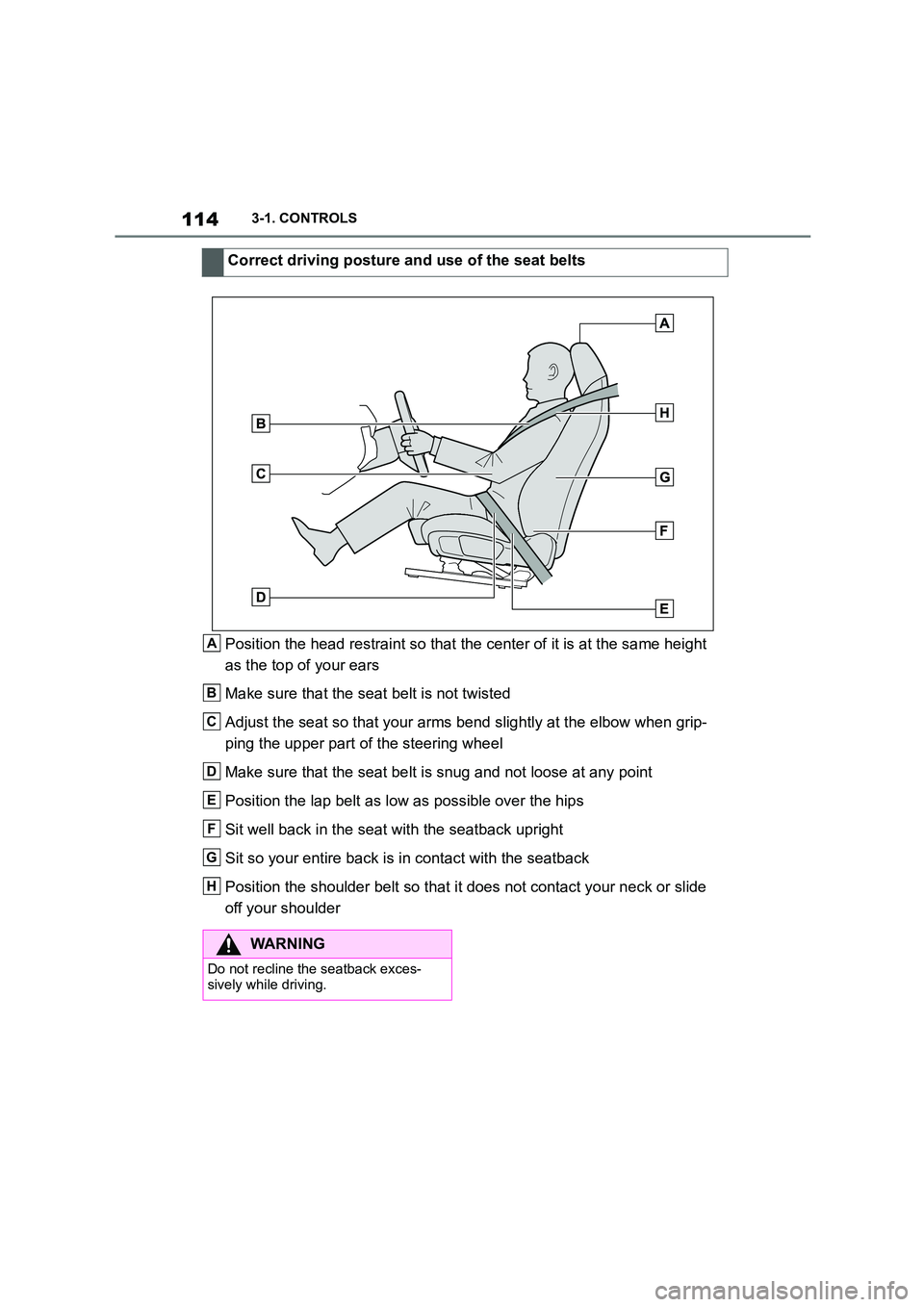
Position the head restraint so that the center of it is at the same height
as the top of your ears
Make sure that the seat belt is not twisted
Adjust the seat so that your arms bend slightly at the elbow when grip-
ping the upper part of the steering wheel
Make sure that the seat belt is snug and not loose at any point
Position the lap belt as low as possible over the hips
Sit well back in the seat with the seatback upright
Sit so your entire back is in contact with the seatback
Position the shoulder belt so that it does not contact your neck or slide
off your shoulder
Correct driving posture and use of the seat belts
A
B
C
D
E
F
G
H
WA R N I N G
Do not recline the seatback exces-
sively while driving.
Page 117 of 498
115
3
3-1. CONTROLS
CONTROLS
• Draw the buckle tongue attached
to the seat belt across the body
and press it into the buckle catch
until a ‘click’ is heard.
• Adjustment of the belt length is
very important. To adjust the lap
belt and check whether the
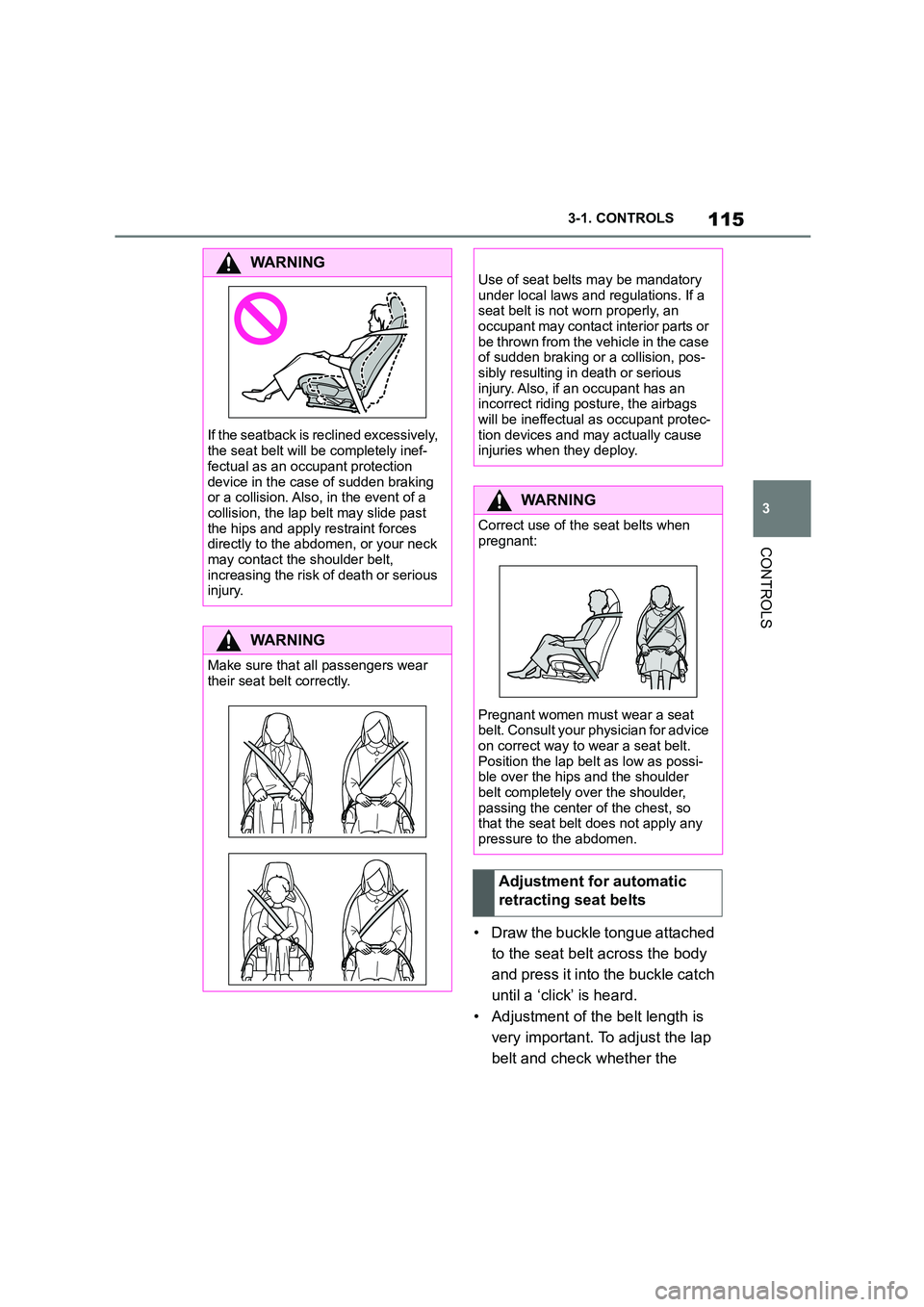
WA R N I N G
If the seatback is reclined excessively,
the seat belt will be completely inef-
fectual as an occupant protection
device in the case of sudden braking or a collision. Also, in the event of a
collision, the lap belt may slide past
the hips and apply restraint forces directly to the abdomen, or your neck
may contact the shoulder belt,
increasing the risk of death or serious injury.
WA R N I N G
Make sure that all passengers wear
their seat belt correctly.
Use of seat belts may be mandatory
under local laws and regulations. If a
seat belt is not worn properly, an occupant may contact interior parts or
be thrown from the vehicle in the case
of sudden braking or a collision, pos- sibly resulting in death or serious
injury. Also, if an occupant has an
incorrect riding posture, the airbags will be ineffectual as occupant protec-
tion devices and may actually cause
injuries when they deploy.
WA R N I N G
Correct use of the seat belts when pregnant:
Pregnant women must wear a seat belt. Consult your physician for advice
on correct way to wear a seat belt.
Position the lap belt as low as possi- ble over the hips and the shoulder
belt completely over the shoulder,
passing the center of the chest, so that the seat belt does not apply any
pressure to the abdomen.
Adjustment for automatic
retracting seat belts
Page 118 of 498
1163-1. CONTROLS
buckle has locked correctly, pull
upwards on the shoulder strap
until the lap belt fits tightly.
• The length of the diagonal shoul-
der strap adjusts itself automati-
cally to allow freedom of
movement.
• To release the seat belt, press
the button on the buckle catch
unit.
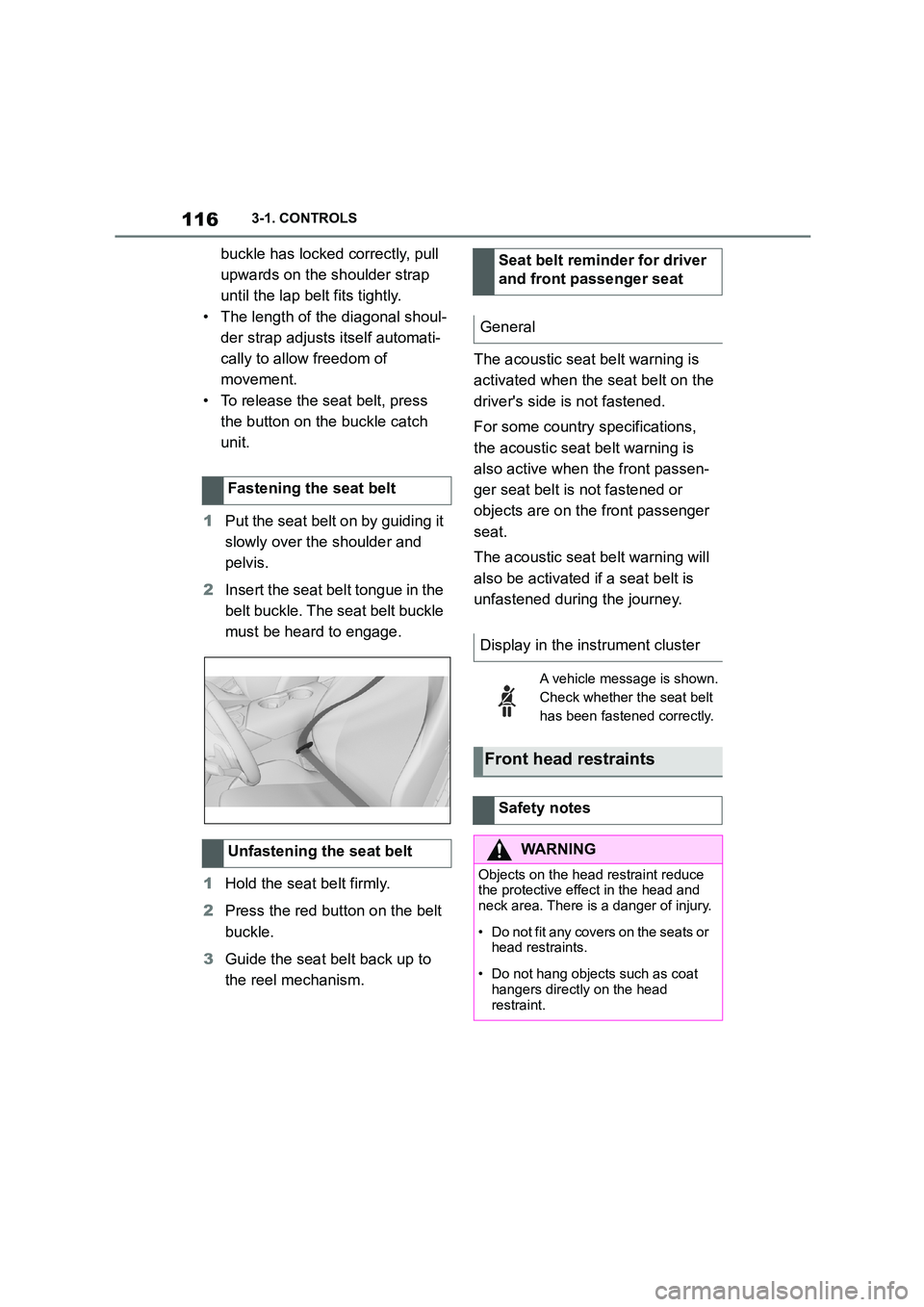
1 Put the seat belt on by guiding it
slowly over the shoulder and
pelvis.
2 Insert the seat belt tongue in the
belt buckle. The seat belt buckle
must be heard to engage.
1 Hold the seat belt firmly.
2 Press the red button on the belt
buckle.
3 Guide the seat belt back up to
the reel mechanism.
The acoustic seat belt warning is
activated when the seat belt on the
driver's side is not fastened.
For some country specifications,
the acoustic seat belt warning is
also active when the front passen-
ger seat belt is not fastened or
objects are on the front passenger
seat.
The acoustic seat belt warning will
also be activated if a seat belt is
unfastened during the journey.
Fastening the seat belt
Unfastening the seat belt
Seat belt reminder for driver
and front passenger seat
General
Display in the instrument cluster
A vehicle message is shown.
Check whether the seat belt
has been fastened correctly.
Front head restraints
Safety notes
WA R N I N G
Objects on the head restraint reduce the protective effect in the head and
neck area. There is a danger of injury.
• Do not fit any covers on the seats or
head restraints.
• Do not hang objects such as coat
hangers directly on the head
restraint.