key YAMAHA TMAX 2016 Owner's Manual
[x] Cancel search | Manufacturer: YAMAHA, Model Year: 2016, Model line: TMAX, Model: YAMAHA TMAX 2016Pages: 110, PDF Size: 6.26 MB
Page 44 of 110
Instrument and control functions
4-19
1
2
3
4
5
6
7
8
9
10
11
12
13
14 locked inside and the smart key
system may not operate normally.
NOTICE
ECA15963
Do not leave the seat open for
an extended period of time, oth-
erwise the light may cause the
battery to discharge.
Since the storage compartment
may get wet while the scooter is
being washed, wrap any articles
stored in the compartment in a
plastic bag.
To avoid humidity from spread-
ing through the storage com-
partment and to discourage
possible mold growth, wrap wet
articles in a plastic bag before
storing them in the compart-
ment.
Do not keep anything valuable
or breakable in the storage com-
partment.
Since the storage compartment
accumulates heat from the en-
gine and from direct sunlight,
do not store anything suscepti-
ble to heat, such as food or
flammable items, inside the
compartment.
WARNING
EWA15861
Do not exceed the following loading
limits:
Front storage compartment: 1
kg (2 lb)
Rear storage compartment: 5 kg
(11 lb)
Maximum load for the vehicle:
193 kg (425 lb) (XP500A)
196 kg (432 lb) (XP500)
EAU52212
Windshield
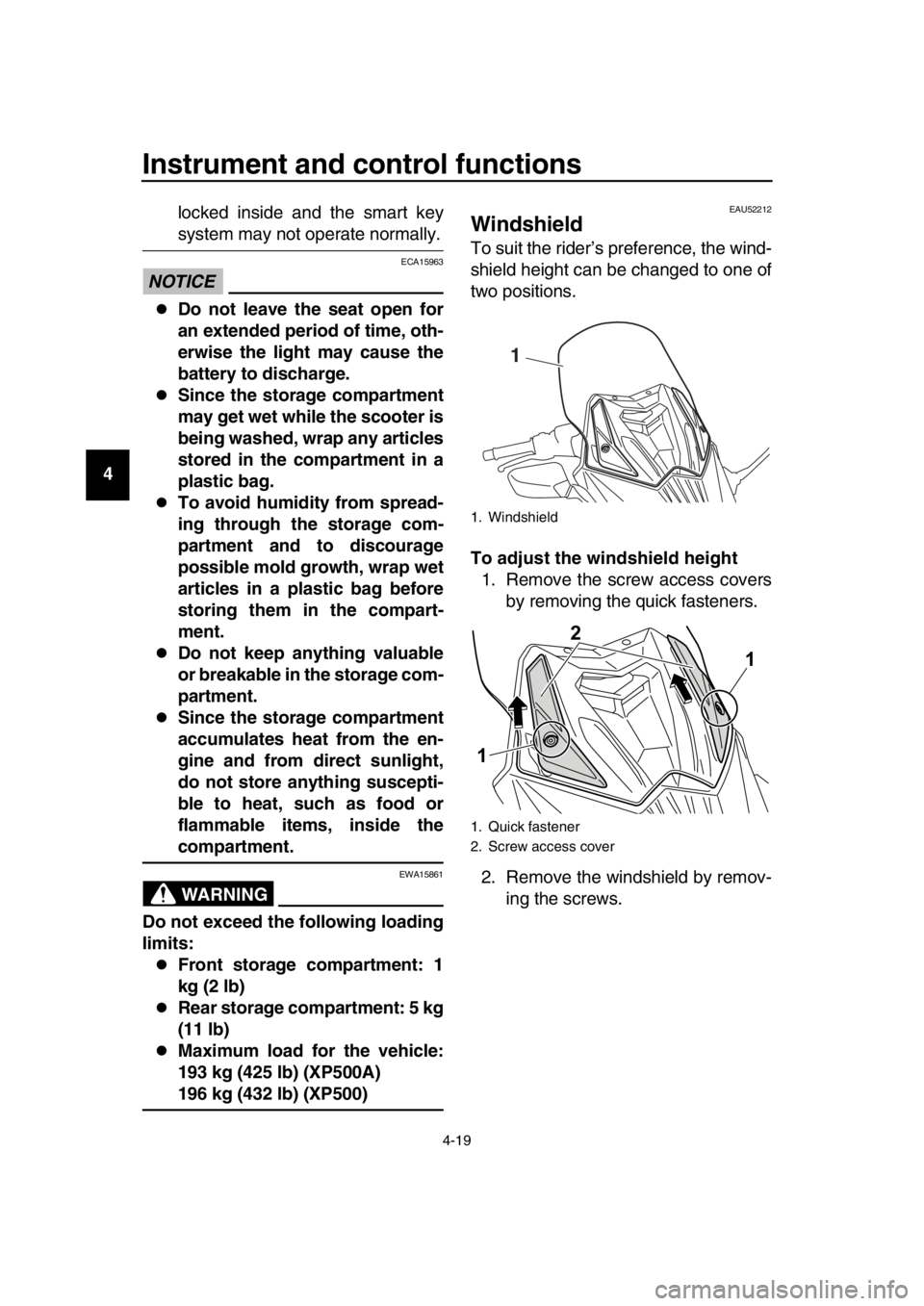
To suit the rider’s preference, the wind-
shield height can be changed to one of
two positions.
To adjust the windshield height
1. Remove the screw access covers by removing the quick fasteners.
2. Remove the windshield by remov- ing the screws.
1. Windshield
1. Quick fastener
2. Screw access cover
1
1
2
1
2PW-9-E1.book 19 ページ 2015年9月10日 木曜日 午後5時17分
Page 49 of 110
Instrument and control functions
4-24
1
2
3
4
5
6
7
8
9
10
11
12
13
14
EAU49453
Auxiliary DC jack
WARNING
EWA14361
To prevent electrical shock or short-
circuiting, make sure that the cap is
installed when the auxiliary DC jack
is not being used.
NOTICE
ECA15432
The accessory connected to the
auxiliary DC jack should not be used
with the engine turned off, and the
load must never exceed 24 W (2 A),
otherwise the fuse may blow or the
battery may discharge.
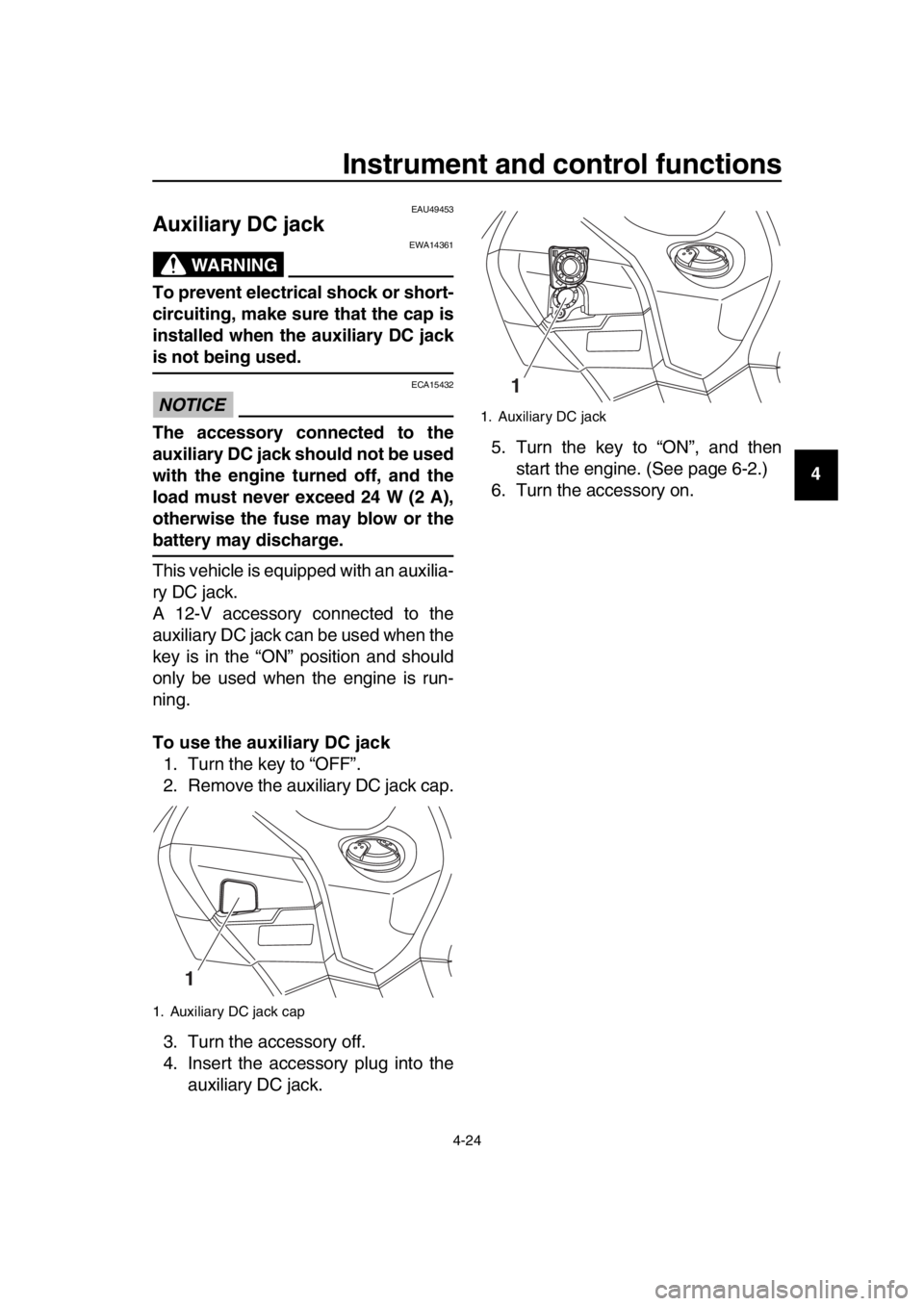
This vehicle is equipped with an auxilia-
ry DC jack.
A 12-V accessory connected to the
auxiliary DC jack can be used when the
key is in the “ON” position and should
only be used when the engine is run-
ning.
To use the auxiliary DC jack 1. Turn the key to “OFF”.
2. Remove the auxiliary DC jack cap.
3. Turn the accessory off.
4. Insert the accessory plug into the auxiliary DC jack. 5. Turn the key to “ON”, and then
start the engine. (See page 6-2.)
6. Turn the accessory on.
1. Auxiliary DC jack cap
1
1. Auxiliary DC jack
1
2PW-9-E1.book 24 ページ 2015年9月10日 木曜日 午後5時17分
Page 53 of 110
Operation and important riding points
6-2
1
2
3
4
5
6
7
8
9
10
11
12
13
14
EAU61552
Starting the engine
NOTICE
ECA10251
See page 6-5 for engine break-in in-
structions prior to operating the ve-
hicle for the first time.
In order for the ignition circuit cut-off
system to enable starting, the sides-
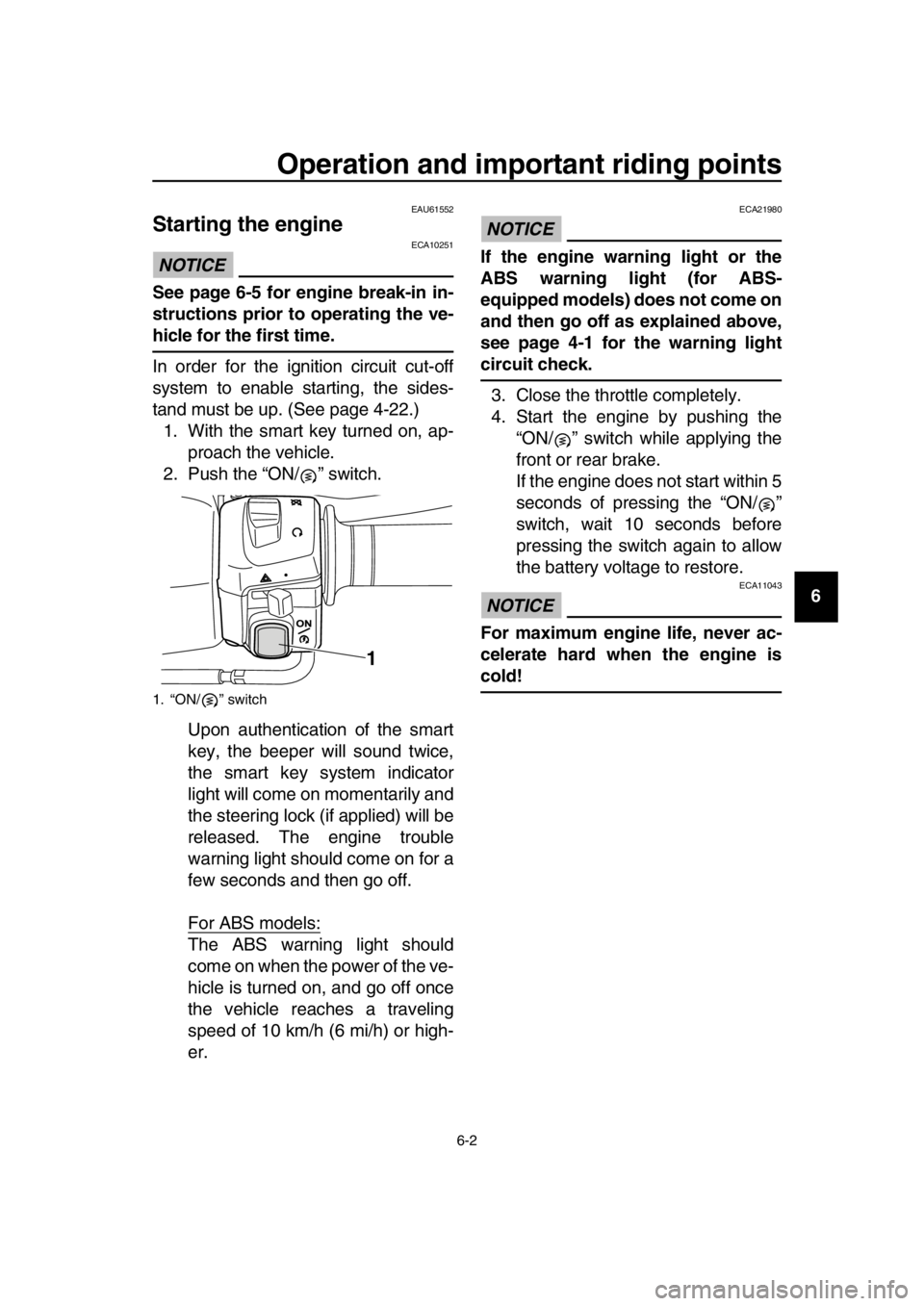
tand must be up. (See page 4-22.) 1. With the smart key turned on, ap- proach the vehicle.
2. Push the “ON/ ” switch.
Upon authentication of the smart
key, the beeper will sound twice,
the smart key system indicator
light will come on momentarily and
the steering lock (if applied) will be
released. The engine trouble
warning light should come on for a
few seconds and then go off.
For ABS models:
The ABS warning light should
come on when the power of the ve-
hicle is turned on, and go off once
the vehicle reaches a traveling
speed of 10 km/h (6 mi/h) or high-
er.
NOTICE
ECA21980
If the engine warning light or the
ABS warning light (for ABS-
equipped models) does not come on
and then go off as explained above,
see page 4-1 for the warning light
circuit check.3. Close the throttle completely.
4. Start the engine by pushing the “ON/ ” switch while applying the
front or rear brake.
If the engine does not start within 5
seconds of pressing the “ON/ ”
switch, wait 10 seconds before
pressing the switch again to allow
the battery voltage to restore.
NOTICE
ECA11043
For maximum engine life, never ac-
celerate hard when the engine is
cold!
1. “ON/ ” switch
1
2PW-9-E1.book 2 ページ 2015年9月10日 木曜日 午後5時17分
Page 57 of 110
Operation and important riding points
6-6
1
2
3
4
5
6
7
8
9
10
11
12
13
14
EAU63740
Parking
When parking, turn the vehicle power
off, and then turn the smart key off.
WARNING
EWA10312
Since the engine and exhaust
system can become very hot,
park in a place where pedestri-
ans or children are not likely to
touch them and be burned.
Do not park on a slope or on soft
ground, otherwise the vehicle
may overturn, increasing the
risk of a fuel leak and fire.
Do not park near grass or other
flammable materials which
might catch fire.
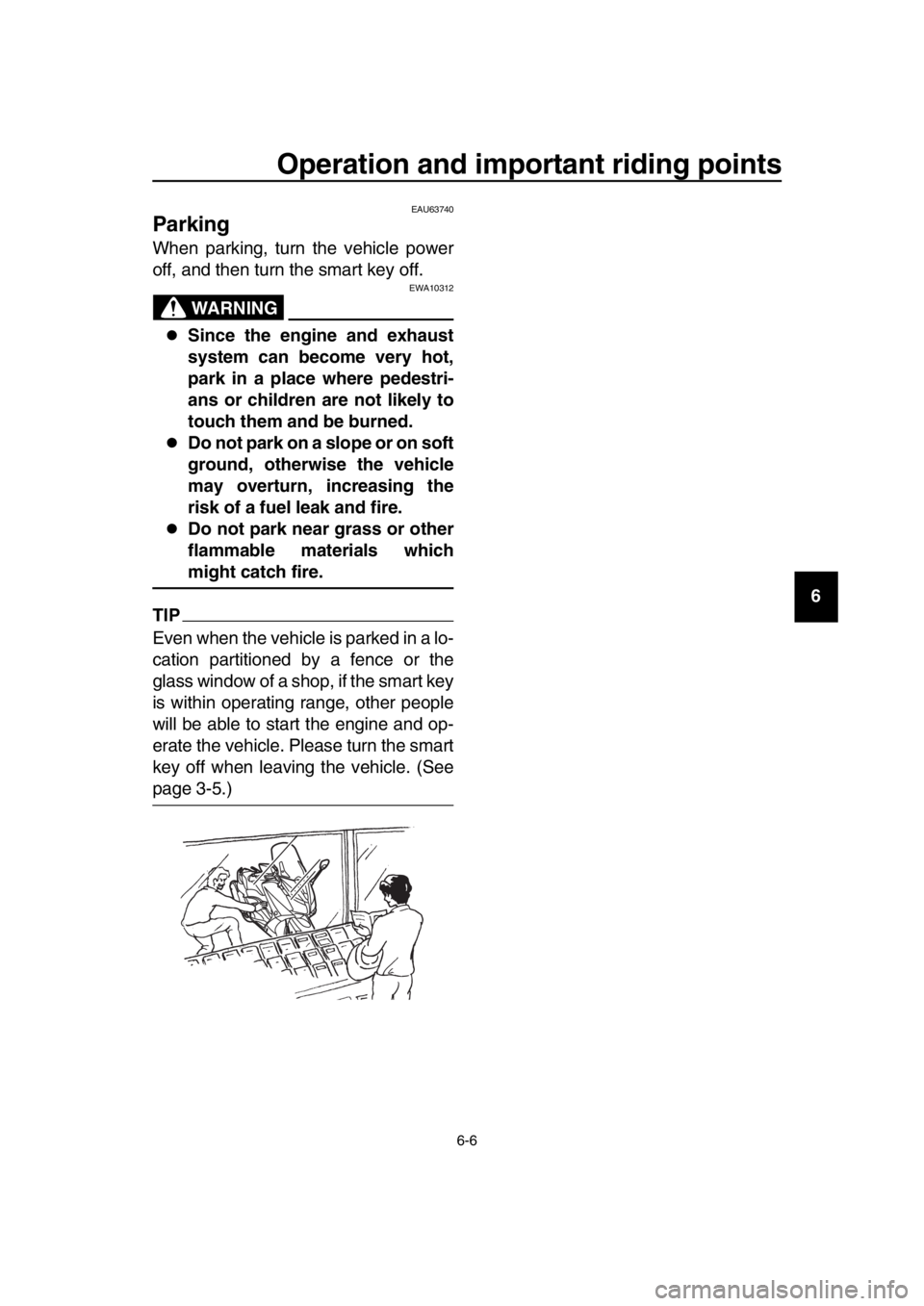
TIP
Even when the vehicle is parked in a lo-
cation partitioned by a fence or the
glass window of a shop, if the smart key
is within operating range, other people
will be able to start the engine and op-
erate the vehicle. Please turn the smart
key off when leaving the vehicle. (See
page 3-5.)
2PW-9-E1.book 6 ページ 2015年9月10日 木曜日 午後5時17分
Page 91 of 110

Periodic maintenance and adjustment
7-34
1
2
3
4
5
6
7
8
9
10
11
12
13
14
EAU24314
Replacing the license plate
light bulb
1. Remove the license plate light unit by removing the screws.
2. Remove the license plate light bulb socket (together with the bulb) by
pulling it out.
3. Remove the burnt-out bulb by pull- ing it out.
4. Insert a new bulb into the socket.
5. Install the socket (together with the bulb) by pushing it in.
6. Install the license plate light unit by installing the screws.
EAU61562
Troubleshooting
Although Yamaha scooters receive a
thorough inspection before shipment
from the factory, trouble may occur dur-
ing operation. Any problem in the fuel,
compression, or ignition systems, for
example, can cause poor starting and
loss of power.
The following troubleshooting charts
represent quick and easy procedures
for checking these vital systems your-
self. However, should your scooter re-
quire any repair, take it to a Yamaha
dealer, whose skilled technicians have
the necessary tools, experience, and
know-how to service the scooter prop-
erly.
Use only genuine Yamaha replace-
ment parts. Imitation parts may look like
Yamaha parts, but they are often inferi-
or, have a shorter service life and can
lead to expensive repair bills.
WARNING
EWA15142
When checking the fuel system, do
not smoke, and make sure there are
no open flames or sparks in the ar-
ea, including pilot lights from water
heaters or furnaces. Gasoline or
gasoline vapors can ignite or ex-
plode, causing severe injury or
property damage.
Smart key system troubleshooting
Please check the following items when
the smart key system does not work.
Is the smart key turned on? (See
page 3-5.)
Is the smart key battery dis-
charged? (See page 3-6.)
Is the smart key battery installed
1. Screw
1. License plate light unit
2. License plate light bulb socket
1
1 2
2PW-9-E1.book 34 ページ 2015年9月10日 木曜日 午後5時17分
Page 92 of 110
Periodic maintenance and adjustment
7-35
1
2
3
4
5
6
7
8
9
10
11
12
13
14 correctly? (See page 3-6.)
Is the smart key being used in a lo-
cation with strong radio waves or
other electromagnetic noise? (See
page 3-1.)
Are you using the smart key that is
registered to the vehicle?
Is the vehicle battery discharged?
When the vehicle battery is dis-
charged, the smart key system will
not operate. Please have the vehi-
cle battery charged or replaced.
(See page 7-28.)
If the smart key system does not work
after checking the above-mentioned
items, have a Yamaha dealer check the
smart key system.
TIP
Refer to emergency mode on page
7-38 on how to start the engine without
using the smart key.
2PW-9-E1.book 35 ページ 2015年9月10日 木曜日 午後5時17分
Page 95 of 110

Periodic maintenance and adjustment
7-38
1
2
3
4
5
6
7
8
9
10
11
12
13
14
EAU61545
Emergency mode
When the smart key is lost, damaged,
or its battery has discharged, the vehi-
cle can still be turned on and the engine
started. You will need a mechanical key
and the smart key system identification
number. (See page 3-3.) To operate
the vehicle in emergency mode, carry
out the following steps.
TIP
Emergency mode operation will be
cancelled if the respective steps are not
carried out within the time set for each
operation or if the “OFF/LOCK” switch
is pushed. 1. Stop the vehicle in a safe place.
2. Unlock the seat by inserting the mechanical key into the lock inside
the front storage compartment and
turn it clockwise.
3. Open the seat and check that the trunk light comes on.
4. Push the “ON/ ” switch once.
5. Without completely shutting the seat, raise and lower it three times
within 10 seconds.
TIP
Use the rear storage compartment light
as a guide when raising and lowering
the seat. The smart key system indicator
light on the speedometer will come
on for three seconds to indicate
the transition to emergency mode.
6. After the smart key system indica- tor light goes off, use the “SEAT
OPEN/ ” switch to enter the
identification number. Refer to the
following procedure on how to in-
put the identification number.
7. Inputting the identification number is done by counting the number of
flashes of the smart key system in-
dicator light.
For example, if the identification
number is 123456:
Push and hold the “SEAT
OPEN/ ” switch.
The smart key system indicator
1. Smart key system indicator light “ ”
1. Identification number
1
1 1
2PW-9-E1.book 38 ページ 2015年9月10日 木曜日 午後5時17分
Page 96 of 110
Periodic maintenance and adjustment
7-39
1
2
3
4
5
6
7
8
9
10
11
12
13
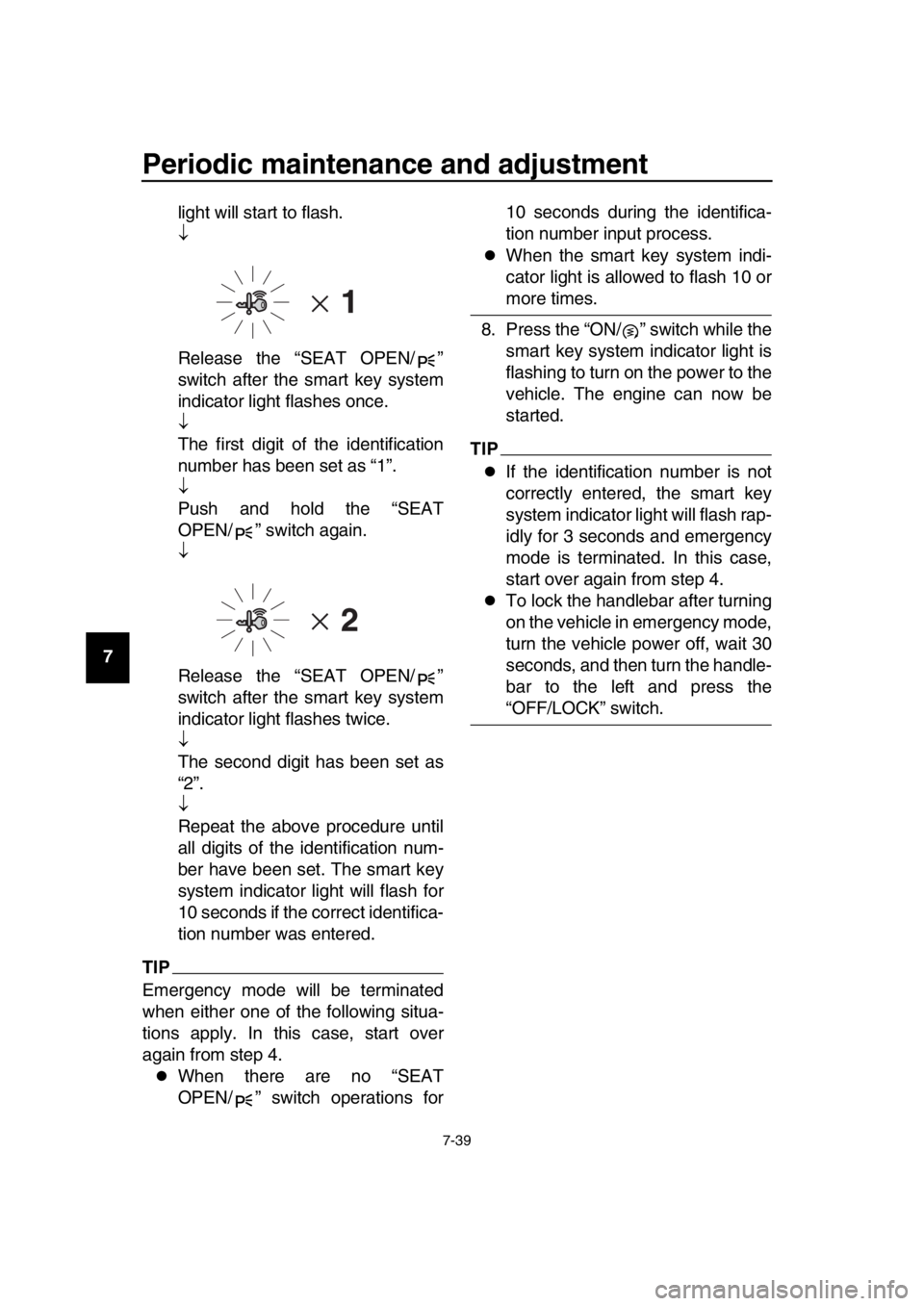
14 light will start to flash.
Release the “SEAT OPEN/ ”
switch after the smart key system
indicator light flashes once.
The first digit of the identification
number has been set as “1”.
Push and hold the “SEAT
OPEN/ ” switch again.
Release the “SEAT OPEN/ ”
switch after the smart key system
indicator light flashes twice.
The second digit has been set as
“2”.
Repeat the above procedure until
all digits of the identification num-
ber have been set. The smart key
system indicator light will flash for
10 seconds if the correct identifica-
tion number was entered.
TIP
Emergency mode will be terminated
when either one of the following situa-
tions apply. In this case, start over
again from step 4.
When there are no “SEAT
OPEN/ ” switch operations for 10 seconds during the identifica-
tion number input process.
When the smart key system indi-
cator light is allowed to flash 10 or
more times.
8. Press the “ON/ ” switch while the smart key system indicator light is
flashing to turn on the power to the
vehicle. The engine can now be
started.
TIP
If the identification number is not
correctly entered, the smart key
system indicator light will flash rap-
idly for 3 seconds and emergency
mode is terminated. In this case,
start over again from step 4.
To lock the handlebar after turning
on the vehicle in emergency mode,
turn the vehicle power off, wait 30
seconds, and then turn the handle-
bar to the left and press the
“OFF/LOCK” switch.
2PW-9-E1.book 39 ページ 2015年9月10日 木曜日 午後5時17分
Page 104 of 110

Specifications
9-3
1
2
3
4
5
6
7
8
9
10
11
12
13
14
Turn signal indicator light: LED
Engine trouble warning light: LED
ABS warning light: LED (XP500A)
Smart key system indicator light:
LED
Fuse(s):
Main fuse:40.0 A
Headlight fuse:
10.0 A
Signaling system fuse: 15.0 A
Ignition fuse: 7.5 A
Parking lighting fuse:
10.0 A
Radiator fan motor fuse: 15.0 A
Fuel injection system fuse: 7.5 A
ABS control unit fuse:
7.5 A (XP500A)
ABS motor fuse: 30.0 A (XP500A)
ABS solenoid fuse: 15.0 A (XP500A)
Auxiliary DC jack fuse:
5.0 A
Backup fuse: 7.5 A
2PW-9-E1.book 3 ページ 2015年9月10日 木曜日 午後5時17分
Page 107 of 110

11-1
1
2
3
4
5
6
7
8
9
10
11
12
13
14
Index
A
ABS (for ABS models) ...........................4-13
ABS warning light (for ABS models)........4-1
Acceleration and deceleration .................6-3
Air filter element, replacing ....................7-15
Auxiliary DC jack ...................................4-24
Auxiliary lights .......................................7-32
B
Battery ...................................................7-28
Brake fluid, changing .............................7-23
Brake fluid level, checking .....................7-22
Brake lever, front ...................................4-11
Brake lever, rear ....................................4-12
Brake levers, lubricating ........................7-25
Braking ....................................................6-4
C
Cables, checking and lubricating...........7-24
Care.........................................................8-1
Catalytic converter.................................4-16
Centerstand and sidestand, checking and lubricating .....................7-26
Coolant ..................................................7-13
D
Dimmer switch .......................................4-10
Drive belt slack ......................................7-24
E
Emergency mode ..................................7-38
Engine break-in .......................................6-5
Engine idling speed ...............................7-16
Engine oil and oil filter cartridge ............7-10
Engine serial number ............................10-1
Engine stop switch ................................4-10
Engine trouble warning light ....................4-1
F
Front and rear brake lever free play,
checking ..............................................7-20
Front and rear brake pads, checking.....7-22
Front fork, checking ...............................7-26
Fuel .......................................................4-15
Fuel consumption, tips for reducing ........6-5
Fuel tank cap .........................................4-14
Fuses, replacing ....................................7-29
H
Handlebar switches ...............................4-10
Hazard switch ........................................4-10
Headlights .............................................7-31
Helmet holder ........................................4-17
High beam indicator light .........................4-1
Horn switch............................................4-10
How to lock the steering ........................3-10
I
Identification numbers ........................... 10-1
Ignition circuit cut-off system................. 4-22
Indicator lights and warning lights ........... 4-1
K
Key, handling of smart and mechanical
key ........................................................ 3-3
L
License plate light bulb, replacing ......... 7-34
M
Maintenance and lubrication, periodic .... 7-4
Maintenance, emission control system ... 7-3
Matte color, caution................................. 8-1
Model label............................................ 10-2
Multi-function display .............................. 4-3
O
ON/Start switch ..................................... 4-10
Operating range of the smart key system .................................................. 3-2
P
Panels, removing and installing .............. 7-7
Parking .................................................... 6-6
Parking mode ........................................ 3-11
Part locations .......................................... 2-1
Pass switch ........................................... 4-10
Powering off the vehicle .......................... 3-9
R
Rear brake lock cable, adjusting ........... 7-21
Rear brake lock, checking..................... 7-21
Rear brake lock lever ............................ 4-12
Rear view mirrors .................................. 4-21
Rider backrest, adjusting ...................... 4-17
S
Safe-riding points .................................... 1-5
Safety information ................................... 1-1
Seat opening and closing...................... 3-10
Shock absorber assembly..................... 4-21
Sidestand .............................................. 4-22
Smart key ................................................ 3-5
Smart key battery, replacing ................... 3-6
Smart key system ................................... 3-1
Smart key system indicator light ............. 4-2
Spark plugs, checking ............................. 7-9
Specifications .......................................... 9-1
Speedometer .......................................... 4-2
Starting off............................................... 6-3
Starting the engine .................................. 6-2
Steering, checking ................................ 7-27
Storage ................................................... 8-4
Storage compartments.......................... 4-18
2PW-9-E1.book 1 ページ 2015年9月10日 木曜日 午後5時17分