wheel YAMAHA XSR 900 2022 Owner's Manual
[x] Cancel search | Manufacturer: YAMAHA, Model Year: 2022, Model line: XSR 900, Model: YAMAHA XSR 900 2022Pages: 114, PDF Size: 4.36 MB
Page 44 of 114
Instrument and control functions
4-21
1
2
34
5
6
7
8
9
10
11
12
13
EAU12944
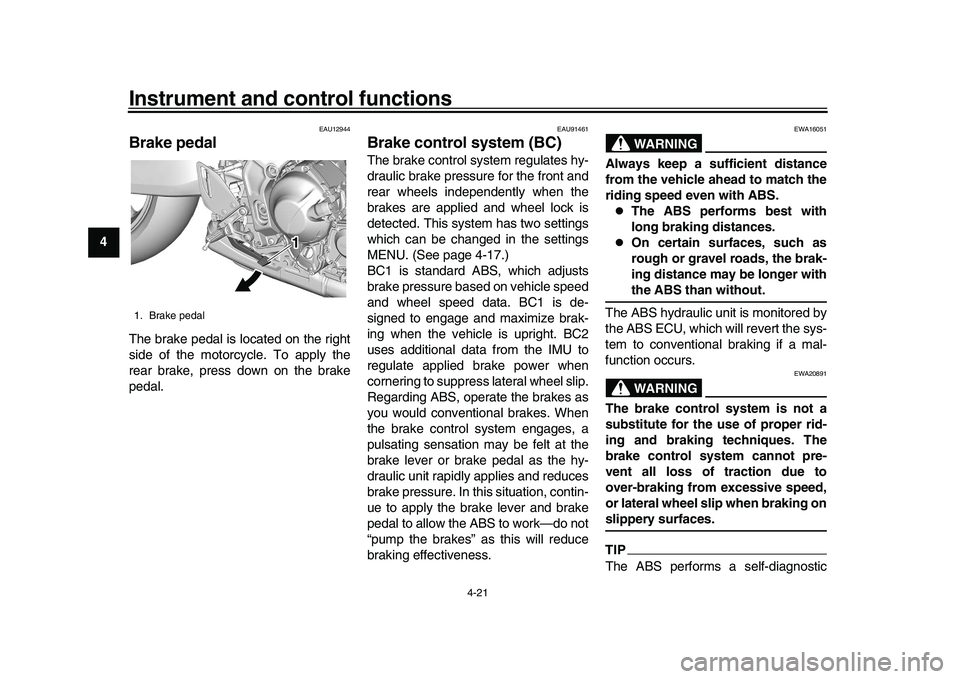
Brake pedalThe brake pedal is located on the right
side of the motorcycle. To apply the
rear brake, press down on the brake
pedal.
EAU91461
Brake control system (BC)The brake control system regulates hy-
draulic brake pressure for the front and
rear wheels independently when the
brakes are applied and wheel lock is
detected. This system has two settings
which can be changed in the settings
MENU. (See page 4-17.)
BC1 is standard ABS, which adjusts
brake pressure based on vehicle speed
and wheel speed data. BC1 is de-
signed to engage and maximize brak-
ing when the vehicle is upright. BC2
uses additional data from the IMU to
regulate applied brake power when
cornering to suppress lateral wheel slip.
Regarding ABS, operate the brakes as
you would conventional brakes. When
the brake control system engages, a
pulsating sensation may be felt at the
brake lever or brake pedal as the hy-
draulic unit rapidly applies and reduces
brake pressure. In this situation, contin-
ue to apply the brake lever and brake
pedal to allow the ABS to work—do not
“pump the brakes” as this will reduce
braking effectiveness.
WARNING
EWA16051
Always keep a sufficient distance
from the vehicle ahead to match the
riding speed even with ABS.
The ABS performs best with
long braking distances.
On certain surfaces, such as
rough or gravel roads, the brak-
ing distance may be longer withthe ABS than without.
The ABS hydraulic unit is monitored by
the ABS ECU, which will revert the sys-
tem to conventional braking if a mal-
function occurs.WARNING
EWA20891
The brake control system is not a
substitute for the use of proper rid-
ing and braking techniques. The
brake control system cannot pre-
vent all loss of traction due to
over-braking from excessive speed,
or lateral wheel slip when braking onslippery surfaces.TIPThe ABS performs a self-diagnostic
1. Brake pedal
11 1 1
BEA-28199-E0.book 21 ページ 2021年12月1日 水曜日 午後7時8分
Page 45 of 114
Instrument and control functions
4-22
1
2
345
6
7
8
9
10
11
12
13
test when the vehicle is started and
reaches a speed of 5 km/h (3 mi/h).
During this test, a clicking noise may be
audible from the hydraulic control unit,
and a vibration may be felt at the brake
lever or pedal, but this is normal.NOTICE
ECA20100
Be careful not to damage the wheel
sensor or wheel sensor rotor; other-
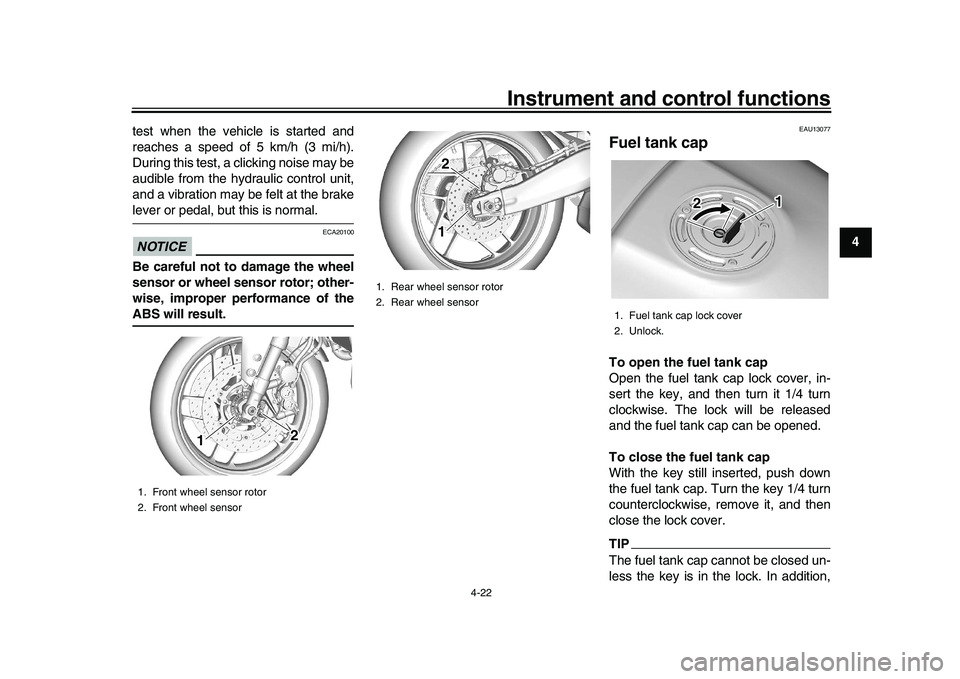
wise, improper performance of theABS will result.
EAU13077
Fuel tank capTo open the fuel tank cap
Open the fuel tank cap lock cover, in-
sert the key, and then turn it 1/4 turn
clockwise. The lock will be released
and the fuel tank cap can be opened.
To close the fuel tank cap
With the key still inserted, push down
the fuel tank cap. Turn the key 1/4 turn
counterclockwise, remove it, and then
close the lock cover.TIPThe fuel tank cap cannot be closed un-
less the key is in the lock. In addition,
1. Front wheel sensor rotor
2. Front wheel sensor
111
22
1. Rear wheel sensor rotor
2. Rear wheel sensor
11122
1. Fuel tank cap lock cover
2. Unlock.
1
2
BEA-28199-E0.book 22 ページ 2021年12月1日 水曜日 午後7時8分
Page 58 of 114
For your safety – pre-operation checks
5-2
1
2
3
45
6
7
8
9
10
11
12
13
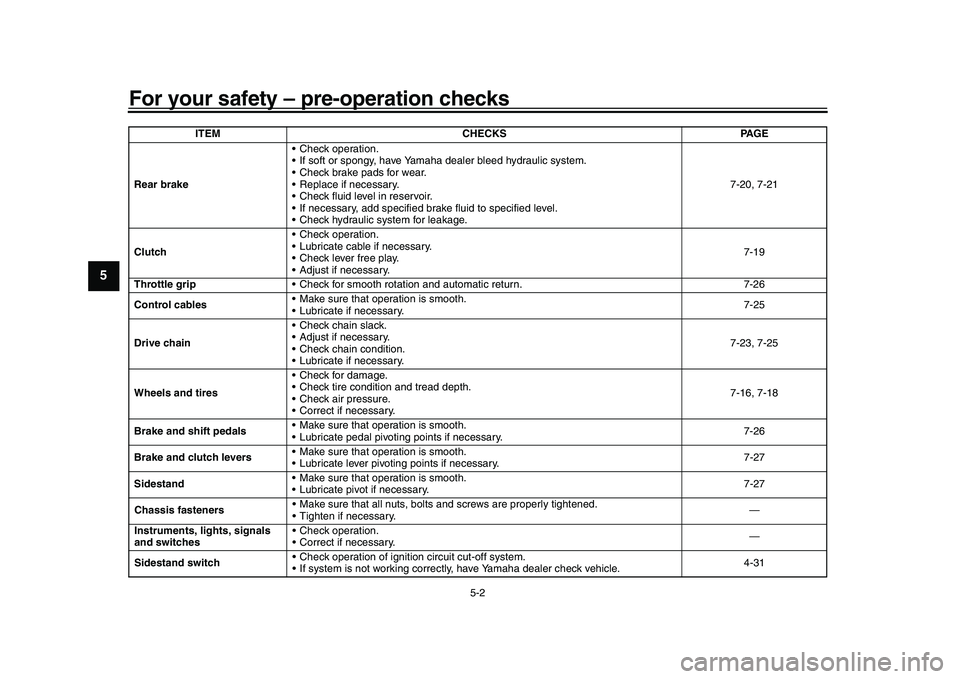
Rear brake Check operation.
If soft or spongy, have Yamaha dealer bleed hydraulic system.
Check brake pads for wear.
Replace if necessary.
Check fluid level in reservoir.
If necessary, add specified brake fluid to specified level.
Check hydraulic system for leakage. 7-20, 7-21
Clutch Check operation.
Lubricate cable if necessary.
Check lever free play.
Adjust if necessary. 7-19
Throttle grip Check for smooth rotation and automatic return. 7-26
Control cables Make sure that operation is smooth.
Lubricate if necessary. 7-25
Drive chain Check chain slack.
Adjust if necessary.
Check chain condition.
Lubricate if necessary. 7-23, 7-25
Wheels and tires Check for damage.
Check tire condition and tread depth.
Check air pressure.
Correct if necessary. 7-16, 7-18
Brake and shift pedals Make sure that operation is smooth.
Lubricate pedal pivoting points if necessary. 7-26
Brake and clutch levers Make sure that operation is smooth.
Lubricate lever pivoting points if necessary. 7-27
Sidestand Make sure that operation is smooth.
Lubricate pivot if necessary. 7-27
Chassis fasteners Make sure that all nuts, bolts
and screws are properly tightened.
Tighten if necessary. —
Instruments, lights, signals
and switches Check operation.
Correct if necessary.
—
Sidestand switch Check operation of ignition circuit cut-off system.
If system is not working correctly, have Yamaha dealer check vehicle. 4-31
ITEM CHECKS PAGE
BEA-28199-E0.book 2 ページ 2021年12月1日 水曜日 午後7時8分
Page 62 of 114
Operation and important riding points
6-4
1
2
3
4
56
7
8
9
10
11
12
13 lever slowly.
4. After starting out, close the throttle, and at the same time, quickly pull
the clutch lever in.
5. Shift the transmission into second gear. (Make sure not to shift the
transmission into the neutral posi-
tion.)
6. Open the throttle part way and gradually release the clutch lever.
7. Follow the same procedure when shifting to the next higher gear.
EAU85380
To decelerate1. Release the throttle and apply both the front and the rear brakes
smoothly to slow the motorcycle.
2. As the vehicle decelerates, shift to a lower gear.
3. When the engine is about to stall or runs roughly, pull the clutch le-
ver in, use the brakes to slow the
motorcycle, and continue to down-
shift as necessary.
4. Once the motorcycle has stopped, the transmission can be shifted
into the neutral position. The neu-
tral indicator light should come on and then the clutch lever can be
released.
WARNING
EWA17380
Improper braking can cause
loss of control or traction. Al-
ways use both brakes and apply
them smoothly.
Make sure that the motorcycle
and the engine have sufficiently
slowed before shifting to a low-
er gear. Engaging a lower gear
when the vehicle or engine
speed is too high could make
the rear wheel lose traction or
the engine to over-rev. This
could cause loss of control, an
accident and injury. It could also
cause engine or drive train dam-age.
EAU16811
Tips for reducing fuel
consumptionFuel consumption depends largely on
your riding style. Consider the following
tips to reduce fuel consumption:
Shift up swiftly, and avoid high en-
gine speeds during acceleration.
Do not rev the engine while shifting
down, and avoid high engine
speeds with no load on the engine.
Turn the engine off instead of let-
ting it idle for an extended length of
time (e.g., in traffic jams, at traffic
lights or at railroad crossings).
BEA-28199-E0.book 4 ページ 2021年12月1日 水曜日 午後7時8分
Page 67 of 114
Periodic maintenance and adjustment
7-4
1
2
3
4
5
678
9
10
11
12
13
EAU71353
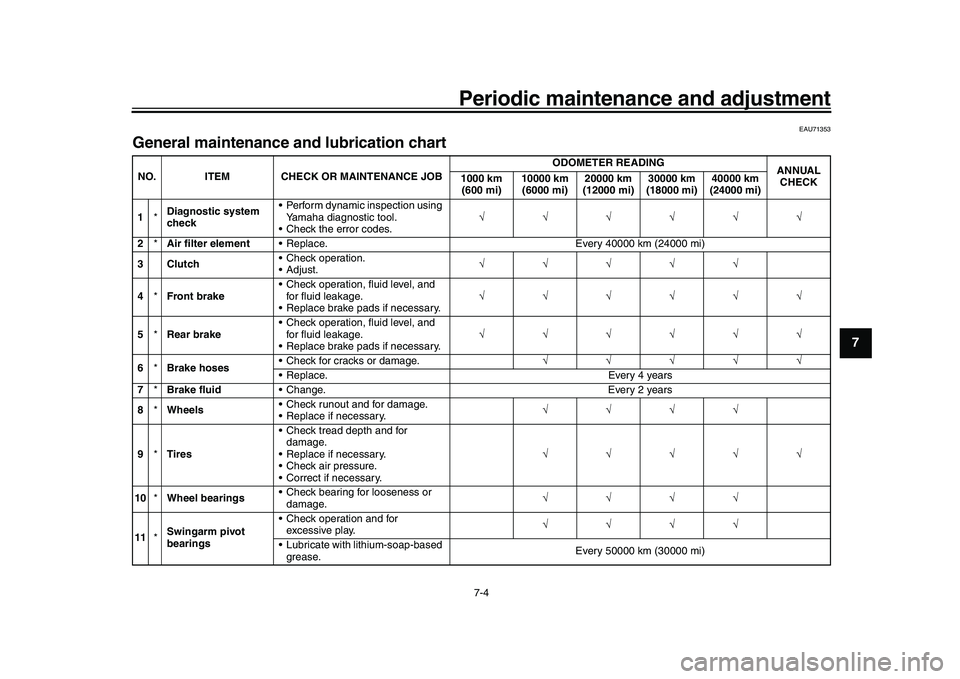
General maintenance an d lubrication chartNO. ITEM CHECK OR MAINTENANCE JOB ODOMETER READING
ANNUAL
CHECK
1000 km
(600 mi) 10000 km
(6000 mi) 20000 km
(12000 mi) 30000 km
(18000 mi) 40000 km
(24000 mi)
1 *Diagnostic system
check Perform dynamic inspection using
Yamaha diagnostic tool.
Check the error codes.
2 *Air filter element Replace. Every 40000 km (24000 mi)
3Clutch Check operation.
Adjust.
4 *Front brake Check operation, fluid level, and
for fluid leakage.
Replace brake pads if necessary.
5 *Rear brake Check operation, fluid level, and
for fluid leakage.
Replace brake pads if necessary.
6 *Brake hoses Check for cracks or damage.
Replace. Every 4 years
7 *Brake fluid Change. Every 2 years
8 *Wheels Check runout and for damage.
Replace if necessary.
9 *Tires Check tread depth and for
damage.
Replace if necessary.
Check air pressure.
Correct if necessary.
10 *Wheel bearings Check bearing for looseness or
damage.
11 *Swingarm pivot
bearings Check operation and for
excessive play.
Lubricate with lithium-soap-based grease. Every 50000 km (30000 mi)
BEA-28199-E0.book 4 ページ 2021年12月1日 水曜日 午後7時8分
Page 80 of 114
Periodic maintenance and adjustment
7-17
1
2
3
4
5
67
8
9
10
11
12
13
WARNING
EWA10472
Have a Yamaha dealer replace
excessively worn tires. Besides
being illegal, operating the vehi-
cle with excessively worn tires
decreases riding stability and
can lead to loss of control.
The replacement of all wheel
and brake-related parts, includ-
ing the tires, should be left to a
Yamaha dealer, who has the
necessary professional knowl-
edge and experience to do so.
Ride at moderate speeds after
changing a tire since the tire
surface must first be “broken
in” for it to develop its optimalcharacteristics. Tire information
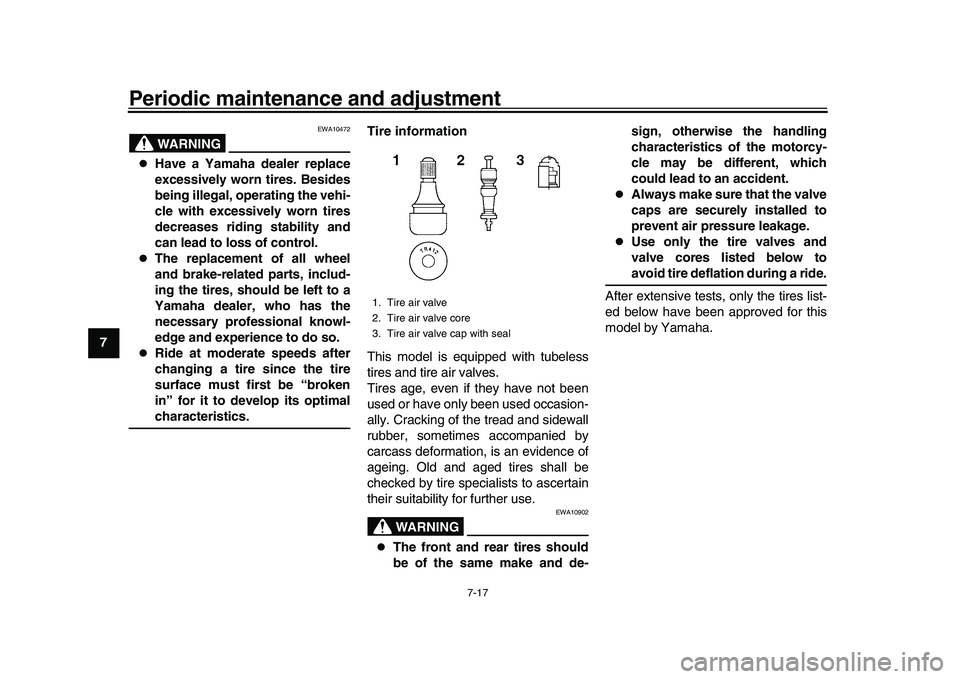
This model is equipped with tubeless
tires and tire air valves.
Tires age, even if they have not been
used or have only been used occasion-
ally. Cracking of the tread and sidewall
rubber, sometimes accompanied by
carcass deformation, is an evidence of
ageing. Old and aged tires shall be
checked by tire specialists to ascertain
their suitability for further use.
WARNING
EWA10902
The front and rear tires should
be of the same make and de- sign, otherwise the handling
characteristics of the motorcy-
cle may be different, which
could lead to an accident.
Always make sure that the valve
caps are securely installed to
prevent air pressure leakage.
Use only the tire valves and
valve cores listed below toavoid tire deflation during a ride.
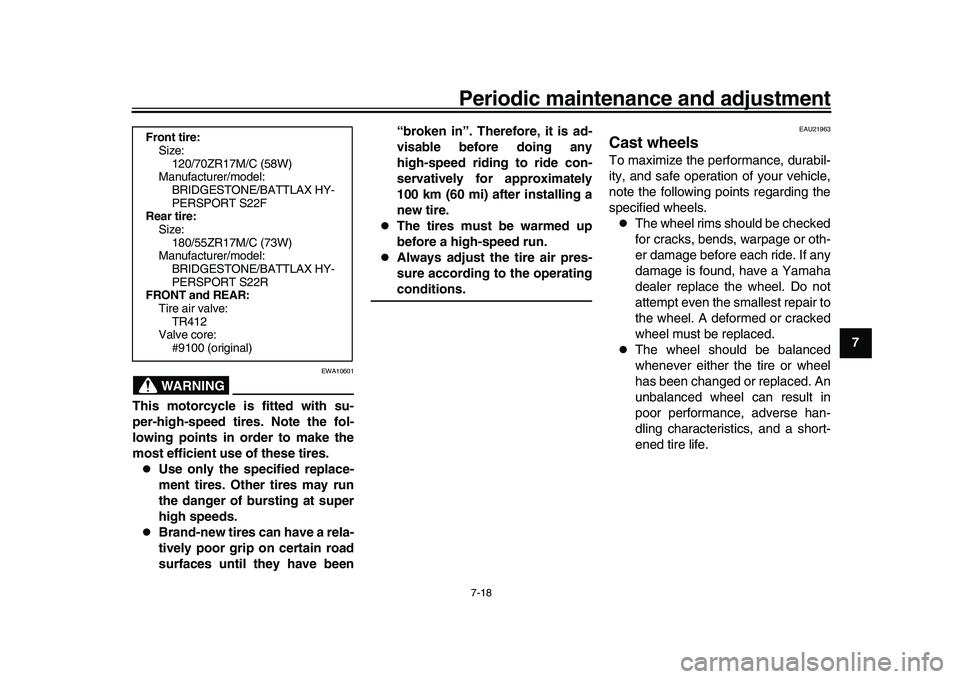
After extensive tests, only the tires list-
ed below have been approved for this
model by Yamaha.
1. Tire air valve
2. Tire air valve core
3. Tire air valve cap with seal
BEA-28199-E0.book 17 ページ 2021年12月1日 水曜日 午後7時8分
Page 81 of 114
Periodic maintenance and adjustment7-18
1
2
3
4
5
678
9
10
11
12
13
WARNING
EWA10601
This motorcycle is fitted with su-
per-high-speed tires. Note the fol-
lowing points in order to make the
most efficient use of these tires.
Use only the specified replace-
ment tires. Other tires may run
the danger of bursting at super
high speeds.
Brand-new tires can have a rela-
tively poor grip on certain road
surfaces until they have been “broken in”. Therefore, it is ad-
visable before doing any
high-speed riding to ride con-
servatively for approximately
100 km (60 mi) after installing a
new tire.
The tires must be warmed up
before a high-speed run.
Always adjust the tire air pres-
sure according to the operatingconditions.
EAU21963
Cast wheelsTo maximize the performance, durabil-
ity, and safe operation of your vehicle,
note the following points regarding the
specified wheels.
The wheel rims should be checked
for cracks, bends, warpage or oth-
er damage before each ride. If any
damage is found, have a Yamaha
dealer replace the wheel. Do not
attempt even the smallest repair to
the wheel. A deformed or cracked
wheel must be replaced.
The wheel should be balanced
whenever either the tire or wheel
has been changed or replaced. An
unbalanced wheel can result in
poor performance, adverse han-
dling characteristics, and a short-
ened tire life.
Front tire:
Size: 120/70ZR17M/C (58W)
Manufacturer/model:
BRIDGESTONE/BATTLAX HY-
PERSPORT S22F
Rear tire:
Size: 180/55ZR17M/C (73W)
Manufacturer/model:
BRIDGESTONE/BATTLAX HY-
PERSPORT S22R
FRONT and REAR:
Tire air valve: TR412
Valve core:
#9100 (original)
BEA-28199-E0.book 18 ページ 2021年12月1日 水曜日 午後7時8分
Page 87 of 114
Periodic maintenance and adjustment7-24
1
2
3
4
5
678
9
10
11
12
13
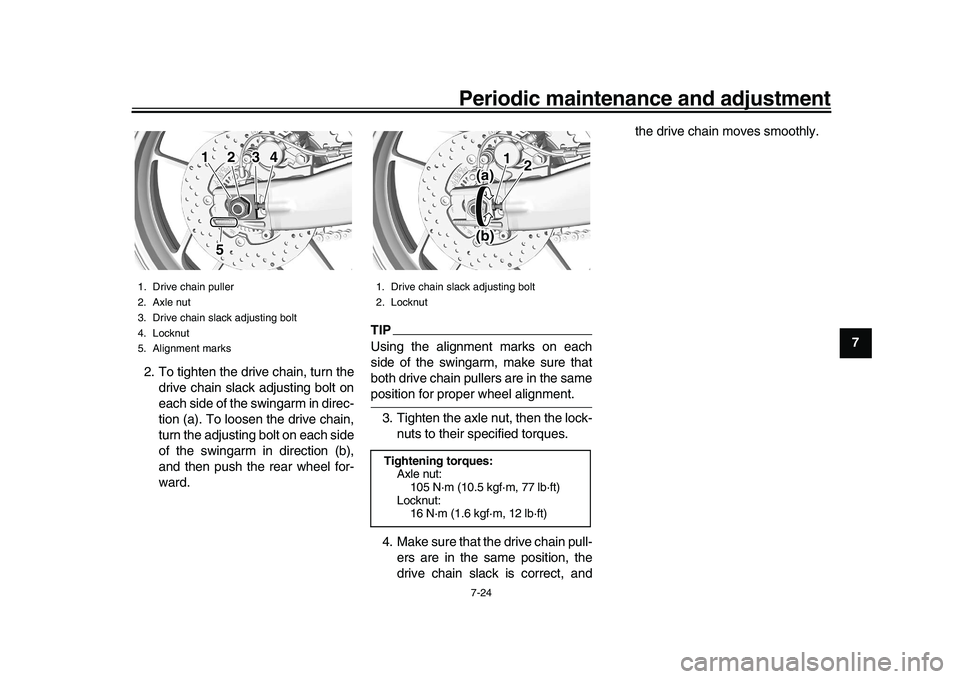
2. To tighten the drive chain, turn the
drive chain slack adjusting bolt on
each side of the swingarm in direc-
tion (a). To loosen the drive chain,
turn the adjusting bolt on each side
of the swingarm in direction (b),
and then push the rear wheel for-
ward.
TIPUsing the alignment marks on each
side of the swingarm, make sure that
both drive chain pullers are in the sameposition for proper wheel alignment.
3. Tighten the axle nut, then the lock- nuts to their specified torques.
4. Make sure that the drive chain pull- ers are in the same position, the
drive chain slack is correct, and the drive chain moves smoothly.
1. Drive chain puller
2. Axle nut
3. Drive chain slack adjusting bolt
4. Locknut
5. Alignment marks
5
3
1
2
4
1. Drive chain slack adjusting bolt
2. LocknutTightening torques:
Axle nut:105 N·m (10.5 kgf·m, 77 lb·ft)
Locknut: 16 N·m (1.6 kgf·m, 12 lb·ft)
(a) 1
2
(b)
BEA-28199-E0.book 24 ページ 2021年12月1日 水曜日 午後7時8分
Page 92 of 114
Periodic maintenance and adjustment
7-29
1
2
3
4
5
67
8
9
10
11
12
13
EAU23285
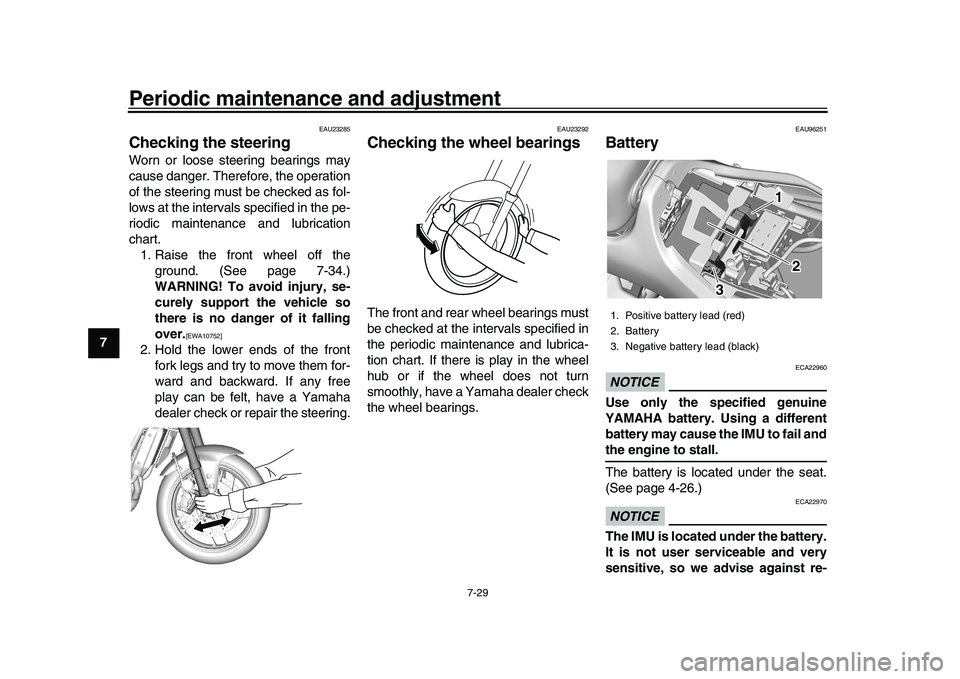
Checking the steeringWorn or loose steering bearings may
cause danger. Therefore, the operation
of the steering must be checked as fol-
lows at the intervals specified in the pe-
riodic maintenance and lubrication
chart. 1. Raise the front wheel off the ground. (See page 7-34.)
WARNING! To avoid injury, se-
curely support the vehicle so
there is no danger of it falling
over.
[EWA10752]
2. Hold the lower ends of the frontfork legs and try to move them for-
ward and backward. If any free
play can be felt, have a Yamaha
dealer check or repair the steering.
EAU23292
Checking the w heel bearingsThe front and rear wheel bearings must
be checked at the intervals specified in
the periodic maintenance and lubrica-
tion chart. If there is play in the wheel
hub or if the wheel does not turn
smoothly, have a Yamaha dealer check
the wheel bearings.
EAU96251
BatteryNOTICE
ECA22960
Use only the specified genuine
YAMAHA battery. Using a different
battery may cause the IMU to fail andthe engine to stall.
The battery is located under the seat.
(See page 4-26.)NOTICE
ECA22970
The IMU is located under the battery.
It is not user serviceable and very
sensitive, so we advise against re-1. Positive battery lead (red)
2. Battery
3. Negative battery lead (black)
1 1 1
2 2
3 3
BEA-28199-E0.book 29 ページ 2021年12月1日 水曜日 午後7時8分
Page 97 of 114
Periodic maintenance and adjustment7-34
1
2
3
4
5
678
9
10
11
12
13
EAU80380
Vehicle lightsExcept for the license plate light bulb,
this model’s lights are all LED.
If an LED light does not come on, check
the fuses and then have a Yamaha
dealer check the vehicle. If the license
plate light does not come on, check and
replace the bulb. (See page 7-34.)NOTICE
ECA16581
Do not affix any type of tinted film orstickers to the headlight lens.
EAU24331
License plate lightIf the license plate light does not come
on, have a Yamaha dealer check the
electrical circuit or replace the bulb.
EAU67131
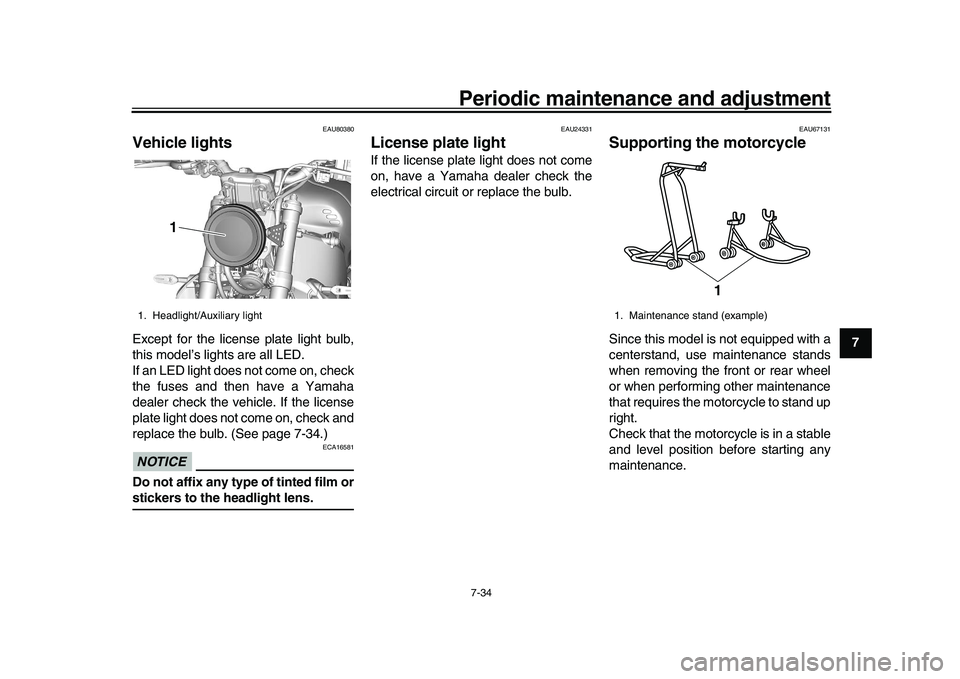
Supporting the motorcycleSince this model is not equipped with a
centerstand, use maintenance stands
when removing the front or rear wheel
or when performing other maintenance
that requires the motorcycle to stand up
right.
Check that the motorcycle is in a stable
and level position before starting any
maintenance.
1. Headlight/Auxiliary light
1 1 1
1. Maintenance stand (example)
1
BEA-28199-E0.book 34 ページ 2021年12月1日 水曜日 午後7時8分