engine ACURA NSX 1991 Service Repair Manual
[x] Cancel search | Manufacturer: ACURA, Model Year: 1991, Model line: NSX, Model: ACURA NSX 1991Pages: 1640, PDF Size: 60.48 MB
Page 966 of 1640
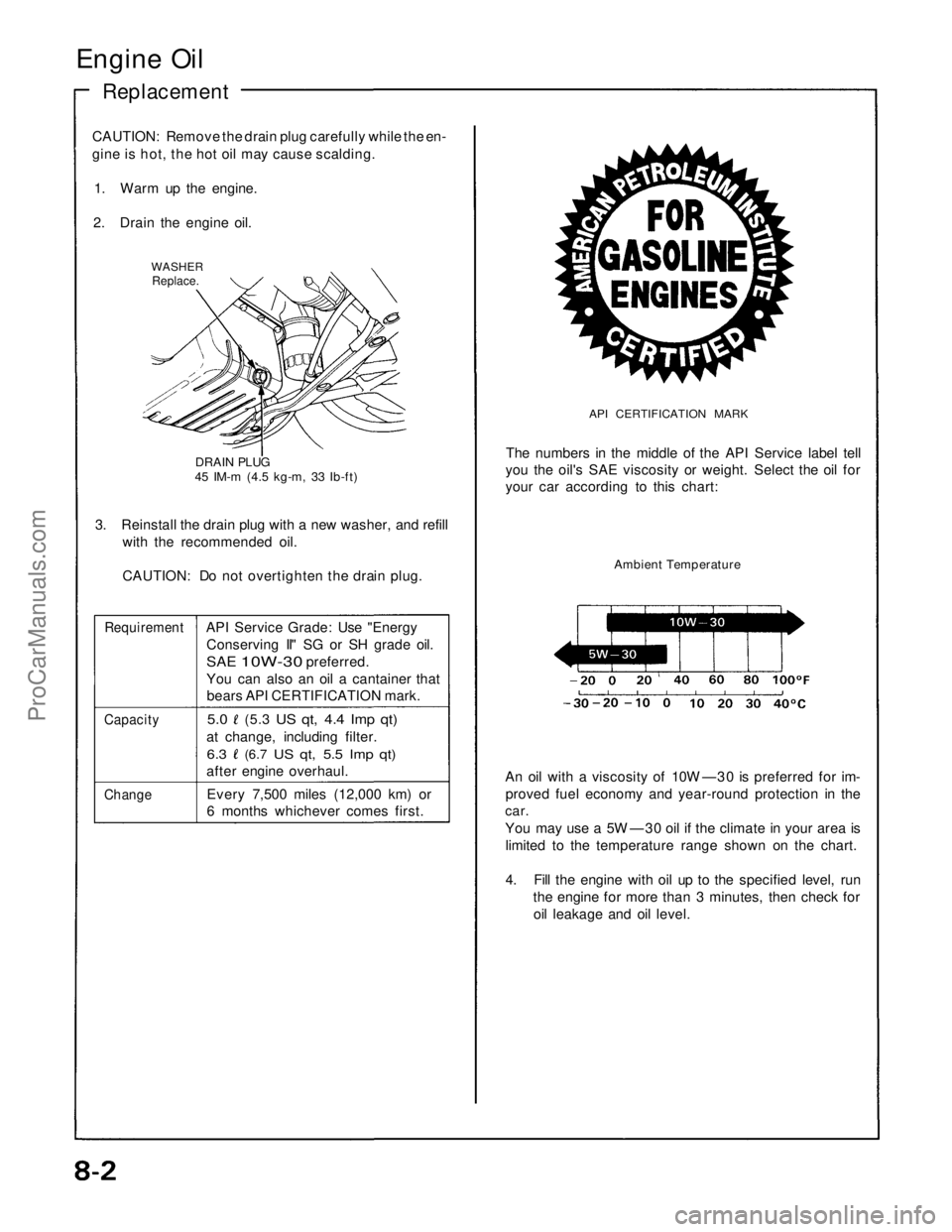
Engine Oil
Replacement
CAUTION: Remove the drain plug carefully while the en-
gine is hot, the hot oil may cause scalding.
1. Warm up the engine.
2. Drain the engine oil.
WASHER
Replace.
DRAIN PLUG
45 IM-m (4.5 kg-m, 33 Ib-ft)
3. Reinstall the drain plug with a new washer, and refill
with the recommended oil.
CAUTION: Do not overtighten the drain plug.
Requirement
API Service Grade: Use "Energy
Conserving II" SG or SH grade oil.
SAE
10W-30
preferred.
You can also an oil a cantainer that
bears API CERTIFICATION mark.
Capacity
5.0
(5.3
US qt, 4.4 Imp qt)
at change, including filter.
6.3
(6.7
US qt, 5.5 Imp qt)
after engine overhaul.
Change
Every 7,500 miles (12,000 km) or
6 months whichever comes first.
API CERTIFICATION MARK
The numbers in the middle of the API Service label tell
you the oil's SAE viscosity or weight. Select the oil for
your car according to this chart:
Ambient Temperature
An oil with a viscosity of 10W —30 is preferred for im-
proved fuel economy and year-round protection in the
car.
You may use a 5W —30 oil if the climate in your area is
limited to the temperature range shown on the chart.
4. Fill the engine with oil up to the specified level, run
the engine for more than 3 minutes, then check for
oil leakage and oil level.ProCarManuals.com
Page 968 of 1640
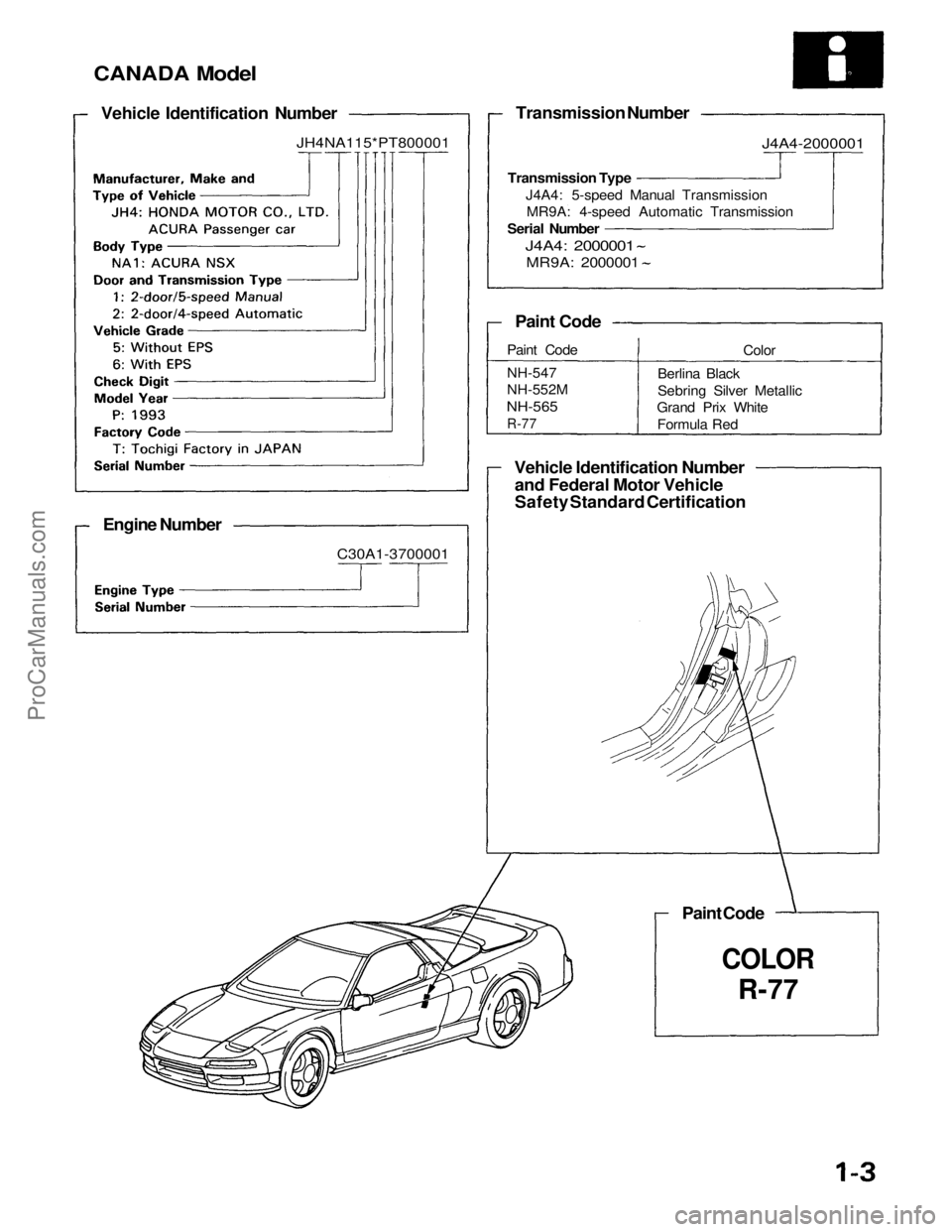
CANADA Model
Vehicle Identification Number
JH4NA115*PT800001
Engine Number
C30A1-3700001
Transmission Number
Transmission Type J4A4: 5-speed Manual TransmissionMR9A: 4-speed Automatic Transmission
Serial Number
J4A4: 2000001
MR9A: 2000001
Paint Code
Paint Code
NH-547
NH-552M
NH-565
R-77
Color
Berlina Black
Sebring Silver Metallic
Grand Prix White
Formula Red
Vehicle Identification Number and Federal Motor Vehicle
Safety Standard Certification
Paint Code
COLOR
R-77
J4A4-2000001ProCarManuals.com
Page 969 of 1640
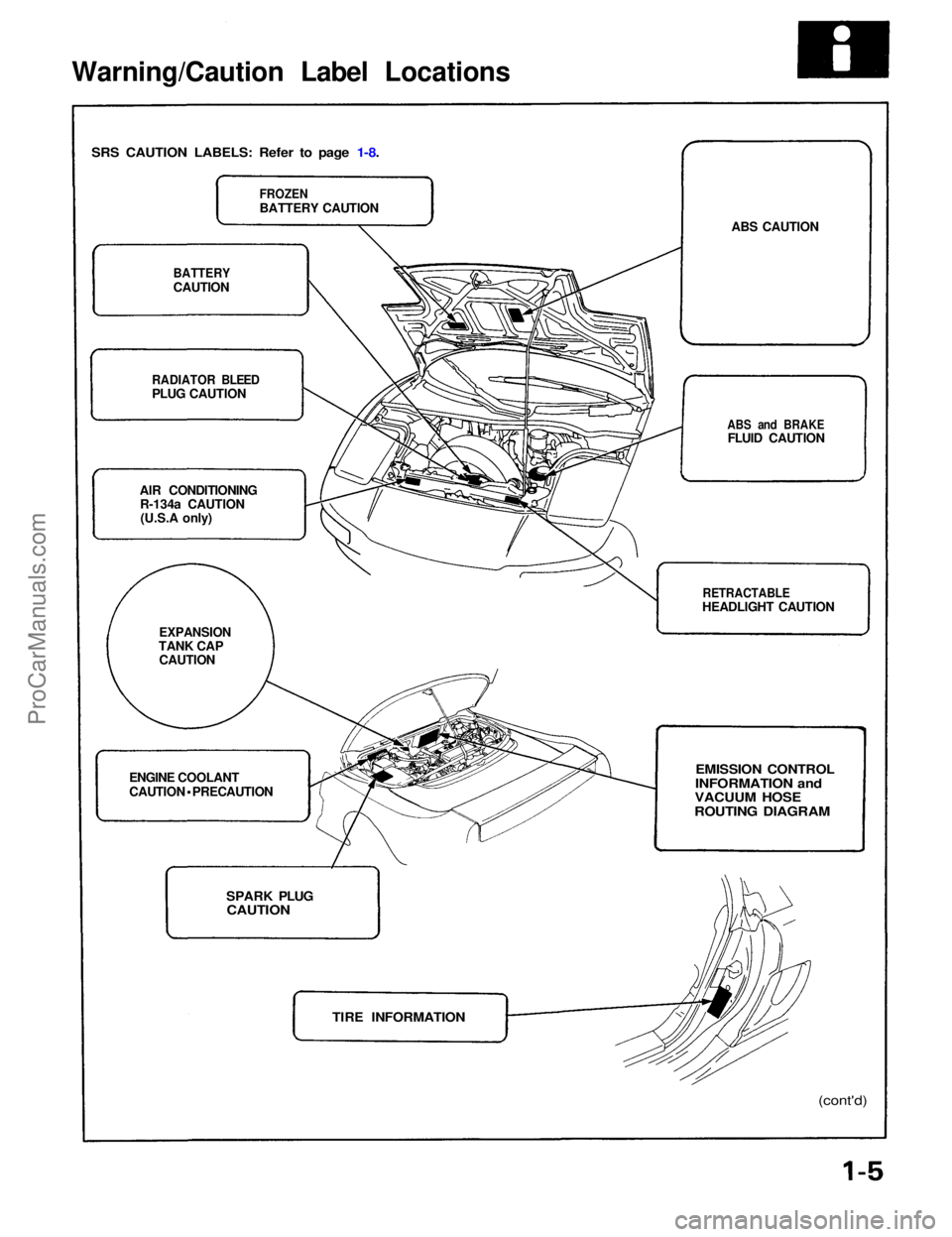
Warning/Caution Label Locations
SRS CAUTION LABELS: Refer to page 1-8.
FROZEN
BATTERY CAUTION
BATTERY
CAUTION
RADIATOR BLEED
PLUG CAUTION
AIR CONDITIONING R-134a CAUTION(U.S.A only)
EXPANSION
TANK CAP CAUTION
ENGINE COOLANT
CAUTION • PRECAUTION
SPARK PLUG
CAUTION
TIRE INFORMATION
EMISSION CONTROL
INFORMATION and
VACUUM HOSE
ROUTING DIAGRAM
RETRACTABLE
HEADLIGHT CAUTION
ABS and BRAKE
FLUID CAUTION ABS CAUTION
(cont'd)ProCarManuals.com
Page 972 of 1640
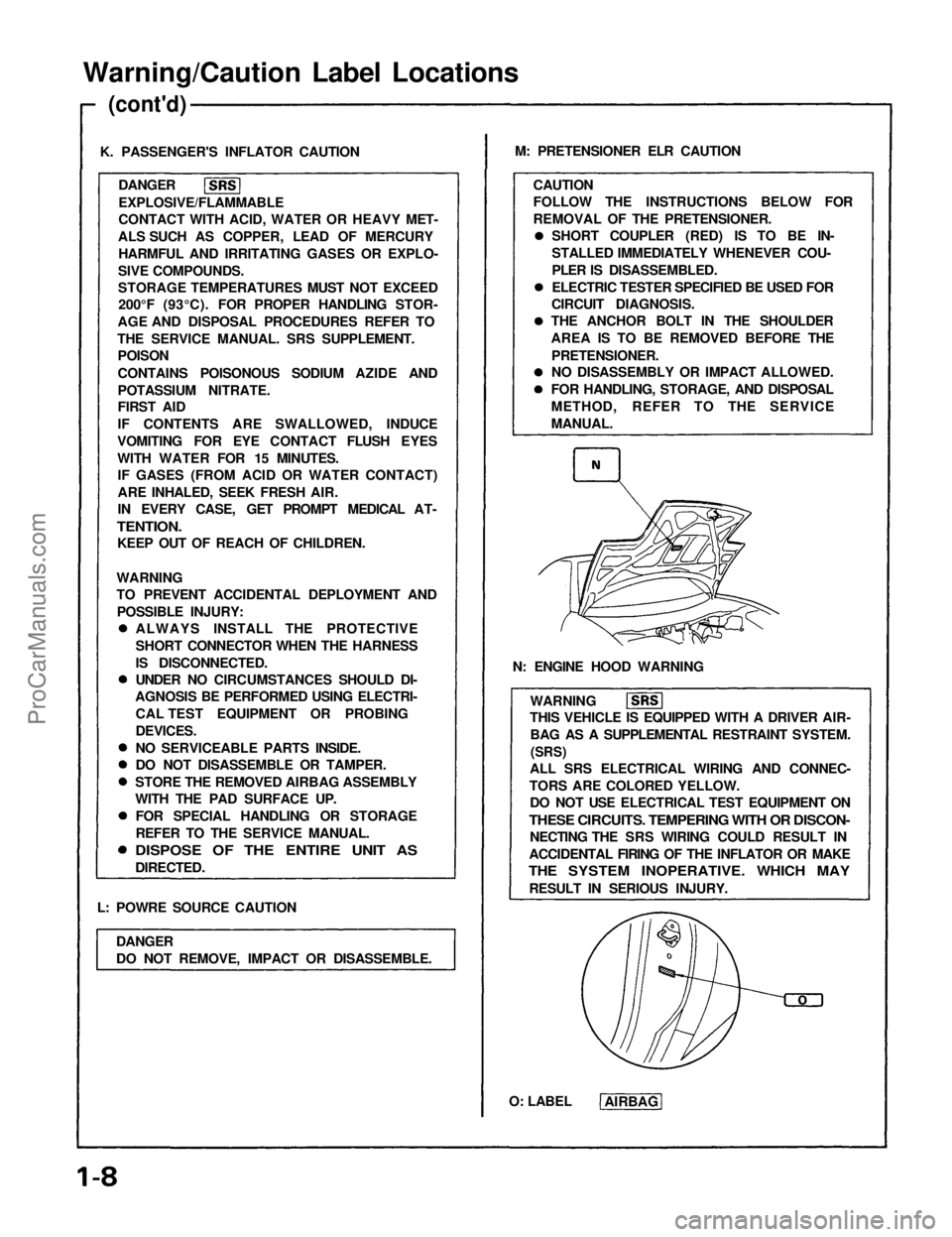
Warning/Caution Label Locations
(cont'd)
K. PASSENGER'S INFLATOR CAUTION DANGER
EXPLOSIVE/FLAMMABLE
CONTACT WITH ACID, WATER OR HEAVY MET-
ALS SUCH AS COPPER, LEAD OF MERCURY HARMFUL AND IRRITATING GASES OR EXPLO-
SIVE COMPOUNDS.
STORAGE TEMPERATURES MUST NOT EXCEED 200°F (93°C). FOR PROPER HANDLING STOR-
AGE AND DISPOSAL PROCEDURES REFER TO
THE SERVICE MANUAL. SRS SUPPLEMENT. POISON
CONTAINS POISONOUS SODIUM AZIDE AND
POTASSIUM NITRATE.
FIRST AID
IF CONTENTS ARE SWALLOWED, INDUCE
VOMITING FOR EYE CONTACT FLUSH EYES
WITH WATER FOR 15 MINUTES. IF GASES (FROM ACID OR WATER CONTACT)
ARE INHALED, SEEK FRESH AIR.
IN EVERY CASE, GET PROMPT MEDICAL AT-
TENTION.
KEEP OUT OF REACH OF CHILDREN.
L: POWRE SOURCE CAUTION DANGER
DO NOT REMOVE, IMPACT OR DISASSEMBLE. M: PRETENSIONER ELR CAUTION
CAUTION
FOLLOW THE INSTRUCTIONS BELOW FOR
REMOVAL OF THE PRETENSIONER.
N: ENGINE HOOD WARNING WARNING
THIS VEHICLE IS EQUIPPED WITH A DRIVER AIR-
BAG AS A SUPPLEMENTAL RESTRAINT SYSTEM.
(SRS)
ALL SRS ELECTRICAL WIRING AND CONNEC-
TORS ARE COLORED YELLOW. DO NOT USE ELECTRICAL TEST EQUIPMENT ON
THESE CIRCUITS. TEMPERING WITH OR DISCON-
NECTING THE SRS WIRING COULD RESULT IN
ACCIDENTAL FIRING OF THE INFLATOR OR MAKE
THE SYSTEM INOPERATIVE. WHICH MAY
RESULT IN SERIOUS INJURY.
O: LABEL AIRBAG
WARNING
TO PREVENT ACCIDENTAL DEPLOYMENT AND
POSSIBLE INJURY: ALWAYS INSTALL THE PROTECTIVE
SHORT CONNECTOR WHEN THE HARNESS
IS DISCONNECTED.
UNDER NO CIRCUMSTANCES SHOULD DI-
AGNOSIS BE PERFORMED USING ELECTRI-
CAL TEST EQUIPMENT OR PROBING
DEVICES.
NO SERVICEABLE PARTS INSIDE.
DO NOT DISASSEMBLE OR TAMPER.
STORE THE REMOVED AIRBAG ASSEMBLY
WITH THE PAD SURFACE UP. FOR SPECIAL HANDLING OR STORAGE
REFER TO THE SERVICE MANUAL.
DISPOSE OF THE ENTIRE UNIT AS
DIRECTED. SHORT COUPLER (RED) IS TO BE IN-
STALLED IMMEDIATELY WHENEVER COU-
PLER IS DISASSEMBLED.
ELECTRIC TESTER SPECIFIED BE USED FOR
CIRCUIT DIAGNOSIS.
THE ANCHOR BOLT IN THE SHOULDER
AREA IS TO BE REMOVED BEFORE THE
PRETENSIONER.
NO DISASSEMBLY OR IMPACT ALLOWED.
FOR HANDLING, STORAGE, AND DISPOSAL
METHOD, REFER TO THE SERVICE
MANUAL.ProCarManuals.com
Page 973 of 1640
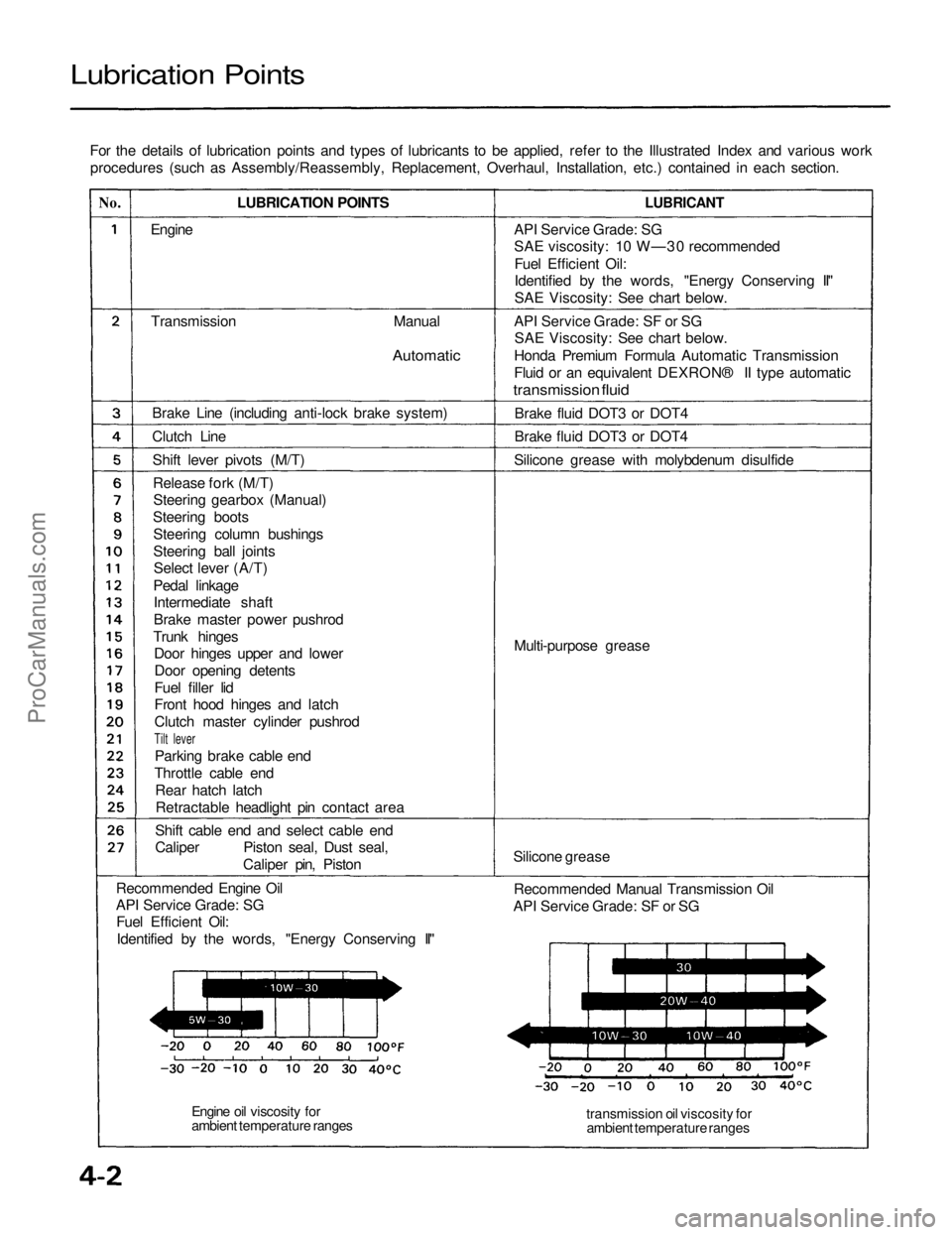
Lubrication Points
For the details of lubrication points and types of lubricants to be applied, refer to the Illustrated Index and various workprocedures (such as Assembly/Reassembly, Replacement, Overhaul, Installation, etc.) contained in each section.
No.
LUBRICATION POINTS
LUBRICANT
Engine
Transmission
Manual
Automatic
Brake Line (including anti-lock brake system)
Clutch Line Shift lever pivots (M/T)Release fork (M/T)Steering gearbox (Manual)
Steering boots Steering column bushings
Steering ball jointsSelect lever (A/T)
Pedal linkage Intermediate shaft
Brake master power pushrod
Trunk hinges Door hinges upper and lower
Door opening detents
Fuel filler lid
Front hood hinges and latch
Clutch master cylinder pushrod
Tilt lever
Parking brake cable end
Throttle cable end Rear hatch latchRetractable headlight pin contact area
Shift cable end and select cable end
Caliper Piston seal, Dust seal, Caliper pin, Piston
Recommended Engine Oil
API Service Grade: SG Fuel Efficient Oil:
Identified by the words, "Energy Conserving II" API Service Grade: SG
SAE viscosity: 10 W—30 recommended
Fuel Efficient Oil:
Identified by the words, "Energy Conserving II"
SAE Viscosity: See chart below.
API Service Grade: SF or SG SAE Viscosity: See chart below.
Honda Premium Formula Automatic Transmission
Fluid or an equivalent DEXRON® II type automatic
transmission fluid
Brake fluid DOT3 or DOT4
Brake fluid DOT3 or DOT4
Silicone grease with molybdenum disulfide
Multi-purpose grease
Silicone grease Recommended Manual Transmission Oil
API Service Grade: SF or SG
transmission oil viscosity forambient temperature ranges
Engine oil viscosity for
ambient temperature rangesProCarManuals.com
Page 976 of 1640
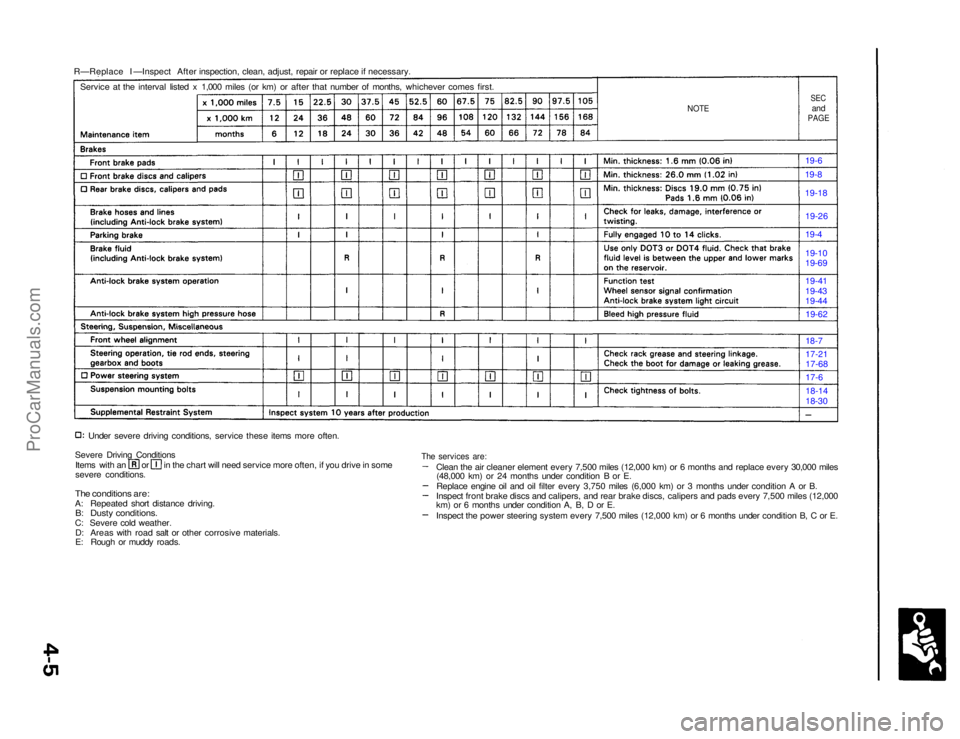
R—Replace I —Inspect After inspection, clean, adjust, repair or replace if necessary.
NOTE
SEC
and
PAGE
Service at the interval listed x 1,000 miles (or km) or after that number of months, whichever comes first.
19-6
19-8
19-18
Under severe driving conditions, service these items more often.
Severe Driving Conditions Items with an or in the chart will need service more often, if you drive in some
severe conditions.
The conditions are:
A: Repeated short distance driving.
B: Dusty conditions.
C: Severe cold weather. D: Areas with road salt or other corrosive materials.
E: Rough or muddy roads. 18-14
18-30
17-6
17-21
17-68
18-7
19-62
19-41
19-43
19-44 19-10
19-69 19-4
19-26
The services are:
Clean the air cleaner element every 7,500 miles (12,000 km) or 6 months and replace every 30,000 miles(48,000 km) or 24 months under condition B or E.
Replace engine oil and oil filter every 3,750 miles (6,000 km) or 3 months under condition A or B.
Inspect front brake discs and calipers, and rear brake discs, calipers and pads every 7,500 miles (12,000
km) or 6 months under condition A, B, D or E.
Inspect the power steering system every 7,500 miles (12,000 km) or 6 months under condition B, C or E.ProCarManuals.com
Page 977 of 1640
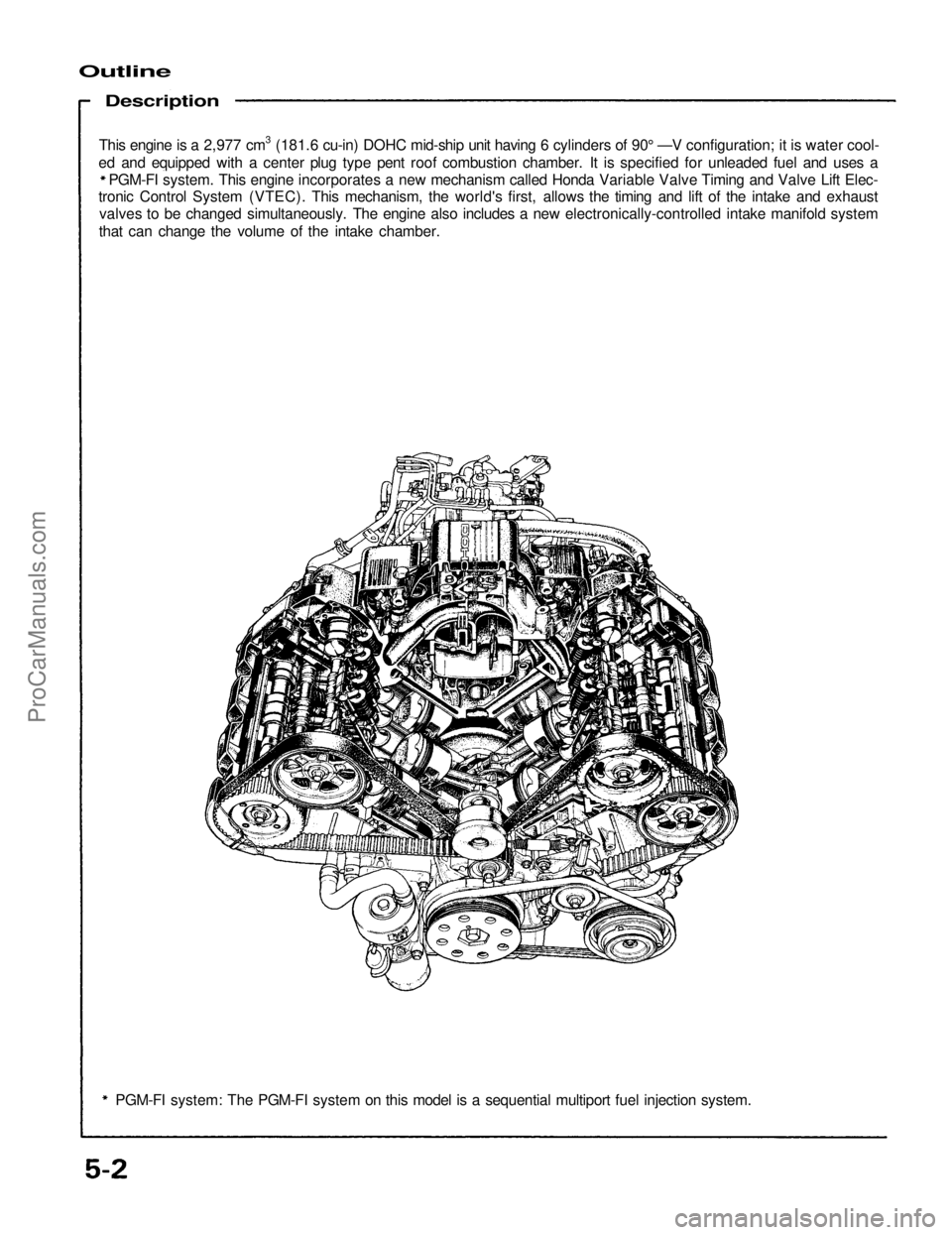
Outline
Description
This engine is a 2,977 cm3 (181.6 cu-in) DOHC mid-ship unit having 6 cylinders of 90° —V configuration; it is water cool-
ed and equipped with a center plug type pent roof combustion chamber. It is specified for unleaded fuel and uses a
PGM-FI system: The PGM-FI system on this model is a sequential multiport fuel injection system.
PGM-FI system. This engine incorporates a new mechanism called Honda Variable Valve Timing and Valve Lift Elec-
tronic Control System (VTEC). This mechanism, the world's first, allows the timing and lift of the intake and exhaust
valves to be changed simultaneously. The engine also includes a new electronically-controlled intake manifold system
that can change the volume of the intake chamber.ProCarManuals.com
Page 978 of 1640
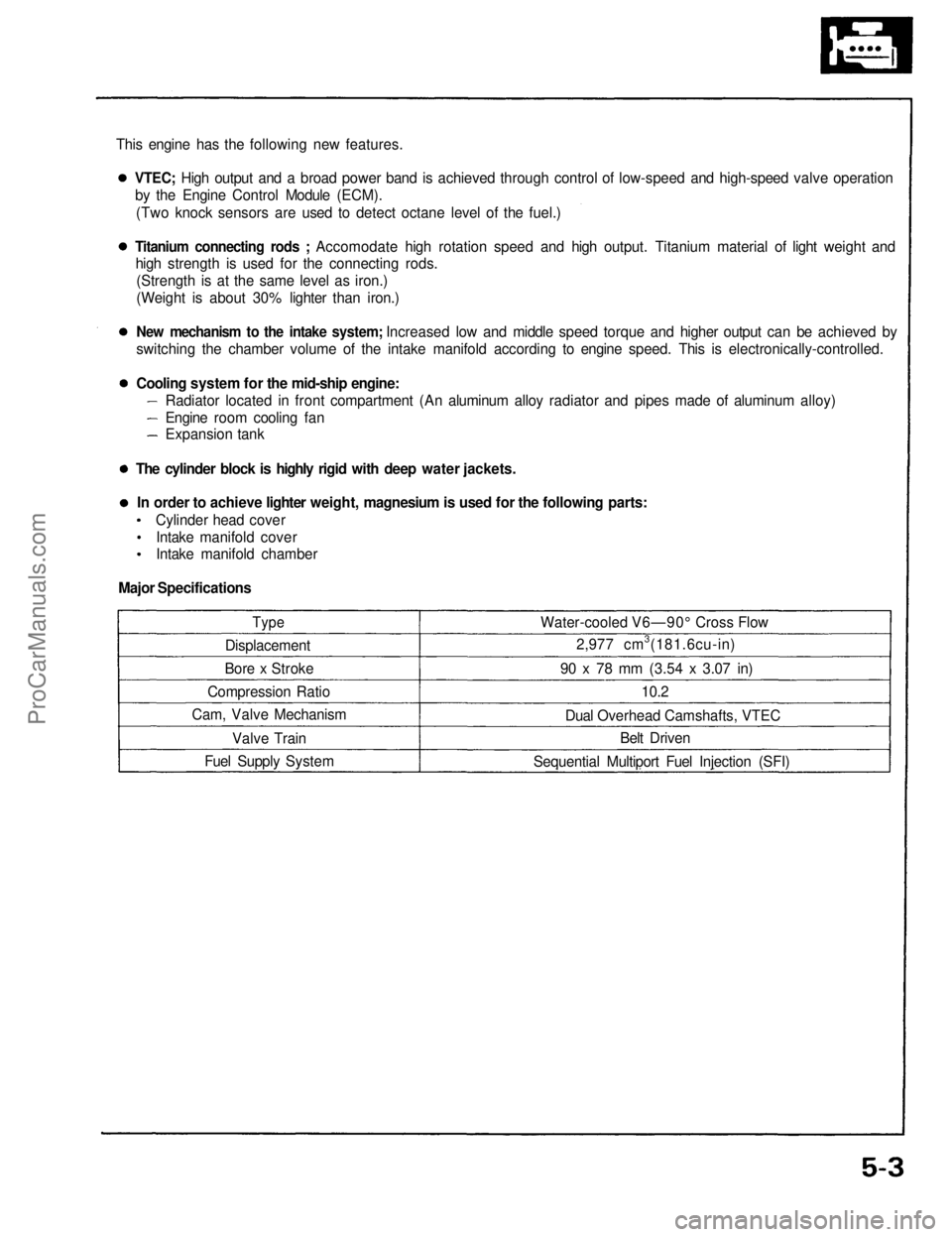
This engine has the following new features.
Type
Displacement
Bore x Stroke
Compression Ratio
Cam, Valve Mechanism
Valve Train
Fuel Supply System Water-cooled V6—90° Cross Flow
2,977 cm3(181.6cu-in)
90 x 78 mm
(3.54
x
3.07
in)
10.2
Dual Overhead Camshafts, VTEC Belt Driven
Sequential Multiport Fuel Injection (SFI)VTEC; High output and a broad power band is achieved through control of low-speed and high-speed valve operation
by the Engine Control Module (ECM).
(Two knock sensors are used to detect octane level of the fuel.)
Titanium connecting rods ; Accomodate high rotation speed and high output. Titanium material of light weight and
high strength is used for the connecting rods.
(Strength is at the same level as iron.)
(Weight is about 30% lighter than iron.)
New mechanism to the intake system; Increased low and middle speed torque and higher output can be achieved by
switching the chamber volume of the intake manifold according to engine speed. This is electronically-controlled.
Cooling system for the mid-ship engine:
Radiator located in front compartment (An aluminum alloy radiator and pipes made of aluminum alloy)
Engine room cooling fan
Expansion tank
The cylinder block is highly rigid with deep water jackets. In order to achieve lighter weight, magnesium is used for the following parts: Cylinder head coverIntake manifold cover
Intake manifold chamber
Major SpecificationsProCarManuals.com
Page 979 of 1640
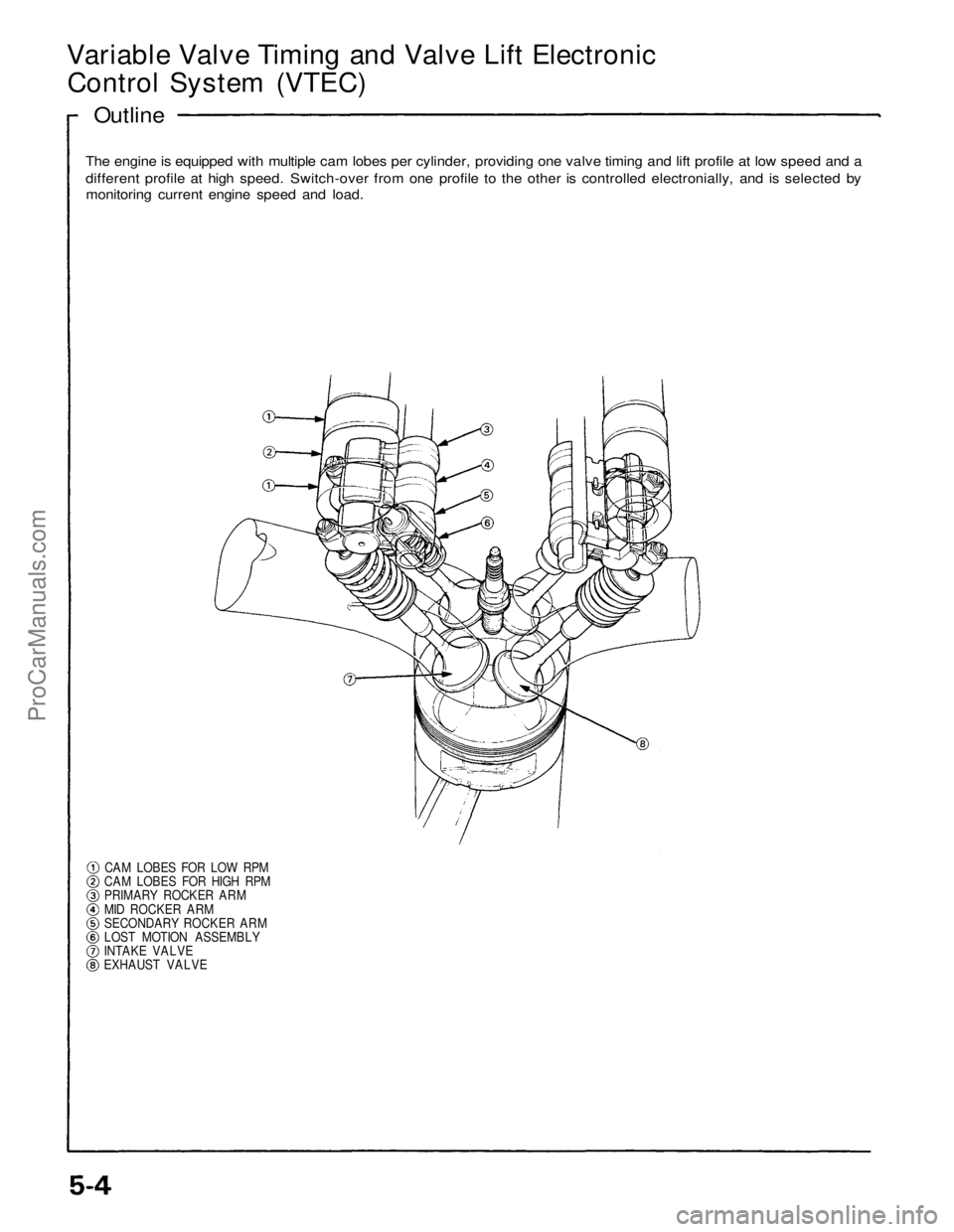
Variable Valve Timing and Valve Lift Electronic
Control System (VTEC)
Outline
The engine is equipped with multiple cam lobes per cylinder, providing one valve timing and lift profile at low speed and a
different profile at high speed. Switch-over from one profile to the other is controlled electronially, and is selected by monitoring current engine speed and load.
CAM LOBES FOR LOW RPM
CAM LOBES FOR HIGH RPM
PRIMARY ROCKER ARM
MID ROCKER ARM
SECONDARY ROCKER ARM
LOST MOTION ASSEMBLY
INTAKE VALVE
EXHAUST VALVEProCarManuals.com
Page 980 of 1640
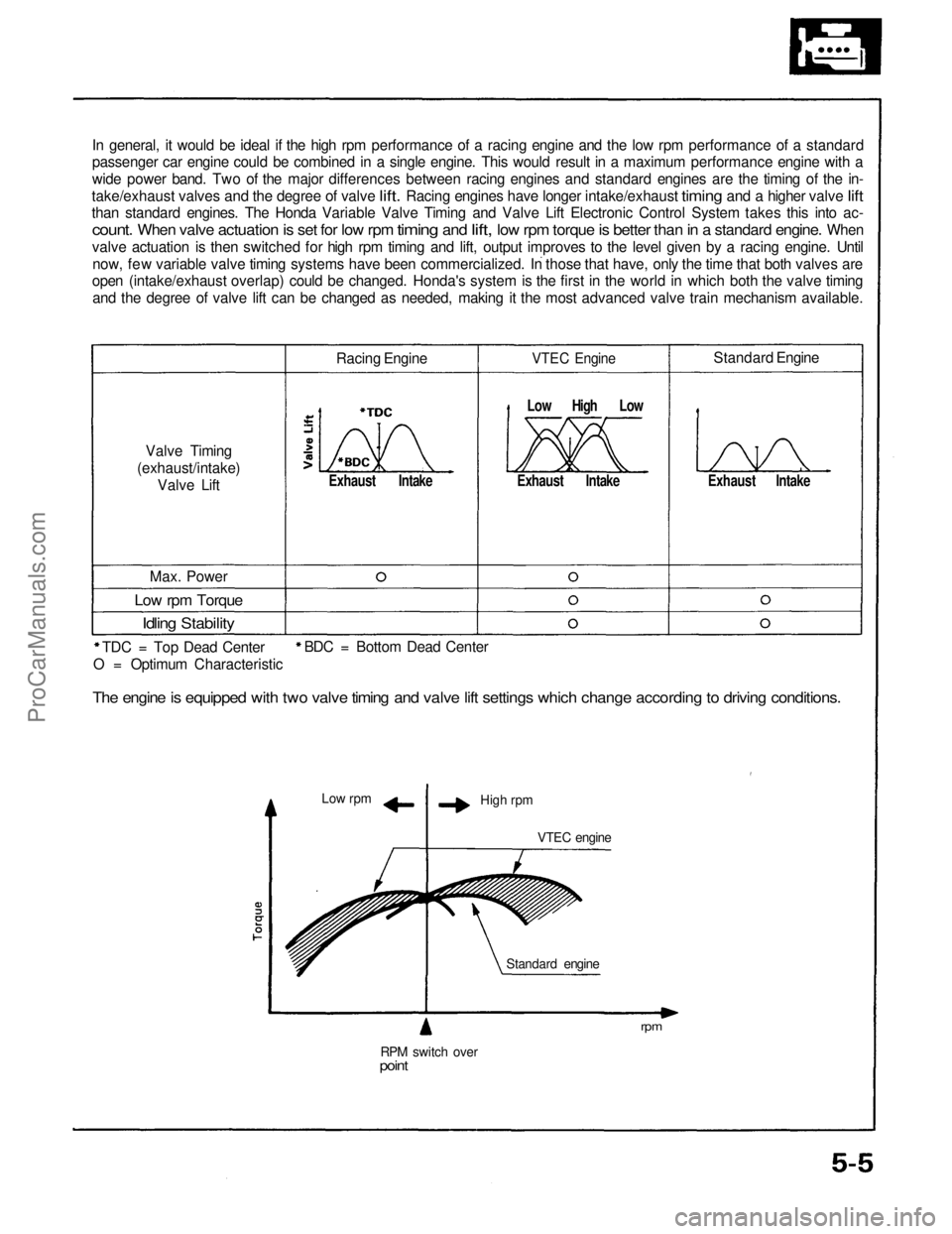
In general, it would be ideal if the high rpm performance of a racing engine and the low rpm performance of a standard
passenger car engine could be combined in a single engine. This would result in a maximum performance engine with a
wide power band. Two of the major differences between racing engines and standard engines are the timing of the in-
take/exhaust valves
and the
degree
of
valve
lift.
Racing engines have longer intake/exhaust
timing
and a
higher valve
lift
than standard engines. The Honda Variable Valve Timing and Valve Lift Electronic Control System takes this into ac-
count.
When
valve
actuation
is set for low rpm
timing
and
lift,
low rpm
torque
is
better
than
in a
standard
engine.
When
valve actuation is then switched for high rpm timing and lift, output improves to the level given by a racing engine. Untilnow, few variable valve timing systems have been commercialized. In those that have, only the time that both valves are
open (intake/exhaust overlap) could be changed. Honda's system is the first in the world in which both the valve timing
and the degree of valve lift can be changed as needed, making it the most advanced valve train mechanism available.
Valve Timing
(exhaust/intake) Valve Lift Racing Engine
Exhaust Intake
VTEC Engine
Low High Low
Exhaust Intake
Standard Engine
Exhaust Intake
Max. Power
Low rpm Torque
Idling Stability
TDC = Top Dead Center
Low rpm
High rpm
VTEC engine
RPM switch over
point
Standard engine
rpm
BDC = Bottom Dead Center
O = Optimum Characteristic
The engine is equipped with two valve timing and valve lift settings which change according to driving conditions.ProCarManuals.com