engine ACURA NSX 1991 Service Repair Manual
[x] Cancel search | Manufacturer: ACURA, Model Year: 1991, Model line: NSX, Model: ACURA NSX 1991Pages: 1640, PDF Size: 60.48 MB
Page 675 of 1640
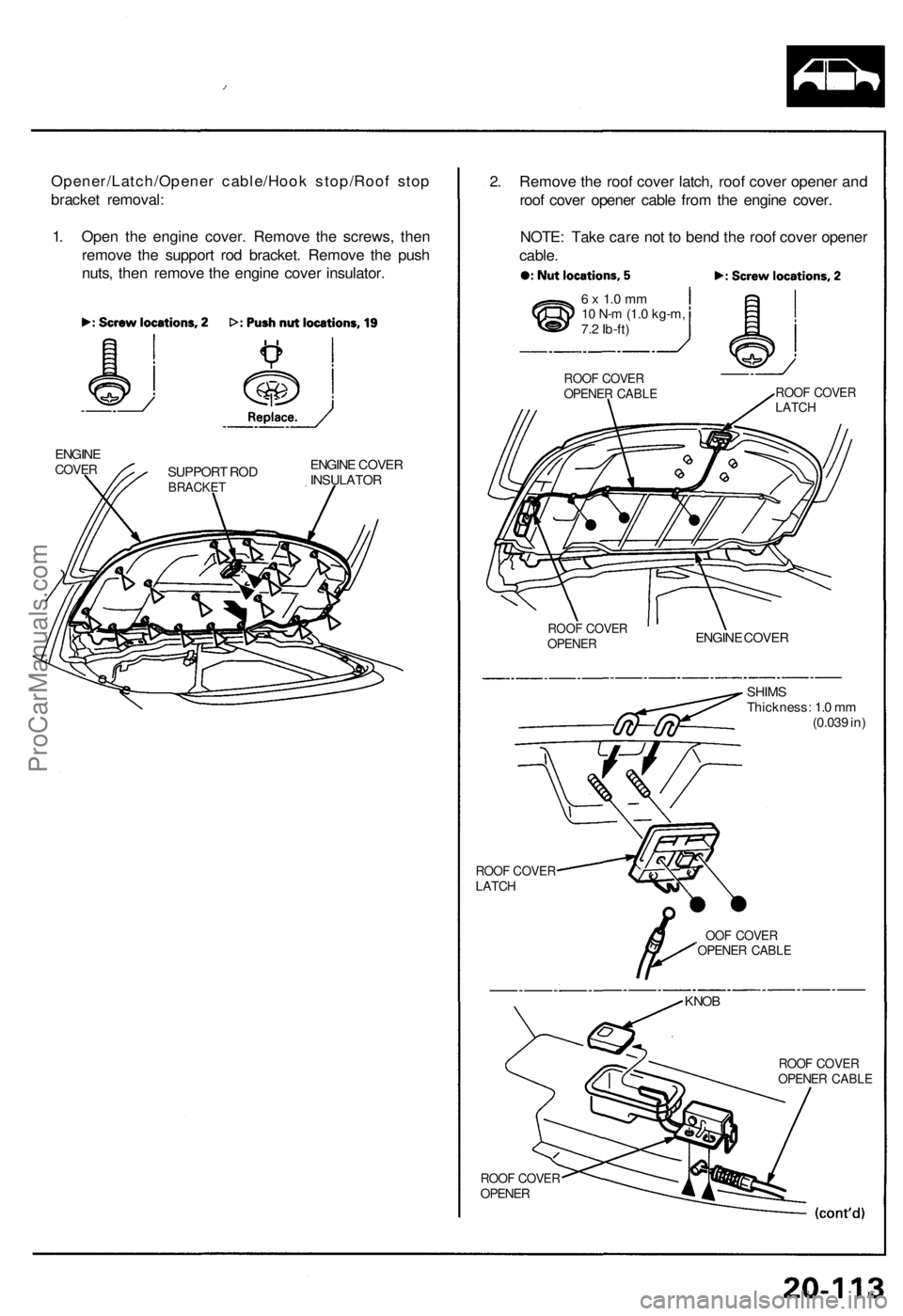
Opener/Latch/Opener cable/Hook stop/Roof stop
bracket removal:
1. Open the engine cover. Remove the screws, then
remove the support rod bracket. Remove the push
nuts, then remove the engine cover insulator.
ENGINE
COVER
SUPPORT ROD
BRACKET
ENGINE COVER
INSULATOR
2. Remove the roof cover latch, roof cover opener and
roof cover opener cable from the engine cover.
NOTE: Take care not to bend the roof cover opener
cable.
6 x 1.0 mm
10 N-m
(1.0 kg-m,
7.2 Ib-ft)
ROOF COVER
OPENER
ENGINE COVER
SHIMS
Thickness: 1.0 mm
(0.039 in)
ROOF COVER
LATCH
ROOF COVER
OPENER CABLE
ROOF COVER
OPENER
R
OOF COVER
OPENER CABLE
KNOB
ROOF COVER
LATCH
ROOF COVER
OPENER CABLEProCarManuals.com
Page 676 of 1640
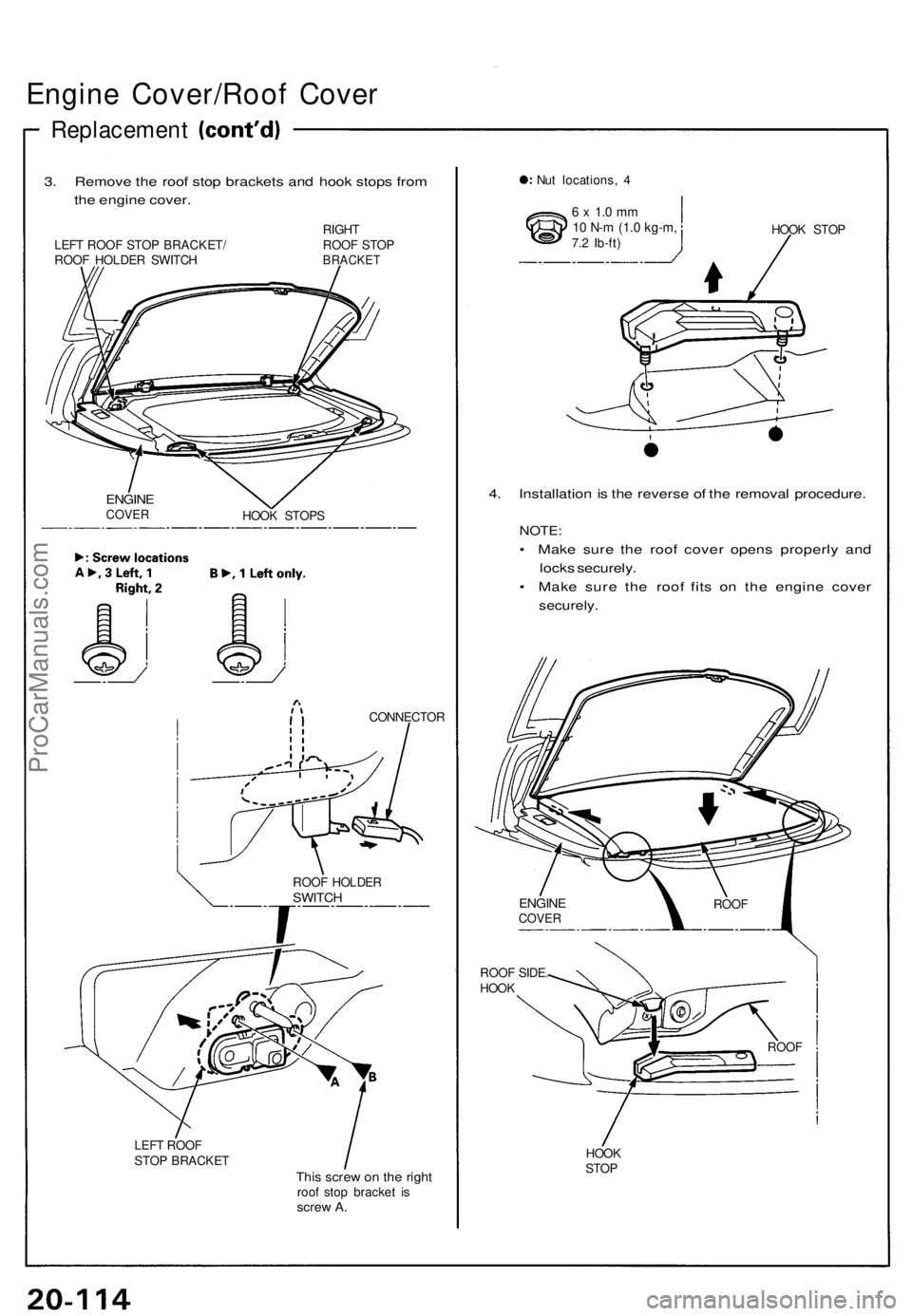
Engine Cover/Roo f Cove r
Replacemen t
3. Remov e th e roo f sto p bracket s an d hoo k stop s fro m
th e engin e cover .
LEFT ROO F STO P BRACKET /
ROO F HOLDE R SWITC H RIGH
T
ROO F STO PBRACKE T
ENGINECOVERHOOK STOP S
CONNECTO R
LEF T ROO F
STO P BRACKE T
This scre w o n th e righ troof sto p bracke t i sscre w A .
Nu t locations , 4
6 x 1. 0 m m10 N- m (1. 0 kg-m ,7.2 Ib-ft ) HOO
K STO P
4. Installatio n is th e revers e o f th e remova l procedure .
NOTE:
• Mak e sur e th e roo f cove r open s properl y an d
lock s securely .
• Mak e sur e th e roo f fit s o n th e engin e cove r
securely .
HOOK
STO P
ROO
F HOLDE R
SWITCHENGINECOVERROOF
ROO F SIDE .
HOO K
ROOF
ProCarManuals.com
Page 683 of 1640
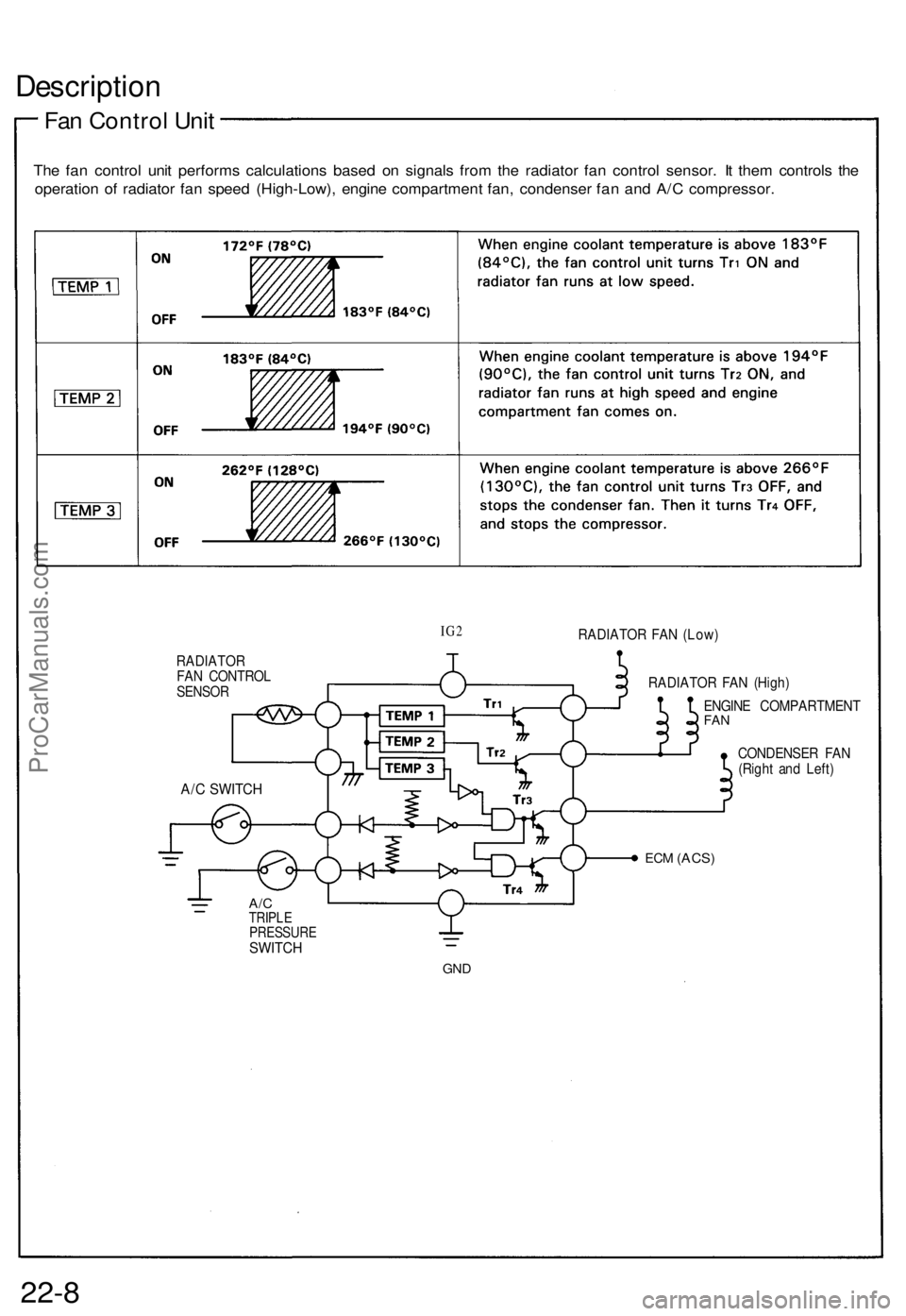
Description
Fan Control Unit
The fan control unit performs calculations based on signals from the radiator fan control sensor. It them controls the
operation of radiator fan speed (High-Low), engine compartment fan, condenser fan and A/C compressor.
IG2
RADIATOR FAN (Low)
RADIATOR
FAN CONTROL
SENSOR
RADIATOR FAN (High)
ENGINE COMPARTMENT
FAN
CONDENSER FAN
(Right and Left)
ECM
(ACS)
A/C
TRIPLE
PRESSURE
SWITCH
GND
22-8
A/C SWITCHProCarManuals.com
Page 684 of 1640
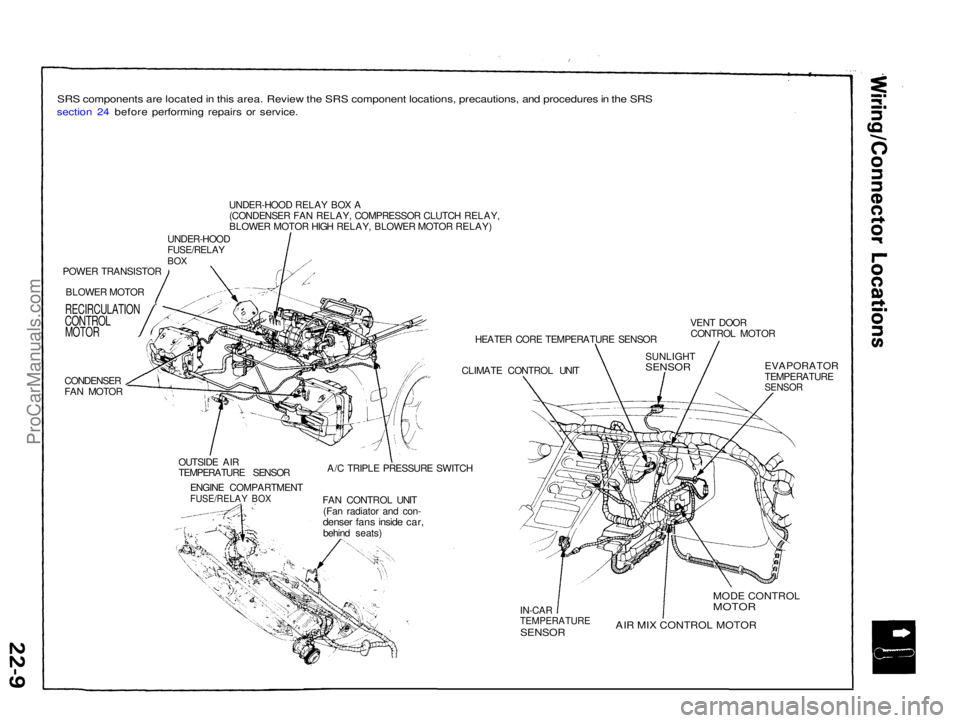
SRS components are located in this area. Review the SRS component locations, precautions, and procedures in the SRS
section 24 before performing repairs or service.
POWER TRANSISTORBLOWER MOTOR
RECIRCULATION
CONTROL
MOTOR
CONDENSER
FAN MOTOR UNDER-HOOD RELAY BOX A
(CONDENSER FAN RELAY, COMPRESSOR CLUTCH RELAY,
BLOWER MOTOR HIGH RELAY, BLOWER MOTOR RELAY)
UNDER-HOOD
FUSE/RELAY
BOX
HEATER CORE TEMPERATURE SENSOR
CLIMATE CONTROL UNIT VENT DOOR
CONTROL MOTOR
OUTSIDE AIR
TEMPERATURE SENSOR ENGINE COMPARTMENT
FUSE/RELAY BOX
A/C TRIPLE PRESSURE SWITCH
FAN CONTROL UNIT (Fan radiator and con-
denser fans inside car,
behind seats)
EVAPORATOR
TEMPERATURE
SENSOR
IN-CAR
TEMPERATURE
SENSOR
MODE CONTROL
MOTOR
AIR MIX CONTROL MOTOR
SUNLIGHT
SENSORProCarManuals.com
Page 686 of 1640
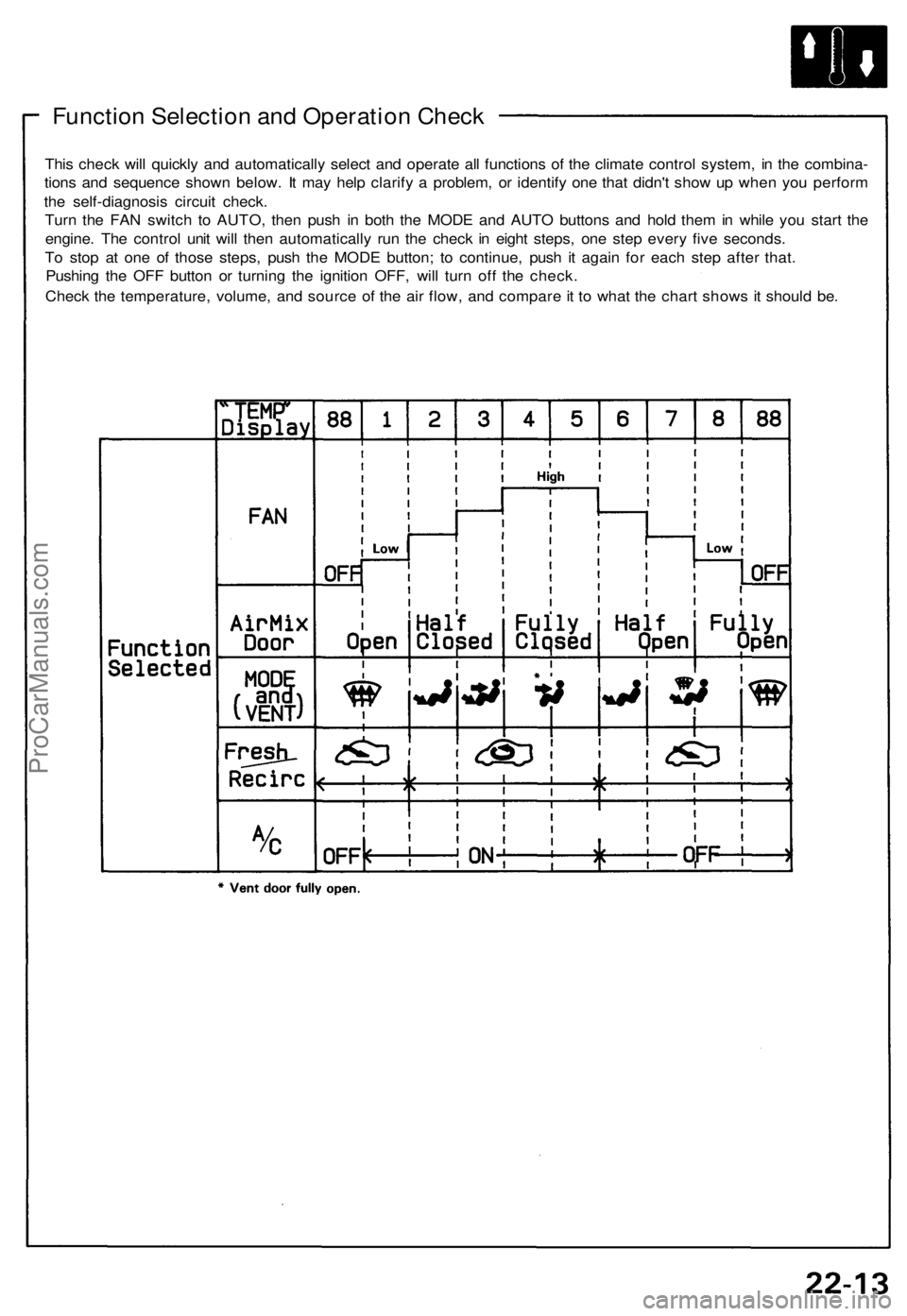
Function Selection and Operation Check
This check will quickly and automatically select and operate all functions of the climate control system, in the combina-
tions and sequence shown below. It may help clarify a problem, or identify one that didn't show up when you perform
the self-diagnosis circuit check.
Turn the FAN switch to AUTO, then push in both the MODE and AUTO buttons and hold them in while you start the
engine. The control unit will then automatically run the check in eight steps, one step every five seconds.
To stop at one of those steps, push the MODE button; to continue, push it again for each step after that.
Pushing the OFF button or turning the ignition OFF, will turn off the check.
Check the temperature, volume, and source of the air flow, and compare it to what the chart shows it should be.ProCarManuals.com
Page 687 of 1640
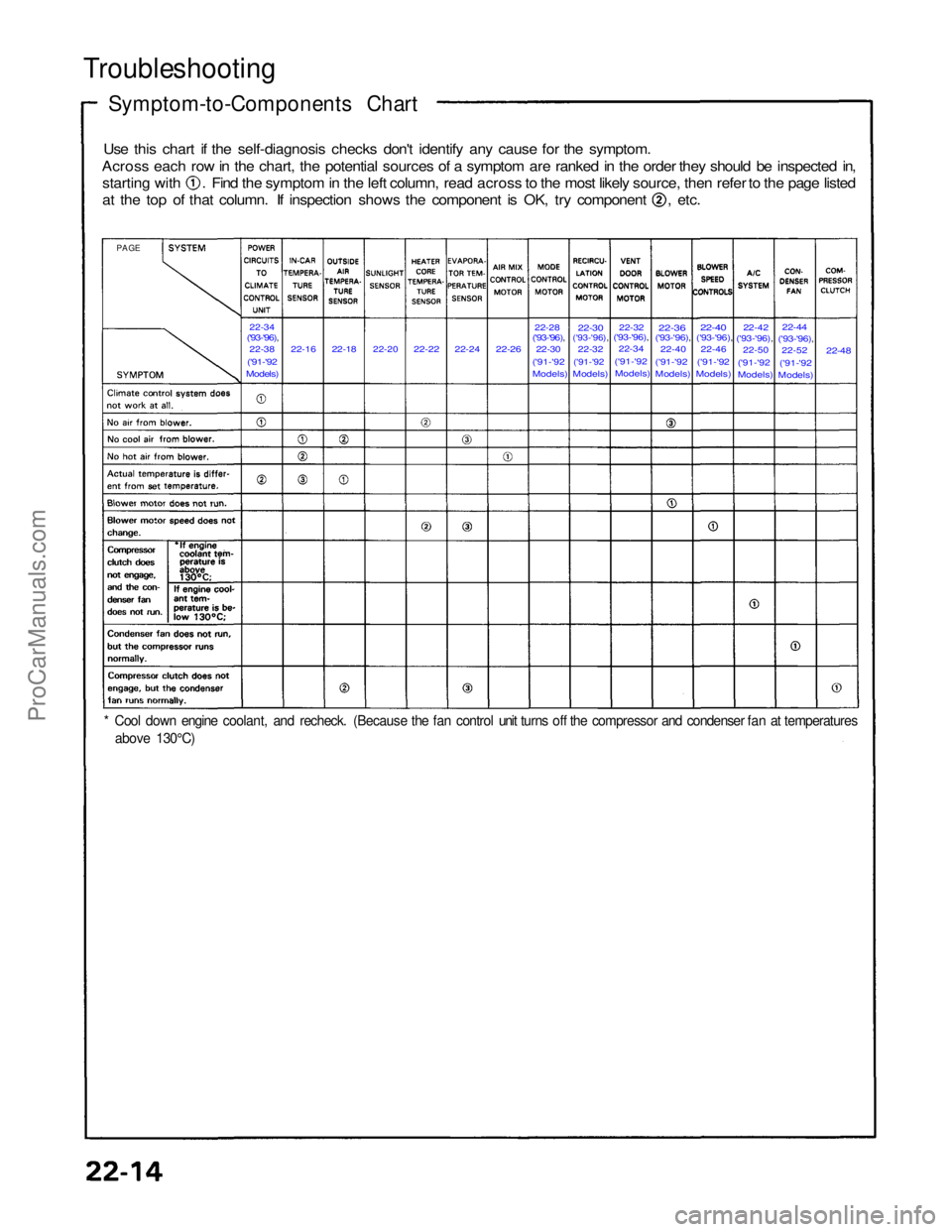
Troubleshooting
Symptom-to-Components Chart
Use this chart if the self-diagnosis checks don't identify any cause for the symptom.
Across each row in the chart, the potential sources of a symptom are ranked in the order they should be inspected in, starting with . Find the symptom in the left column, read across to the most likely source, then refer to the page listed
at the top of that column. If inspection shows the component is OK, try component , etc.
22-34
('93-'96),
22-38
('91-'92
Models)
22-16
22-18
22-20
22-22
22-24
22-26
22-30
('93-'96),22-28
('91-'92
Models)
22-30
('93-'96),
22-32
('91-'92
Models)
22-32
('93-'96),
22-34
('91-'92 Models)
22-36
('93-'96),
22-40
('91-'92 Models)
22-40
('93-'96),
22-46
('91-'92
Models)
22-42
('93-'96),
22-50
('91-'92 Models)
22-44
('93-'96),
22-52
('91-'92
Models)
22-48
PAGE
* Cool down engine coolant, and recheck. (Because the fan control unit turns off the compressor and condenser fan at temperatures above 130°C)ProCarManuals.com
Page 709 of 1640
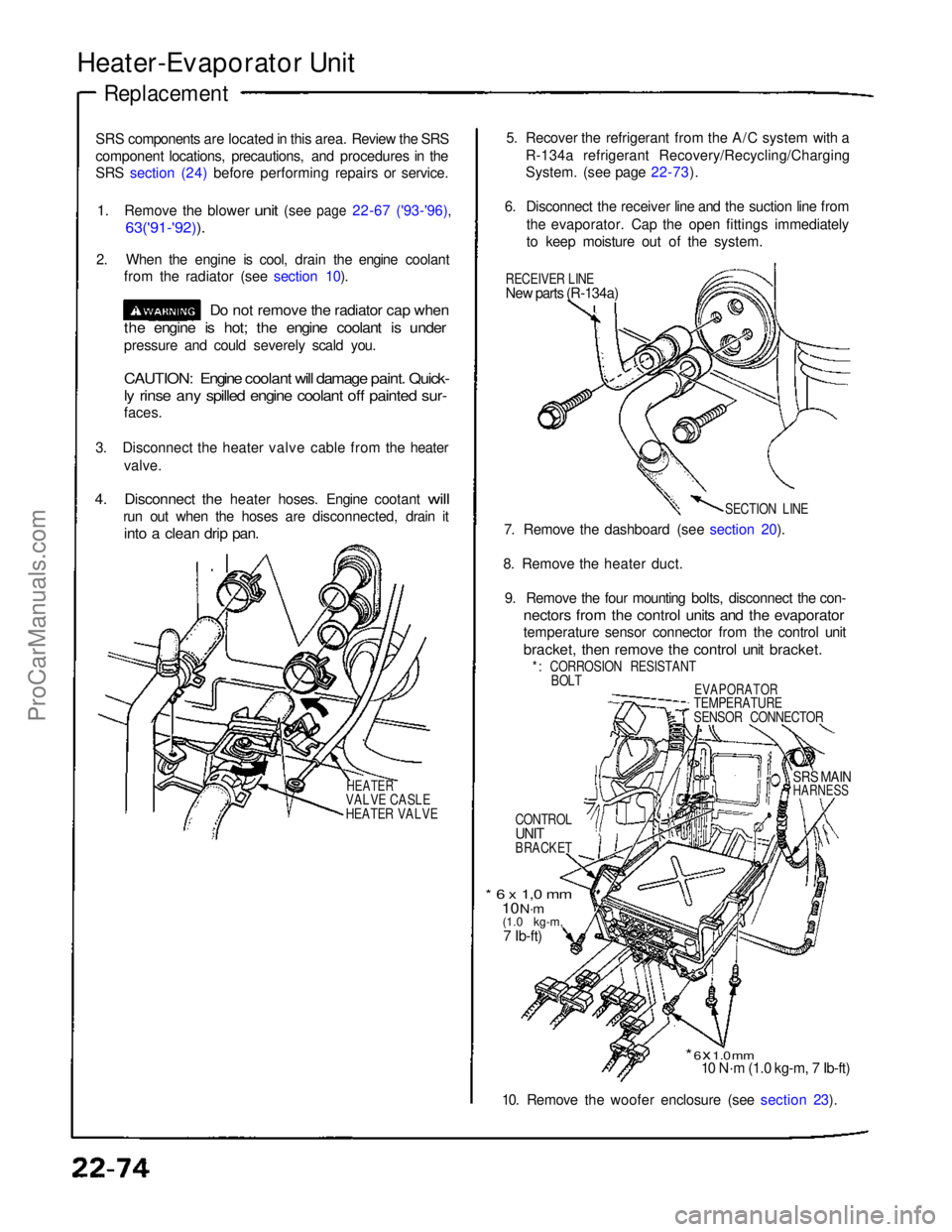
Heater-Evaporator Unit
Replacement
SRS components are located in this area. Review the SRS
component locations, precautions, and procedures in the
SRS section (24) before performing repairs or service.
1.
Remove
the
blower
unit
(see
page
22-67 ('93-'96),
63('91-'92)).
2. When the engine is cool, drain the engine coolant from the radiator (see section 10).
Do not remove the radiator cap when
the engine is hot; the engine coolant is under
pressure and could severely scald you.
CAUTION: Engine coolant will damage paint. Quick-
ly rinse any spilled engine coolant off painted sur-
faces.
3. Disconnect the heater valve cable from the heater valve.
4.
Disconnect
the
heater hoses. Engine cootant
will
run out when the hoses are disconnected, drain it
into a clean drip pan.
HEATER
VALVE CASLE
HEATER VALVE
5. Recover the refrigerant from the A/C system with a
R-134a refrigerant Recovery/Recycling/Charging
System. (see page 22-73).
6. Disconnect the receiver line and the suction line from the evaporator. Cap the open fittings immediately
to keep moisture out of the system.
RECEIVER LINE
New parts (R-134a)
SECTION LINE
7. Remove the dashboard (see section 20).
8. Remove the heater duct. 9. Remove the four mounting bolts, disconnect the con-
nectors from the control units and the evaporator
temperature sensor connector from the control unit
bracket, then remove the control unit bracket.
*: CORROSION RESISTANT BOLT
EVAPORATOR
TEMPERATURE
SENSOR CONNECTOR
CONTROL
UNIT
BRACKET
SRS MAIN
HARNESS
* 6 x 1,0 mm
10 N·m
(1.0 kg-m,
7 Ib-ft)
* 6 x 1.0 mm
10 N·m (1.0 kg-m, 7 Ib-ft)
10. Remove the woofer enclosure (see section 23).ProCarManuals.com
Page 710 of 1640
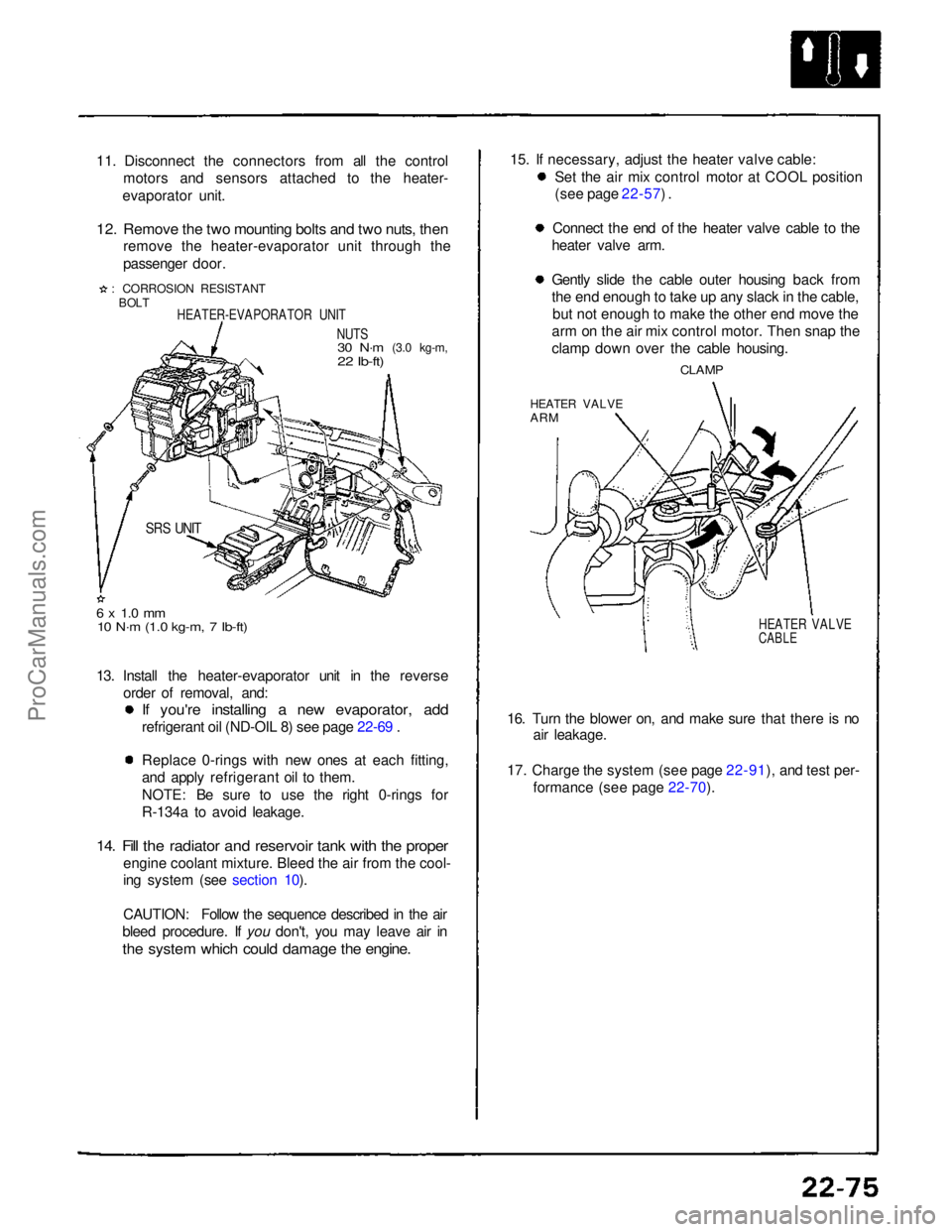
11. Disconnect the connectors from all the control
motors and sensors attached to the heater-
evaporator unit.
12. Remove the two mounting bolts and two nuts, then
remove the heater-evaporator unit through the
passenger door.
: CORROSION RESISTANT
BOLT
HEATER-EVAPORATOR UNIT
NUTS
30 N·m
(3.0 kg-m,
22 Ib-ft)
SRS UNIT
6 x 1.0 mm
10 N·m (1.0 kg-m, 7 Ib-ft)
13. Install the heater-evaporator unit in the reverse order of removal, and:
If you're installing a new evaporator, add
refrigerant oil (ND-OIL 8) see page 22-69 .
Replace 0-rings with new ones at each fitting,
and apply refrigerant oil to them.
NOTE: Be sure to use the right 0-rings for
R-134a to avoid leakage.
14. Fill the radiator and reservoir tank with the proper
engine coolant mixture. Bleed the air from the cool-
ing system (see section 10).
CAUTION: Follow the sequence described in the air
bleed procedure. If you don't, you may leave air in
the system which could damage the engine.
15. If necessary, adjust the heater valve cable:
Set the air mix control motor at COOL position
(see page 22-57) .
Connect the end of the heater valve cable to the
heater valve arm. Gently slide the cable outer housing back from
the end enough to take up any slack in the cable,
bu
t not enough to make the other end move the
arm on the air mix control motor. Then snap the
clamp down over the cable housing.
CLAMP
HEATER VALVE
ARM
HEATER VALVE
CABLE
16. Turn the blower on, and make sure that there is no air leakage.
17. Charge the system (see page 22-91), and test per- formance (see page 22-70).ProCarManuals.com
Page 729 of 1640
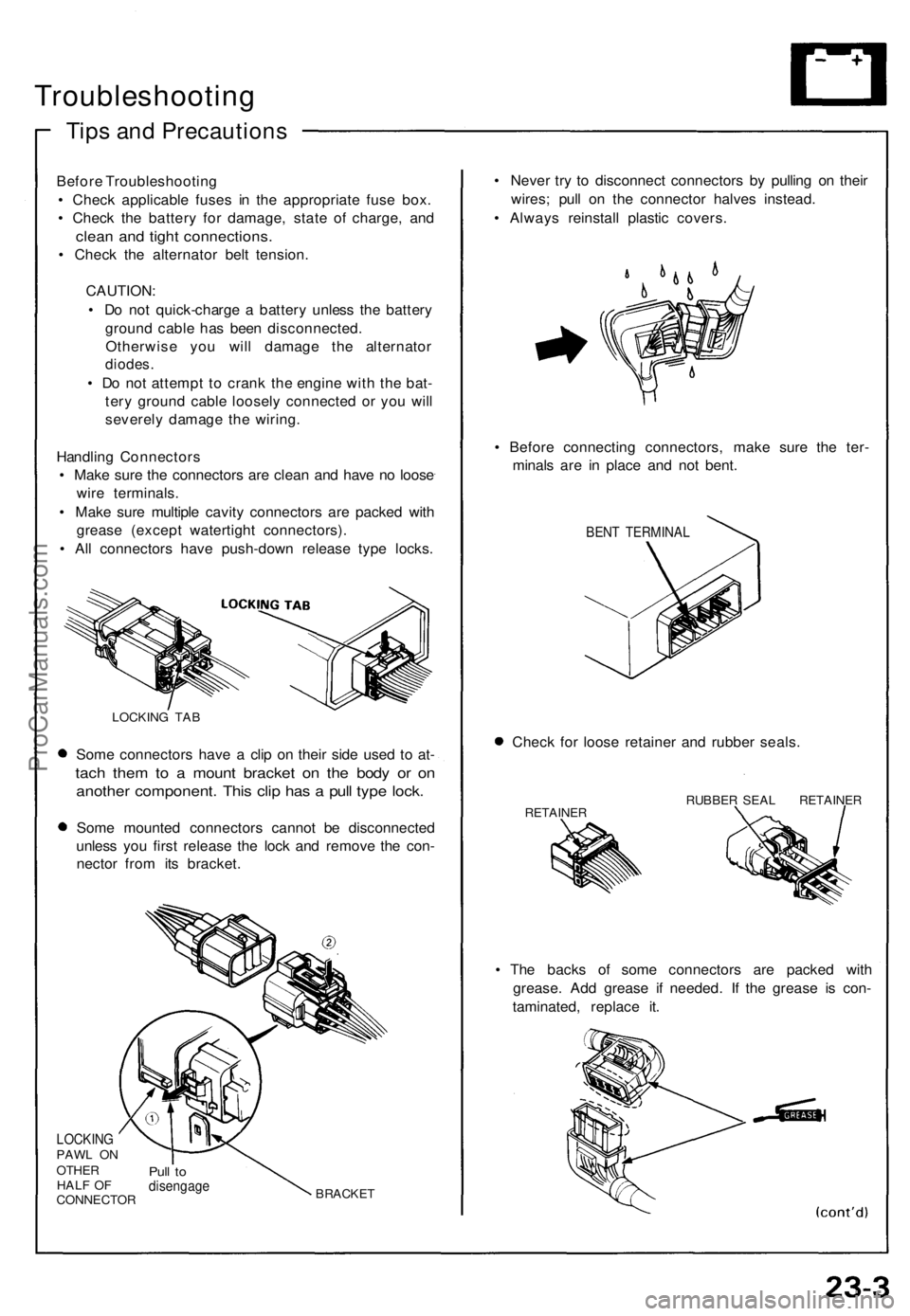
Troubleshooting
Tips and Precautions
Before Troubleshooting
• Check applicable fuses in the appropriate fuse box.
• Check the battery for damage, state of charge, and
clean and tight connections.
• Check the alternator belt tension.
CAUTION:
• Do not quick-charge a battery unless the battery
ground cable has been disconnected.
Otherwise you will damage the alternator
diodes.
• Do not attempt to crank the engine with the bat-
tery ground cable loosely connected or you will
severely damage the wiring.
Handling Connectors
• Make sure the connectors are clean and have no loose
wire terminals.
• Make sure multiple cavity connectors are packed with
grease (except watertight connectors).
• All connectors have push-down release type locks.
LOCKING TAB
Some connectors have a clip on their side used to at-
tach them to a mount bracket on the body or on
another component. This clip has a pull type lock.
Some mounted connectors cannot be disconnected
unless you first release the lock and remove the con-
nector from its bracket.
LOCKING
PAWL ON
OTHER
HALF OF
CONNECTOR
Pull to
disengage
BRACKET
• Never try to disconnect connectors by pulling on their
wires; pull on the connector halves instead.
• Always reinstall plastic covers.
• Before connecting connectors, make sure the ter-
minals are in place and not bent.
BENT TERMINAL
Check for loose retainer and rubber seals.
RETAINER
RUBBER SEAL RETAINER
• The backs of some connectors are packed with
grease. Add grease if needed. If the grease is con-
taminated, replace it.ProCarManuals.com
Page 737 of 1640
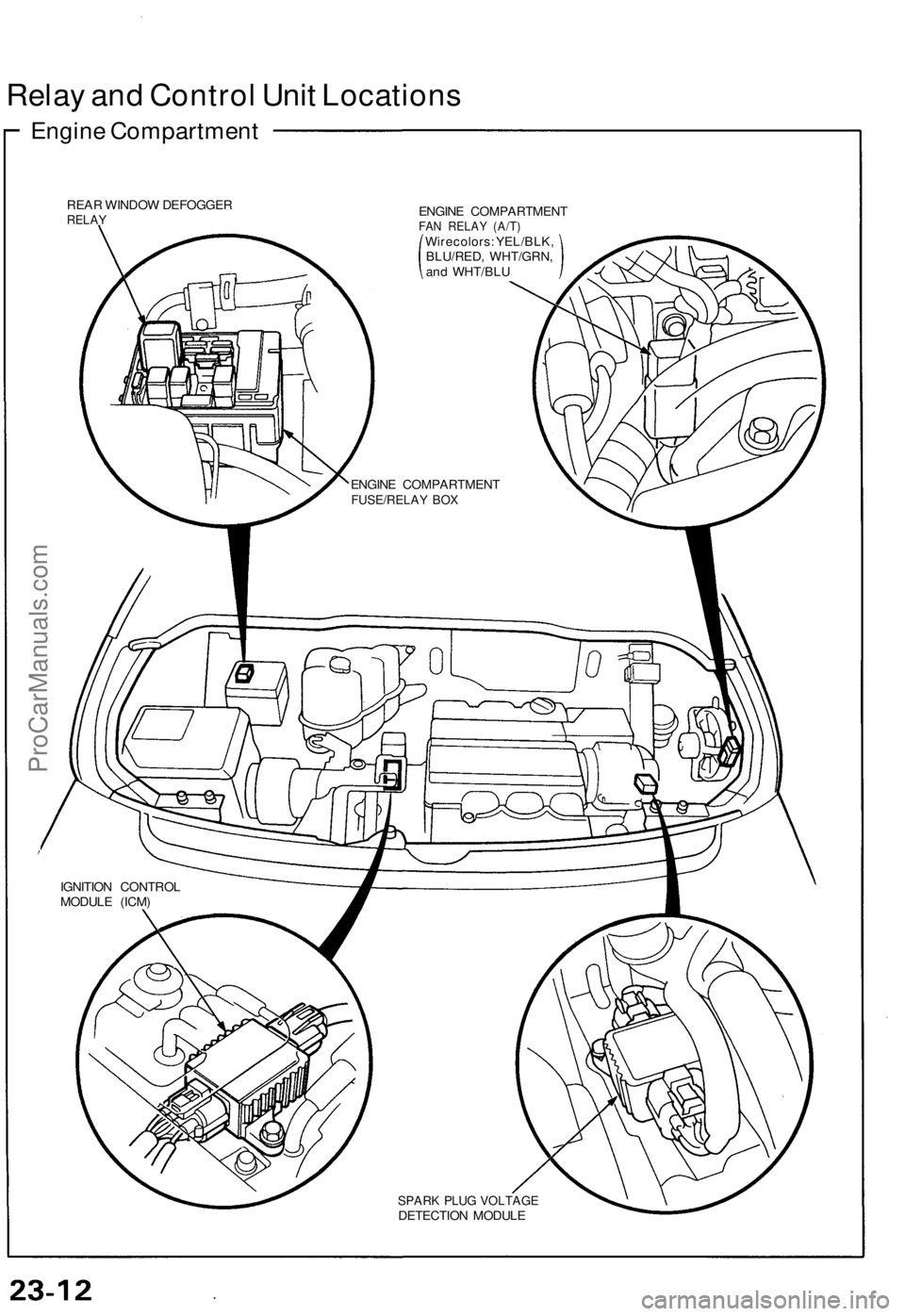
Relay and Control Unit Locations
Engine Compartment
REAR WINDOW DEFOGGER
RELAY
ENGINE COMPARTMENT
FAN RELAY (A/T)
Wire colors: YEL/BLK,
BLU/RED, WHT/GRN,
and WHT/BLU
SPARK PLUG VOLTAGE
DETECTION MODULE
ENGINE COMPARTMENT
FUSE/RELAY BOX
IGNITION CONTROL
MODULE (ICM)ProCarManuals.com