engine ACURA NSX 1991 Service Repair Manual
[x] Cancel search | Manufacturer: ACURA, Model Year: 1991, Model line: NSX, Model: ACURA NSX 1991Pages: 1640, PDF Size: 60.48 MB
Page 1335 of 1640
Troubleshooting Procedures
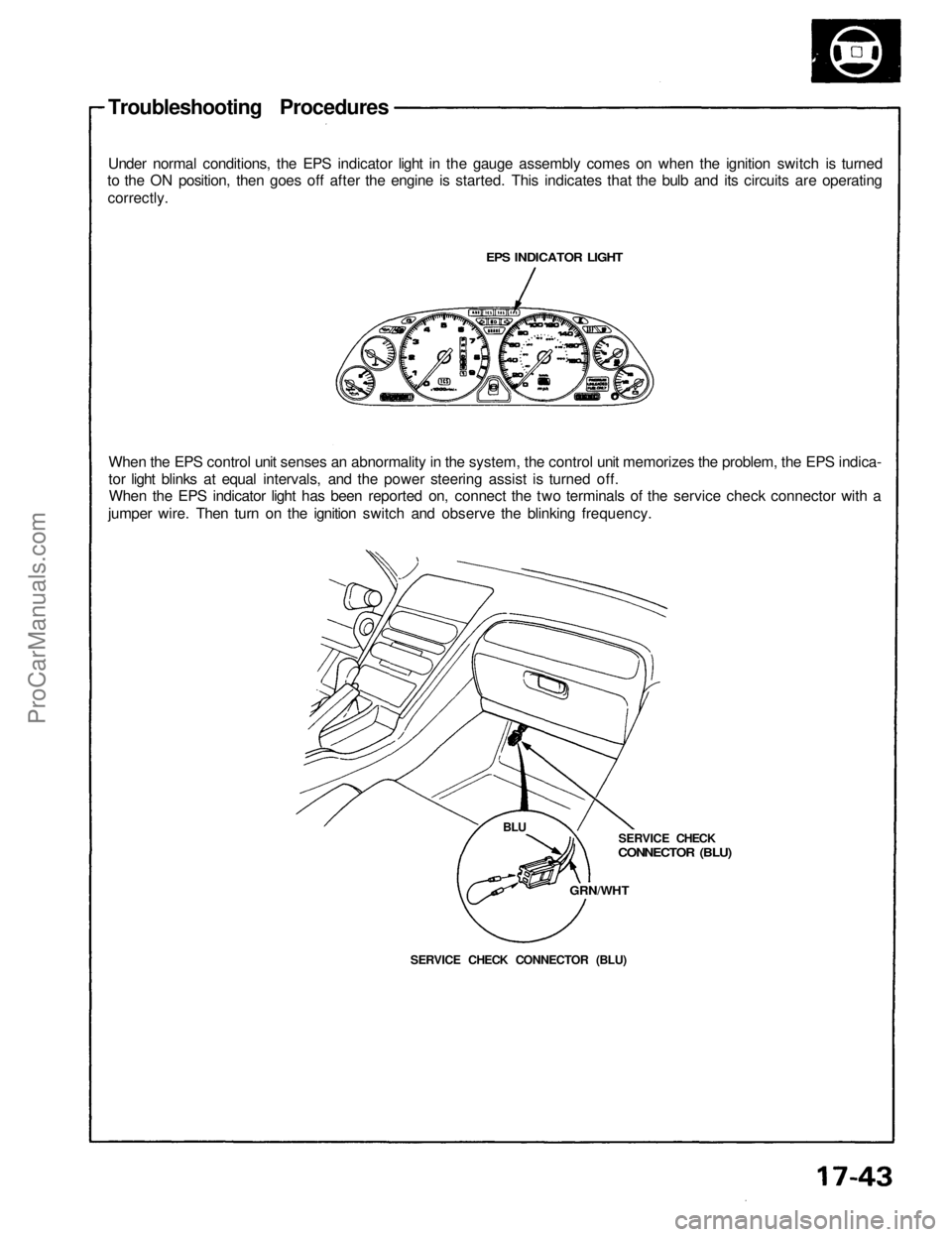
Under normal conditions, the EPS indicator light in the gauge assembly comes on when the ignition switch is turned
to the ON position, then goes off after the engine is started. This indicates that the bulb and its circuits are operating
correctly.
EPS INDICATOR LIGHT
When the EPS control unit senses an abnormality in the system, the control unit memorizes the problem, the EPS indica-
tor light blinks at equal intervals, and the power steering assist is turned off.
When the EPS indicator light has been reported on, connect the two terminals of the service check connector with a
jumper wire. Then turn on the ignition switch and observe the blinking frequency.
SERVICE CHECK
CONNECTOR (BLU)
GRN/WHT
SERVICE CHECK CONNECTOR (BLU)
BLUProCarManuals.com
Page 1361 of 1640
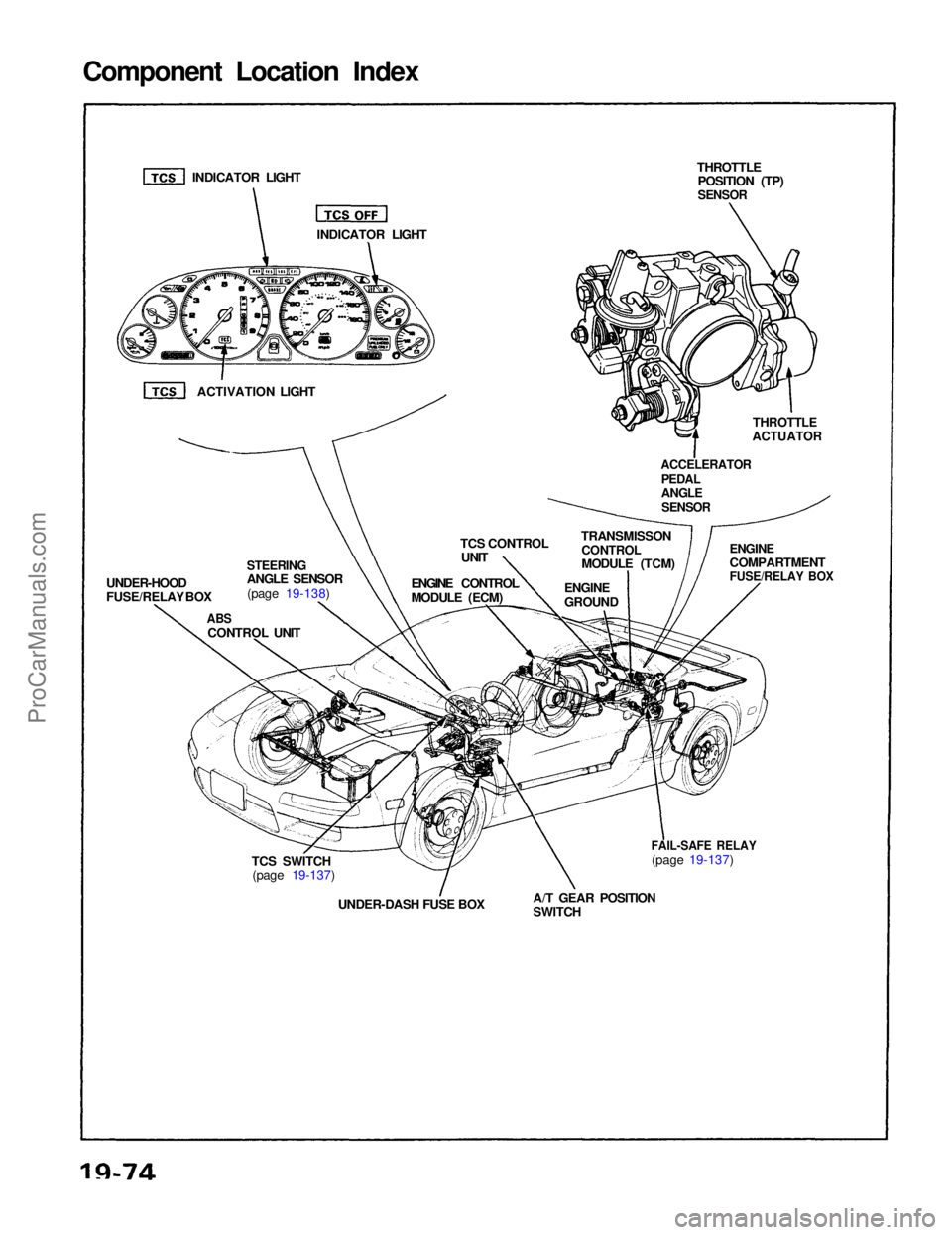
Component Location Index
INDICATOR LIGHT
ACTIVATION LIGHT INDICATOR LIGHT
UNDER-HOOD
FUSE/RELAY BOX
ABS
CONTROL UNIT
STEERING
ANGLE SENSOR
(page 19-138)
TCS SWITCH(page 19-137)
UNDER-DASH FUSE BOX
A/T GEAR POSITION
SWITCH
FAIL-SAFE RELAY
(page 19-137)
ENGINE
COMPARTMENT
FUSE/RELAY BOX
TRANSMISSON
CONTROL
MODULE (TCM)
ENGINE
GROUND
TCS CONTROL
UNIT
ENGINE CONTROL
MODULE (ECM)
ACCELERATOR
PEDAL
ANGLE
SENSOR
THROTTLE
ACTUATOR
THROTTLE
POSITION (TP)
SENSORProCarManuals.com
Page 1362 of 1640
System Description
TCS Control unit
Acceleration Control:
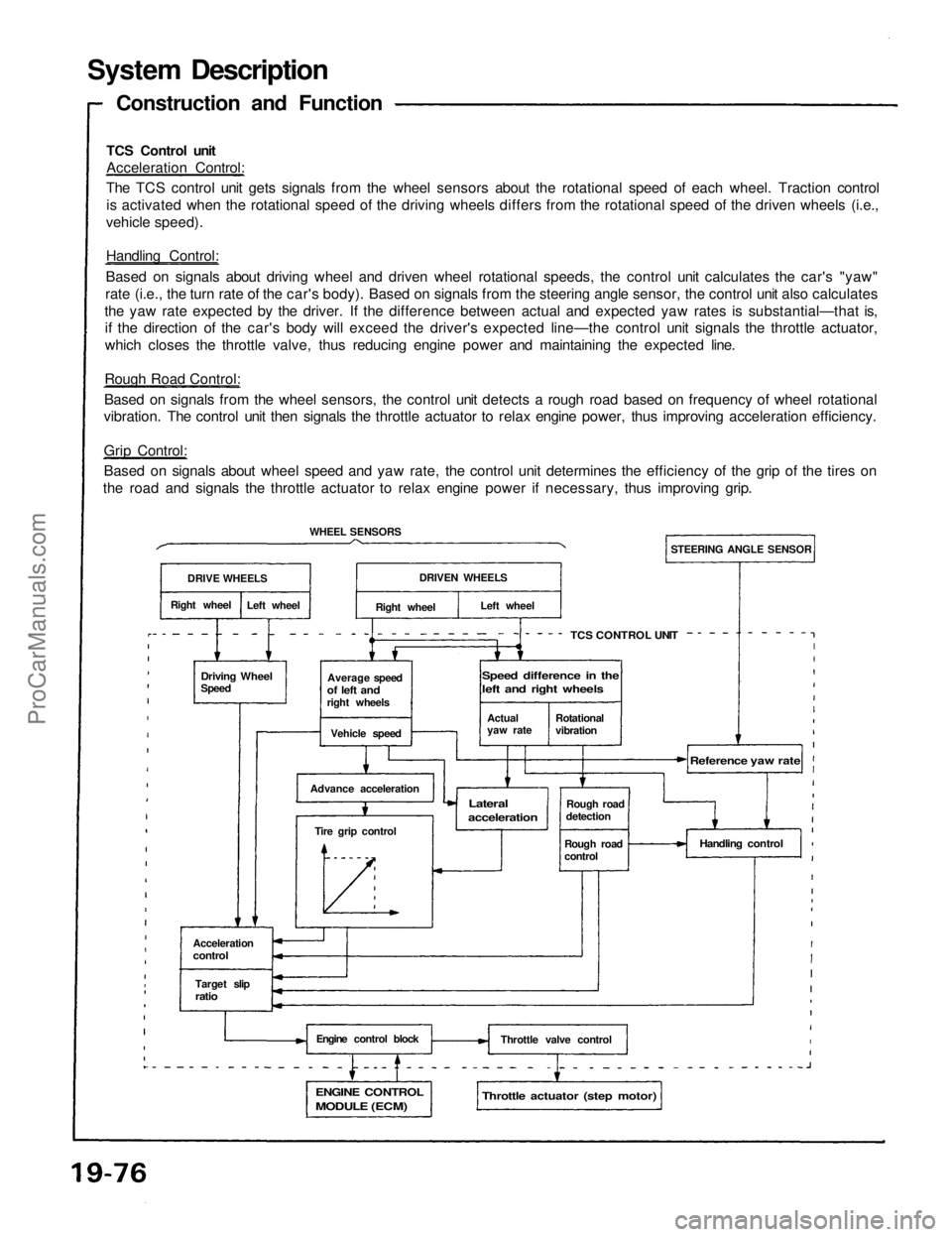
The TCS control unit gets signals from the wheel sensors about the rotational speed of each wheel. Traction control
is activated when the rotational speed of the driving wheels differs from the rotational speed of the driven wheels (i.e.,
vehicle speed).
Handling Control:
Based on signals about driving wheel and driven wheel rotational speeds, the control unit calculates the car's "yaw"
rate (i.e., the turn rate of the car's body). Based on signals from the steering angle sensor, the control unit also calculates
the yaw rate expected by the driver. If the difference between actual and expected yaw rates is substantial—that is,
if the direction of the car's body will exceed the driver's expected line—the control unit signals the throttle actuator,
which closes the throttle valve, thus reducing engine power and maintaining the expected line.
Rough Road Control:
Based on signals from the wheel sensors, the control unit detects a rough road based on frequency of wheel rotational
vibration. The control unit then signals the throttle actuator to relax engine power, thus improving acceleration efficiency.
Grip Control:
Based on signals about wheel speed and yaw rate, the control unit determines the efficiency of the grip of the tires on
the road and signals the throttle actuator to relax engine power if necessary, thus improving grip.
Construction and Function
DRIVE WHEELS
Right wheel
Left wheel
WHEEL SENSORS
Driving Wheel
Speed
Average speed
of left and
right wheels
Vehicle speed
Advance acceleration
Tire grip control
Acceleration
control
Target slip
ratio
Engine control block
ENGINE CONTROL
MODULE (ECM)
Throttle actuator (step motor)
Throttle valve control
Handling control
Rough road
detection
Rough road
control
Reference yaw rate
Lateral
acceleration
TCS CONTROL UNIT
STEERING ANGLE SENSOR
DRIVEN WHEELS
Right wheel
Left wheel
Actual
yaw rate
Rotational
vibration
Speed difference in the
left and right wheelsProCarManuals.com
Page 1364 of 1640
System Description
Engine Output Control
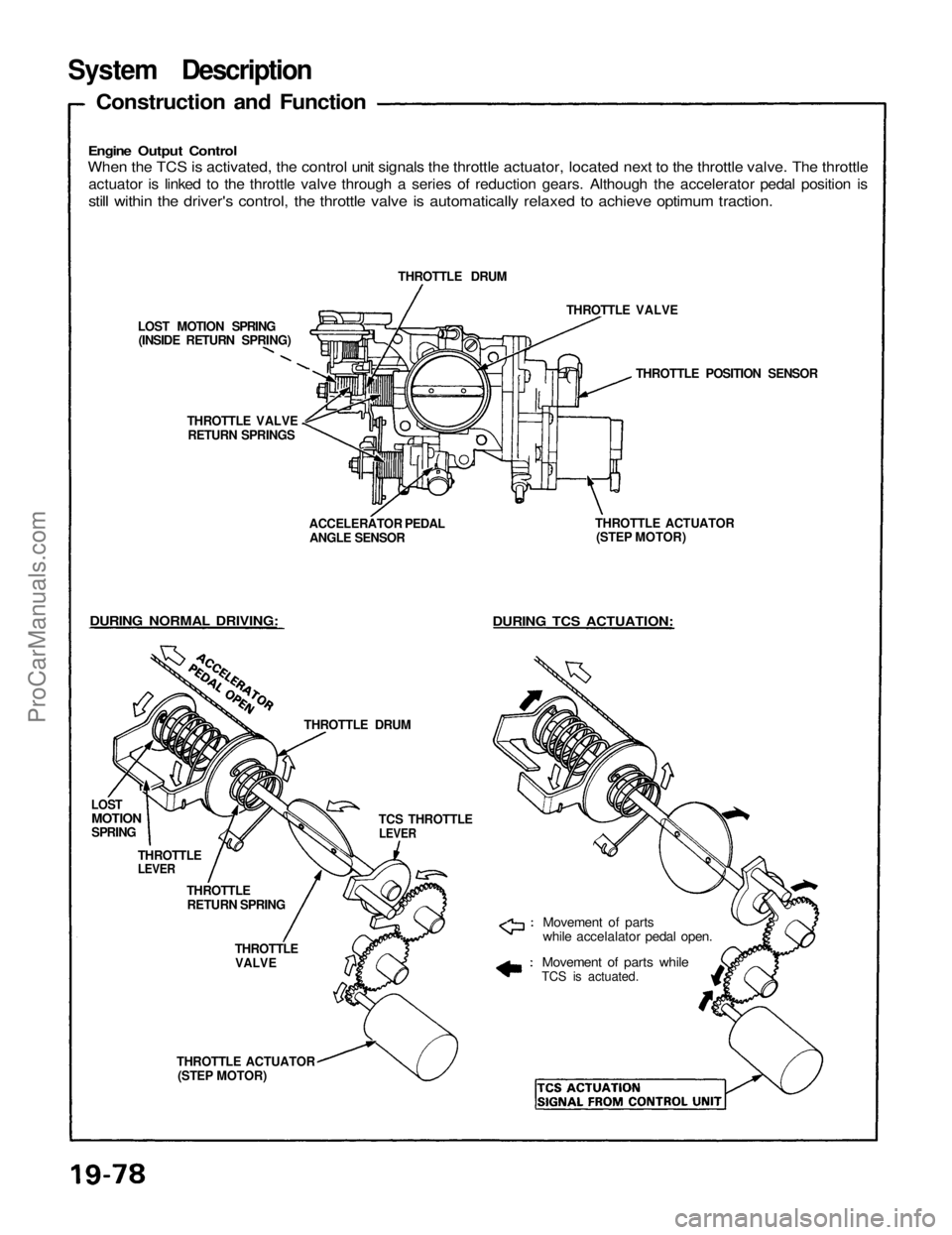
When the TCS is activated, the control unit signals the throttle actuator, located next to the throttle valve. The throttle
actuator is linked to the throttle valve through a series of reduction gears. Although the accelerator pedal position is
still within the driver's control, the throttle valve is automatically relaxed to achieve optimum traction.
Construction and Function
LOST MOTION SPRING
(INSIDE RETURN SPRING)
THROTTLE VALVE
RETURN SPRINGS
DURING NORMAL DRIVING:
LOST
MOTION
SPRING
THROTTLE
LEVER
THROTTLE
RETURN SPRING
THROTTLE DRUM
THROTTLE
VALVE
THROTTLE ACTUATOR
(STEP MOTOR)
Movement of parts
while accelalator pedal open.
Movement of parts while
TCS is actuated.
DURING TCS ACTUATION:
THROTTLE ACTUATOR
(STEP MOTOR)
THROTTLE POSITION SENSOR
THROTTLE VALVE
THROTTLE DRUM
ACCELERATOR PEDAL
ANGLE SENSOR
TCS THROTTLE
LEVERProCarManuals.com
Page 1365 of 1640
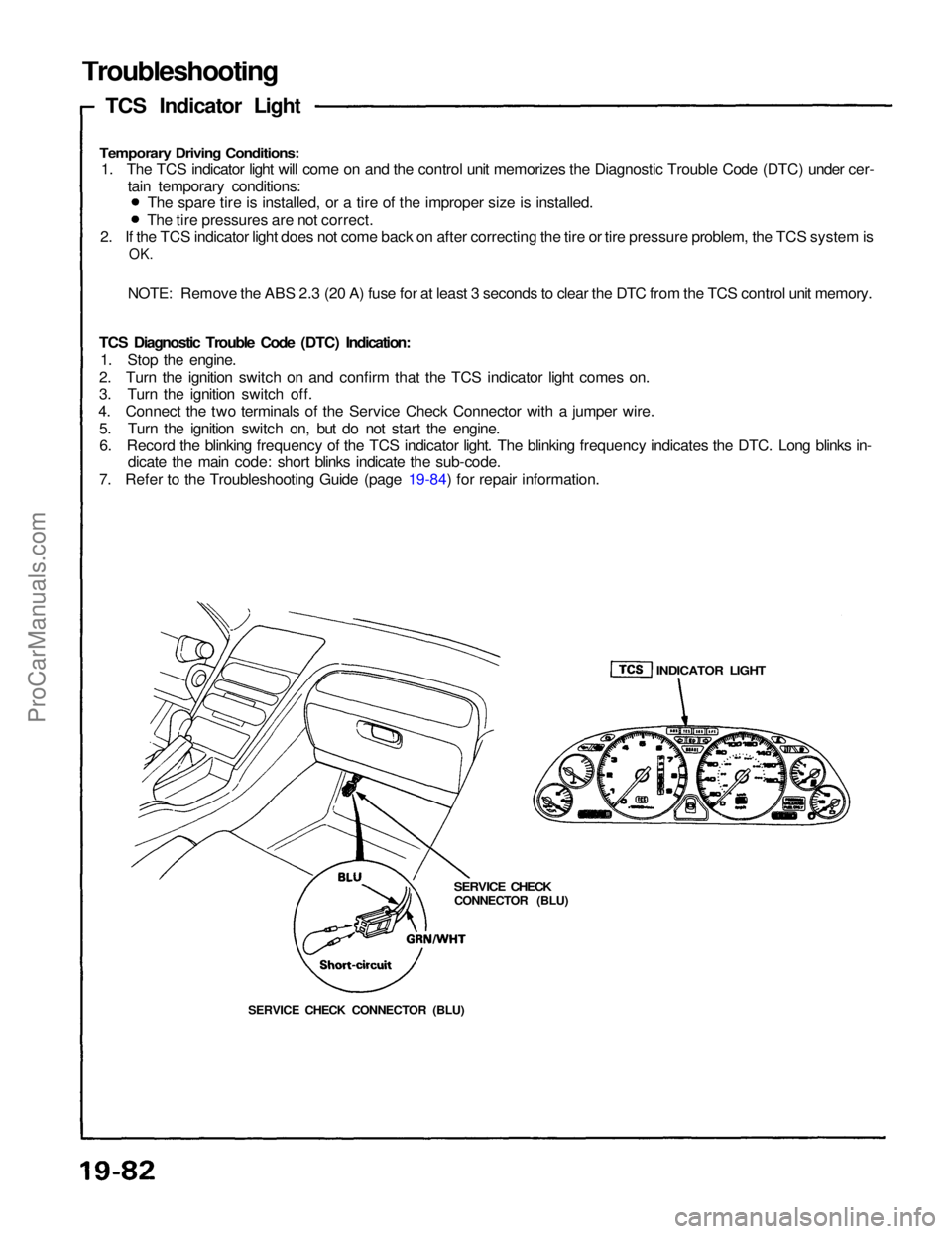
Troubleshooting
TCS Indicator Light
Temporary Driving Conditions:
1. The TCS indicator light will come on and the control unit memorizes the Diagnostic Trouble Code (DTC) under cer-
tain temporary conditions:
2. If the TCS indicator light does not come back on after correcting the tire or tire pressure problem, the TCS system is
OK.
NOTE: Remove the ABS 2.3 (20 A) fuse for at least 3 seconds to clear the DTC from the TCS control unit memory.
TCS Diagnostic Trouble Code (DTC) Indication: 1. Stop the engine.
2. Turn the ignition switch on and confirm that the TCS indicator light comes on.
3. Turn the ignition switch off.
4. Connect the two terminals of the Service Check Connector with a jumper wire.
5. Turn the ignition switch on, but do not start the engine.6. Record the blinking frequency of the TCS indicator light. The blinking frequency indicates the DTC. Long blinks in- dicate the main code: short blinks indicate the sub-code.
7. Refer to the Troubleshooting Guide (page 19-84) for repair information. The spare tire is installed, or a tire of the improper size is installed.
The tire pressures are not correct.
SERVICE CHECK CONNECTOR (BLU)
SERVICE CHECK
CONNECTOR (BLU)
INDICATOR LIGHTProCarManuals.com
Page 1366 of 1640
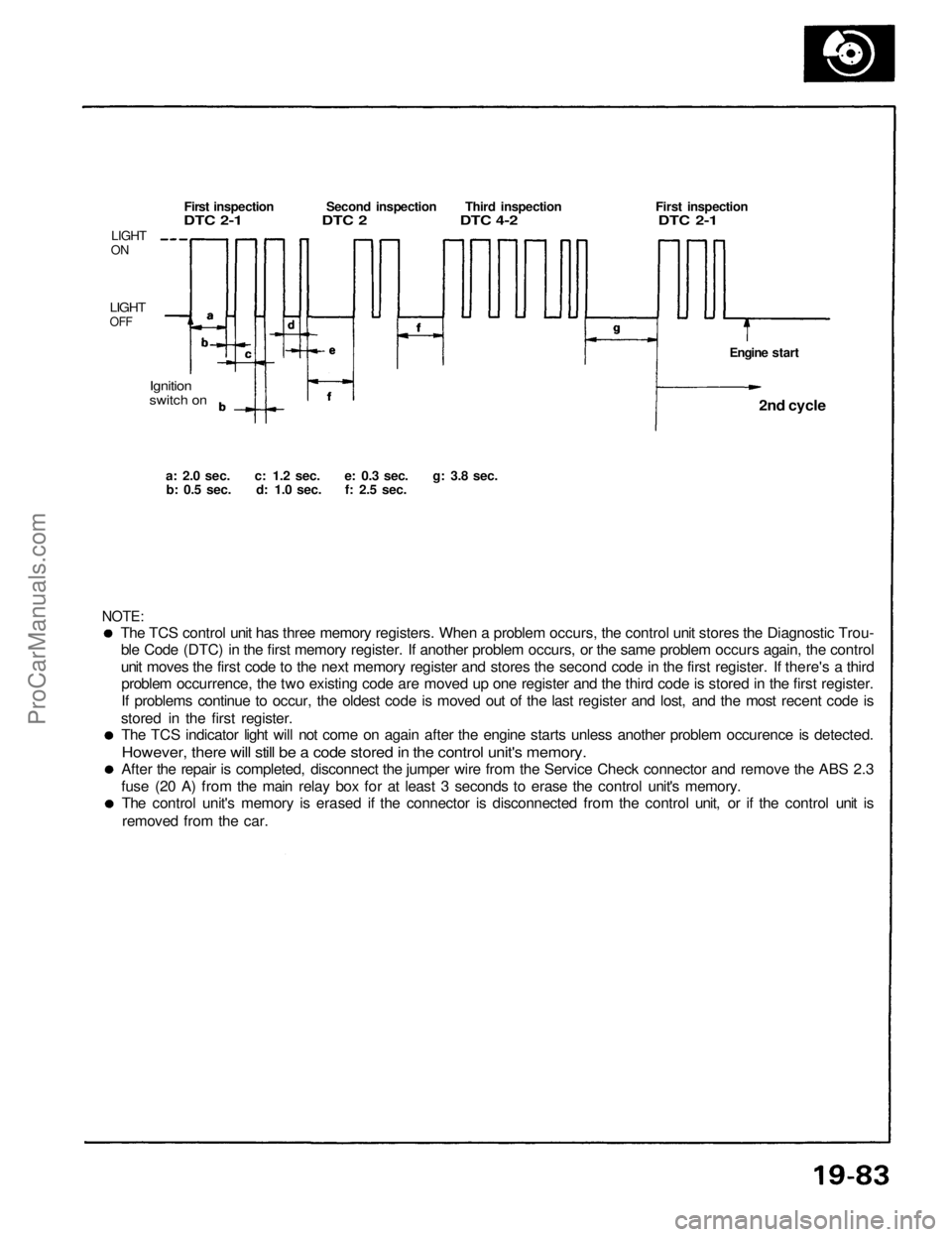
The TCS control unit has three memory registers. When a problem occurs, the control unit stores the Diagnostic Trou-
ble Code (DTC) in the first memory register. If another problem occurs, or the same problem occurs again, the control
unit moves the first code to the next memory register and stores the second code in the first register. If there's a thirdproblem occurrence, the two existing code are moved up one register and the third code is stored in the first register.
If problems continue to occur, the oldest code is moved out of the last register and lost, and the most recent code is
stored in the first register. The TCS indicator light will not come on again after the engine starts unless another problem occurence is detected.
However, there will still be a code stored in the control unit's memory.
After the repair is completed, disconnect the jumper wire from the Service Check connector and remove the ABS 2.3
fuse (20 A) from the main relay box for at least 3 seconds to erase the control unit's memory. The control unit's memory is erased if the connector is disconnected from the control unit, or if the control unit is
removed from the car.
NOTE:
a: 2.0
sec.
c: 1.2
sec.
e: 0.3
sec.
g: 3.8
sec.
b: 0.5
sec.
d: 1.0
sec.
f: 2.5
sec.
Ignition
switch on
LIGHT
ON
LIGHT
OFF
First inspection Second inspection Third inspection First inspection
DTC 2-1 DTC 2 DTC 4-2 DTC 2-1
Engine start2nd cycle
ProCarManuals.com
Page 1388 of 1640
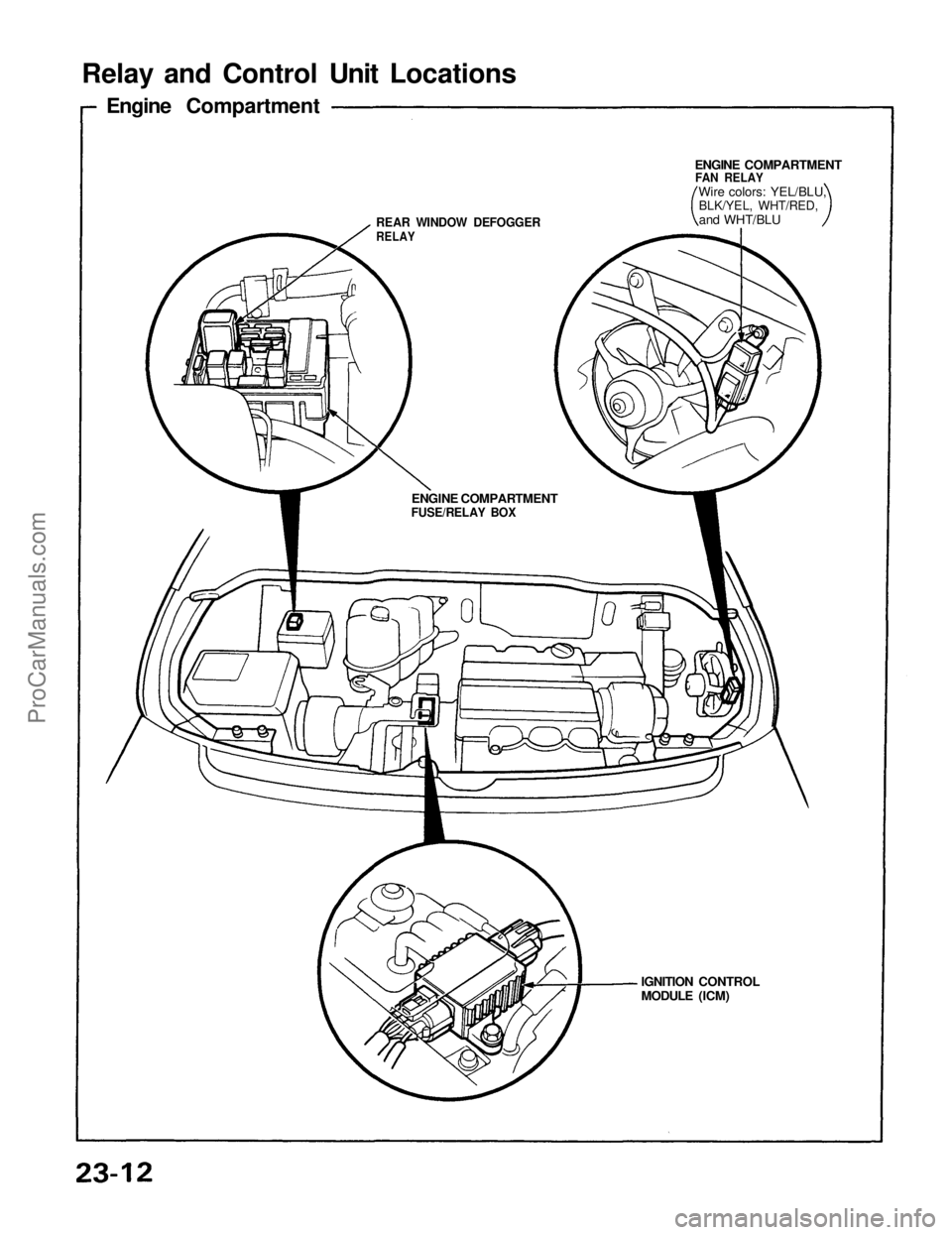
Relay and Control Unit Locations
Engine Compartment
REAR WINDOW DEFOGGER
RELAY
ENGINE COMPARTMENT
FUSE/RELAY BOX
ENGINE COMPARTMENT
FAN RELAY
Wire colors: YEL/BLU,
BLK/YEL, WHT/RED,
and WHT/BLU
IGNITION CONTROL
MODULE (ICM)ProCarManuals.com
Page 1393 of 1640
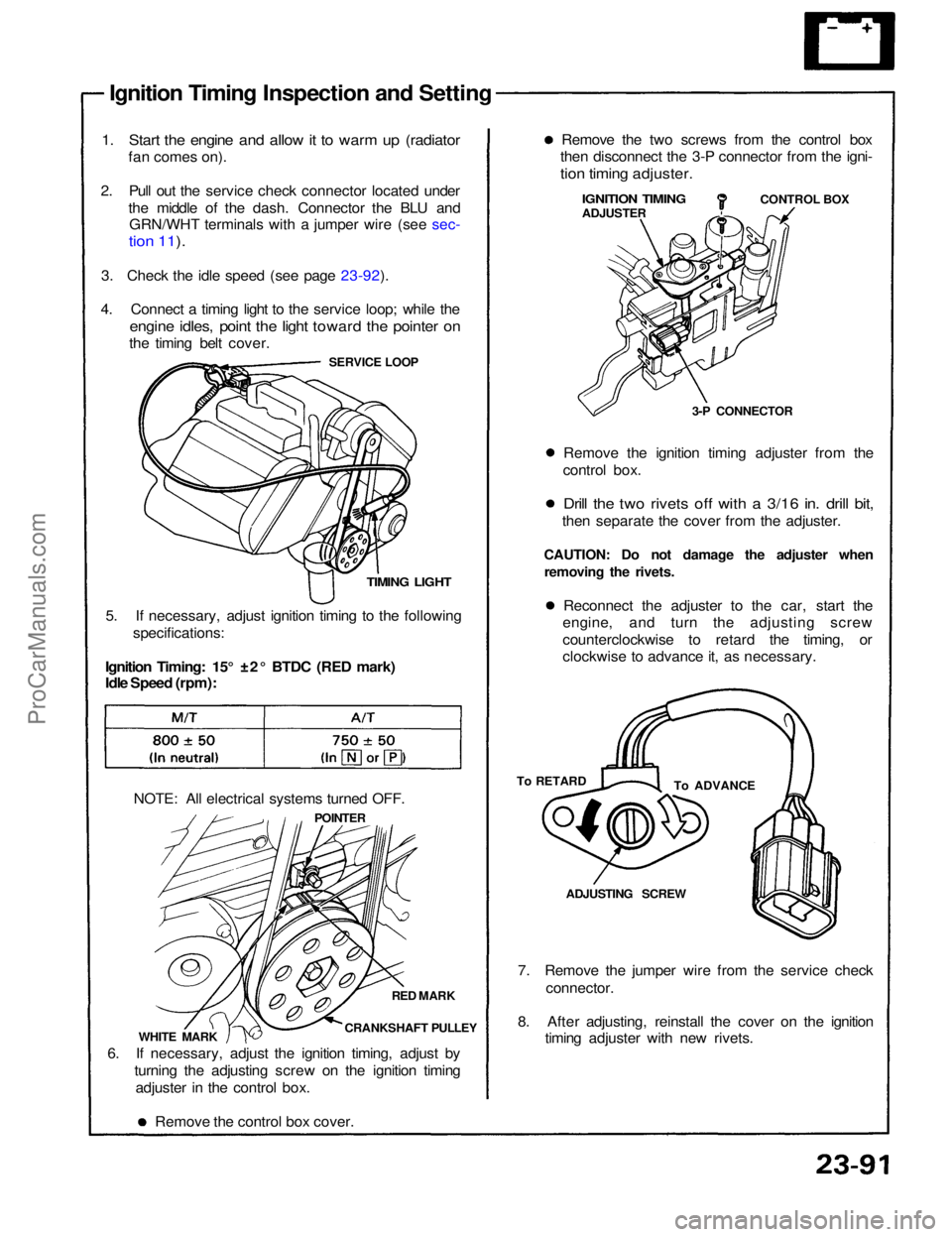
Ignition Timing Inspection and Setting
1. Start the engine and allow it to warm up (radiator
fan comes on).
2. Pull out the service check connector located under the middle of the dash. Connector the BLU andGRN/WHT terminals with a jumper wire (see sec-
tion 11).
3. Check the idle speed (see page 23-92).
4. Connect a timing light to the service loop; while the
engine idles, point the light toward the pointer on
the timing belt cover.
SERVICE LOOP
TIMING LIGHT
5. If necessary, adjust ignition timing to the following specifications:
Ignition Timing: 15° ±2° BTDC (RED mark)
Idle Speed (rpm):
NOTE: All electrical systems turned OFF. POINTER
RED MARK
CRANKSHAFT PULLEY
WHITE MARK
6. If necessary, adjust the ignition timing, adjust by turning the adjusting screw on the ignition timingadjuster in the control box.
Remove the control box cover. 7. Remove the jumper wire from the service check
connector.
8. After adjusting, reinstall the cover on the ignition timing adjuster with new rivets.ADJUSTING SCREW
To ADVANCE
To RETARD Reconnect the adjuster to the car, start the
engine, and turn the adjusting screw
counterclockwise to retard the timing, or
clockwise to advance it, as necessary.
CAUTION: Do not damage the adjuster when
removing the rivets. Remove the ignition timing adjuster from the
control box.
Drill the two rivets off with a 3/16 in. drill bit,
then separate the cover from the adjuster. 3-P CONNECTORCONTROL BOX
IGNITION TIMING
ADJUSTER
Remove the two screws from the control box
then disconnect the 3-P connector from the igni-
tion timing adjuster.ProCarManuals.com
Page 1394 of 1640
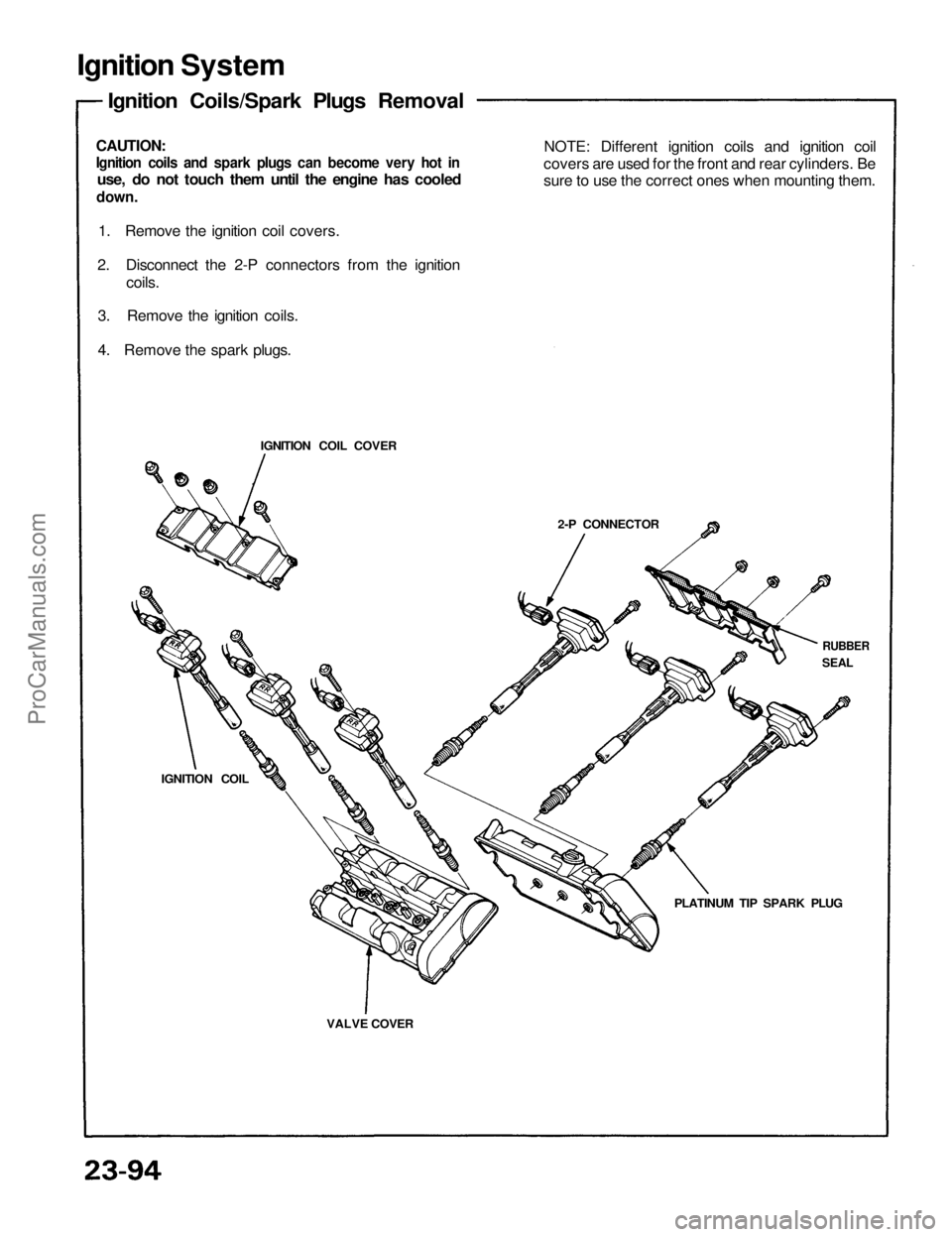
Ignition System
Ignition Coils/Spark Plugs Removal
CAUTION:
Ignition coils and spark plugs can become very hot in
use, do not touch them until the engine has cooled
down.
1. Remove the ignition coil covers.
2. Disconnect the 2-P connectors from the ignition
coils.
3. Remove the ignition coils.
4. Remove the spark plugs.
IGNITION COIL COVER
IGNITION COIL
VALVE COVER
PLATINUM TIP SPARK PLUG
RUBBER
SEAL
2-P CONNECTOR
NOTE: Different ignition coils and ignition coil
covers are used for the front and rear cylinders. Be
sure to use the correct ones when mounting them.ProCarManuals.com
Page 1398 of 1640
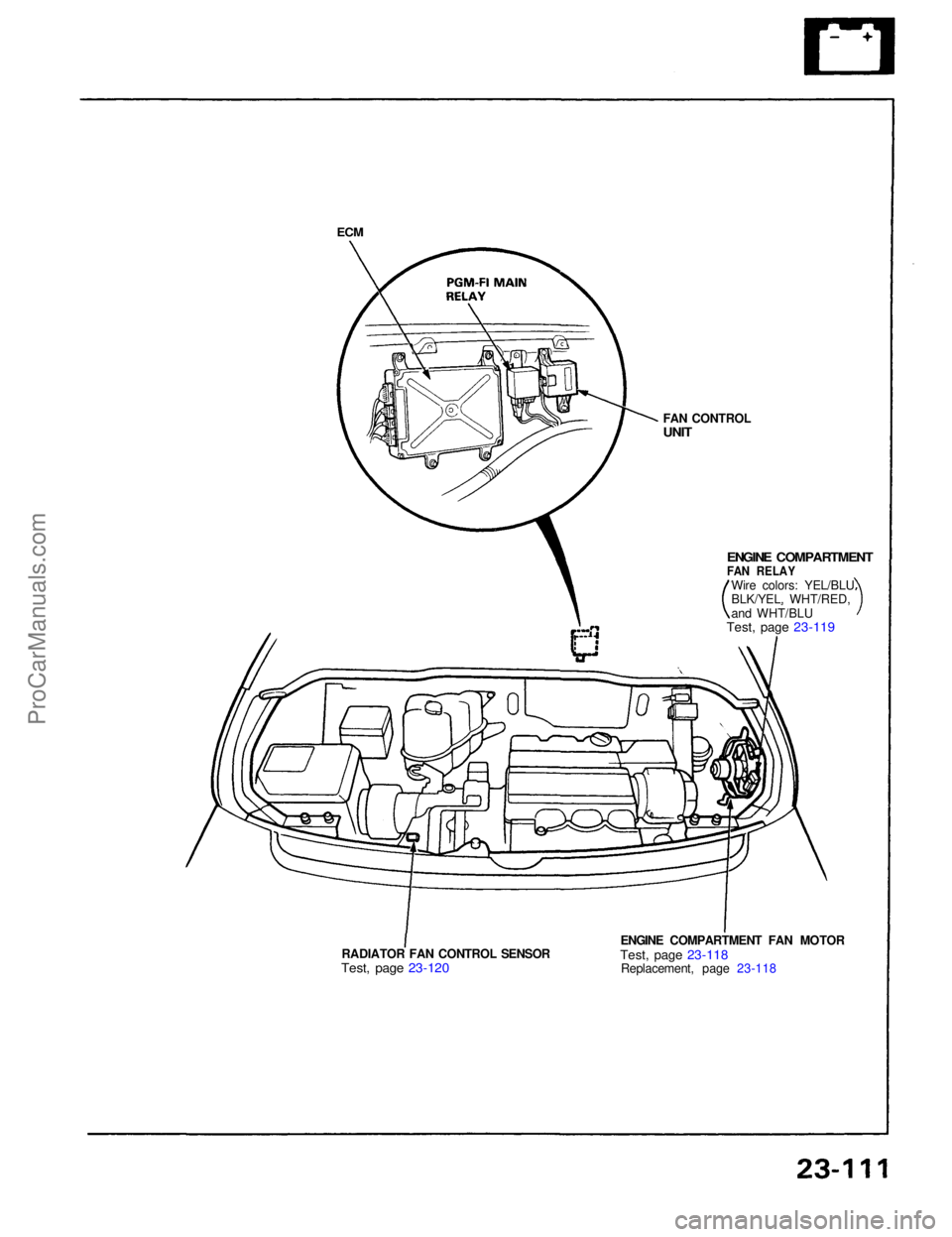
ECM
RADIATOR FAN CONTROL SENSOR
Test, page 23-120
ENGINE COMPARTMENT FAN MOTOR
Test, page 23-118
Replacement, page 23-118
ENGINE COMPARTMENT
FAN RELAY
Wire colors: YEL/BLU
BLK/YEL, WHT/RED,
and WHT/BLU
Test, page 23-119
FAN CONTROL
UNITProCarManuals.com