AUDI TT 2013 Owner´s Manual
Manufacturer: AUDI, Model Year: 2013, Model line: TT, Model: AUDI TT 2013Pages: 262, PDF Size: 65.91 MB
Page 51 of 262
come back a while later and drive off, the rain
sensor will reactivate itself after the vehicle
speed has exceeded 4 mph (6 km/h).
The rain sensor* is only activated with the
wiper lever set to position(!). When it starts
to rain, the rain sensor will automatically acti
vate the intermittent wiping mode.
To reduce the sensitivity of the sensor, move
switch @ down. To increase the sensitivity,
move the switch up. The higher you adjust the
sensitivity, the faster the sensor will react
when it senses moisture on the windshield. The pauses between wiper turns depend not
only on the sensitivity setting, but on the ve
hicle speed as well.
During brief stops, e.g . at a red light, wiper
motion will automatically be reduced to the
next lower speed . Wipers already turning at
low speed change to intermittent wiping.
When the ignition is turned on, the washer
jets are heated .
A WARNING
-Wiper blades are crucial for safe driving!
Only when they are in good condition are
they able to clear the windows properly
to provide uncompromising visibility.
Worn or damaged wiper blades are a
safety hazard
r=;, page 51, Replacing
windshield wiper blades!
- The light/rain sensor* is only designed to
assist and support the driver.
It remains
entirely the driver's responsibility to
monitor outside weather conditions and
to manually activate the wipers as soon
as rain or drizzle reduces visibility
through the windshield.
- The windshield must not be treated with
water-repellent materials. They can in
crease glare under poor visibility condi
tions such as wetness, darkness, or when
the sun is low on the horizon. In addi
tion, they can cause the windshield wip
ers to chatter.
Clear vision 49
@ Note
In freezing or near freezing conditions:
- Always check that the wiper blades are
not frozen to the glass before you turn
the wipers on. Loosen a wiper blade
which is frozen in place before operating
the wipers to prevent damage to the
wiper blade or the wiper motor.
- Do not use the wipers to clear a frosted
window. Using the wipers as a conven ient ice scraper will destroy the wiper
blades .
- Before you take your vehicle to an auto
matic car wash, make sure you have the
windshield wiper system switched off (lever in position
0), otherwise the wind
shield wiper system could get damaged
in the car wash if it should suddenly
come on.
@ Tips
-The windshield wipers are switched off
when the ignition is turned off. Activate
the windshield wipers after the ignition
is switched back on by moving the wind
shield wiper lever to any position.
- Worn or dirty windshield wiper blades
cause smearing, which can affect the op
eration of the light/rain sensor*. Check
the condition of your windshield wiper
blades regularly.
-The rain sensor is part of the interval
wiping system. Turning off the ignition
will also deactivate the rain sensor. To re
activate the sensor, switch off the inter
val wiping function, then switch it back
on again.
-Applies to vehicles with light/rain sen
sor: When the wipers are switched on
manually and in rain conditions, the au
tomatic headlights* turn on
r=;, page 42,
Switching the headlights on and off
or
off during the day when the wipers are
no longer operating. The automatic
headlights* function is available in this
case only when the light switch is in the
"AUTO" position¢
page 42, fig. 39.
Page 52 of 262
50 Clear vis ion
- Make sure the washe r fl ui d reservoi r in
the engine compartment is topped
off
before going on a long t rip . L oo k up
c:> page 194 for checking and fi lling the
washer container.
- The w ipers only operate w ith the hood
completely closed.
Headlight washer system
App lies to vehicles : with hea dli ght washer syste m
The headlight washer system cleans the
headlights.
., Operate the windshield wiper/washer sys
tem
c:> page 48, fig. 50 ® with the head
li ghts turned on by holding the lever for lon
ger than one second.
The washe r jets extend forward o ut of the
front bumper driven by water pressure to
spray the front headlights with water.
You shou ld inspect the headlights regularly
(for example when refue ling) and clean
off
any solid dirt or insects from the lenses .
To ensure the system wo rks properly in winter,
keep the washer jets free o f snow and remove
any ice using a de- ic ing spray.
Service position
It is only possible to change wiper blades if
you move the wiper arms to the service posi
tion .
In o rder to use the windsh ie ld w ipers, the
front lid must be comp letely closed .
Moving wiper blades to the service
position
., When there is a ris k of frost, ma ke s ure that
the wiper b lades are not frozen to the wind
shield .
.. Switch the ignition on .
., Move the wiper lever to position
0
c:> page 48, fig. 50 .
., Press the I Re set I button until the D isplay
typ e
menu appears in the Driver Informa
t ion System display . .,
Using the rocker switch and the
I R ese t! but
ton, se lect the
Set > Wipe rs > Front > Serv
ice position on
funct ion . T he w indshield
w iper arms move to the service posit ion.
Mo ving wip er blades to pa rk position
., Ma ke certain that the w iper arms are ly ing
against the windshield .
., Switch the ignitio n on and move the wiper
lever from pos ition O
to 4 c:> page 48,
fig. 50. The w iper arms will move back to
the park position.
@ Note
Never drive your veh icle when the wind
sh ield wiper arms are in the service posi
tion and pulled away from the winds hield .
When you drive faster than
4 mph (6 km/
h), the wiper a rms automatically return to
the pa rk position and cou ld cause paint
damage to the front lid!
@ Tips
- Yo u can also tur n on the se rvice posit ion,
for example, if you want to p rotect the
w indshield from icing by us ing a cover.
- The service posit ion moves to
off auto
matically whe n you ope rate the w ind
shield wiper lever, o r speed exceeds
4 mph (6 km/h) .
Page 53 of 262
Replacing windshield wiper blades
Wiper blades in good condition help keep the
windshield clear .
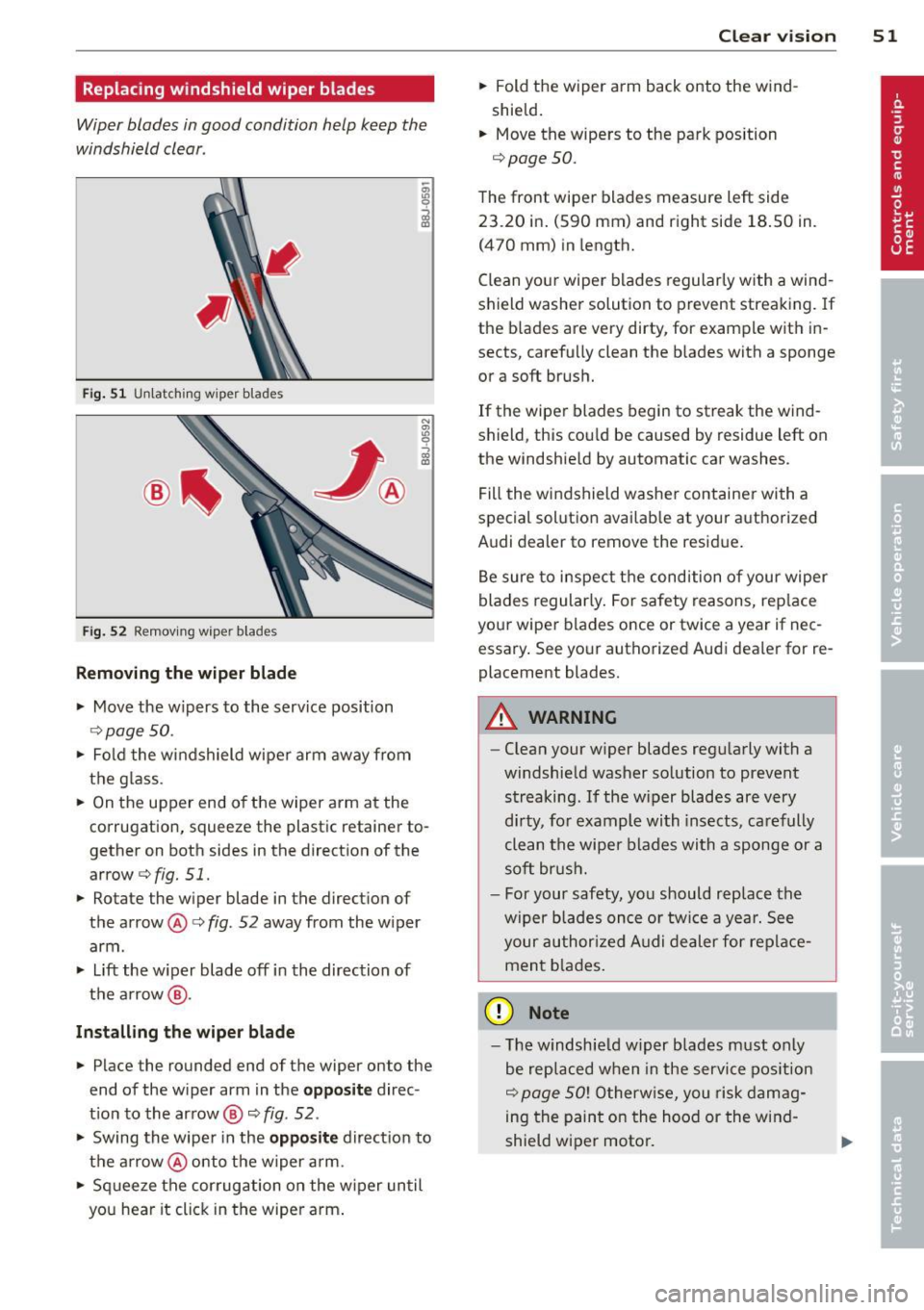
Fig. 51 Un l atc hing wiper blades
Fig. 52 Remov ing wiper blades
Removing the wip er blade
• Move the w ipers to the service position
<:;> page 50.
• Fo ld the w indshield wiper arm away from
the g lass.
• On the upper end of the wiper arm at the
corrugation, squeeze the plastic retainer to
gether on both sides in the direction of the
arrow¢fig. 51.
• Rotate the wiper blade in the direction of
the arrow @¢
fig. 52 away from the wiper
arm .
• Lift the w iper blade off i n the direction of
the a rrow @.
Inst alling the wiper blade
• Place the rounded end of the wiper onto the
end of the wiper arm in the
opposit e direc
t ion to the arrow@¢
fig. 52 .
• Swing the wipe r in the oppo site direction to
the a rrow @onto the wiper arm.
• Sq ueeze the corrugation on the w iper un til
you hear it click in the wipe r arm .
Clear vi sion 51
• Fold the wiper arm back onto the wind
shield.
• Move the wipers to the park position
¢page SO.
The front wipe r blades measure left side
23.20 in. (590 mm) and right side 18.SO in.
(470 mm) in length.
C lean your wiper blades regularly with a wind
shield washer solution to prevent streaking. If
the blades are very dirty, for example with in
sects, carefully clean the blades with a sponge
or a soft brush.
If the wiper blades begin to streak the wind
shield, this could be caused by residue left on
the windshie ld by automatic car washes.
Fill the wi ndshield washe r container with a
spec ial solutio n availab le at your a uth orized
Audi dealer to remove the resid ue .
Be sure to inspect t he condition of your wiper
blades regularly. For safety reasons, rep lace
your wiper blades once or twice a year if nec
essary . See yo ur authorized Aud i dealer for re
placement blades.
A WARNING
- Clean your wiper blades regu larly with a
windshie ld washer so lution to prevent
streaking. If the w iper blades are very
d irty, fo r example with insects, ca refully
clean the wiper blades with a sponge or a
s oft br ush.
- For your safety, yo u should rep lace the
w iper b lades once o r twice a yea r. See
your author ized Audi dealer for repla ce
ment b lades .
(D Note
-The windshie ld w iper blades m ust only
be replaced when in the service pos ition
q page 50! Otherw ise, you risk damag
ing the paint on the hood or the w ind
shield w ipe r moto r.
Page 54 of 262
52 Clear vis ion
- To help prevent damage to the wiper sys
tem, a lways loosen blades which are fro
zen to the windsh ield before operat ing
wipers.
- To he lp prevent damage to w iper blades,
do not use gasoline, kerosene, pa int
thinner, or other solvents on or near the
wiper blades.
- To he lp prevent damage to the wiper
arms or other components, do not at
tempt to move the wipers by hand .
(D Tips
-Commercial hot waxes applied by auto
matic car washes affect the cleanability
of the glass surface .
- The front wiper blades are different
l engths; the blade on the driver's s ide is
l onger .
Digital compass
Activating or deactivating the compass
Applies to vehicles: with digital compass
The direction is displayed on the interior rear
view mirror.
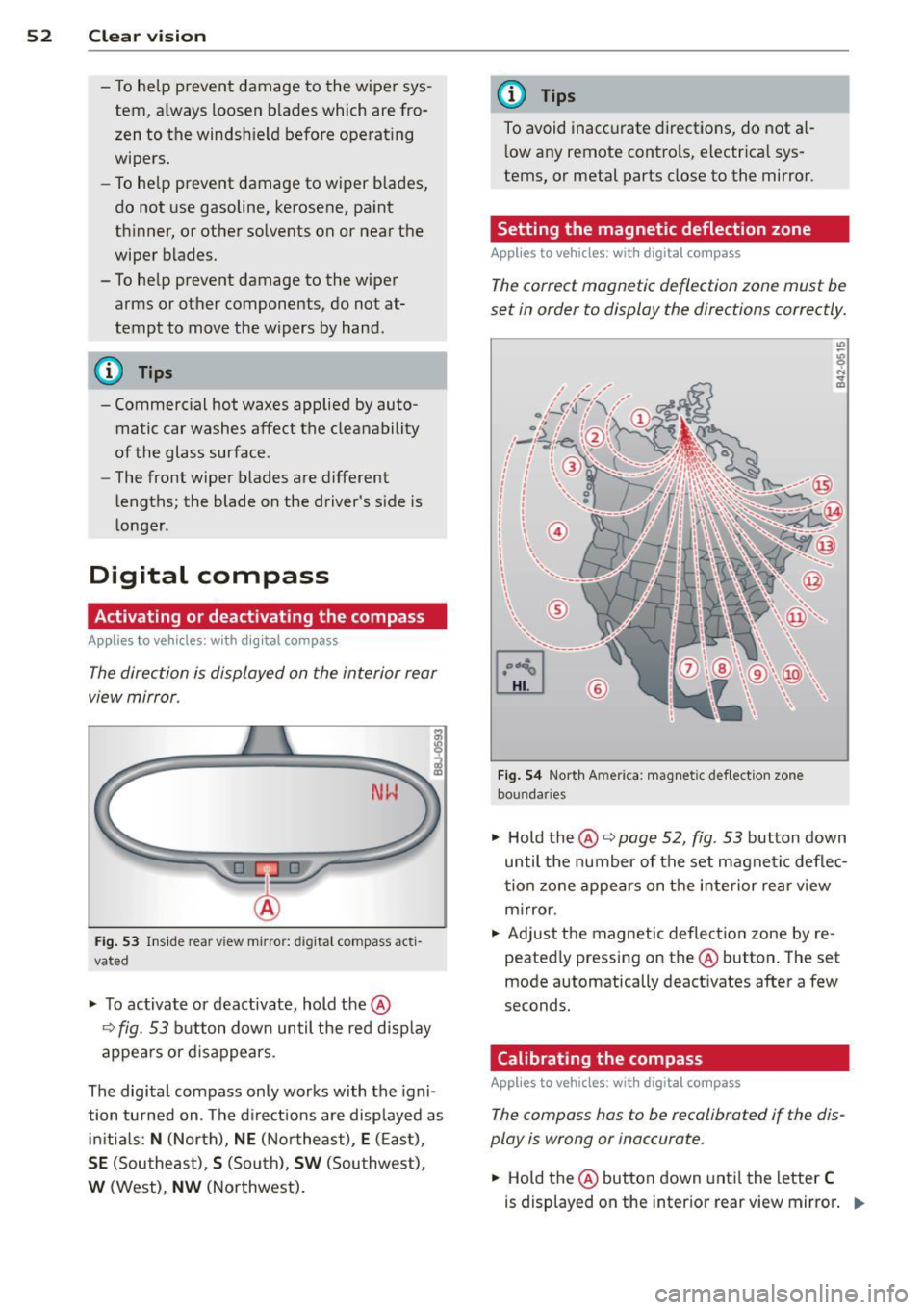
Fig . 53 In side rea r vi ew m irro r: digi tal compass ac ti
v at ed
.. To activate o r deactivate, hold the@
c::> fig. 53 b utton down until the red disp lay
appe ars or d is a ppears.
The digital compass only works with the igni
tion tu rned on . T he d irect io ns are displayed as
ini tia ls :
N (North), NE (No rthe ast) , E (E as t),
SE (Southe ast), S (Sou th), SW (Southwest),
W (West) , NW (Northwest).
(D Tips
To avoid inaccurate directions, do not al
l ow any remote contro ls, electr ica l sys
tems, or metal parts close to the mirror .
Setting the magnetic deflection zone
Applies to vehicles: with digita l compass
The correct magn etic deflection zon e must be
set in order to display the dire ctions correctly.
©
Fi g. 54 North A meric a: magne tic def le ction zo ne
bo un daries
" Ho ld th e@ c::> page 52, fig . 53 button down
until the number of the set magnetic deflec
t ion zo ne appe ars on the inte rior re ar v iew
m irror.
.. Adjust the magnetic de flect ion zone by re
peated ly pressing on the @button . The set
mode automatically deact ivates after a few
seconds.
Calibrating the compass
Applies to vehicles: with digita l compass
The compass has to b e recalibrated if the dis
play is wrong or inaccurate.
.. Hold the @button down unti l th e letter C
is displayed on the inter ior rear view mirror . ..,.
Page 55 of 262
~ Drive in a circle at a speed of about 5 mph
(10 km/h) until a direction is shown on the
interior rear view mi rror.
A WARNING
The d igital compass is to be used as a di
rectional a id only. Even though you may
want to look at it wh ile you are driv ing, you
must sti ll pay attention to t raffic , road and
weather condit io ns as we ll as other possi
ble h azards.
Clear vis ion 53
Page 56 of 262

54 Seat s a nd s tor ag e
Seats and storage
General recommen
dations
Why is your seat adjustment so
important?
The safety belts and the airbag system can
only provide maximum protection if the front
seats are correctly adjusted.
There are various ways of adjust ing the front
seats to provide safe and comfortable support
for the driver and the front passenger . Adjust
your seat properly so that :
- you can easily and quick ly reach all the
switches and controls in the instrument
panel
-your body is prope rly supported thus reduc
ing physical stress and fatigue
- the safety be lts and airbag system can offer
maximum protection
¢ page 108 .
In the following sec tions, you will see exactly
how you can best adjust you r seats .
There are special regulations and instructions
for insta lling a child safety seat on the front
passenger's seat. Always heed the informa
tion rega rd ing child safety provided in
~ page 130, Child Safety.
A WARNING
Incorrect seating position of the driver and
all other passengers can result in serious
personal in jury.
- Always keep your feet on the floor when
the vehicle is in motion -never p ut your
feet on top of the instrument panel, out
of the w indow or on top of the seat cush
ion! This applies espec ially to the passen
gers .
If your seating position is incorrect
yo u increase the r isk of injury in the case
of sudden braking or an acc ident.
If the
airbag infla tes and the seating position
is incorrect this could result in personal
injury or even death.
- It is import ant for bo th the driver and
front passenger to keep a distance of at least 10 inches (25 cm) between them
selves and the steering wheel and/or in
strument panel. If you're s itting any
closer than th is, the a irbag system can
not protect you properly . In addition to
this, the front seats and head restra ints
must be adjusted to your body height so
that they can give you max imum protec
tion.
- Always try to keep as much distance as
possible between yourself and the s teer
ing wheel or instrument pane l.
- Do not adjust the driver's o r fron t pa s
senger's seat whi le the vehicle is moving.
Your seat may move unexpected ly, caus
ing sudden loss of vehicle contro l and
personal injury . If you ad just yo ur seat
while the veh icle is moving, you are out
of posit ion.
Driver's seat
The correct seat position is important for safe
and relaxed driving.
We recommend that you adjust the driver's
seat in the fo llowing manner:
.,. Adjust the seat in fore and aft direction so
t ha t you can easily p ush the peda ls to the
floor wh ile keeping your knee slightly bent
~ A in Why is your seat adjustment so im
portant? on page 54 .
.,. Adjust the seatback so that when you sit
w ith your back against the seatback, you can
still grasp the top of the steering wheel.
.,. Posit ion the head restraint accord ing to the
occupant 's height~
page 57 . For maxi
mum protection, t he top of the head re
s t raint shou ld be a t least at eye level, pref
erably higher and idea lly level with the top
of the head
¢ page 94, fig. 92.
A WARNING "--
Never place any objects in the dr iver's foot-
well. An object could get into the pedal
area and interfere with pedal function. In
case of sudden braking or an acc ident, you
would not be able to brake or accelerate!
Page 57 of 262
Front passenger's seat
Always move the front passenger seat into the rearmost position .
To avoid contact with the airbag while it is de
ploying, do not sit any closer to the instru
ment panel than necessary and always wear
the three-point safety belt provided adjusted
correctly . We recommend that you adjust the
passenger's seat in the following manner:
.. Bring the backrest up to an (almost) upright
pos it ion .
Do not ride with the seat reclined .
.. The idea l posit ion for the head restraint is
with the upper edge of the restraint level
with the top of your head
¢ page 5 7. You
shou ld
not lower the top of the restraint be
low the level of your eyes .
.. Place your feet on the floor in front of the
passenger's seat.
Adjusting front seats manually
Adjustment controls
Applies to vehicles: with manual seat adjustme nt
Various controls on the manual seats provide
a wide range for individual adjustments.
Fig. S5 Ad just men t contro ls : locat ions o n drive r's seat
CD Moving the seat forward or backward
@ Adjusting the lumbar support
@ Adjusting the seat height
@ Adjusting the seatback angle
® Releasing the seatback
Seats and storage 55
@ Tips
Some of the controls are fitted on certain
models only or they are optional equip
ment .
Adjusting the manual seats
Applies to vehicles: with manual seat adjustment
Position, angle and shape of the manual
seats can be adjusted to provide safe and
comfortable seating .
Reed and heed all WARNINGS ¢.&. before
you adjust your seat .
Moving the front seats forward or
backward
.. Lift the lever CD¢ page 55, fig. 55 and slide
the seat to the desired position.
.. Release the lever and then move the seat
further until you feel and hear it engage.
Adjusting the seat height
.. Pull the lever ® up and pump it to raise the
seat .
.. Push the lever down and pump it to lower
the seat.
Adjusting the seatback angle
.. Lean forward to take your weight off the
seatback .
.. Turn the hand wheel@ in the direction you
want the seatback to tilt.
Releasing seatback
.. Pull the lever ® up .
.. Push the seatback forward.
WARNING
-Never adjust the driver's or front pas
senger's seat while the vehicle is moving.
If you do this while the vehicle is moving,
you will be out of position. Always adjust
the dr iver's or front passenger's seat
when the vehicle is not moving .
- Be careful when adjusting the seat
he ight. Check to see that no one is in the
way, or serious injury cou ld result!
Page 58 of 262
56 Seats and storage
- To reduce the r isk of injury in the case of
sudden braking or accident, front pas
sengers must never ride in
a moving ve
hicle with the seatback recl ined . Safety
belts and the airbag system only offer
maximum protection whe n the seatback
is up right and the safe ty belts a re p rop
erly posi tioned on the body. The more
the seatback is re clin ed, the greate r the
risk of personal injury from an incorrect
seating posit ion and improperly posi
t ioned safety be lts!
Power seats
Adjustment switches
App lies to vehicles: with power seats
The operating logic for the switches corre
sponds to the construction and function of
the seat.
Fi g. 56 Adjust ment sw itches : locat io ns on driver seat
The operating logic for the switches corre
sponds to the constr uction, the design and
the function of the seat . Push or pull e ither
switch in exactly the same d irect ion you want
the corresponding part of the seat to move.
Adjustment switches
CD Adjusting the lumbar s upport
@ Adjusting seat height and fore-and-aft po
sition
@ Adjusting the ang le of the seatback
@ Releasing the seatback
Power seat adjustment
Applies to vehicles: with power seats
The switches can be moved in various direc
tions to allow precise adjustment.
Read and heed all warnings before you adjust
your seat.¢ &.
Adju sting the curv atur e of the lumbar
support
.,._ Push the forward or rear depression on the
sw itch shell CD¢
page 56, fig. 56 to in
crease or decrease the back rest curvature.
Adju sting the he ight of the lumbar
support
.,._ Push the top or bottom depress ion on the
sw itch shell (!) to raise or lower the support
in the back rest .
Mo ving the front se ats forward or
ba ckward
.,._ Press the switch @forward or backward
hor izontally.
Ad ju sting the seat height
.,._ Pull or push the switch @even ly at both
ends to ra ise or lower the seat.
Angling the seat cu shion up and down
(front )
.,._ Pull or push the switch @at the front only
to raise or lower the seat .
Angling the seat cushion up and down
( rear)
.,._ Pull or push the switch @at the rear on ly
to ra ise or lower the seat.
Ad ju sting the seatback
.,._ Push or pull the switch @ in the same direc-
tion you want the seatback to tilt .
Releasing seatback
.,. Pull the lever@ up .
.,. Push the seatback forward.
Page 59 of 262
A WARNING
-Never adjust the driver's or front passen
ger seat while the vehicle is moving. If
you do this while the vehicle is moving,
you will be out of posit ion. Always adjust
the driver's or front passenger seat when
the vehicle is not moving.
- Be careful when adjusting the seat
height. Check to see that no one is in the
way, or serious injury could result!
- Beca use the seats can be electrically ad
justed wi th the ign it ion key removed,
never leave children unattended in the
vehicle. Unsupervised use of the e lectric
seat adj ustments may cause serious in
jury.
- To reduce the r isk of injury in the case of
sudden braking or accident, front pas
sengers must never ride in a moving ve hicle with the seatback recl ined. Safety
belts and the airbag system offer maxi
mum p rotection only when the seatback
is upright and the safety be lts a re prop
erly posit ioned on the body. The more
the seatback is recl ined, the greate r the
risk of personal injury from an inco rrec t
seating position and improperly posi
t ioned safety be lts!
- Always make sure the front seatbac ks are
in the upright position and securely
locked in place when driving.
S ea ts a nd s to rage 57
Head restraints
Adjusting head restraints, front seats
The head restraints must be adjusted proper
ly to provide protection.
Fi g. 57 Driver's seat head restra int: adjust ing the
he ig ht
The head restraints on the front seats can be
adjusted to provide safe support to head and
neck at the optimum height . When optimally
adjusted , the top of the rest raint should be
level with the top of the head
~ page 94,
Proper adjustment of head restraints .
.. Grasp the sides of the head restraint with
both hands and slide it upward/downward
until you fee l it click into place<>
fig. 57.
A WARNING
- Driving withou t head restraint s or wit h
head restra ints tha t are not properly ad
justed increases the risk of serious o r fa
tal neck injury dramatica lly .
- Read and heed all WARNINGS
<> page 94 .
{i) Tips
Correctly adjusted head restraints and
safety be lts are an ext reme ly effect ive
combination of safety features.
-
Page 60 of 262
58 Seat s a nd s tor ag e
Rear seats
General information
Safe transportation of passengers on the rear
seats requires proper safety precautions .
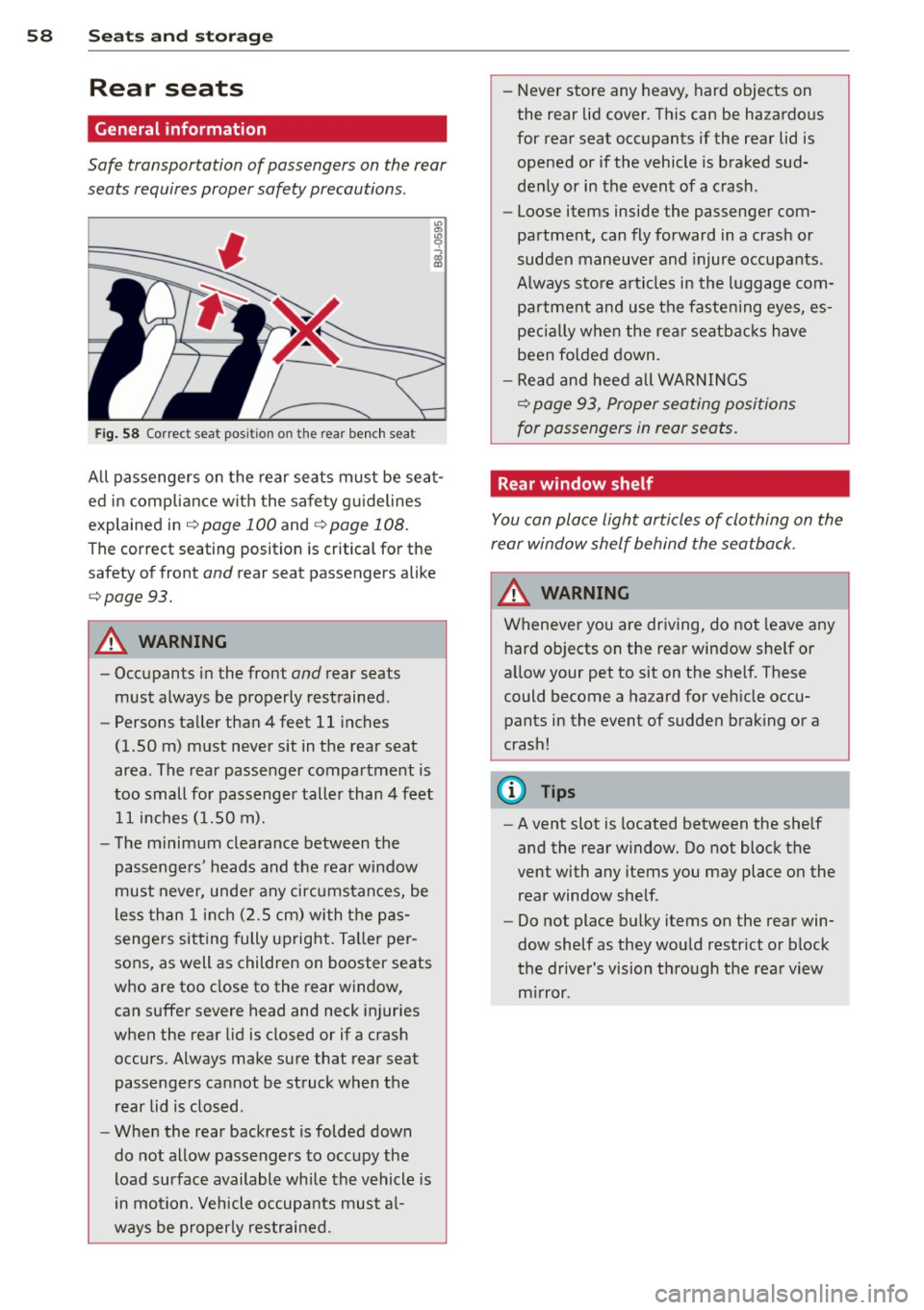
Fig. 58 Correc t seat po sit io n on the rear bench seat
A ll passengers on the rear seats must be sea t
ed in compliance w ith the sa fety guidelines
explained in
c::> page 100 and c::> page 108.
The correct seating position is critical for the
safety of front
and rear seat passengers alike
c::> page 93.
A WARNING
,--
- Occupants in the front and rear seats
must always be properly restrained.
- Persons taller than 4 feet 11 inches
(1. 50 m) must never sit in the rear seat
area . The rear passenger compartment is
too small for passenger taller than 4 feet 11 inches
(1. 50 m).
- The minimum clearance between the
passenge rs' heads and the rear window
must never, under any circumstances, be
less than 1 inc h (2.5 cm) with the pas
sengers sit ting fully upright. Ta ller per
sons, as well as children on booster seats
who are too close to the rear window, can suffer severe head and neck injuries
when the rear lid is closed or if a crash
occurs. Always make sure that rear seat
passengers ca nnot be struck when the
rear lid is closed .
- When the rear backrest is folded down
do not allow passengers to occupy the
load surface available while the vehicle is
in motion. Vehicle occupa nts must al
ways be properly restrained. -
Never store any heavy, hard objects on
the rear lid cover. This can be hazardous
for rear seat occupants if the rear lid is
opened or if the vehicle is braked sud
denly or in the event of a crash .
- Loose items inside the passenger com
partment, can fly forward in a crash or
sudden maneuver and injure occupants .
Always sto re a rticles in the luggage com
pa rtment and use the faste ning eyes, es
pecia lly when the rea r seatbacks have
been fo lded down.
- Read and heed all WARN INGS
c::> page 93, Proper seating positions
for passengers in rear seats.
Rear window shelf '
You can place light articles of clothing on the
rear window shelf behind the seatback .
A WARNING ~ -
Whenever you are driving, do not leave any
hard objects on the rear window shelf or
a llow your pet to sit on the she lf. These
could become a hazard for veh icle occu
pants in the event of sudden brak ing or a
crash!
(i) Tips
- A vent slot is located between the shelf
and the rear w indow. Do not block the
vent with any items you may place on the
rear window she lf.
- Do not place bu lky items on the rear win
dow shelf as they wou ld restr ict or block
the driver's vision t hrough the rear view
m irror .