brake fluid DATSUN 210 1979 Owner's Manual
[x] Cancel search | Manufacturer: DATSUN, Model Year: 1979, Model line: 210, Model: DATSUN 210 1979Pages: 548, PDF Size: 28.66 MB
Page 360 of 548
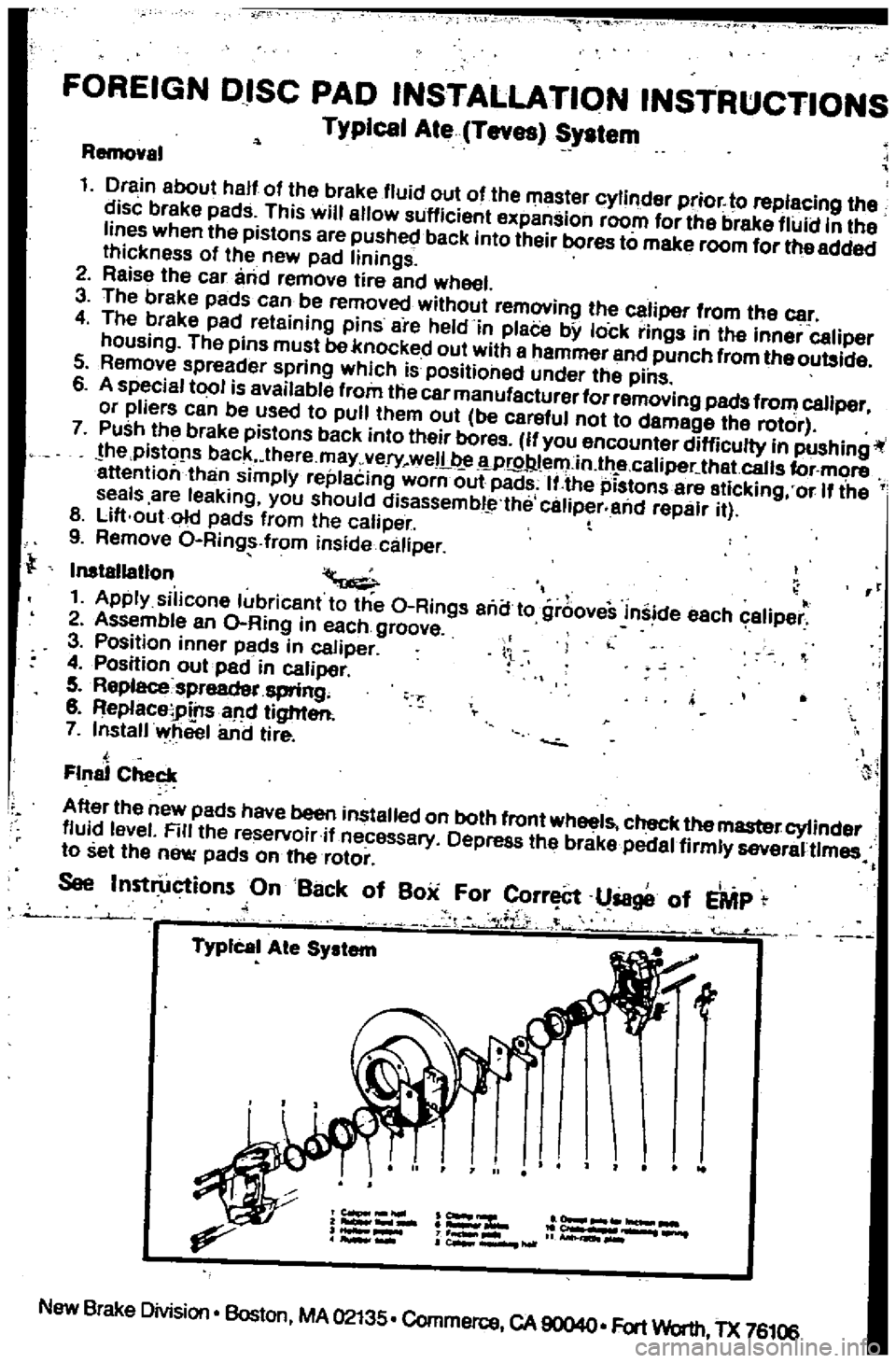
FOREIGN
DISC
PAD
INSTALLATION
INSTRUCTIONS
Typical
Ate
Teves
System
Removel
1
Drain
about
half
of
the
brake
fluid
out
of
the
master
cylinder
prior
to
replacing
the
disc
brake
pads
This
will
allow
sufficient
expansion
room
for
the
brake
fluid
in
the
lines
when
the
pistons
are
pushed
back
into
their
bores
to
make
room
for
the
added
Ihickness
of
the
new
pad
linings
2
Reise
the
car
and
lemove
tire
and
wheel
3
The
breke
pads
can
be
removed
without
lemovinll
the
caliper
from
the
car
4
The
brake
pad
reteining
pins
are
held
in
plaCe
bY
lock
rinlls
in
Ihe
inner
caliper
housing
The
pins
must
be
knocked
out
with
e
hammel
end
punch
from
theoulllide
5
Remove
spreader
spring
which
is
positioned
under
the
pins
6
A
special
tool
is
available
flom
the
car
manufacturer
forremoving
pads
from
caliper
or
pliers
can
be
used
to
pull
them
oul
be
careful
not
to
damage
the
rotor
7
Push
Ihe
brake
pistons
back
into
their
boros
If
you
encounter
difficulty
in
pushingil
he
pistofls
back
lhere
may
very
weIL
Wr9Jl
l
ern
in
lh
e
caliper
that
calls
for
more
attention
than
simplY
replecing
worn
out
pads
IUhe
pistons
are
eticking
or
If
the
seals
are
leaking
you
should
disassembl
the
caliper
and
repair
il
8
Lift
out
old
pads
from
Ihe
caliper
9
Remove
O
Ring
from
inside
caliper
Inslallatlon
II
1
Apply
silicone
lubricanl
to
Ihe
O
Rings
ana
to
grooveS
inside
each
caliper
2
Assemble
an
O
Ring
in
each
groove
3
Position
innor
pads
in
caliper
4
Position
oulpad
in
caliper
5
Replacespreadet
spring
8
ReplaceiPtnsaM
lighter
7
Install
wheel
and
lire
l
Final
Checl
A
Iter
Ihe
new
padS
have
been
installed
on
bolh
front
wheel
check
the
master
cylinder
fluid
level
Rlllhe
reservoiril
necessary
Depress
Ihe
brake
pedal
firmly
severaUlmes
to
sellhe
new
pads
on
he
rotor
i
See
Inst
ctionsOnBat
k
of
Box
For
rr
l8ge
of
EMP
l
iL
1
f
J
TypIcal
Ale
System
New
Brake
Division
Boston
MA
02135
Commerce
CA
90040
Fort
Worth
TX
76106
Page 361 of 548

BR563
Fig
BR
10
Removing
Pad
Inspection
Clean
pads
with
cleaning
solvent
CAUTION
Use
brake
fluid
to
clean
Never
use
mineral
oil
2
When
pads
are
heavily
fouled
with
oil
or
grease
or
when
pad
is
deteriorated
or
deformed
replace
it
3
If
pad
is
worn
to
less
than
the
specified
value
replace
Pad
wear
limit
Minimum
thickness
t
6
mm
0
063
in
Note
Always
replace
pads
in
pad
kit
four
pads
two
clips
four
pad
pins
and
four
pad
springs
4
Check
rotor
referring
to
Rotor
for
inspection
Installetlon
I
Clean
and
apply
P
RC
grease
on
yoke
guide
groove
of
cylinder
body
sliding
contact
portions
of
yoke
and
end
surface
of
piston
Note
a
Do
not
use
common
brake
grease
b
Be
careful
not
to
get
brake
grease
on
rotor
and
pads
2
Loosen
air
bleeder
and
push
pis
ton
B
outer
piston
in
cylinder
until
end
surface
of
piston
B
coincides
with
end
surface
of
retaining
ring
on
boot
Then
inner
pad
can
be
installed
Brake
System
BR564
Fig
BR
11
Pushing
Piston
CAUTION
Piston
can
be
easily
pushed
in
by
hand
but
if
pushed
too
far
groove
of
piston
will
go
inside
of
piston
seal
as
shown
in
Fig
BR
12
At
this
point
if
piston
is
pressured
or
moved
piston
seal
will
be
damaged
If
piston
has
been
pushed
in
too
far
remove
brake
assembly
and
disassemble
it
Then
push
piston
out
in
the
direction
shown
by
arrow
Assemble
it
again
referring
to
follow
ing
section
00
I
Normal
I
position
L
BR409
Fig
BR
12
Position
for
Pushing
Piston
3
Push
piston
A
inner
piston
in
cylinder
by
pulling
yoke
as
shown
The
outer
pad
can
then
be
installed
BRS6S
Fig
BR
13
Pulling
in
Piston
A
BR
7
4
After
installing
pads
depress
brake
pedal
several
times
and
pads
will
settle
into
proper
position
Note
When
worn
out
pads
are
re
placed
with
new
ones
brake
fluid
may
overflow
reservoir
While
re
placing
pads
keep
loosening
bleeder
to
release
brake
fluid
5
Install
wheels
and
lower
car
to
ground
REMOVAL
I
Remove
pads
Refer
to
Pad
Re
placement
2
Remove
brake
tube
from
caliper
assembly
CAUTION
When
removing
brake
tube
use
suit
able
tube
wrench
Never
use
open
end
or
adjustable
wrench
Note
Plug
up
hole
in
caliper
so
that
brake
fluid
does
not
flow
out
from
cylinder
body
3
Loosen
bolts
securing
cylinder
body
to
knuckle
spindle
and
remove
caliper
assembly
from
strut
DISASSEMBLY
I
Drain
brake
fluid
from
top
hole
of
cylinder
body
2
Push
both
pistons
A
and
B
into
cylinder
Refer
to
Pad
Replacement
3
Tap
cylinder
body
lightly
with
a
plastic
hammer
Cylinder
will
then
separate
from
yoke
BR115A
Fig
BR
14
Tapping
Cylinder
Block
Page 362 of 548
Remove
bias
ring
from
piston
A
S
Remove
retaining
rings
and
boots
at
the
end
of
both
pistons
A
and
B
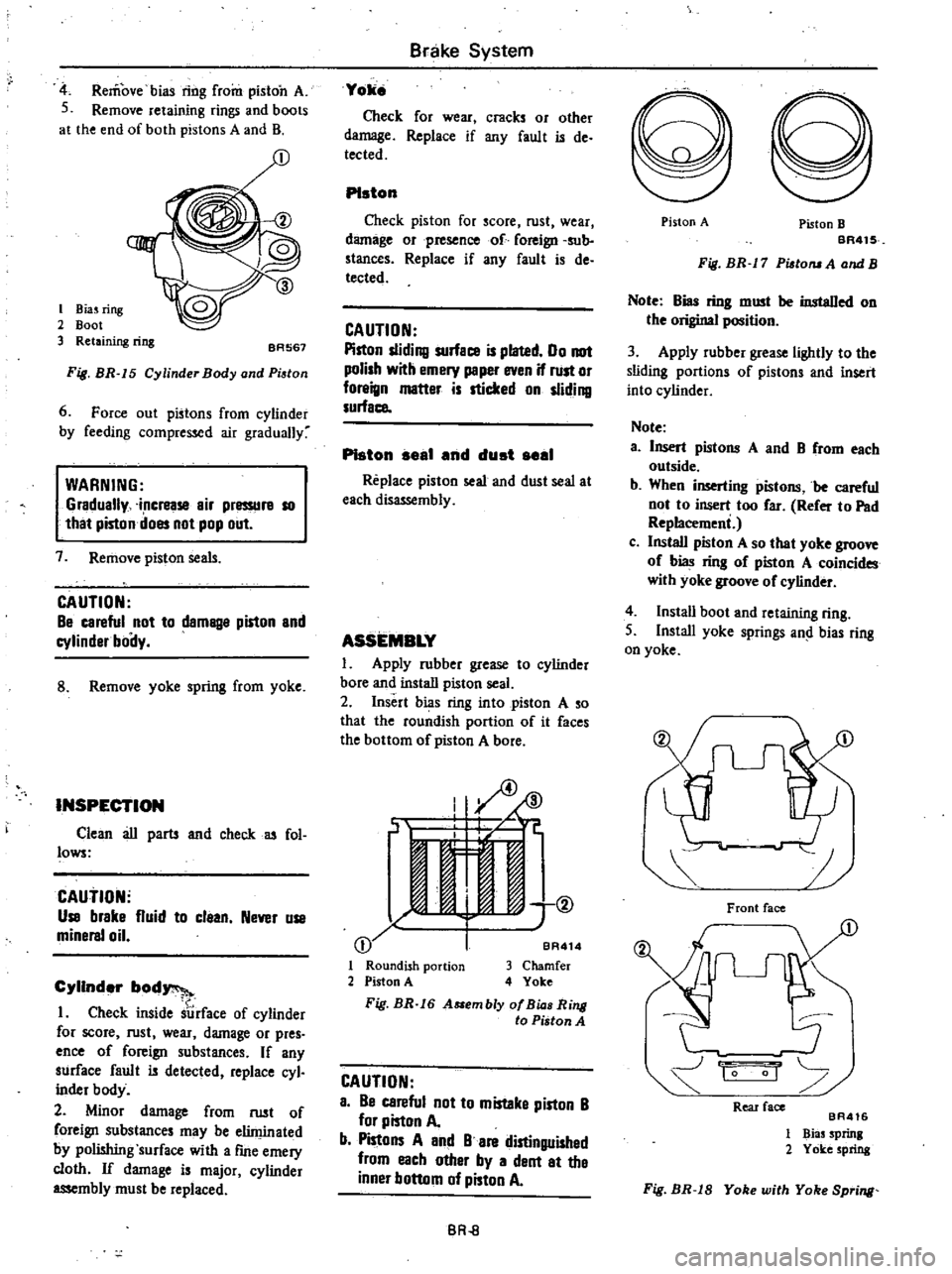
I
Biuring
2
Boot
3
Retaining
ring
BA567
Fig
BR
15
Cylinder
Body
and
Pi
tan
6
Force
out
pistons
from
cylinder
by
feeding
compressed
air
gradually
WARNING
Gradually
increase
air
pressurs
10
that
piston
does
not
pop
out
7
Remove
piston
seals
CAUTION
Be
careful
not
to
damBlle
piston
and
cylinder
boily
8
Remove
yoke
spring
from
yoke
INSPECTION
Clean
au
parts
and
check
u
fol
lows
CAutiON
Use
brake
fluid
to
claan
Never
use
minersl
oil
Cylinder
bod
1
Check
inside
surface
of
cylinder
for
score
rust
wear
damage
or
pres
ence
of
foreign
substances
If
any
surface
fault
is
detected
replace
cyl
inder
body
2
Minor
damage
from
rust
of
foreign
substances
may
be
eliminated
by
polishing
surface
with
a
fme
emery
cloth
If
damage
is
major
cylinder
assembly
must
be
replaced
Brake
System
Yoke
Check
for
wear
cracks
or
other
damage
Replace
if
any
fault
is
de
tected
PIston
Check
piston
for
score
rust
wear
damage
orpresenco
of
foreign
sub
stances
Replace
if
any
fault
is
de
tected
CAUTION
Piston
sliding
surface
is
plated
00
not
polish
with
emery
peper
even
if
rust
or
foreign
matter
is
sticked
on
sliding
surface
PIston
seal
end
dust
seel
Replace
piston
seal
and
dust
seal
at
each
dis
mbly
ASSEMBLY
1
Apply
rubber
grease
to
cylinder
bore
and
install
piston
seal
2
Insert
bias
ring
into
piston
A
so
that
the
roundish
portion
of
it
faces
the
bottom
of
piston
A
bore
I
ID
J
if
C
jt
11
e
1
@
I
j
BA
I
Roundish
portion
3
Chamfer
2
Piston
A
4
Yoke
Fig
BR
16
A
embly
af
Bia
Ring
to
Piston
A
CAUTION
a
Be
careful
not
to
mistaka
piston
B
for
piston
A
b
Pistons
A
and
B
are
distinguished
from
each
other
by
a
dent
at
the
inner
bottom
of
piston
A
BR
8
Piston
A
Piston
B
BR41S
Fig
BR
17
Pisto
A
and
B
Note
Bias
ring
must
be
instaDed
on
the
original
position
3
Apply
rubber
grease
lightly
to
the
sliding
portions
of
pistons
and
insert
into
cylinder
Note
a
Insert
pistons
A
and
B
from
each
outside
b
When
inserting
pistons
be
careful
not
to
insert
too
far
Refer
to
Pad
Replacemeni
c
Install
piston
A
so
that
yoke
groove
of
bias
ring
of
piston
A
coincides
with
yoke
groove
of
cylinder
4
Instau
boot
and
retaining
ring
S
Install
yoke
springs
an
bias
ring
on
yoke
Front
face
1
1
0
Rear
face
BA416
1
Bias
Sprinl
2
Yoke
spring
Fig
BR
18
Yoke
with
Yoke
Spring
Page 364 of 548
REAR
BRAKE
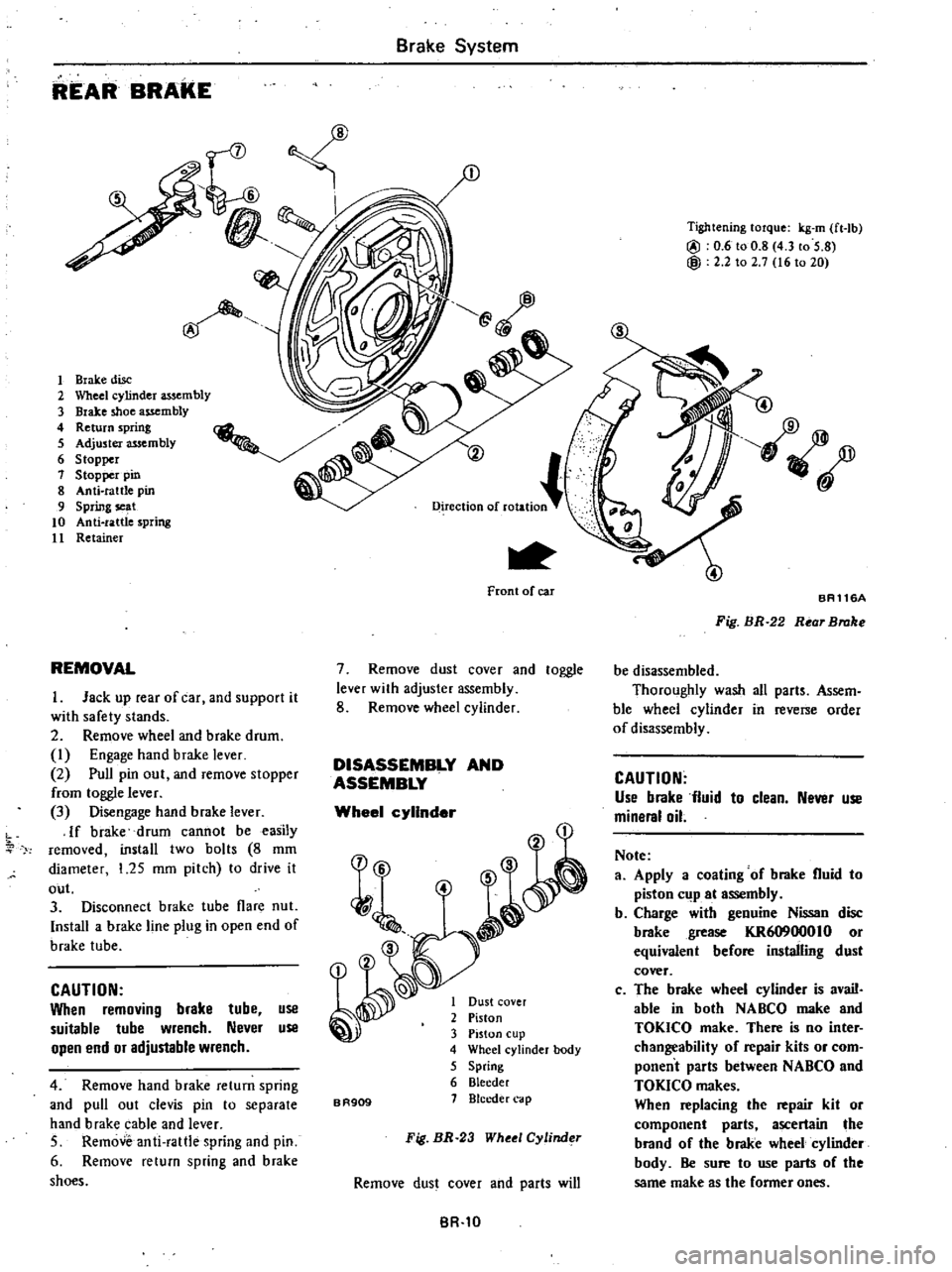
1
Brake
disc
2
Wheel
cylinder
assembly
3
Brake
shoe
assembly
4
Return
spring
5
Adjuster
assembly
6
Stopper
1
Stopper
pin
8
Anti
rattle
pin
9
Spring
se
t
10
Anti
rattle
spring
11
Retainer
REMOVAL
L
Jack
up
rear
of
car
and
support
it
with
safety
stands
2
Remove
wheel
and
brake
drum
I
Engage
hand
brake
lever
2
Pull
pin
out
and
remove
stopper
from
toggle
lever
3
Disengage
hand
brake
lever
If
brake
drum
cannot
be
easily
removed
install
two
baIts
8
mm
diameter
I
25
mm
pitch
to
drive
it
out
3
Disconnect
brake
tube
flare
nut
Install
a
brake
line
plug
in
open
end
of
brake
tube
CAUTION
When
removing
brake
tube
use
suitable
tube
wrench
Never
use
open
end
or
adjustable
wrench
4
Remove
hand
brake
return
spring
and
pull
out
clevis
pin
to
separate
hand
brake
cable
and
lever
5
Remove
anti
rattle
spring
and
pin
6
Remove
return
spring
and
brake
shoes
Brake
System
Dueetio
of
ro
tiO
Front
of
car
7
Remove
dust
cover
and
toggle
lever
with
adjuster
assembly
8
Remove
wheel
cylinder
DISASSEMBLY
AND
ASSEMBLY
Wheel
cylinder
BR909
I
Dust
cover
2
Piston
3
Piston
cup
4
Wheel
cylinder
body
5
Spring
6
Bleeder
1
Bleeder
cap
Fig
BR
23
Wheel
Cylinder
Remove
dust
cover
and
parts
will
BR
l0
Tightening
torque
kg
m
ft
lb
@
0
6
to
0
8
4
3
ro
5
8
@
2
2
to
2
7
16
to
20
BR116A
Fig
BR
22
Rear
Broke
be
disassembled
Thoroughly
wash
all
parts
Assem
ble
wheel
cylinder
in
reverse
order
of
disassembly
CAUTION
Use
brake
fluid
to
clean
Never
use
mineral
oil
Note
a
Apply
a
coating
of
brake
fluid
to
piston
cliP
at
assembly
b
Charge
with
genuine
Nissan
disc
brake
grease
KR60900010
or
equivalent
before
installing
dust
cover
c
The
brake
wheel
cylinder
is
avail
able
in
both
NABCO
make
and
TOKlCO
make
There
is
no
inter
changeability
of
repair
kits
or
com
ponent
parts
between
NABCO
and
TOKlCO
makes
When
replacing
the
repair
kit
or
component
parts
ascertain
the
brand
of
the
brake
wheel
cylinder
body
Be
sure
to
use
parts
of
the
same
make
as
the
fonner
ones
Page 367 of 548

Relationship
between
oil
pressure
and
pedal
operating
force
is
illustrated
in
Fig
BR
29
If
test
results
are
not
as
specified
in
Fig
BR
29
check
brake
booster
for
condition
in
manner
des
cribed
under
Inspection
before
re
moval
of
this
unit
REMOVAL
M60
120
1
710
AA
I
1
1
110
1
560
1
v
e
100
1
420
I
90
1
280
I
1
1
80
1
140
I
Z
I
t
70
1
000
i
60
850
I
o
50
710
d
40
570
g
i
gl
j
ll
10
140
J
0
1
0
2
0
221
441
Rod
operating
force
kg
lb
Brake
System
Also
check
brake
line
for
evidence
of
fluid
leakage
Note
Detennine
whether
source
of
problem
is
in
brake
booster
or
check
valve
Before
you
reach
a
fmal
conclusion
always
inspect
check
valve
first
o
10
20
30
40
50
22
44
66
88
110
Pedal
operating
force
kg
lb
BA121A
Fig
BR
29
Performance
Diagram
of
Brake
Booster
Remo
parts
in
numerical
order
enumerated
BR593
ti
J
Fig
BR
30
Procedures
for
Removing
Brake
Booster
ADJUSTMENT
I
Adjust
the
length
of
push
rod
to
the
value
indicated
below
Length
ad
justment
of
push
rod
is
made
at
the
tip
of
push
rod
Length
A
9
75
to
10
00
mm
0
3839
to
0
3937
in
j
f
Irl
I
l
if
L
J
BA290
Fig
BR
31
Length
A
BR
13
BR288
Fig
BR
32
Adjusting
Push
Rod
Length
2
Install
clevis
Adjust
length
of
operating
rod
to
specified
value
length
B
135
mm
5
31
in
c
f
lIJ
t
t
B
BR947
Fig
BR
33
Length
B
INSTALLATION
Install
in
the
reverse
sequence
of
removaJ
IiJ
Tightening
torque
Master
cylinder
to
brake
booster
0
8
to
1
1
kg
m
5
8
to
8
0
ft
Ib
Brake
booster
to
body
0
8
to
1
1
kg
m
5
8
to
8
0
ft
lbl
Note
After
brake
boOster
is
properly
installed
in
car
conduct
an
air
tight
and
op
rational
tests
as
previously
described
Page 373 of 548
Brake
System
TROUBLE
DIAGNOSES
AND
CORRECTIONS
Condition
Excessive
pedal
travel
Spongy
pedal
Poor
braking
effect
Probable
cause
Low
brake
fluid
level
or
empty
master
cyUnder
reservoir
Leakage
in
master
cylinder
Deteriorated
check
valve
Air
in
system
Faulty
brake
adjustment
Excessive
lateral
play
on
disc
caused
by
loose
or
worn
wheel
bearings
or
steering
parts
Low
fluid
level
in
master
cylinder
Air
in
system
Faulty
brake
adjustment
Reservoir
fIller
cap
vent
hole
clogged
Swollen
hose
due
to
deterioration
or
use
of
poor
quality
hose
Distored
brake
shoes
or
excessively
worn
or
cracked
brake
drum
Soft
or
swollen
caliper
seals
Use
of
a
brake
fluid
with
too
low
boiling
point
Fluid
leakage
in
brake
lines
Low
brake
fluid
level
or
empty
master
cylinder
reservoir
Air
in
brake
lines
Excessive
shoe
to
d
rum
clearance
Grease
oil
mud
or
water
on
linings
or
pads
Deterioration
of
linings
or
pads
Local
fit
of
linings
or
pads
Linings
or
pads
excessively
worn
Master
cylinder
or
wheel
cylinders
in
poor
condition
Frozen
or
seized
caliper
pistons
on
disc
brakes
Finding
mechanical
linkage
at
brake
pedal
and
shoes
BR
19
Corrective
action
Fill
and
bleed
as
necessary
Test
for
source
of
leakage
by
examining
all
lines
connec
tions
and
wheel
cylinder
Overhaul
master
cylinder
Replace
check
valve
and
bleed
system
Bleed
system
Adjust
shoe
to
drum
clearance
Inspect
auto
adjuster
operation
Replace
or
adjust
faulty
parts
Top
with
fluid
and
inspect
for
leakage
Correct
as
necessary
Adjust
shoe
to
drum
clearance
Inspect
auto
adjuster
operation
Clean
and
bleed
system
Replace
hose
and
bleed
system
Replace
faul
ty
parts
Drain
hydraulic
system
flush
with
alcohol
and
replace
all
seals
Replace
with
specified
brake
fluid
and
bleed
system
Check
master
cylinder
p
pmg
and
wheel
cylinder
for
leaks
and
repair
Fill
and
bleed
as
necessary
Bleed
system
Adjust
Clean
brake
mechanism
and
check
for
cause
of
problem
Replace
linings
or
pads
Replace
Shave
or
replace
Replace
Repair
or
replace
Disassemble
caliper
and
free
up
as
required
Free
up
as
required
Page 374 of 548
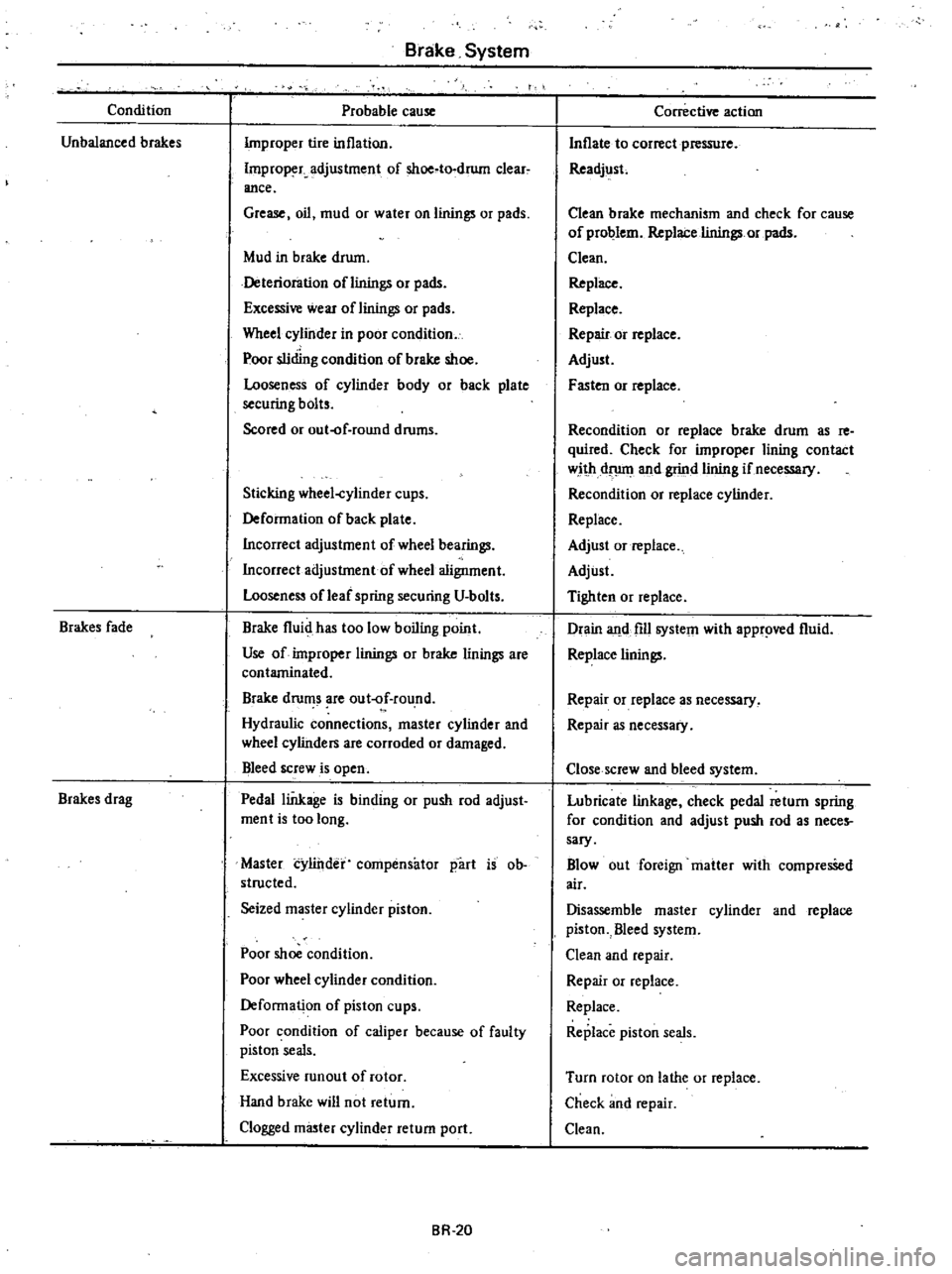
Condition
Unbalanced
brakes
Brakes
fade
Brakes
drag
Brake
System
Probable
cause
Improper
tire
inflation
Improp
r
adjustment
of
shoe
to
drum
clear
ance
Grease
oil
mud
or
water
on
linings
or
pads
Mud
in
brake
drum
Deterioration
oflinings
or
pads
Excessi
wear
of
linings
or
pads
Wheel
cylinder
in
poor
condition
Poor
sliding
condition
of
brake
shoe
Looseness
of
cylinder
body
or
back
plate
securing
bolts
Scored
or
out
f
round
drums
Sticking
wheel
cylinder
cups
Deformation
of
back
plate
Incorrect
adjustment
of
wheel
bearings
Incorrect
adjustment
of
wheel
aligoment
Looseness
of
leaf
spring
securing
U
bolts
Brake
fluid
has
too
low
boiling
point
Use
of
improper
linings
or
brake
linings
are
contaminated
Brake
drums
are
out
f
round
Hydraulic
connections
master
cylinder
and
wheel
cylinders
are
corroded
or
damaged
Bleed
screw
is
open
Pedal
linkage
is
binding
or
push
rod
adjust
ment
is
too
long
Master
cylinder
compensator
part
is
ob
structed
Seized
master
cylinder
piston
Poor
shoe
condition
Poor
wheel
cylinder
condition
Deformation
of
piston
cups
Poor
condition
of
caliper
because
of
faulty
piston
seals
Excessive
runaut
of
rotor
Hand
brake
will
not
return
Clogged
m
ter
cylinder
return
port
BR
20
Corrective
action
Inflate
to
correct
pressure
Readjust
Clean
brake
mechanism
and
check
for
cause
of
problem
Replace
linings
or
pads
Clean
Replace
Replace
Repair
or
replace
Adjust
F
ten
or
replace
Recondition
or
replace
brake
drum
as
re
quired
Check
for
improper
lining
contact
with
dflllll
and
grind
lining
if
necessary
Recondition
or
replace
cylinder
Replace
Adjust
or
replace
Adjust
Tighten
or
replace
Drain
and
fill
system
with
appr
d
fluid
Replace
linings
Repair
or
replace
as
necessary
Repair
as
necessary
Close
screw
and
bleed
system
Lubricate
linkage
check
pedal
return
spring
for
condition
and
adjust
push
rod
as
neces
sary
Blowout
foreign
matter
with
compresSed
air
Disassemble
master
cylinder
and
replace
piston
Bleed
system
Clean
and
repair
Repair
or
replace
Replace
Replace
piston
seals
Turn
rotor
on
lathe
or
replace
Check
and
repair
Clean
Page 375 of 548
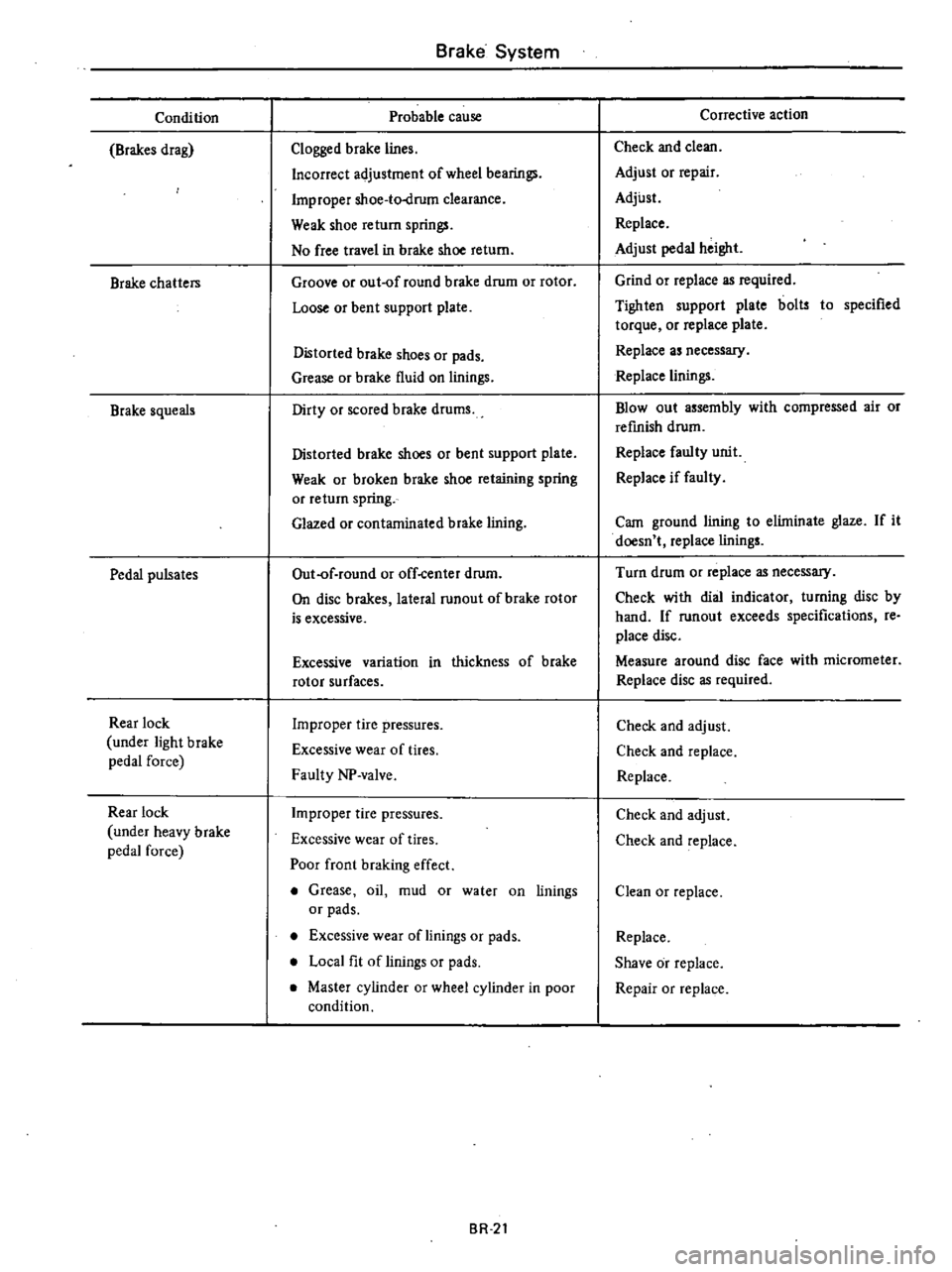
Condition
Brakes
drag
Brake
chatters
Brake
squeals
Pedal
pulsates
Rear
lock
under
light
brake
pedal
force
Rear
lock
under
heavy
brake
pedal
force
Brake
System
Probable
cause
Clogged
brake
lines
Incorrect
adjustment
of
wheel
bearings
Improper
shoe
to
drum
clearance
Weak
shoe
return
springs
No
free
travel
in
brake
shoe
return
Groove
or
out
of
round
brake
drum
or
rotor
Loose
or
bent
support
plate
Distorted
brake
shoes
or
pads
Grease
or
brake
fluid
on
linings
Dirty
or
scored
brake
drums
Distorted
brake
shoes
or
bent
support
plate
Weak
or
broken
brake
shoe
retaining
spring
or
return
spring
Glazed
or
contaminated
brake
lining
Out
of
round
or
off
center
drum
On
disc
brakes
lateral
runout
of
brake
rotor
is
excessive
Excessive
variation
in
thickness
of
brake
rotor
surfaces
Improper
tire
pressures
Excessive
wear
of
tires
Faulty
NP
valve
Improper
tire
pressures
Excessive
wear
of
tires
Poor
front
braking
effect
Grease
oil
mud
or
water
on
linings
or
pads
Excessive
wear
of
linings
or
pads
Local
fit
of
linings
or
pads
Master
cylinder
or
wheel
cylinder
in
poor
condition
BR
2t
Corrective
action
Check
and
clean
Adjust
or
repair
Adjust
Replace
Adjust
pedal
height
Grind
or
replace
as
required
Tighten
support
plate
bolts
to
specified
torque
or
replace
plate
Replace
as
necessary
Replace
linings
Blowout
assembly
with
compressed
air
or
refinish
drum
Replace
faulty
unit
Replace
if
faulty
Cam
ground
lining
to
elilninate
glaze
If
it
doesn
t
replace
linings
Turn
drum
or
replace
as
necessary
Check
with
dial
indicator
turning
disc
by
hand
If
runout
exceeds
specifications
re
place
disc
Measure
around
disc
face
with
micrometer
Replace
disc
as
required
Check
and
adjust
Check
and
replace
Replace
Check
and
adjust
Check
and
replace
Clean
or
replace
Replace
Shave
or
replace
Repair
or
replace
Page 460 of 548
CHARGE
WARNING
SYSTEM
Refer
to
Section
EE
BRAKE
WARNING
SYSTEM
REPLACEMENT
Hand
brake
switch
I
Disconnect
battery
ground
cable
2
Remove
console
box
if
equipped
3
Disconnect
hand
brake
switch
lead
wire
at
connector
4
Remove
switch
from
switch
bracket
by
pulling
it
5
Install
new
switch
in
the
reverse
order
of
removal
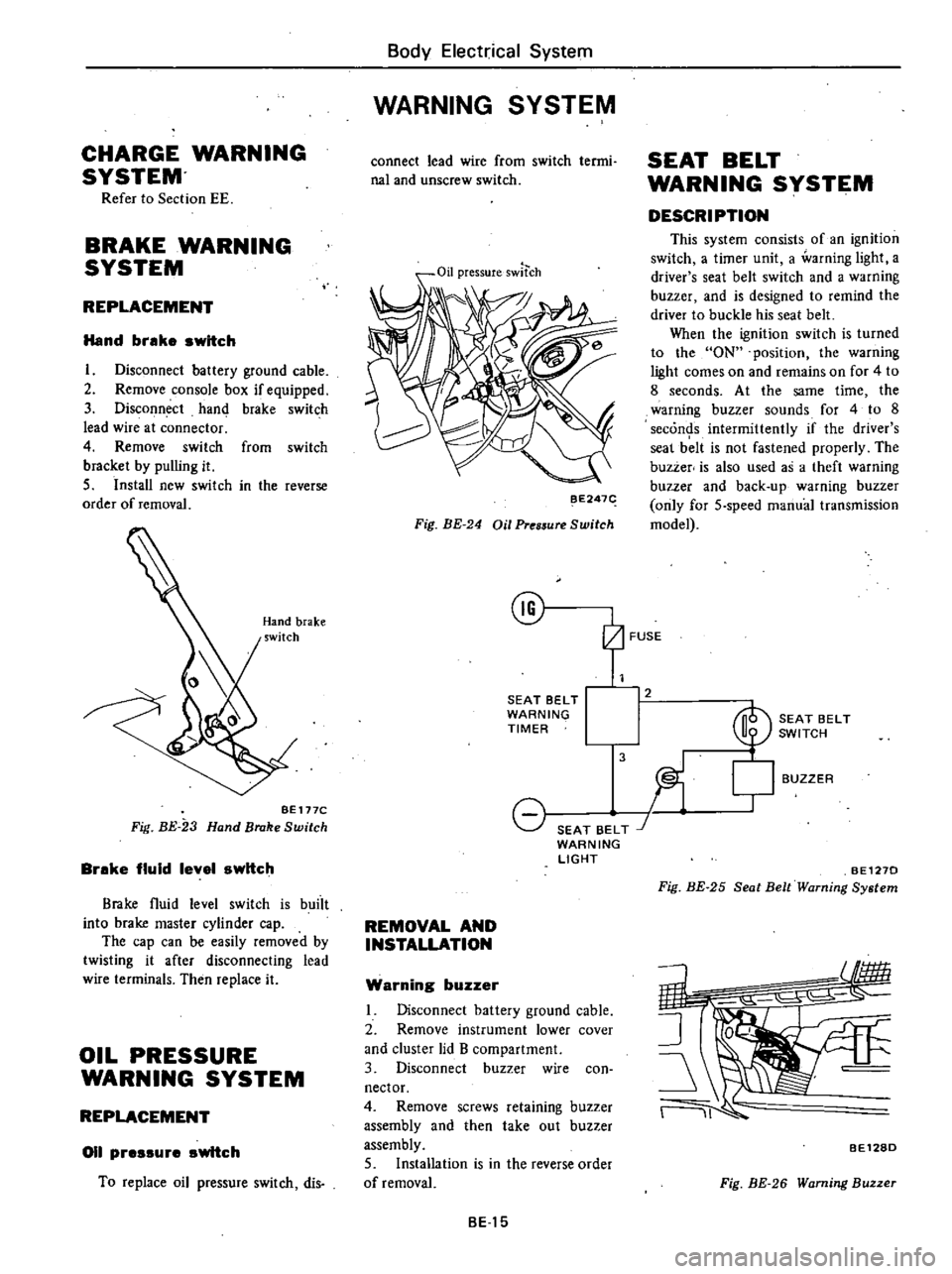
BE
177C
Fig
BE
23
Hand
Brake
Switch
Brake
fluid
level
switch
Brake
fluid
level
switch
is
buiit
into
brake
master
cylinder
cap
The
cap
can
be
easily
removed
by
twisting
it
after
disconnecting
lead
wire
terminals
Then
replace
it
OIL
PRESSURE
WARNING
SYSTEM
REPLACEMENT
011
pressure
switch
To
replace
oil
pressure
switch
dis
Body
Electrical
System
WARNING
SYSTEM
connect
lead
wire
from
switch
termi
nal
and
unscrew
switch
Oil
pressureswltch
BE247
Fig
BE
24
Oil
Pres5ure
Switch
@
SEAT
BELT
WARNING
TIMER
8
SEAT
BELT
J
WARNING
LIGHT
REMOVAL
AND
INSTALLATION
Warning
buzzer
Disconnect
battery
ground
cable
2
Remove
instrument
lower
cover
and
cluster
lid
B
compartment
3
Disconnect
buzzer
wire
con
nector
4
Remove
screws
retaining
buzzer
assembly
and
then
take
out
buzzer
assembly
5
Installation
is
in
the
reverse
order
of
removal
BE15
SEAT
BELT
WARNING
SYSTEM
DESCRIPTION
This
system
consists
of
an
ignition
switch
a
timer
unit
a
warning
light
a
driver
s
seat
belt
switch
and
a
warning
buzzer
and
is
designed
to
remind
the
driver
to
buckle
his
seat
belt
When
the
ignition
switch
is
turned
to
the
ON
position
the
warning
light
comes
on
and
remains
on
for
4
to
8
seconds
At
the
same
time
the
warning
buzzer
sounds
for
4
to
8
seconds
intermittently
if
the
driver
s
seal
b
lt
is
not
fastened
properly
The
buzzer
is
also
used
as
a
theft
warning
buzzer
and
back
up
warning
buzzer
only
for
5
speed
manual
transmission
model
2
3
BUZZER
SEAT
BELT
SWITCH
l
BE1270
Fig
BE
25
Seat
Belt
Warning
System
11
BE128D
Fig
BE
26
Warning
Buzzer
Page 491 of 548
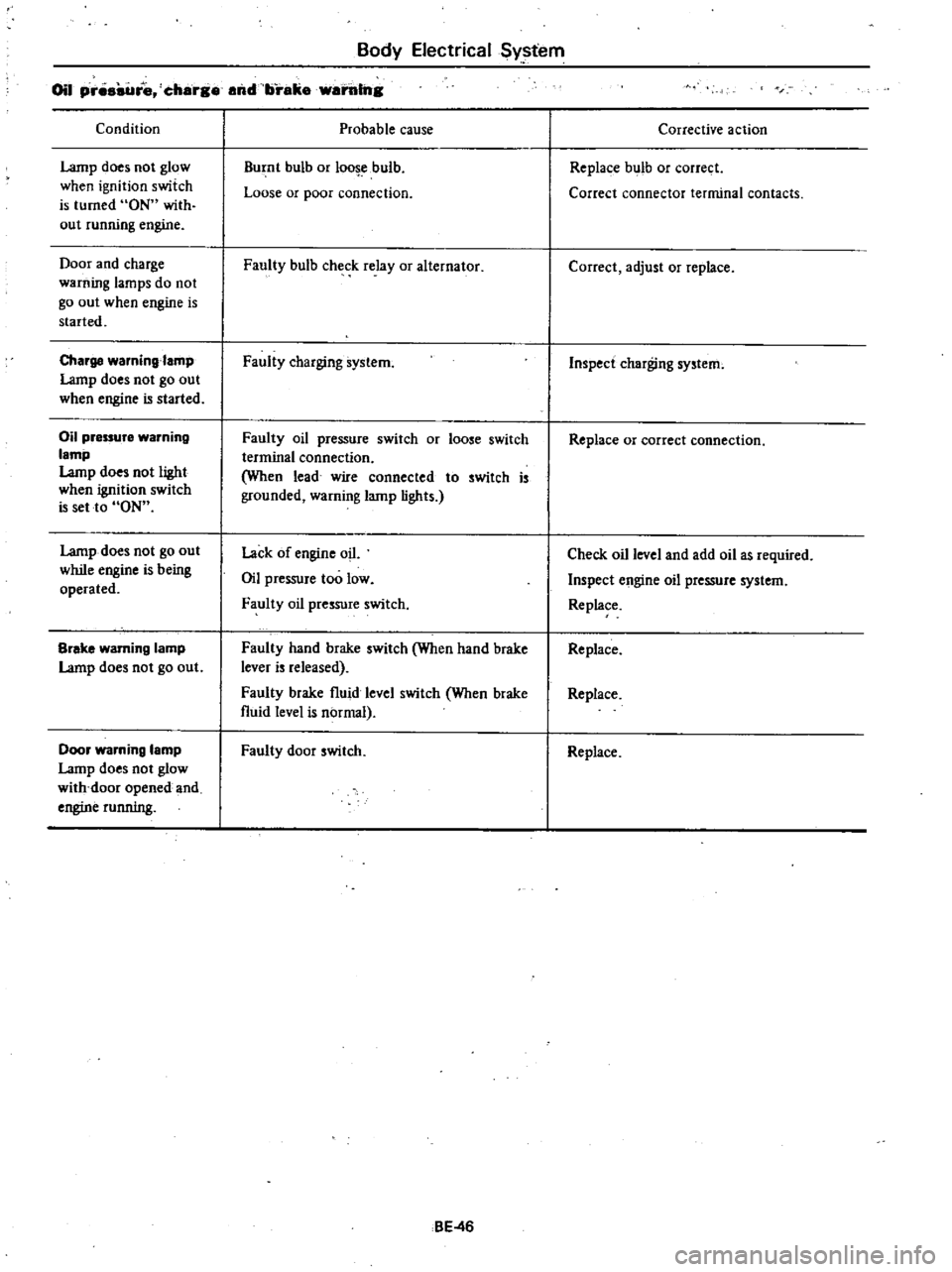
Body
Electrical
Sy
tem
Oil
pr
re
charg
and
brake
warillng
Condition
Lamp
does
not
glow
when
ignition
switch
is
turned
ON
with
out
running
engine
Door
and
charge
warning
lamps
do
not
go
out
when
engine
is
started
Charge
waming
amp
Lamp
does
not
go
out
when
engine
is
started
Oil
pressure
warning
lamp
Lamp
does
not
light
when
ignition
switch
is
set
to
ON
Lamp
does
not
go
out
while
engine
is
being
operated
Brake
warning
lamp
Lamp
does
not
go
out
Door
warning
lamp
Lamp
does
not
glow
with
door
opened
and
engine
running
Probable
cause
Burnt
bulb
or
loo
ebulb
Loose
or
poor
connection
Faully
bulb
check
relay
or
alternator
Faully
charging
system
Faully
oil
pressure
switch
or
loose
switch
terminal
connection
When
lead
wire
connected
to
switch
is
grounded
warning
lamp
lights
Lack
of
engine
oil
Oil
pressure
too
low
Faully
oil
pressure
switch
Faulty
hand
brake
switch
When
hand
brake
lever
is
released
Faully
brake
fluid
level
switch
When
brake
fluid
level
is
normal
Faully
door
switch
BE
46
Corrective
action
Replace
bulb
or
correct
Correct
connector
terminal
contacts
Correct
adjust
or
replace
Inspect
charging
system
Replace
or
correct
connection
Check
oil
level
and
add
oil
as
required
Inspect
engine
oil
pressure
system
Replace
Replace
Replace
Replace