torque DATSUN B110 1973 Service Manual PDF
[x] Cancel search | Manufacturer: DATSUN, Model Year: 1973, Model line: B110, Model: DATSUN B110 1973Pages: 513, PDF Size: 28.74 MB
Page 205 of 513
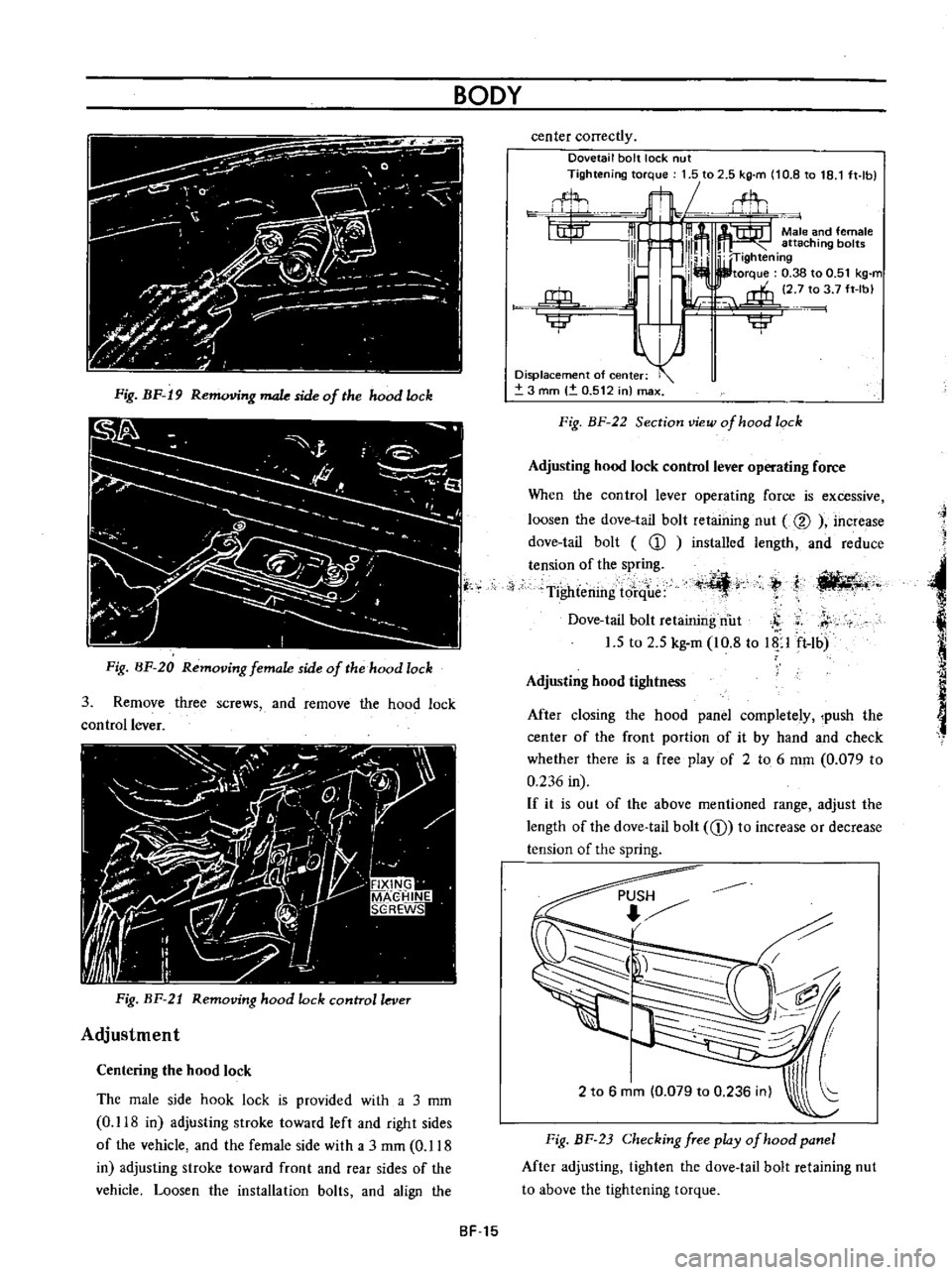
BODY
Fig
BF
19
R
g
male
side
of
the
hood
lock
Fig
BF
20
Removing
female
side
of
the
hood
lock
3
Remove
three
screws
and
remove
the
hood
lock
control
lever
Fig
BF
21
Removing
hood
lock
control
lever
Adjustment
Centering
the
hood
lock
The
male
side
hook
lock
is
provided
with
a
3
mm
0
118
in
adjusting
stroke
toward
left
and
right
sides
of
the
vehicle
and
the
female
side
with
a
3
rnm
0
118
in
adjusting
stroke
toward
front
and
rear
sides
of
the
vehicle
Loosen
the
installation
bolts
and
align
the
center
correctly
Dovetail
bolt
lock
nut
Tightening
torque
1
5
to
2
5
kg
m
10
8
to
18
1
ft
lb
flL
t1t
m
m
Male
and
female
111
l
111m
attaching
bol
W
TIghtening
I
lb
I
I
torque
0
38
to
0
51
kg
m
l
i
2
7
to
3
7
ft
Ibl
j
rffi
u
Ilillr
iji
Displacement
of
center
3
mm
0
512
in
max
Fig
BF
22
Section
view
of
hood
lock
Adjusting
hood
lock
control
lever
operating
force
When
the
control
lever
operating
force
is
excessive
loosen
the
dove
tail
bolt
retaining
nut
@
increase
dove
tail
bolt
CD
installed
length
and
reduce
tension
of
the
spring
Tightening
tore
ue
t
I
ili
4r
ti
llt4
t
j
Dove
tail
bolt
retaining
nut
S
r
1
5
to
2
5
kg
m
10
8
to
Up
ft
lb
Adjusting
hood
tightness
After
closing
the
hood
panel
completely
push
the
center
of
the
front
portion
of
it
by
hand
and
check
whether
there
is
a
free
play
of
2
to
6
mm
0
079
to
0
236
in
If
it
is
out
of
the
above
mentioned
range
adjust
the
length
of
the
dove
tail
bolt
CD
to
increase
or
decrease
tension
of
the
spring
2
to
6
mm
0
079
to
0
236
inl
Fig
BF
23
Checking
free
play
of
hood
panel
After
adjusting
tighten
the
dove
tail
bolt
retaining
nut
to
above
the
tightening
torque
SF
15
Page 206 of 513
BODY
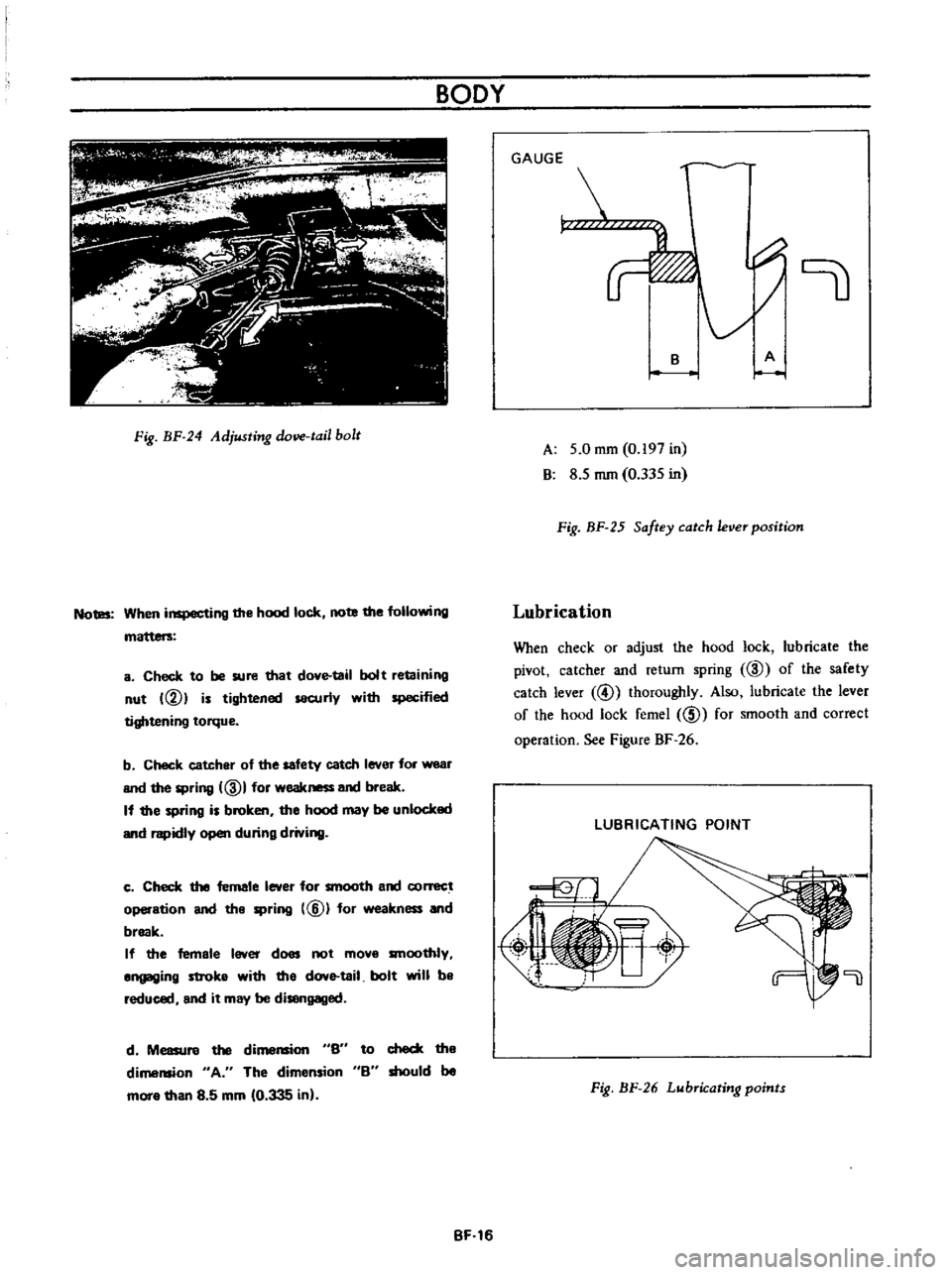
Fig
BF
24
Adjusting
dove
tail
bolt
Notes
When
inspecting
the
hood
lock
note
the
following
a
Check
to
be
sure
that
dove
tail
bolt
retaining
nut
VI
is
tightened
securly
with
specified
tightening
torque
b
Check
catcher
of
the
safety
catch
lever
for
wear
and
the
spring
ID
I
for
weakness
and
break
If
the
spring
is
broken
the
hood
may
be
unlocked
and
rapidly
open
during
driving
c
Check
the
female
lever
for
smooth
and
conect
operation
and
the
spring
@
for
weakness
and
break
If
the
female
lever
does
not
mova
smoothly
angaging
stroka
with
tha
dove
tail
bolt
will
ba
reduced
and
it
may
be
disengaged
d
Measure
the
di
S6
to
check
the
dimension
A
The
dimension
B
should
be
mora
than
8
5
mm
10
335
in
BF
16
GAUGE
r
B
A
A
5
0
mm
0
197
in
B
8
5
mm
0
335
in
Fig
BF
25
Saftey
catch
ever
position
Lubrication
When
check
or
adjust
the
hood
lock
lubricate
the
pivot
catcher
and
return
spring
ID
of
the
safety
catch
lever
@
thoroughly
Also
lubricate
the
lever
of
the
hood
lock
femel
ID
for
smooth
and
correct
operation
See
Figure
BF
26
LUBRICATING
POINT
Fig
BF
26
Lubricating
points
Page 209 of 513
BODY
I
1
I
Ik
I
ro
I
W
a
21
zrl
l
11
J
1
3781
I
1
Ii
100
tJ94t
I
100
3
94
0
0551
A
I
10013
94
1
510
0984
100
13
94
I
J
10
1378
2010
787
L
I
l
0
433
O
I
l
JS
348
13
7
5
1
77
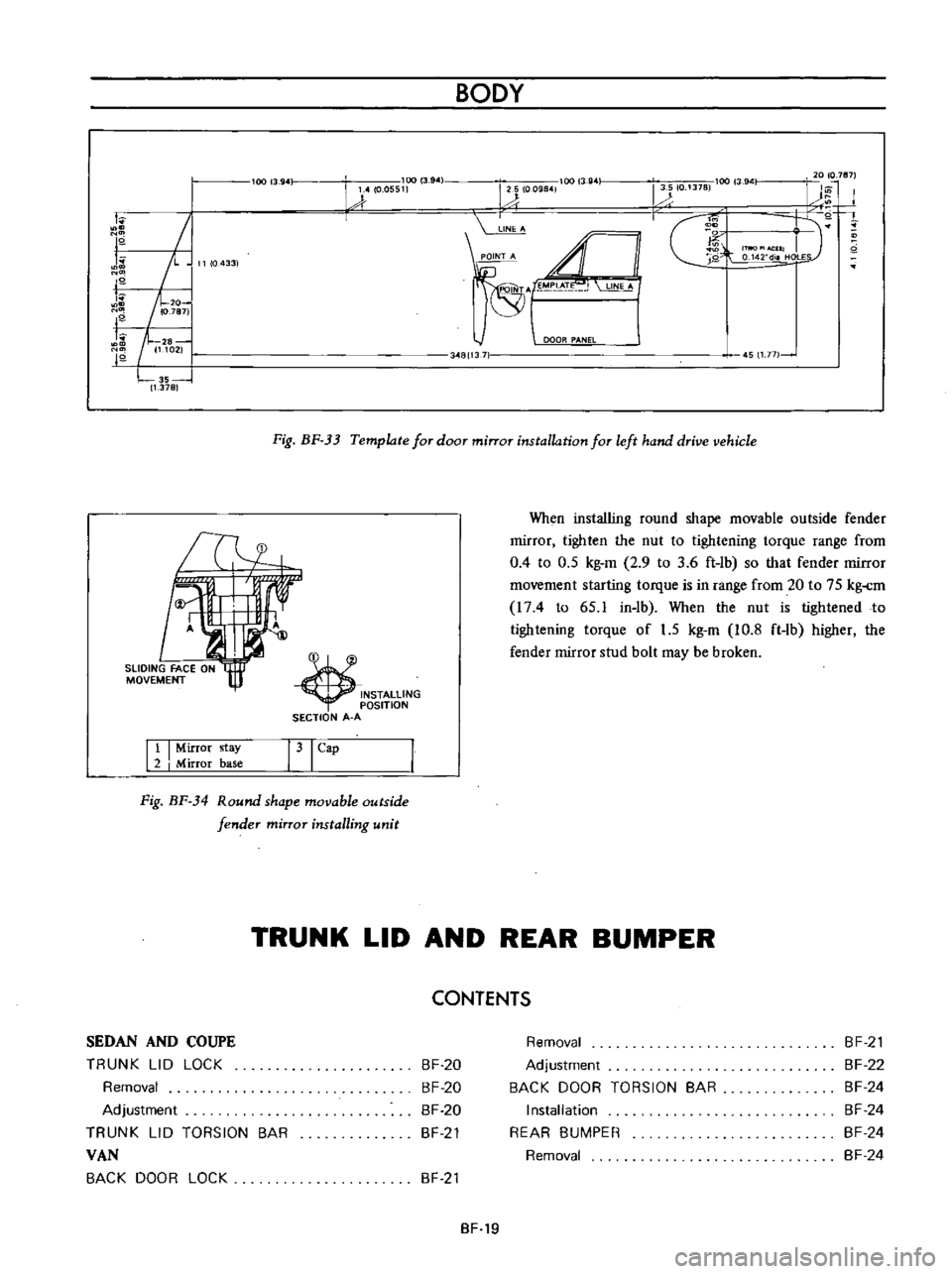
Fig
BF
33
Template
for
door
mirror
installation
for
left
hand
drive
vehicle
INSTALLING
OSITION
SECTION
A
A
When
installing
round
shape
movable
outside
fender
rnirror
tighten
the
nut
to
tightening
torque
range
from
0
4
to
0
5
kg
m
2
9
to
3
6
ft
lb
so
that
fender
rnirror
rnovernent
starting
torque
is
in
range
from
20
to
75
kg
rn
I74
to
65
1
in
lb
When
the
nut
is
tightened
to
tightening
torque
of
1
5
kg
m
10
8
ft
lb
higher
the
fender
mirror
stud
bolt
may
be
broken
Tl4
11
I
Mirror
stay
2
I
Mirror
base
31
Cap
Fig
BF
34
Round
shape
movable
outside
fender
mirror
installing
unit
TRUNK
LID
AND
REAR
BUMPER
CONTENTS
SEDAN
AND
COUPE
TRUNK
LID
LOCK
Removal
Adjustment
TRUNK
LID
TORSION
BAR
VAN
BACK
DOOR
LOCK
BF
20
BF
20
BF
20
BF
21
Removal
Adjustment
BACK
DOOR
TORSION
BAR
Installation
REAR
BUMPER
Removal
BF
21
BF
22
BF
24
BF
24
BF
24
BF
24
BF
21
BF
19
Page 210 of 513
BODY
SEDAN
AND
COUPE
CD
@
h
r
1
@
@
II
I
Trunk
lid
2
Trunk
lid
lock
assembly
13
I
Trunk
lid
weatherstrip
4
Hinge
fixing
pin
15
I
Trunk
lid
hinge
6
Striker
assembly
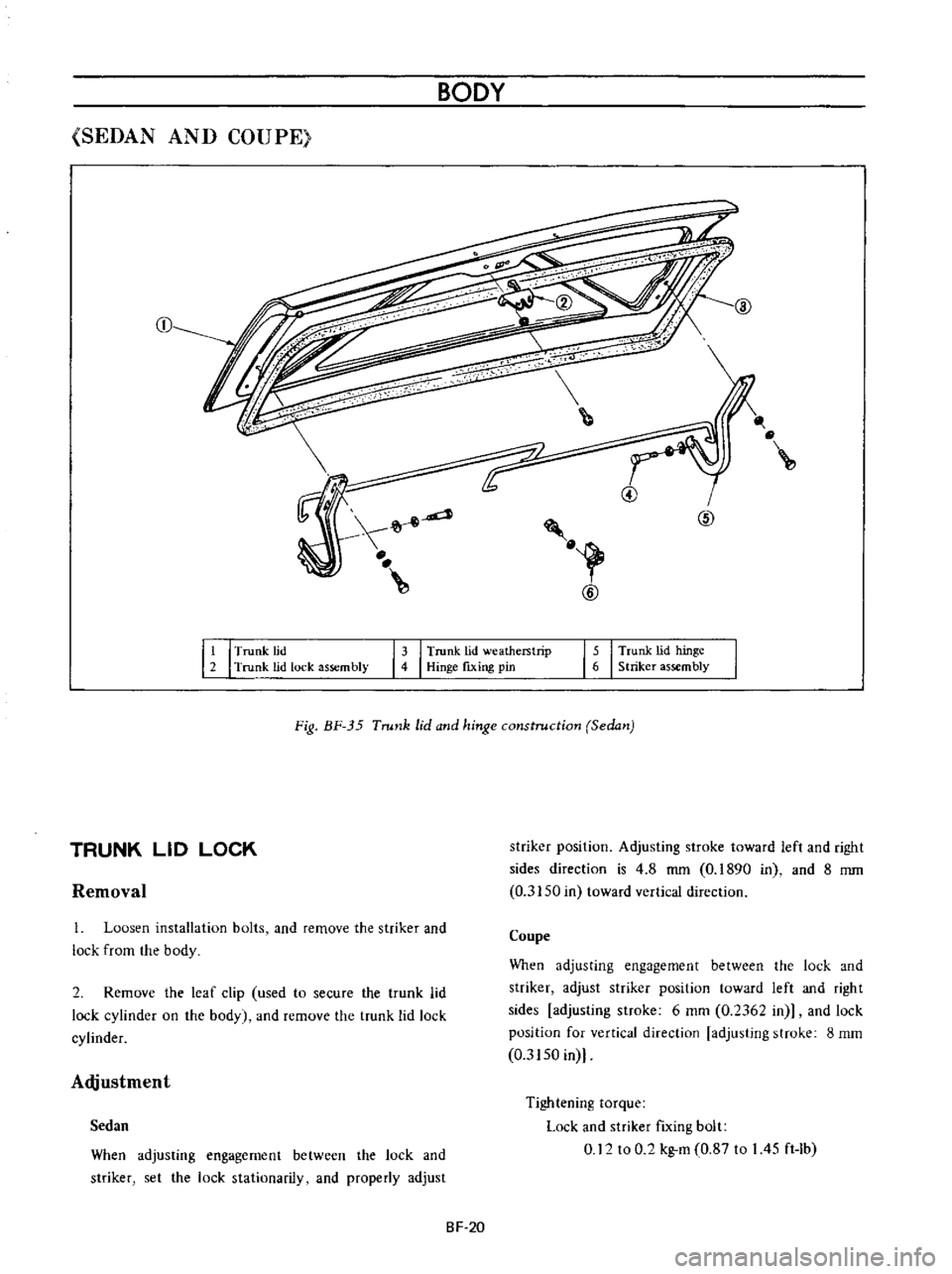
Fig
BF
35
Trunk
lid
and
hinge
construction
Sedan
Removal
striker
position
Adjusting
stroke
toward
left
and
right
sides
direction
is
4
8
mm
0
1890
in
and
8
mm
0
3150
in
toward
vertical
direction
TRUNK
LID
LOCK
1
Loosen
installation
bolts
and
remove
the
striker
and
lock
from
the
body
Coupe
When
adjusting
engagement
between
the
lock
and
striker
adjust
striker
position
toward
left
and
right
sides
adjusting
stroke
6
mm
0
2362
in
and
lock
position
for
vertical
direction
adjusting
stroke
8
mm
0
3150
in
2
Remove
the
leaf
clip
used
to
secure
the
trunk
lid
lock
cylinder
on
the
body
and
remove
the
trunk
lid
lock
cylinder
Adjustment
When
adjusting
engagement
between
the
lock
and
striker
set
the
lock
stationarily
and
properly
adjust
Tightening
torque
Lock
and
striker
fIxing
bolt
0
12
to
0
2
kg
m
0
87
to
I
45
ft
Ib
Sedan
SF
20
Page 212 of 513
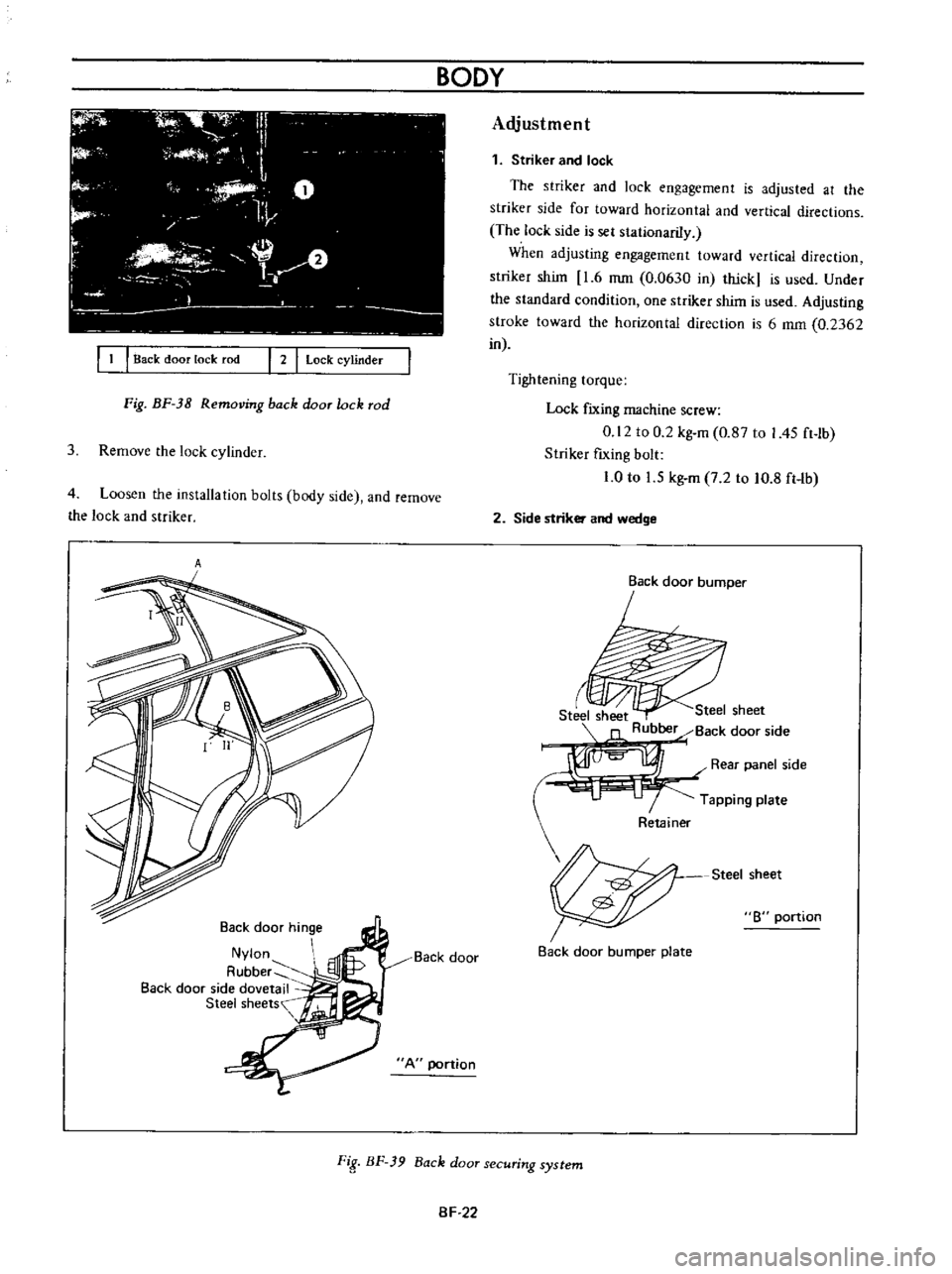
I
1
I
Back
door
lock
rod
I
2
I
Lock
cylinder
Fig
BF
38
Removing
back
door
lock
rod
3
Remove
the
lock
cylinder
4
Loosen
the
installation
bolts
body
side
and
remove
the
lock
and
striker
A
Back
door
hinge
Nylon
A
ubber
Back
door
side
dovetail
Steel
sheets
Back
door
A
portion
BODY
Adjustment
1
Striker
and
lock
The
striker
and
lock
engagement
is
adjusted
at
the
striker
side
for
toward
horizontal
and
vertical
directions
The
lock
side
is
sel
stationariIy
When
adjusting
engagement
toward
vertical
direction
striker
shim
1
6
mm
0
0630
in
thick
is
used
Under
the
standard
condition
one
striker
shim
is
used
Adjusting
stroke
toward
the
horizontal
direction
is
6
mm
0
2362
in
Tightening
torque
Lock
fIXing
machine
screw
0
12
to
0
2
kg
m
0
87
to
I
45
ft
lb
Striker
fIxing
bolt
1
0
to
1
5
kg
m
7
2
to
10
8
ft
Ib
2
Side
striker
and
wedge
Back
door
bumper
r
Steel
sheet
Steel
sheet
Rubber
Back
door
side
I
Rear
panel
side
Tapping
plate
Steel
sheet
8
portion
Back
door
bumper
plate
FiS
BF
39
Back
door
securing
system
SF
22
Page 213 of 513
n
order
to
secure
the
back
door
in
the
position
adjust
the
position
in
accordance
with
the
following
instruc
tions
I
Install
two
back
door
bumpers
@
on
the
bottom
of
the
back
door
Positions
of
the
back
door
bumpers
are
used
for
standard
positions
when
positioning
the
back
door
and
therefore
no
adjusting
stroke
is
provided
Tightening
torque
Back
door
bumper
fixing
machine
screw
I
kg
m
7
2
ft
lb
2
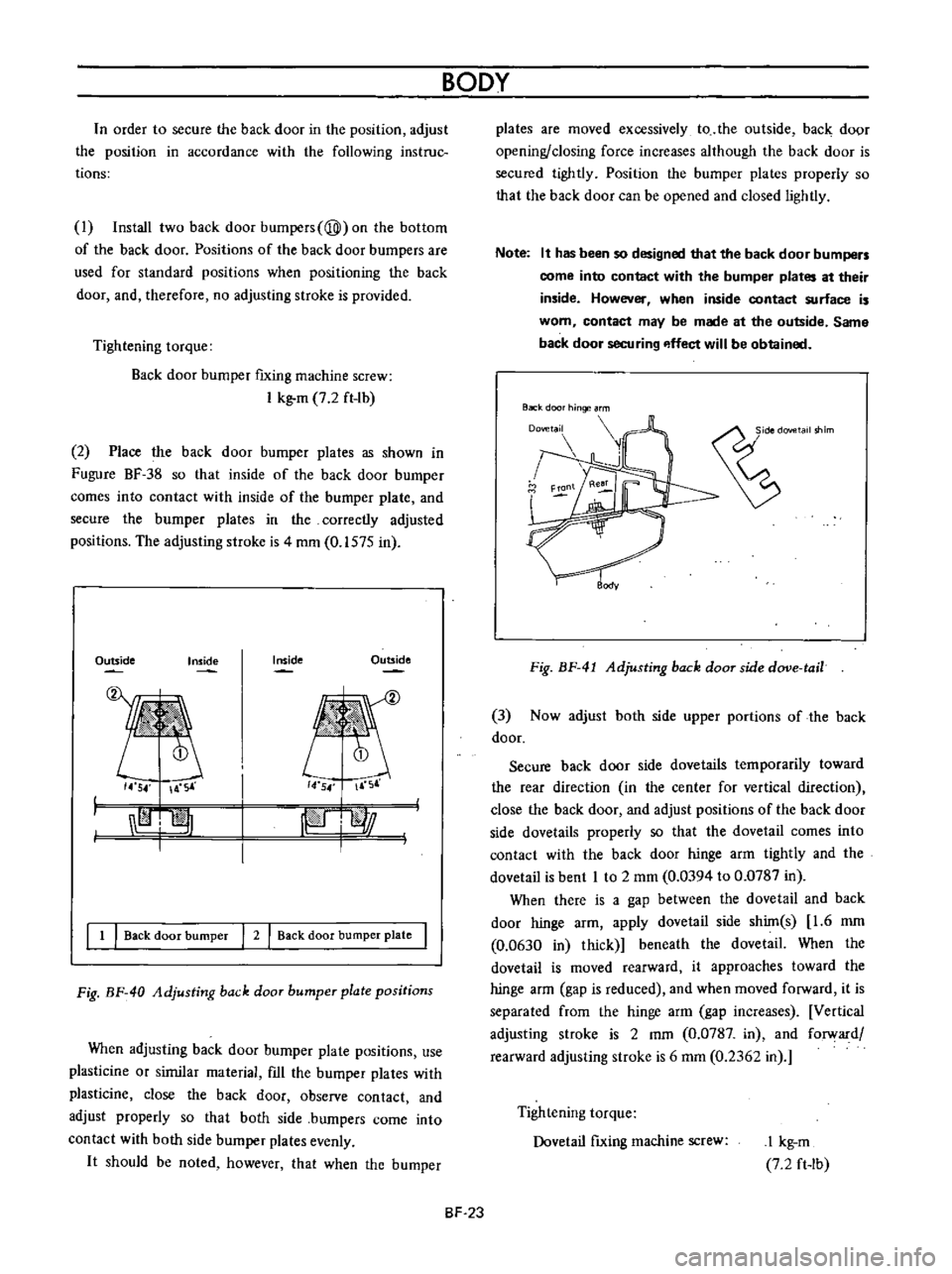
Place
the
back
door
bumper
plates
as
shown
in
Fugure
BF
38
so
that
inside
of
the
back
door
bumper
comes
into
contact
with
inside
of
the
bumper
plate
and
secure
the
bumper
plates
in
the
correctly
adjusted
positions
The
adjusting
stroke
is
4
mm
0
1575
in
Outside
Inside
Outside
Inside
14
54
A
S
14
54
F
r
I
I
jpiJ
l
l
j
I
1
I
Back
door
bumper
I
2
I
Back
door
bumper
plate
I
Fig
BF
40
Adjusting
back
door
bumper
plate
positions
When
adjusting
back
door
burnper
plate
positions
use
plasticine
or
sirnilar
material
fIll
the
bumper
plates
with
plasticine
close
the
back
door
observe
contact
and
adjust
properly
so
that
both
side
bumpers
come
into
contact
with
both
side
bumper
plates
evenly
It
should
be
noted
however
that
when
the
bumper
BODY
BF
23
plates
are
moved
excessively
to
the
outside
back
door
opening
closing
force
increases
although
the
back
door
is
secured
tightly
Position
the
bumper
plates
properly
so
that
the
back
door
can
be
opened
and
closed
lightly
Note
It
has
been
so
designed
that
the
back
door
bumpers
come
into
contact
with
the
bumper
plates
at
their
inside
However
when
inside
contact
surface
is
worn
contact
may
be
made
at
the
outside
Same
back
door
securing
p
ffect
will
be
obtained
Back
door
hinge
rm
Fig
BF
41
Adjusting
back
door
side
dove
tail
3
Now
adjust
both
side
upper
portions
of
the
back
door
Secure
back
door
side
dovetails
temporarily
toward
the
rear
direction
in
the
center
for
vertical
direction
close
the
back
door
and
adjust
positions
of
the
back
door
side
dovetails
properly
so
that
the
dovetail
comes
into
contact
with
the
back
door
hinge
arm
tightly
and
the
dovetail
is
bent
I
to
2
mm
0
0394
to
0
0787
in
When
there
is
a
gap
between
the
dovetail
and
back
door
hinge
arm
apply
dovetail
side
shim
s
1
6
mm
0
0630
in
thick
beneath
the
dovetail
When
the
dovetail
is
moved
rearward
it
approaches
toward
the
hinge
arm
gap
is
reduced
and
when
moved
forward
it
is
separated
from
the
hinge
arrn
gap
increases
Vertical
adjusting
stroke
is
2
mm
0
0787
in
and
forward
rearward
adjusting
stroke
is
6
mm
0
2362
in
Tightening
torque
Dovetail
fIxing
machine
screw
I
kg
m
7
2
ft
Ib
Page 216 of 513
Removal
I
t
is
recommended
that
the
door
be
removed
from
the
body
with
the
door
hinges
attached
on
the
door
although
the
door
may
be
removed
from
the
body
with
or
without
the
hinges
attached
on
the
door
Front
door
Remove
the
package
tray
2
Remove
the
door
hinge
service
hole
cover
from
the
dash
side
trim
3
With
the
door
fully
opened
support
the
door
by
applying
a
stand
or
jack
beneath
the
door
so
that
the
door
does
not
drop
off
Note
Apply
a
piece
of
rag
between
the
door
and
stand
so
that
the
door
panel
is
protected
from
damaging
4
Remove
the
door
hinge
installation
bolts
at
the
body
side
by
the
use
of
a
box
wrench
and
remove
the
door
from
the
body
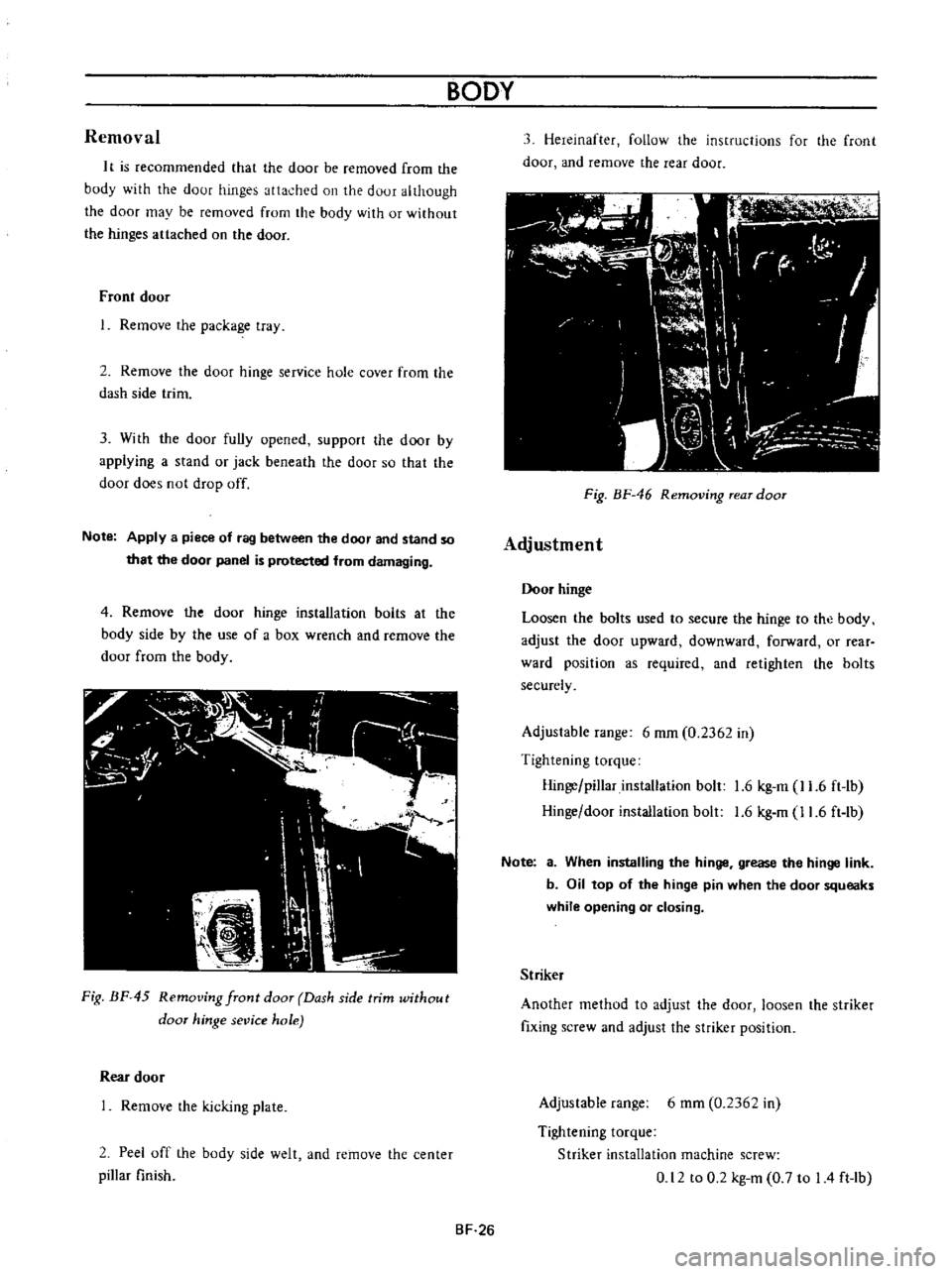
Fig
BF
45
Removing
front
door
Dash
side
trim
without
door
hinge
sevice
hole
Rear
door
Remove
the
kicking
plate
2
Peel
off
the
body
side
welt
and
remove
the
center
pillar
finish
BODY
3
Hereinafter
follow
the
instructions
for
the
front
door
and
remove
the
rear
door
11
I
fl
C
I
r
r
I
W
I
r
I
I
dl
J
Ik
I
h
I
l
i
J
n
Fig
BF
46
Removing
rear
door
Adjustment
Door
hinge
Loosen
the
bolts
used
to
secure
the
hinge
to
the
body
adjust
the
door
upward
downward
forward
or
rear
ward
position
as
required
and
retighten
the
bolts
securely
Adjustable
range
6
mm
0
2362
in
Tightening
torque
Hinge
pillar
installation
bolt
1
6
kg
m
11
6
ft
lb
Hinge
door
installation
bolt
1
6
kg
m
11
6
ft
lb
Note
a
When
installing
the
hinge
grease
the
hinge
link
b
Oil
top
of
the
hinge
pin
when
the
door
squeaks
while
opening
or
closing
Striker
Another
method
to
adjust
the
door
loosen
the
striker
fixing
screw
and
adjust
the
striker
position
Adjustable
range
6
mm
0
2362
in
Tightening
torque
Striker
installation
machine
screw
0
12
to
0
2
kg
m
0
7
to
I
4
ft
lb
BF
26
Page 219 of 513
the
outside
handle
rod
@
is
provided
with
2
to
3
mm
0
0787
to
0
1181
in
play
in
the
stroke
If
the
nylon
nut
@
is
positioned
too
low
the
locking
plate
@
is
depressed
at
the
full
ratch
the
locking
plate
does
not
intermesh
with
the
ratchet
completely
and
the
knob
cannot
be
locked
If
play
in
stroke
of
the
outside
handle
rod
@
is
excessive
may
be
unlocked
up
to
5
mm
0
1967
in
stroke
of
the
outside
handle
will
be
insufficient
If
the
nylon
nut
is
loosened
the
above
described
trouble
occurs
Be
sure
to
secure
the
nut
completely
by
means
of
adhesive
Check
the
springs
@
and
@
for
rust
and
replace
as
required
Tightening
torque
Door
lock
installation
screw
0
12
to
0
2
kg
m
0
9
to
I
4
ft
lb
Door
lock
remote
control
installation
screw
0
12
to
0
2
kg
m
0
9
to
14
ft
lb
Outside
handle
installation
nut
0
2
to
0
3
kg
m
1
4
to
2
2
ft
Ib
Rear
door
lock
removal
1
Remove
the
parts
up
to
the
seal
screen
2
Raise
the
door
glass
to
the
top
and
remove
the
door
DOOR
GLASS
AND
REGULATOR
i
v
BODY
lock
knob
3
Remove
the
bell
crank
installation
screw
Hereinafter
the
instructions
for
removal
of
the
front
door
lock
apply
Fig
BF
54
Door
without
sealing
screen
Rear
door
lock
installation
Install
the
rear
door
lock
in
reverse
sequence
of
removal
Note
Except
for
the
precautions
for
outside
handle
the
precautions
for
the
front
door
lock
apply
AD
1
Front
door
panel
2
Glass
run
rubber
3
Door
window
glass
4
Glazing
rubber
5
Bottom
channel
6
Door
ventilator
frame
7
Ventilator
glass
channel
8
Catch
handle
9
Door
ventilator
glass
10
Pivot
bracket
11
Door
ventilator
weatherstrip
12
Glass
run
rubber
13
Front
window
regulator
14
Door
handle
washer
15
Door
window
regulator
handle
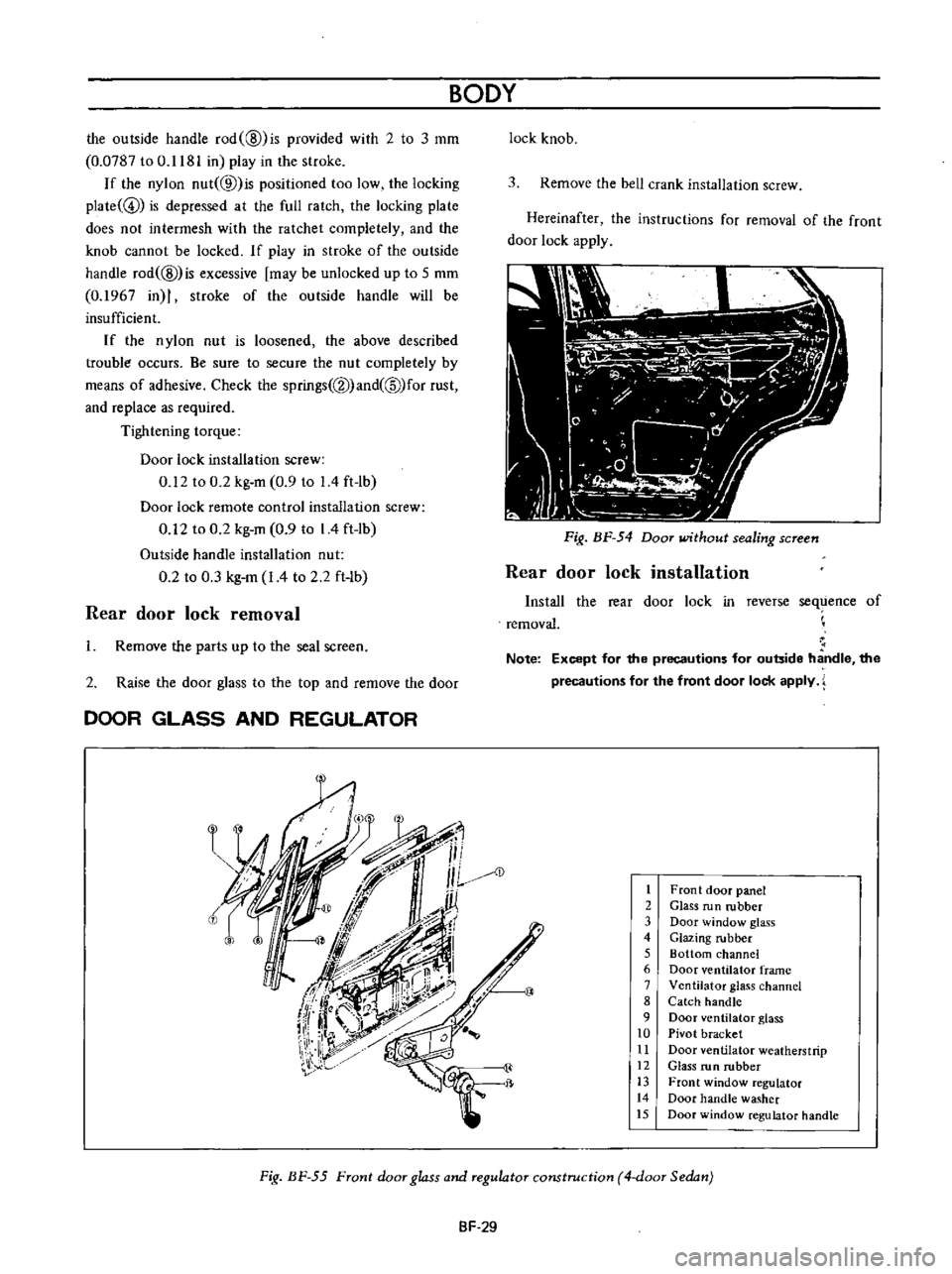
Fig
BF
55
Front
door
glass
and
regulator
construction
4
door
Sedan
SF
29
Page 262 of 513
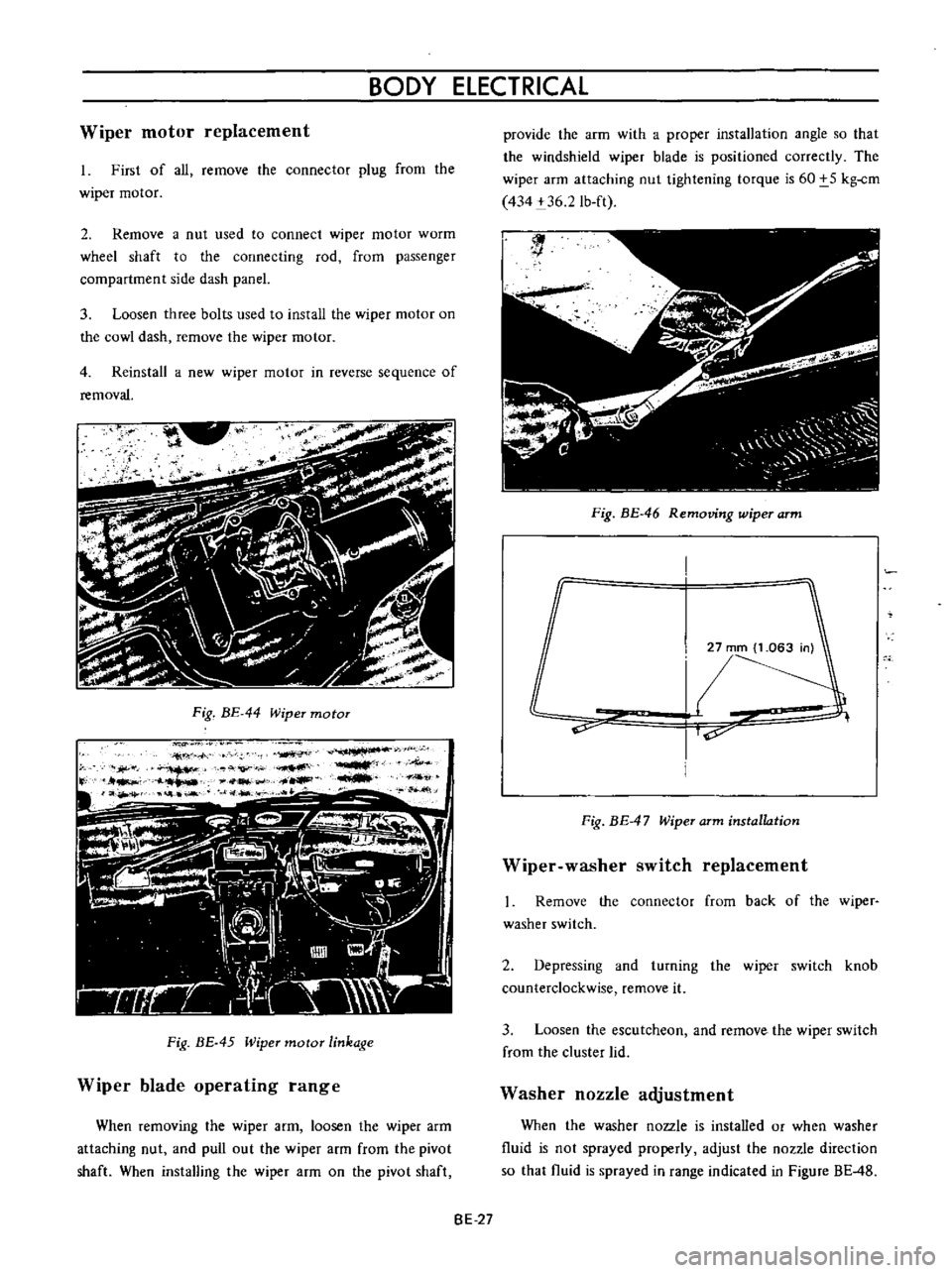
BODY
ELECTRICAL
Wiper
motor
replacement
First
of
all
remove
the
connector
plug
from
the
wiper
motoI
2
Remove
a
nut
used
to
connect
wiper
motor
worm
wheel
shaft
to
the
connecting
rod
from
passenger
compartment
side
dash
panel
3
Loosen
three
bolts
used
to
install
the
wiper
motor
on
the
cowl
dash
remove
the
wiper
motor
4
Reinstall
a
new
wiper
motor
in
reverse
sequence
of
removal
Fig
BE
44
Wiper
motor
Q
V
rt
ir
o
y
At
Jllif
Fig
BE
45
Wiper
motor
linkage
Wiper
blade
operating
range
When
removing
the
wiper
arm
loosen
the
wiper
arm
attaching
nut
and
pull
out
the
wiper
arm
from
the
pivot
shaft
When
installing
the
wiper
arm
on
the
pivot
shaft
provide
the
arm
with
a
proper
installation
angle
so
that
the
windshield
wiper
blade
is
positioned
correctly
The
wiper
arm
attaching
nut
tightening
torque
is
60
5
kg
m
434
36
2lb
ft
Fig
BE
46
Removing
wiper
arm
00
I
i
Fig
BE
47
Wiper
arm
installation
Wiper
washer
switch
replacement
Remove
the
connector
from
back
of
the
wiper
washer
switch
2
Depressing
and
turning
the
wiper
switch
knob
counterclockwise
remove
it
3
Loosen
the
escutcheon
and
remove
the
wiper
switch
from
the
cluster
lid
Washer
nozzle
adjustment
When
the
washer
nozzle
is
installed
or
when
washer
fluid
is
not
sprayed
properly
adjust
the
nozzle
direction
so
that
fluid
is
sprayed
in
range
indicated
in
Figure
BE
48
BE
27
Page 280 of 513
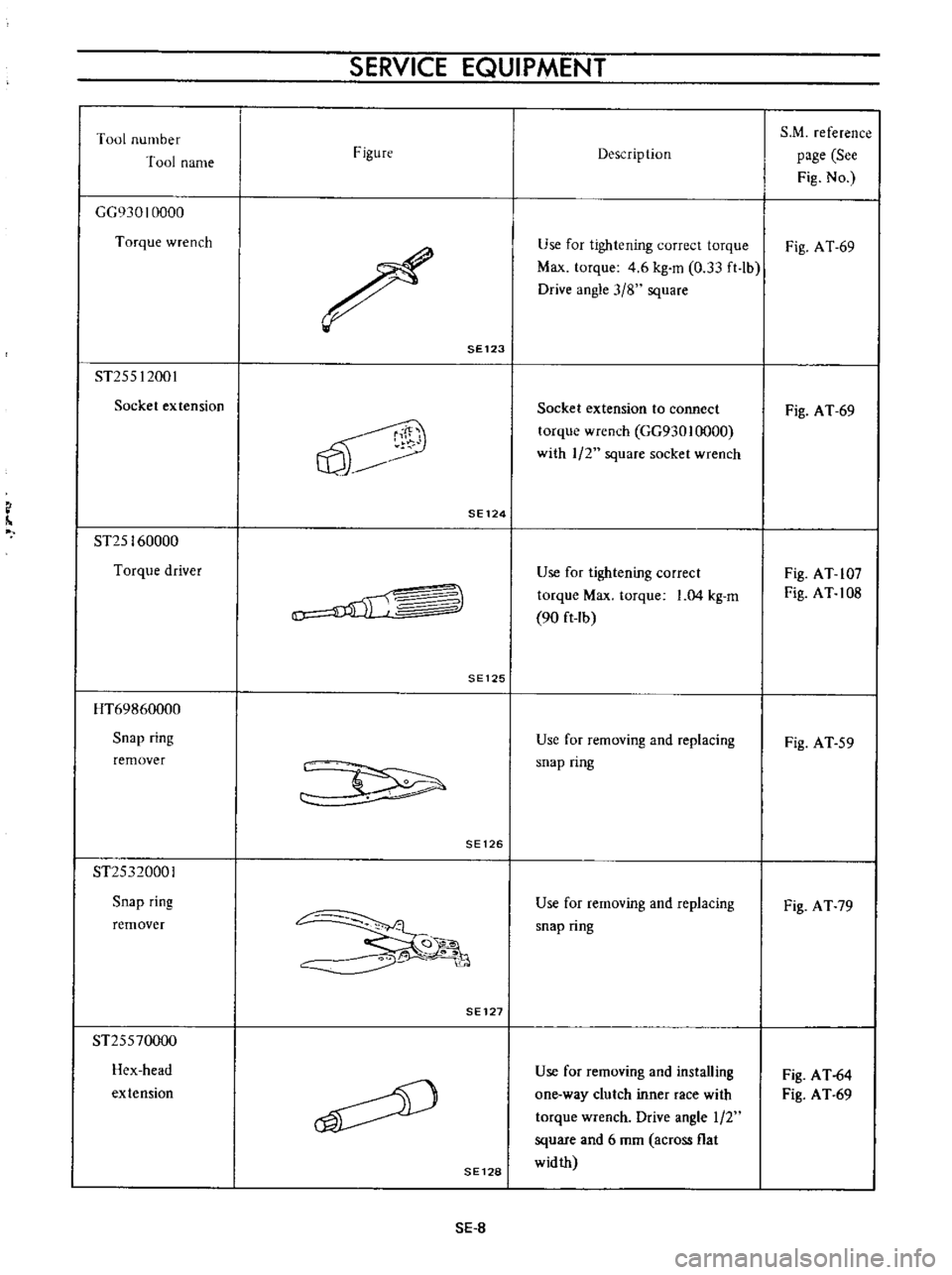
SERVICE
EQUIPMENT
Tool
number
S
M
reference
Tool
name
Figure
Description
page
See
Fig
No
GG930
10000
Torque
wrench
Use
for
tightening
correct
torque
Fig
A
T
69
Max
torque
4
6
kg
m
0
33
ft
lb
Drive
angle
3
8
square
SE123
ST255
12001
Socket
extension
Socket
extension
to
connect
Fig
A
T
69
0
torque
wrench
GG930
I
000
with
1
2
square
socket
wrench
SE124
ST25
160000
Torque
driver
Use
for
tightening
correct
Fig
AT
107
torque
Max
torque
1
04
kg
m
Fig
AT
108
u
90
ft
Ib
SE125
HT69860000
Snap
ring
Use
for
removing
and
replacing
Fig
AT
59
remover
snap
ring
SE126
ST25320001
Snap
ring
Use
for
removing
and
replacing
Fig
AT
79
snap
ring
remover
Go
O
SE127
ST25570000
Hex
head
Use
for
removing
and
installing
Fig
AT
64
extension
one
way
clutch
inner
race
with
Fig
AT
69
torque
wrench
Drive
angle
1
2
square
and
6
mm
across
flat
SE128
width
sE
8