torque DATSUN B110 1973 Service Workshop Manual
[x] Cancel search | Manufacturer: DATSUN, Model Year: 1973, Model line: B110, Model: DATSUN B110 1973Pages: 513, PDF Size: 28.74 MB
Page 103 of 513
FRONT
AXLE
FRONT
SUSPENSION
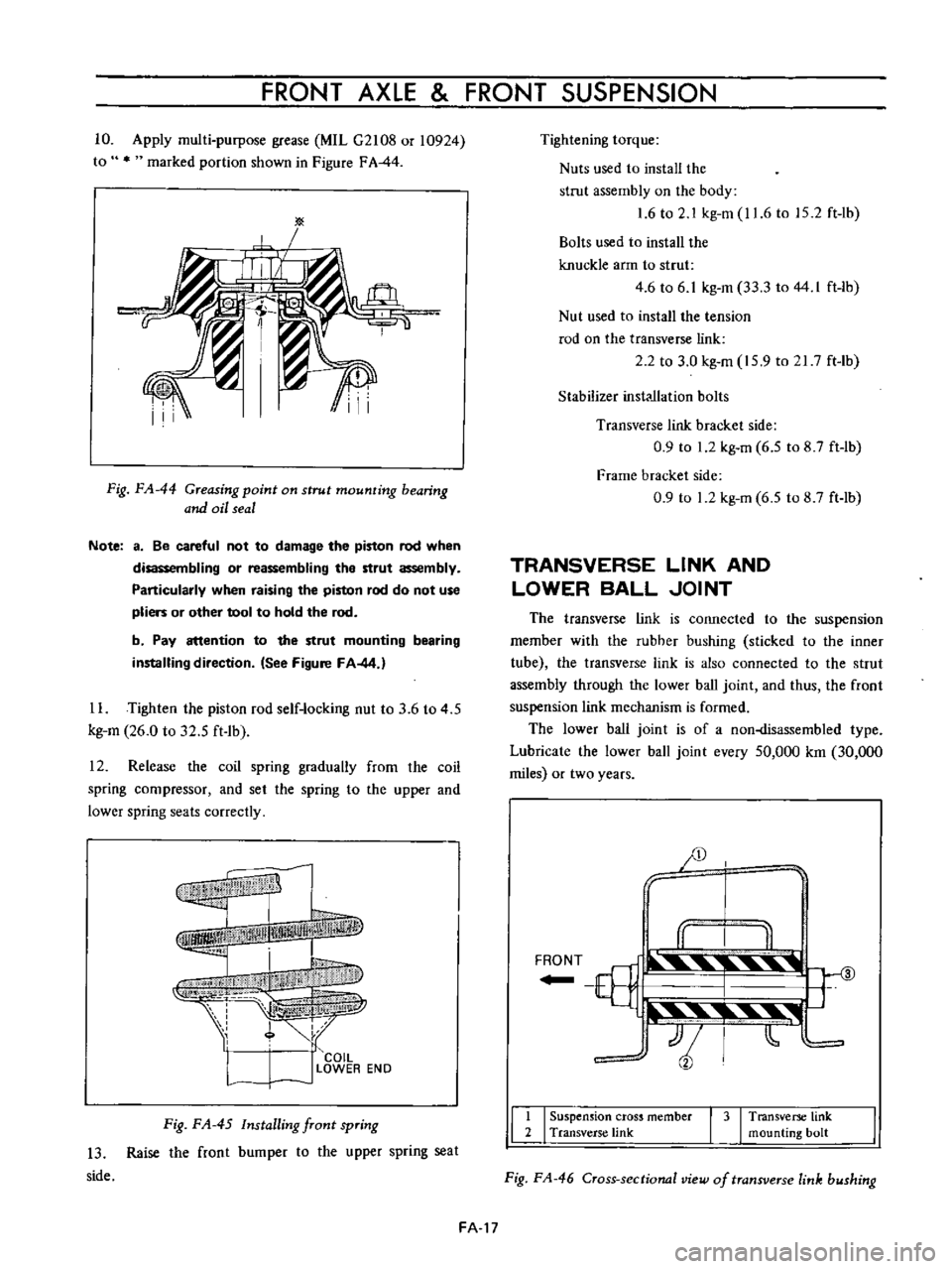
10
Apply
multi
purpose
grease
MIL
G2108
or
10924
to
marked
portion
shown
in
Figure
FA
44
Fig
FA
44
Greasing
point
on
strut
mounting
bearing
and
oil
seal
Note
a
Be
careful
not
to
damage
the
piston
rod
when
disassembling
or
reassembling
the
strut
assembly
Particularly
when
raising
the
piston
rod
do
not
use
pliers
or
other
tool
to
hold
the
rod
b
Pay
attention
to
the
strut
mounting
bearing
installing
direction
See
Figure
FA
44
1
L
Tighten
the
piston
rod
self
locking
nut
to
3
6
to
4
5
kg
m
26
0
to
32
5
ft
1b
12
Release
the
coil
spring
gradually
from
lhe
coil
spring
compressor
and
set
the
spring
to
the
upper
and
lower
spring
seats
correctly
f
I
I
COIL
l
J
LOWER
EN
D
Fig
FA
45
Installing
front
spring
13
Raise
the
front
bumper
to
the
upper
spring
seat
side
Tightening
torque
Nuts
used
to
install
the
strut
assembly
on
the
body
1
6
to
2
1
kg
m
11
6
to
15
2
ft
lb
Bolts
used
to
install
the
knuckle
arm
to
strut
4
6
to
6
1
kg
m
33
3
to
44
I
ft
lb
Nut
used
to
install
the
tension
rod
on
the
transverse
link
2
2
to
3
0
kg
m
15
9
to
21
7
ft
Ib
Stabilizer
inst
llation
bolts
Transverse
link
bracket
side
0
9
to
1
2
kg
m
6
5
to
8
7
ft
lb
Frame
bracket
side
0
9
to
1
2
kg
m
6
5
to
8
7
ft
lb
TRANSVERSE
LINK
AND
LOWER
BALL
JOINT
The
transverse
link
is
connected
to
the
suspension
member
with
the
rubher
bushing
sticked
to
the
inner
tube
the
transverse
link
is
also
connected
to
the
strut
assembly
through
the
lower
ball
joint
and
thus
the
front
suspension
link
mechanism
is
formed
The
lower
ball
joint
is
of
a
non
lisassembled
type
Lubricate
the
lower
ball
joint
every
50
000
km
30
000
miles
or
two
years
JD
y
I
II
I
II
F
T
ill
3
YJ
t
tjli
t
11
I
Suspension
cross
member
I
3
I
Transverse
link
2
Transverse
link
mounting
bolt
Fig
FA
46
Cross
sectional
view
of
transverse
link
bushing
FA
17
Page 105 of 513
FRONT
AXLE
FRONT
SUSPENSION
I
ST36721
000
ST36722000
Fig
FA
51
Removing
transverse
link
bushing
Inspection
Transverse
link
bushing
Rubber
and
inner
tube
joints
adhered
are
sticky
melted
or
cracked
replace
the
transverse
link
as
an
assembly
Ball
joint
I
The
ball
joint
is
of
a
non
disassembled
type
and
therefore
the
ball
joint
cannot
be
disassembled
Measure
end
play
toward
the
axial
direction
and
shaking
torque
and
replace
when
deviated
from
the
standards
Standard
end
play
axial
direction
0
3
to
1
0
mm
0
0118
to
0
0394
in
Shaking
torque
35
to
60
kg
cm
30
4
to
52
1
in
ib
At
the
cotter
pin
opening
position
6
6
to
11
3
kg
14
6
to
24
9Ib
I
Fig
FA
52
Measuring
ball
joint
shaking
torque
2
Replace
the
ball
joint
with
a
new
one
when
the
dust
cover
is
cracked
3
Lubricate
the
ball
joint
with
multi
purpose
grease
MIL
G2108
or
10924
every
50
000
km
30
000
miles
or
two
years
Install
a
grease
nipple
on
the
plug
hole
and
grease
completely
so
that
old
grease
is
replaced
with
new
grease
Be
sure
to
reinstall
the
plug
when
completely
greased
Note
When
a
high
pressure
grease
gun
is
used
operate
the
grease
gun
carefully
so
that
grease
is
injected
slowly
and
new
grease
does
not
come
out
from
the
clamp
portion
Reinstallation
Reinstall
the
transve
l
e
link
and
lower
ball
joint
in
reverse
sequence
of
removal
noting
the
following
ins
true
tions
I
When
transverse
link
collar
interior
along
which
the
transverse
link
bushing
is
inserted
is
rusted
remove
it
with
emery
paper
2
In
order
to
improve
slide
make
bushing
surface
and
transverse
link
collar
interior
wet
with
soap
water
when
inserting
the
transverse
link
bushing
3
Fit
the
transverse
link
bushing
to
the
transverse
link
collar
by
the
use
of
a
transverse
link
bushing
replacer
set
special
1001
ST36720000
In
order
to
unify
distances
from
the
transverse
link
collar
end
surface
to
the
bushing
inner
tube
for
both
sides
following
instructions
apply
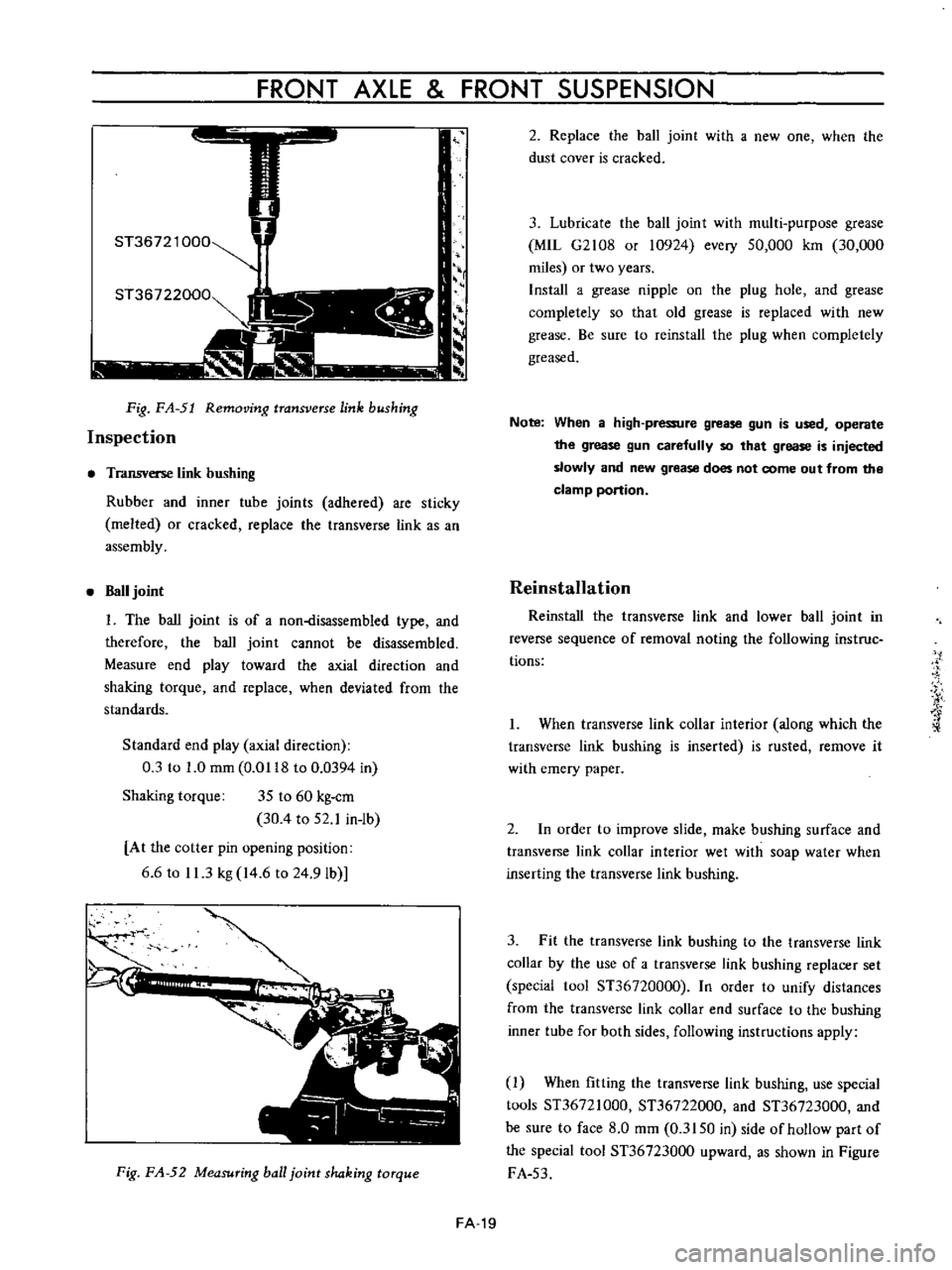
1
When
fitting
the
transve
l
e
link
bushing
use
special
tools
ST36721000
ST36722000
and
ST36723000
and
be
sure
to
face
8
0
mm
0
3150
in
side
of
hollow
part
of
the
special
tool
ST36723000
upward
as
shown
in
Figure
FA
53
FA
19
Page 106 of 513
CHASSIS
ST36721000
ST36722000
I
ST36723000
r
Fig
FA
53
Installing
transverse
link
bushing
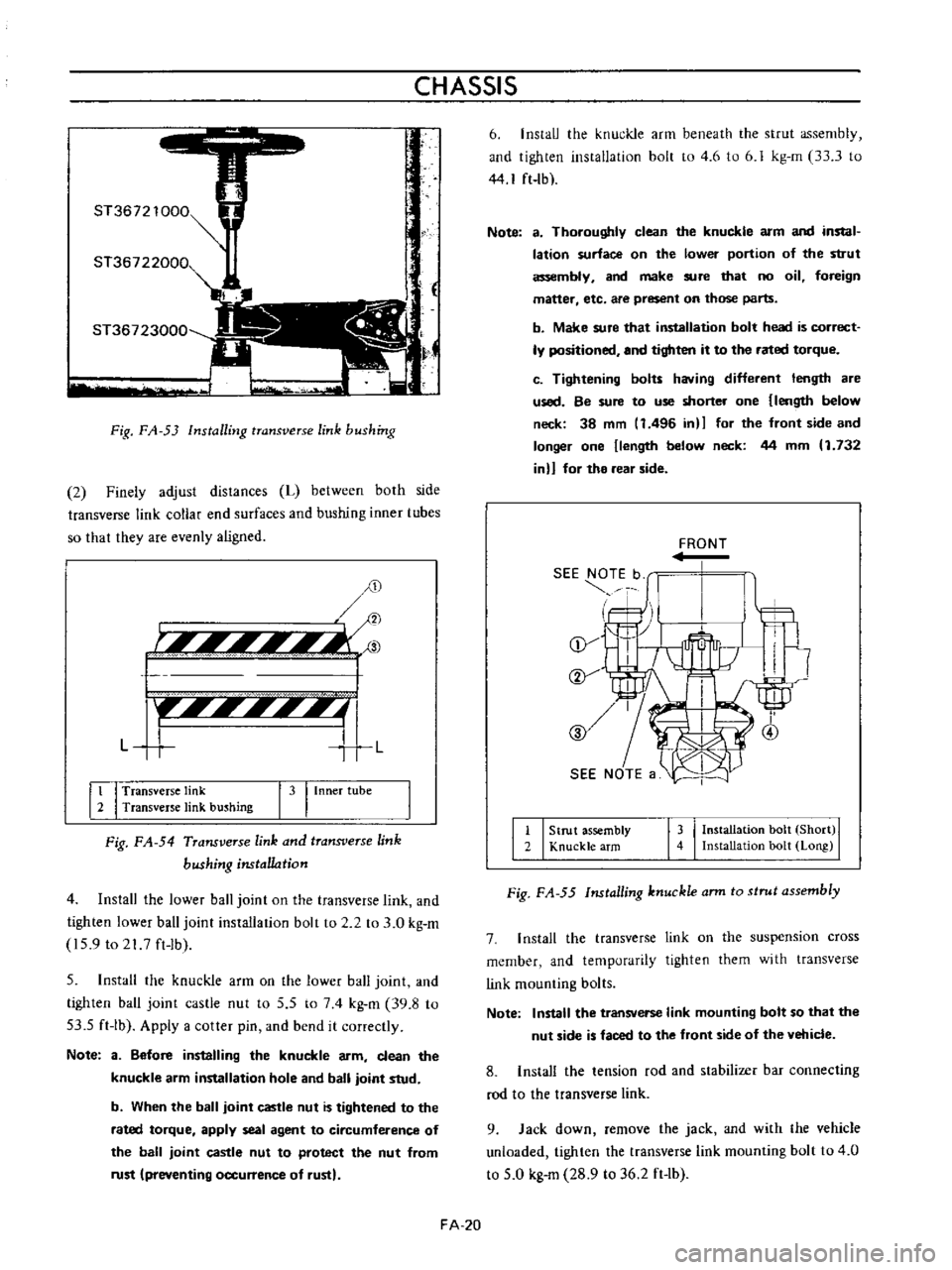
2
Finely
adjust
distances
L
between
both
side
transverse
link
collar
end
surfaces
and
bushing
inner
tubes
so
that
they
are
evenly
aligned
D
r
Ii
l
Ii
3
F
f
IIII
I
I
L
T
L
It
I
Transverse
link
2
Transverse
link
bushing
I
3
I
Inner
tube
Fig
FA
54
Transverse
link
and
transverse
link
bushing
nstal1o
tion
4
Install
the
lower
ball
joint
on
the
transverse
link
and
tighten
lower
ball
joint
installation
bolt
to
2
2
to
3
0
kg
m
159
to
21
7
ft
Ib
5
Install
the
knuckle
arm
on
the
lower
ball
joint
and
tighten
ball
joint
castle
nut
to
5
5
to
74
kg
m
39
8
to
53
5
ft
Ib
Apply
a
cotter
pin
and
bend
it
correctly
Note
3
Before
installing
the
knuckle
arm
clean
the
knuckle
arm
installation
hole
and
ball
joint
stud
b
When
the
ball
joint
castle
nut
is
tightened
to
the
rated
torque
apply
seal
agent
to
circumference
of
the
ball
joint
castle
nut
to
protect
the
nut
from
rust
preventing
occurrence
of
rust
FA
20
6
InstaIJ
the
knuckle
arm
beneath
the
strut
assembly
and
tighten
instaIJation
bolt
to
4
6
to
6
J
kg
m
33
3
to
44
I
ft
lb
Note
a
Thoroughly
clean
the
knuckle
arm
and
instal
lation
surface
on
the
lower
portion
of
the
strut
assembly
and
make
sure
that
no
oil
foreign
maner
etc
are
present
on
those
parts
b
Make
sure
that
installation
bolt
head
is
correct
ly
positioned
and
tighten
it
to
the
rated
torque
c
Tightening
bolu
having
different
length
are
used
Be
sure
to
use
shorter
one
length
below
neck
38
mm
11496
in
for
the
front
side
and
longer
one
length
below
neck
44
mm
1
132
in
for
the
rear
side
FRONT
II
I
Strut
assembly
2
Knuckle
arm
143
I
Installation
bolt
Short
I
Installation
bolt
Long
Fig
FA
55
Installing
knuckle
ann
to
strut
assembly
7
I
nstall
the
transverse
link
on
the
suspension
cross
member
and
temporarily
tighten
them
with
transverse
link
mounting
bolts
Note
Install
the
transverse
link
mounting
bolt
so
that
the
nut
side
is
faced
to
the
front
side
of
the
vehicle
8
Install
the
tension
rod
and
stabilizer
bar
connecting
rod
to
the
transverse
link
9
Jack
down
remove
the
jack
and
with
the
vehicle
unloaded
tighten
the
transverse
link
mounting
bolt
to
4
0
to
5
0
kg
m
28
9
to
36
2
ft
lb
Page 110 of 513
CHASSIS
Strut
assembly
Strut
outer
diameter
Piston
rod
diameter
mmlin
nml
in
45
17
7
18
0
709
15
0
984
Piston
diameter
mmlin
Damping
force
at
piston
speed
0
3
m
sec
Expansion
kg
Ib
Compression
kg
lb
48
106
22
48
5
Piston
rod
Bend
limit
Wear
limit
mm
in
0
1
0
0039
mm
in
0
025
0
0010
Piston
cylinder
Bend
limit
Wear
limit
inside
mm
in
mm
in
0
2
0
0079
0
1
0
0039
17
0
669
Stabilizer
bar
diameter
mm
in
Front
wheel
bearing
rotation
starting
torque
kg
cm
in
lb
Ball
joint
shaking
torque
kg
cm
in
lb
Ball
joint
end
play
axial
direction
mm
in
9
0
7
8
35
to
60
30
4
to
52
1
0
3
to
1
0
0
0118
to
0
0394
TIGHTENING
TORQUE
Front
axle
Brake
disc
rotor
and
hub
assembly
tightening
torque
Wheel
bearing
lock
nut
Disc
brake
caliper
fixing
bolt
Buffle
plate
installation
screw
Brake
disc
assembly
installation
bolt
kg
m
ft
lb
4
4
to
5
9
31
8
to
42
7
2
2
to
2
4
15
9
to
174
4
6
to
6
1
33
3
to
44
1
0
3
to
0
4
2
1
to
2
9
2
7
to
3
7
19
5
to
26
8
Strut
assembly
Gland
packing
tightening
torque
Piston
rod
self
locking
nut
Upper
support
nut
8
0
to
11
0
57
8
to
79
5
3
6
to
4
5
26
0
to
32
5
1
6
to
2
1
I
1
6
to
15
2
Transverse
link
and
ball
joint
Bolts
used
to
install
the
knuckle
arm
to
strut
Ball
joint
castle
nut
Bolts
used
to
install
the
transverse
link
to
ball
4
6
to
6
1
33
3
to
44
1
5
5
to
7
4
39
8
to
53
5
FA
24
Page 119 of 513
CHASSIS
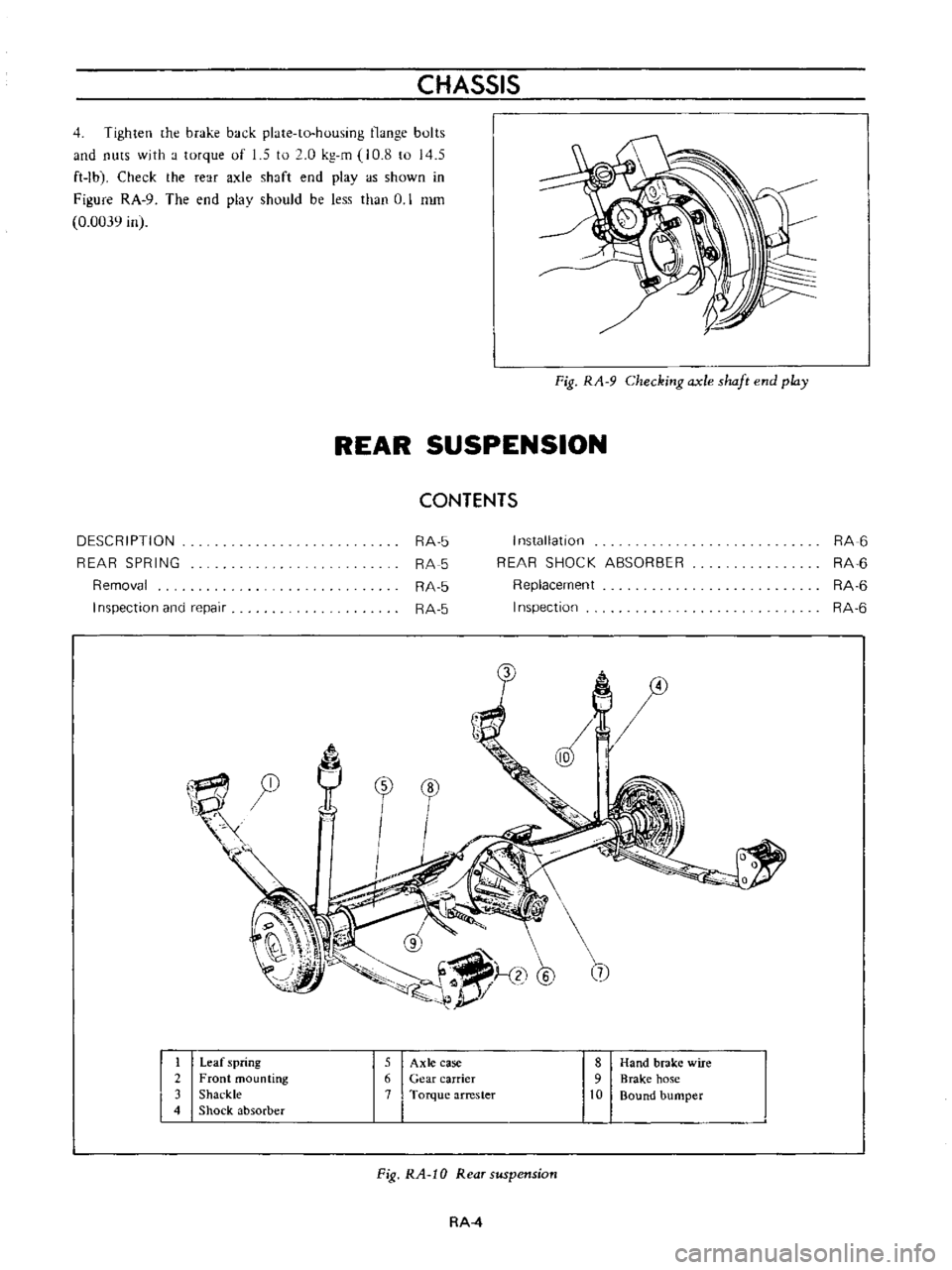
4
Tighten
he
brake
back
plate
to
housing
nunge
bults
and
nuts
with
a
torque
of
1
5
to
2
0
kg
m
10
8
to
145
ft
Ibl
Check
the
rear
axle
shaft
end
playas
shown
in
Figure
RA
9
The
end
plav
should
be
less
than
U
I
nun
0
0039
in
Fig
RA
9
Checking
axle
shaft
end
play
REAR
SUSPENSION
CONTENTS
DESCRIPTION
REAR
SPRING
Removal
I
nspection
and
repair
RA
5
RA
5
RA
5
RA
5
I
n5tallatlon
REAR
SHOCK
ABSORBER
Replacement
Inspection
RA
6
RA
6
RA
6
RA
6
0
tr
1
1
@
5
@
7
I
Leaf
spring
5
Axle
case
8
Hand
brake
wire
2
Front
mounting
6
Gear
carrier
9
Brake
hose
3
Shackle
7
Torque
arrester
10
Bound
bumper
4
Shock
absorber
Fig
RA
10
Rear
suspension
RA
4
Page 122 of 513
REAR
AXLE
REAR
SUSPENSION
SERVICE
DATA
AN
D
SPECIFICATIONS
Shock
absorber
Applied
model
Sedan
Coupe
Van
Stroke
x
max
length
mm
in
167x506
6
57xI9
9
180
x
440
7
09
x
17
3
180
x
468
7
09
x
18
4
Damping
force
at
0
3mjs
Rebound
Compression
kg
Ib
kg
lb
58
128
38
83
8
68
I
50
45
99
2
90
198
45
99
2
Rear
spring
Length
x
widlh
x
thickness
NO
ofleaves
mm
in
6
I
1
llOx50x72
O
6
1
I
ll
x50x7
2
6
3
1
110
x
50
x
13
1
0
24
1
43
7x
1
97x
0
28
2
0
24
2
43
7xI
97x
0
28
1
0
52
1
1
110x50x
6
2
43
7X
1
97
x
0
24
1
7
1
0
28
2
11
1
0
43
1
0
24
1
43
7x
1
97x
0
28
2
Heavy
duty
spring
Camber
Free
mm
in
109
t3
4
29
1
0
1181
11
0
433
109
1
3
4
29
1
0
1181
11
0
433
131
1
5
5
15
tO
1969
11
0
433
Loaded
wi
th
specified
load
mm
in
Specified
load
kg
Ib
In
423
In
423
295
650
Spring
eye
diameter
Front
mm
in
35
1
378
35
1
378
35
1
378
Rear
mm
in
23
0
906
23
0
906
23
0
906
Rear
axle
End
play
mm
in
Less
than
0
1
0
0039
Rear
axle
end
shim
mm
in
0
Q75
0
003
Wheel
bearing
coUar
pressing
force
ton
Ib
3
to
5
6
600
to
11
000
Tightening
torque
Axle
shaft
to
housing
flange
bolt
nuts
kg
m
ft
lb
1
5
to
2
0
10
9
to
14
5
L7
to
2
5
12
3
to
18
1
Differential
carrier
to
housing
bolts
Spring
V
bolts
3
2
to
4
0
23
1
to
28
9
RA
7
Page 123 of 513
CHASSIS
Wheel
nuts
8
0
to
9
0
7
8
to
65
1
Spring
front
bracket
to
body
bolt
nuts
Sedan
and
Coupe
Van
6
to
0
1
6
to
14
5
6
to
I
11
6
to
15
2
Spring
shackle
pin
nuts
1
6
to
0
11
6
to
14
5
Spring
front
pin
nut
Sedan
and
Coupe
Van
6
to
2
0
1
6
to
14
5
3
2
to
4
0
23
1
to
28
9
Shock
absorber
upper
nuts
Sedan
and
Van
Coupe
3
6
to
4
5
26
0
to
32
5
0
to
1
7
2
to
8
6
Shock
absorber
lower
nuts
Sedan
and
Van
Coupe
3
6
to
4
5
26
0
to
32
5
0
to
I
2
7
2
to
8
6
0
6
to
0
8
4
3
to
5
8
Torque
arrester
to
body
bolts
SERVICE
JOURNAL
OR
BULLETIN
REFERENCE
DATE
JOURNAL
or
BULLETIN
No
PAGE
No
SUBJECT
RA
8
Page 128 of 513
CHASSIS
Ii
t
L
1
J
rJ
I
e
i
L
rubber
parts
und
alcohol
long
than
30
seconds
After
the
parts
are
cleaned
dry
them
with
com
pressed
air
Check
the
cylinder
and
piston
for
damage
and
uneven
wear
on
the
sliding
surface
and
for
other
defective
conditions
Replace
as
required
2
Replace
if
the
cylinder
and
piston
clearance
is
more
than
0
15
mm
0
006
in
3
In
principle
replace
the
piston
cup
packing
and
valves
with
new
ones
whenever
the
master
cylinder
is
disassembled
Be
sure
to
replace
if
damaged
worn
weakened
or
expanded
4
Check
the
return
springs
for
wear
damage
and
other
defective
conditions
and
replace
as
required
5
Replace
others
if
deformed
damaged
or
defective
Reassembly
Assemble
the
master
cylinder
in
reverse
sequence
of
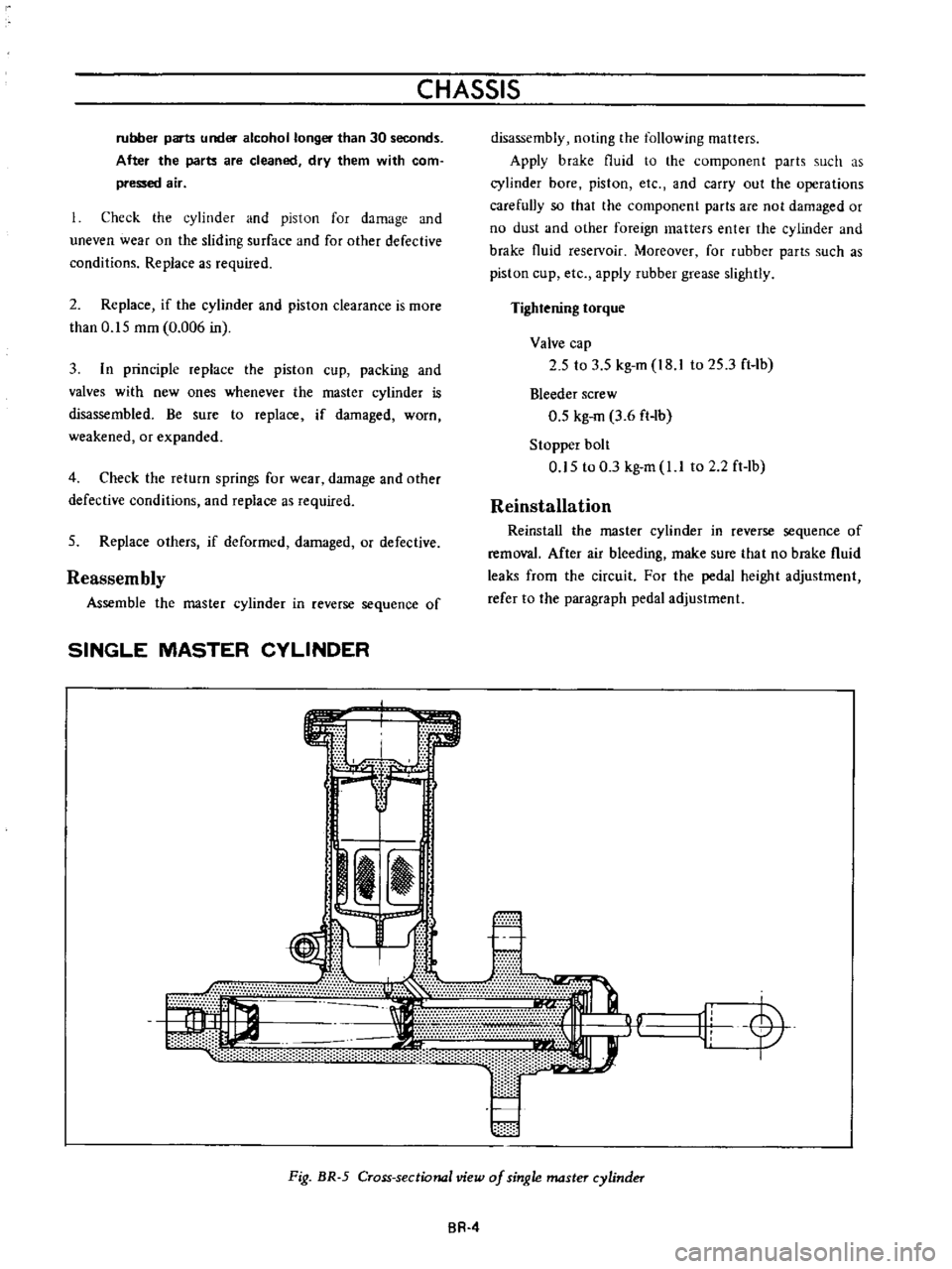
SINGLE
MASTER
CYLINDER
s
m
e
disassembly
noting
the
following
matters
Apply
brake
fluid
to
the
component
parts
such
as
cylinder
bore
piston
etc
and
carry
out
the
operations
carefully
so
that
the
component
parts
are
not
damaged
or
no
dust
and
other
foreign
matters
enter
the
cylinder
and
brake
fluid
reselVoir
Moreover
for
rubber
parts
such
as
piston
cup
etc
apply
rubber
grease
slightly
Tightening
torque
Valve
cap
2
5
to
3
5
kg
m
I8
to
25
3
ft
Ib
Bleeder
screw
0
5
kg
m
3
6
ft
lb
Stopper
bolt
0
5
to
0
3
kg
m
l
I
to
2
2ft
lb
Reinstallation
Reinstall
the
master
cylinder
in
reverse
sequence
of
removal
After
air
bleeding
make
sure
that
no
brake
fluid
leaks
from
the
circuit
For
the
pedal
height
adjustment
refer
to
lhe
paragraph
pedal
adjustment
r
11L
y
Fig
BR
5
Cross
sectional
view
of
single
master
cylinder
BR
4
Page 131 of 513
Tightening
torque
3
way
connector
1
5
to
1
8
kg
m
10
8
to
13
0
ft
lh
1
5
to
1
8
kg
m
10
8
to
13
0
ft
lh
1
5
to
1
8
kg
m
10
8
to
13
0
ft
lb
0
7
to
0
9
kg
m
5
1
to
6
5
ft
1b
Master
cylinder
Brake
hose
Air
bleeder
5
Fill
the
master
cylinder
brake
fluid
reservoir
with
brake
fluid
and
perform
air
bleeding
complele1y
Note
a
Do
not
use
brake
fluid
other
than
specified
b
The
specified
brake
fluid
is
used
for
both
single
and
tandem
type
master
cylinders
6
Upon
completion
of
air
bleeding
make
sure
that
the
brake
operates
correctly
and
check
the
brake
tube
and
hose
connectors
for
fluid
leaking
Fully
depress
the
brake
pedal
continue
to
depress
the
brake
pedal
for
several
seconds
and
make
sure
that
no
brake
fluid
leaks
from
any
part
of
the
brake
line
Replace
defective
part
if
required
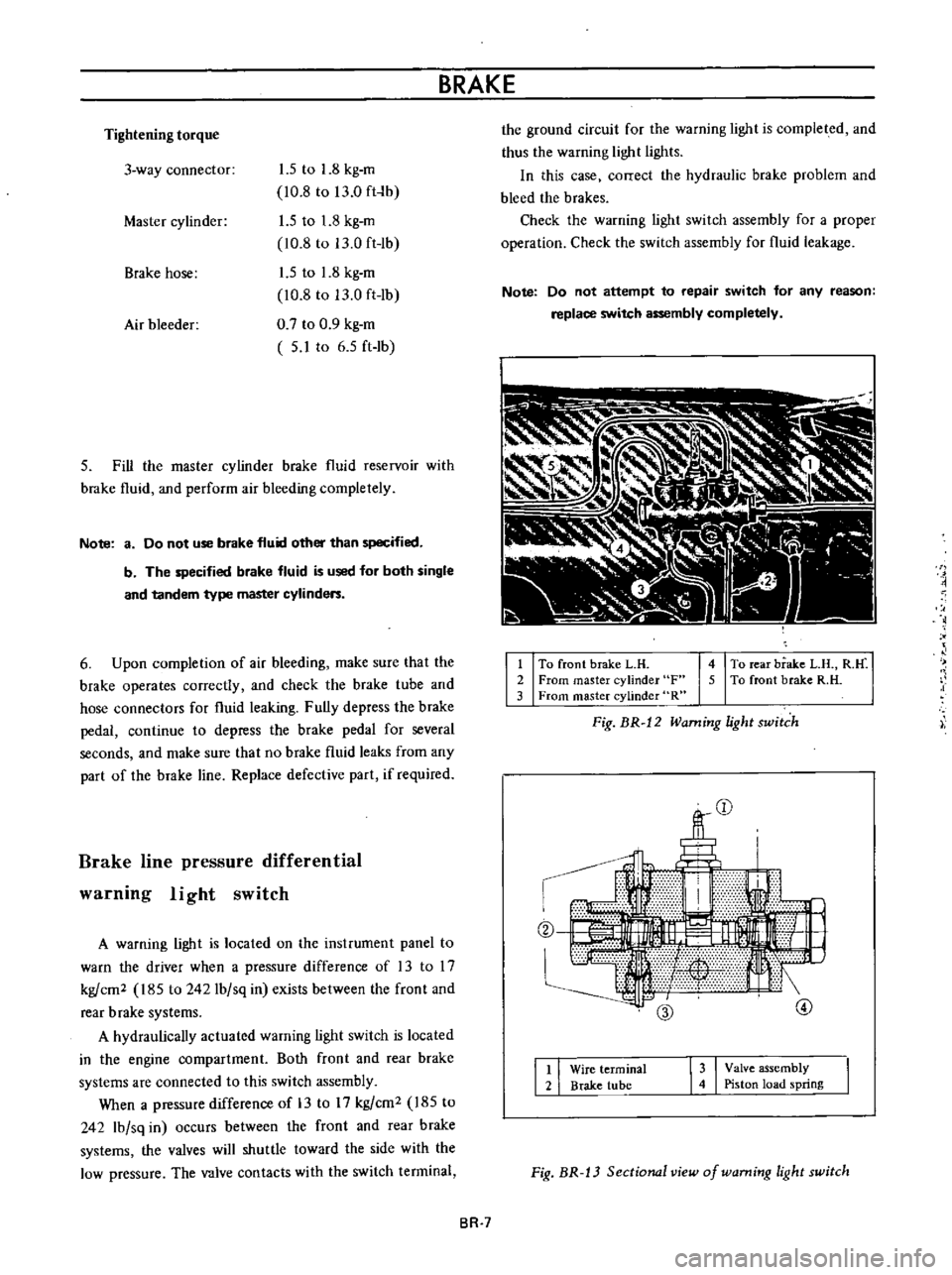
Brake
line
pressure
differential
warning
light
switch
A
warning
light
is
located
on
the
instrument
panel
to
warn
the
driver
when
a
pressure
difference
of
13
to
17
kg
cm2
185
to
2421bJsq
in
exists
between
the
front
and
rear
b
rake
systems
A
hydraulically
actuated
warning
light
switch
is
located
in
the
engine
compartment
Both
front
and
rear
brake
systems
are
connected
to
this
switch
assembly
When
a
pressure
difference
of
13
to
17
kgJcm2
185
to
242
lbJsq
in
occurs
between
the
front
and
rear
brake
systems
the
valves
will
shuttle
toward
the
side
with
the
low
pressure
The
valve
contacts
with
the
switch
terminal
BRAKE
the
ground
circuit
for
the
warning
light
is
completed
and
thus
the
warning
light
lights
In
this
case
correct
the
hydraulic
brake
problem
and
bleed
the
brakes
Check
the
warning
light
switch
assembly
for
a
proper
operation
Check
the
switch
assembly
for
fluid
leakage
Note
Do
not
attempt
to
repair
switch
for
any
reason
replace
switch
assembly
completely
1
To
front
brake
L
H
2
From
master
cylinder
F
3
From
master
cylinder
R
4
To
rear
brake
L
B
R
M
5
To
front
brake
R
H
Fig
BR
12
Warning
light
switch
r
I
@
I
I
3
I
Valve
assembly
4
Piston
load
spring
Wire
terminal
Brake
tube
Fig
BR
13
Sectional
view
of
warning
light
switch
BR
7
Page 140 of 513
CHASSIS
Fig
BR
37
Correcting
bias
spring
position
10
Assemble
the
cylinder
body
and
yoke
by
tapping
the
yoke
lightly
11
Apply
the
brake
grease
fully
to
the
yoke
sliding
groove
of
cylinder
12
Install
the
air
bleeder
Reinstallation
Reinstall
the
caliper
assembly
in
reverse
sequence
of
removal
After
the
pad
is
installed
completely
bleed
the
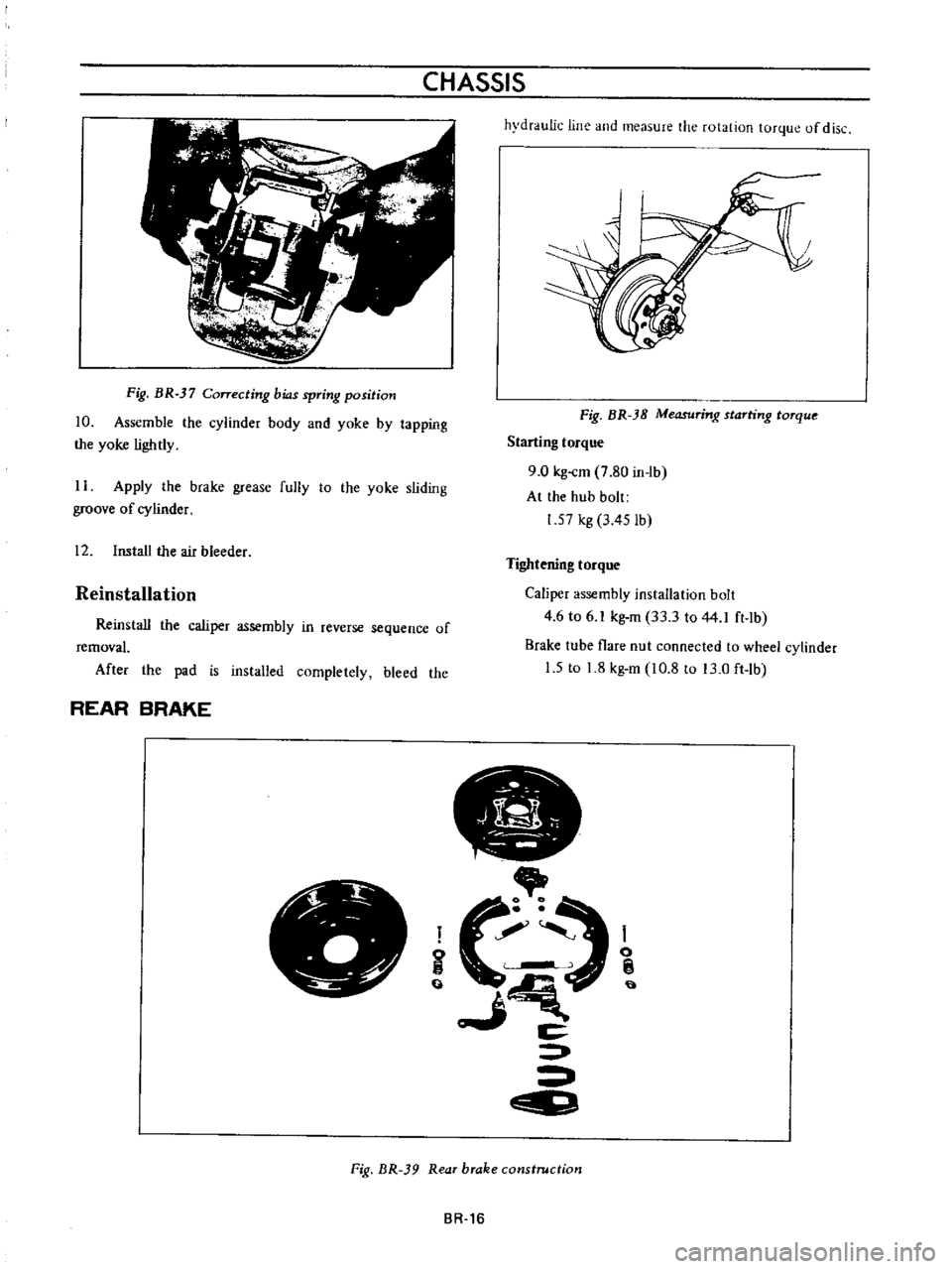
REAR
BRAKE
r
e
hydraulic
line
and
measure
the
rotation
torque
of
disc
Fig
BR
38
Measuring
starting
torque
Starting
torque
9
0
kg
cm
7
80
in
lb
At
the
hub
bolt
1
57
kg
3
45
lb
Tightening
torque
Caliper
assembly
installation
bolt
4
6
to
6
kg
m
33
3
to
44
1
ft
lb
Brake
tube
flare
nut
connected
to
wheel
cylinder
1
5
to
1
8
kg
m
10
8
to
3
0
ft
lb
JJ
i
o
C
EID
I
o
fj
t
Fig
BR
39
Rear
brake
construction
BR
16