steering DODGE NEON 1999 Service Repair Manual
[x] Cancel search | Manufacturer: DODGE, Model Year: 1999, Model line: NEON, Model: DODGE NEON 1999Pages: 1200, PDF Size: 35.29 MB
Page 800 of 1200
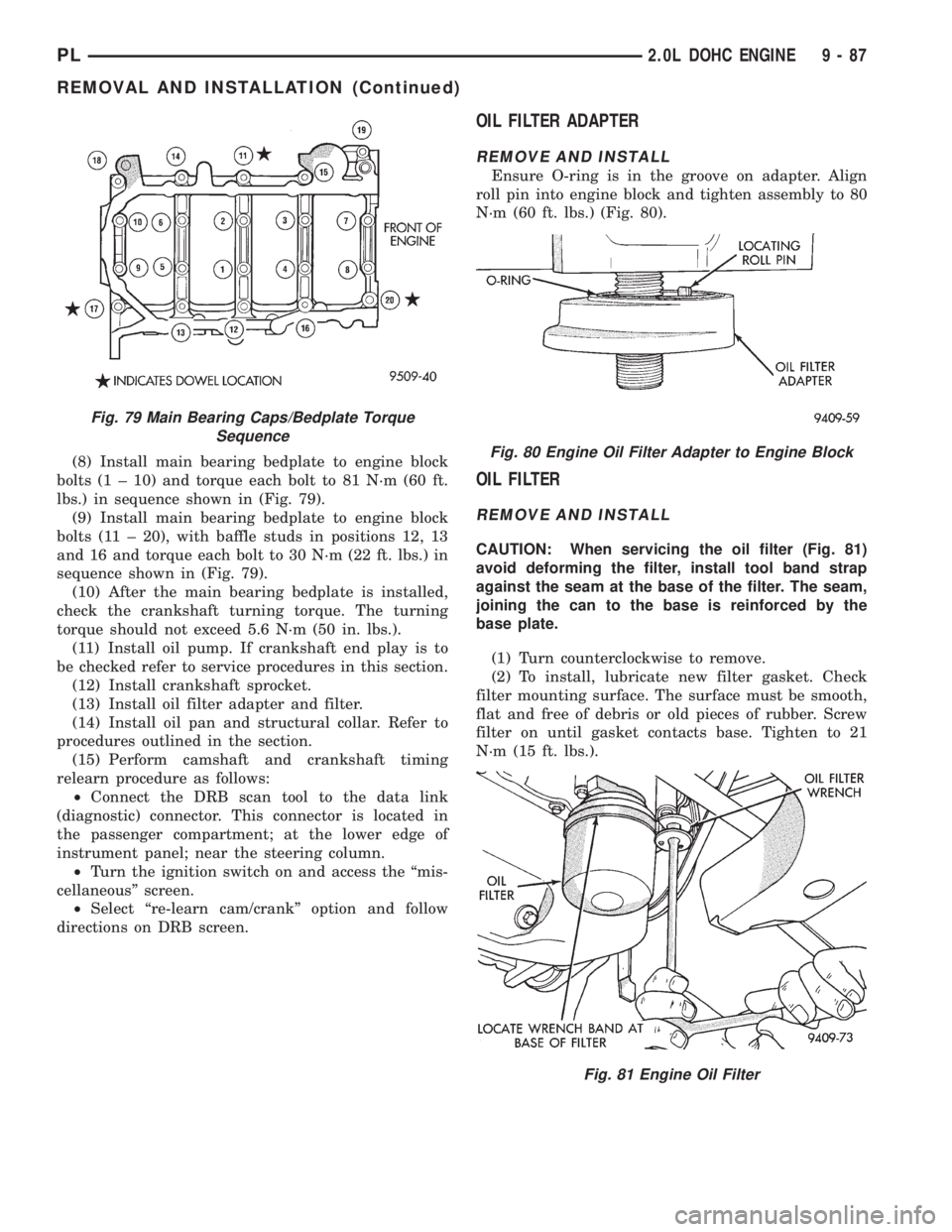
(8) Install main bearing bedplate to engine block
bolts (1 ± 10) and torque each bolt to 81 N´m (60 ft.
lbs.) in sequence shown in (Fig. 79).
(9) Install main bearing bedplate to engine block
bolts (11 ± 20), with baffle studs in positions 12, 13
and 16 and torque each bolt to 30 N´m (22 ft. lbs.) in
sequence shown in (Fig. 79).
(10) After the main bearing bedplate is installed,
check the crankshaft turning torque. The turning
torque should not exceed 5.6 N´m (50 in. lbs.).
(11) Install oil pump. If crankshaft end play is to
be checked refer to service procedures in this section.
(12) Install crankshaft sprocket.
(13) Install oil filter adapter and filter.
(14) Install oil pan and structural collar. Refer to
procedures outlined in the section.
(15) Perform camshaft and crankshaft timing
relearn procedure as follows:
²Connect the DRB scan tool to the data link
(diagnostic) connector. This connector is located in
the passenger compartment; at the lower edge of
instrument panel; near the steering column.
²Turn the ignition switch on and access the ªmis-
cellaneousº screen.
²Select ªre-learn cam/crankº option and follow
directions on DRB screen.
OIL FILTER ADAPTER
REMOVE AND INSTALL
Ensure O-ring is in the groove on adapter. Align
roll pin into engine block and tighten assembly to 80
N´m (60 ft. lbs.) (Fig. 80).
OIL FILTER
REMOVE AND INSTALL
CAUTION: When servicing the oil filter (Fig. 81)
avoid deforming the filter, install tool band strap
against the seam at the base of the filter. The seam,
joining the can to the base is reinforced by the
base plate.
(1) Turn counterclockwise to remove.
(2) To install, lubricate new filter gasket. Check
filter mounting surface. The surface must be smooth,
flat and free of debris or old pieces of rubber. Screw
filter on until gasket contacts base. Tighten to 21
N´m (15 ft. lbs.).
Fig. 79 Main Bearing Caps/Bedplate Torque
Sequence
Fig. 80 Engine Oil Filter Adapter to Engine Block
Fig. 81 Engine Oil Filter
PL2.0L DOHC ENGINE 9 - 87
REMOVAL AND INSTALLATION (Continued)
Page 832 of 1200
FRAMES
INDEX
page page
REMOVAL AND INSTALLATION
FRONT SUSPENSION CROSSMEMBER....... 3
SPECIFICATIONS
STRUCTURAL DIMENSIONS................ 4TORQUE SPECIFICATIONS................ 10
REMOVAL AND INSTALLATION
FRONT SUSPENSION CROSSMEMBER
WARNING: IF SUSPENSION CROSSMEMBER IS
REPLACED DUE TO COLLISION DAMAGE, INSPECT
THE STEERING COLUMN TO STEERING GEAR
COUPLING FOR DAMAGE. REFER TO GROUP 19,
STEERING FOR INSTRUCTIONS.
Before removing front suspension crossmem-
ber, index mark location of crossmember on
frame to aid installation.
The front suspension crossmember must be prop-
erly installed to achieve design camber, caster set-
tings and wheel stagger. The crossmember can be
installed out of position on the frame rails due to its
design. Bolts and cage nuts hold the rear of the
crossmember to the frame torque boxes. Bolts and
J-nuts hold the front of the crossmember to the
frame rails. No designed in locating device is used to
position the crossmember in the vehicle. Before
removing the crossmember mark the frame torque
box around the rear mounting location to aid instal-
lation. A crossmember that is removed during service
must be installed in the same position from which it
was removed. To verify that crossmember is in the
proper position, refer to the dimensions provided.
Front end dimensions are gauged from the principal
locating point (PLP) holes located under the frame
torque boxes rearward of the front wheels. After
removal and installation of the crossmember is per-
formed, verify that front suspension alignment is
within specifications. If camber, caster settings and
wheel stagger is not within specifications, loosen and
reposition crossmember to bring suspension within
specifications. Refer to Group 2, Front Suspension
and Driveshaft for additional information.
REMOVAL
(1) Hoist and support vehicle on safety stands.
(2) Using a suitable marking device, mark the out-
line of the suspension crossmember on the frame
torque box around the rear mounting location.(3) Remove front wheels from vehicle.
(4) Remove pinch bolts holding front ball joints to
spindles.
(5) Separate ball joints from spindles.
(6) Position a suitable lifting device under the
crossmember.
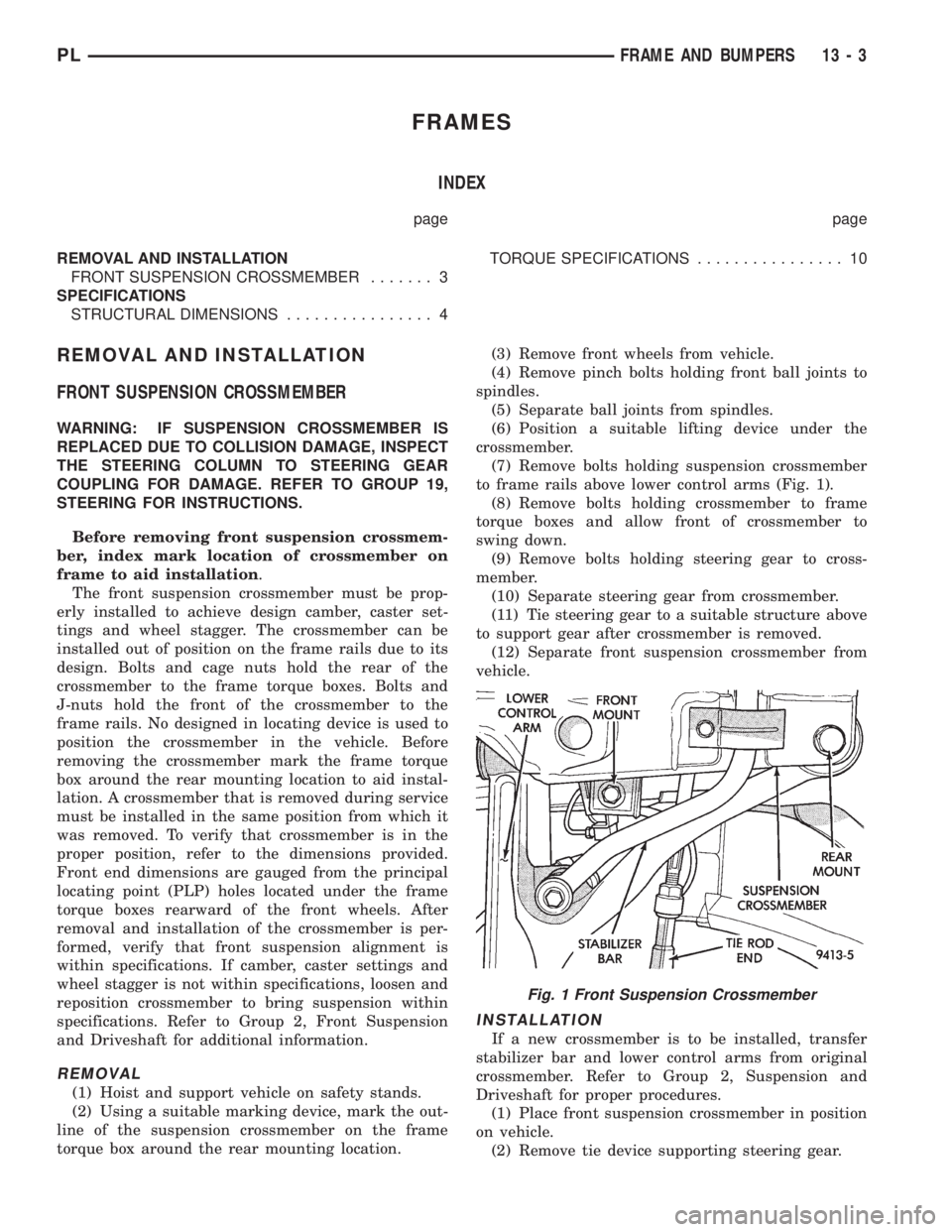
(7) Remove bolts holding suspension crossmember
to frame rails above lower control arms (Fig. 1).
(8) Remove bolts holding crossmember to frame
torque boxes and allow front of crossmember to
swing down.
(9) Remove bolts holding steering gear to cross-
member.
(10) Separate steering gear from crossmember.
(11) Tie steering gear to a suitable structure above
to support gear after crossmember is removed.
(12) Separate front suspension crossmember from
vehicle.
INSTALLATION
If a new crossmember is to be installed, transfer
stabilizer bar and lower control arms from original
crossmember. Refer to Group 2, Suspension and
Driveshaft for proper procedures.
(1) Place front suspension crossmember in position
on vehicle.
(2) Remove tie device supporting steering gear.
Fig. 1 Front Suspension Crossmember
PLFRAME AND BUMPERS 13 - 3
Page 833 of 1200
(3) Place steering gear in position on crossmember.
(4) Install bolts to hold steering gear to crossmem-
ber.
(5) Position lifting device under the crossmember.
(6) Lift crossmember to frame rails.
(7) Engage bolts to hold crossmember rear mounts
into cage nuts in the frame torque boxes. Do not
tighten bolts.
(8) Install bolts to hold crossmember to frame rails
above lower control arms.
(9) Lower and remove lifting device.
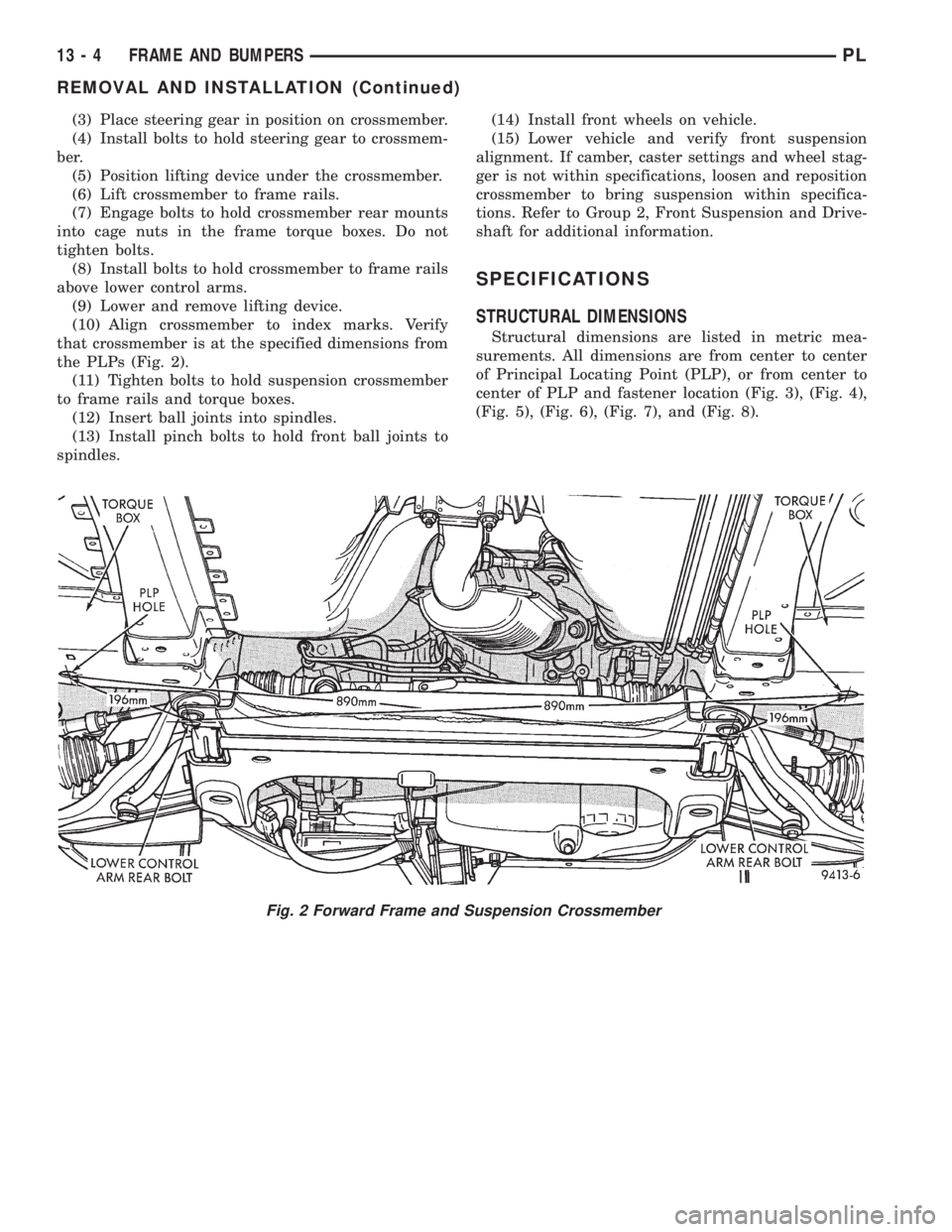
(10) Align crossmember to index marks. Verify
that crossmember is at the specified dimensions from
the PLPs (Fig. 2).
(11) Tighten bolts to hold suspension crossmember
to frame rails and torque boxes.
(12) Insert ball joints into spindles.
(13) Install pinch bolts to hold front ball joints to
spindles.(14) Install front wheels on vehicle.
(15) Lower vehicle and verify front suspension
alignment. If camber, caster settings and wheel stag-
ger is not within specifications, loosen and reposition
crossmember to bring suspension within specifica-
tions. Refer to Group 2, Front Suspension and Drive-
shaft for additional information.
SPECIFICATIONS
STRUCTURAL DIMENSIONS
Structural dimensions are listed in metric mea-
surements. All dimensions are from center to center
of Principal Locating Point (PLP), or from center to
center of PLP and fastener location (Fig. 3), (Fig. 4),
(Fig. 5), (Fig. 6), (Fig. 7), and (Fig. 8).
Fig. 2 Forward Frame and Suspension Crossmember
13 - 4 FRAME AND BUMPERSPL
REMOVAL AND INSTALLATION (Continued)
Page 858 of 1200
(2) Disconnect vapor tube from rollover valve.
(3) Using a straight screwdriver, pry the valve out
of the grommet in the fuel filler tube.
INSTALLATION
(1) Apply a light coating of power steering fluid to
the grommet.
(2) Install valve in grommet.
(3) Attach vapor tube to valve.
(4) Install fuel filler tube cap.
ACCELERATOR PEDAL
CAUTION: When servicing the accelerator pedal,
throttle cable or speed control cable, do not dam-
age or kink the core wire inside the cable sheath-
ing.
REMOVAL
(1) Working from the engine compartment, remove
the throttle control shield.
(2) Hold the throttle body throttle lever in the
wide open position. Remove the throttle cable from
the throttle body cam.
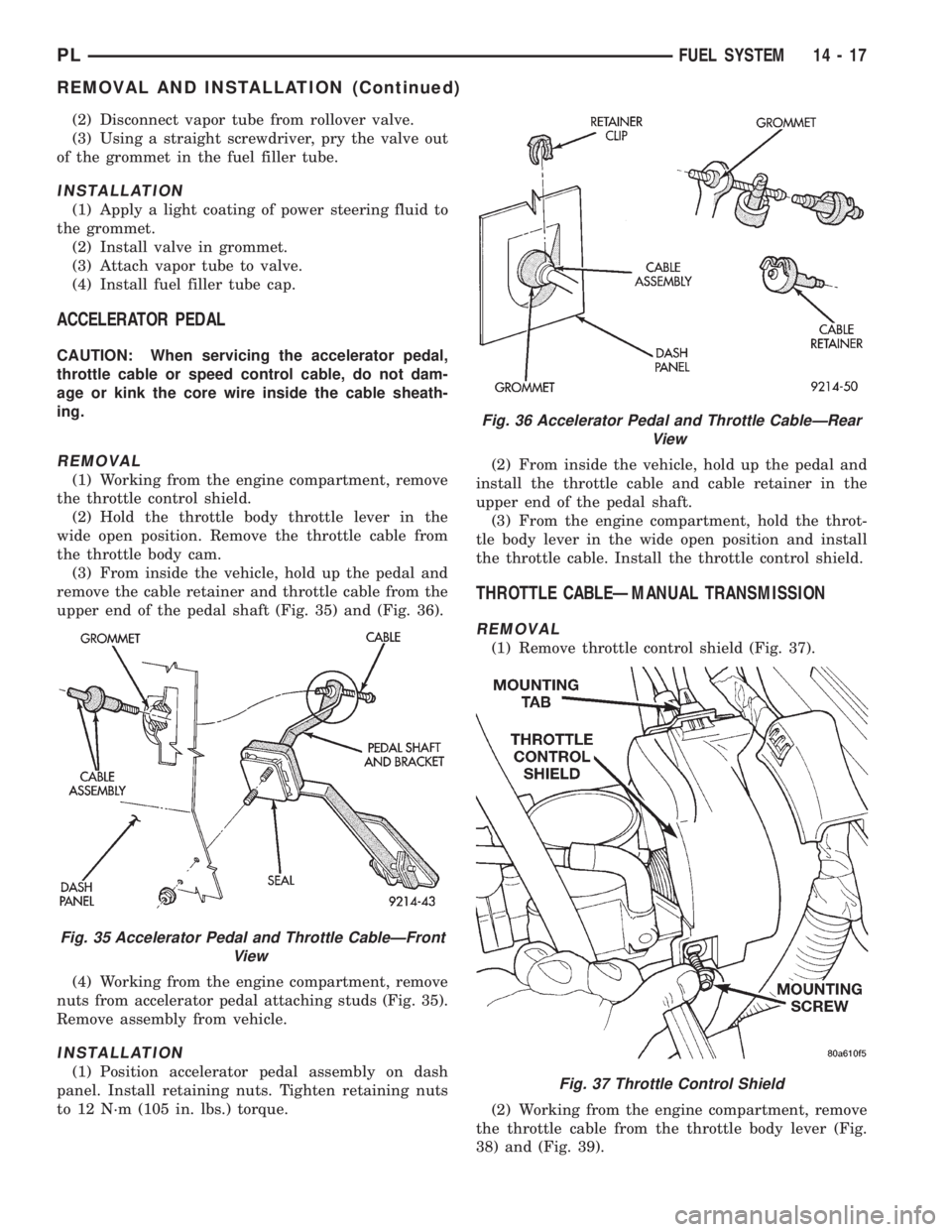
(3) From inside the vehicle, hold up the pedal and
remove the cable retainer and throttle cable from the
upper end of the pedal shaft (Fig. 35) and (Fig. 36).
(4) Working from the engine compartment, remove
nuts from accelerator pedal attaching studs (Fig. 35).
Remove assembly from vehicle.
INSTALLATION
(1) Position accelerator pedal assembly on dash
panel. Install retaining nuts. Tighten retaining nuts
to 12 N´m (105 in. lbs.) torque.(2) From inside the vehicle, hold up the pedal and
install the throttle cable and cable retainer in the
upper end of the pedal shaft.
(3) From the engine compartment, hold the throt-
tle body lever in the wide open position and install
the throttle cable. Install the throttle control shield.
THROTTLE CABLEÐMANUAL TRANSMISSION
REMOVAL
(1) Remove throttle control shield (Fig. 37).
(2) Working from the engine compartment, remove
the throttle cable from the throttle body lever (Fig.
38) and (Fig. 39).
Fig. 35 Accelerator Pedal and Throttle CableÐFront
View
Fig. 36 Accelerator Pedal and Throttle CableÐRear
View
Fig. 37 Throttle Control Shield
PLFUEL SYSTEM 14 - 17
REMOVAL AND INSTALLATION (Continued)
Page 861 of 1200
FUEL INJECTION SYSTEM
INDEX
page page
GENERAL INFORMATION
INTRODUCTION......................... 21
MODES OF OPERATION.................. 21
DESCRIPTION AND OPERATION
AIR CONDITIONING CLUTCH RELAYÐ
PCM OUTPUT......................... 31
AIR CONDITIONING PRESSURE
TRANSDUCERÐPCM INPUT............. 25
AUTOMATIC SHUTDOWN (ASD) SENSEÐ
PCM INPUT........................... 25
AUTOMATIC SHUTDOWN RELAYÐ
PCM OUTPUT......................... 32
BATTERY TEMPERATURE SENSORÐ
PCM INPUT........................... 25
BATTERY VOLTAGEÐPCM INPUT........... 25
BRAKE SWITCHÐPCM INPUT.............. 25
CAMSHAFT POSITION SENSORÐPCM INPUT . 25
CHARGING SYSTEM INDICATOR LAMPÐ
PCM OUTPUT......................... 32
CRANKSHAFT POSITION SENSORÐ
PCM INPUT........................... 26
DATA LINK CONNECTOR.................. 33
DUTY CYCLE EVAP PURGE SOLENOIDÐ
PCM OUTPUT......................... 32
ELECTRIC EGR TRANSDUCERÐ
PCM OUTPUT......................... 32
ENGINE COOLANT TEMPERATURE SENSORÐ
PCM INPUT........................... 26
FUEL INJECTORSÐPCM OUTPUT.......... 34
FUEL LEVEL SENSORÐPCM INPUT......... 27
FUEL PUMP RELAYÐPCM OUTPUT......... 32
GENERATOR FIELDÐPCM OUTPUT......... 33
HEATED OXYGEN SENSOR (O2S SENSOR)Ð
PCM INPUT........................... 27
IDLE AIR CONTROL MOTORÐPCM OUTPUT . . 33
IGNITION CIRCUIT SENSEÐPCM INPUT..... 28
IGNITION COILÐPCM OUTPUT............. 34
INTAKE AIR TEMPERATURE SENSORÐ
PCM INPUT........................... 28
KNOCK SENSORÐPCM INPUT............. 29
MALFUNCTION INDICATOR (CHECK ENGINE)
LAMPÐPCM OUTPUT.................. 34
MANIFOLD ABSOLUTE PRESSURE (MAP)
SENSORÐPCM INPUT.................. 29
PARK/NEUTRAL POSITION SWITCHÐ
PCM INPUT........................... 30
POWER DISTRIBUTION CENTER........... 23
POWER STEERING PRESSURE SWITCHÐ
PCM INPUT........................... 30
POWERTRAIN CONTROL MODULE.......... 24SCI RECEIVEÐPCM INPUT................ 30
SCI RECEIVEÐPCM OUTPUT.............. 35
SENSOR RETURNÐPCM INPUT............ 30
SOLID STATE FAN RELAYÐPCM OUTPUT.... 35
SPEED CONTROL SERVOSÐPCM OUTPUT . . . 30
SPEED CONTROLÐPCM INPUT............ 35
SYSTEM DIAGNOSIS..................... 23
TACHOMETERÐPCM OUTPUT............. 35
THROTTLE POSITION SENSORÐPCM INPUT . 30
TORQUE CONVERTOR CLUTCH SOLENOIDÐ
PCM OUTPUT......................... 35
VEHICLE SPEED SENSORÐPCM INPUT..... 30
DIAGNOSIS AND TESTING
ASD AND FUEL PUMP RELAYS............. 46
CAMSHAFT AND CRANKSHAFT POSITION
SENSOR............................. 47
ENGINE COOLANT TEMPERATURE SENSOR . . 47
HEATED OXYGEN SENSOR............... 47
IDLE AIR CONTROL (IAC) MOTOR TEST...... 47
KNOCK SENSOR........................ 47
MANIFOLD ABSOLUTE PRESSURE (MAP)
SENSOR............................. 48
THROTTLE BODY MINIMUM AIR FLOW....... 48
THROTTLE POSITION SENSOR............ 48
VEHICLE SPEED SENSOR................ 49
VISUAL INSPECTIONÐDOHC.............. 40
VISUAL INSPECTIONÐSOHC.............. 35
REMOVAL AND INSTALLATION
AIR CLEANER ELEMENT.................. 55
CAMSHAFT POSITION SENSOR............ 54
CRANKSHAFT POSITION SENSOR.......... 54
DOWNSTREAM HEATED OXYGEN SENSOR . . . 55
DUTY CYCLE EVAP PURGE SOLENOID VALVE . 53
ENGINE COOLANT TEMPERATURE SENSOR . . 56
IDLE AIR CONTROL MOTOR............... 52
KNOCK SENSOR........................ 57
MAP/IAT SENSORÐDOHC................. 53
MAP/IAT SENSORÐSOHC................. 53
POWERTRAIN CONTROL MODULE (PCM).... 54
THROTTLE BODYÐAUTOMATIC
TRANSMISSION....................... 50
THROTTLE BODYÐMANUAL TRANSMISSION . 50
THROTTLE POSITION SENSOR (TPS)....... 52
UPSTREAM HEATED OXYGEN SENSOR...... 54
VEHICLE SPEED SENSOR................ 56
SPECIFICATIONS
TORQUE.............................. 57
VECI LABEL............................ 57
SPECIAL TOOLS
FUEL................................. 57
14 - 20 FUEL SYSTEMPL
Page 863 of 1200
ENGINE START-UP MODE
This is an OPEN LOOP mode. If the vehicle is in
park or neutral (automatic transaxles) or the clutch
pedal is depressed (manual transaxles) the ignition
switch energizes the starter relay. The following
actions occur when the starter motor is engaged.
²If the PCM receives the camshaft position sensor
and crankshaft position sensor signals, it energizes
the Auto Shutdown (ASD) and fuel pump relays. If
the PCM does not receive both signals within approx-
imately one second, it will not energize the ASD
relay and fuel pump relay. The ASD and fuel pump
relays supply battery voltage to the fuel pump, fuel
injectors, ignition coil and heated oxygen sensors.
²The PCM energizes all four injectors (on the 69É
degree falling edge) for a calculated pulse width until
it determines crankshaft position from the camshaft
position sensor and crankshaft position sensor sig-
nals. The PCM determines crankshaft position within
1 engine revolution.
²After determining crankshaft position, the PCM
begins energizing the injectors in sequence. It adjusts
injector pulse width and controls injector synchroni-
zation by turning the individual ground paths to the
injectors On and Off.
²When the engine idles within664 RPM of its
target RPM, the PCM compares current MAP sensor
value with the atmospheric pressure value received
during the Ignition Switch On (zero RPM) mode. If
the PCM does not detect a minimum difference
between the two values, it sets a MAP diagnostic
trouble code into memory.
Once the ASD and fuel pump relays have been
energized, the PCM determines injector pulse width
based on the following:
²Battery voltage
²Engine coolant temperature
²Engine RPM
²Intake air temperature (IAT)
²Throttle position
²The number of engine revolutions since cranking
was initiated
During Start-up the PCM maintains ignition tim-
ing at 9É BTDC.
ENGINE WARM-UP MODE
This is an OPEN LOOP mode. The following inputs
are received by the PCM:
²Engine coolant temperature
²Manifold Absolute Pressure (MAP)
²Intake air temperature (IAT)
²Crankshaft position (engine speed)
²Camshaft position
²Knock sensor
²Throttle position
²A/C switch
²Battery voltage²Power steering pressure switch
²Vehicle speed
²Speed control
²Both O2 sensors
²All diagnostics
The PCM adjusts injector pulse width and controls
injector synchronization by turning the individual
ground paths to the injectors On and Off.
The PCM adjusts ignition timing and engine idle
speed. Engine idle speed is adjusted through the idle
air control motor.
CRUISE OR IDLE MODE
When the engine is at operating temperature this
is a CLOSED LOOP mode. During cruising or idle
the following inputs are received by the PCM:
²Intake air temperature
²Engine coolant temperature
²Manifold absolute pressure
²Crankshaft position (engine speed)
²Camshaft position
²Knock sensor
²Throttle position
²Exhaust gas oxygen content
²A/C control positions
²Power steering pressure switch
²Battery voltage
²Vehicle speed
The PCM adjusts injector pulse width and controls
injector synchronization by turning the individual
ground paths to the injectors On and Off.
The PCM adjusts engine idle speed and ignition
timing. The PCM adjusts the air/fuel ratio according
to the oxygen content in the exhaust gas (measured
by the upstream and downstream heated oxygen sen-
sor).
The PCM monitors for engine misfire. During
active misfire and depending on the severity, the
PCM either continuously illuminates or flashes the
malfunction indicator lamp (Check Engine light on
instrument panel). Also, the PCM stores an engine
misfire DTC in memory.
The PCM performs several diagnostic routines.
They include:
²Oxygen sensor monitor
²Downstream heated oxygen sensor diagnostics
during open loop operation (except for shorted)
²Fuel system monitor
²EGR monitor
²Purge system monitor
²All inputs monitored for proper voltage range.
²All monitored components (refer to Group 25 for
On-Board Diagnostics).
The PCM compares the upstream and downstream
heated oxygen sensor inputs to measure catalytic
convertor efficiency. If the catalyst efficiency drops
14 - 22 FUEL SYSTEMPL
GENERAL INFORMATION (Continued)
Page 864 of 1200
below the minimum acceptable percentage, the PCM
stores a diagnostic trouble code in memory.
During certain idle conditions, the PCM may enter
a variable idle speed strategy. During variable idle
speed strategy the PCM adjusts engine speed based
on the following inputs.
²A/C sense
²Battery voltage
²Battery temperature
²Engine coolant temperature
²Engine run time
²Power steering pressure switch
²Vehicle mileage
ACCELERATION MODE
This is a CLOSED LOOP mode. The PCM recog-
nizes an abrupt increase in Throttle Position sensor
output voltage or MAP sensor output voltage as a
demand for increased engine output and vehicle
acceleration. The PCM increases injector pulse width
in response to increased fuel demand.
DECELERATION MODE
This is a CLOSED LOOP mode. During decelera-
tion the following inputs are received by the PCM:
²A/C pressure transducer
²A/C sense
²Battery voltage
²Intake air temperature
²Engine coolant temperature
²Crankshaft position (engine speed)
²Exhaust gas oxygen content (upstream heated
oxygen sensor)
²Knock sensor
²Manifold absolute pressure
²Power steering pressure switch
²Throttle position
²IAC motor control changes in respones to MAP
sensor feedback
The PCM may receive a closed throttle input from
the Throttle Position Sensor (TPS) when it senses an
abrupt decrease in manifold pressure. This indicates
a hard deceleration. In response, the PCM may
momentarily turn off the injectors. This helps
improve fuel economy, emissions and engine braking.
If decel fuel shutoff is detected, downstream oxy-
gen sensor diagnostics is performed.
WIDE-OPEN-THROTTLE MODE
This is an OPEN LOOP mode. During wide-open-
throttle operation, the following inputs are received
by the PCM:
²Intake air temperature
²Engine coolant temperature
²Engine speed
²Knock sensor
²Manifold absolute pressure²Throttle position
When the PCM senses a wide-open-throttle condi-
tion through the Throttle Position Sensor (TPS) it de-
energizes the A/C compressor clutch relay. This
disables the air conditioning system.
The PCM does not monitor the heated oxygen sen-
sor inputs during wide-open-throttle operation except
for downstream heated oxygen sensor and both
shorted diagnostics. The PCM adjusts injector pulse
width to supply a predetermined amount of addi-
tional fuel.
IGNITION SWITCH OFF MODE
When the operator turns the ignition switch to the
OFF position, the following occurs:
²All outputs are turned off, unless 02 Heater
Monitor test is being run. Refer to Group 25,
On-Board Diagnostics.
²No inputs are monitored except for the heated
oxygen sensors. The PCM monitors the heating ele-
ments in the oxygen sensors and then shuts down.
DESCRIPTION AND OPERATION
SYSTEM DIAGNOSIS
The PCM can test many of its own input and out-
put circuits. If the PCM senses a fault in a major
system, the PCM stores a Diagnostic Trouble Code
(DTC) in memory.
For DTC information, refer to Group 25, Emission
Control Systems. See On-Board Diagnostics.
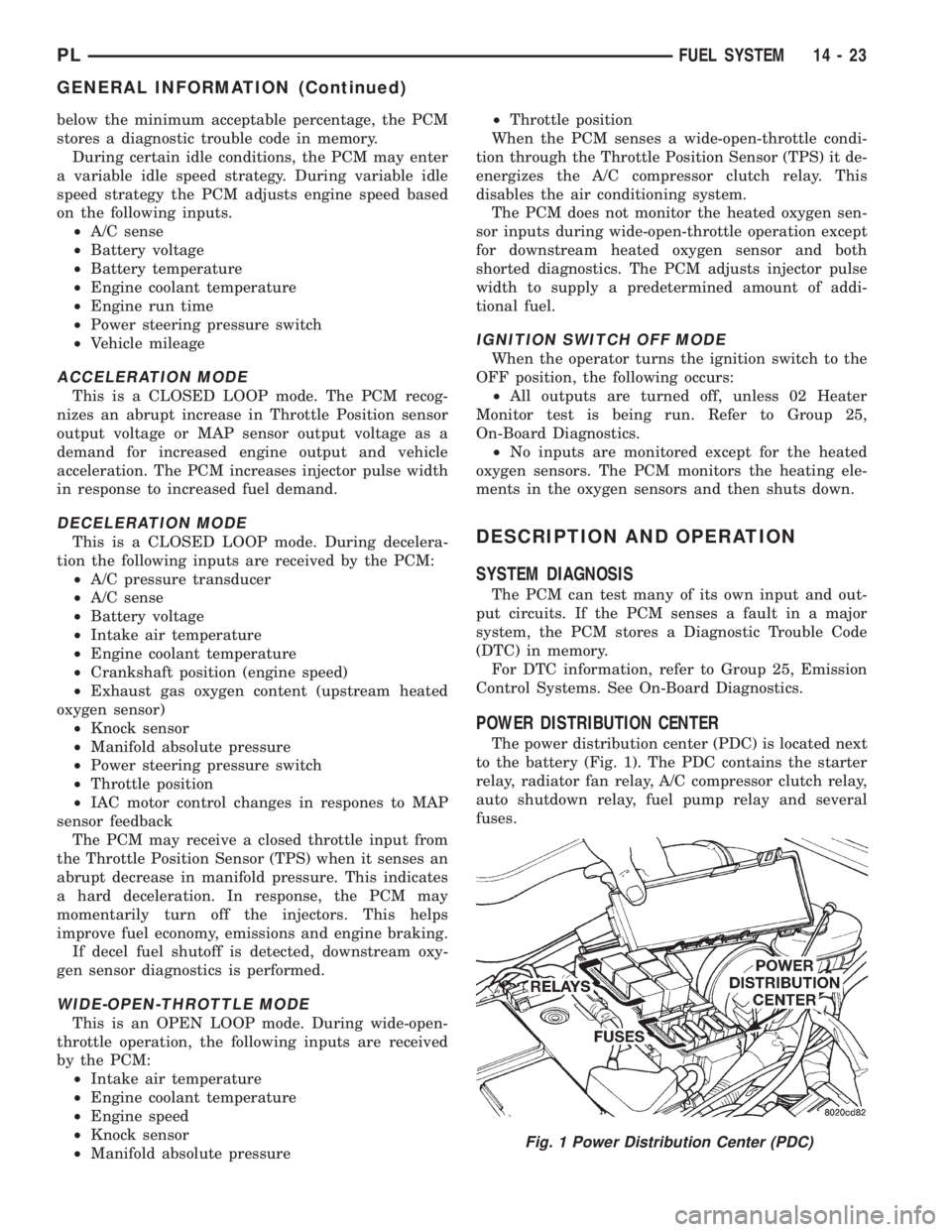
POWER DISTRIBUTION CENTER
The power distribution center (PDC) is located next
to the battery (Fig. 1). The PDC contains the starter
relay, radiator fan relay, A/C compressor clutch relay,
auto shutdown relay, fuel pump relay and several
fuses.
Fig. 1 Power Distribution Center (PDC)
PLFUEL SYSTEM 14 - 23
GENERAL INFORMATION (Continued)
Page 865 of 1200
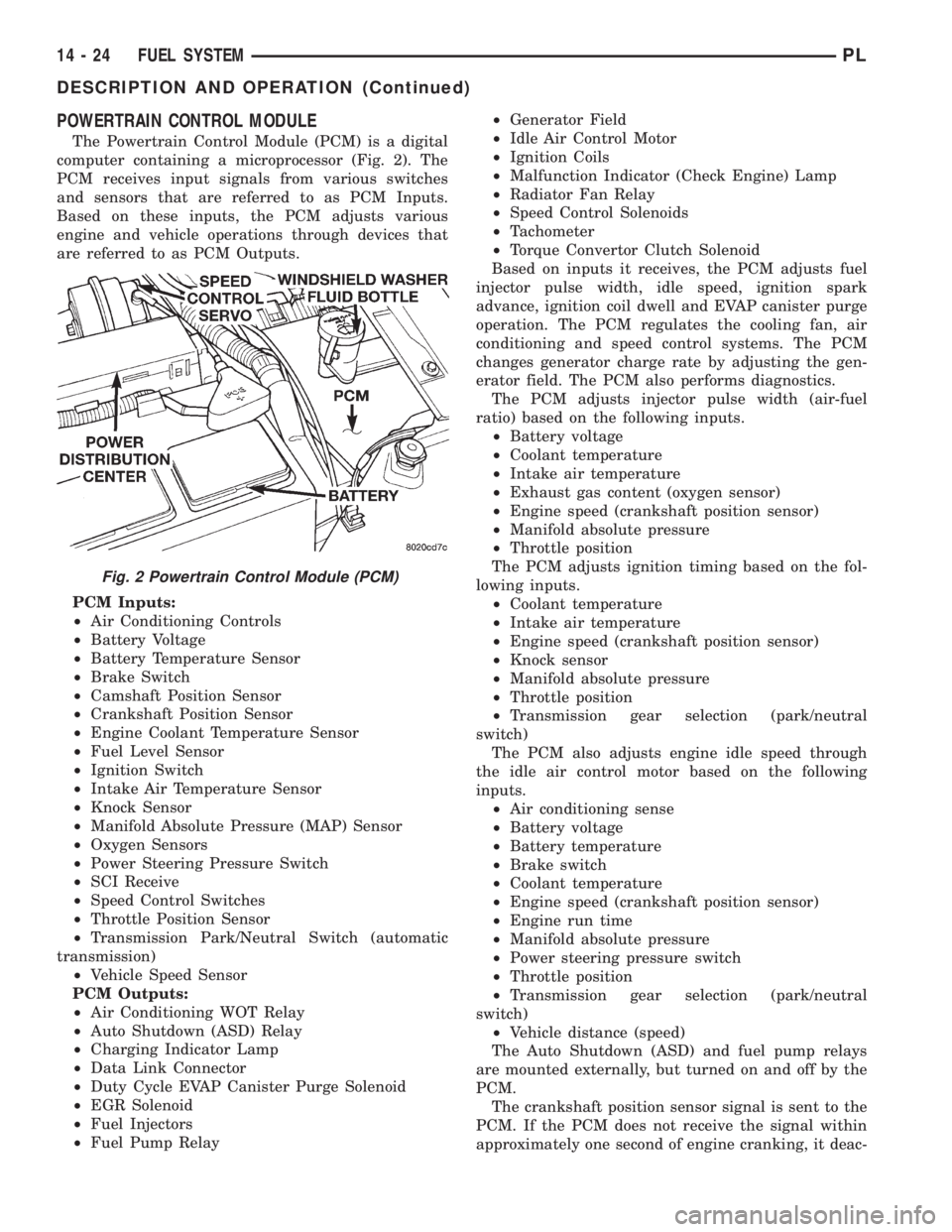
POWERTRAIN CONTROL MODULE
The Powertrain Control Module (PCM) is a digital
computer containing a microprocessor (Fig. 2). The
PCM receives input signals from various switches
and sensors that are referred to as PCM Inputs.
Based on these inputs, the PCM adjusts various
engine and vehicle operations through devices that
are referred to as PCM Outputs.
PCM Inputs:
²Air Conditioning Controls
²Battery Voltage
²Battery Temperature Sensor
²Brake Switch
²Camshaft Position Sensor
²Crankshaft Position Sensor
²Engine Coolant Temperature Sensor
²Fuel Level Sensor
²Ignition Switch
²Intake Air Temperature Sensor
²Knock Sensor
²Manifold Absolute Pressure (MAP) Sensor
²Oxygen Sensors
²Power Steering Pressure Switch
²SCI Receive
²Speed Control Switches
²Throttle Position Sensor
²Transmission Park/Neutral Switch (automatic
transmission)
²Vehicle Speed Sensor
PCM Outputs:
²Air Conditioning WOT Relay
²Auto Shutdown (ASD) Relay
²Charging Indicator Lamp
²Data Link Connector
²Duty Cycle EVAP Canister Purge Solenoid
²EGR Solenoid
²Fuel Injectors
²Fuel Pump Relay²Generator Field
²Idle Air Control Motor
²Ignition Coils
²Malfunction Indicator (Check Engine) Lamp
²Radiator Fan Relay
²Speed Control Solenoids
²Tachometer
²Torque Convertor Clutch Solenoid
Based on inputs it receives, the PCM adjusts fuel
injector pulse width, idle speed, ignition spark
advance, ignition coil dwell and EVAP canister purge
operation. The PCM regulates the cooling fan, air
conditioning and speed control systems. The PCM
changes generator charge rate by adjusting the gen-
erator field. The PCM also performs diagnostics.
The PCM adjusts injector pulse width (air-fuel
ratio) based on the following inputs.
²Battery voltage
²Coolant temperature
²Intake air temperature
²Exhaust gas content (oxygen sensor)
²Engine speed (crankshaft position sensor)
²Manifold absolute pressure
²Throttle position
The PCM adjusts ignition timing based on the fol-
lowing inputs.
²Coolant temperature
²Intake air temperature
²Engine speed (crankshaft position sensor)
²Knock sensor
²Manifold absolute pressure
²Throttle position
²Transmission gear selection (park/neutral
switch)
The PCM also adjusts engine idle speed through
the idle air control motor based on the following
inputs.
²Air conditioning sense
²Battery voltage
²Battery temperature
²Brake switch
²Coolant temperature
²Engine speed (crankshaft position sensor)
²Engine run time
²Manifold absolute pressure
²Power steering pressure switch
²Throttle position
²Transmission gear selection (park/neutral
switch)
²Vehicle distance (speed)
The Auto Shutdown (ASD) and fuel pump relays
are mounted externally, but turned on and off by the
PCM.
The crankshaft position sensor signal is sent to the
PCM. If the PCM does not receive the signal within
approximately one second of engine cranking, it deac-
Fig. 2 Powertrain Control Module (PCM)
14 - 24 FUEL SYSTEMPL
DESCRIPTION AND OPERATION (Continued)
Page 871 of 1200
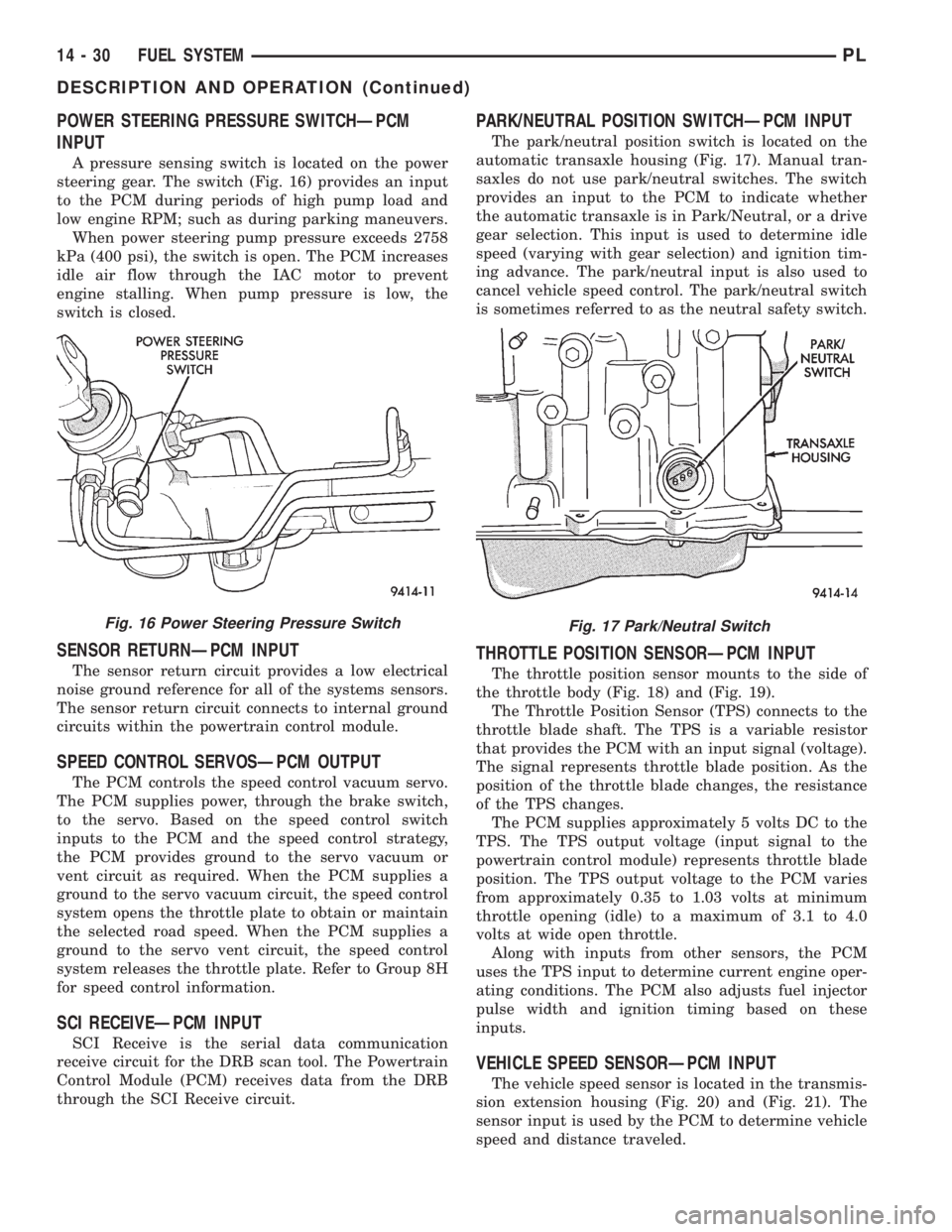
POWER STEERING PRESSURE SWITCHÐPCM
INPUT
A pressure sensing switch is located on the power
steering gear. The switch (Fig. 16) provides an input
to the PCM during periods of high pump load and
low engine RPM; such as during parking maneuvers.
When power steering pump pressure exceeds 2758
kPa (400 psi), the switch is open. The PCM increases
idle air flow through the IAC motor to prevent
engine stalling. When pump pressure is low, the
switch is closed.
SENSOR RETURNÐPCM INPUT
The sensor return circuit provides a low electrical
noise ground reference for all of the systems sensors.
The sensor return circuit connects to internal ground
circuits within the powertrain control module.
SPEED CONTROL SERVOSÐPCM OUTPUT
The PCM controls the speed control vacuum servo.
The PCM supplies power, through the brake switch,
to the servo. Based on the speed control switch
inputs to the PCM and the speed control strategy,
the PCM provides ground to the servo vacuum or
vent circuit as required. When the PCM supplies a
ground to the servo vacuum circuit, the speed control
system opens the throttle plate to obtain or maintain
the selected road speed. When the PCM supplies a
ground to the servo vent circuit, the speed control
system releases the throttle plate. Refer to Group 8H
for speed control information.
SCI RECEIVEÐPCM INPUT
SCI Receive is the serial data communication
receive circuit for the DRB scan tool. The Powertrain
Control Module (PCM) receives data from the DRB
through the SCI Receive circuit.
PARK/NEUTRAL POSITION SWITCHÐPCM INPUT
The park/neutral position switch is located on the
automatic transaxle housing (Fig. 17). Manual tran-
saxles do not use park/neutral switches. The switch
provides an input to the PCM to indicate whether
the automatic transaxle is in Park/Neutral, or a drive
gear selection. This input is used to determine idle
speed (varying with gear selection) and ignition tim-
ing advance. The park/neutral input is also used to
cancel vehicle speed control. The park/neutral switch
is sometimes referred to as the neutral safety switch.
THROTTLE POSITION SENSORÐPCM INPUT
The throttle position sensor mounts to the side of
the throttle body (Fig. 18) and (Fig. 19).
The Throttle Position Sensor (TPS) connects to the
throttle blade shaft. The TPS is a variable resistor
that provides the PCM with an input signal (voltage).
The signal represents throttle blade position. As the
position of the throttle blade changes, the resistance
of the TPS changes.
The PCM supplies approximately 5 volts DC to the
TPS. The TPS output voltage (input signal to the
powertrain control module) represents throttle blade
position. The TPS output voltage to the PCM varies
from approximately 0.35 to 1.03 volts at minimum
throttle opening (idle) to a maximum of 3.1 to 4.0
volts at wide open throttle.
Along with inputs from other sensors, the PCM
uses the TPS input to determine current engine oper-
ating conditions. The PCM also adjusts fuel injector
pulse width and ignition timing based on these
inputs.
VEHICLE SPEED SENSORÐPCM INPUT
The vehicle speed sensor is located in the transmis-
sion extension housing (Fig. 20) and (Fig. 21). The
sensor input is used by the PCM to determine vehicle
speed and distance traveled.
Fig. 16 Power Steering Pressure SwitchFig. 17 Park/Neutral Switch
14 - 30 FUEL SYSTEMPL
DESCRIPTION AND OPERATION (Continued)
Page 874 of 1200
operates the solenoid based on inputs from the multi-
port fuel injection system. The transducer and EGR
valve are serviced as an assembly.
When the PCM energizes the solenoid, vacuum
does not reach the transducer. Vacuum flows to the
transducer when the PCM de-energizes the solenoid.
When exhaust system back-pressure becomes high
enough, it fully closes a bleed valve in the vacuum
transducer. When the PCM de-energizes the solenoid
and back-pressure closes the transducer bleed valve,
vacuum flows through the transducer to operate the
EGR valve.
De-energizing the solenoid, but not fully closing the
transducer bleed hole (because of low back-pressure),
varies the strength of the vacuum signal applied to
the EGR valve. Varying the strength of the vacuum
signal changes the amount of EGR supplied to the
engine. This provides the correct amount of exhaust
gas recirculation for different operating conditions.
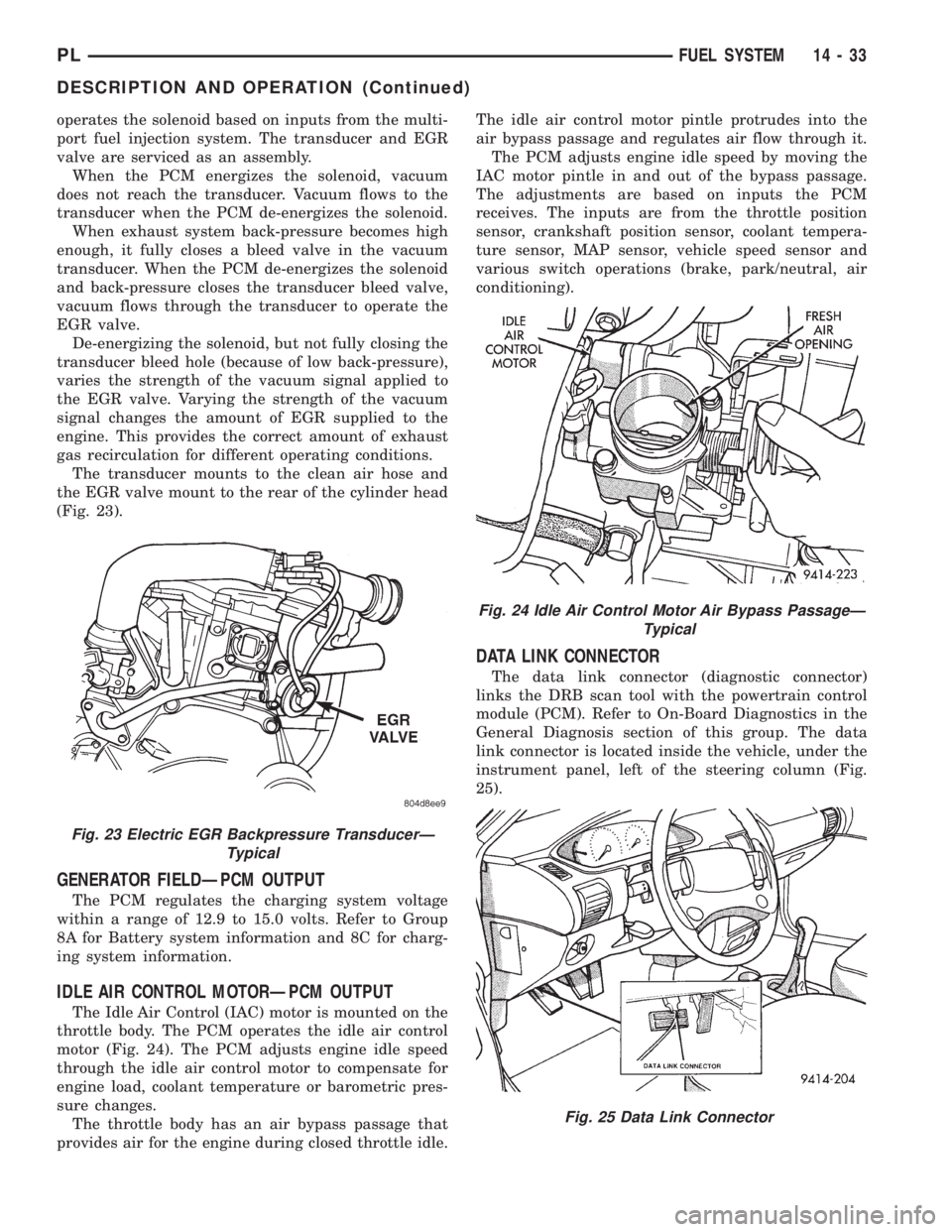
The transducer mounts to the clean air hose and
the EGR valve mount to the rear of the cylinder head
(Fig. 23).
GENERATOR FIELDÐPCM OUTPUT
The PCM regulates the charging system voltage
within a range of 12.9 to 15.0 volts. Refer to Group
8A for Battery system information and 8C for charg-
ing system information.
IDLE AIR CONTROL MOTORÐPCM OUTPUT
The Idle Air Control (IAC) motor is mounted on the
throttle body. The PCM operates the idle air control
motor (Fig. 24). The PCM adjusts engine idle speed
through the idle air control motor to compensate for
engine load, coolant temperature or barometric pres-
sure changes.
The throttle body has an air bypass passage that
provides air for the engine during closed throttle idle.The idle air control motor pintle protrudes into the
air bypass passage and regulates air flow through it.
The PCM adjusts engine idle speed by moving the
IAC motor pintle in and out of the bypass passage.
The adjustments are based on inputs the PCM
receives. The inputs are from the throttle position
sensor, crankshaft position sensor, coolant tempera-
ture sensor, MAP sensor, vehicle speed sensor and
various switch operations (brake, park/neutral, air
conditioning).
DATA LINK CONNECTOR
The data link connector (diagnostic connector)
links the DRB scan tool with the powertrain control
module (PCM). Refer to On-Board Diagnostics in the
General Diagnosis section of this group. The data
link connector is located inside the vehicle, under the
instrument panel, left of the steering column (Fig.
25).
Fig. 23 Electric EGR Backpressure TransducerÐ
Typical
Fig. 24 Idle Air Control Motor Air Bypass PassageÐ
Typical
Fig. 25 Data Link Connector
PLFUEL SYSTEM 14 - 33
DESCRIPTION AND OPERATION (Continued)