lock DODGE NEON 1999 Service Repair Manual
[x] Cancel search | Manufacturer: DODGE, Model Year: 1999, Model line: NEON, Model: DODGE NEON 1999Pages: 1200, PDF Size: 35.29 MB
Page 1031 of 1200
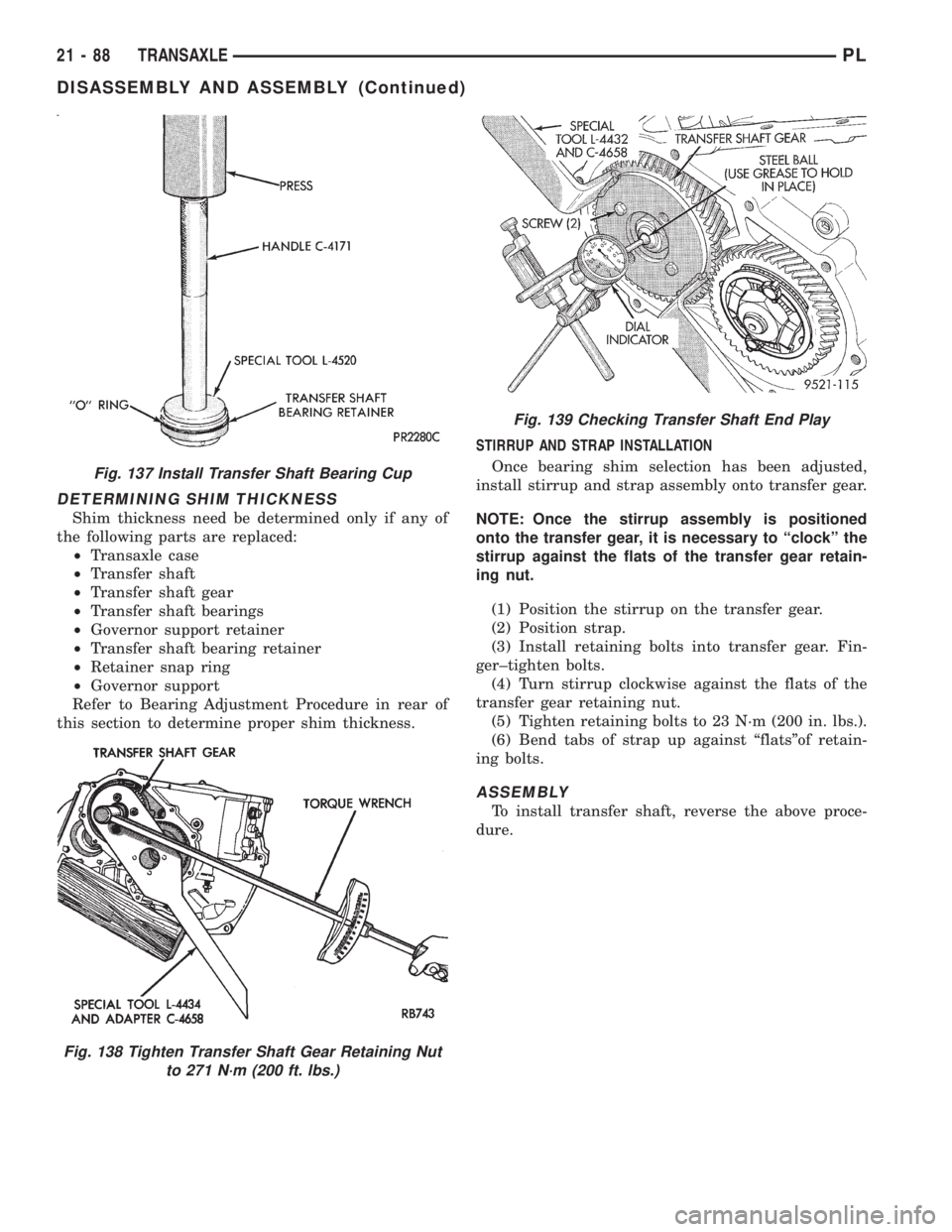
DETERMINING SHIM THICKNESS
Shim thickness need be determined only if any of
the following parts are replaced:
²Transaxle case
²Transfer shaft
²Transfer shaft gear
²Transfer shaft bearings
²Governor support retainer
²Transfer shaft bearing retainer
²Retainer snap ring
²Governor support
Refer to Bearing Adjustment Procedure in rear of
this section to determine proper shim thickness.STIRRUP AND STRAP INSTALLATION
Once bearing shim selection has been adjusted,
install stirrup and strap assembly onto transfer gear.
NOTE: Once the stirrup assembly is positioned
onto the transfer gear, it is necessary to ªclockº the
stirrup against the flats of the transfer gear retain-
ing nut.
(1) Position the stirrup on the transfer gear.
(2) Position strap.
(3) Install retaining bolts into transfer gear. Fin-
ger±tighten bolts.
(4) Turn stirrup clockwise against the flats of the
transfer gear retaining nut.
(5) Tighten retaining bolts to 23 N´m (200 in. lbs.).
(6) Bend tabs of strap up against ªflatsºof retain-
ing bolts.
ASSEMBLY
To install transfer shaft, reverse the above proce-
dure.
Fig. 137 Install Transfer Shaft Bearing Cup
Fig. 138 Tighten Transfer Shaft Gear Retaining Nut
to 271 N´m (200 ft. lbs.)
Fig. 139 Checking Transfer Shaft End Play
21 - 88 TRANSAXLEPL
DISASSEMBLY AND ASSEMBLY (Continued)
Page 1037 of 1200
STIRRUP AND RETAINING STRAP
INSTALLATION
Once bearing turning torque and shim selection
has been adjusted, install stirrup and strap assembly
onto output gear.
NOTE: Once the stirrup assembly is positioned
onto the output gear, it is necessary to ªclockº the
stirrup against the flats of the output gear retaining
nut.
(1) Position the stirrup on the output gear.
(2) Position strap.
(3) Install retaining bolts into output gear. Finger-
±tighten bolts.
(4) Turn stirrup clockwise against the flats of the
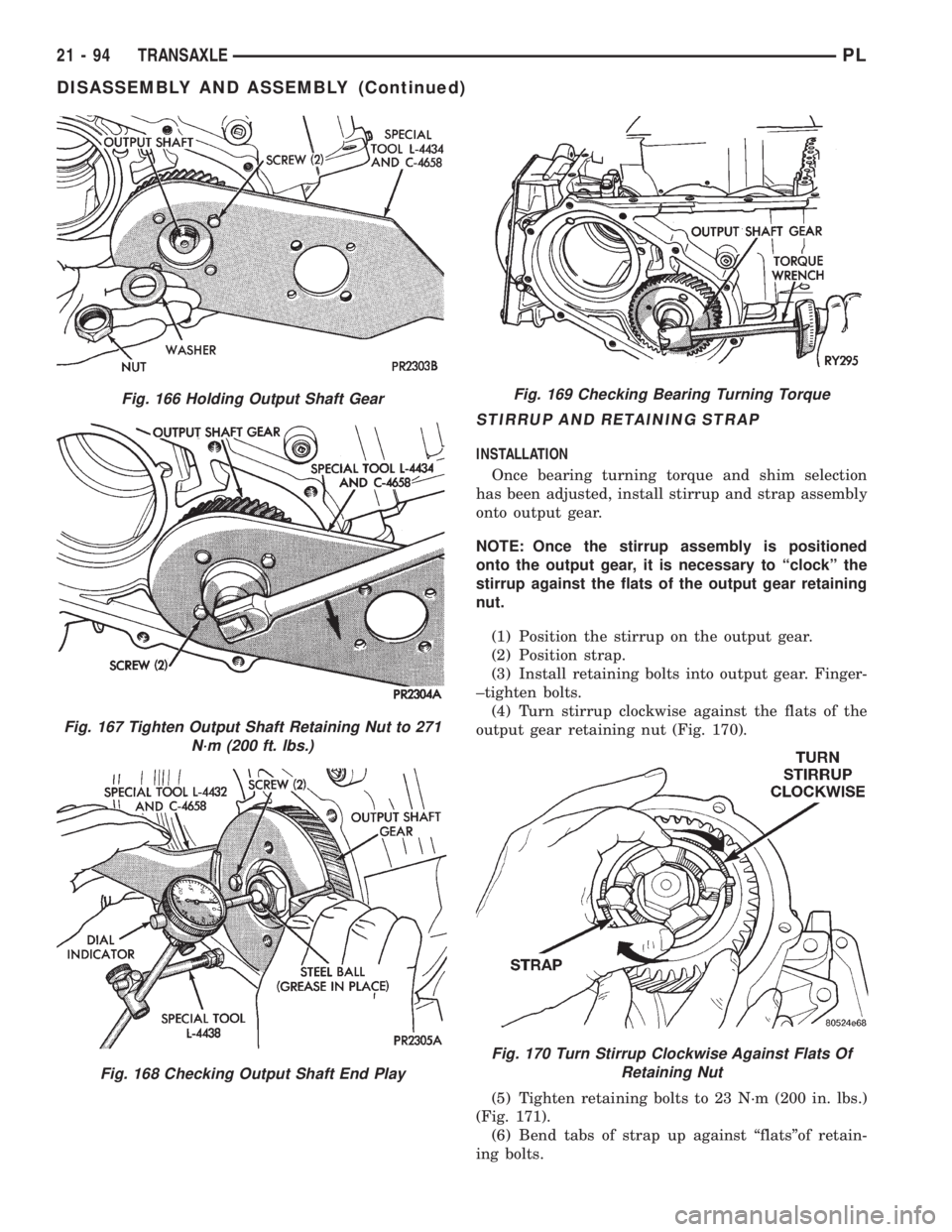
output gear retaining nut (Fig. 170).
(5) Tighten retaining bolts to 23 N´m (200 in. lbs.)
(Fig. 171).
(6) Bend tabs of strap up against ªflatsºof retain-
ing bolts.
Fig. 166 Holding Output Shaft Gear
Fig. 167 Tighten Output Shaft Retaining Nut to 271
N´m (200 ft. lbs.)
Fig. 168 Checking Output Shaft End Play
Fig. 169 Checking Bearing Turning Torque
Fig. 170 Turn Stirrup Clockwise Against Flats Of
Retaining Nut
21 - 94 TRANSAXLEPL
DISASSEMBLY AND ASSEMBLY (Continued)
Page 1043 of 1200
ADJUSTMENT
(1) Set parking brake.
(2) Remove floor console. Refer to Group 23, Body.
(3) Place gearshift lever in the (PARK) (P) posi-
tion.
(4) Push down on the tab and unsnap the collar at
the shifter cable to allow the cable to be adjusted
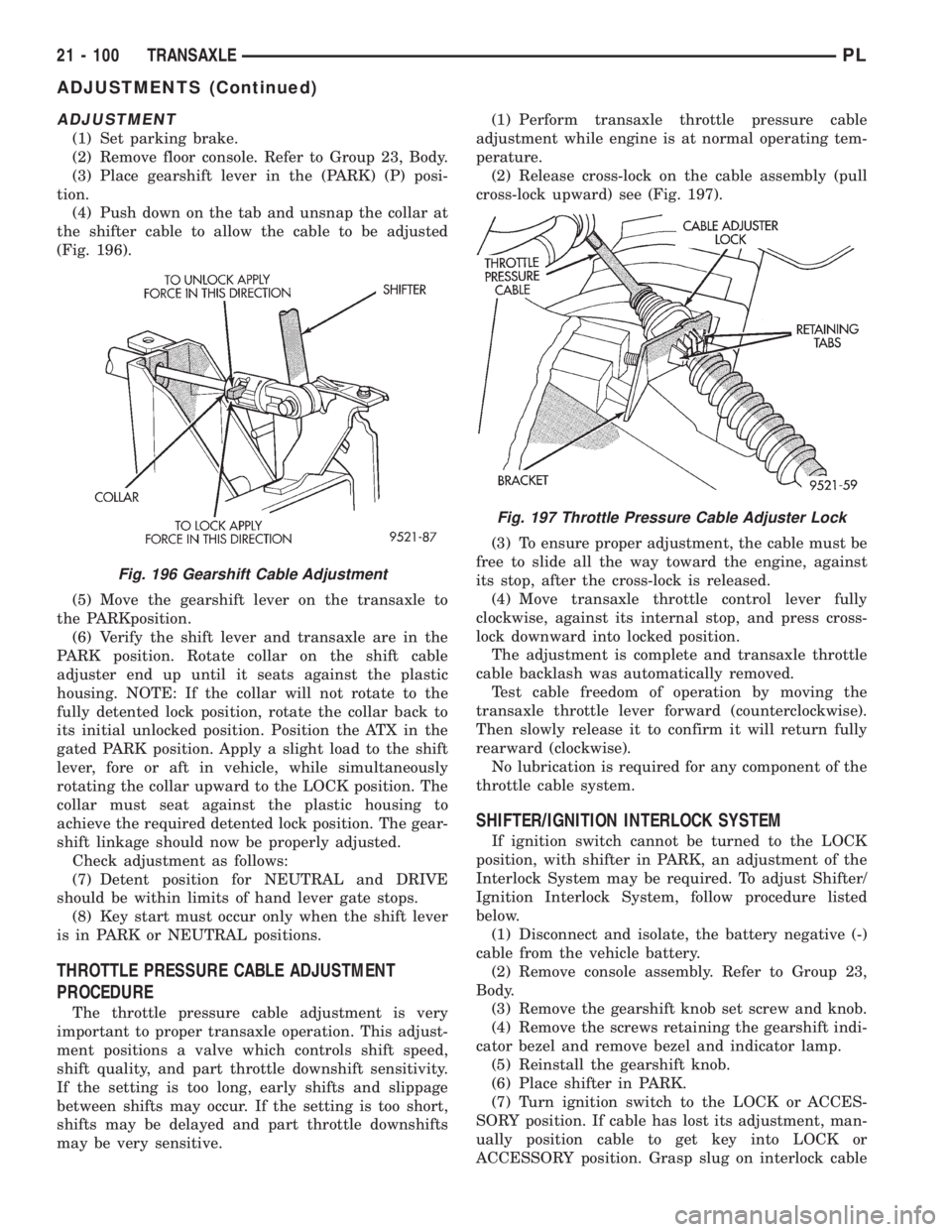
(Fig. 196).
(5) Move the gearshift lever on the transaxle to
the PARKposition.
(6) Verify the shift lever and transaxle are in the
PARK position. Rotate collar on the shift cable
adjuster end up until it seats against the plastic
housing. NOTE: If the collar will not rotate to the
fully detented lock position, rotate the collar back to
its initial unlocked position. Position the ATX in the
gated PARK position. Apply a slight load to the shift
lever, fore or aft in vehicle, while simultaneously
rotating the collar upward to the LOCK position. The
collar must seat against the plastic housing to
achieve the required detented lock position. The gear-
shift linkage should now be properly adjusted.
Check adjustment as follows:
(7) Detent position for NEUTRAL and DRIVE
should be within limits of hand lever gate stops.
(8) Key start must occur only when the shift lever
is in PARK or NEUTRAL positions.
THROTTLE PRESSURE CABLE ADJUSTMENT
PROCEDURE
The throttle pressure cable adjustment is very
important to proper transaxle operation. This adjust-
ment positions a valve which controls shift speed,
shift quality, and part throttle downshift sensitivity.
If the setting is too long, early shifts and slippage
between shifts may occur. If the setting is too short,
shifts may be delayed and part throttle downshifts
may be very sensitive.(1) Perform transaxle throttle pressure cable
adjustment while engine is at normal operating tem-
perature.
(2) Release cross-lock on the cable assembly (pull
cross-lock upward) see (Fig. 197).
(3) To ensure proper adjustment, the cable must be
free to slide all the way toward the engine, against
its stop, after the cross-lock is released.
(4) Move transaxle throttle control lever fully
clockwise, against its internal stop, and press cross-
lock downward into locked position.
The adjustment is complete and transaxle throttle
cable backlash was automatically removed.
Test cable freedom of operation by moving the
transaxle throttle lever forward (counterclockwise).
Then slowly release it to confirm it will return fully
rearward (clockwise).
No lubrication is required for any component of the
throttle cable system.
SHIFTER/IGNITION INTERLOCK SYSTEM
If ignition switch cannot be turned to the LOCK
position, with shifter in PARK, an adjustment of the
Interlock System may be required. To adjust Shifter/
Ignition Interlock System, follow procedure listed
below.
(1) Disconnect and isolate, the battery negative (-)
cable from the vehicle battery.
(2) Remove console assembly. Refer to Group 23,
Body.
(3) Remove the gearshift knob set screw and knob.
(4) Remove the screws retaining the gearshift indi-
cator bezel and remove bezel and indicator lamp.
(5) Reinstall the gearshift knob.
(6) Place shifter in PARK.
(7) Turn ignition switch to the LOCK or ACCES-
SORY position. If cable has lost its adjustment, man-
ually position cable to get key into LOCK or
ACCESSORY position. Grasp slug on interlock cable
Fig. 196 Gearshift Cable Adjustment
Fig. 197 Throttle Pressure Cable Adjuster Lock
21 - 100 TRANSAXLEPL
ADJUSTMENTS (Continued)
Page 1044 of 1200
with needle±nose pliers and pull back on cable. This
will allow the ignition switch to be turned to the
LOCK or ACCESSORY position.
(8) Check that the interlock cable slug is com-
pletely seated into the shifter interlock lever.
(9) Check that the ignition switch is still in the
LOCK or ACCESSORY position.
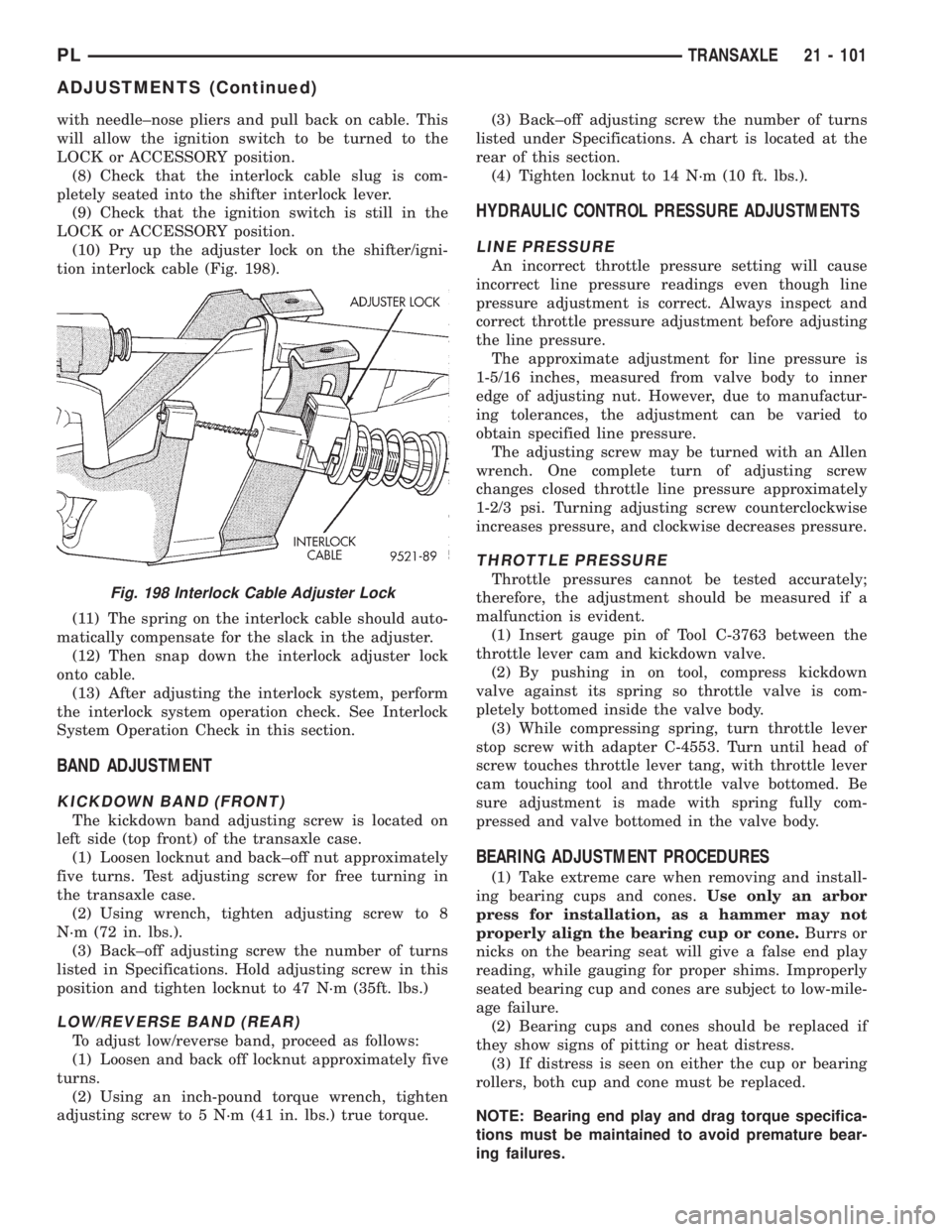
(10) Pry up the adjuster lock on the shifter/igni-
tion interlock cable (Fig. 198).
(11) The spring on the interlock cable should auto-
matically compensate for the slack in the adjuster.
(12) Then snap down the interlock adjuster lock
onto cable.
(13) After adjusting the interlock system, perform
the interlock system operation check. See Interlock
System Operation Check in this section.
BAND ADJUSTMENT
KICKDOWN BAND (FRONT)
The kickdown band adjusting screw is located on
left side (top front) of the transaxle case.
(1) Loosen locknut and back±off nut approximately
five turns. Test adjusting screw for free turning in
the transaxle case.
(2) Using wrench, tighten adjusting screw to 8
N´m (72 in. lbs.).
(3) Back±off adjusting screw the number of turns
listed in Specifications. Hold adjusting screw in this
position and tighten locknut to 47 N´m (35ft. lbs.)
LOW/REVERSE BAND (REAR)
To adjust low/reverse band, proceed as follows:
(1) Loosen and back off locknut approximately five
turns.
(2) Using an inch-pound torque wrench, tighten
adjusting screw to 5 N´m (41 in. lbs.) true torque.(3) Back±off adjusting screw the number of turns
listed under Specifications. A chart is located at the
rear of this section.
(4) Tighten locknut to 14 N´m (10 ft. lbs.).
HYDRAULIC CONTROL PRESSURE ADJUSTMENTS
LINE PRESSURE
An incorrect throttle pressure setting will cause
incorrect line pressure readings even though line
pressure adjustment is correct. Always inspect and
correct throttle pressure adjustment before adjusting
the line pressure.
The approximate adjustment for line pressure is
1-5/16 inches, measured from valve body to inner
edge of adjusting nut. However, due to manufactur-
ing tolerances, the adjustment can be varied to
obtain specified line pressure.
The adjusting screw may be turned with an Allen
wrench. One complete turn of adjusting screw
changes closed throttle line pressure approximately
1-2/3 psi. Turning adjusting screw counterclockwise
increases pressure, and clockwise decreases pressure.
THROTTLE PRESSURE
Throttle pressures cannot be tested accurately;
therefore, the adjustment should be measured if a
malfunction is evident.
(1) Insert gauge pin of Tool C-3763 between the
throttle lever cam and kickdown valve.
(2) By pushing in on tool, compress kickdown
valve against its spring so throttle valve is com-
pletely bottomed inside the valve body.
(3) While compressing spring, turn throttle lever
stop screw with adapter C-4553. Turn until head of
screw touches throttle lever tang, with throttle lever
cam touching tool and throttle valve bottomed. Be
sure adjustment is made with spring fully com-
pressed and valve bottomed in the valve body.
BEARING ADJUSTMENT PROCEDURES
(1) Take extreme care when removing and install-
ing bearing cups and cones.Use only an arbor
press for installation, as a hammer may not
properly align the bearing cup or cone.Burrs or
nicks on the bearing seat will give a false end play
reading, while gauging for proper shims. Improperly
seated bearing cup and cones are subject to low-mile-
age failure.
(2) Bearing cups and cones should be replaced if
they show signs of pitting or heat distress.
(3) If distress is seen on either the cup or bearing
rollers, both cup and cone must be replaced.
NOTE: Bearing end play and drag torque specifica-
tions must be maintained to avoid premature bear-
ing failures.
Fig. 198 Interlock Cable Adjuster Lock
PLTRANSAXLE 21 - 101
ADJUSTMENTS (Continued)
Page 1056 of 1200
SPECIFICATIONS
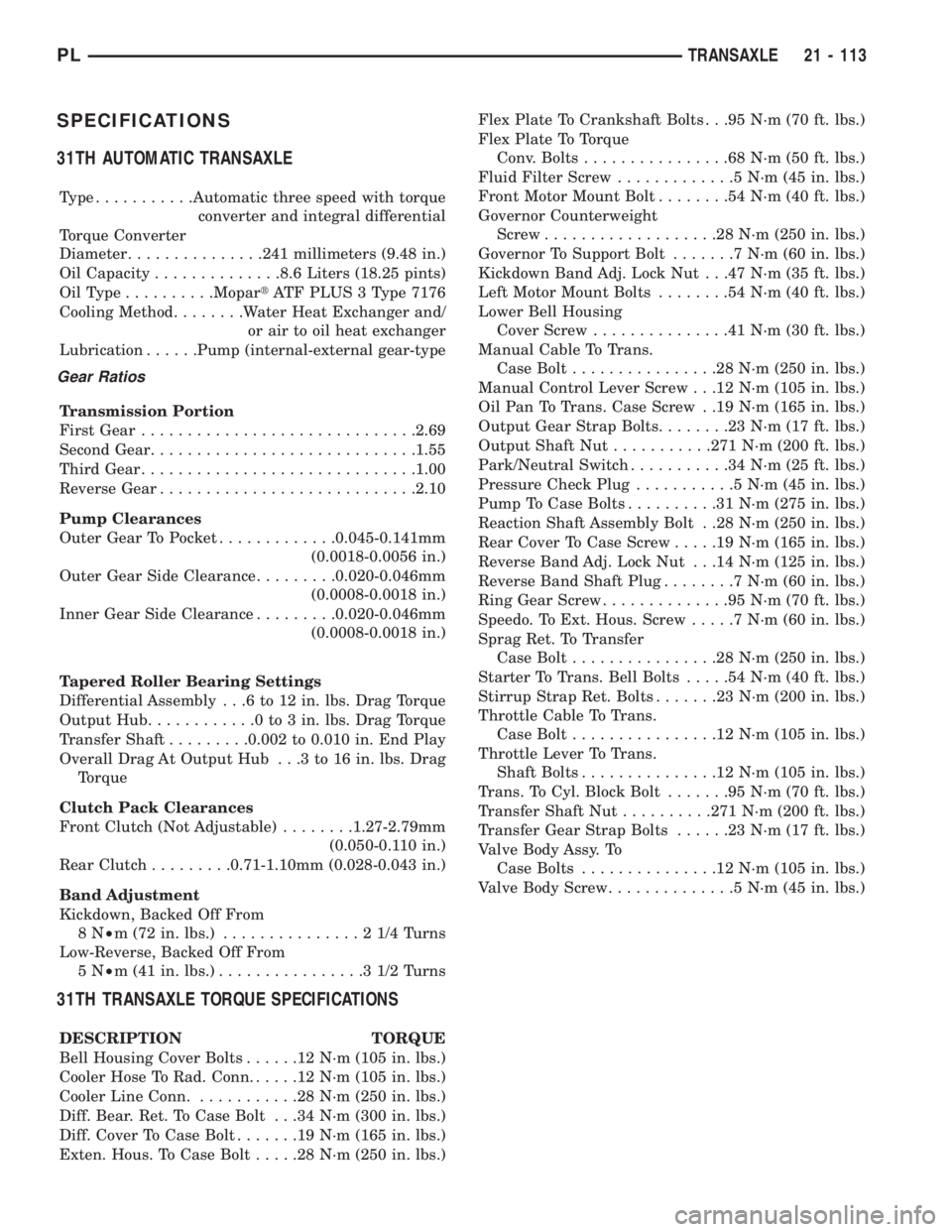
31TH AUTOMATIC TRANSAXLE
Type...........Automatic three speed with torque
converter and integral differential
Torque Converter
Diameter...............241 millimeters (9.48 in.)
Oil Capacity..............8.6 Liters (18.25 pints)
OilType..........MopartATF PLUS 3 Type 7176
Cooling Method........Water Heat Exchanger and/
or air to oil heat exchanger
Lubrication......Pump (internal-external gear-type
Gear Ratios
Transmission Portion
First Gear..............................2.69
Second Gear.............................1.55
Third Gear..............................1.00
Reverse Gear............................2.10
Pump Clearances
Outer Gear To Pocket.............0.045-0.141mm
(0.0018-0.0056 in.)
Outer Gear Side Clearance.........0.020-0.046mm
(0.0008-0.0018 in.)
Inner Gear Side Clearance.........0.020-0.046mm
(0.0008-0.0018 in.)
Tapered Roller Bearing Settings
Differential Assembly . . .6 to 12 in. lbs. Drag Torque
Output Hub............0to3in.lbs. Drag Torque
Transfer Shaft.........0.002 to 0.010 in. End Play
Overall Drag At Output Hub . . .3 to 16 in. lbs. Drag
Torque
Clutch Pack Clearances
Front Clutch (Not Adjustable)........1.27-2.79mm
(0.050-0.110 in.)
Rear Clutch.........0.71-1.10mm (0.028-0.043 in.)
Band Adjustment
Kickdown, Backed Off From
8N²m (72 in. lbs.)...............21/4Turns
Low-Reverse, Backed Off From
5N²m (41 in. lbs.)................31/2Turns
31TH TRANSAXLE TORQUE SPECIFICATIONS
DESCRIPTION TORQUE
Bell Housing Cover Bolts......12N´m(105 in. lbs.)
Cooler Hose To Rad. Conn......12N´m(105 in. lbs.)
Cooler Line Conn............28N´m(250 in. lbs.)
Diff. Bear. Ret. To Case Bolt . . .34 N´m (300 in. lbs.)
Diff. Cover To Case Bolt.......19N´m(165 in. lbs.)
Exten. Hous. To Case Bolt.....28N´m(250 in. lbs.)Flex Plate To Crankshaft Bolts . . .95 N´m (70 ft. lbs.)
Flex Plate To Torque
Conv. Bolts................68N´m(50ft.lbs.)
Fluid Filter Screw.............5N´m(45in.lbs.)
Front Motor Mount Bolt........54N´m(40ft.lbs.)
Governor Counterweight
Screw...................28N´m(250 in. lbs.)
Governor To Support Bolt.......7N´m(60in.lbs.)
Kickdown Band Adj. Lock Nut . . .47 N´m (35 ft. lbs.)
Left Motor Mount Bolts........54N´m(40ft.lbs.)
Lower Bell Housing
Cover Screw...............41N´m(30ft.lbs.)
Manual Cable To Trans.
Case Bolt................28N´m(250 in. lbs.)
Manual Control Lever Screw . . .12 N´m (105 in. lbs.)
Oil Pan To Trans. Case Screw . .19 N´m (165 in. lbs.)
Output Gear Strap Bolts........23N´m(17ft.lbs.)
Output Shaft Nut...........271 N´m (200 ft. lbs.)
Park/Neutral Switch...........34N´m(25ft.lbs.)
Pressure Check Plug...........5N´m(45in.lbs.)
Pump To Case Bolts..........31N´m(275 in. lbs.)
Reaction Shaft Assembly Bolt . .28 N´m (250 in. lbs.)
Rear Cover To Case Screw.....19N´m(165 in. lbs.)
Reverse Band Adj. Lock Nut . . .14 N´m (125 in. lbs.)
Reverse Band Shaft Plug........7N´m(60in.lbs.)
Ring Gear Screw..............95N´m(70ft.lbs.)
Speedo. To Ext. Hous. Screw.....7N´m(60in.lbs.)
Sprag Ret. To Transfer
Case Bolt................28N´m(250 in. lbs.)
Starter To Trans. Bell Bolts.....54N´m(40ft.lbs.)
Stirrup Strap Ret. Bolts.......23N´m(200 in. lbs.)
Throttle Cable To Trans.
Case Bolt................12N´m(105 in. lbs.)
Throttle Lever To Trans.
Shaft Bolts...............12N´m(105 in. lbs.)
Trans. To Cyl. Block Bolt.......95N´m(70ft.lbs.)
Transfer Shaft Nut..........271 N´m (200 ft. lbs.)
Transfer Gear Strap Bolts......23N´m(17ft.lbs.)
Valve Body Assy. To
Case Bolts...............12N´m(105 in. lbs.)
Valve Body Screw..............5N´m(45in.lbs.)
PLTRANSAXLE 21 - 113
Page 1057 of 1200
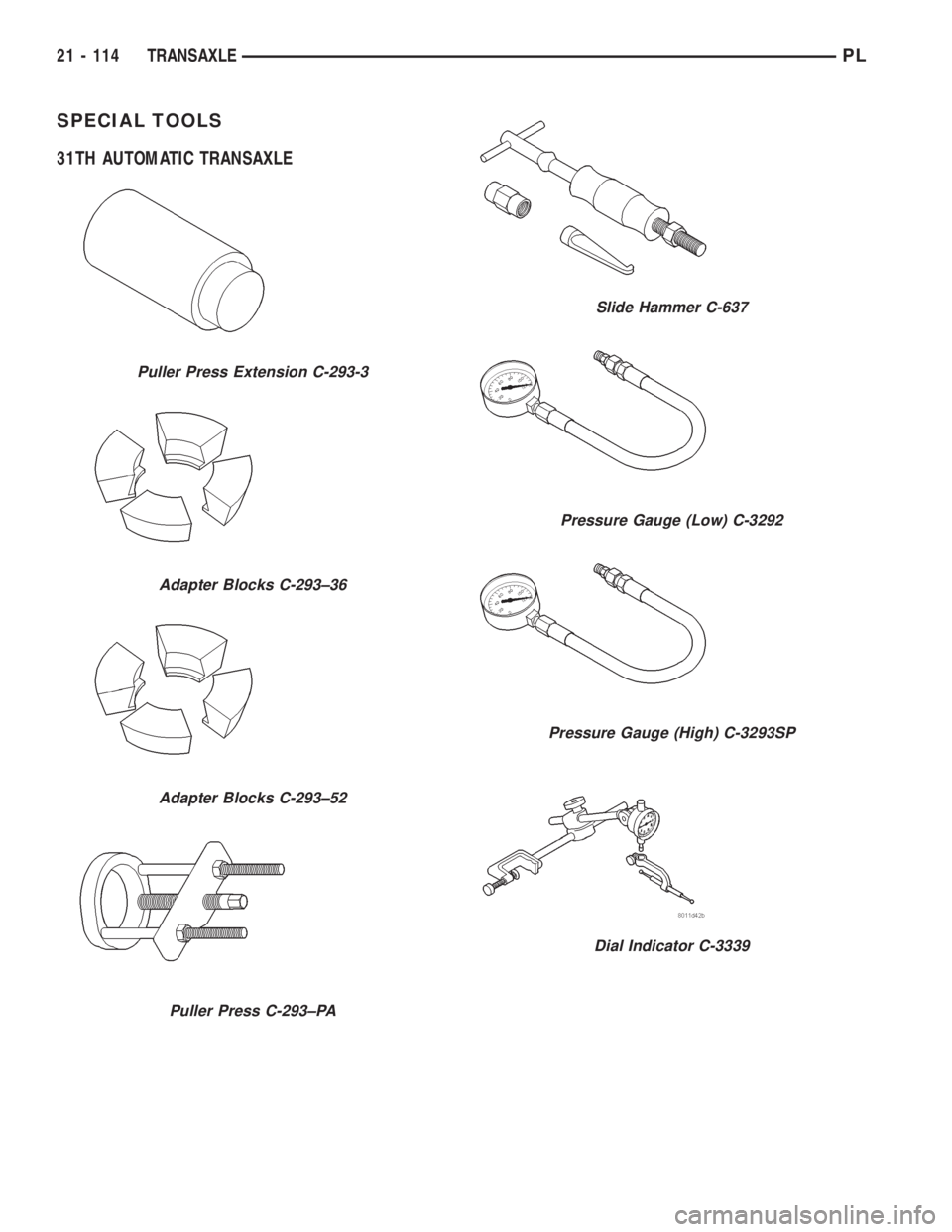
SPECIAL TOOLS
31TH AUTOMATIC TRANSAXLE
Puller Press Extension C-293-3
Adapter Blocks C-293±36
Adapter Blocks C-293±52
Puller Press C-293±PA
Slide Hammer C-637
Pressure Gauge (Low) C-3292
Pressure Gauge (High) C-3293SP
Dial Indicator C-3339
21 - 114 TRANSAXLEPL
Page 1064 of 1200
TRANSAXLE
CONTENTS
page page
DESCRIPTION AND OPERATION
BRAKE TRANSMISSION SHIFT INTERLOCK
(BTSI) SYSTEM........................ 1
DIAGNOSIS AND TESTING
BRAKE TRANSMISSION SHIFT INTERLOCK
(BTSI) SYSTEM........................ 1REMOVAL AND INSTALLATION
BRAKE TRANSMISSION SHIFT INTERLOCK
(BTSI) CABLE ASSEMBLY................ 2
ADJUSTMENTS
BRAKE TRANSMISSION SHIFT INTERLOCK
(BTSI) SYSTEM ADJUSTMENT............ 4
DESCRIPTION AND OPERATION
BRAKE TRANSMISSION SHIFT INTERLOCK
(BTSI) SYSTEM
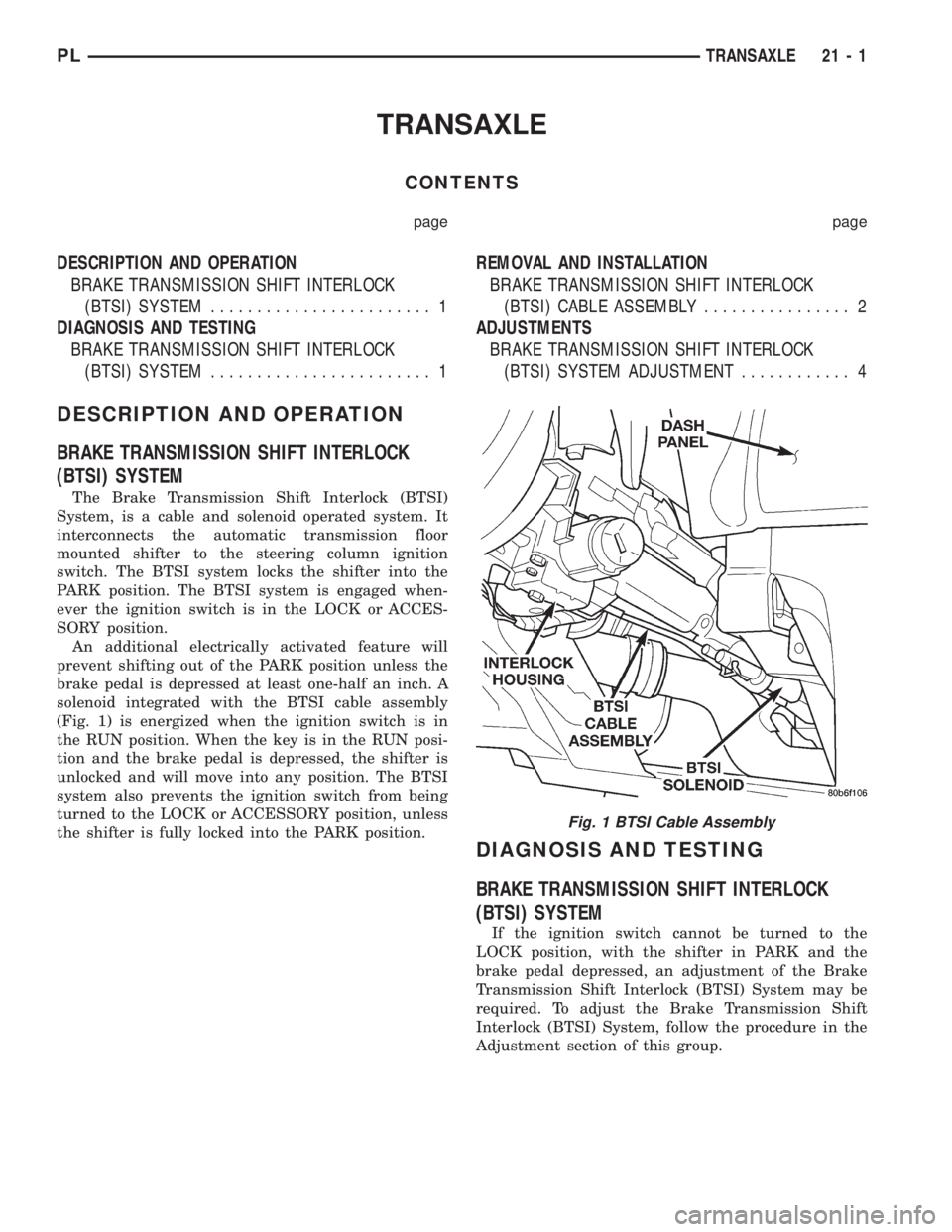
The Brake Transmission Shift Interlock (BTSI)
System, is a cable and solenoid operated system. It
interconnects the automatic transmission floor
mounted shifter to the steering column ignition
switch. The BTSI system locks the shifter into the
PARK position. The BTSI system is engaged when-
ever the ignition switch is in the LOCK or ACCES-
SORY position.
An additional electrically activated feature will
prevent shifting out of the PARK position unless the
brake pedal is depressed at least one-half an inch. A
solenoid integrated with the BTSI cable assembly
(Fig. 1) is energized when the ignition switch is in
the RUN position. When the key is in the RUN posi-
tion and the brake pedal is depressed, the shifter is
unlocked and will move into any position. The BTSI
system also prevents the ignition switch from being
turned to the LOCK or ACCESSORY position, unless
the shifter is fully locked into the PARK position.
DIAGNOSIS AND TESTING
BRAKE TRANSMISSION SHIFT INTERLOCK
(BTSI) SYSTEM
If the ignition switch cannot be turned to the
LOCK position, with the shifter in PARK and the
brake pedal depressed, an adjustment of the Brake
Transmission Shift Interlock (BTSI) System may be
required. To adjust the Brake Transmission Shift
Interlock (BTSI) System, follow the procedure in the
Adjustment section of this group.
Fig. 1 BTSI Cable Assembly
PLTRANSAXLE 21 - 1
Page 1065 of 1200
REMOVAL AND INSTALLATION
BRAKE TRANSMISSION SHIFT INTERLOCK
(BTSI) CABLE ASSEMBLY
REMOVAL
(1) Disconnect and isolate, the battery negative (-)
cable from the vehicle battery.
(2) Remove console assembly. Refer to Group 23,
Body.
(3) Remove the gearshift knob set screw and knob.
(4) Remove the screws retaining the gearshift indi-
cator bezel and remove bezel and indicator lamp.
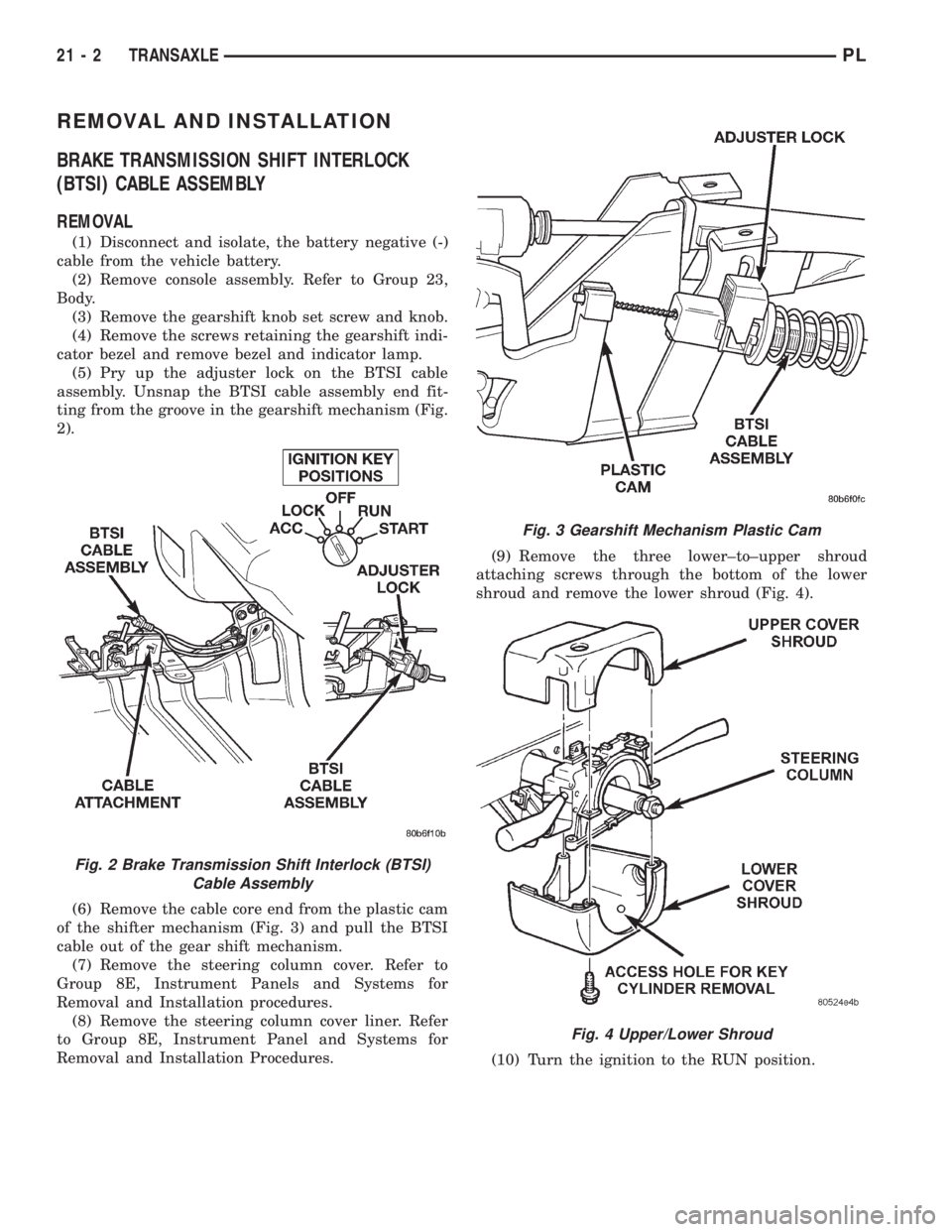
(5) Pry up the adjuster lock on the BTSI cable
assembly. Unsnap the BTSI cable assembly end fit-
ting from the groove in the gearshift mechanism (Fig.
2).
(6) Remove the cable core end from the plastic cam
of the shifter mechanism (Fig. 3) and pull the BTSI
cable out of the gear shift mechanism.
(7) Remove the steering column cover. Refer to
Group 8E, Instrument Panels and Systems for
Removal and Installation procedures.
(8) Remove the steering column cover liner. Refer
to Group 8E, Instrument Panel and Systems for
Removal and Installation Procedures.(9) Remove the three lower±to±upper shroud
attaching screws through the bottom of the lower
shroud and remove the lower shroud (Fig. 4).
(10) Turn the ignition to the RUN position.
Fig. 2 Brake Transmission Shift Interlock (BTSI)
Cable Assembly
Fig. 3 Gearshift Mechanism Plastic Cam
Fig. 4 Upper/Lower Shroud
21 - 2 TRANSAXLEPL
Page 1066 of 1200
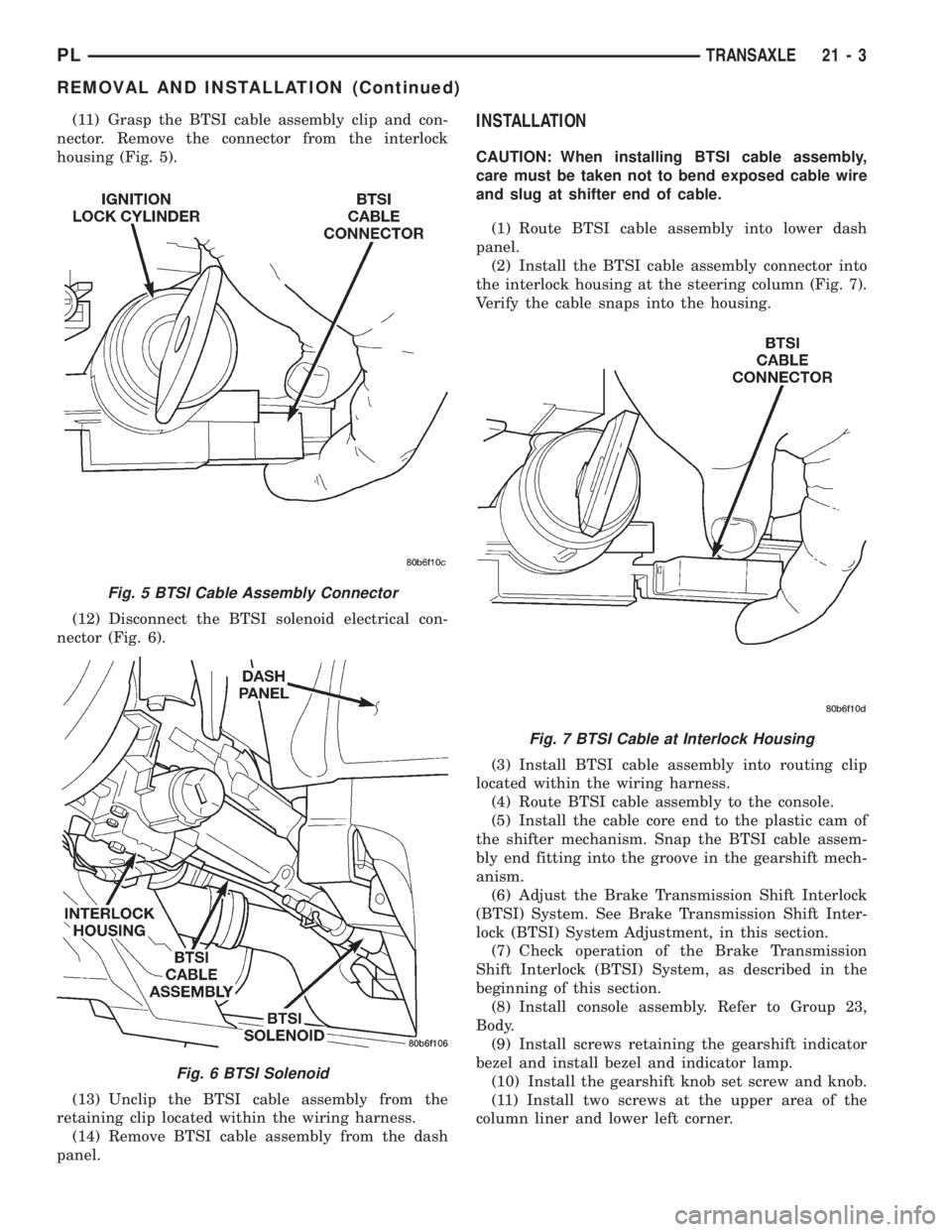
(11) Grasp the BTSI cable assembly clip and con-
nector. Remove the connector from the interlock
housing (Fig. 5).
(12) Disconnect the BTSI solenoid electrical con-
nector (Fig. 6).
(13) Unclip the BTSI cable assembly from the
retaining clip located within the wiring harness.
(14) Remove BTSI cable assembly from the dash
panel.INSTALLATION
CAUTION: When installing BTSI cable assembly,
care must be taken not to bend exposed cable wire
and slug at shifter end of cable.
(1) Route BTSI cable assembly into lower dash
panel.
(2) Install the BTSI cable assembly connector into
the interlock housing at the steering column (Fig. 7).
Verify the cable snaps into the housing.
(3) Install BTSI cable assembly into routing clip
located within the wiring harness.
(4) Route BTSI cable assembly to the console.
(5) Install the cable core end to the plastic cam of
the shifter mechanism. Snap the BTSI cable assem-
bly end fitting into the groove in the gearshift mech-
anism.
(6) Adjust the Brake Transmission Shift Interlock
(BTSI) System. See Brake Transmission Shift Inter-
lock (BTSI) System Adjustment, in this section.
(7) Check operation of the Brake Transmission
Shift Interlock (BTSI) System, as described in the
beginning of this section.
(8) Install console assembly. Refer to Group 23,
Body.
(9) Install screws retaining the gearshift indicator
bezel and install bezel and indicator lamp.
(10) Install the gearshift knob set screw and knob.
(11) Install two screws at the upper area of the
column liner and lower left corner.
Fig. 5 BTSI Cable Assembly Connector
Fig. 6 BTSI Solenoid
Fig. 7 BTSI Cable at Interlock Housing
PLTRANSAXLE 21 - 3
REMOVAL AND INSTALLATION (Continued)
Page 1067 of 1200
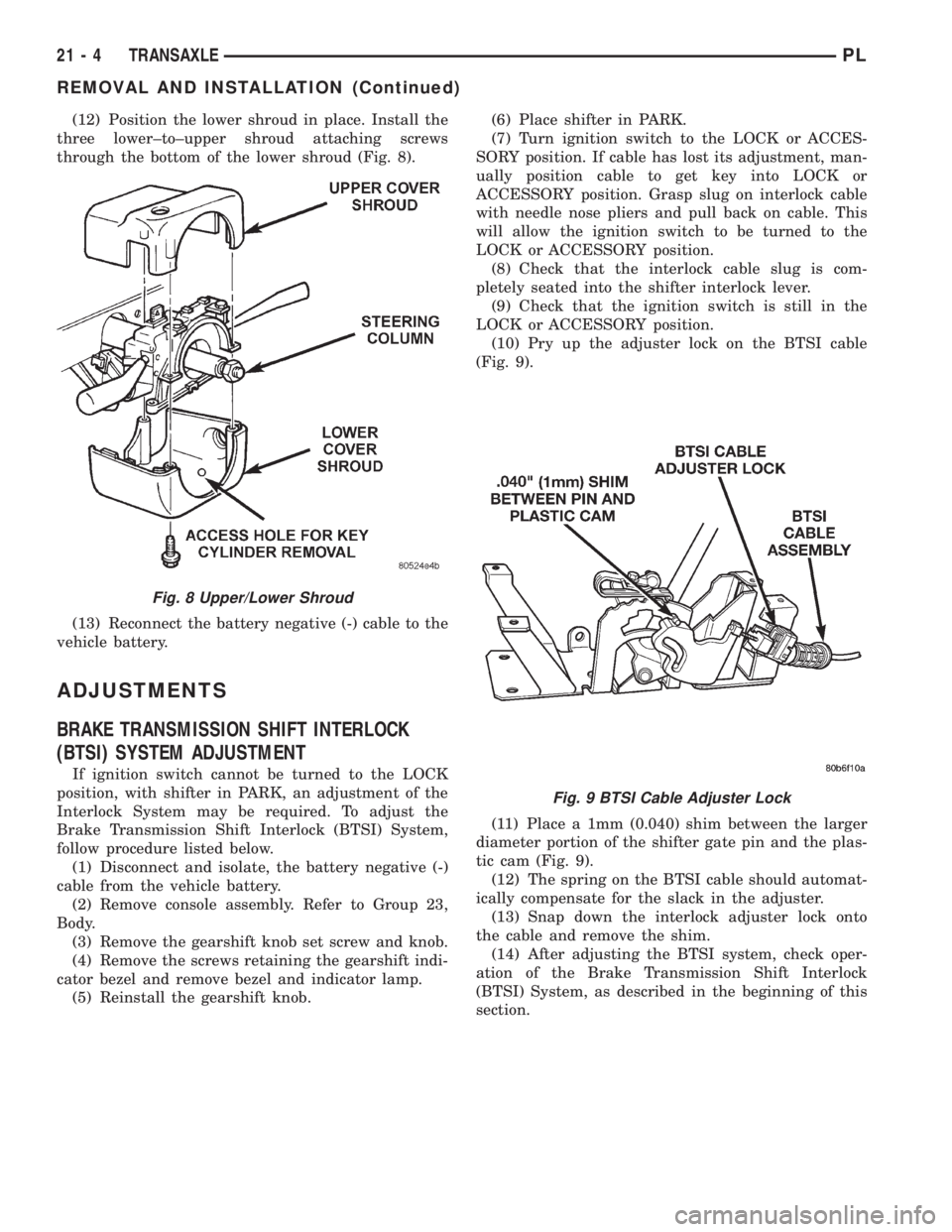
(12) Position the lower shroud in place. Install the
three lower±to±upper shroud attaching screws
through the bottom of the lower shroud (Fig. 8).
(13) Reconnect the battery negative (-) cable to the
vehicle battery.
ADJUSTMENTS
BRAKE TRANSMISSION SHIFT INTERLOCK
(BTSI) SYSTEM ADJUSTMENT
If ignition switch cannot be turned to the LOCK
position, with shifter in PARK, an adjustment of the
Interlock System may be required. To adjust the
Brake Transmission Shift Interlock (BTSI) System,
follow procedure listed below.
(1) Disconnect and isolate, the battery negative (-)
cable from the vehicle battery.
(2) Remove console assembly. Refer to Group 23,
Body.
(3) Remove the gearshift knob set screw and knob.
(4) Remove the screws retaining the gearshift indi-
cator bezel and remove bezel and indicator lamp.
(5) Reinstall the gearshift knob.(6) Place shifter in PARK.
(7) Turn ignition switch to the LOCK or ACCES-
SORY position. If cable has lost its adjustment, man-
ually position cable to get key into LOCK or
ACCESSORY position. Grasp slug on interlock cable
with needle nose pliers and pull back on cable. This
will allow the ignition switch to be turned to the
LOCK or ACCESSORY position.
(8) Check that the interlock cable slug is com-
pletely seated into the shifter interlock lever.
(9) Check that the ignition switch is still in the
LOCK or ACCESSORY position.
(10) Pry up the adjuster lock on the BTSI cable
(Fig. 9).
(11) Place a 1mm (0.040) shim between the larger
diameter portion of the shifter gate pin and the plas-
tic cam (Fig. 9).
(12) The spring on the BTSI cable should automat-
ically compensate for the slack in the adjuster.
(13) Snap down the interlock adjuster lock onto
the cable and remove the shim.
(14) After adjusting the BTSI system, check oper-
ation of the Brake Transmission Shift Interlock
(BTSI) System, as described in the beginning of this
section.
Fig. 8 Upper/Lower Shroud
Fig. 9 BTSI Cable Adjuster Lock
21 - 4 TRANSAXLEPL
REMOVAL AND INSTALLATION (Continued)