lock DODGE NEON 1999 Service Repair Manual
[x] Cancel search | Manufacturer: DODGE, Model Year: 1999, Model line: NEON, Model: DODGE NEON 1999Pages: 1200, PDF Size: 35.29 MB
Page 1096 of 1200
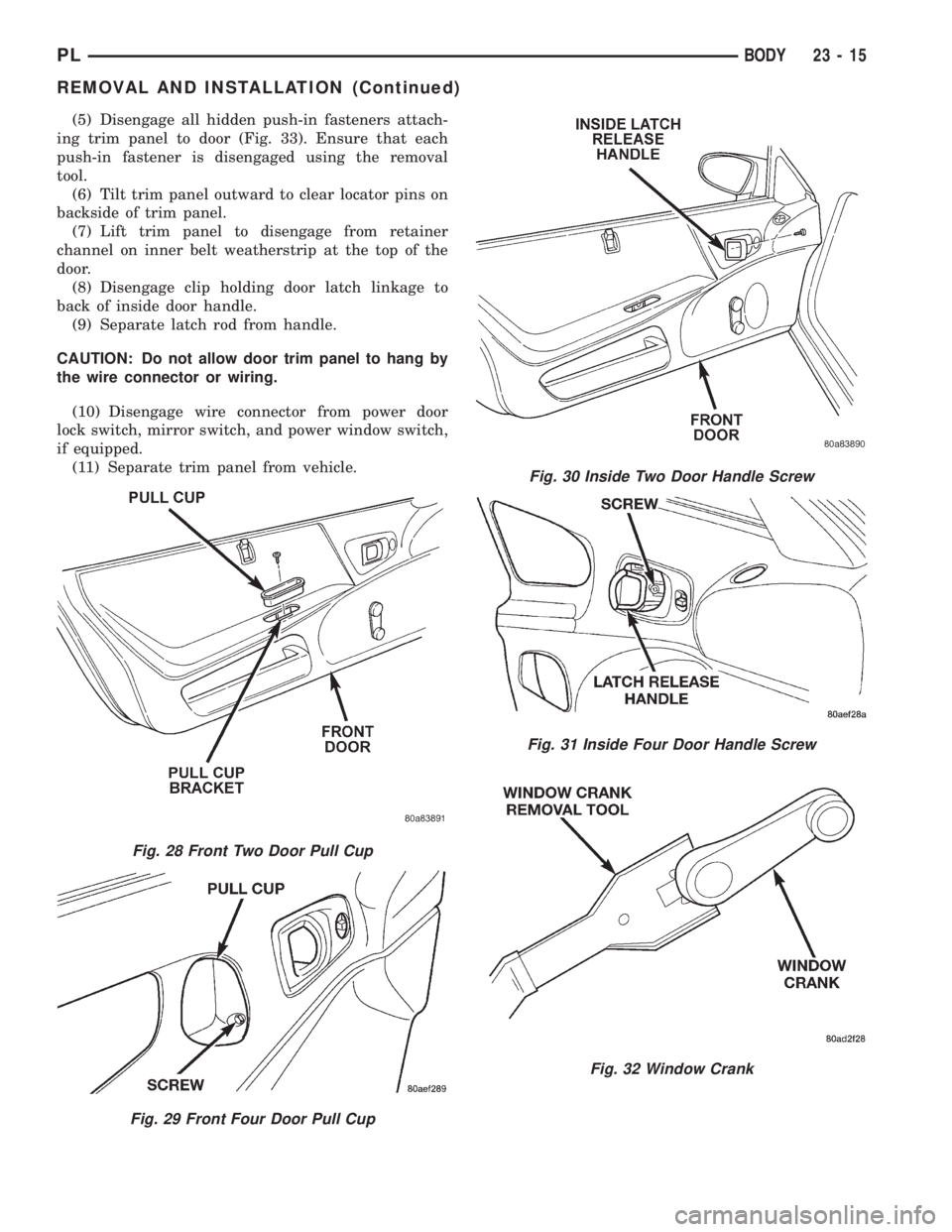
(5) Disengage all hidden push-in fasteners attach-
ing trim panel to door (Fig. 33). Ensure that each
push-in fastener is disengaged using the removal
tool.
(6) Tilt trim panel outward to clear locator pins on
backside of trim panel.
(7) Lift trim panel to disengage from retainer
channel on inner belt weatherstrip at the top of the
door.
(8) Disengage clip holding door latch linkage to
back of inside door handle.
(9) Separate latch rod from handle.
CAUTION: Do not allow door trim panel to hang by
the wire connector or wiring.
(10) Disengage wire connector from power door
lock switch, mirror switch, and power window switch,
if equipped.
(11) Separate trim panel from vehicle.
Fig. 28 Front Two Door Pull Cup
Fig. 29 Front Four Door Pull Cup
Fig. 30 Inside Two Door Handle Screw
Fig. 31 Inside Four Door Handle Screw
Fig. 32 Window Crank
PLBODY 23 - 15
REMOVAL AND INSTALLATION (Continued)
Page 1097 of 1200
INSTALLATION
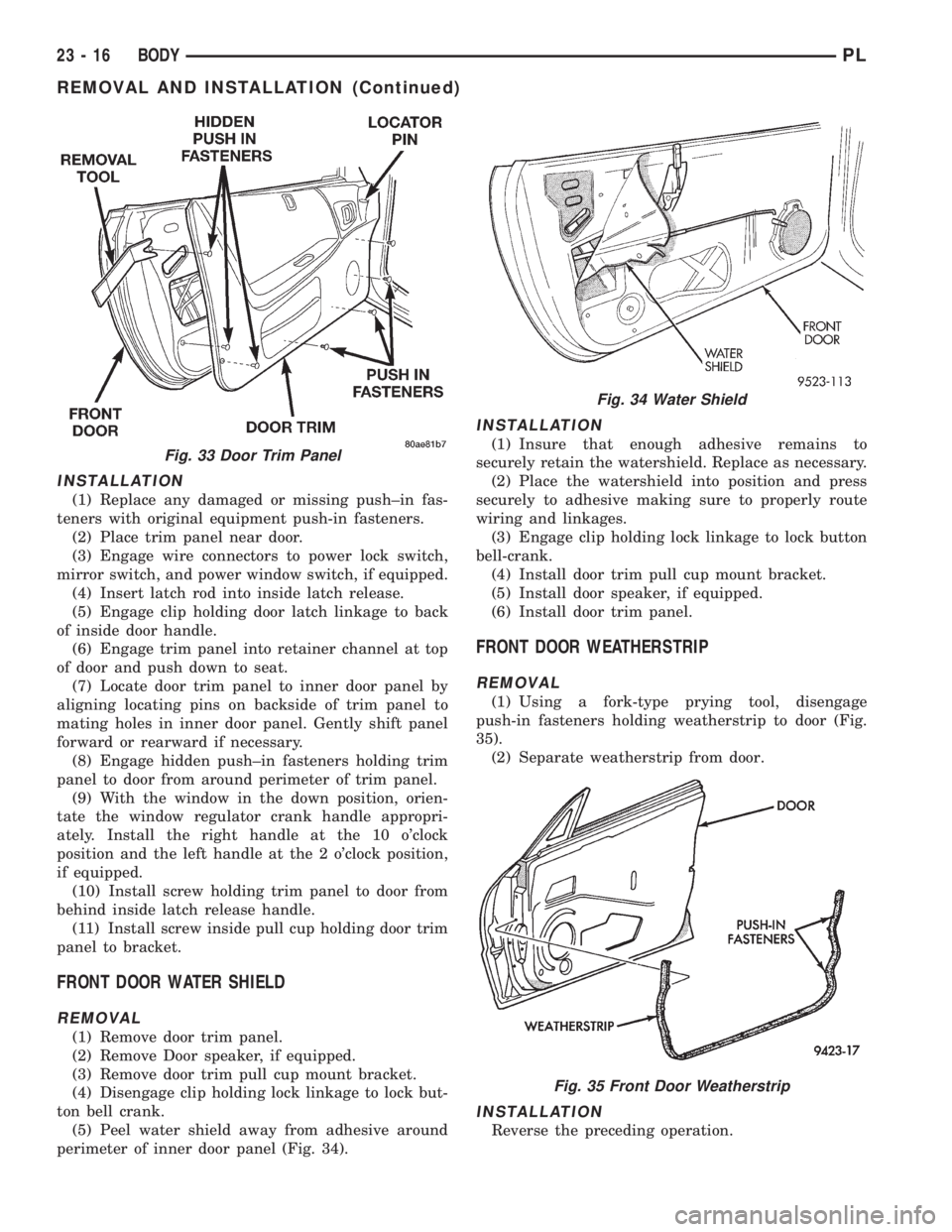
(1) Replace any damaged or missing push±in fas-
teners with original equipment push-in fasteners.
(2) Place trim panel near door.
(3) Engage wire connectors to power lock switch,
mirror switch, and power window switch, if equipped.
(4) Insert latch rod into inside latch release.
(5) Engage clip holding door latch linkage to back
of inside door handle.
(6) Engage trim panel into retainer channel at top
of door and push down to seat.
(7) Locate door trim panel to inner door panel by
aligning locating pins on backside of trim panel to
mating holes in inner door panel. Gently shift panel
forward or rearward if necessary.
(8) Engage hidden push±in fasteners holding trim
panel to door from around perimeter of trim panel.
(9) With the window in the down position, orien-
tate the window regulator crank handle appropri-
ately. Install the right handle at the 10 o'clock
position and the left handle at the 2 o'clock position,
if equipped.
(10) Install screw holding trim panel to door from
behind inside latch release handle.
(11) Install screw inside pull cup holding door trim
panel to bracket.
FRONT DOOR WATER SHIELD
REMOVAL
(1) Remove door trim panel.
(2) Remove Door speaker, if equipped.
(3) Remove door trim pull cup mount bracket.
(4) Disengage clip holding lock linkage to lock but-
ton bell crank.
(5) Peel water shield away from adhesive around
perimeter of inner door panel (Fig. 34).
INSTALLATION
(1) Insure that enough adhesive remains to
securely retain the watershield. Replace as necessary.
(2) Place the watershield into position and press
securely to adhesive making sure to properly route
wiring and linkages.
(3) Engage clip holding lock linkage to lock button
bell-crank.
(4) Install door trim pull cup mount bracket.
(5) Install door speaker, if equipped.
(6) Install door trim panel.
FRONT DOOR WEATHERSTRIP
REMOVAL
(1) Using a fork-type prying tool, disengage
push-in fasteners holding weatherstrip to door (Fig.
35).
(2) Separate weatherstrip from door.
INSTALLATION
Reverse the preceding operation.
Fig. 33 Door Trim Panel
Fig. 34 Water Shield
Fig. 35 Front Door Weatherstrip
23 - 16 BODYPL
REMOVAL AND INSTALLATION (Continued)
Page 1098 of 1200
FRONT OUTBOARD SEAT BELT
REMOVAL
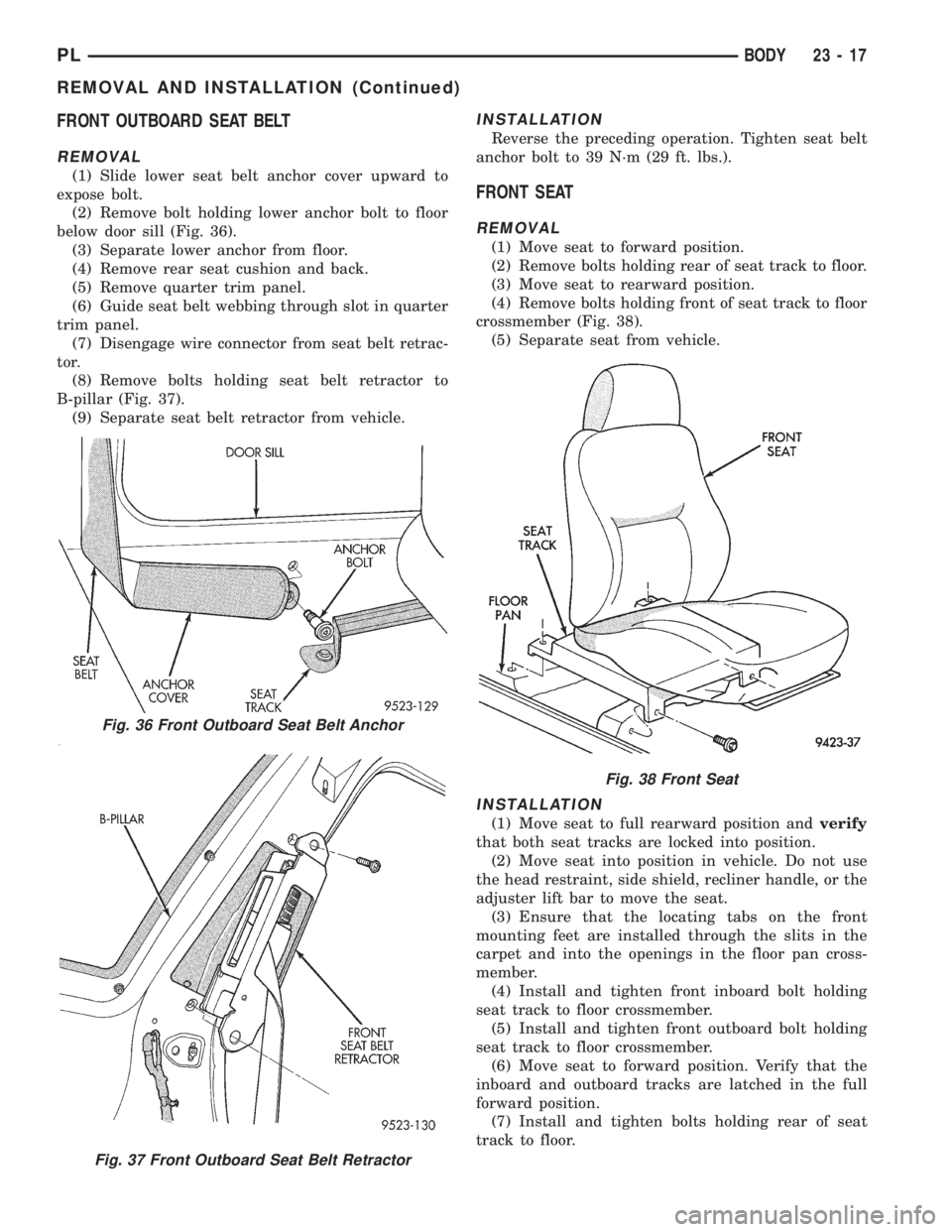
(1) Slide lower seat belt anchor cover upward to
expose bolt.
(2) Remove bolt holding lower anchor bolt to floor
below door sill (Fig. 36).
(3) Separate lower anchor from floor.
(4) Remove rear seat cushion and back.
(5) Remove quarter trim panel.
(6) Guide seat belt webbing through slot in quarter
trim panel.
(7) Disengage wire connector from seat belt retrac-
tor.
(8) Remove bolts holding seat belt retractor to
B-pillar (Fig. 37).
(9) Separate seat belt retractor from vehicle.
INSTALLATION
Reverse the preceding operation. Tighten seat belt
anchor bolt to 39 N´m (29 ft. lbs.).
FRONT SEAT
REMOVAL
(1) Move seat to forward position.
(2) Remove bolts holding rear of seat track to floor.
(3) Move seat to rearward position.
(4) Remove bolts holding front of seat track to floor
crossmember (Fig. 38).
(5) Separate seat from vehicle.
INSTALLATION
(1) Move seat to full rearward position andverify
that both seat tracks are locked into position.
(2) Move seat into position in vehicle. Do not use
the head restraint, side shield, recliner handle, or the
adjuster lift bar to move the seat.
(3) Ensure that the locating tabs on the front
mounting feet are installed through the slits in the
carpet and into the openings in the floor pan cross-
member.
(4) Install and tighten front inboard bolt holding
seat track to floor crossmember.
(5) Install and tighten front outboard bolt holding
seat track to floor crossmember.
(6) Move seat to forward position. Verify that the
inboard and outboard tracks are latched in the full
forward position.
(7) Install and tighten bolts holding rear of seat
track to floor.
Fig. 36 Front Outboard Seat Belt Anchor
Fig. 37 Front Outboard Seat Belt Retractor
Fig. 38 Front Seat
PLBODY 23 - 17
REMOVAL AND INSTALLATION (Continued)
Page 1102 of 1200
(4) Remove bolts holding hood hinge to front
fender flange and separate hinge from vehicle. If nec-
essary, paint new hinge before installation.
INSTALLATION
(1) If necessary, paint new hinge before installa-
tion.
(2) Place hinge in position on vehicle.
(3) Install bolts to hold hood hinge to front fender
flange.
(4) Install bolts to hold hood to hinge.
(5) Align all marks and secure bolts. The hood
should be aligned to 4 mm (0.160 in.) gap to the front
fenders and flush across the top surfaces along fend-
ers. Shims can be added or removed under hood
hinge to achieve proper hood height.
(6) Remove support from under hood and verify
hood operation.
HOOD LATCH
REMOVAL
(1) Release hood latch and open hood.
(2) Support hood on prop rod.
(3) Remove grille.
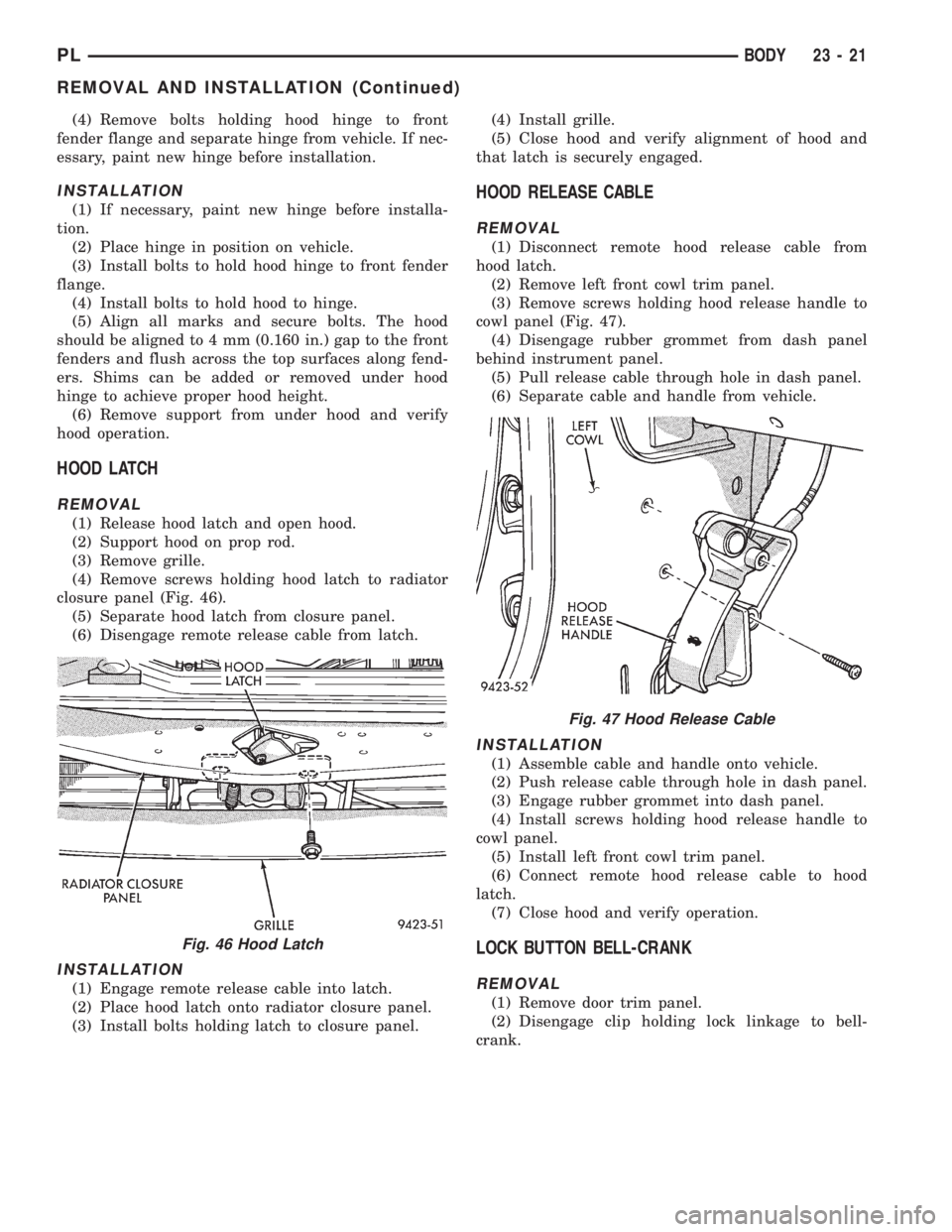
(4) Remove screws holding hood latch to radiator
closure panel (Fig. 46).
(5) Separate hood latch from closure panel.
(6) Disengage remote release cable from latch.
INSTALLATION
(1) Engage remote release cable into latch.
(2) Place hood latch onto radiator closure panel.
(3) Install bolts holding latch to closure panel.(4) Install grille.
(5) Close hood and verify alignment of hood and
that latch is securely engaged.
HOOD RELEASE CABLE
REMOVAL
(1) Disconnect remote hood release cable from
hood latch.
(2) Remove left front cowl trim panel.
(3) Remove screws holding hood release handle to
cowl panel (Fig. 47).
(4) Disengage rubber grommet from dash panel
behind instrument panel.
(5) Pull release cable through hole in dash panel.
(6) Separate cable and handle from vehicle.
INSTALLATION
(1) Assemble cable and handle onto vehicle.
(2) Push release cable through hole in dash panel.
(3) Engage rubber grommet into dash panel.
(4) Install screws holding hood release handle to
cowl panel.
(5) Install left front cowl trim panel.
(6) Connect remote hood release cable to hood
latch.
(7) Close hood and verify operation.
LOCK BUTTON BELL-CRANK
REMOVAL
(1) Remove door trim panel.
(2) Disengage clip holding lock linkage to bell-
crank.
Fig. 46 Hood Latch
Fig. 47 Hood Release Cable
PLBODY 23 - 21
REMOVAL AND INSTALLATION (Continued)
Page 1103 of 1200
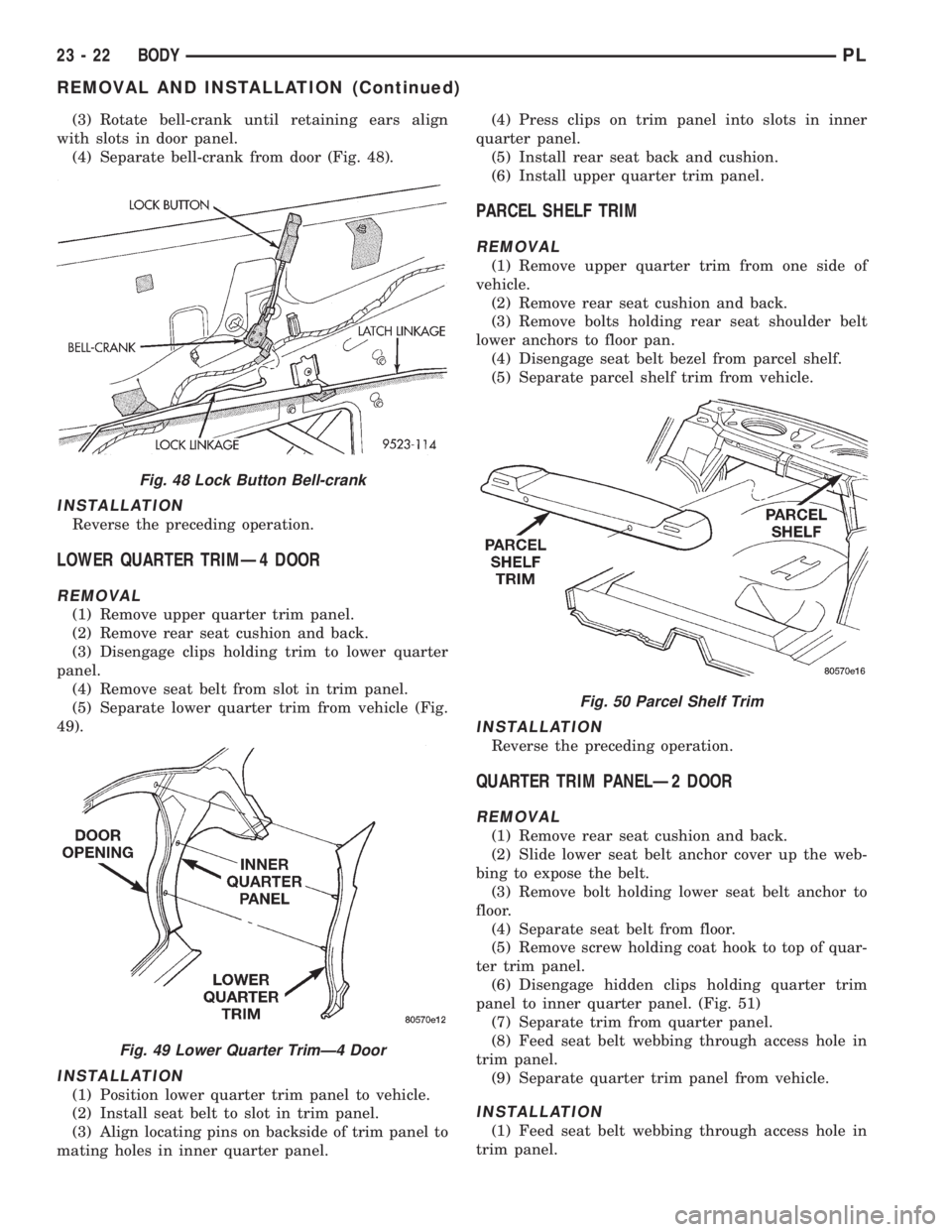
(3) Rotate bell-crank until retaining ears align
with slots in door panel.
(4) Separate bell-crank from door (Fig. 48).
INSTALLATION
Reverse the preceding operation.
LOWER QUARTER TRIMÐ4 DOOR
REMOVAL
(1) Remove upper quarter trim panel.
(2) Remove rear seat cushion and back.
(3) Disengage clips holding trim to lower quarter
panel.
(4) Remove seat belt from slot in trim panel.
(5) Separate lower quarter trim from vehicle (Fig.
49).
INSTALLATION
(1) Position lower quarter trim panel to vehicle.
(2) Install seat belt to slot in trim panel.
(3) Align locating pins on backside of trim panel to
mating holes in inner quarter panel.(4) Press clips on trim panel into slots in inner
quarter panel.
(5) Install rear seat back and cushion.
(6) Install upper quarter trim panel.
PARCEL SHELF TRIM
REMOVAL
(1) Remove upper quarter trim from one side of
vehicle.
(2) Remove rear seat cushion and back.
(3) Remove bolts holding rear seat shoulder belt
lower anchors to floor pan.
(4) Disengage seat belt bezel from parcel shelf.
(5) Separate parcel shelf trim from vehicle.
INSTALLATION
Reverse the preceding operation.
QUARTER TRIM PANELÐ2 DOOR
REMOVAL
(1) Remove rear seat cushion and back.
(2) Slide lower seat belt anchor cover up the web-
bing to expose the belt.
(3) Remove bolt holding lower seat belt anchor to
floor.
(4) Separate seat belt from floor.
(5) Remove screw holding coat hook to top of quar-
ter trim panel.
(6) Disengage hidden clips holding quarter trim
panel to inner quarter panel. (Fig. 51)
(7) Separate trim from quarter panel.
(8) Feed seat belt webbing through access hole in
trim panel.
(9) Separate quarter trim panel from vehicle.
INSTALLATION
(1) Feed seat belt webbing through access hole in
trim panel.
Fig. 48 Lock Button Bell-crank
Fig. 49 Lower Quarter TrimÐ4 Door
Fig. 50 Parcel Shelf Trim
23 - 22 BODYPL
REMOVAL AND INSTALLATION (Continued)
Page 1105 of 1200
REAR DOOR INTERLOCK LATCH STRIKER
REMOVAL
(1) Release door latch and open rear door.
(2) Mark outline of interlock striker on C-pillar to
aid installation.
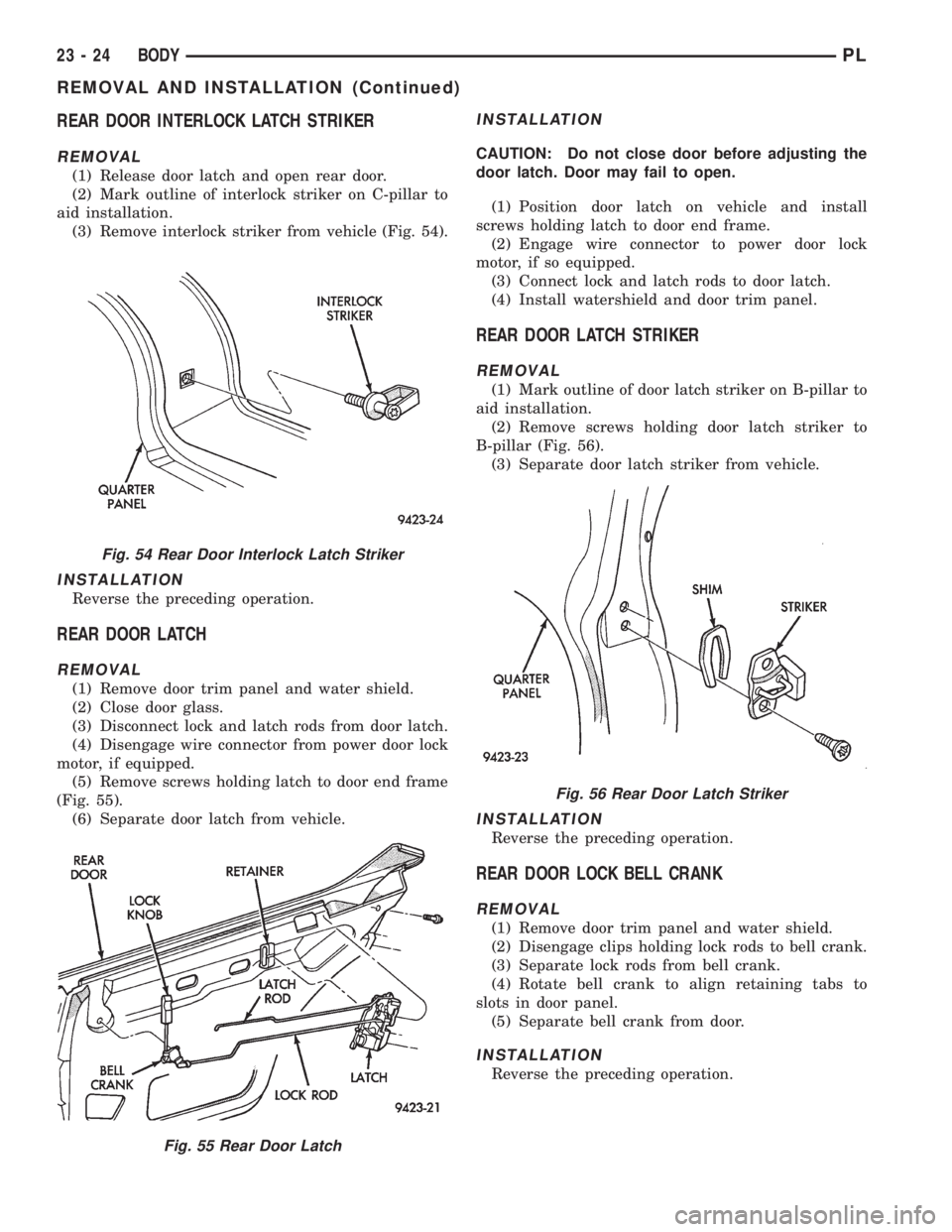
(3) Remove interlock striker from vehicle (Fig. 54).
INSTALLATION
Reverse the preceding operation.
REAR DOOR LATCH
REMOVAL
(1) Remove door trim panel and water shield.
(2) Close door glass.
(3) Disconnect lock and latch rods from door latch.
(4) Disengage wire connector from power door lock
motor, if equipped.
(5) Remove screws holding latch to door end frame
(Fig. 55).
(6) Separate door latch from vehicle.
INSTALLATION
CAUTION: Do not close door before adjusting the
door latch. Door may fail to open.
(1) Position door latch on vehicle and install
screws holding latch to door end frame.
(2) Engage wire connector to power door lock
motor, if so equipped.
(3) Connect lock and latch rods to door latch.
(4) Install watershield and door trim panel.
REAR DOOR LATCH STRIKER
REMOVAL
(1) Mark outline of door latch striker on B-pillar to
aid installation.
(2) Remove screws holding door latch striker to
B-pillar (Fig. 56).
(3) Separate door latch striker from vehicle.
INSTALLATION
Reverse the preceding operation.
REAR DOOR LOCK BELL CRANK
REMOVAL
(1) Remove door trim panel and water shield.
(2) Disengage clips holding lock rods to bell crank.
(3) Separate lock rods from bell crank.
(4) Rotate bell crank to align retaining tabs to
slots in door panel.
(5) Separate bell crank from door.
INSTALLATION
Reverse the preceding operation.
Fig. 54 Rear Door Interlock Latch Striker
Fig. 55 Rear Door Latch
Fig. 56 Rear Door Latch Striker
23 - 24 BODYPL
REMOVAL AND INSTALLATION (Continued)
Page 1114 of 1200
(7) Separate trunk lid from vehicle.
INSTALLATION
(1) Place trunk lid in position on vehicle.
(2) With aid from a helper, install bolts to hold bot-
tom of hinge to trunk lid.
(3) Install bolts to hold top of hinge to trunk lid.
(4) Align trunk lid to achieve equal spacing on all
sides and flush across gaps.
(5) Verify trunk lid operation and sealing.
(6) Connect wire connector and release cable on
latch.
(7) Install clips to hold wire harness and cable to
trunk lid.
TRUNK LID LIFT SPRINGS
REMOVAL
WARNING: USE EYE AND HAND PROTECTION
WHEN REMOVING SPRINGS, PERSONAL CAN
RESULT.
(1) Release trunk and open trunk lid.
(2) Support trunk lid on a suitable prop device.
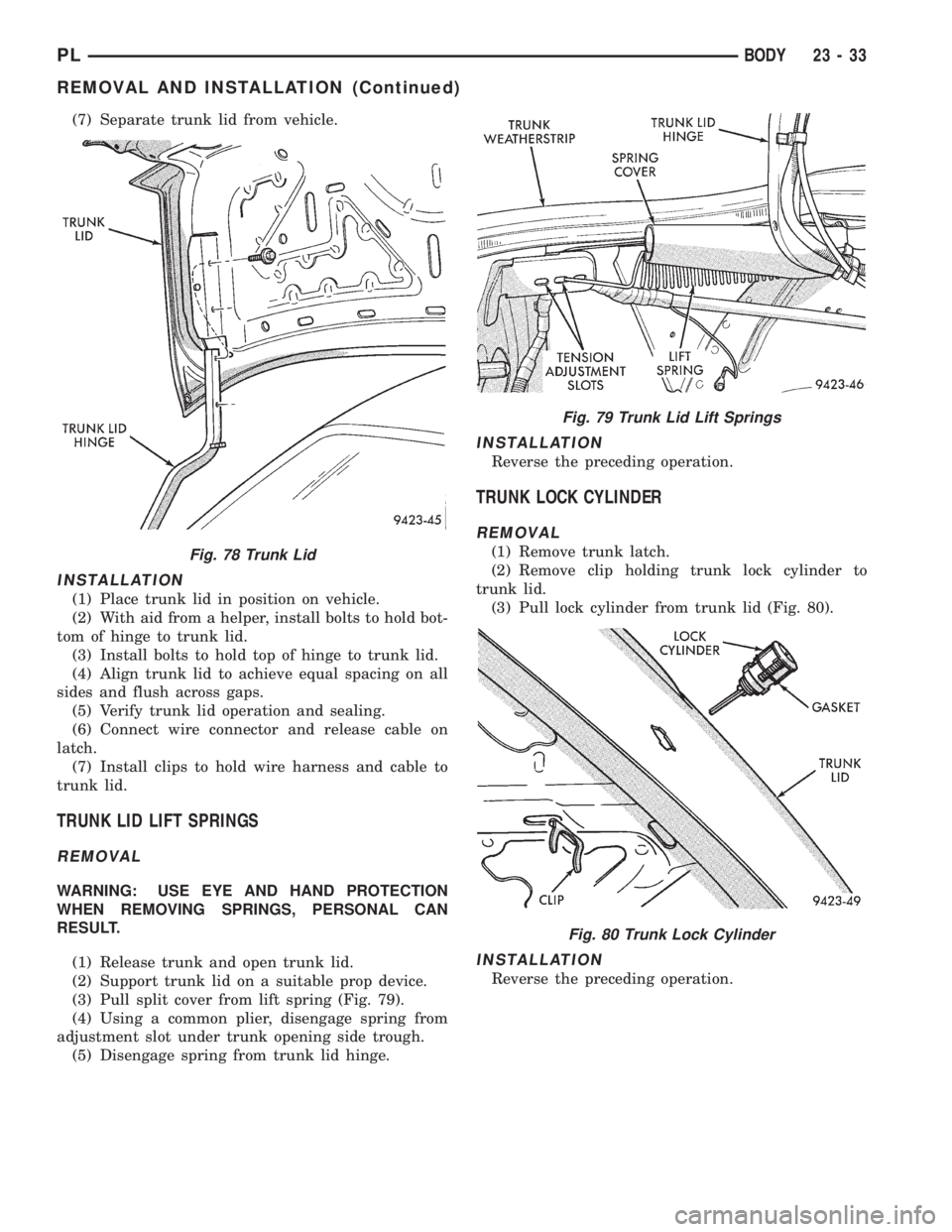
(3) Pull split cover from lift spring (Fig. 79).
(4) Using a common plier, disengage spring from
adjustment slot under trunk opening side trough.
(5) Disengage spring from trunk lid hinge.
INSTALLATION
Reverse the preceding operation.
TRUNK LOCK CYLINDER
REMOVAL
(1) Remove trunk latch.
(2) Remove clip holding trunk lock cylinder to
trunk lid.
(3) Pull lock cylinder from trunk lid (Fig. 80).
INSTALLATION
Reverse the preceding operation.
Fig. 78 Trunk Lid
Fig. 79 Trunk Lid Lift Springs
Fig. 80 Trunk Lock Cylinder
PLBODY 23 - 33
REMOVAL AND INSTALLATION (Continued)
Page 1120 of 1200
(5) Adjust glass so that a piece of paper can be
pulled between the glass and weatherstrip with some
tension.
REAR DOOR LATCH ADJUSTMENT
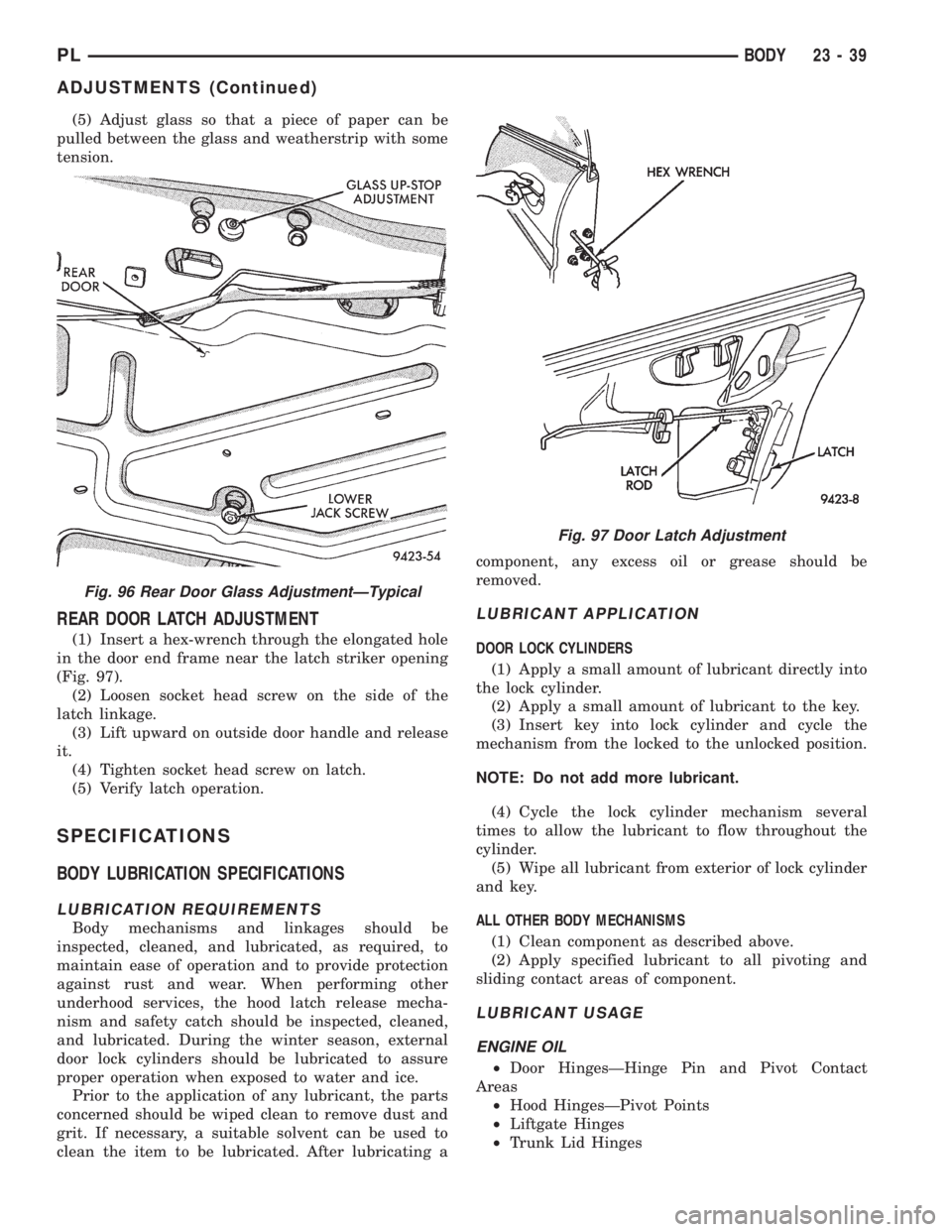
(1) Insert a hex-wrench through the elongated hole
in the door end frame near the latch striker opening
(Fig. 97).
(2) Loosen socket head screw on the side of the
latch linkage.
(3) Lift upward on outside door handle and release
it.
(4) Tighten socket head screw on latch.
(5) Verify latch operation.
SPECIFICATIONS
BODY LUBRICATION SPECIFICATIONS
LUBRICATION REQUIREMENTS
Body mechanisms and linkages should be
inspected, cleaned, and lubricated, as required, to
maintain ease of operation and to provide protection
against rust and wear. When performing other
underhood services, the hood latch release mecha-
nism and safety catch should be inspected, cleaned,
and lubricated. During the winter season, external
door lock cylinders should be lubricated to assure
proper operation when exposed to water and ice.
Prior to the application of any lubricant, the parts
concerned should be wiped clean to remove dust and
grit. If necessary, a suitable solvent can be used to
clean the item to be lubricated. After lubricating acomponent, any excess oil or grease should be
removed.
LUBRICANT APPLICATION
DOOR LOCK CYLINDERS
(1) Apply a small amount of lubricant directly into
the lock cylinder.
(2) Apply a small amount of lubricant to the key.
(3) Insert key into lock cylinder and cycle the
mechanism from the locked to the unlocked position.
NOTE: Do not add more lubricant.
(4) Cycle the lock cylinder mechanism several
times to allow the lubricant to flow throughout the
cylinder.
(5) Wipe all lubricant from exterior of lock cylinder
and key.
ALL OTHER BODY MECHANISMS
(1) Clean component as described above.
(2) Apply specified lubricant to all pivoting and
sliding contact areas of component.
LUBRICANT USAGE
ENGINE OIL
²Door HingesÐHinge Pin and Pivot Contact
Areas
²Hood HingesÐPivot Points
²Liftgate Hinges
²Trunk Lid Hinges
Fig. 96 Rear Door Glass AdjustmentÐTypical
Fig. 97 Door Latch Adjustment
PLBODY 23 - 39
ADJUSTMENTS (Continued)
Page 1121 of 1200
MOPARTSPRAY WHITE LUBE OR EQUIVALENT
²Door Check Straps
²Liftgate Latches
²Liftgate Prop Pivots
²Ash Receiver
²Fuel Filler Door Remote Control Latch Mecha-
nism
²Parking Brake Mechanism
²Sliding Seat Tracks
²Trunk Latch
MOPARTMULTI±PURPOSE GREASE OR
EQUIVALENT
²All Other Hood Mechanisms
MOPARTLOCK CYLINDER LUBRICANT OR
EQUIVALENT
²Door Lock Cylinders
²Trunk Lock Cylinder
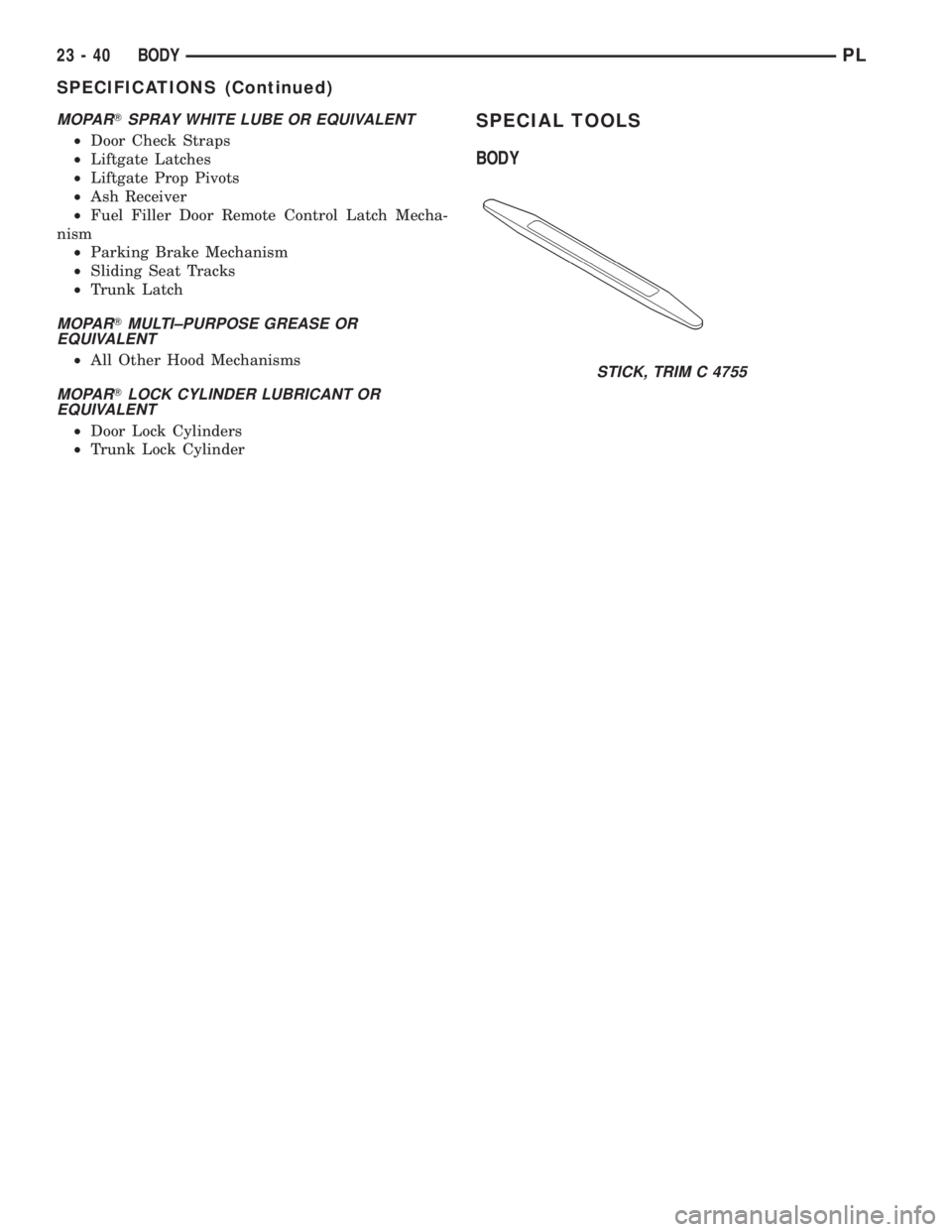
SPECIAL TOOLS
BODY
STICK, TRIM C 4755
23 - 40 BODYPL
SPECIFICATIONS (Continued)
Page 1125 of 1200
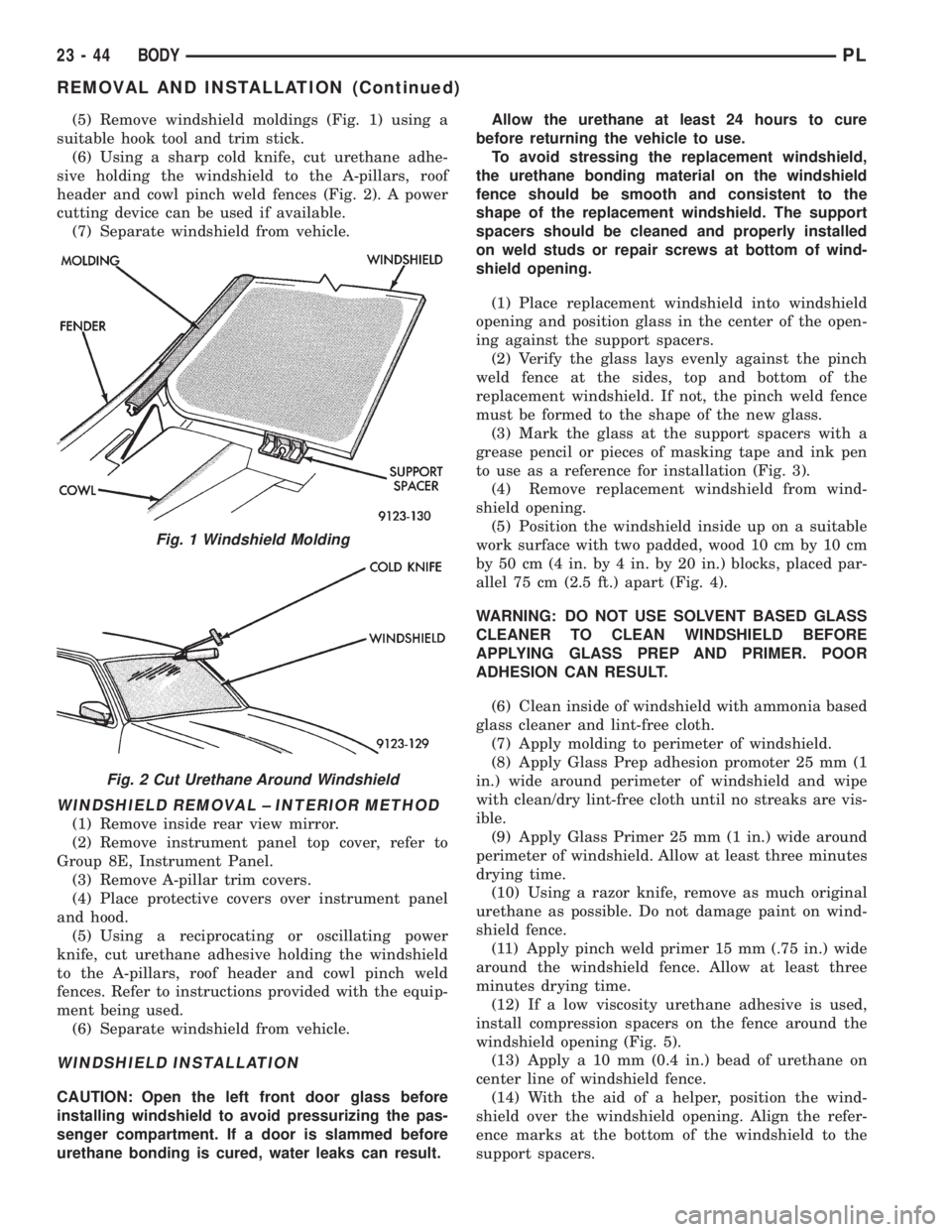
(5) Remove windshield moldings (Fig. 1) using a
suitable hook tool and trim stick.
(6) Using a sharp cold knife, cut urethane adhe-
sive holding the windshield to the A-pillars, roof
header and cowl pinch weld fences (Fig. 2). A power
cutting device can be used if available.
(7) Separate windshield from vehicle.
WINDSHIELD REMOVAL ± INTERIOR METHOD
(1) Remove inside rear view mirror.
(2) Remove instrument panel top cover, refer to
Group 8E, Instrument Panel.
(3) Remove A-pillar trim covers.
(4) Place protective covers over instrument panel
and hood.
(5) Using a reciprocating or oscillating power
knife, cut urethane adhesive holding the windshield
to the A-pillars, roof header and cowl pinch weld
fences. Refer to instructions provided with the equip-
ment being used.
(6) Separate windshield from vehicle.
WINDSHIELD INSTALLATION
CAUTION: Open the left front door glass before
installing windshield to avoid pressurizing the pas-
senger compartment. If a door is slammed before
urethane bonding is cured, water leaks can result.Allow the urethane at least 24 hours to cure
before returning the vehicle to use.
To avoid stressing the replacement windshield,
the urethane bonding material on the windshield
fence should be smooth and consistent to the
shape of the replacement windshield. The support
spacers should be cleaned and properly installed
on weld studs or repair screws at bottom of wind-
shield opening.
(1) Place replacement windshield into windshield
opening and position glass in the center of the open-
ing against the support spacers.
(2) Verify the glass lays evenly against the pinch
weld fence at the sides, top and bottom of the
replacement windshield. If not, the pinch weld fence
must be formed to the shape of the new glass.
(3) Mark the glass at the support spacers with a
grease pencil or pieces of masking tape and ink pen
to use as a reference for installation (Fig. 3).
(4) Remove replacement windshield from wind-
shield opening.
(5) Position the windshield inside up on a suitable
work surface with two padded, wood 10 cm by 10 cm
by 50 cm (4 in. by 4 in. by 20 in.) blocks, placed par-
allel 75 cm (2.5 ft.) apart (Fig. 4).
WARNING: DO NOT USE SOLVENT BASED GLASS
CLEANER TO CLEAN WINDSHIELD BEFORE
APPLYING GLASS PREP AND PRIMER. POOR
ADHESION CAN RESULT.
(6) Clean inside of windshield with ammonia based
glass cleaner and lint-free cloth.
(7) Apply molding to perimeter of windshield.
(8) Apply Glass Prep adhesion promoter 25 mm (1
in.) wide around perimeter of windshield and wipe
with clean/dry lint-free cloth until no streaks are vis-
ible.
(9) Apply Glass Primer 25 mm (1 in.) wide around
perimeter of windshield. Allow at least three minutes
drying time.
(10) Using a razor knife, remove as much original
urethane as possible. Do not damage paint on wind-
shield fence.
(11) Apply pinch weld primer 15 mm (.75 in.) wide
around the windshield fence. Allow at least three
minutes drying time.
(12) If a low viscosity urethane adhesive is used,
install compression spacers on the fence around the
windshield opening (Fig. 5).
(13) Apply a 10 mm (0.4 in.) bead of urethane on
center line of windshield fence.
(14) With the aid of a helper, position the wind-
shield over the windshield opening. Align the refer-
ence marks at the bottom of the windshield to the
support spacers.
Fig. 1 Windshield Molding
Fig. 2 Cut Urethane Around Windshield
23 - 44 BODYPL
REMOVAL AND INSTALLATION (Continued)