tra DODGE NEON 2000 Service Repair Manual
[x] Cancel search | Manufacturer: DODGE, Model Year: 2000, Model line: NEON, Model: DODGE NEON 2000Pages: 1285, PDF Size: 29.42 MB
Page 1132 of 1285
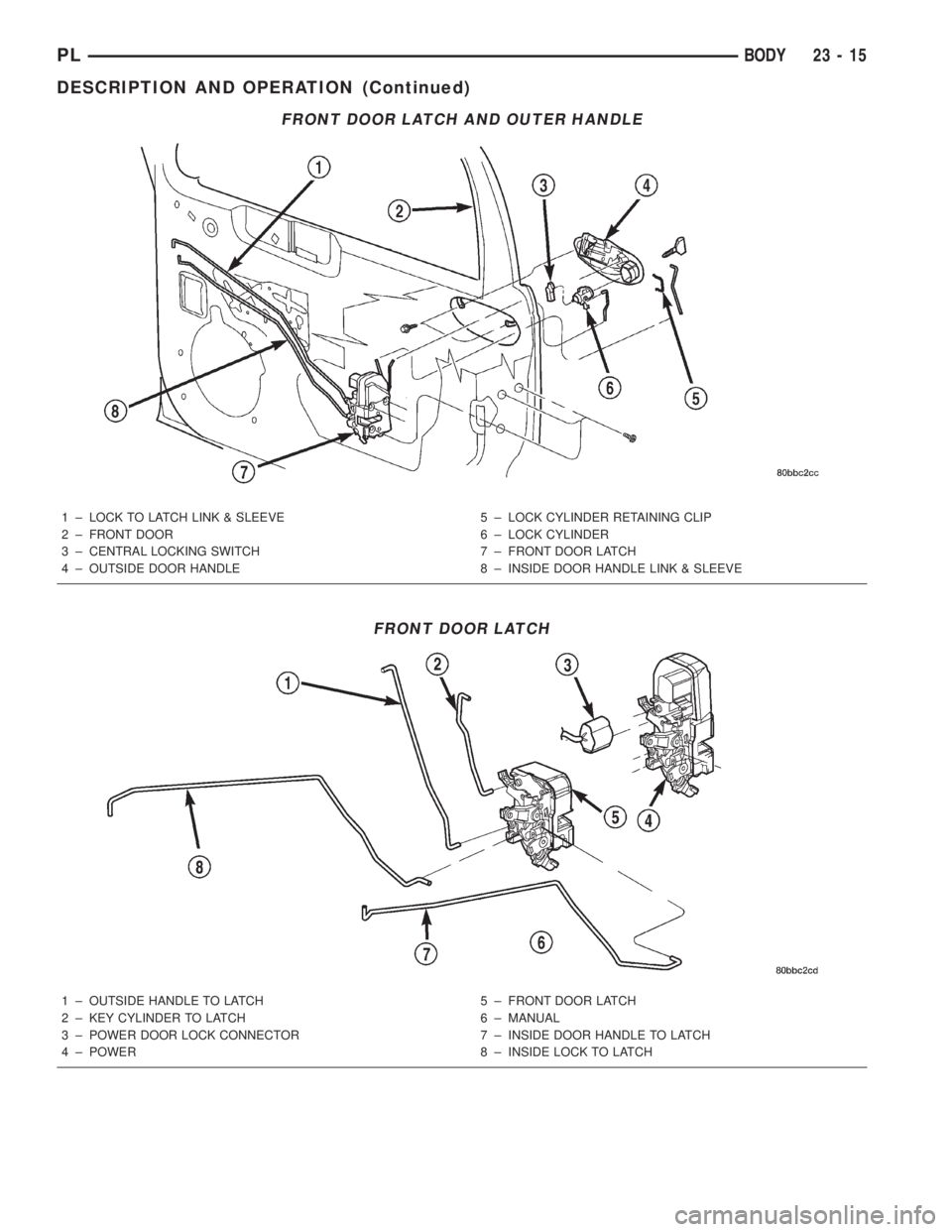
FRONT DOOR LATCH AND OUTER HANDLE
1 ± LOCK TO LATCH LINK & SLEEVE
2 ± FRONT DOOR
3 ± CENTRAL LOCKING SWITCH
4 ± OUTSIDE DOOR HANDLE5 ± LOCK CYLINDER RETAINING CLIP
6 ± LOCK CYLINDER
7 ± FRONT DOOR LATCH
8 ± INSIDE DOOR HANDLE LINK & SLEEVE
FRONT DOOR LATCH
1 ± OUTSIDE HANDLE TO LATCH
2 ± KEY CYLINDER TO LATCH
3 ± POWER DOOR LOCK CONNECTOR
4 ± POWER5 ± FRONT DOOR LATCH
6 ± MANUAL
7 ± INSIDE DOOR HANDLE TO LATCH
8 ± INSIDE LOCK TO LATCH
PLBODY 23 - 15
DESCRIPTION AND OPERATION (Continued)
Page 1135 of 1285
DIAGNOSIS AND TESTING
WATER LEAKS
Water leaks can be caused by poor sealing,
improper body component alignment, body seam
porosity, missing plugs, or blocked drain holes. Cen-
trifugal and gravitational force can cause water to
drip from a location away from the actual leak point,
making leak detection difficult. All body sealing
points should be water tight in normal wet-driving
conditions. Water flowing downward from the front of
the vehicle should not enter the passenger or luggage
compartment. Moving sealing surfaces will not
always seal water tight under all conditions. At
times, side glass or door seals will allow water to
enter the passenger compartment during high pres-
sure washing or hard driving rain (severe) condi-
tions. Overcompensating on door or glass
adjustments to stop a water leak that occurs under
severe conditions can cause premature seal wear and
excessive closing or latching effort. After completing
a repair, water-test vehicle to verify leak has stopped
before returning vehicle to use.
VISUAL INSPECTION BEFORE WATER LEAK TESTS
Verify that floor and body plugs are in place, body
drains are clear, and body components are properly
aligned and sealed. If component alignment or seal-
ing is necessary, refer to the appropriate section of
this group for proper procedures.
WATER LEAK TESTS
WARNING: DO NOT USE ELECTRIC SHOP LIGHTS
OR TOOLS IN WATER TEST AREA. PERSONAL
INJURY CAN RESULT.
When the conditions causing a water leak have
been determined, simulate the conditions as closely
as possible.
²If a leak occurs with the vehicle parked in a
steady light rain, flood the leak area with an open-
ended garden hose.
²If a leak occurs while driving at highway speeds
in a steady rain, test the leak area with a reasonable
velocity stream or fan spray of water. Direct the
spray in a direction comparable to actual conditions.
²If a leak occurs when the vehicle is parked on an
incline, hoist the end or side of the vehicle to simu-
late this condition. This method can be used when
the leak occurs when the vehicle accelerates, stops or
turns. If the leak occurs on acceleration, hoist the
front of the vehicle. If the leak occurs when braking,
hoist the back of the vehicle. If the leak occurs on left
turns, hoist the left side of the vehicle. If the leak
occurs on right turns, hoist the right side of the vehi-cle. For hoisting recommendations refer to Group 0,
Lubrication and Maintenance, General Information
section.
WATER LEAK DETECTION
To detect a water leak point-of-entry, do a water
test and watch for water tracks or droplets forming
on the inside of the vehicle. If necessary, remove inte-
rior trim covers or panels to gain visual access to the
leak area. If the hose cannot be positioned without
being held, have someone help do the water test.
Some water leaks must be tested for a considerable
length of time to become apparent. When a leak
appears, find the lowest point of the water track or
drop. After leak point has been found, repair the leak
and water test to verify that the leak has stopped.
Locating the entry point of water that is leaking
into a cavity between panels can be difficult. The
trapped water may splash or run from the cavity,
often at a distance from the entry point. Most water
leaks of this type become apparent after accelerating,
stopping, turning, or when on an incline.
MIRROR INSPECTION METHOD
When a leak point area is visually obstructed, use
a suitable mirror to gain visual access. A mirror can
also be used to deflect light to a limited-access area
to assist in locating a leak point.
BRIGHT LIGHT LEAK TEST METHOD
Some water leaks in the luggage compartment can
be detected without water testing. Position the vehi-
cle in a brightly lit area. From inside the darkened
luggage compartment inspect around seals and body
seams. If necessary, have a helper direct a drop light
over the suspected leak areas around the luggage
compartment. If light is visible through a normally
sealed location, water could enter through the open-
ing.
PRESSURIZED LEAK TEST METHOD
When a water leak into the passenger compart-
ment cannot be detected by water testing, pressurize
the passenger compartment and soap test exterior of
the vehicle. To pressurize the passenger compart-
ment, close all doors and windows, start engine, and
set heater control to high blower in HEAT position. If
engine can not be started, connect a charger to the
battery to ensure adequate voltage to the blower.
With interior pressurized, apply dish detergent solu-
tion to suspected leak area on the exterior of the
vehicle. Apply detergent solution with spray device or
soft bristle brush. If soap bubbles occur at a body
seam, joint, seal or gasket, the leak entry point could
be at that location.
23 - 18 BODYPL
Page 1136 of 1285

WIND NOISE
Wind noise is the result of most air leaks. Air leaks
can be caused by poor sealing, improper body compo-
nent alignment, body seam porosity, or missing plugs
in the engine compartment or door hinge pillar areas.
All body sealing points should be airtight in normal
driving conditions. Moving sealing surfaces will not
always seal airtight under all conditions. At times,
side glass or door seals will allow wind noise to be
noticed in the passenger compartment during high
cross winds. Over compensating on door or glass
adjustments to stop wind noise that occurs under
severe conditions can cause premature seal wear and
excessive closing or latching effort. After a repair pro-
cedure has been performed, test vehicle to verify
noise has stopped before returning vehicle to use.
Wind noise can also be caused by improperly fitted
exterior moldings or body ornamentation. Loose
moldings can flutter, creating a buzzing or chattering
noise. An open cavity or protruding edge can create a
whistling or howling noise. Inspect the exterior of the
vehicle to verify that these conditions do not exist.
VISUAL INSPECTION BEFORE TESTS
Verify that floor and body plugs are in place and
body components are aligned and sealed. If compo-
nent alignment or sealing is necessary, refer to the
appropriate section of this group for proper proce-
dures.
ROAD TESTING WIND NOISE
(1) Drive the vehicle to verify the general location
of the wind noise.
(2) Apply 50 mm (2 in.) masking tape in 150 mm
(6 in.) lengths along weatherstrips, weld seams or
moldings. After each length is applied, drive the vehi-
cle. If noise goes away after a piece of tape is applied,
remove tape, locate, and repair defect.
POSSIBLE CAUSE OF WIND NOISE
²Moldings standing away from body surface can
catch wind and whistle.
²Gaps in sealed areas behind overhanging body
flanges can cause wind-rushing sounds.
²Misaligned movable components.
²Missing or improperly installed plugs in pillars.
²Weld burn through holes.
SERVICE PROCEDURES
HEAT STAKING
(1) Remove trim panel.
(2) Bend or move the trim panel components at
the heat staked joints. Observe the heat staked loca-
tions and/or component seams for looseness.(3) Heat stake the components.
(a) If the heat staked or component seam loca-
tion is loose, hold the two components tightly
together and using a soldering gun with a flat tip,
melt the material securing the components
together. Do not over heat the affected area, dam-
age to the exterior of the trim panel may occur.
(b) If the heat staked material is broken or miss-
ing, use a hot glue gun to apply new material to
the area to be repaired. The panels that are being
heat staked must be held together while the apply-
ing the glue. Once the new material is in place, it
may be necessary to use a soldering gun to melt
the newly applied material. Do not over heat the
affected area, damage to the exterior of the trim
panel may occur.
(4) Allow the repaired area to cool and verify the
repair.
(5) Install trim panel.
PLASTIC BODY PANEL REPAIR
DESCRIPTION OPERATION
Resin Transfer Molded (RTM) body panels are rein-
forced with a continuous fiberglass mesh. Epoxy
resin is injected into a gel-coated and fiberglass-lined
mold to form a body panel. Sheet molded compound
(SMC) body panels are constructed with fiberglass
strands usually 1 inch or shorter, epoxy resin formed
into sheet stock and pressed in mold flowing material
to form a sheet molded compound (SMC) body panel.
RTM and SMC body panels can be repaired with
epoxy adhesive after market products. Refer to
instructions provided by the manufacturer of prod-
ucts being used to repair RTM or SMC. Daimler-
Chrysler Corporation recommends that a trained
automotive body technician perform body panel
repair procedures (Fig. 1).
Fig. 1 Panel Repair
PLBODY 23 - 19
DIAGNOSIS AND TESTING (Continued)
Page 1137 of 1285

SAFETY PRECAUTION AND WARNINGS
WARNING: EYE PROTECTION SHOULD BE USED
WHEN SERVICING RTM AND SMC COMPONENTS.
PERSONAL INJURE CAN RESULT.
USE AN OSHA APPROVED BREATHING DEVICE
WHEN MIXING EPOXY, GRINDING RTM AND SMC,
AND SPRAYING PAINT OR SOLVENTS IN A CON-
FINED AREA. PERSONAL INJURY CAN RESULT.
AVOID PROLONGED SKIN CONTACT WITH
EPOXY RESIN, PETROLEUM, OR ALCOHOL BASED
SOLVENTS. PERSONAL INJURY CAN RESULT.
DO NOT VENTURE UNDER A HOISTED VEHICLE
THAT IS NOT PROPERLY SUPPORTED ON SAFETY
STANDS. PERSONAL INJURY CAN RESULT.
²When holes must be drilled or cut in body pan-
els, verify locations of internal body components and
electrical wiring. Damage to vehicle can result.
²Do not use abrasive chemicals or compounds on
undamaged painted surfaces around repair areas.
Damage to finish can result.
PANEL SECTIONING
If it is required to section a large panel for an SMC
or RTM repair, it will be necessary to reinforce the
panel with epoxy structural adhesive (rigid repair
adhesive) (Fig. 2). To bond two plastic panels
together, a reinforcement must overlap both panels.
The panels must be ªV'dº at a 20 degree angle. The
area to be reinforced should be washed, then sanded.
Be sure to wipe off any excess soap and water when
finished. Lightly sand or abrade the plastic with an
abrasive pad or sandpaper. Blow off any dust with
compressed air or wipe with a clean dry rag.When bonding SMC or RTM panels, use a two-part
epoxy adhesive. Properly mix parts A and B, and
apply it to the panels being repaired. Be sure that
enough adhesive has been applied to allow squeeze
out and to fill the full bond line. Once the pieces
have been brought together, do not move them until
the adhesive is cured. The assembly can be held
together with clamps, rivets, etc. A faster cure can be
obtained by heating with a heat lamp or heat gun.
After the parts have been bonded and have had
time to cure, rough sand the seam and apply the
final adhesive filler to the area being repaired.
Smooth the filler with a spatula, wooden tongue
depressor, or squeegee. For fine texturing, a small
amount of water can be applied to the filler surface
while smoothing. The cured filler can be sanded as
necessary and, as a final step, cleanup can be done
withy soapy water. Wipe the surface clean with a dry
cloth allowing time for the panel to dry before mov-
ing on with the repair.
PANEL REINFORCEMENT
Structural repair procedures for rigid panels such
as Sheet Molded compound (SMC) or Resin Transfer
Molded (RTM) with large cracks and holes will
require a reinforcement backing. Reinforcements can
be made with several applications of glass cloth sat-
urated with epoxy structural adhesive, semirigid or
flexible repair materials should be used for semirigid
or flexible part repairs (Fig. 3) and (Fig. 4). Open
meshed fiberglass dry wall tape can be used to form
a reinforcement. The dry wall tape allows the resin
to penetrate through and make a good bond between
the panel and the epoxy adhesive. Structurally, the
more dry wall tape used, the stronger the repair.
Another kind of repair that can be done to repair
large cracks and holes is to use a scrap piece of sim-
ilar plastic and bond with structural adhesive. The
reinforcement should cover the entire break and
should have a generous amount of overlap on either
side of the cracked or broken area.
When repairing plastic, the damaged area is first
ªV'dº out, or beveled. Large bonding areas are desir-
able when repairing plastic because small repairs are
less likely to hold permanently. Beveling the area
around a crack at a 20 degree angle will increase the
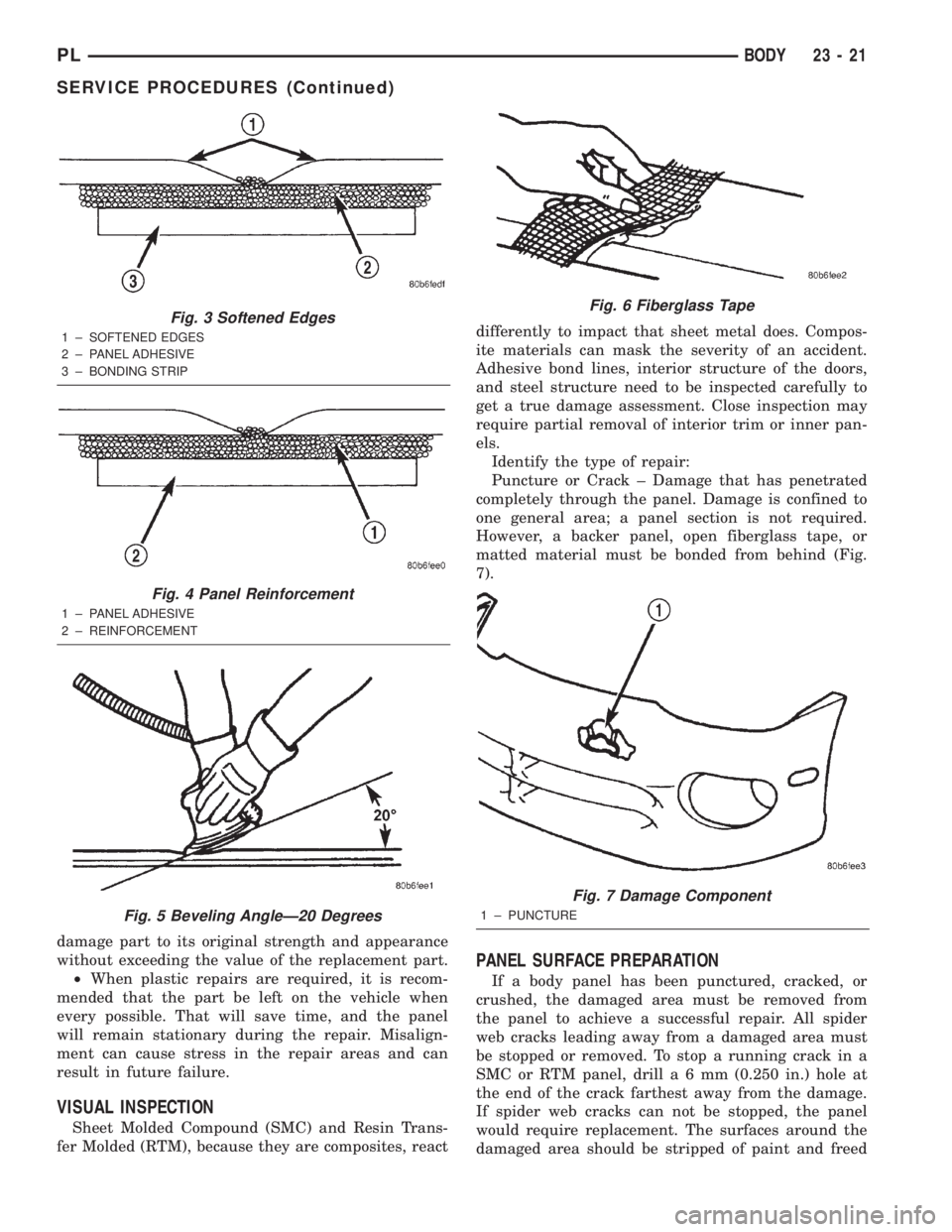
bonding surface for a repair (Fig. 5). It is recom-
mended that sharp edges be avoided because the
joint may show through after the panel is refinished.
²Panel repair for both flexible and rigid panels
are basically the same. The primary difference
between flexible panel repair and rigid panel repair
is in the adhesive materials used (Fig. 6).
²The technician should first decide what needs to
be done when working on any type of body panel.
One should determine if it is possible to return the
Fig. 2 Panel Sectioning
1 ± EXISTING PANEL
2 ± NEW PANEL
3 ± PANEL ADHESIVE
4 ± BONDING STRIP
23 - 20 BODYPL
SERVICE PROCEDURES (Continued)
Page 1138 of 1285
damage part to its original strength and appearance
without exceeding the value of the replacement part.
²When plastic repairs are required, it is recom-
mended that the part be left on the vehicle when
every possible. That will save time, and the panel
will remain stationary during the repair. Misalign-
ment can cause stress in the repair areas and can
result in future failure.
VISUAL INSPECTION
Sheet Molded Compound (SMC) and Resin Trans-
fer Molded (RTM), because they are composites, reactdifferently to impact that sheet metal does. Compos-
ite materials can mask the severity of an accident.
Adhesive bond lines, interior structure of the doors,
and steel structure need to be inspected carefully to
get a true damage assessment. Close inspection may
require partial removal of interior trim or inner pan-
els.
Identify the type of repair:
Puncture or Crack ± Damage that has penetrated
completely through the panel. Damage is confined to
one general area; a panel section is not required.
However, a backer panel, open fiberglass tape, or
matted material must be bonded from behind (Fig.
7).
PANEL SURFACE PREPARATION
If a body panel has been punctured, cracked, or
crushed, the damaged area must be removed from
the panel to achieve a successful repair. All spider
web cracks leading away from a damaged area must
be stopped or removed. To stop a running crack in a
SMC or RTM panel, drilla6mm(0.250 in.) hole at
the end of the crack farthest away from the damage.
If spider web cracks can not be stopped, the panel
would require replacement. The surfaces around the
damaged area should be stripped of paint and freed
Fig. 3 Softened Edges
1 ± SOFTENED EDGES
2 ± PANEL ADHESIVE
3 ± BONDING STRIP
Fig. 4 Panel Reinforcement
1 ± PANEL ADHESIVE
2 ± REINFORCEMENT
Fig. 5 Beveling AngleÐ20 Degrees
Fig. 6 Fiberglass Tape
Fig. 7 Damage Component
1 ± PUNCTURE
PLBODY 23 - 21
SERVICE PROCEDURES (Continued)
Page 1145 of 1285
(2) Install the five screws holding cowl panel to
cowl at base of windshield opening.
(3) Push the hood to cowl seal over the forward
flange of the cowl cover and cowl plenum.
(4) Install windshield wiper arms, refer to Group
8K, Windshield Wiper and Washer Systems, for
proper procedures.
FRONT WHEELHOUSE SPLASH SHIELD
REMOVAL
(1) Hoist and support vehicle on safety stands.
(2) Remove front wheel.
(3) Remove push-in fasteners attaching splash
shield to frame rail forward of suspension (Fig. 24).
(4) Remove push in fasteners attaching splash
shield to frame rail rearward of suspension.
(5) Remove screws attaching wheelhouse splash
shield to front fender.
(6) Remove splash shield from vehicle.
INSTALLATION
(1) Place splash shield in position on vehicle.
(2) Install screws attaching wheelhouse splash
shield to front fender.
(3) Install push in fasteners attaching splash
shield to frame rail rearward of suspension.
(4) Install push in fasteners attaching splash
shield to frame rail forward of suspension.
(5) Install front wheel.
(6) Lower vehicle.
FENDER
REMOVAL
(1) Remove headlamp housing.
(2) Right side of vehicle remove pulley splash
shield.(3) Remove inner splash shield.
(4) Remove fender to fascia nuts.
(5) Remove fender bolt to lower rocker panel.
(6) Remove fender bolt to lower cowl.
(7) Pull fascia away from fender.
(8) Remove bolts attaching fender to upper rail.
(9) Remove fender from vehicle (Fig. 25).
INSTALLATION
(1) Place fender in position on vehicle.
(2) Start the center upper rail bolt.
(3) From inside engine compartment, install all
the bolts attaching fender to upper rail and tighten.
(4) Install lower cowl panel bolt to fender.
(5) Install rocker panel bolt to fender.
(6) Place fascia into position.
(7) Install fender to fascia nuts.
(8) Install inner splash shield.
(9) Install right side pulley splash shield.
(10) Install headlamp assembly.
(11) Check fender for flush and gap.
EXTERIOR BADGEING ATTACHED WITH
DOUBLE SIDED FOAM TAPE
REMOVAL
(1) Mark reference points before removing.
(2) Using a heat gun gently apply heat in a circu-
lar motion to loosen the adhesive bond.
(3) Using a nonmetallic prying device, such as a
plastic or wood trim stick gently pry up at corners
and remove.
(4) Clean off all traces of adhesive or double sided
tape from the panel with a general purpose adhesive
remover.
INSTALLATION
(1) Clean panel surface with isopropy alcohol.
(2) Align badgeing to reference points.
(3) Install and press securely to full adhesive con-
tact
(4) Clean away any reference points.
EXTERIOR BADGEING/TAPE STRIPES
ATTACHED WITH ADHESIVES
REMOVAL
(1) Mark reference points before removing.
(2) Using a heat gun gently apply heat in a circu-
lar motion to loosen the adhesive bond.
(3) With your fingernail lift up and peel away
badgeing /tape from panel, using a heat gun as you
go.
(4) Clean off all traces of adhesive from the pan-
el(s) with a general purpose adhesive remover.
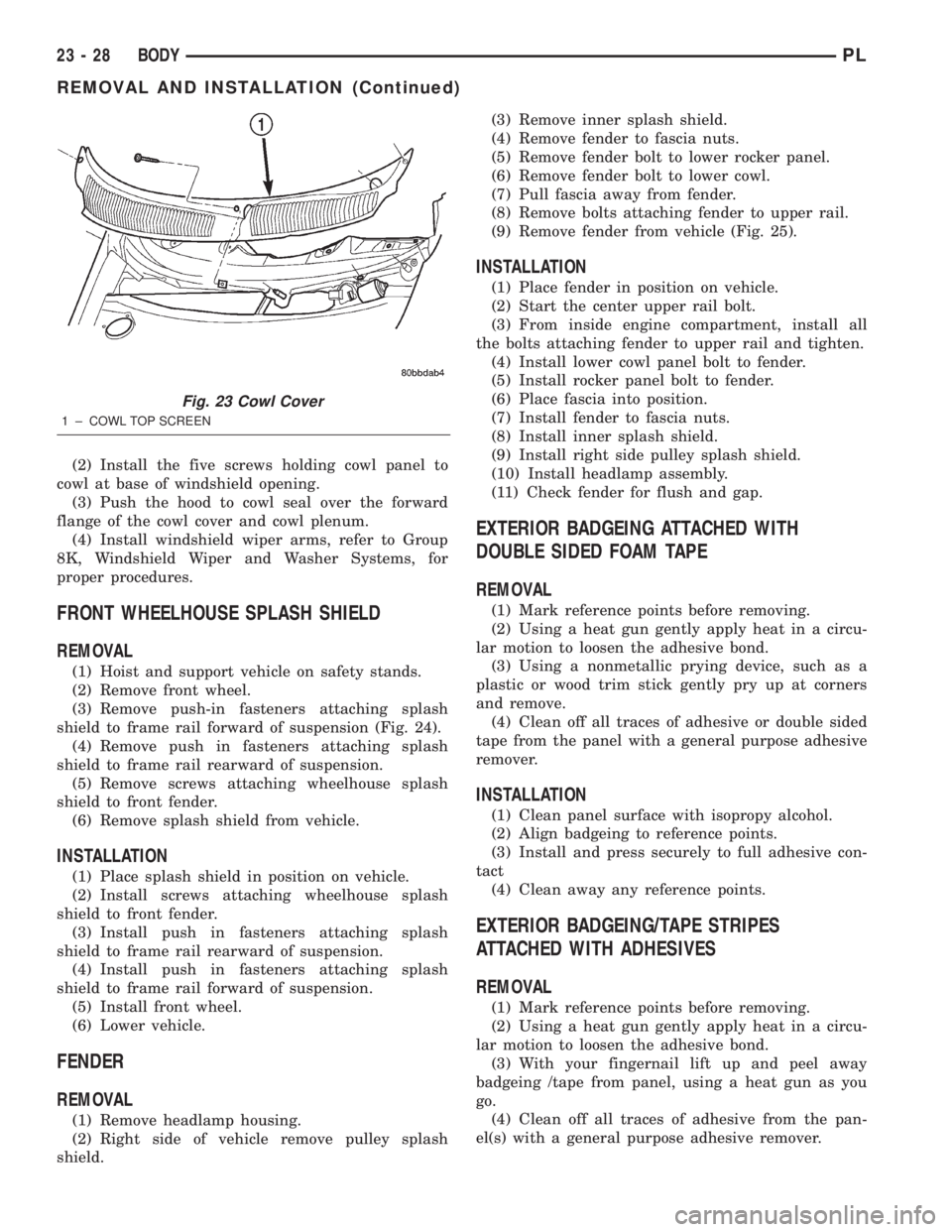
Fig. 23 Cowl Cover
1 ± COWL TOP SCREEN
23 - 28 BODYPL
REMOVAL AND INSTALLATION (Continued)
Page 1150 of 1285
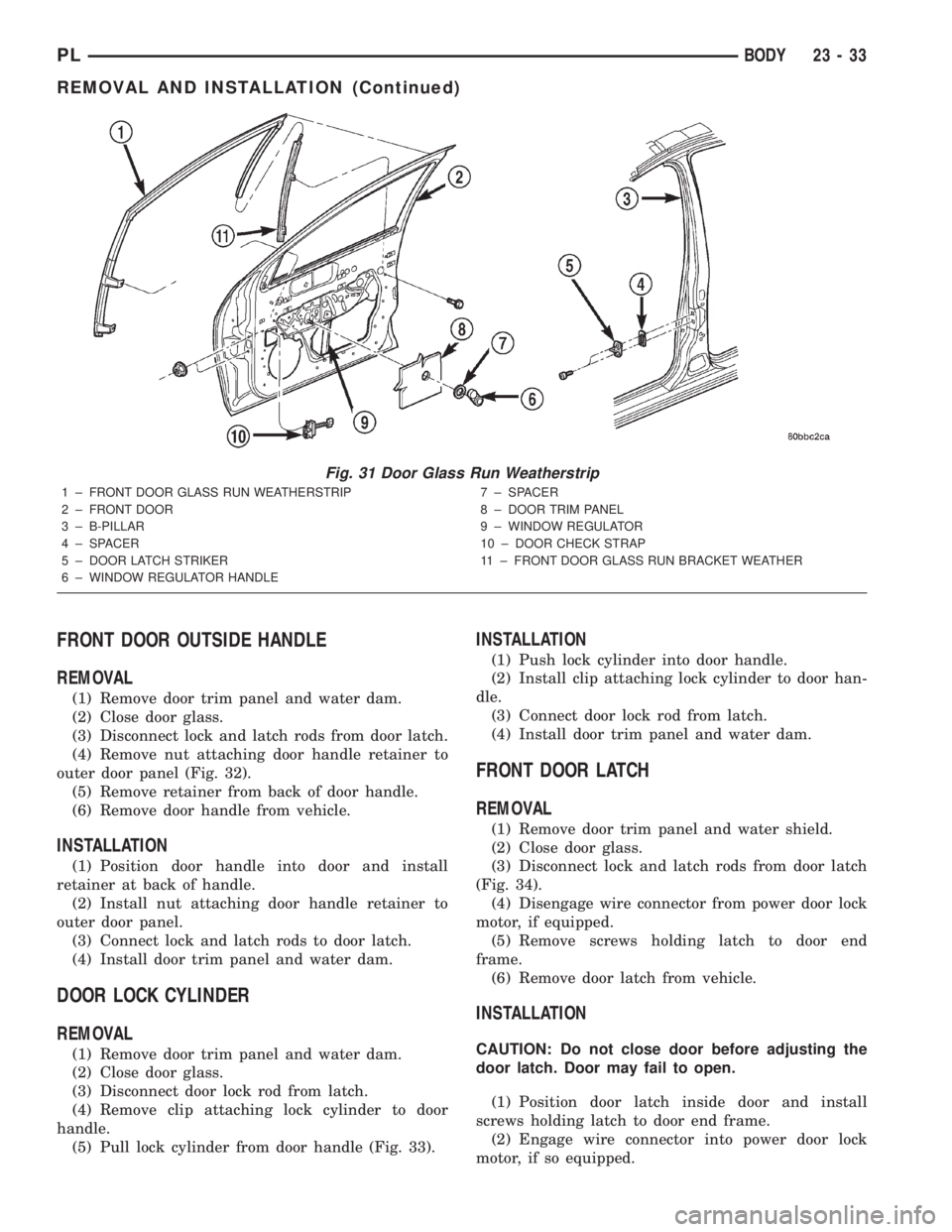
FRONT DOOR OUTSIDE HANDLE
REMOVAL
(1) Remove door trim panel and water dam.
(2) Close door glass.
(3) Disconnect lock and latch rods from door latch.
(4) Remove nut attaching door handle retainer to
outer door panel (Fig. 32).
(5) Remove retainer from back of door handle.
(6) Remove door handle from vehicle.
INSTALLATION
(1) Position door handle into door and install
retainer at back of handle.
(2) Install nut attaching door handle retainer to
outer door panel.
(3) Connect lock and latch rods to door latch.
(4) Install door trim panel and water dam.
DOOR LOCK CYLINDER
REMOVAL
(1) Remove door trim panel and water dam.
(2) Close door glass.
(3) Disconnect door lock rod from latch.
(4) Remove clip attaching lock cylinder to door
handle.
(5) Pull lock cylinder from door handle (Fig. 33).
INSTALLATION
(1) Push lock cylinder into door handle.
(2) Install clip attaching lock cylinder to door han-
dle.
(3) Connect door lock rod from latch.
(4) Install door trim panel and water dam.
FRONT DOOR LATCH
REMOVAL
(1) Remove door trim panel and water shield.
(2) Close door glass.
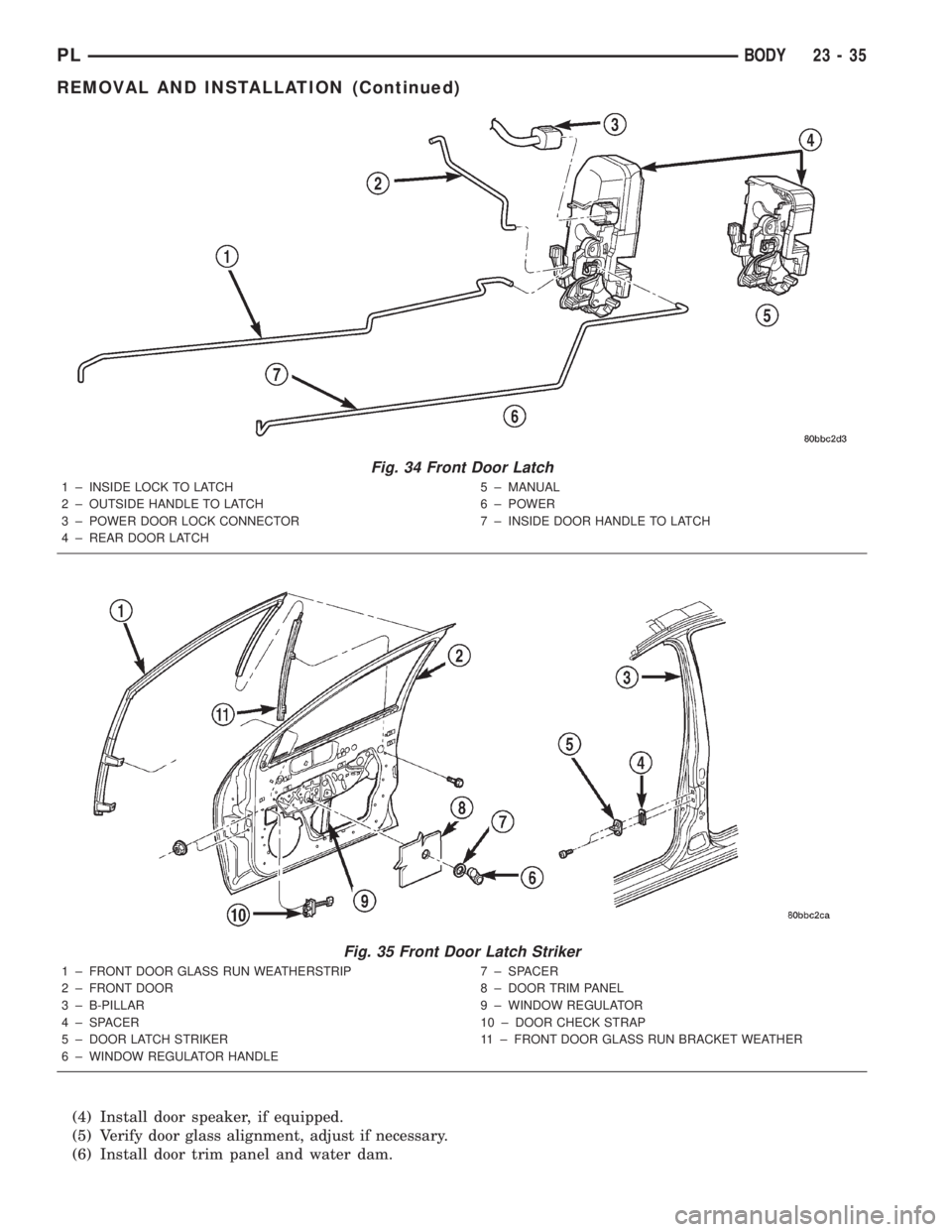
(3) Disconnect lock and latch rods from door latch
(Fig. 34).
(4) Disengage wire connector from power door lock
motor, if equipped.
(5) Remove screws holding latch to door end
frame.
(6) Remove door latch from vehicle.
INSTALLATION
CAUTION: Do not close door before adjusting the
door latch. Door may fail to open.
(1) Position door latch inside door and install
screws holding latch to door end frame.
(2) Engage wire connector into power door lock
motor, if so equipped.
Fig. 31 Door Glass Run Weatherstrip
1 ± FRONT DOOR GLASS RUN WEATHERSTRIP
2 ± FRONT DOOR
3 ± B-PILLAR
4 ± SPACER
5 ± DOOR LATCH STRIKER
6 ± WINDOW REGULATOR HANDLE7 ± SPACER
8 ± DOOR TRIM PANEL
9 ± WINDOW REGULATOR
10 ± DOOR CHECK STRAP
11 ± FRONT DOOR GLASS RUN BRACKET WEATHER
PLBODY 23 - 33
REMOVAL AND INSTALLATION (Continued)
Page 1152 of 1285
(4) Install door speaker, if equipped.
(5) Verify door glass alignment, adjust if necessary.
(6) Install door trim panel and water dam.
Fig. 34 Front Door Latch
1 ± INSIDE LOCK TO LATCH
2 ± OUTSIDE HANDLE TO LATCH
3 ± POWER DOOR LOCK CONNECTOR
4 ± REAR DOOR LATCH5 ± MANUAL
6 ± POWER
7 ± INSIDE DOOR HANDLE TO LATCH
Fig. 35 Front Door Latch Striker
1 ± FRONT DOOR GLASS RUN WEATHERSTRIP
2 ± FRONT DOOR
3 ± B-PILLAR
4 ± SPACER
5 ± DOOR LATCH STRIKER
6 ± WINDOW REGULATOR HANDLE7 ± SPACER
8 ± DOOR TRIM PANEL
9 ± WINDOW REGULATOR
10 ± DOOR CHECK STRAP
11 ± FRONT DOOR GLASS RUN BRACKET WEATHER
PLBODY 23 - 35
REMOVAL AND INSTALLATION (Continued)
Page 1153 of 1285
FRONT DOOR GLASS
REMOVAL
(1) Remove door trim panel and water dam.
(2) Remove inner door belt weatherstrip.
(3) Loosen window inner belt stabilizer.
(4) Lower door glass to bottom of door to gain
access to attaching bolts.
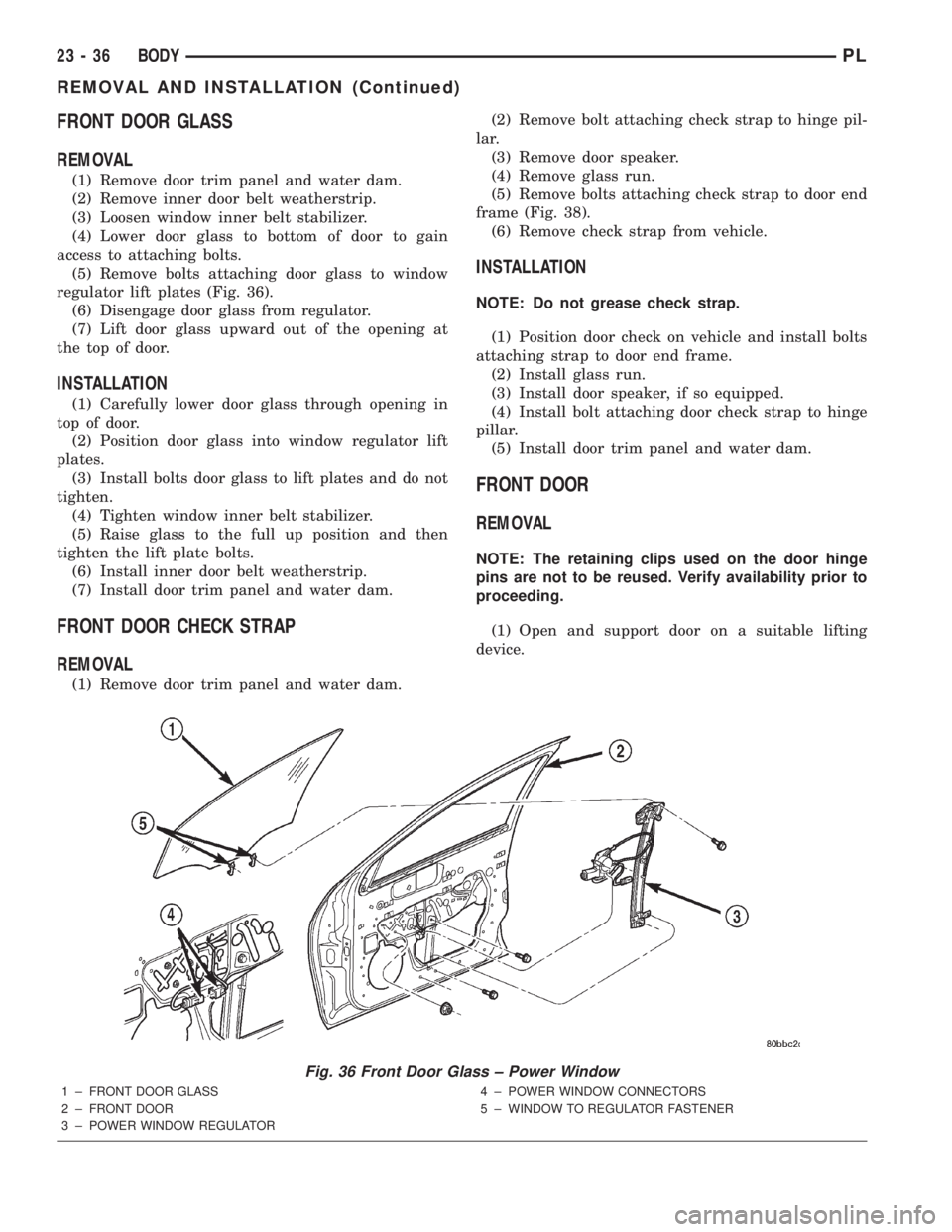
(5) Remove bolts attaching door glass to window
regulator lift plates (Fig. 36).
(6) Disengage door glass from regulator.
(7) Lift door glass upward out of the opening at
the top of door.
INSTALLATION
(1) Carefully lower door glass through opening in
top of door.
(2) Position door glass into window regulator lift
plates.
(3) Install bolts door glass to lift plates and do not
tighten.
(4) Tighten window inner belt stabilizer.
(5) Raise glass to the full up position and then
tighten the lift plate bolts.
(6) Install inner door belt weatherstrip.
(7) Install door trim panel and water dam.
FRONT DOOR CHECK STRAP
REMOVAL
(1) Remove door trim panel and water dam.(2) Remove bolt attaching check strap to hinge pil-
lar.
(3) Remove door speaker.
(4) Remove glass run.
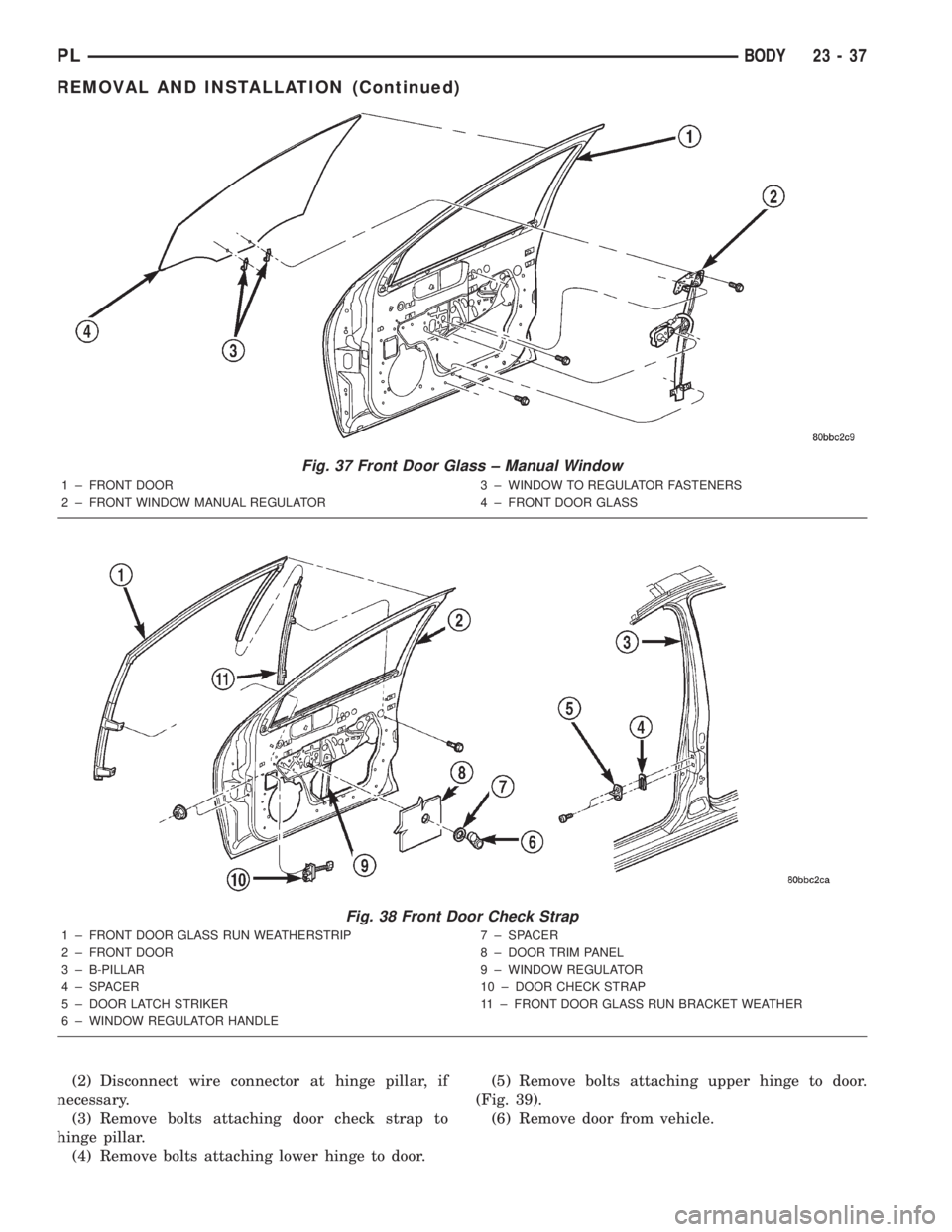
(5) Remove bolts attaching check strap to door end
frame (Fig. 38).
(6) Remove check strap from vehicle.
INSTALLATION
NOTE: Do not grease check strap.
(1) Position door check on vehicle and install bolts
attaching strap to door end frame.
(2) Install glass run.
(3) Install door speaker, if so equipped.
(4) Install bolt attaching door check strap to hinge
pillar.
(5) Install door trim panel and water dam.
FRONT DOOR
REMOVAL
NOTE: The retaining clips used on the door hinge
pins are not to be reused. Verify availability prior to
proceeding.
(1) Open and support door on a suitable lifting
device.
Fig. 36 Front Door Glass ± Power Window
1 ± FRONT DOOR GLASS
2 ± FRONT DOOR
3 ± POWER WINDOW REGULATOR4 ± POWER WINDOW CONNECTORS
5 ± WINDOW TO REGULATOR FASTENER
23 - 36 BODYPL
REMOVAL AND INSTALLATION (Continued)
Page 1154 of 1285
(2) Disconnect wire connector at hinge pillar, if
necessary.
(3) Remove bolts attaching door check strap to
hinge pillar.
(4) Remove bolts attaching lower hinge to door.(5) Remove bolts attaching upper hinge to door.
(Fig. 39).
(6) Remove door from vehicle.
Fig. 37 Front Door Glass ± Manual Window
1 ± FRONT DOOR
2 ± FRONT WINDOW MANUAL REGULATOR3 ± WINDOW TO REGULATOR FASTENERS
4 ± FRONT DOOR GLASS
Fig. 38 Front Door Check Strap
1 ± FRONT DOOR GLASS RUN WEATHERSTRIP
2 ± FRONT DOOR
3 ± B-PILLAR
4 ± SPACER
5 ± DOOR LATCH STRIKER
6 ± WINDOW REGULATOR HANDLE7 ± SPACER
8 ± DOOR TRIM PANEL
9 ± WINDOW REGULATOR
10 ± DOOR CHECK STRAP
11 ± FRONT DOOR GLASS RUN BRACKET WEATHER
PLBODY 23 - 37
REMOVAL AND INSTALLATION (Continued)