torque DODGE RAM SRT-10 2006 Service Repair Manual
[x] Cancel search | Manufacturer: DODGE, Model Year: 2006, Model line: RAM SRT-10, Model: DODGE RAM SRT-10 2006Pages: 5267, PDF Size: 68.7 MB
Page 2115 of 5267
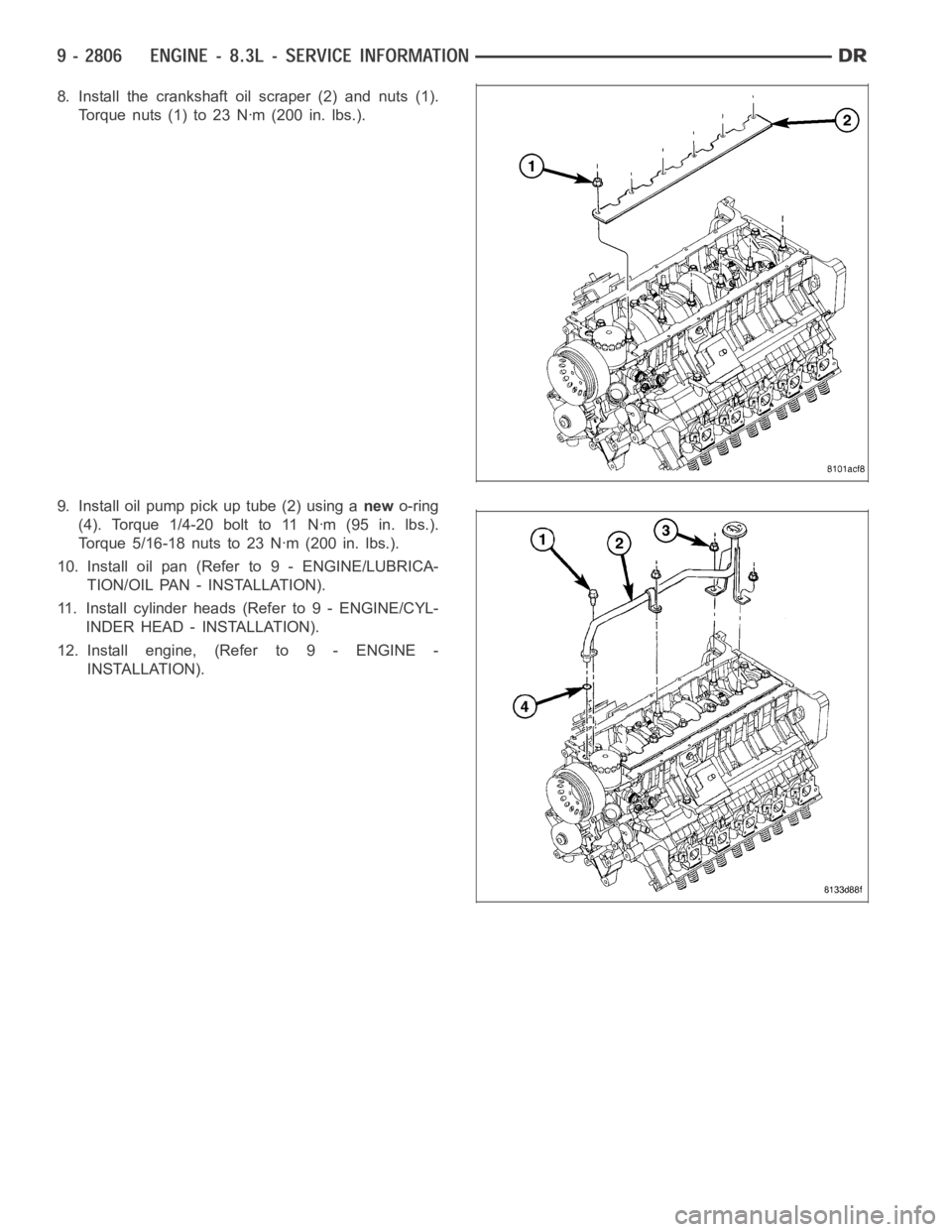
8. Install the crankshaft oil scraper (2) and nuts (1).
Torque nuts (1) to 23 Nꞏm (200 in. lbs.).
9. Install oil pump pick up tube (2) using anewo-ring
(4). Torque 1/4-20 bolt to 11 Nꞏm (95 in. lbs.).
Torque 5/16-18 nuts to 23 Nꞏm (200 in. lbs.).
10. Install oil pan (Refer to 9 - ENGINE/LUBRICA-
TION/OIL PAN - INSTALLATION).
11. Install cylinder heads (Refer to 9 - ENGINE/CYL-
INDER HEAD - INSTALLATION).
12. Install engine, (Refer to 9 - ENGINE -
INSTALLATION).
Page 2119 of 5267
BEARINGS-CONNECTING ROD
DESCRIPTION
The bearing caps are not interchangeable and should be paint marked or scribed at removal to insure correct
assembly.
The bearing shells must be installed so that the tangs are in the machined grooves in the rods and caps.
Limits of taper or out-of-round on any crankshaft journals should be held to 0.013 mm (0.0005 in.). Bearings are
available in 0.025 mm (0.001 in.), 0.051 mm (0.002 in.), 0.076 mm (0.003 in.), 0.254 mm (0.010 in.) and 0.305 mm
(0.012 in.) undersize.Install the bearings in pairs. Do not use a new bearing half with an old bearing half. Do
not file the rods or bearing caps.
STANDARD PROCEDURE
CONNECTING ROD BEARING - FITTING
Fit all rods on one bank until complete. Do not alternate from one bank to another, because when the rods are
assembled to pistons correctly, they are not interchangeable from one bank to another.
The bearing caps are not interchangeable and should be marked at removal toinsure correct assembly.
The bearing shells must be installed so that the tangs are in the machined grooves in the rods and caps.
Limits of taper or out-of-round on any crankshaft journals should be held to 0.013 mm (0.0005 in.). Bearings are
available in 0.025 mm (0.001 in.), 0.051 mm (0.002 in.), 0.076 mm (0.003 in.), 0.254 mm (0.010 in.) and 0.305 mm
(0.012 in.) undersize.Install the bearings in pairs. Do not use a new bearing half with an old bearing half. Do
not file the rods or bearing caps.
1. (Refer to 9 - ENGINE/ENGINE BLOCK/CONNECTING ROD BEARINGS - STANDARD PROCEDURE) - Mea-
suring Connecting Rod Bearing Clearance to determine bearing clearance.
2. Before installing the connecting rod cap bolts, the bolt threads shouldbe oiled with engine oil.
3. Install bolts finger tight, then alternately torque each bolt to assemble the cap properly.
4. Tighten the connecting rod bolts to 68 Nꞏm (50 ft. lbs.).
MEASURING CONNECTING ROD BEARING CLEARANCE
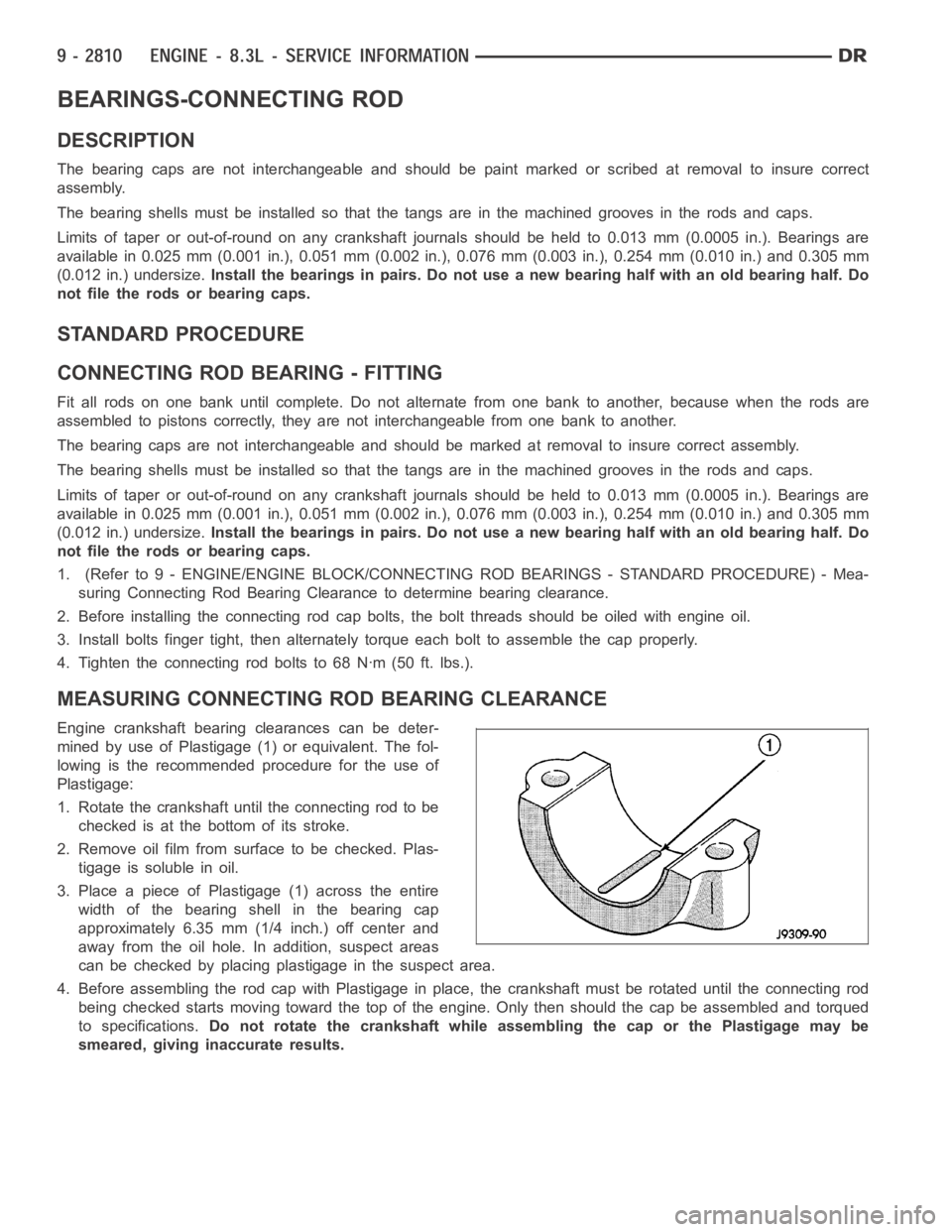
Engine crankshaft bearing clearances can be deter-
mined by use of Plastigage (1) or equivalent. The fol-
lowing is the recommended procedure for the use of
Plastigage:
1. Rotate the crankshaft until the connecting rod to be
checked is at the bottom of its stroke.
2. Remove oil film from surface to be checked. Plas-
tigage is soluble in oil.
3. Place a piece of Plastigage (1) across the entire
width of the bearing shell in the bearing cap
approximately 6.35 mm (1/4 inch.) off center and
away from the oil hole. In addition, suspect areas
can be checked by placing plastigage in the suspect area.
4. Before assembling the rod cap with Plastigage in place, the crankshaft must be rotated until the connecting rod
being checked starts moving toward the top of the engine. Only then should the cap be assembled and torqued
to specifications.Do not rotate the crankshaft while assembling the cap or the Plastigage maybe
smeared, giving inaccurate results.
Page 2127 of 5267
ALTERNATIVE METHOD
1. With the weight of the crankshaft being supported
by a jack under the counterweight adjacent to the
bearing being checked.
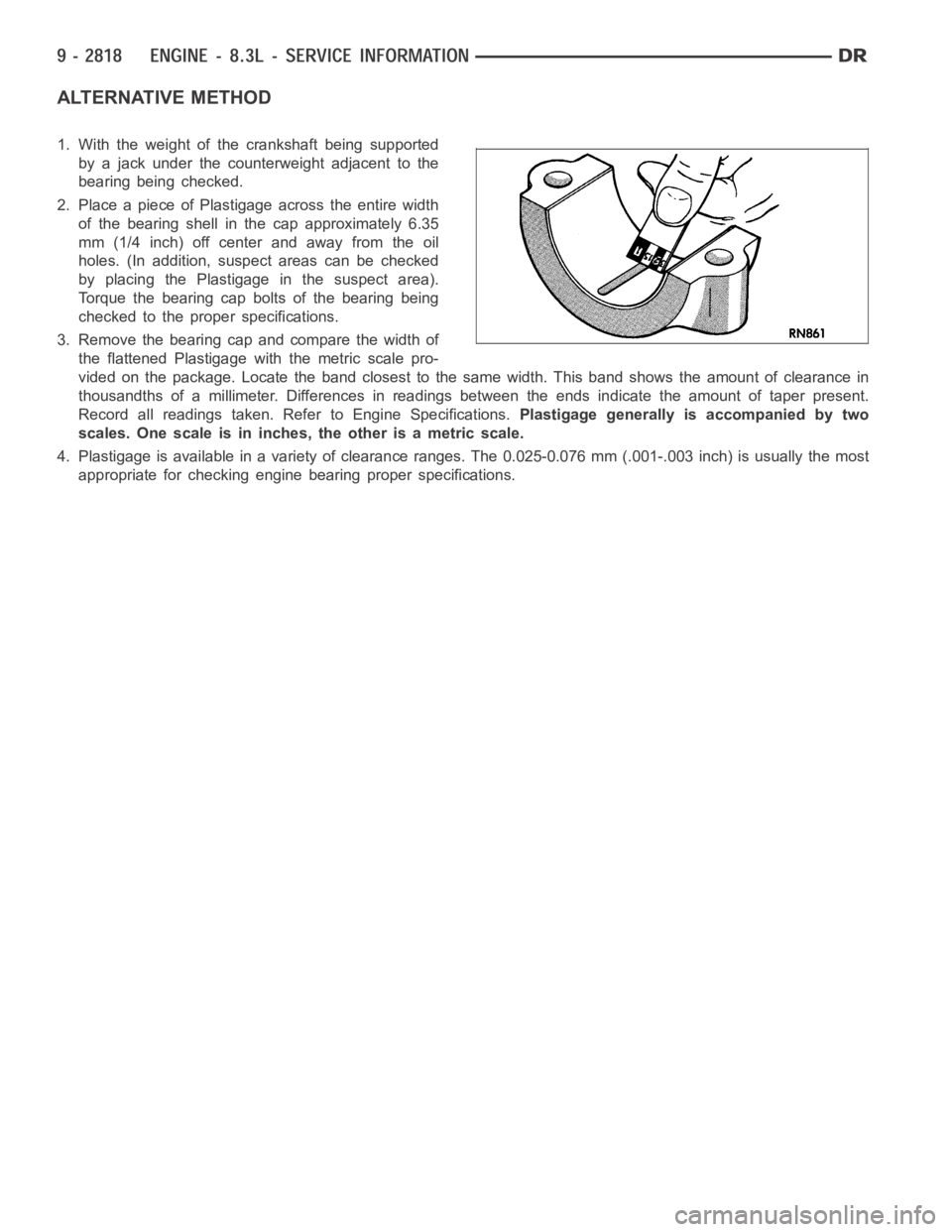
2. Place a piece of Plastigage across the entire width
of the bearing shell in the cap approximately 6.35
mm (1/4 inch) off center and away from the oil
holes. (In addition, suspect areas can be checked
by placing the Plastigage in the suspect area).
Torque the bearing cap bolts of the bearing being
checked to the proper specifications.
3. Remove the bearing cap and compare the width of
the flattened Plastigage with the metric scale pro-
vided on the package. Locate the band closest to the same width. This band shows the amount of clearance in
thousandths of a millimeter. Differences in readings between the ends indicate the amount of taper present.
Record all readings taken. Refer to Engine Specifications.Plastigage generally is accompanied by two
scales. One scale is in inches, the other is a metric scale.
4. Plastigage is available in a variety of clearance ranges. The 0.025-0.076 mm (.001-.003 inch) is usually the most
appropriate for checking engine bearing proper specifications.
Page 2132 of 5267
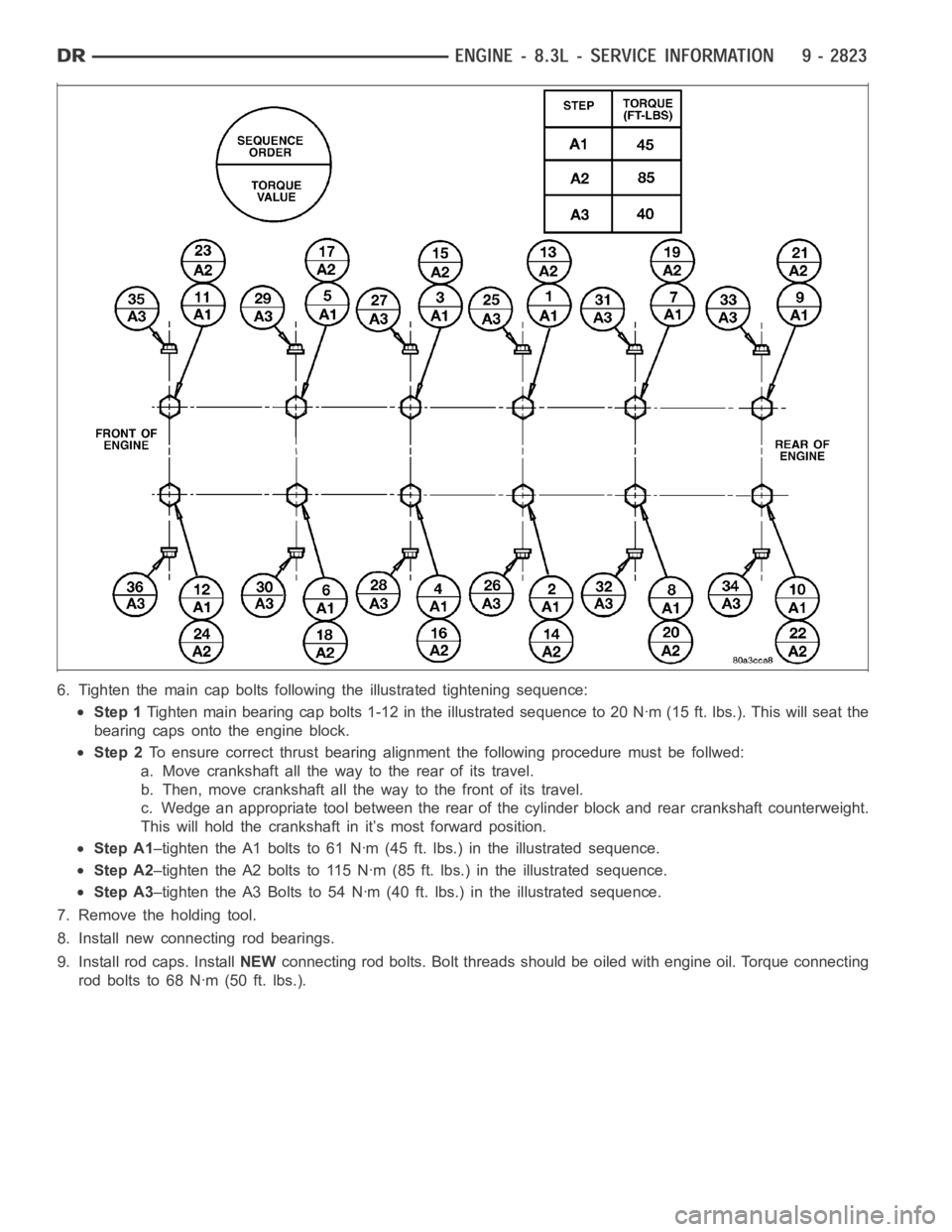
6. Tighten the main cap bolts following the illustrated tightening sequence:
Step 1Tighten main bearing cap bolts 1-12 inthe illustrated sequence to 20 Nꞏm (15 ft. lbs.). This will seat the
bearing caps onto the engine block.
Step 2To ensure correct thrust bearing alignment the following procedure must be follwed:
a. Move crankshaft all the way to the rear of its travel.
b. Then, move crankshaft all the way to the front of its travel.
c. Wedge an appropriate tool between the rear of the cylinder block and rearcrankshaft counterweight.
This will hold the crankshaft in it’s most forward position.
Step A1–tighten the A1 bolts to 61 Nꞏm (45 ft. lbs.) in the illustrated sequence.
Step A2–tighten the A2 bolts to 115 Nꞏm (85 ft. lbs.) in the illustrated sequence.
Step A3–tighten the A3 Bolts to 54 Nꞏm (40 ft. lbs.) in the illustrated sequence.
7. Remove the holding tool.
8. Install new connecting rod bearings.
9. Install rod caps. InstallNEWconnecting rod bolts. Bolt threads should be oiled with engine oil. Torqueconnecting
rod bolts to 68 Nꞏm (50 ft. lbs.).
Page 2133 of 5267
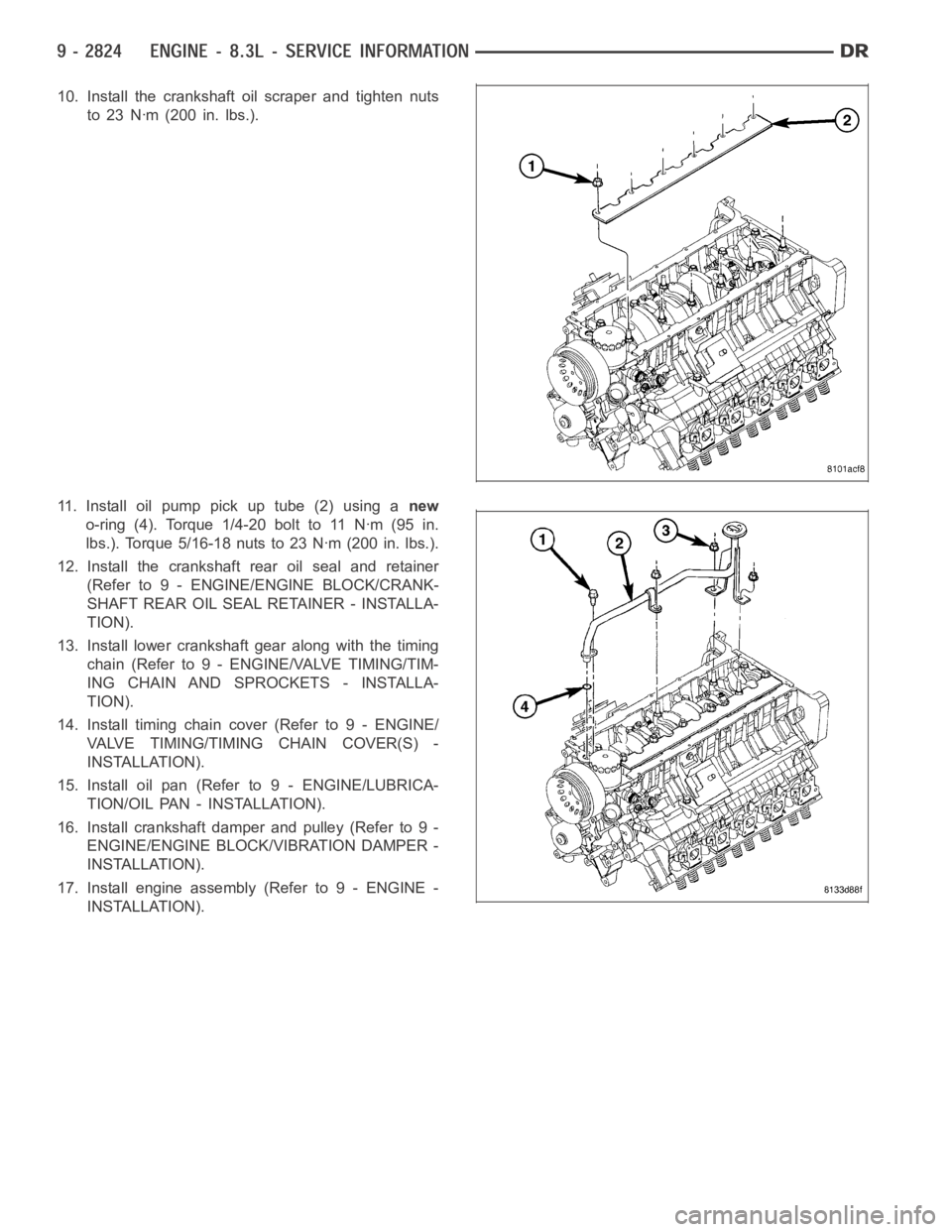
10. Install the crankshaft oil scraper and tighten nuts
to 23 Nꞏm (200 in. lbs.).
11.Installoilpumppickuptube(2)usinganew
o-ring (4). Torque 1/4-20 bolt to 11 Nꞏm (95 in.
lbs.). Torque 5/16-18 nuts to 23 Nꞏm (200 in. lbs.).
12. Install the crankshaft rear oil seal and retainer
(Refer to 9 - ENGINE/ENGINE BLOCK/CRANK-
SHAFT REAR OIL SEAL RETAINER - INSTALLA-
TION).
13. Install lower crankshaft gear along with the timing
chain (Refer to 9 - ENGINE/VALVE TIMING/TIM-
ING CHAIN AND SPROCKETS - INSTALLA-
TION).
14. Install timing chain cover (Refer to 9 - ENGINE/
VALVE TIMING/TIMING CHAIN COVER(S) -
INSTALLATION).
15. Install oil pan (Refer to 9 - ENGINE/LUBRICA-
TION/OIL PAN - INSTALLATION).
16. Install crankshaft damper and pulley (Refer to 9 -
ENGINE/ENGINE BLOCK/VIBRATION DAMPER -
INSTALLATION).
17. Install engine assembly (Refer to 9 - ENGINE -
INSTALLATION).
Page 2136 of 5267
EXHAUST SYSTEM
TABLE OF CONTENTS
page page
EXHAUST SYSTEM
DESCRIPTION
GAS ENGINES ............................... 2
5.9L DIESEL ................................. 3
DIAGNOSIS AND TESTING
GAS ENGINE ................................ 4
DIESEL ENGINE............................. 5
SPECIFICATIONS
TORQUE .................................... 5
SPECIAL TOOLS ............................... 7
CONVERTER-CATALYTIC
DESCRIPTION ................................. 8
OPERATION ................................... 8
REMOVAL
3.7L/4.7L ENGINE ............................ 8
5.7L ENGINE ................................ 9
5.9L DIESEL ENGINE ......................... 9
8.3L ENGINE ............................... 10
INSPECTION ................................. 10
INSTALLATION
3.7L/4.7L ENGINE ........................... 10
5.7L ENGINE ............................... 11
5.9L ENGINE DIESEL ........................ 11
8.3L ENGINE ............................... 12
PIPE EXHAUST
REMOVAL
3.7L/4.7L/5.7L ENGINE ...................... 13
5.9L DIESEL ................................ 13
8.3L ENGINE ............................... 13
INSPECTION ................................. 14
INSTALLATION
3.7L/4.7L/5.7L ENGINE ...................... 14
5.9L DIESEL ................................ 14
8.3L ENGINE ............................... 15
HEAT SHIELDS
DESCRIPTION ................................ 16
REMOVAL .................................... 16
INSTALLATION ............................... 17
MUFFLER
REMOVAL
3.7L/4.7L/5.7L ENGINE ...................... 19
8.3L ENGINE ............................... 195.9L DIESEL ENGINE....................... 20
INSTALLATION
3.7L/4.7L/5.7L ENGINE ...................... 20
8.3L ENGINE ............................... 21
5.9L DIESEL ENGINE....................... 21
TAILPIPE
REMOVAL
3.7L/4.7L/5.7L ENGINE ...................... 22
5.9L DIESEL................................ 22
8.3L ENGINE ............................... 23
INSPECTION ................................. 23
INSTALLATION
3.7L/4.7L/5.7L ENGINE ...................... 23
5.9L DIESEL................................ 24
8.3L ENGINE ............................... 24
TURBOCHARGER SYSTEM
DIAGNOSIS AND TESTING
TURBOCHARGER BOOST PRESSURE ....... 25
TURBOCHARGER
DESCRIPTION ................................ 26
OPERATION .................................. 27
REMOVAL
TURBOCHARGER .......................... 29
TURBOCHARGER OIL DRAIN TUBE .......... 30
CLEANING ................................... 30
INSPECTION ................................. 30
INSTALLATION
TURBOCHARGER .......................... 31
TURBOCHARGER OIL DRAIN TUBE .......... 32
WASTEGATE - ELECTRONIC ACTUATOR
REMOVAL .................................... 33
INSTALLATION ............................... 33
CHARGE AIR COOLER AND PLUMBING
DESCRIPTION ................................ 34
OPERATION .................................. 34
DIAGNOSIS AND TESTING
CHARGE AIR COOLER SYSTEM - LEAKS.... 35
REMOVAL .................................... 35
CLEANING ................................... 36
INSPECTION ................................. 36
INSTALLATION ............................... 36
Page 2140 of 5267
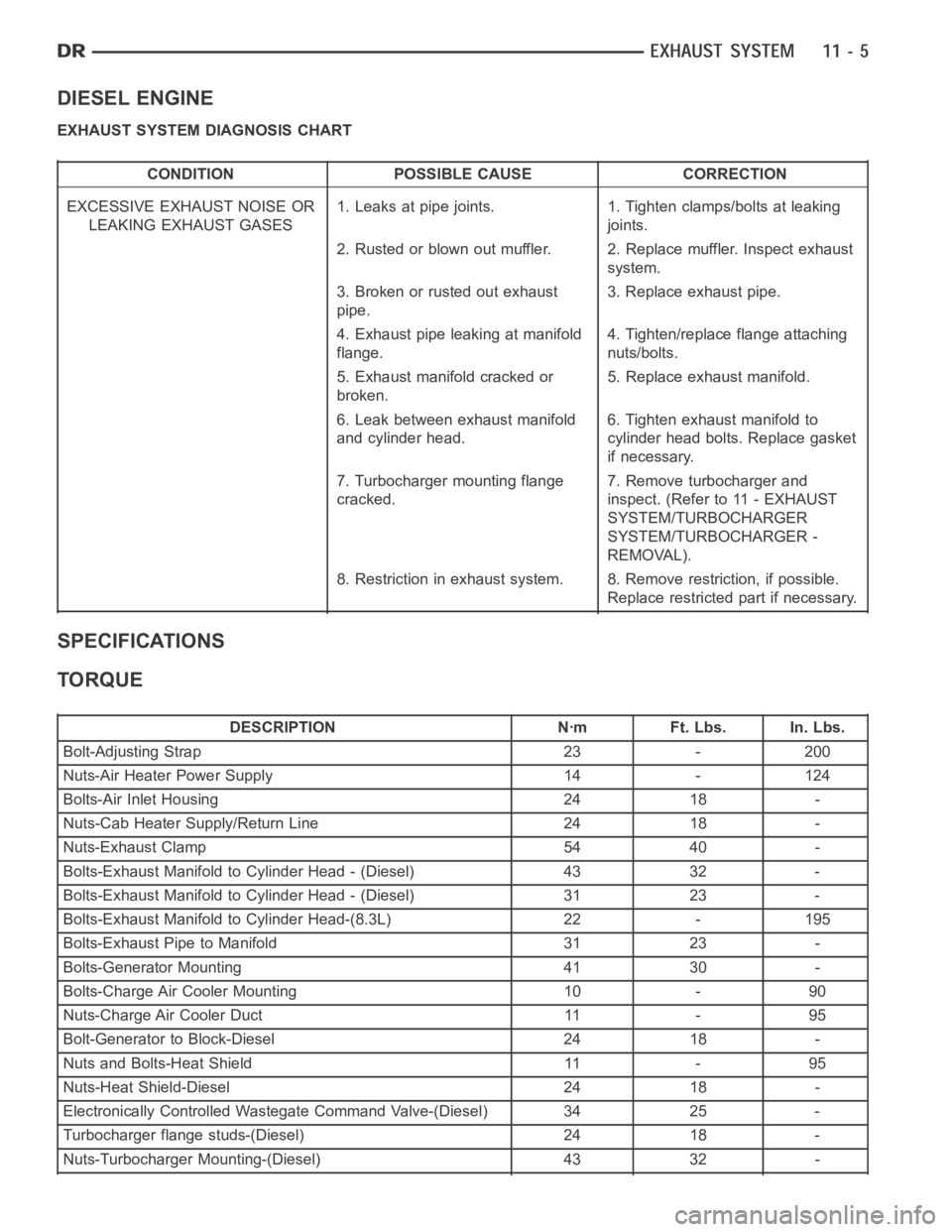
DIESEL ENGINE
EXHAUST SYSTEM DIAGNOSIS CHART
CONDITION POSSIBLE CAUSE CORRECTION
EXCESSIVE EXHAUST NOISE OR
LEAKING EXHAUST GASES1. Leaks at pipe joints. 1. Tighten clamps/bolts at leaking
joints.
2. Rusted or blown out muffler. 2. Replace muffler. Inspect exhaust
system.
3. Broken or rusted out exhaust
pipe.3. Replace exhaust pipe.
4. Exhaust pipe leaking at manifold
flange.4. Tighten/replace flange attaching
nuts/bolts.
5. Exhaust manifold cracked or
broken.5. Replace exhaust manifold.
6. Leak between exhaust manifold
and cylinder head.6. Tighten exhaust manifold to
cylinder head bolts. Replace gasket
if necessary.
7. Turbocharger mounting flange
cracked.7. Remove turbocharger and
inspect. (Refer to 11 - EXHAUST
SYSTEM/TURBOCHARGER
SYSTEM/TURBOCHARGER -
REMOVAL).
8. Restriction in exhaust system. 8. Remove restriction, if possible.
Replace restricted part if necessary.
SPECIFICATIONS
TORQUE
DESCRIPTION Nꞏm Ft. Lbs. In. Lbs.
Bolt-Adjusting Strap 23 - 200
Nuts-Air Heater Power Supply 14 - 124
Bolts-Air Inlet Housing 24 18 -
Nuts-Cab Heater Supply/Return Line 24 18 -
Nuts-Exhaust Clamp 54 40 -
Bolts-Exhaust Manifold to Cylinder Head - (Diesel) 43 32 -
Bolts-Exhaust Manifold to Cylinder Head - (Diesel) 31 23 -
Bolts-Exhaust Manifold to Cylinder Head-(8.3L) 22 - 195
Bolts-Exhaust Pipe to Manifold 31 23 -
Bolts-Generator Mounting 41 30 -
Bolts-Charge Air Cooler Mounting 10 - 90
Nuts-Charge Air Cooler Duct 11 - 95
Bolt-Generator to Block-Diesel 24 18 -
Nuts and Bolts-Heat Shield 11 - 95
Nuts-Heat Shield-Diesel 24 18 -
Electronically Controlled Wastegate Command Valve-(Diesel) 34 25 -
Turbocharger flange studs-(Diesel) 24 18 -
Nuts-Turbocharger Mounting-(Diesel) 43 32 -
Page 2145 of 5267
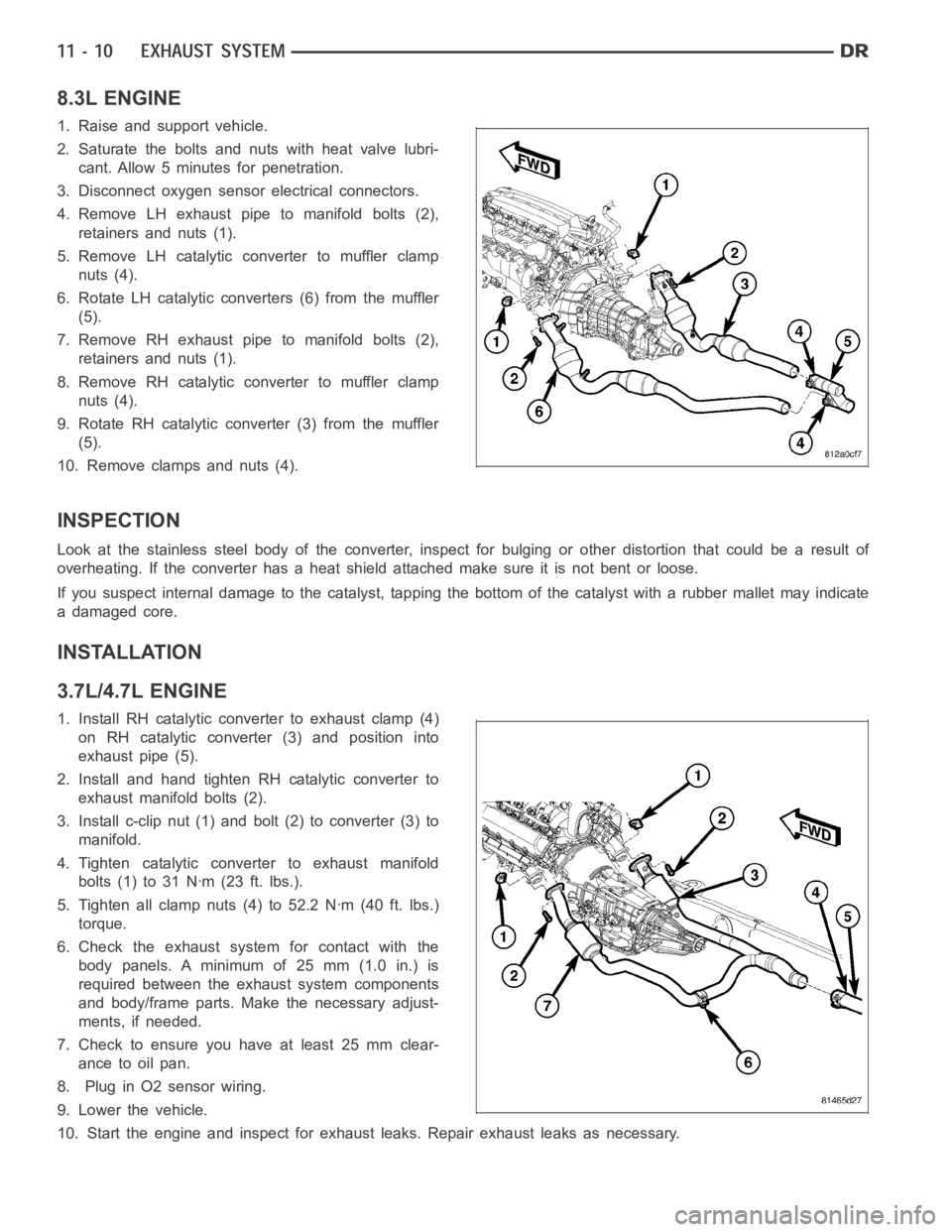
8.3L ENGINE
1. Raise and support vehicle.
2. Saturate the bolts and nuts with heat valve lubri-
cant. Allow 5 minutes for penetration.
3. Disconnect oxygen sensor electrical connectors.
4. Remove LH exhaust pipe to manifold bolts (2),
retainers and nuts (1).
5. Remove LH catalytic converter to muffler clamp
nuts (4).
6. Rotate LH catalytic converters (6) from the muffler
(5).
7. Remove RH exhaust pipe to manifold bolts (2),
retainers and nuts (1).
8. Remove RH catalytic converter to muffler clamp
nuts (4).
9. Rotate RH catalytic converter (3) from the muffler
(5).
10. Remove clamps and nuts (4).
INSPECTION
Look at the stainless steel body of the converter, inspect for bulging or other distortion that could be a result of
overheating. If the converter has a heat shield attached make sure it is notbent or loose.
If you suspect internal damage to the catalyst, tapping the bottom of the catalyst with a rubber mallet may indicate
a damaged core.
INSTALLATION
3.7L/4.7L ENGINE
1. Install RH catalytic converter to exhaust clamp (4)
on RH catalytic converter (3) and position into
exhaust pipe (5).
2. Install and hand tighten RH catalytic converter to
exhaust manifold bolts (2).
3. Install c-clip nut (1) and bolt (2) to converter (3) to
manifold.
4. Tighten catalytic converter to exhaust manifold
bolts(1)to31Nꞏm(23ft.lbs.).
5. Tighten all clamp nuts (4) to 52.2 Nꞏm (40 ft. lbs.)
torque.
6. Check the exhaust system for contact with the
body panels. A minimum of 25 mm (1.0 in.) is
required between the exhaust system components
and body/frame parts. Make the necessary adjust-
ments, if needed.
7. Check to ensure you have at least 25 mm clear-
ance to oil pan.
8. Plug in O2 sensor wiring.
9. Lower the vehicle.
10. Start the engine and inspect for exhaust leaks. Repair exhaust leaks asnecessary.
Page 2146 of 5267
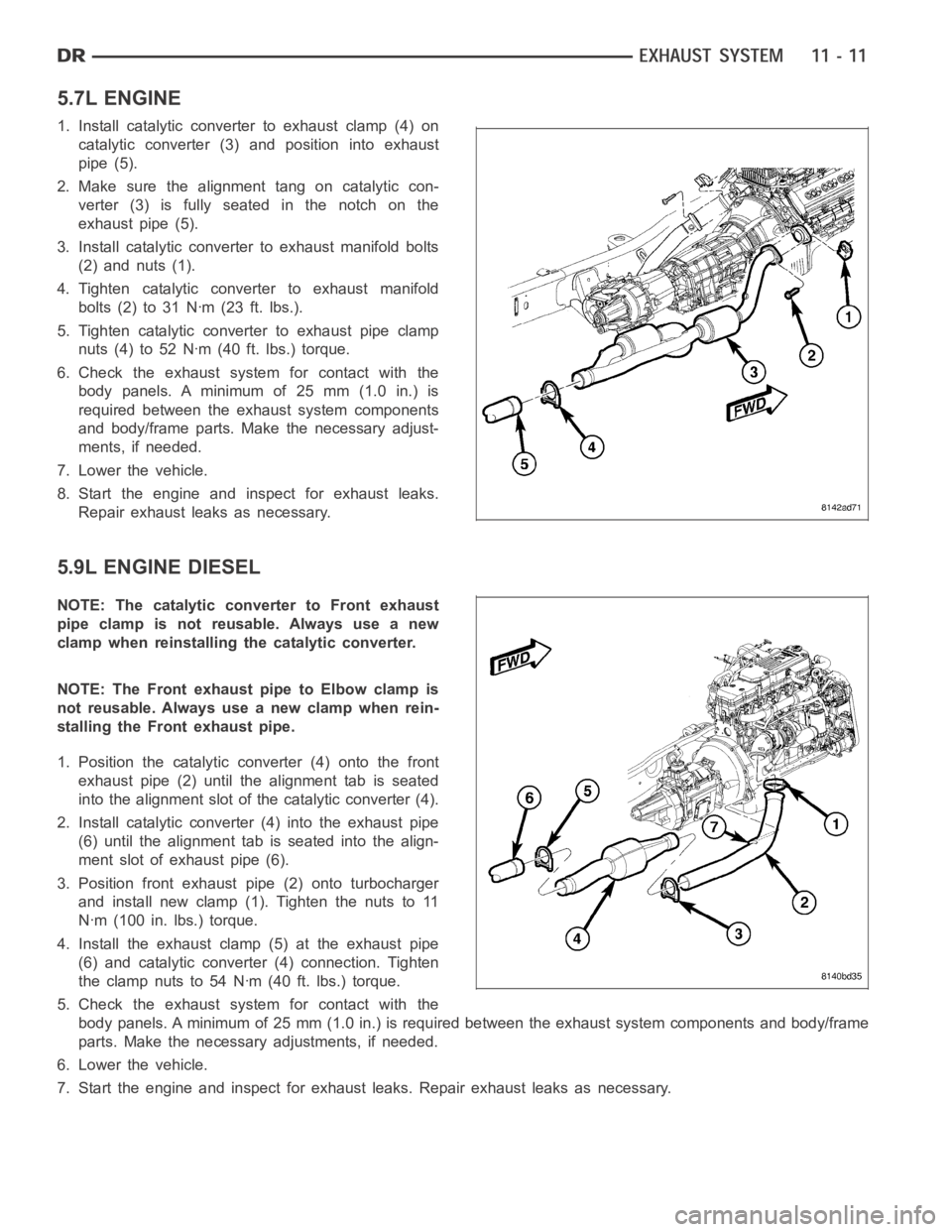
5.7L ENGINE
1. Install catalytic converter to exhaust clamp (4) on
catalytic converter (3) and position into exhaust
pipe (5).
2. Make sure the alignment tang on catalytic con-
verter (3) is fully seated in the notch on the
exhaust pipe (5).
3. Install catalytic converter to exhaust manifold bolts
(2) and nuts (1).
4. Tighten catalytic converter to exhaust manifold
bolts(2)to31Nꞏm(23ft.lbs.).
5. Tighten catalytic converter to exhaust pipe clamp
nuts (4) to 52 Nꞏm (40 ft. lbs.) torque.
6. Check the exhaust system for contact with the
body panels. A minimum of 25 mm (1.0 in.) is
required between the exhaust system components
and body/frame parts. Make the necessary adjust-
ments, if needed.
7. Lower the vehicle.
8. Start the engine and inspect for exhaust leaks.
Repair exhaust leaks as necessary.
5.9L ENGINE DIESEL
NOTE: The catalytic converter to Front exhaust
pipe clamp is not reusable. Always use a new
clamp when reinstalling the catalytic converter.
NOTE: The Front exhaust pipe to Elbow clamp is
not reusable. Always use a new clamp when rein-
stalling the Front exhaust pipe.
1. Position the catalytic converter (4) onto the front
exhaust pipe (2) until the alignment tab is seated
into the alignment slot of the catalytic converter (4).
2. Install catalytic converter (4) into the exhaust pipe
(6) until the alignment tab is seated into the align-
ment slot of exhaust pipe (6).
3. Position front exhaust pipe (2) onto turbocharger
and install new clamp (1). Tighten the nuts to 11
Nꞏm (100 in. lbs.) torque.
4. Install the exhaust clamp (5) at the exhaust pipe
(6) and catalytic converter (4) connection. Tighten
the clamp nuts to 54 Nꞏm (40 ft. lbs.) torque.
5. Check the exhaust system for contact with the
body panels. A minimum of 25 mm (1.0 in.) is required between the exhaust system components and body/frame
parts. Make the necessary adjustments, if needed.
6. Lower the vehicle.
7. Start the engine and inspect for exhaust leaks. Repair exhaust leaks as necessary.
Page 2147 of 5267
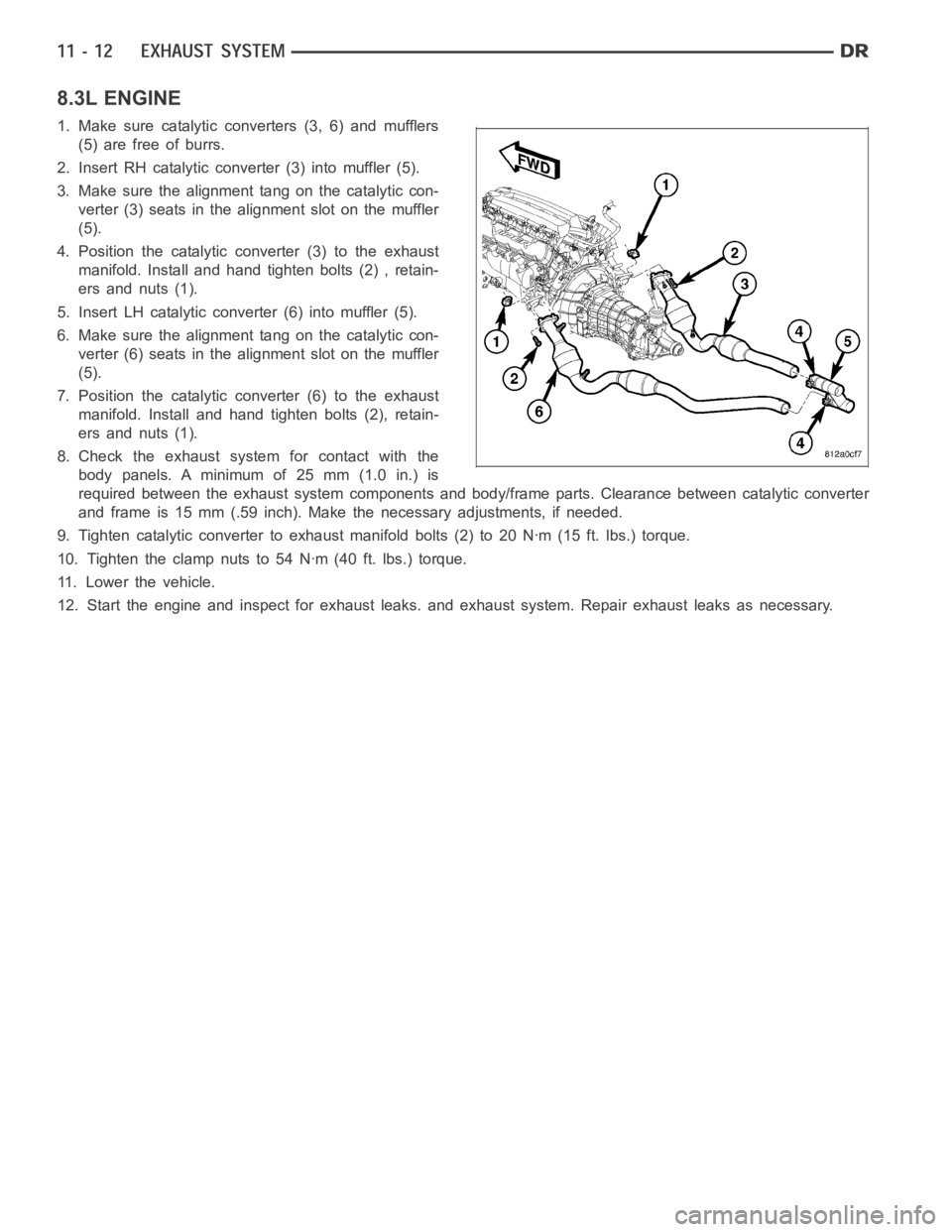
8.3L ENGINE
1. Make sure catalytic converters (3, 6) and mufflers
(5) are free of burrs.
2. Insert RH catalytic converter (3) into muffler (5).
3. Make sure the alignment tang on the catalytic con-
verter (3) seats in the alignment slot on the muffler
(5).
4. Position the catalytic converter (3) to the exhaust
manifold. Install and hand tighten bolts (2) , retain-
ers and nuts (1).
5. Insert LH catalytic converter (6) into muffler (5).
6. Make sure the alignment tang on the catalytic con-
verter (6) seats in the alignment slot on the muffler
(5).
7. Position the catalytic converter (6) to the exhaust
manifold. Install and hand tighten bolts (2), retain-
ers and nuts (1).
8. Check the exhaust system for contact with the
body panels. A minimum of 25 mm (1.0 in.) is
required between the exhaust system components and body/frame parts. Clearance between catalytic converter
and frame is 15 mm (.59 inch). Make the necessary adjustments, if needed.
9. Tighten catalytic converter to exhaust manifold bolts (2) to 20 Nꞏm (15 ft. lbs.) torque.
10. Tighten the clamp nuts to 54 Nꞏm (40 ft. lbs.) torque.
11. Lower the vehicle.
12. Start the engine and inspect for exhaust leaks. and exhaust system. Repair exhaust leaks as necessary.