torque DODGE RAM SRT-10 2006 Service Repair Manual
[x] Cancel search | Manufacturer: DODGE, Model Year: 2006, Model line: RAM SRT-10, Model: DODGE RAM SRT-10 2006Pages: 5267, PDF Size: 68.7 MB
Page 2174 of 5267
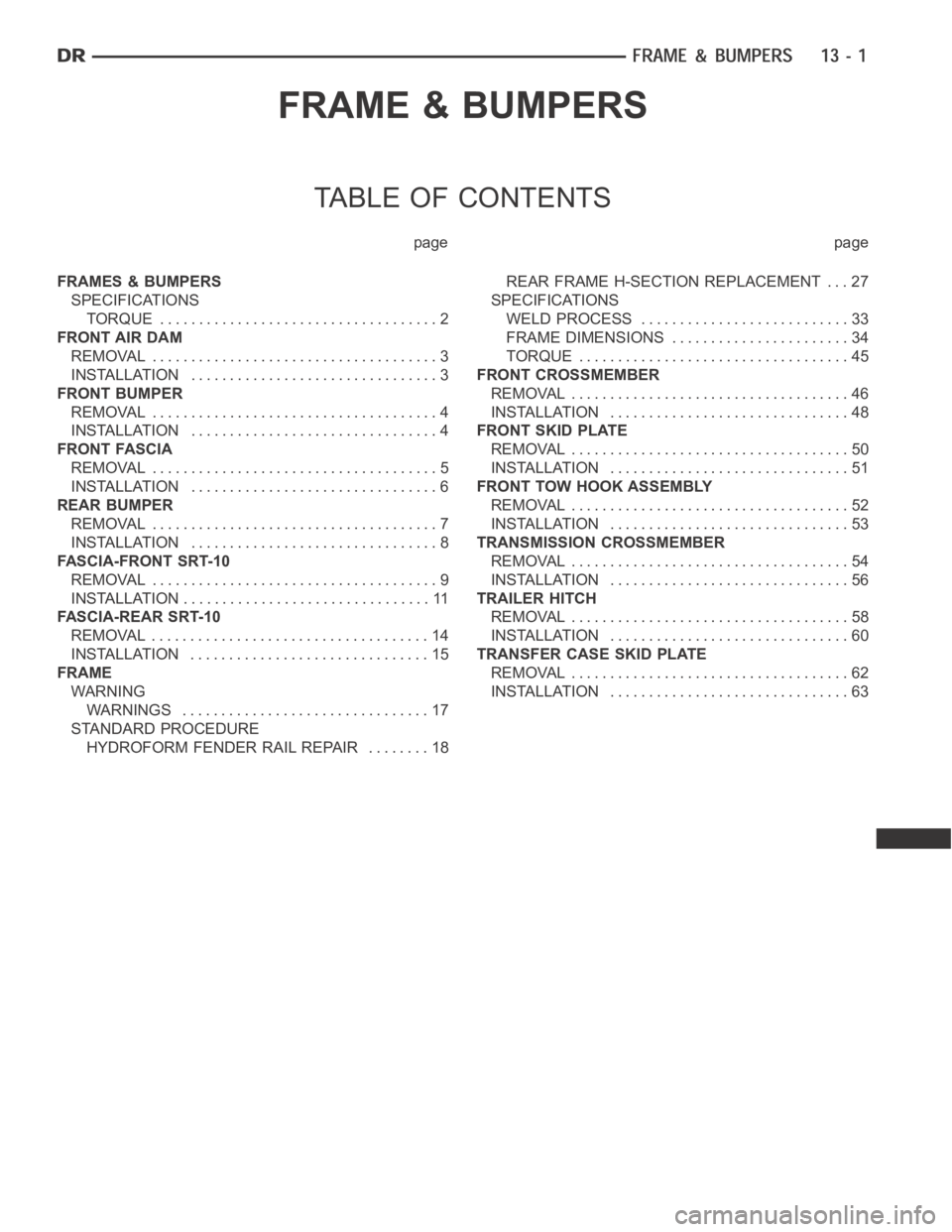
FRAME & BUMPERS
TABLE OF CONTENTS
page page
FRAMES & BUMPERS
SPECIFICATIONS
TORQUE .................................... 2
FRONT AIR DAM
REMOVAL ..................................... 3
INSTALLATION ................................ 3
FRONT BUMPER
REMOVAL ..................................... 4
INSTALLATION ................................ 4
FRONT FASCIA
REMOVAL ..................................... 5
INSTALLATION ................................ 6
REAR BUMPER
REMOVAL ..................................... 7
INSTALLATION ................................ 8
FASCIA-FRONT SRT-10
REMOVAL ..................................... 9
INSTALLATION ................................ 11
FASCIA-REAR SRT-10
REMOVAL .................................... 14
INSTALLATION ............................... 15
FRAME
WARNING
WARNINGS ................................ 17
STANDARD PROCEDURE
HYDROFORM FENDER RAIL REPAIR ........ 18REAR FRAME H-SECTION REPLACEMENT . . . 27
SPECIFICATIONS
WELD PROCESS ........................... 33
FRAME DIMENSIONS ....................... 34
TORQUE ................................... 45
FRONT CROSSMEMBER
REMOVAL .................................... 46
INSTALLATION ............................... 48
FRONT SKID PLATE
REMOVAL .................................... 50
INSTALLATION ............................... 51
FRONT TOW HOOK ASSEMBLY
REMOVAL .................................... 52
INSTALLATION ............................... 53
TRANSMISSION CROSSMEMBER
REMOVAL .................................... 54
INSTALLATION ............................... 56
TRAILER HITCH
REMOVAL .................................... 58
INSTALLATION ............................... 60
TRANSFER CASE SKID PLATE
REMOVAL .................................... 62
INSTALLATION ............................... 63
Page 2175 of 5267
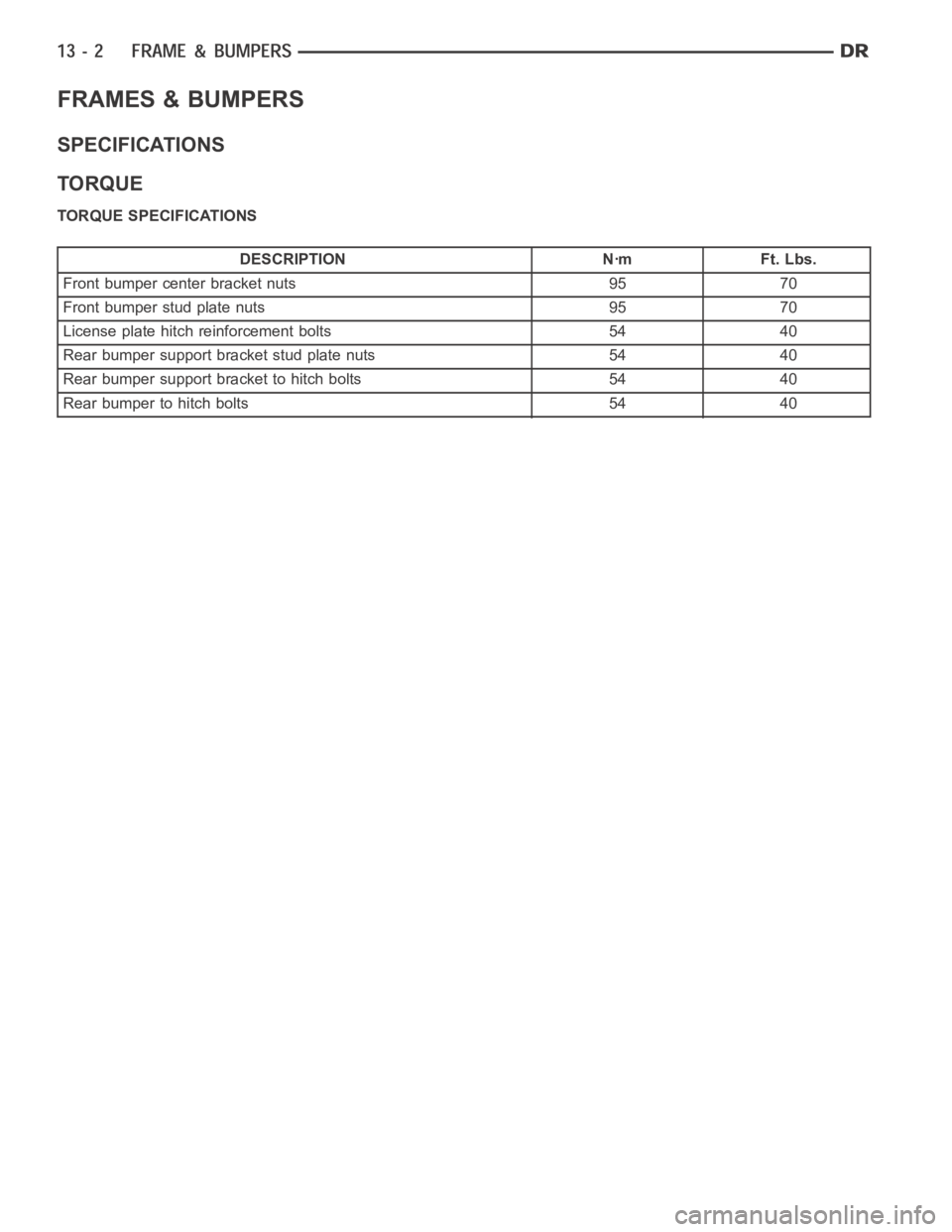
FRAMES & BUMPERS
SPECIFICATIONS
TORQUE
TORQUE SPECIFICATIONS
DESCRIPTION Nꞏm Ft. Lbs.
Front bumper center bracket nuts 95 70
Front bumper stud plate nuts 95 70
License plate hitch reinforcement bolts 54 40
Rear bumper support bracket stud plate nuts 54 40
Rear bumper support bracket to hitch bolts 54 40
Rear bumper to hitch bolts 54 40
Page 2218 of 5267
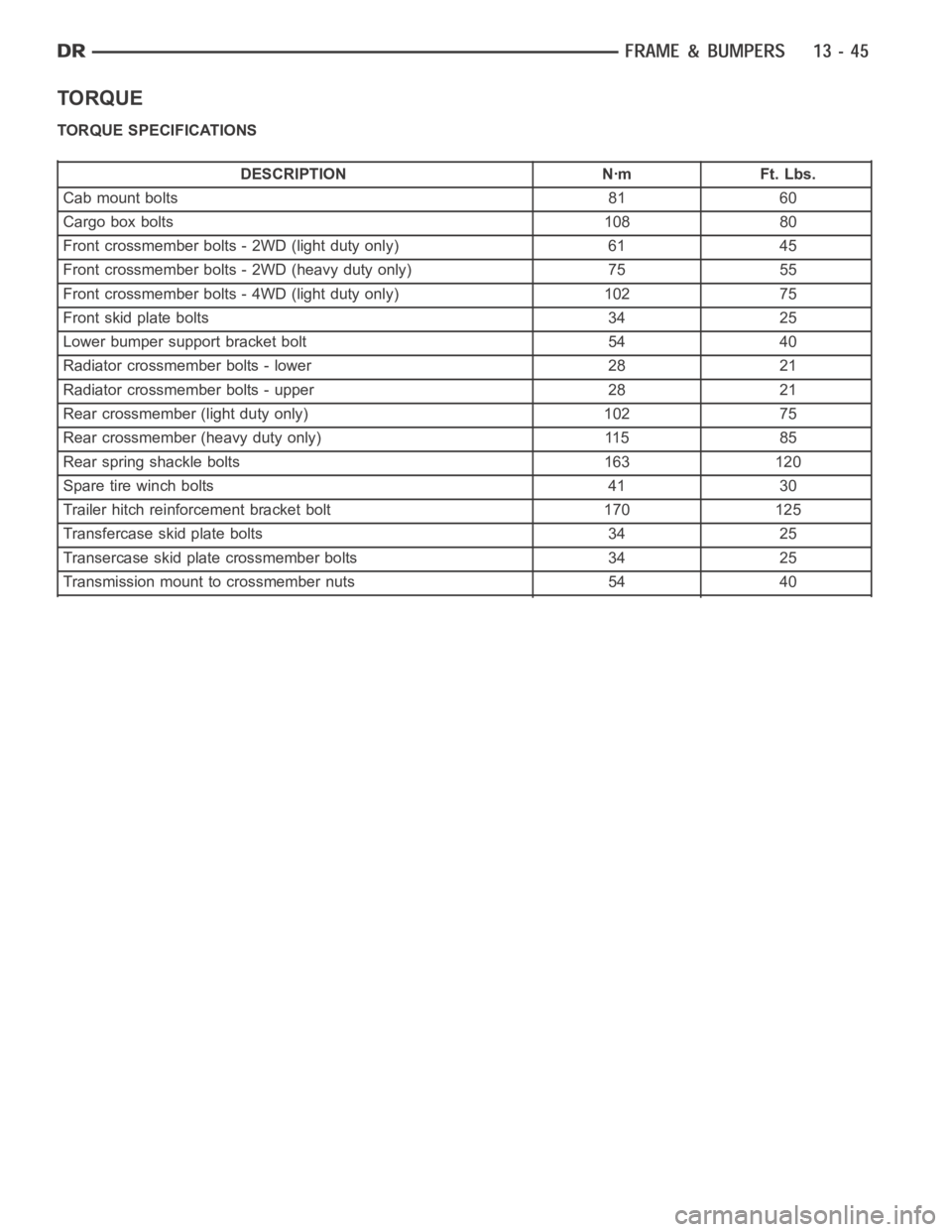
TORQUE
TORQUE SPECIFICATIONS
DESCRIPTION Nꞏm Ft. Lbs.
Cab mount bolts 81 60
Cargo box bolts 108 80
Front crossmember bolts - 2WD (light duty only) 61 45
Front crossmember bolts - 2WD (heavy duty only) 75 55
Front crossmember bolts - 4WD (light duty only) 102 75
Front skid plate bolts 34 25
Lower bumper support bracket bolt 54 40
Radiator crossmember bolts - lower 28 21
Radiator crossmember bolts - upper 28 21
Rear crossmember (light duty only) 102 75
Rear crossmember (heavy duty only) 115 85
Rear spring shackle bolts 163 120
Sparetirewinchbolts 41 30
Trailer hitch reinforcement bracket bolt 170 125
Transfercase skid plate bolts 34 25
Transercase skid plate crossmember bolts 34 25
Transmission mount to crossmember nuts 54 40
Page 2238 of 5267
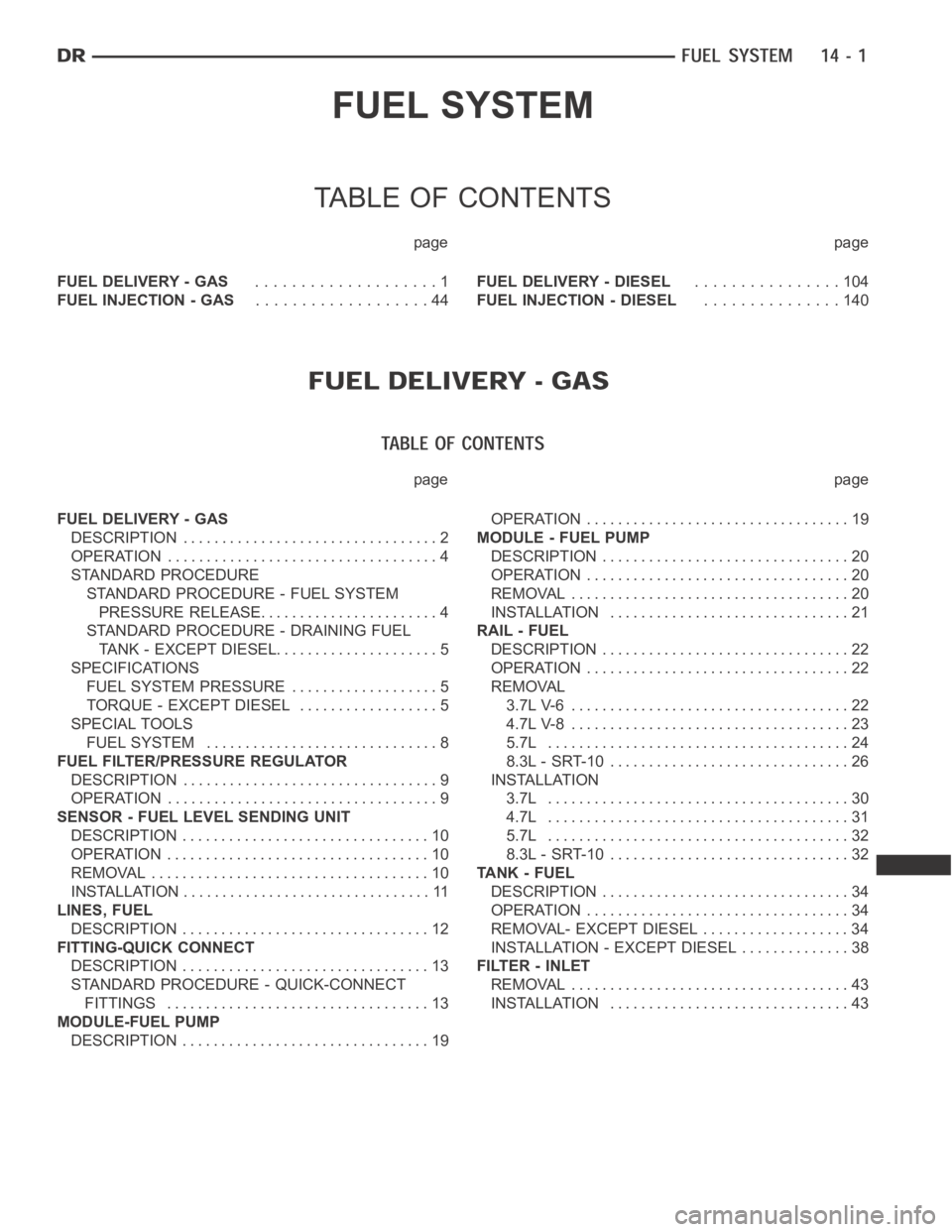
FUEL SYSTEM
TABLE OF CONTENTS
page page
FUEL DELIVERY - GAS....................1
FUEL INJECTION - GAS...................44FUEL DELIVERY - DIESEL................104
FUEL INJECTION - DIESEL...............140
page page
FUEL DELIVERY - GAS
DESCRIPTION ................................. 2
OPERATION ................................... 4
STANDARD PROCEDURE
STANDARD PROCEDURE - FUEL SYSTEM
PRESSURE RELEASE........................ 4
STANDARD PROCEDURE - DRAINING FUEL
TANK - EXCEPT DIESEL...................... 5
SPECIFICATIONS
FUEL SYSTEM PRESSURE ................... 5
TORQUE - EXCEPT DIESEL.................. 5
SPECIAL TOOLS
FUEL SYSTEM.............................. 8
FUEL FILTER/PRESSURE REGULATOR
DESCRIPTION ................................. 9
OPERATION ................................... 9
SENSOR - FUEL LEVEL SENDING UNIT
DESCRIPTION ................................ 10
OPERATION .................................. 10
REMOVAL .................................... 10
INSTALLATION ................................ 11
LINES, FUEL
DESCRIPTION ................................ 12
FITTING-QUICK CONNECT
DESCRIPTION ................................ 13
STANDARD PROCEDURE - QUICK-CONNECT
FITTINGS .................................. 13
MODULE-FUEL PUMP
DESCRIPTION ................................ 19OPERATION .................................. 19
MODULE - FUEL PUMP
DESCRIPTION ................................ 20
OPERATION .................................. 20
REMOVAL .................................... 20
INSTALLATION ............................... 21
RAIL - FUEL
DESCRIPTION ................................ 22
OPERATION .................................. 22
REMOVAL
3.7L V-6 .................................... 22
4.7L V-8 .................................... 23
5.7L ....................................... 24
8.3L - SRT-10 ............................... 26
INSTALLATION
3.7L ....................................... 30
4.7L ....................................... 31
5.7L ....................................... 32
8.3L - SRT-10 ............................... 32
TA N K - F U E L
DESCRIPTION ................................ 34
OPERATION .................................. 34
REMOVAL- EXCEPT DIESEL ................... 34
INSTALLATION - EXCEPT DIESEL . ............. 38
FILTER - INLET
REMOVAL .................................... 43
INSTALLATION ............................... 43
Page 2242 of 5267
8. Connect other end of jumper wire to positive side of battery.
9. Connect one end of a second jumper wire to remaining injector terminal.
CAUTION: Powering an injector for more than a few seconds will permanentlydamage the injector.
10. Momentarily touch other end of jumper wire to negative terminal of battery for no more than a few seconds.
11. Place a rag or towel below fuel line quick-connect fitting at fuel rail.
12. Disconnect quick-connect fitting at fuel rail. Refer to Quick-Connect Fittings.
13. Return fuel pump relay to PDC.
14. One or more Diagnostic Trouble Codes (DTC’s) may have been stored in PCMmemory due to fuel pump relay
removal. The DRB
scantoolmustbeusedtoeraseaDTC.
STANDARD PROCEDURE - DRAINING FUEL TANK - EXCEPT DIESEL
WARNING: The fuel system may be under constant fuel pressure even with the engine off. This pressure
must be released before servicing fuel tank.
Two different procedures may be used to drain fuel tank: through the fuel fill fitting on tank, or using a diagnostic
scan tool to activate the fuel pump relay. Due to a one-way check valve installed into the fuel fill opening fitting at
the tank, the tank cannot be drained conventionally at the fill cap.
The quickest draining procedure involves removing the rubber fuel fill hose at the fuel tank.
As an alternative procedure, the electric fuel pump may be activated allowingtanktobedrainedatfuelrailcon-
nection. Refer to diagnostic scan tool for fuel pump activation procedures. Before disconnecting fuel line at fuel rail,
release fuel pressure. Refer to the Fuel System Pressure Release Procedure for procedures. Attach end of special
test hose tool number 6631 or 6539 at fuel rail disconnection (tool number 6631isusedon5/16”fuellineswhile
tool number 6539 is used on 3/8” fuel lines). Position opposite end of this hose tool to an approved gasoline drain-
ing station. Activate fuel pump and drain tank until empty.
If electric fuel pump is not operating, fuel must be drained through fuel fill fitting at tank. Refer to following proce-
dures.
1. Release fuel system pressure.
2. Raise vehicle.
3. Thoroughly clean area around fuel fill fitting and rubber fuel fill hoseat tank.
4. If vehicle is equipped with 4 doors and a 6 foot (short) box, remove left-rear tire/wheel.
5. Loosen clamp and disconnect rubber fuel fill hose at tank fitting. Usingan approved gas holding tank, drain fuel
tank through this fitting.
SPECIFICATIONS
FUEL SYSTEM PRESSURE
58 psi +/- 2 psi
TORQUE - EXCEPT DIESEL
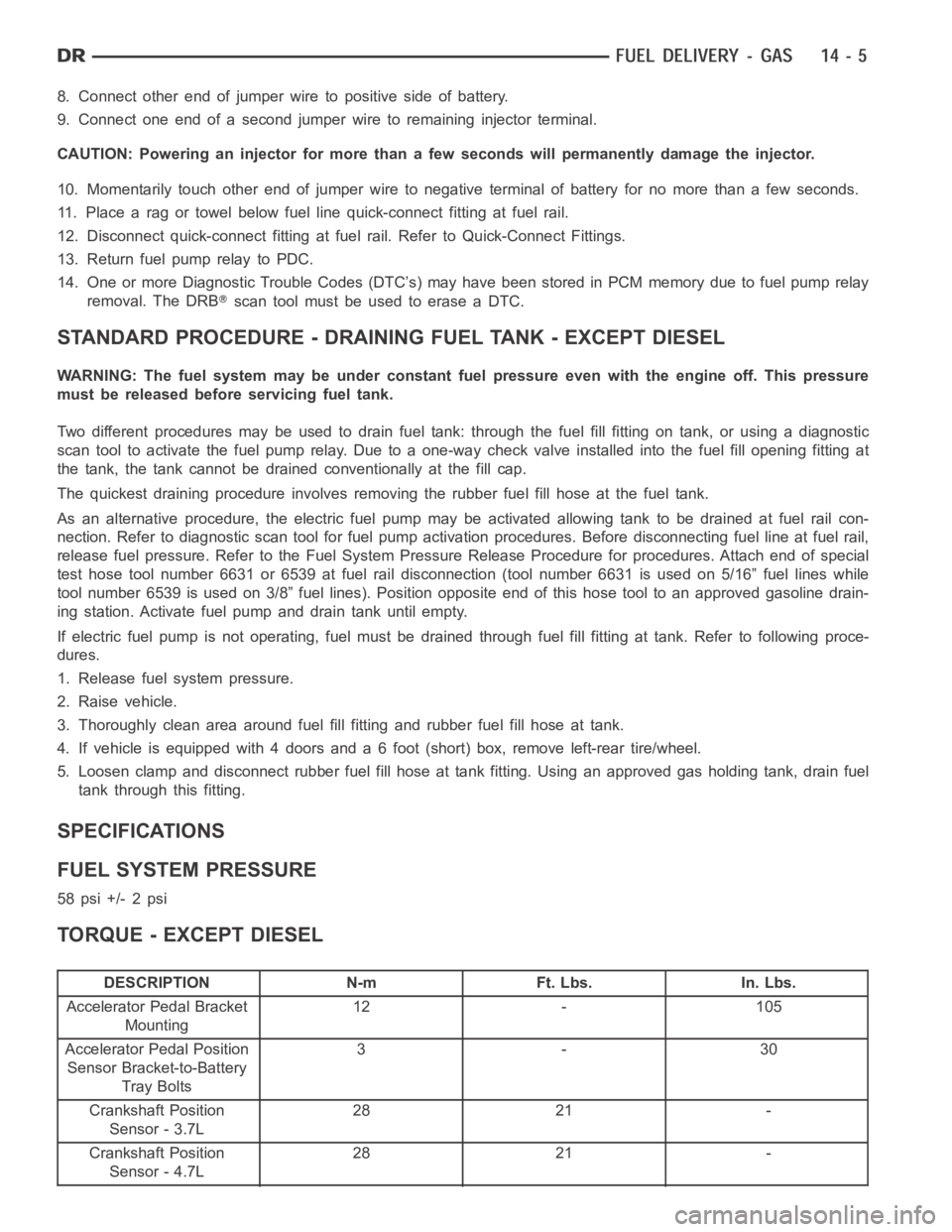
DESCRIPTION N-m Ft. Lbs. In. Lbs.
Accelerator Pedal Bracket
Mounting12 - 105
Accelerator Pedal Position
Sensor Bracket-to-Battery
Tray Bolts3-30
Crankshaft Position
Sensor - 3.7L28 21 -
Crankshaft Position
Sensor - 4.7L28 21 -
Page 2276 of 5267
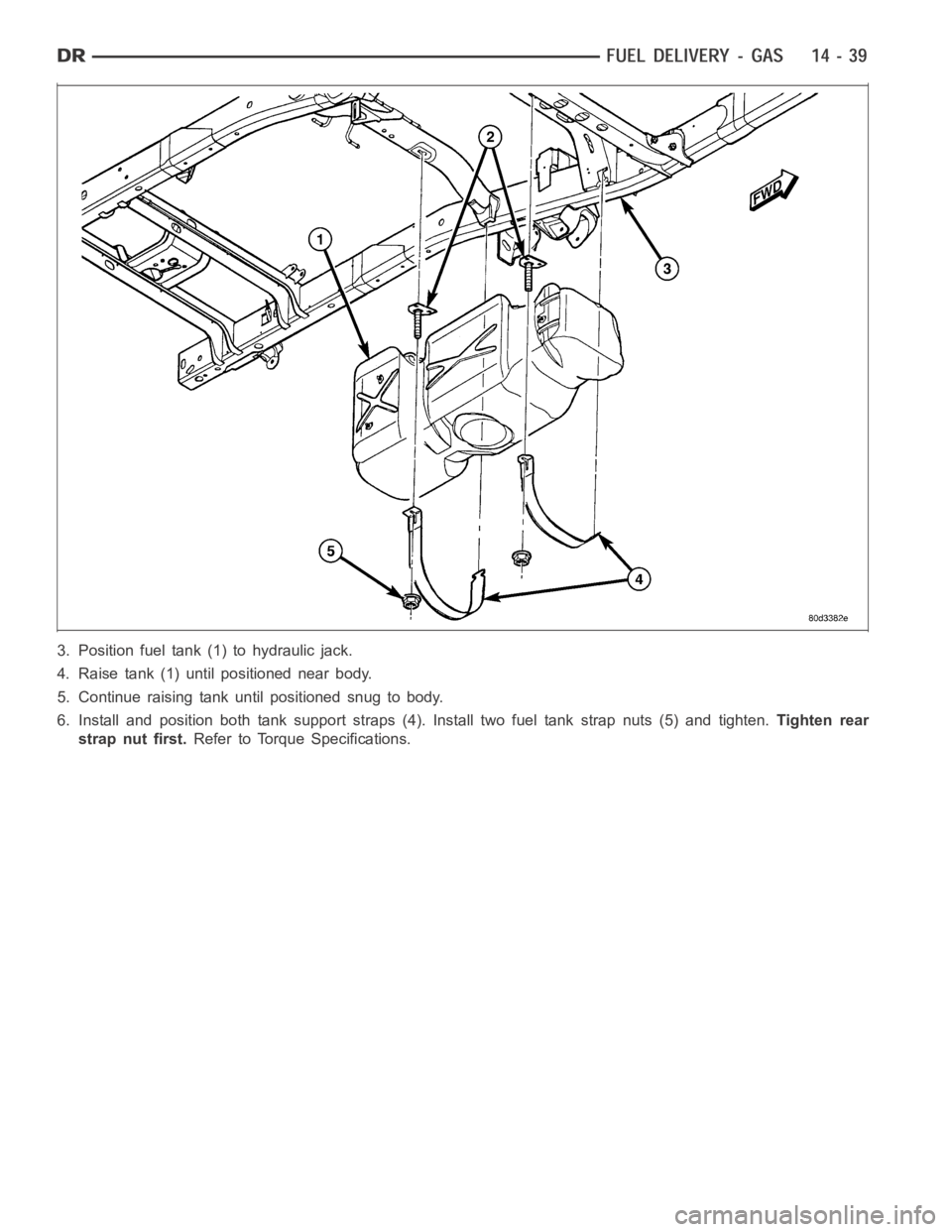
3. Position fuel tank (1) to hydraulic jack.
4. Raise tank (1) until positioned near body.
5. Continue raising tank until positioned snug to body.
6. Install and position both tank support straps (4). Install two fuel tankstrap nuts (5) and tighten.Tighten rear
strap nut first.Refer to Torque Specifications.
Page 2283 of 5267
PEDAL - ACCELERATOR
REMOVAL
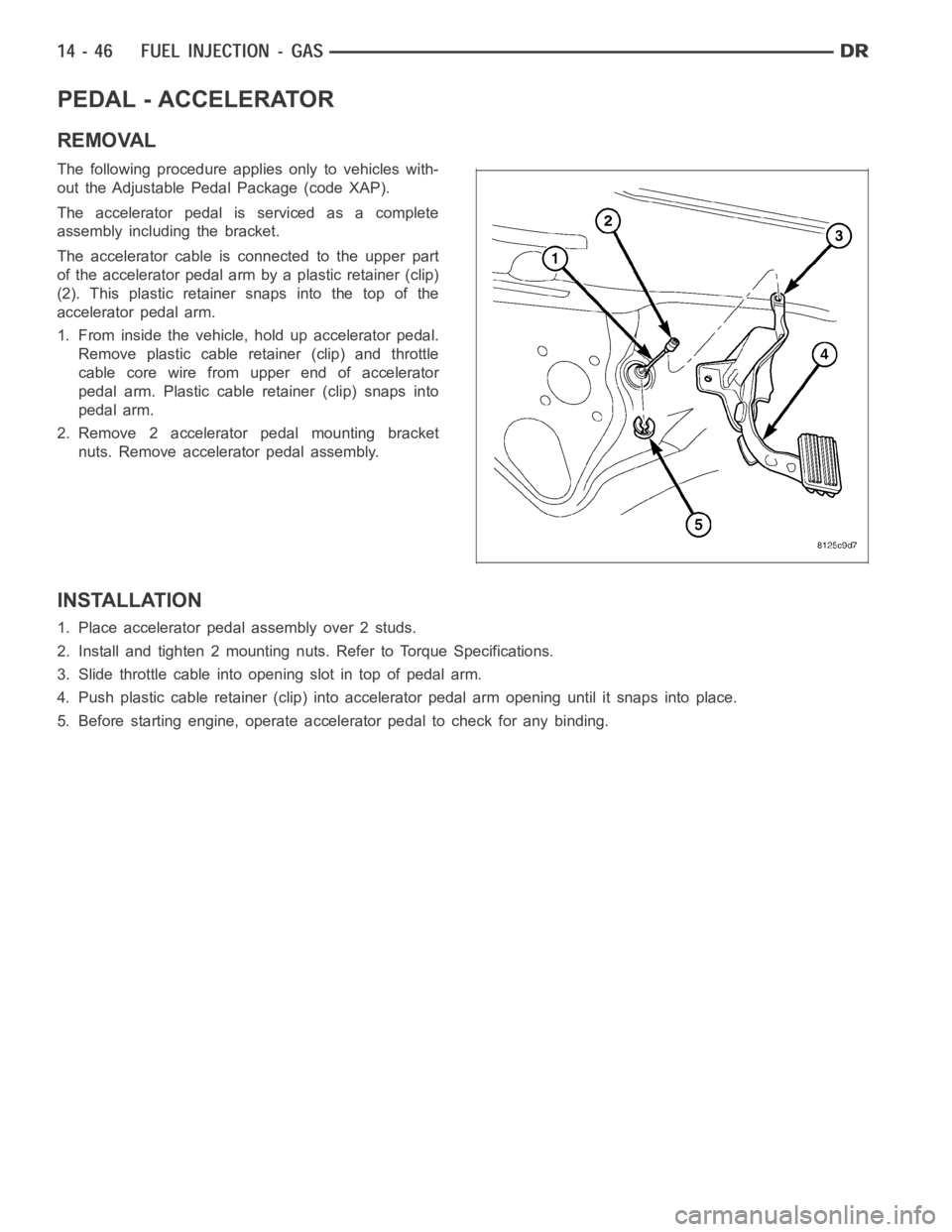
The following procedure applies only to vehicles with-
out the Adjustable Pedal Package (code XAP).
The accelerator pedal is serviced as a complete
assembly including the bracket.
The accelerator cable is connected to the upper part
of the accelerator pedal arm by a plastic retainer (clip)
(2). This plastic retainer snaps into the top of the
accelerator pedal arm.
1. From inside the vehicle, hold up accelerator pedal.
Remove plastic cable retainer (clip) and throttle
cable core wire from upper end of accelerator
pedal arm. Plastic cable retainer (clip) snaps into
pedal arm.
2. Remove 2 accelerator pedal mounting bracket
nuts. Remove accelerator pedal assembly.
INSTALLATION
1. Place accelerator pedal assembly over 2 studs.
2. Install and tighten 2 mounting nuts. Refer to Torque Specifications.
3. Slide throttle cable into opening slot in top of pedal arm.
4. Push plastic cable retainer (clip) into accelerator pedal arm opening until it snaps into place.
5. Before starting engine, operate accelerator pedal to check for any binding.
Page 2291 of 5267
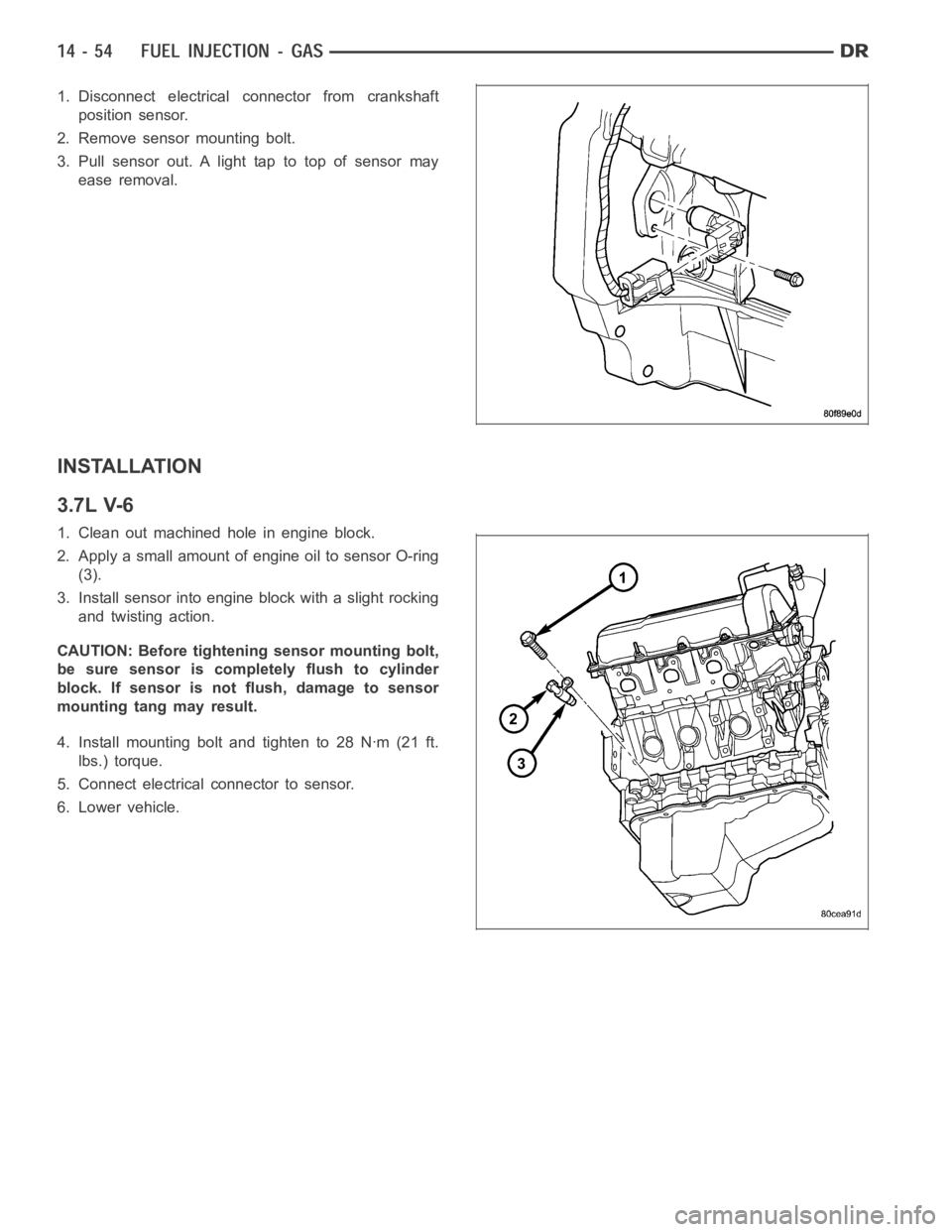
1. Disconnect electrical connector from crankshaft
position sensor.
2. Remove sensor mounting bolt.
3. Pull sensor out. A light tap to top of sensor may
ease removal.
INSTALLATION
3.7L V-6
1. Clean out machined hole in engine block.
2. Apply a small amount of engine oil to sensor O-ring
(3).
3. Install sensor into engine block with a slight rocking
and twisting action.
CAUTION: Before tightening sensor mounting bolt,
be sure sensor is completely flush to cylinder
block. If sensor is not flush, damage to sensor
mounting tang may result.
4. Install mounting bolt and tighten to 28 Nꞏm (21 ft.
lbs.) torque.
5. Connect electrical connector to sensor.
6. Lower vehicle.
Page 2292 of 5267
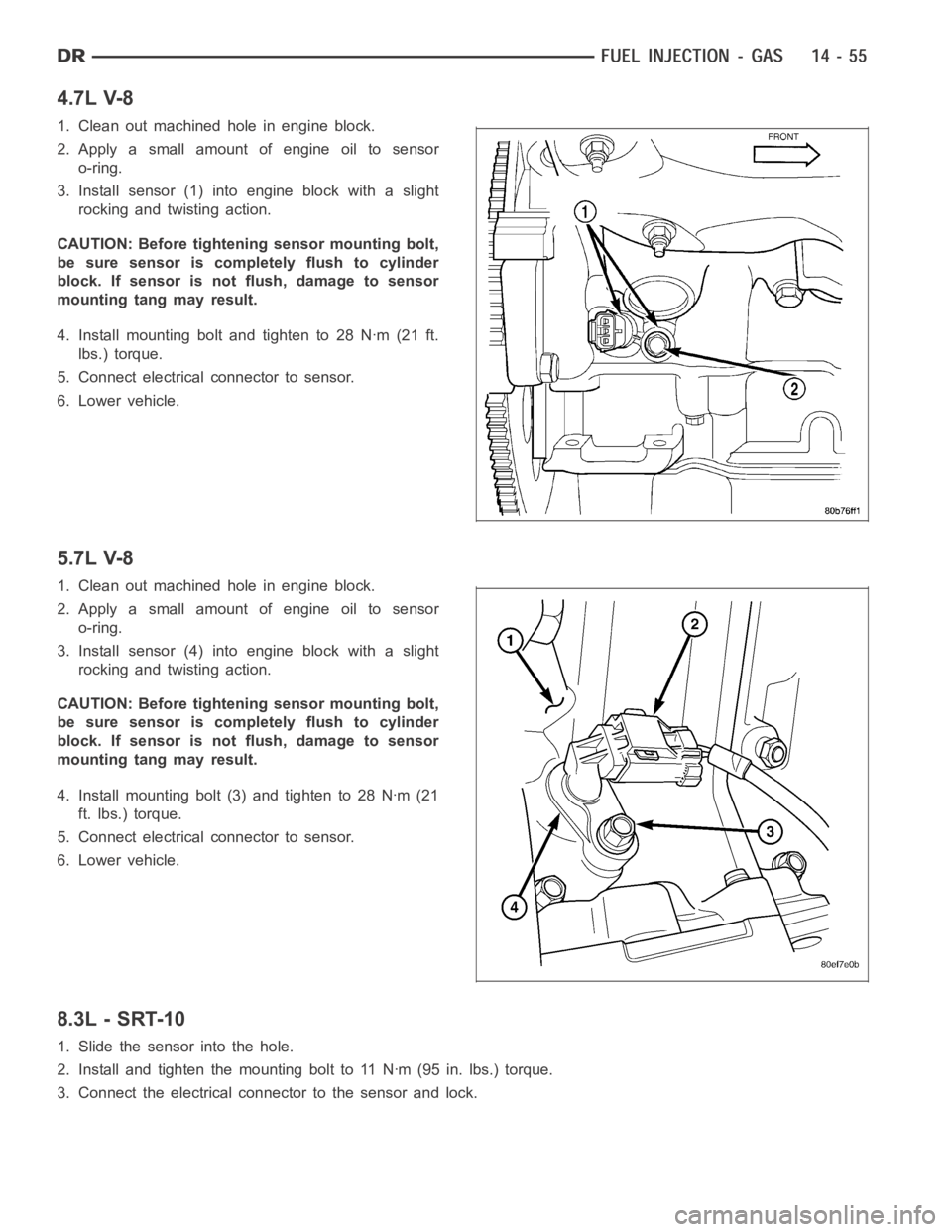
4.7L V-8
1. Clean out machined hole in engine block.
2. Apply a small amount of engine oil to sensor
o-ring.
3. Install sensor (1) into engine block with a slight
rocking and twisting action.
CAUTION: Before tightening sensor mounting bolt,
be sure sensor is completely flush to cylinder
block. If sensor is not flush, damage to sensor
mounting tang may result.
4. Install mounting bolt and tighten to 28 Nꞏm (21 ft.
lbs.) torque.
5. Connect electrical connector to sensor.
6. Lower vehicle.
5.7L V-8
1. Clean out machined hole in engine block.
2. Apply a small amount of engine oil to sensor
o-ring.
3. Install sensor (4) into engine block with a slight
rocking and twisting action.
CAUTION: Before tightening sensor mounting bolt,
be sure sensor is completely flush to cylinder
block. If sensor is not flush, damage to sensor
mounting tang may result.
4. Install mounting bolt (3) and tighten to 28 Nꞏm (21
ft. lbs.) torque.
5. Connect electrical connector to sensor.
6. Lower vehicle.
8.3L - SRT-10
1. Slide the sensor into the hole.
2. Install and tighten the mounting bolt to 11 Nꞏm (95 in. lbs.) torque.
3. Connect the electrical connector to the sensor and lock.
Page 2303 of 5267
INSTALLATION
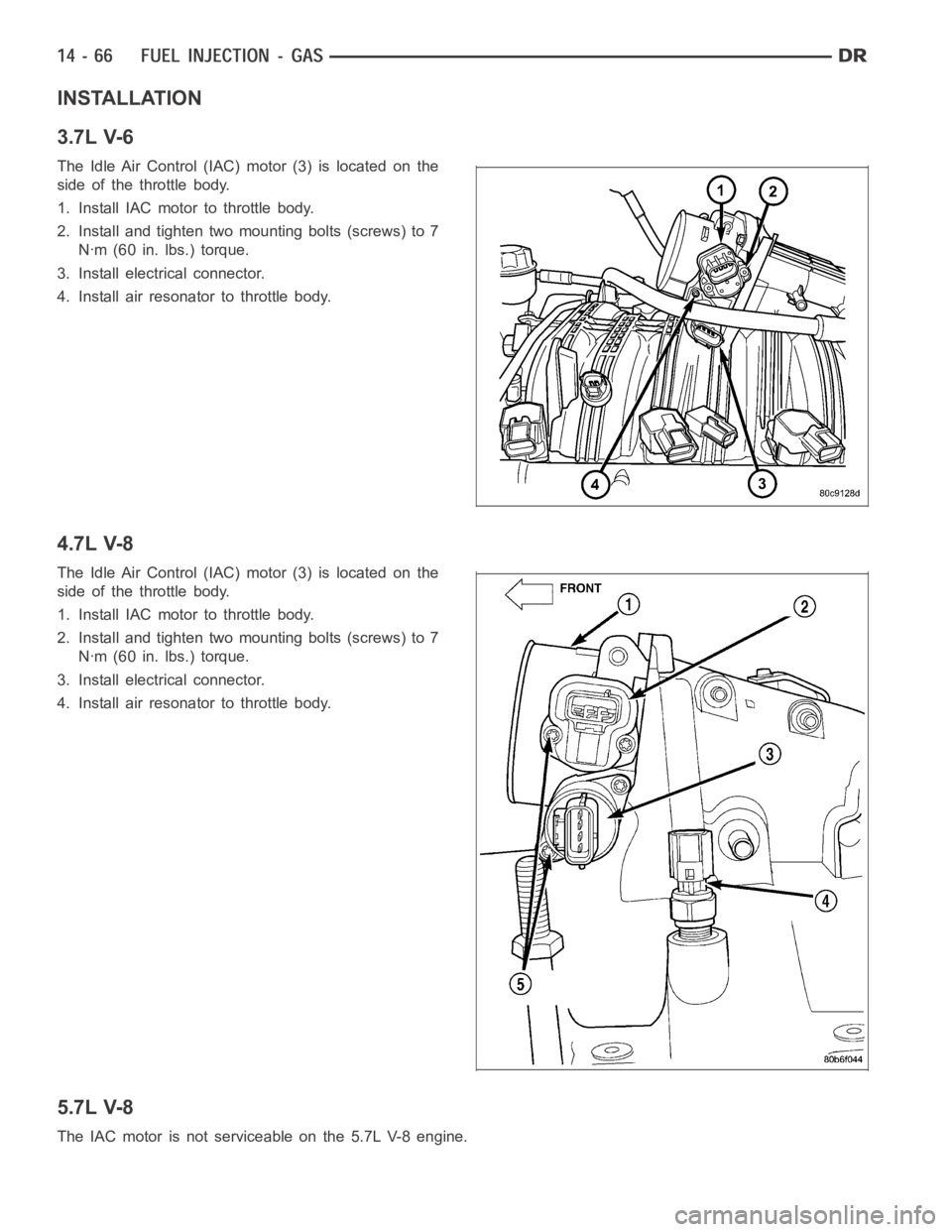
3.7L V-6
The Idle Air Control (IAC) motor (3) is located on the
side of the throttle body.
1. Install IAC motor to throttle body.
2. Install and tighten two mounting bolts (screws) to 7
Nꞏm (60 in. lbs.) torque.
3. Install electrical connector.
4. Install air resonator to throttle body.
4.7L V-8
The Idle Air Control (IAC) motor (3) is located on the
side of the throttle body.
1. Install IAC motor to throttle body.
2. Install and tighten two mounting bolts (screws) to 7
Nꞏm (60 in. lbs.) torque.
3. Install electrical connector.
4. Install air resonator to throttle body.
5.7L V-8
The IAC motor is not serviceable on the 5.7L V-8 engine.