lock FORD MUSTANG 1969 Volume One Chassis
[x] Cancel search | Manufacturer: FORD, Model Year: 1969, Model line: MUSTANG, Model: FORD MUSTANG 1969Pages: 413, PDF Size: 75.81 MB
Page 57 of 413
02-02-38
Brake System
02-02-38
2.
Disconnect the actuator solenoid
and warning switch harness connectors
from the control module.
3.
Remove the two wiring harness
grommets from the dash panel and
push the wiring harness and connec-
tors through the openings in the dash
panel.
4.
Working in the engine compart-
ment loosen the hose clamp and re-
move the air hose from the air filter.
5.
Remove the engine air cleaner-
Loosen the hose clamp and remove
the vacuum hose from the vacuum
manifold fitting.
6. Raise the vehicle on a hoist.
7.
Disconnect the exhaust pipes
from the exhaust manifold and sup-
port with wire to provide access to the
actuator assembly.
8. Remove the bolt retaining the
actuator ground wire to the rear outer
corner of the engine right bank.
9. Loosen the tube nuts and discon-
nect the brake system hydraulic tubes
from the hydraulic valve housing.
10.
Remove the three nuts retaining
the actuator assembly to the actuator
support bracket.
11.
Remove the three bolts that re-
tain the actuator mounting bracket to
the side rail and remove the mounting
bracket.
12.
Remove the actuator assembly
from the vehicle and place it on a
bench.
13.
Remove the air and vacuum
hoses from the actuator.
INSTALLATION
1.
Install the air and vacuum hoses
on the new actuator.
2.
Place the actuator assembly into
position under the vehicle, routing the
air and vacuum hoses up between the
engine and fender apron and inserting
the solenoid leads through the holes in
the firewall.
3.
Position the ground wire to the
rear of the engine block and install re-
taining bolt.
4.
Position the actuator mounting
bracket to the frame side rail and in-
stall the three retaining bolts.
5.
Position the actuator assembly
to the mounting bracket and install
the three retaining nuts.
6. Connect the hydraulic tubes to
the hydraulic valve assembly and
tighten the tube nuts to specifications.
7.
Connect the exhaust pipes to the
exhaust manifolds.
8. Lower the vehicle.
9. Pull the actuator solenoid and
brake warning switch wiring harness
through the two holes in the dash
panel from inside the car. Seat the
wiring harness grommets in the dash
panel.
10.
Connect the actuator solenoid
and brake warning switch wiring har-
ness connectors to the control mo-
dules.
'
11.
Position the control module in
the bracket under the glove box and
install the retaining screw.
12.
In the engine compartment con-
nect the air hose to the air filter and
position the hose clamp.
13.
Connect the vacuum hose to the
engine vacuum manifold fitting. In-
stall the engine air cleaner.
14.
Bleed the rear brake system and
centralize the pressure differential
valve.
15.
Raise the rear wheels. Apply
the brakes with the rear wheels turn-
ing to verify proper operation of the
anti-skid control system.
ANTI-SKID CONTROL MODULE
REMOVAL
Refer to Fig. 39.
1.
Remove the retaining strap hold-
ing the harnesses.
2.
Remove the screw that attaches
the forward end of the control module
retainer to the support assembly.
3.
Lower the forward end of the
control module and retainer from the
support assembly; move the module
and retainer forward slightly until the
flange clears the slot in the support
assembly.
4.
Disconnect the five wiring har-
ness plugs from the control module.
5.
Remove the control module from
the vehicle.
INSTALLATION
1.
Connect the five wiring harness
plugs to the control module. Only one
arrangement is possible.
2.
Position the control module in
the retainer, orienting the module per
the markings on it, and insert the re-
tainer flange into the slot at the rear
of the support assembly.
3.
Pivot the retainer and control
module upward and align the screw
hole in the forward end of the retainer
with the hole in the support bracket
assembly. Install the retaining screw.
4.
Test the vehicle on the hoist to
verify correct operation of the skid
control system.
5.-
Secure the wiring to the module
support extension with the retaining
strap.
ANTI-SKID CONTROL SENSOR
REMOVAL
Refer to Fig. 39.
1.
Raise the vehicle on a hoist.
2.
Remove the rear wheel and tire
assembly.
3.
Remove the three Tinnerman
nuts (3) and remove the brake drum.
4.
Disconnect the sensor lead from
the rear wiring harness.
5.
Unseat the sensor lead grommet
pushing it to the inside of the brake
assembly.
6. Remove the four nuts that retain
the sensor to the backing plate and
pull the axle shaft, sensor assembly
and wheel bearing assembly from the
axle housing.
7.
Press the wheel bearing retainer
and wheel bearing off the axle shaft
(Refer to Part 4-2).
8. Remove the sensor assembly and
press the rotor off the shaft with tool
T69P-2B384-A Detail 2 and TOOL
1225-DA.
INSTALLATION
1.
Press a new rotor onto the axle
shaft. Install a new sensor assembly
on the shaft with tool T69P-
2B384-ADetail 1 and TOOL 1225-
DA, and press the bearing and bear-
ing retainer onto the shaft (Refer to
Part 4-2).
2.
Insert the axle shaft assembly in
the rear axle housing onto the four
backing plate retaining bolts, feeding
the sensor lead through the hole in the
backing plate.
3.
Seat the sensor lead grommet in
the backing plate.
4.
Install the four nuts on the re-
taining bolts and tighten to specifica-
tions.
5.
Connect the sensor lead to the
rear wiring harness and install two re-
taining straps.
6. Install the rear brake drum and
retain with the Tinnerrhan drum re-
taining nuts.
7.
Install the rear wheel and tire as-
sembly and tighten the wheel nuts to
specifications.
8. Test the vehicle on the hoist to
verify proper operation of the skid
control system.procarmanuals.com
Page 60 of 413
02-02-41
Brake System
02-02-41
bolt and G-ring in the bottom of the
master cylinder.
8. Install the bleed screw (if so
equipped). Install the gasket (dia-
phragm) in the master cylinder filler
cover. Position the gasket as shown in
Figs.
40 and 41. Make sure the gasket
is securely seated.
9. Install the cover and gasket on
the master cylinder and secure the
cover into position with the retainer.
DISC BRAKE CALIPER
ALL MODELS EXCEPT
LINCOLN CONTINENTAL
Disassembly
1.
Remove the caliper assembly
from the vehicle as outlined in Section
2.
2.
Remove the caliper locating pins
from the caliper assembly and lift the
anchor plate from the caliper.
3.
Slide the two outer shoe retain-
ing clips off the retaining pins (Fig.
43).
4.
Remove the two retaining pins,
then remove the outer brake shoe
from the caliper.
5.
Slide the inner brake shoe out-
ward until it is free of the hold-down
springs, then remove the brake shoe.
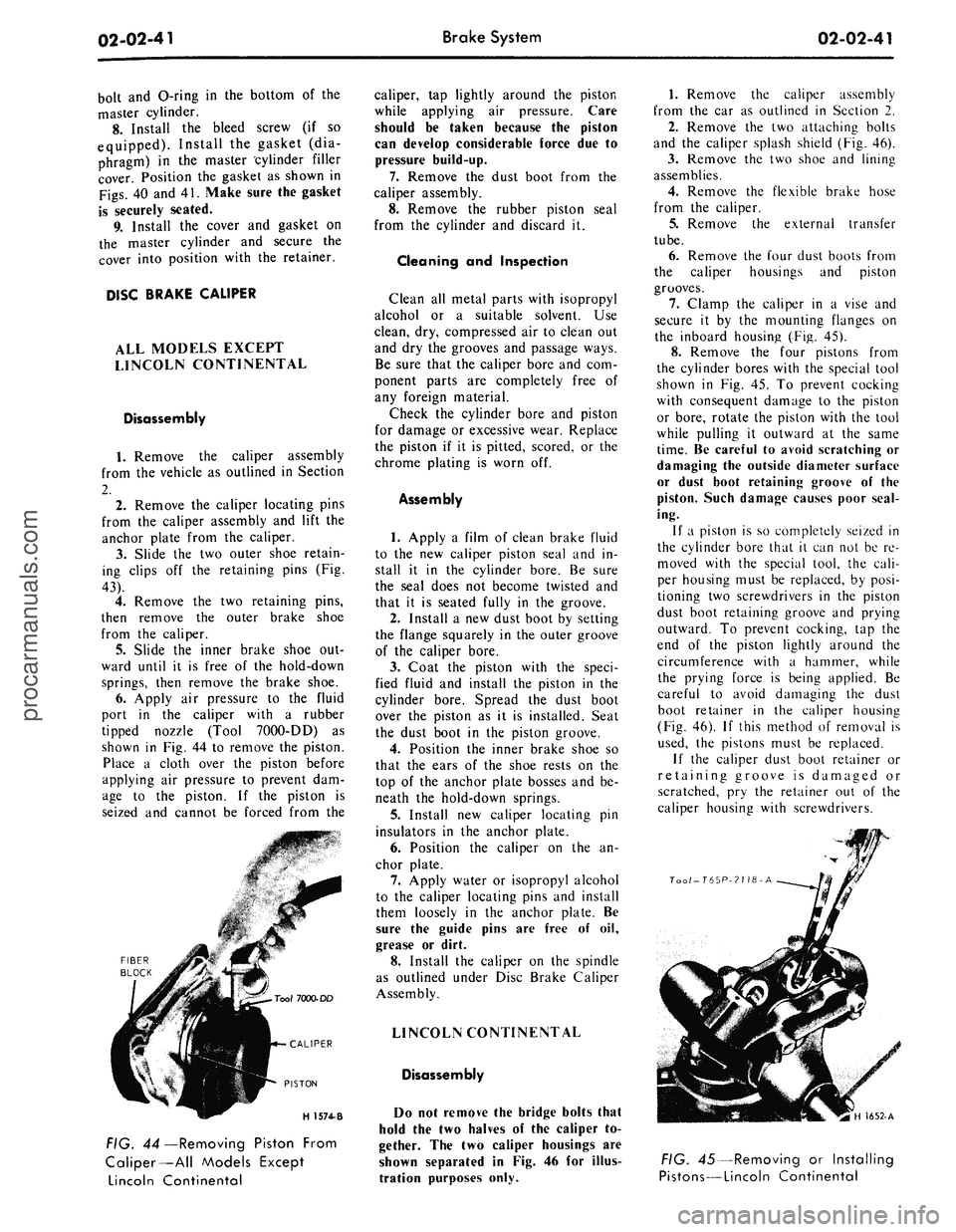
6. Apply air pressure to the fluid
port in the caliper with a rubber
tipped nozzle (Tool 7000-DD) as
shown in Fig. 44 to remove the piston.
Place a cloth over the piston before
applying air pressure to prevent dam-
age to the piston. If the piston is
seized and cannot be forced from the
FIBER
BLOCK
CALIPER
PISTON
H 1574-B
FIG. 44 —Removing Piston From
Caliper —
All
Models Except
Lincoln Continental
caliper, tap lightly around the piston
while applying air pressure. Care
should be taken because the piston
can develop considerable force due to
pressure build-up.
7.
Remove the dust boot from the
caliper assembly.
8. Remove the rubber piston seal
from the cylinder and discard it.
Cleaning and Inspection
Clean all metal parts with isopropyl
alcohol or a suitable solvent. Use
clean, dry, compressed air to clean out
and dry the grooves and passage ways.
Be sure that the caliper bore and com-
ponent parts are completely free of
any foreign material.
Check the cylinder bore and piston
for damage or excessive wear. Replace
the piston if it is pitted, scored, or the
chrome plating is worn off.
Assembly
1.
Apply a film of clean brake fluid
to the new caliper piston seal and in-
stall it in the cylinder bore. Be sure
the seal does not become twisted and
that it is seated fully in the groove.
2.
Install a new dust boot by setting
the flange squarely in the outer groove
of the caliper bore.
3.
Coat the piston with the speci-
fied fluid and install the piston in the
cylinder bore. Spread the dust boot
over the piston as it is installed. Seat
the dust boot in the piston groove.
4.
Position the inner brake shoe so
that the ears of the shoe rests on the
top of the anchor plate bosses and be-
neath the hold-down springs.
5.
Install new caliper locating pin
insulators in the anchor plate.
6. Position the caliper on the an-
chor plate.
7.
Apply water or isopropyl alcohol
to the caliper locating pins and install
them loosely in the anchor plate. Be
sure the guide pins are free of oil,
grease or dirt.
8. Install the caliper on the spindle
as outlined under Disc Brake Caliper
Assembly.
LINCOLN CONTINENTAL
Disassembly
Do not remove the bridge bolts that
hold the two halves of the caliper to-
gether. The two caliper housings are
shown separated in Fig. 46 for illus-
tration purposes only.
1.
Remove the caliper assembly
from the car as outlined in Section 2.
2.
Remove the two attaching bolts
and the caliper splash shield (Fig. 46).
3.
Remove the two shoe and lining
assemblies.
4.
Remove the flexible brake hose
from the caliper.
5.
Remove the external transfer
tube.
6. Remove the four dust boots from
the caliper housings and piston
grooves.
7.
Clamp the caliper in a vise and
secure it by the mounting flanges on
the inboard housing (Fig. 45).
8. Remove the four pistons from
the cylinder bores with the special tool
shown in Fig. 45. To prevent cocking
with consequent damage to the piston
or bore, rotate the piston with the tool
while pulling it outward at the same
time.
Be careful to avoid scratching or
damaging the outside diameter surface
or dust boot retaining groove of the
piston. Such damage causes poor seal-
ing.
If a piston is so completely seized in
the cylinder bore that it can not be re-
moved with the special tool, the cali-
per housing must be replaced, by posi-
tioning two screwdrivers in the piston
dust boot retaining groove and prying
outward. To prevent cocking, tap the
end of the piston lightly around the
circumference with a hammer, while
the prying force is being applied. Be
careful to avoid damaging the dust
boot retainer in the caliper housing
(Fig. 46). If this method of removal is
used, the pistons must be replaced.
If the caliper dust boot retainer or
retaining groove is damaged or
scratched, pry the retainer out of the
caliper housing with screwdrivers.
Too/-T65P-2
J
18- A
H 1652-A
FIG. 45—Removing or Installing
Pistons —
Lincoln
Continentalprocarmanuals.com
Page 63 of 413
02-03-02
Specifications
02-03-02
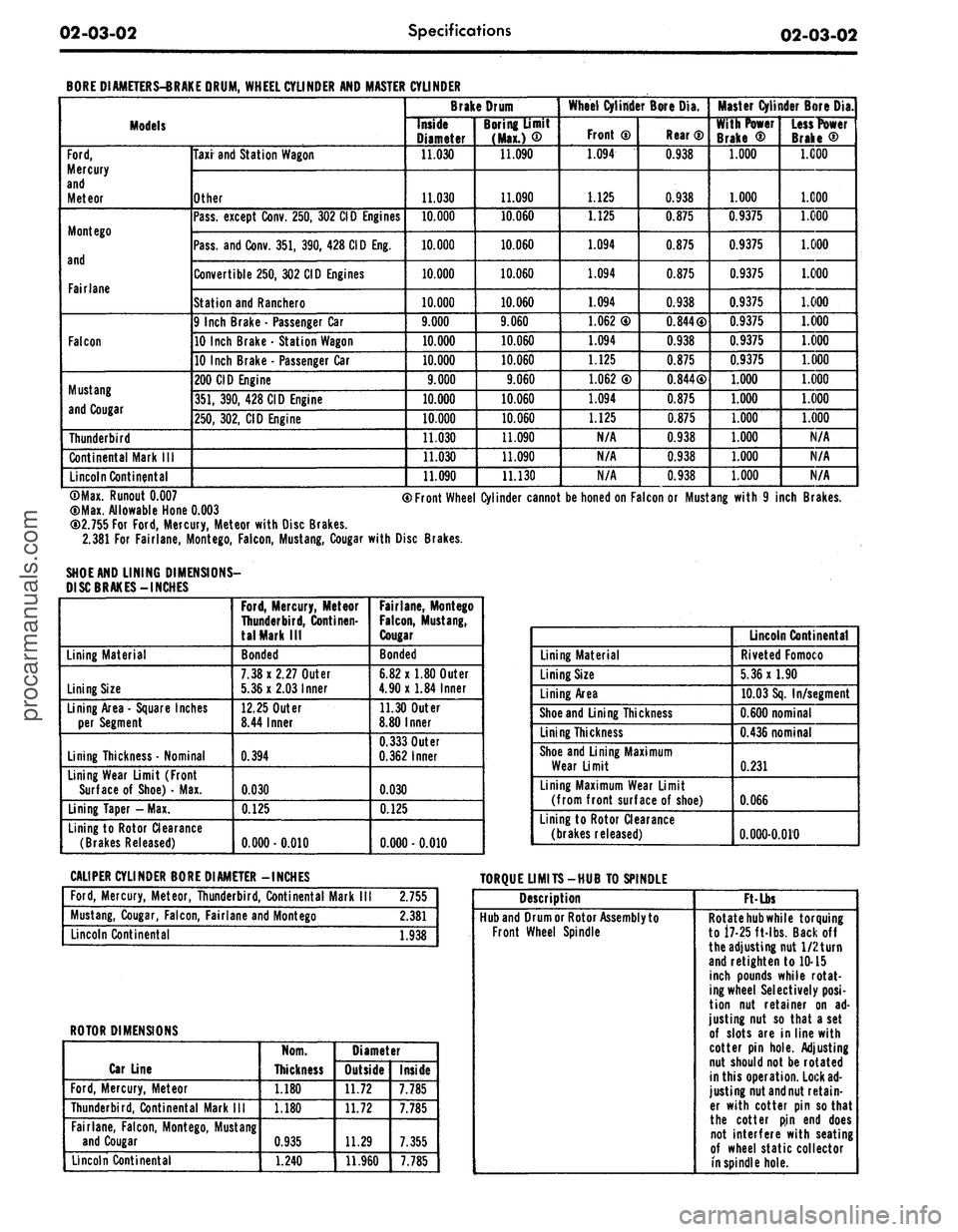
BORE DIAMETERS-BRAKE DRUM, WHEEL CYLINDER AND MASTER
Models
Ford,
Mercury
and
Meteor
Mont ego
and
Fairlane
Falcon
Mustang
and Cougar
Thunderbird
Continental Mark
III
Lincoln Continental
Taxi and Station Wagon
Other
Pass, except Conv. 250, 302 CID Engines
Pass, and Conv. 351, 390, 428 CID Eng.
Convertible 250, 302 CID Engines
Station and Ranchero
9 Inch Brake
-
Passenger Car
10 Inch Brake
•
Station Wagon
10 Inch Brake
•
Passenger Car
200 CID Engine
351,
390, 428 CID Engine
250,
302, CID Engine
CYLINDER
Brake Drum
Inside
Diameter
11.030
11.030
10.000
10.000
10.000
10.000
9.000
10.000
10.000
9.000
10.000
10.000
11.030
11.030
11.090
Boring Umit
(Max.)
®
11.090
11.090
10.060
10.060
10.060
10.060
9.060
10.060
10.060
9.060
10.060
10.060
11.090
11.090
11.130
Wheel Cylinder Bore Dia.
Front
0
1.094
L_ U25
1.125
1.094
1.094
1.094
1.062
0
1.094
1.125
1.062
®
1.094
1.125
N/A
N/A
N/A
Rear
®
0.938
0.938
0.875
0.875
0.875
0.938
0.844®
0.938
0.875
0.844®
0.875
0.875
0.938
0.938
0.938
Master Cylinder Bore Dia.
With Power
Brake
®
1.000
1.000
0.9375
0.9375
0.9375
0.9375
0.9375
0.9375
0.9375
1.000
1.000
1.000
1.000
1.000
1.000
Less Power
Brake
®
1.000
1.000
1.000
1.000
1.000
1.000
1.000
1.000
1.000
1.000
1.000
1.000
N/A
N/A
N/A
©Max. Runout
0.007
(DMax. Allowable Hone
0.003
CD2.755 For
Ford,
Mercury, Meteor with Disc Brakes.
2.381 For Fairlane, Montego, Falcon, Mustang, Cougar with Disc Brakes.
SHOE AND LINING DIMENSIONS-
DISC BRAKES-INCHES
® Front Wheel Cylinder cannot be honed on Falcon or Mustang with
9
inch Brakes.
Lining Material
Lining Size
Lining Area
-
Square Inches
per Segment
Lining Thickness • Nominal
Lining Wear Limit (Front
Surface
of
Shoe)
•
Max.
Lining Taper -Max.
Lining to Rotor Clearance
(Brakes Released)
Ford,
Mercury, Meteor
Thunderbird, Continen-
tal Mark
III
Bonded
7.38x2.27
Outer
5.36x2.03
Inner
12.25 Outer
8.44 Inner
0.394
0.030
0.125
0.000-0.010
Fairlane, Montego
Falcon,
Mustang,
Cougar
Bonded
6.82 x 1.80 Outer
4.90x1.84 Inner
11.30 Outer
8.80 Inner
0.333
Outer
0.362
Inner
0.030
0.125
0.000
• 0.010
Lining Material
Lining Size
Lining Area
Shoe and Lining Thickness
Lining Thickness
Shoe and Lining Maximum
Wear Limit
Lining Maximum Wear Limit
(from front surface
of
shoe)
Lining to Rotor Clearance
(brakes released)
Lincoln Continental
Riveted Fomoco
5.36x1.90
10.03 Sq. In/segment
0.600
nominal
0.436
nominal
0.231
0.066
0.000-0.010
CALIPER CYLINDER BORE DIAMETER -INCHES
TORQUE LIMITS-HUB TO SPINDLE
Ford,
Mercury, Meteor, Thunderbird, Continental Mark
2.755
Mustang, Cougar, Falcon, Fairlane and Montego
2.381
Lincoln Continental
1.938
ROTOR DIMENSIONS
Car Line
Ford,
Mercury, Meteor
Thunderbird, Continental Mark
III
Fairlane, Falcon, Montego, Mustang
and Cougar
Lincoln Continental
Norn.
Thickness
1.180
1.180
0.935
1.240
Diameter
Outside
11.72
11.72
11.29
11.960
Inside
7.785
7.785
7.355
7.785
Description
Hub and Drum or Rotor Assembly to
Front Wheel Spindle
Ft-Lbs
Rotate
hub
while torquing
to 17-25 ft-lbs. Backoff
the adjusting nut 1/2 turn
and retighten to 10-15
inch pounds while rotat-
ing wheel Selectively
posi-
tion
nut
retainer
on ad-
justing nut
so
that a set
of slots are in line with
cotter pin hole. Adjusting
nut should not be rotated
in this operation. Lock
ad-
justing nut and nut retain-
er with cotter pin so that
the cotter
pin end
does
not interfere with seating
of wheel static collector
in spindle hole.procarmanuals.com
Page 68 of 413
03-01-03
Suspension — Steering, Wheels And Tires — General Service
03-01-03
4.
Connect a tachometer, start the
engine and operate it at idle speed
until the reservoir fluid temperature
reaches 165 to 175. This temperature
must be maintained throughout the
test. Valve B may be partially closed
to create a back pressure up to 350
psi to hasten the temperature rise. The
reservoir fluid must be at the proper
level.
5.
With the engine operating at rec-
ommended idle rpm and fluid temper-
ature noted in Step 4, close the manu-
al valve B. The minimum acceptable
pressure reading is 620 psi.
6. If the pressure gauge reading is
below the minimum specification, the
pump is at fault and should be re-
paired with necessary parts.
7.
If the reading is at or above the
minimum specification, the pump flow
is normal. Open manual valve B and
proceed to the Pump Fluid Pressure
Test.
PUMP FLUID
PRESSURE TEST
1.
Keep the lines and tools con-
nected as in the Pump Flow Test.
2.
With manual valves A and B
opened fully, operate the engine at
recommended idle speed (Fig. 2).
Close manual valve A, then manual
valve B. Do not keep both valves
closed for more than 5 seconds as this
would abnormally increase the fluid
temperature and cause undue pump
and/or gear wear.
3.
With the valves fully closed, the
pressure gauge should read 1000 psi
minimum for Ford, Mercury, Meteor
or Thunderbird and 750 psi minimum
for Cougar, Fairlane, Falcon, Monte-
go or Mustang.
4.
If the pressure gauge reading is
below the minimum specification, the
pump is at fault and should be re-
paired with necessary parts.
5.
If the pressure gauge reading is
at or above the minimum specifica-
tions,
the pump is normal and the
power steering gear or power assist
control valve is at fault.
FLUID PRESSURE TEST-
LINCOLN CONTINENTAL AND
CONTINENTAL MARK III
The pressure testing gauge set, tool
T56L-33610-D, requires modification
to make it adaptable for installation
in the power steering hydraulic sys-
tem. The parts required and the modi-
fication procedure are as follows:
OWER STEERING
PRESSURE LINE
INVERTED FLARE
CONNECTOR
%* TUBE x VA" PIPE
FLARED FEMALE COUPW
%' TUBE x VA" PIPE
G1544.A
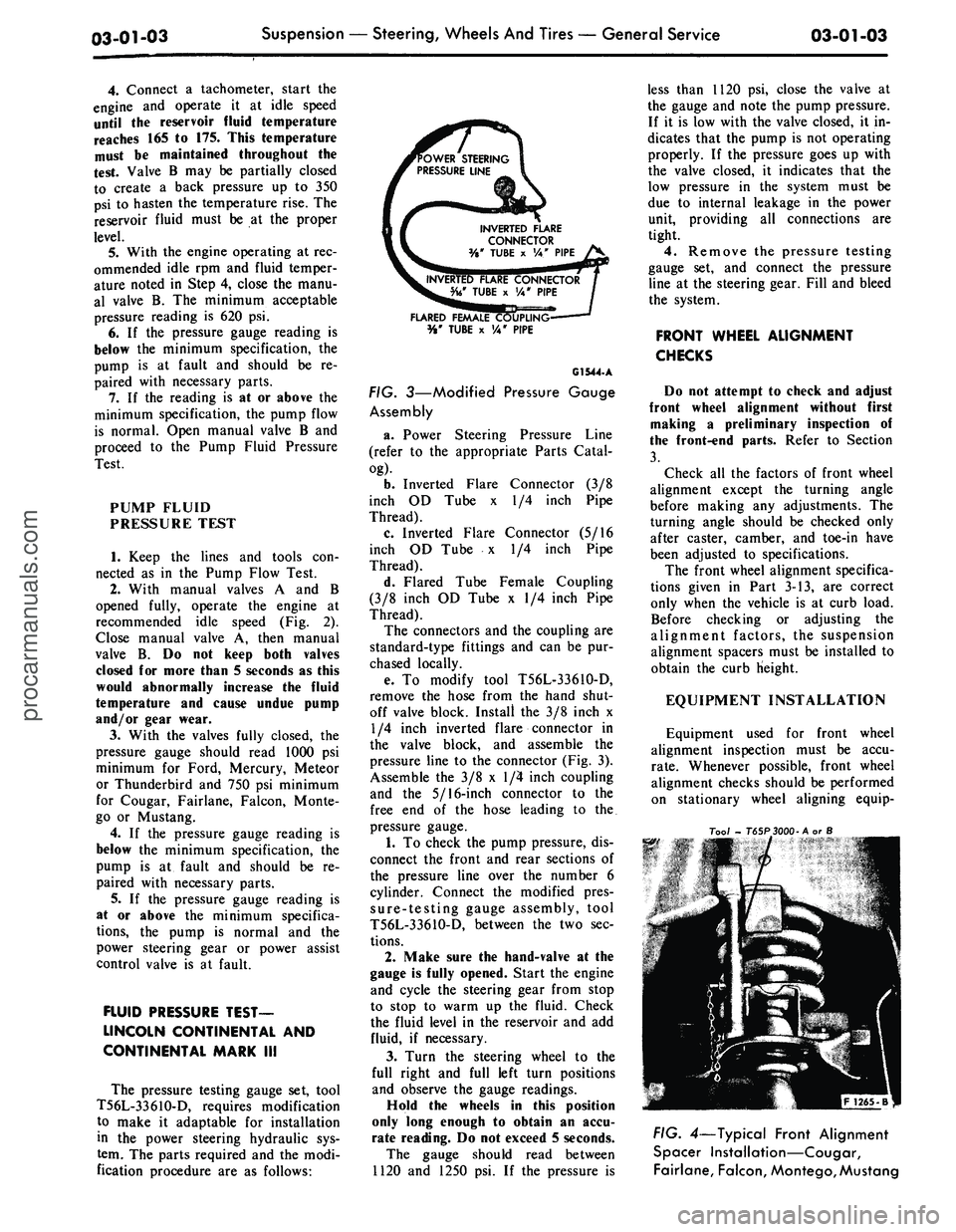
FIG. 3—Modified Pressure Gauge
Assembly
a. Power Steering Pressure Line
(refer to the appropriate Parts Catal-
og).
b.
Inverted Flare Connector (3/8
inch OD Tube x 1/4 inch Pipe
Thread).
c. Inverted Flare Connector (5/16
inch OD Tube x 1/4 inch Pipe
Thread).
d. Flared Tube Female Coupling
(3/8 inch OD Tube x 1/4 inch Pipe
Thread).
The connectors and the coupling are
standard-type fittings and can be pur-
chased locally.
e. To modify tool T56L-33610-D,
remove the hose from the hand shut-
off valve block. Install the 3/8 inch x
1/4 inch inverted flare connector in
the valve block, and assemble the
pressure line to the connector (Fig. 3).
Assemble the 3/8 x 1/4 inch coupling
and the 5/16-inch connector to the
free end of the hose leading to the.
pressure gauge.
1.
To check the pump pressure, dis-
connect the front and rear sections of
the pressure line over the number 6
cylinder. Connect the modified pres-
sure-testing gauge assembly, tool
T56L-3361O-D, between the two sec-
tions.
2.
Make sure the hand-valve at the
gauge is fully opened. Start the engine
and cycle the steering gear from stop
to stop to warm up the fluid. Check
the fluid level in the reservoir and add
fluid, if necessary.
3.
Turn the steering wheel to the
full right and full left turn positions
and observe the gauge readings.
Hold the wheels in this position
only long enough to obtain an accu-
rate reading. Do not exceed 5 seconds.
The gauge should read between
1120 and 1250 psi. If the pressure is
less than 1120 psi, close the valve at
the gauge and note the pump pressure.
If it is low with the valve closed, it in-
dicates that the pump is not operating
properly. If the pressure goes up with
the valve closed, it indicates that the
low pressure in the system must be
due to internal leakage in the power
unit, providing all connections are
tight.
4.
Remove the pressure testing
gauge set, and connect the pressure
line at the steering gear. Fill and bleed
the system.
FRONT WHEEL ALIGNMENT
CHECKS
Do not attempt to check and adjust
front wheel alignment without first
making a preliminary inspection of
the front-end parts. Refer to Section
3.
Check all the factors of front wheel
alignment except the turning angle
before making any adjustments. The
turning angle should be checked only
after caster, camber, and toe-in have
been adjusted to specifications.
The front wheel alignment specifica-
tions given in Part 3-13, are correct
only when the vehicle is at curb load.
Before checking or adjusting the
alignment factors, the suspension
alignment spacers must be installed to
obtain the curb Height.
EQUIPMENT INSTALLATION
Equipment used for front wheel
alignment inspection must be accu-
rate.
Whenever possible, front wheel
alignment checks should be performed
on stationary wheel aligning equip-
Too/
- T65P3000-A or S
FIG. 4—Typical Front Alignment
Spacer Installation—Cougar,
Fairlane, Falcon,
Montego,
Mustangprocarmanuals.com
Page 71 of 413
03-01-06
Suspension — Steering, Wheels And Tires — General Service
03-01-06
SUSPENSION UPPER
ARM MOVEMENT
Front Bolt Outboard
Rear Bolt Outboard
Front Bolt Inboard
Rear Bolt Inboard
CASTER CHANGE
Tilt Backward
Increase Positive Caster
or
Decrease Negative Caster
Tilt Forward
Decrease Positive Caster
or
Increase Negative Caster
Tilt Forward
Decrease Positive Caster
or
Increase Negative Caster
Tilt Backward
Increase Positive Caster
or
Decrease Negative Caster
CAMBER CHANGE
Tilt Outward
Increase Positive Camber
or
Decrease Negative Camber
Tilt Inward
Decrease Positive Camber
or
Increase Negative Camber
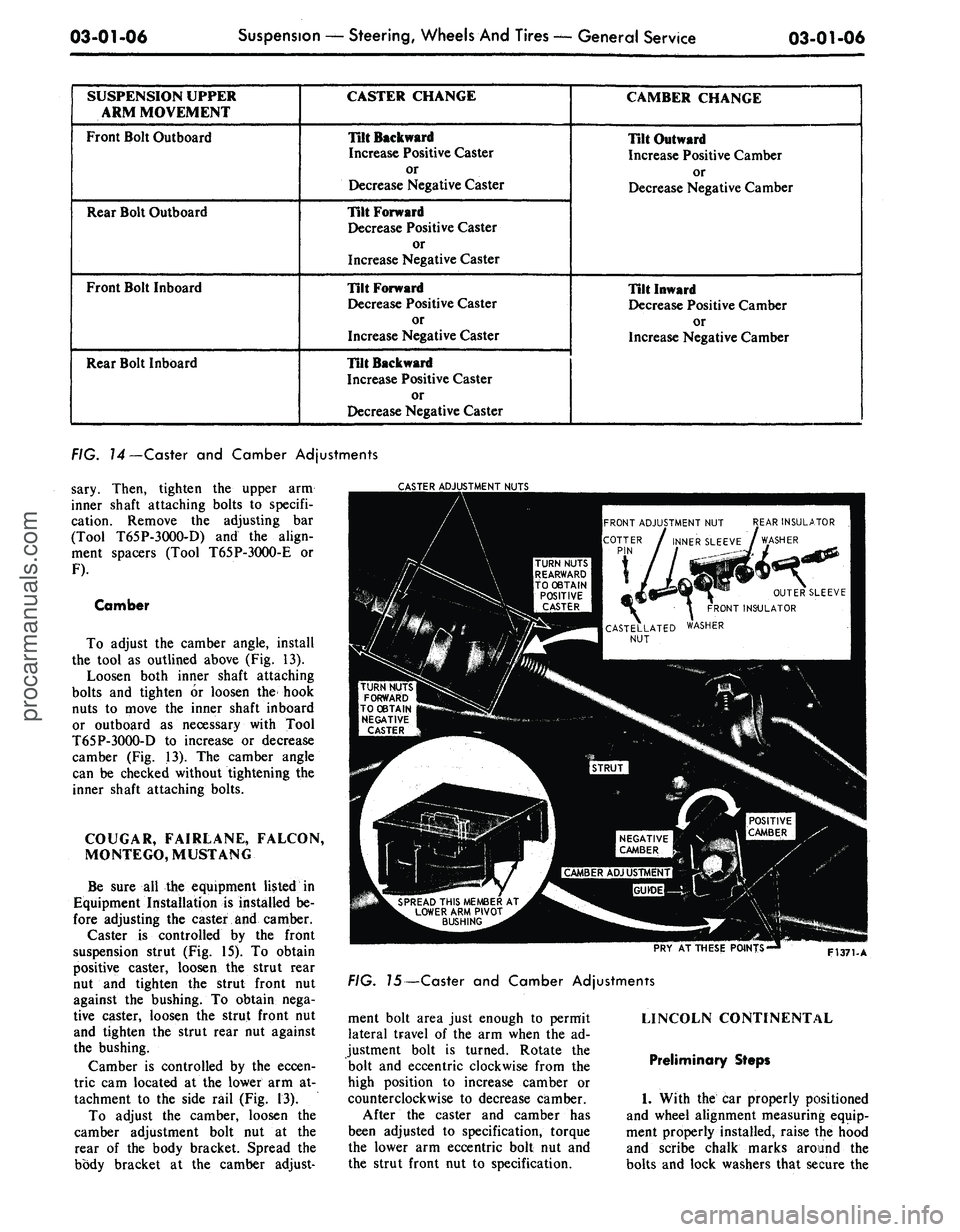
FIG. 14—Caster and Camber Adjustments
sary. Then, tighten the upper arm
inner shaft attaching bolts to specifi-
cation. Remove the adjusting bar
(Tool T65P-3OOO-D) and the align-
ment spacers (Tool T65P-3O00-E or
F).
Camber
To adjust the camber angle, install
the tool as outlined above (Fig. 13).
Loosen both inner shaft attaching
bolts and tighten or loosen the hook
nuts to move the inner shaft inboard
or outboard as necessary with Tool
T65P-3OOO-D to increase or decrease
camber (Fig. 13). The camber angle
can be checked without tightening the
inner shaft attaching bolts.
COUGAR, FAIRLANE, FALCON,
MONTEGO, MUSTANG
Be sure all the equipment listed in
Equipment Installation is installed be-
fore adjusting the caster and camber.
Caster is controlled by the front
suspension strut (Fig. 15). To obtain
positive caster, loosen the strut rear
nut and tighten the strut front nut
against the bushing. To obtain nega-
tive caster, loosen the strut front nut
and tighten the strut rear nut against
the bushing.
Camber is controlled by the eccen-
tric cam located at the lower arm at-
tachment to the side rail (Fig. 13).
To adjust the camber, loosen the
camber adjustment bolt nut at the
rear of the body bracket. Spread the
body bracket at the camber adjust-
TER ADJUSTMENT NUTS
EAR INSULATOR
WASHER
FRONT ADJUSTMENT NUT
INNER SLEEVE
TURN NUTS
REARWARD
TO OBTAIN
POSITIVE
CASTER
OUTER SLEEVE
RONT INSULATOR
WASHER
CASTELLATED
NUT
TURN NUTS
FORWARD
TO OBTAIN
NEGATIVE
CASTER
NEGATIVE
CAMBER
SPREAD THIS MEMBER AT
LOWER ARM PIVOT
BUSHING
PRY AT THESE POINTS'
F1371-A
FIG. J5—Caster and Camber Adjustments
ment bolt area just enough to permit
lateral travel of the arm when the ad-
justment bolt is turned. Rotate the
bolt and eccentric clockwise from the
high position to increase camber or
counterclockwise to decrease camber.
After the caster and camber has
been adjusted to specification, torque
the lower arm eccentric bolt nut and
the strut front nut to specification.
LINCOLN CONTINENTAL
Preliminary Steps
1.
With the car properly positioned
and wheel alignment measuring equip-
ment properly installed, raise the hood
and scribe chalk marks around the
bolts and lock washers that secure theprocarmanuals.com
Page 85 of 413
03-02-09
Suspension
03-02-09
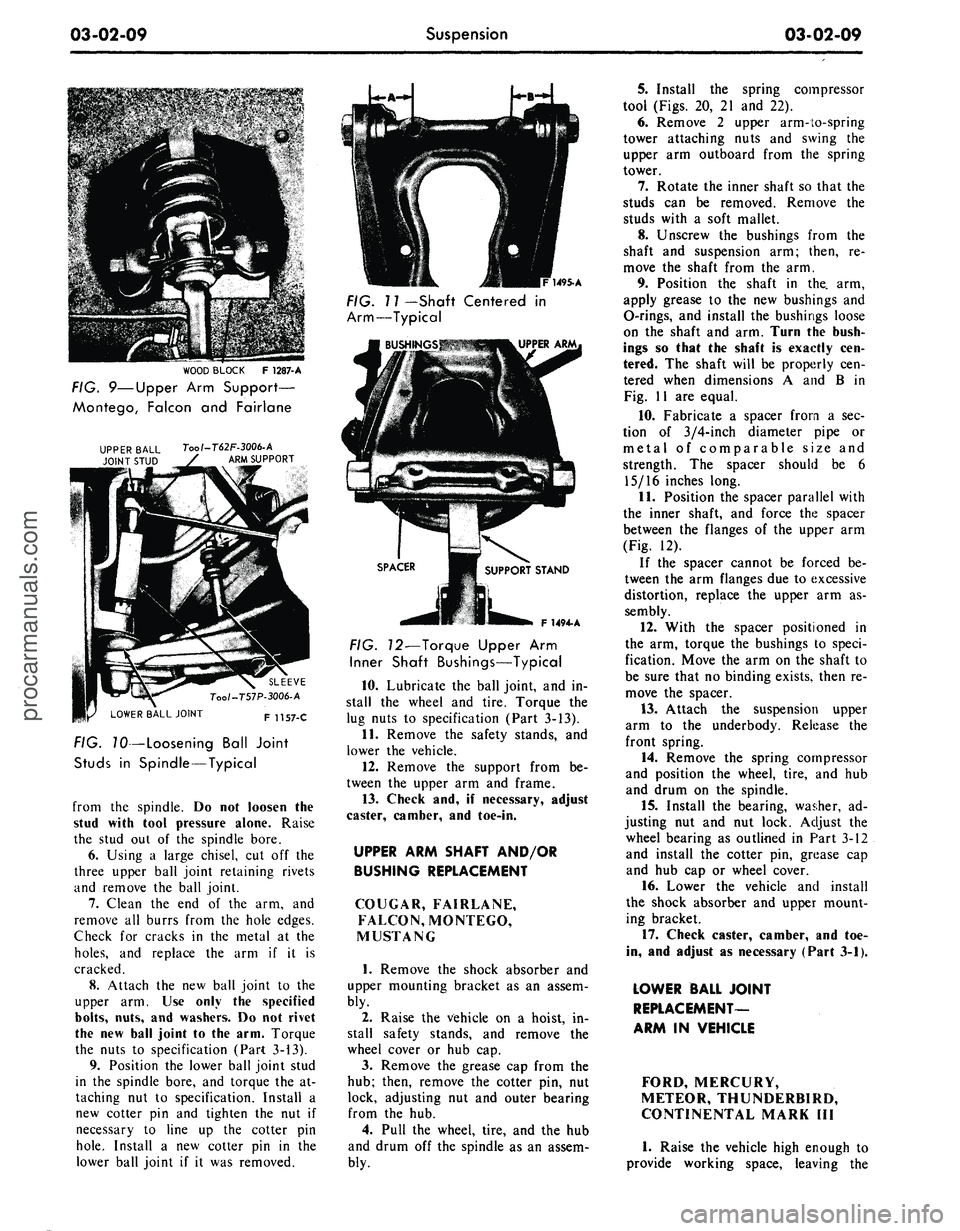
WOOD BLOCK
F
1287-A
FIG. 9—Upper
Arm
Support—
Montego, Falcon
and
Fairlane
Tool-T62F-3006-A
ARM SUPPORT
LOWER BALL JOINT
SLEEVE
Too/-T57P-3006-A
F 1157-C
FIG. TO—Loosening Ball Joint
Studs
in
Spindle—Typical
from
the
spindle.
Do not
loosen
the
stud with tool pressure alone. Raise
the stud
out of the
spindle bore.
6. Using
a
large chisel,
cut off the
three upper ball joint retaining rivets
and remove
the
ball joint.
7.
Clean
the end of the arm, and
remove
all
burrs from
the
hole edges.
Check
for
cracks
in the
metal
at the
holes,
and
replace
the arm if it is
cracked.
8. Attach
the new
ball joint
to the
upper
arm. Use
only
the
specified
bolts,
nuts,
and
washers.
Do not
rivet
the
new
ball joint
to the
arm. Torque
the nuts
to
specification (Part 3-13).
9. Position
the
lower ball joint stud
in
the
spindle bore,
and
torque
the at-
taching
nut to
specification. Install
a
new cotter
pin and
tighten
the nut if
necessary
to
line
up the
cotter
pin
hole.
Install
a new
cotter
pin in the
lower ball joint
if it was
removed.
1495-A
FIG. 11 —Shaft Centered
in
Arm—Typical
F 1494- A
FIG. 12—Torque Upper
Arm
Inner Shaft Bushings—Typical
10.
Lubricate
the
ball joint,
and in-
stall
the
wheel
and
tire. Torque
the
lug nuts
to
specification (Part 3-13).
11.
Remove
the
safety stands,
and
lower
the
vehicle.
12.
Remove
the
support from
be-
tween
the
upper
arm and
frame.
13.
Check
and, if
necessary, adjust
caster, camber,
and
toe-in.
UPPER ARM SHAFT AND/OR
BUSHING REPLACEMENT
COUGAR, FAIRLANE,
FALCON, MONTEGO,
MUSTANG
1.
Remove
the
shock absorber
and
upper mounting bracket
as an
assem-
bly.
2.
Raise
the
vehicle
on a
hoist,
in-
stall safety stands,
and
remove
the
wheel cover
or hub cap.
3.
Remove
the
grease
cap
from
the
hub;
then, remove
the
cotter
pin, nut
lock, adjusting
nut and
outer bearing
from
the hub.
4.
Pull
the
wheel, tire,
and the hub
and drum
off the
spindle
as an
assem-
bly.
5.
Install
the
spring compressor
tool (Figs.
20, 21 and 22).
6. Remove
2
upper arm-to-spring
tower attaching nuts
and
swing
the
upper
arm
outboard from
the
spring
tower.
7.
Rotate
the
inner shaft
so
that
the
studs
can be
removed. Remove
the
studs with
a
soft mallet.
8. Unscrew
the
bushings from
the
shaft
and
suspension
arm;
then,
re-
move
the
shaft from
the arm.
9. Position
the
shaft
in the. arm,
apply grease
to the new
bushings
and
O-rings,
and
install
the
bushings loose
on
the
shaft
and
arm. Turn
the
bush-
ings
so
that
the
shaft
is
exactly
cen-
tered.
The
shaft will
be
properly
cen-
tered when dimensions
A and B in
Fig.
11 are
equal.
10.
Fabricate
a
spacer from
a sec-
tion
of
3/4-inch diameter pipe
or
metal
of
comparable size
and
strength.
The
spacer should
be 6
15/16 inches long.
11.
Position
the
spacer parallel with
the inner shaft,
and
force
the
spacer
between
the
flanges
of the
upper
arm
(Fig.
12).
If
the
spacer cannot
be
forced
be-
tween
the arm
flanges due
to
excessive
distortion, replace
the
upper
arm as-
sembly.
12.
With
the
spacer positioned
in
the
arm,
torque
the
bushings
to
speci-
fication. Move
the arm on the
shaft
to
be sure that
no
binding exists, then
re-
move
the
spacer.
13.
Attach
the
suspension upper
arm
to the
underbody. Release
the
front spring.
14.
Remove
the
spring compressor
and position
the
wheel, tire,
and hub
and drum
on the
spindle.
15.
Install
the
bearing, washer,
ad-
justing
nut and nut
lock. Adjust
the
wheel bearing
as
outlined
in
Part
3-12
and install
the
cotter
pin,
grease
cap
and
hub cap or
wheel cover.
16.
Lower
the
vehicle
and
install
the shock absorber
and
upper mount-
ing bracket.
17.
Check caster, camber,
and toe-
in,
and
adjust
as
necessary (Part 3-1).
LOWER BALL JOINT
REPLACEMENT-
ARM
IN
VEHICLE
FORD, MERCURY,
METEOR, THUNDERBIRD,
CONTINENTAL MARK
III
1.
Raise
the
vehicle high enough
to
provide working space, leaving
theprocarmanuals.com
Page 89 of 413
03-02-13
Suspension
03-02-13
BALL JOINT BOLT HEAD
STABILIZER
F1370-A
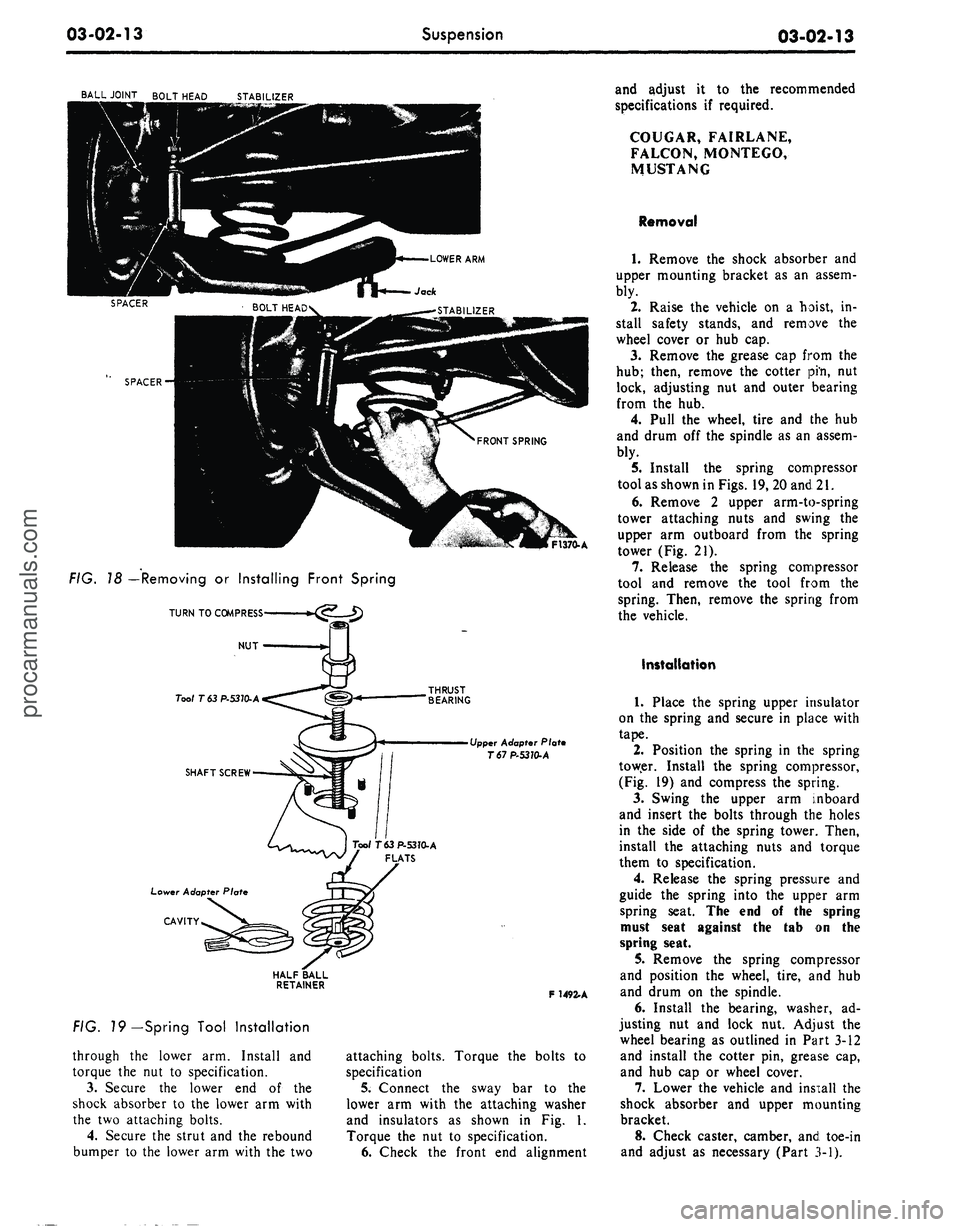
FIG. 18 —Removing or Installing Front Spring
TURN TO COMPRESS
NUT
•
Tool T 63 P-53J0-A
SHAFT SCREW
Lower Adapter Plate
CAVITY
Upper Adapter Plate
T67P-5370-A
FIG. 79—Spring Tool Installation
through the lower arm. Install and
torque the nut to specification.
3.
Secure the lower end of the
shock absorber to the lower arm with
the two attaching bolts.
4.
Secure the strut and the rebound
bumper to the lower arm with the two
F
1492.
A
attaching bolts. Torque the bolts to
specification
5.
Connect the sway bar to the
lower arm with the attaching washer
and insulators as shown in Fig. 1.
Torque the nut to specification.
6. Check the front end alignment
and adjust it to the recommended
specifications if required.
COUGAR, FAIRLANE,
FALCON, MONTEGO,
MUSTANG
Removal
1.
Remove the shock absorber and
upper mounting bracket as an assem-
bly.
2.
Raise the vehicle on a hoist, in-
stall safety stands, and remove the
wheel cover or hub cap.
3.
Remove the grease cap from the
hub;
then, remove the cotter pin, nut
lock, adjusting nut and outer bearing
from the hub.
4.
Pull the wheel, tire and the hub
and drum off the spindle as an assem-
bly.
5.
Install the spring compressor
tool as shown in Figs. 19, 20 and 21.
6. Remove 2 upper arm-to-spring
tower attaching nuts and swing the
upper arm outboard from the spring
tower (Fig. 21).
7.
Release the spring compressor
tool and remove the tool from the
spring. Then, remove the spring from
the vehicle.
Installation
1.
Place the spring upper insulator
on the spring and secure in place with
tape.
2.
Position the spring in the spring
tower. Install the spring compressor,
(Fig. 19) and compress the spring.
3.
Swing the upper arm inboard
and insert the bolts through the holes
in the side of the spring tower. Then,
install the attaching nuts and torque
them to specification.
4.
Release the spring pressure and
guide the spring into the upper arm
spring seat. The end o! the spring
must seat against the tab on the
spring seat.
5. Remove the spring compressor
and position the wheel, tire, and hub
and drum on the spindle.
6. Install the bearing, washer, ad-
justing nut and lock nut. Adjust the
wheel bearing as outlined in Part 3-12
and install the cotter pin, grease cap,
and hub cap or wheel cover.
7.
Lower the vehicle and install the
shock absorber and upper mounting
bracket.
8. Check caster, camber, and toe-in
and adjust as necessary (Part 3-1).procarmanuals.com
Page 91 of 413
03-02-15
Suspension
03-02-15
BUSHING
BUSHING
WASHER
BOLT
K5s»
LOCKWASHER
STRUT
NUT
;Y'0lT-£ii *
' N
WASHER
>*V ©"*
LOCKWASHER #
NUT
SHER/
©^—
SLOWER
ARM
ASSY.
«
^PLUG
INSULATOR
WASHER
NUT
NUT
F1221-B
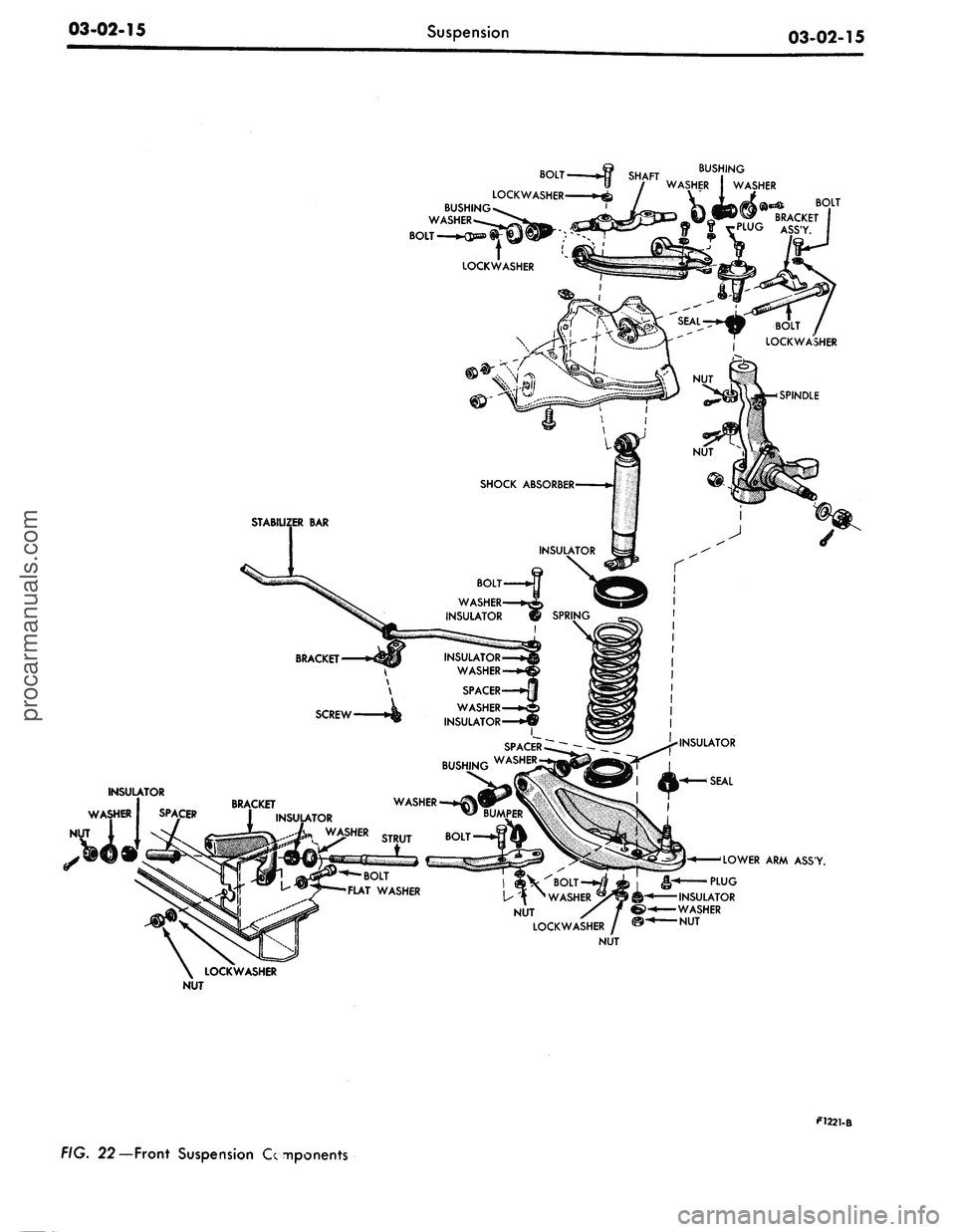
FIG. 22—Front Suspension Componentsprocarmanuals.com
Page 94 of 413
03-02-18
Suspension
03-02-18
5.
Remove the cotter pin from the
upper ball joint stud nut.
6. Loosen the upper ball joint stud
nut one or two turns. Do not remove
the nut from the stud at this time.
7.
Install tool T57P-3006-A be-
tween the upper and lower ball joint
studs with the adapter screw on top
(Fig. 13). The tool should be seated
firmly against the ends of both studs
and not against the nuts or lower stud
cotter pin.
8. With a wrench, turn the adapter
screw until the tool places the stua
under tension. Tap the spindle near
the upper stud with a hammer to loos-
en the stud in the spindle. Do not
loosen the stud from the spindle with
tool pressure only.
9. Remove the tool from between
the ball joint studs and place a floor
jack under the lower arm.
10.
Raise the floor jack to relieve
the pressure from the upper ball joint
stud nut and remove the nut.
11.
Remove the upper arm inner
shaft attaching bolts. Remove the
upper arm and inner shaft as an as-
sembly (Fig. 1).
12.
Remove the bumpei from the
upper arm.
Installation
1.
Position the bumper to the upper
arm and install the nut and washer.
Torque the nut to specifications.
2.
Position the upper arm inner
shaft to the frame side rail and install
the 2 attaching bolts and washers
snug.
3.
Connect the upper ball joint stud
to the spindle and install the attaching
nut. Torque the nut to specification
and continue to tighten the nut until
the cotter pin hole in the stud is in
line with the nut slots. Then, install
the cotter pin.
4.
If equipped with drum type bra-
kes—Adjust the brakes as outlined in
Part 2-2. Install the wheel, tire, and
drum to the spindle and adjust the
wheel bearings as outlined in Part
3-12.
5.
If equipped with disc brak-
es—Install the wheel and tire on the
hub and adjust the wheel bearings as
outlined in Part 3-12.
6. Install the hub cap or wheel
cover.
7.
Remove the safety stands and
lower the front of the vehicle.
8. Check caster, camber, and toe-in
and adjust as required (Section 2, Part
3-D.
COUGAR, FAIRLANE,
FALCON, MONTEGO,
MUSTANG
Removal
1.
Raise the front of the vehicle,
position safety stands under the
frame, and lower the vehicle slightly.
2.
Remove the wheel and tire.
3.
Remove the shock absorber
lower attaching nuts and washers.
4.
Remove the shock absorber
upper mounting bracket attaching
nuts,
and remove the shock absorber
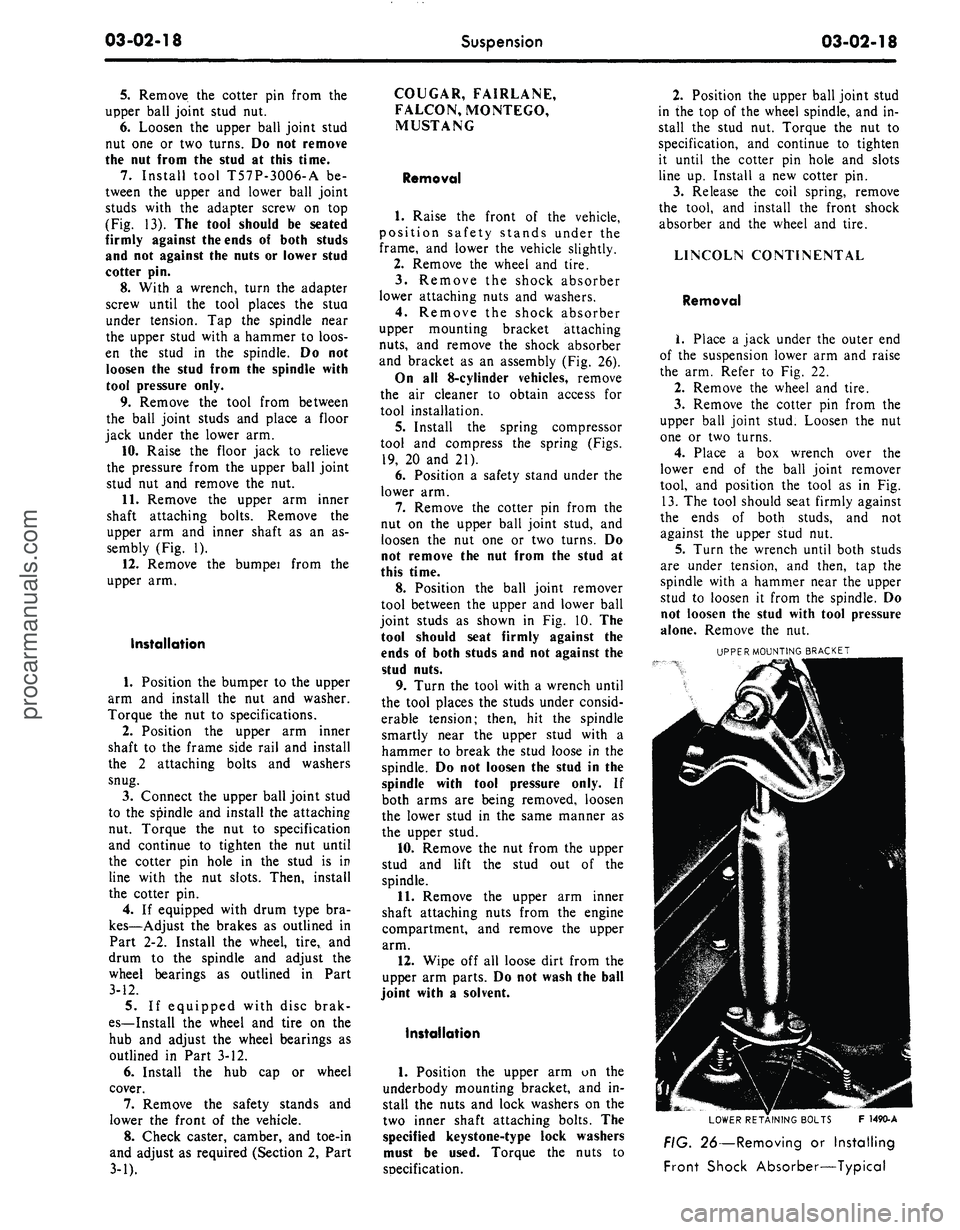
and bracket as an assembly (Fig. 26).
On all 8-cylinder vehicles, remove
the air cleaner to obtain access for
tool installation.
5.
Install the spring compressor
tool and compress the spring (Figs.
19,
20 and 21).
6. Position a safety stand under the
lower arm.
7.
Remove the cotter pin from the
nut on the upper ball joint stud, and
loosen the nut one or two turns. Do
not remove the nut from the stud at
this time.
8. Position the ball joint remover
tool between the upper and lower ball
joint studs as shown in Fig. 10. The
tool should seat firmly against the
ends of both studs and not against the
stud nuts.
9. Turn the tool with a wrench until
the tool places the studs under consid-
erable tension; then, hit the spindle
smartly near the upper stud with a
hammer to break the stud loose in the
spindle. Do not loosen the stud in the
spindle with tool pressure only. If
both arms are being removed, loosen
the lower stud in the same manner as
the upper stud.
10.
Remove the nut from the upper
stud and lift the stud out of the
spindle.
11.
Remove the upper arm inner
shaft attaching nuts from the engine
compartment, and remove the upper
arm.
12.
Wipe off all loose dirt from the
upper arm parts. Do not wash the ball
joint with a solvent.
Installation
1.
Position the upper arm on the
underbody mounting bracket, and in-
stall the nuts and lock washers on the
two inner shaft attaching bolts. The
specified keystone-type lock washers
must be used. Torque the nuts to
soecification.
2.
Position the upper ball joint stud
in the top of the wheel spindle, and in-
stall the stud nut. Torque the nut to
specification, and continue to tighten
it until the cotter pin hole and slots
line up. Install a new cotter pin.
3.
Release the coil spring, remove
the tool, and install the front shock
absorber and the wheel and tire.
LINCOLN CONTINENTAL
Removal
1.
Place a jack under the outer end
of the suspension lower arm and raise
the arm. Refer to Fig. 22.
2.
Remove the wheel and tire.
3.
Remove the cotter pin from the
upper ball joint stud. Loosen the nut
one or two turns.
4.
Place a box wrench over the
lower end of the ball joint remover
tool, and position the tool as in Fig.
13.
The tool should seat firmly against
the ends of both studs, and not
against the upper stud nut.
5.
Turn the wrench until both studs
are under tension, and then, tap the
spindle with a hammer near the upper
stud to loosen it from the spindle. Do
not loosen the stud with tool pressure
alone. Remove the nut.
UPPER MOUNTING BRACKET
LOWER RETAINING BOLTS F 1490-A
FIG. 26—Removing or Installing
Front Shock Absorber—Typicalprocarmanuals.com
Page 95 of 413
03-02-19
Suspension
03-02-19
6. Raise the upper arm to free the
ball joint stud from the spindle. Wire
the upper end of the spindle to the un-
derbody to prevent damage to the
brake hose.
7.
Mark the position of the upper
arm shaft on the underbody member
to facilitate making caster and camber
adjustments after installation of the
upper arm.
8. Remove the suspension upper
arm-to-underbody attaching bolts,
lock washers, and attaching nuts.
Then, remove the upper arm.
Installation
1.
Position the upper arm shaft on
the underbody member. Line up the
shaft with the marks made before re-
moval of the arm.
2.
Install the attaching bolts and
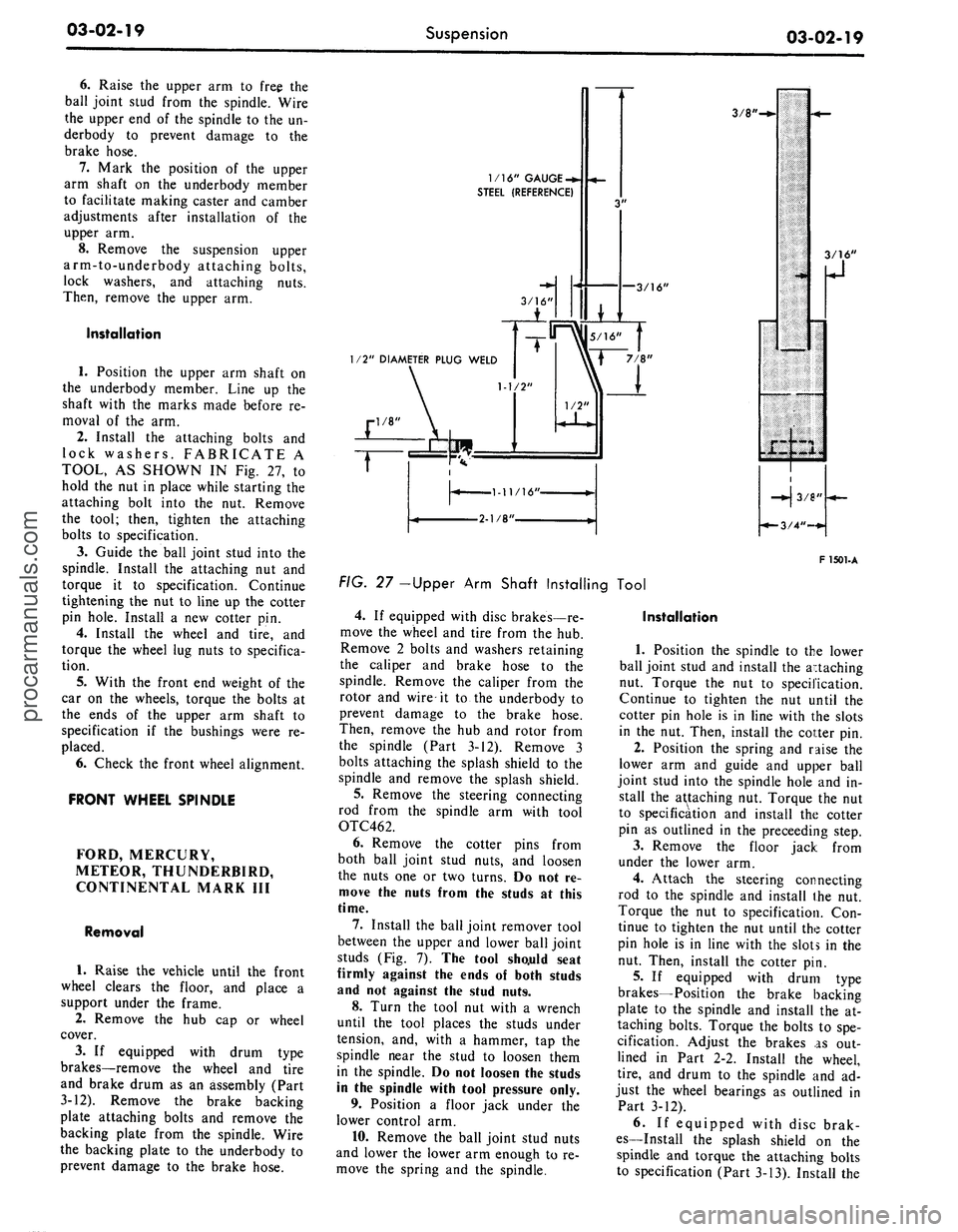
lock washers. FABRICATE A
TOOL, AS SHOWN IN Fig. 27, to
hold the nut in place while starting the
attaching bolt into the nut. Remove
the tool; then, tighten the attaching
bolts to specification.
3.
Guide the ball joint stud into the
spindle. Install the attaching nut and
torque it to specification. Continue
tightening the nut to line up the cotter
pin hole. Install a new cotter pin.
4.
Install the wheel and tire, and
torque the wheel lug nuts to specifica-
tion.
5.
With the front end weight of the
car on the wheels, torque the bolts at
the ends of the upper arm shaft to
specification if the bushings were re-
placed.
6. Check the front wheel alignment.
FRONT WHEEL SPINDLE
FORD, MERCURY,
METEOR, THUNDERBIRD,
CONTINENTAL MARK III
Removal
1.
Raise the vehicle until the front
wheel clears the floor, and place a
support under the frame.
2.
Remove the hub cap or wheel
cover.
3.
If equipped with drum type
brakes—remove the wheel and tire
and brake drum as an assembly (Part
3-12). Remove the brake backing
plate attaching bolts and remove the
backing plate from the spindle. Wire
the backing plate to the underbody to
prevent damage to the brake hose.
1/16" GAUGE
-*.
STEEL (REFERENCE)
—3/16'
3/8'
1/2" DIAMETER PLUG WELD
F 1501-A
FIG. 27 -Upper Arm Shaft Installing Tool
4.
If equipped with disc brakes—re-
move the wheel and tire from the hub.
Remove 2 bolts and washers retaining
the caliper and brake hose to the
spindle. Remove the caliper from the
rotor and wire it to the underbody to
prevent damage to the brake hose.
Then, remove the hub and rotor from
the spindle (Part 3-12). Remove 3
bolts attaching the splash shield to the
spindle and remove the splash shield.
5.
Remove the steering connecting
rod from the spindle arm with tool
OTC462.
6. Remove the cotter pins from
both ball joint stud nuts, and loosen
the nuts one or two turns. Do not re-
move the nuts from the studs at this
time.
7.
Install the ball joint remover tool
between the upper and lower ball joint
studs (Fig. 7). The tool sho.uld seat
firmly against the ends of both studs
and not against the stud nuts.
8. Turn the tool nut with a wrench
until the tool places the studs under
tension, and, with a hammer, tap the
spindle near the stud to loosen them
in the spindle. Do not loosen the studs
in the spindle with tool pressure only.
9. Position a floor jack under the
lower control arm.
10.
Remove the ball joint stud nuts
and lower the lower arm enough to re-
move the spring and the spindle.
Installation
1.
Position the spindle to the lower
ball joint stud and install the attaching
nut. Torque the nut to specification.
Continue to tighten the nut until the
cotter pin hole is in line with the slots
in the nut. Then, install the cotter pin.
2.
Position the spring and raise the
lower arm and guide and upper ball
joint stud into the spindle hole and in-
stall the attaching nut. Torque the nut
to specification and install the cotter
pin as outlined in the preceeding step.
3.
Remove the floor jack from
under the lower arm.
4.
Attach the steering connecting
rod to the spindle and install the nut.
Torque the nut to specification. Con-
tinue to tighten the nut until the cotter
pin hole is in line with the slots in the
nut. Then, install the cotter pin.
5.
If equipped with drum type
brakes—Position the brake backing
plate to the spindle and install the at-
taching bolts. Torque the bolts to spe-
cification. Adjust the brakes as out-
lined in Part 2-2. Install the wheel,
tire,
and drum to the spindle and ad-
just the wheel bearings as outlined in
Part 3-12).
6. If equipped with disc brak-
es—Install the splash shield on the
spindle and torque the attaching bolts
to specification (Part 3-13). Install theprocarmanuals.com