fuel pump ISUZU KB P190 2007 Workshop Service Manual
[x] Cancel search | Manufacturer: ISUZU, Model Year: 2007, Model line: KB P190, Model: ISUZU KB P190 2007Pages: 6020, PDF Size: 70.23 MB
Page 1088 of 6020

6E-54 Engine Control System (4JH1)
DTC
(Symptom Code) Flash
Code MIL
Status DTC Name on
scan tool Condition for
Running the DTC Condition for
Setting the DTC Possible Cause
P0243
(8) 64 ON Turbocharger
W aste gate
Solenoid Boost
Solenoid Circuit
High Voltage •
The ignition switch
is ON. •
The ECM detects
that the high
voltage condition on
the turbocharger
solenoid valve
control circuit for
longer than 3
seconds when the
solenoid valve is
commanded ON.
•
Turbocharger solenoid valve
control circuit is short to battery
or ignition voltage circuit.
• Faulty turbocharger solenoid
valve.
• Faulty ECM.
P0251 (6) 53 ON Injection Pump
Fuel Metering
Control •
The fuel injection
pump CMP sensor
signal is generated.
• The CAN
communication
between the ECM
and PCU is normal.
•
The PCU detects
that the fuel
injection solenoid
valve is operated
when the desired
fuel injection
quantity is
commanded 0
mg/strk.
•
Faulty fuel injection pump.
• Faulty PCU.
P0251 (7) 53 ON Injection Pump
Fuel Metering
Control •
The fuel injection
pump CMP sensor
signal is generated.
• The CKP sensor
signal is generated.
• The engine speed
is higher than 500
RPM.
•
The PCU detects
that the doubled
fuel injection pump
speed is lower than
engine speed by
690 RPM for longer
than 0.2 seconds.
•
Faulty CKP sensor signal.
• Faulty fuel injection pump CMP
sensor signal.
• Electrical interference.
• Magnetic interference.
• Faulty PCU.
P0251 (9) 53 ON Injection Pump
Fuel Metering
Control •
The ignition switch
is ON. •
The PCU detects
internal fuel
injection pump
control maps are
not programmed
during self-test.
•
Faulty PCU.
P0251 (A) 53 ON Injection Pump
Fuel Metering
Control •
The ignition switch
is ON. •
The PCU detects
internal EEPROM
or A/D converter is
failed during self-
test.
•
Faulty PCU.
P0251 (B) 53 ON Injection Pump
Fuel Metering
Control •
The ignition switch
is ON. •
The PCU detects
that the fuel
injection solenoid
valve drive circuit is
failed during self-
test.
•
Faulty fuel injection pump.
• Faulty PCU.
P0251 (D) 53 ON Injection Pump
Fuel Metering
Control •
The ignition switch
is ON. •
The PCU detects
that the fuel
injection solenoid
valve drive circuit
voltage level is
abnormal during
self-test.
•
Faulty fuel injection pump.
• Faulty PCU.
BACK TO CHAPTER INDEX
TO MODEL INDEX
ISUZU KB P190 2007
Page 1089 of 6020

Engine Control System (4JH1) 6E-55
DTC
(Symptom Code) Flash
Code MIL
Status DTC Name on
scan tool Condition for
Running the DTC Condition for
Setting the DTC Possible Cause
P0251
(E) 53 ON Injection Pump
Fuel Metering
Control •
The ignition switch
is ON. •
The ECM detects
communication
message from the
PCU is not received
for longer than 1
second.
•
CAN high circuit is open circuit,
high resistance, short to ground,
short to battery or ignition
voltage.
• CAN low circuit is open circuit,
high resistance, short to ground,
short to battery or ignition
voltage.
• Electrical interference.
• Magnetic interference.
• Faulty PCU.
• Faulty ECM.
P0335 (B) 43 ON
Crankshaft
Position (CKP)
Sensor Circuit •
The ignition switch
is ON.
• The engine speed
is higher than 665
RPM.
•
The ECM detects
extra or missing
CKP sensor signals
while engine is
running. •
Sensor signal circuit is open
circuit, high resistance, short to
ground, short to battery or short
to ignition voltage.
• Sensor low reference circuit is
open circuit, high resistance,
short to ground, short to battery
or short to ignition voltage.
• Sensor shield ground is open
circuit, high resistance, short to
ground, short to battery or short
to ignition voltage.
• Faulty CKP sensor.
• Faulty ECM.
• Electrical interference.
• Magnetic interference.
• Faulty sensor installation.
• Faulty flywheel circumference.
P0335 (D) 43 ON
Crankshaft
Position (CKP)
Sensor Circuit •
DTC P0335
(Symptom Code B)
is not set.
• The ignition switch
is ON.
• The fuel injection
pump CMP sensor
signal is generated.
• The CAN
communication
between the ECM
and PCU is normal.
•
The ECM detects
that the CKP sensor
signals are not
generated when
doubled fuel
injection pump
rotation speed is
higher than 50
RPM.
•
Sensor signal circuit is open
circuit, high resistance, short to
ground, short to battery or short
to ignition voltage.
• Sensor low reference circuit is
open circuit, high resistance,
short to ground, short to battery
or short to ignition voltage.
• Sensor shield ground is open
circuit, high resistance, short to
ground, short to battery or short
to ignition voltage.
• Faulty CKP sensor.
• Faulty ECM.
• Electrical interference.
• Magnetic interference.
• Faulty sensor installation.
• Faulty flywheel circumference.
P0335 (E) 43 ON Crankshaft
Position (CKP)
Sensor Circuit •
Ignition switch is
ON.
•
The ECM detects
that the engine
speed is higher
than 5700 RPM for
0.2 seconds. •
Engine overrun.
• Faulty CKP sensor.
• Faulty ECM.
• Electrical interference.
• Magnetic interference.
• Faulty flywheel circumference.
BACK TO CHAPTER INDEX
TO MODEL INDEX
ISUZU KB P190 2007
Page 1096 of 6020
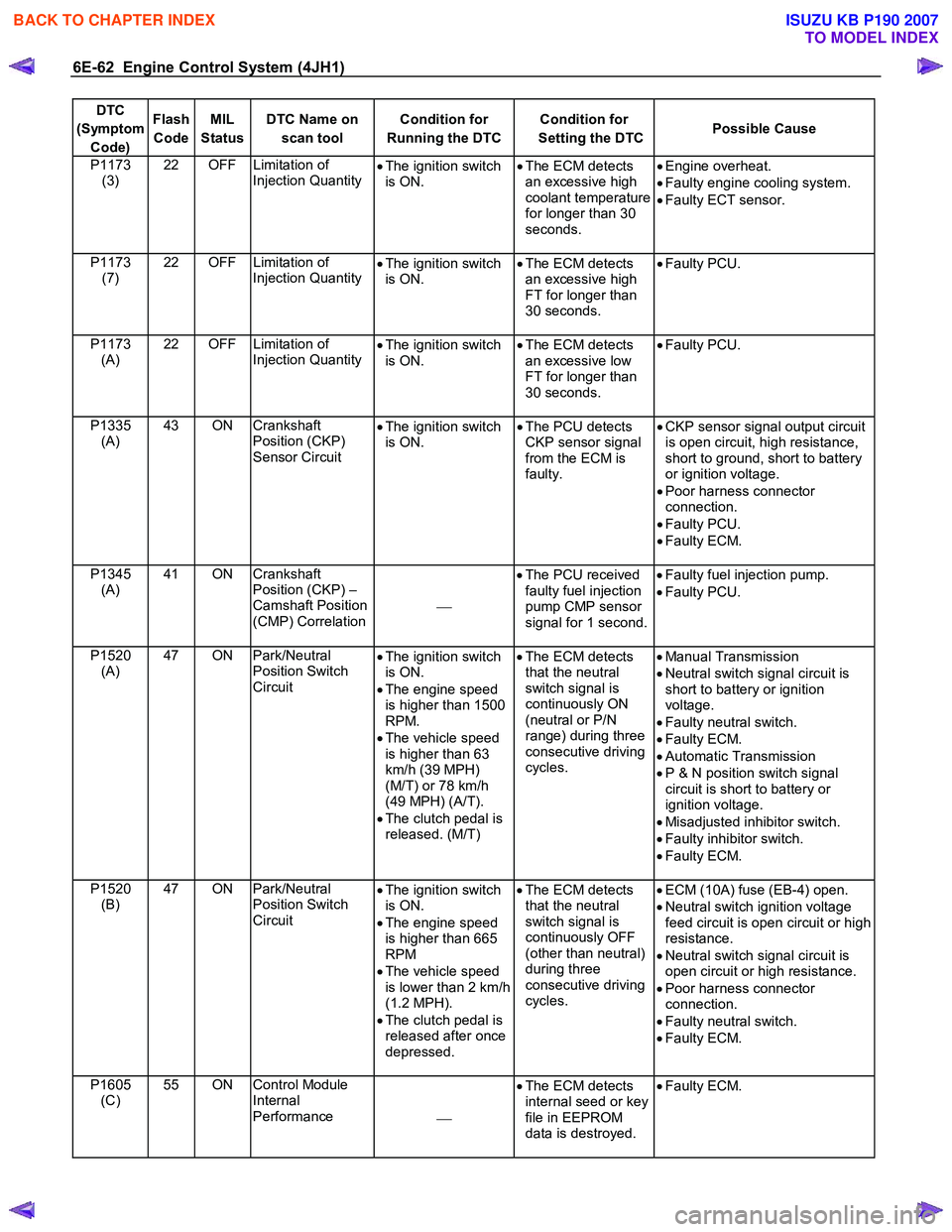
6E-62 Engine Control System (4JH1)
DTC
(Symptom Code) Flash
Code MIL
Status DTC Name on
scan tool Condition for
Running the DTC Condition for
Setting the DTC Possible Cause
P1173
(3) 22 OFF Limitation of
Injection Quantity •
The ignition switch
is ON. •
The ECM detects
an excessive high
coolant temperature
for longer than 30
seconds.
•
Engine overheat.
• Faulty engine cooling system.
• Faulty ECT sensor.
P1173 (7) 22 OFF Limitation of
Injection Quantity
•
The ignition switch
is ON. •
The ECM detects
an excessive high
FT for longer than
30 seconds.
•
Faulty PCU.
P1173 (A) 22 OFF Limitation of
Injection Quantity
•
The ignition switch
is ON. •
The ECM detects
an excessive low
FT for longer than
30 seconds.
•
Faulty PCU.
P1335 (A) 43 ON Crankshaft
Position (CKP)
Sensor Circuit •
The ignition switch
is ON. •
The PCU detects
CKP sensor signal
from the ECM is
faulty.
•
CKP sensor signal output circuit
is open circuit, high resistance,
short to ground, short to battery
or ignition voltage.
• Poor harness connector
connection.
• Faulty PCU.
• Faulty ECM.
P1345 (A) 41 ON Crankshaft
Position (CKP) –
Camshaft Position
(CMP) Correlation
•
The PCU received
faulty fuel injection
pump CMP sensor
signal for 1 second.
•
Faulty fuel injection pump.
• Faulty PCU.
P1520 (A) 47 ON Park/Neutral
Position Switch
Circuit •
The ignition switch
is ON.
• The engine speed
is higher than 1500
RPM.
• The vehicle speed
is higher than 63
km/h (39 MPH)
(M/T) or 78 km/h
(49 MPH) (A/T).
• The clutch pedal is
released. (M/T)
•
The ECM detects
that the neutral
switch signal is
continuously ON
(neutral or P/N
range) during three
consecutive driving
cycles.
•
Manual Transmission
• Neutral switch signal circuit is
short to battery or ignition
voltage.
• Faulty neutral switch.
• Faulty ECM.
• Automatic Transmission
• P & N position switch signal
circuit is short to battery or
ignition voltage.
• Misadjusted inhibitor switch.
• Faulty inhibitor switch.
• Faulty ECM.
P1520 (B) 47 ON Park/Neutral
Position Switch
Circuit •
The ignition switch
is ON.
• The engine speed
is higher than 665
RPM
• The vehicle speed
is lower than 2 km/h
(1.2 MPH).
• The clutch pedal is
released after once
depressed.
•
The ECM detects
that the neutral
switch signal is
continuously OFF
(other than neutral)
during three
consecutive driving
cycles.
•
ECM (10A) fuse (EB-4) open.
• Neutral switch ignition voltage
feed circuit is open circuit or high
resistance.
• Neutral switch signal circuit is
open circuit or high resistance.
• Poor harness connector
connection.
• Faulty neutral switch.
• Faulty ECM.
P1605 (C) 55 ON Control Module
Internal
Performance •
The ECM detects
internal seed or key
file in EEPROM
data is destroyed.
•
Faulty ECM.
BACK TO CHAPTER INDEX
TO MODEL INDEX
ISUZU KB P190 2007
Page 1098 of 6020
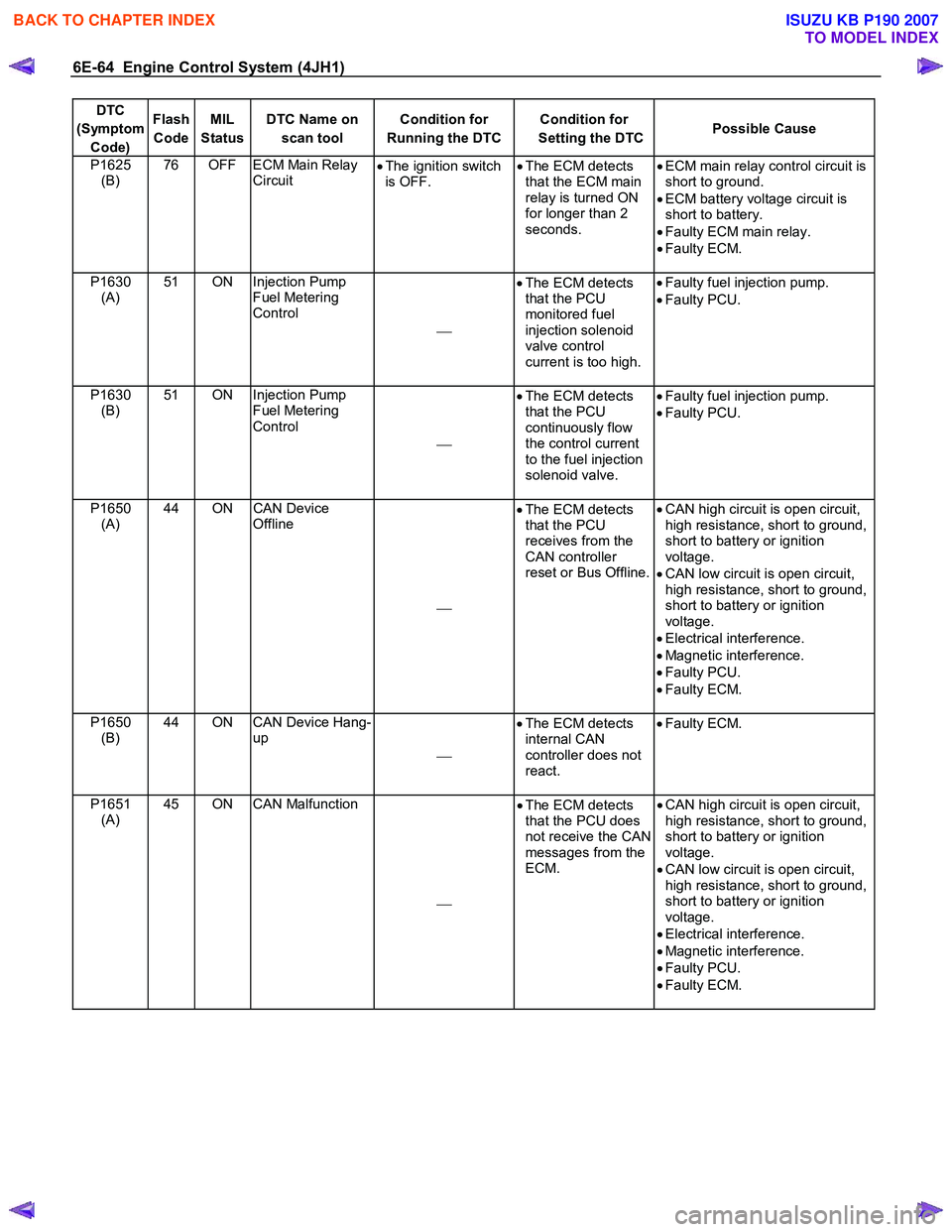
6E-64 Engine Control System (4JH1)
DTC
(Symptom Code) Flash
Code MIL
Status DTC Name on
scan tool Condition for
Running the DTC Condition for
Setting the DTC Possible Cause
P1625
(B) 76 OFF ECM Main Relay
Circuit •
The ignition switch
is OFF. •
The ECM detects
that the ECM main
relay is turned ON
for longer than 2
seconds. •
ECM main relay control circuit is
short to ground.
• ECM battery voltage circuit is
short to battery.
• Faulty ECM main relay.
• Faulty ECM.
P1630 (A) 51 ON Injection Pump
Fuel Metering
Control
•
The ECM detects
that the PCU
monitored fuel
injection solenoid
valve control
current is too high.
•
Faulty fuel injection pump.
• Faulty PCU.
P1630 (B) 51 ON Injection Pump
Fuel Metering
Control
•
The ECM detects
that the PCU
continuously flow
the control current
to the fuel injection
solenoid valve.
•
Faulty fuel injection pump.
• Faulty PCU.
P1650 (A) 44 ON CAN Device
Offline
•
The ECM detects
that the PCU
receives from the
CAN controller
reset or Bus Offline.
•
CAN high circuit is open circuit,
high resistance, short to ground,
short to battery or ignition
voltage.
• CAN low circuit is open circuit,
high resistance, short to ground,
short to battery or ignition
voltage.
• Electrical interference.
• Magnetic interference.
• Faulty PCU.
• Faulty ECM.
P1650 (B) 44 ON CAN Device Hang-
up
•
The ECM detects
internal CAN
controller does not
react.
•
Faulty ECM.
P1651 (A) 45 ON CAN Malfunction
•
The ECM detects
that the PCU does
not receive the CAN
messages from the
ECM.
•
CAN high circuit is open circuit,
high resistance, short to ground,
short to battery or ignition
voltage.
• CAN low circuit is open circuit,
high resistance, short to ground,
short to battery or ignition
voltage.
• Electrical interference.
• Magnetic interference.
• Faulty PCU.
• Faulty ECM.
BACK TO CHAPTER INDEX
TO MODEL INDEX
ISUZU KB P190 2007
Page 1129 of 6020

Engine Control System (4JH1) 6E-95
DTC P0180 (Symptom Code B) (Flash Code 15)
Circuit Description
The fuel temperature (FT) sensor is internal to the fuel
injection pump control unit (PCU). It detects fuel
temperature in the fuel injection pump. The engine
control module (ECM) and PCU communicates with
each other over the controller area network (CAN) link.
If the PCU internal FT sensor output is an excessivel
y
high or low, this DTC will set.
Condition for Running the DTC
• The ignition switch is ON.
Condition for Setting the DTC
• The PCU internal FT sensor output is lower than -
40°C (-40°F) for 3 seconds or higher than 150°C
(302°F) for 3 seconds.
Action Taken When the DTC Sets
• The ECM illuminates the malfunction indicato
r
lamp (MIL) when the diagnostic runs and fails.
•
The ECM uses a default FT substitution for engine
control.
Condition for Clearing the MIL/DTC
• The ECM turns OFF the MIL when the diagnostic
runs and does not fail.
• A history DTC clears after 40 consecutive driving
cycles without a fault. Or clear with the scan tool.
Diagnostic Aids
• If an intermittent condition is suspected, refer to
Intermittent Conditions in this section.
Notice:
• FT sensor is internal to the PCU and it is part o
f
the fuel injection pump assembly.
DTC P0180 (Symptom Code B) (Flash Code 15)
Step Action Value(s) Yes No
1 Did you perform the Diagnostic System Check-
Engine Controls?
Go to Step 2 Go to Diagnostic
System Check-
Engine Controls
2 1. Install the scan tool. 2. Turn OFF the ignition for 30 seconds.
3. Start the engine.
4. Monitor the Diagnostic Trouble Code (DTC) Information with the scan tool.
Does the DTC fail this ignition?
Go to Step 3 Go to Step 4
3 Important: The fuel injection pump must be timed to
the engine.
Replace the fuel injection pump. Refer to Fuel
Injection Pump Replacement in engine mechanical
section. (Fuel temperature (FT) sensor is internal to
the fuel injection pump control unit (PCU) and it is
part of the fuel injection pump assembly.)
Did you complete the replacement?
Go to Step 4
4 1. Clear the DTCs with the scan tool.
2. Turn OFF the ignition for 30 seconds.
3. Start the engine.
4. Monitor the DTC Information with the scan tool.
Did the DTC fail this ignition?
Go to Step 3 Go to Step 5
5 Observe the DTC Information with the scan tool. Are there any DTCs that you have not diagnosed? Go to Diagnostic
Trouble Code (DTC) List System OK
BACK TO CHAPTER INDEX
TO MODEL INDEX
ISUZU KB P190 2007
Page 1130 of 6020

6E-96 Engine Control System (4JH1)
DTC P0215 (Symptom Code A) (Flash Code 52)
Circuit Description
The engine control module (ECM) calculates the
desired fuel injection quantity and timing using data sent
from various sensors. These desired data are sent to
the fuel injection pump control unit (PCU) via a
controller area network (CAN) communication bus. The
PCU also receives signals from the internal inputs:
pump camshaft position (CMP) sensor that is located
inside the fuel injection pump to determine the cam ring
rotation angle and the fuel injection pump speed. The
fuel temperature (FT) sensor is internal the PCU. These
values are used to compare the desired values sent
from the ECM then PCU determines the injection time
r
piston position and fuel injection quantity, and actuates
timing control valve (TCV) & fuel injection solenoid
valve based on control maps in the PCU.
The fuel injection solenoid valve is installed to the fuel
injection pump rear side. The fuel injection event is
determined by this solenoid ON/OFF command. The
fuel injection solenoid valve cuts the fuel when the
engine shutoff (ESO) solenoid valve is commanded
shutoff from the PCU. (The fuel injection solenoid valve
and engine shutoff (ESO) solenoid valve is same part. It
calls ESO solenoid valve when fuel is shutoff.) W hen
the ignition switch is turned OFF or commanded from
fail-safe action, the ESO solenoid valve is commanded
shutoff to stop the engine running. If the ECM detects
that the engine is continuously run after the ignition
switch is OFF, this DTC will set.
Condition for Running the DTC
• The ignition switch is OFF.
• The engine speed is lower than 1500 RPM.
• The vehicle speed is lower than 1.5 km/h (1 MPH).
Condition for Setting the DTC
•
After the condition for running this DTC for 2
seconds, the engine speed is higher than 200
RPM when the ESO solenoid valve is commanded
shutoff from the CPU. This indicates the PCU
reacts to the command from the ECM but ESO
solenoid valve does not react to the command
from the PCU and fuel cannot shutoff.
Action Taken When the DTC Sets
• The ECM illuminates the malfunction indicato
r
lamp (MIL) at next ignition cycle.
• The ECM cuts fuel injection.
Condition for Clearing the MIL/DTC
• The ECM turns OFF the MIL when the diagnostic
runs and does not fail.
• A history DTC clears after 40 consecutive driving
cycles without a fault. Or clear with the scan tool.
Diagnostic Aids
• If an intermittent condition is suspected, refer to
Intermittent Conditions in this section.
Notice:
• Fuel injection solenoid valve is internal to the fuel
injection pump assembly.
• PCU is part of the fuel injection pump assembly.
DTC P0215 (Symptom Code A) (Flash Code 52)
Step Action Value(s) Yes No
1 Did you perform the Diagnostic System Check-
Engine Controls?
Go to Step 2 Go to Diagnostic
System Check-
Engine Controls
2 1. Install the scan tool. 2. Turn OFF the ignition for 30 seconds.
3. Start the engine and let idle for 30 seconds.
4. Monitor the Diagnostic Trouble Code (DTC) Information with the scan tool.
5. Turn OFF the engine.
Does the DTC fail this ignition before the engine
control module (ECM) turned OFF?
Go to Step 3 Go to Step 4
3 Important: The fuel injection pump must be timed to
the engine.
Replace the fuel injection pump. Refer to Fuel
Injection Pump Replacement in engine mechanical
section.
Did you complete the replacement?
Go to Step 4
BACK TO CHAPTER INDEX
TO MODEL INDEX
ISUZU KB P190 2007
Page 1132 of 6020

6E-98 Engine Control System (4JH1)
DTC P0215 (Symptom Code B) (Flash Code 52)
Circuit Description
The engine control module (ECM) calculates the
desired fuel injection quantity and timing using data sent
from various sensors. These desired data are sent to
the fuel injection pump control unit (PCU) via a
controller area network (CAN) communication bus. The
PCU also receives signals from the internal inputs:
pump camshaft position (CMP) sensor that is located
inside the fuel injection pump to determine the cam ring
rotation angle and the fuel injection pump speed. The
fuel temperature (FT) sensor is internal the PCU. These
values are used to compare the desired values sent
from the ECM then PCU determines the injection time
r
piston position and fuel injection quantity, and actuates
timing control valve (TCV) & fuel injection solenoid
valve based on control maps in the PCU.
The fuel injection solenoid valve is installed to the fuel
injection pump rear side. The fuel injection event is
determined by this solenoid ON/OFF command. The
fuel injection solenoid valve cuts the fuel when the
engine shutoff (ESO) solenoid valve is commanded
shutoff from the PCU. (The fuel injection solenoid valve
and engine shutoff (ESO) solenoid valve is same part. It
calls ESO solenoid valve when fuel is shutoff.) W hen
the ignition switch is turned OFF or commanded from
fail-safe action, the ESO solenoid valve is commanded
shutoff to stop the engine running. If the PCU detects
that the ESO solenoid valve control circuit voltage level
from the ECM to PCU is high, this DTC will set.
Condition for Running the DTC
• The ignition switch is ON.
Condition for Setting the DTC
• The PCU detects high voltage condition on the
ESO solenoid valve control circuit for longer than 1
second when the ECM does not command shutoff.
Action Taken When the DTC Sets
• The ECM illuminates the malfunction indicato
r
lamp (MIL) when the diagnostic runs and fails.
Condition for Clearing the MIL/DTC
• The ECM turns OFF the MIL when the diagnostic
runs and does not fail.
• A history DTC clears after 40 consecutive driving
cycles without a fault. Or clear with the scan tool.
Diagnostic Aids
• If an intermittent condition is suspected, refer to
Intermittent Conditions in this section.
Notice:
• Fuel injection solenoid valve is internal to the fuel
injection pump assembly.
• PCU is part of the fuel injection pump assembly.
• If this DTC is present, engine will not start.
DTC P0215 (Symptom Code B) (Flash Code 52)
Schematic Reference: Engine Controls Schematics
Connector End View Reference: Engine Controls
Connector End Views or Engine Control Module (ECM)
Connector End Views
Step Action Value(s) Yes No
1 Did you perform the Diagnostic System Check-
Engine Controls?
Go to Step 2 Go to Diagnostic
System Check-
Engine Controls
2 1. Install the scan tool. 2. Turn OFF the ignition for 30 seconds.
3. Start the engine. If the engine does not start, crank over the engine.
4. Monitor the Diagnostic Trouble Code (DTC) Information with the scan tool.
Does the DTC fail this ignition?
Go to Step 3 Go to Diagnostic
Aids
3 1. Turn OFF the ignition. 2. Disconnect the fuel injection pump control unit (PCU) harness connector.
3. Connect a test lamp between the engine shutoff (ESO) solenoid valve control signal circuit (pin 5
of E-6 connector) and a known good ground.
4. Turn ON the ignition, with the engine OFF.
Does the test lamp illuminate?
Go to Step 5 Go to Step 4
BACK TO CHAPTER INDEX
TO MODEL INDEX
ISUZU KB P190 2007
Page 1133 of 6020
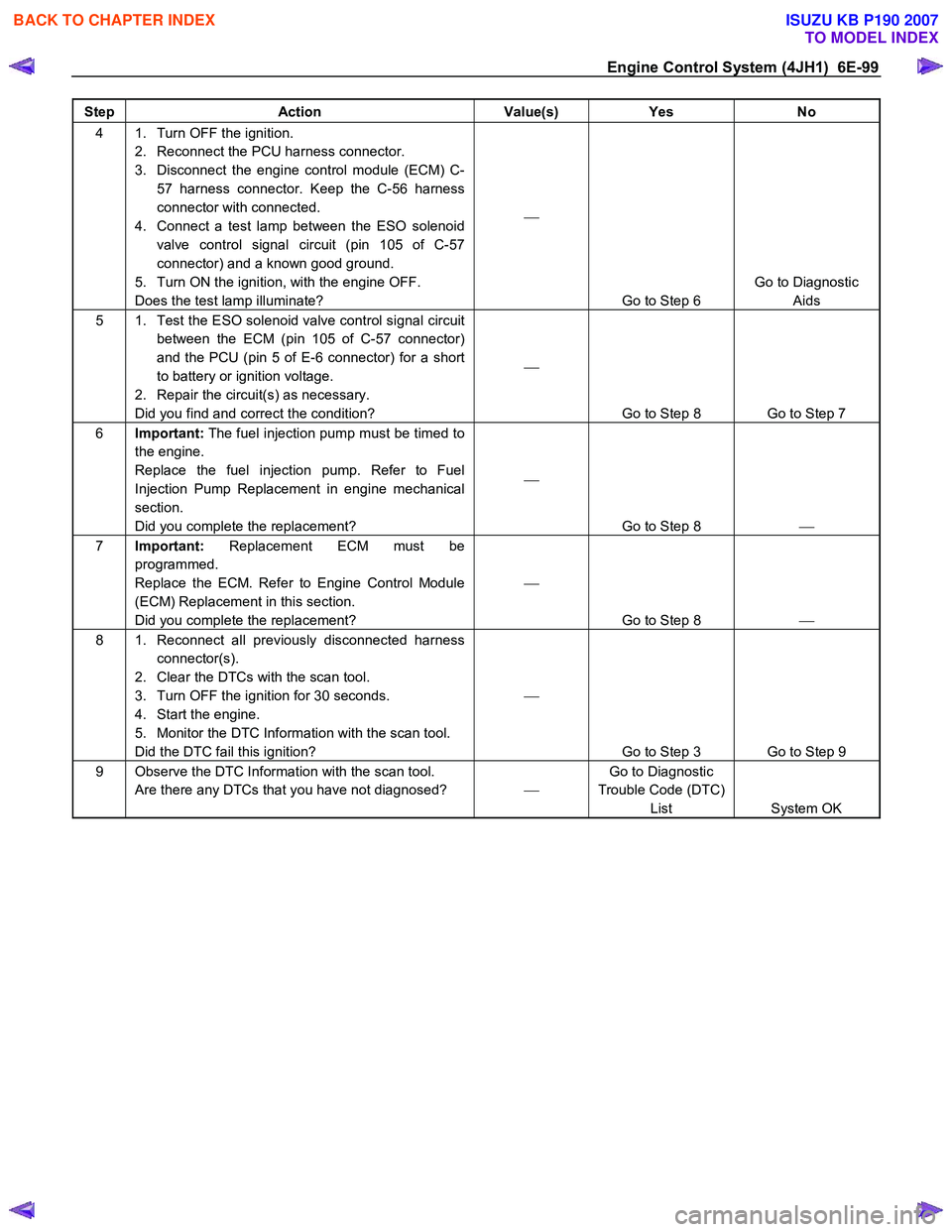
Engine Control System (4JH1) 6E-99
Step Action Value(s) Yes No
4 1. Turn OFF the ignition.
2. Reconnect the PCU harness connector.
3. Disconnect the engine control module (ECM) C- 57 harness connector. Keep the C-56 harness
connector with connected.
4. Connect a test lamp between the ESO solenoid valve control signal circuit (pin 105 of C-57
connector) and a known good ground.
5. Turn ON the ignition, with the engine OFF.
Does the test lamp illuminate?
Go to Step 6 Go to Diagnostic
Aids
5 1. Test the ESO solenoid valve control signal circuit between the ECM (pin 105 of C-57 connector)
and the PCU (pin 5 of E-6 connector) for a short
to battery or ignition voltage.
2. Repair the circuit(s) as necessary.
Did you find and correct the condition?
Go to Step 8 Go to Step 7
6 Important: The fuel injection pump must be timed to
the engine.
Replace the fuel injection pump. Refer to Fuel
Injection Pump Replacement in engine mechanical
section.
Did you complete the replacement?
Go to Step 8
7 Important: Replacement ECM must be
programmed.
Replace the ECM. Refer to Engine Control Module
(ECM) Replacement in this section.
Did you complete the replacement?
Go to Step 8
8 1. Reconnect all previously disconnected harness
connector(s).
2. Clear the DTCs with the scan tool.
3. Turn OFF the ignition for 30 seconds.
4. Start the engine.
5. Monitor the DTC Information with the scan tool.
Did the DTC fail this ignition?
Go to Step 3 Go to Step 9
9 Observe the DTC Information with the scan tool. Are there any DTCs that you have not diagnosed? Go to Diagnostic
Trouble Code (DTC) List System OK
BACK TO CHAPTER INDEX
TO MODEL INDEX
ISUZU KB P190 2007
Page 1134 of 6020

6E-100 Engine Control System (4JH1)
DTC P0215 (Symptom Code C) (Flash Code 52)
Circuit Description
The engine control module (ECM) calculates the
desired fuel injection quantity and timing using data sent
from various sensors. These desired data are sent to
the fuel injection pump control unit (PCU) via a
controller area network (CAN) communication bus. The
PCU also receives signals from the internal inputs:
pump camshaft position (CMP) sensor that is located
inside the fuel injection pump to determine the cam ring
rotation angle and the fuel injection pump speed. The
fuel temperature (FT) sensor is internal the PCU. These
values are used to compare the desired values sent
from the ECM then PCU determines the injection time
r
piston position and fuel injection quantity, and actuates
timing control valve (TCV) & fuel injection solenoid
valve based on control maps in the PCU.
The fuel injection solenoid valve is installed to the fuel
injection pump rear side. The fuel injection event is
determined by this solenoid ON/OFF command. The
fuel injection solenoid valve cuts the fuel when the
engine shutoff (ESO) solenoid valve is commanded
shutoff from the PCU. (The fuel injection solenoid valve
and engine shutoff (ESO) solenoid valve is same part. It
calls ESO solenoid valve when fuel is shutoff.) W hen
the ignition switch is turned OFF or commanded from
fail-safe action, the ESO solenoid valve is commanded
shutoff to stop the engine running. If the ECM detects
that the engine is continuously run after the ignition
switch is OFF, this DTC will set.
Condition for Running the DTC
• The ignition switch is OFF.
• The engine speed is lower than 1500 RPM.
• The vehicle speed is lower than 1.5 km/h (1 MPH).
Condition for Setting the DTC
• The engine speed is higher than 200 RPM within 2
seconds after the condition for running the DTC
are met. This indicates the PCU does not react to
the command from the ECM and fuel cannot
shutoff.
Action Taken When the DTC Sets
• The ECM illuminates the malfunction indicato
r
lamp (MIL) when the diagnostic runs and fails.
• The ECM cuts fuel injection.
Condition for Clearing the MIL/DTC
• The ECM turns OFF the MIL when the diagnostic
runs and does not fail.
• A history DTC clears after 40 consecutive driving
cycles without a fault. Or clear with the scan tool.
Diagnostic Aids
• If an intermittent condition is suspected, refer to
Intermittent Conditions in this section.
Notice:
• Fuel injection solenoid valve is internal to the fuel
injection pump assembly.
• PCU is part of the fuel injection pump assembly.
DTC P0215 (Symptom Code C) (Flash Code 52)
Schematic Reference: Engine Controls Schematics
Connector End View Reference: Engine Controls
Connector End Views or Engine Control Module (ECM)
Connector End Views
Step Action Value(s) Yes No
1 Did you perform the Diagnostic System Check-
Engine Controls?
Go to Step 2 Go to Diagnostic
System Check-
Engine Controls
2 1. Install the scan tool. 2. Turn OFF the ignition for 30 seconds.
3. Start the engine and let idle for 30 seconds.
4. Monitor the Diagnostic Trouble Code (DTC) Information with the scan tool.
5. Turn OFF the engine.
Does the DTC fail this ignition before the engine
control module (ECM) turns OFF?
Go to Step 3 Go to Diagnostic
Aids
3 1. Turn OFF the ignition. 2. Disconnect the fuel injection pump control unit (PCU) harness connector.
3. Connect a test lamp between the engine shutoff (ESO) solenoid valve control signal circuit (pin 5
of E-6 connector) and battery voltage.
4. Turn ON the ignition, with the engine OFF.
Does the test lamp illuminate?
Go to Step 5 Go to Step 4
BACK TO CHAPTER INDEX
TO MODEL INDEX
ISUZU KB P190 2007
Page 1135 of 6020

Engine Control System (4JH1) 6E-101
Step Action Value(s) Yes No
4 1. Turn OFF the ignition.
2. Connect a DMM between the ESO solenoid valve control signal circuit (pin 5 of E-6 connector) and
a known good ground.
3. Turn ON the ignition, with the engine OFF.
Is the DMM voltage more than the specified value? 10 volts
Go to Step 7 Go to Step 6
5 1. Test the ESO solenoid valve control signal circuit between the ECM (pin 105 of C-57 connector)
and the PCU (pin 5 of E-6 connector) for a short
to ground.
2. Repair the circuit(s) as necessary.
Did you find and correct the condition?
Go to Step 11 Go to Step 10
6 1. Test the ESO solenoid valve control signal circuit between the ECM (pin 105 of C-57 connector)
and the PCU (pin 5 of E-6 connector) for an open
circuit or high resistance.
2. Repair the circuit(s) as necessary.
Did you find and correct the condition?
Go to Step 11 Go to Step 8
7 1. Turn OFF the ignition. 2. Inspect for an intermittent, for a poor connection and corrosion on the ESO solenoid valve control
signal circuit at the harness connector of the
PCU (pin 5 of E-6 connector).
3. Repair the connection(s) as necessary.
Did you find and correct the condition?
Go to Step 11 Go to Step 9
8 1. Turn OFF the ignition. 2. Disconnect the ECM harness connector.
3. Inspect for an intermittent and for a poor connection on the ESO solenoid valve control
signal circuit at the harness connector of the
ECM (pin 105 of C-57 connector).
4. Repair the connection(s) as necessary.
Did you find and correct the condition?
Go to Step 11 Go to Step 10
9 Important: The fuel injection pump must be timed to
the engine.
Replace the fuel injection pump. Refer to Fuel
Injection Pump Replacement in engine mechanical
section.
Did you complete the replacement?
Go to Step 11
10 Important: Replacement ECM must be
programmed.
Replace the ECM. Refer to Engine Control Module
(ECM) Replacement in this section.
Did you complete the replacement?
Go to Step 11
11 1. Reconnect all previously disconnected harness
connector(s).
2. Clear the DTCs with the scan tool.
3. Turn OFF the ignition for 30 seconds.
4. Start the engine.
5. Monitor the DTC Information with the scan tool.
6. Turn OFF the engine.
Does the DTC fail this ignition before the ECM turns
OFF?
Go to Step 3 Go to Step 12
12 Observe the DTC Information with the scan tool. Are there any DTCs that you have not diagnosed? Go to Diagnostic
Trouble Code (DTC) List System OK
BACK TO CHAPTER INDEX
TO MODEL INDEX
ISUZU KB P190 2007