AUX ISUZU KB P190 2007 Workshop Repair Manual
[x] Cancel search | Manufacturer: ISUZU, Model Year: 2007, Model line: KB P190, Model: ISUZU KB P190 2007Pages: 6020, PDF Size: 70.23 MB
Page 2141 of 6020
6D1-4 ENGINE ELECTRICAL
Battery Charging
Observe the following safety precautions when charging the
battery:
1. Never attempt to charge the battery when the fluid level is
below the lower level line on the side of the battery. In this
case, the battery must be replaced.
2. Pay close attention to the battery during charging procedure.
Battery charging should be discontinued or the rate o
f
charge reduced if the battery feels hot to the touch.
Battery charging should be discontinued or the rate o
f
charge reduced if the battery begins to gas or spew
electrolyte from the vent holes.
3. In order to more easily view the hydrometer blue dot or ring, it may be necessary to jiggle or tilt the battery.
4. Battery temperature can have a great effect on batter
y
charging capacity.
5. The sealed battery used on this vehicle may be either quick charged or slow charged in the same manner as othe
r
batteries.
W hichever method you decide to use, be sure that you completely charge the battery. Never partially charge the
battery.
Jump Starting
Jump Starting with an Auxiliary (Booster)
Battery
CAUTION: Never push or tow the vehicle in an attempt to
start it. Serious damage to the emission system as well as
other vehicle parts will result.
Treat both the discharged battery and the booster battery
with great care when using jumper cables.
Carefully follow the jump starting procedure, being careful
at all times to avoid sparking.
WARNING: FAILURE TO CAREFULLY FOLLOW THE JUMP
STARTING PROCEDURE COULD RESULT IN THE
FOLLOWING:
1. Serous personal injury, particularly to your eyes.
2. Property damage from a battery explosion, battery acid, o
r
an electrical fire.
3. Damage to the electronic components of one or both vehicles particularly.
Never expose the battery to an open flame or electrical spark.
Gas generated by the battery may catch fire or explode.
Remove any rings, watches, or other jewelry before working
around the battery. Protect your eyes by wearing an approved
set of goggles.
Never allow battery fluid to come in contact with your eyes or
skin.
Never allow battery fluid to come in contact with fabrics or
painted surfaces.
BACK TO CHAPTER INDEX
TO MODEL INDEX
ISUZU KB P190 2007
Page 3198 of 6020
Engine Cooling – V6 Engine Page 6B1–63
4.5 Problems Not Requiring Disassembly of
Cooling System
1 Large obstructions blocking radiator or condenser airflow.
• Auxiliary oil coolers
• License plate
• Obstruction of radiator grille, for example, driving lights or mud
2 Loose, damaged or missing air chute side panels.
3 Missing or damaged air baffle.
4 Cracked or loose coolant recovery system hose.
5 Leaking heater component such as the heater core or water valve.
4.6 Problems Requiring Disassembly of Cooling System
1 Damaged cooling fan or faulty motor operation.
2 Pressure test cooling system.
3 Defective coolant pump.
• Eroded or broken impeller vanes
• Failed bearing or seal – check for shaft or bearing end play
4 Internally blocked radiator core.
5 Obstruction of coolant recovery system.
6 Internal system leaks.
• Head gaskets
• Cracked cylinder block
• Engine front cover
• Intake manifold gaskets
7 Blocked coolant passages in cylinder heads or block – remove cylinder heads and check.
4.7 Black Light and Dye Leak Diagnosis Method
It is strongly recommended that this diagnostic method be used to diagnose fluid leaks. This method is a proven and
reliable method that identifies the specific leak source.
The black light kit can be used for the leak detection of a number of fluids, when used with the appropriate tracer dye.
Examples are: Coolant, Engine Oil, Automatic Transmission Fluid and Air Conditioning Refrigerant (R134A).
The following is a summary of the steps involved in detecting a cooling system fluid leak using black light and dye:
1 Pour specified amount of dye into the cooling system via the coolant filler cap on the outlet housing. Refer 3.1 Service Notes in this Section.
2 Road test the vehicle under normal operating conditions.
3 Direct the light towards the suspect area. The fluid leak will appear as a brightly coloured path leading from the source.
4 Repair fluid leak and recheck to ensure that leak has been rectified.
5 Refer to the manufacturer’s directions when using this method.
BACK TO CHAPTER INDEX
TO MODEL INDEX
ISUZU KB P190 2007
Page 3630 of 6020
Starting System – V6 Page 6D1-2–22
4.3 Starter Motor Bench Tests
Preliminary Checks
1 Check the drive assembly is fully retracted.
2 Check the drive assembly pinion turns freely on the planetary drive shaft.
3 Perform the No Load Test (as outlined in this Section) if the drive assembly is not fully retracted.
4 Disassemble and service the starter motor if it fails the No Load test, refer to 4.4 Starter Motor Disassemble and
Reassemble in this Section.
Pull-in Test
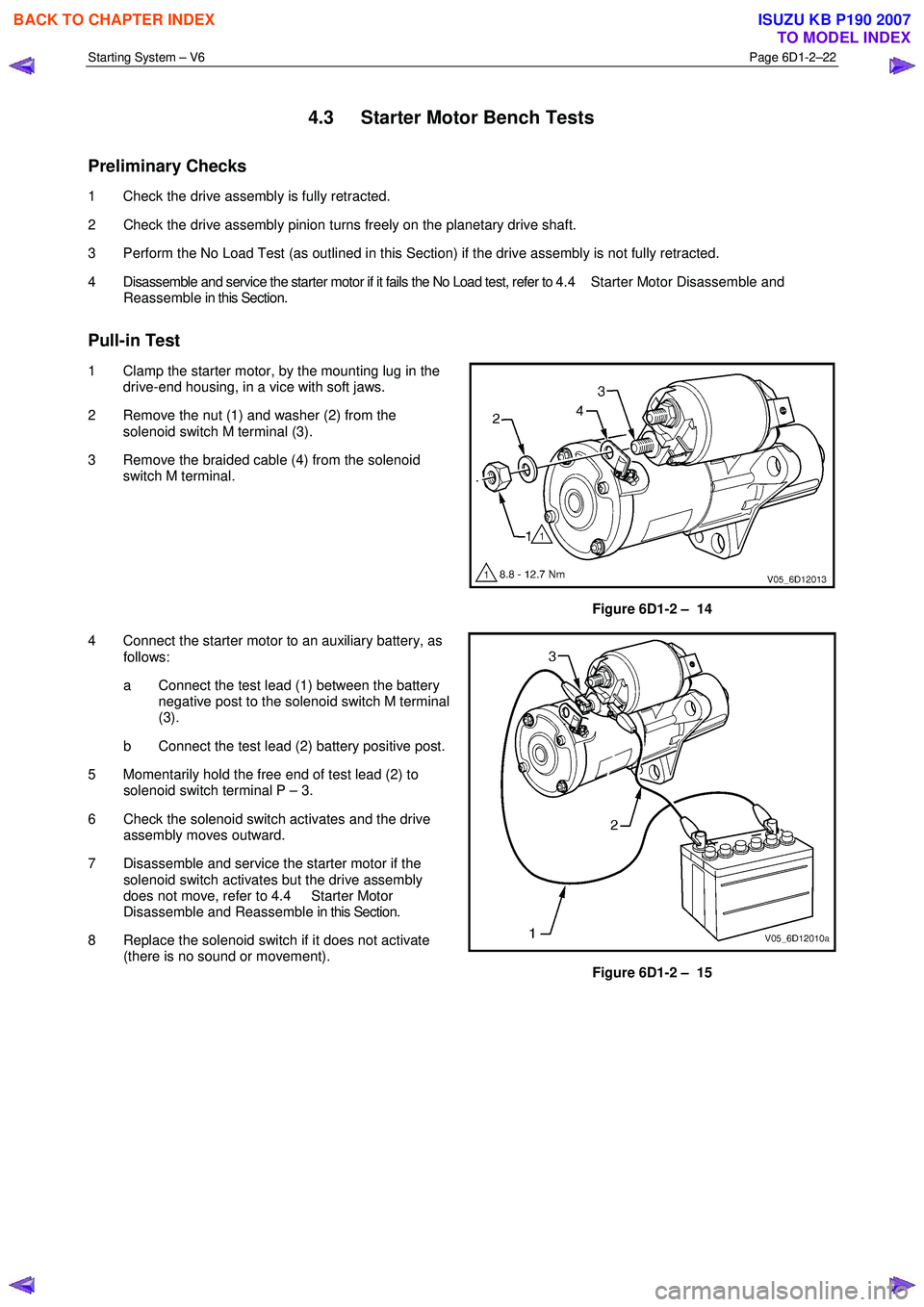
1 Clamp the starter motor, by the mounting lug in the drive-end housing, in a vice with soft jaws.
2 Remove the nut (1) and washer (2) from the solenoid switch M terminal (3).
3 Remove the braided cable (4) from the solenoid switch M terminal.
Figure 6D1-2 – 14
4 Connect the starter motor to an auxiliary battery, as follows:
a Connect the test lead (1) between the battery negative post to the solenoid switch M terminal
(3).
b Connect the test lead (2) battery positive post.
5 Momentarily hold the free end of test lead (2) to solenoid switch terminal P – 3.
6 Check the solenoid switch activates and the drive assembly moves outward.
7 Disassemble and service the starter motor if the solenoid switch activates but the drive assembly
does not move, refer to 4.4 Starter Motor
Disassemble and Reassemble in this Section.
8 Replace the solenoid switch if it does not activate (there is no sound or movement).
Figure 6D1-2 – 15
BACK TO CHAPTER INDEX
TO MODEL INDEX
ISUZU KB P190 2007
Page 3631 of 6020
Starting System – V6 Page 6D1-2–23
Hold-in Test
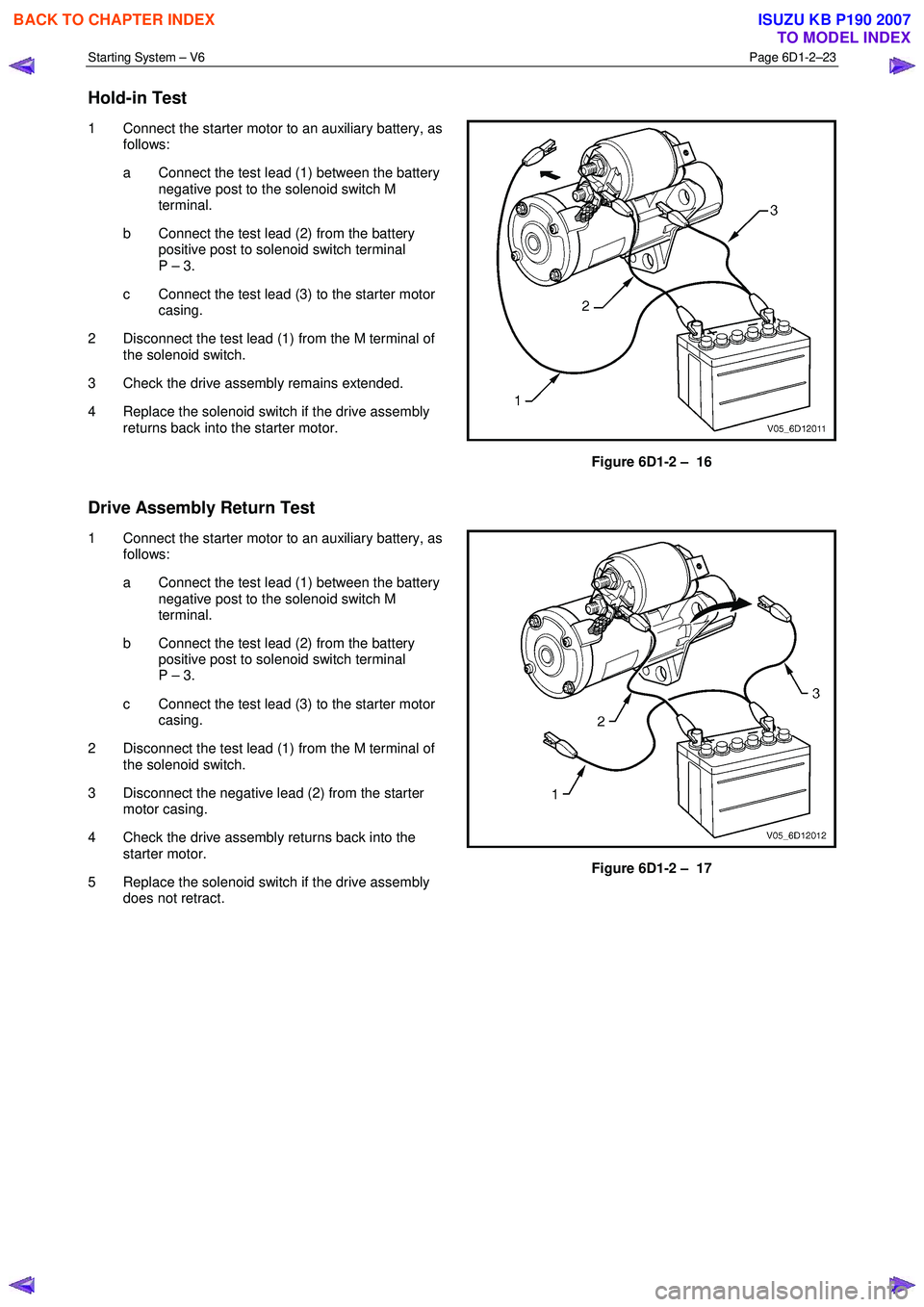
1 Connect the starter motor to an auxiliary battery, as
follows:
a Connect the test lead (1) between the battery negative post to the solenoid switch M
terminal.
b Connect the test lead (2) from the battery positive post to solenoid switch terminal
P – 3.
c Connect the test lead (3) to the starter motor casing.
2 Disconnect the test lead (1) from the M terminal of the solenoid switch.
3 Check the drive assembly remains extended.
4 Replace the solenoid switch if the drive assembly returns back into the starter motor.
Figure 6D1-2 – 16
Drive Assembly Return Test
1 Connect the starter motor to an auxiliary battery, as follows:
a Connect the test lead (1) between the battery negative post to the solenoid switch M
terminal.
b Connect the test lead (2) from the battery positive post to solenoid switch terminal
P – 3.
c Connect the test lead (3) to the starter motor casing.
2 Disconnect the test lead (1) from the M terminal of the solenoid switch.
3 Disconnect the negative lead (2) from the starter motor casing.
4 Check the drive assembly returns back into the starter motor.
5 Replace the solenoid switch if the drive assembly does not retract.
Figure 6D1-2 – 17
BACK TO CHAPTER INDEX
TO MODEL INDEX
ISUZU KB P190 2007
Page 3819 of 6020
Automatic Transmission – 4L60E – Electrical Diagnosis Page 7C2–33
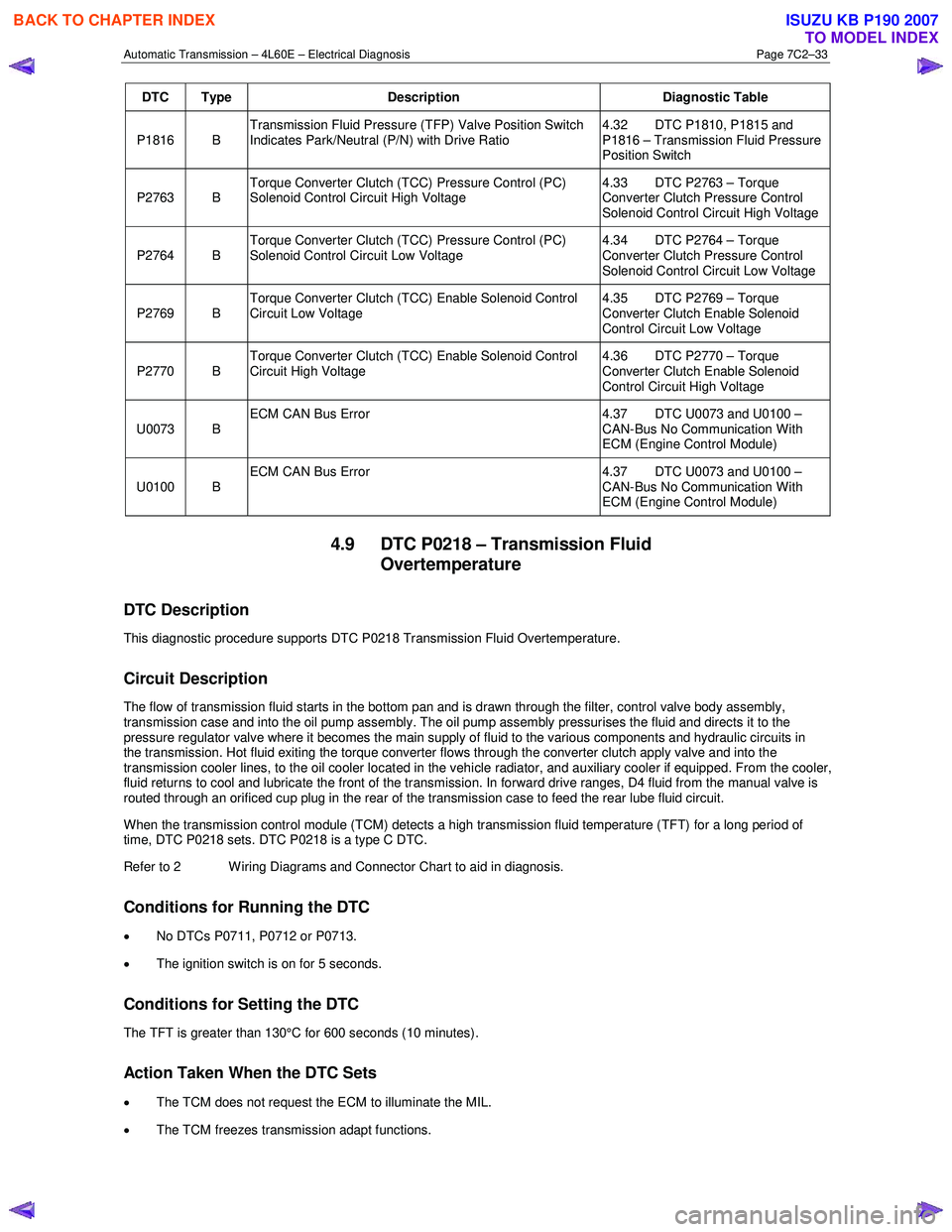
DTC Type Description Diagnostic Table
P1816 B Transmission Fluid Pressure (TFP) Valve Position Switch
Indicates Park/Neutral (P/N) with Drive Ratio 4.32 DTC P1810, P1815 and
P1816 – Transmission Fluid Pressure
Position Switch
P2763 B Torque Converter Clutch (TCC) Pressure Control (PC)
Solenoid Control Circuit High Voltage 4.33 DTC P2763 – Torque
Converter Clutch Pressure Control
Solenoid Control Circuit High Voltage
P2764 B Torque Converter Clutch (TCC) Pressure Control (PC)
Solenoid Control Circuit Low Voltage 4.34 DTC P2764 – Torque
Converter Clutch Pressure Control
Solenoid Control Circuit Low Voltage
P2769 B Torque Converter Clutch (TCC) Enable Solenoid Control
Circuit Low Voltage 4.35 DTC P2769 – Torque
Converter Clutch Enable Solenoid
Control Circuit Low Voltage
P2770 B Torque Converter Clutch (TCC) Enable Solenoid Control
Circuit High Voltage 4.36 DTC P2770 – Torque
Converter Clutch Enable Solenoid
Control Circuit High Voltage
U0073 B ECM CAN Bus Error
4.37 DTC U0073 and U0100 –
CAN-Bus No Communication With
ECM (Engine Control Module)
U0100 B ECM CAN Bus Error
4.37 DTC U0073 and U0100 –
CAN-Bus No Communication With
ECM (Engine Control Module)
4.9 DTC P0218 – Transmission Fluid Overtemperature
DTC Description
This diagnostic procedure supports DTC P0218 Transmission Fluid Overtemperature.
Circuit Description
The flow of transmission fluid starts in the bottom pan and is drawn through the filter, control valve body assembly,
transmission case and into the oil pump assembly. The oil pump assembly pressurises the fluid and directs it to the
pressure regulator valve where it becomes the main supply of fluid to the various components and hydraulic circuits in
the transmission. Hot fluid exiting the torque converter flows through the converter clutch apply valve and into the
transmission cooler lines, to the oil cooler located in the vehicle radiator, and auxiliary cooler if equipped. From the cooler ,
fluid returns to cool and lubricate the front of the transmission. In forward drive ranges, D4 fluid from the manual valve is
routed through an orificed cup plug in the rear of the transmission case to feed the rear lube fluid circuit.
When the transmission control module (TCM) detects a high transmission fluid temperature (TFT) for a long period of
time, DTC P0218 sets. DTC P0218 is a type C DTC.
Refer to 2 W iring Diagrams and Connector Chart to aid in diagnosis.
Conditions for Running the DTC
• No DTCs P0711, P0712 or P0713.
• The ignition switch is on for 5 seconds.
Conditions for Setting the DTC
The TFT is greater than 130°C for 600 seconds (10 minutes).
Action Taken When the DTC Sets
•
The TCM does not request the ECM to illuminate the MIL.
• The TCM freezes transmission adapt functions.
BACK TO CHAPTER INDEX
TO MODEL INDEX
ISUZU KB P190 2007
Page 4878 of 6020
7D1-4 TRANSFER CONTROL SYSTEM
Summary of transfer control system
The transfer control system switches between the 2-wheel
drive (2H), 4-wheel drive high-speed (4H), 4-wheel drive low-
speed (4L), and neutral positions electrically when the driver
operates the switches.
This system has following functions.
1. Connection or disconnection of drive force distribution to the
front wheel front shaft (axle shaft). (The drive force
distribution to the front propeller is connected o
r
disconnected with the motor actuator.)
2. Try to repeat the connection or disconnection of the front wheel drive function as described above.
3. Option: Shift on the fly type only.
Instruction of connection or disconnection of the drive force transmission between the front wheel axle (axle shaft) and
front wheel. (The motor actuator connects or disconnects
the left front wheel and front wheel axle (axle shaft).)
4. Shifting of auxiliary transmission gears, connection o
r
disconnection of wheel and engine drive force (4H, 4L,
neutral).
5. Operation of the indicator on the instrument panel.
6. Transmission of the position signal to other controllers.
BACK TO CHAPTER INDEX
TO MODEL INDEX
ISUZU KB P190 2007