steering JAGUAR XJ6 1994 2.G Repair Manual
[x] Cancel search | Manufacturer: JAGUAR, Model Year: 1994, Model line: XJ6, Model: JAGUAR XJ6 1994 2.GPages: 521, PDF Size: 17.35 MB
Page 399 of 521
Specification
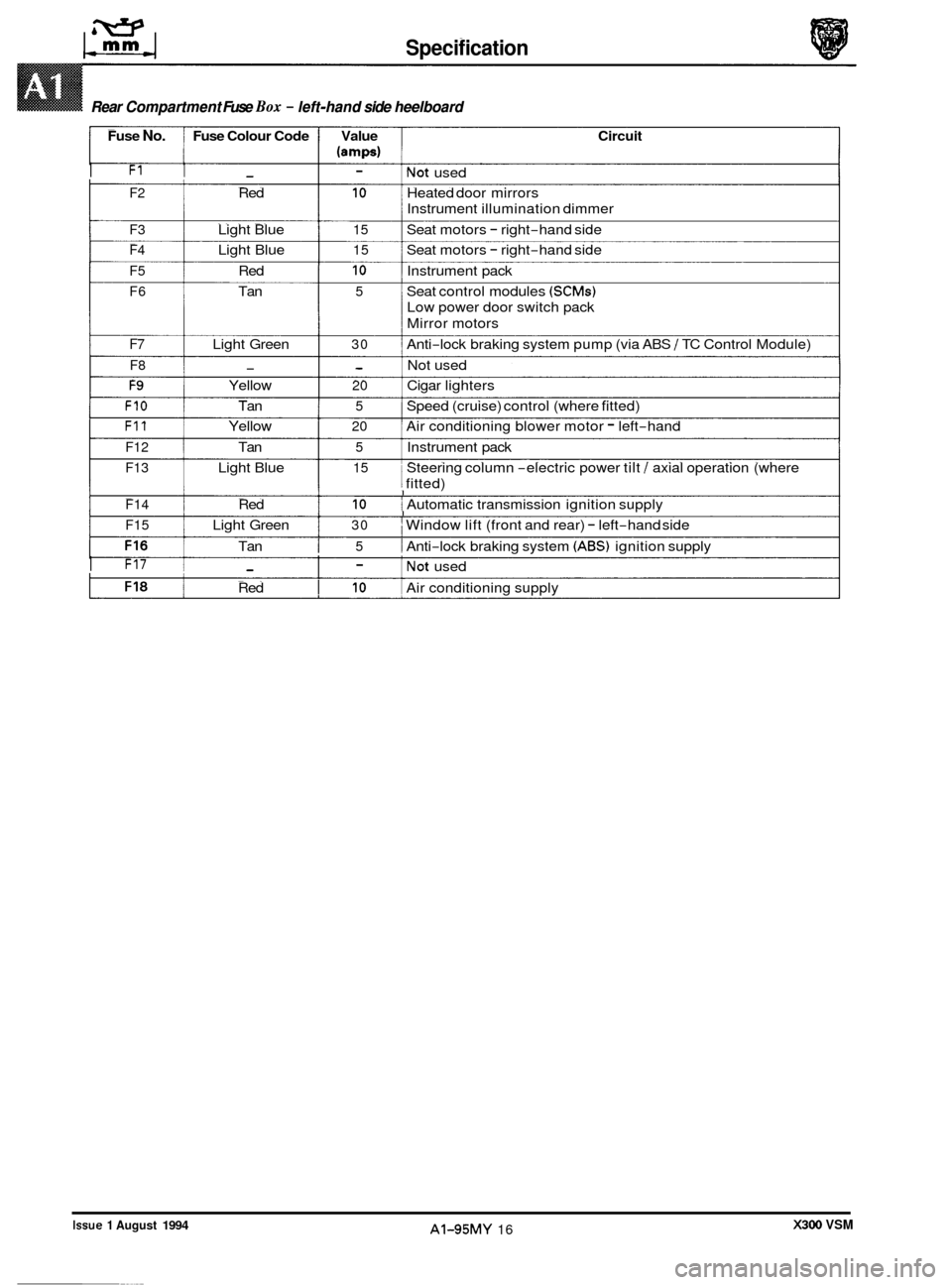
Rear Compartment Fuse Box - left-hand side heelboard
Fuse No. Fuse Colour Code Value Circuit
(amps)
I F1 I - I - lNot used
F2 Red 10 Heated door mirrors
F3 Light Blue 15 Seat motors - right-hand side
F4 Light Blue 15 Seat motors - right-hand side
F5 Red 10 Instrument pack
F6 Tan 5 Seat control modules (SCMs)
Low power door switch pack
Mirror motors
Instrument
illumination dimmer
F7 Light Green 30 Anti-lock braking system pump (via ABS / TC Control Module)
F8 - - Not used
F9 Yellow 20 Cigar lighters
FIO Tan 5 Speed (cruise) control (where fitted)
F11 Yellow 20 Air conditioning blower motor - left-hand
F12 Tan 5 Instrument pack
F13 Light Blue 15 Steering column -electric power tilt / axial operation (where
j fitted) 1 I I F14 Red 10 i Automatic transmission ignition supply I I I F15 Light Green 30 I Window lift (front and rear) - left-hand side
Tan
I 5 1 Anti-lock braking system (ABS) ignition supply
I F17 1 - I - lNot used
Red
I 10 I Air conditioning supply
Rear Compartment Fuse Box - left-hand side heelboard ~~
X300 VSM Issue 1 August 1994 AI-95MY 16
0
0
0
Page 400 of 521
(amps)
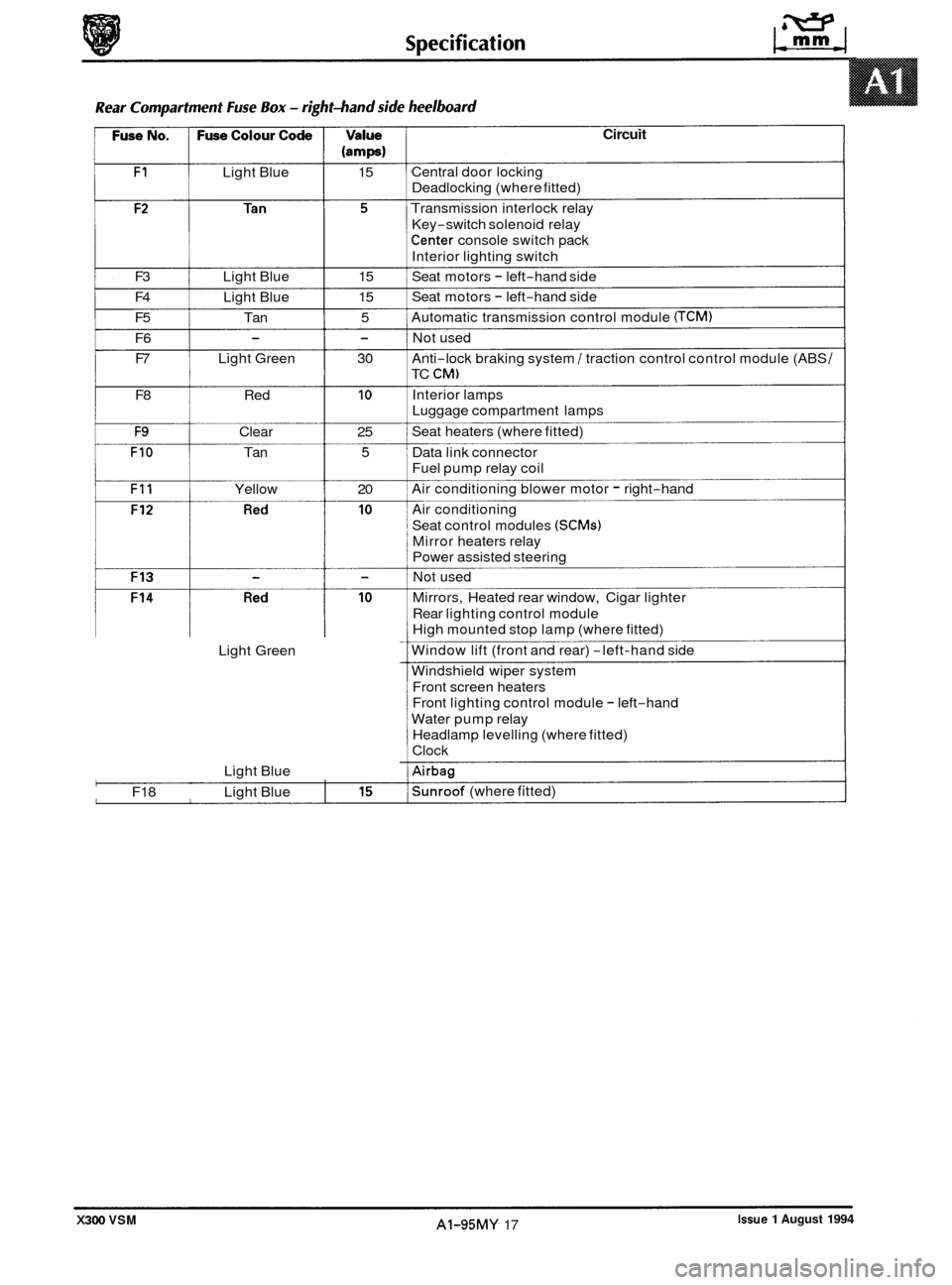
F1 Light Blue 15
F3 Light Blue 15
F4 Light Blue 15
F5 Tan 5
F6 F7 Light Green 30
- -
F8 Red 10
F9 Clear 25
FIO Tan 5
F11 Yellow 20 0
Light Green
Light Blue
F18 Light Blue
0'
I
Circuit
Central door locking
Deadlocking (where fitted)
Transmission interlock relay
Key
-switch solenoid relay
Center console switch pack
Interior lighting switch
Seat motors
- left-hand side
Seat motors
- left-hand side
Automatic transmission control module
(TCM)
Not used
Anti
-lock braking system / traction control control module (ABS /
TC CM)
Interior lamps
Luggage compartment lamps
Seat heaters (where fitted)
Data link connector
Fuel pump relay coil
Air conditioning blower motor
- right-hand
Air conditioning
Seat control modules
(SCMs)
Mirror heaters relay
Power assisted steering
Not used
Mirrors, Heated rear window, Cigar lighter
Rear lighting control module
High mounted stop lamp (where fitted)
Window lift (front and rear)
-left-hand side
Windshield wiper system Front screen heaters
Front lighting control module
- left-hand
Water pump relay
Headlamp levelling (where fitted)
Clock
Airbag
Sunroof (where fitted)
Issue 1 August 1994 AI-95MY 17 X300 VSM
Page 407 of 521
* Routine Maintenance
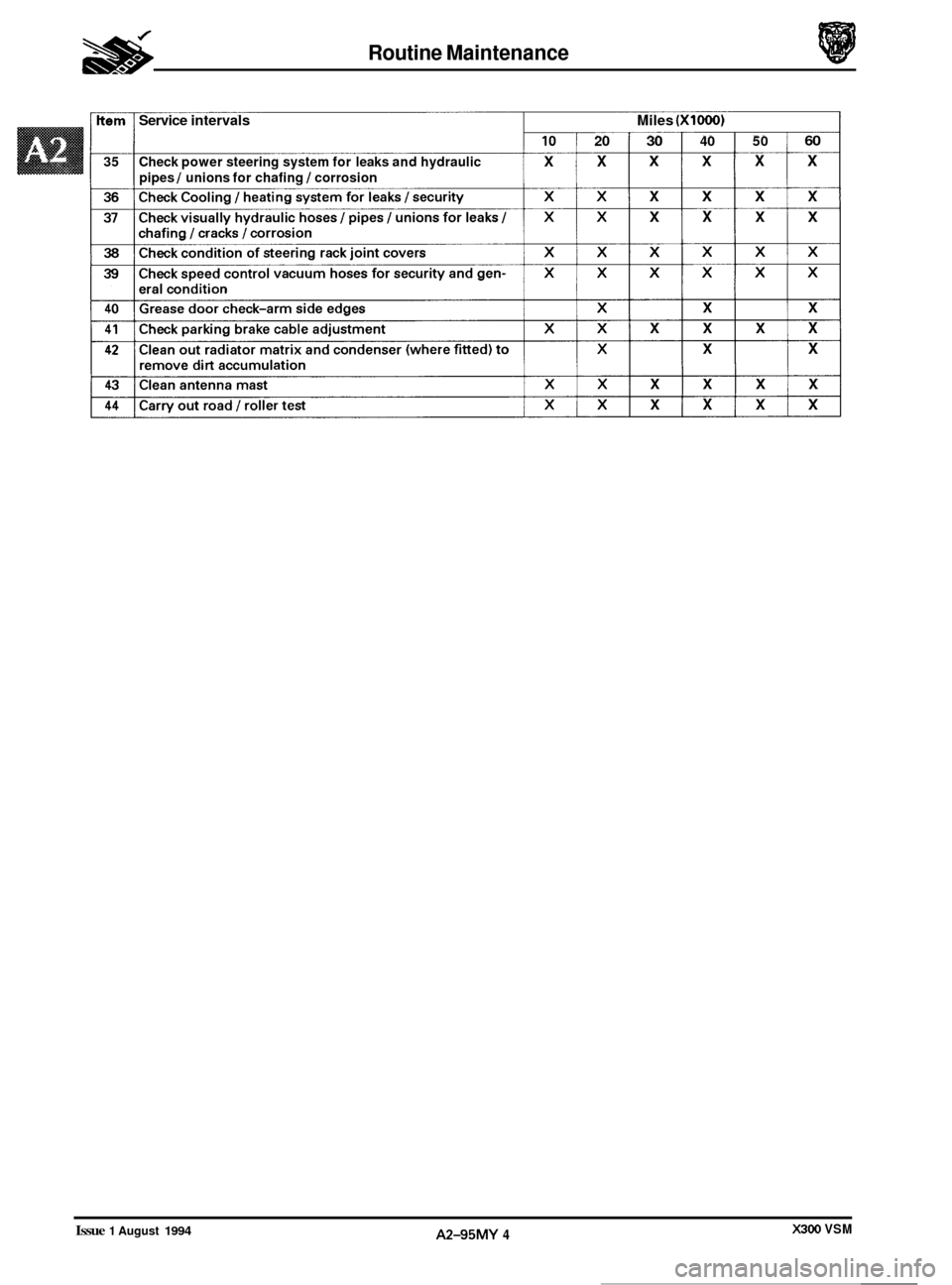
Item Service intervals Miles (XlOOO)
10 20
35 Check power steering system for leaks and hydraulic X X
pipes 1 unions for chafing I corrosion
30 40 50 60
X X X X
X X X X
X X X X
X X
X X X
X
X X
X X X X
X
X X X
.
X300 VSM Issue 1 August 1994 A2-95MY 4
Page 409 of 521
Routine Maintenance
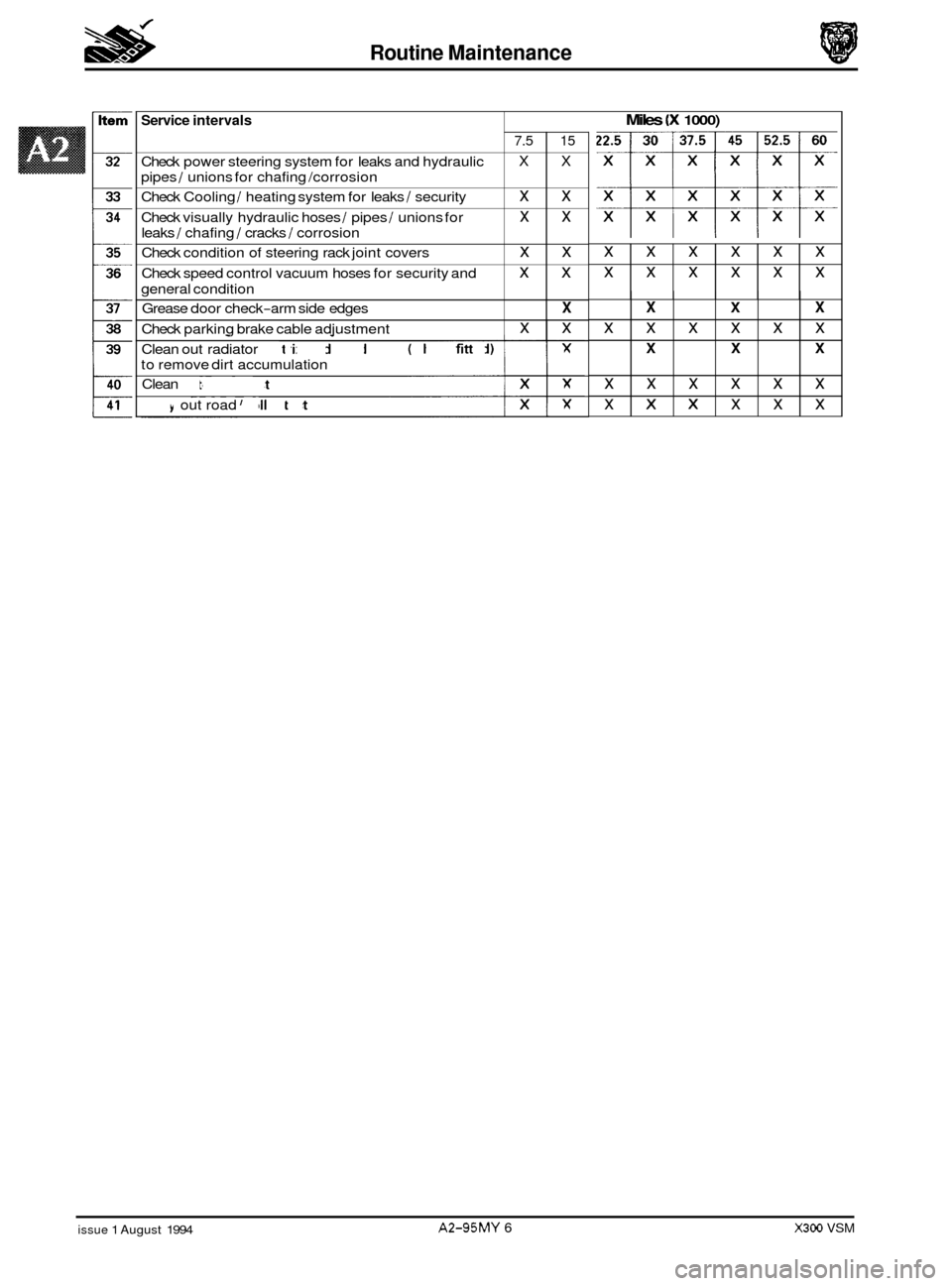
Service intervals
Check power steering system for leaks and hydraulic
pipes
/ unions for chafing /corrosion
Check Cooling
/ heating system for leaks / security
Check visually hydraulic hoses
/ pipes / unions for
leaks
/ chafing / cracks / corrosion
Check condition of steering rack joint covers
Check speed control vacuum hoses for security and
general condition
Grease door check
-arm side edges
Check parking brake cable adjustment
Miles (X 1000)
7.5 15
X X
xx
xx
xx
xx
X
xx
xxxxxx
xxxxxx
x
X X X
xxxxxx
X X X
xxxxxx
XIX x x x
-
Clean out radiator matrix and condenser (where fitted)
to remove dirt accumulation
Clean antenna mast
xx
Carry out road / roller test Ix
i
0
0
0
X
x
issue 1 August 1994 A2-95MY 6 X300 VSM
Page 415 of 521
General Fitting Instructions
Pressordrifttheseal in tothefull depthofthe housing ifthe housing is shouldered,orflush withthefaceofthe housing
where no shoulder is provided.
Note: Careless fitting of oil seals, which can result in damage to the seal and sealing surfaces, accounts for most
cases of failure of seals. Care in fitting is essential
if good results are to be obtained.
A3.2.7 joints And joint Faces
Remove all traces of old jointing materials prior to reassembly. Inspect joint faces for scratches or burrs and remove
with a fine file or oilstone; do not allow swarf or dirt to enter tapped holes or enclosed parts. Blow out any pipes, chan- nels or crevices with compressed air, refitting or renewing any 0-rings or seals which have been displaced by the com- pressed air.
Always use the specified gaskets. Use jointing compound only when recommended, otherwise fit joints dry. When
jointing compound is used, apply in
a thin film to metal surfaces; take great care to prevent it from entering oilways, pipes or blind tapped holes.
A3.2.8
Before removing a hose from the brake or power steering systems, thoroughly clean the end fittings and the area sur- rounding them. Obtain blanking caps beforedetaching hosefittings,sothat portscan becovered to excludedirt. Clean
the hose externally and blow through with compressed air. Examine the hose carefully for cracks, separation of plies,
security of end fittings and external damage. Reject any hose found to be faulty. When refitting the hose, ensure that
no unnecessary bends are introduced and that the hose is not twisted before or during tightening of union nuts.
Do not store hydraulic fluid in an unsealed container because it will absorb water. Fluid in this condition would be dan- gerous to use due to a lowering of its boiling point. Do not allow hydraulic fluid to be contaminated with mineral oil,
or use a container which has previously contained mineral oil.
Do not re-use fluid bled from the system. Always use clean brake fluid, or a recommended alternative, to clean the
hydraulic components. Fit a blanking cap to the hydraulic union and
a plug to its mating socket, after removal from
the vehicle, to prevent ingress of dirt. Absolute cleanliness must be observed with hydraulic components at all times.
After any work has been performed on hydraulicsystems, inspect carefully for leaks underneath the car while a second
operator applies maximum pressure to the brakes (with the engine running) and operates the steering.
Hydraulic Flexible Pipes And Hoses
A3.2.9 Metric
Bolt Identification
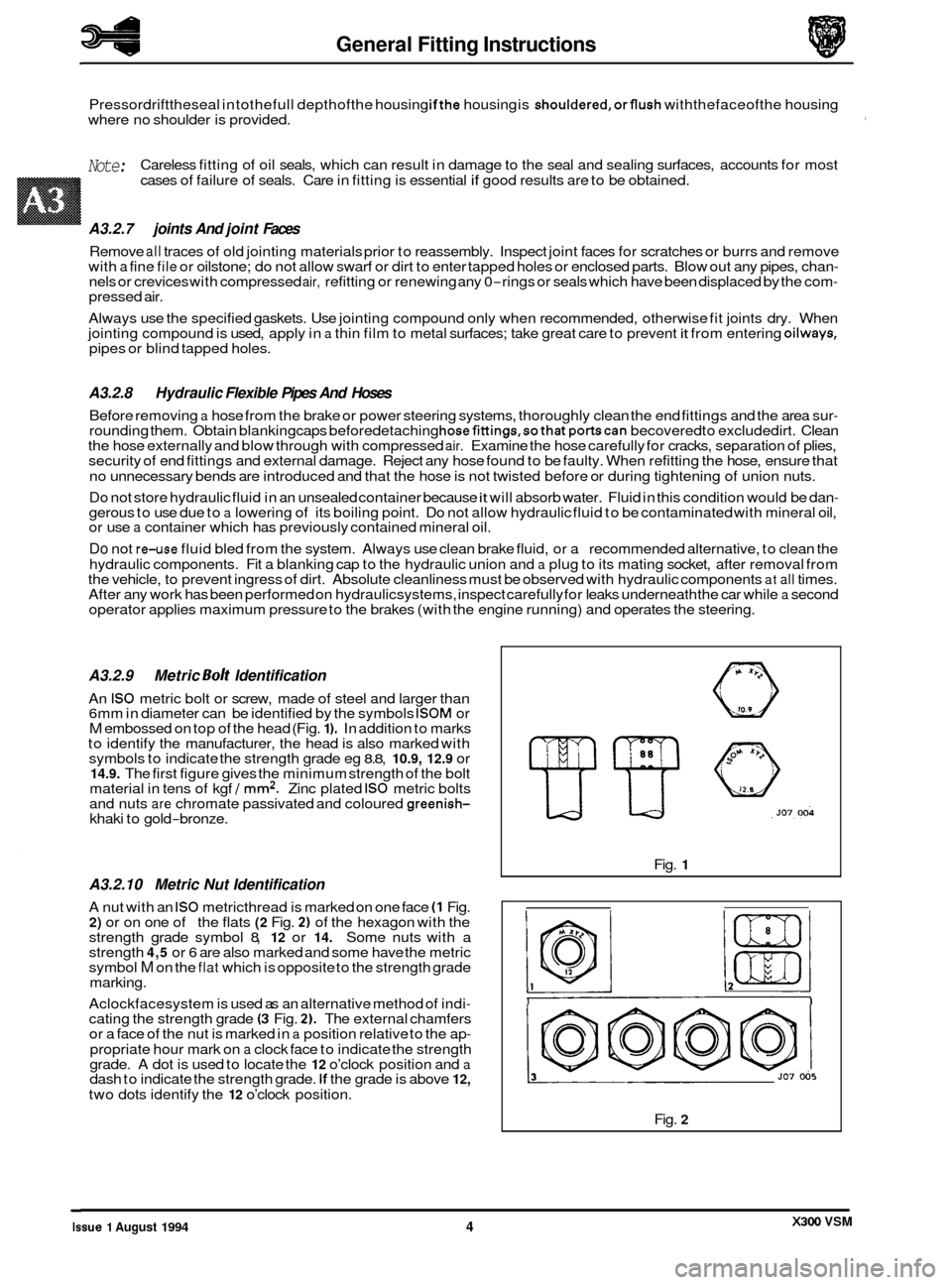
An IS0 metric bolt or screw, made of steel and larger than
6mm in diameter can be identified by the symbols ISOM or M embossed on top of the head (Fig. 1 ). In addition to marks
to identify the manufacturer, the head is also marked with
symbols to indicate the strength grade eg
8.8, 10.9, 12.9 or 14.9. The first figure gives the minimum strength of the bolt
material in tens of kgf / mm2. Zinc plated IS0 metric bolts
and nuts are chromate passivated and coloured greenish- khaki to gold-bronze.
A3.2.10 Metric Nut Identification
A nut with an IS0 metricthread is marked on one face (1 Fig. 2) or on one of the flats (2 Fig. 2) of the hexagon with the
strength grade symbol 8, 12 or 14. Some nuts with a
strength 4,5 or 6 are also marked and some have the metric
symbol M on the flat which is opposite to the strength grade
marking.
Aclockfacesystem is used as an alternative method of indi
- cating the strength grade (3 Fig. 2). The external chamfers
or a face of the nut is marked in a position relative to the ap-
propriate hour mark on a clock face to indicate the strength
grade. A dot is used to locate the 12 o’clock position and a dash to indicate the strength grade. If the grade is above 12,
two dots identify the 12 o’clock position. Fig.
1
I I
Fig. 2
X300 VSM Issue 1 August 1994 4
Page 428 of 521
0
0
0
Body Systems Body Repair
A4.1 BODY REPAIR
Introduction
This section contains information, specifications and procedures for body repair and rectification of the Jaguar sedan
range (with standard wheelbase).
All repairs, whether structural or cosmetic, must ensure the continuance of the Paint Surface and Corrosion warranty,
where applicable.
Following repair or rectification, the vehicle must be returned to the original manufactured condition with regard to
occupant safety, dimensional accuracy, finish and corrosion protection.
Similarly, repaired vehicles must be fully checked, and where appropriate reset, with regard to steering, suspension,
restraint and
braking systems.
A4.1.1 Health and Safety
(Please Read The
Fol/owing Notes Carethlly)
Where legislation governing working conditions and practises is applicable, you should observe it. Do not forget that
you have a duty, to yourself and those around you, to act in a responsible manner in the workplace.
In the United Kingdom the Health and Safety
at Work Act (1974) places a duty on employers and employees to ensure,
whenever possible, safe working conditions and practices. Wherever a potential hazard is notified to, or identified by
the operator, he must employ the correct safety procedures and equipment.
Should
a personal injury occur as a result of any workshop activity, seek medical help as soon as possible and do not
attempt self-treatment other than by the application of first aid.
With the constant introduction of new materials in the manufacture of vehicles,
it is important that potential risks are
identified and precautions made known.
WARNING: READ AND UNDERSTAND WORKING PRACTICES CLIMATE CONTROL SYSTEMS, SECTION 14, WITH SPECIAL REFERENCE TO
ERY
/ RECYCLE / RECHARGE EQUIPMENT.
WEAR SUITABLE EYE AND SKIN PROTECTION.
OBSERVE ALL APPLICABLE SAFETY REQUIREMENTS.
DO
NOT VENT REFRIGERANT DIRECTLY TO ATMOSPHERE, ALWAYS USE JAGUAR APPROVED RECOV
-
Issue 1 August 1994 1 X300 VSM
Page 442 of 521

Body Systems & Body Repair
A4.2.4 PANELS - ASSOCIATED, RENEW
SRO 77.10.02
w: Where other components must be removed to gain access, please referto the relevant manual section for guid- ance. This is critically important with regard to steering, braking, suspension, electrical and safety systems.
. Expose the resistance spot welds, for those spot welds which are not obviously visible, use a rotary wire brush fitted to an air drill or a hand held wire brush (A Fig. 1).
WARM: DO NOT BURN UNDERSEAL OFF. USE A 'HOT KNIFE' OR SUITABLE SOLVENT.
. Cut out the spot welds using a Zipcutter or Roto-Bor (B Fig. 1).
Jhh: On some panels, before removing the bulk of panel with the pneumatic saw, brazed areas and MIG welded
seams should be removed.
= Separate the spot welded joints and remove the panel remnants.
At
this point
it may be necessary to cut out the bulk of the panel using a pneumatic saw (C Fig. 1).
A
C
Fia. 1
B
II I
II I
15 Issue 1 August 1994 X300 VSM
Page 459 of 521
B C D
K J H G
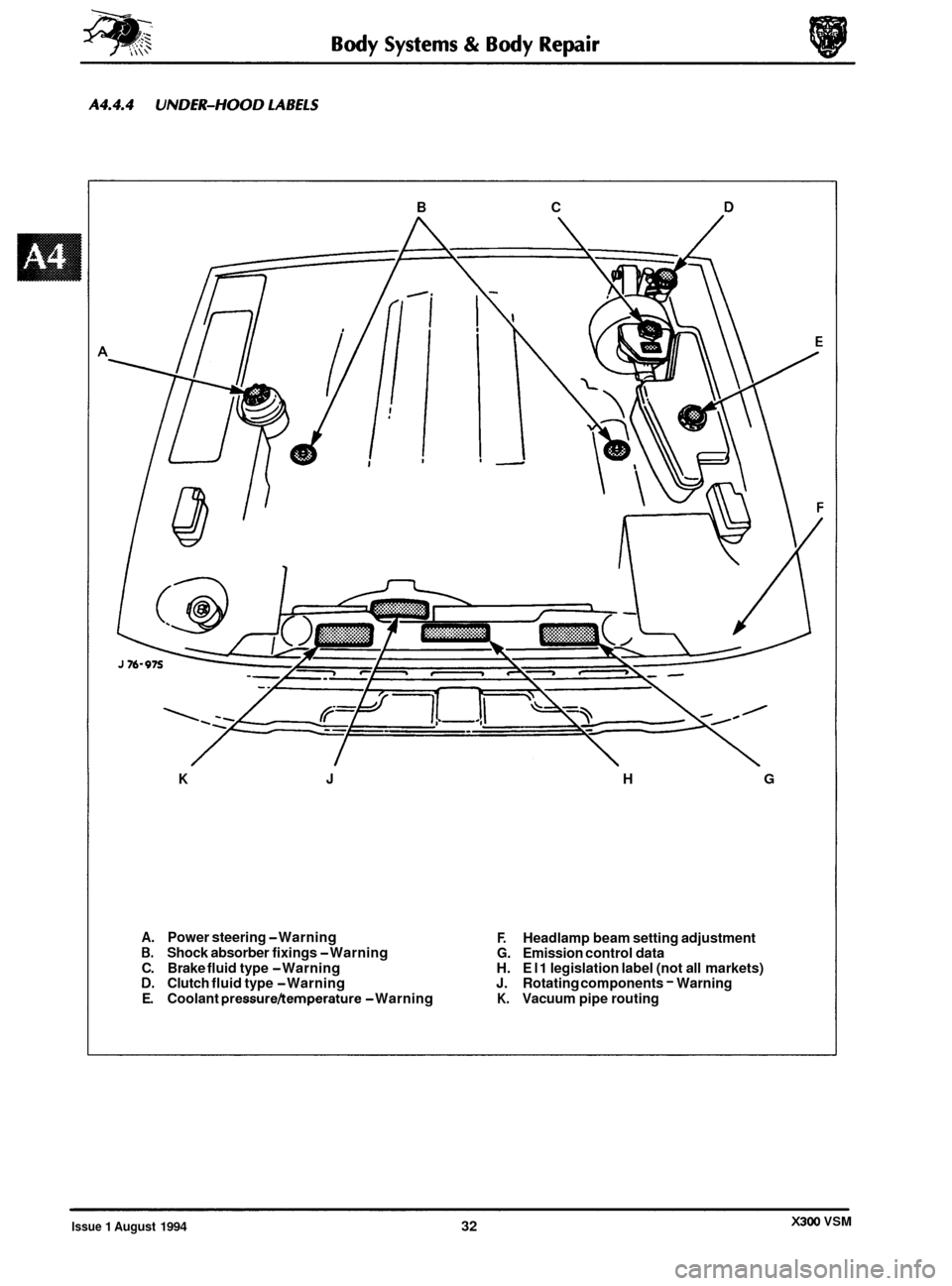
A. Power steering -Warning F. Headlamp beam setting adjustment B. Shock absorber fixings -Warning G. Emission control data
C. Brake fluid type -Warning H. El 1 legislation label (not all markets) D. Clutch fluid type -Warning J. Rotating components - Warning
E. Coolant pressureltemperature -Warning K. Vacuum pipe routing
0
0
X300 VSM Issue 1 August 1994 32
Page 480 of 521
I 03 I Door lock actuators (4 off) 1 part of door assemblv I I
Issue 1 August 1994 X300 VSM 3 I
1 04 I Door lock switches (2 off) I part of door latch assembly I I
1 05 IHoodswitch 1 located above siren I I
1 06 IHorn 1 located on front RH side of en(
1 07 I Inclination sensor I behind luggage compartment LH liner I I
I 08 I Intrusion sensor (LH) I located above LH door behind roof lining I
I 09 I intrusion sensor (RH) 1 located above LH door behind roof lining I
I
1 1 part of door latch assembly I 10 I Key barrel switches (2 off)
1 11 I Key fob transmitter 1 part of key fob I I
I 12 I Key transponder 1 part of key I I
I 13 I Reader exciter coil 1 part of ignition switch I I
I 14 I Reader exciter module 1 part of steering column assembly I I
1 15 I Relays (deadlock) I I I
1 18 I Security active indicator part of central locking switch I I
I 19 I Securitv and lockina control module (SLCM) located in luaaaae compartment behind LH liner I I
1 20 ISounder , located on front RH side of engine bay I I
1 25 IValet switch 1 in centre console compartment I I
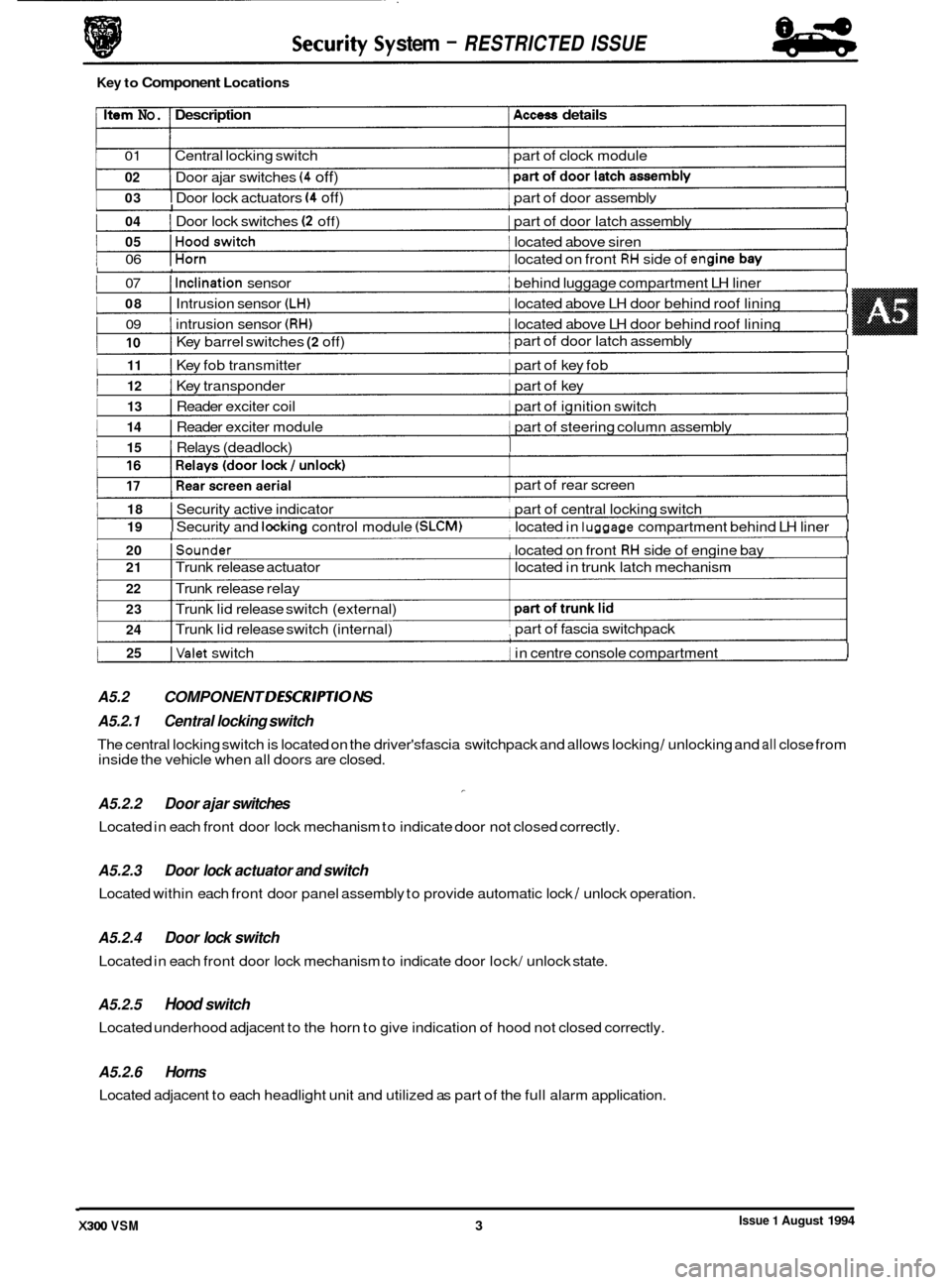
A5.2 COMPONENT DESCR/PT/O NS I
stem - RESTRICTED ISSUE
Key to Component Locations
Item No. Description Access details
01 Central locking switch part of clock module
02
1 I
Door ajar switches (4 off)
I I
part of rear screen
I 21 I Trunk release actuator located in trunk latch mechanism
22 I Trunk release relay
23
24 I Trunk lid release switch (external)
I Trunk lid release switch (internal) part of
fascia switchpack ,
A5.2.1 Central locking switch
A5.2.2 Door ajar switches
Located in each front door lock mechanism to indicate door not closed correctly.
-
The central locking switch is located on the driver'sfascia switchpack and allows locking / unlocking and all close from
inside the vehicle when all doors are closed.
A5.2.3
Located within each front door panel assembly to provide automatic lock / unlock operation.
Door lock actuator and switch
A5.2.4 Door lock switch
Located in each front door lock mechanism to indicate door lock/ unlock state.
A5.2.5 Hood switch
Located underhood adjacent to the horn to give indication of hood not closed correctly.
A5.2.6 Horns
Located adjacent to each headlight unit and utilized as part of the full alarm application.
Page 481 of 521
84
- Security System - RESTRICTED /SSU€
A5.2.7 Inclination sensor
Located adjacent to the SLCM underthe luggage compartment LH side linerto give indication of unauthorized jacking / lifting of the vehicle.
A5.2.8 Intrusion sensors
Located above each front door to give indication of unauthorized entry into the vehicle passenger compartment.
A5.2.9 Reader exciter coil
Forms an integral part of the ignition switch to prove correct key insertion by communicating key transponder signal
to control module.
A5.2.10 Reader exciter module
Located on the steering column to receive signals from the reader/ exciter coil and disarm the engine immobilization
system on correct demand.
A5.2.11 Security active indicator
An LED built into the central locking switch to indicate when security system is armed.
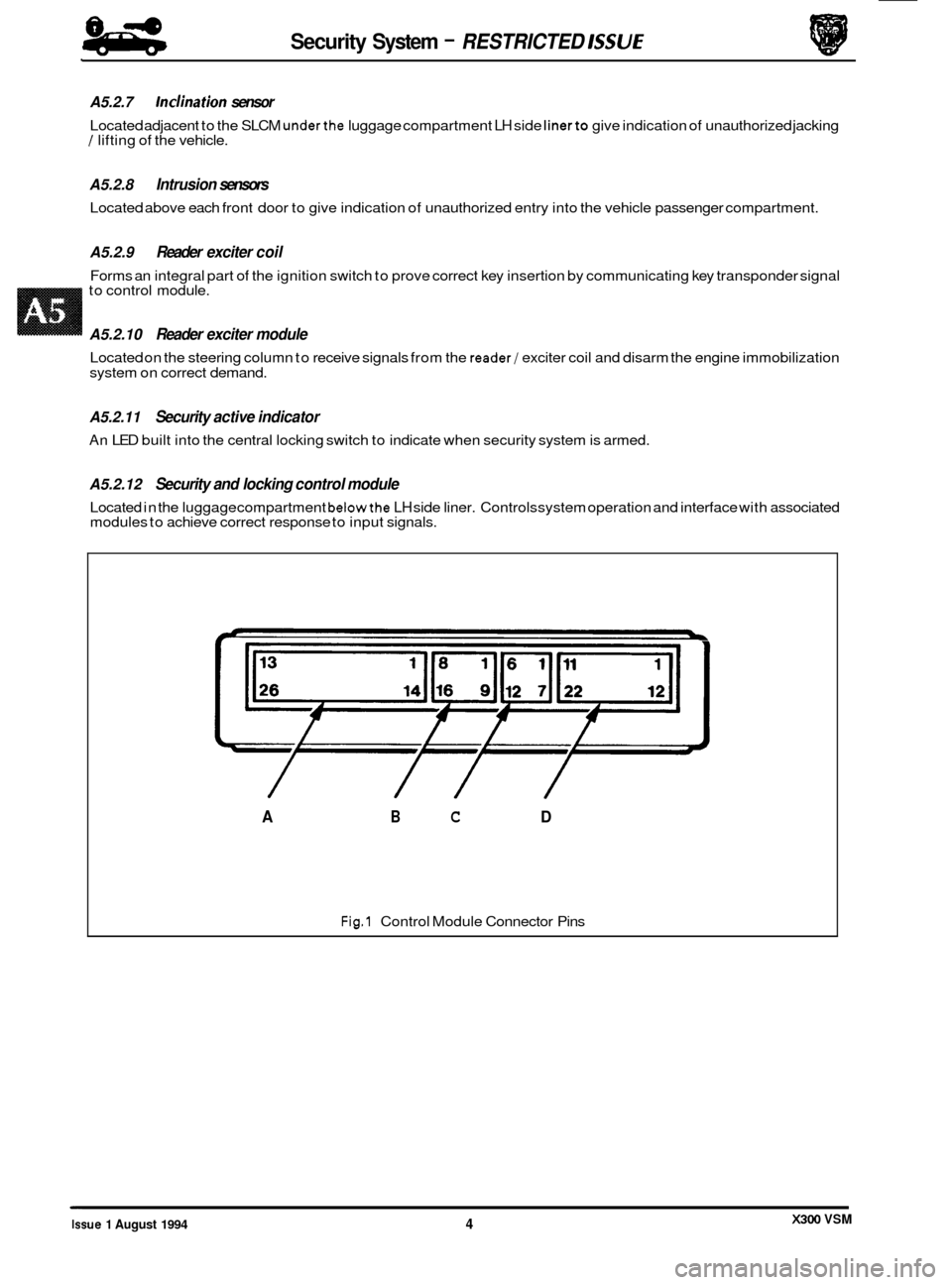
A5.2.12 Security and locking control module
Located in the luggage compartment belowthe LH side liner. Controls system operation and interface with associated
modules to achieve correct response to input signals.
L
Fig.1 Control Module Connector Pins
/ // /
A B C D
X300 VSM Issue 1 August 1994 4