ECU JAGUAR XJ6 1994 2.G Repair Manual
[x] Cancel search | Manufacturer: JAGUAR, Model Year: 1994, Model line: XJ6, Model: JAGUAR XJ6 1994 2.GPages: 521, PDF Size: 17.35 MB
Page 209 of 521

@ Steering
. Pack the annular gaps of the oil seal lips with grease.
. Bearing. Wash the hub assembly thoroughly and 'drift' the affected bearing cup(s) from the hub.
!&!$Q:
rn Hub. At this point the hub may be renewed if required.
Assembly
. Bearing. Assemble the inner bearing track to the hub using service tool 18G 134 and adaptor JD 550 - 5 / 1.
Ensure that the hub inner seal diameter is free of debris or damage and is lightly lubricated prior to assembly.
Only replace complete bearings, never cup or race in isolation.
Assemble the outer bearing cup to the hub using service tool
18G 134 and adaptor JD 550 - 5 / 2. Pack each race with approximately 4 ml of grease and position the inner race onto the stub axle.
Apply a smear of grease to hub inner surfaces and bearing cups. Assemble the hub to the stub axle followed by
outer race, bearing washer and hub nut.
It is not necessary to fill the hub cavity with grease, merely protect from corrosion with a coat of IubricanL'Seat'the bear-
ings by slightly tightening the hub nut whilst rotating the hub. Do not apply load without rotation. m:
. End float. Set a Dial Test Indicator (DTI) as shown in Fig. 1 and adjust the hub nut to achieve the correct end float.
As the adjustment is made, continually load the hub axial-
ly in both directions.
. Without disturbing the end float setting, fit the castellated
nut retainer so that it aligns with both hub nut and stub
axle drilling.
. Secure nut retainer using a new cotter pin.
9 Assembly and fitting is the reversal of this procedure not- ing that; all fixings MUST be tightened to specification
and operation of the braking system verified.
Fig. 1
Issue 1 August 1994 10 X300 VSM
Page 214 of 521

Suspension Systems
11.1 INTRODUCTION
This section describes the front and rear suspension systems, and also covers diagnostic procedures.
Fig. 1 Front Suspension Layout
11.2 FRONT SUSPENSION, DESCRIPTION
Theupperrearwishbone(1 Fig.l)andthe upperfrontwishbone(2 Fig.1)arepivotedon the upperfulcrum bolt (3Fig.l), passing through the front cross beam assembly. They are also fitted via an upper ball joint assembly (4 Fig.1) to a verti- cal linkaccommodating the stub axle (5 Fig.l), whereas the vertical linkisfittedvia a lower ball joint assembly (6 Fig.1) to the lower wishbone assembly.
The lower wishbone assembly comprises
a lower rear wishbone (7 Fig.l), lower front wishbone (8 Fig.l), damper (9 Fig.1) (incorporating damper bush 10 Fig.1) and spring pan (1 1 Fig.1) supporting the road spring (12 Fig.1). The lower
wishbone assembly is pivoted on the bushed lower fulcrum shaft (13 Fig.1) which also passes through thecross beam
assembly.
Both independent front suspension assemblies are linked by a stabilizer bar (14 Fig.1) which is secured to the cross
member using a fixing arrangement of mounting rubbers (15 Fig.1, clamps (16 Fig.l), nuts bolts, washers (17 Fig.1) and two link arm assemblies (18 Fig.1). Each link arm assembly is fitted to one end of the stabilizer bar and to one end
of the lower front wishbone using a fixing arrangement of bolts washers and self locking nuts.
All suspension loads, except the damper, are fed into a pressed steel crossbeam which is isolated from the body by
rubber bushes. This mounting method allows the necessary amount of compliance.
The degree
of caster is adjustable via shims positioned on either side of the upper ball joint assembly but camber is facton/ set and is not adjustable. The vertical link and the steering arm form a single forging. Cast iron hubs rotate
on twin tapered roller bearings.
X300 VSM 1 Issue 1 August 1994
Page 215 of 521
Suspension Systems
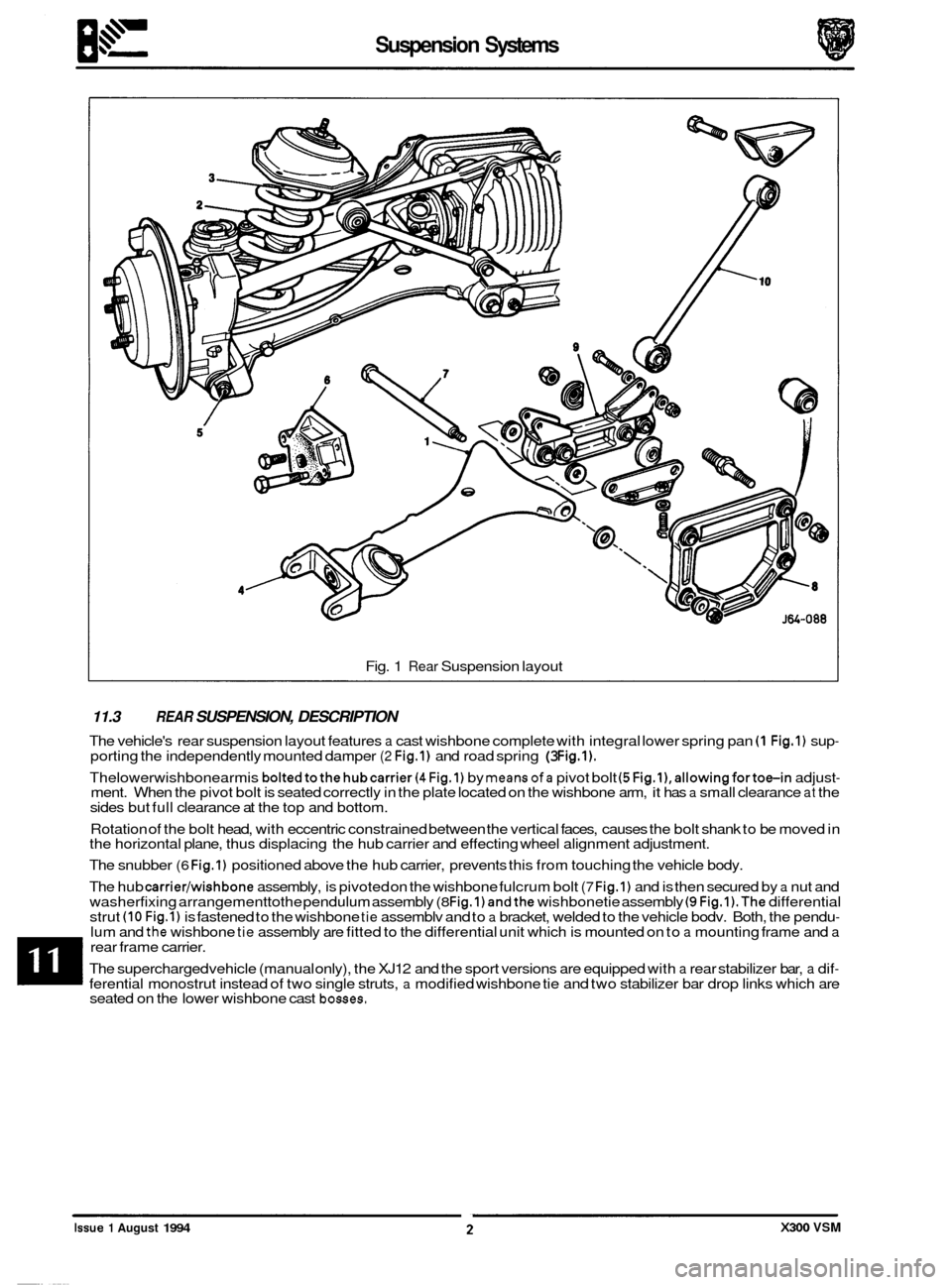
Fig. 1 Rear Suspension layout
11.3 REAR SUSPENSION, DESCRIPTION
The vehicle's rear suspension layout features a cast wishbone complete with integral lower spring pan (1 Fig.1) sup- porting the independently mounted damper (2 Fig.1) and road spring (3 Fig.1).
Thelowerwishbonearmis boltedtothehubcarrier(4 Fig.1) by meansofa pivot bolt (5Fig.l),allowingfortoe-in adjust- ment. When the pivot bolt is seated correctly in the plate located on the wishbone arm, it has a small clearance at the
sides but full clearance at the top and bottom.
Rotation of the bolt head, with eccentric constrained between the vertical faces, causes the bolt shank to be moved in
the horizontal plane, thus displacing the hub carrier and effecting wheel alignment adjustment.
The snubber
(6 Fig.1) positioned above the hub carrier, prevents this from touching the vehicle body.
The hub
carrier/wishbone assembly, is pivoted on the wishbone fulcrum bolt (7 Fig.1) and is then secured by a nut and
washerfixing arrangementtothe pendulum assembly (8 Fig.1) andthe wishbonetie assembly (9 Fig.l).The differential
strut (10 Fia.1) is fastened to the wishbone tie assemblv and to a bracket, welded to the vehicle bodv. Both, the pendu- lum and the wishbone tie assembly are fitted to the differential unit which is mounted on to a mounting frame and a rear frame carrier.
The supercharged vehicle (manual only), the XJ12 and the sport versions are equipped with
a rear stabilizer bar, a dif- ferential monostrut instead of two single struts, a modified wishbone tie and two stabilizer bar drop links which are
seated on the lower wishbone cast bosses.
0
0
e
Issue 1 August 1994 X300 VSM
Page 223 of 521

1. SERVICE TOOLS & EQUIPMENT
Description
Parking brake cable remover
Illustration
Notes
not
illustrated
Pipe connectors to hydraulic module:
M12
M10
Jaguar Number
JD.142
15
- 19
12 - 16
186.672
Description
U-
Molykote 11 1 Caliper to carrier securing bolts
6947017
Notes
JDS.9013
Replacer disc brake
piston seal
I
Brake hose clamp, Girling
Brake pedal hold down tool
11. TORQUE TIGHTENING SPECIFICATIONS
Fixing 1 Tightening Torque
(Nm)
Vacuum booster to pedal box I 21 -29 I
Tandem master cylinder to booster I 21 -29 I
Hvdraulic module to module bracket I 18 - 26 I
Caliper guide pins I 25 - 35 I
Caliper to vertical link I 120 - 160 I
Caliper to hub carrier I 54 - 66 I
111. SERVICE MATERIALS
Iv. SERVICE DATA
Front brake disc run out
Front brake
disc parallelism
Rear brake disc
run out
Rear brake disc parallelism 0.101
mm (0.004 in) max.
0.0127mm (0.0005in) max.
0.101
mm (0.004 in) max.
0.0127mm (0.0005in) max.
Issue 1 August 1994 ii X300 VSM
Page 226 of 521
Brakes (a)
12.1.2. Anti-lock Braking / Traction Control Operation
The rear wheels are controlled collectively on a 'select-low' principle during ABS operation. During traction control,
separate circuits allow individual control of the rear wheels. To facilitate this the valve block has four outlet ports.
The
ABS/TC CM is integrated with the valve block. The pump, motor, valve block and control module are supplied as
a unit and are non-sewiceable. Faulty units must be renewed as a whole.
Both front and rear brakes on
all vehicles are fitted with single piston caliper assemblies. Ventilated brake rotors, with
provision for parking brake shoes at the rear, are fitted all round.
0
Issue 1 August 1994 X300 VSM 3
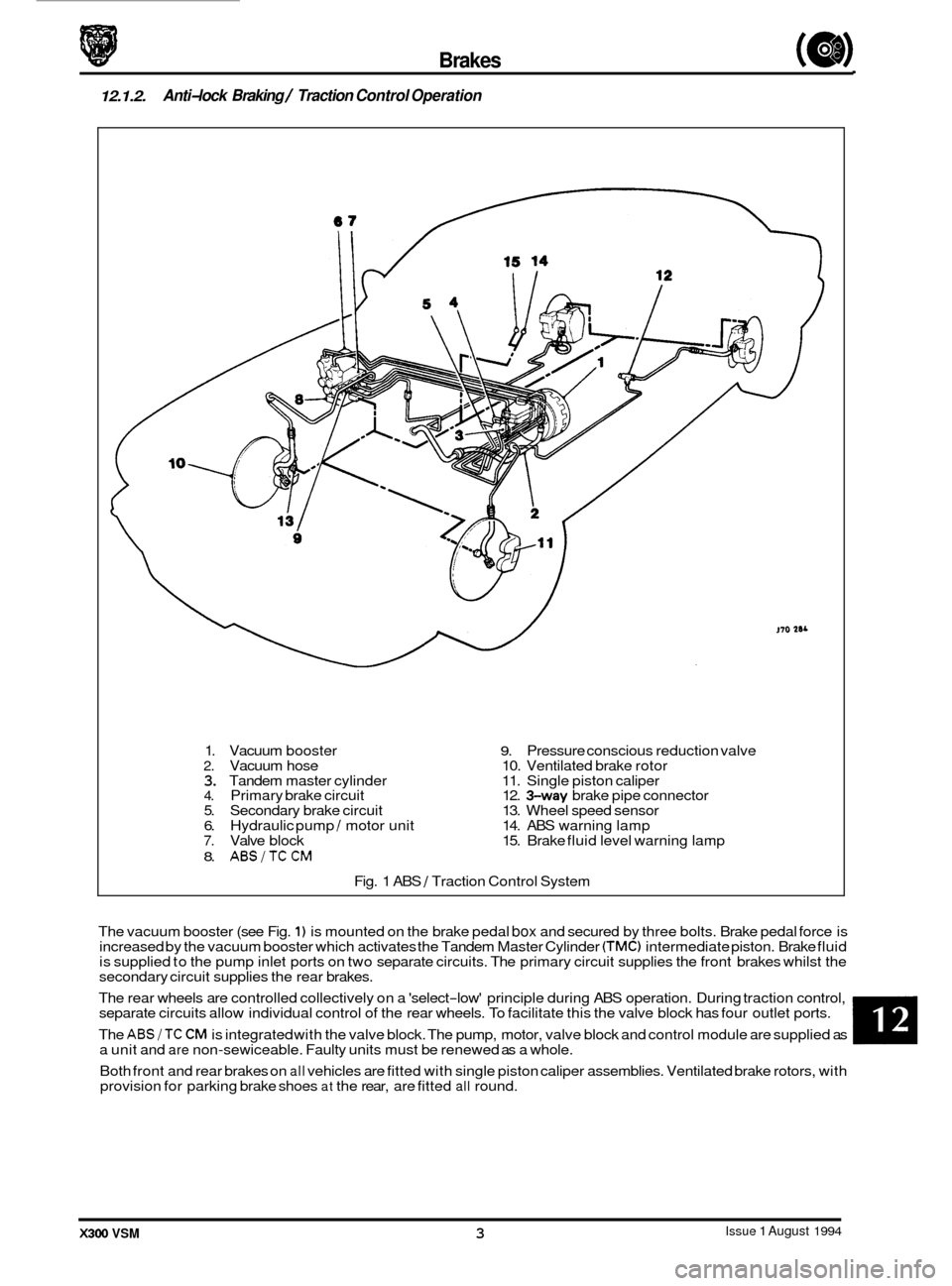
1. Vacuum booster 9. Pressure conscious reduction valve 2. Vacuum hose 10. Ventilated brake rotor 3. Tandem master cylinder 11. Single piston caliper 4. Primary brake circuit 12. %way brake pipe connector
5. Secondary brake circuit 13. Wheel speed sensor
6. Hydraulic pump / motor unit 14. ABS warning lamp 7. Valve block 15. Brake fluid level warning lamp
8. ABS/TCCM
Fig. 1 ABS / Traction Control System
The vacuum booster (see Fig.
1) is mounted on the brake pedal box and secured by three bolts. Brake pedal force is
increased by the vacuum booster which activates the Tandem Master Cylinder (TMC) intermediate piston. Brake fluid
is supplied to the pump inlet ports on two separate circuits. The primary circuit supplies the front brakes whilst the
secondary circuit supplies the rear brakes.
Page 229 of 521
12.1.5. ABS Components
Hydraulic Module
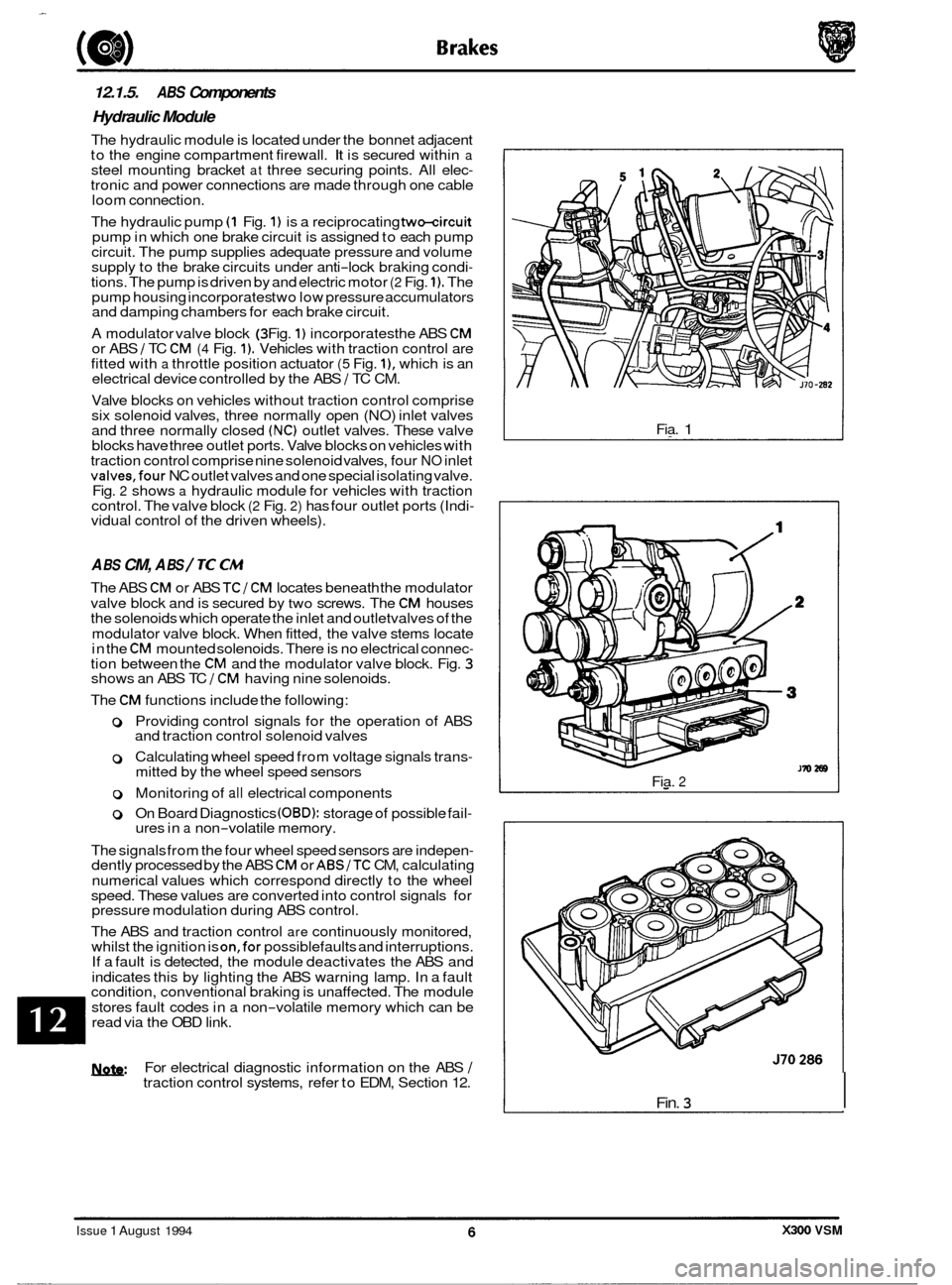
The hydraulic module is located under the bonnet adjacent
to the engine compartment firewall. It is secured within a steel mounting bracket at three securing points. All elec- tronic and power connections are made through one cable
loom connect ion.
The hydraulic pump
(1 Fig. 1) is a reciprocating two-circuit pump in which one brake circuit is assigned to each pump
circuit. The pump supplies adequate pressure and volume
supply to the brake circuits under anti
-lock braking condi- tions. The pump is driven by and electric motor (2 Fig. 1). The
pump housing incorporates two low pressure accumulators
and damping chambers for each brake circuit.
A modulator valve block
(3 Fig. 1) incorporates the ABS CM or ABS / TC CM (4 Fig. 1). Vehicles with traction control are
fitted with a throttle position actuator (5 Fig. I), which is an
electrical device controlled by the ABS 1 TC CM.
Valve blocks on vehicles without traction control comprise
six solenoid valves, three normally open (NO) inlet valves
and three normally closed
(NC) outlet valves. These valve
blocks have three outlet ports. Valve blocks on vehicles with
traction control comprise nine solenoid valves, four
NO inlet valves,four NC outlet valves and one special isolating valve.
Fig. 2 shows a hydraulic module for vehicles with traction
control. The valve block (2 Fig. 2) has four outlet ports (Indi- vidual control of the driven wheels).
A BS CM, A BS / TC CM
The ABS CM or ABS TCI CM locates beneath the modulator
valve block and is secured by
two screws. The CM houses
the solenoids which operate the inlet and outletvalves of the
modulator valve block. When fitted, the valve stems locate
in the
CM mounted solenoids. There is no electrical connec- tion between the CM and the modulator valve block. Fig. 3 shows an ABS TC 1 CM having nine solenoids.
The
CM functions include the following:
0 Providing control signals for the operation of ABS
and traction control solenoid valves
0 Calculating wheel speed from voltage signals trans- mitted by the wheel speed sensors
0 Monitoring of all electrical components
0 On Board Diagnostics (OBD): storage of possible fail- ures in a non-volatile memory.
The signals from the four wheel speed sensors are indepen
- dently processed by the ABS CM or ABSITC CM, calculating
numerical values which correspond directly to the wheel
speed. These values are converted into control signals for
pressure modulation during ABS control.
The ABS and traction control
are continuously monitored,
whilst the ignition is on,for possiblefaults and interruptions.
If a fault is detected, the module deactivates the ABS and
indicates this by lighting the ABS warning lamp. In a fault
condition, conventional braking is unaffected. The module
stores fault codes in a non
-volatile memory which can be
read via the OBD link.
U: For electrical diagnostic information on the ABS I traction control systems, refer to EDM, Section 12. Fia.
1
Fia. 2
Fin. 3 I
J70286
Issue 1 August 1994 X300 VSM
Page 230 of 521
0 12.1.6 Calipers
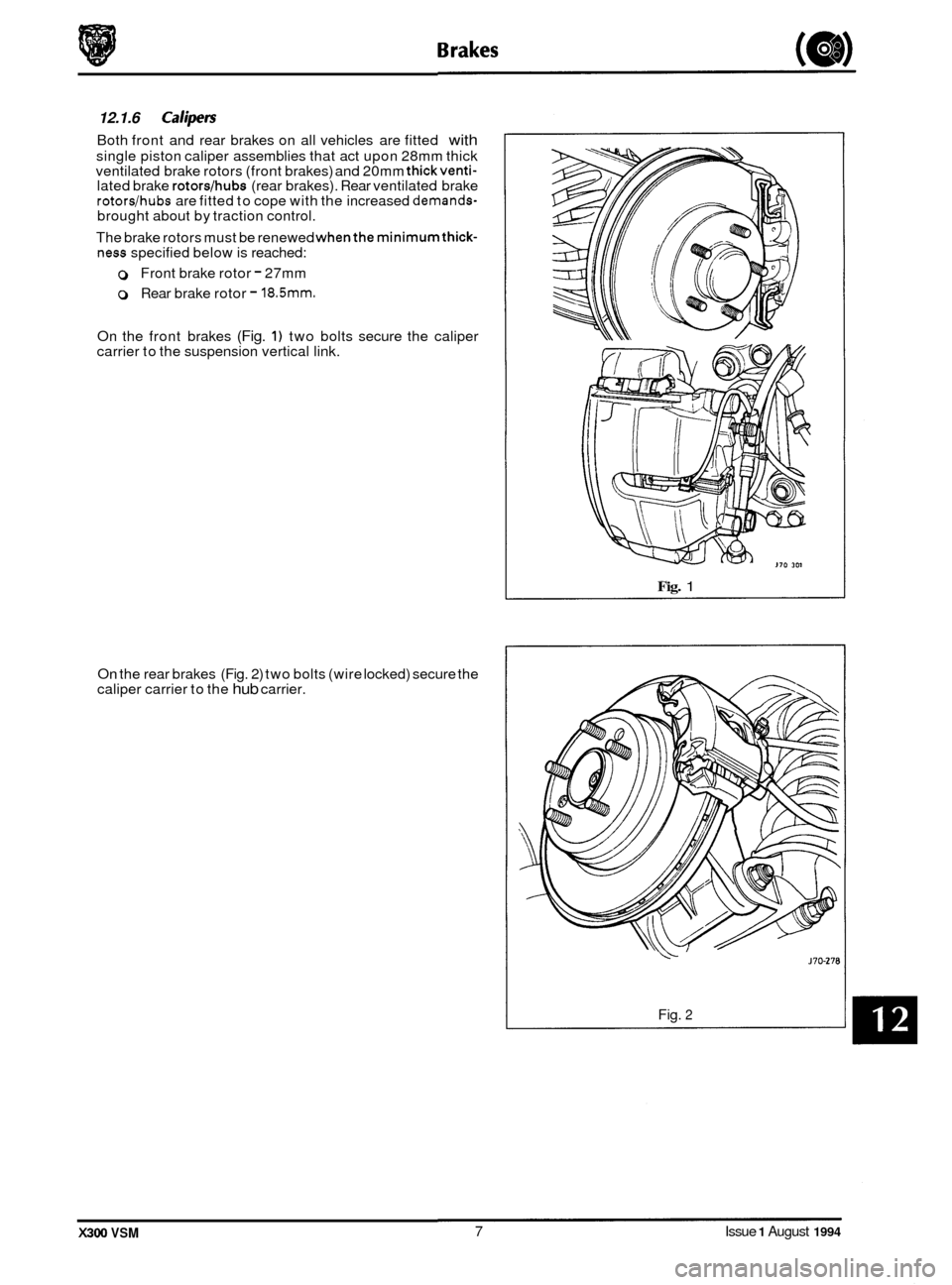
Both front and rear brakes on all vehicles are fitted with
single piston caliper assemblies that act upon 28mm thick
ventilated brake rotors (front brakes) and 20mm thickventi- lated brake rotors/hubs (rear brakes). Rear ventilated brake rotordhubs are fitted to cope with the increased demands- brought about by traction control.
The brake rotors must be renewed
whenthe minimumthick- ness specified below is reached:
0 Front brake rotor - 27mm
0 Rear brake rotor - 18.5mm.
On the front brakes (Fig. 1) two bolts secure the caliper
carrier to the suspension vertical link.
On the rear brakes (Fig. 2) two bolts (wire locked) secure the
caliper carrier to the hub carrier.
Fig. 1
\
Fig. 2
J70-278
X300 VSM 7 Issue 1 August 1994
Page 232 of 521
Brakes (e#
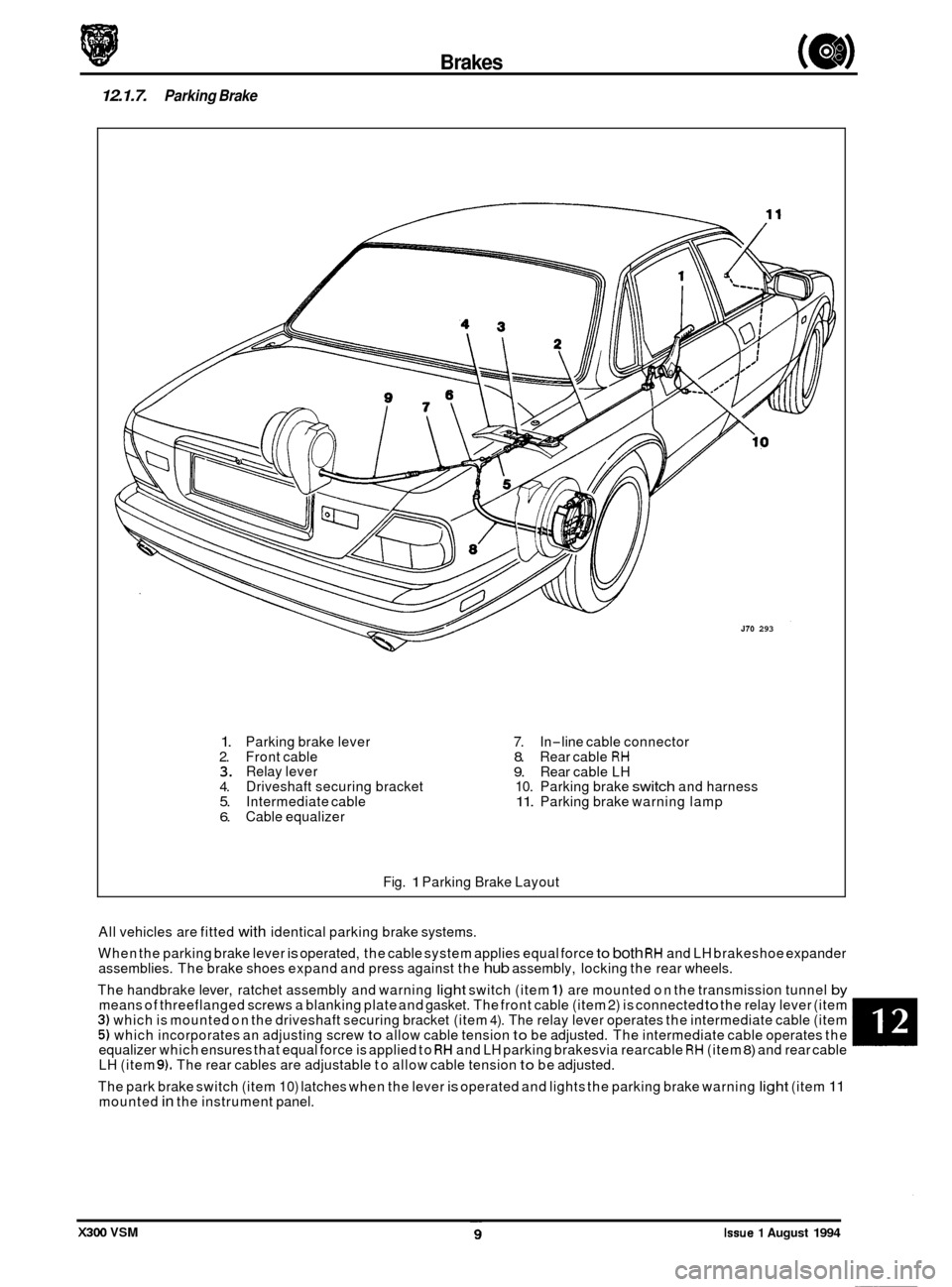
12.1.7. Parking Brake
J70 293
W
1. Parking brake lever 2. Front cable 3. Relay lever 4. Driveshaft securing bracket 5. Intermediate cable 6. Cable equalizer
7. In-line cable connector 8. Rear cable RH 9. Rear cable LH
10. Parking brake switch and harness 11. Parking brake warning lamp
Fig.
1 Parking Brake Layout
All vehicles are fitted with identical parking brake systems.
When the parking brake lever
is operated, the cable system applies equal force to both RH and LH brakeshoe expander
assemblies. The brake shoes expand and press against the hub assembly, locking the rear wheels.
The handbrake lever, ratchet assembly and warning
light switch (item 1) are mounted on the transmission tunnel by means of threeflanged screws a blanking plate and gasket. The front cable (item 2) is connected to the relay lever (item 3) which is mounted on the driveshaft securing bracket (item 4). The relay lever operates the intermediate cable (item 5) which incorporates an adjusting screw to allow cable tension to be adjusted. The intermediate cable operates the
equalizer which ensures that equal force is applied to RH and LH parking brakesvia rearcable RH (item 8) and rear cable
LH (item 9). The rear cables are adjustable to allow cable tension to be adjusted.
The park brake switch (item 10) latches when the lever
is operated and lights the parking brake warning light (item 11 mounted in the instrument panel.
X300 VSM Issue 1 August 1994
Page 244 of 521
Brakes
a 12.5 GENERAL FI77lNG lNSTRUCTlONS
12.5.1 Brake Fluid
WARNING: BRAKE FLUID IS CORROSIVE. EXTREME CARE MUST BE TAKEN WHEN HANDLING. AVOID SKIN OR EYE
CONTACT. AVOID INGESTION. IF SKIN OR EYES ARE ACCIDENTALLY SPLASHED WITH BRAKE FLUID,
RINSE THE AFFECTED AREA IMMEDIATELY WITH PLENTY OF WATER AND SEEK MEDICAL ATTENTION.
IF BRAKE FLUID
IS INGESTED, SEEK MEDICAL ATTENTION IMMEDIATELY.
CAUTION:
Fluid must not be allowed to contact the vehicle paintwork. Remove any spilt fluid from the paintwork
by rinsing away with running water. Methylated spirit (denatured alcohol) must not be used to clean the
contaminated area.
Cleaning Solvents
CAUTION: Never use methylated spirit (denatured alcohol) for cleaning purposes. Use only a proprietary brake
cleaning fluid.
m: THROUGHOUT THE FOLLOWING MAINTENANCE / SERVICE OPERATIONS, ABSOLUTE CLEANLINESS
MUST BE OBSERVED TO PREVENT GRIT OR OTHER FOREIGN MATTER CONTAMINATING THE BRAKE
TION. TO CLEAN BRAKE SYSTEM COMPONENTS, WASH
IN A PROPRIETARY BRAKE CLEANING FLUID.
REMOVE ALL TRACES OF CLEANING FLUID BEFORE REASSEMBLY. ALL BRAKE SYSTEM RUBBER COh PONENTS MUST BE DIPPED IN CLEAN BRAKE FLUID AND ASSEMBLED USING THE FINGERS ONLY.
SYSTEM.
IFTHE SYSTEM IS TO
BE FLUSHED, USE CLEAN BRAKE FLUID TO MINIMUM DOT 4 SPECIFICA-
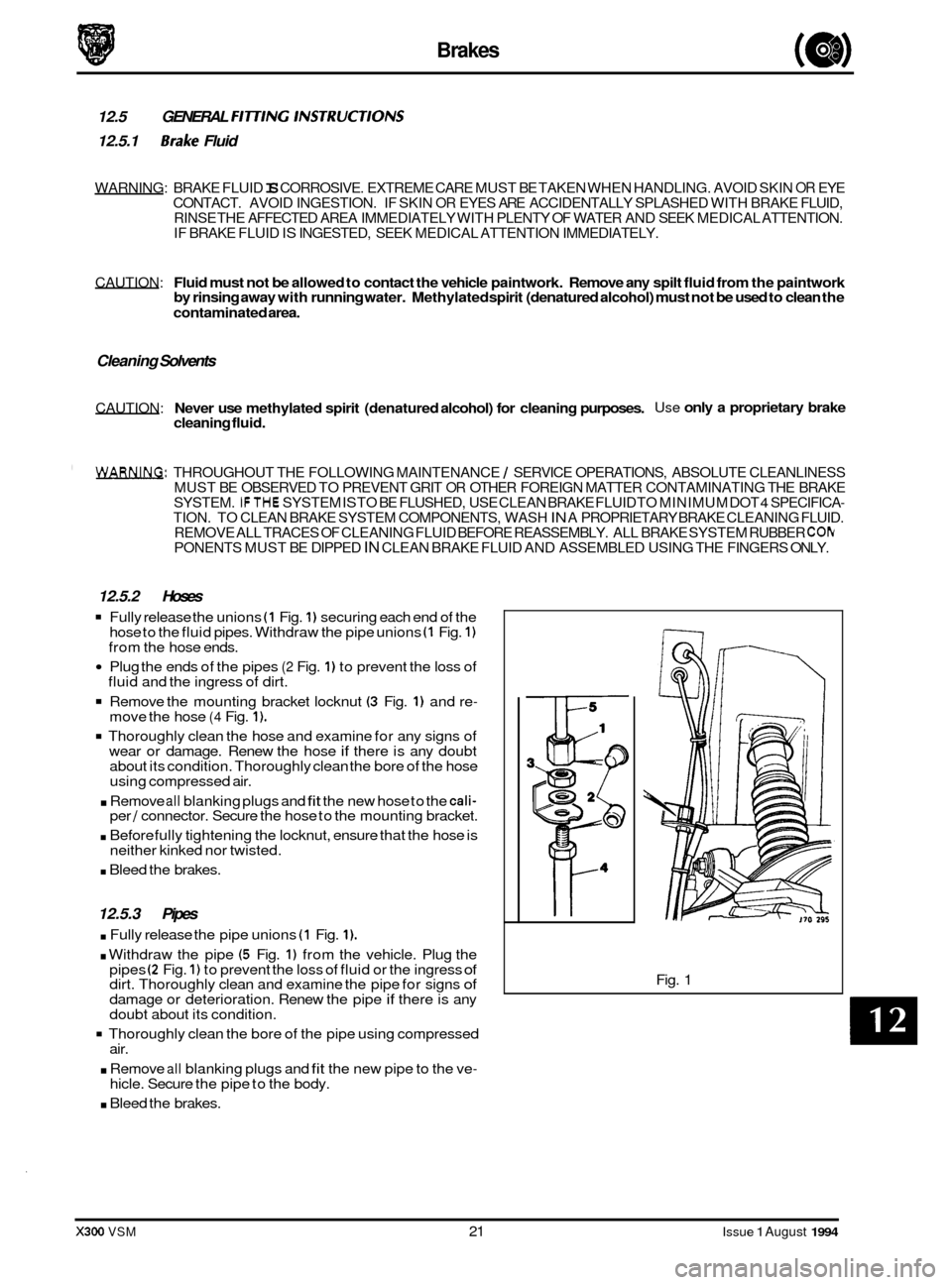
12.5.2 Hoses
Fully release the unions (1 Fig. 1) securing each end of the
hose to the fluid pipes. Withdraw the pipe unions (1 Fig. 1) from the hose ends.
Plug the ends of the pipes (2 Fig. 1) to prevent the loss of
fluid and the ingress of dirt.
Remove the mounting bracket locknut (3 Fig. 1) and re- move the hose (4 Fig. 1).
Thoroughly clean the hose and examine for any signs of
wear or damage. Renew the hose if there is any doubt
about its condition. Thoroughly clean the bore of the hose
using compressed air.
. Remove all blanking plugs and fit the new hose to the cali- per / connector. Secure the hose to the mounting bracket.
. Before fully tightening the locknut, ensure that the hose is
neither kinked nor twisted.
. Bleed the brakes.
12.5.3 Pipes
. Fully release the pipe unions (1 Fig. 1).
. Withdraw the pipe (5 Fig. 1) from the vehicle. Plug the
pipes (2 Fig. 1) to prevent the loss of fluid or the ingress of dirt. Thoroughly clean and examine the pipe for signs of damage or deterioration. Renew the pipe if there is any
doubt about its condition.
Thoroughly clean the bore of the pipe using compressed
air.
. Remove all blanking plugs and fit the new pipe to the ve- hicle. Secure the pipe to the body.
. Bleed the brakes.
17
Fig. 1
X300 VSM 21 Issue 1 August 1994
Page 245 of 521
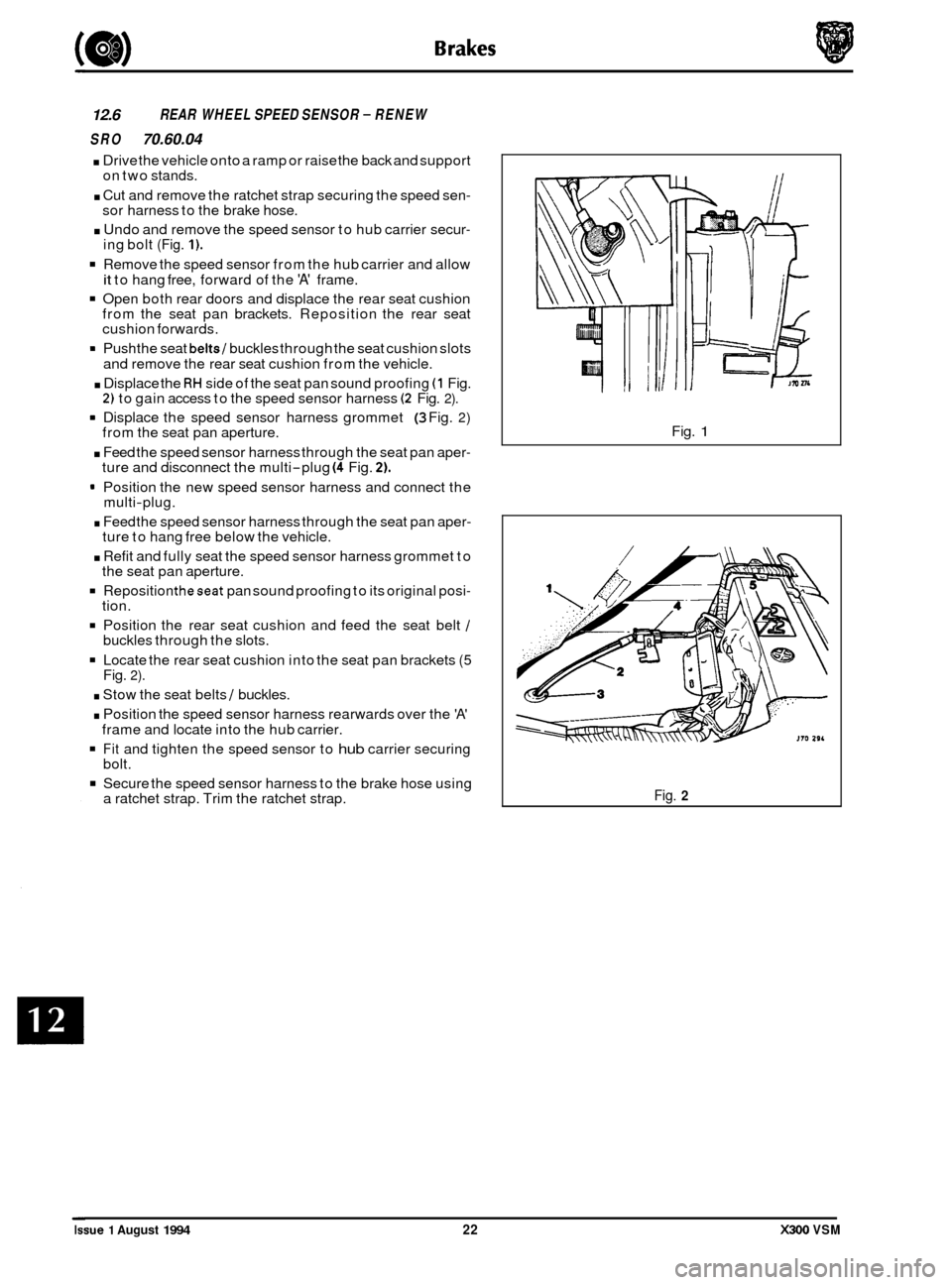
12.6 REAR WHEEL SPEED SENSOR - RENEW
SRO
70.60.04
. Drive the vehicle onto a ramp or raise the back and support
on two stands.
. Cut and remove the ratchet strap securing the speed sen- sor harness to the brake hose.
. Undo and remove the speed sensor to hub carrier secur- ing bolt (Fig. 1).
Remove the speed sensor from the hub carrier and allow
it to hang free, forward of the 'A' frame.
Open both rear doors and displace the rear seat cushion
from the seat pan brackets. Reposition the rear seat
cushion forwards.
9 Push the seat belts/ buckles through the seat cushion slots
and remove the rear seat cushion from the vehicle.
. Displace the RH side of the seat pan sound proofing (1 Fig. 2) to gain access to the speed sensor harness (2 Fig. 2).
9 Displace the speed sensor harness grommet (3 Fig. 2) from the seat pan aperture.
. Feed the speed sensor harness through the seat pan aper- ture and disconnect the multi-plug (4 Fig. 2).
9 Position the new speed sensor harness and connect the
multi-plug.
. Feed the speed sensor harness through the seat pan aper- ture to hang free below the vehicle.
. Refit and fully seat the speed sensor harness grommet to
the seat pan aperture.
Reposition theseat pan sound proofing to its original posi- tion.
Position the rear seat cushion and feed the seat belt / buckles through the slots.
Locate the rear seat cushion into the seat pan brackets (5 Fig. 2).
. Stow the seat belts / buckles.
. Position the speed sensor harness rearwards over the 'A'
Fit and tighten the speed sensor to hub carrier securing
Secure the speed sensor harness to the brake hose using
frame
and locate into the hub carrier.
bolt.
a ratchet strap. Trim the ratchet strap. Fig.
1
Fig. 2
Issue 1 August 1994 22 X300 VSM
0
0
0