air filter LAND ROVER DISCOVERY 2002 Repair Manual
[x] Cancel search | Manufacturer: LAND ROVER, Model Year: 2002, Model line: DISCOVERY, Model: LAND ROVER DISCOVERY 2002Pages: 1672, PDF Size: 46.1 MB
Page 381 of 1672
EMISSION CONTROL - V8
17-2-44 REPAIRS
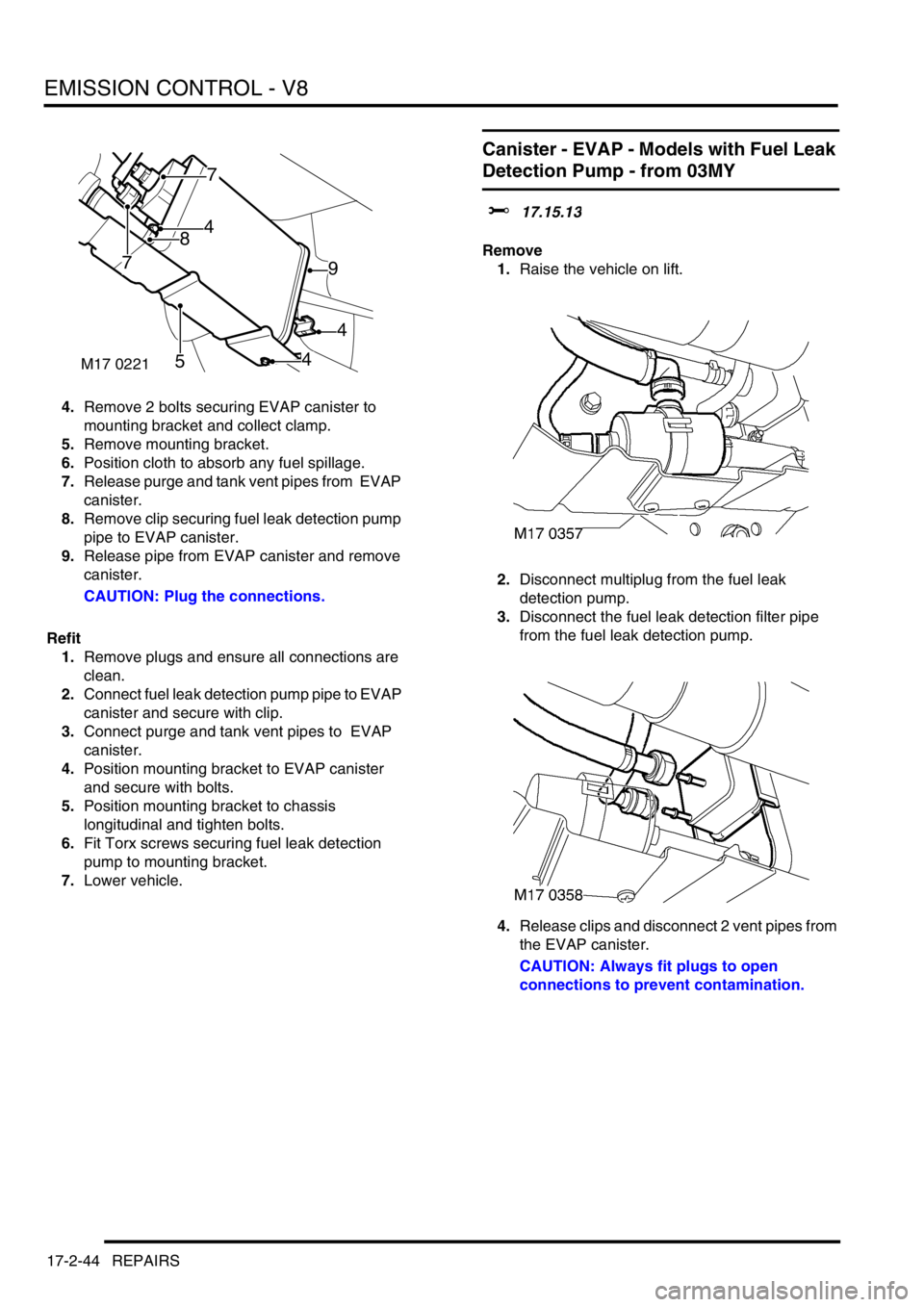
4.Remove 2 bolts securing EVAP canister to
mounting bracket and collect clamp.
5.Remove mounting bracket.
6.Position cloth to absorb any fuel spillage.
7.Release purge and tank vent pipes from EVAP
canister.
8.Remove clip securing fuel leak detection pump
pipe to EVAP canister.
9.Release pipe from EVAP canister and remove
canister.
CAUTION: Plug the connections.
Refit
1.Remove plugs and ensure all connections are
clean.
2.Connect fuel leak detection pump pipe to EVAP
canister and secure with clip.
3.Connect purge and tank vent pipes to EVAP
canister.
4.Position mounting bracket to EVAP canister
and secure with bolts.
5.Position mounting bracket to chassis
longitudinal and tighten bolts.
6.Fit Torx screws securing fuel leak detection
pump to mounting bracket.
7.Lower vehicle.
Canister - EVAP - Models with Fuel Leak
Detection Pump - from 03MY
$% 17.15.13
Remove
1.Raise the vehicle on lift.
2.Disconnect multiplug from the fuel leak
detection pump.
3.Disconnect the fuel leak detection filter pipe
from the fuel leak detection pump.
4.Release clips and disconnect 2 vent pipes from
the EVAP canister.
CAUTION: Always fit plugs to open
connections to prevent contamination.
M17 0221
4
4
4
9
7
7
5
8
Page 382 of 1672
EMISSION CONTROL - V8
REPAIRS 17-2-45
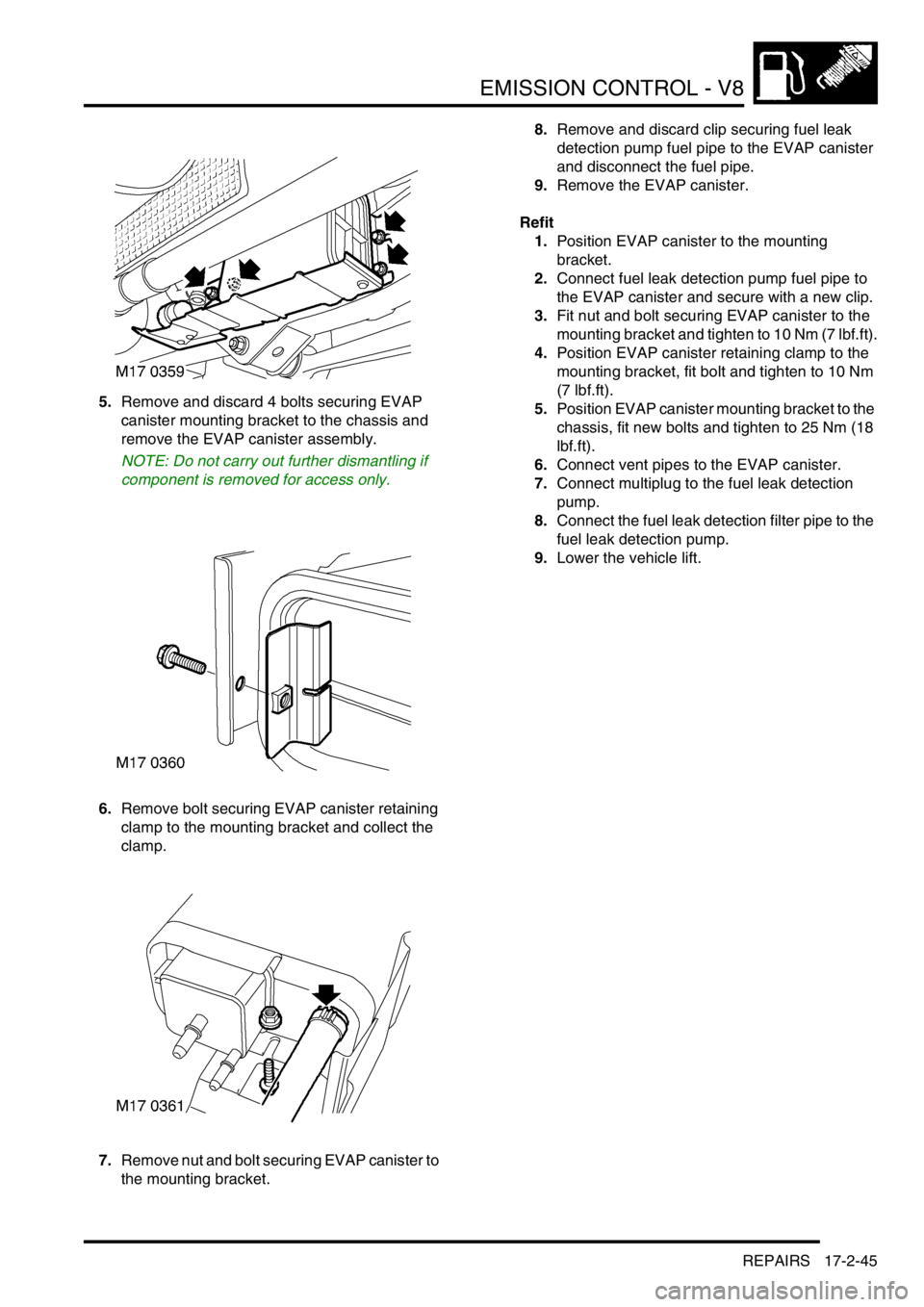
5.Remove and discard 4 bolts securing EVAP
canister mounting bracket to the chassis and
remove the EVAP canister assembly.
NOTE: Do not carry out further dismantling if
component is removed for access only.
6.Remove bolt securing EVAP canister retaining
clamp to the mounting bracket and collect the
clamp.
7.Remove nut and bolt securing EVAP canister to
the mounting bracket.8.Remove and discard clip securing fuel leak
detection pump fuel pipe to the EVAP canister
and disconnect the fuel pipe.
9.Remove the EVAP canister.
Refit
1.Position EVAP canister to the mounting
bracket.
2.Connect fuel leak detection pump fuel pipe to
the EVAP canister and secure with a new clip.
3.Fit nut and bolt securing EVAP canister to the
mounting bracket and tighten to 10 Nm (7 lbf.ft).
4.Position EVAP canister retaining clamp to the
mounting bracket, fit bolt and tighten to 10 Nm
(7 lbf.ft).
5.Position EVAP canister mounting bracket to the
chassis, fit new bolts and tighten to 25 Nm (18
lbf.ft).
6.Connect vent pipes to the EVAP canister.
7.Connect multiplug to the fuel leak detection
pump.
8.Connect the fuel leak detection filter pipe to the
fuel leak detection pump.
9.Lower the vehicle lift.
Page 391 of 1672

EMISSION CONTROL - V8
17-2-54 REPAIRS
Pump - Fuel Leak Detection - up to 03MY
$% 17.45.41
Remove
1.Raise the vehicle on lift.
2.Disconnect multiplug from fuel leak detection
pump.
3.Release leak detection air filter hose from top of
pump.
4.Remove 3 Torx screws securing pump to
mounting bracket.
5.Remove clip securing EVAP canister hose to
pump.
6.Release EVAP canister hose from pump.
7.Remove pump.
Refit
1.Connect EVAP canister hose to pump and
secure with clip.
2.Position pump to mounting bracket and secure
with Torx screws.
3.Connect leak detection air filter hose to top of
leak detection pump.
4.Connect multiplug to pump.
5.Lower vehicle.
Pump - fuel leak detection - from 03MY
$% 17.45.41
Remove
1.Raise the vehicle on lift.
2.Disconnect multiplug from the fuel leak
detection pump.
3.Remove 3 screws securing the fuel leak
detection pump to the chassis mounting
bracket.
4.Position absorbent cloth around fuel hoses to
collect any fuel spillage.
5.Disconnect the fuel leak detection filter pipe
from the fuel leak detection pump.
CAUTION: Always fit plugs to open
connections to prevent contamination.
6.Remove and discard clip securing EVAP pipe
to the fuel leak detection pump and disconnect
the pipe.
7.Remove the fuel leak detection pump.
Refit
1.Connect the EVAP pipe to the fuel leak
detection pump and secure with a new clip.
2.Connect the fuel leak detection filter pipe to the
fuel leak detection pump.
3.Remove absorbent cloth.
4.Fit and tighten 3 screws securing the fuel leak
detection pump to the chassis mounting
bracket.
5.Connect multiplug to the fuel leak detection
pump.
6.Lower the vehicle lift.
M17 0235
2
3
4
57
Page 392 of 1672

EMISSION CONTROL - V8
REPAIRS 17-2-55
Filter - fuel leak detection pump - up to
03MY
$% 17.45.42
Remove
1.Remove bolt securing air filter to mounting
bracket and collect nut.
2.Remove clip securing hose to air filter.
3.Release hose from air filter.
4.Remove air filter.
Refit
1.Connect hose to air filter and secure with clip.
2.Position air filter to mounting bracket and
secure with nut and bolt.
Filter - fuel leak detection pump - from
03MY
$% 17.45.42
Remove
1.Remove Allen bolt securing fuel leak detection
pump filter to the mounting bracket.
2.Remove and discard clip securing fuel pipe to
the fuel leak detection pump filter and
disconnect the pipe.
CAUTION: Always fit plugs to open
connections to prevent contamination.
3.Remove the fuel leak detection pump filter.
Refit
1.Connect fuel pipe to the fuel leak detection
pump and secure with a new clip.
2.Position fuel leak detection pump filter to
mounting bracket, fit Allen bolt and tighten to 3
Nm (2.2 lbf.ft).
17M 0224
Page 403 of 1672
ENGINE MANAGEMENT SYSTEM - TD5
18-1-10 DESCRIPTION AND OPERATION
Mass Air Flow (MAF) sensor
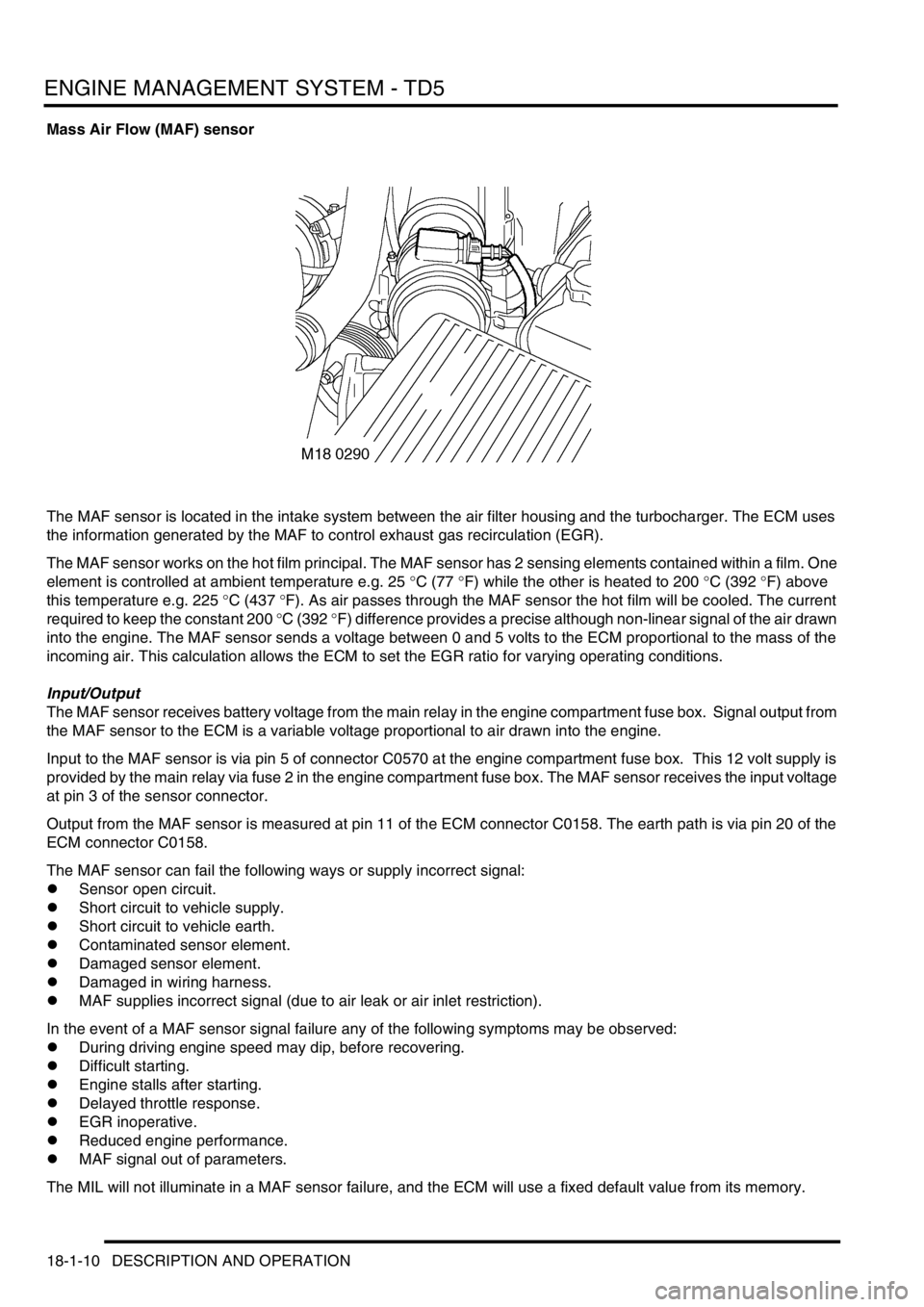
The MAF sensor is located in the intake system between the air filter housing and the turbocharger. The ECM uses
the information generated by the MAF to control exhaust gas recirculation (EGR).
The MAF sensor works on the hot film principal. The MAF sensor has 2 sensing elements contained within a film. One
element is controlled at ambient temperature e.g. 25
°C (77 °F) while the other is heated to 200 °C (392 °F) above
this temperature e.g. 225
°C (437 °F). As air passes through the MAF sensor the hot film will be cooled. The current
required to keep the constant 200
°C (392 °F) difference provides a precise although non-linear signal of the air drawn
into the engine. The MAF sensor sends a voltage between 0 and 5 volts to the ECM proportional to the mass of the
incoming air. This calculation allows the ECM to set the EGR ratio for varying operating conditions.
Input/Output
The MAF sensor receives battery voltage from the main relay in the engine compartment fuse box. Signal output from
the MAF sensor to the ECM is a variable voltage proportional to air drawn into the engine.
Input to the MAF sensor is via pin 5 of connector C0570 at the engine compartment fuse box. This 12 volt supply is
provided by the main relay via fuse 2 in the engine compartment fuse box. The MAF sensor receives the input voltage
at pin 3 of the sensor connector.
Output from the MAF sensor is measured at pin 11 of the ECM connector C0158. The earth path is via pin 20 of the
ECM connector C0158.
The MAF sensor can fail the following ways or supply incorrect signal:
lSensor open circuit.
lShort circuit to vehicle supply.
lShort circuit to vehicle earth.
lContaminated sensor element.
lDamaged sensor element.
lDamaged in wiring harness.
lMAF supplies incorrect signal (due to air leak or air inlet restriction).
In the event of a MAF sensor signal failure any of the following symptoms may be observed:
lDuring driving engine speed may dip, before recovering.
lDifficult starting.
lEngine stalls after starting.
lDelayed throttle response.
lEGR inoperative.
lReduced engine performance.
lMAF signal out of parameters.
The MIL will not illuminate in a MAF sensor failure, and the ECM will use a fixed default value from its memory.
Page 404 of 1672
ENGINE MANAGEMENT SYSTEM - TD5
DESCRIPTION AND OPERATION 18-1-11
Ambient Air Temperature and Pressure (AAP) sensor
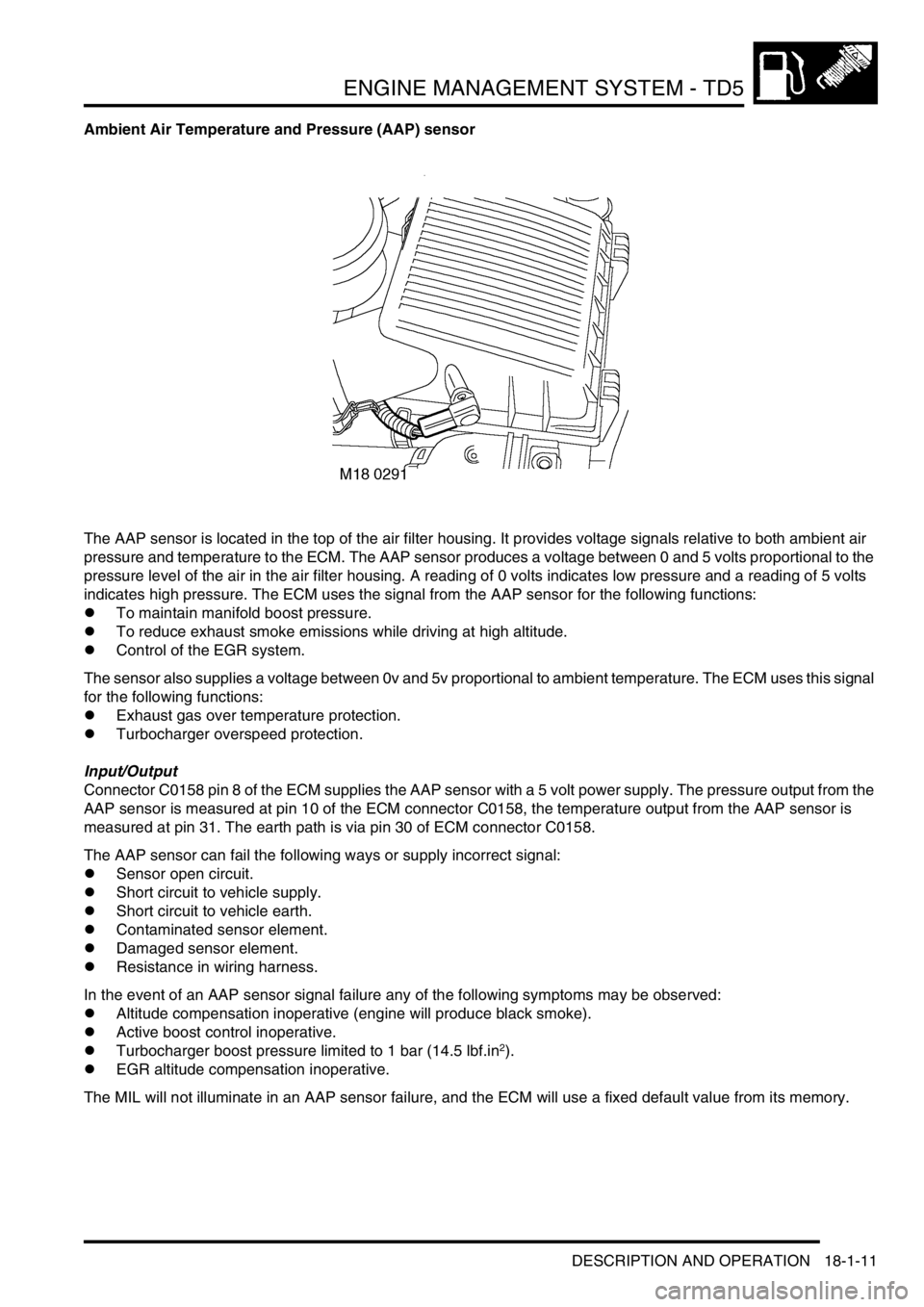
The AAP sensor is located in the top of the air filter housing. It provides voltage signals relative to both ambient air
pressure and temperature to the ECM. The AAP sensor produces a voltage between 0 and 5 volts proportional to the
pressure level of the air in the air filter housing. A reading of 0 volts indicates low pressure and a reading of 5 volts
indicates high pressure. The ECM uses the signal from the AAP sensor for the following functions:
lTo maintain manifold boost pressure.
lTo reduce exhaust smoke emissions while driving at high altitude.
lControl of the EGR system.
The sensor also supplies a voltage between 0v and 5v proportional to ambient temperature. The ECM uses this signal
for the following functions:
lExhaust gas over temperature protection.
lTurbocharger overspeed protection.
Input/Output
Connector C0158 pin 8 of the ECM supplies the AAP sensor with a 5 volt power supply. The pressure output from the
AAP sensor is measured at pin 10 of the ECM connector C0158, the temperature output from the AAP sensor is
measured at pin 31. The earth path is via pin 30 of ECM connector C0158.
The AAP sensor can fail the following ways or supply incorrect signal:
lSensor open circuit.
lShort circuit to vehicle supply.
lShort circuit to vehicle earth.
lContaminated sensor element.
lDamaged sensor element.
lResistance in wiring harness.
In the event of an AAP sensor signal failure any of the following symptoms may be observed:
lAltitude compensation inoperative (engine will produce black smoke).
lActive boost control inoperative.
lTurbocharger boost pressure limited to 1 bar (14.5 lbf.in
2).
lEGR altitude compensation inoperative.
The MIL will not illuminate in an AAP sensor failure, and the ECM will use a fixed default value from its memory.
Page 426 of 1672

ENGINE MANAGEMENT SYSTEM - TD5
DESCRIPTION AND OPERATION 18-1-33
The turbocharger is exposed to extremely high operating temperatures (up to 1,000 °C (1832 °F)) because of the hot
exhaust gases and the high speed revolution of the turbine (up to 150,000 rev/min). In order to resist wear of the
turbine bearings a flow of lubrication oil is supplied from the engine lubrication system to keep the bearings cool. Oil
is supplied from a tapping at the front of the full-flow filter adaptor housing via a metal pipe with banjo connections.
Oil is returned to the sump via a metal pipe which connects to the cylinder block at a port below the turbocharger
assembly.
A heatshield is attached to the left hand side of the engine to protect adjacent components from the heat generated
at the turbocharger. The heatshield is attached to the engine by two bolts an additional bolt attaches the heatshield
to the turbocharger casting.
The engine control module controls the amount of boost pressure the engine receives by way of the turbocharger.
When full boost is reached a control signal is sent to the wastegate modulator, and a vacuum is applied to the
wastegate valve. The wastegate valve opens, bypassing some of the exhaust gas away from the turbine to be output
to the exhaust system.
The engine should be allowed to idle for 15 seconds following engine start up and before the engine is switched off
to protect the turbocharger by maintaining oil supply to the turbine bearings.
Intercooler
The intercooler is an air-to-air heat exchanger which lowers the intake air temperature to obtain a higher air density
for better combustion efficiency. The intercooler receives compressed air from the turbocharger via a metal pipe; it
cools the intake air via the intercooler matrix and delivers it to the intake manifold by means of a rubber hose which
connects between the intercooler outlet and the intake manifold outlet. The rubber hose is connected to ports at each
end by metal band clips.
+ COOLING SYSTEM - Td5, DESCRIPTION AND OPERATION, Description.
The intercooler is located at the front of the engine bay, forward of the radiator.
Page 441 of 1672
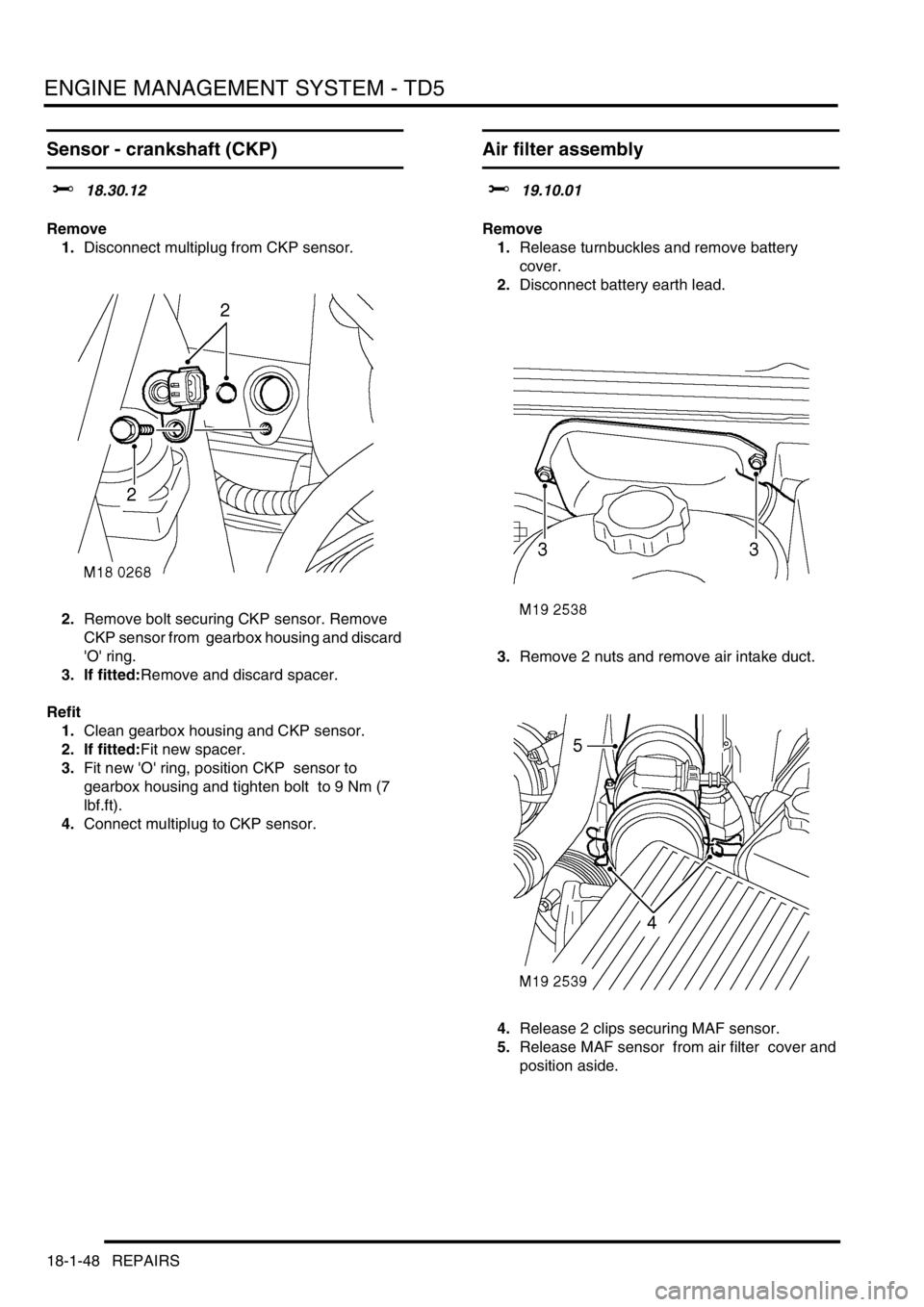
ENGINE MANAGEMENT SYSTEM - TD5
18-1-48 REPAIRS
Sensor - crankshaft (CKP)
$% 18.30.12
Remove
1.Disconnect multiplug from CKP sensor.
2.Remove bolt securing CKP sensor. Remove
CKP sensor from gearbox housing and discard
'O' ring.
3. If fitted:Remove and discard spacer.
Refit
1.Clean gearbox housing and CKP sensor.
2. If fitted:Fit new spacer.
3.Fit new 'O' ring, position CKP sensor to
gearbox housing and tighten bolt to 9 Nm (7
lbf.ft).
4.Connect multiplug to CKP sensor.
Air filter assembly
$% 19.10.01
Remove
1.Release turnbuckles and remove battery
cover.
2.Disconnect battery earth lead.
3.Remove 2 nuts and remove air intake duct.
4.Release 2 clips securing MAF sensor.
5.Release MAF sensor from air filter cover and
position aside.
Page 442 of 1672

ENGINE MANAGEMENT SYSTEM - TD5
REPAIRS 18-1-49
6.Release air filter from 3 grommets, remove
assembly and discard 'O' ring.
7.Remove 2 screws, remove AAP sensor and
discard 'O' ring.
Refit
1.Clean MAF sensor and air filter mating faces.
2.Fit new 'O' ring to air filter.
3.Clean AAP sensor.
4.Using new 'O' ring, fit AAP sensor and tighten
screws.
5.Position air filter assembly and secure in
grommets.
6.Position MAF sensor and secure clips.
7.Position intake duct to air filter and tighten nuts.
8.Connect battery earth lead.
9.Fit battery cover and secure with fixings.
Element - air filter
$% 19.10.10
Remove
1.Release 2 clips and disconnect MAF sensor
from air filter cover.
Page 443 of 1672

ENGINE MANAGEMENT SYSTEM - TD5
18-1-50 REPAIRS
2.Disconnect multiplug from AAP sensor.
3.Release 2 clips and remove cover from air
filter.
4.Remove air filter element.
Refit
1.Clean air filter body and cover.
2.Fit new air filter element.
3.Position air cleaner cover and secure clips.
4.Position MAF sensor and secure clips.
5.Connect multiplug to AAP sensor.
Sensor - fuel temperature
$% 19.22.08
Remove
1.Remove 3 bolts and remove engine acoustic
cover.
2.Release fixings and remove battery cover.
3.Disconnect battery earth lead.
4.Disconnect multiplug from fuel temperature
sensor.
5. Thoroughly clean area around fuel
temperature sensor before removal.
6.Remove fuel temperature sensor and discard
sealing washer.
Refit
1.Clean fuel temperature sensor mating faces.
2.Fit new sealing washer and tighten fuel
temperature sensor to 13 Nm (10 lbf.ft) .
3.Connect multiplug to fuel temperature sensor.
4.Connect battery earth lead.
5.Fit battery cover and secure fixings.
6.Fit engine acoustic cover, and secure with
fixings.