battery MAZDA 626 1987 Workshop Manual
[x] Cancel search | Manufacturer: MAZDA, Model Year: 1987, Model line: 626, Model: MAZDA 626 1987Pages: 1865, PDF Size: 94.35 MB
Page 950 of 1865

7B REMOVAL
76G07B-107
G4A-EL
76G07B-108
76G07B-109
1. Remove the battery and battery carrier.
2. Disconnect the main fuse block.
3. Disconnect the distributor lead.
4. Disconnect the air flow meter connector and re-
move the air cleaner assembly. (G4A-EL)
5. Remove the air cleaner hose. (G4A-EL)
6. Remove the fresh air duct. (G4A-HL)
7. Disconnect the speedometer cable.
8. Disconnect the connectors.
(1) Inhibitor switch
(2) Solenoid valve
(3) Pulse generator (G4A-EL)
(4) Fluid temperature switch (G4A-EL)
9. Disconnect the grounds from the transaxle case.
10. Disconnect the selector cable.
11. Disconnect the throttle cable.
76G07B-110
7B—84
Page 1086 of 1865
7B INSTALLATION
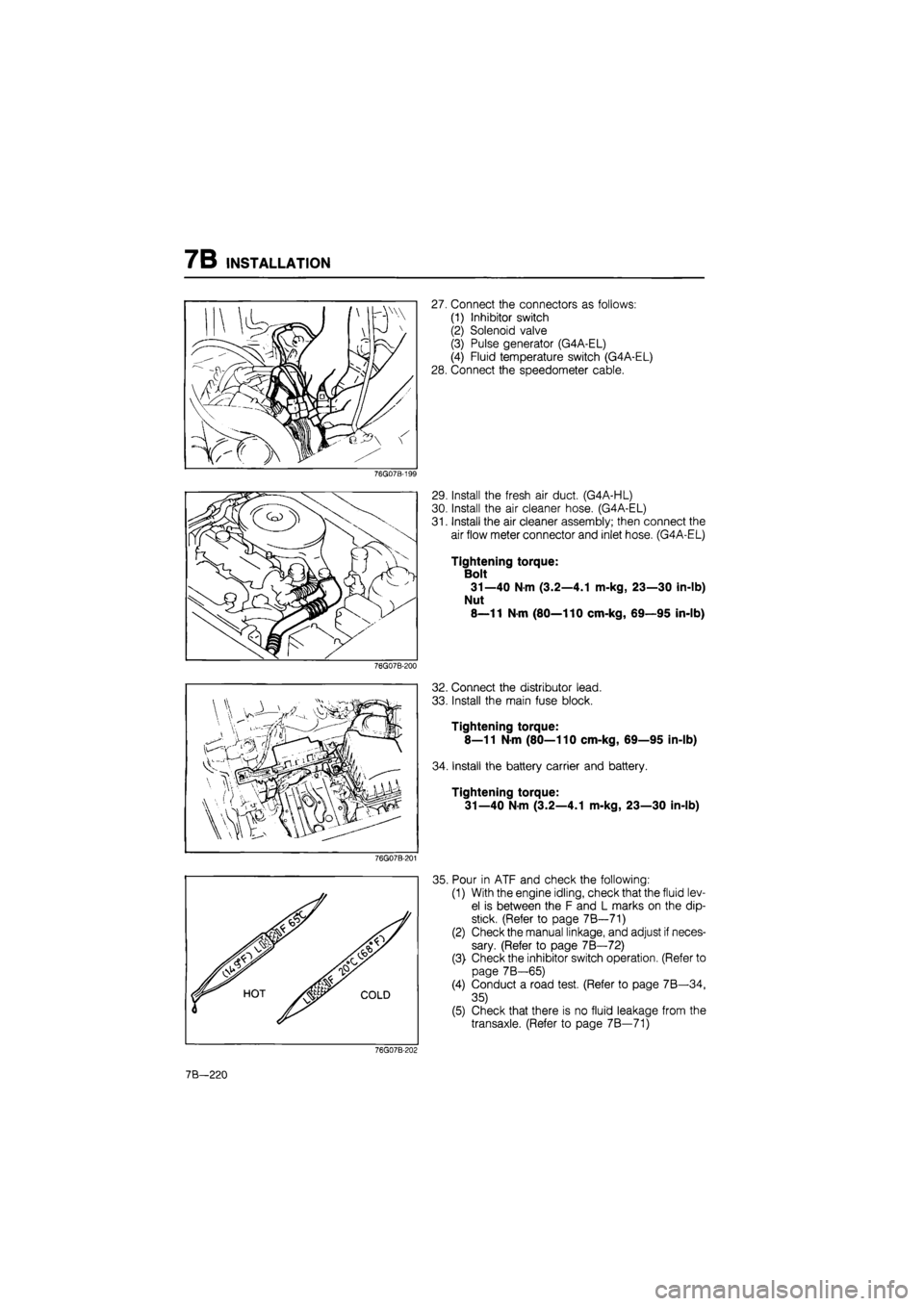
27. Connect the connectors as follows:
(1) Inhibitor switch
(2) Solenoid valve
(3) Pulse generator (G4A-EL)
(4) Fluid temperature switch (G4A-EL)
28. Connect the speedometer cable.
76G07B-199
76G07B-200
76G07B-201
29. Install the fresh air duct. (G4A-HL)
30. Install the air cleaner hose. (G4A-EL)
31. Install the air cleaner assembly; then connect the
air flow meter connector and inlet hose. (G4A-EL)
Tightening torque:
Bolt
31—40 N-m (3.2—4.1 m-kg, 23—30 in-lb)
Nut
8—11 N-m (80—110 cm-kg, 69—95 in-lb)
32. Connect the distributor lead.
33. Install the main fuse block.
Tightening torque:
8—11 N-m (80—110 cm-kg, 69—95 in-lb)
34. Install the battery carrier and battery.
Tightening torque:
31—40 N-m (3.2—4.1 m-kg, 23—30 in-lb)
35. Pour in ATF and check the following:
(1) With the engine idling, check that the fluid lev-
el is between the F and L marks on the dip-
stick. (Refer to page 7B—71)
(2) Check the manual linkage, and adjust if neces-
sary. (Refer to page 7B—72)
(3) Check the inhibitor switch operation. (Refer to
page 7B—65)
(4) Conduct a road test. (Refer to page 7B—34,
35)
(5) Check that there is no fluid leakage from the
transaxle. (Refer to page 7B—71)
76G07B-202
7B—220
Page 1142 of 1865

7C ON-VEHICLE MAINTENANCE
REPLACEMENT OF CONTROL VALVE
1. Disconnect the negative battery cable.
2. Jack up the vehicle and support it with safety
stands.
3. Drain the ATF.
4. Remove the under cover and side cover.
76G07C-049
63U07B-024
jr
j riSJS
®
76G07C-050
5. Remove the oil pan from the transaxle case.
Caution
Be careful because some ATF will be in the
oil pan.
6. Remove the control valve body.
Caution
Be careful not to lose the ball and spring for
the torque converter relief valve or the vacu-
um diaphragm rod.
7. Install the control valve body as follows:
(1) Install the vacuum diaphragm rod.
(2) Insert the ball and spring into the hole in the
transaxle case.
Note
a) The ball is inserted first, then the spring.
b) Use petroleum jelly to prevent them from
falling out.
(3) Install the control valve, mating the groove of
the manual valve with the driving pin of the con-
trol rod.
(4) Tighten the control valve mounting bolts to the
specified torque.
Tightening torque:
8—11 N-m (80—110 cm-kg, 69—95 in-lb)
8. Install the oil pan and tighten the bolts to the speci-
fied torque.
Tightening torque:
5—8 N-m (50—80 cm-kg, 43—69 in-lb)
76G07C-051
7C-28
Page 1144 of 1865

7C REMOVAL
REMOVAL
PREPARATION
(1) Drain the ATF before removal.
(2) Attach the engine support.
(3) Jack up the vehicle and support it with safety stands.
Components
1. Battery
2. Battery carrier
3. Fresh air duct
4. Main fuse block
5. Distributor leads
6. Speedometer cable
7. Cnnectors
8. Ground wires
9. Selector cable
10. Vacuum hose
11. Front wheels
12. Splash shields
13. Oil cooler outlet and inlet
hoses
14. Tie-rod ends
15. Stabilizer bar control links
16. Lower arm ball joints
17. Driveshaft
18. Joint shaft bracket
76G07C-056
19. Joint shaft and driveshaft
20. Under cover
21. Torque converter bolts
22. Starter
23. Engine mount No.4
24. Engine mount No.2
25. Crossmember and left side
lower arm
26. Transaxle
7C-30
Page 1145 of 1865

REMOVAL 7C
76G07C-057
76G07C-058
76G07C-059
1. Remove the battery and battery carrier.
2. Remove the fresh air duct.
3. Disconnect the main fuse block.
4. Disconnect the distributor leads.
5. Disconnect the speedometer cable.
6. Disconnect the connectors.
(1) Inhibitor switch
(2) Kick-down solenoid
7. Disconnect the grounds from the transaxle case
and oil pump.
8. Disconnect the selector cable.
9. Disconnect the vacuum hose.
10. Remove the front wheels.
11. Remove the splash shields.
12. Drain the ATF.
13. Disconnect the oil cooler outlet and inlet hoses.
76G07C-060
7C—31
Page 1238 of 1865

7C INSTALLATION
31.
Connect the distributor lead.
Connect the main fuse block.
Tightening torque:
8—11 N-m (80—110 cm-kg, 69—95 in-lb)
Install the fresh air duct.
Install the battery carrier and battery.
Tghtening torque:
Bolts
9—13 N-m (90—130 cm-kg, 78—113 in-lb)
Nut
5—7 N-m (50—70 cm-kg, 43—61 in-lb)
Pour in ATF and check the following:
(1) With the engine idling, check that the fluid lev-
el is between the F and L marks on the dip-
stick. (Refer to page 7C—25.)
(2) Check the manual linkage, and adjust if neces-
sary. (Refer to page 7C—26.)
(3) Check the inhibitor switch operation. (Refer to
page 7C—23.)
(4) Conduct a road test. (Refer to page 7C—18.)
(5) Check that there is no fluid leakage from the
transaxle. (Refer to page 7C—25.)
76G07C-337
7C-124
Page 1317 of 1865

STEERING GEAR AND LINKAGE 1 0
86U10X-052
REMOVAL
Note
The power steering fluid will leak out when the
return hose or the pressure hose is discon-
nected. Prepare a suitable container for it to
drain into.
1. Disconnect the negative battery cable.
2. Disconnect the pressure switch connector.
3. Raise the vehicle on a lift or safety stands, and re-
move the front wheels.
4. Disconnect the power steering hose and pipe.
5. Disconnect the tie-rod ends from the knuckles with
the SST.
6. Remove the steering shaft universal joint.
86U10X-053
7. Remove the mud flap.
8. Remove the mounting bolts and the steering gear.
86U10X-054
10—29
Page 1390 of 1865

1 0 ELECTRICAL COMPONENTS OF 4-WHEEL STEERING
flashes
Replace control unit
4WS-9 Failure of control unit, alternator, or wiring harness
Start engine,
I
Check voltage between terminal of control unit con-nector and body ground.
Terminal Voltage
G(B) OV
H (B) OV
K(G) Approx. 12V
L (G) Approx. 12V
N(B) OV
OK
NG
Check 4WS relay and timer (Refer to page 10—103) -
OK
Check battery, harness, and alternator.
NG
Turn ignition switch OFF. Start engine. Check if 4WS warning light flashes or illuminates.
NO
Momentary problem (If warning light often flashes or illuminates, check battery and alter-nator. Replace control unit if necessary).
YES
Replace control unit.
Replace relay and timer
76G10X-031
4WS WARNING LIGHT
1. Turn the ignition switch OFF.
2. Turn the ignition switch ON, and check that the
4WS warning light illuminates.
3. If there is no illumination, check the warning light
bulb and wiring harness.
Replace the control unit if necessary.
86U10X-232
10-102
Page 1465 of 1865

ANTI-LOCK BRAKE SYSTEM (ABS) 1 1
TROUBLESHOOTING
Precaution
Conditions that are not malfunctions
1. It may happen that vibration is felt in the steering wheel, body, and/or brake pedal when the ABS
is functioning; such vibration is simply an indication that the system is functioning.
2. Sound of the pump motor operating, accumulator pressure being released, or the relay operating
may be heard from the engine compartment when the engine is started as the system is being auto-
matically checked.
3. The ABS pump motor may be automatically activated even though the ABS is not operating.
4. The ABS warning light may illuminate under any of the following conditions:
• When the vehicle is traveling on snow or ice with the parking brake activated or a brake dragging
at one wheel.
• When different-sized tires are used.
• When tires of different gripping performance are used.
• When (while the vehicle is jacked up or stuck) only the front wheels are spun for 20 seconds or more.
• When there is insufficient battery voltage.
Note
Under the above conditions, the warning light will not illuminate a second time when the
ignition is switched OFF then back ON, and there will be no memory entry to the control
unit of a problem.
Troubleshooting notes
The ABS is composed of electrical components, mechanical components (hydraulic unit), and the com-
ponents of the standard brake system.
Fundamentally, malfunction of the ABS electrical or mechanical components is judged by the self-
diagnosis function within the ABS control unit. And malfunctions are indicated by the warning light
in the instrument panel.
The location
of
a malfunction is indicated by the technician switching the system to the diagnosis-indication
mode.
The self-diagnosis and indication functions must be used when malfunctions of the ABS are being
diagnosed.
76G11X-091
11—73
Page 1467 of 1865

ANTI-LOCK BRAKE SYSTEM (ABS) 1 1
Diagnosis Table
Note
Flashing of the warning light shows past failure, and its illumination shows present failure.
Diagnosis indication Possible failure Flow chart
No. Warning light Voltmeter Possible failure Flow chart
No.
ON
n
i2vn
OV
Hydraulic unit Harness
Right front wheel speed
sensor ABS-1
ON
n nn
Hydraulic unit Harness Left front wheel speed sensor ABS-2
OFF
Hydraulic unit Harness Left front wheel speed sensor ABS-2
OFF
nnn
Hydraulic unit Harness
Rear wheel speed sensor ABS-3
n
nnnn
Right front sensor rotor ABS-4
n
nnnnn
Left front sensor rotor ABS-5
JLilTUITLTL
Right rear sensor rotor ABS-6
jirLruiJum
Left rear sensor rotor ABS-7
J n
Hydraulic unit Harness
Control unit connector (11-pin)
ABS-8
nnnn
Hydraulic unit Harness
Control unit connector (11-pin)
ABS-8
J nn
Relay box
Hydraulic unit
Harness
ABS-9
jumruiTL
Relay box
Hydraulic unit
Harness
ABS-10
j nnn
Relay box
Hydraulic unit
Harness
ABS-11
jinnjuuL
Relay box
Hydraulic unit
Harness ABS-12
j nnnn
Relay box
Hydraulic unit
Harness
ABS-13
jiruuirirL
Relay box
Hydraulic unit
Harness
ABS-14
j nnnnn
Hydraulic unit Harness Control unit
ABS-15
juuuiruL
Hydraulic unit Harness Control unit ABS-16
j JinjiruifL.
Control unit
ABS-17
jiruinjiri—
JinjiruifL.
Control unit
ABS-18
j
No signal; failure condi-tions not stored
in
memory
Control unit Control unit connector (17-pin) Battery capacity Alternator output voltage Wiring harness (warning light-control unit-check connector)
Inspect, and repair or replace as necessary
j
No signal; failure condi-tions not stored
in
memory
No problem When warning light does
not
illuminate with engine running and
no
jumper wire
76G11X092
11-75