torque MITSUBISHI 3000GT 1991 Workshop Manual
[x] Cancel search | Manufacturer: MITSUBISHI, Model Year: 1991, Model line: 3000GT, Model: MITSUBISHI 3000GT 1991Pages: 1146, PDF Size: 76.68 MB
Page 498 of 1146
23-46AUTOMATIC TRANSAXLE - Service Adjustment Procedures
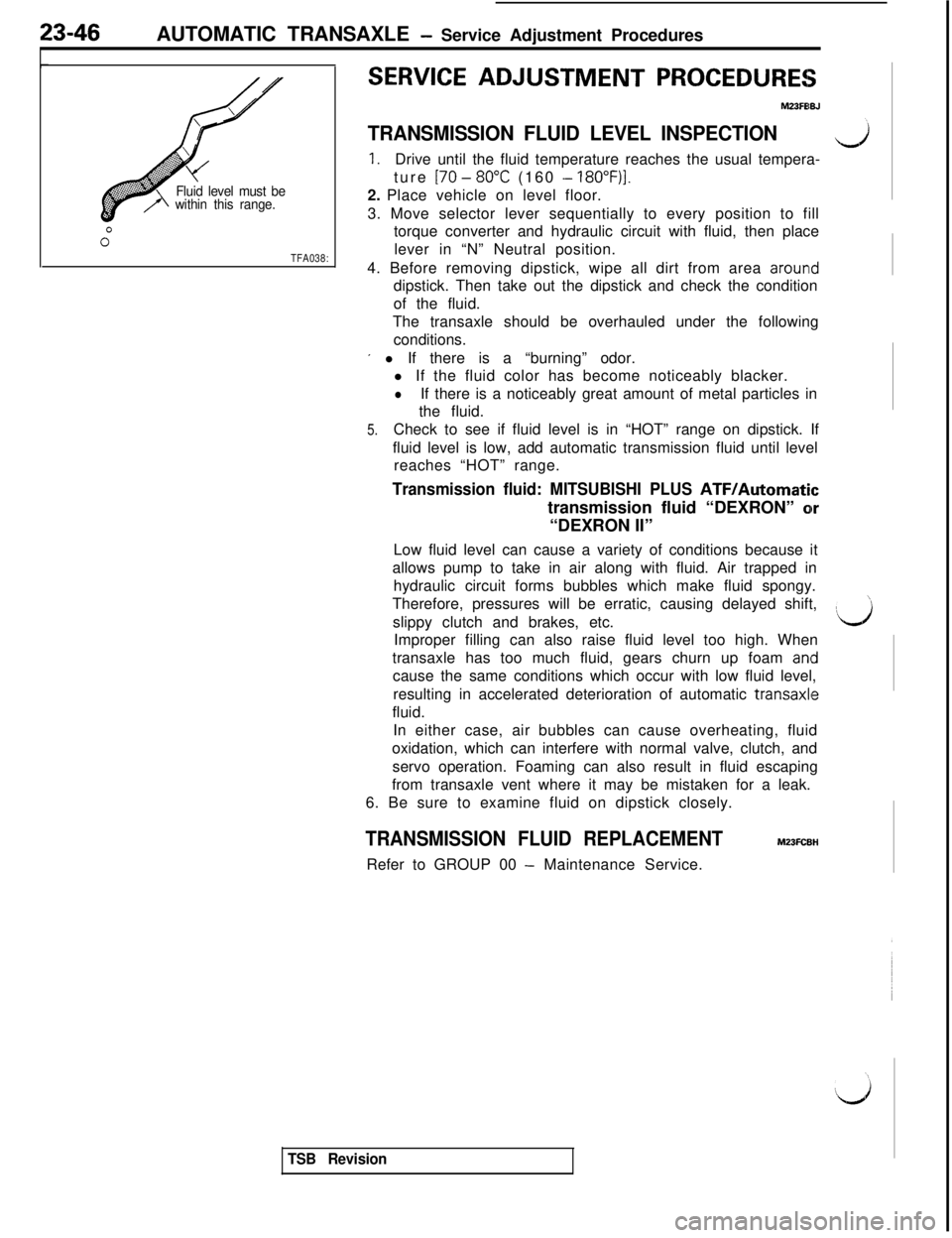
Fluid level must be
within this range.
TFA038:
SERVICE ADJUSTMENT PROCEDURE!5
MZ3FElBJ
TRANSMISSION FLUID LEVEL INSPECTION
1.Drive until the fluid temperature reaches the usual tempera-
ture
170 - 80°C (160 - 18O”F)].2. Place vehicle on level floor.
3. Move selector lever sequentially to every position to fill
torque converter and hydraulic circuit with fluid, then place
lever in “N” Neutral position.
4. Before removing dipstick, wipe all dirt from area
arouniddipstick. Then take out the dipstick and check the condition
of the fluid.
The transaxle should be overhauled under the following
conditions.
’ l If there is a “burning” odor.
l If the fluid color has become noticeably blacker.
lIf there is a noticeably great amount of metal particles in
the fluid.
5.Check to see if fluid level is in “HOT” range on dipstick. If
fluid level is low, add automatic transmission fluid until level
reaches “HOT” range.
Transmission fluid: MITSUBISHI PLUS ATF/Automatictransmission fluid “DEXRON”
abr“DEXRON II”
Low fluid level can cause a variety of conditions because it
allows pump to take in air along with fluid. Air trapped in
hydraulic circuit forms bubbles which make fluid spongy.
Therefore, pressures will be erratic, causing delayed shift,
slippy clutch and brakes, etc.
Improper filling can also raise fluid level too high. When
transaxle has too much fluid, gears churn up foam
anldcause the same conditions which occur with low fluid level,
resulting in accelerated deterioration of automatic
transaxllefluid.
In either case, air bubbles can cause overheating, fluid
oxidation, which can interfere with normal valve, clutch, and
servo operation. Foaming can also result in fluid escaping
from transaxle vent where it may be mistaken for a leak.
6. Be sure to examine fluid on dipstick closely.
TRANSMISSION FLUID REPLACEMENTM23FCBHRefer to GROUP 00
- Maintenance Service.
TSB Revision
Page 499 of 1146
AUTOMATIC TRANSAXLE - Service Adjustment Procedures23-47
MD998916-3-01
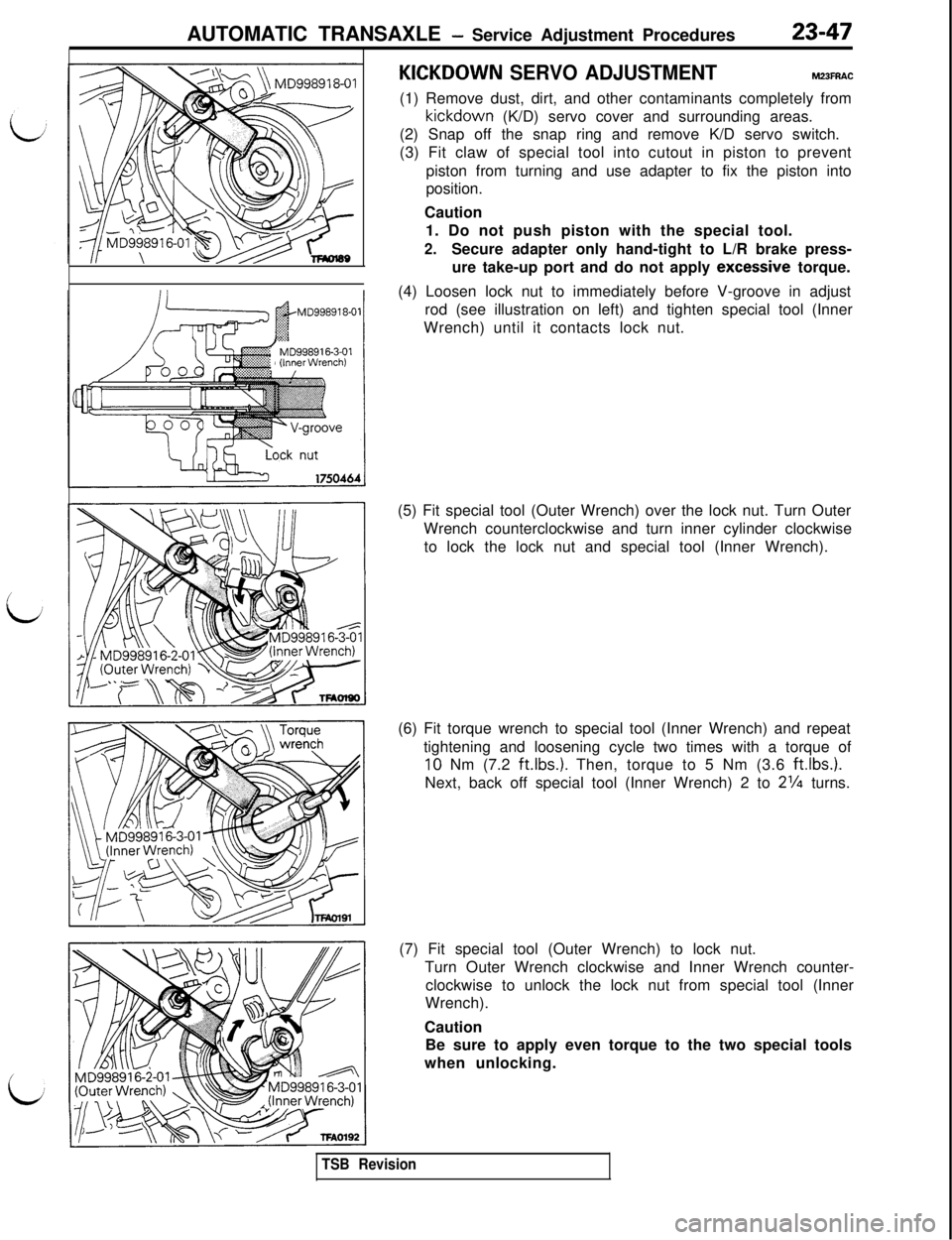
KICKDOWN SERVO ADJUSTMENTM23FRAC(1) Remove dust, dirt, and other contaminants completely fromkickdown (K/D) servo cover and surrounding areas.
(2) Snap off the snap ring and remove K/D servo switch.
(3) Fit claw of special tool into cutout in piston to prevent
piston from turning and use adapter to fix the piston into
position.
Caution
1. Do not push piston with the special tool.
2.Secure adapter only hand-tight to L/R brake press-
ure take-up port and do not apply
excessiwe torque.
(4) Loosen lock nut to immediately before V-groove in adjust
rod (see illustration on left) and tighten special tool (Inner
Wrench) until it contacts lock nut.
(5) Fit special tool (Outer Wrench) over the lock nut. Turn Outer
Wrench counterclockwise and turn inner cylinder clockwise
to lock the lock nut and special tool (Inner Wrench).
(6) Fit torque wrench to special tool (Inner Wrench) and repeat
tightening and loosening cycle two times with a torque of
10 Nm (7.2 ft.lbs.). Then, torque to 5 Nm (3.6 ftlbs.).Next, back off special tool (Inner Wrench) 2 to
2’/4 turns.
(7) Fit special tool (Outer Wrench) to lock nut.
Turn Outer Wrench clockwise and Inner Wrench counter-
clockwise to unlock the lock nut from special tool (Inner
Wrench).
Caution
Be sure to apply even torque to the two special tools
when unlocking.
TSB Revision
Page 500 of 1146
23-48AUTOMATIC TRANSAXLE - Service Adjustment Procedures
Adjusting screw4
or~0\====m00~7/IIIITFAm
c-1
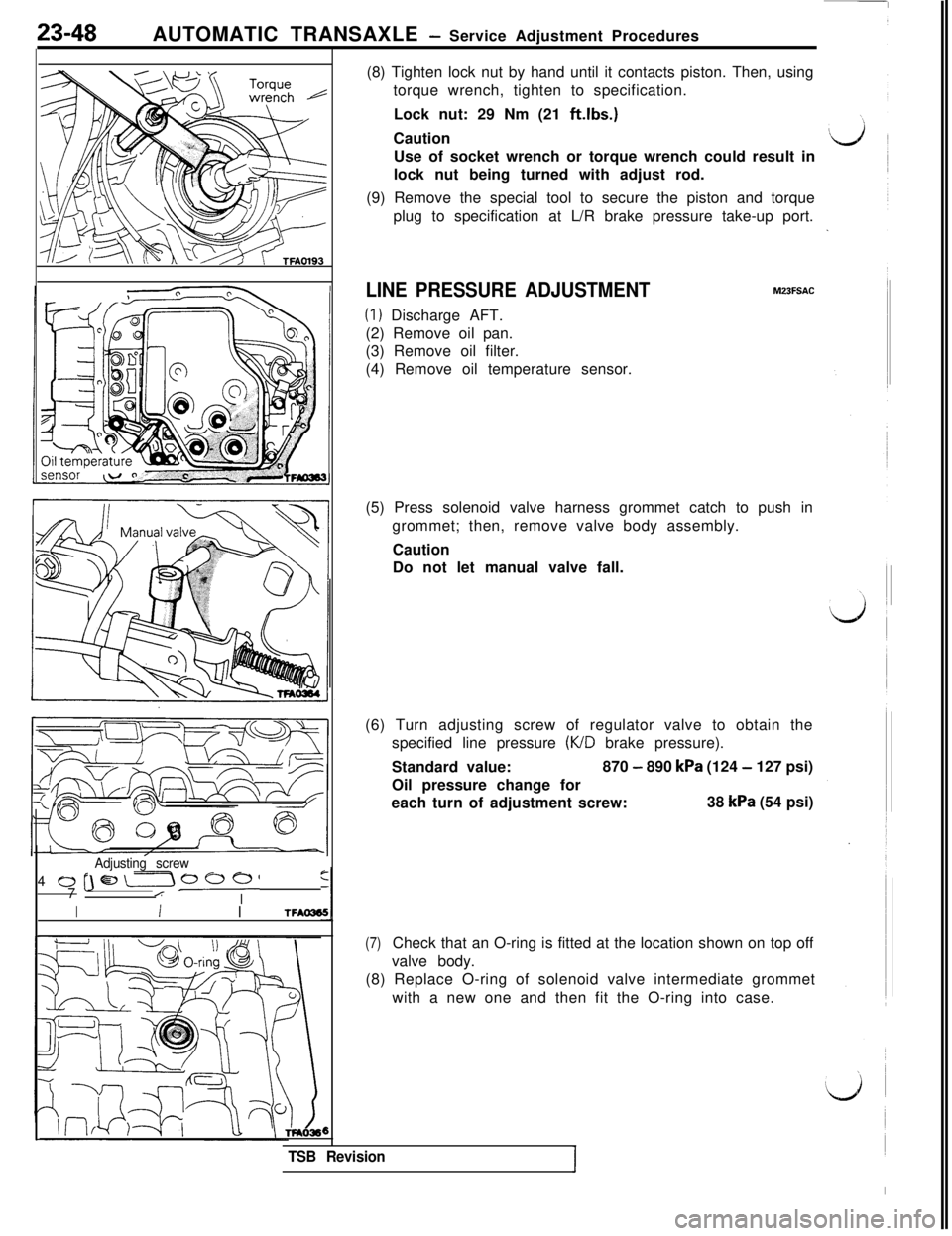
Pi(8) Tighten lock nut by hand until it contacts piston. Then, using
torque wrench, tighten to specification.
Lock nut: 29 Nm (21
ftlbs.)Caution
Use of socket wrench or torque wrench could result in
lock nut being turned with adjust rod.
(9) Remove the special tool to secure the piston and torque
plug to specification at L/R brake pressure take-up port.
LINE PRESSURE ADJUSTMENT
(I) Discharge AFT.
(2) Remove oil pan.
(3) Remove oil filter.
(4) Remove oil temperature sensor.
M23FSAC(5) Press solenoid valve harness grommet catch to push in
grommet; then, remove valve body assembly.
Caution
Do not let manual valve fall.
(6) Turn adjusting screw of regulator valve to obtain the
specified line pressure
(K/D brake pressure).
Standard value:870
- 890 kPa (124 - 127 psi)
Oil pressure change for
each turn of adjustment screw:38
kPa (54 psi)
(7)Check that an O-ring is fitted at the location shown on top off
valve body.
(8) Replace O-ring of solenoid valve intermediate grommet
with a new one and then fit the O-ring into case.6
TSB RevisionI
Page 504 of 1146
23-52
AUTOMATIC TRANSAXLE - Service Adjustment Procedures
Manual
control leverINHIBITOR SWITCH AND CONTROL CABLE
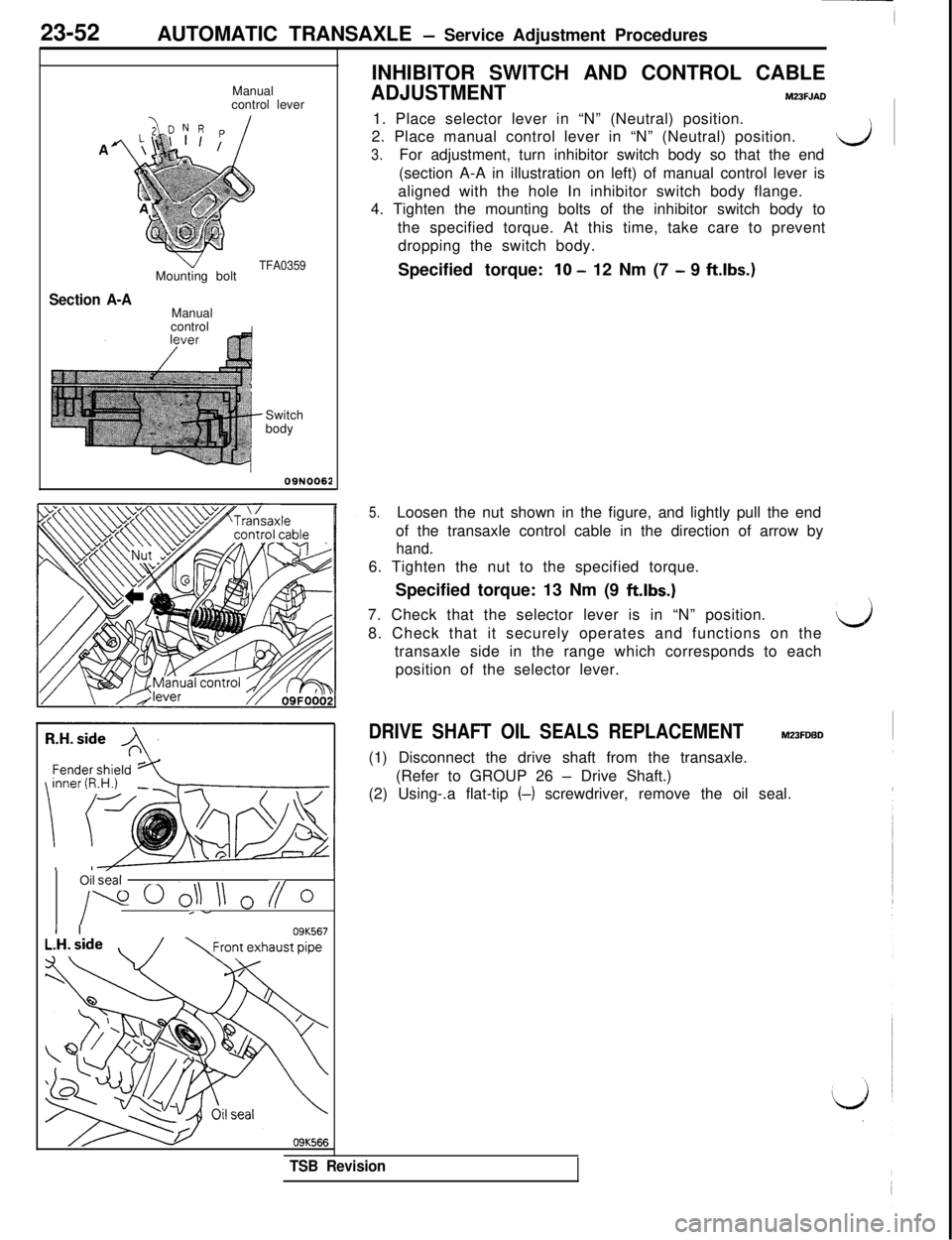
ADJUSTMENTM23FJADI1. Place selector lever in “N” (Neutral) position.
2. Place manual control lever in “N” (Neutral) position.
d3.For adjustment, turn inhibitor switch body so that the end
(section A-A in illustration on left) of manual control lever is
aligned with the hole In inhibitor switch body flange.
4. Tighten the mounting bolts of the inhibitor switch body to
the specified torque. At this time, take care to prevent
dropping the switch body.
TFA0359Mounting bolt
Section A-AManual
control
ISwitch
body
09N0062Oil
skal
1
v0 o\l II 0 // 0*-
I I09K567
09K566Specified torque:
10 - 12 Nm (7 - 9 ftlbs.)
5.Loosen the nut shown in the figure, and lightly pull the end
of the transaxle control cable in the direction of arrow by
hand.6. Tighten the nut to the specified torque.
Specified torque: 13 Nm (9
ftlbs.)7. Check that the selector lever is in “N” position.
8. Check that it securely operates and functions on the
transaxle side in the range which corresponds to each
position of the selector lever.
d
DRIVE SHAFT OIL SEALS REPLACEMENTM23FLN3D(1) Disconnect the drive shaft from the transaxle.
(Refer to GROUP 26
- Drive Shaft.)
(2) Using-.a flat-tip (-) screwdriver, remove the oil seal.
TSB Revision
Page 516 of 1146
23-64
AUTOMATIC, TRANSAXLE - Transaxle Assembly
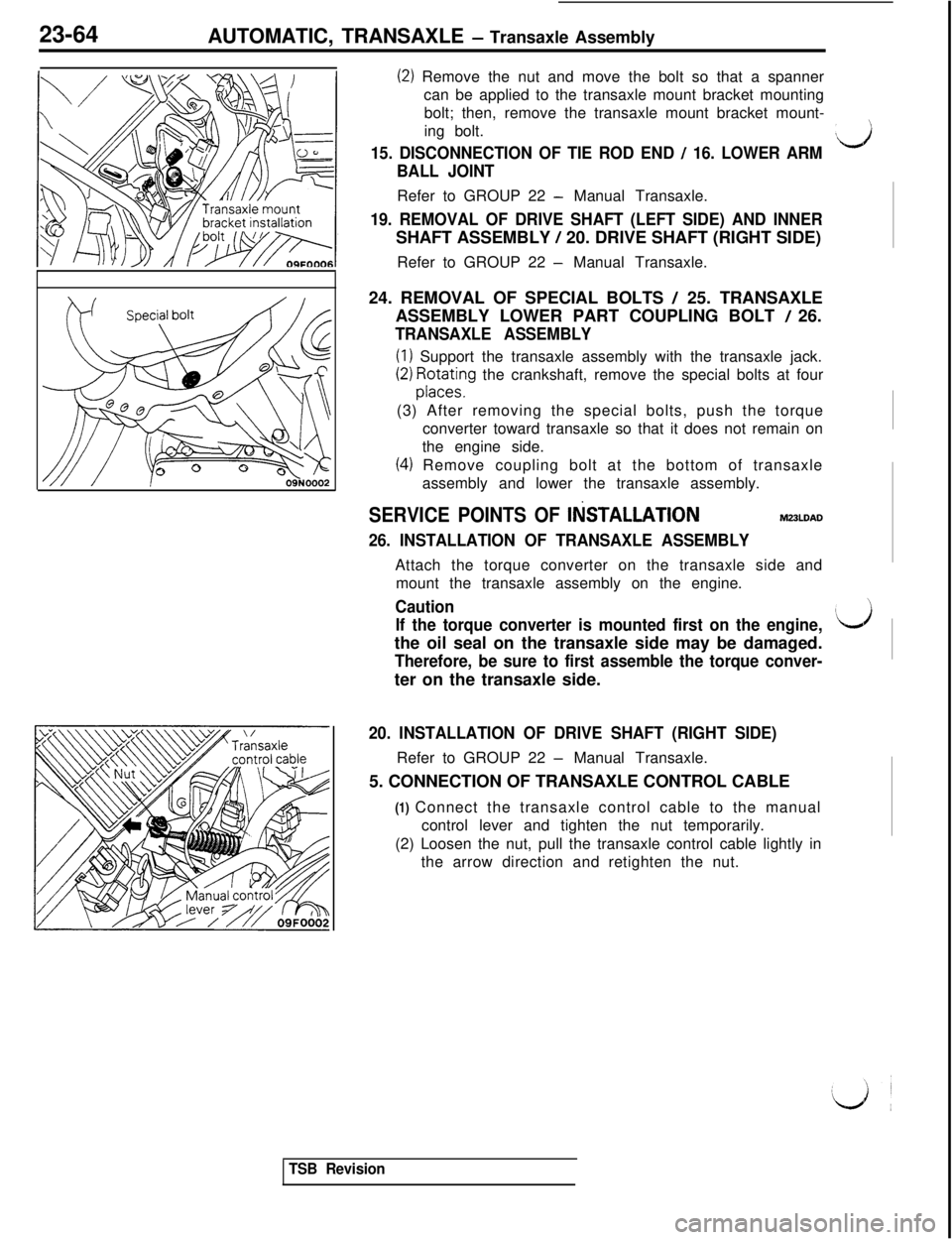
(2) Remove the nut and move the bolt so that a spanner
can be applied to the transaxle mount bracket mounting
bolt; then, remove the transaxle mount bracket mount-
ing bolt.
15. DISCONNECTION OF TIE ROD END / 16. LOWER ARM$3
BALL JOINTRefer to GROUP 22
- Manual Transaxle.
19. REMOVAL OF DRIVE SHAFT (LEFT SIDE) AND INNERSHAFT ASSEMBLY
/ 20. DRIVE SHAFT (RIGHT SIDE)
Refer to GROUP 22
- Manual Transaxle.
24. REMOVAL OF SPECIAL BOLTS
/ 25. TRANSAXLE
ASSEMBLY LOWER PART COUPLING BOLT
/ 26.
TRANSAXLE ASSEMBLY
(1) Support the transaxle assembly with the transaxle jack.
(2) ;;F;ng the crankshaft, remove the special bolts at four
(3) After removing the special bolts, push the torque
converter toward transaxle so that it does not remain on
the engine side.
(4) Remove coupling bolt at the bottom of transaxle
assembly and lower the transaxle assembly.
SERVICE POINTS OF IliSTALLATlONM23LDAD
26. INSTALLATION OF TRANSAXLE ASSEMBLYAttach the torque converter on the transaxle side and
mount the transaxle assembly on the engine.
Caution
If the torque converter is mounted first on the engine,
Idthe oil seal on the transaxle side may be damaged.
Therefore, be sure to first assemble the torque conver-ter on the transaxle side.
20. INSTALLATION OF DRIVE SHAFT (RIGHT SIDE)Refer to GROUP 22
- Manual Transaxle.
5. CONNECTION OF TRANSAXLE CONTROL CABLE
(1) Connect the transaxle control cable to the manual
control lever and tighten the nut temporarily.
(2) Loosen the nut, pull the transaxle control cable lightly in
the arrow direction and retighten the nut.
TSB Revision
Page 517 of 1146
i
LJ
AUTOMATIC TRANSAXLE - Transaxle Assembly
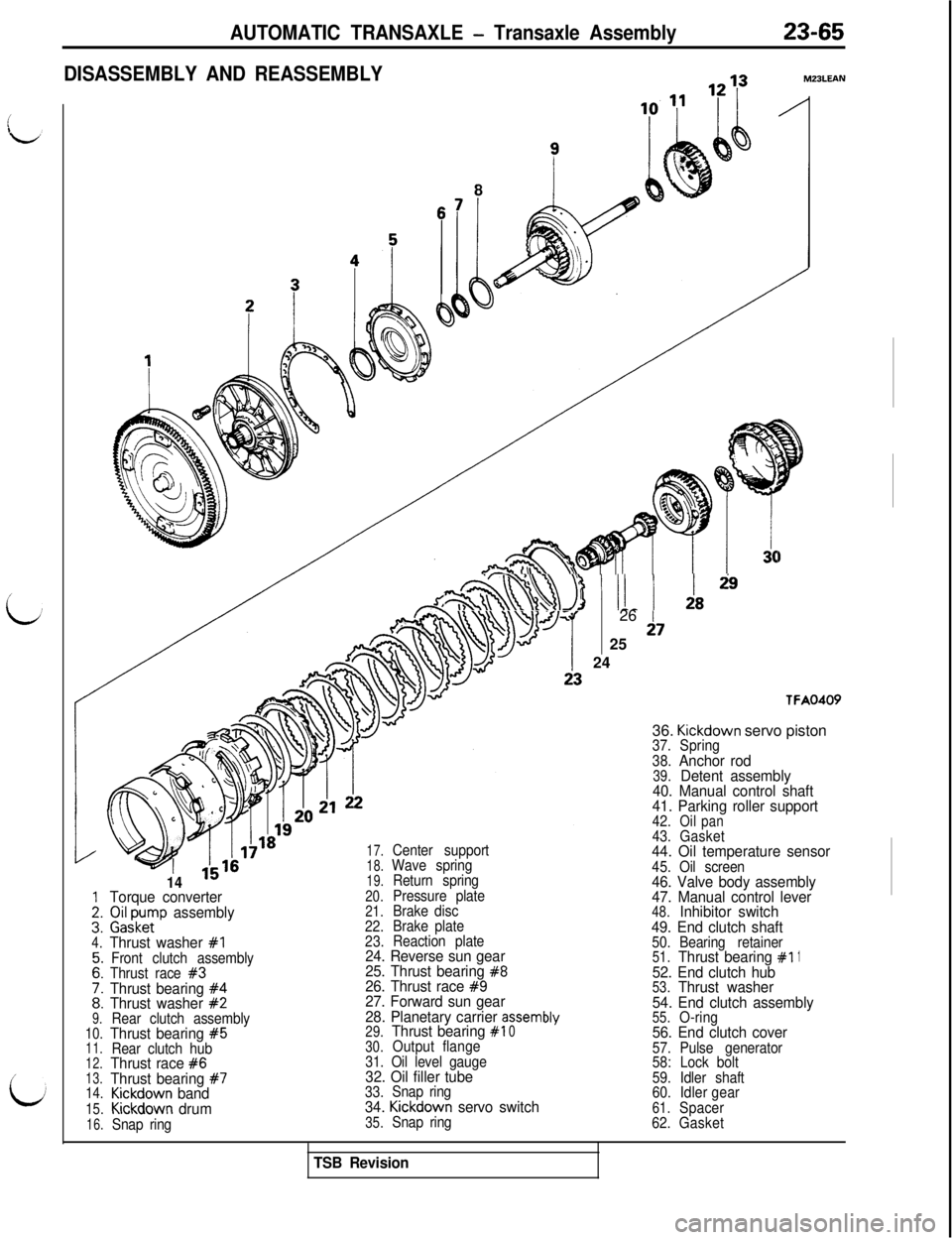
DISASSEMBLY AND REASSEMBLY23-65
M23LEAN
11
Z:4.
::
;:9.10.11.
12.
13.
14.
15.
16.8
%&,kd!~~ / I!- 1A8 ii9
-114Torque converter~.I~I~~~ assembly
Thrust washer
#IFront clutch assembly
Thrust race #3
Thrust bearing #4Thrust washer #2Rear clutch assemblyThrust bearing #5Rear clutch hubThrust race #6Thrust bearing #7Kickdown bandKickdown drumSnap ring
17.Center support18.Wave spring19.Return spring
20.Pressure plate21.Brake disc
22.Brake plate
23.Reaction plate
24. Reverse sun gear
25. Thrust bearing #8
26. Thrust race #927. Forward sun gear
28. Planetary carrier asseml
29.Thrust bearing #I030.Output flange
31. Oil level gauge
32. Oil filler tube33.Snap ring34. Kickdown servo switch35.Snap ring26
25
24
TFA040936.
Kickdown servo piston37.Spring
38.Anchor rod39.Detent assembly
40. Manual control shaft
41. Parking roller support
42.Oilpan43.Gasket44. Oil temperature sensor45.Oil screen46. Valve body assembly
47. Manual control lever
48.Inhibitor switch
49. End clutch shaft
50.Bearing retainer51.Thrust bearing #I1
52. End clutch hub53.Thrust washer
54. End clutch assembly
55.O-ring56. End clutch cover57.Pulse generator
58:Lock bolt
59.Idler shaft
60.Idlergear
61.Spacer
62.Gasket
TSB Revision
Page 519 of 1146
AUTOMATIC TRANSAXLE - Transaxle Assembly
23-67
DISASSEMBLY
Caution1. The automatic transaxle consists of high-precision
parts and utmost care must be exercised during
disassembly and reassembly to prevent damage to the
parts.
2.Place a rubber mat on the workbench and keep it cleanat all times.
3.Do not use cotton work gloves or waste cloth for the
disassembly job. Use nylon cloth or paper towel if
necessary.4. Clean all disassembled parts. Commercially available
detergent may be used to clean the
metalllic parts;
however, be sure to dry them completely with air.
5. Clean the clutch disc, plastic thrust plates, and rubberparts with ATF (automatic transmission fluid) to pre-
vent adhesion of dust and dirt.
6.If the transaxle is damaged, the cooler system should
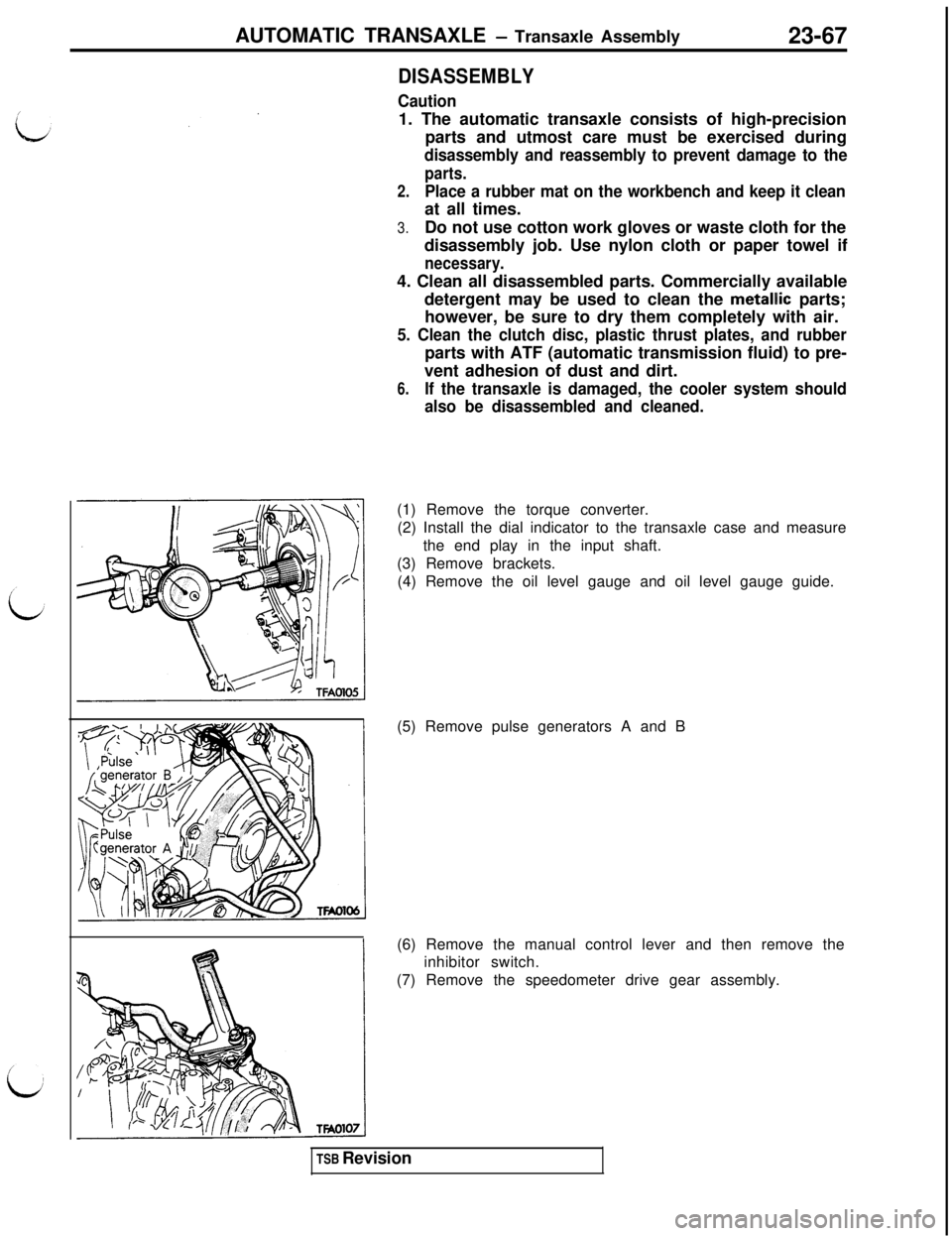
also be disassembled and cleaned.(1) Remove the torque converter.
(2) Install the dial indicator to the transaxle case and measure
the end play in the input shaft.
(3) Remove brackets.
(4) Remove the oil level gauge and oil level gauge guide.
(5) Remove pulse generators A and B
(6) Remove the manual control lever and then remove the
inhibitor switch.
(7) Remove the speedometer drive gear assembly.
TSB Revision
Page 543 of 1146
AUTOMATIC TRANSAXLE - Transaxle Assembly23-91
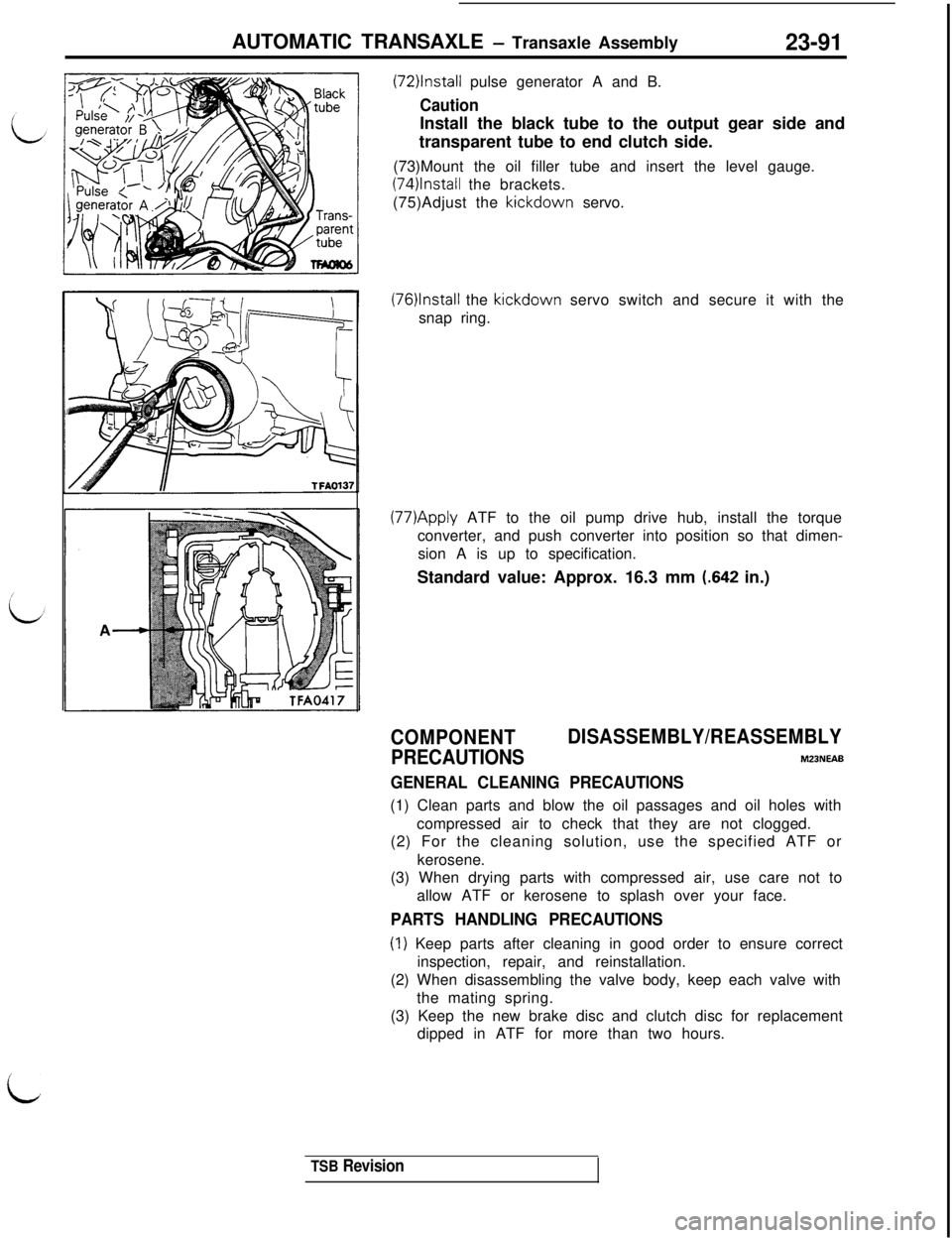
(72)lnstall pulse generator A and B.
CautionInstall the black tube to the output gear side and
transparent tube to end clutch side.
(73)Mount the oil filler tube and insert the level gauge.
(74)lnstall the brackets.
(75)Adjust the kickdown servo.
(76)lnstall the kickdown servo switch and secure it with the
snap ring.(77)Apply ATF to the oil pump drive hub, install the torque
converter, and push converter into position so that dimen-
sion A is up to specification.
Standard value: Approx. 16.3 mm
(.642 in.)
COMPONENTDISASSEMBLY/REASSEMBLY
PRECAUTIONSM23NEAB
GENERAL CLEANING PRECAUTIONS(1) Clean parts and blow the oil passages and oil holes with
compressed air to check that they are not clogged.
(2) For the cleaning solution, use the specified ATF or
kerosene.
(3) When drying parts with compressed air, use care not to
allow ATF or kerosene to splash over your face.
PARTS HANDLING PRECAUTIONS
(1) Keep parts after cleaning in good order to ensure correct
inspection, repair, and reinstallation.
(2) When disassembling the valve body, keep each valve with
the mating spring.
(3) Keep the new brake disc and clutch disc for replacement
dipped in ATF for more than two hours.
i
TSB Revision
Page 546 of 1146
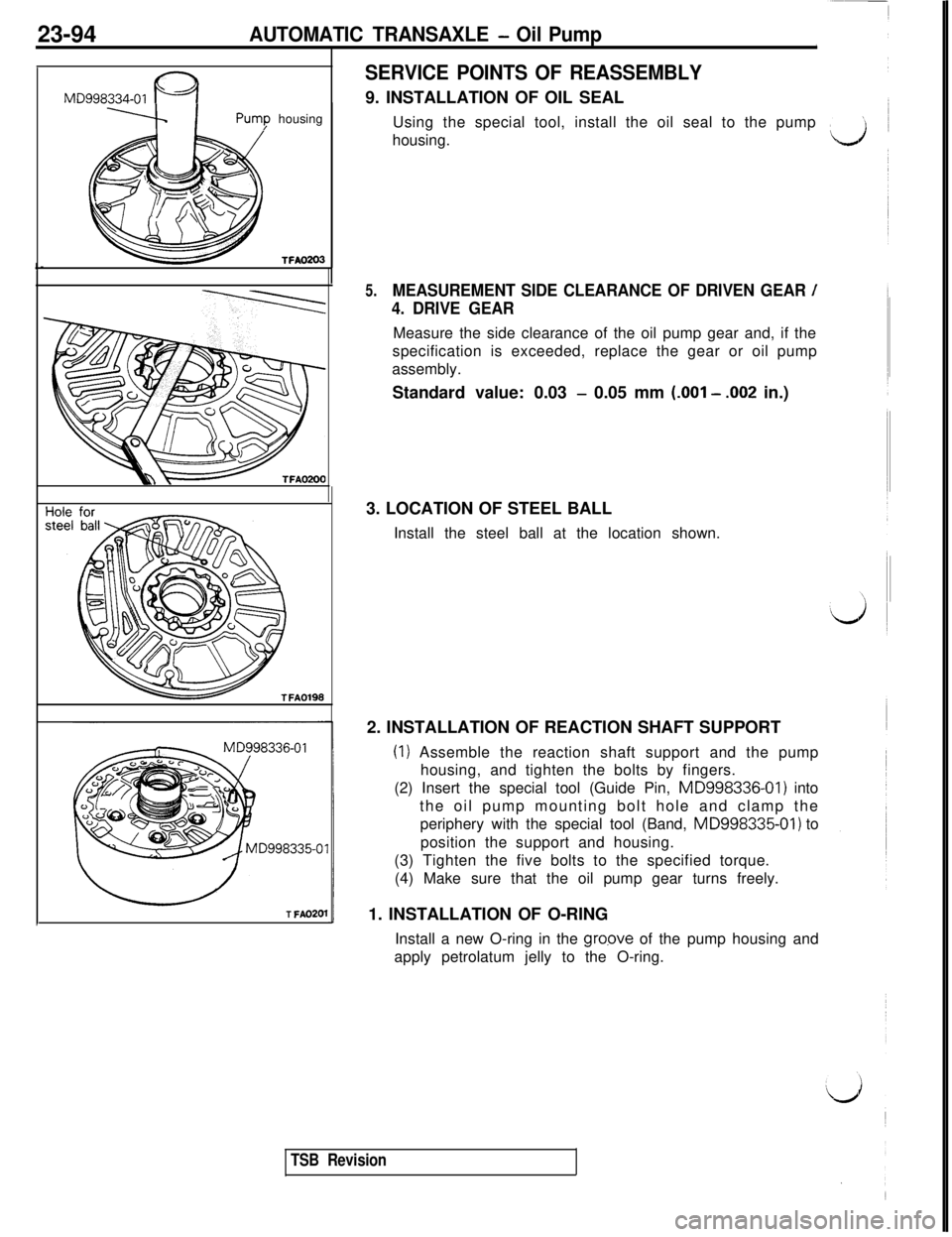
23-94AUTOMATIC TRANSAXLE - Oil PumpI-Pump housingMD998334-01
IQ
TFAOX)3
T FAO201
SERVICE POINTS OF REASSEMBLY9. INSTALLATION OF OIL SEAL
Using the special tool, install the oil seal to the pump
housing.
5.MEASUREMENT SIDE CLEARANCE OF DRIVEN GEAR /
4. DRIVE GEARMeasure the side clearance of the oil pump gear and, if the
specification is exceeded, replace the gear or oil pump
assembly.
Standard value: 0.03
- 0.05 mm (-001 - .002 in.)
3. LOCATION OF STEEL BALL
Install the steel ball at the location shown.
2. INSTALLATION OF REACTION SHAFT SUPPORT
(I) Assemble the reaction shaft support and the pump
housing, and tighten the bolts by fingers.
(2) Insert the special tool (Guide Pin, MD998336-01) into
the oil pump mounting bolt hole and clamp the
periphery with the special tool (Band, MD998335-01) to
position the support and housing.
(3) Tighten the five bolts to the specified torque.
(4) Make sure that the oil pump gear turns freely.
1. INSTALLATION OF O-RING
Install a new O-ring in the
gro,ove of the pump housing and
apply petrolatum jelly to the O-ring.
TSB Revision
Page 561 of 1146
 F
/@/44
<@’
e
40
VA0518
24. Front end cover38.
25.
Pressure controlspring39.2-3/4-3 shift")
AUTOMATIC TRANSAXLE - Valve Bodv23409
26
2?I A
46Viewed from B
7+
.7L%6
if tp+?E ”LF$\
w
aG
r
G
41
45Br) F
/@/44
<@’
e
40
VA0518
24. Front end cover38.
25.
Pressure controlspring39.2-3/4-3 shift spring2-314-3 shift valve
26. Pressure control valve
27. Torque converter control spring
28. Torque converter control valve
29. Adjusting screw
40. Rear end cover
41. Shift control plug B
l * 42. Stopper plate43. Shift control valve
30.Regulator spring44.
31.
Regulator valve45.1-2 shift spring1-2 shift valve
46. Upper valve body
32. Shift control spring
l + 33. Stopper plate34. Shift control plug35. Rear clutch exhaust valve A
36. Rear clutch exhaust valve B
37. Rear clutch exhaust spring
TSB Revision