torque MITSUBISHI 3000GT 1991 Workshop Manual
[x] Cancel search | Manufacturer: MITSUBISHI, Model Year: 1991, Model line: 3000GT, Model: MITSUBISHI 3000GT 1991Pages: 1146, PDF Size: 76.68 MB
Page 449 of 1146
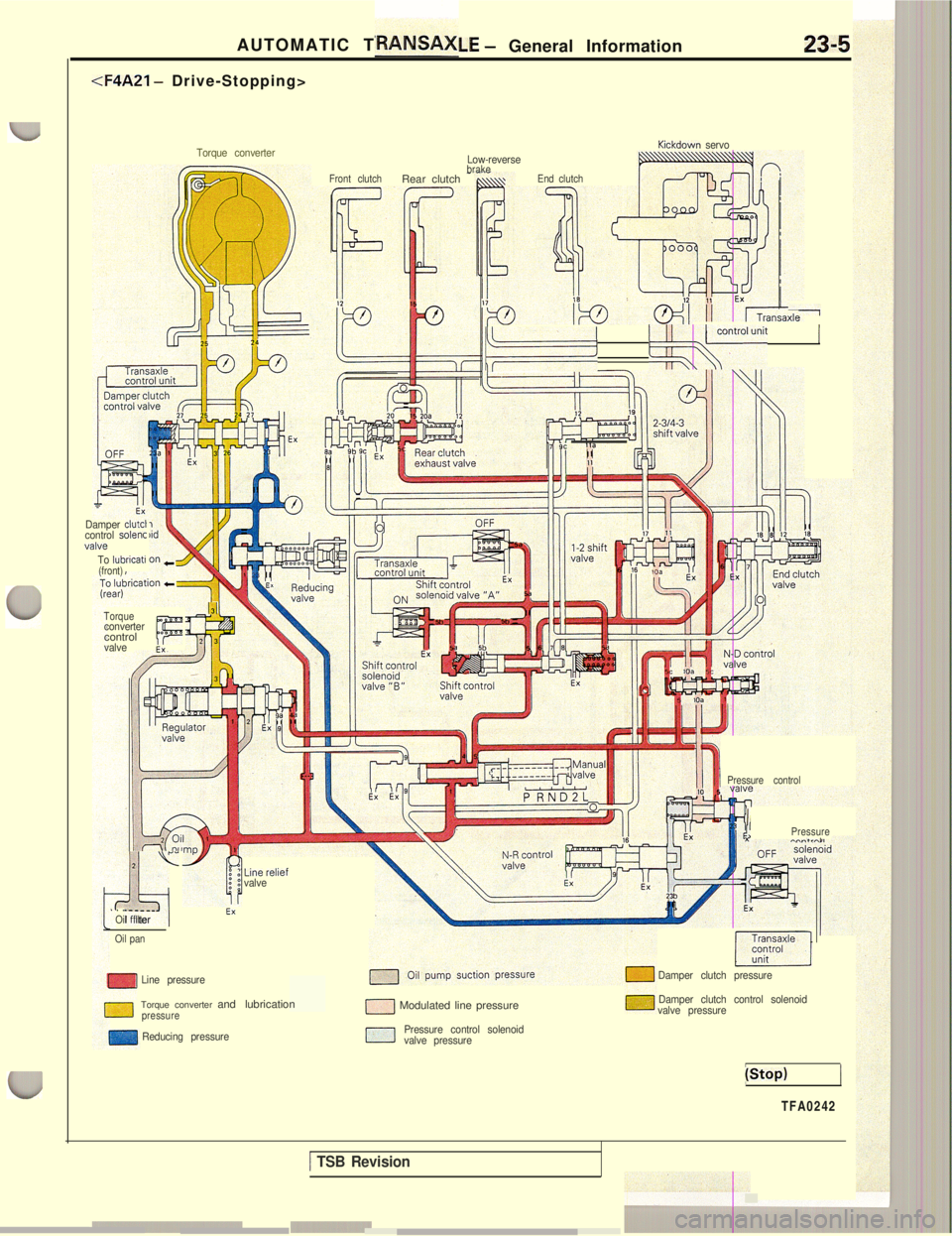
AUTOMATIC TLE - General Information23-5
cF4A21 - Drive-Stopping>
Torque converter
Low-reverse
brake
Kickdown servo
Front clutchRear clutch -End clutch
jy ~&~ntroiun~t j
Damper clutchcontrol solencvalve
To lubrmtl(front)
Torque
I31
converterFcontrol ”valveEX
Pressure control
IPressurex^,?“t*,.l
* Y
4- - - - - _ _ _Oil filter
Lme reliefvalve
EX
Oil pan
Line pressure
0Torque converter and lubricationpressure
Reducing pressure
0 Modulated line pressure
IPressure control solenoid
valve pressure
[-
Damper clutch pressure
Damper clutch control solenoid
valve pressure
1 Drive(Stop) /TFA0242
1 TSB Revision
Page 451 of 1146
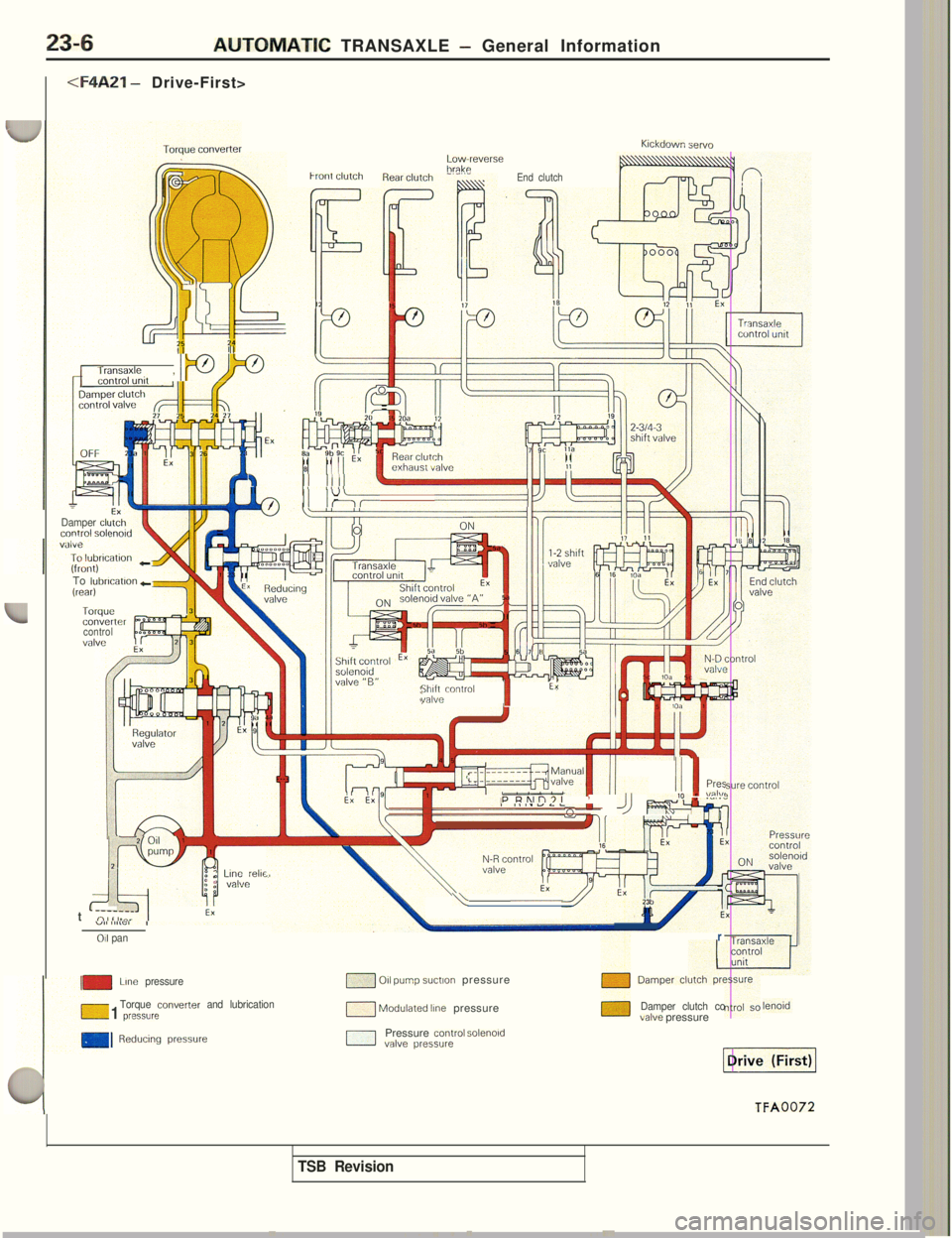
23-6AUTOMATIC TRANSAXLE - General Information
Kickdow:: servoILOWreverseIbraketront LlutLh
End clutch
IIII
rransaxk!, j p Ja
Damper Cllcmltrol SOlf
PII Iill
/I I%------=*To
lubrlcdtlon +(Wir)
TorqueCO”“Wtei
control
valv!?
ihlfr rontrolVllveI
, ,k.x
11 IPCP Rhln71, JI & \JPl
PUW2
4; ;
LlrlC r&t.
1
: -VBIL’B
--_____E*n I6 ,S^_tI
Y$__.--
@II pan
[LIW pressure
Torque
cnnvertar and lubrication1 pressurs
/ 011 pump SUC!IO!l pressure
n Mod&ted 1x1~ pressurerDamper clutch coL&e pressure]
RedllCl!?g preswreElPressure contrcJ snlerloidwlve presslirs
psiizq
TFA0072
TSB Revision
15 II I b/ 0 ib1 ( fPIV
Page 461 of 1146
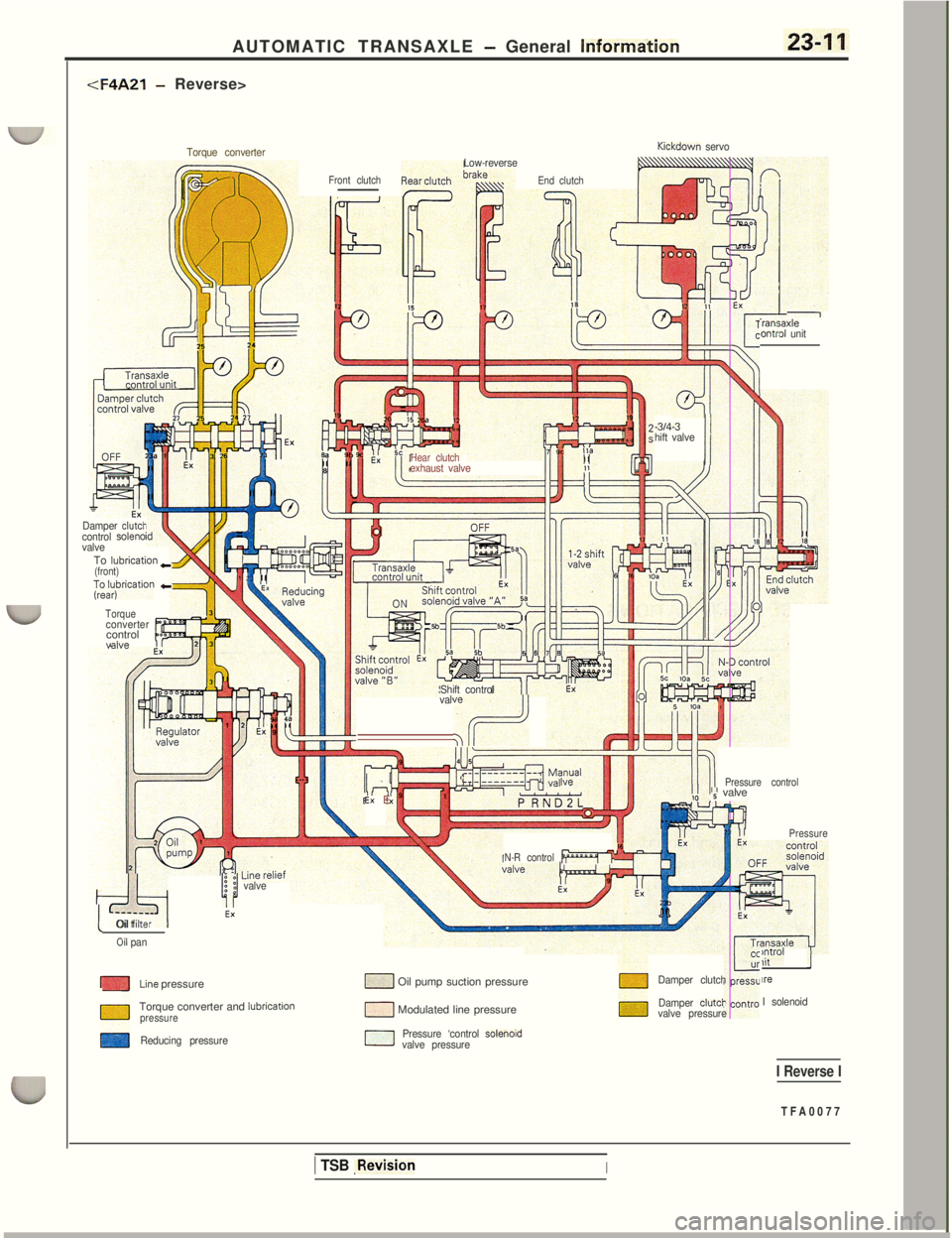
AUTOMATIC TRANSAXLE - General lnformatisn
Low-reverse
Kickdown servo
Torque converter
Front clutch
End clutch
‘ransaxleontrol unit
-3/4-3hift valve
I!Hear clutchexhaust valve
Damper
clutctcontrol solenovalveTo lubrlcatlon c(front):p,$matlon c
Torqueconvertercontrol 0svalveF
Shift control
valve
,:+
I,Ex E
IvePressure control‘2 valve
Pressure
N-R control
-7
i+----___Oil filter
H .j
\I:ovalve
EX
011 pan;tro’ j
Ire0 Oil pump suction pressureDamper clutchLine pressure
0 Modulated line pressureDamper clutchvalve pressureI solenoidTorque converter and lubrlcatlon
pressure
0Pressure ‘control solenoidvalve pressure Reducing pressure
I Reverse ITFA0077
1 TSB ,RevisionI
Page 464 of 1146
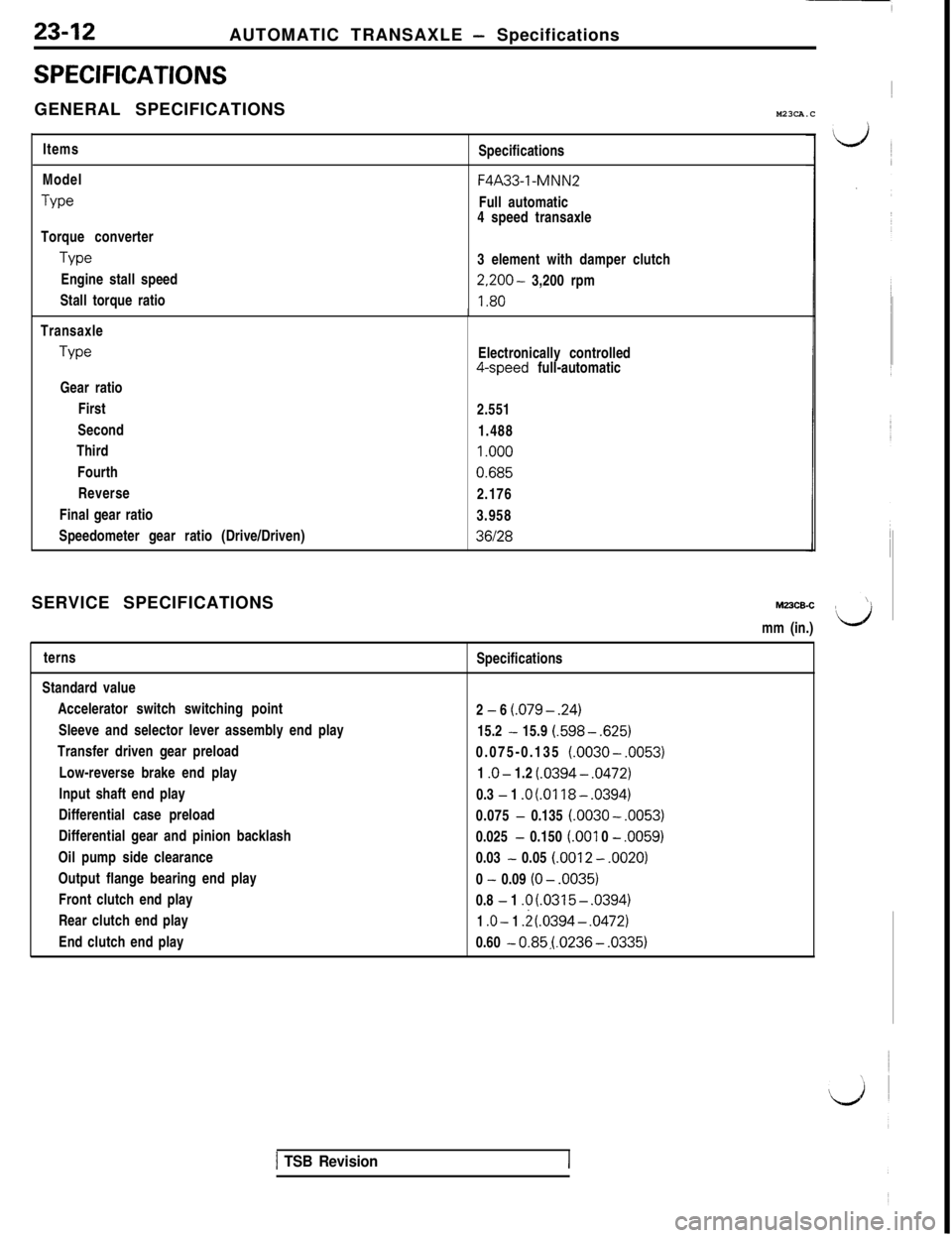
23-12AUTOMATIC TRANSAXLE - Specifications
SPECIFICATIONSGENERAL SPECIFICATIONS~
M23CA.C
Items
Model
TypeTorque converter
WeEngine stall speed
Stall torque ratioSpecifications
F4A33-I-MNN2Full automatic
4 speed transaxle
3 element with damper clutch
2,200- 3,200 rpm
1.80Transaxle
TypeGear ratio
First
Second
Third
Fourth
Reverse
Final gear ratio
Speedometer gear ratio (Drive/Driven)Electronically controlled4-speed full-automatic
2.551
1.488
1.000
0.6852.176
3.95836128
SERVICE SPECIFICATIONS
M23CB-Cmm (in.)
‘dterns
Standard value
Accelerator switch switching point
Sleeve and selector lever assembly end play
Transfer driven gear preload
Low-reverse brake end playSpecifications
2
- 6 (.079 - .24)
15.2
- 15.9 (598 - .625)0.075-0.135
(.0030- .0053)1
.O - 1.2 (.0394 - .0472)Input shaft end play
0.3
- 1 .O t.0118 - .0394)Differential case preload
0.075
- 0.135 (0030 - .0053)Differential gear and pinion backlash
0.025
- 0.150 LOOI 0 - .0059)Oil pump side clearance
0.03
- 0.05 (.0012 - .0020)Output flange bearing end play
0
- 0.09 (0 - .0035)Front clutch end play
0.8
- 1 .O (0315 - .0394)Rear clutch end play
1 .O - 1 .j (.0394- .0472)End clutch end play
0.60
- 0.851.0236 - .0335)
1 TSB Revision
Page 465 of 1146
AUTOMATIC TRANSAXLE - Specifications23-13
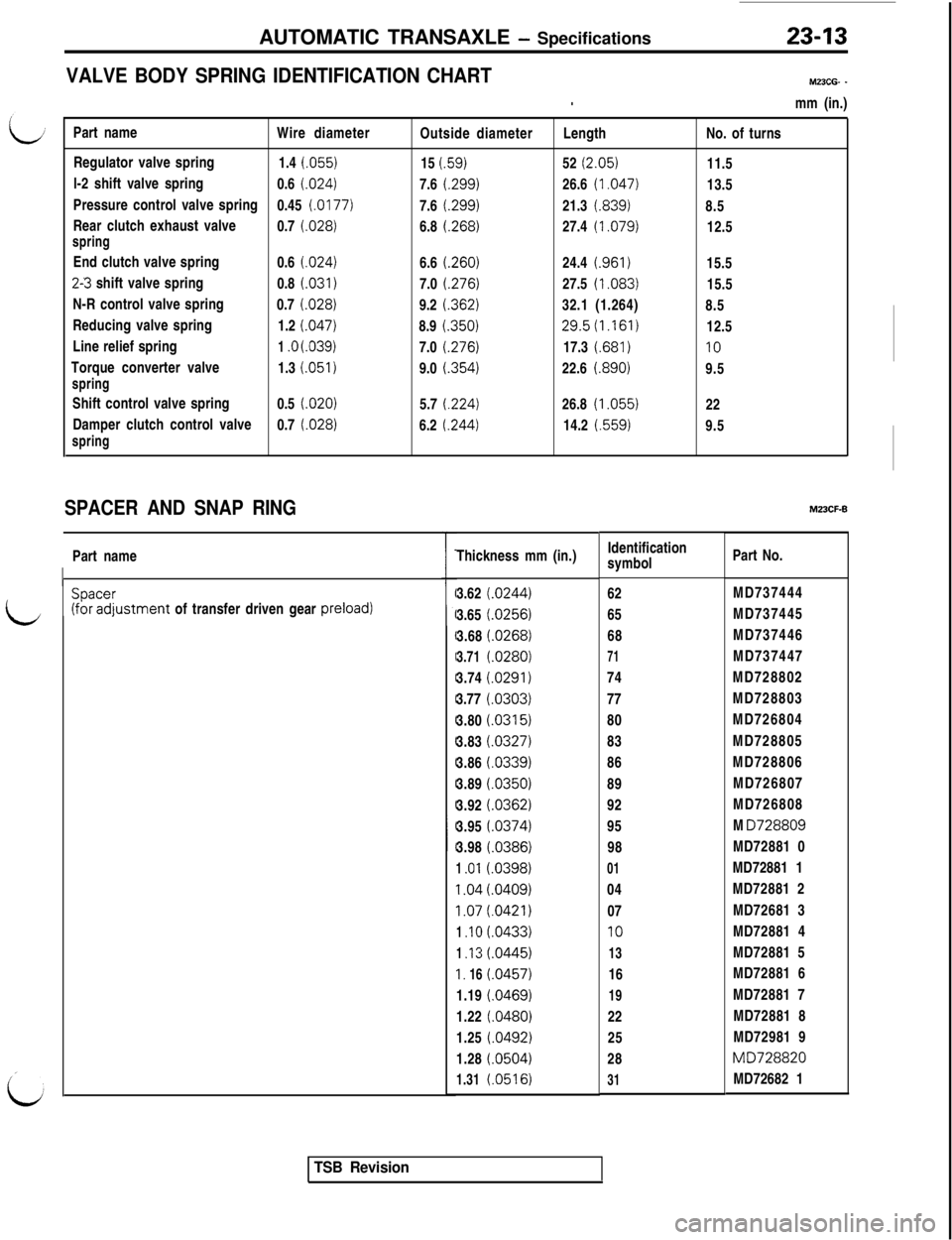
VALVE BODY SPRING IDENTIFICATION CHARTMZJCG- -
.mm (in.)
Part name
Wire diameter
Outside diameterLengthNo. of turns
Regulator valve spring
1.4 (.055)
15
(59)52 (2.05)
11.5
l-2 shift valve spring
0.6
(024)7.6 (.299)26.6 (1.047)13.5
Pressure control valve spring
0.45
(.0177)7.6 f.299)21.3 (.839)8.5
Rear clutch exhaust valve
0.7
(028)6.8 (268)27.4 (1.079)12.5springEnd clutch valve spring
0.6
(024)6.6 (260)24.4 (.961)15.5
23 shift valve spring
0.8 (031)7.0 (.276)27.5 (1.083)15.5
N-R control valve spring
0.7 (.028)
9.2 (.362)32.1 (1.264)
8.5
Reducing valve spring
1.2 (.047)
8.9
(350)29.5(1.161)12.5
Line relief spring
1 .o (.039)
7.0 (276)17.3 (.681)10Torque converter valve
1.3 (.051)
9.0 (.354)22.6
f.890)9.5springShift control valve spring
0.5 (.020)
5.7 (.224)26.8
(1.055)22
Damper clutch control valve
0.7 (.028)
6.2 (.244)14.2 t.559)
9.5
spring
SPACER AND SNAP RINGPart name
id??$%justment of transfer driven gear preload)Thickness mm (in.)Identification
symbol
3.62(.0244)62
3.65
(.0256)65
3.68
(.0268)68
3.71(0280)713.74
(.0291)74
3.77
(.0303)77
3.80
(.0315)80
3.83
(.0327)83
3.86
l.0339)86
3.89
(0350)89
3.92
(0362)92
3.95
(.0374)95
3.98
(0386)98
1 .Ol(.0398)01
1.04(.0409)041.07
(.0421)07
1 .I0(.0433)10
1 .I3(.0445)13
I. 16(.0457)16
1.19
f.0469)191.22
(.0480)22
1.25
(.0492)25
1.28
(.0504)28
1.31(.0516)31Part No.
MD737444
MD737445
MD737446
MD737447
MD728802
MD728803
MD726804
MD728805
MD728806
MD726807
MD726808
M
D726809MD72881 0
MD72881 1
MD72881 2
MD72681 3
MD72881 4
MD72881 5
MD72881 6
MD72881 7
MD72881 8
MD72981 9
MD729820MD72682 1
TSB Revision
Page 474 of 1146
![MITSUBISHI 3000GT 1991 Workshop Manual 23-22AUTOMATIC TRANSAXLE - Troubleshooting
0”
TM362
DIAGNOSIS AND TEST
FLUID LEVEL AND CONDITION
1.Drive until the fluid temperature reaches the usual tempera-
ture
[70 - 80°C (160 - 18O”F)].2.](/img/19/57085/w960_57085-473.png "MITSUBISHI 3000GT 1991 Workshop Manual 23-22AUTOMATIC TRANSAXLE - Troubleshooting
0”
TM362
DIAGNOSIS AND TEST
FLUID LEVEL AND CONDITION
1.Drive until the fluid temperature reaches the usual tempera-
ture
[70 - 80°C (160 - 18O”F)].2.")
23-22AUTOMATIC TRANSAXLE - Troubleshooting
0”
TM362
DIAGNOSIS AND TEST
FLUID LEVEL AND CONDITION
1.Drive until the fluid temperature reaches the usual tempera-
ture
[70 - 80°C (160 - 18O”F)].2. Place vehicle on level floor.
3. Move selector lever sequentially to every position to fill
torque converter and hydraulic circuit with fluid, then place
lever in “N” Neutral position. This operation is necessary to
be sure that fluid level check is accurate.
4. Before removing dipstick, wipe all dirt from area around
dipstick. Then take out the dipstick and check the condition
of the fluid.
The transaxle should be overhauled under the following
conditions.
l If there is a “burning” odor.
l If the fluid color has become noticeably blacker.
lIf there is a noticeably great amount of metal particles in
the fluid.
5.Check to see if fluid level is in “HOT” range on dipstick. If
fluid level is low, add automatic transaxle fluid until level
reaches “HOT” range.
Low fluid level can cause a variety of conditions because it
allows pump to take in air along with fluid. Air trapped in
hydraulic circuit forms bubbles which make fluid spongy.
Therefore, pressures will be erratic.
Improper filling can also raise fluid level too high. When
transaxle has too much fluid, gears churn up foam and
cause same conditions which occur with low fluid level,
resulting in accelerated deterioration of automatic transaxle
fluid.
dIn either case, air bubbles can cause overheating, fluid
oxidation, which can interfere with normal valve, clutch, and
servo operation. Foaming can also result in fluid escaping
from transaxle vent where it may be mistaken for a leak.
6. Be sure to examine fluid on dipstick closely.
,CONTROL CABLEWhether control cable is properly adjusted can be confirmed by
checking whether inhibitor switch is performing well.
1. Apply parking brakes and service brakes securely.
2. Place selector lever to “R” range.
3. Set ignition key to “ST” position.
4. Slowly move the selector lever upward until it clicks as it
fits in notch of “P” range. If starter motor operates when
lever makes a click, “P” position is correct.
5.Then slowly move selector lever to “N” range by the same
procedure as in foregoing paragraph. If starter motor
operates when selector lever fits in
“N”, “N” position is
correct.
6. Also check to be sure the vehicle doesn’t begin to move
and the lever doesn’t stop between P-R-N-D.
7. The control cable is properly adjusted if, as described
above, the starter motor starts at both the “P” range and
the “N” range.
TSB Revision
Page 478 of 1146
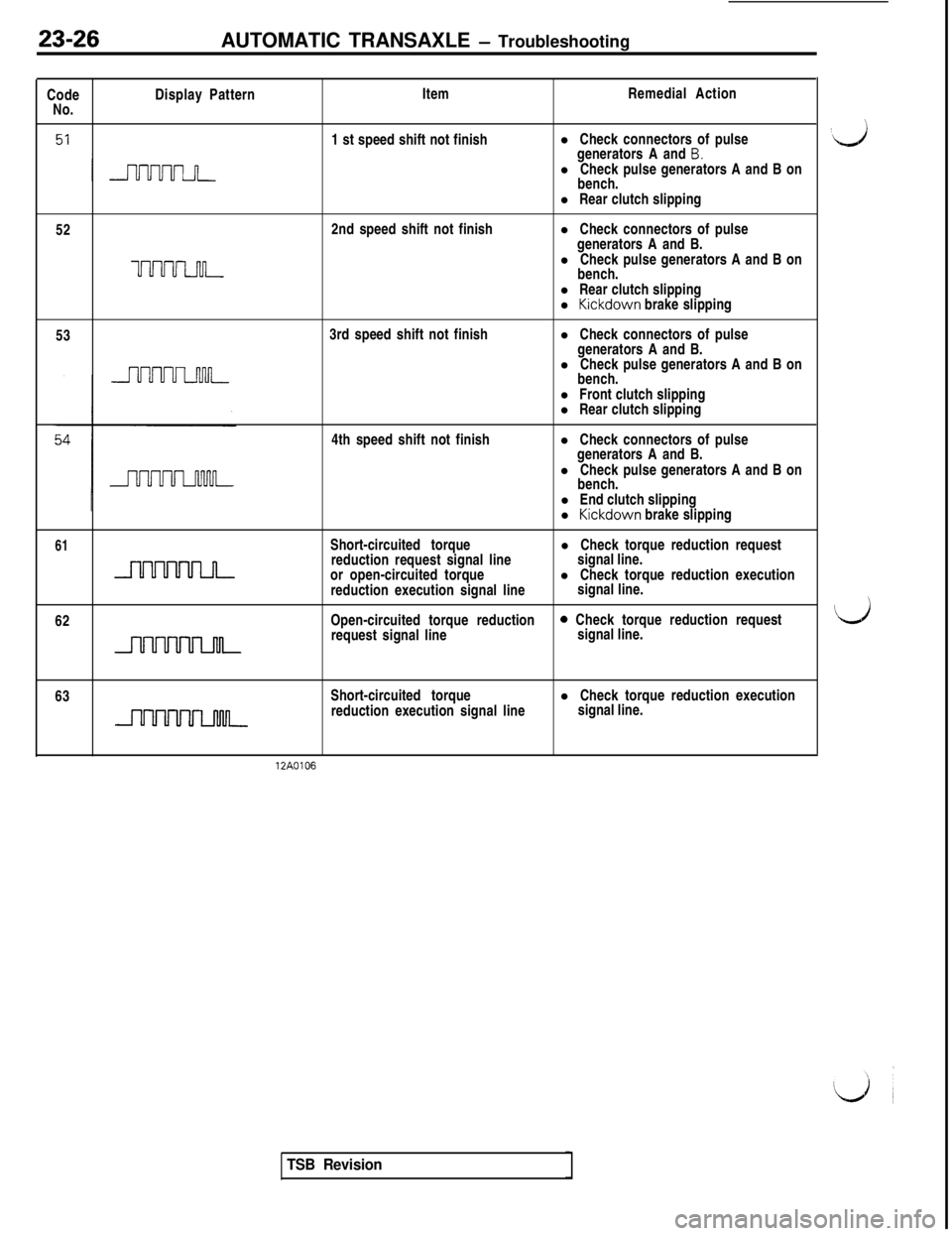
23-26AUTOMATIC TRANSAXLE - Troubleshooting
Code
No.Display PatternItemRemedial Action
1 st speed shift not finishl Check connectors of pulse
generators A and
B.l Check pulse generators A and B on
bench.
l Rear clutch slipping
52
uuuuu-ln-2nd speed shift not finishl Check connectors of pulse
generators A and B.
l Check pulse generators A and B on
bench.
l Rear clutch slipping
533rd speed shift not finishl Kickdown brake slipping
l Check connectors of pulse
generators A and B.
4th speed shift not finishl Check pulse generators A and B on
bench.
l Front clutch slipping
l Rear clutch slipping
l Check connectors of pulse
generators A and B.
l Check pulse generators A and B on
bench.
l End clutch slipping
6162l Kickdown brake slipping
Short-circuited torque
reduction request signal linel Check torque reduction request
or open-circuited torquesignal line.
reduction execution signal linel Check torque reduction execution
signal line.
Open-circuited torque reduction
request signal line0 Check torque reduction request
signal line.
63Short-circuited torque
reduction execution signal linel Check torque reduction execution
signal line.
12A0106
‘J
\J
TSB Revision
Page 491 of 1146
AUTOMATIC TRANSAXLE - Troubleshooting23-39
//!’ 6Rear@FrontclutchpressureI
@Kickdown brakeoressure (Release)
e
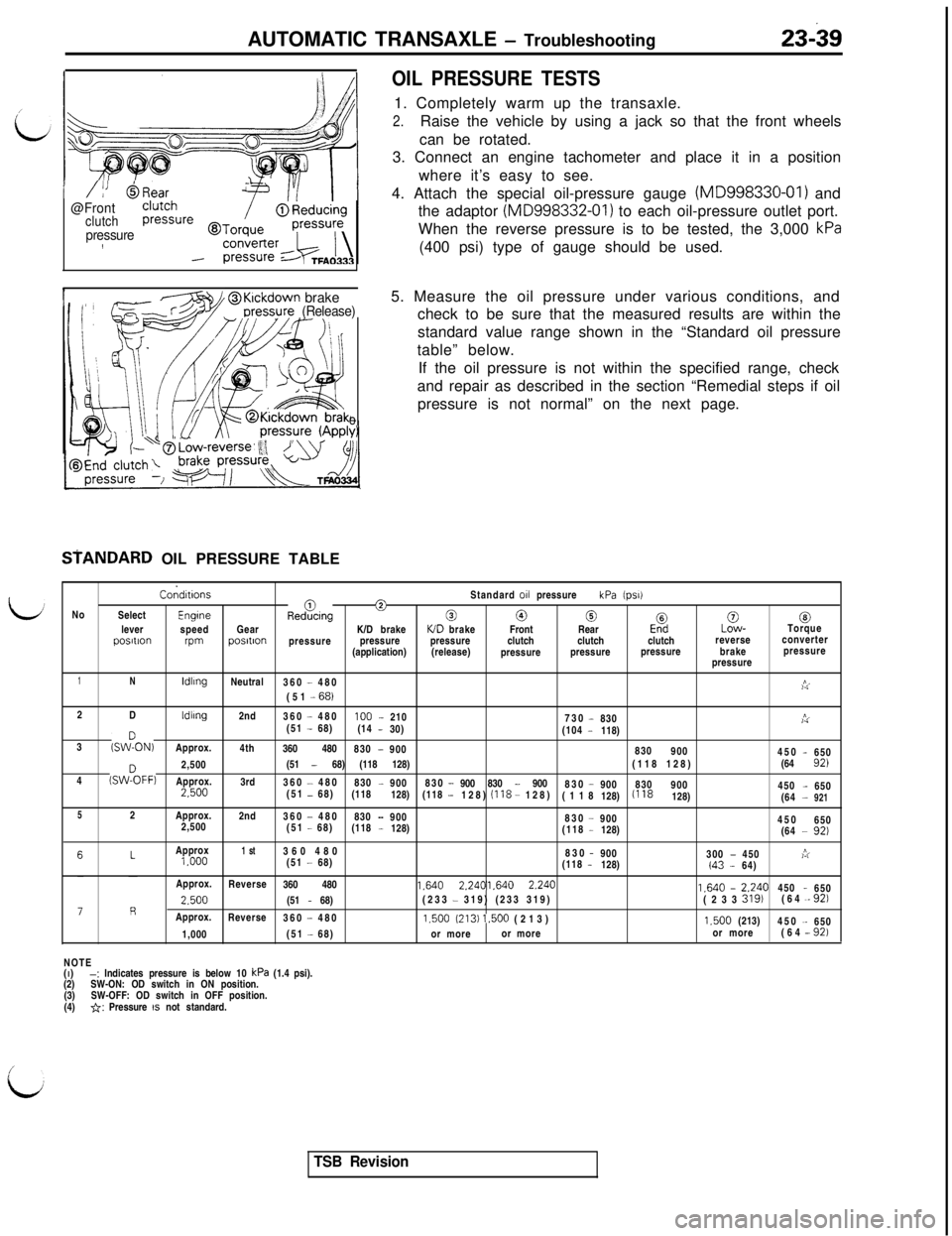
OIL PRESSURE TESTS1. Completely warm up the transaxle.
2.Raise the vehicle by using a jack so that the front wheels
can be rotated.
3. Connect an engine tachometer and place it in a position
where it’s easy to see.
4. Attach the special oil-pressure gauge (MD998330-01) and
the adaptor (MD998332-01) to each oil-pressure outlet port.
When the reverse pressure is to be tested, the 3,000
kPa(400 psi) type of gauge should be used.
5. Measure the oil pressure under various conditions, and
check to be sure that the measured results are within the
standard value range shown in the “Standard oil pressure
table” below.
If the oil pressure is not within the specified range, check
and repair as described in the section “Remedial steps if oil
pressure is not normal” on the next page.
STANDARD OIL PRESSURE TABLECondtttonsStandard
011 pressurekPa (PSI)No
SelectEngme
Red&g@000E%00leverspeedGearK/D brakeWD brakeFrontRearLow-TorqueposItlollvposltlon
pressurepressurepressureclutchclutchclutchreverseconverter
(application)(release)
pressurepressurepressurebrakepressure
pressure
1Nldlmg
Neutral
360 - 4808,(51 - 6812
Dldlmg
2nd
360
- 480100-210
730 -830k(51 - 68)
(14-30)
(104 -118)
3(SWFON,
Approx.
4th
360 480
830
-900
830
900
450-650
2,500(51 - 68) (118 128)(118 128)(64 92)
(SWZFF)Approx.
3rd
360 - 480
830
900830 -900 830 - 900
830 -900830
900
450-4
650-2.500(51 - 68)
(118
128)(118 -128) (118 - 128)
(118
128)(118128)
(64-921
52
Approx.
2nd
360
- 480
830--900
830 -900
450
650
2,500
(51 - 68)
(118-128)
(118 -128)
(64-921
Approx
1 st360 480
830 -900
300-450A1.000(51 - 68)
(118 -128)I43 .-64)
Approx.
Reverse
360 480
1.6402.2401.640 2.2401.640 -2.240450-6502.500(51 - 68)(233 - 319) (233 319)(233 319)(64 ~- 921
Approx.
Reverse
360
- 4801.500(213) 1.500 (213)1.500(213)
450~-650
1,000(51 - 68)or moreor moreor more(64 - 92)NOTE
(I)
-: Indicates pressure is below 10 kPa (1.4 psi).
(2)SW-ON: OD switch in ON position.
(3)SW-OFF: OD switch in OFF position.
(4)
a: Pressure IS not standard.
TSB Revision
Page 492 of 1146
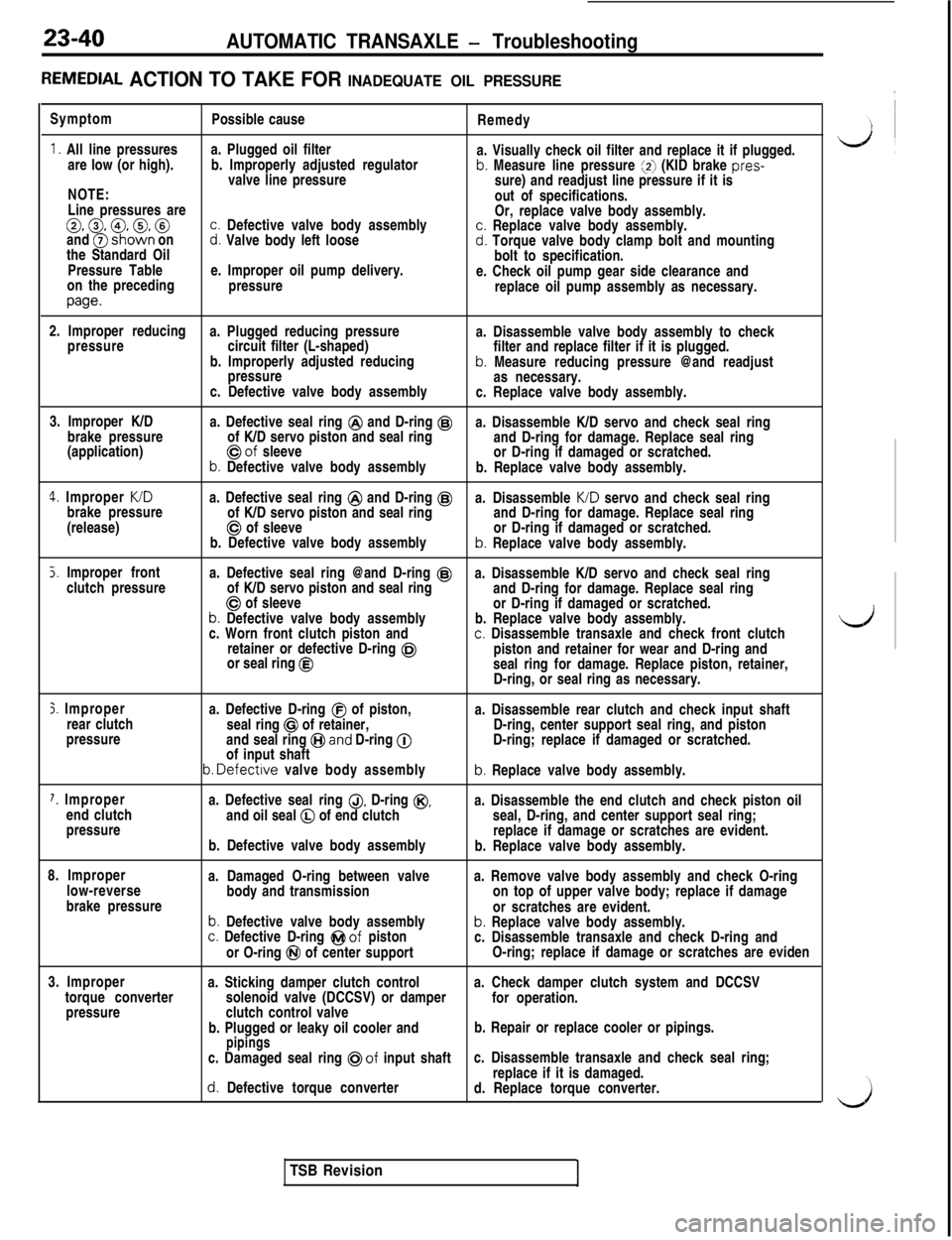
23-40AUTOMATIC TRANSAXLE - Troubleshooting
REMEDIAL ACTION TO TAKE FOR INADEQUATE OIL PRESSURESymptom
Possible cause
Remedy
1. All line pressuresa. Plugged oil filter
are low (or high).b. Improperly adjusted regulatora. Visually check oil filter and replace it if plugged.
valve line pressure
b. Measure line pressure (2) (KID brake pres-
NOTE:sure) and readjust line pressure if it is
Line pressures areout of specifications.
@.@.@).@.@and @shown onc. Defective valve body assemblyOr, replace valve body assembly.
the Standard Oil
Pressure Table
on the preceding
paw.
d. Valve body left loose
e. Improper oil pump delivery.
pressurec. Replace valve body assembly.d. Torque valve body clamp bolt and mounting
bolt to specification.
e. Check oil pump gear side clearance and
replace oil pump assembly as necessary.
2. Improper reducing
a. Plugged reducing pressure
a. Disassemble valve body assembly to check
pressurecircuit filter (L-shaped)
b. Improperly adjusted reducingfilter and replace filter if it is plugged.
b. Measure reducing pressure @and readjust
pressure
c. Defective valve body assemblyas necessary.
c. Replace valve body assembly.
3. Improper K/D
brake pressure
(application)a. Defective seal ring
@ and D-ring @of K/D servo piston and seal ringa. Disassemble K/D servo and check seal ring
@of sleeveand D-ring for damage. Replace seal ringb. Defective valve body assemblyor D-ring if damaged or scratched.
b. Replace valve body assembly.
4. Improper KIDbrake pressure
(release)
J. Improper front
clutch pressurea. Defective seal ring
@ and D-ring @of K/D servo piston and seal ringa. Disassemble KID servo and check seal ring
@ of sleeveand D-ring for damage. Replace seal ring
b. Defective valve body assemblyor D-ring if damaged or scratched.b. Replace valve body assembly.
a. Defective seal ring @and D-ring
@of K/D servo piston and seal ringa. Disassemble K/D servo and check seal ring
@ of sleeveand D-ring for damage. Replace seal ringb. Defective valve body assemblyor D-ring if damaged or scratched.
c. Worn front clutch piston andb. Replace valve body assembly.c. Disassemble transaxle and check front clutch
retainer or defective D-ring @or seal ring @piston and retainer for wear and D-ring and
seal ring for damage. Replace piston, retainer,
D-ring, or seal ring as necessary.
3. Improper
rear clutch
pressure
7. Improper
end clutch
pressurea. Defective D-ring
@ of piston,
seal ring @ of retainer,
and seal ring @and D-ring @of input shaft
b. Defectrve valve body assembly
a. Defective seal ring
0. D-ring 0,and oil seal (iJ of end clutch
b. Defective valve body assemblya. Disassemble rear clutch and check input shaft
D-ring, center support seal ring, and piston
D-ring; replace if damaged or scratched.
b. Replace valve body assembly.
a. Disassemble the end clutch and check piston oil
seal, D-ring, and center support seal ring;
replace if damage or scratches are evident.
b. Replace valve body assembly.
8. Improper
low-reverse
brake pressurea. Damaged O-ring between valve
body and transmission
b. Defective valve body assemblyc. Defective D-ring @of piston
or O-ring
@I of center supporta. Remove valve body assembly and check O-ring
on top of upper valve body; replace if damage
or scratches are evident.
b. Replace valve body assembly.
c. Disassemble transaxle and check D-ring and
O-ring; replace if damage or scratches are eviden
3. Improper
torque converter
pressurea. Sticking damper clutch controla. Check damper clutch system and DCCSV
solenoid valve (DCCSV) or damper
for operation.
clutch control valve
b. Plugged or leaky oil cooler and
pipingsb. Repair or replace cooler or pipings.
c. Damaged seal ring @of input shaftc. Disassemble transaxle and check seal ring;
d. Defective torque converterreplace if it is damaged.
d. Replace torque converter.
TSB Revision
d
‘\
d
Page 495 of 1146
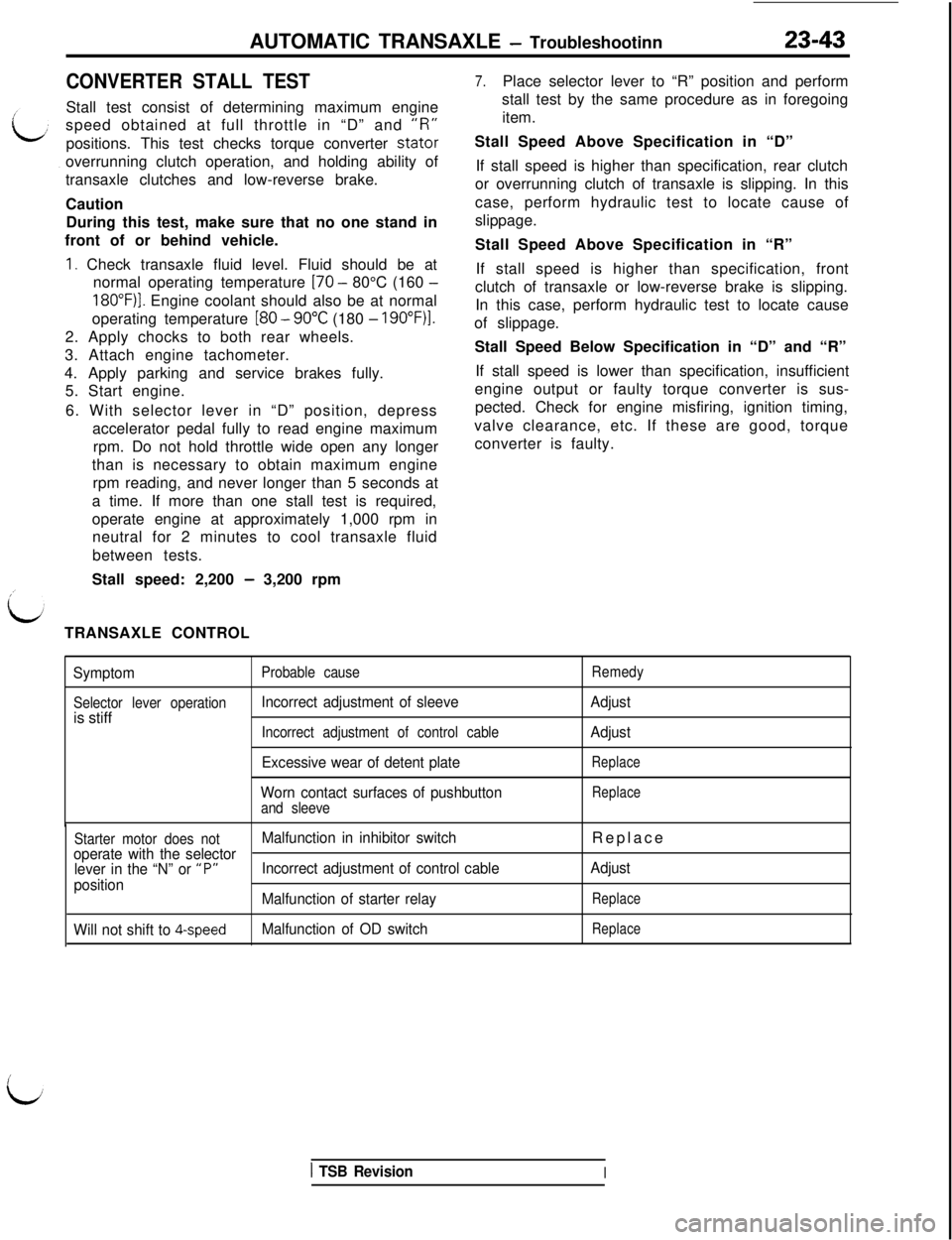
AUTOMATIC TRANSAXLE - Troubleshootinn23-43
CONVERTER STALL TESTStall test consist of determining maximum engine
speed obtained at full throttle in “D” and
“I?”positions. This test checks torque converter
statoroverrunning clutch operation, and holding ability of
transaxle clutches and low-reverse brake.
Caution
During this test, make sure that no one stand in
front of or behind vehicle.
1. Check transaxle fluid level. Fluid should be at
normal operating temperature
[70 - 80°C (160 -
18O”F)I. Engine coolant should also be at normal
operating temperature
[80 - 90°C (180 - 19O”F)l.2. Apply chocks to both rear wheels.
3. Attach engine tachometer.
4. Apply parking and service brakes fully.
5. Start engine.
6. With selector lever in “D” position, depress
accelerator pedal fully to read engine maximum
rpm. Do not hold throttle wide open any longer
than is necessary to obtain maximum engine
rpm reading, and never longer than 5 seconds at
a time. If more than one stall test is required,
operate engine at approximately 1,000 rpm in
neutral for 2 minutes to cool transaxle fluid
between tests.
Stall speed: 2,200
- 3,200 rpm
7.Place selector lever to “R” position and perform
stall test by the same procedure as in foregoing
item.
Stall Speed Above Specification in “D”
If stall speed is higher than specification, rear clutch
or overrunning clutch of transaxle is slipping. In this
case, perform hydraulic test to locate cause of
slippage.
Stall Speed Above Specification in “R”
If stall speed is higher than specification, front
clutch of transaxle or low-reverse brake is slipping.
In this case, perform hydraulic test to locate cause
of slippage.
Stall Speed Below Specification in “D” and “R”
If stall speed is lower than specification, insufficient
engine output or faulty torque converter is sus-
pected. Check for engine misfiring, ignition timing,
valve clearance, etc. If these are good, torque
converter is faulty.
TRANSAXLE CONTROL
Symptom
Selector lever operationis stiff
Probable cause
Incorrect adjustment of sleeve
Remedy
Adjust
Incorrect adjustment of control cable
Excessive wear of detent plate
Worn contact surfaces of pushbutton
and sleeve
Adjust
Replace
Replace
Starter motor does notMalfunction in inhibitor switchReplace
operate with the selector
lever in the “N” or “P”Incorrect adjustment of control cableAdjust
position
Will not shift to
4-speed
Malfunction of starter relay
Malfunction of OD switchReplace
Replace
1 TSB RevisionI