check engine MITSUBISHI DIAMANTE 1900 Repair Manual
[x] Cancel search | Manufacturer: MITSUBISHI, Model Year: 1900, Model line: DIAMANTE, Model: MITSUBISHI DIAMANTE 1900Pages: 408, PDF Size: 71.03 MB
Page 165 of 408
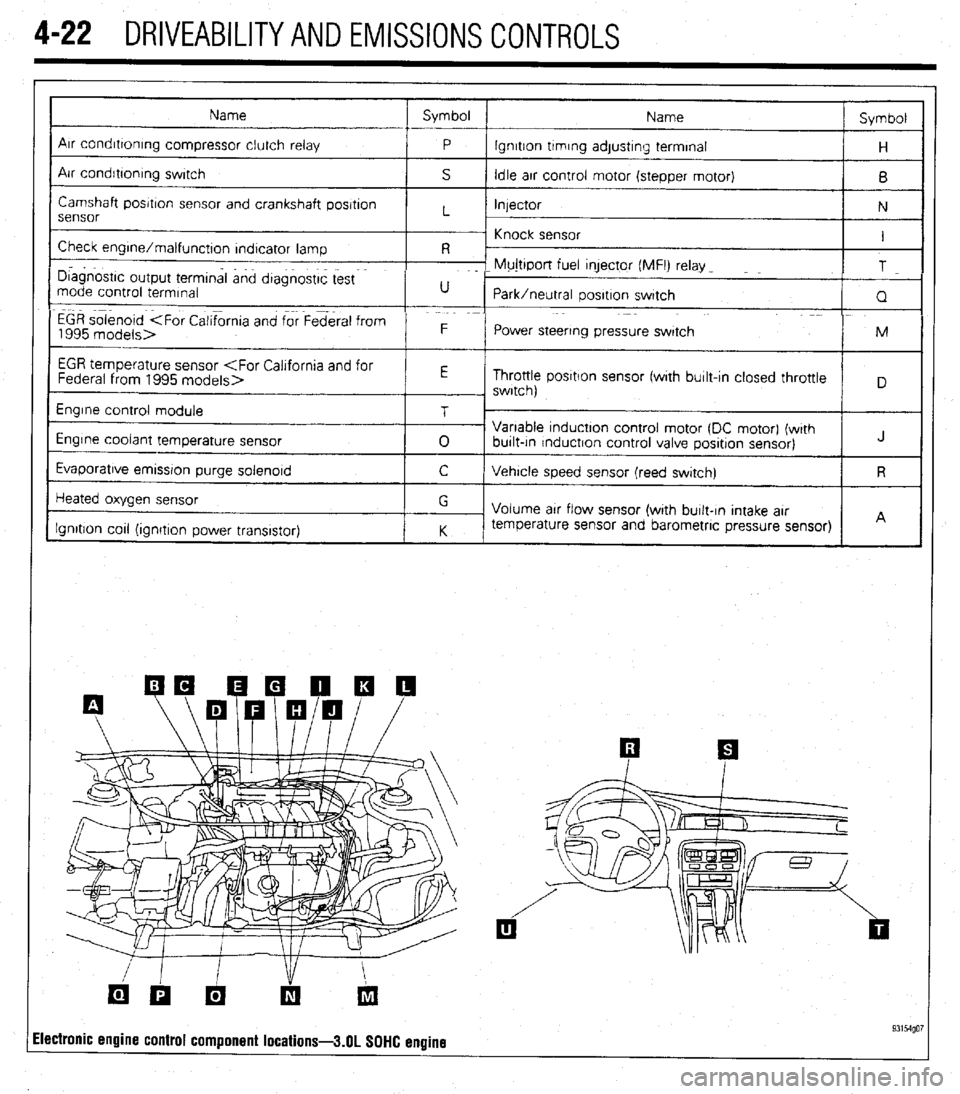
4-22 DRIVEABILITYAND EMISSIONS CONTROLS
Name Symbol
Name Symbol
I
Arr condrttontng compressor clutch relay
P lgnrtton trmrng adjustrng terminal
H
Air condrbonrng swrtch
S Idle arr control motor (stepper motor)
B
Camshaft posrtron sensor and crankshaft posrtron
Injector
N
sensor L
~ Knock sensor
Check engrne/malfunctton rndtcator lamp I
R -
I D~agnostrc output termtnal and dtagnostrc test F- Mujttport fuel qector (MFI) relay _
T
mode control termrnal U
Park/neutral oosrtron swatch
Q
EGR solenoid
1995 models> F
Power steering pressure swatch M
I
EGR temperature sensor
Throttle posrtlon sensor fwrth burlt-In closed throttle
, swrtch)
Engrne control module
Engine coolant temperature sensor
Evaporatrve emrssron purge solenord T
0 Variable tnductton control motor (DC motor) (wrth
burlt-tn rnductron control valve posrtron sensor) J
C Vehrcle speed sensor (reed swatch) R
Heated oxygen sensor
Ignition cot1 (ionrtron Dower transistor) G
Volume arr flow sensor (with burlt-In Intake arr
K temperature sensor and barometric pressure sensor)
I I A
ilectronic engine control component locations-3.01 SOHC engine 93154go7
Page 167 of 408
.
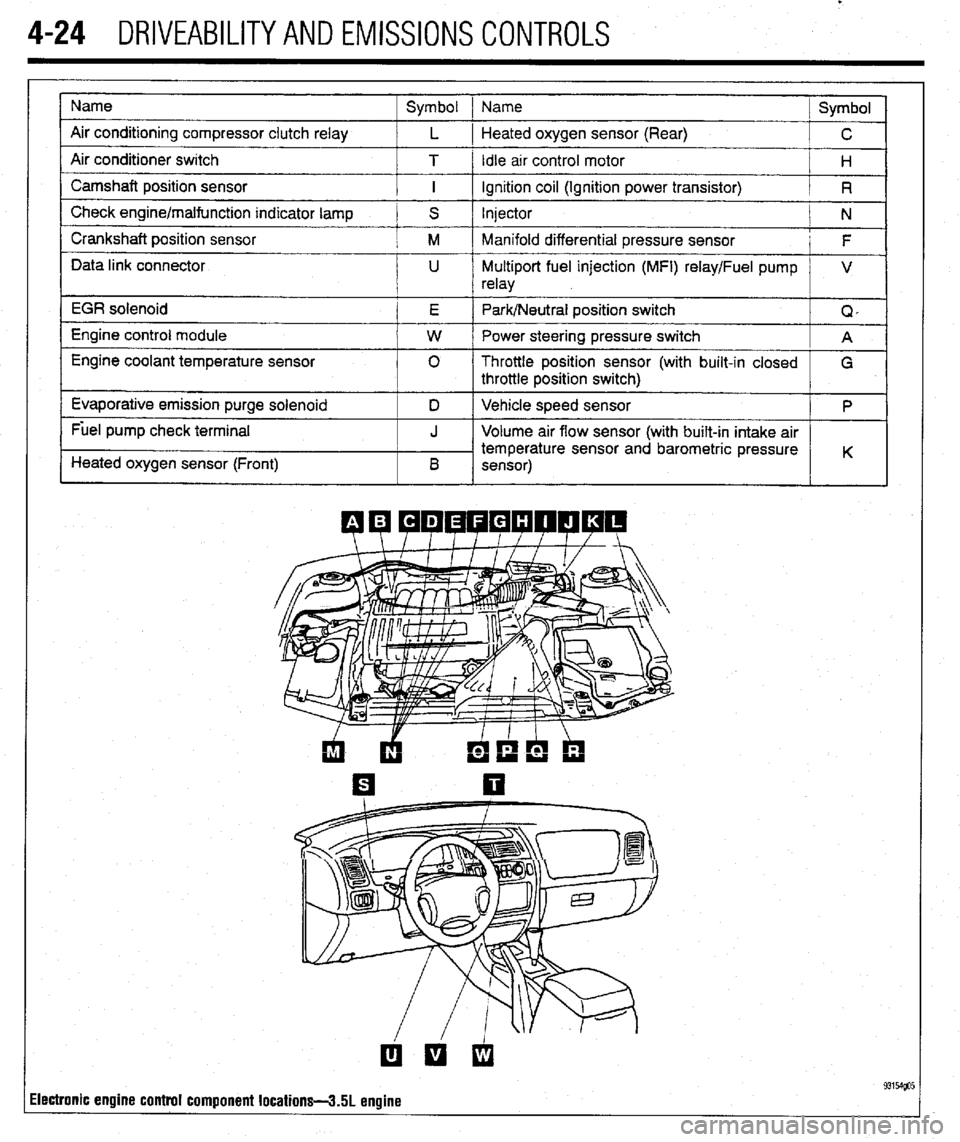
4-24 DRIVEABILITYAND EMISSIONS CONTROLS
Name
Air conditioning compressor clutch relay
Air conditioner switch
Camshaft position sensor
Check engine/malfunction indicator lamp
Crankshaft position sensor
Data link connector
EGR solenoid
Engine control module
Engine coolant temperature sensor
Evaporative emission purge solenoid
Fuel pump check terminal
Heated oxygen sensor (Front) Symbol 1 Name
Symbol
L 1 Heated oxygen sensor (Rear)
C
T / Idle arr control motor
H
I ignition coil (Ignition power transistor)
R
S Injector
N
M Manifold differential pressure sensor
F
U Multiport fuel injection (MFI) relay/Fuel pump V
relay
E Park/Neutral position switch
Q,
W Power steering pressure switch
A
0 Throttle position sensor (with built-in closed
G
throttle position switch)
D Vehicle speed sensor
P
J Volume air flow sensor (with built-in intake air
temperature sensor and barometric pressure
B K
sensor)
ilectronic engine control component locations-3.51 engine
Page 169 of 408
4-26 DRIVEABILITYAND EMISSIONS CONTROLS
The Powertrain Control Module (PCM) monitors
the signals of input and output sensors, some all the
time and others at certain times and processes each
signal. When the PCM notices that an irregularity has
continued for a specified time or longer from when
the irregular signal was initially monitored, the PCM
judges that a malfunction has occurred and will
memorize the malfunction code. The code is then
stored in the memory of the PCM and is accessible
through the data link (diagnostic connector) with the
use of an electronic scan tool or a voltmeter.
CHECK ENGINE/MALFUNCTION
INDICATOR LIGHT
Among the on-board diagnostic items, a check
engine/malfunction indicator light comes on to notify
the driver of a emission control component irregular-
ity. If the irregularity detected returns to normal or the
PCM judges that the component has returned to nor-
mal, the check engine/malfunction indicator light will
be turned off Moreover, if the ignition is turned OFF
and then the engine is restarted, the check
engine/malfunction indicator light will not be turned
on unttl a malfunction is detected.
The check engine/malfunction indicator light will
come on immediately after the ignition switch is
turned ON. The light should stay lit for 5 seconds
and then will go off. This Indicates that the check en-
gine/malfunction indicator lamp is operating nor-
mally. This does not signify a problem with the sys-
tem.
*The check engine/malfunction indicator
lamp will come on when the terminal for the
ignition timing adjustment is shorted to
ground. Therefore, it is not abnormal that the
light comes on even when the terminal for ig-
nition timing is shorted at time of ignition
timing adjustment.
To test the light, perform the following:
1. Turn the ignition switch ON. Inspect the check
engine/malfunction indicator lamp for Illumination.
2. The light should be lit for 5 seconds and then
should go out.
3. If the lamp does not illuminate, check for open
circuit In the harness, blown fuse or blown bulb.
SERVICE PRECAUTIONS
l Before attachrng or detaching the PCM harness
connectors, make sure the ignition switch is OFF and
the negative battery cable is disconnected to avoid
the possibility of damage to the PCM.
l When performing PCM input/output signal di-
agnosis, remove the pin terminal retainer from the
connectors to make it easier to insert tester probes
into the connector.
l When attaching or detaching pin connectors ,
from the PCM, take care not to bend or break any pin
terminals. Check that there are no bends or breaks on
PCM pin terminals before attempting any connec-
tions.
l Before replacing any PCM, perform the PCM
input/output signal diagnosis to make sure the PCM
is functioning properly.
l When measuring supply voltage of PCM-con-
trolled components with a circuit tester, separate 1
tester probe from another. If the 2 tester probes acci-
dentally make contact with each other during mea-
surement, a short circuit WIII result and damage the
PCM.
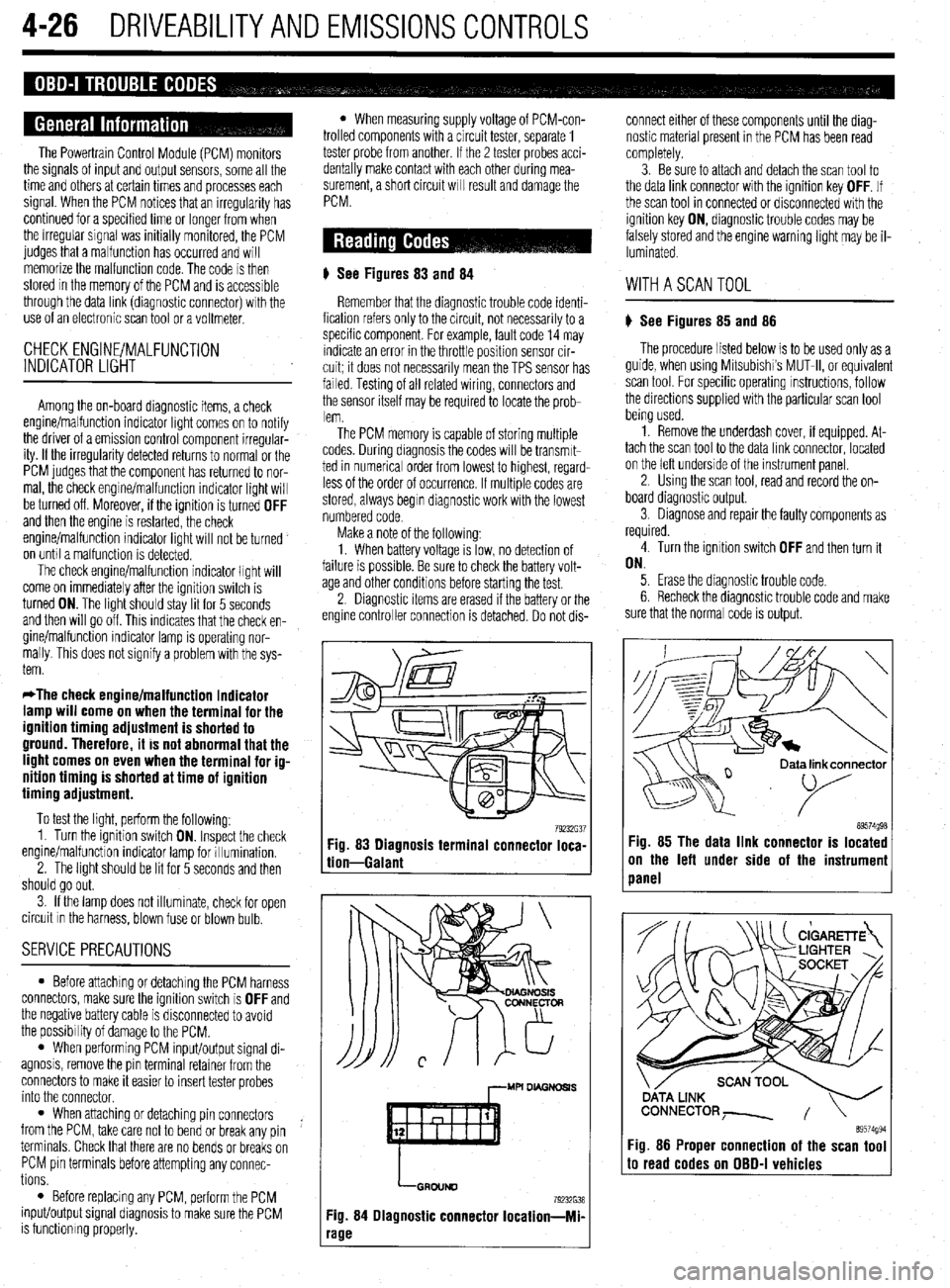
# See Figures 83
and 84
Remember that the diagnostic trouble code identi-
fication refers only to the circuit, not necessarily to a
specific component. For example, fault code 14 may
indicate an error in the throttle position sensor cir-
cuit; it does not necessarily mean the TPS sensor has
failed Testing of all related wiring, connectors and
the sensor itself may be required to locate the prob-
lem.
The PCM memory is capable of storing multiple
codes. During diagnosis the codes will be transmlt-
ted in numerical order from lowest to highest, regard-
less of the order of occurrence. If multiple codes are
stored, always begin diagnostic work with the lowest
numbered code
Make a note of the following:
1. When battery voltage IS low, no detection of
failure is possible. Be sure to check the battery volt-
age and other conditions before starting the test.
2. Diagnostic items are erased if the battery or the
engine controller connection is detached. Do not dis- connect either of these components until the diag-
nostic material present in the PCM has been read
completely.
3. Be sure to attach and detach the scan tool to
the data link connector with the ignition key OFF. If
the scan tool in connected or disconnected with the
ignition key ON, diagnostic trouble codes may be
falsely stored and the engine warning light may be il-
luminated. WITHASCANTOOL
) See Figures 85 and 86
The procedure listed below is to be used only as a
guide, when using Mitsubishi’s MUT-II, or equivalent
scan tool. For specific operating instructions, follow
the directions supplied with the particular scan tool
bemg used.
1. Remove the underdash cover, if equipped. At-
tach the scan tool to the data link connector, located
on the left underside of the instrument panel.
2. Using the scan tool, read and record the on-
board diagnostic output.
3. Diagnose and repair the faulty components as
required
4. Turn the ignition switch OFF and then turn it
ON.
5. Erase the diagnostic trouble code.
6 Recheck the diaanostic trouble code and make
sure that the normal &de is output.
79232G37 89574g98 Fig. 83 Diagnosis terminal connector loca-
tion-Galant Fig. 85 The data link connector is located
on the left under side of the instrumeni
panel
,--MU DL4GNDSl.S
LGRDIJND
79232638
Fig. 84 Diagnostic connector Iocation-Mi-
‘age
ata link connector
89574994 Fig. 86 Proper connection of the scan tool to read codes on OBD-I vehicles
Page 170 of 408
DRIVEABILITYAND EMISSIONS CONTROLS 4-27
WITHOUTASCANTOOL
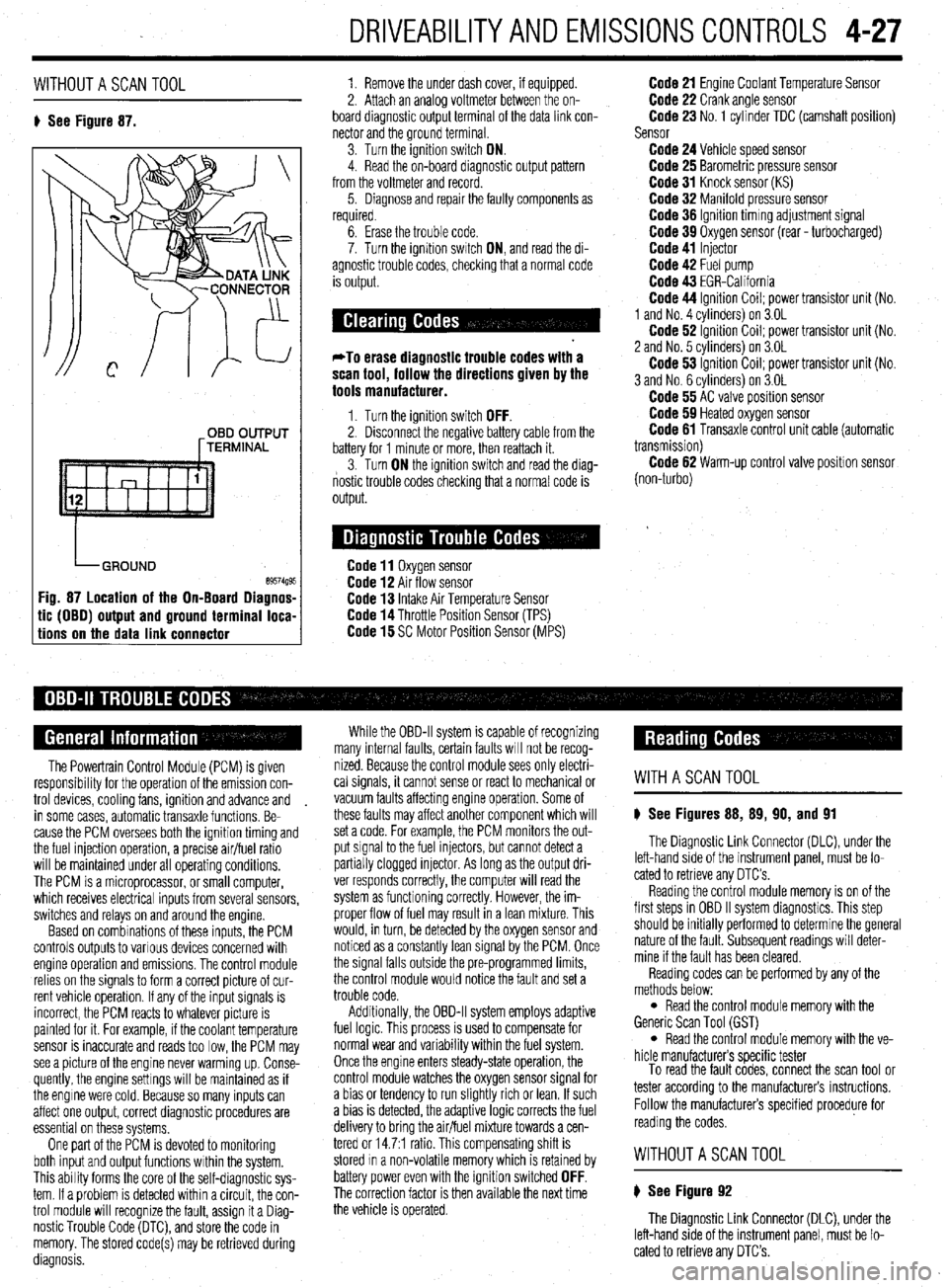
8 See Figure 87. 1. Remove the under dash cover, if equipped.
2. Attach an analoa voltmeter between the on-
board diagnostic outpit terminal of the data link con-
nector and the ground terminal
3. Turn the ignition switch ON.
4. Read the on-board diagnostic output pattern
from the voltmeter and record.
5. Diagnose and repair the faulty components as
required.
OBD OUTPUT
[TERMINAL
tic (OBO) output and ground terminal loca-
tions on the data link connector
6. Erase the trouble code.
7. Turn the ignition swatch ON, and read the di-
agnostic trouble codes, checking that a normal code
is output.
*To erase diagnostic trouble codes with a
scan tool, follow the directions given by the
tools manufacturer.
1. Turn the ignition switch OFF. 2. Disconnect the negative battery cable from the
battery for 1 minute or more, then reattach it.
3. Turn ON the ignition switch and read the diag-
nostic trouble codes checking that a normal code is
output.
Code 11 Oxygen sensor Code 12 Air flow sensor Code 13 Intake Air Temperature Sensor Code 14 Throttle Position Sensor (TPS) Code 15 SC Motor Position Sensor (MPS)
Code 21 Engine Coolant Temperature Sensor Code 22 Crank angle sensor Code 23 No. 1 cylinder TDC (camshaft position)
Sensor
Code 24 Vehicle speed sensor Code 25 Barometric pressure sensor Code 31 Knock sensor (KS) Code 32 Manifold pressure sensor Code 36 Ignition timmg adjustment signal Code 39 Oxygen sensor (rear - turbocharged) Code 41 Injector Code 42 Fuel pump Code 43 EGR-California Code 44 Ignition Coil; power transistor unit (No.
1 and No. 4 cvlinders) on 3.OL
Code 62 ignition Coil; power transistor unit (No.
2 and No. 5 cvlinders) on 3.OL
Code 53 ignition Coil; power transistor unit (No.
3 and No. 6 cylinders) on 3.OL
Code 55 AC valve position sensor Code 59 Heated oxygen sensor Code 61 Transaxle control unit cable (automatic
transmission)
Code 62 Warm-up control valve position sensor
(non-turbo)
The Powertrain Control Module (PCM) is given
responsibrlity for the operation of the emission con-
trol devices, cooling fans, ignition and advance and
in some cases, automatic transaxle functions. Be-
cause the PCM oversees both the ignition timing and
the fuel injection operation, a precise air/fuel ratio
will be maintained under all operating conditions,
The PCM is a microprocessor, or small computer,
which receives electrical inputs from several sensors,
switches and relays on and around the engine.
Based on combinations of these inputs, the PCM
controls outputs to various devices concerned with
engine operation and emissions. The control module
relies on the signals to form a correct picture of cur-
rent vehicle operation. If any of the input signals is
incorrect, the PCM reacts to whatever picture is
painted for it. For example, if the coolant temperature
sensor is inaccurate and reads too low, the PCM may
see a picture of the engine never warming up. Conse-
quently, the engine settings will be maintained as if
the engine were cold. Because so many inputs can
affect one output, correct diagnostic procedures are
essential on these systems,
One part of the PCM is devoted to monitoring
both input and output functions within the system.
This ability forms the core of the self-diagnostic sys-
tem. If a problem is detected within a circuit, the con-
trol module will recognize the fault, assign it a Diag-
nostic Trouble Code (DTC), and store the code in
memory. The stored code(s) may be retrieved during
diagnosis. While the OBD-II system is capable of recognizing
many internal faults, certain faults WIII not be recog-
nized. Because the control module sees only electri-
cal signals, it cannot sense or react to mechanical or
vacuum faults affecting engine operation. Some of
these faults may affect another component which will
set a code. For example, the PCM monitors the out-
put signal to the fuel injectors, but cannot detect a
partially clogged injector. As long as the output dri-
ver responds correctly, the computer will read the
system as functioning correctly. However, the im-
proper flow of fuel may result in a lean mixture. This
would, in turn, be detected by the oxygen sensor and
noticed as a constantly lean signal by the PCM. Once
the signal falls outside the pre-programmed limits,
the control module would notice the fault and set a
trouble code.
Additionally, the OBD-II system employs adaptive
fuel logic. This process is used to compensate for
normal wear and variability within the fuel system.
Once the engine enters steady-state operation, the
control module watches the oxygen sensor signal for
a bias or tendency to run slightly rich or lean. If such
a bias is detected, the adaptive logic corrects the fuel
delivery to bring the air/fuel mixture towards a cen-
tered or 14.7:1 ratio. This compensating shift is
stored In a non-volatile memory which is retained by
battery power even with the ignition switched
OFF. The correction factor is then available the next time
the vehicle is operated.
WITHASCANTOOL
8 See Figures 88, 89, 90, and 91
The Diagnostic Link Connector (DLC), under the
left-hand side of the instrument panel, must be lo-
cated to retrieve any OTC’s
Reading the control module memory is on of the
first steps in OBD II system diagnostics. This step
should be initially performed to determine the general
nature of the fault. Subsequent readings will deter-
mine if the fault has been cleared.
Reading codes can be performed by any of the
methods below:
l Read the control module memory with the
Generic Scan Tool (GST)
l Read the control module memory with the ve-
hicle manufacturers specific tester
To read the fault codes, connect the scan tool or
tester according to the manufacturers instructions.
Follow the manufacturers specified procedure for
reading the codes.
WITHOUTASCANTOOL
8 See Figure 92
The Diagnostic Link Connector (DLC), under the
left-hand side of the instrument panel, must be lo-
cated to retrieve any DTC’s.
Page 174 of 408
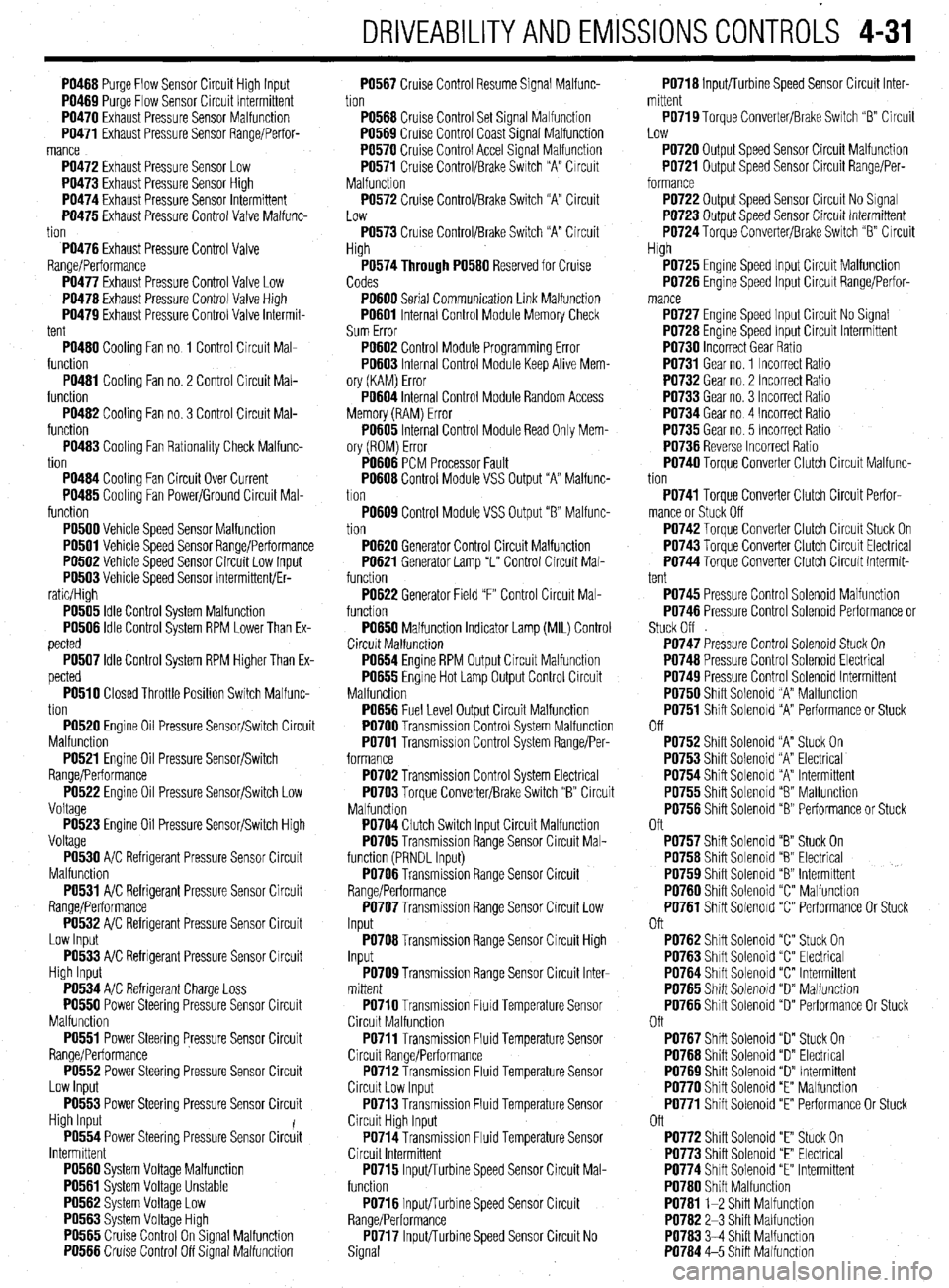
DRIVEABILITYAND EMISSIONSCONTROL-S 4-31
PO466 Purge Flow Sensor Circuit High Input
PO469 Purqe Flow Sensor Circuit Intermittent
PO470 Exhaust Pressure Sensor Malfunction
PO471 Exhaust Pressure Sensor Range/Perfor-
mance
PO472 Exhaust Pressure Sensor Low
PO473 Exhaust Pressure Sensor Hiah
PO474 Exhaust Pressure Sensor lnirmittent
PO475 Exhaust Pressure Control Valve Malfunc-
tion
PO476 Exhaust Pressure Control Valve
Range/Performance
PO477 Exhaust Pressure Control Valve Low
PO476 Exhaust Pressure Control Valve High
PO479 Exhaust Pressure Control Valve Intermit-
tent
PO460 Cooling Fan no 1 Control Circuit Mal-
function
PO461 Cooling Fan no. 2 Control Circuit Mal-
function
PO462 Cooling Fan no. 3 Control Circuit Mal-
function
PO463 Cooling Fan Rationality Check Malfunc-
tion
PO464 Cooling Fan Circuit Over Current
PO465 Cooling Fan Power/Ground Circuit Mal-
function
PO500 Vehicle Speed Sensor Malfunction
PO501 Vehicle Speed Sensor Range/Performance
PO502 Vehicle Speed Sensor Circuit Low Input
PO503 Vehicle Speed Sensor Intermittent/Er-
ratic/High
PO505 Idle Control System Malfunction
PO506 Idle Control System RPM Lower Than Ex-
pected
PO507 Idle Control System RPM Higher Than Ex-
pected
PO510 Closed Throttle Position Switch Malfunc-
tion
PO520 Engine Oil Pressure Sensor/Switch Circuit
Malfunction
PO521 Engine Oil Pressure Sensor/Switch
Range/Performance
PO522 Engine Oil Pressure Sensor/Switch Low
Voltage
PO523 Engine Oil Pressure Sensor/Switch High
Voltage
PO530 A/C Refrigerant Pressure Sensor Circuit
Malfunction
PO531 A/C Refrigerant Pressure Sensor Circuit
Range/Performance
PO532 A/C Refrigerant Pressure Sensor Circuit
Low Input
PO533 A/C Refrigerant Pressure Sensor Circuit
High Input
PO534 A/C Refrigerant Charge Loss
PO550 Power Steering Pressure Sensor Circuit
Malfunction
PO551 Power Steering Pressure Sensor Circuit
Range/Performance
PO552 Power Steering Pressure Sensor Circuit
Low Input
PO553 Power Steering Pressure Sensor Circuit
High Input
PO554 Power Steering Pressure Sensor Circiit
Intermittent
PO560 System Voltage Malfunction
PO561 System Voltage Unstable
PO562 System Voltage Low
PO563 Svstem Voltaoe Hlah
PO565 Ciuise Control On%ignal Malfunction
PO566 Cruise Control Off Signal Malfunction PO567 Cruise Control Resume Signal Malfunc-
tion
PO566 Cruise Control Set Signal Malfunction
PO569 Cruise Control Coast Signal Malfunction
PO570 Cruise Control Accel Signal Malfunction
PO571 Cruise Control/Brake Switch “A” Circuit
Malfunction
PO572 Cruise Control/Brake Switch “A” Circuit
Low
PO573 Cruise Control/Brake Switch “A” Circuit
High
P0574Through PO560 Reserved for Cruise
Codes
PO600 Serial Communication Link Malfunction
PO601 Internal Control Module Memory Check
Sum Error
PO602 Control Module Programming Error
PO603 Internal Control Module Keep Alive Mem-
ory (KAM) Error
PO604 Internal Control Module Random Access
Memory (RAM) Error
PO605 Internal Control Module Read Only Mem-
ory (ROM) Error
PO606 PCM Processor Fault
PO606 Control Module VSS Output “A” Malfunc-
tion
PO609 Control Module VSS Output “6” Malfunc-
tion
PO620 Generator Control Circuit Malfunction
PO621 Generator Lamp “L” Control Circuit Mal-
function
PO622 Generator Field “F” Control Circuit Mal-
function
PO650 Malfunction Indicator Lamp (MIL) Control
Circuit Malfunctron
PO654 Engine RPM Output Circuit Malfunction
PO655 Engine Hot Lamp Output Control Circuit
Malfunction
PO656 Fuel Level Output Circuit Malfunction
PO700 Transmission Control System Malfunction
PO701 Transmission Control System Range/Per-
formance
PO702 Transmission Control System Electrical
PO703 Torque Converter/Brake Switch “B” Circuit
Malfunction
PO704 Clutch Switch Input Circuit Malfunction
PO705 Transmission Range Sensor Circuit Mal-
function (PRNDL Input)
PO706 Transmission Range Sensor Circuit
Range/Performance
PO707 Transmission Range Sensor Circuit Low
Input
PO706 Transmission Range Sensor Circuit High
Input
PO709 Transmission Range Sensor Circuit Inter-
mittent
PO710 Transmission FluId Temperature Sensor
Circuit Malfunction
PO711 Transmission Fluid Temperature Sensor
Circuit Range/Performance
PO712 Transmission Fluid Temperature Sensor
Circuit Low Input
PO713 Transmission Fluid Temperature Sensor
Circuit High Input
PO714 Transmission Fluid Temperature Sensor
Circuit Intermittent
PO715 Input/Turbine Speed Sensor Circuit Mal-
function
PO716 Input/Turbine Speed Sensor Circuit
Range/Performance
PO717 InpWurbine Speed Sensor Circuit No
Signal PO716 Inputflurbine Speed Sensor Circuit Inter-
mittent
PO719 Torque Converter/Brake Switch “B” Circuit
Low
PO720 Output Speed Sensor Circuit Malfunction
PO721 Output Speed Sensor Circuit Range/Per-
formance
PO722 Output Speed Sensor Circuit No Signal
PO723 Output Speed Sensor Circuit Intermittent
PO724 Toraue Converter/Brake Switch “B” Circuit
High
PO725 Engine Speed Input Circuit Malfunction
PO726 Engine Speed Input Circuit Range/Perfor-
PO727 Engine Speed Input Circuit No Signal
PO726 Engine Speed Input Circuit Intermittent
PO730 Incorrect Gear Ratio
PO731 Gear no. 1 Incorrect Ratio
PO732 Gear no. 2 Incorrect Ratio
PO733 Gear no. 3 Incorrect Ratio
PO734 Gear no 4 Incorrect Ratio
PO735 Gear no. 5 Incorrect Ratio
PO736 Reverse Incorrect Ratio
PO740 Torque Converter Clutch Circuit Malfunc-
tion
PO741 Torque Converter Clutch Circuit Perfor-
mance or Stuck Off
PO742 Torque Converter Clutch Circuit Stuck On
PO743 Torque Converter Clutch Circuit Electrical
PO744 Torque Converter Clutch Circuit Intermit-
tent
PO745 Pressure Control Solenoid Malfunction
PO746 Pressure Control Solenoid Performance or
Stuck Off
PO747 Pressure Control Solenoid Stuck On
PO746 Pressure Control Solenoid Electrical
PO749 Pressure Control Solenoid Intermittent
PO750 Shift Solenoid “A” Malfunction
PO751 Shift Solenoid “A” Performance or Stuck
Off
PO752 Shift Solenoid “A” Stuck On
PO753 Shift Solenoid “A” Electrical
PO754 Shift Solenoid “A” Intermittent
PO755 Shift Solenoid “8 Malfunction
PO756 Shift Solenoid “B” Performance or Stuck
Oft
PO757 Shift Solenoid “B” Stuck On
PO756 Shift Solenoid “6” Electrical
PO759 Shift Solenoid “8” Intermittent
PO760 Shift Solenoid “C” Malfunction
PO761 Shift Solenoid “C” Performance Or Stuck
Oft
PO762 Shift Solenoid “C” Stuck On
PO763 Shift Solenoid “C” Electrical
PO764 Shift Solenoid “C” Intermittent
PO765 Shift Solenoid “D” Malfunction
PO766 Shift Solenoid “D” Performance Or Stuck
Oft
PO767 Shift Solenoid “D” Stuck On
PO766 Shift Solenoid “D” Electrical
PO769 Shift Solenoid “D” Intermittent
PO770 Shift Solenoid “E” Malfunction
PO771 Shift Solenoid “E” Performance Or Stuck
Off
PO772 Shift Solenoid “E” Stuck On
PO773 Shift Solenoid “E” Electrical
PO774 Shift Solenoid “E” Intermittent
PO760 Shift Malfunction
PO761 l-2 Shift Malfunction
PO762 2-3 Shift Malfunction
PO763 3-4 Shift Malfunction
PO764 4-5 Shift Malfunction
Page 177 of 408
.
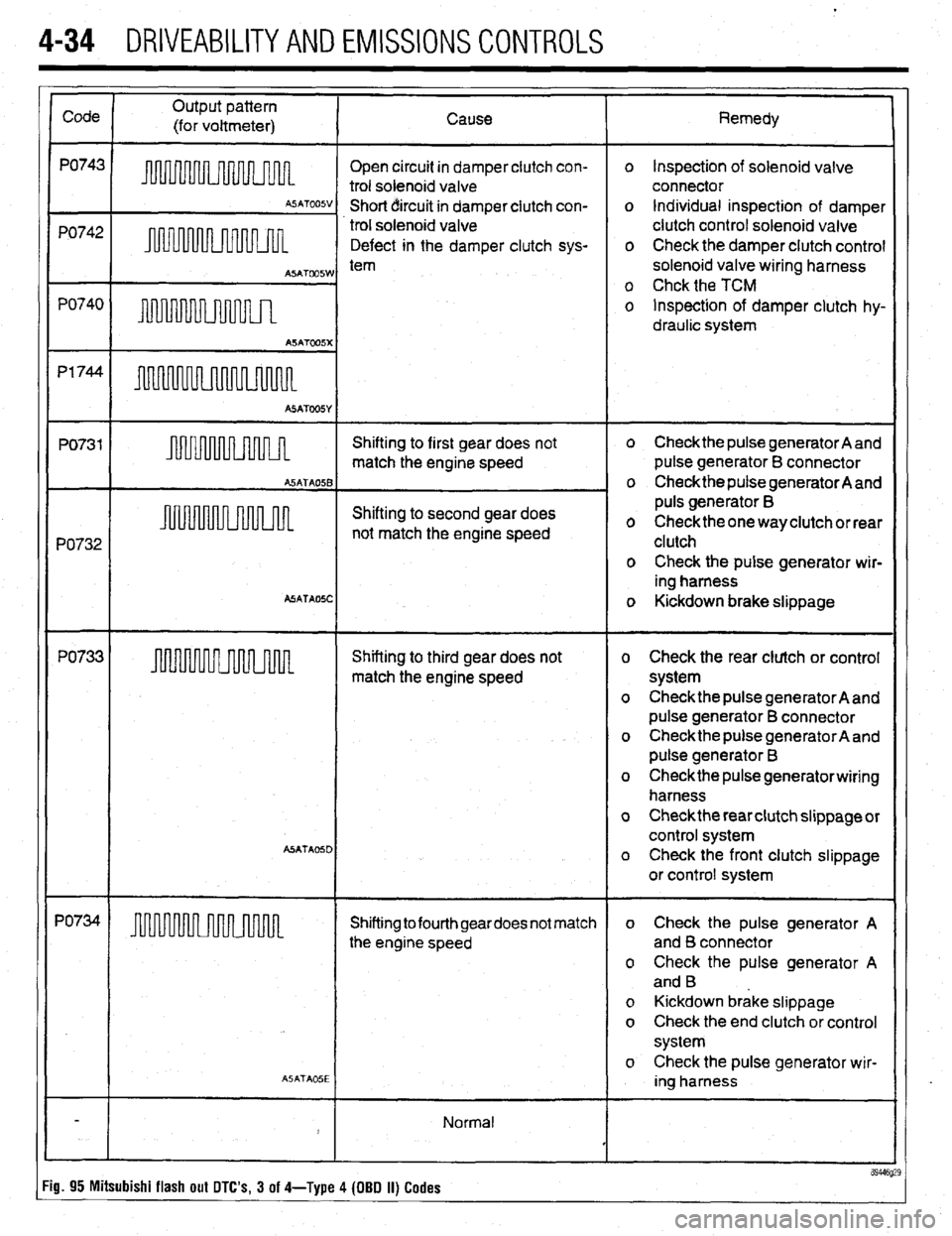
4-34 DRIVEABILITYAND EMISSIONS CONTROLS
Open circuit in damper clutch con-
trol solenoid valve
Short circuit in damper clutch con-
trol solenoid valve
Defect in the damper clutch sys- o Inspection of solenoid valve
connector
o Individual inspection of damper
clutch control solenoid valve
o Check the damper clutch control
solenoid valve wiring harness
o Chck the TCM
o Inspection of damper clutch hy-
draulic system
PO732 Shifting to first gear does not heckthe pulse generator A and
match the engine speed pulse generator B connector
o Check the pulse generator A and
Shifting to second gear does puls generator B
not match the engine speed o Checkthe one way clutch or rear
clutch
o Check the pulse generator wir-
ing harness
ASATAOSC o Kickdown brake slippage
PO733 Shifting to third gear does not o Check the rear clutch or control
match the engine speed system
o Check the pulse generator A and
pulse generator B connector
o Check the pulse generator A and
pulse generator B
o Checkthe pulse generatorwiring
harness
o Check the rear clutch slippage or
control system
A5ATA05D o Check the front clutch slippage
or control system
PO734
Shifting to fourth geardoes not match o Check the pulse generator A
the engine speed and B connector
o Check the pulse generator A
and B
o Kickdown brake slippage
o Check the end clutch or control
system
o Check the pulse generator wir-
ASATA05E ing harness
Normal
J
89446 :ig. 95 Mitsubishi flash out DTC’s, 3 of 4-Type 4 (OBD II) Codes
Page 189 of 408
I
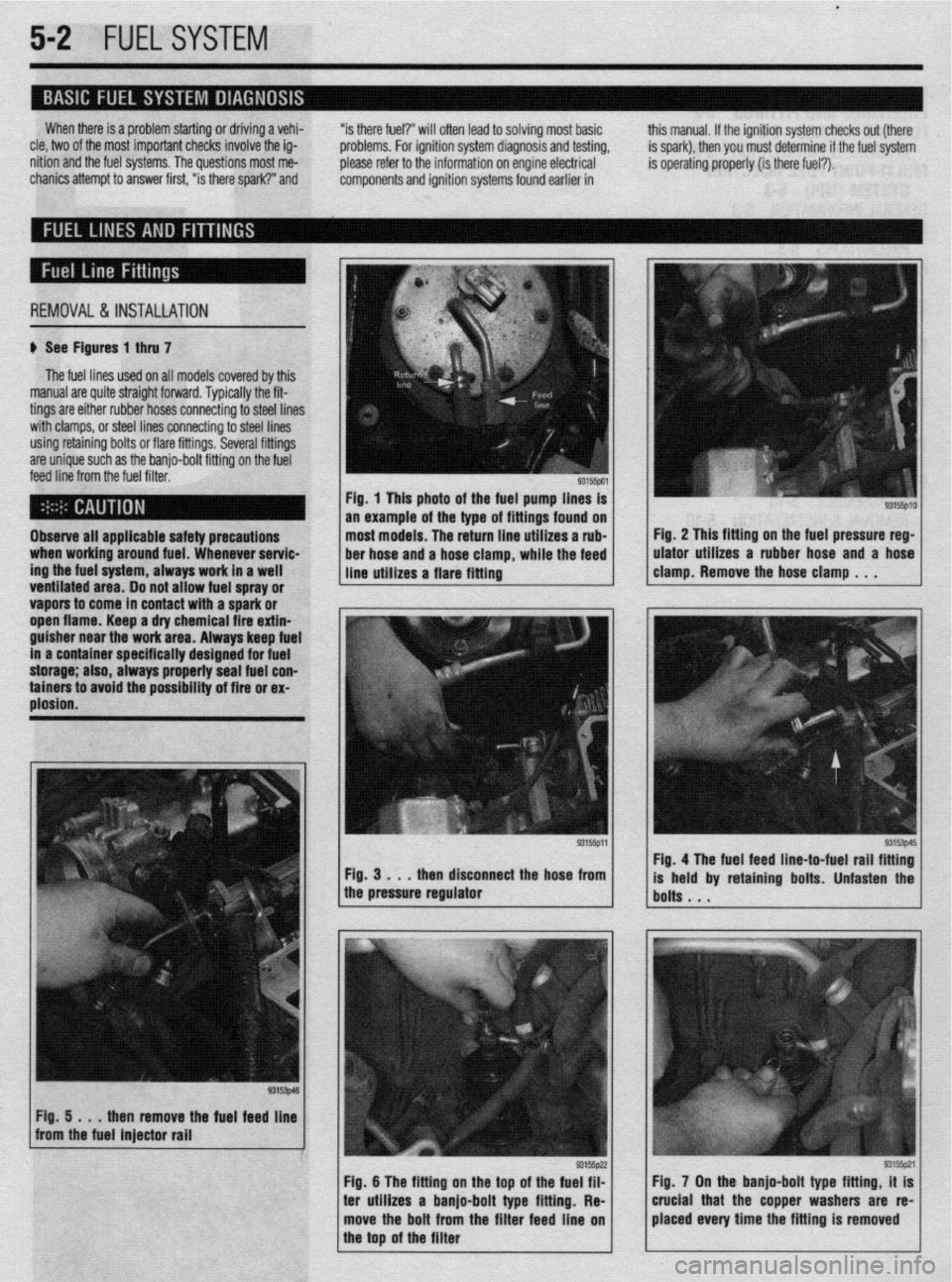
5-2, FUELSYSTEM
When there is a problem starting or driving a vehi-
“is there fuel? will often lead to solving most basic
cle, two of the most important checks involve the ig- problems. For ignition system diagnosis and testing,
nition and the fuel systems. The questions most me-
please refer to the information on engine electrical
chanics attempt to answer first, “is there spark?” and
components and ignition systems found earlier in this manual. If the ignition system checks out (there
is spark), then you must determine if the fuel system
is operating properly (is there fuel?).
REMOVAL&INSTALLATION
# See Figures 1 thru 7
The fuel lines used on all models covered by this
manual are quite straight forward. Typically the fit-
tings are either rubber hoses connecting to steel lines
with clamps, or steel lines connecting to steel lines
using retaining bolts or flare fittings. Several fittings
are unique such as the banjo-bolt fitting on the fuel
feed line from the fuel filter.
ventitateu area. Do not allow fuel spray or
vapors to come in contact with a spark or
ooen flame. Keen a drv chemical fire extin- Observe all applicable safety precautions
when working around fuel. Whenever servic-
ing the fuel system, always work in a well
___ _ . . . _
guisher near the’work &ea. Always keep fuel
in a container specifically designed for fuel
storage; also, always pmperly seal fuel con-
tainers to avoid the possibility of fire or ex-
plosion. Fig. 1 This photo of the fuel pump lines is
an example of the type of fittings found on
most models. The return line utilizes a rub-
ber hose and a hose clamp, while the feed
line utilizes a flare fitting
ren disconnect the hose from
1 the pressure regulator Fig. 2 This fitting on the fuel pressure reg-
ulator utilizes a rubber hose and a hose
clamp. Remove the hose clamp . . .
93153p45 Fig. 4 The fuel feed line-to-fuel rail fitting
is held by retaining bolts. Unfasten the
bolts . . .
Fig. 5 . . .
then remove the fuel feed line
from the fuel injector rail
I
1 Fig. 6 The fitting on the too of the fueg;?lz
I I
93155pzl Fig. 7 On the banjo-bolt type fitting, it is
ter utilizes a banjo-bolt type fitting. Re-
I I crucial that the copper washers are re-
move the bolt from the filter feed line on placed every time the fitting is removed
the top of the filter
Page 191 of 408
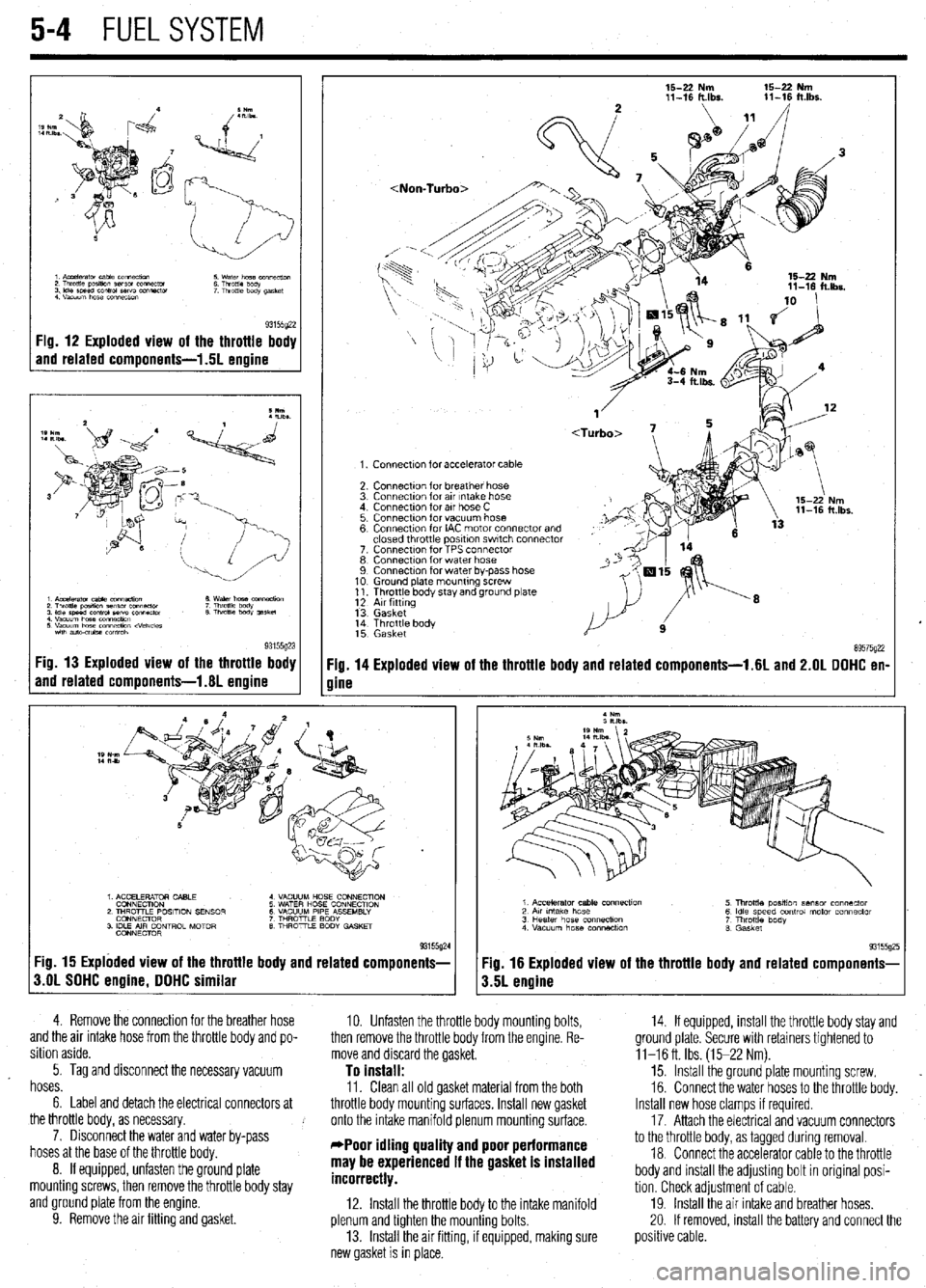
5-4 FUELSYSTEM
93155422 Fig. 12 Exploded view of the throttle body
and related components-l .5L engine
15-Z Nm
11-16 lt.lbs. 15-22 Nm 11-16 ft.lbr.
1. Connectnn for accelerator cable
2. Connection for breather hose
3 Connection for au intake hose
4 Connectton for au hose C
5. Connectton for vacuum hose
6 Connectton for IAC motor connector and
closed throttle posItIon swtch connector
7 ConnectIon for TPS connector
8 Connectton for water hose
9 Connectnon for water by-pass hose
10 Ground plate mounting screw
11. Throttle body stay and ground plate
12 Au flttlng
13 Gasket
14 Throttle body
15 Gasket ’
89575422 :ig. 14 Exploded view of the throttle body and related components-l.61 and 2.OL DOHC en-
line
93155g24 Yg. 15 Exploded view of the throttle body and related components- :ig. 16 Exploded view of the throttle body and related components-
1.OL SOHC engine, DOHC similar
1.5L engine
4. Remove the connection for the breather hose
10. Unfasten the throttle body mounting bolts, 14. If equipped, install the throttle body stay and
and the air intake hose from the throttle body and po-
then remove the throttle body from the engine. Re- QrOUnd plate. Secure with retainers tightened to
sition aside.
move and discard the gasket. 11-16 ft. Ibs. (15-22 Nm).
5. Tag and disconnect the necessary vacuum
To install: 15. Install the ground plate mounting screw.
hoses.
11. Clean all old gasket material from the both 16. Connect the water hoses to the throttle body.
6. Label and detach the electrical connectors at throttle body mounting surfaces. Install new gasket Install new hose clamps if required.
the throttle body, as necessary.
1 onto the intake manifold plenum mounting surface. 17. Attach the electrical and vacuum connectors
7. Disconnect the water and water by-pass
*Poor idling quality and poor performance to the throttle body, as tagged during removal.
hoses at the base of the throttle body.
may be experienced if the gasket is installed 18 Connect the accelerator cable to the throttle
8. If equipped, unfasten the ground plate
incorrectly. body and install the adjusting bolt in original posi-
mounting screws, then remove the throttle body stay
tion. Check adjustment of cable.
and QrOUnd plate from the engine.
12. Install the throttle body to the intake manifold 19 Install the air intake and breather hoses.
9. Remove the air fitting and
gasket. plenum and tighten the mounting bolts. 20. If removed, install the battery and connect the
13. Install the air fitting, if equipped, making sure positive cable.
new gasket iS in place.
Page 192 of 408
FUEL SYSTEM 5-5,
21. Connect the negative battery cable. Refill the
cooling system.
REMOVAL & INSTALLATION
1.5L, 1.8L, And 2.OL SOHC Engines
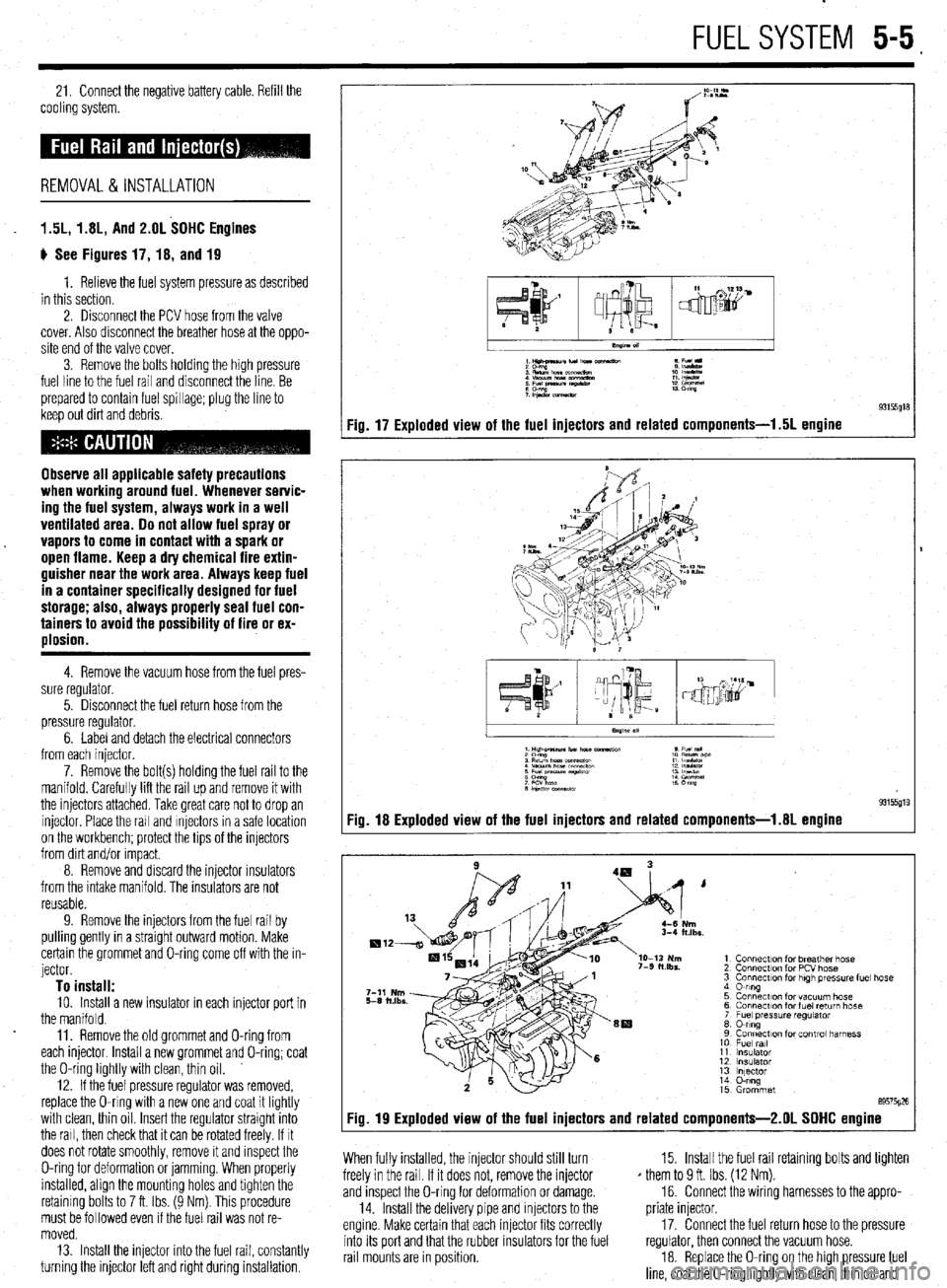
ti See Figures 17, 18, and 19
1. Relieve the fuel system pressure as described
in this section.
2. Disconnect the PCV hose from the valve
cover. Also disconnect the breather hose at the oppo-
site end of the valve cover.
3. Remove the bolts holding the high pressure
fuel line to the fuel rail and disconnect the line. Be
prepared to contain fuel spillage; plug the line to
keep out dirt and debris.
Observe all applicable safety precautions
when working around fuel. Whenever servic-
ing the fuel system, always work in a well
ventilated area. 00 not allow fuel spray or
vapors to come in contact with a spark or
open flame. Keep a dry chemical fire extin-
guisher near the work area. Always keep fuel
in a container specifically designed for fuel
storage; also, always properly seal fuel con-
tainers to avoid the possibility of fire or ex-
plosion.
4. Remove the vacuum hose from the fuel pres-
sure regulator.
5. Disconnect the fuel return hose from the
pressure regulator.
6. Label and detach the electrical connectors
from each injector.
7. Remove the bolt(s) holding the fuel rail to the
manifold. Carefully lift the rail up and remove it with
the injectors attached. Take great care not to drop an
injector Place the rail and Injectors in a safe location
on the workbench; protect the tips of the injectors
from dirt and/or Impact.
8. Remove and discard the injector rnsulators
from the intake manifold. The insulators are not
reusable.
9. Remove the injectors from the fuel rail by
pulling gently in a straight outward motion. Make
certain the grommet and O-ring come off with the in-
jector.
To install: 10. Install a new insulator in each injector port in
the manifold.
11. Remove the old grommet and O-ring from
each injector Install a new grommet and O-ring; coat
the O-ring lightly with clean, thin oil.
12. If the fuel pressure regulator was removed,
replace the O-ring with a new one and coat it lightly
with clean, thin oil Insert the regulator straight into
the rail, then check that it can be rotated freely. If It
does not rotate smoothly, remove it and inspect the
O-ring for deformation or jamming. When properly
installed, align the mounting holes and tighten the
retaining bolts to 7 ft. Ibs. (9 Nm). This procedure
must be followed even if the fuel rail was not re-
moved.
13. Install the injector into the fuel rail, constantly
turning the injector left and right during installation.
1Hilt4naunfu(norc e Fu(l
:E%!,,.,.- 1: IEE
: Efgz tz!z? :: %%I
;P&.xmeaw 13 m
Fig. 17 Exploded view of the fuel injectors and related components-l .5L engine
I
.xs.
1 Connection for breather hose
2 Connection for PCV hose
3 Connection for high tm?ss”re fuel hose
4 0-ring
5 Connection for vacuum hose
6 Connecr~on for fuel return hose
7 Fuel pressure regulator
8 0-ring
9 Connection for control harness
10 Fuel ml
11 Insulator
12 insulator
13 lnlector
14 O-ring
15 Grommet
89575026
Fig. 19 Exploded view of the fuel injectors and related components-2.01 SOHC engine
When fully installed, the injector should still turn
freely in the rail. If it does not, remove the injector
and inspect the O-ring for deformation or damage.
14. Install the delivery pipe and injectors to the
engine. Make certain that each injector fits correctly
into its port and that the rubber insulators for the fuel
rail mounts are in position. 15. Install the fuel rail retaining bolts and tighten
* them to 9 ft. Ibs. (12 Nm).
16. Connect the wiring harnesses to the appro-
priate injector.
17. Connect the fuel return hose to the pressure
regulator, then connect the vacuum hose.
18. Replace the O-ring on the high pressure fuel
line, coat the O-ring lightly with clean, thin oil and
Page 193 of 408
install the line to the fuel rail. Tighten the mounting
bolts,
19. Attach the PCV hose and the breather hose if
thev were disconnected.
20. Connect the negative battery cable. Pressur-
ize the fuel system and inspect all connections for
I
leaks.
1.6L and 2.01 DOHC Engines
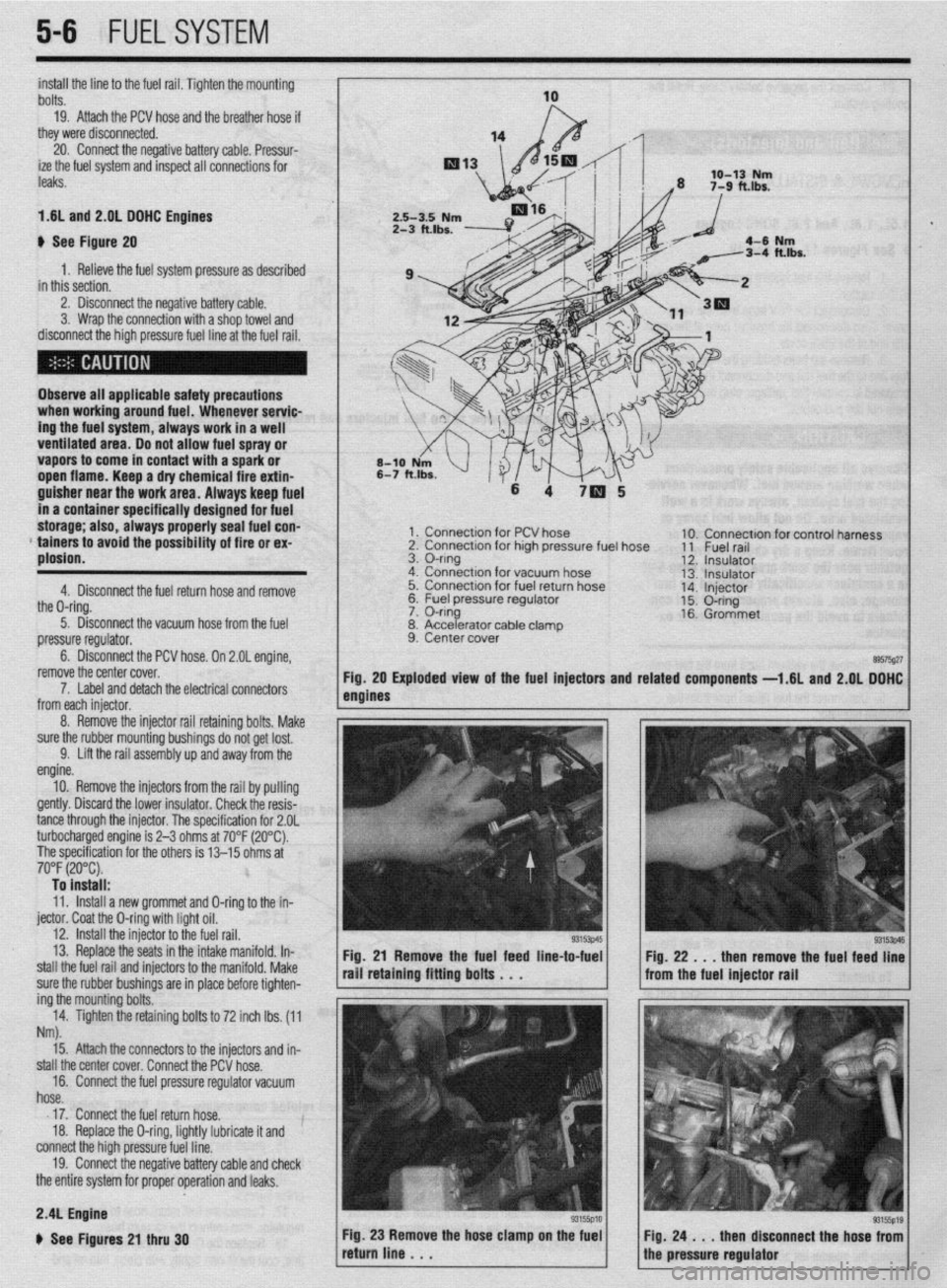
b See Figure 20
1. Relieve the fuel system pressure as described
in this section.
2. Disconnect the negative battery cable.
3. Wrap the connection with a shop towel and
disconnect the high pressure fuel line at the fuel rail.
Observe all applicable safety precautions
when working around fuel. Whenever servic-
ing the fuel system, always work in a well
ventilated area. Do not allow fuel spray or
vapors to come in contact with a spark or
open flame. Keep a dry chemical fire extin-
guisher near the work area. Always keep fuel
in a container specifically designed for fuel
storage; also, always properly seal fuel con-
* tainers to avoid the possibility of fire or ex-
plosion.
4. Disconnect the fuel return hose and remove
the O-ring.
5. Disconnect the vacuum hose from the fuel
pressure regulator.
6. Disconnect the PCV hose. On 2.OL engine,
remove the center cover.
1 x Connection for PCV hose
2. Connection for high pressure fuel hose
3. O-ring
4. Connection for vacuum hose
5. Connection for fuel return hose
&2 I=, 1c.1 nrncc*.ra regu,ator
lble clamD
7. Label and detach the electrical connectors
from each iniector.
8. Accelerator ca
9. Center cover . 10. Connection for control harness
11 Fuel rail
12. Insulator
13. Insulator
14. Injector
15. O-ring
16. Grommet
89575g27 Exploded view of the fuel injectors and related
components -1.6L and 2.QL DOHC
5-6 FUELSYSTEM
8. Remove the injector rail retaining bolts, Make
sure the rubber mounting bushings do not get lost.
9. Lift the rail assembly up and away from the
engine.
10. Remove the injectors from the rail by pulling
gently. Discard the lower insulator. Check the resis-
tance through the injector. The specification for 2.OL
turbocharged engine is 2-3 ohms at 70°F (20°C).
The specification for the others is 13-15 ohms at
70°F (20°C). To install:
11. Install a new grommet and O-ring to the in-
jector. Coat the O-ring with light oil.
12. install the injector to the fuel rail.
13. Replace the seats in the intake manifold. In-
stall the fuel rail and injectors to the manifold. Make
sure the rubber bushings are in place before tighten-
ing the mounting bolts.
14. Tighten the retaining bolts to 72 inch lbs. (11
Nm).
Fig. 21 Remove the fuel feed line-to-fuel
rail retaining fitting bolts . . .
15. Attach the connectors to the injectors and in-
stall the center cover. Connect the PCV hose.
16. Connect the fuel pressure regulator vacuum
hose.
17. Connect the fuel return hose.
18. Replace the O-ring, lightly lubricate it and
connect the high pressure fuel line.
19. Connect the negative battery cable and check
the entire system for proper operation and leaks. Fig. 22 . . . then remove the fuel feed line
from the fuel injector rail
2.4L Engine
b See Figures 21 thru 30