Gear MITSUBISHI LANCER 2005 Workshop Manual
[x] Cancel search | Manufacturer: MITSUBISHI, Model Year: 2005, Model line: LANCER, Model: MITSUBISHI LANCER 2005Pages: 788, PDF Size: 45.98 MB
Page 8 of 788

GENERAL INFORMATION
ENGINE LUBRICATION12-2
GENERAL INFORMATION
M1121000100357
The lubrication method is a fully force-fed, full-flow
filtration type. The engine oil pump is a trochoid type
which is driven by the crankshaft <4G1>.The engine
oil pump is a gear type which is driven by the
crankshaft via the balancer timing belt <4G6>.
ENGINE OILS
Health Warning
Prolonged and repeated contact with mineral oil will
result in the removal of natural fats from the skin,
leading to dryness, irritation and dermatitis. In
addition, used engine oil contains potentially harmful
contaminants which may cause skin cancer.
Adequate means of skin protection and washing
facilities must be provided.
Recommended Precautions
The most effective precaution is to adapt working
practices which prevent, as far as practicable, the
risk of skin contact with mineral oils, for example by
using enclosed systems for handling used engine oil
and by degreasing components, where practicable,
before handling them. Other precautions:
•Avoid prolonged and repeated contact with oils,
particularly used engine oils.
•Wear protective clothing, including impervious
gloves where practicable.•Avoid contaminating clothes, particularly
underpants, with oil.
•Do not put oily rags in pockets, the use of overalls
without pockets will avoid this.
•Do not wear heavily soiled clothing and
oil-impregnated foot-wear. Overalls must be
cleaned regularly and kept separate from
personal clothing.
•Where there is a risk of eye contact, eye
protection should be worn, for example, chemical
goggles or face shields; in addition an eye wash
facility should be provided.
•Obtain first aid treatment immediately for open
cuts and wounds.
•Wash regularly with soap and water to ensure all
oil is removed, especially before meals (skin
cleansers and nail brushes will help). After
cleaning, the application of preparations
containing lanolin to replace the natural skin oils
is advised.
•Do not use petrol, kerosine, diesel fuel, gas oil,
thinners or solvents for cleaning skin.
•Use barrier creams, applying them before each
work period, to help the removal of oil from the
skin after work.
•If skin disorders develop, obtain medical advice
without delay.
SERVICE SPECIFICATION
M1121000300232
LUBRICANT
M1121000400433
Item Standard value
Oil pressure kPa at idle 29 or more
at 3,500 r/min 294 − 686
Item Specification
Engine oil ACEA classification A1, A2 or A3
Engine oil API classification SG or higher
Engine oil quantity L 4G1 Oil filter 0.3
To t a l 3 . 3
4G6 Oil filter 0.3
To t a l 4 . 3
Page 83 of 788
STARTING SYSTEM
ENGINE ELECTRICAL16-19
STARTING SYSTEM
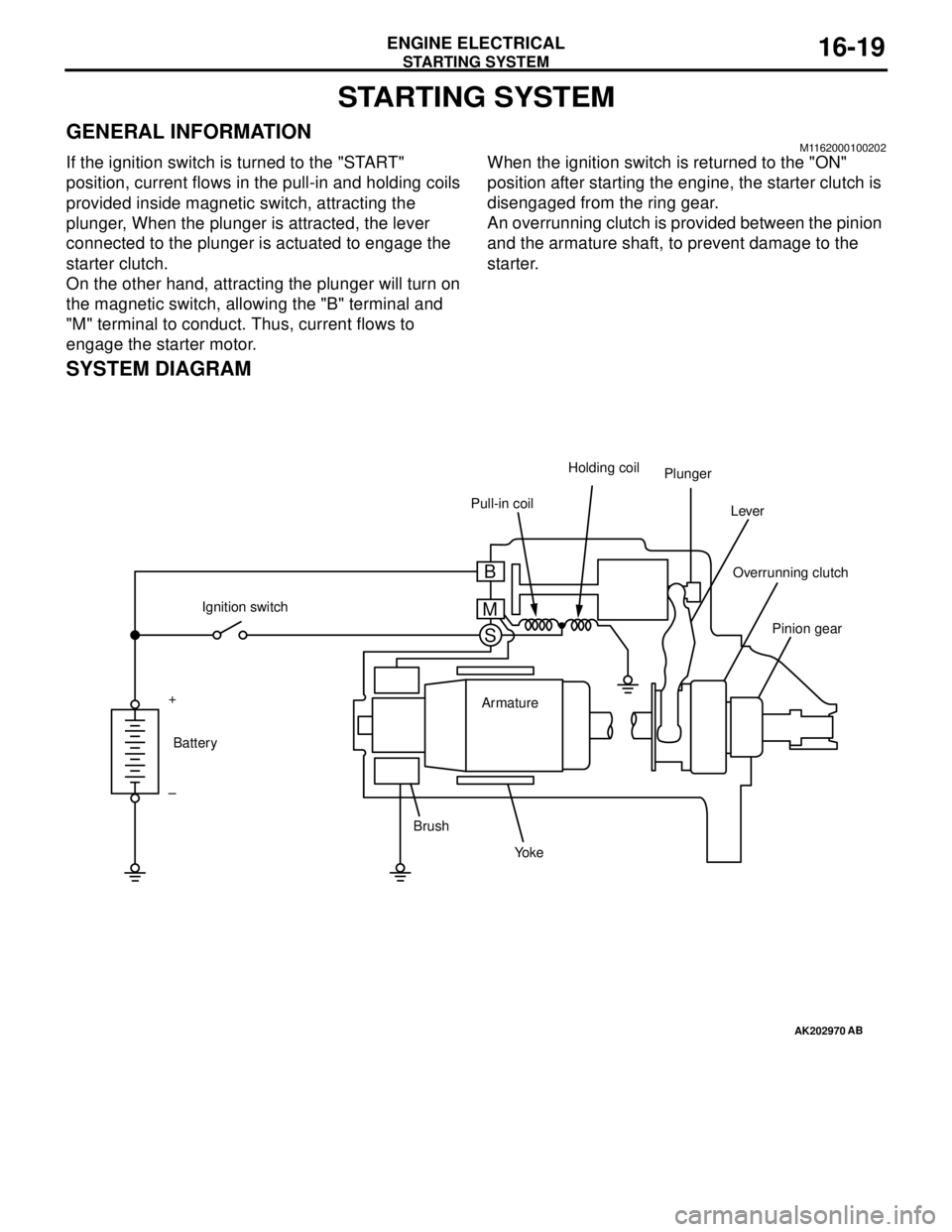
GENERAL INFORMATIONM1162000100202
If the ignition switch is turned to the "START"
position, current flows in the pull-in and holding coils
provided inside magnetic switch, attracting the
plunger, When the plunger is attracted, the lever
connected to the plunger is actuated to engage the
starter clutch.
On the other hand, attracting the plunger will turn on
the magnetic switch, allowing the "B" terminal and
"M" terminal to conduct. Thus, current flows to
engage the starter motor.When the ignition switch is returned to the "ON"
position after starting the engine, the starter clutch is
disengaged from the ring gear.
An overrunning clutch is provided between the pinion
and the armature shaft, to prevent damage to the
starter.
SYSTEM DIAGRAM
AK202970
Pull-in coilHolding coil
Plunger
Lever
Pinion gear Overrunning clutch
Yo k e BrushArmature Ignition switch
Battery +
–
AB
B
M
S
Page 84 of 788

STARTING SYSTEM
ENGINE ELECTRICAL16-20
STARTER MOTOR SPECIFICATIONS
SERVICE SPECIFICATIONS
M1162000300068
Item 4G1 4G6
Type Reduction drive with planetary
gearReduction drive with planetary gear
Rated output kW/V 1.2/12 1.4/12
Number of pinion teeth 8 8
Item Standard value Limit
Pinion gap mm 0.5 − 2.0
−
Commutator run-out mm
−0.05
Commutator diameter mm 29.4 28.8
Undercut depth mm 0.5 0.2
Page 90 of 788
STARTING SYSTEM
ENGINE ELECTRICAL16-26
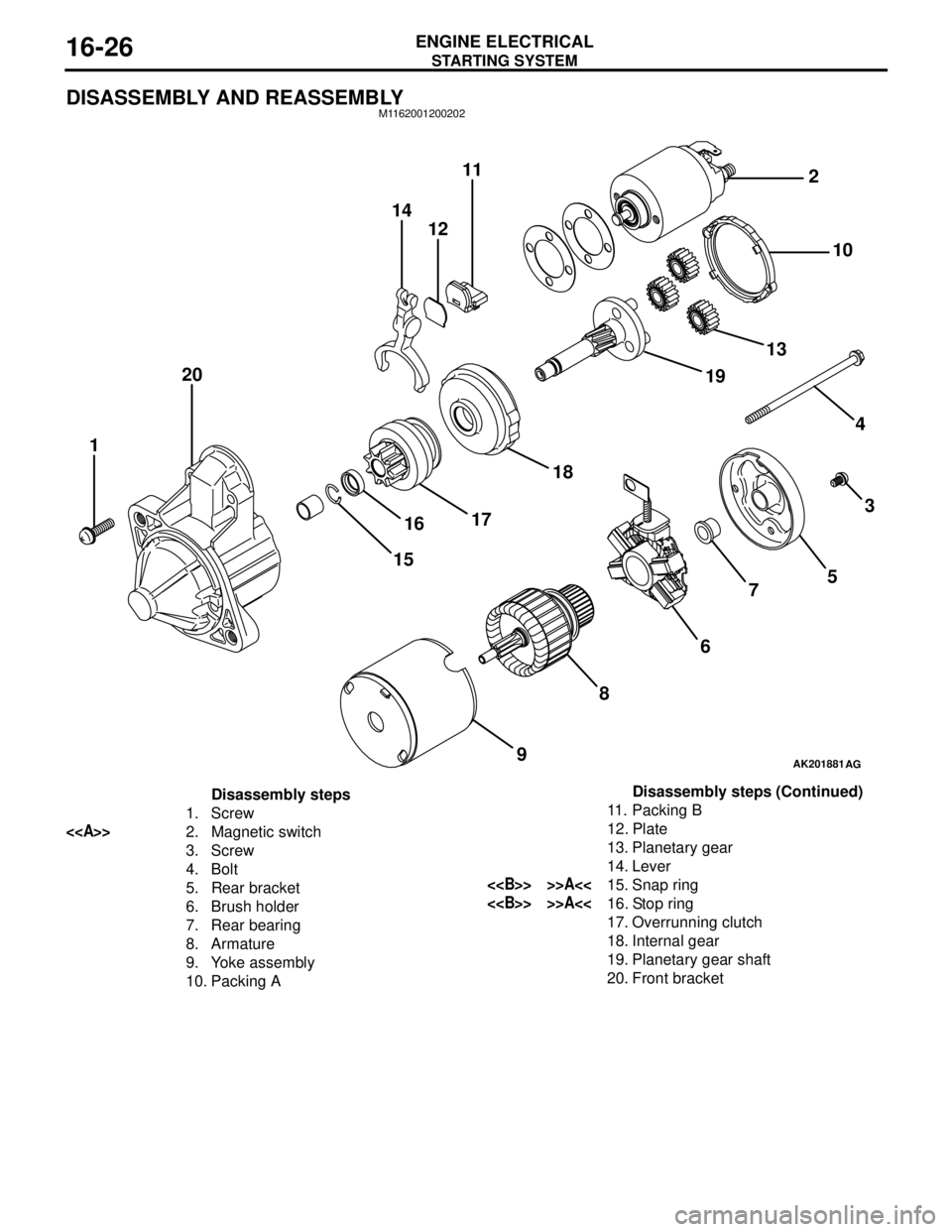
DISASSEMBLY AND REASSEMBLYM1162001200202
AK201881
14
1211
20
1
15161718191310 2
4
3
5
7
6
8
9
AG
Disassembly steps
1. Screw
<>2. Magnetic switch
3. Screw
4. Bolt
5. Rear bracket
6. Brush holder
7. Rear bearing
8. Armature
9. Yoke assembly
10. Packing A11. Packing B
12. Plate
13. Planetary gear
14. Lever
<> >>A<<15. Snap ring
<> >>A<<16. Stop ring
17. Overrunning clutch
18. Internal gear
19. Planetary gear shaft
20. Front bracketDisassembly steps (Continued)
Page 91 of 788
Page 94 of 788
IGNITION SYSTEM
ENGINE ELECTRICAL16-30
IGNITION SYSTEM
GENERAL INFORMATIONM1163000100294
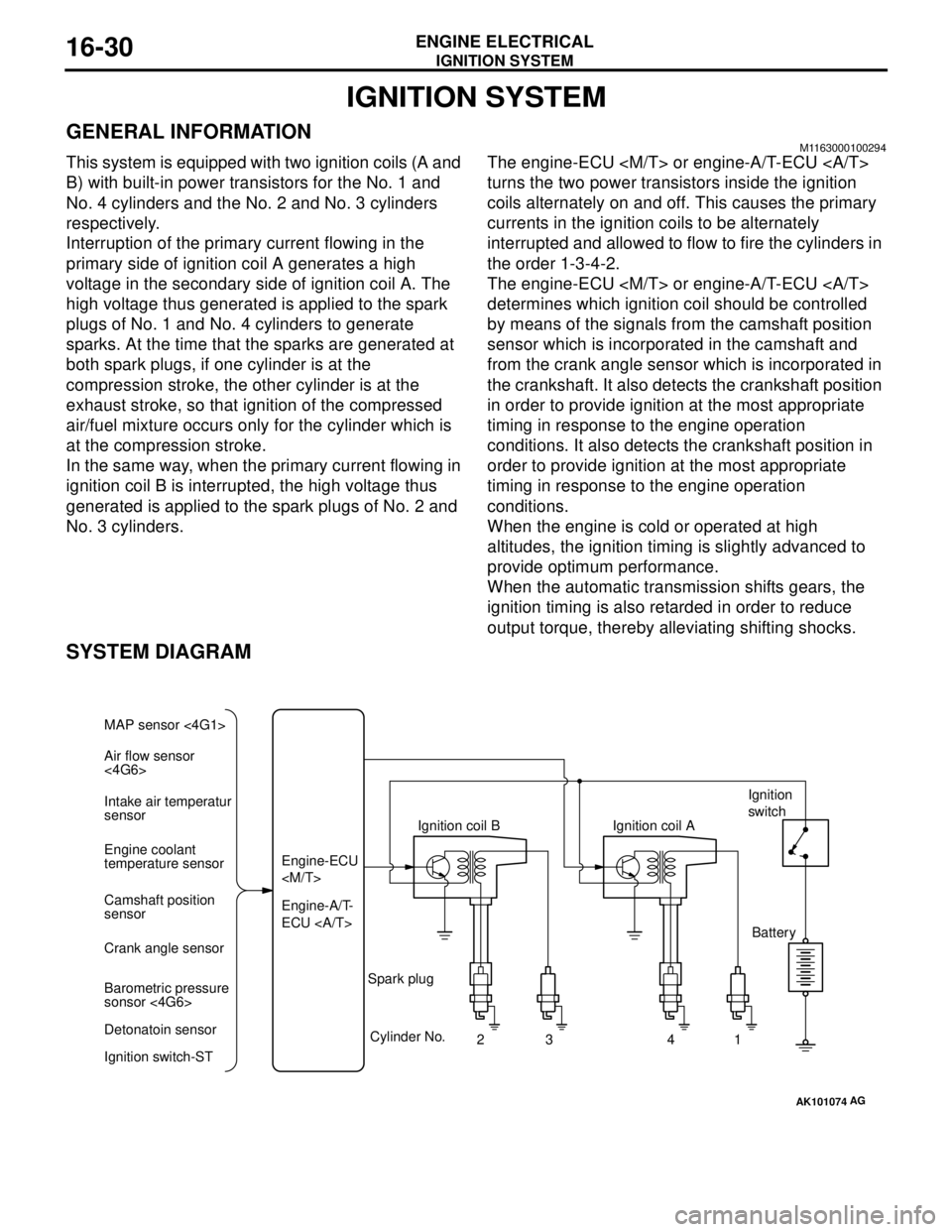
This system is equipped with two ignition coils (A and
B) with built-in power transistors for the No. 1 and
No. 4 cylinders and the No. 2 and No. 3 cylinders
respectively.
Interruption of the primary current flowing in the
primary side of ignition coil A generates a high
voltage in the secondary side of ignition coil A. The
high voltage thus generated is applied to the spark
plugs of No. 1 and No. 4 cylinders to generate
sparks. At the time that the sparks are generated at
both spark plugs, if one cylinder is at the
compression stroke, the other cylinder is at the
exhaust stroke, so that ignition of the compressed
air/fuel mixture occurs only for the cylinder which is
at the compression stroke.
In the same way, when the primary current flowing in
ignition coil B is interrupted, the high voltage thus
generated is applied to the spark plugs of No. 2 and
No. 3 cylinders.The engine-ECU
turns the two power transistors inside the ignition
coils alternately on and off. This causes the primary
currents in the ignition coils to be alternately
interrupted and allowed to flow to fire the cylinders in
the order 1-3-4-2.
The engine-ECU
determines which ignition coil should be controlled
by means of the signals from the camshaft position
sensor which is incorporated in the camshaft and
from the crank angle sensor which is incorporated in
the crankshaft. It also detects the crankshaft position
in order to provide ignition at the most appropriate
timing in response to the engine operation
conditions. It also detects the crankshaft position in
order to provide ignition at the most appropriate
timing in response to the engine operation
conditions.
When the engine is cold or operated at high
altitudes, the ignition timing is slightly advanced to
provide optimum performance.
When the automatic transmission shifts gears, the
ignition timing is also retarded in order to reduce
output torque, thereby alleviating shifting shocks.
SYSTEM DIAGRAM
AK101074
Air flow sensor
<4G6> MAP sensor <4G1>
Intake air temperatur
sensor
Engine coolant
temperature sensor
Camshaft position
sensor
Crank angle sensor
Barometric pressure
sonsor <4G6>
Detonatoin sensor
Ignition switch-STEngine-A/T-
ECU Engine-ECU
Cylinder No.
23 4
AG
1 Spark plugIgnition coil AIgnition
switch
Battery
Page 134 of 788
GENERAL INFORMATION
FRONT AXLE26-2
GENERAL INFORMATION
M1261000100347
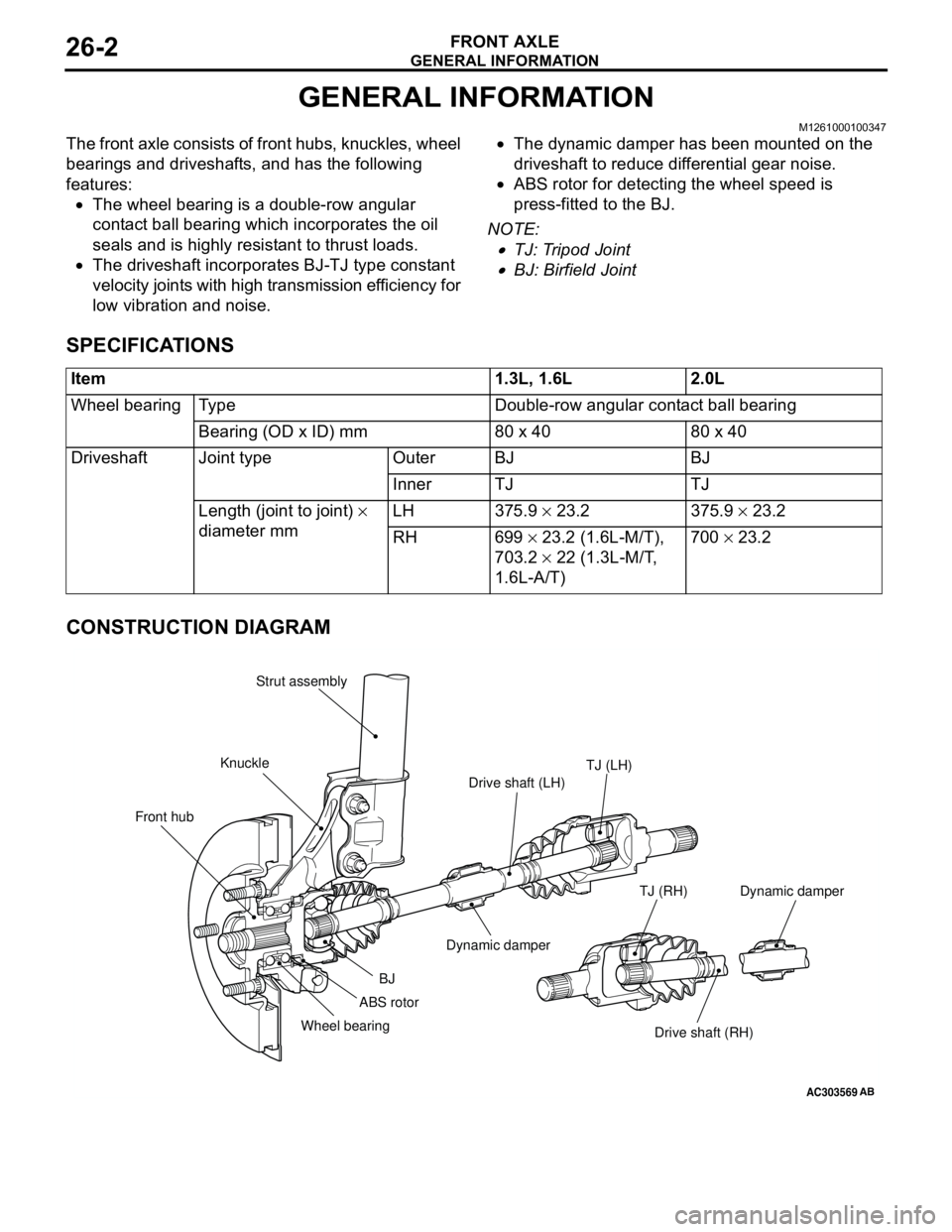
The front axle consists of front hubs, knuckles, wheel
bearings and driveshafts, and has the following
features:
•The wheel bearing is a double-row angular
contact ball bearing which incorporates the oil
seals and is highly resistant to thrust loads.
•The driveshaft incorporates BJ-TJ type constant
velocity joints with high transmission efficiency for
low vibration and noise.•The dynamic damper has been mounted on the
driveshaft to reduce differential gear noise.
•ABS rotor for detecting the wheel speed is
press-fitted to the BJ.
NOTE: .
•TJ: Tripod Joint
•BJ: Birfield Joint
SPECIFICATIONS
CONSTRUCTION DIAGRAM
Item 1.3L, 1.6L 2.0L
Wheel bearing Type Double-row angular contact ball bearing
Bearing (OD x ID) mm 80 x 40 80 x 40
Driveshaft Joint type Outer BJ BJ
Inner TJ TJ
Length (joint to joint) ×
diameter mm LH 375.9 × 23.2 375.9 × 23.2
RH 699 × 23.2 (1.6L-M/T),
703.2 × 22 (1.3L-M/T,
1.6L-A/T)700 × 23.2
AC303569
Front hubKnuckleStrut assembly
TJ (LH)
Drive shaft (LH)
Dynamic damper
BJ
Wheel bearing
Drive shaft (RH) TJ (RH)
AB
ABS rotorDynamic damper
Page 179 of 788
CROSSMEMBER
POWER PLANT MOUNT32-9
AC304000
108 ± 10 N·m 25 ± 4 N·m 18 ± 2 N·m
70 ± 10 N·m
21 ± 4 N·m 21 ± 4 N·m
186 ± 10 N·m*
167 ± 9 N·m
49 ± 10 N·m 52 ± 7 N·m*45 ± 5 N·m*
70 ± 10 N·m57 ± 7 N·m 12 ± 2 N·m
5
4 10
9 11
8
12
1413 6
716
15
172
3
1
N
N
N
2 11
AB
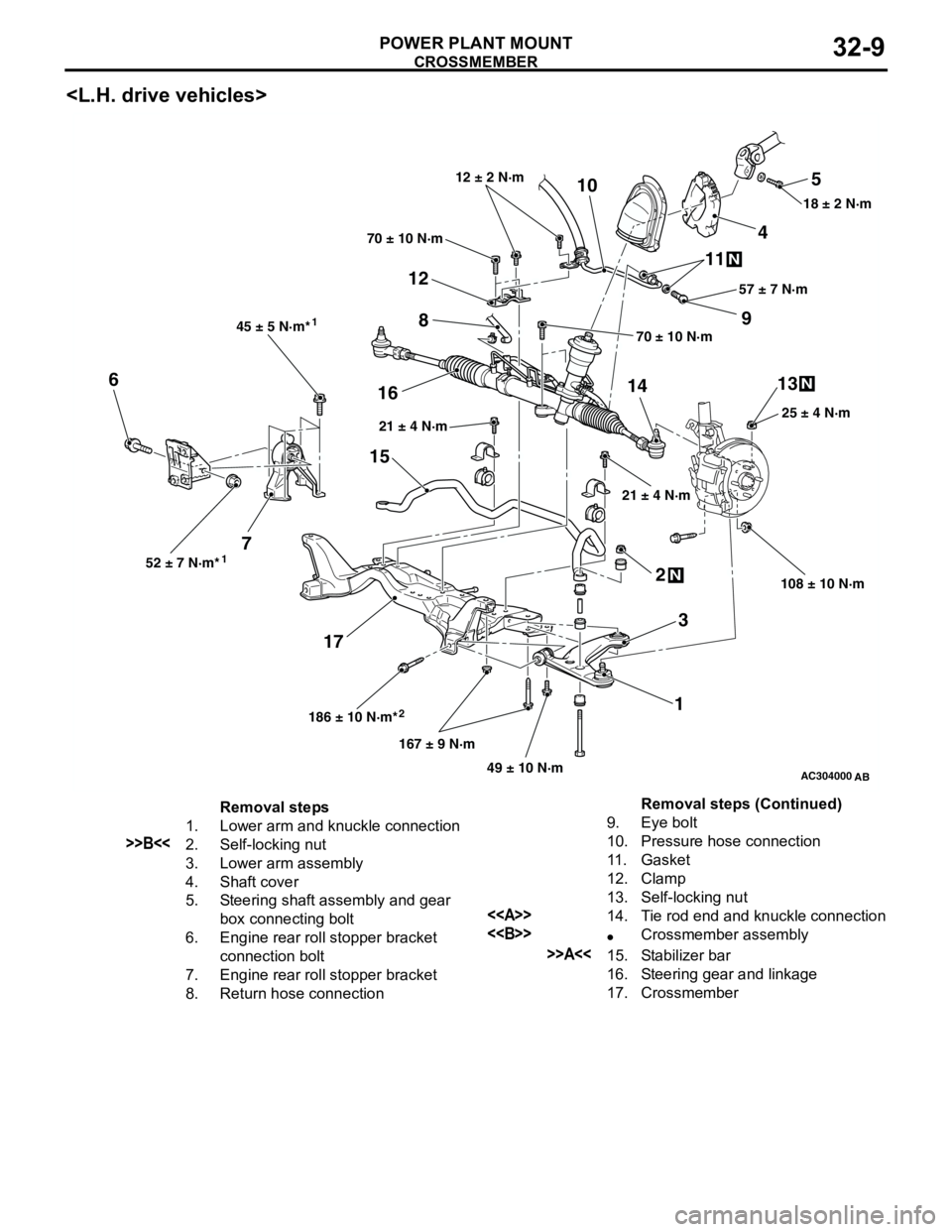
Removal steps
1. Lower arm and knuckle connection
>>B<<2. Self-locking nut
3. Lower arm assembly
4. Shaft cover
5. Steering shaft assembly and gear
box connecting bolt
6. Engine rear roll stopper bracket
connection bolt
7. Engine rear roll stopper bracket
8. Return hose connection9. Eye bolt
10. Pressure hose connection
11. Gasket
12. Clamp
13. Self-locking nut
<>14. Tie rod end and knuckle connection
<>•Crossmember assembly
>>A<<15. Stabilizer bar
16. Steering gear and linkage
17. CrossmemberRemoval steps (Continued)
Page 180 of 788
CROSSMEMBER
POWER PLANT MOUNT32-10
AC101614
12
3 4 5
678
9
10 11
12
131415
16
45 ± 5 N·m*¹
52 ± 7 N·m*¹
186 ± 10 N·m*²
167 ± 9 N·m
49 ± 10 N·m108 ± 10 N·m 25 ± 4 N·m
21 ± 4 N·m 70 ± 10 N·m 5.0 ± 1.0 N·m 18 ± 2 N·m 57 ± 7 N·m
N
N
N
AE
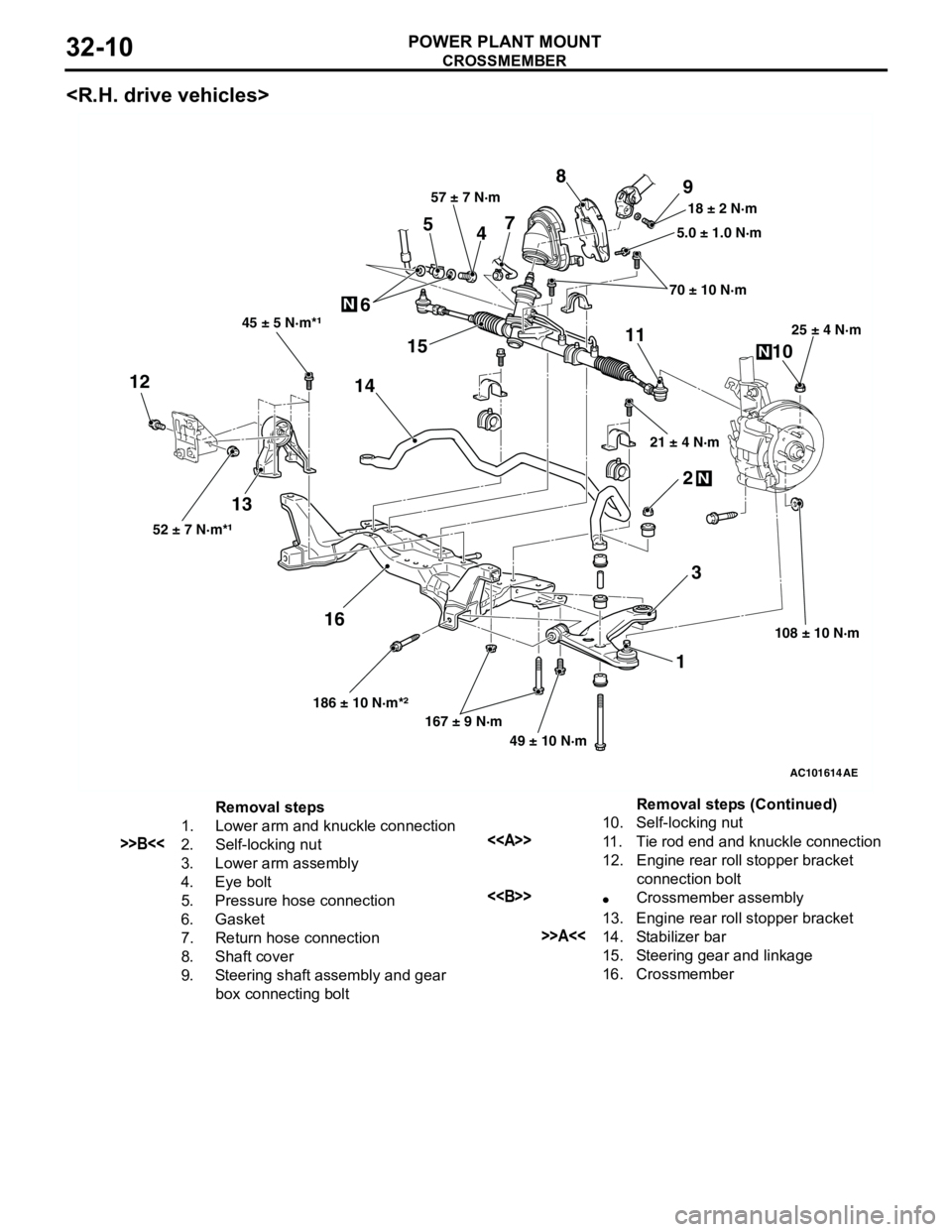
Removal steps
1. Lower arm and knuckle connection
>>B<<2. Self-locking nut
3. Lower arm assembly
4. Eye bolt
5. Pressure hose connection
6. Gasket
7. Return hose connection
8. Shaft cover
9. Steering shaft assembly and gear
box connecting bolt10. Self-locking nut<>11. Tie rod end and knuckle connection
12. Engine rear roll stopper bracket
connection bolt
<>•Crossmember assembly
13. Engine rear roll stopper bracket
>>A<<14. Stabilizer bar
15. Steering gear and linkage
16. CrossmemberRemoval steps (Continued)
Page 181 of 788