relay NISSAN NAVARA 2005 Repair Owners Manual
[x] Cancel search | Manufacturer: NISSAN, Model Year: 2005, Model line: NAVARA, Model: NISSAN NAVARA 2005Pages: 3171, PDF Size: 49.59 MB
Page 2043 of 3171
![NISSAN NAVARA 2005 Repair Owners Manual LAN-266
[CAN]
CAN SYSTEM (TYPE 15)
Case 16
Check IPDM E/R ignition relay circuit continuously sticks “OFF”. Refer toLAN-304, "IPDM E/R Ignition Relay
Circuit Inspection".
Case 17
Check IPDM E/R ig](/img/5/57362/w960_57362-2042.png "NISSAN NAVARA 2005 Repair Owners Manual LAN-266
[CAN]
CAN SYSTEM (TYPE 15)
Case 16
Check IPDM E/R ignition relay circuit continuously sticks “OFF”. Refer toLAN-304, \"IPDM E/R Ignition Relay
Circuit Inspection\".
Case 17
Check IPDM E/R ig")
LAN-266
[CAN]
CAN SYSTEM (TYPE 15)
Case 16
Check IPDM E/R ignition relay circuit continuously sticks “OFF”. Refer toLAN-304, "IPDM E/R Ignition Relay
Circuit Inspection".
Case 17
Check IPDM E/R ignition relay circuit continuously sticks “ON”. Refer toLAN-304, "IPDM E/R Ignition Relay
Circuit Inspection".
PKIC1615E
PKIC1616E
Page 2055 of 3171
![NISSAN NAVARA 2005 Repair Owners Manual LAN-278
[CAN]
CAN SYSTEM (TYPE 16)
Case 10
Check IPDM E/R ignition relay circuit continuously sticks “OFF”. Refer toLAN-304, "IPDM E/R Ignition Relay
Circuit Inspection".
Case 11
Check IPDM E/R ig](/img/5/57362/w960_57362-2054.png "NISSAN NAVARA 2005 Repair Owners Manual LAN-278
[CAN]
CAN SYSTEM (TYPE 16)
Case 10
Check IPDM E/R ignition relay circuit continuously sticks “OFF”. Refer toLAN-304, \"IPDM E/R Ignition Relay
Circuit Inspection\".
Case 11
Check IPDM E/R ig")
LAN-278
[CAN]
CAN SYSTEM (TYPE 16)
Case 10
Check IPDM E/R ignition relay circuit continuously sticks “OFF”. Refer toLAN-304, "IPDM E/R Ignition Relay
Circuit Inspection".
Case 11
Check IPDM E/R ignition relay circuit continuously sticks “ON”. Refer toLAN-304, "IPDM E/R Ignition Relay
Circuit Inspection".
PKIC1968E
PKIC1969E
Page 2068 of 3171
![NISSAN NAVARA 2005 Repair Owners Manual CAN SYSTEM (TYPE 17)
LAN-291
[CAN]
C
D
E
F
G
H
I
J
L
MA
B
LAN
Case 11
Check IPDM E/R ignition relay circuit continuously sticks “OFF”. Refer toLAN-304, "IPDM E/R Ignition Relay
Circuit Inspection"](/img/5/57362/w960_57362-2067.png "NISSAN NAVARA 2005 Repair Owners Manual CAN SYSTEM (TYPE 17)
LAN-291
[CAN]
C
D
E
F
G
H
I
J
L
MA
B
LAN
Case 11
Check IPDM E/R ignition relay circuit continuously sticks “OFF”. Refer toLAN-304, \"IPDM E/R Ignition Relay
Circuit Inspection\"")
CAN SYSTEM (TYPE 17)
LAN-291
[CAN]
C
D
E
F
G
H
I
J
L
MA
B
LAN
Case 11
Check IPDM E/R ignition relay circuit continuously sticks “OFF”. Refer toLAN-304, "IPDM E/R Ignition Relay
Circuit Inspection".
Case 12
Check IPDM E/R ignition relay circuit continuously sticks “ON”. Refer toLAN-304, "IPDM E/R Ignition Relay
Circuit Inspection".
PKIC1980E
PKIC1981E
Page 2081 of 3171
![NISSAN NAVARA 2005 Repair Owners Manual LAN-304
[CAN]
TROUBLE DIAGNOSIS FOR SYSTEM
3.CHECK HARNESS FOR SHORT CIRCUIT
Check continuity between data link connector M45 terminals 6, 14
and ground.
OK or NG
OK >> GO TO 4.
NG >>
lRepair harness.](/img/5/57362/w960_57362-2080.png "NISSAN NAVARA 2005 Repair Owners Manual LAN-304
[CAN]
TROUBLE DIAGNOSIS FOR SYSTEM
3.CHECK HARNESS FOR SHORT CIRCUIT
Check continuity between data link connector M45 terminals 6, 14
and ground.
OK or NG
OK >> GO TO 4.
NG >>
lRepair harness.")
LAN-304
[CAN]
TROUBLE DIAGNOSIS FOR SYSTEM
3.CHECK HARNESS FOR SHORT CIRCUIT
Check continuity between data link connector M45 terminals 6, 14
and ground.
OK or NG
OK >> GO TO 4.
NG >>
lRepair harness.
lChange harness if shielded lines are used for the har-
ness.
4.ECM AND IPDM E/R INTERNAL CIRCUIT INSPECTION
1. Remove ECM and IPDM E/R from vehicle.
2. Check resistance between ECM terminals.
3. Check resistance between IPDM E/R terminals.
OK or NG
OK >> GO TO 5.
NG >> Replace ECM and/or IPDM E/R.
5.CHECK SYMPTOM
1. Fill in described symptoms on the column “Symptom” in the check sheet.
2. Connect all connectors, and then make sure that the symptom is reproduced.
OK or NG
OK >> GO TO 6.
NG >> Refer toLAN-13, "
Example of Filling in Check Sheet When Initial Conditions Are Not Reproduced"
.
6.UNIT REPRODUCIBILITY INSPECTION
Perform the following procedure for each unit on the CAN network, and then perform reproducibility test.
1. Turn ignition switch OFF.
2. Disconnect the battery cable from the negative terminal.
3. Disconnect the unit connector.
4. Connect the battery cable to the negative terminal.
5. Make sure that the symptom filled in the “Symptom” of the check sheet is reproduced. (Do not confuse it
with the symptom related to removed unit.)
6. Make sure that the same symptom is reproduced.
Inspection results
Reproduced>>Install removed unit, and then check the other unit.
Not reproduced>>Replace removed unit.
IPDM E/R Ignition Relay Circuit InspectionEKS00O5C
Check the following. If no malfunction is found, replace the IPDM E/R.
lIPDM E/R power supply circuit. Refer toPG-24, "Check IPDM E/R Power Supply and Ground Circuit". 6 – Ground : Continuity should not exist.
14 – Ground : Continuity should not exist.
PKIA9872E
Terminal Resistance (Approx.)
95 87 108 – 132W
Terminal Resistance (Approx.)
39 40 108 – 132W
LKIA0037E
Page 2088 of 3171
HEADLAMP -CONVENTIONAL TYPE-
LT-5
C
D
E
F
G
H
I
J
L
MA
B
LT
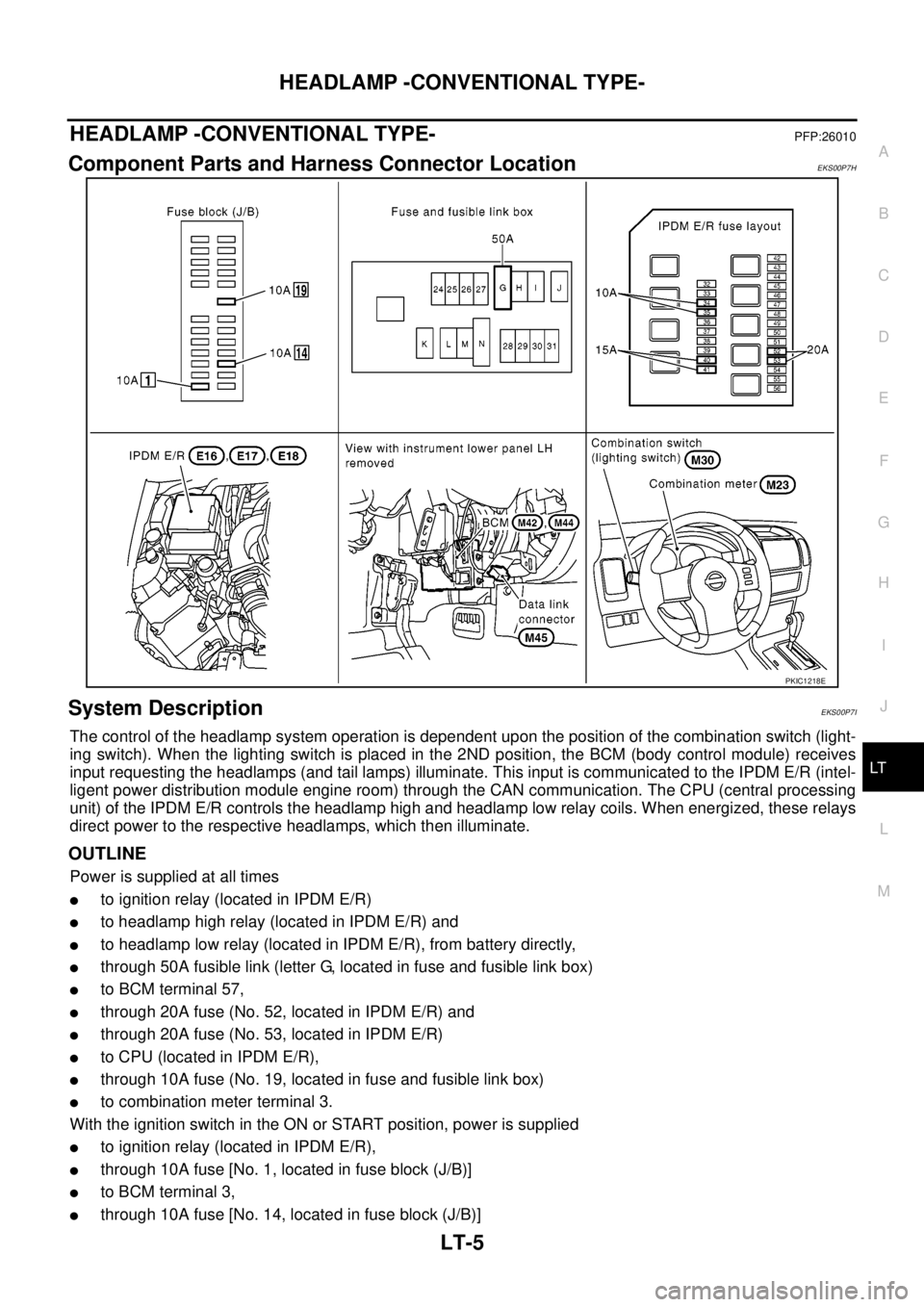
HEADLAMP -CONVENTIONAL TYPE-PFP:26010
Component Parts and Harness Connector LocationEKS00P7H
System DescriptionEKS00P7I
The control of the headlamp system operation is dependent upon the position of the combination switch (light-
ing switch). When the lighting switch is placed in the 2ND position, the BCM (body control module) receives
input requesting the headlamps (and tail lamps) illuminate. This input is communicated to the IPDM E/R (intel-
ligent power distribution module engine room) through the CAN communication. The CPU (central processing
unit) of the IPDM E/R controls the headlamp high and headlamp low relay coils. When energized, these relays
direct power to the respective headlamps, which then illuminate.
OUTLINE
Power is supplied at all times
lto ignition relay (located in IPDM E/R)
lto headlamp high relay (located in IPDM E/R) and
lto headlamp low relay (located in IPDM E/R), from battery directly,
lthrough 50A fusible link (letter G, located in fuse and fusible link box)
lto BCM terminal 57,
lthrough 20A fuse (No. 52, located in IPDM E/R) and
lthrough 20A fuse (No. 53, located in IPDM E/R)
lto CPU (located in IPDM E/R),
lthrough 10A fuse (No. 19, located in fuse and fusible link box)
lto combination meter terminal 3.
With the ignition switch in the ON or START position, power is supplied
lto ignition relay (located in IPDM E/R),
lthrough 10A fuse [No. 1, located in fuse block (J/B)]
lto BCM terminal 3,
lthrough 10A fuse [No. 14, located in fuse block (J/B)]
PKIC1218E
Page 2089 of 3171

LT-6
HEADLAMP -CONVENTIONAL TYPE-
lto combination meter terminal 16.
Ground is supplied at all times
lto BCM terminal 55 and
lto combination meter terminal 23
lthrough grounds M21, M80 and M83,
lto IPDM E/R terminals 38 and 59
lthrough grounds E21, E41 and E61.
Low Beam Operation
With the lighting switch in 2ND position, the BCM receives input requesting the headlamps to illuminate. This
input is communicated to the IPDM E/R through the CAN communication. The CPU of the IPDM E/R controls
the headlamp low relay coil. When energized, this relay directs power
lthrough 15A fuse (No. 41, located in IPDM E/R)
lthrough IPDM E/R terminal 54
lto front combination lamp RH terminal 1,
lthrough 15A fuse (No. 40, located in IPDM E/R)
lthrough IPDM E/R terminal 52
lto front combination lamp LH terminal 1.
Ground is supplied
lto front combination lamp RH and LH terminals 3
lthrough grounds E21, E41 and E61.
With power and ground supplied, low beam headlamps illuminate.
High Beam Operation/Flash-to-Pass Operation
With the lighting switch in 2ND position and placed in HIGH or PASS position, the BCM receives input request-
ing the headlamp high beams to illuminate. This input is communicated to the IPDM E/R through the CAN
communication. The CPU of the IPDM E/R controls the headlamp high relay coil. When energized, this relay
directs power
lthrough 10A fuse (No. 34, located in IPDM E/R)
lthrough IPDM E/R terminal 56
lto front combination lamp RH terminal 2,
lthrough 10A fuse (No. 35, located in IPDM E/R)
lthrough IPDM E/R terminal 55
lto front combination lamp LH terminal 2.
Ground is supplied
lto front combination lamp RH and LH terminals 3
lthrough grounds E21, E41 and E61.
With power and ground supplied, the high beam headlamps illuminate.
Combination meter that received high beam request signal by BCM through the CAN communication makes a
high beam indicator lamp turn on in combination meter.
FRIENDLY LIGHTING FUNCTION
This function starts timer function of BCM by operating passing switch, and illuminates headlamps (LOW
beam) for a given length of time.
Headlamps (LOW beam) stay ON for a given length of time by operating passing switch when ignition switch is
OFF and lighting switch is OFF.
Headlamps (LOW beam) stays ON for two minutes at a maximum by operating passing switch repeatedly.
CONSULT-II is capable of setting a lighting time. Refer toLT- 1 6 , "
WORK SUPPORT".
CAN Communication System DescriptionEKS00P7J
Refer toLAN-23, "CAN COMMUNICATION".
Page 2100 of 3171
HEADLAMP -CONVENTIONAL TYPE-
LT-17
C
D
E
F
G
H
I
J
L
MA
B
LT
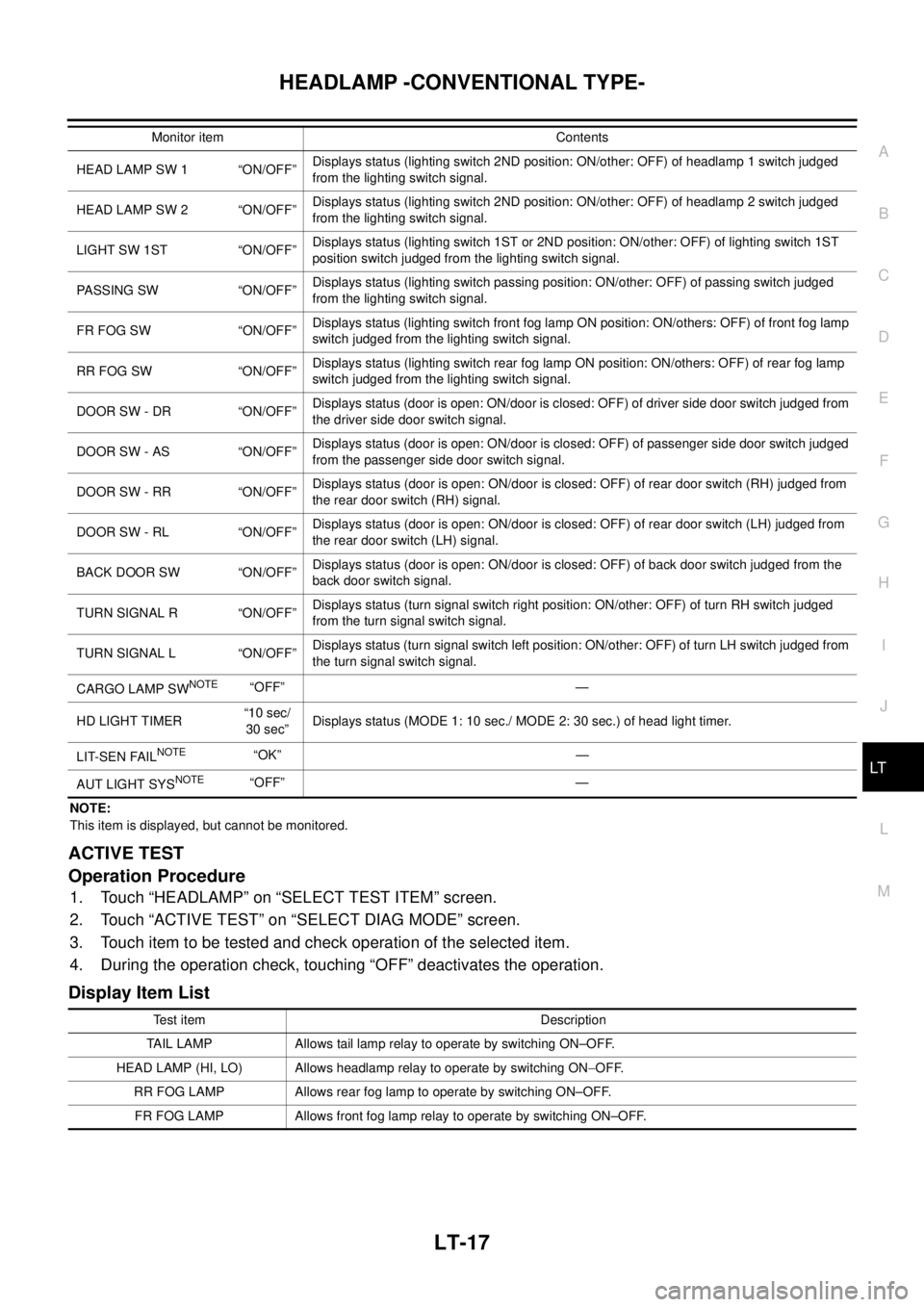
NOTE:
This item is displayed, but cannot be monitored.
ACTIVE TEST
Operation Procedure
1. Touch “HEADLAMP” on “SELECT TEST ITEM” screen.
2. Touch “ACTIVE TEST” on “SELECT DIAG MODE” screen.
3. Touch item to be tested and check operation of the selected item.
4. During the operation check, touching “OFF” deactivates the operation.
Display Item List
HEAD LAMP SW 1 “ON/OFF”Displays status (lighting switch 2ND position: ON/other: OFF) of headlamp 1 switch judged
from the lighting switch signal.
HEAD LAMP SW 2 “ON/OFF”Displays status (lighting switch 2ND position: ON/other: OFF) of headlamp 2 switch judged
from the lighting switch signal.
LIGHT SW 1ST “ON/OFF”Displays status (lighting switch 1ST or 2ND position: ON/other: OFF) of lighting switch 1ST
position switch judged from the lighting switch signal.
PASSING SW “ON/OFF”Displays status (lighting switch passing position: ON/other: OFF) of passing switch judged
from the lighting switch signal.
FR FOG SW “ON/OFF”Displays status (lighting switch front fog lamp ON position: ON/others: OFF) of front fog lamp
switch judged from the lighting switch signal.
RR FOG SW “ON/OFF”Displays status (lighting switch rear fog lamp ON position: ON/others: OFF) of rear fog lamp
switch judged from the lighting switch signal.
DOOR SW - DR “ON/OFF”Displays status (door is open: ON/door is closed: OFF) of driver side door switch judged from
the driver side door switch signal.
DOOR SW - AS “ON/OFF”Displays status (door is open: ON/door is closed: OFF) of passenger side door switch judged
from the passenger side door switch signal.
DOOR SW - RR “ON/OFF”Displays status (door is open: ON/door is closed: OFF) of rear door switch (RH) judged from
the rear door switch (RH) signal.
DOOR SW - RL “ON/OFF”Displays status (door is open: ON/door is closed: OFF) of rear door switch (LH) judged from
the rear door switch (LH) signal.
BACK DOOR SW “ON/OFF”Displays status (door is open: ON/door is closed: OFF) of back door switch judged from the
back door switch signal.
TURN SIGNAL R “ON/OFF”Displays status (turn signal switch right position: ON/other: OFF) of turn RH switch judged
from the turn signal switch signal.
TURN SIGNAL L “ON/OFF”Displays status (turn signal switch left position: ON/other: OFF) of turn LH switch judged from
the turn signal switch signal.
CARGO LAMP SW
NOTE“OFF” —
HD LIGHT TIMER“10 sec/
30 sec”Displays status (MODE 1: 10 sec./ MODE 2: 30 sec.) of head light timer.
LIT-SEN FAIL
NOTE“OK” —
AUT LIGHT SYS
NOTE“OFF” — Monitor item Contents
Test item Description
TAIL LAMP Allows tail lamp relay to operate by switching ON–OFF.
HEAD LAMP (HI, LO) Allows headlamp relay to operate by switching ON-OFF.
RR FOG LAMP Allows rear fog lamp to operate by switching ON–OFF.
FR FOG LAMP Allows front fog lamp relay to operate by switching ON–OFF.
Page 2103 of 3171
LT-20
HEADLAMP -CONVENTIONAL TYPE-
Headlamp High Beam Does Not Illuminate (Both Sides)
EKS00P7S
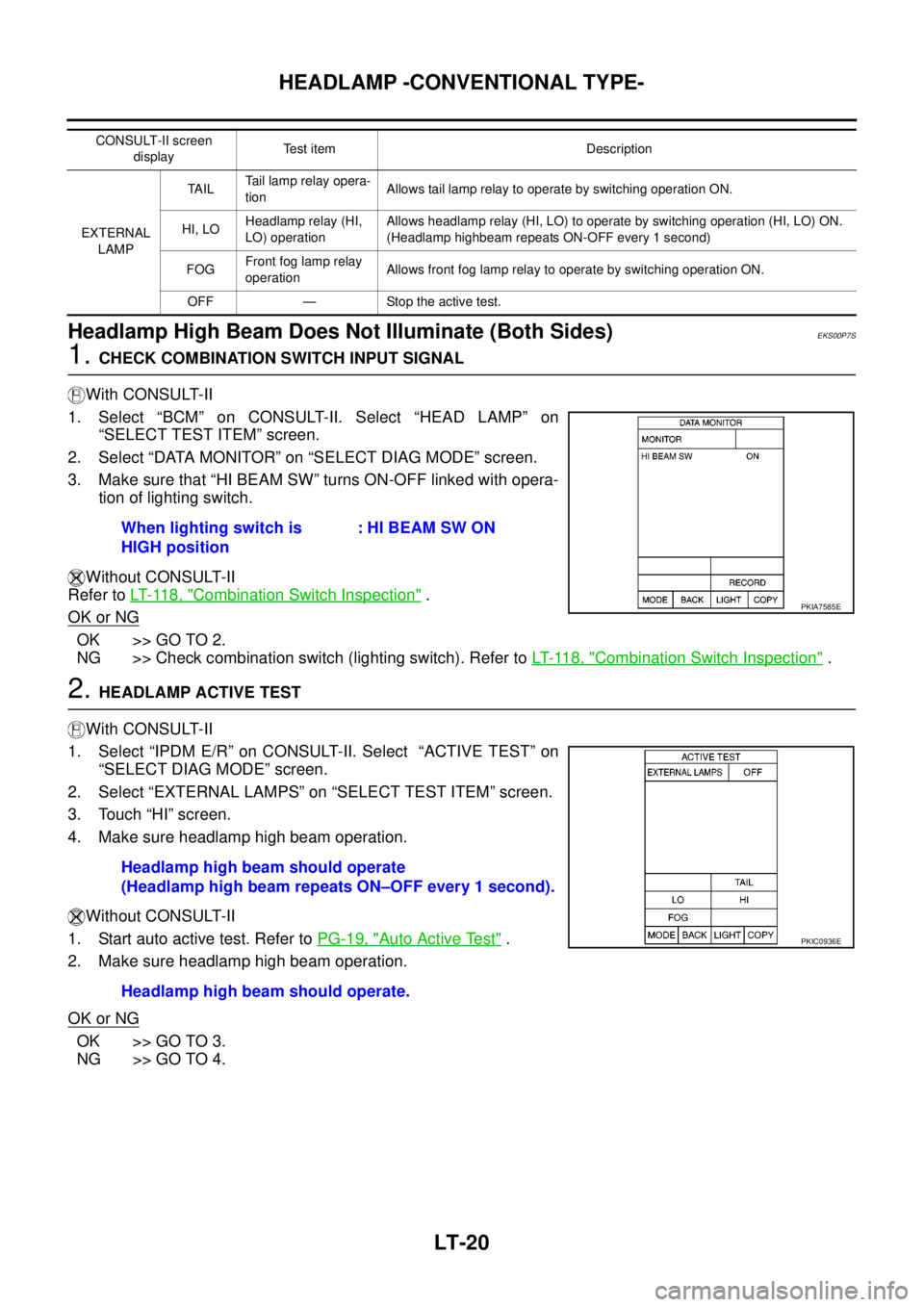
1.CHECK COMBINATION SWITCH INPUT SIGNAL
With CONSULT-II
1. Select “BCM” on CONSULT-II. Select “HEAD LAMP” on
“SELECT TEST ITEM” screen.
2. Select “DATA MONITOR” on “SELECT DIAG MODE” screen.
3. Make sure that “HI BEAM SW” turns ON-OFF linked with opera-
tion of lighting switch.
Without CONSULT-II
Refer toLT- 11 8 , "
Combination Switch Inspection".
OK or NG
OK >> GO TO 2.
NG >> Check combination switch (lighting switch). Refer toLT- 11 8 , "
Combination Switch Inspection".
2.HEADLAMP ACTIVE TEST
With CONSULT-II
1. Select “IPDM E/R” on CONSULT-II. Select “ACTIVE TEST” on
“SELECT DIAG MODE” screen.
2. Select “EXTERNAL LAMPS” on “SELECT TEST ITEM” screen.
3. Touch “HI” screen.
4. Make sure headlamp high beam operation.
Without CONSULT-II
1. Start auto active test. Refer toPG-19, "
Auto Active Test".
2. Make sure headlamp high beam operation.
OK or NG
OK >> GO TO 3.
NG >> GO TO 4.
CONSULT-II screen
displayTest item Description
EXTERNAL
LAMPTA I LTail lamp relay opera-
tionAllows tail lamp relay to operate by switching operation ON.
HI, LOHeadlamp relay (HI,
LO) operationAllows headlamp relay (HI, LO) to operate by switching operation (HI, LO) ON.
(Headlamp highbeam repeats ON-OFF every 1 second)
FOGFront fog lamp relay
operationAllows front fog lamp relay to operate by switching operation ON.
OFF — Stop the active test.
When lighting switch is
HIGH position: HI BEAM SW ON
PKIA7585E
Headlamp high beam should operate
(Headlamp high beam repeats ON–OFF every 1 second).
Headlamp high beam should operate.
PKIC0936E
Page 2114 of 3171
HEADLAMP - DAYTIME LIGHT SYSTEM -
LT-31
C
D
E
F
G
H
I
J
L
MA
B
LT
HEADLAMP - DAYTIME LIGHT SYSTEM -PFP:26010
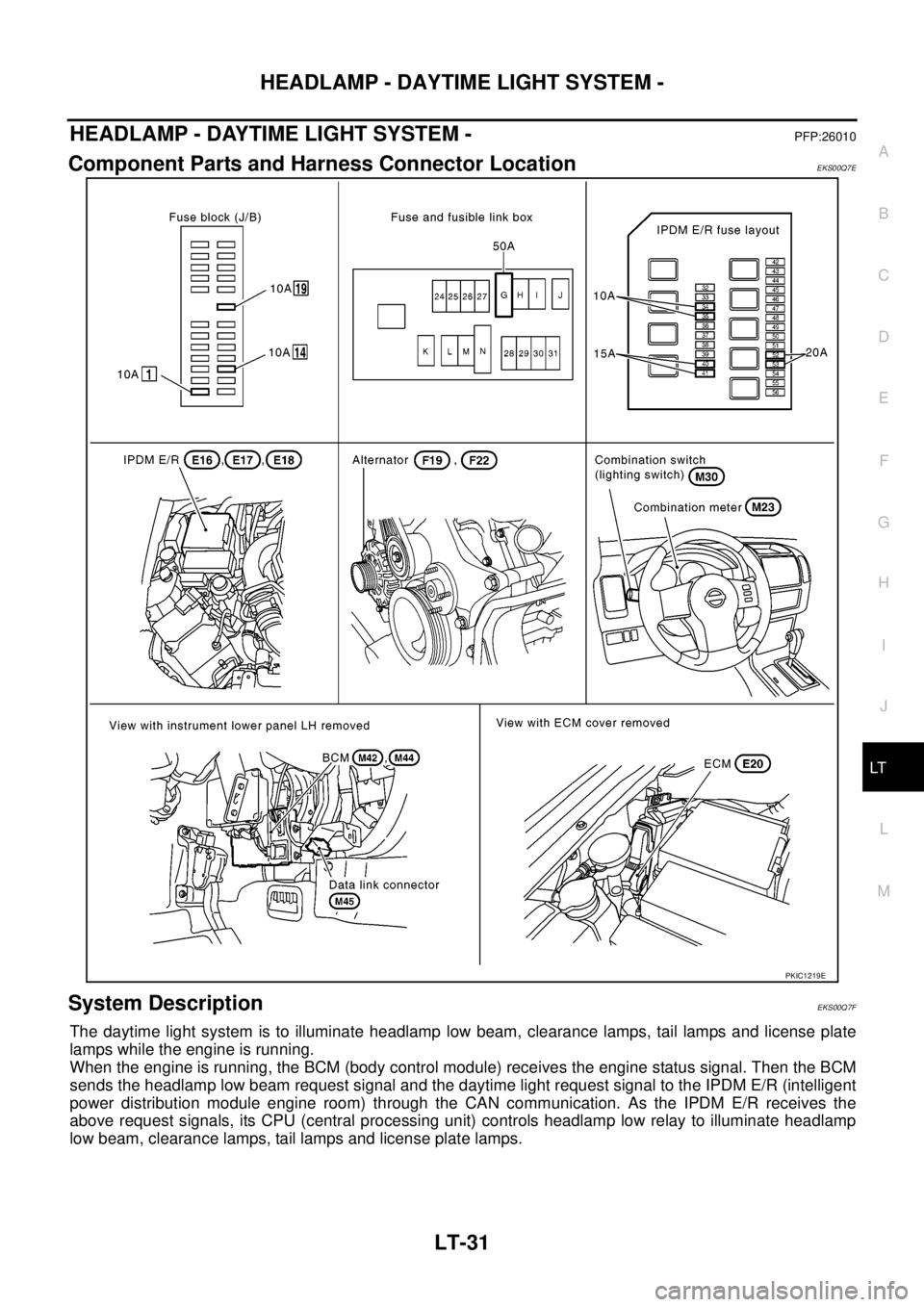
Component Parts and Harness Connector LocationEKS00Q7E
System DescriptionEKS00Q7F
The daytime light system is to illuminate headlamp low beam, clearance lamps, tail lamps and license plate
lamps while the engine is running.
When the engine is running, the BCM (body control module) receives the engine status signal. Then the BCM
sends the headlamp low beam request signal and the daytime light request signal to the IPDM E/R (intelligent
power distribution module engine room) through the CAN communication. As the IPDM E/R receives the
above request signals, its CPU (central processing unit) controls headlamp low relay to illuminate headlamp
low beam, clearance lamps, tail lamps and license plate lamps.
PKIC1219E
Page 2115 of 3171

LT-32
HEADLAMP - DAYTIME LIGHT SYSTEM -
OUTLINE
Power is supplied at all times
lto ignition relay (located in IPDM E/R)
lto headlamp high relay (located in IPDM E/R) and
lto headlamp low relay (located in IPDM E/R), from battery directly,
lthrough 50A fusible link (letter G, located in fuse and fusible link box)
lto BCM terminal 57,
lthrough 20A fuse (No. 52, located in IPDM E/R) and
lthrough 20A fuse (No. 53, located in IPDM E/R)
lto CPU (located in IPDM E/R),
lthrough 10A fuse [No. 19, located in fuse block (J/B)]
lto combination meter terminal 3.
With the ignition switch in the ON or START position, power is supplied
lto ignition relay (located in IPDM E/R),
lthrough 10A fuse [No. 1, located in fuse block (J/B)]
lto BCM terminal 3,
lthrough 10A fuse [No. 14, located in fuse block (J/B)]
lto combination meter terminal 16.
Ground is supplied at all times
lto BCM terminal 55 and
lto combination meter terminal 23
lthrough grounds M21, M80 and M83,
lto IPDM E/R terminals 38 and 59
lthrough grounds E21, E41 and E61.
DAYTIME LIGHT OPERATION
With the lighting switch in the OFF position and engine running, the BCM receives input signal requesting
headlamp low beam, clearance lamp, license plate lamp, and tail lamp to illuminate. This input signal is com-
municated to the IPDM E/R through the CAN communication. The CPU located in the IPDM E/R controls
headlamp low relay.
lthrough 15A fuse (No. 41, located in IPDM E/R)
lthrough IPDM E/R terminal 54
lto front combination lamp RH terminal 1,
lthrough 15A fuse (No. 40, located in IPDM E/R)
lthrough IPDM E/R terminal 52
lto front combination lamp LH terminal 1.
Ground is supplied at all times
lto front combination lamp RH and LH terminals 3
lthrough grounds E21, E41 and E61.
With power and ground supplied, the headlamp low beam, clearance, license plate and tail lamps illuminate.