ESP NISSAN TEANA 2008 Owners Manual
[x] Cancel search | Manufacturer: NISSAN, Model Year: 2008, Model line: TEANA, Model: NISSAN TEANA 2008Pages: 5121, PDF Size: 69.03 MB
Page 3429 of 5121
![NISSAN TEANA 2008 Owners Manual PCS-38
< FUNCTION DIAGNOSIS >[POWER DISTRIBUTION SYSTEM]
POWER DISTRIBUTION SYSTEM
FUNCTION DIAGNOSIS
POWER DISTRIBUTION SYSTEM
System DescriptionINFOID:0000000003805720
PDS (POWER DISTRIBUTION SYST](/img/5/57391/w960_57391-3428.png "NISSAN TEANA 2008 Owners Manual PCS-38
< FUNCTION DIAGNOSIS >[POWER DISTRIBUTION SYSTEM]
POWER DISTRIBUTION SYSTEM
FUNCTION DIAGNOSIS
POWER DISTRIBUTION SYSTEM
System DescriptionINFOID:0000000003805720
PDS (POWER DISTRIBUTION SYST")
PCS-38
< FUNCTION DIAGNOSIS >[POWER DISTRIBUTION SYSTEM]
POWER DISTRIBUTION SYSTEM
FUNCTION DIAGNOSIS
POWER DISTRIBUTION SYSTEM
System DescriptionINFOID:0000000003805720
PDS (POWER DISTRIBUTION SYSTEM) is the system that BCM controls with the operation of the push-
button ignition switch and performs the power distribution to each power circuit. This system is used instead
of the mechanical power supply changing mechanism with the operation of the conventional key cylinder.
The push-button ignition switch can be operated when Intelligent Key is in the following condition. Refer to
Engine Start Function for details.
- Intelligent Key is in the detection area of the inside key antenna
- Insert Intelligent Key into the key slot
- Insert key fob into the key slot
The push-button ignition switch operation is input to BCM as a signal. BCM changes the power supply posi-
tion according to the status and operates the following relays to supply power to each power circuit.
- Ignition relay (built into IPDM E/R)
- Ignition relay (inserted into fuse block)
- ACC relay
- Blower fan relay
NOTE:
The engine switch operation changes due to the conditions of brake pedal, selector lever and vehicle speed.
The power supply position can be confirmed with the illuminating of the indicators around the push-button
ignition switch.
BATTERY SAVER SYSTEM
When all of the following conditions are met for 60 minutes, the battery saver system will cut off the power sup-
ply to prevent battery discharge.
The ignition switch is in the ACC position
All doors are closed
Selector lever is in the P position
Reset Condition of Battery Saver System
In order to prevent the battery from discharging, the battery saver system will cut off the power supply when all
doors are closed, the selector lever is in the P position and the ignition switch is left in the ACC position for 60
minutes. If any of the following conditions are met the battery saver system is released and the steering will
change automatically to the LOCK position from the OFF position.
Opening any door
Operating with door key cylinder on door lock
Operating with request switch on door lock
Operating with Intelligent Key on door lock
Press push-button ignition switch and ignition switch will change to the ACC position from the OFF position.
STEERING LOCK OPERATION
Steering is locked by steering lock unit when ignition switch is in the OFF position, selector lever is in the P
position and any of the following conditions are met.
Opening door
Closing door
Door is locked with request switch
Door is locked with Intelligent Key
PUSH-BUTTON IGNITION SWITCH OPERATION PROCEDURE
The power supply position changing operation can be performed with the following operations.
Operation Enable Condition
When an Intelligent Key is within the detection area of inside key antenna and when it is inserted into the key
slot, the operation is as per the following.
When starting the engine, the BCM monitors the following engine start conditions,
- Brake pedal operating condition
- Selector lever position
- Vehicle speed
Unless each start condition is fulfilled, the engine will not respond regardless of how many times the engine
switch is pressed. At that time, illumination repeats the position in the order of LOCK→ACC→ON→OFF.
Page 3444 of 5121
![NISSAN TEANA 2008 Owners Manual PCS
B2614 ACC RELAY
PCS-53
< COMPONENT DIAGNOSIS >[POWER DISTRIBUTION SYSTEM]
C
D
E
F
G
H
I
J
K
L B A
O
P N
B2614 ACC RELAY
DescriptionINFOID:0000000003805740
BCM controls the various electrical compo](/img/5/57391/w960_57391-3443.png "NISSAN TEANA 2008 Owners Manual PCS
B2614 ACC RELAY
PCS-53
< COMPONENT DIAGNOSIS >[POWER DISTRIBUTION SYSTEM]
C
D
E
F
G
H
I
J
K
L B A
O
P N
B2614 ACC RELAY
DescriptionINFOID:0000000003805740
BCM controls the various electrical compo")
PCS
B2614 ACC RELAY
PCS-53
< COMPONENT DIAGNOSIS >[POWER DISTRIBUTION SYSTEM]
C
D
E
F
G
H
I
J
K
L B A
O
P N
B2614 ACC RELAY
DescriptionINFOID:0000000003805740
BCM controls the various electrical components and simultaneously supplies power according to the power
supply position.
BCM checks the power supply position internally.
DTC LogicINFOID:0000000003805741
DTC DETECTION LOGIC
DTC CONFIRMATION PROCEDURE
1.PERFORM DTC CONFIRMATION PROCEDURE
1. Turn the power supply position to ACC under the following conditions, and wait for at least 1 second.
- Selector lever is in the P or N position.
- Do not depress brake pedal.
2. Check “Self diagnostic result” with CONSULT-III.
Is DTC detected?
YES >> Go to PCS-53, "Diagnosis Procedure".
NO >> INSPECTION END
Diagnosis ProcedureINFOID:0000000003805742
1.CHECK ACCESSORY RELAY POWER SUPPLY
1. Turn ignition switch OFF.
2. Disconnect accessory relay.
3. Check voltage between accessory relay harness connector and ground.
Is the inspection result normal?
YES >> GO TO 3.
NO >> GO TO 2.
2.CHECK ACCESSORY RELAY POWER SUPPLY CIRCUIT
1. Turn ignition switch OFF.
2. Disconnect BCM connector.
3. Check continuity between accessory relay harness connector and BCM harness connector.
4. Check continuity between accessory relay harness connector and ground.
DTC No.Trouble diagnosis
nameDTC detecting condition Possible cause
B2614 ACC relayAn immediate operation of ACC relay is requested
by BCM, but there is no response for more than 1
second. Harness or connectors
(ACC relay circuit is open or short-
ed)
ACC relay
(+)
(–) ConditionVoltage (V)
(Approx.) Accessory relay
Te r m i n a l
1 Ground Ignition switchOFF 0
ACC Battery voltage
Accessory relay BCM
Continuity
Terminal Connector Terminal
1 M122 95 Existed
Page 3450 of 5121
![NISSAN TEANA 2008 Owners Manual PCS
B2618 BCM
PCS-59
< COMPONENT DIAGNOSIS >[POWER DISTRIBUTION SYSTEM]
C
D
E
F
G
H
I
J
K
L B A
O
P N
B2618 BCM
DescriptionINFOID:0000000003805752
BCM controls the various electrical components and si](/img/5/57391/w960_57391-3449.png "NISSAN TEANA 2008 Owners Manual PCS
B2618 BCM
PCS-59
< COMPONENT DIAGNOSIS >[POWER DISTRIBUTION SYSTEM]
C
D
E
F
G
H
I
J
K
L B A
O
P N
B2618 BCM
DescriptionINFOID:0000000003805752
BCM controls the various electrical components and si")
PCS
B2618 BCM
PCS-59
< COMPONENT DIAGNOSIS >[POWER DISTRIBUTION SYSTEM]
C
D
E
F
G
H
I
J
K
L B A
O
P N
B2618 BCM
DescriptionINFOID:0000000003805752
BCM controls the various electrical components and simultaneously supplies power according to the power
supply position.
BCM checks the power supply position internally.
DTC LogicINFOID:0000000003805753
DTC DETECTION LOGIC
NOTE:
If DTC B2618 is displayed with DTC U1000, first perform the trouble diagnosis for DTC U1000. Refer to
PCS-46, "
BCM : DTC Logic".
If DTC B2618 is displayed with DTC U1010, first perform the trouble diagnosis for DTC U1010. Refer to
PCS-48, "
BCM : DTC Logic".
DTC CONFIRMATION PROCEDURE
1.PERFORM DTC CONFIRMATION PROCEDURE
1. Turn ignition switch ON under the following conditions, and wait for at least 1 second.
- Selector lever is in the P or N position.
- Do not depress brake pedal.
2. Check “Self diagnostic result” with CONSULT-III.
Is DTC detected?
YES >> Go to PCS-59, "Diagnosis Procedure".
NO >> INSPECTION END
Diagnosis ProcedureINFOID:0000000003805754
1.INSPECTION START
1. Turn ignition switch ON.
2. Select “Self diagnostic result” mode with CONSULT-III.
3. Touch “ERASE”.
4.Perform DTC Confirmation Procedure.
See PCS-59, "
DTC Logic".
Is the 1st trip DTC B2618 displayed again?
YES >> Replace BCM. Refer to BCS-78, "Removal and Installation"
NO >> INSPECTION END
DTC No.Trouble diagnosis
nameDTC detecting condition Possible cause
B2618 BCMAn immediate operation of ignition relay (IPDM E/
R) is requested by BCM, but there is no response
for more than 1 secondBCM
Page 3495 of 5121
![NISSAN TEANA 2008 Owners Manual PCS-104
< ECU DIAGNOSIS >[POWER DISTRIBUTION SYSTEM]
BCM (BODY CONTROL MODULE)
HIGH FLASHER OPERATION
BCM detects the turn signal lamp circuit status by the current value.
BCM increases the turn signa](/img/5/57391/w960_57391-3494.png "NISSAN TEANA 2008 Owners Manual PCS-104
< ECU DIAGNOSIS >[POWER DISTRIBUTION SYSTEM]
BCM (BODY CONTROL MODULE)
HIGH FLASHER OPERATION
BCM detects the turn signal lamp circuit status by the current value.
BCM increases the turn signa")
PCS-104
< ECU DIAGNOSIS >[POWER DISTRIBUTION SYSTEM]
BCM (BODY CONTROL MODULE)
HIGH FLASHER OPERATION
BCM detects the turn signal lamp circuit status by the current value.
BCM increases the turn signal lamp blinking speed if the bulb or harness open is detected with the turn signal
lamp operating.
NOTE:
The blinking speed is normal while activating the hazard warning lamp.
DTC Inspection Priority ChartINFOID:0000000003880877
If some DTCs are displayed at the same time, perform inspections one by one based on the following priority
chart.
B2608: STARTER RELAY Inhibit engine cranking500 ms after the following signal communication status becomes
consistent
Starter motor relay control signal
Starter relay status signal (CAN)
B2609: S/L STATUS Inhibit engine cranking
Inhibit steering lockWhen the following steering lock conditions agree
BCM steering lock control status
Steering lock condition No. 1 signal status
Steering lock condition No. 2 signal status
B260A: IGNITION RELAY Inhibit engine cranking500 ms after the following conditions are fulfilled
IGN relay (IPDM E/R) control signal: OFF (Battery voltage)
Ignition ON signal (CAN to IPDM E/R): OFF (Request signal)
Ignition ON signal (CAN from IPDM E/R): OFF (Condition signal)
B260F: ENG STATE SIG LOSTMaintains the power supply
position attained at the time
of DTC detectionWhen any of the following conditions is fulfilled
Power position changes to ACC
Receives engine status signal (CAN)
B2612: S/L STATUS Inhibit engine cranking
Inhibit steering lockWhen any of the following conditions is fulfilled
Steering lock unit status signal (CAN) is received normally
The BCM steering lock control status matches the steering lock
status recognized by the steering lock unit status signal (CAN
from IPDM E/R)
B2617: STARTER RELAY CIRC Inhibit engine cranking1 second after the starter motor relay control inside BCM becomes
normal
B2618: BCM Inhibit engine cranking1 second after the ignition relay (IPDM E/R) control inside BCM be-
comes normal
B2619: BCM Inhibit engine cranking1 second after the steering lock unit power supply output control in-
side BCM becomes normal
B261E: VEHICLE TYPE Inhibit engine cranking BCM initialization
B26E1: ENG STATE NO RES Inhibit engine crankingWhen any of the following conditions is fulfilled
Power position changes to ACC
Receives engine status signal (CAN)
B26E9: S/L STATUS Inhibit engine cranking
Inhibit steering lockWhen BCM transmits the LOCK request signal to steering lock unit,
and receives LOCK response signal from steering lock unit, the fol-
lowing conditions is fulfilled
Steering condition No. 1 signal: LOCK (0 V)
Steering condition No. 2 signal: LOCK (Battery voltage) Display contents of CONSULT Fail-safe Cancellation
Priority DTC
1 B2562: LOW VOLTAGE
2 U1000: CAN COMM CIRCUIT
U1010: CONTROL UNIT (CAN)
3 B2190: NATS ANTENNA AMP
B2191: DIFFERENCE OF KEY
B2192: ID DISCORD BCM-ECM
B2193: CHAIN OF BCM-ECM
Page 3600 of 5121
![NISSAN TEANA 2008 Owners Manual PG-82
< COMPONENT DIAGNOSIS >[POWER SUPPLY&GROUND CIRCUIT]
POWER SUPPLY ROUTING CIRCUIT
Fuse
INFOID:0000000003792666
If fuse is blown, be sure to eliminate cause of malfunction before
installing new](/img/5/57391/w960_57391-3599.png "NISSAN TEANA 2008 Owners Manual PG-82
< COMPONENT DIAGNOSIS >[POWER SUPPLY&GROUND CIRCUIT]
POWER SUPPLY ROUTING CIRCUIT
Fuse
INFOID:0000000003792666
If fuse is blown, be sure to eliminate cause of malfunction before
installing new")
PG-82
< COMPONENT DIAGNOSIS >[POWER SUPPLY&GROUND CIRCUIT]
POWER SUPPLY ROUTING CIRCUIT
Fuse
INFOID:0000000003792666
If fuse is blown, be sure to eliminate cause of malfunction before
installing new fuse.
Use fuse of specified rating. Never use fuse of more than specified
rating.
Do not partially install fuse; always insert it into fuse holder prop-
erly.
Remove fuse for “ELECTRICAL PARTS (BAT)” if vehicle is not
used for a long period of time.
Fusible LinkINFOID:0000000003792667
A melted fusible link can be detected either by visual inspection or by feeling with finger tip. If its condition is
questionable, use circuit tester or test lamp.
CAUTION:
If fusible link should melt, it is possible that critical circuit (power supply or large current carrying
circuit) is shorted. In such a case, carefully check and eliminate cause of malfunction.
Never wrap outside of fusible link with vinyl tape. Important: Never let fusible link touch any other
wiring harness, vinyl or rubber parts.
Circuit BreakerINFOID:0000000003792668
The PTC thermistor generates heat in response to current flow. The
temperature (and resistance) of the thermistor element varies with
current flow. Excessive current flow will cause the element's temper-
ature to rise. When the temperature reaches a specified level, the
electrical resistance will rise sharply to control the circuit current.
Reduced current flow will cause the element to cool. Resistance falls
accordingly and normal circuit current flow is allowed to resume.
CEL083
1. Fusible link
JPMIA1018ZZ
SEL109W
Page 3614 of 5121
![NISSAN TEANA 2008 Owners Manual PG-96
< COMPONENT DIAGNOSIS >[POWER SUPPLY&GROUND CIRCUIT]
HARNESS CONNECTOR
HARNESS CONNECTOR
DescriptionINFOID:0000000003792682
HARNESS CONNECTOR (TAB-LOCKING TYPE)
The tab-locking type connectors](/img/5/57391/w960_57391-3613.png "NISSAN TEANA 2008 Owners Manual PG-96
< COMPONENT DIAGNOSIS >[POWER SUPPLY&GROUND CIRCUIT]
HARNESS CONNECTOR
HARNESS CONNECTOR
DescriptionINFOID:0000000003792682
HARNESS CONNECTOR (TAB-LOCKING TYPE)
The tab-locking type connectors")
PG-96
< COMPONENT DIAGNOSIS >[POWER SUPPLY&GROUND CIRCUIT]
HARNESS CONNECTOR
HARNESS CONNECTOR
DescriptionINFOID:0000000003792682
HARNESS CONNECTOR (TAB-LOCKING TYPE)
The tab-locking type connectors help prevent accidental looseness or disconnection.
The tab-locking type connectors are disconnected by pushing or lifting the locking tab(s). Refer to the figure
below.
CAUTION:
Never pull the harness or wires when disconnecting the connector.
[Example]
HARNESS CONNECTOR (SLIDE-LOCKING TYPE)
A new style slide-locking type connector is used on certain systems and components, especially those
related to OBD.
The slide-locking type connectors help prevent incomplete locking and accidental looseness or disconnec-
tion.
The slide-locking type connectors are disconnected by pushing or pulling the slider. Refer to the figure
below.
SEL769DA
Page 3637 of 5121
POWER WINDOW SYSTEM
PWC-7
< FUNCTION DIAGNOSIS >
C
D
E
F
G
H
I
J
L
MA
B
PWC
N
O
P
FUNCTION DIAGNOSIS
POWER WINDOW SYSTEM
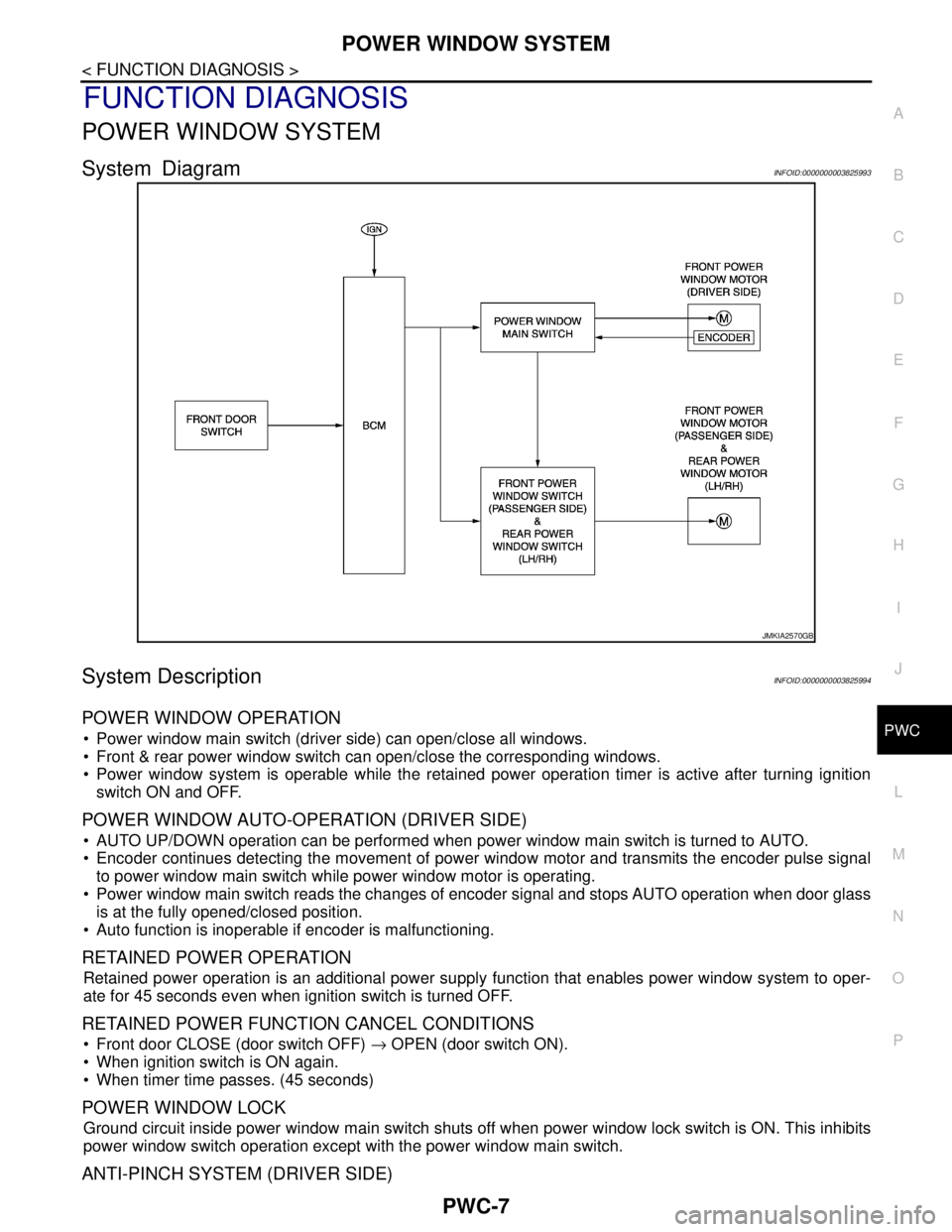
System DiagramINFOID:0000000003825993
System DescriptionINFOID:0000000003825994
POWER WINDOW OPERATION
Power window main switch (driver side) can open/close all windows.
Front & rear power window switch can open/close the corresponding windows.
Power window system is operable while the retained power operation timer is active after turning ignition
switch ON and OFF.
POWER WINDOW AUTO-OPERATION (DRIVER SIDE)
AUTO UP/DOWN operation can be performed when power window main switch is turned to AUTO.
Encoder continues detecting the movement of power window motor and transmits the encoder pulse signal
to power window main switch while power window motor is operating.
Power window main switch reads the changes of encoder signal and stops AUTO operation when door glass
is at the fully opened/closed position.
Auto function is inoperable if encoder is malfunctioning.
RETAINED POWER OPERATION
Retained power operation is an additional power supply function that enables power window system to oper-
ate for 45 seconds even when ignition switch is turned OFF.
RETAINED POWER FUNCTION CANCEL CONDITIONS
Front door CLOSE (door switch OFF) → OPEN (door switch ON).
When ignition switch is ON again.
When timer time passes. (45 seconds)
POWER WINDOW LOCK
Ground circuit inside power window main switch shuts off when power window lock switch is ON. This inhibits
power window switch operation except with the power window main switch.
ANTI-PINCH SYSTEM (DRIVER SIDE)
JMKIA2570GB
Page 3693 of 5121

BCM (BODY CONTROL MODULE)
PWC-63
< ECU DIAGNOSIS >
C
D
E
F
G
H
I
J
L
MA
B
PWC
N
O
P
HIGH FLASHER OPERATION
BCM detects the turn signal lamp circuit status by the current value.
BCM increases the turn signal lamp blinking speed if the bulb or harness open is detected with the turn signal
lamp operating.
NOTE:
The blinking speed is normal while activating the hazard warning lamp.
DTC Inspection Priority ChartINFOID:0000000003888238
If some DTCs are displayed at the same time, perform inspections one by one based on the following priority
chart.
B2608: STARTER RELAY Inhibit engine cranking500 ms after the following signal communication status becomes
consistent
Starter motor relay control signal
Starter relay status signal (CAN)
B2609: S/L STATUS Inhibit engine cranking
Inhibit steering lockWhen the following steering lock conditions agree
BCM steering lock control status
Steering lock condition No. 1 signal status
Steering lock condition No. 2 signal status
B260A: IGNITION RELAY Inhibit engine cranking500 ms after the following conditions are fulfilled
IGN relay (IPDM E/R) control signal: OFF (Battery voltage)
Ignition ON signal (CAN to IPDM E/R): OFF (Request signal)
Ignition ON signal (CAN from IPDM E/R): OFF (Condition signal)
B260F: ENG STATE SIG LOSTMaintains the power supply
position attained at the time
of DTC detectionWhen any of the following conditions is fulfilled
Power position changes to ACC
Receives engine status signal (CAN)
B2612: S/L STATUS Inhibit engine cranking
Inhibit steering lockWhen any of the following conditions is fulfilled
Steering lock unit status signal (CAN) is received normally
The BCM steering lock control status matches the steering lock
status recognized by the steering lock unit status signal (CAN
from IPDM E/R)
B2617: STARTER RELAY CIRC Inhibit engine cranking1 second after the starter motor relay control inside BCM becomes
normal
B2618: BCM Inhibit engine cranking1 second after the ignition relay (IPDM E/R) control inside BCM be-
comes normal
B2619: BCM Inhibit engine cranking1 second after the steering lock unit power supply output control in-
side BCM becomes normal
B261E: VEHICLE TYPE Inhibit engine cranking BCM initialization
B26E1: ENG STATE NO RES Inhibit engine crankingWhen any of the following conditions is fulfilled
Power position changes to ACC
Receives engine status signal (CAN)
B26E9: S/L STATUS Inhibit engine cranking
Inhibit steering lockWhen BCM transmits the LOCK request signal to steering lock unit,
and receives LOCK response signal from steering lock unit, the fol-
lowing conditions is fulfilled
Steering condition No. 1 signal: LOCK (0 V)
Steering condition No. 2 signal: LOCK (Battery voltage) Display contents of CONSULT Fail-safe Cancellation
Priority DTC
1 B2562: LOW VOLTAGE
2 U1000: CAN COMM CIRCUIT
U1010: CONTROL UNIT (CAN)
3 B2190: NATS ANTENNA AMP
B2191: DIFFERENCE OF KEY
B2192: ID DISCORD BCM-ECM
B2193: CHAIN OF BCM-ECM
Page 3782 of 5121

BCM (BODY CONTROL MODULE)
RF-51
< ECU DIAGNOSIS >
C
D
E
F
G
H
I
J
L
MA
B
RF
N
O
P
HIGH FLASHER OPERATION
BCM detects the turn signal lamp circuit status by the current value.
BCM increases the turn signal lamp blinking speed if the bulb or harness open is detected with the turn signal
lamp operating.
NOTE:
The blinking speed is normal while activating the hazard warning lamp.
DTC Inspection Priority ChartINFOID:0000000003888230
If some DTCs are displayed at the same time, perform inspections one by one based on the following priority
chart.
B2608: STARTER RELAY Inhibit engine cranking500 ms after the following signal communication status becomes
consistent
Starter motor relay control signal
Starter relay status signal (CAN)
B2609: S/L STATUS Inhibit engine cranking
Inhibit steering lockWhen the following steering lock conditions agree
BCM steering lock control status
Steering lock condition No. 1 signal status
Steering lock condition No. 2 signal status
B260A: IGNITION RELAY Inhibit engine cranking500 ms after the following conditions are fulfilled
IGN relay (IPDM E/R) control signal: OFF (Battery voltage)
Ignition ON signal (CAN to IPDM E/R): OFF (Request signal)
Ignition ON signal (CAN from IPDM E/R): OFF (Condition signal)
B260F: ENG STATE SIG LOSTMaintains the power supply
position attained at the time
of DTC detectionWhen any of the following conditions is fulfilled
Power position changes to ACC
Receives engine status signal (CAN)
B2612: S/L STATUS Inhibit engine cranking
Inhibit steering lockWhen any of the following conditions is fulfilled
Steering lock unit status signal (CAN) is received normally
The BCM steering lock control status matches the steering lock
status recognized by the steering lock unit status signal (CAN
from IPDM E/R)
B2617: STARTER RELAY CIRC Inhibit engine cranking1 second after the starter motor relay control inside BCM becomes
normal
B2618: BCM Inhibit engine cranking1 second after the ignition relay (IPDM E/R) control inside BCM be-
comes normal
B2619: BCM Inhibit engine cranking1 second after the steering lock unit power supply output control in-
side BCM becomes normal
B261E: VEHICLE TYPE Inhibit engine cranking BCM initialization
B26E1: ENG STATE NO RES Inhibit engine crankingWhen any of the following conditions is fulfilled
Power position changes to ACC
Receives engine status signal (CAN)
B26E9: S/L STATUS Inhibit engine cranking
Inhibit steering lockWhen BCM transmits the LOCK request signal to steering lock unit,
and receives LOCK response signal from steering lock unit, the fol-
lowing conditions is fulfilled
Steering condition No. 1 signal: LOCK (0 V)
Steering condition No. 2 signal: LOCK (Battery voltage) Display contents of CONSULT Fail-safe Cancellation
Priority DTC
1 B2562: LOW VOLTAGE
2 U1000: CAN COMM CIRCUIT
U1010: CONTROL UNIT (CAN)
3 B2190: NATS ANTENNA AMP
B2191: DIFFERENCE OF KEY
B2192: ID DISCORD BCM-ECM
B2193: CHAIN OF BCM-ECM
Page 3802 of 5121
SQUEAK AND RATTLE TROUBLE DIAGNOSES
RF-71
< SYMPTOM DIAGNOSIS >
C
D
E
F
G
H
I
J
L
MA
B
RF
N
O
P
SQUEAK AND RATTLE TROUBLE DIAGNOSES
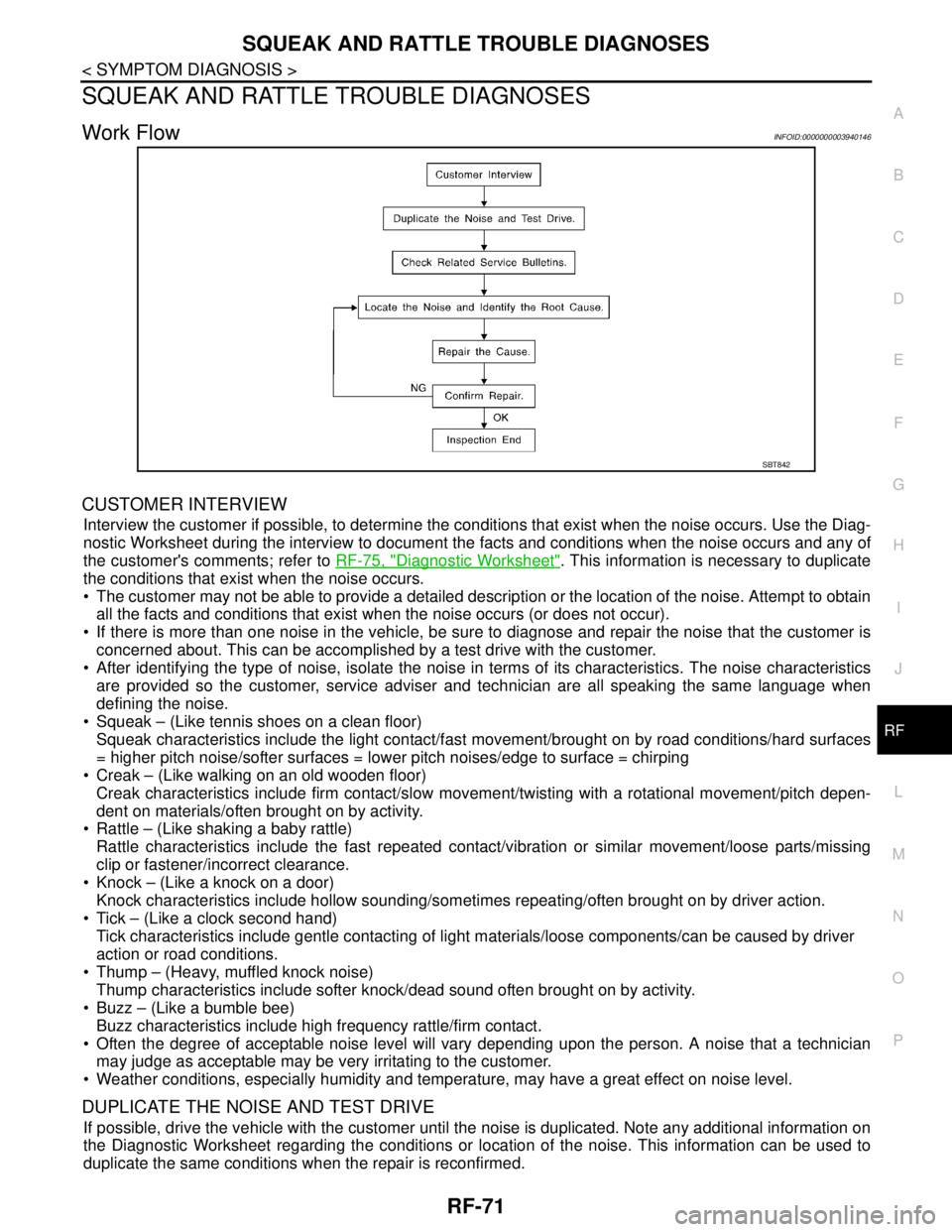
Work FlowINFOID:0000000003940146
CUSTOMER INTERVIEW
Interview the customer if possible, to determine the conditions that exist when the noise occurs. Use the Diag-
nostic Worksheet during the interview to document the facts and conditions when the noise occurs and any of
the customer's comments; refer to RF-75, "
Diagnostic Worksheet". This information is necessary to duplicate
the conditions that exist when the noise occurs.
The customer may not be able to provide a detailed description or the location of the noise. Attempt to obtain
all the facts and conditions that exist when the noise occurs (or does not occur).
If there is more than one noise in the vehicle, be sure to diagnose and repair the noise that the customer is
concerned about. This can be accomplished by a test drive with the customer.
After identifying the type of noise, isolate the noise in terms of its characteristics. The noise characteristics
are provided so the customer, service adviser and technician are all speaking the same language when
defining the noise.
Squeak – (Like tennis shoes on a clean floor)
Squeak characteristics include the light contact/fast movement/brought on by road conditions/hard surfaces
= higher pitch noise/softer surfaces = lower pitch noises/edge to surface = chirping
Creak – (Like walking on an old wooden floor)
Creak characteristics include firm contact/slow movement/twisting with a rotational movement/pitch depen-
dent on materials/often brought on by activity.
Rattle – (Like shaking a baby rattle)
Rattle characteristics include the fast repeated contact/vibration or similar movement/loose parts/missing
clip or fastener/incorrect clearance.
Knock – (Like a knock on a door)
Knock characteristics include hollow sounding/sometimes repeating/often brought on by driver action.
Tick – (Like a clock second hand)
Tick characteristics include gentle contacting of light materials/loose components/can be caused by driver
action or road conditions.
Thump – (Heavy, muffled knock noise)
Thump characteristics include softer knock/dead sound often brought on by activity.
Buzz – (Like a bumble bee)
Buzz characteristics include high frequency rattle/firm contact.
Often the degree of acceptable noise level will vary depending upon the person. A noise that a technician
may judge as acceptable may be very irritating to the customer.
Weather conditions, especially humidity and temperature, may have a great effect on noise level.
DUPLICATE THE NOISE AND TEST DRIVE
If possible, drive the vehicle with the customer until the noise is duplicated. Note any additional information on
the Diagnostic Worksheet regarding the conditions or location of the noise. This information can be used to
duplicate the same conditions when the repair is reconfirmed.
SBT842