ESP NISSAN TEANA 2008 Repair Manual
[x] Cancel search | Manufacturer: NISSAN, Model Year: 2008, Model line: TEANA, Model: NISSAN TEANA 2008Pages: 5121, PDF Size: 69.03 MB
Page 1991 of 5121
EM-116
< DISASSEMBLY AND ASSEMBLY >
CYLINDER BLOCK
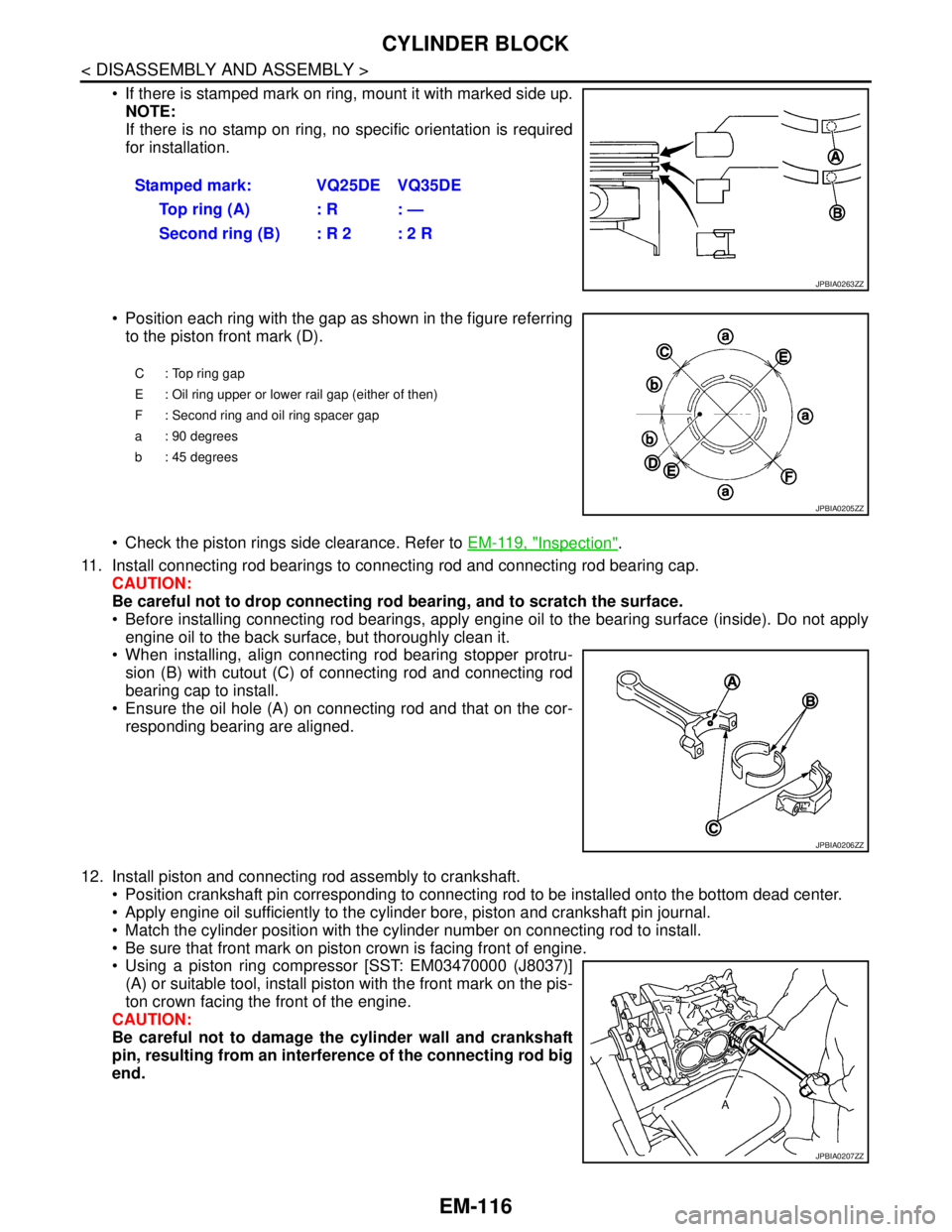
If there is stamped mark on ring, mount it with marked side up.
NOTE:
If there is no stamp on ring, no specific orientation is required
for installation.
Position each ring with the gap as shown in the figure referring
to the piston front mark (D).
Check the piston rings side clearance. Refer to EM-119, "
Inspection".
11. Install connecting rod bearings to connecting rod and connecting rod bearing cap.
CAUTION:
Be careful not to drop connecting rod bearing, and to scratch the surface.
Before installing connecting rod bearings, apply engine oil to the bearing surface (inside). Do not apply
engine oil to the back surface, but thoroughly clean it.
When installing, align connecting rod bearing stopper protru-
sion (B) with cutout (C) of connecting rod and connecting rod
bearing cap to install.
Ensure the oil hole (A) on connecting rod and that on the cor-
responding bearing are aligned.
12. Install piston and connecting rod assembly to crankshaft.
Position crankshaft pin corresponding to connecting rod to be installed onto the bottom dead center.
Apply engine oil sufficiently to the cylinder bore, piston and crankshaft pin journal.
Match the cylinder position with the cylinder number on connecting rod to install.
Be sure that front mark on piston crown is facing front of engine.
Using a piston ring compressor [SST: EM03470000 (J8037)]
(A) or suitable tool, install piston with the front mark on the pis-
ton crown facing the front of the engine.
CAUTION:
Be careful not to damage the cylinder wall and crankshaft
pin, resulting from an interference of the connecting rod big
end.Stamped mark: VQ25DE VQ35DE
To p r i n g ( A ) : R : —
Second ring (B) : R 2 : 2 R
JPBIA0263ZZ
C : Top ring gap
E : Oil ring upper or lower rail gap (either of then)
F : Second ring and oil ring spacer gap
a : 90 degrees
b : 45 degrees
JPBIA0205ZZ
JPBIA0206ZZ
JPBIA0207ZZ
Page 2006 of 5121
HOW TO SELECT PISTON AND BEARING
EM-131
< DISASSEMBLY AND ASSEMBLY >
C
D
E
F
G
H
I
J
K
L
MA
EM
N
P O
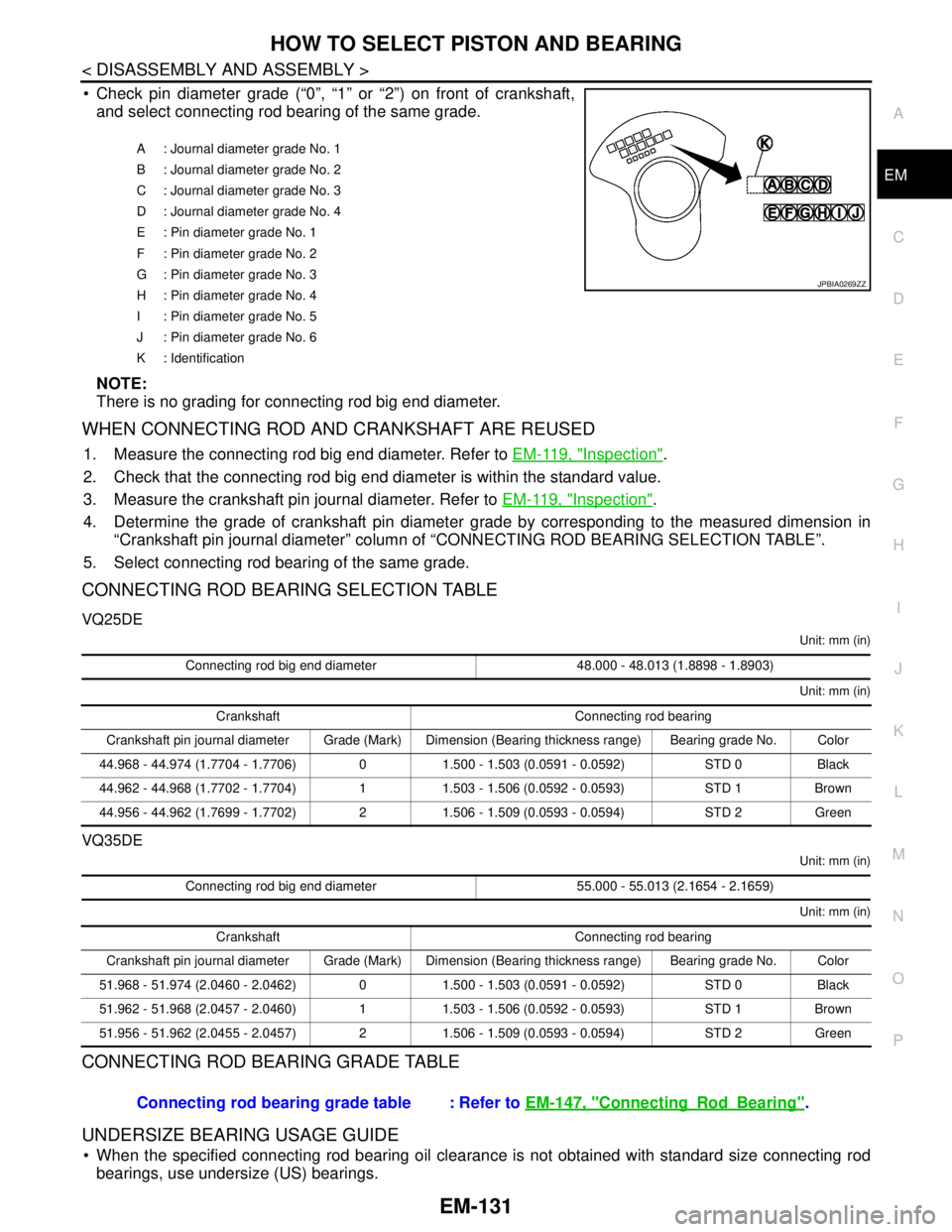
Check pin diameter grade (“0”, “1” or “2”) on front of crankshaft,
and select connecting rod bearing of the same grade.
NOTE:
There is no grading for connecting rod big end diameter.
WHEN CONNECTING ROD AND CRANKSHAFT ARE REUSED
1. Measure the connecting rod big end diameter. Refer to EM-119, "Inspection".
2. Check that the connecting rod big end diameter is within the standard value.
3. Measure the crankshaft pin journal diameter. Refer to EM-119, "
Inspection".
4. Determine the grade of crankshaft pin diameter grade by corresponding to the measured dimension in
“Crankshaft pin journal diameter” column of “CONNECTING ROD BEARING SELECTION TABLE”.
5. Select connecting rod bearing of the same grade.
CONNECTING ROD BEARING SELECTION TABLE
VQ25DE
Unit: mm (in)
Unit: mm (in)
VQ35DE
Unit: mm (in)
Unit: mm (in)
CONNECTING ROD BEARING GRADE TABLE
UNDERSIZE BEARING USAGE GUIDE
When the specified connecting rod bearing oil clearance is not obtained with standard size connecting rod
bearings, use undersize (US) bearings.
A : Journal diameter grade No. 1
B : Journal diameter grade No. 2
C : Journal diameter grade No. 3
D : Journal diameter grade No. 4
E : Pin diameter grade No. 1
F : Pin diameter grade No. 2
G : Pin diameter grade No. 3
H : Pin diameter grade No. 4
I : Pin diameter grade No. 5
J : Pin diameter grade No. 6
K : Identification
JPBIA0269ZZ
Connecting rod big end diameter 48.000 - 48.013 (1.8898 - 1.8903)
Crankshaft Connecting rod bearing
Crankshaft pin journal diameter Grade (Mark) Dimension (Bearing thickness range) Bearing grade No. Color
44.968 - 44.974 (1.7704 - 1.7706) 0 1.500 - 1.503 (0.0591 - 0.0592) STD 0 Black
44.962 - 44.968 (1.7702 - 1.7704) 1 1.503 - 1.506 (0.0592 - 0.0593) STD 1 Brown
44.956 - 44.962 (1.7699 - 1.7702) 2 1.506 - 1.509 (0.0593 - 0.0594) STD 2 Green
Connecting rod big end diameter 55.000 - 55.013 (2.1654 - 2.1659)
Crankshaft Connecting rod bearing
Crankshaft pin journal diameter Grade (Mark) Dimension (Bearing thickness range) Bearing grade No. Color
51.968 - 51.974 (2.0460 - 2.0462) 0 1.500 - 1.503 (0.0591 - 0.0592) STD 0 Black
51.962 - 51.968 (2.0457 - 2.0460) 1 1.503 - 1.506 (0.0592 - 0.0593) STD 1 Brown
51.956 - 51.962 (2.0455 - 2.0457) 2 1.506 - 1.509 (0.0593 - 0.0594) STD 2 Green
Connecting rod bearing grade table : Refer to EM-147, "ConnectingRodBearing".
Page 2007 of 5121
EM-132
< DISASSEMBLY AND ASSEMBLY >
HOW TO SELECT PISTON AND BEARING
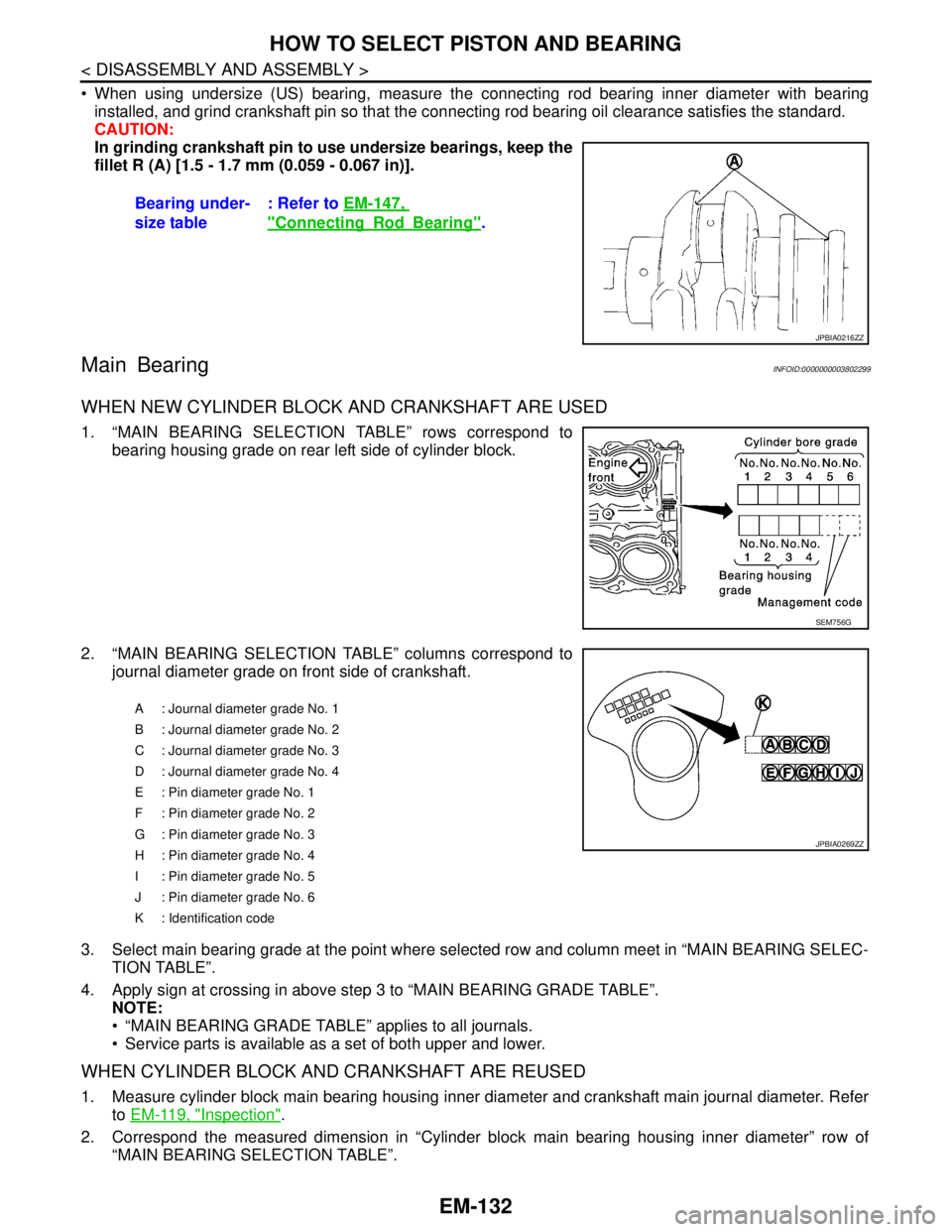
When using undersize (US) bearing, measure the connecting rod bearing inner diameter with bearing
installed, and grind crankshaft pin so that the connecting rod bearing oil clearance satisfies the standard.
CAUTION:
In grinding crankshaft pin to use undersize bearings, keep the
fillet R (A) [1.5 - 1.7 mm (0.059 - 0.067 in)].
Main BearingINFOID:0000000003802299
WHEN NEW CYLINDER BLOCK AND CRANKSHAFT ARE USED
1. “MAIN BEARING SELECTION TABLE” rows correspond to
bearing housing grade on rear left side of cylinder block.
2. “MAIN BEARING SELECTION TABLE” columns correspond to
journal diameter grade on front side of crankshaft.
3. Select main bearing grade at the point where selected row and column meet in “MAIN BEARING SELEC-
TION TABLE”.
4. Apply sign at crossing in above step 3 to “MAIN BEARING GRADE TABLE”.
NOTE:
“MAIN BEARING GRADE TABLE” applies to all journals.
Service parts is available as a set of both upper and lower.
WHEN CYLINDER BLOCK AND CRANKSHAFT ARE REUSED
1. Measure cylinder block main bearing housing inner diameter and crankshaft main journal diameter. Refer
to EM-119, "
Inspection".
2. Correspond the measured dimension in “Cylinder block main bearing housing inner diameter” row of
“MAIN BEARING SELECTION TABLE”.Bearing under-
size table: Refer to EM-147,
"ConnectingRodBearing".
JPBIA0216ZZ
SEM756G
A : Journal diameter grade No. 1
B : Journal diameter grade No. 2
C : Journal diameter grade No. 3
D : Journal diameter grade No. 4
E : Pin diameter grade No. 1
F : Pin diameter grade No. 2
G : Pin diameter grade No. 3
H : Pin diameter grade No. 4
I : Pin diameter grade No. 5
J : Pin diameter grade No. 6
K : Identification code
JPBIA0269ZZ
Page 2008 of 5121
HOW TO SELECT PISTON AND BEARING
EM-133
< DISASSEMBLY AND ASSEMBLY >
C
D
E
F
G
H
I
J
K
L
MA
EM
N
P O
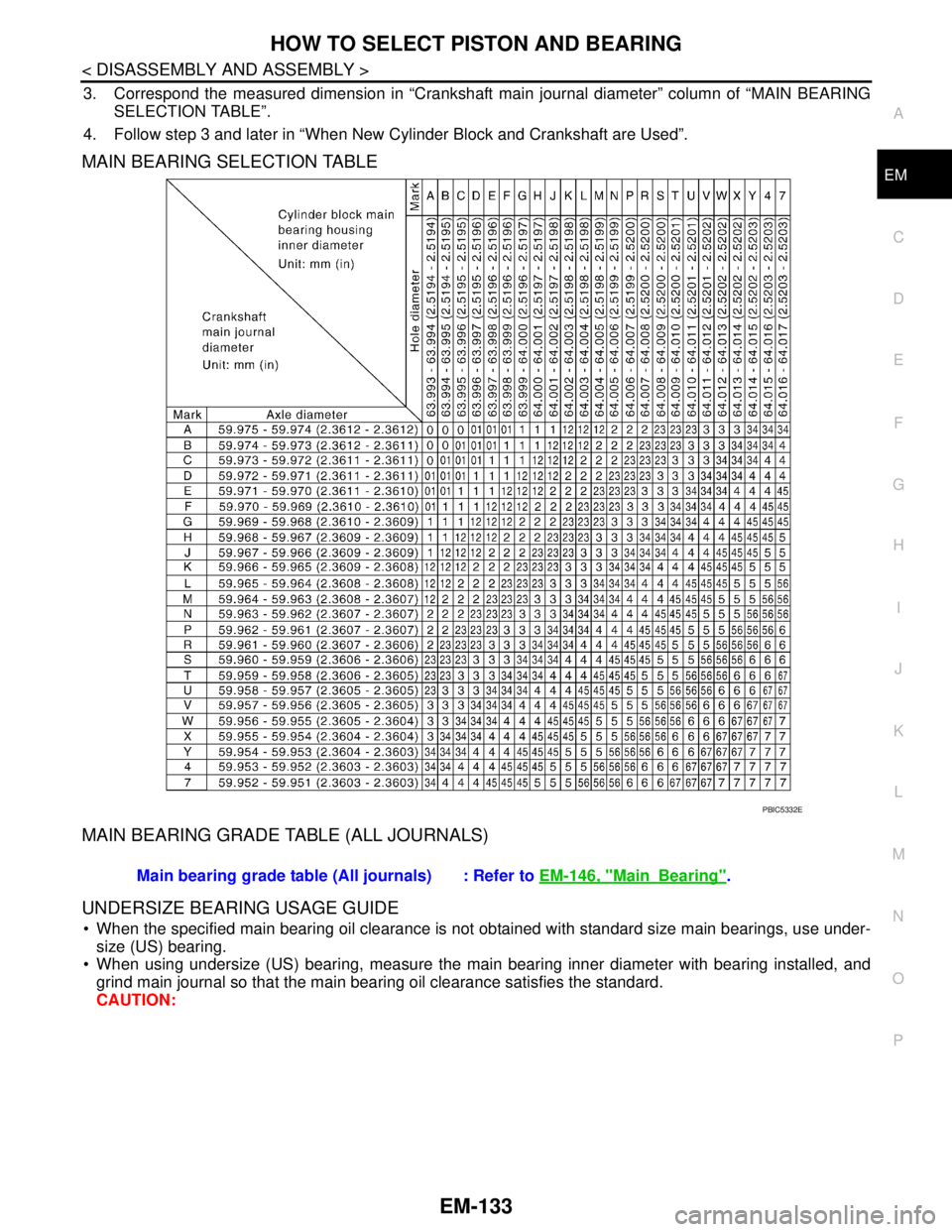
3. Correspond the measured dimension in “Crankshaft main journal diameter” column of “MAIN BEARING
SELECTION TABLE”.
4. Follow step 3 and later in “When New Cylinder Block and Crankshaft are Used”.
MAIN BEARING SELECTION TABLE
MAIN BEARING GRADE TABLE (ALL JOURNALS)
UNDERSIZE BEARING USAGE GUIDE
When the specified main bearing oil clearance is not obtained with standard size main bearings, use under-
size (US) bearing.
When using undersize (US) bearing, measure the main bearing inner diameter with bearing installed, and
grind main journal so that the main bearing oil clearance satisfies the standard.
CAUTION:
PBIC5332E
Main bearing grade table (All journals) : Refer to EM-146, "MainBearing".
Page 2066 of 5121
![NISSAN TEANA 2008 Repair Manual DIAGNOSIS SYSTEM (HEADLAMP LEVELIZER)
EXL-37
< FUNCTION DIAGNOSIS >[XENON TYPE]
C
D
E
F
G
H
I
J
K
MA
B
EXL
N
O
P
DIAGNOSIS SYSTEM (HEADLAMP LEVELIZER)
CONSULT-III Functions (HEADLAMP LEVELIZER)INFOID:](/img/5/57391/w960_57391-2065.png "NISSAN TEANA 2008 Repair Manual DIAGNOSIS SYSTEM (HEADLAMP LEVELIZER)
EXL-37
< FUNCTION DIAGNOSIS >[XENON TYPE]
C
D
E
F
G
H
I
J
K
MA
B
EXL
N
O
P
DIAGNOSIS SYSTEM (HEADLAMP LEVELIZER)
CONSULT-III Functions (HEADLAMP LEVELIZER)INFOID:")
DIAGNOSIS SYSTEM (HEADLAMP LEVELIZER)
EXL-37
< FUNCTION DIAGNOSIS >[XENON TYPE]
C
D
E
F
G
H
I
J
K
MA
B
EXL
N
O
P
DIAGNOSIS SYSTEM (HEADLAMP LEVELIZER)
CONSULT-III Functions (HEADLAMP LEVELIZER)INFOID:0000000003805598
Function item
WORK SUPPORT
DATA MONITOR
ACTIVE TEST
Diagnosis mode Description
ECU IDENTIFICATION Allows confirmation of auto levelizer control unit part number.
SELF DIAGNOSTIC RESULT Displays the diagnosis results judged by auto levelizer control unit.
WORK SUPPORT Performs settings on sensors.
DATA MONITOR Displays input data for headlamp auto aiming motor control unit in real time.
ACTIVE TEST Transmits a drive signal to the load to check their operation.
CONFIGURATION Writes the vehicle specification when replacing auto levelizer control unit.
Work item Setting details
SENSOR INITIALIZE Adjusts sensor lever signal output under unladen conditions.
Monitor item
[Unit]Display item
INT SEN VALUE
[%]Displays the sensor lever angle corresponding to the maximum value of sensor lever
angle that is recognized with auto levelizer control unit by ratio
ACT OUTPUT
[%]Displays the control value of aiming motor drive signal that is calculated by auto lev-
elizer control unit with the ratio corresponding to the ignition power supply
ACT MEASURED
[%]Displays the measured value of aiming motor drive signal that is output from auto lev-
elizer control unit with the ratio corresponding to ignition power supply
SPEED SIG
[km/h]Displays the vehicle speed judged from vehicle speed signal (8-pulse) that is input to
auto levelizer control unit
LIGHT SIGNAL
[V]Displays the status judged from tail lamp signal that is input to auto levelizer control
unit
INT SEN VOLT
[V]Displays the ignition power supply status that is input to auto levelizer control unit
EXT SEN VOLT
[V]NOTE:
The item is indicated, but not monitored.
EXT SEN SIG
[V]NOTE:
The item is indicated, but not monitored.
Test item Operation item Operation status
LAMP TESTMIN Moves the light axis to the highest position.
MID Moves the light axis to the initial position.
MAX Moves the light axis to the lowest position.
Page 2168 of 5121
![NISSAN TEANA 2008 Repair Manual BCM (BODY CONTROL MODULE)
EXL-139
< ECU DIAGNOSIS >[XENON TYPE]
C
D
E
F
G
H
I
J
K
MA
B
EXL
N
O
PHIGH FLASHER OPERATION
BCM detects the turn signal lamp circuit status by the current value.
BCM increas](/img/5/57391/w960_57391-2167.png "NISSAN TEANA 2008 Repair Manual BCM (BODY CONTROL MODULE)
EXL-139
< ECU DIAGNOSIS >[XENON TYPE]
C
D
E
F
G
H
I
J
K
MA
B
EXL
N
O
PHIGH FLASHER OPERATION
BCM detects the turn signal lamp circuit status by the current value.
BCM increas")
BCM (BODY CONTROL MODULE)
EXL-139
< ECU DIAGNOSIS >[XENON TYPE]
C
D
E
F
G
H
I
J
K
MA
B
EXL
N
O
PHIGH FLASHER OPERATION
BCM detects the turn signal lamp circuit status by the current value.
BCM increases the turn signal lamp blinking speed if the bulb or harness open is detected with the turn signal
lamp operating.
NOTE:
The blinking speed is normal while activating the hazard warning lamp.
DTC Inspection Priority ChartINFOID:0000000003959693
If some DTCs are displayed at the same time, perform inspections one by one based on the following priority
chart.
B2608: STARTER RELAY Inhibit engine cranking500 ms after the following signal communication status becomes
consistent
Starter motor relay control signal
Starter relay status signal (CAN)
B2609: S/L STATUS Inhibit engine cranking
Inhibit steering lockWhen the following steering lock conditions agree
BCM steering lock control status
Steering lock condition No. 1 signal status
Steering lock condition No. 2 signal status
B260A: IGNITION RELAY Inhibit engine cranking500 ms after the following conditions are fulfilled
IGN relay (IPDM E/R) control signal: OFF (Battery voltage)
Ignition ON signal (CAN to IPDM E/R): OFF (Request signal)
Ignition ON signal (CAN from IPDM E/R): OFF (Condition signal)
B260F: ENG STATE SIG LOSTMaintains the power supply
position attained at the time
of DTC detectionWhen any of the following conditions is fulfilled
Power position changes to ACC
Receives engine status signal (CAN)
B2612: S/L STATUS Inhibit engine cranking
Inhibit steering lockWhen any of the following conditions is fulfilled
Steering lock unit status signal (CAN) is received normally
The BCM steering lock control status matches the steering lock
status recognized by the steering lock unit status signal (CAN
from IPDM E/R)
B2617: STARTER RELAY CIRC Inhibit engine cranking1 second after the starter motor relay control inside BCM becomes
normal
B2618: BCM Inhibit engine cranking1 second after the ignition relay (IPDM E/R) control inside BCM be-
comes normal
B2619: BCM Inhibit engine cranking1 second after the steering lock unit power supply output control in-
side BCM becomes normal
B261E: VEHICLE TYPE Inhibit engine cranking BCM initialization
B26E1: ENG STATE NO RES Inhibit engine crankingWhen any of the following conditions is fulfilled
Power position changes to ACC
Receives engine status signal (CAN)
B26E9: S/L STATUS Inhibit engine cranking
Inhibit steering lockWhen BCM transmits the LOCK request signal to steering lock unit,
and receives LOCK response signal from steering lock unit, the fol-
lowing conditions is fulfilled
Steering condition No. 1 signal: LOCK (0 V)
Steering condition No. 2 signal: LOCK (Battery voltage) Display contents of CONSULT Fail-safe Cancellation
Priority DTC
1 B2562: LOW VOLTAGE
2 U1000: CAN COMM CIRCUIT
U1010: CONTROL UNIT (CAN)
3 B2190: NATS ANTENNA AMP
B2191: DIFFERENCE OF KEY
B2192: ID DISCORD BCM-ECM
B2193: CHAIN OF BCM-ECM
Page 2340 of 5121
![NISSAN TEANA 2008 Repair Manual BCM (BODY CONTROL MODULE)
EXL-311
< ECU DIAGNOSIS >[HALOGEN TYPE]
C
D
E
F
G
H
I
J
K
MA
B
EXL
N
O
PHIGH FLASHER OPERATION
BCM detects the turn signal lamp circuit status by the current value.
BCM incre](/img/5/57391/w960_57391-2339.png "NISSAN TEANA 2008 Repair Manual BCM (BODY CONTROL MODULE)
EXL-311
< ECU DIAGNOSIS >[HALOGEN TYPE]
C
D
E
F
G
H
I
J
K
MA
B
EXL
N
O
PHIGH FLASHER OPERATION
BCM detects the turn signal lamp circuit status by the current value.
BCM incre")
BCM (BODY CONTROL MODULE)
EXL-311
< ECU DIAGNOSIS >[HALOGEN TYPE]
C
D
E
F
G
H
I
J
K
MA
B
EXL
N
O
PHIGH FLASHER OPERATION
BCM detects the turn signal lamp circuit status by the current value.
BCM increases the turn signal lamp blinking speed if the bulb or harness open is detected with the turn signal
lamp operating.
NOTE:
The blinking speed is normal while activating the hazard warning lamp.
DTC Inspection Priority ChartINFOID:0000000003959699
If some DTCs are displayed at the same time, perform inspections one by one based on the following priority
chart.
B2608: STARTER RELAY Inhibit engine cranking500 ms after the following signal communication status becomes
consistent
Starter motor relay control signal
Starter relay status signal (CAN)
B2609: S/L STATUS Inhibit engine cranking
Inhibit steering lockWhen the following steering lock conditions agree
BCM steering lock control status
Steering lock condition No. 1 signal status
Steering lock condition No. 2 signal status
B260A: IGNITION RELAY Inhibit engine cranking500 ms after the following conditions are fulfilled
IGN relay (IPDM E/R) control signal: OFF (Battery voltage)
Ignition ON signal (CAN to IPDM E/R): OFF (Request signal)
Ignition ON signal (CAN from IPDM E/R): OFF (Condition signal)
B260F: ENG STATE SIG LOSTMaintains the power supply
position attained at the time
of DTC detectionWhen any of the following conditions is fulfilled
Power position changes to ACC
Receives engine status signal (CAN)
B2612: S/L STATUS Inhibit engine cranking
Inhibit steering lockWhen any of the following conditions is fulfilled
Steering lock unit status signal (CAN) is received normally
The BCM steering lock control status matches the steering lock
status recognized by the steering lock unit status signal (CAN
from IPDM E/R)
B2617: STARTER RELAY CIRC Inhibit engine cranking1 second after the starter motor relay control inside BCM becomes
normal
B2618: BCM Inhibit engine cranking1 second after the ignition relay (IPDM E/R) control inside BCM be-
comes normal
B2619: BCM Inhibit engine cranking1 second after the steering lock unit power supply output control in-
side BCM becomes normal
B261E: VEHICLE TYPE Inhibit engine cranking BCM initialization
B26E1: ENG STATE NO RES Inhibit engine crankingWhen any of the following conditions is fulfilled
Power position changes to ACC
Receives engine status signal (CAN)
B26E9: S/L STATUS Inhibit engine cranking
Inhibit steering lockWhen BCM transmits the LOCK request signal to steering lock unit,
and receives LOCK response signal from steering lock unit, the fol-
lowing conditions is fulfilled
Steering condition No. 1 signal: LOCK (0 V)
Steering condition No. 2 signal: LOCK (Battery voltage) Display contents of CONSULT Fail-safe Cancellation
Priority DTC
1 B2562: LOW VOLTAGE
2 U1000: CAN COMM CIRCUIT
U1010: CONTROL UNIT (CAN)
3 B2190: NATS ANTENNA AMP
B2191: DIFFERENCE OF KEY
B2192: ID DISCORD BCM-ECM
B2193: CHAIN OF BCM-ECM
Page 2391 of 5121
EXT-2
< SYMPTOM DIAGNOSIS >
SQUEAK AND RATTLE TROUBLE DIAGNOSES
SYMPTOM DIAGNOSIS
SQUEAK AND RATTLE TROUBLE DIAGNOSES
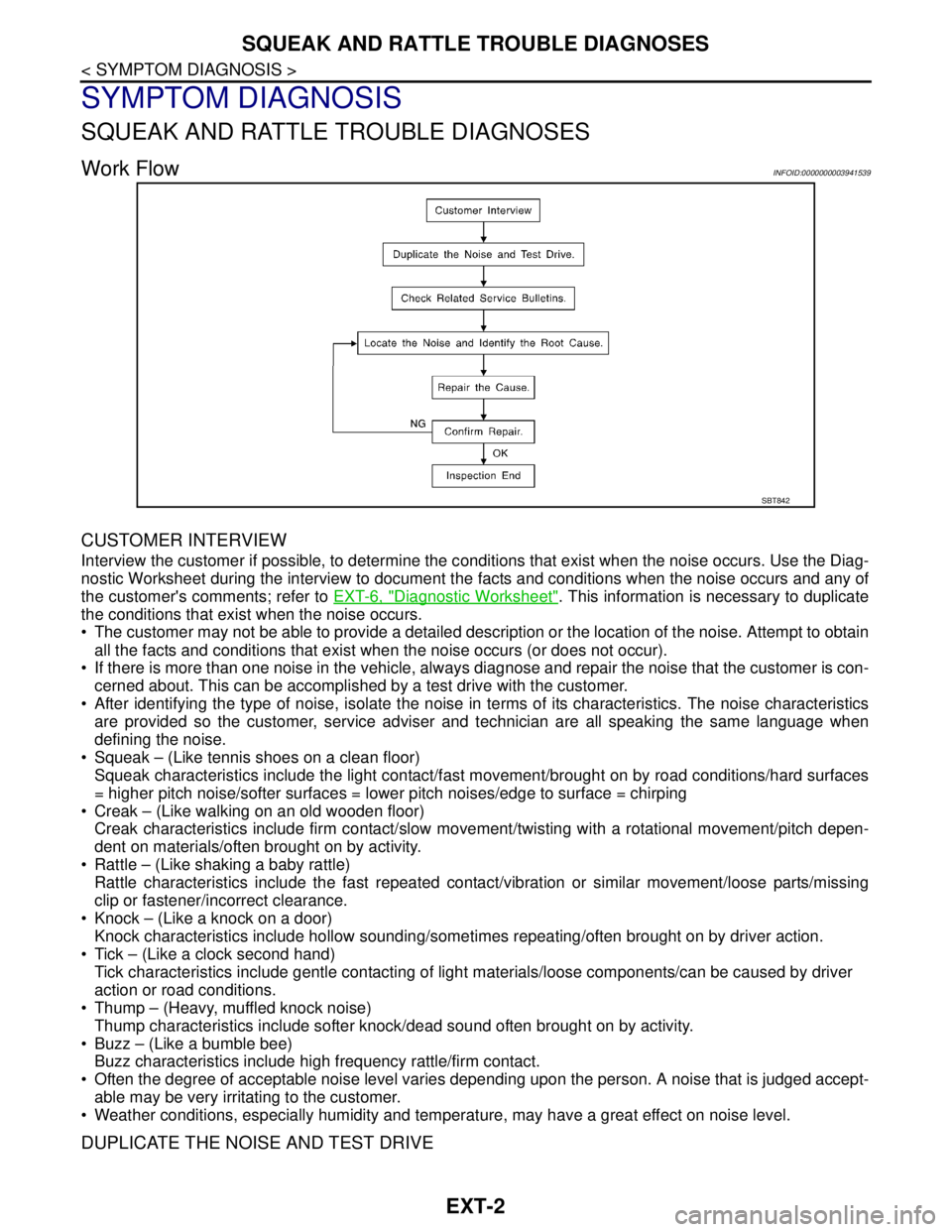
Work FlowINFOID:0000000003941539
CUSTOMER INTERVIEW
Interview the customer if possible, to determine the conditions that exist when the noise occurs. Use the Diag-
nostic Worksheet during the interview to document the facts and conditions when the noise occurs and any of
the customer's comments; refer to EXT-6, "
Diagnostic Worksheet". This information is necessary to duplicate
the conditions that exist when the noise occurs.
• The customer may not be able to provide a detailed description or the location of the noise. Attempt to obtain
all the facts and conditions that exist when the noise occurs (or does not occur).
If there is more than one noise in the vehicle, always diagnose and repair the noise that the customer is con-
cerned about. This can be accomplished by a test drive with the customer.
After identifying the type of noise, isolate the noise in terms of its characteristics. The noise characteristics
are provided so the customer, service adviser and technician are all speaking the same language when
defining the noise.
Squeak – (Like tennis shoes on a clean floor)
Squeak characteristics include the light contact/fast movement/brought on by road conditions/hard surfaces
= higher pitch noise/softer surfaces = lower pitch noises/edge to surface = chirping
Creak – (Like walking on an old wooden floor)
Creak characteristics include firm contact/slow movement/twisting with a rotational movement/pitch depen-
dent on materials/often brought on by activity.
Rattle – (Like shaking a baby rattle)
Rattle characteristics include the fast repeated contact/vibration or similar movement/loose parts/missing
clip or fastener/incorrect clearance.
Knock – (Like a knock on a door)
Knock characteristics include hollow sounding/sometimes repeating/often brought on by driver action.
Tick – (Like a clock second hand)
Tick characteristics include gentle contacting of light materials/loose components/can be caused by driver
action or road conditions.
Thump – (Heavy, muffled knock noise)
Thump characteristics include softer knock/dead sound often brought on by activity.
Buzz – (Like a bumble bee)
Buzz characteristics include high frequency rattle/firm contact.
Often the degree of acceptable noise level varies depending upon the person. A noise that is judged accept-
able may be very irritating to the customer.
Weather conditions, especially humidity and temperature, may have a great effect on noise level.
DUPLICATE THE NOISE AND TEST DRIVE
SBT842
Page 2470 of 5121
FUEL LEVEL SENSOR UNIT, FUEL FILTER AND FUEL PUMP ASSEMBLY
FL-7
< ON-VEHICLE REPAIR >
C
D
E
F
G
H
I
J
K
L
MA
FL
N
P O
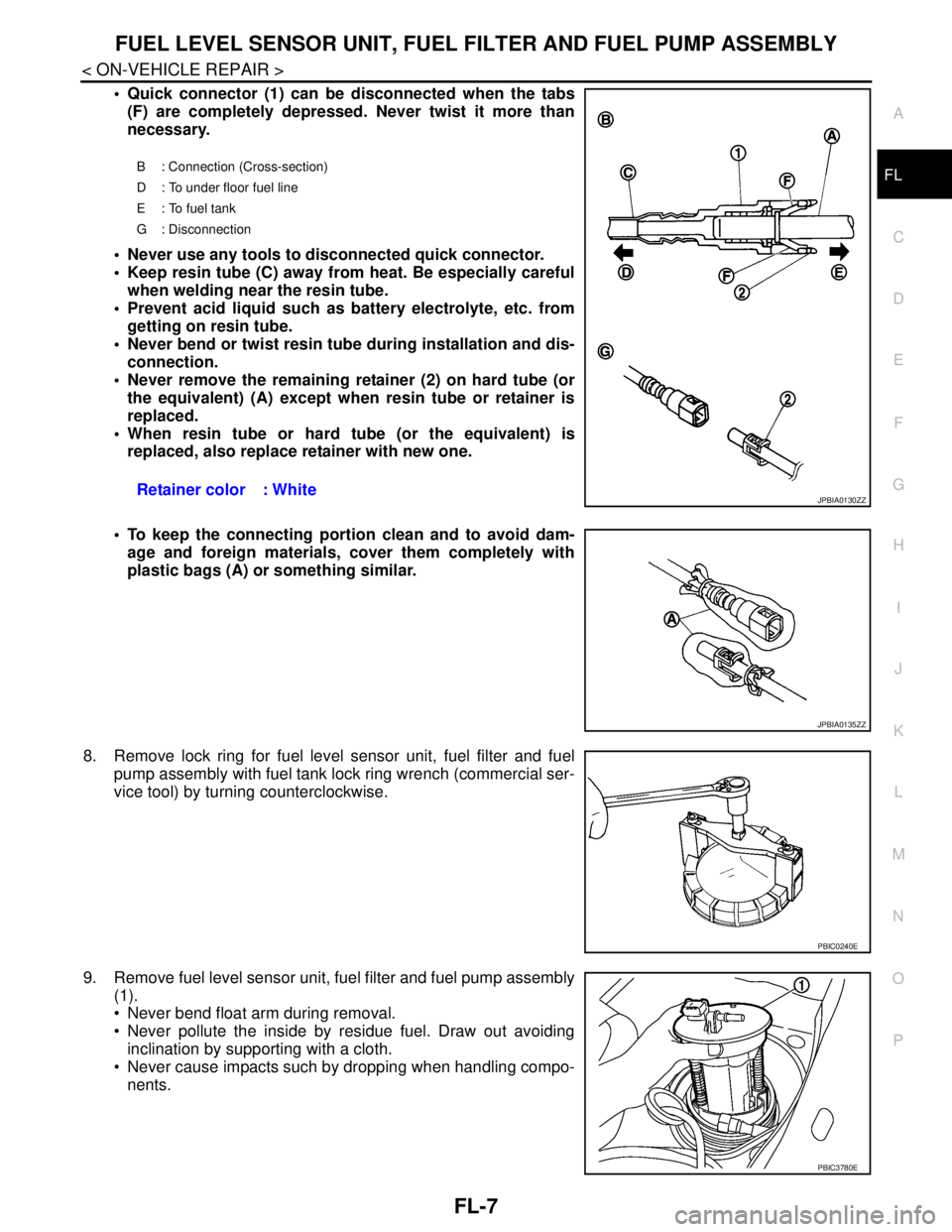
Quick connector (1) can be disconnected when the tabs
(F) are completely depressed. Never twist it more than
necessary.
Never use any tools to disconnected quick connector.
Keep resin tube (C) away from heat. Be especially careful
when welding near the resin tube.
Prevent acid liquid such as battery electrolyte, etc. from
getting on resin tube.
Never bend or twist resin tube during installation and dis-
connection.
Never remove the remaining retainer (2) on hard tube (or
the equivalent) (A) except when resin tube or retainer is
replaced.
When resin tube or hard tube (or the equivalent) is
replaced, also replace retainer with new one.
To keep the connecting portion clean and to avoid dam-
age and foreign materials, cover them completely with
plastic bags (A) or something similar.
8. Remove lock ring for fuel level sensor unit, fuel filter and fuel
pump assembly with fuel tank lock ring wrench (commercial ser-
vice tool) by turning counterclockwise.
9. Remove fuel level sensor unit, fuel filter and fuel pump assembly
(1).
Never bend float arm during removal.
Never pollute the inside by residue fuel. Draw out avoiding
inclination by supporting with a cloth.
Never cause impacts such by dropping when handling compo-
nents.
B : Connection (Cross-section)
D : To under floor fuel line
E : To fuel tank
G : Disconnection
Retainer color : WhiteJPBIA0130ZZ
JPBIA0135ZZ
PBIC0240E
PBIC3780E
Page 2502 of 5121
HOW TO READ WIRING DIAGRAMS
GI-9
< HOW TO USE THIS MANUAL >
C
D
E
F
G
H
I
J
K
L
MB
GI
N
O
PHOW TO READ WIRING DIAGRAMS
Connector SymbolsINFOID:0000000003852766
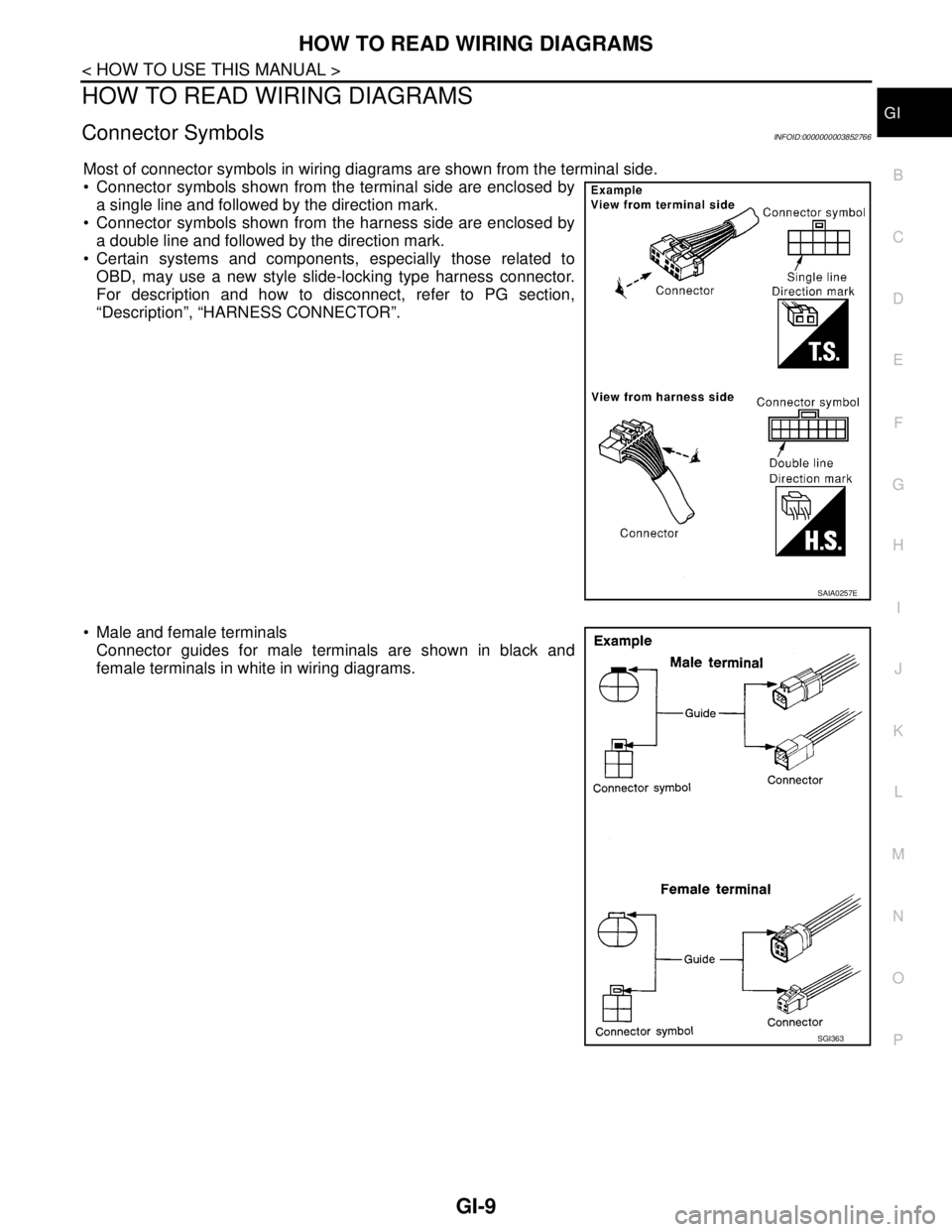
Most of connector symbols in wiring diagrams are shown from the terminal side.
Connector symbols shown from the terminal side are enclosed by
a single line and followed by the direction mark.
Connector symbols shown from the harness side are enclosed by
a double line and followed by the direction mark.
Certain systems and components, especially those related to
OBD, may use a new style slide-locking type harness connector.
For description and how to disconnect, refer to PG section,
“Description”, “HARNESS CONNECTOR”.
Male and female terminals
Connector guides for male terminals are shown in black and
female terminals in white in wiring diagrams.
SAIA0257E
SGI363