ESP NISSAN TEANA 2008 Workshop Manual
[x] Cancel search | Manufacturer: NISSAN, Model Year: 2008, Model line: TEANA, Model: NISSAN TEANA 2008Pages: 5121, PDF Size: 69.03 MB
Page 1856 of 5121
![NISSAN TEANA 2008 Workshop Manual ECM
EC-395
< ECU DIAGNOSIS >[VQ25DE, VQ35DE]
C
D
E
F
G
H
I
J
K
L
MA
EC
N
P O
ItemOBD-
MIDSelf-diagnostic test item DTCTest value and
Te s t l i m i t
(GST display)
Description
TIDUnit and
Scaling](/img/5/57391/w960_57391-1855.png "NISSAN TEANA 2008 Workshop Manual ECM
EC-395
< ECU DIAGNOSIS >[VQ25DE, VQ35DE]
C
D
E
F
G
H
I
J
K
L
MA
EC
N
P O
ItemOBD-
MIDSelf-diagnostic test item DTCTest value and
Te s t l i m i t
(GST display)
Description
TIDUnit and
Scaling")
ECM
EC-395
< ECU DIAGNOSIS >[VQ25DE, VQ35DE]
C
D
E
F
G
H
I
J
K
L
MA
EC
N
P O
ItemOBD-
MIDSelf-diagnostic test item DTCTest value and
Te s t l i m i t
(GST display)
Description
TIDUnit and
Scaling
ID
HO2S01HAir fuel ratio (A/F) sensor 1
(Bank 1)P0131 83H 0BHMinimum sensor output voltage for test
cycle
P0131 84H 0BHMaximum sensor output voltage for test
cycle
P0130 85H 0BHMinimum sensor output voltage for test
cycle
P0130 86H 0BHMaximum sensor output voltage for test
cycle
P0133 87H 04HResponse rate: Response ratio (Lean to
Rich)
P0133 88H 04HResponse rate: Response ratio (Rich to
Lean)
P2A00 89H 84H The amount of shift in air fuel ratio
P2A00 8AH 84H The amount of shift in air fuel ratio
P0130 8BH 0BH Difference in sensor output voltage
P0133 8CH 83H Response gain at the limited frequency
02HHeated oxygen sensor 2
(Bank 1)P0138 07H 0CHMinimum sensor output voltage for test
cycle
P0137 08H 0CHMaximum sensor output voltage for test
cycle
P0138 80H 0CH Sensor output voltage
P0139 81H 0CH Difference in sensor output voltage
03HHeated oxygen sensor 3
(Bank 1)P0143 07H 0CHMinimum sensor output voltage for test
cycle
P0144 08H 0CHMaximum sensor output voltage for test
cycle
P0146 80H 0CH Sensor output voltage
P0145 81H 0CH Difference in sensor output voltage
Page 1857 of 5121
![NISSAN TEANA 2008 Workshop Manual EC-396
< ECU DIAGNOSIS >[VQ25DE, VQ35DE]
ECM
HO2S05HAir fuel ratio (A/F) sensor 1
(Bank 2)P0151 83H 0BHMinimum sensor output voltage for test
cycle
P0151 84H 0BHMaximum sensor output voltage for tes](/img/5/57391/w960_57391-1856.png "NISSAN TEANA 2008 Workshop Manual EC-396
< ECU DIAGNOSIS >[VQ25DE, VQ35DE]
ECM
HO2S05HAir fuel ratio (A/F) sensor 1
(Bank 2)P0151 83H 0BHMinimum sensor output voltage for test
cycle
P0151 84H 0BHMaximum sensor output voltage for tes")
EC-396
< ECU DIAGNOSIS >[VQ25DE, VQ35DE]
ECM
HO2S05HAir fuel ratio (A/F) sensor 1
(Bank 2)P0151 83H 0BHMinimum sensor output voltage for test
cycle
P0151 84H 0BHMaximum sensor output voltage for test
cycle
P0150 85H 0BHMinimum sensor output voltage for test
cycle
P0150 86H 0BHMaximum sensor output voltage for test
cycle
P0153 87H 04HResponse rate: Response ratio (Lean to
Rich)
P0153 88H 04HResponse rate: Response ratio (Rich to
Lean)
P2A03 89H 84H The amount of shift in air fuel ratio
P2A03 8AH 84H The amount of shift in air fuel ratio
P0150 8BH 0BH Difference in sensor output voltage
P0153 8CH 83H Response gain at the limited frequency
06HHeated oxygen sensor 2
(Bank 2)P0158 07H 0CHMinimum sensor output voltage for test
cycle
P0157 08H 0CHMaximum sensor output voltage for test
cycle
P0158 80H 0CH Sensor output voltage
P0159 81H 0CH Difference in sensor output voltage
07HHeated oxygen sensor 3
(Bank2)P0163 07H 0CHMinimum sensor output voltage for test
cycle
P0164 08H 0CHMaximum sensor output voltage for test
cycle
P0166 80H 0CH Sensor output voltage
P0165 81H 0CH Difference in sensor output voltage
CATA-
LYST21HThree way catalyst function
(Bank1)P0420 80H 01H O2 storage index
P0420 82H 01HSwitching time lag engine exhaust index
value
P2423 83H 0CHDifference in 3rd O2 sensor output volt-
age
P2423 84H 84H O2 storage index in HC trap catalyst
22HThree way catalyst function
(Bank2)P0430 80H 01H O2 storage index
P0430 82H 01HSwitching time lag engine exhaust index
value
P2424 83H 0CHDifference in 3rd O2 sensor output volt-
age
P2424 84H 84H O2 storage index in HC trap catalyst ItemOBD-
MIDSelf-diagnostic test item DTCTest value and
Te s t l i m i t
(GST display)
Description
TIDUnit and
Scaling
ID
Page 1859 of 5121
![NISSAN TEANA 2008 Workshop Manual EC-398
< ECU DIAGNOSIS >[VQ25DE, VQ35DE]
ECM
FUEL
SYSTEM81HFuel injection system function
(Bank 1)P0171 or P0172 80H 2FH Long-term fuel trim
P0171 or P0172 81H 24H The number of lambda control clamp](/img/5/57391/w960_57391-1858.png "NISSAN TEANA 2008 Workshop Manual EC-398
< ECU DIAGNOSIS >[VQ25DE, VQ35DE]
ECM
FUEL
SYSTEM81HFuel injection system function
(Bank 1)P0171 or P0172 80H 2FH Long-term fuel trim
P0171 or P0172 81H 24H The number of lambda control clamp")
EC-398
< ECU DIAGNOSIS >[VQ25DE, VQ35DE]
ECM
FUEL
SYSTEM81HFuel injection system function
(Bank 1)P0171 or P0172 80H 2FH Long-term fuel trim
P0171 or P0172 81H 24H The number of lambda control clamped
82HFuel injection system function
(Bank 2)P0174 or P0175 80H 2FH Long-term fuel trim
P0174 or P0175 81H 24H The number of lambda control clamped
MISFIRE A1H Multiple Cylinder MisfiresP0301 80H 24HMisfiring counter at 1000 revolution of
the first cylinder
P0302 81H 24HMisfiring counter at 1000 revolution of
the second cylinder
P0303 82H 24HMisfiring counter at 1000 revolution of
the third cylinder
P0304 83H 24HMisfiring counter at 1000 revolution of
the fourth cylinder
P0305 84H 24HMisfiring counter at 1000 revolution of
the fifth cylinder
P0306 85H 24HMisfiring counter at 1000 revolution of
the sixth cylinder
P0307 86H 24HMisfiring counter at 1000 revolution of
the seventh cylinder
P0308 87H 24HMisfiring counter at 1000 revolution of
the eighth cylinder
P0300 88H 24HMisfiring counter at 1000 revolution of
the multiple cylinders
P0301 89H 24HMisfiring counter at 200 revolution of the
first cylinder
P0302 8AH 24HMisfiring counter at 200 revolution of the
second cylinder
P0303 8BH 24HMisfiring counter at 200 revolution of the
third cylinder
P0304 8CH 24HMisfiring counter at 200 revolution of the
fourth cylinder
P0305 8DH 24HMisfiring counter at 200 revolution of the
fifth cylinder
P0306 8EH 24HMisfiring counter at 200 revolution of the
fifth cylinder
P0307 8FH 24HMisfiring counter at 200 revolution of the
fifth cylinder
P0308 90H 24HMisfiring counter at 200 revolution of the
fifth cylinder
P0300 91H 24HMisfiring counter at 1000 revolution of
the single cylinder
P0300 92H 24HMisfiring counter at 200 revolution of the
single cylinder
P0300 93H 24HMisfiring counter at 200 revolution of the
multiple cylinders ItemOBD-
MIDSelf-diagnostic test item DTCTest value and
Te s t l i m i t
(GST display)
Description
TIDUnit and
Scaling
ID
Page 1867 of 5121
![NISSAN TEANA 2008 Workshop Manual EC-406
< PRECAUTION >[VQ25DE, VQ35DE]
PRECAUTIONS
CAUTION:
Always turn the ignition switch OFF and disconnect the negative battery cable before any repair or
inspection work. The open/short circuit](/img/5/57391/w960_57391-1866.png "NISSAN TEANA 2008 Workshop Manual EC-406
< PRECAUTION >[VQ25DE, VQ35DE]
PRECAUTIONS
CAUTION:
Always turn the ignition switch OFF and disconnect the negative battery cable before any repair or
inspection work. The open/short circuit")
EC-406
< PRECAUTION >[VQ25DE, VQ35DE]
PRECAUTIONS
CAUTION:
Always turn the ignition switch OFF and disconnect the negative battery cable before any repair or
inspection work. The open/short circuit of related switches, sensors, solenoid valves, etc. will cause
the MI to illuminate.
Always connect and lock the connectors securely after work. A loose (unlocked) connector will
cause the MI to illuminate due to the open circuit. (Be sure the connector is free from water, grease,
dirt, bent terminals, etc.)
Certain systems and components, especially those related to OBD, may use a new style slide-lock-
ing type harness connector. For description and how to disconnect, refer to PG-96, "
Description".
Always to route and secure the harnesses properly after work. The interference of the harness with a
bracket, etc. may cause the MI to illuminate due to the short circuit.
Always connect rubber tubes properly after work. A misconnected or disconnected rubber tube may
cause the MI to illuminate due to the malfunction of the EVAP system or fuel injection system, etc.
Always erase the unnecessary malfunction information (repairs completed) from the ECM and TCM
(Transmission control module) before returning the vehicle to the customer.
General PrecautionsINFOID:0000000003856881
Always use a 12 volt battery as power source.
Never attempt to disconnect battery cables while engine is
running.
Before connecting or disconnecting the ECM harness con-
nector, turn ignition switch OFF and disconnect negative bat-
tery cable. Failure to do so may damage the ECM because
battery voltage is applied to ECM even if ignition switch is
turned OFF.
Before removing parts, turn ignition switch OFF and then dis-
connect battery ground cable.
Never disassemble ECM.
If a battery cable is disconnected, the memory will return to the ECM value.
The ECM will now start to self-control at its initial value. Thus, engine operation can vary slightly in
this case. However, this is not an indication of a malfunction. Never replace parts because of a slight
variation.
If the battery is disconnected, the following emission-related diagnostic information will be lost
within 24 hours.
-Diagnostic trouble codes
-1st trip diagnostic trouble codes
-Freeze frame data
-1st trip freeze frame data
-System readiness test (SRT) codes
-Test values
When connecting ECM harness connector, fasten (B) it
securely with a lever (1) as far as it will go as shown in the fig-
ure.
SEF289H
2: ECM
A : Loosen
PBIB2947E
Page 1897 of 5121
EM-22
< ON-VEHICLE MAINTENANCE >
COMPRESSION PRESSURE
COMPRESSION PRESSURE
InspectionINFOID:0000000003802245
1. Warm up engine thoroughly. Then, stop it.
2. Release fuel pressure. Refer to EC-411, "
Inspection".
3. Disconnect fuel pump fuse to avoid fuel injection during measurement. Refer to EC-20,
"ComponentPartsLocation".
4. Remove engine cover. Refer to EM-24, "
Exploded View".
5. Remove ignition coil and spark plug from each cylinder. Refer to EM-49, "
Exploded View".
6. Connect engine tachometer (not required in use of CONSULT-III).
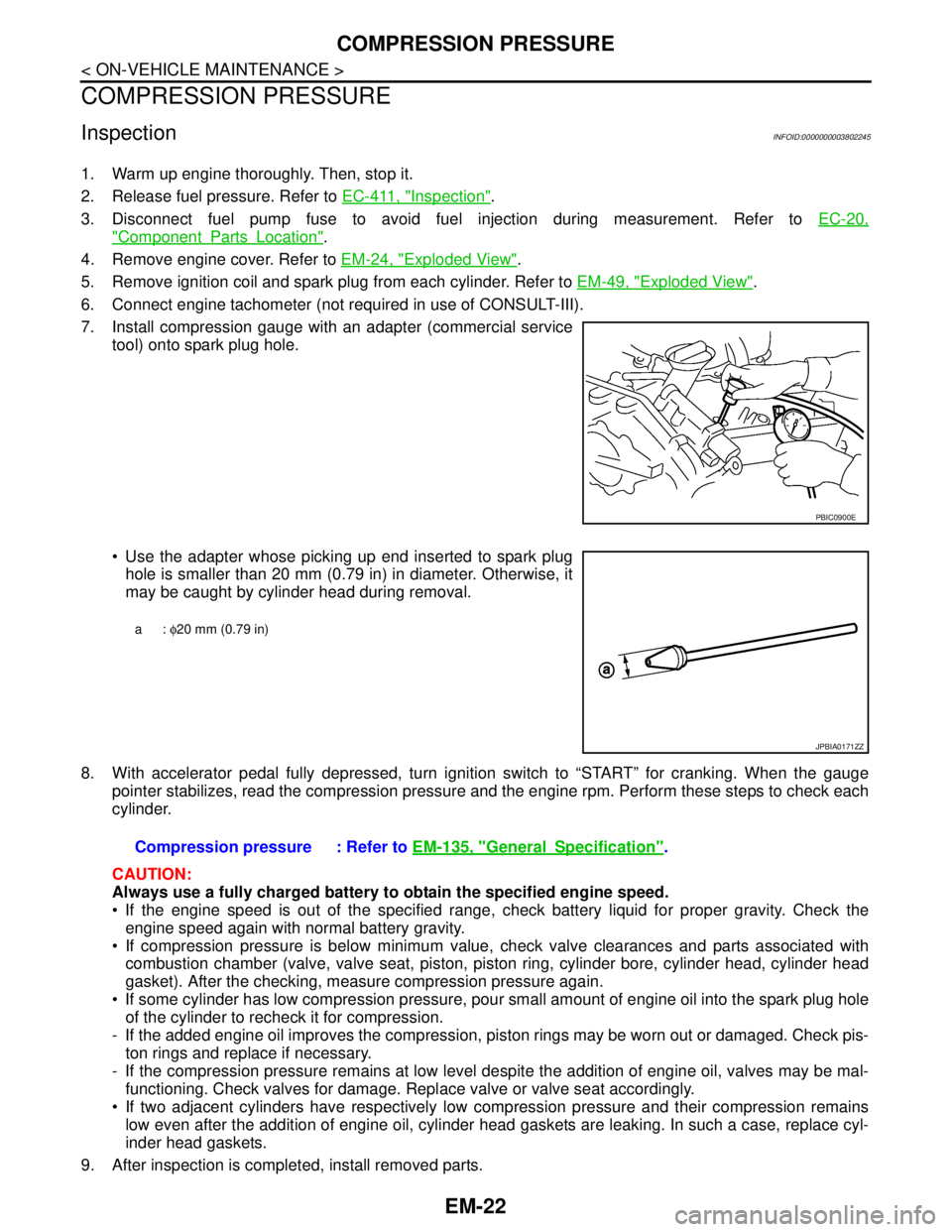
7. Install compression gauge with an adapter (commercial service
tool) onto spark plug hole.
Use the adapter whose picking up end inserted to spark plug
hole is smaller than 20 mm (0.79 in) in diameter. Otherwise, it
may be caught by cylinder head during removal.
8. With accelerator pedal fully depressed, turn ignition switch to “START” for cranking. When the gauge
pointer stabilizes, read the compression pressure and the engine rpm. Perform these steps to check each
cylinder.
CAUTION:
Always use a fully charged battery to obtain the specified engine speed.
If the engine speed is out of the specified range, check battery liquid for proper gravity. Check the
engine speed again with normal battery gravity.
If compression pressure is below minimum value, check valve clearances and parts associated with
combustion chamber (valve, valve seat, piston, piston ring, cylinder bore, cylinder head, cylinder head
gasket). After the checking, measure compression pressure again.
If some cylinder has low compression pressure, pour small amount of engine oil into the spark plug hole
of the cylinder to recheck it for compression.
- If the added engine oil improves the compression, piston rings may be worn out or damaged. Check pis-
ton rings and replace if necessary.
- If the compression pressure remains at low level despite the addition of engine oil, valves may be mal-
functioning. Check valves for damage. Replace valve or valve seat accordingly.
If two adjacent cylinders have respectively low compression pressure and their compression remains
low even after the addition of engine oil, cylinder head gaskets are leaking. In such a case, replace cyl-
inder head gaskets.
9. After inspection is completed, install removed parts.
PBIC0900E
a: φ20 mm (0.79 in)
JPBIA0171ZZ
Compression pressure : Refer to EM-135, "GeneralSpecification".
Page 1920 of 5121
FUEL INJECTOR AND FUEL TUBE
EM-45
< ON-VEHICLE REPAIR >
C
D
E
F
G
H
I
J
K
L
MA
EM
N
P O
5. Drain engine coolant, or when water hoses are disconnected, attach plug to prevent engine coolant leak-
age. Refer to CO-8, "
Draining" or EM-28, "Exploded View".
CAUTION:
Perform this step when the engine is cold.
6. Remove intake manifold collector. Refer to EM-28, "
Exploded View".
7. When separating fuel feed hose and fuel tube connection, disconnect quick connector as follows:
a. Remove quick connector cap from quick connector.
b. Disconnect quick connector from fuel tube as follows:
CAUTION:
Disconnect quick connector by using the quick connector release [SST: — (J-45488)], not by pick-
ing out retainer tabs.
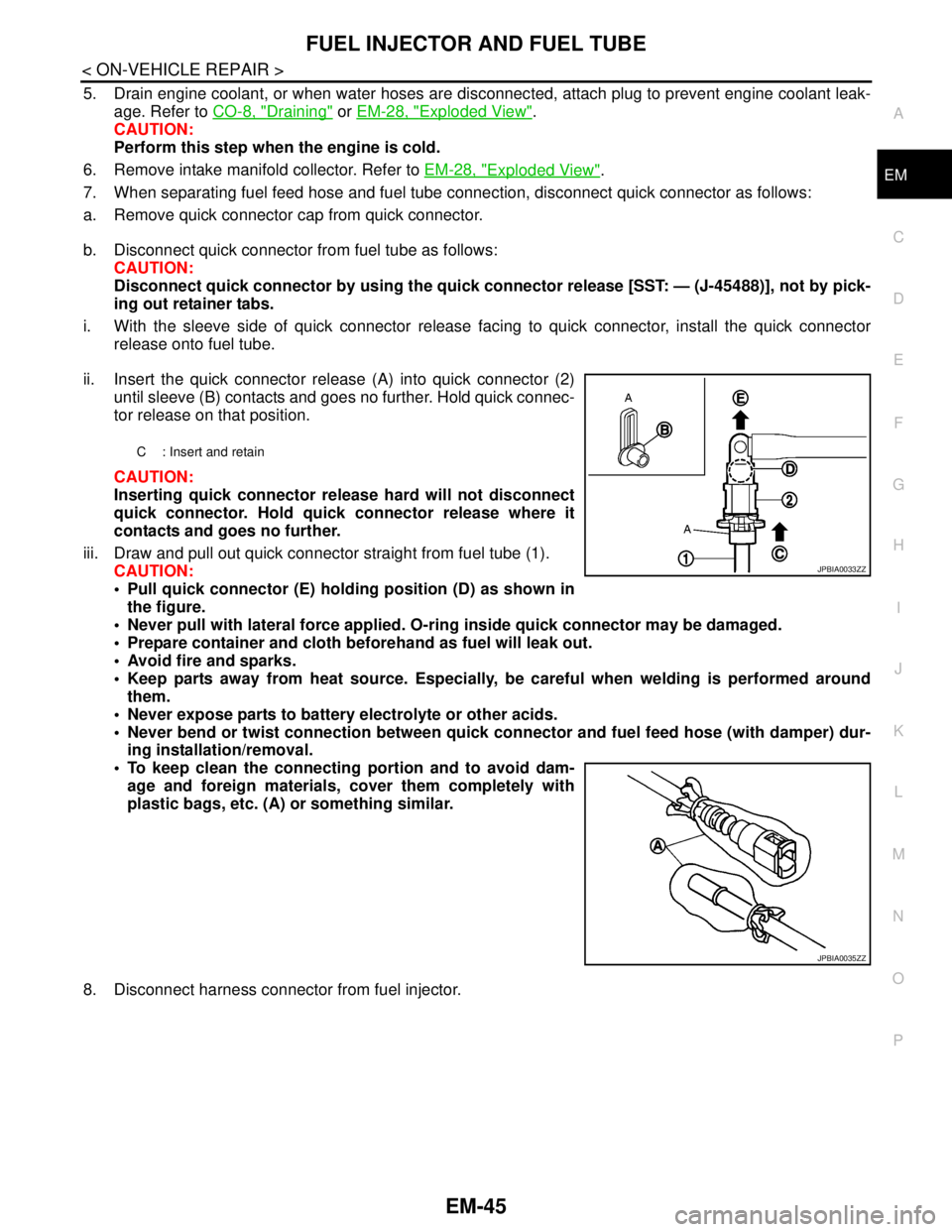
i. With the sleeve side of quick connector release facing to quick connector, install the quick connector
release onto fuel tube.
ii. Insert the quick connector release (A) into quick connector (2)
until sleeve (B) contacts and goes no further. Hold quick connec-
tor release on that position.
CAUTION:
Inserting quick connector release hard will not disconnect
quick connector. Hold quick connector release where it
contacts and goes no further.
iii. Draw and pull out quick connector straight from fuel tube (1).
CAUTION:
Pull quick connector (E) holding position (D) as shown in
the figure.
Never pull with lateral force applied. O-ring inside quick connector may be damaged.
Prepare container and cloth beforehand as fuel will leak out.
Avoid fire and sparks.
Keep parts away from heat source. Especially, be careful when welding is performed around
them.
Never expose parts to battery electrolyte or other acids.
Never bend or twist connection between quick connector and fuel feed hose (with damper) dur-
ing installation/removal.
To keep clean the connecting portion and to avoid dam-
age and foreign materials, cover them completely with
plastic bags, etc. (A) or something similar.
8. Disconnect harness connector from fuel injector.
C : Insert and retain
JPBIA0033ZZ
JPBIA0035ZZ
Page 1934 of 5121
TIMING CHAIN
EM-59
< ON-VEHICLE REPAIR >
C
D
E
F
G
H
I
J
K
L
MA
EM
N
P O
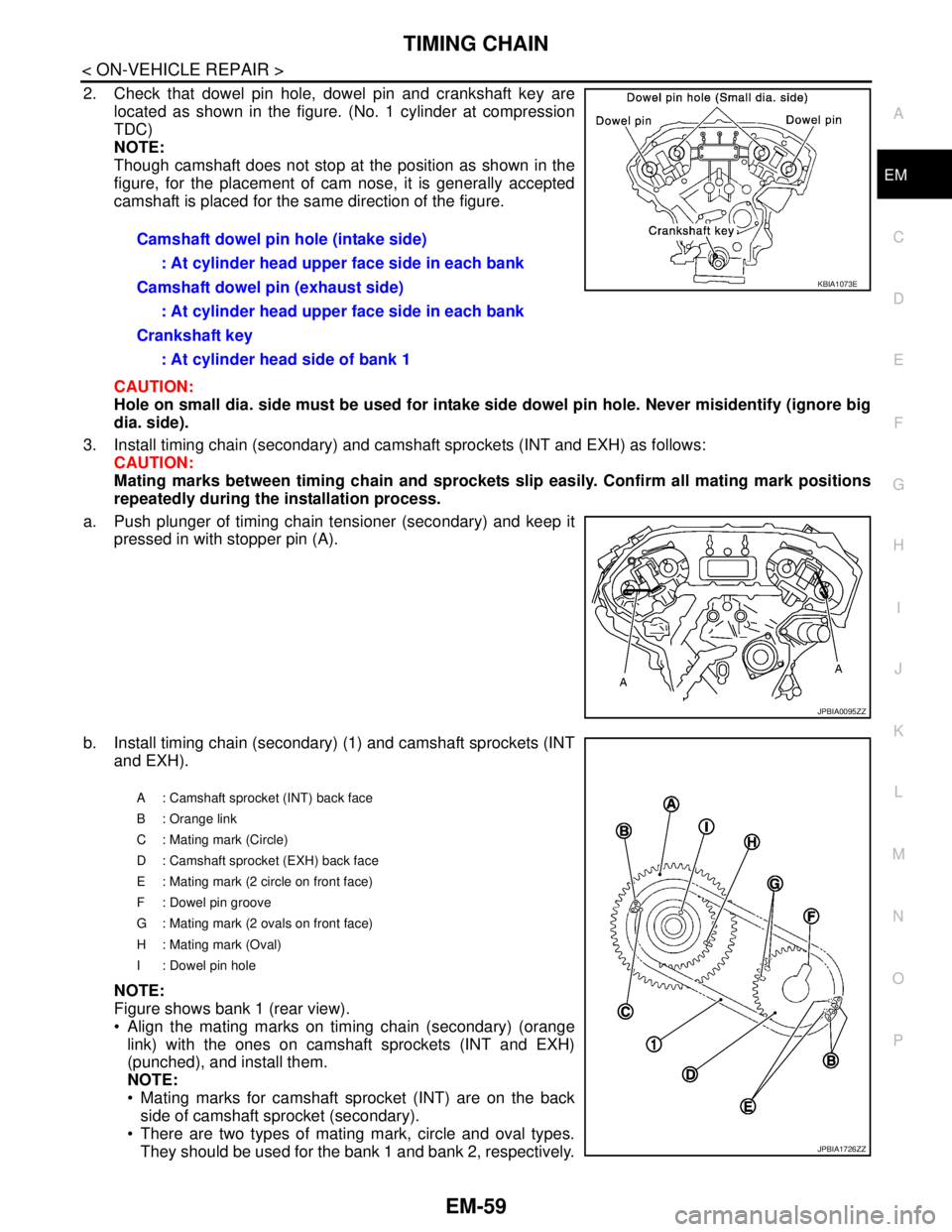
2. Check that dowel pin hole, dowel pin and crankshaft key are
located as shown in the figure. (No. 1 cylinder at compression
TDC)
NOTE:
Though camshaft does not stop at the position as shown in the
figure, for the placement of cam nose, it is generally accepted
camshaft is placed for the same direction of the figure.
CAUTION:
Hole on small dia. side must be used for intake side dowel pin hole. Never misidentify (ignore big
dia. side).
3. Install timing chain (secondary) and camshaft sprockets (INT and EXH) as follows:
CAUTION:
Mating marks between timing chain and sprockets slip easily. Confirm all mating mark positions
repeatedly during the installation process.
a. Push plunger of timing chain tensioner (secondary) and keep it
pressed in with stopper pin (A).
b. Install timing chain (secondary) (1) and camshaft sprockets (INT
and EXH).
NOTE:
Figure shows bank 1 (rear view).
Align the mating marks on timing chain (secondary) (orange
link) with the ones on camshaft sprockets (INT and EXH)
(punched), and install them.
NOTE:
Mating marks for camshaft sprocket (INT) are on the back
side of camshaft sprocket (secondary).
There are two types of mating mark, circle and oval types.
They should be used for the bank 1 and bank 2, respectively. Camshaft dowel pin hole (intake side)
: At cylinder head upper face side in each bank
Camshaft dowel pin (exhaust side)
: At cylinder head upper face side in each bank
Crankshaft key
: At cylinder head side of bank 1
KBIA1073E
JPBIA0095ZZ
A : Camshaft sprocket (INT) back face
B : Orange link
C : Mating mark (Circle)
D : Camshaft sprocket (EXH) back face
E : Mating mark (2 circle on front face)
F : Dowel pin groove
G : Mating mark (2 ovals on front face)
H : Mating mark (Oval)
I : Dowel pin hole
JPBIA1726ZZ
Page 1967 of 5121
EM-92
< DISASSEMBLY AND ASSEMBLY >
CAMSHAFT
b. Disconnect ignition coil and injector harness connectors. Refer to EM-49, "Exploded View" and EM-44,
"Exploded View".
3. Remove intake valve timing control solenoid valve. Refer to EM-79, "
Exploded View".
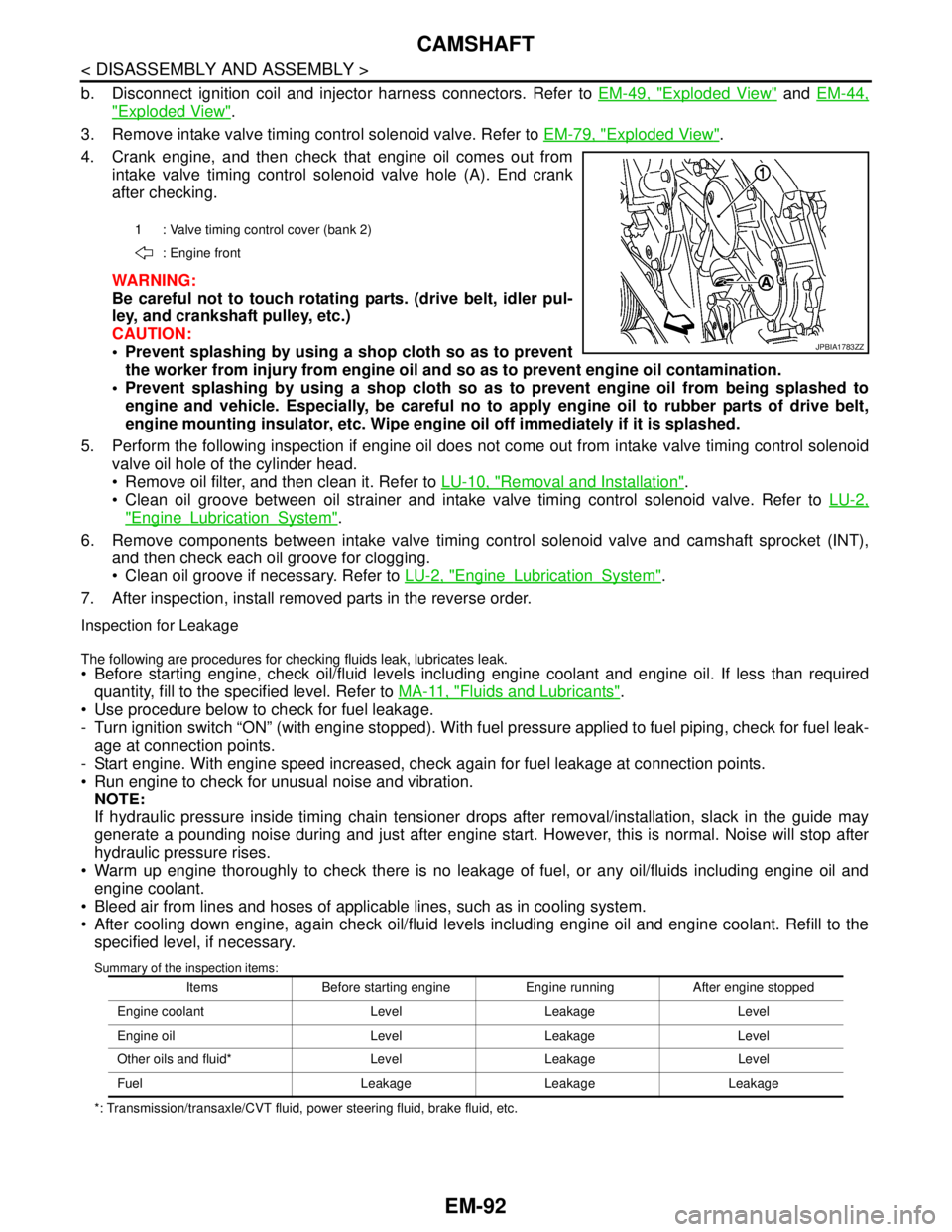
4. Crank engine, and then check that engine oil comes out from
intake valve timing control solenoid valve hole (A). End crank
after checking.
WARNING:
Be careful not to touch rotating parts. (drive belt, idler pul-
ley, and crankshaft pulley, etc.)
CAUTION:
Prevent splashing by using a shop cloth so as to prevent
the worker from injury from engine oil and so as to prevent engine oil contamination.
Prevent splashing by using a shop cloth so as to prevent engine oil from being splashed to
engine and vehicle. Especially, be careful no to apply engine oil to rubber parts of drive belt,
engine mounting insulator, etc. Wipe engine oil off immediately if it is splashed.
5. Perform the following inspection if engine oil does not come out from intake valve timing control solenoid
valve oil hole of the cylinder head.
Remove oil filter, and then clean it. Refer to LU-10, "
Removal and Installation".
Clean oil groove between oil strainer and intake valve timing control solenoid valve. Refer to LU-2,
"EngineLubricationSystem".
6. Remove components between intake valve timing control solenoid valve and camshaft sprocket (INT),
and then check each oil groove for clogging.
Clean oil groove if necessary. Refer to LU-2, "
EngineLubricationSystem".
7. After inspection, install removed parts in the reverse order.
Inspection for Leakage
The following are procedures for checking fluids leak, lubricates leak. Before starting engine, check oil/fluid levels including engine coolant and engine oil. If less than required
quantity, fill to the specified level. Refer to MA-11, "
Fluids and Lubricants".
Use procedure below to check for fuel leakage.
- Turn ignition switch “ON” (with engine stopped). With fuel pressure applied to fuel piping, check for fuel leak-
age at connection points.
- Start engine. With engine speed increased, check again for fuel leakage at connection points.
Run engine to check for unusual noise and vibration.
NOTE:
If hydraulic pressure inside timing chain tensioner drops after removal/installation, slack in the guide may
generate a pounding noise during and just after engine start. However, this is normal. Noise will stop after
hydraulic pressure rises.
Warm up engine thoroughly to check there is no leakage of fuel, or any oil/fluids including engine oil and
engine coolant.
Bleed air from lines and hoses of applicable lines, such as in cooling system.
After cooling down engine, again check oil/fluid levels including engine oil and engine coolant. Refill to the
specified level, if necessary.
Summary of the inspection items:
*: Transmission/transaxle/CVT fluid, power steering fluid, brake fluid, etc.1 : Valve timing control cover (bank 2)
: Engine front
JPBIA1783ZZ
Items Before starting engine Engine running After engine stopped
Engine coolant Level Leakage Level
Engine oil Level Leakage Level
Other oils and fluid* Level Leakage Level
Fuel Leakage Leakage Leakage
Page 1985 of 5121
EM-110
< DISASSEMBLY AND ASSEMBLY >
CYLINDER BLOCK
Disassembly and Assembly
INFOID:0000000003802294
DISASSEMBLY
1. Remove the following parts:
Intake manifold collector: Refer to EM-28, "
Exploded View".
Intake manifold: Refer to EM-32, "
Exploded View".
Oil pans (lower and upper): Refer to EM-38, "
Exploded View".
Front and rear timing chain case: Refer to EM-79, "
Exploded View".
Cylinder head: Refer to EM-96, "
Exploded View".
2. Remove knock sensor.
CAUTION:
Carefully handle sensor avoiding shocks.
3. Remove rear oil seal retainer.
Remove by inserting screwdriver between main bearing cap and rear oil seal retainer.
CAUTION:
If rear oil seal retainer is removed, replace it with new one.
NOTE:
Regard both rear oil seal and retainer as an assembly.
4. Remove baffle plate from main bearing beam.
5. Remove piston and connecting rod assembly with the following procedure:
Before removing piston and connecting rod assembly, check the connecting rod side clearance. Refer to
EM-119, "
Inspection".
CAUTION:
Be careful not to drop connecting rod bearing, and to scratch the surface.
a. Position crankshaft pin corresponding to connecting rod to be removed onto the bottom dead center.
b. Remove connecting rod bearing cap.
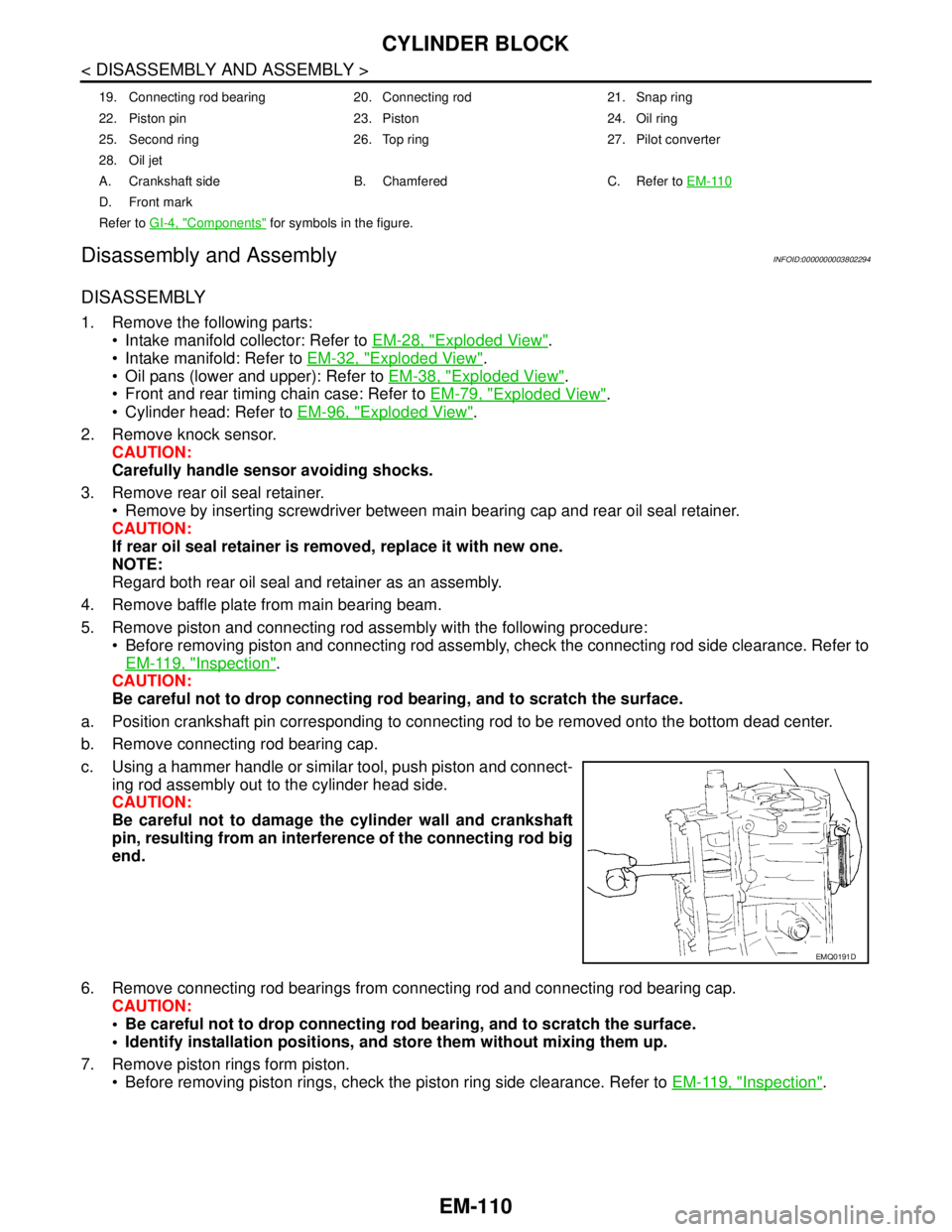
c. Using a hammer handle or similar tool, push piston and connect-
ing rod assembly out to the cylinder head side.
CAUTION:
Be careful not to damage the cylinder wall and crankshaft
pin, resulting from an interference of the connecting rod big
end.
6. Remove connecting rod bearings from connecting rod and connecting rod bearing cap.
CAUTION:
Be careful not to drop connecting rod bearing, and to scratch the surface.
Identify installation positions, and store them without mixing them up.
7. Remove piston rings form piston.
Before removing piston rings, check the piston ring side clearance. Refer to EM-119, "
Inspection".
19. Connecting rod bearing 20. Connecting rod 21. Snap ring
22. Piston pin 23. Piston 24. Oil ring
25. Second ring 26. Top ring 27. Pilot converter
28. Oil jet
A. Crankshaft side B. Chamfered C. Refer to EM-110
D. Front mark
Refer to GI-4, "
Components" for symbols in the figure.
EMQ0191D
Page 1989 of 5121
EM-114
< DISASSEMBLY AND ASSEMBLY >
CYLINDER BLOCK
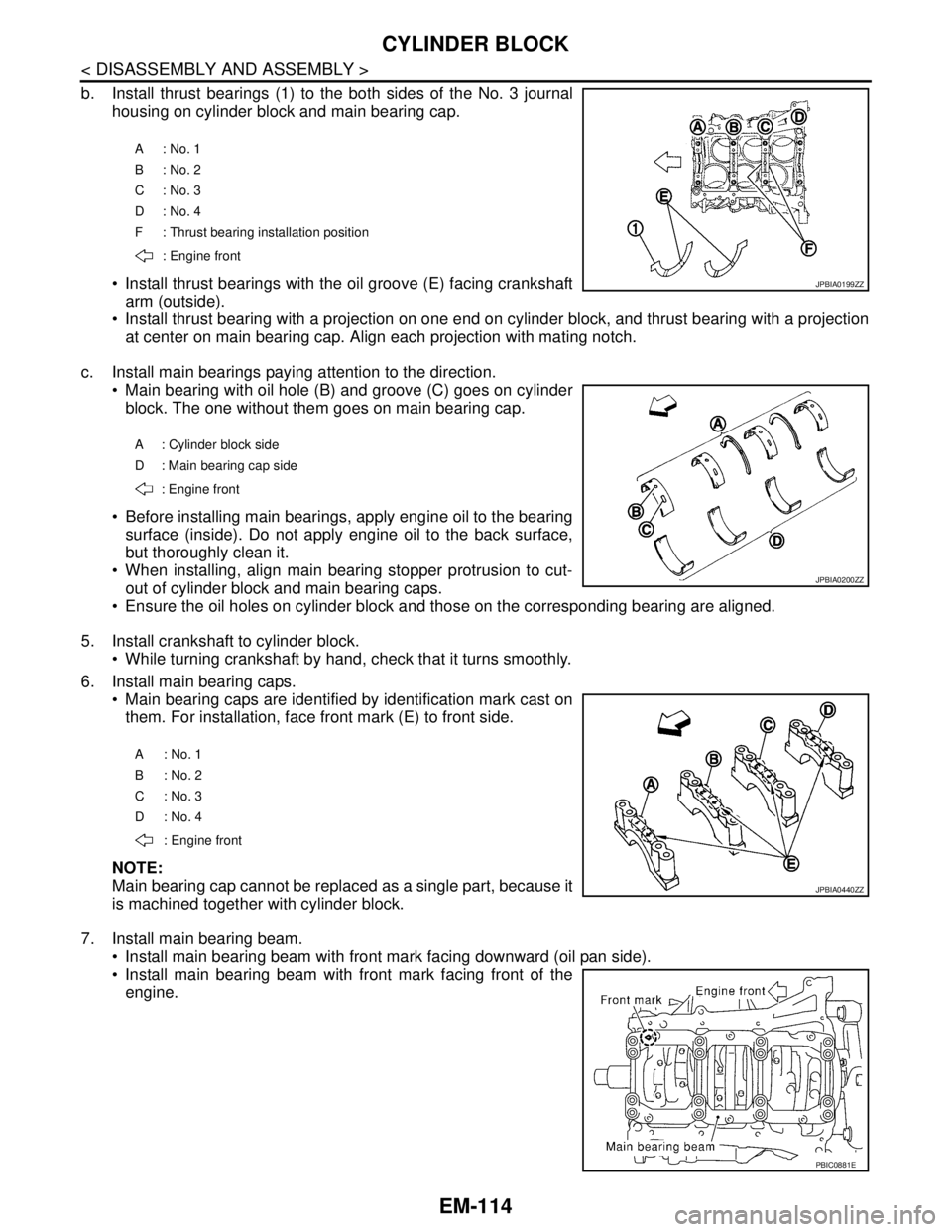
b. Install thrust bearings (1) to the both sides of the No. 3 journal
housing on cylinder block and main bearing cap.
Install thrust bearings with the oil groove (E) facing crankshaft
arm (outside).
Install thrust bearing with a projection on one end on cylinder block, and thrust bearing with a projection
at center on main bearing cap. Align each projection with mating notch.
c. Install main bearings paying attention to the direction.
Main bearing with oil hole (B) and groove (C) goes on cylinder
block. The one without them goes on main bearing cap.
Before installing main bearings, apply engine oil to the bearing
surface (inside). Do not apply engine oil to the back surface,
but thoroughly clean it.
When installing, align main bearing stopper protrusion to cut-
out of cylinder block and main bearing caps.
Ensure the oil holes on cylinder block and those on the corresponding bearing are aligned.
5. Install crankshaft to cylinder block.
While turning crankshaft by hand, check that it turns smoothly.
6. Install main bearing caps.
Main bearing caps are identified by identification mark cast on
them. For installation, face front mark (E) to front side.
NOTE:
Main bearing cap cannot be replaced as a single part, because it
is machined together with cylinder block.
7. Install main bearing beam.
Install main bearing beam with front mark facing downward (oil pan side).
Install main bearing beam with front mark facing front of the
engine.
A : No. 1
B : No. 2
C : No. 3
D : No. 4
F : Thrust bearing installation position
: Engine front
JPBIA0199ZZ
A : Cylinder block side
D : Main bearing cap side
: Engine front
JPBIA0200ZZ
A : No. 1
B : No. 2
C : No. 3
D : No. 4
: Engine front
JPBIA0440ZZ
PBIC0881E