ESP NISSAN TEANA 2008 Manual PDF
[x] Cancel search | Manufacturer: NISSAN, Model Year: 2008, Model line: TEANA, Model: NISSAN TEANA 2008Pages: 5121, PDF Size: 69.03 MB
Page 2518 of 5121
PRECAUTIONS
GI-25
< PRECAUTION >
C
D
E
F
G
H
I
J
K
L
MB
GI
N
O
P
If turning the steering wheel is required with the battery disconnected or discharged, follow the procedure
below before starting the repair operation.
OPERATION PROCEDURE
1. Connect both battery cables.
NOTE:
Supply power using jumper cables if battery is discharged.
2. Turn the push-button ignition switch to ACC position.
(At this time, the steering lock will be released.)
3. Disconnect both battery cables. The steering lock will remain released with both battery cables discon-
nected and the steering wheel can be turned.
4. Perform the necessary repair operation.
5. When the repair work is completed, re-connect both battery cables. With the brake pedal released, turn
the push-button ignition switch from ACC position to ON position, then to LOCK position. (The steering
wheel will lock when the push-button ignition switch is turned to LOCK position.)
6. Perform self-diagnosis check of all control units using CONSULT-III.
Precaution for Procedure without Cowl Top CoverINFOID:0000000003852857
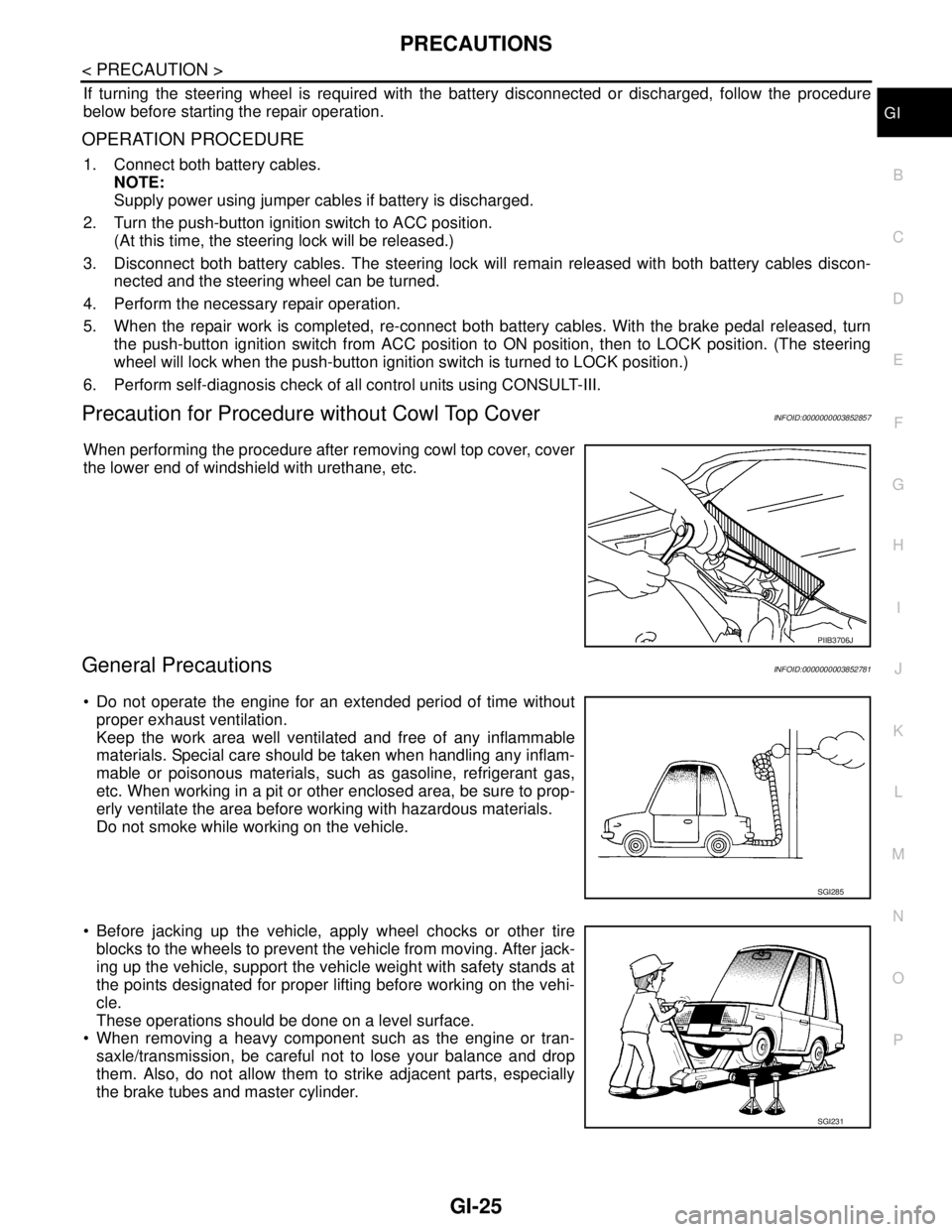
When performing the procedure after removing cowl top cover, cover
the lower end of windshield with urethane, etc.
General PrecautionsINFOID:0000000003852781
Do not operate the engine for an extended period of time without
proper exhaust ventilation.
Keep the work area well ventilated and free of any inflammable
materials. Special care should be taken when handling any inflam-
mable or poisonous materials, such as gasoline, refrigerant gas,
etc. When working in a pit or other enclosed area, be sure to prop-
erly ventilate the area before working with hazardous materials.
Do not smoke while working on the vehicle.
Before jacking up the vehicle, apply wheel chocks or other tire
blocks to the wheels to prevent the vehicle from moving. After jack-
ing up the vehicle, support the vehicle weight with safety stands at
the points designated for proper lifting before working on the vehi-
cle.
These operations should be done on a level surface.
When removing a heavy component such as the engine or tran-
saxle/transmission, be careful not to lose your balance and drop
them. Also, do not allow them to strike adjacent parts, especially
the brake tubes and master cylinder.
PIIB3706J
SGI285
SGI231
Page 2545 of 5121
GW-2
< SYMPTOM DIAGNOSIS >
SQUEAK AND RATTLE TROUBLE DIAGNOSES
SYMPTOM DIAGNOSIS
SQUEAK AND RATTLE TROUBLE DIAGNOSES
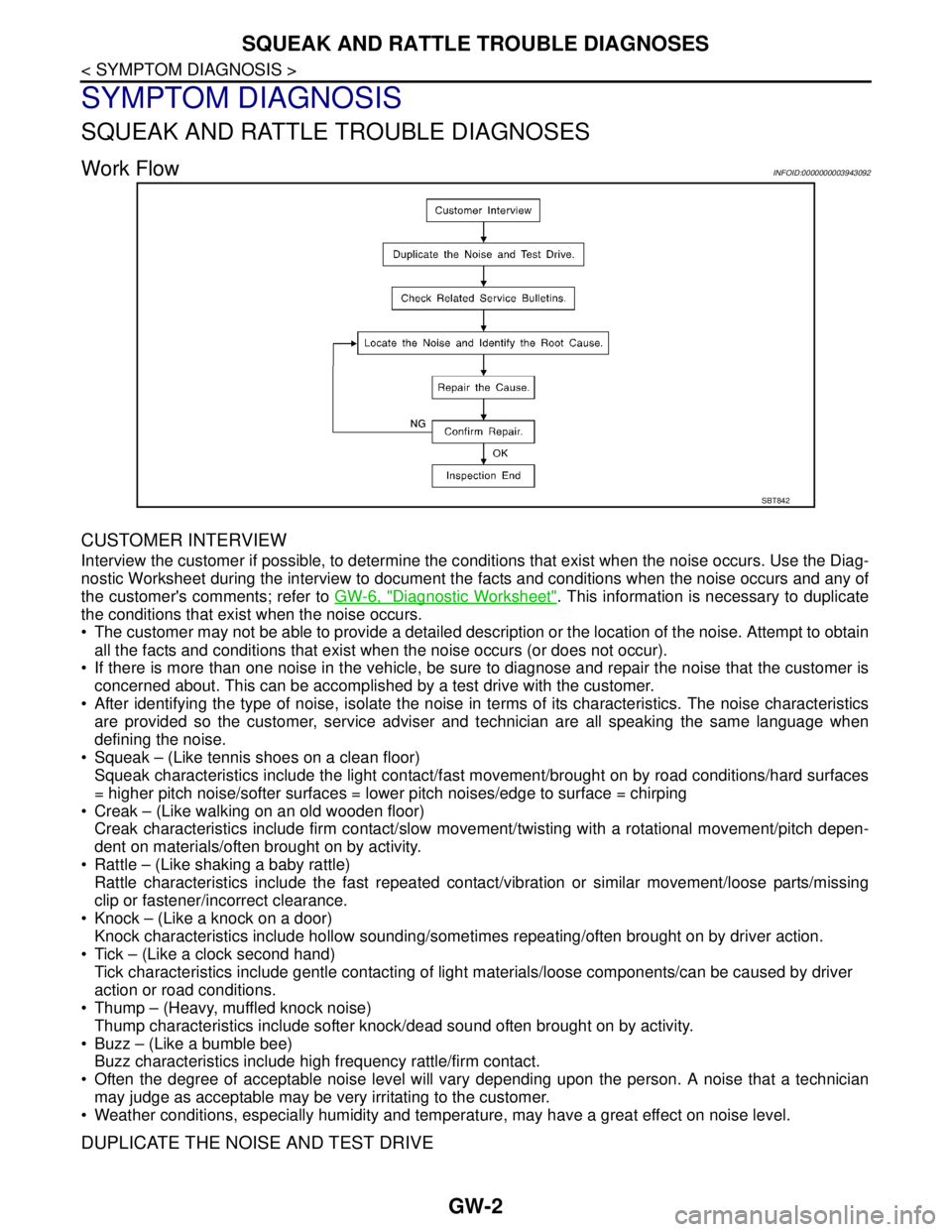
Work FlowINFOID:0000000003943092
CUSTOMER INTERVIEW
Interview the customer if possible, to determine the conditions that exist when the noise occurs. Use the Diag-
nostic Worksheet during the interview to document the facts and conditions when the noise occurs and any of
the customer's comments; refer to GW-6, "
Diagnostic Worksheet". This information is necessary to duplicate
the conditions that exist when the noise occurs.
• The customer may not be able to provide a detailed description or the location of the noise. Attempt to obtain
all the facts and conditions that exist when the noise occurs (or does not occur).
If there is more than one noise in the vehicle, be sure to diagnose and repair the noise that the customer is
concerned about. This can be accomplished by a test drive with the customer.
After identifying the type of noise, isolate the noise in terms of its characteristics. The noise characteristics
are provided so the customer, service adviser and technician are all speaking the same language when
defining the noise.
Squeak – (Like tennis shoes on a clean floor)
Squeak characteristics include the light contact/fast movement/brought on by road conditions/hard surfaces
= higher pitch noise/softer surfaces = lower pitch noises/edge to surface = chirping
Creak – (Like walking on an old wooden floor)
Creak characteristics include firm contact/slow movement/twisting with a rotational movement/pitch depen-
dent on materials/often brought on by activity.
Rattle – (Like shaking a baby rattle)
Rattle characteristics include the fast repeated contact/vibration or similar movement/loose parts/missing
clip or fastener/incorrect clearance.
Knock – (Like a knock on a door)
Knock characteristics include hollow sounding/sometimes repeating/often brought on by driver action.
Tick – (Like a clock second hand)
Tick characteristics include gentle contacting of light materials/loose components/can be caused by driver
action or road conditions.
Thump – (Heavy, muffled knock noise)
Thump characteristics include softer knock/dead sound often brought on by activity.
Buzz – (Like a bumble bee)
Buzz characteristics include high frequency rattle/firm contact.
Often the degree of acceptable noise level will vary depending upon the person. A noise that a technician
may judge as acceptable may be very irritating to the customer.
Weather conditions, especially humidity and temperature, may have a great effect on noise level.
DUPLICATE THE NOISE AND TEST DRIVE
SBT842
Page 2591 of 5121
HA-22
< PREPARATION >
PREPARATION
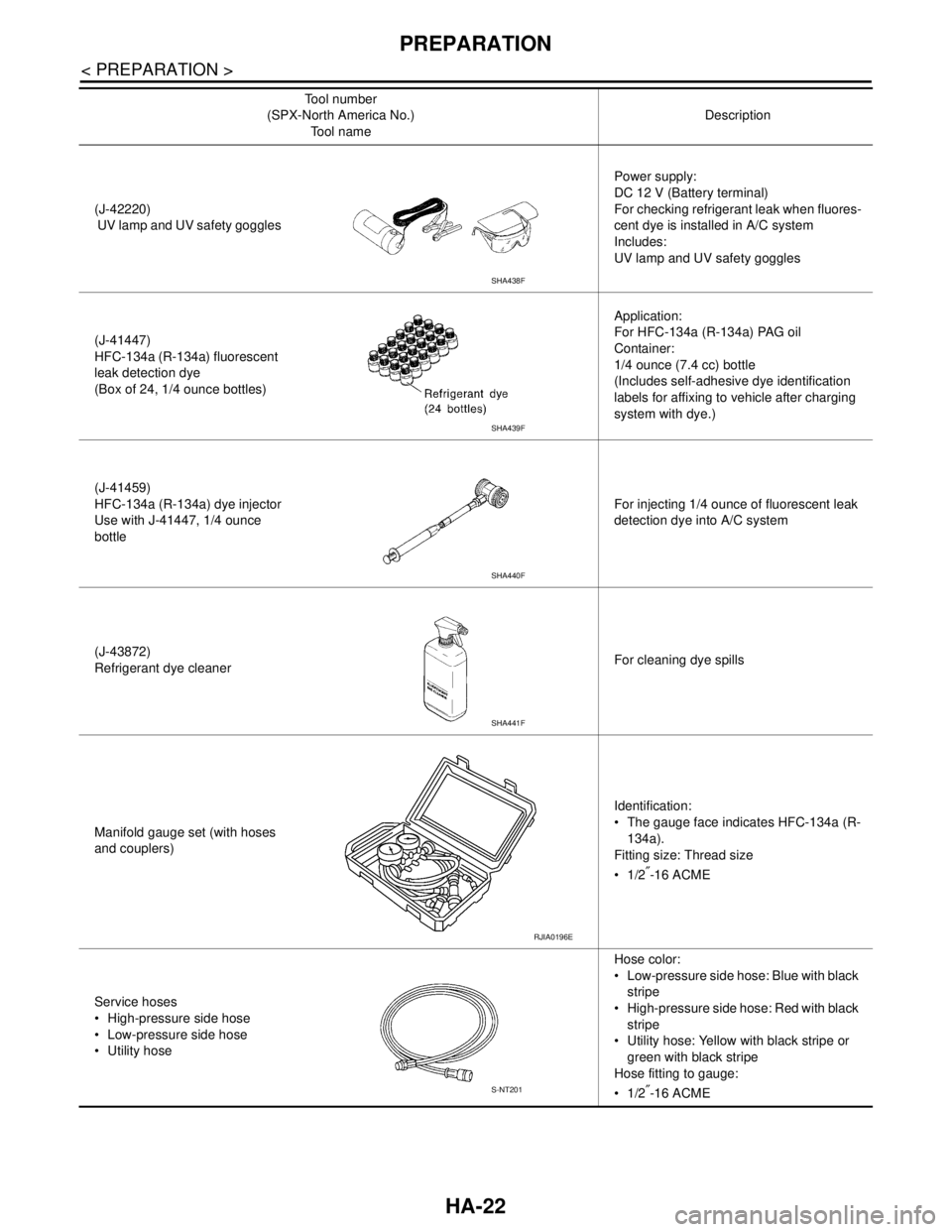
(J-42220)
UV lamp and UV safety gogglesPower supply:
DC 12 V (Battery terminal)
For checking refrigerant leak when fluores-
cent dye is installed in A/C system
Includes:
UV lamp and UV safety goggles
(J-41447)
HFC-134a (R-134a) fluorescent
leak detection dye
(Box of 24, 1/4 ounce bottles)Application:
For HFC-134a (R-134a) PAG oil
Container:
1/4 ounce (7.4 cc) bottle
(Includes self-adhesive dye identification
labels for affixing to vehicle after charging
system with dye.)
(J-41459)
HFC-134a (R-134a) dye injector
Use with J-41447, 1/4 ounce
bottleFor injecting 1/4 ounce of fluorescent leak
detection dye into A/C system
(J-43872)
Refrigerant dye cleanerFor cleaning dye spills
Manifold gauge set (with hoses
and couplers)Identification:
The gauge face indicates HFC-134a (R-
134a).
Fitting size: Thread size
1/2
″-16 ACME
Service hoses
High-pressure side hose
Low-pressure side hose
Utility hoseHose color:
Low-pressure side hose: Blue with black
stripe
High-pressure side hose: Red with black
stripe
Utility hose: Yellow with black stripe or
green with black stripe
Hose fitting to gauge:
1/2
″-16 ACME Tool number
(SPX-North America No.)
Tool nameDescription
SHA438F
SHA439F
SHA440F
SHA441F
RJIA0196E
S-NT201
Page 2651 of 5121
![NISSAN TEANA 2008 Manual PDF AUTOMATIC AIR CONDITIONER SYSTEM
HAC-23
< FUNCTION DIAGNOSIS >[WITHOUT 7 INCH DISPLAY]
C
D
E
F
G
H
J
K
L
MA
B
HAC
N
O
P
Decision (A/C auto amp. indicated value and motor opening angle comparison)
Op](/img/5/57391/w960_57391-2650.png "NISSAN TEANA 2008 Manual PDF AUTOMATIC AIR CONDITIONER SYSTEM
HAC-23
< FUNCTION DIAGNOSIS >[WITHOUT 7 INCH DISPLAY]
C
D
E
F
G
H
J
K
L
MA
B
HAC
N
O
P
Decision (A/C auto amp. indicated value and motor opening angle comparison)
Op")
AUTOMATIC AIR CONDITIONER SYSTEM
HAC-23
< FUNCTION DIAGNOSIS >[WITHOUT 7 INCH DISPLAY]
C
D
E
F
G
H
J
K
L
MA
B
HAC
N
O
P
Decision (A/C auto amp. indicated value and motor opening angle comparison)
Operation
The A/C auto amp. receives data from each of the sensors. The A/C auto amp. sends mode door, the air mix
door and the intake door opening angle data to the mode door motor LCU, the air mix door motor LCUs and
the intake door motor LCU.
The mode door motor, the air mix door motors and the intake door motor read their respective signals accord-
ing to the address signal. Opening angle indication signals received from the A/C auto amp. and each of the
motor position sensors is compared by the LCUs in each door motor with the existing decision and opening
angles. Next, HOT/COLD, DEF/VENT, OPEN/SHUT or FRE/REC operation is selected. The new selection
data is returned to the A/C auto amp.
Transmission Data and Transmission Order
A/C auto amp. data is transmitted consecutively to each of the door motors following the form as shown in the
figure below.
START: Initial compulsory signal is sent to each of the door motors.
ADDRESS: Data sent from the A/C auto amp. is selected according to data-based decisions made by the mode door
motor, the air mix door motors and the intake door motor.
If the addresses are identical, the opening angle data and error check signals are received by the door motor
LCUs. The LCUs then make the appropriate error decision. If the opening angle data has no error, door con-
trol begins.
If an error exists, the received data is rejected and the corrected data received. Finally, door control is based
upon the corrected opening angle data.
OPENING ANGLE:
Data that shows the indicated door opening angle of each door motor.
ERROR CHECK: In this procedure, transmitted and received data is checked for errors. Error data is then compiled. The error
check prevents corrupted data from being used by the mode door motor, the air mix door motors and the
intake door motor. Error data can be related to the following symptoms.
- Malfunction of electrical frequency
- Poor electrical connections
- Signal leakage from transmission lines
- Signal level fluctuation
STOP SIGNAL:
JSIIA1130GB
JSIIA1131GB
Page 2656 of 5121
![NISSAN TEANA 2008 Manual PDF HAC-28
< FUNCTION DIAGNOSIS >[WITHOUT 7 INCH DISPLAY]
MODE DOOR CONTROL SYSTEM
MODE DOOR CONTROL SYSTEM
System DiagramINFOID:0000000003846309
System DescriptionINFOID:0000000003846310
The mode door is](/img/5/57391/w960_57391-2655.png "NISSAN TEANA 2008 Manual PDF HAC-28
< FUNCTION DIAGNOSIS >[WITHOUT 7 INCH DISPLAY]
MODE DOOR CONTROL SYSTEM
MODE DOOR CONTROL SYSTEM
System DiagramINFOID:0000000003846309
System DescriptionINFOID:0000000003846310
The mode door is")
HAC-28
< FUNCTION DIAGNOSIS >[WITHOUT 7 INCH DISPLAY]
MODE DOOR CONTROL SYSTEM
MODE DOOR CONTROL SYSTEM
System DiagramINFOID:0000000003846309
System DescriptionINFOID:0000000003846310
The mode door is automatically controlled by the temperature setting, ambient temperature, in-vehicle temper-
ature, intake temperature and amount of sunload.
SYSTEM OPERATION
The A/C auto amp. receives data from each of the sensors.
The A/C auto amp. sends the air mix door, the mode door and the intake door opening angle data to the air
mix door motor LCUs, the mode door motor LCU and the intake door motor LCU.
The air mix door motors, the mode door motor and the intake door motor read their respective signals
according to the address signal. Opening angle indication signals received from the A/C auto amp. and each
of the motor position sensors are compared by the LCUs in each door motor with the existing decision and
opening angles.
Next, HOT/COLD, DEF/VENT, OPEN/SHUT or FRE/REC operations is selected. The newly selected data is
returned to the A/C auto amp.
Door Motor Circuit
Mode Door Control Specification
JPIIA0493GB
JSIIA1133GB
Page 2658 of 5121
![NISSAN TEANA 2008 Manual PDF HAC-30
< FUNCTION DIAGNOSIS >[WITHOUT 7 INCH DISPLAY]
AIR MIX DOOR CONTROL SYSTEM
AIR MIX DOOR CONTROL SYSTEM
System DiagramINFOID:0000000003846311
System DescriptionINFOID:0000000003846312
The air mi](/img/5/57391/w960_57391-2657.png "NISSAN TEANA 2008 Manual PDF HAC-30
< FUNCTION DIAGNOSIS >[WITHOUT 7 INCH DISPLAY]
AIR MIX DOOR CONTROL SYSTEM
AIR MIX DOOR CONTROL SYSTEM
System DiagramINFOID:0000000003846311
System DescriptionINFOID:0000000003846312
The air mi")
HAC-30
< FUNCTION DIAGNOSIS >[WITHOUT 7 INCH DISPLAY]
AIR MIX DOOR CONTROL SYSTEM
AIR MIX DOOR CONTROL SYSTEM
System DiagramINFOID:0000000003846311
System DescriptionINFOID:0000000003846312
The air mix doors are automatically controlled so that in-vehicle temperature is maintained at a predetermined
value by the temperature setting, ambient temperature, intake temperature and amount of sunload.
SYSTEM OPERATION
The A/C auto amp. receives data from each of the sensors.
The A/C auto amp. sends air mix door, the mode door and the intake door opening angle data to the air mix
door motor LCUs, the mode door motor LCU and the intake door motor LCU.
The air mix door motors, the mode door motor and the intake door motor read their respective signals
according to the address signal. Opening angle indication signals received from the A/C auto amp. and each
of the motor position sensors are compared by the LCUs in each door motor with the existing decision and
opening angles.
Next, HOT/COLD, DEF/VENT, OPEN/SHUT or FRE/REC operation is selected. The newly selected data is
returned to the A/C auto amp.
Door Motor Circuit
Air Mix Door Control Specification
JPIIA0498GB
JSIIA1133GB
Page 2756 of 5121
![NISSAN TEANA 2008 Manual PDF HAC-128
< FUNCTION DIAGNOSIS >[WITH 7 INCH DISPLAY]
AUTOMATIC AIR CONDITIONER SYSTEM
Decision (A/C auto amp. indicated value and motor opening angle comparison)
Operation
The A/C auto amp. receives](/img/5/57391/w960_57391-2755.png "NISSAN TEANA 2008 Manual PDF HAC-128
< FUNCTION DIAGNOSIS >[WITH 7 INCH DISPLAY]
AUTOMATIC AIR CONDITIONER SYSTEM
Decision (A/C auto amp. indicated value and motor opening angle comparison)
Operation
The A/C auto amp. receives")
HAC-128
< FUNCTION DIAGNOSIS >[WITH 7 INCH DISPLAY]
AUTOMATIC AIR CONDITIONER SYSTEM
Decision (A/C auto amp. indicated value and motor opening angle comparison)
Operation
The A/C auto amp. receives data from each of the sensors. The A/C auto amp. sends mode door, the air mix
door and the intake door opening angle data to the mode door motor LCU, the air mix door motor LCUs and
the intake door motor LCU.
The mode door motor, the air mix door motors and the intake door motor read their respective signals accord-
ing to the address signal. Opening angle indication signals received from the A/C auto amp. and each of the
motor position sensors is compared by the LCUs in each door motor with the existing decision and opening
angles. Next, HOT/COLD, DEF/VENT, OPEN/SHUT or FRE/REC operation is selected. The new selection
data is returned to the A/C auto amp.
Transmission Data and Transmission Order
A/C auto amp. data is transmitted consecutively to each of the door motors following the form as shown in the
figure below.
START: Initial compulsory signal is sent to each of the door motors.
ADDRESS: Data sent from the A/C auto amp. is selected according to data-based decisions made by the mode door
motor, the air mix door motors and the intake door motor.
If the addresses are identical, the opening angle data and error check signals are received by the door motor
LCUs. The LCUs then make the appropriate error decision. If the opening angle data has no error, door con-
trol begins.
If an error exists, the received data is rejected and the corrected data received. Finally, door control is based
upon the corrected opening angle data.
OPENING ANGLE:
Data that shows the indicated door opening angle of each door motor.
ERROR CHECK: In this procedure, transmitted and received data is checked for errors. Error data is then compiled. The error
check prevents corrupted data from being used by the mode door motor, the air mix door motors and the
intake door motor. Error data can be related to the following symptoms.
- Malfunction of electrical frequency
- Poor electrical connections
- Signal leakage from transmission lines
- Signal level fluctuation
STOP SIGNAL:
JSIIA1130GB
JSIIA1131GB
Page 2765 of 5121
![NISSAN TEANA 2008 Manual PDF AUTOMATIC AIR CONDITIONER SYSTEM
HAC-137
< FUNCTION DIAGNOSIS >[WITH 7 INCH DISPLAY]
C
D
E
F
G
H
J
K
L
MA
B
HAC
N
O
P
A configuration of these components is as shown in the figure below.
SYSTEM CONSTR](/img/5/57391/w960_57391-2764.png "NISSAN TEANA 2008 Manual PDF AUTOMATIC AIR CONDITIONER SYSTEM
HAC-137
< FUNCTION DIAGNOSIS >[WITH 7 INCH DISPLAY]
C
D
E
F
G
H
J
K
L
MA
B
HAC
N
O
P
A configuration of these components is as shown in the figure below.
SYSTEM CONSTR")
AUTOMATIC AIR CONDITIONER SYSTEM
HAC-137
< FUNCTION DIAGNOSIS >[WITH 7 INCH DISPLAY]
C
D
E
F
G
H
J
K
L
MA
B
HAC
N
O
P
A configuration of these components is as shown in the figure below.
SYSTEM CONSTRUCTION
A small network exists between the A/C auto amp., the mode door motor, the air mix door motor and the intake
door motor. The A/C auto amp. and motors are connected by data transmission lines and motor power supply
lines. The LAN network is built through the ground circuits of each door motor.
Addresses, motor opening angle signals, motor stop signals and error checking messages are all transmitted
through the data transmission lines connecting the A/C auto amp. and each door motor.
The following functions are contained in LCUs built into the mode door motor, the air mix door motors and the
intake door motor.
Address
Motor opening angle signals
Data transmission
Motor stop and drive decision
Opening angle sensor (PBR function)
Comparison
Decision (A/C auto amp. indicated value and motor opening angle comparison)
Operation
The A/C auto amp. receives data from each of the sensors. The A/C auto amp. sends mode door, the air mix
door and the intake door opening angle data to the mode door motor LCU, the air mix door motor LCUs and
the intake door motor LCU.
The mode door motor, the air mix door motors and the intake door motor read their respective signals accord-
ing to the address signal. Opening angle indication signals received from the A/C auto amp. and each of the
motor position sensors is compared by the LCUs in each door motor with the existing decision and opening
angles. Next, HOT/COLD, DEF/VENT, OPEN/SHUT or FRE/REC operation is selected. The new selection
data is returned to the A/C auto amp.
Transmission Data and Transmission Order
A/C auto amp. data is transmitted consecutively to each of the door motors following the form as shown in the
figure below.
JSIIA1129GB
JSIIA1130GB
JSIIA1131GB
Page 2773 of 5121
![NISSAN TEANA 2008 Manual PDF MODE DOOR CONTROL SYSTEM
HAC-145
< FUNCTION DIAGNOSIS >[WITH 7 INCH DISPLAY]
C
D
E
F
G
H
J
K
L
MA
B
HAC
N
O
P
MODE DOOR CONTROL SYSTEM
System DiagramINFOID:0000000003884714
System DescriptionINFOID:00](/img/5/57391/w960_57391-2772.png "NISSAN TEANA 2008 Manual PDF MODE DOOR CONTROL SYSTEM
HAC-145
< FUNCTION DIAGNOSIS >[WITH 7 INCH DISPLAY]
C
D
E
F
G
H
J
K
L
MA
B
HAC
N
O
P
MODE DOOR CONTROL SYSTEM
System DiagramINFOID:0000000003884714
System DescriptionINFOID:00")
MODE DOOR CONTROL SYSTEM
HAC-145
< FUNCTION DIAGNOSIS >[WITH 7 INCH DISPLAY]
C
D
E
F
G
H
J
K
L
MA
B
HAC
N
O
P
MODE DOOR CONTROL SYSTEM
System DiagramINFOID:0000000003884714
System DescriptionINFOID:0000000003884715
The mode door is automatically controlled by the temperature setting, ambient temperature, in-vehicle temper-
ature, intake temperature and amount of sunload.
SYSTEM OPERATION
The A/C auto amp. receives data from each of the sensors.
The A/C auto amp. sends the air mix door, the mode door and the intake door opening angle data to the air
mix door motor LCUs, the mode door motor LCU and the intake door motor LCU.
The air mix door motors, the mode door motor and the intake door motor read their respective signals
according to the address signal. Opening angle indication signals received from the A/C auto amp. and each
of the motor position sensors are compared by the LCUs in each door motor with the existing decision and
opening angles.
Next, HOT/COLD, DEF/VENT, OPEN/SHUT or FRE/REC operations is selected. The newly selected data is
returned to the A/C auto amp.
Door Motor Circuit
Mode Door Control Specification
JPIIA0494GB
JSIIA1133GB
Page 2775 of 5121
![NISSAN TEANA 2008 Manual PDF AIR MIX DOOR CONTROL SYSTEM
HAC-147
< FUNCTION DIAGNOSIS >[WITH 7 INCH DISPLAY]
C
D
E
F
G
H
J
K
L
MA
B
HAC
N
O
P
AIR MIX DOOR CONTROL SYSTEM
System DiagramINFOID:0000000003884718
System DescriptionINF](/img/5/57391/w960_57391-2774.png "NISSAN TEANA 2008 Manual PDF AIR MIX DOOR CONTROL SYSTEM
HAC-147
< FUNCTION DIAGNOSIS >[WITH 7 INCH DISPLAY]
C
D
E
F
G
H
J
K
L
MA
B
HAC
N
O
P
AIR MIX DOOR CONTROL SYSTEM
System DiagramINFOID:0000000003884718
System DescriptionINF")
AIR MIX DOOR CONTROL SYSTEM
HAC-147
< FUNCTION DIAGNOSIS >[WITH 7 INCH DISPLAY]
C
D
E
F
G
H
J
K
L
MA
B
HAC
N
O
P
AIR MIX DOOR CONTROL SYSTEM
System DiagramINFOID:0000000003884718
System DescriptionINFOID:0000000003884719
The air mix doors are automatically controlled so that in-vehicle temperature is maintained at a predetermined
value by the temperature setting, ambient temperature, intake temperature and amount of sunload.
SYSTEM OPERATION
The A/C auto amp. receives data from each of the sensors.
The A/C auto amp. sends air mix door, the mode door and the intake door opening angle data to the air mix
door motor LCUs, the mode door motor LCU and the intake door motor LCU.
The air mix door motors, the mode door motor and the intake door motor read their respective signals
according to the address signal. Opening angle indication signals received from the A/C auto amp. and each
of the motor position sensors are compared by the LCUs in each door motor with the existing decision and
opening angles.
Next, HOT/COLD, DEF/VENT, OPEN/SHUT or FRE/REC operation is selected. The newly selected data is
returned to the A/C auto amp.
Door Motor Circuit
Air Mix Door Control Specification
JPIIA0499GB
JSIIA1133GB