ABS NISSAN TEANA 2008 Service Manual
[x] Cancel search | Manufacturer: NISSAN, Model Year: 2008, Model line: TEANA, Model: NISSAN TEANA 2008Pages: 5121, PDF Size: 69.03 MB
Page 2406 of 5121
REAR BUMPER
EXT-17
< ON-VEHICLE REPAIR >
C
D
E
F
G
H
I
J
L
MA
B
EXT
N
O
P
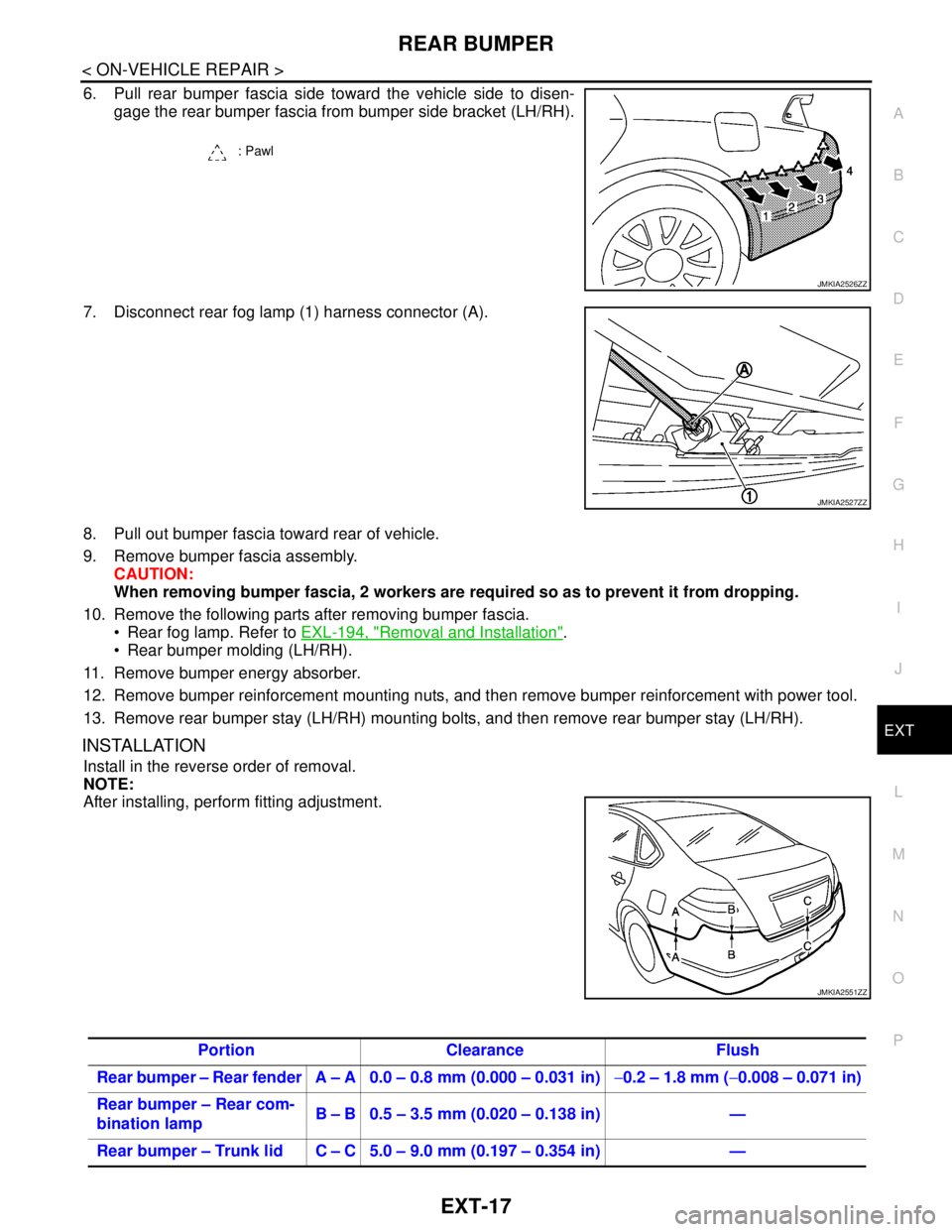
6. Pull rear bumper fascia side toward the vehicle side to disen-
gage the rear bumper fascia from bumper side bracket (LH/RH).
7. Disconnect rear fog lamp (1) harness connector (A).
8. Pull out bumper fascia toward rear of vehicle.
9. Remove bumper fascia assembly.
CAUTION:
When removing bumper fascia, 2 workers are required so as to prevent it from dropping.
10. Remove the following parts after removing bumper fascia.
Rear fog lamp. Refer to EXL-194, "
Removal and Installation".
Rear bumper molding (LH/RH).
11. Remove bumper energy absorber.
12. Remove bumper reinforcement mounting nuts, and then remove bumper reinforcement with power tool.
13. Remove rear bumper stay (LH/RH) mounting bolts, and then remove rear bumper stay (LH/RH).
INSTALLATION
Install in the reverse order of removal.
NOTE:
After installing, perform fitting adjustment.
: Pawl
JMKIA2526ZZ
JMKIA2527ZZ
JMKIA2551ZZ
Portion Clearance Flush
Rear bumper – Rear fender A – A 0.0 – 0.8 mm (0.000 – 0.031 in)−0.2 – 1.8 mm (−0.008 – 0.071 in)
Rear bumper – Rear com-
bination lampB – B 0.5 – 3.5 mm (0.020 – 0.138 in) —
Rear bumper – Trunk lid C – C 5.0 – 9.0 mm (0.197 – 0.354 in) —
Page 2469 of 5121
FL-6
< ON-VEHICLE REPAIR >
FUEL LEVEL SENSOR UNIT, FUEL FILTER AND FUEL PUMP ASSEMBLY
b. Disconnect fuel filler hose from fuel filler tube. Refer to FL-9, "Exploded View".
c. Insert hose into fuel tank through fuel filler hose to draw fuel from fuel tank.
2. Release the fuel pressure from the fuel lines. Refer to EC-411, "
Inspection".
3. Open fuel filler lid.
4. Open filler cap and release the pressure inside fuel tank.
5. Remove rear seat cushion. Refer to SE-98, "
Exploded View" (WITH VENTILATION SEAT) or SE-140,
"Exploded View" (WITHOUT VENTILATION SEAT).
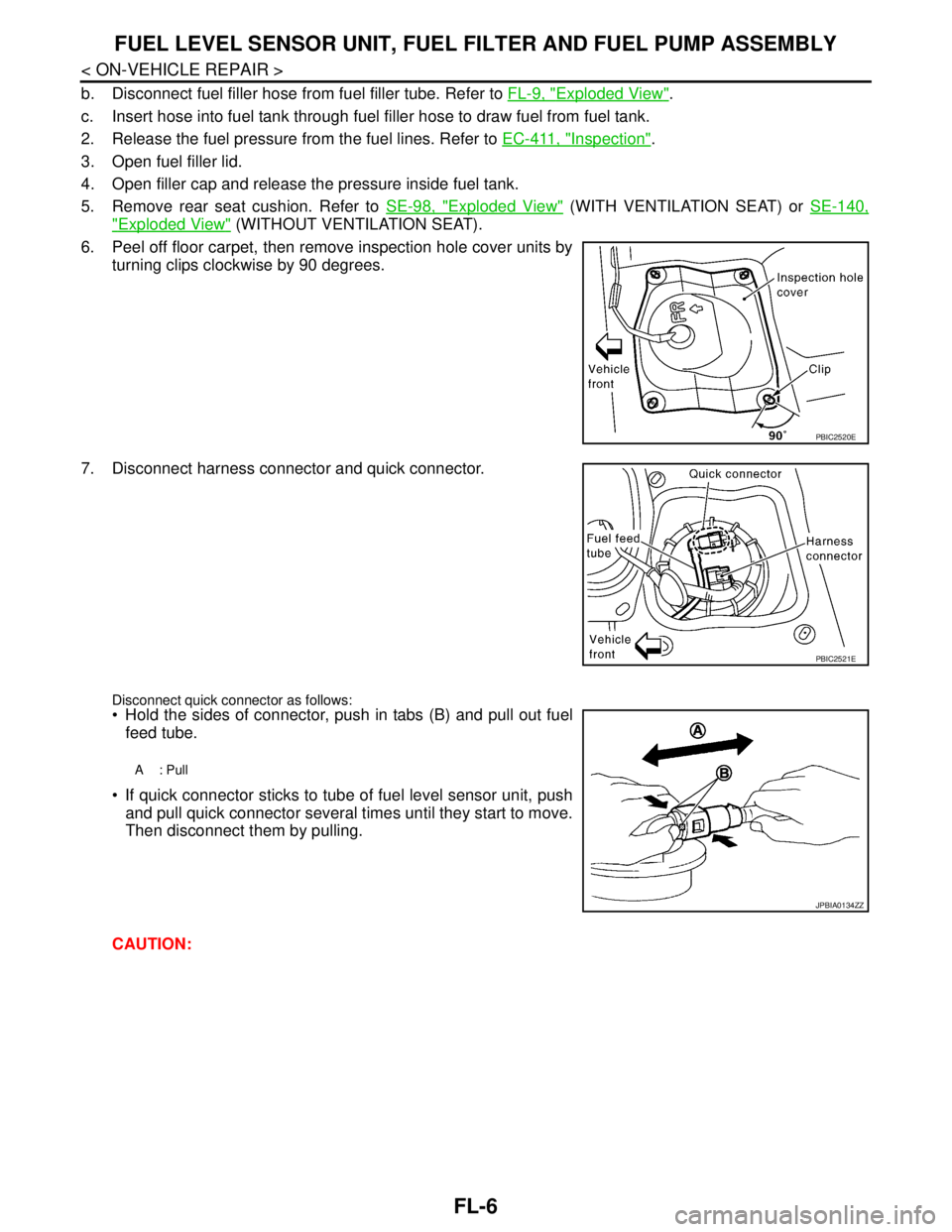
6. Peel off floor carpet, then remove inspection hole cover units by
turning clips clockwise by 90 degrees.
7. Disconnect harness connector and quick connector.
Disconnect quick connector as follows:
Hold the sides of connector, push in tabs (B) and pull out fuel
feed tube.
If quick connector sticks to tube of fuel level sensor unit, push
and pull quick connector several times until they start to move.
Then disconnect them by pulling.
CAUTION:
PBIC2520E
PBIC2521E
A: Pull
JPBIA0134ZZ
Page 2470 of 5121
FUEL LEVEL SENSOR UNIT, FUEL FILTER AND FUEL PUMP ASSEMBLY
FL-7
< ON-VEHICLE REPAIR >
C
D
E
F
G
H
I
J
K
L
MA
FL
N
P O
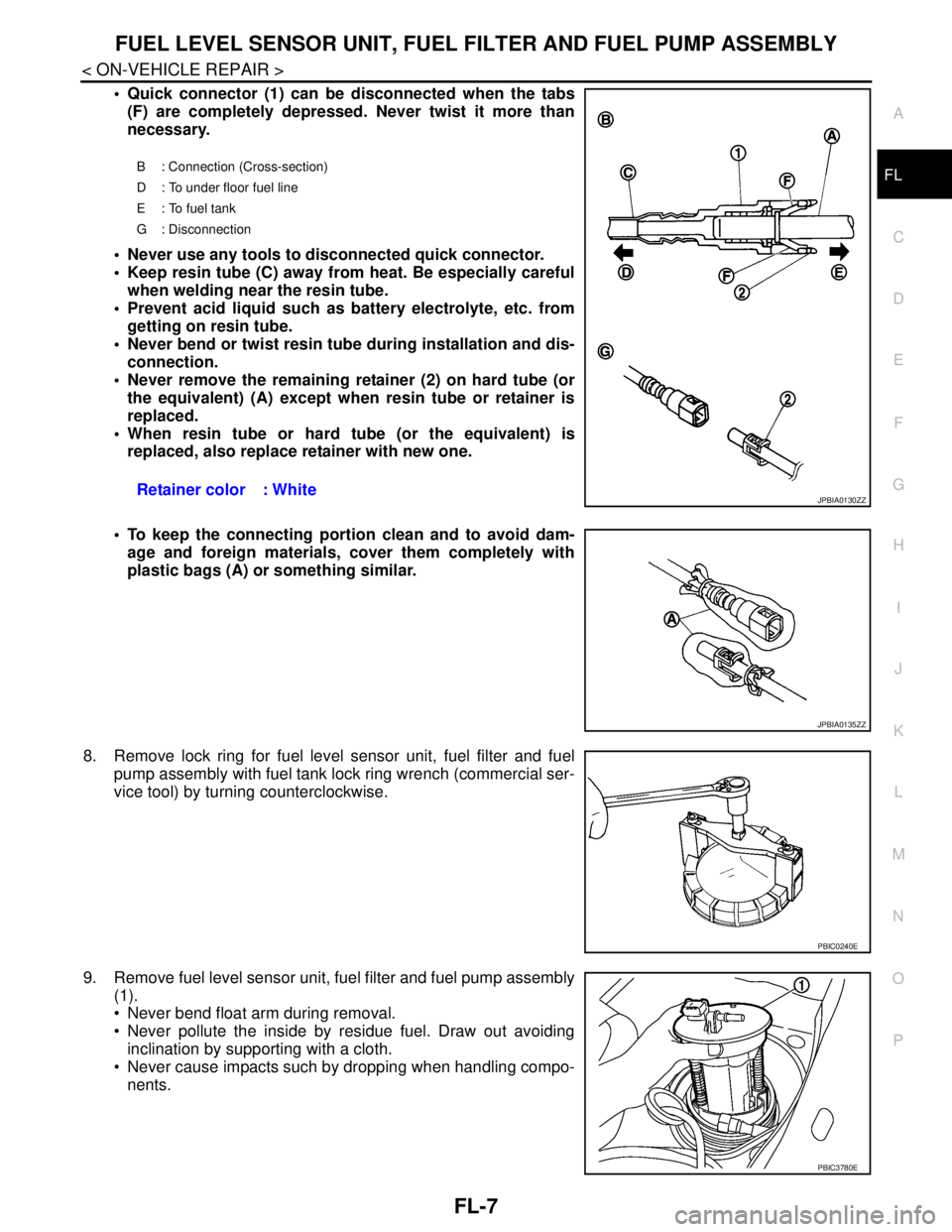
Quick connector (1) can be disconnected when the tabs
(F) are completely depressed. Never twist it more than
necessary.
Never use any tools to disconnected quick connector.
Keep resin tube (C) away from heat. Be especially careful
when welding near the resin tube.
Prevent acid liquid such as battery electrolyte, etc. from
getting on resin tube.
Never bend or twist resin tube during installation and dis-
connection.
Never remove the remaining retainer (2) on hard tube (or
the equivalent) (A) except when resin tube or retainer is
replaced.
When resin tube or hard tube (or the equivalent) is
replaced, also replace retainer with new one.
To keep the connecting portion clean and to avoid dam-
age and foreign materials, cover them completely with
plastic bags (A) or something similar.
8. Remove lock ring for fuel level sensor unit, fuel filter and fuel
pump assembly with fuel tank lock ring wrench (commercial ser-
vice tool) by turning counterclockwise.
9. Remove fuel level sensor unit, fuel filter and fuel pump assembly
(1).
Never bend float arm during removal.
Never pollute the inside by residue fuel. Draw out avoiding
inclination by supporting with a cloth.
Never cause impacts such by dropping when handling compo-
nents.
B : Connection (Cross-section)
D : To under floor fuel line
E : To fuel tank
G : Disconnection
Retainer color : WhiteJPBIA0130ZZ
JPBIA0135ZZ
PBIC0240E
PBIC3780E
Page 2471 of 5121
FL-8
< ON-VEHICLE REPAIR >
FUEL LEVEL SENSOR UNIT, FUEL FILTER AND FUEL PUMP ASSEMBLY
INSTALLATION
Note to the following, and install in the reverse order of removal.
Fuel Level Sensor Unit
1. Install new seal packing to fuel tank without any twist.
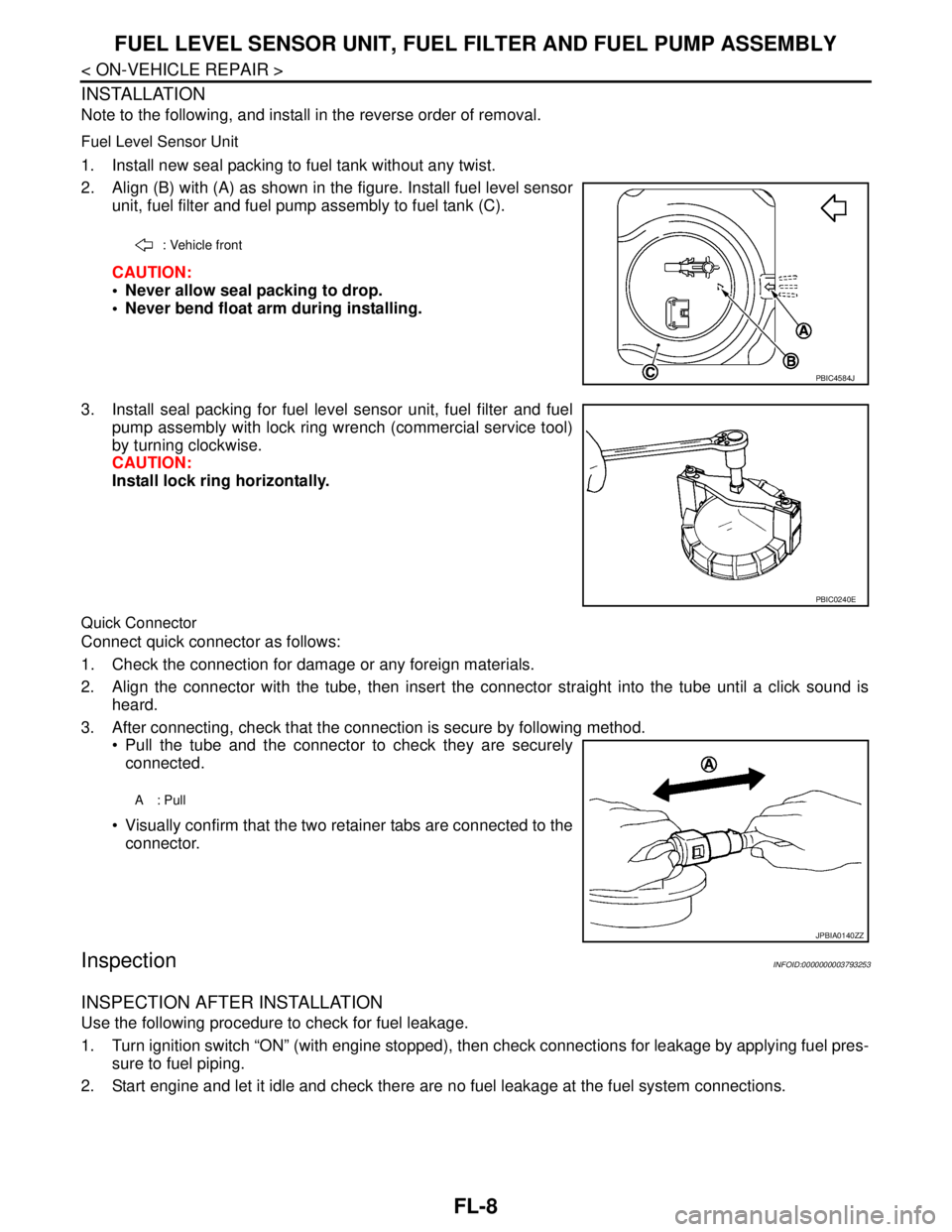
2. Align (B) with (A) as shown in the figure. Install fuel level sensor
unit, fuel filter and fuel pump assembly to fuel tank (C).
CAUTION:
Never allow seal packing to drop.
Never bend float arm during installing.
3. Install seal packing for fuel level sensor unit, fuel filter and fuel
pump assembly with lock ring wrench (commercial service tool)
by turning clockwise.
CAUTION:
Install lock ring horizontally.
Quick Connector
Connect quick connector as follows:
1. Check the connection for damage or any foreign materials.
2. Align the connector with the tube, then insert the connector straight into the tube until a click sound is
heard.
3. After connecting, check that the connection is secure by following method.
Pull the tube and the connector to check they are securely
connected.
Visually confirm that the two retainer tabs are connected to the
connector.
InspectionINFOID:0000000003793253
INSPECTION AFTER INSTALLATION
Use the following procedure to check for fuel leakage.
1. Turn ignition switch “ON” (with engine stopped), then check connections for leakage by applying fuel pres-
sure to fuel piping.
2. Start engine and let it idle and check there are no fuel leakage at the fuel system connections.
: Vehicle front
PBIC4584J
PBIC0240E
A: Pull
JPBIA0140ZZ
Page 2476 of 5121
FSU-2
< SYMPTOM DIAGNOSIS >
NOISE, VIBRATION AND HARSHNESS (NVH) TROUBLESHOOTING
SYMPTOM DIAGNOSIS
NOISE, VIBRATION AND HARSHNESS (NVH) TROUBLESHOOTING
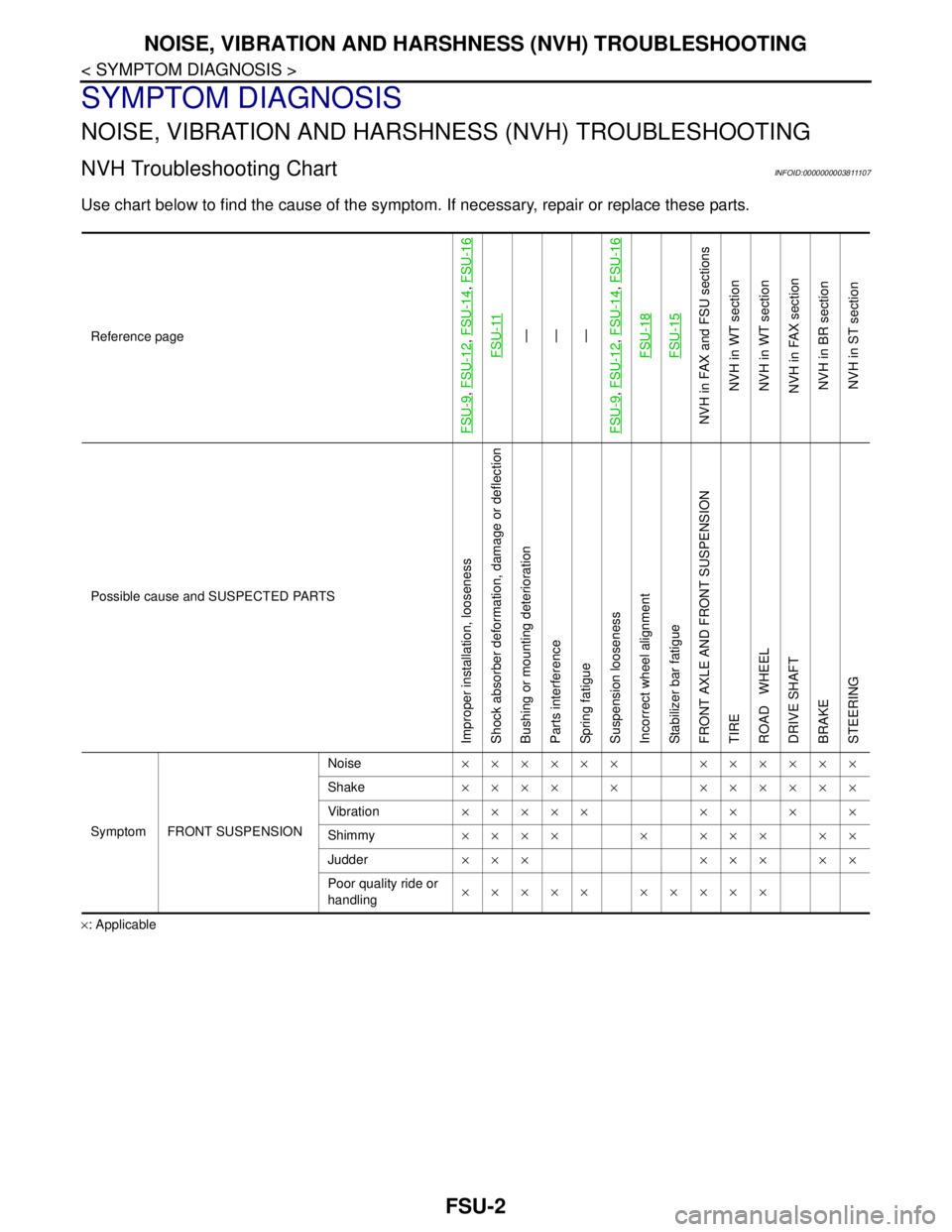
NVH Troubleshooting ChartINFOID:0000000003811107
Use chart below to find the cause of the symptom. If necessary, repair or replace these parts.
×: ApplicableReference page
FSU-9
, FSU-12
, FSU-14
, FSU-16
FSU-11
—
—
—
FSU-9
, FSU-12
, FSU-14
, FSU-16
FSU-18FSU-15
NVH in FAX and FSU sections
NVH in WT section
NVH in WT section
NVH in FAX section
NVH in BR section
NVH in ST section
Possible cause and SUSPECTED PARTS
Improper installation, looseness
Shock absorber deformation, damage or deflection
Bushing or mounting deterioration
Parts interference
Spring fatigue
Suspension looseness
Incorrect wheel alignment
Stabilizer bar fatigue
FRONT AXLE AND FRONT SUSPENSION
TIRE
ROAD WHEEL
DRIVE SHAFT
BRAKE
STEERING
Symptom FRONT SUSPENSIONNoise×××××× ××××××
Shake×××× × ××××××
Vibration××××× ×× × ×
Shimmy×××× × ××× ××
Judder ××× ××× ××
Poor quality ride or
handling××××× ×××××
Page 2511 of 5121

GI-18
< HOW TO USE THIS MANUAL >
TERMINOLOGY
Exhaust gas recirculation control-BPT
valveEGRC-BPT valve BPT valve
Exhaust gas recirculation control-solenoid
valveEGRC-solenoid valve EGR control solenoid valve
Exhaust gas recirculation temperature sen-
sor
EGRT sensor Exhaust gas temperature sensor
EGR temperature sensor
Flash electrically erasable programmable
read only memoryFEEPROM ***
Flash erasable programmable read only
memoryFEPROM ***
Flexible fuel sensor FFS ***
Flexible fuel system FF system ***
Fuel pressure regulator *** Pressure regulator
Fuel pressure regulator control solenoid
valve*** PRVR control solenoid valve
Fuel trim FT ***
Heated Oxygen sensor HO2S Exhaust gas sensor
Idle air control system IAC system Idle speed control
Idle air control valve-air regulator IACV-air regulator Air regulator
Idle air control valve-auxiliary air control
valveIACV-AAC valve Auxiliary air control (AAC) valve
Idle air control valve-FICD solenoid valve IACV-FICD solenoid valve FICD solenoid valve
Idle air control valve-idle up control sole-
noid valveIACV-idle up control solenoid valve Idle up control solenoid valve
Idle speed control-FI pot ISC-FI pot FI pot
Idle speed control system ISC system ***
Ignition control IC ***
Ignition control module ICM ***
Indirect fuel injection system IFI system ***
Intake air IA Air
Intake air temperature sensor IAT sensor Air temperature sensor
Knock *** Detonation
Knock sensor KS Detonation sensor
Malfunction indicator lamp MIL Check engine light
Manifold absolute pressure MAP ***
Manifold absolute pressure sensor MAPS ***
Manifold differential pressure MDP ***
Manifold differential pressure sensor MDPS ***
Manifold surface temperature MST ***
Manifold surface temperature sensor MSTS ***
Manifold vacuum zone MVZ ***
Manifold vacuum zone sensor MVZS ***
Mass air flow sensor MAFS Air flow meter
Mixture control solenoid valve MC solenoid valve Air-fuel ratio control solenoid valve
Multiport fuel injection system MFI system Fuel injection controlNEW TERMNEW ACRONYM /
ABBREVIATIONOLD TERM
Page 2536 of 5121
CONSULT-III/GST CHECKING SYSTEM
GI-43
< BASIC INSPECTION >
C
D
E
F
G
H
I
J
K
L
MB
GI
N
O
PCONSULT-III/GST CHECKING SYSTEM
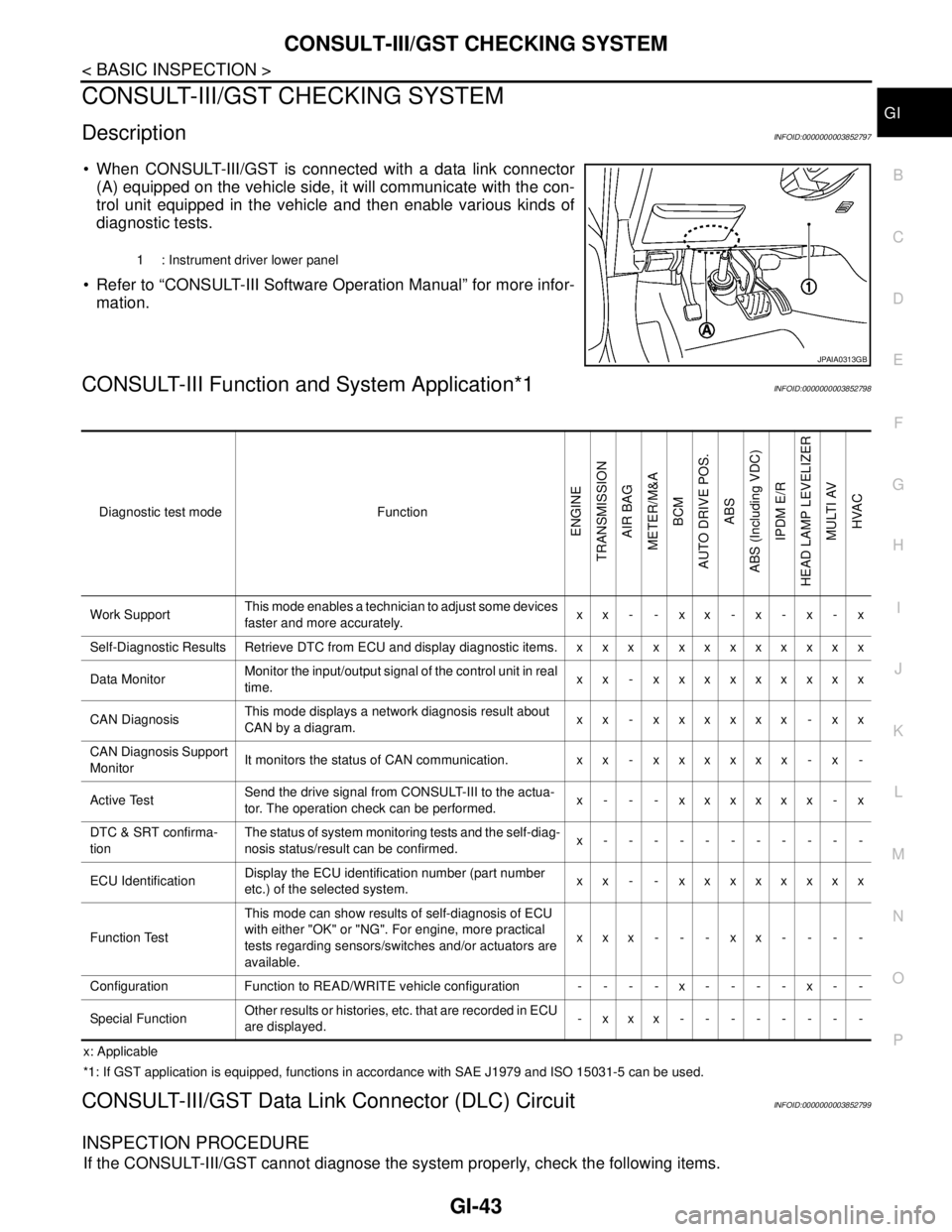
DescriptionINFOID:0000000003852797
When CONSULT-III/GST is connected with a data link connector
(A) equipped on the vehicle side, it will communicate with the con-
trol unit equipped in the vehicle and then enable various kinds of
diagnostic tests.
Refer to “CONSULT-III Software Operation Manual” for more infor-
mation.
CONSULT-III Function and System Application*1INFOID:0000000003852798
x: Applicable
*1: If GST application is equipped, functions in accordance with SAE J1979 and ISO 15031-5 can be used.
CONSULT-III/GST Data Link Connector (DLC) CircuitINFOID:0000000003852799
INSPECTION PROCEDURE
If the CONSULT-III/GST cannot diagnose the system properly, check the following items.
1 : Instrument driver lower panel
JPAIA0313GB
Diagnostic test mode Function
ENGINE
TRANSMISSION
AIR BAG
METER/M&A
BCM
AUTO DRIVE POS.
ABS
ABS (Including VDC)
IPDM E/R
HEAD LAMP LEVELIZER
MULTI AV
HVAC
Work SupportThis mode enables a technician to adjust some devices
faster and more accurately.xx- -xx-x-x-x
Self-Diagnostic Results Retrieve DTC from ECU and display diagnostic items. x x x x x x x x x x x x
Data MonitorMonitor the input/output signal of the control unit in real
time.xx - xxxxxxxxx
CAN DiagnosisThis mode displays a network diagnosis result about
CAN by a diagram.xx - xxxxxx - xx
CAN Diagnosis Support
MonitorIt monitors the status of CAN communication. x x - x x x x x x - x -
Active TestSend the drive signal from CONSULT-III to the actua-
tor. The operation check can be performed.x - - - xxxxxx - x
DTC & SRT confirma-
tionThe status of system monitoring tests and the self-diag-
nosis status/result can be confirmed.x-----------
ECU IdentificationDisplay the ECU identification number (part number
etc.) of the selected system.xx - - xxxxxxxx
Function TestThis mode can show results of self-diagnosis of ECU
with either "OK" or "NG". For engine, more practical
tests regarding sensors/switches and/or actuators are
available.xxx---xx----
Configuration Function to READ/WRITE vehicle configuration - - - - x - - - - x - -
Special FunctionOther results or histories, etc. that are recorded in ECU
are displayed.-xxx--------
Page 2582 of 5121
PRECAUTIONS
HA-13
< PRECAUTION >
C
D
E
F
G
H
J
K
L
MA
B
HA
N
O
P
Precaution for Procedure without Cowl Top CoverINFOID:0000000003795884
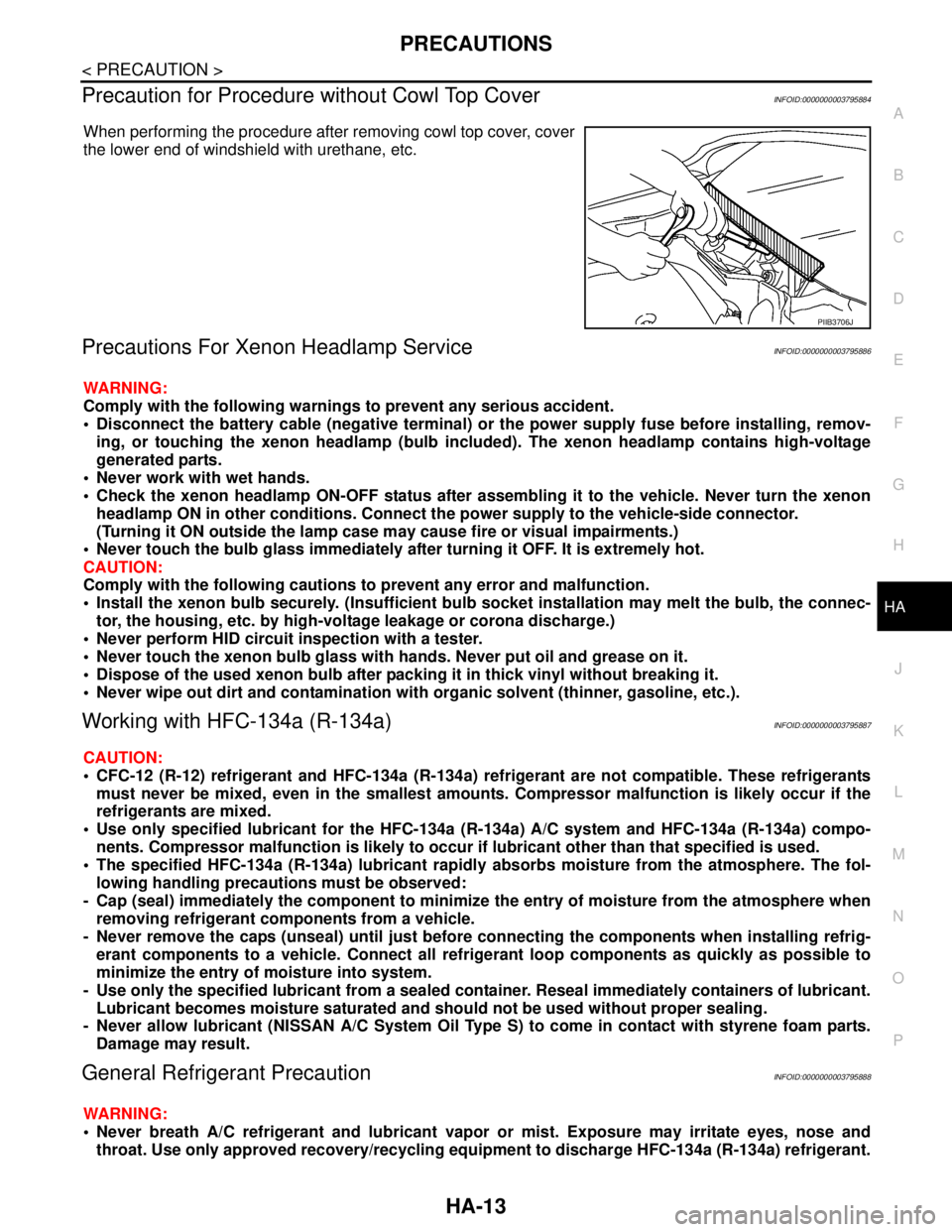
When performing the procedure after removing cowl top cover, cover
the lower end of windshield with urethane, etc.
Precautions For Xenon Headlamp ServiceINFOID:0000000003795886
WARNING:
Comply with the following warnings to prevent any serious accident.
Disconnect the battery cable (negative terminal) or the power supply fuse before installing, remov-
ing, or touching the xenon headlamp (bulb included). The xenon headlamp contains high-voltage
generated parts.
Never work with wet hands.
Check the xenon headlamp ON-OFF status after assembling it to the vehicle. Never turn the xenon
headlamp ON in other conditions. Connect the power supply to the vehicle-side connector.
(Turning it ON outside the lamp case may cause fire or visual impairments.)
Never touch the bulb glass immediately after turning it OFF. It is extremely hot.
CAUTION:
Comply with the following cautions to prevent any error and malfunction.
Install the xenon bulb securely. (Insufficient bulb socket installation may melt the bulb, the connec-
tor, the housing, etc. by high-voltage leakage or corona discharge.)
Never perform HID circuit inspection with a tester.
Never touch the xenon bulb glass with hands. Never put oil and grease on it.
Dispose of the used xenon bulb after packing it in thick vinyl without breaking it.
Never wipe out dirt and contamination with organic solvent (thinner, gasoline, etc.).
Working with HFC-134a (R-134a)INFOID:0000000003795887
CAUTION:
CFC-12 (R-12) refrigerant and HFC-134a (R-134a) refrigerant are not compatible. These refrigerants
must never be mixed, even in the smallest amounts. Compressor malfunction is likely occur if the
refrigerants are mixed.
Use only specified lubricant for the HFC-134a (R-134a) A/C system and HFC-134a (R-134a) compo-
nents. Compressor malfunction is likely to occur if lubricant other than that specified is used.
The specified HFC-134a (R-134a) lubricant rapidly absorbs moisture from the atmosphere. The fol-
lowing handling precautions must be observed:
- Cap (seal) immediately the component to minimize the entry of moisture from the atmosphere when
removing refrigerant components from a vehicle.
- Never remove the caps (unseal) until just before connecting the components when installing refrig-
erant components to a vehicle. Connect all refrigerant loop components as quickly as possible to
minimize the entry of moisture into system.
- Use only the specified lubricant from a sealed container. Reseal immediately containers of lubricant.
Lubricant becomes moisture saturated and should not be used without proper sealing.
- Never allow lubricant (NISSAN A/C System Oil Type S) to come in contact with styrene foam parts.
Damage may result.
General Refrigerant PrecautionINFOID:0000000003795888
WARNING:
Never breath A/C refrigerant and lubricant vapor or mist. Exposure may irritate eyes, nose and
throat. Use only approved recovery/recycling equipment to discharge HFC-134a (R-134a) refrigerant.
PIIB3706J
Page 2616 of 5121
CONDENSER
HA-47
< ON-VEHICLE REPAIR >
C
D
E
F
G
H
J
K
L
MA
B
HA
N
O
P
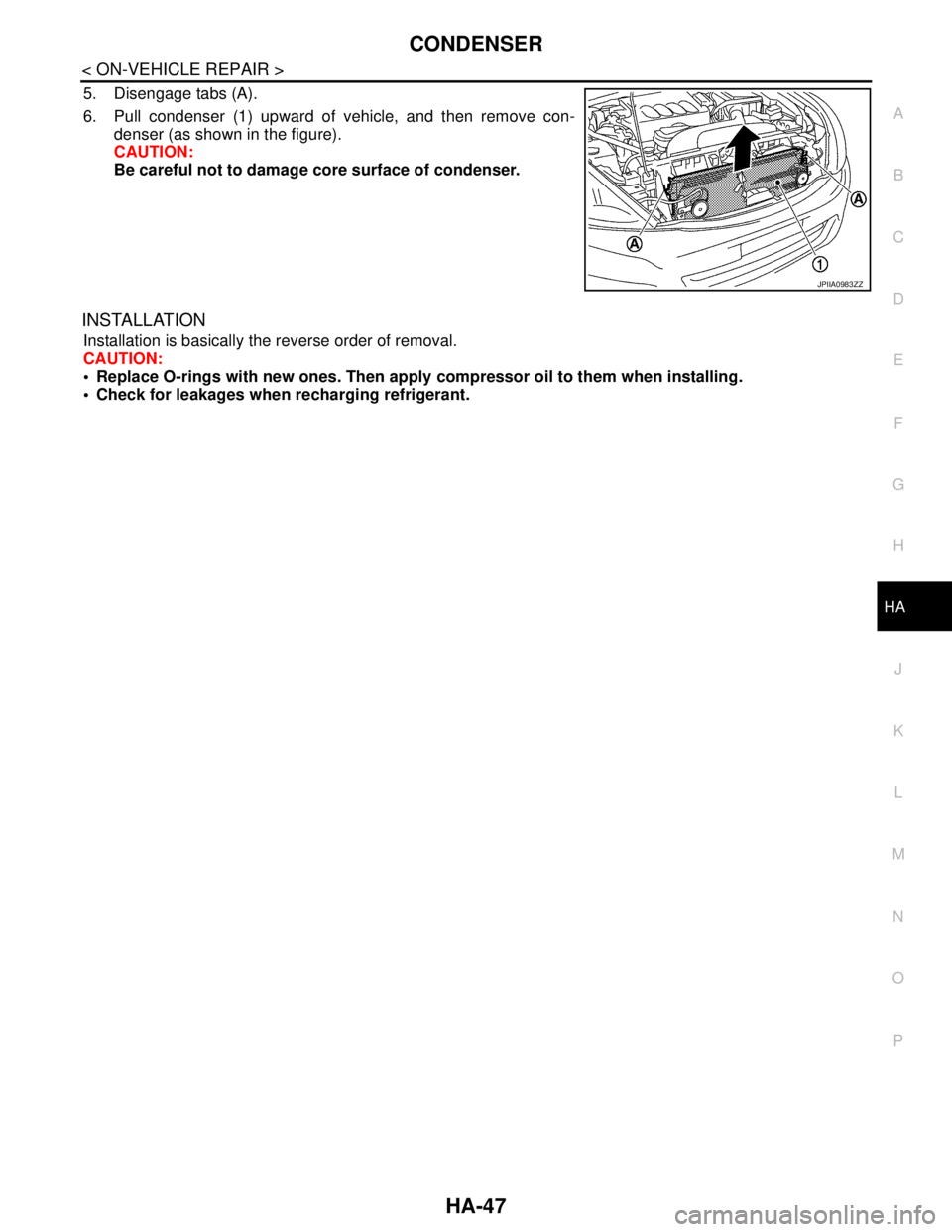
5. Disengage tabs (A).
6. Pull condenser (1) upward of vehicle, and then remove con-
denser (as shown in the figure).
CAUTION:
Be careful not to damage core surface of condenser.
INSTALLATION
Installation is basically the reverse order of removal.
CAUTION:
Replace O-rings with new ones. Then apply compressor oil to them when installing.
Check for leakages when recharging refrigerant.
JPIIA0983ZZ
Page 2722 of 5121
![NISSAN TEANA 2008 Service Manual HAC-94
< SYMPTOM DIAGNOSIS >[WITHOUT 7 INCH DISPLAY]
NOISE
NOISE
DescriptionINFOID:0000000003846390
Symptom
Noise
Noise is heard when the A/C system operates.
Inspection procedureINFOID:00000000038](/img/5/57391/w960_57391-2721.png "NISSAN TEANA 2008 Service Manual HAC-94
< SYMPTOM DIAGNOSIS >[WITHOUT 7 INCH DISPLAY]
NOISE
NOISE
DescriptionINFOID:0000000003846390
Symptom
Noise
Noise is heard when the A/C system operates.
Inspection procedureINFOID:00000000038")
HAC-94
< SYMPTOM DIAGNOSIS >[WITHOUT 7 INCH DISPLAY]
NOISE
NOISE
DescriptionINFOID:0000000003846390
Symptom
Noise
Noise is heard when the A/C system operates.
Inspection procedureINFOID:0000000003846391
1.CHECK OPERATION
1. Operate the A/C system and check the operation. Refer to HAC-8, "
Description & Inspection".
2. Check the parts where noise is occurring.
Can the parts where noise is occurring be checked?
YES-1 >> Noise from blower motor: GO TO 2.
YES-2 >> Noise from compressor: GO TO 3.
YES-3 >> Noise from expansion valve: GO TO 4.
YES-4 >> Noise from A/C piping (pipe, flexible hose): GO TO 6.
YES-5 >> Noise from drive belt: GO TO 7.
NO >> END.
2.CHECK BLOWER MOTOR
1. Remove blower motor.
2. Remove foreign materials that are in the blower unit.
3. Check the noise from blower motor again.
Is the inspection result normal?
YES >> END.
NO >> Replace blower motor.
3.CHECK COMPRESSOR
Perform trouble diagnosis for the compressor and check the compressor. Refer to HA-11, "
Symptom Table".
Is the inspection result normal?
YES >> END.
NO >> Refill the refrigerant or replace the compressor according to the inspection results.
4.CHECK WITH GAUGE PRESSURE
Perform the diagnosis with the gauge pressure. Refer to HA-8, "
Trouble Diagnosis For Unusual Pressure".
Is the inspection result normal?
YES >> GO TO 5.
NO >> Repair or replace parts according to the inspection results.
5.CHECK EXPANSION VALVE
1. Correct the refrigerant with recovery/recycling recharging equipment.
2. Recharge with the proper amount of the collected refrigerant after recycling or new refrigerant.
3. Check for the noise from expansion valve again.
Are the malfunction solved?
YES >> END.
NO >> Replace expansion valve.
6.CHECK A/C PIPING (PIPE, FLEXIBLE HOSE)
1. Check the A/C piping (pipes, flexible hoses) (for deformation and damage, etc.).
2. Check the installation condition of clips and brackets, etc, of the A/C piping (pipes, flexible hoses).
Is the inspection result normal?
YES >> Fix the line with rubber or come vibration absorbing material.
NO >> Repair or replace parts according to the inspection results.
7.CHECK DRIVE BELT