transmission NISSAN TEANA 2008 Owner's Guide
[x] Cancel search | Manufacturer: NISSAN, Model Year: 2008, Model line: TEANA, Model: NISSAN TEANA 2008Pages: 5121, PDF Size: 69.03 MB
Page 1590 of 5121
![NISSAN TEANA 2008 Owners Guide TROUBLE DIAGNOSIS - SPECIFICATION VALUE
EC-129
< COMPONENT DIAGNOSIS >[VQ25DE, VQ35DE]
C
D
E
F
G
H
I
J
K
L
MA
EC
N
P O
2. Disconnect ECM harness connector. Check pin terminal and connector for damage,](/img/5/57391/w960_57391-1589.png "NISSAN TEANA 2008 Owners Guide TROUBLE DIAGNOSIS - SPECIFICATION VALUE
EC-129
< COMPONENT DIAGNOSIS >[VQ25DE, VQ35DE]
C
D
E
F
G
H
I
J
K
L
MA
EC
N
P O
2. Disconnect ECM harness connector. Check pin terminal and connector for damage,")
TROUBLE DIAGNOSIS - SPECIFICATION VALUE
EC-129
< COMPONENT DIAGNOSIS >[VQ25DE, VQ35DE]
C
D
E
F
G
H
I
J
K
L
MA
EC
N
P O
2. Disconnect ECM harness connector. Check pin terminal and connector for damage, and then reconnect it.
>> GO TO 16.
16.CHECK “A/F ALPHA-B1”, “A/F ALPHA-B2”
1. Start engine.
2. Select “A/F ALPHA-B1”, “A/F ALPHA-B2” in “SPEC” of “DATA MONITOR” mode, and check that the each
indication is within the SP value.
Is the measurement value within the SP value?
YES >> INSPECTION END
NO >> Detect malfunctioning part according to EC-400, "
Symptom Table".
17.CHECK “B/FUEL SCHDL”
Select “B/FUEL SCHDL” in “SPEC” of “DATA MONITOR” mode, and check that the indication is within the SP
value.
Is the measurement value within the SP value?
YES >> INSPECTION END
NO-1 >> More than the SP value: GO TO 18.
NO-2 >> Less than the SP value: GO TO 25.
18.DETECT MALFUNCTIONING PART
1. Check for the cause of large engine friction. Refer to the following.
- Engine oil level is too high
- Engine oil viscosity
- Belt tension of power steering, alternator, A/C compressor, etc. is excessive
- Noise from engine
- Noise from transmission, etc.
2. Check for the cause of insufficient combustion. Refer to the following.
- Valve clearance malfunction
- Intake valve timing control function malfunction
- Camshaft sprocket installation malfunction, etc.
>> Repair or replace malfunctioning part, and then GO TO 30.
19.CHECK INTAKE SYSTEM
Check for the cause of uneven air flow through mass air flow sensor. Refer to the following.
Crushed air ducts
Malfunctioning seal of air cleaner element
Uneven dirt of air cleaner element
Improper specification of intake air system
Is the inspection result normal?
YES >> GO TO 21.
NO >> Repair or replace malfunctioning part, and then GO TO 20.
20.CHECK “A/F ALPHA-B1”, “A/F ALPHA-B2”, AND “B/FUEL SCHDL”
Select “A/F ALPHA-B1”, “A/F ALPHA-B2”, and “B/FUEL SCHDL” in “SPEC” of “DATA MONITOR” mode, and
check that each indication is within the SP value.
Is the measurement value within the SP value?
YES >> INSPECTION END
NO >> “B/FUEL SCHDL” is more, “A/F ALPHA-B1”, “A/F ALPHA-B2” are less than the SP value: GO TO
21.
21.DISCONNECT AND RECONNECT MASS AIR FLOW SENSOR HARNESS CONNECTOR
1. Stop the engine.
2. Disconnect mass air flow sensor harness connector. Check pin terminal and connector for damage and
then reconnect it again.
>> GO TO 22.
Page 1596 of 5121
![NISSAN TEANA 2008 Owners Guide U1000, U1001 CAN COMM CIRCUIT
EC-135
< COMPONENT DIAGNOSIS >[VQ25DE, VQ35DE]
C
D
E
F
G
H
I
J
K
L
MA
EC
N
P O
U1000, U1001 CAN COMM CIRCUIT
DescriptionINFOID:0000000003856509
CAN (Controller Area Netwo](/img/5/57391/w960_57391-1595.png "NISSAN TEANA 2008 Owners Guide U1000, U1001 CAN COMM CIRCUIT
EC-135
< COMPONENT DIAGNOSIS >[VQ25DE, VQ35DE]
C
D
E
F
G
H
I
J
K
L
MA
EC
N
P O
U1000, U1001 CAN COMM CIRCUIT
DescriptionINFOID:0000000003856509
CAN (Controller Area Netwo")
U1000, U1001 CAN COMM CIRCUIT
EC-135
< COMPONENT DIAGNOSIS >[VQ25DE, VQ35DE]
C
D
E
F
G
H
I
J
K
L
MA
EC
N
P O
U1000, U1001 CAN COMM CIRCUIT
DescriptionINFOID:0000000003856509
CAN (Controller Area Network) is a serial communication line for real time application. It is an on-vehicle mul-
tiplex communication line with high data communication speed and excellent error detection ability. Many elec-
tronic control units are equipped onto a vehicle, and each control unit shares information and links with other
control units during operation (not independent). In CAN communication, control units are connected with 2
communication lines (CAN H line, CAN L line) allowing a high rate of information transmission with less wiring.
Each control unit transmits/receives data but selectively reads required data only.
DTC LogicINFOID:0000000003856510
DTC DETECTION LOGIC
DTC CONFIRMATION PROCEDURE
1.PERFORM DTC CONFIRMATION PROCEDURE
1. Turn ignition switch ON and wait at least 3 seconds.
2. Check DTC.
Is DTC detected?
YES >>EC-135, "Diagnosis Procedure".
NO >> INSPECTION END
Diagnosis ProcedureINFOID:0000000003856511
Go to LAN-14, "Trouble Diagnosis Flow Chart".
DTC No.Trouble diagnosis
nameDTC detecting condition Possible cause
U1000
CAN communication
lineWhen ECM is not transmitting or receiving CAN com-
munication signal of OBD (emission related diagno-
sis) for 2 seconds or more. Harness or connectors
(CAN communication line is open or
shorted)
U1001When ECM is not transmitting or receiving CAN com-
munication signal other than OBD (emission related
diagnosis) for 2 seconds or more.
Page 1703 of 5121
![NISSAN TEANA 2008 Owners Guide EC-242
< COMPONENT DIAGNOSIS >[VQ25DE, VQ35DE]
P0607 ECM
P0607 ECM
DescriptionINFOID:0000000003856705
CAN (Controller Area Network) is a serial communication line for real time application. It is an o](/img/5/57391/w960_57391-1702.png "NISSAN TEANA 2008 Owners Guide EC-242
< COMPONENT DIAGNOSIS >[VQ25DE, VQ35DE]
P0607 ECM
P0607 ECM
DescriptionINFOID:0000000003856705
CAN (Controller Area Network) is a serial communication line for real time application. It is an o")
EC-242
< COMPONENT DIAGNOSIS >[VQ25DE, VQ35DE]
P0607 ECM
P0607 ECM
DescriptionINFOID:0000000003856705
CAN (Controller Area Network) is a serial communication line for real time application. It is an on-vehicle mul-
tiplex communication line with high data communication speed and excellent error detection ability. Many elec-
tronic control units are equipped onto a vehicle, and each control unit shares information and links with other
control units during operation (not independent). In CAN communication, control units are connected with 2
communication lines (CAN H line, CAN L line) allowing a high rate of information transmission with less wiring.
Each control unit transmits/receives data but selectively reads required data only.
DTC LogicINFOID:0000000003856706
DTC DETECTION LOGIC
DTC CONFIRMATION PROCEDURE
1.PERFORM DTC CONFIRMATION PROCEDURE
1. Turn ignition switch ON.
2. Check DTC.
Is DTC detected?
YES >> Go to EC-242, "Diagnosis Procedure".
NO >> INSPECTION END
Diagnosis ProcedureINFOID:0000000003856707
1.INSPECTION START
1. Turn ignition switch ON.
2. Erase DTC.
3. Perform DTC CONFIRMATION PROCEDURE.
See EC-242, "
DTC Logic".
4. Check DTC.
Is the DTC P0607 displayed again?
Ye s > > G O T O 2 .
No >> INSPECTION END
2.REPLACE ECM
1. Replace ECM.
2. Go to EC-14, "
ADDITIONAL SERVICE WHEN REPLACING CONTROL UNIT : Special Repair Require-
ment".
>> INSPECTION END
DTC No. Trouble diagnosis name DTC detecting condition Possible cause
P0607 CAN communication busWhen detecting error during the initial diagno-
sis of CAN controller of ECM.ECM
Page 1739 of 5121
![NISSAN TEANA 2008 Owners Guide EC-278
< COMPONENT DIAGNOSIS >[VQ25DE, VQ35DE]
P1574 ASCD VEHICLE SPEED SENSOR
P1574 ASCD VEHICLE SPEED SENSOR
DescriptionINFOID:0000000003856758
The ECM receives two vehicle speed signals via CAN com](/img/5/57391/w960_57391-1738.png "NISSAN TEANA 2008 Owners Guide EC-278
< COMPONENT DIAGNOSIS >[VQ25DE, VQ35DE]
P1574 ASCD VEHICLE SPEED SENSOR
P1574 ASCD VEHICLE SPEED SENSOR
DescriptionINFOID:0000000003856758
The ECM receives two vehicle speed signals via CAN com")
EC-278
< COMPONENT DIAGNOSIS >[VQ25DE, VQ35DE]
P1574 ASCD VEHICLE SPEED SENSOR
P1574 ASCD VEHICLE SPEED SENSOR
DescriptionINFOID:0000000003856758
The ECM receives two vehicle speed signals via CAN communication line. One is sent from combination
meter, and the other is from TCM (Transmission control module). The ECM uses these signals for ASCD con-
trol. Refer to EC-51, "
System Diagram" for ASCD functions.
DTC LogicINFOID:0000000003856759
DTC DETECTION LOGIC
NOTE:
If DTC P1574 is displayed with DTC U1000, U1001, first perform the trouble diagnosis for DTC U1000,
U1001. Refer to EC-135, "
DTC Logic".
If DTC P1574 is displayed with DTC P0500, first perform the trouble diagnosis for DTC P0500. Refer
to EC-234, "
DTC Logic".
If DTC P1574 is displayed with DTC P0605, first perform the trouble diagnosis for DTC P0605. Refer
to EC-240, "
DTC Logic".
If DTC P1574 is displayed with DTC P0607, first perform the trouble diagnosis for DTC P0607. Refer
to EC-242, "
DTC Logic".
DTC CONFIRMATION PROCEDURE
1.PRECONDITIONING
If DTC Confirmation Procedure has been previously conducted, always turn ignition switch OFF and wait at
least 10 seconds before conducting the next test.
>> GO TO 2.
2.PERFORM DTC CONFIRMATION PROCEDURE
1. Start engine (VDC switch OFF).
2. Drive the vehicle at more than 40 km/h (25 MPH).
CAUTION:
Always drive vehicle at a safe speed.
NOTE:
This procedure may be conducted with the drive wheels lifted in the shop or by driving the vehicle.
If a road test is expected to be easier, it is unnecessary to lift the vehicle.
3. Check DTC.
Is DTC detected?
YES >> Go to EC-278, "Diagnosis Procedure".
NO >> INSPECTION END
Diagnosis ProcedureINFOID:0000000003856760
1.CHECK DTC WITH TCM
Check DTC with TCM. Refer to TM-35, "
Diagnosis Description".
Is the inspection result normal?
YES >> GO TO 2.
DTC No.Trouble diagnosis
nameDTC detecting condition Possible cause
P1574ASCD vehicle speed
sensorThe difference between the two vehicle speed
signals is out of the specified range. Harness or connectors
(The CAN communication line is open or
shorted.)
Combination meter
ABS actuator and electric unit (control unit)
Wheel sensor
TCM
ECM
Page 1744 of 5121
![NISSAN TEANA 2008 Owners Guide P1720 VSS
EC-283
< COMPONENT DIAGNOSIS >[VQ25DE, VQ35DE]
C
D
E
F
G
H
I
J
K
L
MA
EC
N
P O
P1720 VSS
DescriptionINFOID:0000000003856765
ECM receives two vehicle speed signals via the CAN communication l](/img/5/57391/w960_57391-1743.png "NISSAN TEANA 2008 Owners Guide P1720 VSS
EC-283
< COMPONENT DIAGNOSIS >[VQ25DE, VQ35DE]
C
D
E
F
G
H
I
J
K
L
MA
EC
N
P O
P1720 VSS
DescriptionINFOID:0000000003856765
ECM receives two vehicle speed signals via the CAN communication l")
P1720 VSS
EC-283
< COMPONENT DIAGNOSIS >[VQ25DE, VQ35DE]
C
D
E
F
G
H
I
J
K
L
MA
EC
N
P O
P1720 VSS
DescriptionINFOID:0000000003856765
ECM receives two vehicle speed signals via the CAN communication line. One is sent from “ABS actuator and
electric unit (control unit)” via combination meter, and the other is from TCM (Transmission control module).
ECM uses these signals for engine control.
DTC LogicINFOID:0000000003856766
DTC DETECTION LOGIC
NOTE:
If DTC P1720 is displayed with DTC U1000, U1001 first perform the trouble diagnosis for DTC U1000,
U1001. Refer to EC-135, "
DTC Logic".
If DTC P1720 is displayed with DTC P0607, first perform the trouble diagnosis for DTC P0607. Refer
to EC-242, "
DTC Logic".
DTC CONFIRMATION PROCEDURE
1.PRECONDITIONING
If DTC Confirmation Procedure has been previously conducted, always turn ignition switch OFF and wait at
least 10 seconds before conducting the next test.
>> GO TO 2.
2.PERFORM DTC CONFIRMATION PROCEDURE
1. Start engine.
2. Drive vehicle at a speed of 20 km/h (12 MPH) or more for at least 5 seconds without depressing the brake
pedal.
3. Check 1st trip DTC.
Is 1st trip DTC detected?
YES >> Go to EC-283, "Diagnosis Procedure".
NO >> INSPECTION END
Diagnosis ProcedureINFOID:0000000003856767
1.CHECK DTC WITH TCM
Check DTC with TCM. Refer to TM-121, "
DTC Index".
Is the inspection result normal?
YES >> GO TO 2.
NO >> Perform trouble shooting relevant to DTC indicated.
2.CHECK DTC WITH “ABS ACTUATOR AND ELECTRIC UNIT (CONTROL UNIT)”
Refer to BRC-140, "
DTC No. Index".
Is the inspection result normal?
YES >> GO TO 3.
NO >> Perform trouble shooting relevant to DTC indicated.
DTC No. Trouble diagnosis name DTC detecting condition Possible cause
P1720Vehicle speed sensor
(TCM output)The difference between two vehicle speed
signals is out of the specified range. Harness or connectors
(Secondary speed sensor circuit is open or
shorted.)
Harness or connectors
(Wheel sensor circuit is open or shorted.)
TCM
Secondary speed sensor
ABS actuator and electric unit (control unit)
Wheel sensor
Combination meter
Page 1855 of 5121
![NISSAN TEANA 2008 Owners Guide EC-394
< ECU DIAGNOSIS >[VQ25DE, VQ35DE]
ECM
Sea level
Flat road
Ambient air temperature: 20 - 30°C (68 - 86°F)
Diagnosis is performed as quickly as possible under normal conditions.
Under d](/img/5/57391/w960_57391-1854.png "NISSAN TEANA 2008 Owners Guide EC-394
< ECU DIAGNOSIS >[VQ25DE, VQ35DE]
ECM
Sea level
Flat road
Ambient air temperature: 20 - 30°C (68 - 86°F)
Diagnosis is performed as quickly as possible under normal conditions.
Under d")
EC-394
< ECU DIAGNOSIS >[VQ25DE, VQ35DE]
ECM
Sea level
Flat road
Ambient air temperature: 20 - 30°C (68 - 86°F)
Diagnosis is performed as quickly as possible under normal conditions.
Under different conditions [For example: ambient air temperature other than 20 - 30°C (68 - 86°F)], diagno-
sis may also be performed.
Pattern 1:
The engine is started at the engine coolant temperature of −10 to 35°C (14 to 95°F)
(where the voltage between the ECM terminal 46 and ground is 3.0 - 4.3 V).
The engine must be operated at idle speed until the engine coolant temperature is greater than 70°C
(158°F) (where the voltage between the ECM terminal 46 and ground is lower than 1.4 V).
The engine is started at the fuel tank temperature of warmer than 0°C (32°F) (where the voltage
between the ECM terminal 95 and ground is less than 4.1 V).
Pattern 2:
When steady-state driving is performed again even after it is interrupted, each diagnosis can be conducted.
In this case, the time required for diagnosis may be extended.
Pattern 3:
Operate vehicle following the driving pattern shown in the figure.
Release the accelerator pedal during deceleration of vehicle speed
from 90 km/h (56 MPH) to 0 km/h (0 MPH).
Pattern 4:
The accelerator pedal must be held very steady during steady-
state driving.
If the accelerator pedal is moved, the test must be conducted
again.
*1: Depress the accelerator pedal until vehicle speed is 90 km/h (56
MPH), then release the accelerator pedal and keep it released for
more than 10 seconds. Depress the accelerator pedal until vehicle
speed is 90 km/h (56 MPH) again.
*2: Checking the vehicle speed with GST is advised.
Suggested Transmission Gear Position.
Selector lever position is D.
Test Value and Test LimitINFOID:0000000003856874
The following is the information specified in Service $06 of ISO 15031-5.
The test value is a parameter used to determine whether a system/circuit diagnostic test is OK or NG while
being monitored by the ECM during self-diagnosis. The test limit is a reference value which is specified as the
maximum or minimum value and is compared with the test value being monitored.
These data (test value and test limit) are specified by On Board Monitor ID (OBDMID), Test ID (TID), Unit and
Scaling ID and can be displayed on the GST screen.
The items of the test value and test limit will be displayed with GST screen which items are provided by the
ECM. (eg., if bank 2 is not applied on this vehicle, only the items of bank 1 is displayed)
PBIB2244E
Page 1867 of 5121
![NISSAN TEANA 2008 Owners Guide EC-406
< PRECAUTION >[VQ25DE, VQ35DE]
PRECAUTIONS
CAUTION:
Always turn the ignition switch OFF and disconnect the negative battery cable before any repair or
inspection work. The open/short circuit](/img/5/57391/w960_57391-1866.png "NISSAN TEANA 2008 Owners Guide EC-406
< PRECAUTION >[VQ25DE, VQ35DE]
PRECAUTIONS
CAUTION:
Always turn the ignition switch OFF and disconnect the negative battery cable before any repair or
inspection work. The open/short circuit")
EC-406
< PRECAUTION >[VQ25DE, VQ35DE]
PRECAUTIONS
CAUTION:
Always turn the ignition switch OFF and disconnect the negative battery cable before any repair or
inspection work. The open/short circuit of related switches, sensors, solenoid valves, etc. will cause
the MI to illuminate.
Always connect and lock the connectors securely after work. A loose (unlocked) connector will
cause the MI to illuminate due to the open circuit. (Be sure the connector is free from water, grease,
dirt, bent terminals, etc.)
Certain systems and components, especially those related to OBD, may use a new style slide-lock-
ing type harness connector. For description and how to disconnect, refer to PG-96, "
Description".
Always to route and secure the harnesses properly after work. The interference of the harness with a
bracket, etc. may cause the MI to illuminate due to the short circuit.
Always connect rubber tubes properly after work. A misconnected or disconnected rubber tube may
cause the MI to illuminate due to the malfunction of the EVAP system or fuel injection system, etc.
Always erase the unnecessary malfunction information (repairs completed) from the ECM and TCM
(Transmission control module) before returning the vehicle to the customer.
General PrecautionsINFOID:0000000003856881
Always use a 12 volt battery as power source.
Never attempt to disconnect battery cables while engine is
running.
Before connecting or disconnecting the ECM harness con-
nector, turn ignition switch OFF and disconnect negative bat-
tery cable. Failure to do so may damage the ECM because
battery voltage is applied to ECM even if ignition switch is
turned OFF.
Before removing parts, turn ignition switch OFF and then dis-
connect battery ground cable.
Never disassemble ECM.
If a battery cable is disconnected, the memory will return to the ECM value.
The ECM will now start to self-control at its initial value. Thus, engine operation can vary slightly in
this case. However, this is not an indication of a malfunction. Never replace parts because of a slight
variation.
If the battery is disconnected, the following emission-related diagnostic information will be lost
within 24 hours.
-Diagnostic trouble codes
-1st trip diagnostic trouble codes
-Freeze frame data
-1st trip freeze frame data
-System readiness test (SRT) codes
-Test values
When connecting ECM harness connector, fasten (B) it
securely with a lever (1) as far as it will go as shown in the fig-
ure.
SEF289H
2: ECM
A : Loosen
PBIB2947E
Page 1914 of 5121
OIL PAN AND OIL STRAINER
EM-39
< ON-VEHICLE REPAIR >
C
D
E
F
G
H
I
J
K
L
MA
EM
N
P O
Splash guard (RH and LH): Refer to EXT-22, "FENDER PROTECTOR : Exploded View".
Exhaust front tube: Refer to EX-5, "
Exploded View".
Drive belt: Refer to EM-12, "
Removal and Installation".
4. Remove A/C compressor with piping connected, and temporarily secure it to aside. Refer to HA-36,
"Exploded View".
5. Remove oil level gauge. Refer to EM-96, "
Exploded View".
6. Remove front drive shaft (RH). Refer to FAX-16, "
Exploded View".
7. Remove three way catalyst (bank 1 and bank 2) from exhaust manifolds (bank 1 and bank 2). Refer to
EM-34, "
Exploded View".
8. Remove oil pressure switch.
9. Remove oil filter. Refer to LU-10, "
Removal and Installation".
10. Remove oil cooler and water pipes. Refer to LU-11, "
Exploded View".
11. Support transaxle assembly with a suitable jack.
CAUTION:
When setting the transmission jack, be careful not to allow it to collide against the drain plug.
12. Support front suspension member with a suitable jack.
13. Remove engine mounting insulator (rear). Refer to EM-67, "
Exploded View".
14. Remove engine mounting insulator (LH) mounting bolts from transaxle. Refer to EM-67, "
Exploded View".
15. Remove rear torque rod through bolts from rear torque rod bracket. Refer to EM-67, "
Exploded View".
16. Remove member stay, front suspension member fixing bolts and nuts. Refer to FSU-16, "
Exploded View".
17. Lower the jack for the front suspension member to the height.
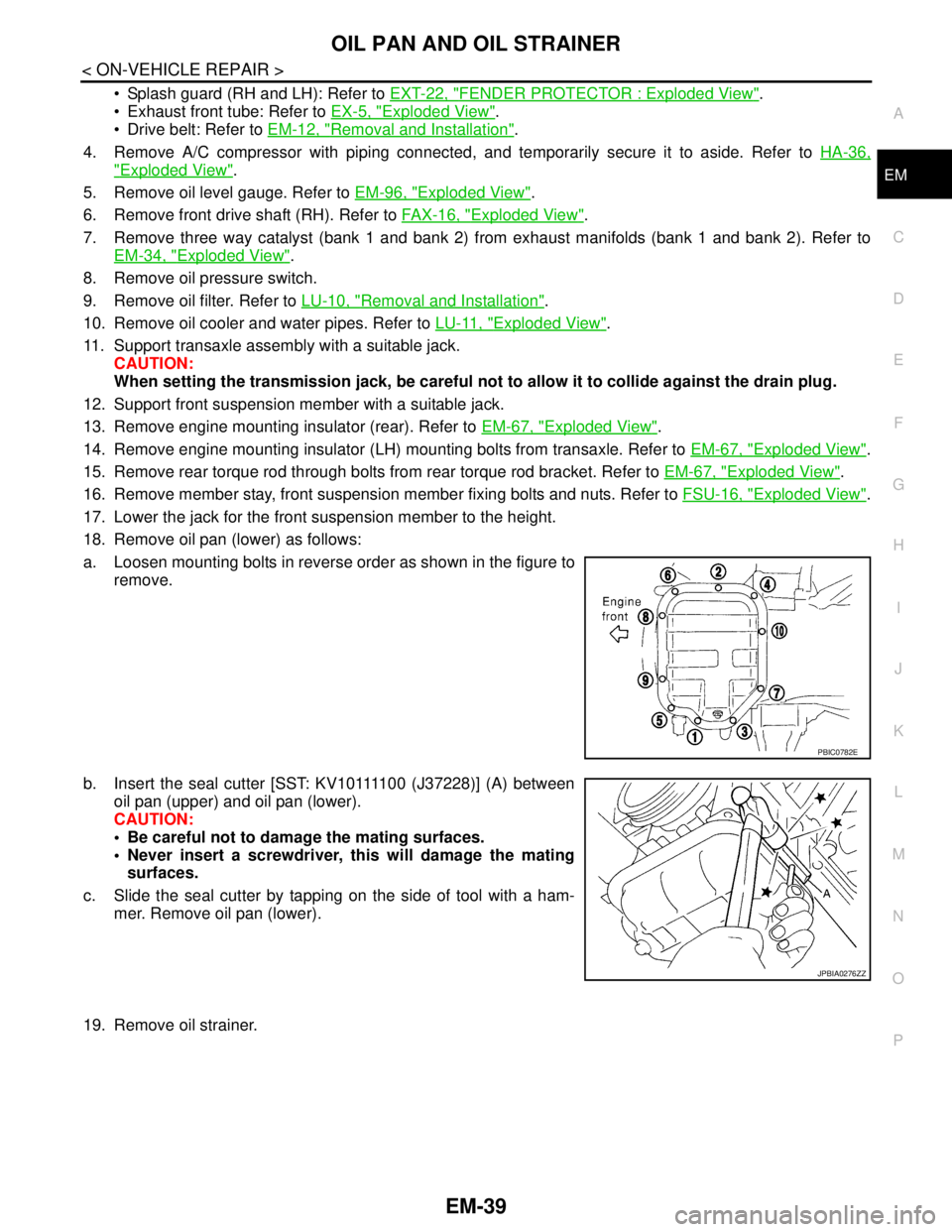
18. Remove oil pan (lower) as follows:
a. Loosen mounting bolts in reverse order as shown in the figure to
remove.
b. Insert the seal cutter [SST: KV10111100 (J37228)] (A) between
oil pan (upper) and oil pan (lower).
CAUTION:
Be careful not to damage the mating surfaces.
Never insert a screwdriver, this will damage the mating
surfaces.
c. Slide the seal cutter by tapping on the side of tool with a ham-
mer. Remove oil pan (lower).
19. Remove oil strainer.
PBIC0782E
JPBIA0276ZZ
Page 1941 of 5121

EM-66
< ON-VEHICLE REPAIR >
TIMING CHAIN
Use procedure below to check for fuel leakage.
- Turn ignition switch “ON” (with engine stopped). With fuel pressure applied to fuel piping, check for fuel leak-
age at connection points.
- Start engine. With engine speed increased, check again for fuel leakage at connection points.
Run engine to check for unusual noise and vibration.
NOTE:
If hydraulic pressure inside chain tensioner drops after removal/installation, slack in guide may generate a
pounding noise during and just after the engine start. However, this does not indicate an unusualness. Noise
will stop after hydraulic pressure rises.
Warm up engine thoroughly to check there is no leakage of fuel, or any oil/fluids including engine oil and
engine coolant.
Bleed air from lines and hoses of applicable lines, such as in cooling system.
After cooling down engine, again check oil/fluid levels including engine oil and engine coolant. Refill to the
specified level, if necessary.
Summary of the inspection items:
*: Transmission/transaxle/CVT fluid, power steering fluid, brake fluid, etc.Items Before starting engine Engine running After engine stopped
Engine coolant Level Leakage Level
Engine oil Level Leakage Level
Other oils and fluid* Level Leakage Level
Fuel Leakage Leakage Leakage
Page 1943 of 5121
EM-68
< REMOVAL AND INSTALLATION >
ENGINE ASSEMBLY
Place chocks at front and back of rear wheels.
For engines not equipped with engine slingers, attach proper slingers and bolts described in PARTS
CATALOG.
CAUTION:
Always be careful to work safely, avoid forceful or uninstructed operations.
Never start working until exhaust system and engine coolant are cool enough.
If items or work required are not covered by the engine section, refer to the applicable sections.
Always use the support point specified for lifting.
Use either 2-pole lift type or separate type lift as best you can. If board-on type is used for unavoid-
able reasons, support at the rear axle jacking point with transmission jack or similar tool before
starting work, in preparation for the backward shift of center of gravity.
For supporting points for lifting and jacking point at rear axle, refer to GI-30, "
Garage Jack and
Safety Stand and 2-Pole Lift".
REMOVAL
Outline
At first, remove the engine and the transaxle assembly with front suspension member downward. Then sepa-
rate the engine and the transaxle.
Preparation
1. Release fuel pressure. Refer to EC-411, "Inspection".
2. Drain engine coolant. Refer to CO-8, "
Draining".
CAUTION:
Perform this step when the engine is cold.
Never spill engine coolant on drive belt.
3. Remove the following parts:
Engine cover: Refer to EM-24, "
Exploded View".
Front road wheel and tires
Splash guards (RH and LH): Refer to EXT-22, "
FENDER PROTECTOR : Exploded View".
Air duct (inlet), air cleaner cases (upper and lower) with mass air flow sensor and air duct assembly:
Refer to EM-26, "
Exploded View".
Battery and battery tray: Refer to PG-109, "
Removal and Installation".
Drive belt: Refer to EM-12, "
Removal and Installation".
Reservoir tank of radiator. Refer to CO-13, "
Exploded View".
Front wiper arm: Refer to WW-105, "
Exploded View".
4. Disconnect engine room harness at the TCM, ECM and other sides.
CAUTION:
To keep clean harness connector and avoid damage and foreign materials, cover them completely
with plastic bags or something similar.
5. Remove battery bracket with ECM and TCM.
6. Remove extension cowl top. Refer to EXT-20, "
Exploded View".
Engine Room
1. Disconnect heater hoses. Refer to CO-25, "Exploded View".
Install plug to avoid leakage of engine coolant.
2. Remove EVAP hose. Refer to EM-28, "
Exploded View".
3. Disconnect fuel feed hose quick connector at fuel tube side. Refer to EM-44, "
Exploded View".
Install plug to avoid leakage of fuel.
4. Disconnect transaxle shift control cable at transaxle side. Refer to TM-319, "
Exploded View" (VQ25DE) or
TM-157, "
Exploded View" (VQ35DE).
5. Disconnect brake booster vacuum hose at engine side. Refer to EM-28, "
Exploded View".
6. Disconnect ground cable.
7. Disconnect A/C compressor piping at A/C compressor side. Refer to HA-36, "
Exploded View".
8. Disconnect suction hoses of power steering oil pump at reservoir tank side. Refer to ST-34, "
Exploded
View".
Install plug to avoid leakage of power steering fluid.
9. Disconnect CVT fluid cooler hoses from radiator. Refer to CO-13, "
Exploded View".