Start NISSAN TERRANO 2002 Service Repair Manual
[x] Cancel search | Manufacturer: NISSAN, Model Year: 2002, Model line: TERRANO, Model: NISSAN TERRANO 2002Pages: 1767, PDF Size: 41.51 MB
Page 1173 of 1767
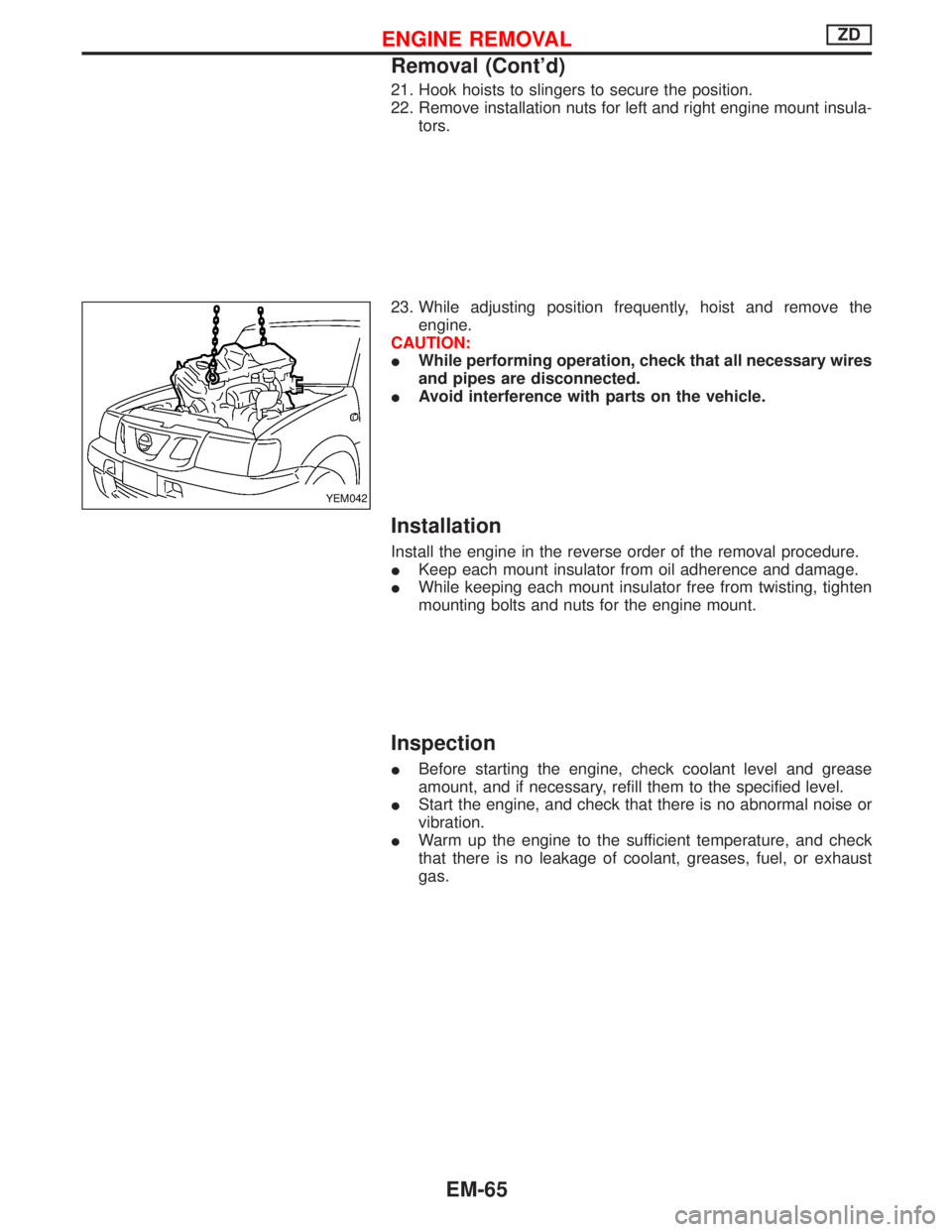
21. Hook hoists to slingers to secure the position.
22. Remove installation nuts for left and right engine mount insula-
tors.
23. While adjusting position frequently, hoist and remove the
engine.
CAUTION:
IWhile performing operation, check that all necessary wires
and pipes are disconnected.
IAvoid interference with parts on the vehicle.
Installation
Install the engine in the reverse order of the removal procedure.
IKeep each mount insulator from oil adherence and damage.
IWhile keeping each mount insulator free from twisting, tighten
mounting bolts and nuts for the engine mount.
Inspection
IBefore starting the engine, check coolant level and grease
amount, and if necessary, refill them to the specified level.
IStart the engine, and check that there is no abnormal noise or
vibration.
IWarm up the engine to the sufficient temperature, and check
that there is no leakage of coolant, greases, fuel, or exhaust
gas.
YEM042
ENGINE REMOVALZD
Removal (Cont'd)
EM-65
Page 1247 of 1767
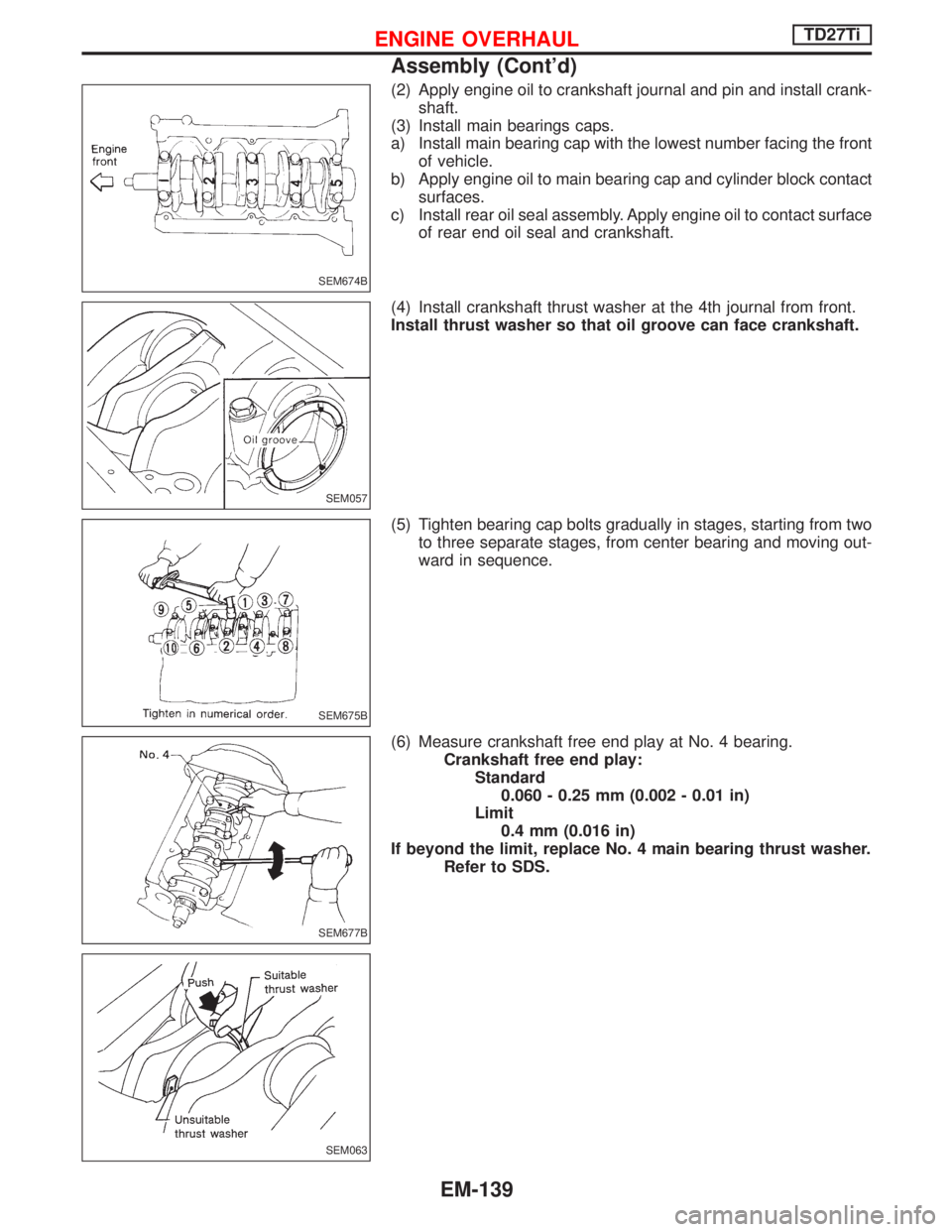
(2) Apply engine oil to crankshaft journal and pin and install crank-
shaft.
(3) Install main bearings caps.
a) Install main bearing cap with the lowest number facing the front
of vehicle.
b) Apply engine oil to main bearing cap and cylinder block contact
surfaces.
c) Install rear oil seal assembly. Apply engine oil to contact surface
of rear end oil seal and crankshaft.
(4) Install crankshaft thrust washer at the 4th journal from front.
Install thrust washer so that oil groove can face crankshaft.
(5) Tighten bearing cap bolts gradually in stages, starting from two
to three separate stages, from center bearing and moving out-
ward in sequence.
(6) Measure crankshaft free end play at No. 4 bearing.
Crankshaft free end play:
Standard
0.060 - 0.25 mm (0.002 - 0.01 in)
Limit
0.4 mm (0.016 in)
If beyond the limit, replace No. 4 main bearing thrust washer.
Refer to SDS.
SEM674B
SEM057
SEM675B
SEM677B
SEM063
ENGINE OVERHAULTD27Ti
Assembly (Cont'd)
EM-139
Page 1249 of 1767
TIMING GEAR CASE
Installation
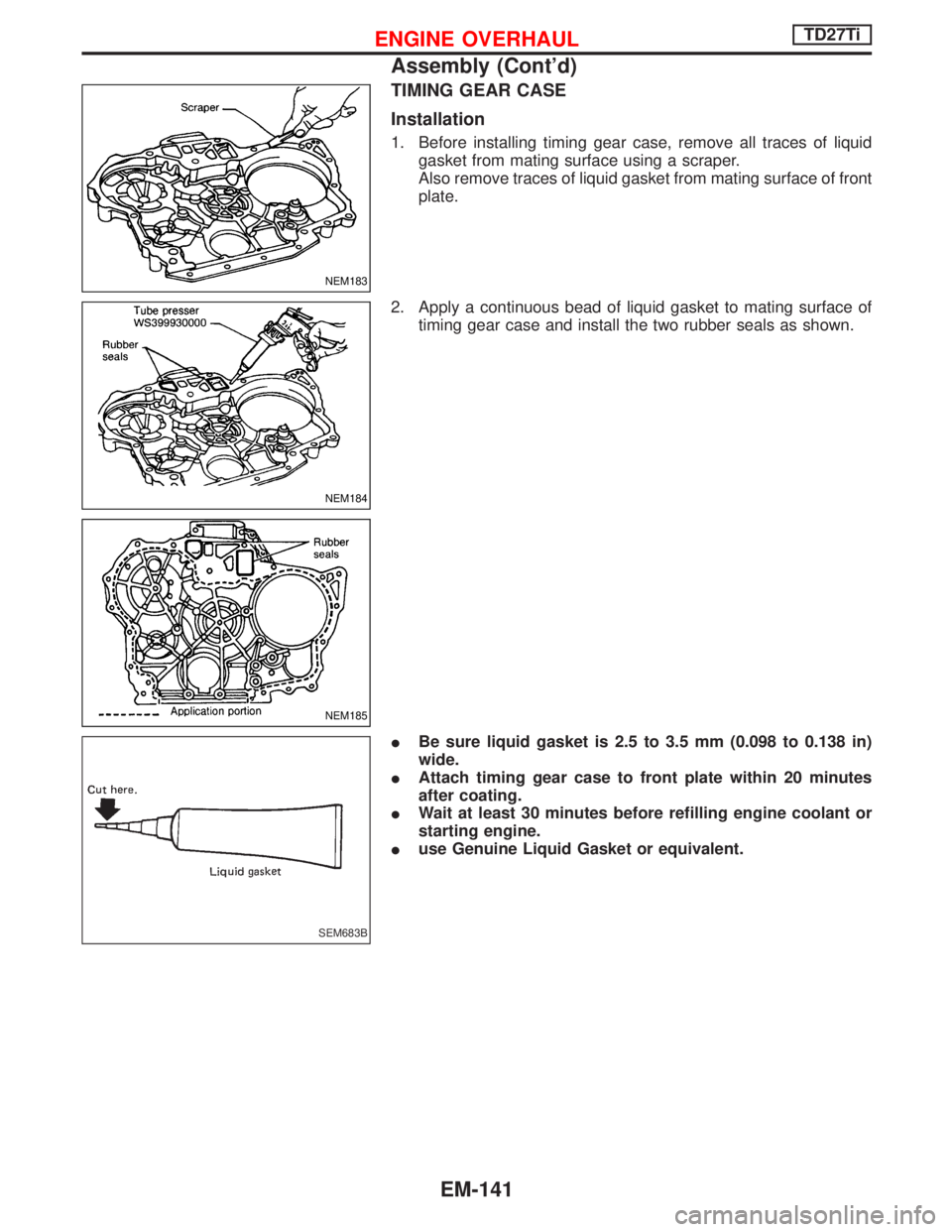
1. Before installing timing gear case, remove all traces of liquid
gasket from mating surface using a scraper.
Also remove traces of liquid gasket from mating surface of front
plate.
2. Apply a continuous bead of liquid gasket to mating surface of
timing gear case and install the two rubber seals as shown.
IBe sure liquid gasket is 2.5 to 3.5 mm (0.098 to 0.138 in)
wide.
IAttach timing gear case to front plate within 20 minutes
after coating.
IWait at least 30 minutes before refilling engine coolant or
starting engine.
Iuse Genuine Liquid Gasket or equivalent.
NEM183
NEM184
NEM185
SEM683B
ENGINE OVERHAULTD27Ti
Assembly (Cont'd)
EM-141
Page 1265 of 1767
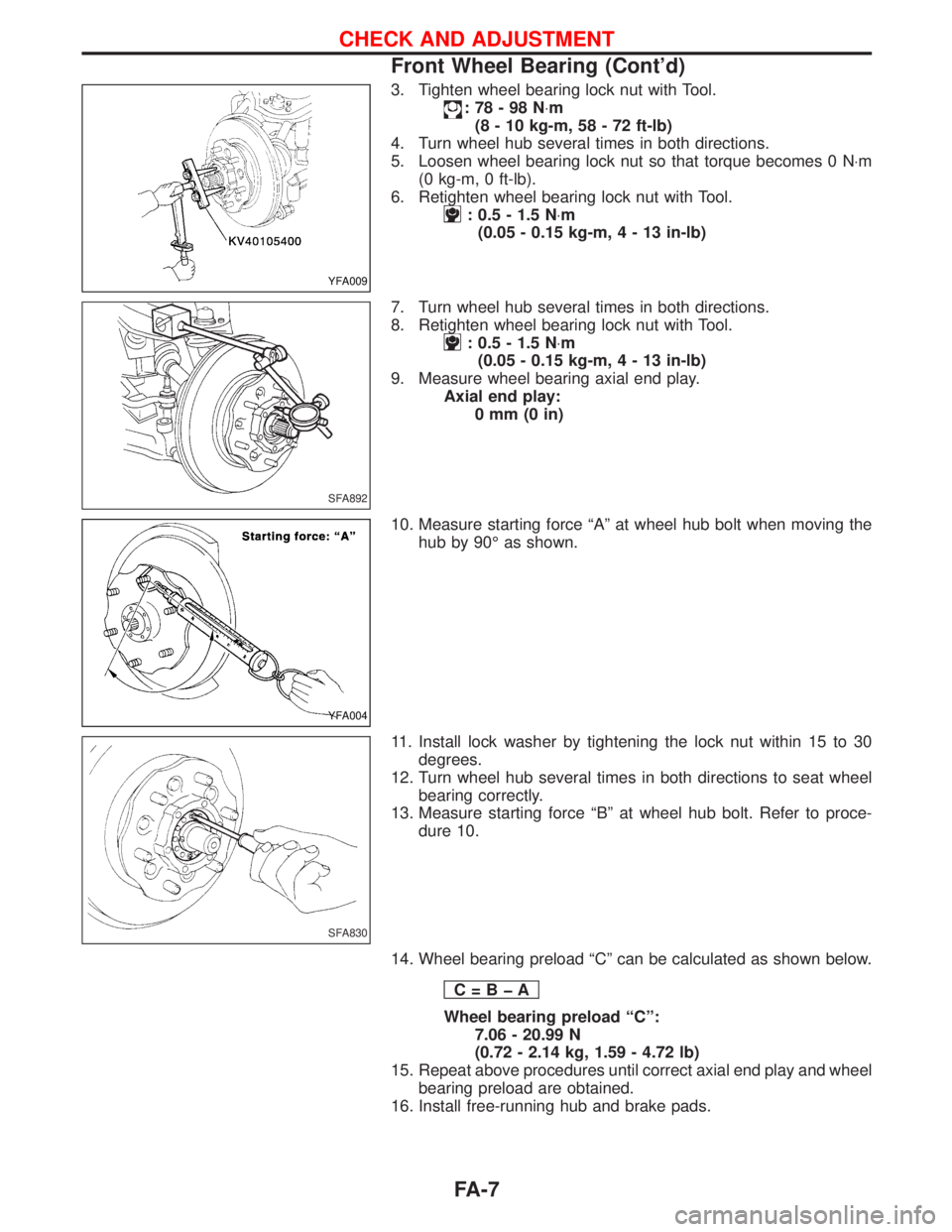
3. Tighten wheel bearing lock nut with Tool.
:78-98N×m
(8 - 10 kg-m, 58 - 72 ft-lb)
4. Turn wheel hub several times in both directions.
5. Loosen wheel bearing lock nut so that torque becomes 0 N×m
(0 kg-m, 0 ft-lb).
6. Retighten wheel bearing lock nut with Tool.
: 0.5 - 1.5 N×m
(0.05 - 0.15 kg-m,4-13in-lb)
7. Turn wheel hub several times in both directions.
8. Retighten wheel bearing lock nut with Tool.
: 0.5 - 1.5 N×m
(0.05 - 0.15 kg-m,4-13in-lb)
9. Measure wheel bearing axial end play.
Axial end play:
0mm(0in)
10. Measure starting force ªAº at wheel hub bolt when moving the
hub by 90É as shown.
11. Install lock washer by tightening the lock nut within 15 to 30
degrees.
12. Turn wheel hub several times in both directions to seat wheel
bearing correctly.
13. Measure starting force ªBº at wheel hub bolt. Refer to proce-
dure 10.
14. Wheel bearing preload ªCº can be calculated as shown below.
C=BþA
Wheel bearing preload ªCº:
7.06 - 20.99 N
(0.72 - 2.14 kg, 1.59 - 4.72 lb)
15. Repeat above procedures until correct axial end play and wheel
bearing preload are obtained.
16. Install free-running hub and brake pads.
YFA009
SFA892
YFA004
SFA830
CHECK AND ADJUSTMENT
Front Wheel Bearing (Cont'd)
FA-7
Page 1274 of 1767
qA
Was the vehicle started after the
transfer lever was shifted from the
ª2Hº to the ª4Hº or ª4Lº position?
No
EYe s
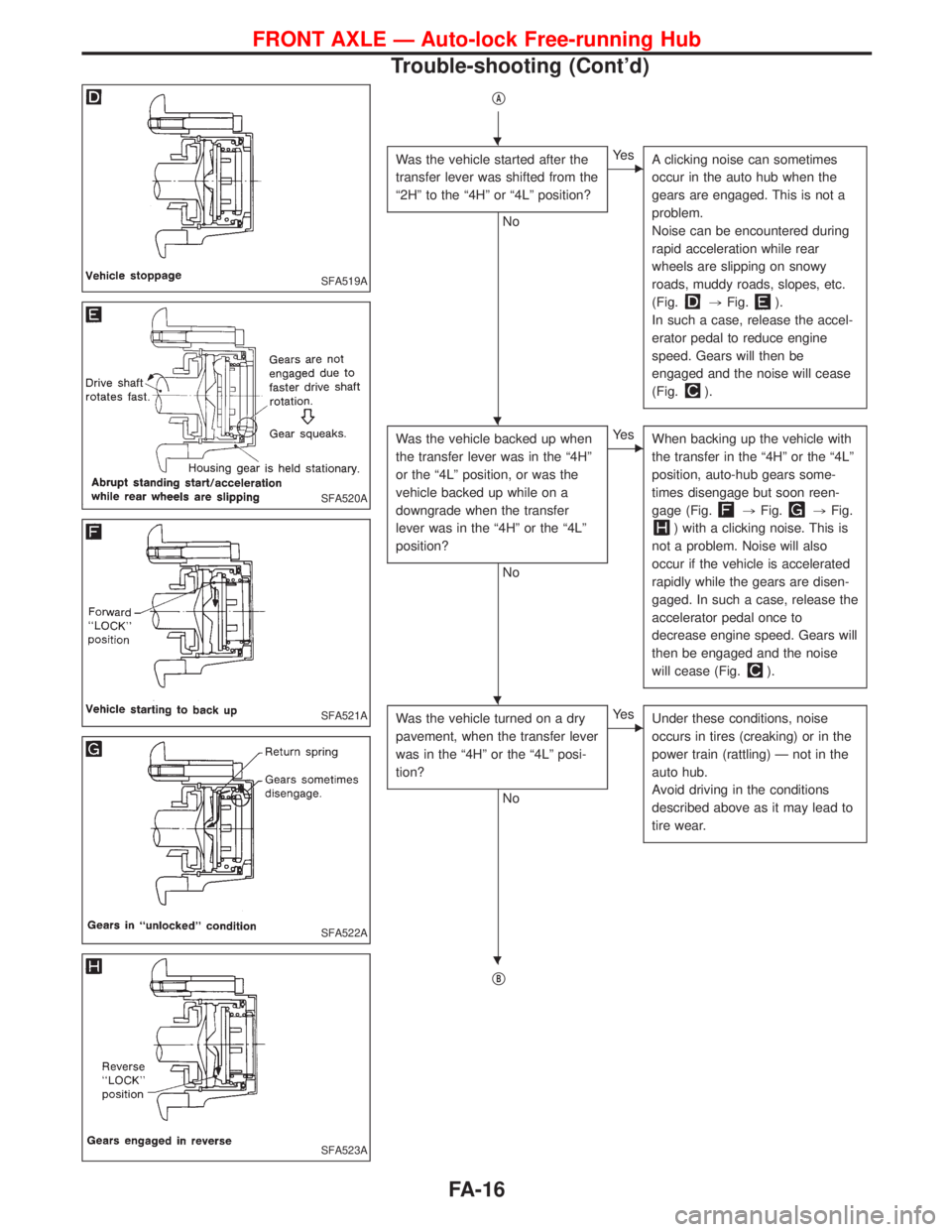
A clicking noise can sometimes
occur in the auto hub when the
gears are engaged. This is not a
problem.
Noise can be encountered during
rapid acceleration while rear
wheels are slipping on snowy
roads, muddy roads, slopes, etc.
(Fig.
,Fig.).
In such a case, release the accel-
erator pedal to reduce engine
speed. Gears will then be
engaged and the noise will cease
(Fig.
).
Was the vehicle backed up when
the transfer lever was in the ª4Hº
or the ª4Lº position, or was the
vehicle backed up while on a
downgrade when the transfer
lever was in the ª4Hº or the ª4Lº
position?
No
EYe s
When backing up the vehicle with
the transfer in the ª4Hº or the ª4Lº
position, auto-hub gears some-
times disengage but soon reen-
gage (Fig.
,Fig.,Fig.
) with a clicking noise. This is
not a problem. Noise will also
occur if the vehicle is accelerated
rapidly while the gears are disen-
gaged. In such a case, release the
accelerator pedal once to
decrease engine speed. Gears will
then be engaged and the noise
will cease (Fig.
).
Was the vehicle turned on a dry
pavement, when the transfer lever
was in the ª4Hº or the ª4Lº posi-
tion?
No
EYe s
Under these conditions, noise
occurs in tires (creaking) or in the
power train (rattling) Ð not in the
auto hub.
Avoid driving in the conditions
described above as it may lead to
tire wear.
qB
SFA519A
SFA520A
SFA521A
SFA522A
SFA523A
H
H
H
H
FRONT AXLE Ð Auto-lock Free-running Hub
Trouble-shooting (Cont'd)
FA-16
Page 1303 of 1767
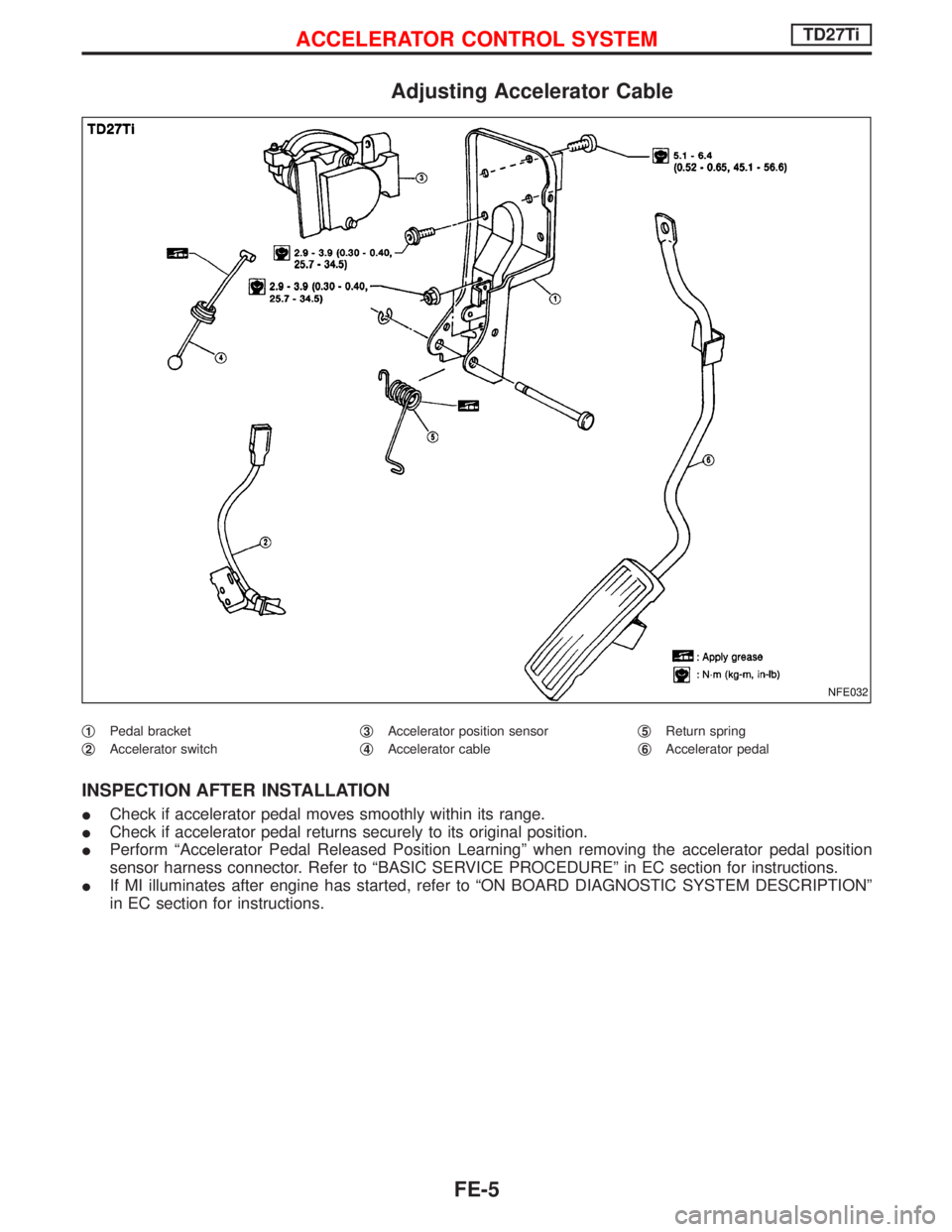
Adjusting Accelerator Cable
q1Pedal bracket
q
2Accelerator switchq
3Accelerator position sensor
q
4Accelerator cableq
5Return spring
q
6Accelerator pedal
INSPECTION AFTER INSTALLATION
ICheck if accelerator pedal moves smoothly within its range.
ICheck if accelerator pedal returns securely to its original position.
IPerform ªAccelerator Pedal Released Position Learningº when removing the accelerator pedal position
sensor harness connector. Refer to ªBASIC SERVICE PROCEDUREº in EC section for instructions.
IIf MI illuminates after engine has started, refer to ªON BOARD DIAGNOSTIC SYSTEM DESCRIPTIONº
in EC section for instructions.
NFE032
ACCELERATOR CONTROL SYSTEMTD27Ti
FE-5
Page 1317 of 1767
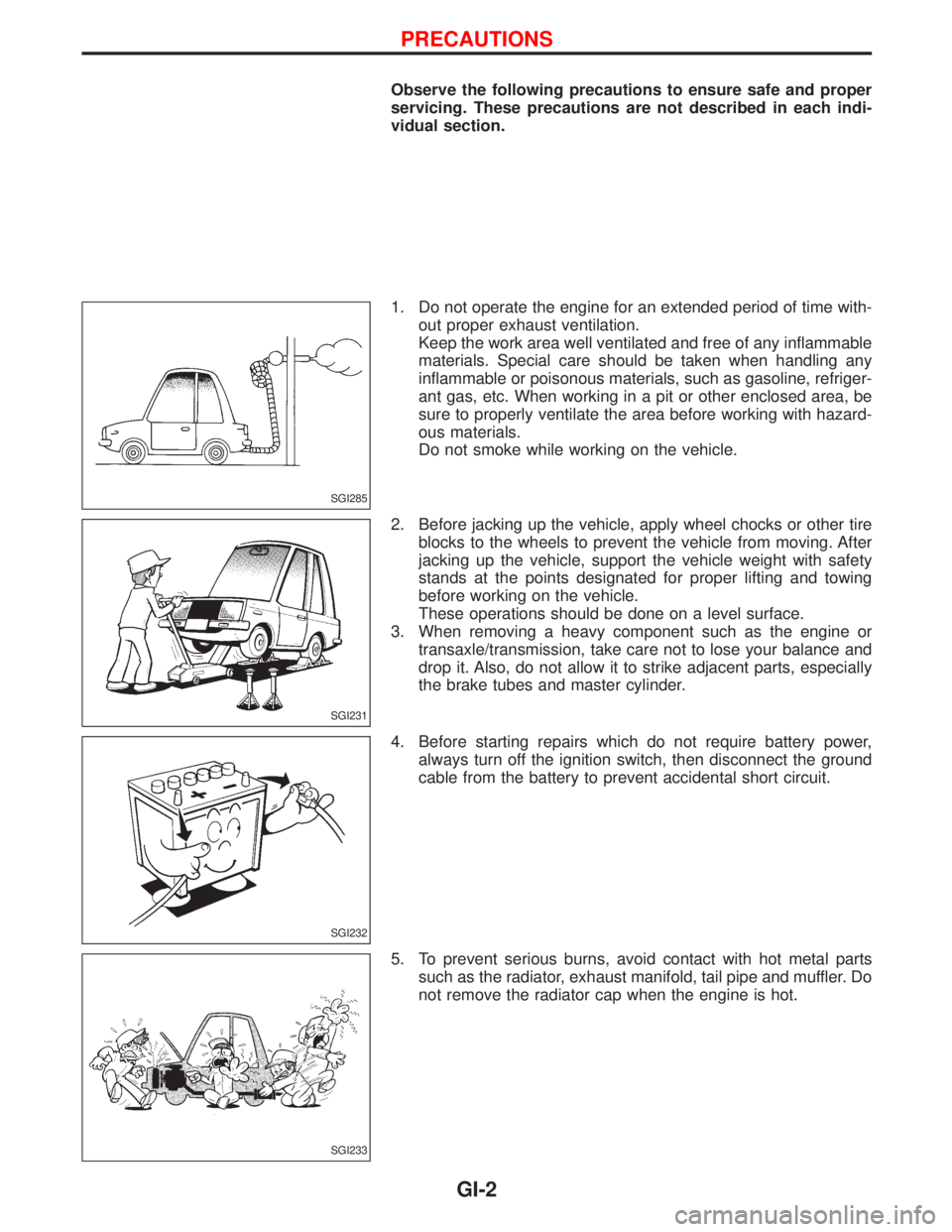
Observe the following precautions to ensure safe and proper
servicing. These precautions are not described in each indi-
vidual section.
1. Do not operate the engine for an extended period of time with-
out proper exhaust ventilation.
Keep the work area well ventilated and free of any inflammable
materials. Special care should be taken when handling any
inflammable or poisonous materials, such as gasoline, refriger-
ant gas, etc. When working in a pit or other enclosed area, be
sure to properly ventilate the area before working with hazard-
ous materials.
Do not smoke while working on the vehicle.
2. Before jacking up the vehicle, apply wheel chocks or other tire
blocks to the wheels to prevent the vehicle from moving. After
jacking up the vehicle, support the vehicle weight with safety
stands at the points designated for proper lifting and towing
before working on the vehicle.
These operations should be done on a level surface.
3. When removing a heavy component such as the engine or
transaxle/transmission, take care not to lose your balance and
drop it. Also, do not allow it to strike adjacent parts, especially
the brake tubes and master cylinder.
4. Before starting repairs which do not require battery power,
always turn off the ignition switch, then disconnect the ground
cable from the battery to prevent accidental short circuit.
5. To prevent serious burns, avoid contact with hot metal parts
such as the radiator, exhaust manifold, tail pipe and muffler. Do
not remove the radiator cap when the engine is hot.
SGI285
SGI231
SGI232
SGI233
PRECAUTIONS
GI-2
Page 1319 of 1767
insulation (either just before the harness connectors or for
the complete harness), for easy identification.
Precautions for NATS
NATS (Nissan Anti-Theft System)
NATS will immobilize the engine if someone tries to start it without
the registered key of NATS.
Both of the originally supplied ignition key IDs have been NATS
registered.
The NATS security indicator is located on the instrument panel. The
indicator blinks when the ignition switch is in ªOFFº or ªACCº posi-
tion. Therefore, NATS warns outsiders that the vehicle is equipped
with the anti-theft system.
IWhen NATS detects trouble, the malfunction indicator lamp
(MIL) blinks.
This blinking indicates that the anti-theft is not functioning, so
prompt service is required.
IIf the malfunction indicator lamp comes on while the engine is
running, return the vehicle to the workshop before turning the
ignition switch ªOFFº.
Once the ignition switch is turned ªOFFº, the engine can not be
started.
IWhen servicing NATS (trouble diagnoses, system initialization
and additional registration of other NATS ignition key IDs) CON-
SULT-II hardware and CONSULT-II NATS software is neces-
sary.
Regarding the procedures of NATS initialization and NATS igni-
tion key ID registration, refer to CONSULT-II operation manual,
NATS.
Therefore, CONSULT-II NATS software (program card and
operation manual) must be kept strictly confidential to main-
tain the integrity of the anti-theft function.
IWhen servicing NATS (trouble diagnoses, system initialization
and additional registration of other NATS ignition key IDs), it
may be necessary to re-register original key identification.
Therefore, be sure to receive all keys from vehicle owner.
A maximum of five key IDs can be registered into NATS.
IWhen failing to start the engine first-time using the key of
NATS, starts as follows:
(1) Turn ignition key to ªOFFº.
(2) Wait approx. 5 seconds.
(3) Turn ignition key to ªSTARTº again while keeping the key
apart from any others on key-chain.
SGI916
PRECAUTIONS
Supplemental Restraint System (SRS) ªAIR
BAGº and ªSEAT BELT PRE-TENSIONERº
(Dual Air Bag System) (Cont'd)
GI-4
Page 1320 of 1767
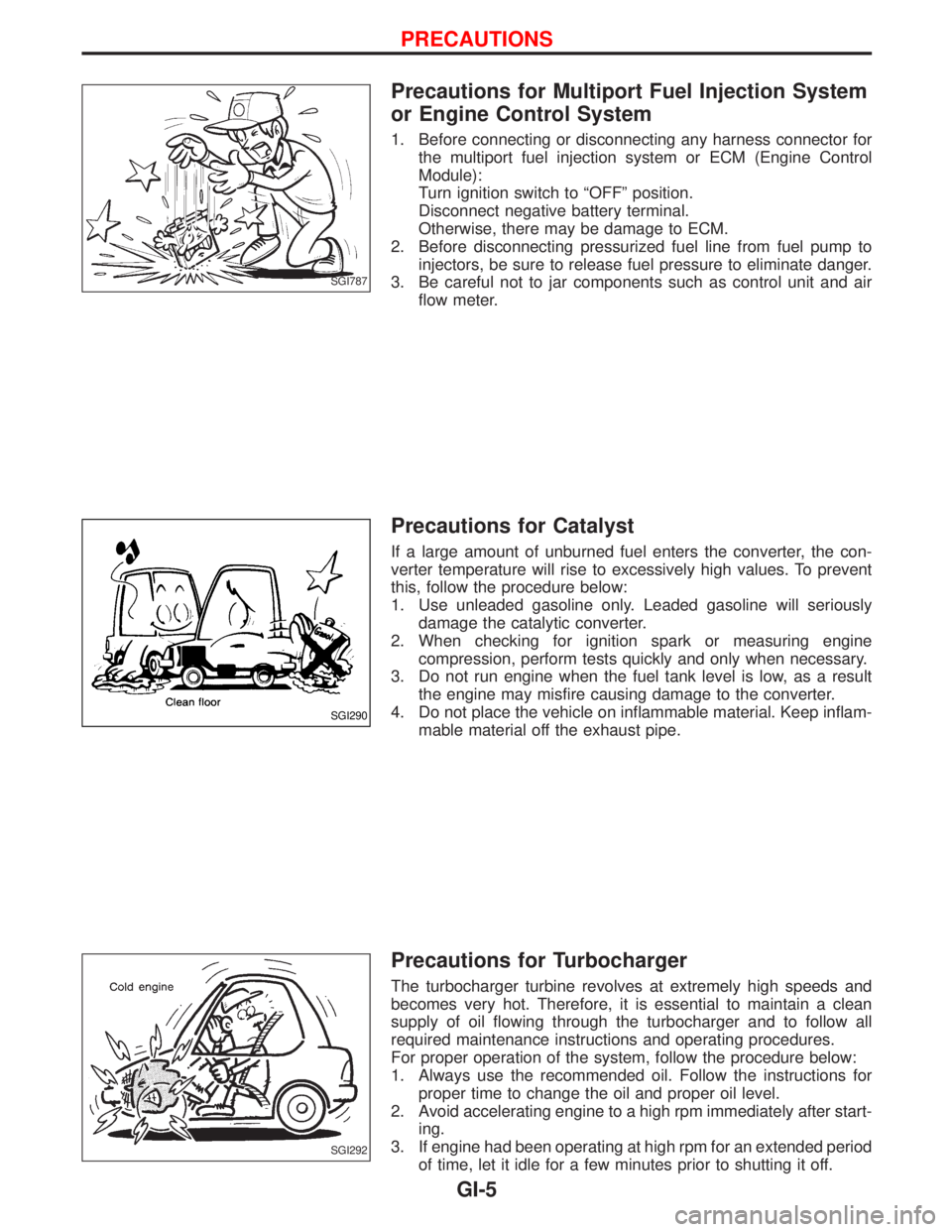
Precautions for Multiport Fuel Injection System
or Engine Control System
1. Before connecting or disconnecting any harness connector for
the multiport fuel injection system or ECM (Engine Control
Module):
Turn ignition switch to ªOFFº position.
Disconnect negative battery terminal.
Otherwise, there may be damage to ECM.
2. Before disconnecting pressurized fuel line from fuel pump to
injectors, be sure to release fuel pressure to eliminate danger.
3. Be careful not to jar components such as control unit and air
flow meter.
Precautions for Catalyst
If a large amount of unburned fuel enters the converter, the con-
verter temperature will rise to excessively high values. To prevent
this, follow the procedure below:
1. Use unleaded gasoline only. Leaded gasoline will seriously
damage the catalytic converter.
2. When checking for ignition spark or measuring engine
compression, perform tests quickly and only when necessary.
3. Do not run engine when the fuel tank level is low, as a result
the engine may misfire causing damage to the converter.
4. Do not place the vehicle on inflammable material. Keep inflam-
mable material off the exhaust pipe.
Precautions for Turbocharger
The turbocharger turbine revolves at extremely high speeds and
becomes very hot. Therefore, it is essential to maintain a clean
supply of oil flowing through the turbocharger and to follow all
required maintenance instructions and operating procedures.
For proper operation of the system, follow the procedure below:
1. Always use the recommended oil. Follow the instructions for
proper time to change the oil and proper oil level.
2. Avoid accelerating engine to a high rpm immediately after start-
ing.
3. If engine had been operating at high rpm for an extended period
of time, let it idle for a few minutes prior to shutting it off.
SGI787
SGI290
SGI292
PRECAUTIONS
GI-5
Page 1338 of 1767
Incident Simulation Tests
INTRODUCTION
Sometimes the symptom is not present when the vehicle is brought in for service. If possible, re-create the
conditions present at the time of the incident. Doing so may help avoid a No Trouble Found Diagnosis. The
following section illustrates ways to simulate the conditions/environment under which the owner experiences
an electrical incident.
The section is broken into the six following topics:
IVehicle vibration
IHeat sensitive
IFreezing
IWater intrusion
IElectrical load
ICold or hot start up
Get a thorough description of the incident from the customer. It is important for simulating the conditions of
the problem.
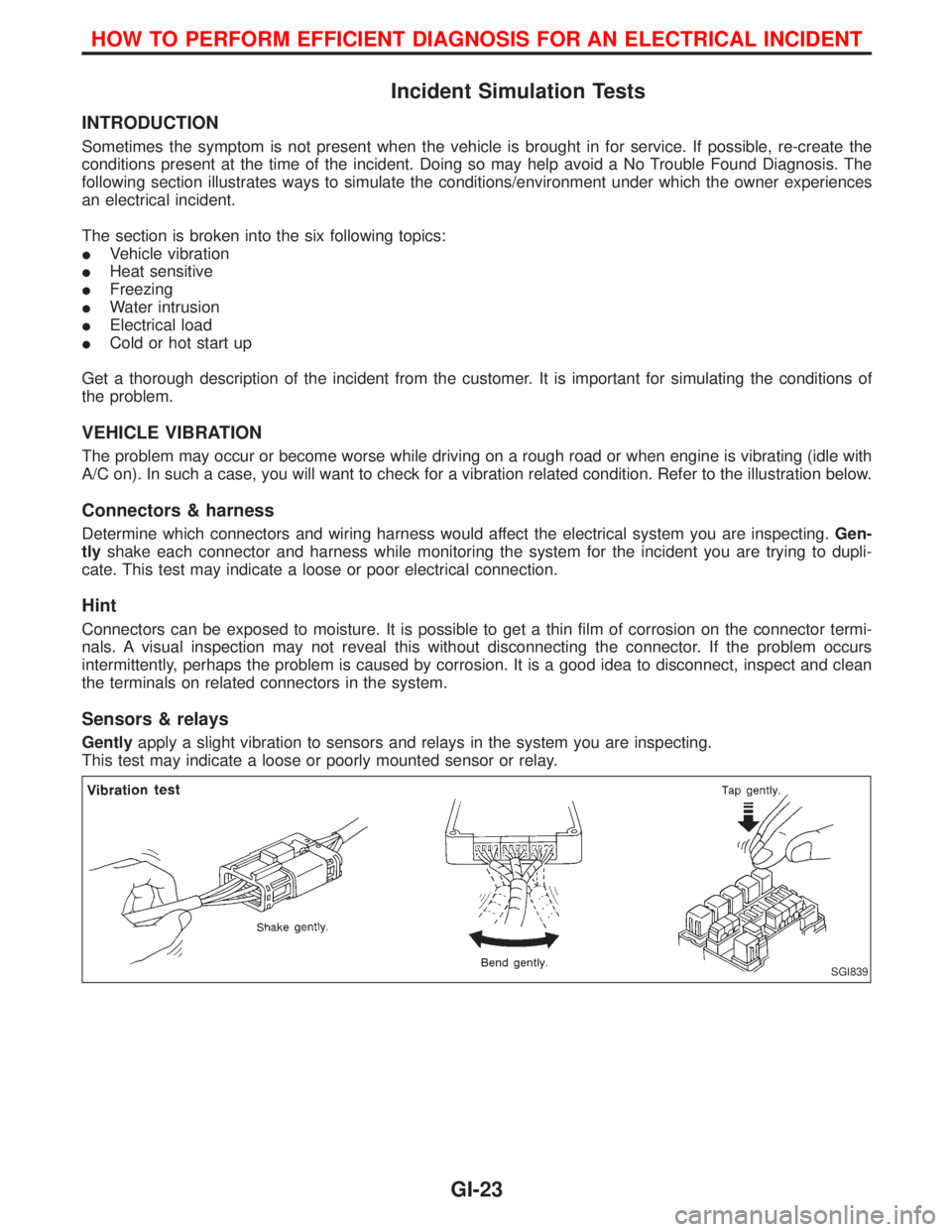
VEHICLE VIBRATION
The problem may occur or become worse while driving on a rough road or when engine is vibrating (idle with
A/C on). In such a case, you will want to check for a vibration related condition. Refer to the illustration below.
Connectors & harness
Determine which connectors and wiring harness would affect the electrical system you are inspecting.Gen-
tlyshake each connector and harness while monitoring the system for the incident you are trying to dupli-
cate. This test may indicate a loose or poor electrical connection.
Hint
Connectors can be exposed to moisture. It is possible to get a thin film of corrosion on the connector termi-
nals. A visual inspection may not reveal this without disconnecting the connector. If the problem occurs
intermittently, perhaps the problem is caused by corrosion. It is a good idea to disconnect, inspect and clean
the terminals on related connectors in the system.
Sensors & relays
Gentlyapply a slight vibration to sensors and relays in the system you are inspecting.
This test may indicate a loose or poorly mounted sensor or relay.
SGI839
HOW TO PERFORM EFFICIENT DIAGNOSIS FOR AN ELECTRICAL INCIDENT
GI-23