Ext NISSAN TIIDA 2007 Service Repair Manual
[x] Cancel search | Manufacturer: NISSAN, Model Year: 2007, Model line: TIIDA, Model: NISSAN TIIDA 2007Pages: 5883, PDF Size: 78.95 MB
Page 4870 of 5883
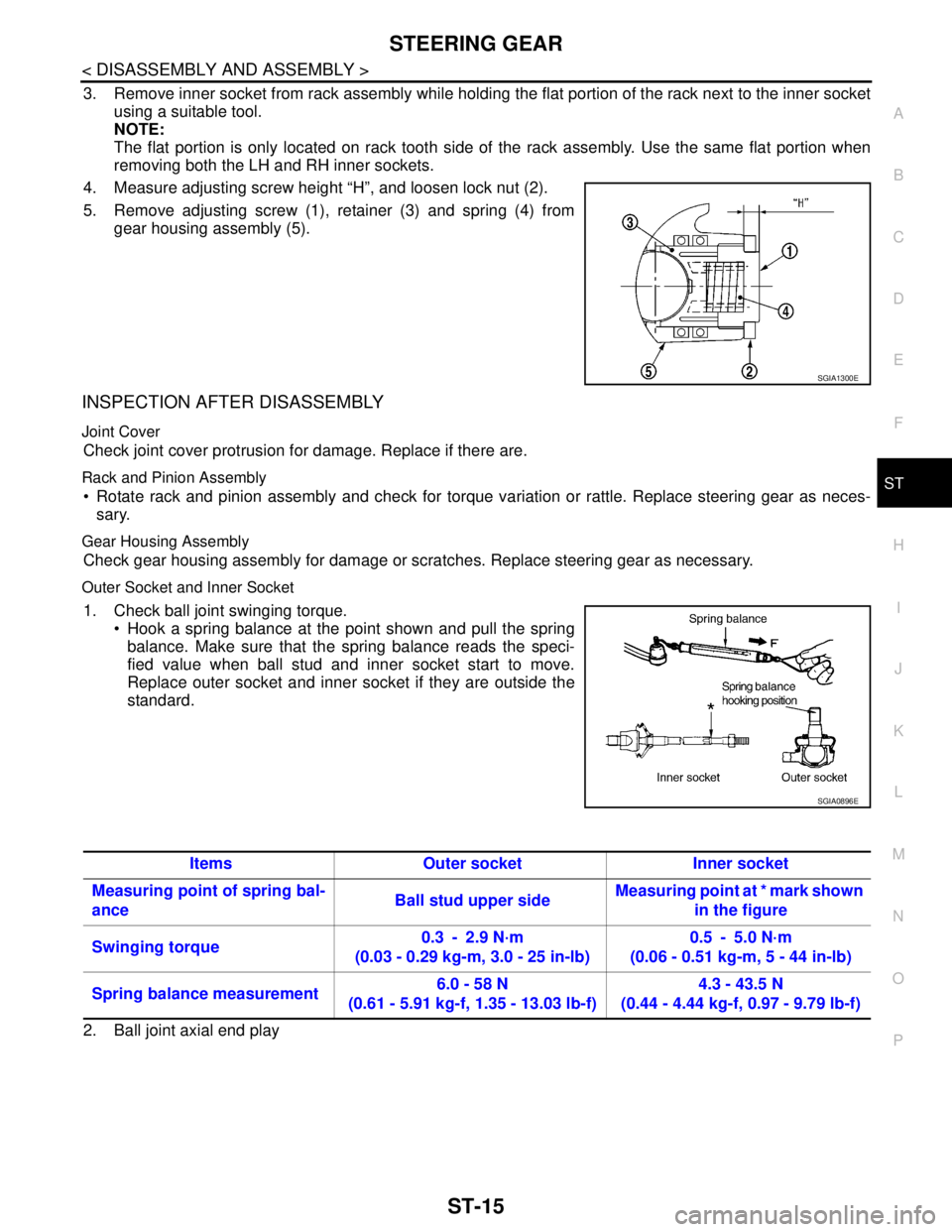
STEERING GEAR
ST-15
< DISASSEMBLY AND ASSEMBLY >
C
D
E
F
H
I
J
K
L
MA
B
ST
N
O
P
3. Remove inner socket from rack assembly while holding the flat portion of the rack next to the inner socket
using a suitable tool.
NOTE:
The flat portion is only located on rack tooth side of the rack assembly. Use the same flat portion when
removing both the LH and RH inner sockets.
4. Measure adjusting screw height “H”, and loosen lock nut (2).
5. Remove adjusting screw (1), retainer (3) and spring (4) from
gear housing assembly (5).
INSPECTION AFTER DISASSEMBLY
Joint Cover
Check joint cover protrusion for damage. Replace if there are.
Rack and Pinion Assembly
Rotate rack and pinion assembly and check for torque variation or rattle. Replace steering gear as neces-
sary.
Gear Housing Assembly
Check gear housing assembly for damage or scratches. Replace steering gear as necessary.
Outer Socket and Inner Socket
1. Check ball joint swinging torque.
Hook a spring balance at the point shown and pull the spring
balance. Make sure that the spring balance reads the speci-
fied value when ball stud and inner socket start to move.
Replace outer socket and inner socket if they are outside the
standard.
2. Ball joint axial end play
SGIA1300E
SGIA0896E
Items Outer socket Inner socket
Measuring point of spring bal-
anceBall stud upper sideMeasuring point at * mark shown
in the figure
Swinging torque0.3 - 2.9 N·m
(0.03 - 0.29 kg-m, 3.0 - 25 in-lb)0.5 - 5.0 N·m
(0.06 - 0.51 kg-m, 5 - 44 in-lb)
Spring balance measurement6.0 - 58 N
(0.61 - 5.91 kg-f, 1.35 - 13.03 lb-f)4.3 - 43.5 N
(0.44 - 4.44 kg-f, 0.97 - 9.79 lb-f)
Page 4871 of 5883
ST-16
< DISASSEMBLY AND ASSEMBLY >
STEERING GEAR
Apply an axial load of 490 N (50 kg-f, 111 lb-f) to ball stud
using a dial gauge. Measure amount of stud movement, and
then make sure that the value is within the specified range.
Replace outer socket and inner socket if the measured value
is outside the standard.
ASSEMBLY
1. Apply recommended grease to teeth part and bush part of rack assembly, if necessary.
2. Apply recommended grease to back of rack assembly, if necessary.
3. Install inner socket to rack assembly. Torque to specified value while holding the flat portion of the rack
next to the inner socket using a suitable tool.
4. Apply recommended grease to inner socket. For application points, refer to "COMPONENT (R24K
TYPE)" .
5. Decide on the neutral position for the rack assembly.
6. Apply recommended grease to around retainer (3), then install
retainer (3), spring (4) and adjusting screw (1) to gear housing
assembly (5).
7. Apply recommended thread locking sealant to the thread (2
turns thread), and then screw in the adjusting screw (1) until it
reaches height “H” from gear housing assembly (5) measured
before disassembling.
8. Tighten lock nut to (2) the specified torque securing it to prevent
adjusting screw (1) from freewheeling condition.
9. Move rack assembly 10 strokes throughout the full stroke so that
the parts can fit with each other.
10. Using Tools A and B, measure rotating torque of pinion assem-
bly. If the measurement is outside of the specified range, read-
just pinion rotating torque. If the measurement is outside of the
specified range for readjust, replace steering gear assembly. Outer socket 0.5 mm (0.020 in) or less
Inner socket 0.2 mm (0.008 in) or less
SGIA0057E
Rack stroke “L” : 65.0 mm (2.559 in)
AWGIA0016ZZ
SGIA1300E
Tool numbers A: ST3127S000 (J-25742-1)
B: KV48103400 ( — )
Pinion rotating torque standard
Around neutral position
(within±100°) Average A0.3 - 1.5 N·m (0.03 - 0.15 kg-m, 3
- 13 in-lb)
Maximum variation C 1.86 N·m (0.19 kg-m, 16 in-lb)
MGIA0017E
Page 4878 of 5883
![NISSAN TIIDA 2007 Service Repair Manual STC-4
< FUNCTION DIAGNOSIS >[EPS]
EPS SYSTEM
FUNCTION DIAGNOSIS
EPS SYSTEM
System DiagramINFOID:0000000001697715
System DescriptionINFOID:0000000001697714
EPS CONTROL UNIT
• EPS control unit perform](/img/5/57395/w960_57395-4877.png "NISSAN TIIDA 2007 Service Repair Manual STC-4
< FUNCTION DIAGNOSIS >[EPS]
EPS SYSTEM
FUNCTION DIAGNOSIS
EPS SYSTEM
System DiagramINFOID:0000000001697715
System DescriptionINFOID:0000000001697714
EPS CONTROL UNIT
• EPS control unit perform")
STC-4
< FUNCTION DIAGNOSIS >[EPS]
EPS SYSTEM
FUNCTION DIAGNOSIS
EPS SYSTEM
System DiagramINFOID:0000000001697715
System DescriptionINFOID:0000000001697714
EPS CONTROL UNIT
• EPS control unit performs an arithmetical operation on data, such as steering wheel turning force (sensor
signal) from the torque sensor, vehicle speed signal, etc. Then it generates an optimum assist torque to the
EPS motor according to the driving condition.
EPS control unit decreases the output to EPS motor while extremely using the power steering function (e.g.,
full steering) for protecting EPS motor and EPS control unit (Protect overload status). While activating pro-
tect overload status, the assist torque gradually decreases, and the steering wheel turning force becomes
heavy. The normal assist torque reactivates by not steering.
In case of an error in the electrical system, the fail-safe function stops output signals to the EPS motor. Then
the previous state is changed to the manual steering state.
Self-diagnosis can be done with CONSULT-III.
EPS MOTOR
EPS motor provides the assist torque by control signal from EPS control unit.
TORQUE SENSOR
Torque sensor detects the steering torque, and transmit the signal to EPS control unit.
REDUCTION GEAR
Reduction gear increases the assist torque provided from EPS motor with worm gears, and outputs to the col-
umn shaft.
EPS WARNING LAMP
Turns ON when there is a malfunction in EPS system. It indicates that fail-safe mode is engaged and enters a
manual steering state (Control turning force steering wheel becomes heavy).
Also turns ON when ignition switch is turned ON, for purpose of lamp check. Turns OFF after the engine starts
if system is normal.
EPS Warning Lamp Indication
SGIA1649E
Condition EPS warning lamp
Lamp checkTurns ON when ignition switch is turned ON.
Turns OFF after engine start.
Page 4897 of 5883
![NISSAN TIIDA 2007 Service Repair Manual EPS CONTROL UNIT
STC-23
< ECU DIAGNOSIS >[EPS]
C
D
E
F
H
I
J
K
L
MA
B
STC
N
O
P
EPS HARNESS CONNECTOR TERMINAL LAYOUT
TERMINALS AND REFERENCE VALUES FOR EPS CONTROL UNIT
Data are reference values an](/img/5/57395/w960_57395-4896.png "NISSAN TIIDA 2007 Service Repair Manual EPS CONTROL UNIT
STC-23
< ECU DIAGNOSIS >[EPS]
C
D
E
F
H
I
J
K
L
MA
B
STC
N
O
P
EPS HARNESS CONNECTOR TERMINAL LAYOUT
TERMINALS AND REFERENCE VALUES FOR EPS CONTROL UNIT
Data are reference values an")
EPS CONTROL UNIT
STC-23
< ECU DIAGNOSIS >[EPS]
C
D
E
F
H
I
J
K
L
MA
B
STC
N
O
P
EPS HARNESS CONNECTOR TERMINAL LAYOUT
TERMINALS AND REFERENCE VALUES FOR EPS CONTROL UNIT
Data are reference values and are measured between each terminal and ground.
CAUTION:
When using a circuit tester to measure voltage for inspection, be sure not to extend forcibly any connector terminals.
SGIA1624E
Te r m i n a lWire
colorItem Condition Data (Approx.)
4 V Torque sensor sub Engine runningSteering wheel: Not steering
(There in no steering force)2.5 V
Steering wheel: Steering1.7 V – 3.3 V
(The value is changed accord-
ing to steering left or right)
5 BR Torque sensor power supplyIgnition switch: ON 8 V
Ignition switch: OFF 0 V
6 G Torque sensor main Engine runningSteering wheel: Not steering
(There is no steering force)2.5 V
Steering wheel: Steering1.7 V – 3.3 V
(The value is changed accord-
ing to steering left or right)
7 R Torque sensor ground Always 0 V
9 L CAN-H — —
10 O Power supplyIgnition switch: ON Battery voltage
Ignition switch: OFF 0 V
16 P CAN-L — —
17 R Power supply (Memory back-up)Ignition switch: ON Battery voltage
Ignition switch: OFF Battery voltage
18 B Ground Always 0 V
19 — Motor (+) — —
20 — Motor (–) — —
Page 4970 of 5883
![NISSAN TIIDA 2007 Service Repair Manual TM-24
< FUNCTION DIAGNOSIS >[TYPE 1 (4AT: RE4F03B)]
A/T CONTROL SYSTEM
The line pressure is temporarily reduced corresponding to a change
in engine torque when shifting gears (that is, when the shift](/img/5/57395/w960_57395-4969.png "NISSAN TIIDA 2007 Service Repair Manual TM-24
< FUNCTION DIAGNOSIS >[TYPE 1 (4AT: RE4F03B)]
A/T CONTROL SYSTEM
The line pressure is temporarily reduced corresponding to a change
in engine torque when shifting gears (that is, when the shift")
TM-24
< FUNCTION DIAGNOSIS >[TYPE 1 (4AT: RE4F03B)]
A/T CONTROL SYSTEM
The line pressure is temporarily reduced corresponding to a change
in engine torque when shifting gears (that is, when the shift solenoid
valve is switched for clutch operation) to reduce shifting shock.
AT LOW FLUID TEMPERATURE
A/T fluid viscosity and frictional characteristics of the clutch facing change with A/T fluid temperature. Clutch
engaging or band-contacting pressure is compensated for, according to A/T fluid temperature, to stabilize
shifting quality.
The line pressure is reduced below 60°C (140°F) to prevent shift-
ing shock due to high viscosity of A/T fluid when temperature is
low.
Line pressure is increased to a maximum irrespective of the throt-
tle opening when A/T fluid temperature drops to −10°C (14°F). This
pressure rise is adopted to prevent a delay in clutch and brake
operation due to extreme drop of A/T fluid viscosity at low temper-
ature.
Shift ControlINFOID:0000000001694426
The shift is regulated entirely by electronic control to accommodate vehicle speed and varying engine opera-
tions. This is accomplished by electrical signals transmitted by the revolution sensor and the ECM (accelerator
pedal position sensor). This results in improved acceleration performance and fuel economy.
CONTROL OF SHIFT SOLENOID VALVES A AND B
The TCM activates shift solenoid valves A and B according to sig-
nals from the accelerator pedal position sensor and revolution sen-
sor to select the optimum gear position on the basis of the shift
schedule memorized in the TCM.
The shift solenoid valve performs simple ON-OFF operation. When
set to “ON”, the drain circuit closes and pilot pressure is applied to
the shift valve.
RELATION BETWEEN SHIFT SOLENOID VALVES A AND B AND GEAR POSITIONS
SCIA4828E
SCIA4829E
SCIA4830E
SAT008J
Page 5070 of 5883
![NISSAN TIIDA 2007 Service Repair Manual TM-124
< ECU DIAGNOSIS >[TYPE 1 (4AT: RE4F03B)]
TCM
The SELF-DIAGNOSIS results will be as follows:
The first SELF-DIAGNOSIS will indicate damage to the vehicle speed sensor or the revolution sensor.](/img/5/57395/w960_57395-5069.png "NISSAN TIIDA 2007 Service Repair Manual TM-124
< ECU DIAGNOSIS >[TYPE 1 (4AT: RE4F03B)]
TCM
The SELF-DIAGNOSIS results will be as follows:
The first SELF-DIAGNOSIS will indicate damage to the vehicle speed sensor or the revolution sensor.")
TM-124
< ECU DIAGNOSIS >[TYPE 1 (4AT: RE4F03B)]
TCM
The SELF-DIAGNOSIS results will be as follows:
The first SELF-DIAGNOSIS will indicate damage to the vehicle speed sensor or the revolution sensor.
During the next SELF-DIAGNOSIS, performed after checking the sensor, no damages will be indicated.
FAIL-SAFE FUNCTION
The following fail-safe functions allow vehicles to be driven even when sensor, switch or solenoid malfunction
occurs.
Vehicle Speed Sensor·A/T (Revolution Sensor)
Vehicle speed sensor·MTR signal is input from combination meter.
Accelerator Pedal Position Sensor Signal and Throttle Position Sensor Signal
TCM controls the throttle opening angle to a predetermined fixed position to enable driving if a malfunctioning
signal is input to TCM.
PNP Switch
When the multiple PNP switch signals are input to TCM, the priority of selector lever position becomes “D”,
“N”, “R”, “2” and “1” in order by internal TCM determination.
The use of 4th gear is inhibited until normal operation resumes. Because the hydraulic circuit of the control
valve is switched by manual valve according to the selector lever position, however, actual operating condition
of vehicle becomes as follows.
Shift Solenoid Valve A and B
If non-standard solenoid signal is sent to TCM, use of certain gears is limited. Refer to chart shown below.
●: Solenoid ON
×: Solenoid OFF
–: Non-standard condition
Line Pressure Solenoid Valve
If non-standard solenoid signal is sent to TCM, line pressure solenoid valve is turned OFF to achieve maxi-
mum oil pressure.
Torque Converter Clutch Solenoid Valve
Actual lever position PNP switch input signal Running status
“P” “P” position and other position signals P
“R” “R” position and other position signals R
“N” “N” position and other position signals N
“D” “D” position and other position signals D
1⇔D2⇔D3⇔D4
“2”“2” position and other position signals (Except “1” position) 21⇔22⇔23
“2” position and “1” position signals 21⇔22
“1”“1” position and other position signals (Except “2” position) 11⇔12⇔13
“1” position and “2” position signals 11⇔12
Shift positionNormalMalfunction in solenoid
valve AMalfunction in solenoid
valve BMalfunction in solenoid
valves A and B
A B Gear A B Gear A B Gear A B Gear
“D” position●●1st –●→×
3rd ●→×–
3rd ––
3rd ×●2nd –●→× ×–––
××3rd – x×–––
●×4th – x●→×–––
“2” position●●1st –●→×●→×–––
×●2nd –●→× ×–––
××3rd – x×–––
“1” position●●1st –●→×●→×–––
×●2nd –●→× ×–––
××3rd – x×–––
Page 5080 of 5883
![NISSAN TIIDA 2007 Service Repair Manual TM-134
< SYMPTOM DIAGNOSIS >[TYPE 1 (4AT: RE4F03B)]
SYSTEM SYMPTOM
Slips/Will Not EngageAlmost no shock or
slipping in changing
from D
2 to D3.ON vehicle1. A/T fluid levelTM-171
2. Accelerator pedal](/img/5/57395/w960_57395-5079.png "NISSAN TIIDA 2007 Service Repair Manual TM-134
< SYMPTOM DIAGNOSIS >[TYPE 1 (4AT: RE4F03B)]
SYSTEM SYMPTOM
Slips/Will Not EngageAlmost no shock or
slipping in changing
from D
2 to D3.ON vehicle1. A/T fluid levelTM-171
2. Accelerator pedal")
TM-134
< SYMPTOM DIAGNOSIS >[TYPE 1 (4AT: RE4F03B)]
SYSTEM SYMPTOM
Slips/Will Not EngageAlmost no shock or
slipping in changing
from D
2 to D3.ON vehicle1. A/T fluid levelTM-171
2. Accelerator pedal position sensorEC-297
3. Line pressure testTM-178
4. Control valve assemblyTM-191
OFF vehicle5. High clutchTM-2626. Forward clutchTM-267
Almost no shock or
slipping in changing
from D
3 to D4.ON vehicle1. A/T fluid levelTM-171
2. Accelerator pedal position sensorEC-297
3. Line pressure testTM-178
4. Control valve assemblyTM-191
OFF vehicle 5. Brake bandTM-287
Races extremely fast
or slips in changing
from D
4 to D3 when
depressing accelera-
tor pedal.ON vehicle1. A/T fluid levelTM-171
2. Accelerator pedal position sensorEC-297
3. Line pressure testTM-178
4. Line pressure solenoid valveTM-81
5. Shift solenoid valve ATM-85
6. Control valve assemblyTM-191
OFF vehicle7. Brake bandTM-2878. Forward clutchTM-267
Races extremely fast
or slips in changing
from D
4 to D2 when
depressing accelera-
tor pedal.ON vehicle1. A/T fluid levelTM-171
2. Accelerator pedal position sensorEC-297
3. Line pressure testTM-178
4. Line pressure solenoid valveTM-81
5. Shift solenoid valve ATM-85
6. Shift solenoid valve BTM-89
7. Control valve assemblyTM-191
OFF vehicle8. Brake bandTM-2879. Forward clutchTM-267
Items Symptom Condition Diagnostic item Reference page
Page 5081 of 5883
![NISSAN TIIDA 2007 Service Repair Manual SYSTEM SYMPTOM
TM-135
< SYMPTOM DIAGNOSIS >[TYPE 1 (4AT: RE4F03B)]
C
E
F
G
H
I
J
K
L
MA
B
TM
N
O
P
Slips/Will Not EngageRaces extremely fast
or slips in changing
from D
3 to D2 when
depressing acce](/img/5/57395/w960_57395-5080.png "NISSAN TIIDA 2007 Service Repair Manual SYSTEM SYMPTOM
TM-135
< SYMPTOM DIAGNOSIS >[TYPE 1 (4AT: RE4F03B)]
C
E
F
G
H
I
J
K
L
MA
B
TM
N
O
P
Slips/Will Not EngageRaces extremely fast
or slips in changing
from D
3 to D2 when
depressing acce")
SYSTEM SYMPTOM
TM-135
< SYMPTOM DIAGNOSIS >[TYPE 1 (4AT: RE4F03B)]
C
E
F
G
H
I
J
K
L
MA
B
TM
N
O
P
Slips/Will Not EngageRaces extremely fast
or slips in changing
from D
3 to D2 when
depressing accelera-
tor pedal. ON vehicle1. A/T fluid levelTM-171
2. Accelerator pedal position sensor EC-297
3. Line pressure testTM-178
4. Line pressure solenoid valveTM-81
5. Shift solenoid valve BTM-89
6. Control valve assemblyTM-191
OFF vehicle7. Brake bandTM-2878. High clutchTM-262
Races extremely fast
or slips in changing
from D
4 or D3 to D 1
when depressing ac-
celerator pedal.ON vehicle1. A/T fluid levelTM-171
2. Accelerator pedal position sensorEC-297
3. Line pressure testTM-178
4. Line pressure solenoid valveTM-81
5. Shift solenoid valve ATM-85
6. Shift solenoid valve BTM-89
7. Control valve assemblyTM-191
OFF vehicle8. Forward clutchTM-2679. Forward one-way clutchTM-278
10. Low one-way clutchTM-222
Vehicle will not run in
any position.ON vehicle1. A/T fluid levelTM-171
2. Control cable adjustmentTM-204
3. Line pressure testTM-178
4. Line pressure solenoid valveTM-81
OFF vehicle5. Oil pumpTM-240
6. High clutchTM-262
7. Brake bandTM-287
8. Low & reverse brakeTM-273
9. Torque converterTM-222
10. Parking componentsTM-213
OthersEngine cannot be
started in “P” and “N”
positions.
TM-140
ON vehicle1. Ignition switch and starterSTR-62. Control cable adjustmentTM-204
3. PNP switch adjustmentTM-195
Engine starts in posi-
tions other than “P”
and “N”.ON vehicle1. Control cable adjustmentTM-204
2. PNP switch adjustmentTM-195
Items Symptom Condition Diagnostic item Reference page
Page 5110 of 5883
![NISSAN TIIDA 2007 Service Repair Manual TM-164
< PRECAUTION >[TYPE 1 (4AT: RE4F03B)]
PRECAUTIONS
Be sure to turn the ignition switch OFF and disconnect battery negative cable from battery negative
terminal before any repair or inspection](/img/5/57395/w960_57395-5109.png "NISSAN TIIDA 2007 Service Repair Manual TM-164
< PRECAUTION >[TYPE 1 (4AT: RE4F03B)]
PRECAUTIONS
Be sure to turn the ignition switch OFF and disconnect battery negative cable from battery negative
terminal before any repair or inspection")
TM-164
< PRECAUTION >[TYPE 1 (4AT: RE4F03B)]
PRECAUTIONS
Be sure to turn the ignition switch OFF and disconnect battery negative cable from battery negative
terminal before any repair or inspection work. The open/short circuit of related switches, sensors,
solenoid valves, etc. will cause the MIL to light up.
Be sure to connect and lock the connectors securely after work. A loose (unlocked) connector will
cause the MIL to light up due to an open circuit. (Be sure the connectors are free from water, grease,
dirt, bent terminals, etc.)
Be sure to route and secure the harnesses properly after work. Interference of the harness with a
bracket, etc. may cause the MIL to light up due to a short circuit.
Be sure to erase the unnecessary malfunction information (repairs completed) from the TCM and
ECM before returning the vehicle to the customer.
PrecautionINFOID:0000000001696267
Before connecting or disconnecting the TCM harness connec-
tor, turn ignition switch OFF and disconnect the battery cable
from the negative terminal. Failure to do so may damage the
TCM. Because battery voltage is applied to TCM even if igni-
tion switch is turned off.
When connecting or disconnecting pin connectors into or
from TCM, take care not to damage pin terminals (bend or
break).
Make sure that there are not any bends or breaks on TCM pin
terminal, when connecting pin connectors.
Before replacing TCM, perform TCM input/output signal
inspection and make sure whether TCM functions properly or
not. (See page XX-XX, "*****"
.)
After performing each TROUBLE DIAGNOSIS, perform “DTC
(Diagnostic Trouble Code) Confirmation Procedure”.
The DTC should not be displayed in the “DTC Confirmation
Procedure” if the repair is completed.
Before proceeding with disassembly, thoroughly clean the outside
of the transaxle. It is important to prevent the internal parts from
becoming contaminated by dirt or other foreign matter.
Disassembly should be done in a clean work area.
Use lint-free cloth or towels for wiping parts clean. Common shop
rags can leave fibers that could interfere with the operation of the A/T.
Place disassembled parts in order for easier and proper assembly.
All parts should be carefully cleaned with a general purpose, non-flammable solvent before inspection or
reassembly.
Gaskets, seals and O-rings should be replaced any time the A/T is disassembled.
It is very important to perform functional tests whenever they are indicated.
The valve body contains precision parts and requires extreme care when parts are removed and serviced.
Place disassembled valve body parts in order for easier and proper assembly. Care will also prevent springs
and small parts from becoming scattered or lost.
Properly installed valves, sleeves, plugs, etc. will slide along bores in valve body under their own weight.
SEF289H
AAT470A
MEF040DA
Page 5111 of 5883
![NISSAN TIIDA 2007 Service Repair Manual PRECAUTIONS
TM-165
< PRECAUTION >[TYPE 1 (4AT: RE4F03B)]
C
E
F
G
H
I
J
K
L
MA
B
TM
N
O
P
Before assembly, apply a coat of recommended ATF to all parts. Apply petroleum jelly to protect O-rings and
s](/img/5/57395/w960_57395-5110.png "NISSAN TIIDA 2007 Service Repair Manual PRECAUTIONS
TM-165
< PRECAUTION >[TYPE 1 (4AT: RE4F03B)]
C
E
F
G
H
I
J
K
L
MA
B
TM
N
O
P
Before assembly, apply a coat of recommended ATF to all parts. Apply petroleum jelly to protect O-rings and
s")
PRECAUTIONS
TM-165
< PRECAUTION >[TYPE 1 (4AT: RE4F03B)]
C
E
F
G
H
I
J
K
L
MA
B
TM
N
O
P
Before assembly, apply a coat of recommended ATF to all parts. Apply petroleum jelly to protect O-rings and
seals, or hold bearings and washers in place during assembly. Do not use grease.
Extreme care should be taken to avoid damage to O-rings, seals and gaskets when assembling.
After overhaul, refill the A/T with new ATF.
When the A/T drain plug is removed, only some of the fluid is drained. Old A/T fluid will remain in torque con-
verter and ATF cooling system.
Always follow the procedures under “Changing A/T Fluid” in the AT section when changing A/T fluid. Refer to
XX-XX, "*****"
, XX-XX, "*****".
Service Notice or PrecautionINFOID:0000000001696268
TORQUE CONVERTER SERVICE
The torque converter should be replaced under any of the following conditions:
External leaks in the hub weld area.
Converter hub is scored or damaged.
Converter pilot is broken, damaged or fits poorly into crankshaft.
Steel particles are found after flushing the cooler and cooler lines.
Pump is damaged or steel particles are found in the converter.
Vehicle has TCC shudder and/or no TCC apply. Replace only after all hydraulic and electrical diagnoses
have been made. (Converter clutch material may be glazed.)
Converter is contaminated with engine coolant containing antifreeze.
Internal malfunction of stator roller clutch.
Heavy clutch debris due to overheating (blue converter).
Steel particles or clutch lining material found in fluid filter or on magnet when no internal parts in unit are
worn or damaged — indicates that lining material came from converter.
The torque converter should not be replaced if:
The fluid has an odor, is discolored, and there is no evidence of metal or clutch facing particles.
The threads in one or more of the converter bolt holes are damaged.
A/T malfunction did not display evidence of damaged or worn internal parts, steel particles or clutch plate lin-
ing material in unit and inside the fluid filter.
Vehicle has been exposed to high mileage (only). The exception may be where the torque converter clutch
dampener plate lining has seen excess wear by vehicles operated in heavy and/or constant traffic, such as
taxi, delivery or police use.
OBD SELF-DIAGNOSIS (FOR TYPE 1 ONLY)
A/T self-diagnosis is performed by the TCM in combination with the ECM. The results can be read through
the blinking pattern of the OD OFF indicator lamp or the malfunction indicator lamp (MIL). Refer to the table
on XX-XX, "*****"
for the indicator used to display each self-diagnostic result.
The self-diagnostic results indicated by the MIL are automatically stored in both the ECM and TCM memo-
ries.
Always perform the procedure “HOW TO ERASE DTC” on XX-XX, "*****"
to complete the repair and
avoid unnecessary blinking of the MIL.
The following self-diagnostic items can be detected using ECM self-diagnostic results mode* only when the
OD OFF indicator lamp does not indicate any malfunctions.
-PNP switch
- A/T 1st, 2nd, 3rd, or 4th gear function
*: For details of OBD, refer to XX-XX, "*****"
.
Wiring Diagram and Trouble DiagnosisINFOID:0000000001696269
When reading wiring diagrams, refer to the following:
XX-XX, "*****"
XX-XX, "*****"
When performing trouble diagnosis, refer to the following:
XX-XX, "*****"
XX-XX, "*****"