tires NISSAN X-TRAIL 2003 Electronic User Guide
[x] Cancel search | Manufacturer: NISSAN, Model Year: 2003, Model line: X-TRAIL, Model: NISSAN X-TRAIL 2003Pages: 3066, PDF Size: 51.47 MB
Page 2202 of 3066

FAX-6
NOISE, VIBRATION, AND HARSHNESS (NVH) TROUBLESHOOTING
NOISE, VIBRATION, AND HARSHNESS (NVH) TROUBLESHOOTING
PFP:00003
NVH Troubleshooting ChartEDS000IF
Use the chart below to help you find the cause of the symptom. If necessary, repair or replace these parts.
´: Applicable Reference page
Refer toFAX -7
FAX -11
ONT WHEEL HUB AND KNUCKLE
—
Refer toFAX -7
NVH in WT section.
NVH in WT section.
NVH in PS section.
Possible cause and SUSPECTED PARTS
Improper installation, looseness
Parts interference
Wheel bearing damage
TIRES
ROAD WHEEL
STEERING
Symptom FRONT AXLENoise´´ ´´´
Shake´´ ´´´
Vibration´´´´
Shimmy´´ ´´´
Judder´ ´´´
Poor quality ride or handling´´´´´
Page 2241 of 3066
FSU-2
PRECAUTIONS
PRECAUTIONS
PFP:00001
CautionEES0006Z
lWhen installing rubber bushings, final tightening must be carried out under unladen conditions with tires
on flat, level ground. Oil will shorten the life of rubber bushings. Be sure to wipe off any spilled oil.
l“Unladen condition” means that fuel, coolant and lubricant are full and ready for drive. However, spare tire,
jack, and hand tools should be unloaded.
lAfter installing the removed suspension parts, always check wheel alignment and adjust if necessary.
lReplace the caulking nut with a new one. Install a new nut without wiping the oil off before tightening.
Precautions for Brake SystemEES000JA
lWhen installing rubber parts, final tightening must be carried out
under unladen condition* with tires on ground.
*: Fuel, radiator coolant and engine oil full. Spare tire, jack,
hand tools and mats in designated positions.
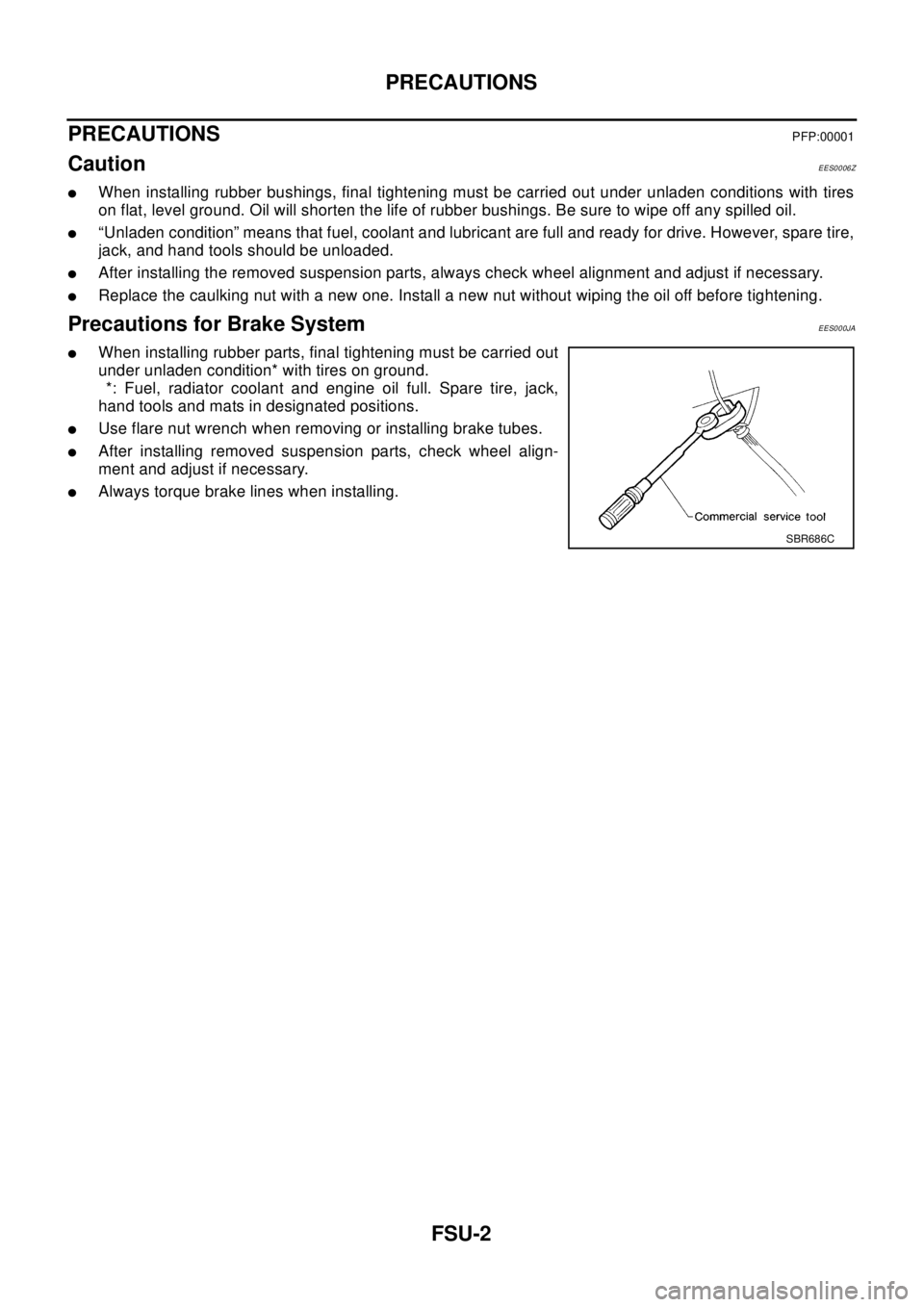
lUse flare nut wrench when removing or installing brake tubes.
lAfter installing removed suspension parts, check wheel align-
ment and adjust if necessary.
lAlways torque brake lines when installing.
SBR686C
Page 2243 of 3066

FSU-4
NOISE, VIBRATION, AND HARSHNESS (NVH) TROUBLESHOOTING
NOISE, VIBRATION, AND HARSHNESS (NVH) TROUBLESHOOTING
PFP:00003
NVH Troubleshooting ChartEES000ID
Use the chart below to help you find the cause of the symptom. If necessary, repair or replace these parts.
´: ApplicableReference page
Refer toFSU-5Refer toFSU-8
—
—
—
Refer toFSU-5
Refer toFSU-6Refer toFSU-11NVH in PR section
NVH in RFD section.
NVHinRAXandRSUsection.
NVH in WT section.
NVH in WT section.
NVH in RAX section.
NVH in BR section.
NVH in PS section.
Possible cause and SUSPECTED PARTS
Improper installation, looseness
Shock absorber deformation, damage or deflection
Bushing or mounting deterioration
Parts interference
Spring fatigue
Suspension looseness
Incorrect wheel alignment
Stabilizer bar fatigue
PROPELLER SHAFT
DIFFERENTIAL
REAR AXLE AND REAR SUSPENSION
TIRES
ROAD WEEL
DRIVE SHAFT
BRAKES
STEERING
Symptom FRONT SUSPENSIONNoise´´´´´ ´ ´´´ ´´´´´
Shake´´´´ ´ ´ ´ ´´´´´
Vibration´´´´´ ´ ´´ ´ ´
Shimmy´´´´ ´ ´´´ ´´
Judder´´´ ´´´ ´´
Poor quality ride or han-
dling´´´´´ ´´ ´ ´´´
Page 2245 of 3066
FSU-6
FRONT SUSPENSION ASSEMBLY
On-Vehicle Inspection and Service
EES00072
LOOSENESS, BACKLASH AND DAMAGE OF MOUNTING PARTS AND CONNECTIONS
Lift vehicle and inspect the following:
lCheck mounting point of each component for looseness, backlash and damage.
lCheck lower ball joint end play.
1. Attach a dial gauge so that the contact rests on the brake caliper.
2. Set front wheels in a straight-ahead position. Do not depress brake pedal.
3. Measure axial endplay by placing an iron pry bar or something similar between transverse link and steer-
ing knuckle.
CAUTION:
Be careful not to damage ball joint boot.
4. If axial endplay is outside the standard, remove transverse link and check lower ball joint.
Wheel AlignmentEES00073
DESCRIPTION
lMeasure wheel alignment under unladen conditions. “Unladen conditions” means that fuel, coolant, and
lubricant are full. However, spare tire, jack, and hand tools should be unloaded.
PRELIMINARY INSPECTION
1. Check the tires for improper air pressure and wear.
2. Check road wheels for runout.
3. Check wheel bearing axial endplay.
4. Check lower ball joint axial endplay.
5. Check strut operation.
6. Check each mounting point of axle and suspension for looseness and deformation.
7. Check each link and arm for cracks, deformation, and other damage.
8. Check the vehicle posture.
INSPECTION OF CAMBER, CASTER, AND KINGPIN INCLINATION ANGLES
lCamber, caster, and kingpin inclination angles cannot be adjusted.
lBefore inspection, mount front wheels onto turning radius gauge. Mount rear wheels onto a stand that has
same height so the vehicle will remain horizontal.
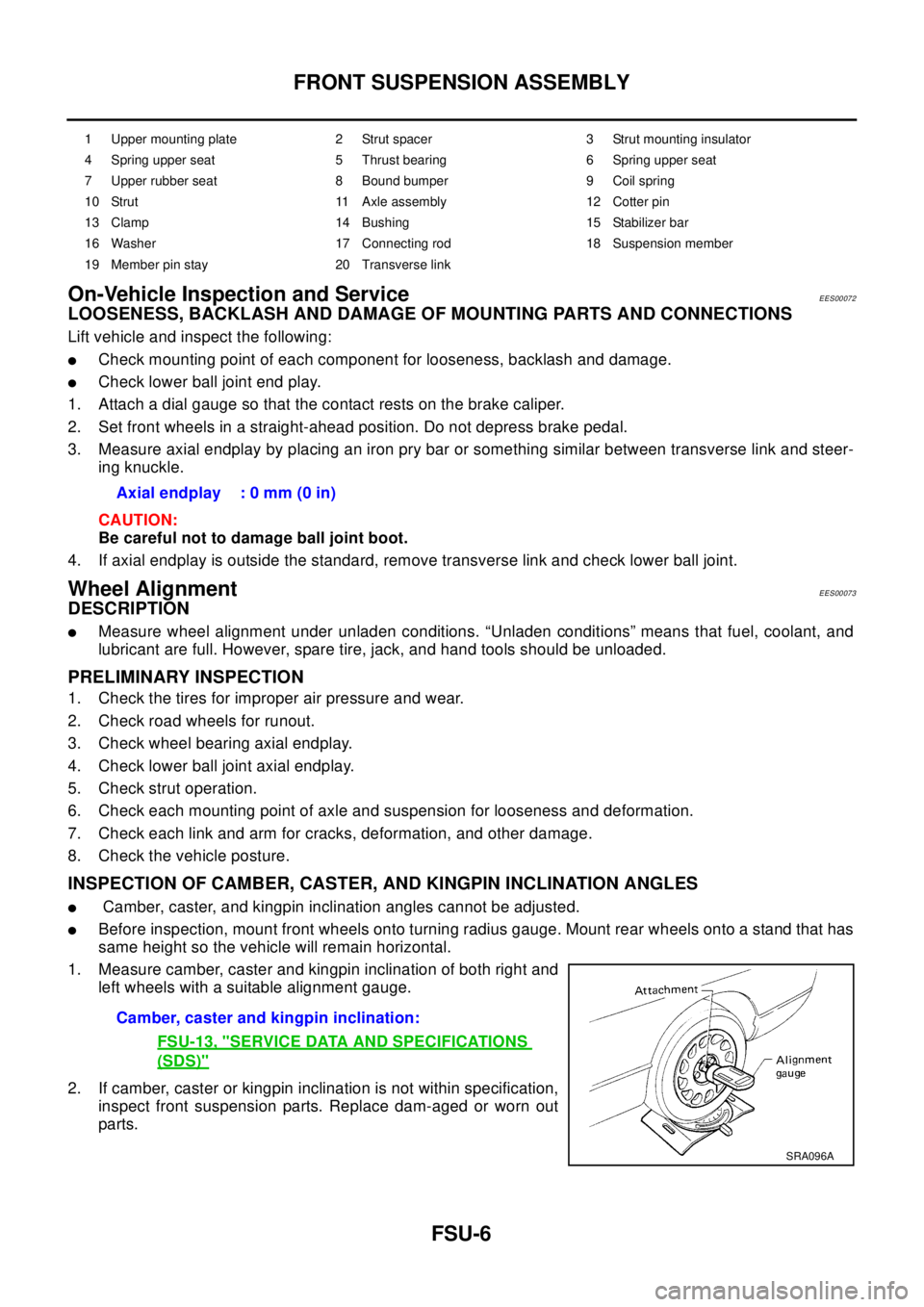
1. Measure camber, caster and kingpin inclination of both right and
left wheels with a suitable alignment gauge.
2. If camber, caster or kingpin inclination is not within specification,
inspect front suspension parts. Replace dam-aged or worn out
parts.
1 Upper mounting plate 2 Strut spacer 3 Strut mounting insulator
4 Spring upper seat 5 Thrust bearing 6 Spring upper seat
7 Upper rubber seat 8 Bound bumper 9 Coil spring
10 Strut 11 Axle assembly 12 Cotter pin
13 Clamp 14 Bushing 15 Stabilizer bar
16 Washer 17 Connecting rod 18 Suspension member
19 Member pin stay 20 Transverse link
Axial endplay : 0 mm (0 in)
Camber, caster and kingpin inclination:
FSU-13, "
SERVICE DATA AND SPECIFICATIONS
(SDS)"
SRA096A
Page 2246 of 3066
FRONT SUSPENSION ASSEMBLY
FSU-7
C
D
F
G
H
I
J
K
L
MA
B
FSU
To e - i n
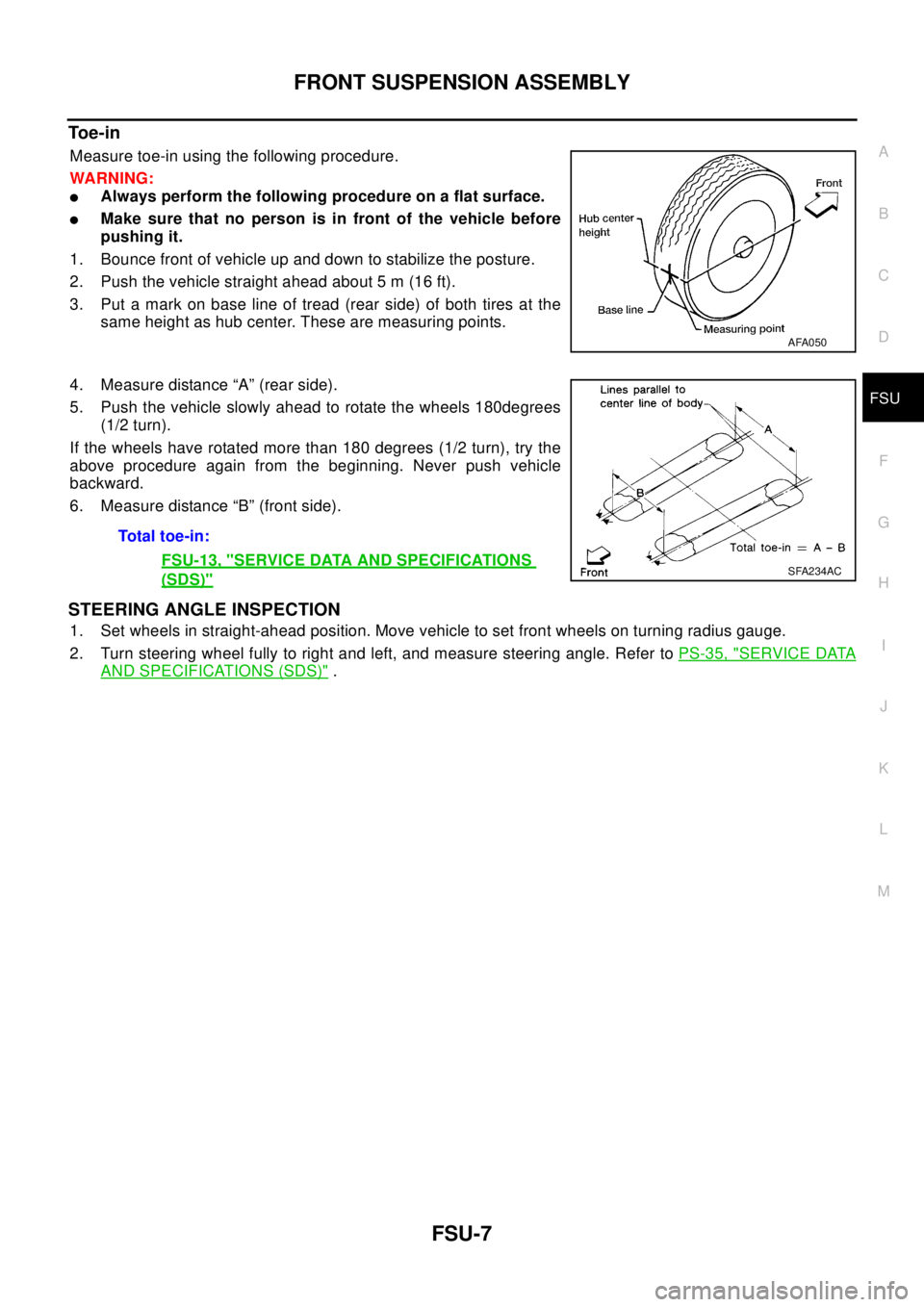
Measure toe-in using the following procedure.
WA RN ING:
lAlways perform the following procedure on a flat surface.
lMake sure that no person is in front of the vehicle before
pushing it.
1. Bounce front of vehicle up and down to stabilize the posture.
2. Push the vehicle straight ahead about 5 m (16 ft).
3. Put a mark on base line of tread (rear side) of both tires at the
same height as hub center. These are measuring points.
4. Measure distance “A” (rear side).
5. Push the vehicle slowly ahead to rotate the wheels 180degrees
(1/2 turn).
If the wheels have rotated more than 180 degrees (1/2 turn), try the
above procedure again from the beginning. Never push vehicle
backward.
6. Measure distance “B” (front side).
STEERING ANGLE INSPECTION
1. Set wheels in straight-ahead position. Move vehicle to set front wheels on turning radius gauge.
2. Turn steering wheel fully to right and left, and measure steering angle. Refer toPS-35, "
SERVICE DATA
AND SPECIFICATIONS (SDS)".
AFA050
Total toe-in:
FSU-13, "
SERVICE DATA AND SPECIFICATIONS
(SDS)"SFA234AC
Page 2247 of 3066
FSU-8
COIL SPRING AND SHOCK ABSORBER
COIL SPRING AND SHOCK ABSORBER
PFP:54302
Removal and InstallationEES00074
REMOVAL
1. Remove tires. Remove brake caliper and hung it aside.
CAUTION:
Avoid depressing brake pedal with brake caliper removed.
2. Remove electrical wires of ABS wheel speed sensor from strut.
3. Remove brake hose lock plate.
4. Remove mounting bolts and nuts securing steering knuckle to strut.
5. Remove mounting nuts on top of strut and remove upper mounting plate and strut from vehicle.
INSTALLATION
lRefer toFSU-5, "Components"in “Front Suspension Assembly” for tightening torque. Tighten in the
reverse order of removal.
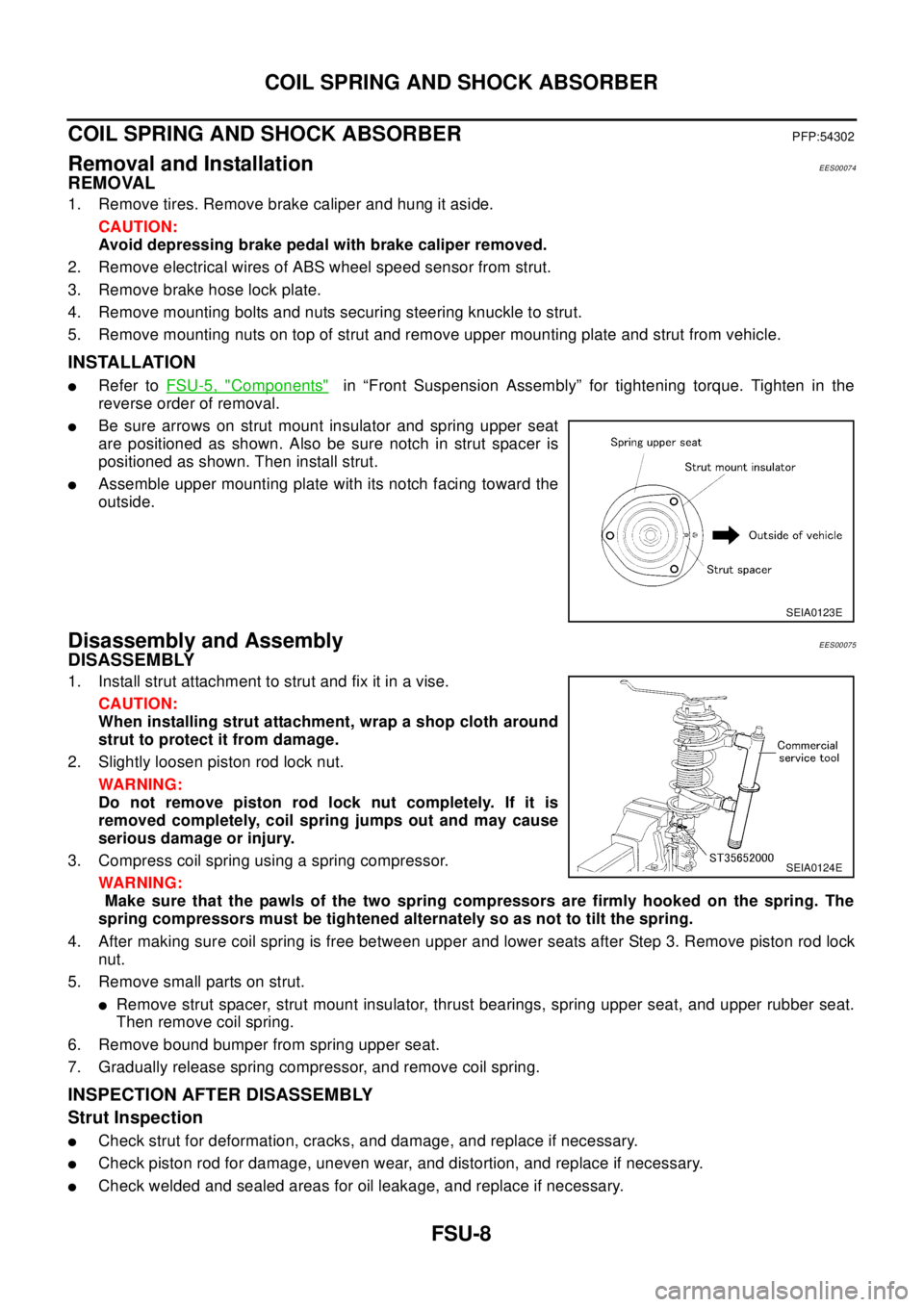
lBe sure arrows on strut mount insulator and spring upper seat
are positioned as shown. Also be sure notch in strut spacer is
positioned as shown. Then install strut.
lAssemble upper mounting plate with its notch facing toward the
outside.
Disassembly and AssemblyEES00075
DISASSEMBLY
1. Install strut attachment to strut and fix it in a vise.
CAUTION:
When installing strut attachment, wrap a shop cloth around
strut to protect it from damage.
2. Slightly loosen piston rod lock nut.
WAR NIN G:
Do not remove piston rod lock nut completely. If it is
removed completely, coil spring jumps out and may cause
serious damage or injury.
3. Compress coil spring using a spring compressor.
WAR NIN G:
Make sure that the pawls of the two spring compressors are firmly hooked on the spring. The
spring compressors must be tightened alternately so as not to tilt the spring.
4. After making sure coil spring is free between upper and lower seats after Step 3. Remove piston rod lock
nut.
5. Remove small parts on strut.
lRemove strut spacer, strut mount insulator, thrust bearings, spring upper seat, and upper rubber seat.
Then remove coil spring.
6. Remove bound bumper from spring upper seat.
7. Gradually release spring compressor, and remove coil spring.
INSPECTION AFTER DISASSEMBLY
Strut Inspection
lCheck strut for deformation, cracks, and damage, and replace if necessary.
lCheck piston rod for damage, uneven wear, and distortion, and replace if necessary.
lCheck welded and sealed areas for oil leakage, and replace if necessary.
SEIA0123E
SEIA0124E
Page 2249 of 3066
FSU-10
TRANSVERSE LINK
TRANSVERSE LINK
PFP:54500
Removal and InstallationEES00076
REMOVAL
1. Remove steering knuckle from transverse link. Refer toFAX-7, "REMOVAL".
2. Remove mounting nuts and washers on lower portion of stabilizer connecting rod.
3. Slightly loosen transverse link mounting bolts.
4. Remove compression rod bracket mounting bolts.
5. Remove transverse link mounting bolts and nuts, and remove transverse link from suspension member.
INSPECTION AFTER REMOVAL
Visual Inspection
Check transverse link and bushing for deformation, cracks, and other damage. Replace the entire transverse
link assembly if cracks, deformation or any other damage is found.
Ball Joint Inspection
CAUTION:
Before measurement, move the ball joint at least ten times by hand to check for smooth movement.
Oscillating Torque Inspection
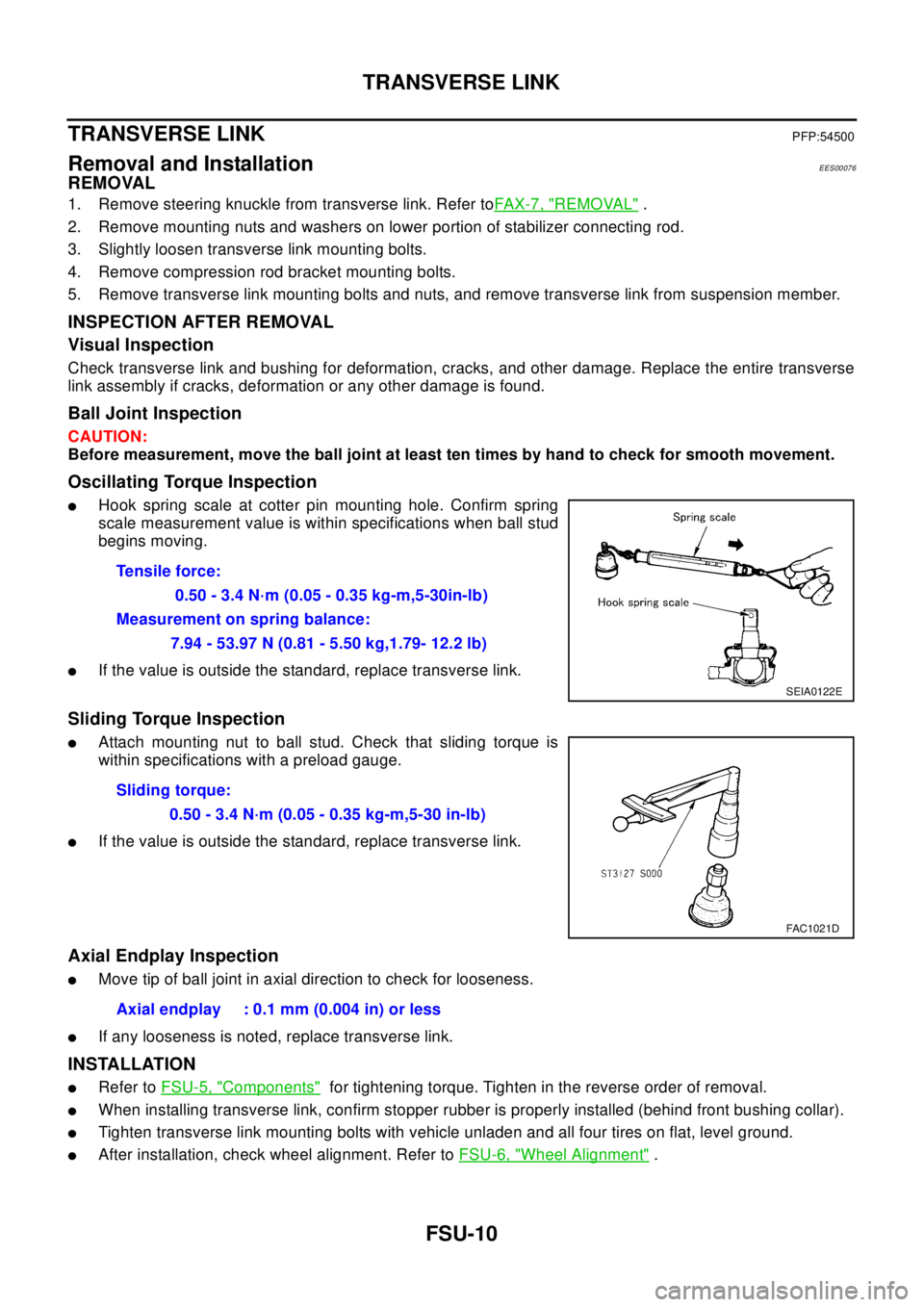
lHook spring scale at cotter pin mounting hole. Confirm spring
scale measurement value is within specifications when ball stud
begins moving.
lIf the value is outside the standard, replace transverse link.
Sliding Torque Inspection
lAttach mounting nut to ball stud. Check that sliding torque is
within specifications with a preload gauge.
lIf the value is outside the standard, replace transverse link.
Axial Endplay Inspection
lMove tip of ball joint in axial direction to check for looseness.
lIf any looseness is noted, replace transverse link.
INSTALLATION
lRefer toFSU-5, "Components"for tightening torque. Tighten in the reverse order of removal.
lWhen installing transverse link, confirm stopper rubber is properly installed (behind front bushing collar).
lTighten transverse link mounting bolts with vehicle unladen and all four tires on flat, level ground.
lAfter installation, check wheel alignment. Refer toFSU-6, "Wheel Alignment". Tensile force:
0.50 - 3.4 N·m (0.05 - 0.35 kg-m,5-30in-lb)
Measurement on spring balance:
7.94 - 53.97 N (0.81 - 5.50 kg,1.79- 12.2 lb)
SEIA0122E
Sliding torque:
0.50 - 3.4 N·m (0.05 - 0.35 kg-m,5-30 in-lb)
FAC1021D
Axial endplay : 0.1 mm (0.004 in) or less
Page 2251 of 3066

FSU-12
FRONT SUSPENSION MEMBER
FRONT SUSPENSION MEMBER
PFP:54401
Removal and InstallationEES00078
REMOVAL
1. Remove tires. Raise vehicle.
2. Remove mounting nuts on lower portion of stabilizer connecting rod from transverse link.
3. Remove transverse link from suspension member, and move the transverse link outward.
4. Remove front exhaust tube mounting rubber from suspension member.
5. Support engine or transmission with a transmission jack.
6. Remove center member from vehicle.
7. Remove steering gear mounting bolts. Remove steering gear and power steering tube bracket from sus-
pension member.
8. Hang steering gear.
9. Remove rear engine mount insulator from suspension member.
10. Remove body-side mounting bolts from member pin stay.
11. Set a transmission jack under suspension member, and remove suspension member mounting nuts.
12. Slowly lower transmission jack to remove suspension member from vehicle.
INSTALLATION
lRefer toFSU-5, "Components"for tightening torque in the reverse order of removal.
lAfter installation, perform final tightening of each part under unladen conditions with tires on ground.
Check wheel alignment. Refer toFSU-6, "
Wheel Alignment".
Page 2255 of 3066

GI-2
MANUAL TRANSAXLE NUMBER ....................... 46
Dimensions ............................................................. 46
Wheels & Tires ....................................................... 46TERMINOLOGY ........................................................47
SAE J1930 Terminology List ...................................47
Page 2294 of 3066
TOW TRUCK TOWING
GI-41
TOWING THE VEHICLE WITH REAR WHEELS RAISED (WITH FRONT WHEELS ON GROUND)
OR FRONT WHEELS RAISED
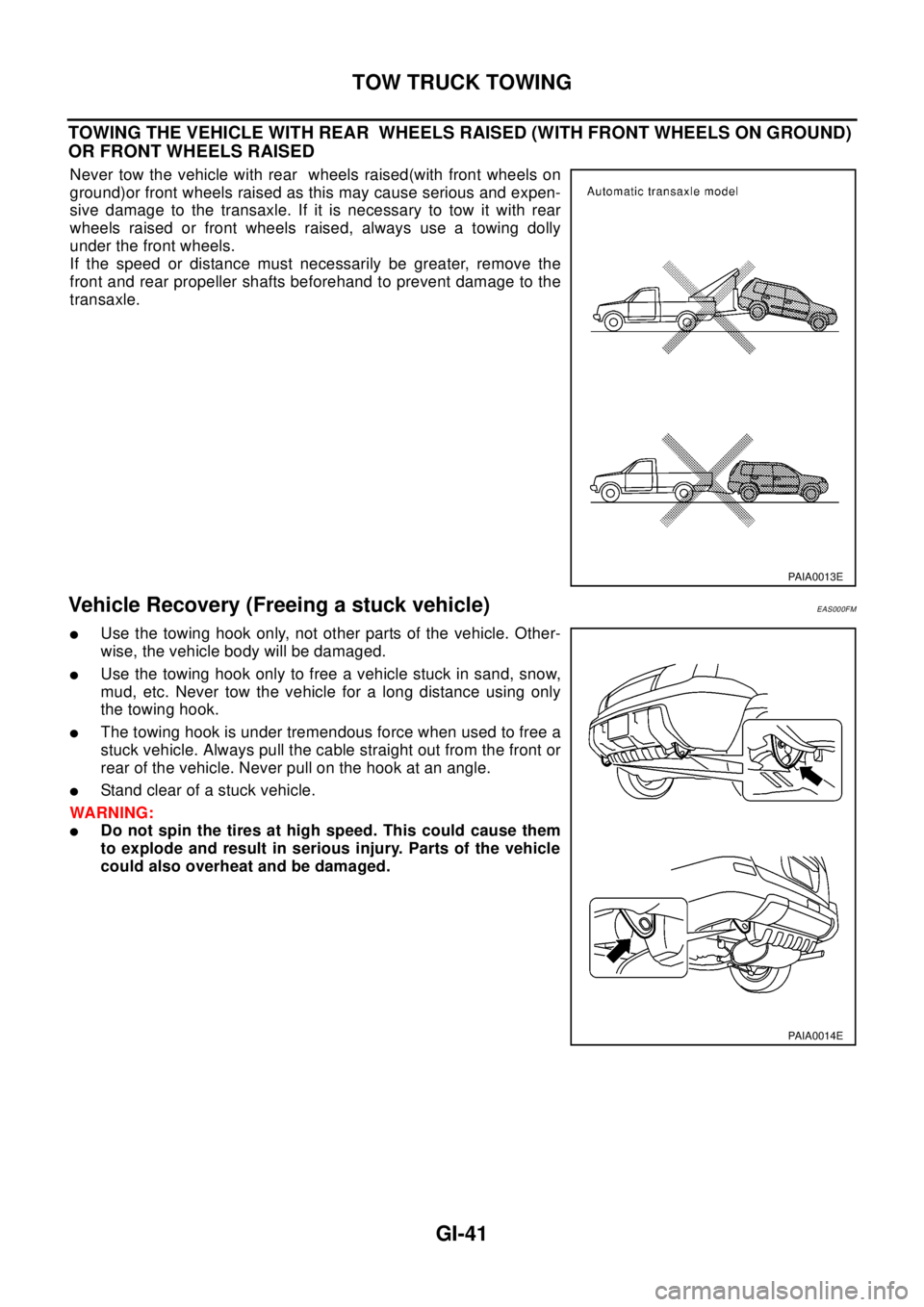
Never tow the vehicle with rear wheels raised(with front wheels on
ground)or front wheels raised as this may cause serious and expen-
sive damage to the transaxle. If it is necessary to tow it with rear
wheels raised or front wheels raised, always use a towing dolly
under the front wheels.
If the speed or distance must necessarily be greater, remove the
front and rear propeller shafts beforehand to prevent damage to the
transaxle.
Vehicle Recovery (Freeing a stuck vehicle)EAS000FM
lUse the towing hook only, not other parts of the vehicle. Other-
wise, the vehicle body will be damaged.
lUse the towing hook only to free a vehicle stuck in sand, snow,
mud, etc. Never tow the vehicle for a long distance using only
the towing hook.
lThe towing hook is under tremendous force when used to free a
stuck vehicle. Always pull the cable straight out from the front or
rear of the vehicle. Never pull on the hook at an angle.
lStand clear of a stuck vehicle.
WA RN ING:
lDo not spin the tires at high speed. This could cause them
to explode and result in serious injury. Parts of the vehicle
could also overheat and be damaged.
PAIA0013E
PAIA0014E