check oil OPEL GT-R 1973 Workshop Manual
[x] Cancel search | Manufacturer: OPEL, Model Year: 1973, Model line: GT-R, Model: OPEL GT-R 1973Pages: 625, PDF Size: 17.22 MB
Page 434 of 625
e. Operation of Controls in Second Range Second Gear
Reverse Clutch
Re easedThird Clutch Released
Seconds Clutch AppliedLow Band Applied
Sprag Over Running
The
selector lever is moved to the Intermediate position an the quadrant. the manual valve is positioned to allow drive oil and Intermediate oilto pan through the valve. Intermediate oil is directed
to the pressure regulator boost control cavity, seating the check ball at the reverse passage.Intermediate oil is then directed to the pressure regulator valve downward to
increaSe the oil prepare in the circuit. At the same time. the inter.
mediate oil from the manual valve is directed lo the 2 3 shift valve train closing off the supply of third clutch oil in the circuit, which isexhausted
through the Reverse and Low control
valve.
SummaryWith third clutch oil exhausted. the third clutch is off, the second clutch is an, the low band
servo is applied. The transmission is in second
Range Second Gear.
Page 436 of 625
f. Operation of Controls in Low Range First GeaReverse Clutch ReleasedThird Clutch Applied
Second Clutch Released
Low Band Applied
Sprag Locked
When the
selector lever is moved to the low position on the quadrant. the manualvalve is positioned to allow drive oil, intermediate oil and low oil to pass
through the valve. Low oil is directed to the
1 2 shift valve train which acts with the I 2 shift valve spring against governor oil pressure to close off drive
oil from passing into the second clutch passage. At the
same time, low oil is directed to the Reverse and Low control valve and acts against the spring to
allow detent regulated oil at the Reverse and Law control
valve to flow to the 2 3 shift valve, which is bottomed in its bore by intermediate oil pressxeand the valve spring. The detent oil
pazses through the 2 3 shift vahre and into the third clutch oil passages to apply the third clutch and to close off
modulator oil pressure from the 3-2 control valve to the 2 3 shift control valve. Third control oil isalSo directed to the Reverse and Law control
valve.which is held open against its spring by low oil pressure. and closes off the
source of rupply to the servo release pasege. to allow the servo to apply the low
band. Intermediate oil seats the check ball at the Reverse
passage at the presue regulator boost valve cavity and continues to the pressure regulator valve
to increase oil pressure in the circuit.
iThe third clutch in on, the band is on. The transmi&n is in Low Range First Gear
Page 438 of 625
9. Operation of Controls in Reverse
Reverse Clutch -Applied
Second Clutch Released
Sprag LockedThird Clutch. Applied
Low Band. Released
When the selector leer is moved to the Reverse position on the quadrant, the manual
valve ispositioned to allow Revert oil to pars through the manual
valve into the
Reverse oil passage. The reverse oil applies the reverse clutch. and a portion is directed to the priming valve which acts as a damper until the
line is filled. to effect a smooth and firm apply of the
reverss clutch. At the wne time, reverse oil is directed to the pressure regulator boost control valve
cavity to seat the check ball and prevent reverse oil pasring into the intermediate oil passage. It is then directed to the pressure regulator boast valve forcing
Reverse oil is also directed to act on the end of the
Reverse and Law control valve against the spring to allow detent regulated oil to pass through the valveto the 2 3 shift
valve. The detent regulated oil passes through the 2 3 shift valve and into the third clutch oil passages to apply the third clutch. The third
clutch oil
al= acts on the end of the 3 2 control valve against the spring and modulator oil pressure, clodng off the supply of modulator oil to the 2 3
shift control valve. Third clutch oil at the rwerse and low control valve is closed off from
parring through the valve. and into the servo releal~ parrage.Summary
The
reverse clutch is cm and the third clutch is on. The transmission is in Reverse Range.
Page 442 of 625
DIAGNOSIS
SEQUENCE
1. Check and correct oil level. Refer to Specifications
for checking and refill procedures.
2. Check and correct vacuum line and fittings.
3. Check and correct manual linkage.
4. Road test car using all selective ranges, noting
when discrepancies in operation occur.
5. If engine performances indicates an engine tuneup
is required, this should be performed before road
testing is completed or transmission correction at-
tempted. Poor engine performance can result in
rough shifting or other malfunctions.
CHECKING PROCEDURESBefore diagnosis of any transmission complaint is
attempted, there must be an understanding of oil
checking procedure and what appearance the oil
should have. Many times a transmission malfunction
can be traced to low oil level, improper reading of
dipstick, or oil appearances; therefore, a careful anal-
ysis of the condition of oil and the level may elimi-
nate needless repairs.
When checking oil level in the Opel Three Speed
Automatic Transmission, the procedure outlined in
Specifications should be followed to obtain the most
accurate reading.
Also when the dipstick is removed, it should be noted
whether the oil is devoid of air bubbles or not. Oil
with air bubbles gives an indication of an air leak in
the suction lines, which can cause erractic operation
and slippage. Water in the oil imparts a milky, pink
cast to the oil and can cause spewing.
EXTERNAL OIL LEAKS
Determining source of oil leakBefore attempting to correct an oil leak, the actual
source of the leak must be determined. In many
cases, the source of the leak can be deceiving due to
“wind flow” around the engine and transmission.
The suspected area should be wiped clear of all oil
before inspecting for the source of the leak. Red dyeAUTOMATIC TRANSMISSION 7C- 81
is used in the transmission oil at the assembly plant
and will indicate if the oil leak is from the transmis-
sion.The use of a “Black Light” to locate the point at
which the oil is leaking is helpful. Comparing the oil
from the leak to that on the engine or transmission
dipstick, when viewed by Black Light, will determine
the source of the leak-engine or transmission.
Oil leaks around the engine and transmission are
generally carried toward the rear of the car by air
stream. For example, a transmission oil filler tube to
case leak will sometimes appear as a leak at the rear
of the transmission. In determining the source of a
leak, proceed as follows:
1. Degrease underside of transmission.
2. Road test to get unit at operating temperature.
3. Inspect for leak with engine running.
4. With engine off, check for oil leaks due to the
raised oil level caused by drain back.
Case Porosity RepairOpel Three-Speed Automatic Transmission external
oil leaks caused by case porosity can be successfully
repaired with the transmission in the car by using the
following recommended procedures:
1. Road test and bring the transmission to operating
temperature, approximately 180 degrees F.
2. Raise car on a hoist or jack stand, engine running,
and locate source of oil leak. Check for oil leaks in
low, drive, and reverse.
3. Shut engine off and thoroughly clean area to be
repaired with a suitable cleaning solvent and a
brush- air dry. A clean, dry soldering acid brush can
be used to clean the area and also to apply the epoxy
cement.
4. Using instructions of the manufacturer, mix a suf-
ficient amount of epoxy, BUICK Group 0.423, Part
No. 1360016, or equivalent, to make the repair. Ob-
serve cautions of manufacturer in handling.
5. While the transmission case is still HOT, apply the
epoxy to the area to be repaired. Make certain the
area to be repaired is fully covered.
6. Allow cement to cure for 3 hours before starting
engine.
7. Road test and check for leaks.
Page 447 of 625
7C- 881973 OPEL SERVICE MANUAL
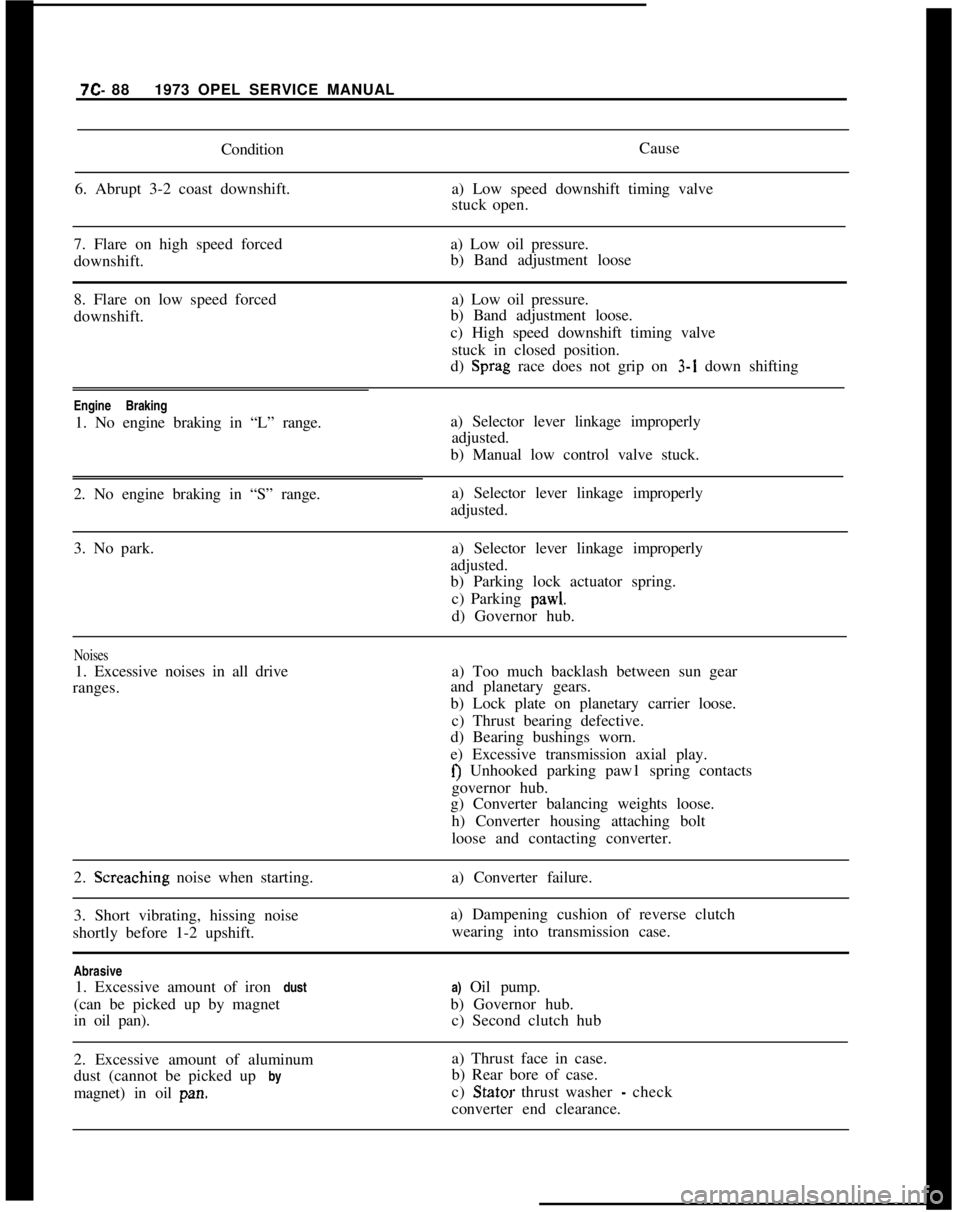
Condition
6. Abrupt 3-2 coast downshift.Cause
a) Low speed downshift timing valve
stuck open.
7. Flare on high speed forceda) Low oil pressure.
downshift.b) Band adjustment loose
8. Flare on low speed forced
downshift.a) Low oil pressure.
b) Band adjustment loose.
c) High speed downshift timing valve
stuck in closed position.
d) Sprag race does not grip on 3-1 down shifting
Engine Braking
1. No engine braking in “L” range.a) Selector lever linkage improperly
adjusted.
b) Manual low control valve stuck.
2. No engine braking in “S” range.a) Selector lever linkage improperly
adjusted.
3. No park.a) Selector lever linkage improperly
adjusted.
b) Parking lock actuator spring.
c) Parking pawl.
d) Governor hub.
Noises1. Excessive noises in all drive
ranges.a) Too much backlash between sun gear
and planetary gears.
b) Lock plate on planetary carrier loose.
c) Thrust bearing defective.
d) Bearing bushings worn.
e) Excessive transmission axial play.
f) Unhooked parking paw1 spring contacts
governor hub.
g) Converter balancing weights loose.
h) Converter housing attaching bolt
loose and contacting converter.
2. Screaching noise when starting.
3. Short vibrating, hissing noise
shortly before 1-2 upshift.a) Converter failure.
a) Dampening cushion of reverse clutch
wearing into transmission case.
Abrasive
1. Excessive amount of iron dust
(can be picked up by magnet
in oil pan).a) Oil pump.
b) Governor hub.
c) Second clutch hub
2. Excessive amount of aluminum
dust (cannot be picked up by
magnet) in oil pan.a) Thrust face in case.
b) Rear bore of case.
c) Stator thrust washer
- check
converter end clearance.
Page 456 of 625
AUTOMATIC TRANSMISSION 7C- 95
12. Place suitable jack under transmission and
remove transmission support bolts.
13. Lower transmission enough to remove detent
cable and modulator vacuum line.
14. Remove speedometer cable.
15. Remove selector lever.
16. Mark flywheel and converter for reassembly in
same position, and remove converter to flywheel
bolts. See Figure 7C-106.17. Remove converter housing to engine bolts and
tiller tube.
18. Pry transmission loose from engine.
19. Keep rear of transmission lower than front to
prevent converter from falling and install converter
holding fixture J-21366. Lower transmission and
move to bench.
Installation. Opel 1900 and Manta1. Assemble transmission to suitable jack and raise
transmission into position. Rotate converter to per-
mit coupling of fly wheel and converter with original
relationship. Remove J-21366.
2. Install tiller tube and converter housing to engine
block bolts. Torque to 35 lb. ft. DO NOT over
torque.
3. Install flywheel to converter bolts. Torque to 30 lb.
ft.4. Install detent cable to transmission.
5. Connect oil cooler lines.
6. Install lower bolt on starter. Torque to 40 lb. ft.
7. Connect shift linkage to transmission.
8. Connect modulator line.
9. Connect speedometer cable.
10. Install transmission support.
11. Install drive shaft. Torque U-Bolts to 18 lb. ft.
12. Install flywheel cover pan. Torque to 15 lb. ft.
13. Install engine support brackets.
14. Reconnect exhaust system.15. Attach stabilizer supports and tighten stabilizer
bolts in lower control arms.
16. Lower car.
17. Install starter bolts. Torque to 40 lb. ft.
18. Reconnect battery.
19. Fill transmission with fluid as described in
Specifications. Check selector lever and detent cable
adjustment.
Removal GT1. Disconnect battery.
2. Remove dipstick.
3. Pull throttle control rod off ball pin.
4. Remove screws from fan shroud.
5. Raise car and provide support for front and rear.
6. Remove heat protection shield from right side to
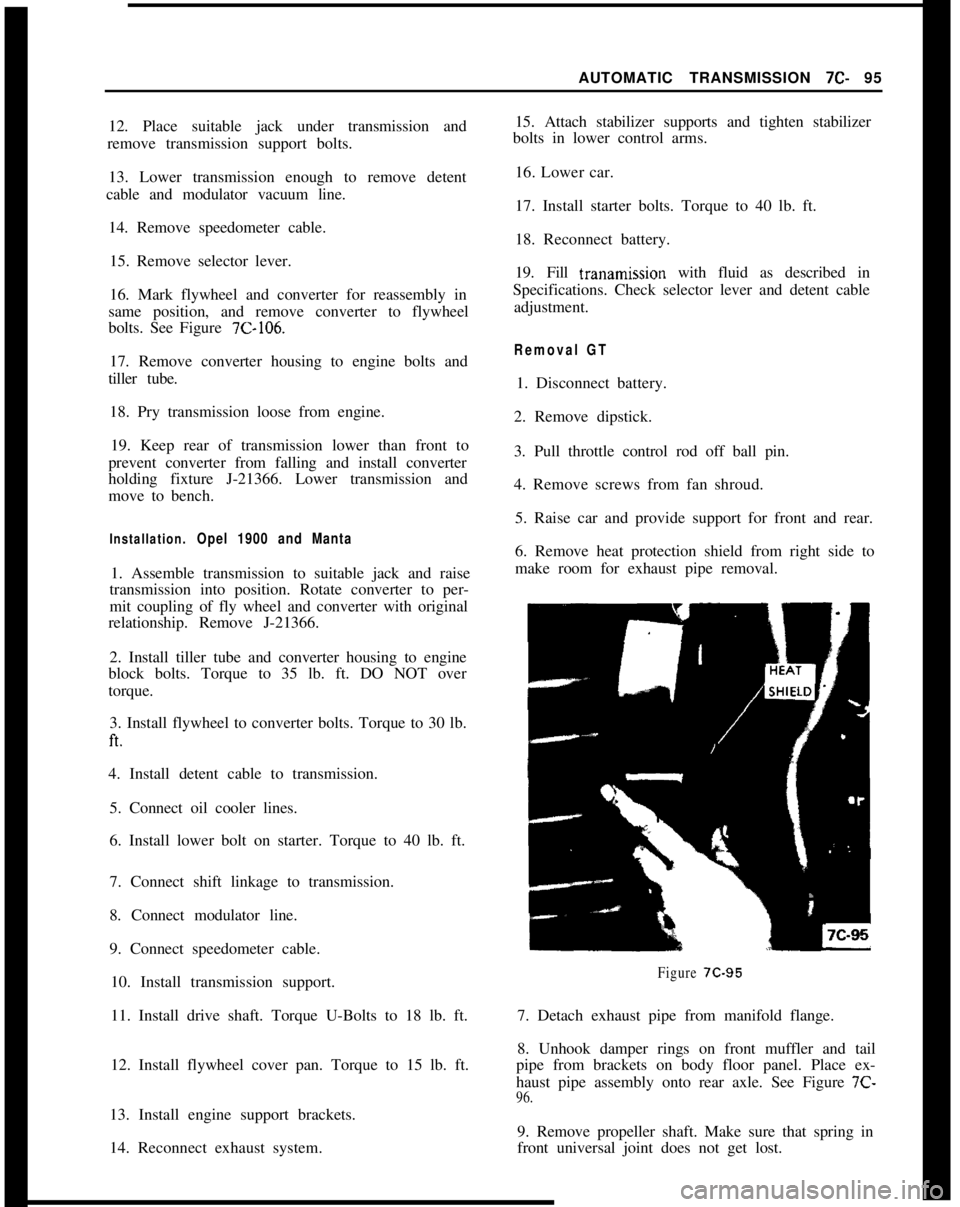
make room for exhaust pipe removal.
Figure 7C-957. Detach exhaust pipe from manifold flange.
8. Unhook damper rings on front muffler and tail
pipe from brackets on body floor panel. Place ex-
haust pipe assembly onto rear axle. See Figure 7C-
96.9. Remove propeller shaft. Make sure that spring in
front universal joint does not get lost.
Page 459 of 625
7C- 981973 OPEL SERVICE MANUAL
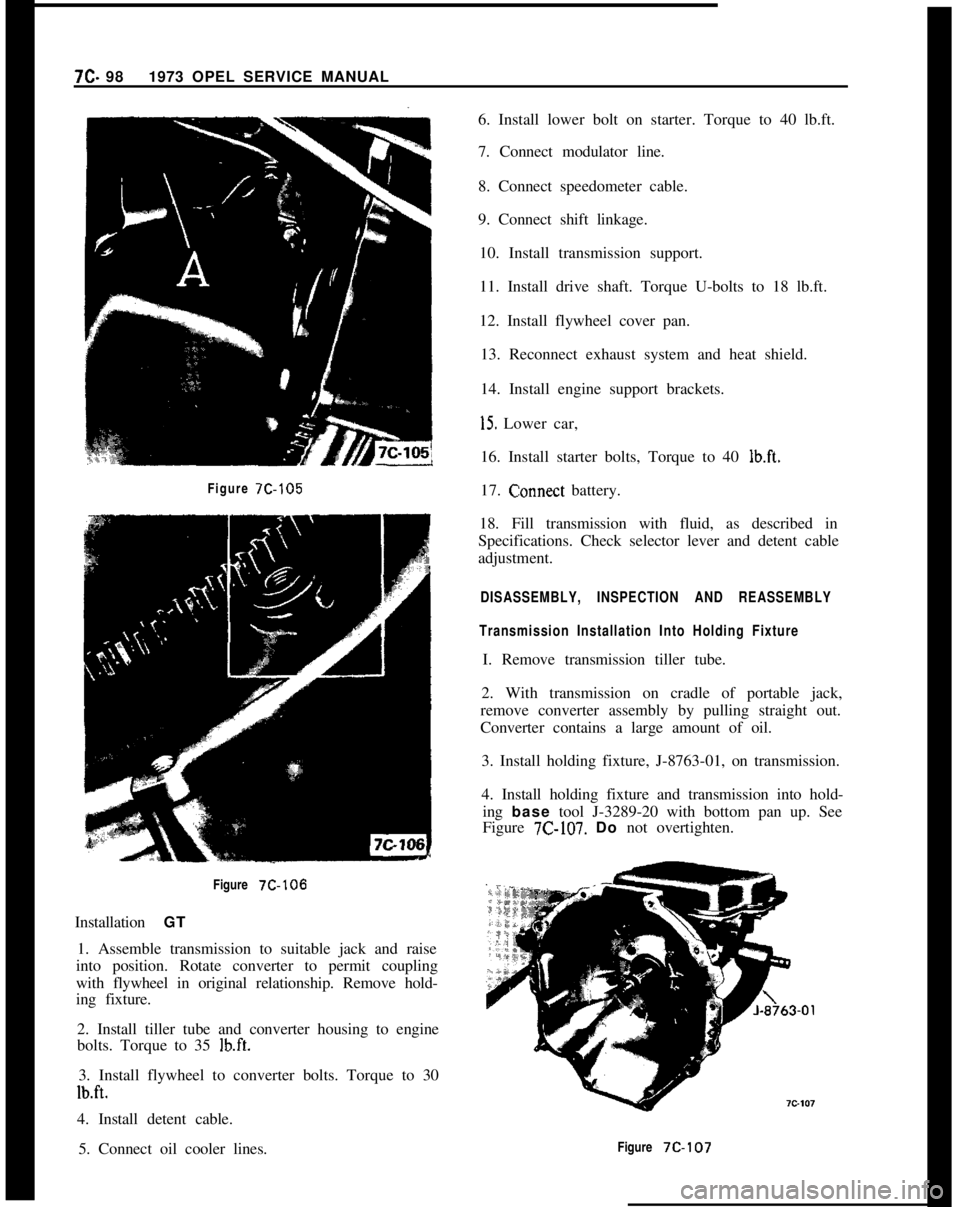
Figure 7C-105Figure
7C-106Installation GT
1. Assemble transmission to suitable jack and raise
into position. Rotate converter to permit coupling
with flywheel in original relationship. Remove hold-
ing fixture.
2. Install tiller tube and converter housing to engine
bolts. Torque to 35
lb.ft.3. Install flywheel to converter bolts. Torque to 30
lb.ft.4. Install detent cable.
5. Connect oil cooler lines.6. Install lower bolt on starter. Torque to 40 lb.ft.
7. Connect modulator line.
8. Connect speedometer cable.
9. Connect shift linkage.
10. Install transmission support.
11. Install drive shaft. Torque U-bolts to 18 lb.ft.
12. Install flywheel cover pan.
13. Reconnect exhaust system and heat shield.
14. Install engine support brackets.
15. Lower car,
16. Install starter bolts, Torque to 40
lb.ft.17.
C:onnect battery.
18. Fill transmission with fluid, as described in
Specifications. Check selector lever and detent cable
adjustment.
DISASSEMBLY, INSPECTION AND REASSEMBLY
Transmission Installation Into Holding FixtureI. Remove transmission tiller tube.
2. With transmission on cradle of portable jack,
remove converter assembly by pulling straight out.
Converter contains a large amount of oil.
3. Install holding fixture, J-8763-01, on transmission.
4. Install holding fixture and transmission into hold-
ing base tool J-3289-20 with bottom pan up. See
Figure
7C-107. Do not overtighten.
Figure
7C-107
Page 461 of 625

7C-1001973 OPEL SERVICE MANUALFigure 7C-1 12
Figure
7C-1 136. Remove the two check balls located in the oil
passages in the transmission case. See Figure
7C-114.Location of these check balls must be noted so that
they are installed correctly.
Removal of Servo PistonThis operation can be performed with transmission
in vehicle
1. Compress servo piston using servo piston com-
pressor tool J-23075.
Figure7C-1 14
2.Using pliers,
remove servo pistonsnap ring.SeeFigure
X-1 15.
Figure
7C-1 153. Loosen servo piston compressor tool J-23075
slowly as servo is under high spring tension. Remove
tool and servo piston assembly. See Figure
7C-116.
Removal of Selector Lever and ShaftNote at this point that the selector lever (on GT
models only) is on the opposite side from all other
models, and that the selector shaft passes through
the case. See Figures 7C-117 and 7C-118. Note also
Page 468 of 625

J-8092
CONVERTERFigure 7C-142
10. Install new converter housing oil seal using tool
J-21359. See Figure
7C-143.12. Mark relative location of oil pump gears and
remove oil pump gears. See Figure
7C-144.AUTOMATIC TRANSMISSION
712.107Figure 7C-144
13. Using compressor tool J-2590-12 with adapter
J-21420-1 on reverse clutch retaining seat, compress
clutch return springs. See Figure
7C-146.14. Remove snap ring using snap ring pliers such as
J- 8059. See Figure
7C-146.Figure 7C-143
Figure 7C-146
11. Check converter pump hub for nicks, burrs or
damage which could have caused oil seal to leak or
have worn bushing. Remove nicks and burrs.15. Loosen compressor tool J-2590-12 and remove
reverse clutch retaining ring and 24 reverse clutch
springs.
Page 469 of 625

712.1081973 OPEL SERVICE MANUALCHSJ
351. RETAINING PIN
72. PRESSURE REGULATOR BOOST VALVE SLEEVE
3. PRESSURE REGVLATOR BOOST VALVE
4. PRESSURE REGULATOR VALVE SPRING SEAT
5. PRESSURE REGULATOR VALVE SPRING
6. PRESSURE REGULATOR VALVE
7. OIL PUMP BODY
8. OIL PUMP PRIMING VALVE, SPRING 8 SPRING SEAT
16. Remove reverse clutch piston.
17. Remove priming valve from oil pump body by
lightly tapping with a drift through the hole at the
rear of oil pump. (Only if diagnosis requires removal
or if excessive dirt has passed through transmission.)
18. Pressure regulator and boost valve may be
removed by using a pari of wire cutters to remove the
retaining pin. Due to the difficulty of removing the
retaining pin, it is not recommended that the pres-
sure regulator valve and boost valve be disassembled
during overhaul, unless it was determined by oil
pressure checks to have been malfunctioning prior to
tear down.
19. Remove pressure regulator boost valve sleeve,
spring, pressure regulator valve and two washers. See
Figure
7C-147.20. Inspect and if necessary replace the oil pump hub
bushing by threading a 3/4” standard pipe tap such
as tool J-23130-5 into bushing. See Figure
7C-148.Figure 7C-148