brake Peugeot 3008 Hybrid 4 2012 - RHD (UK. Australia) Owner's Guide
[x] Cancel search | Manufacturer: PEUGEOT, Model Year: 2012, Model line: 3008 Hybrid 4, Model: Peugeot 3008 Hybrid 4 2012Pages: 284, PDF Size: 14.08 MB
Page 169 of 284
CHECKS
167
CHECKING LEVELS
Oil level
The check is carried out either
when the ignition is switched on
using the oil level indicator on
the instrument panel, or using
the dipstick.
This manual check will only be correct if the
vehicle is on level ground and the engine
has been off for more than 30 minutes.
It is normal to top up the oil level be-
tween two services (or oil changes).
PEUGEOT recommends that you check
the level, and top up if necessary, every
3 000 miles (5 000 kms).
After topping up the oil, the check when
switching on the ignition with the oil
level indicator in the instrument panel
is not valid during the 30 minutes after
topping up.
Take care when working under
the bonnet, as certain areas of
the engine may be extremely
hot (risk of burns).
Before doing anything under the
bonnet, switch off the ignition
( Ready
lamp off) to avoid any
risk of injury resulting from automatic
operation of the engine.
If a level drops signifi cantly, have the corre-
sponding system checked by a PEUGEOT
dealer or a qualifi ed workshop.
Check all of these levels regularly and top
them up if necessary, unless otherwise
indicated.
Engine oil change
Refer to the servicing booklet for details
of the interval for this operation.
In order to maintain the reliability of the
engine and emission control system,
the use of additives in the engine oil is
prohibited.
Oil specifi cation
The oil must be the correct grade for
your engine and conform to the manu-
facturer's recommendations.
Brake fluid level
The brake fl uid level should be
close to the "MAX" mark. If it is
not, check the brake pad wear.
Changing the fl uid
Refer to the servicing booklet for details
of the interval for this operation.
Fluid specifi cation
The brake fl uid must conform to the
manufacturer's recommendations and
meet the DOT4 standard.
Power steering fluid level
The power steering fl uid level
should be close to the "MAX"
mark. With the engine cold, un-
screw the cap to check the level.
Coolant level
The coolant level should be
close to the "MAX" mark but
should never exceed it.
When the engine is warm, the
temperature of the coolant is regulated
by the fan. This can operate with the ig-
nition off.
In addition, as the cooling system is
pressurised, wait at least one hour after
switching off the engine before carrying
out any work.
To avoid any risk of scalding, unscrew
the cap by two turns to allow the pres-
sure to drop. When the pressure has
dropped, remove the cap and top up
the level.
Changing the coolant
The coolant does not have to be changed.
Fluid specifi cation
The coolant must conform to the manu-
facturer's recommendations.
For vehicles fi tted with a particle
emissions fi lter, the cooling fan may
continue to run after stopping the ve-
hicle, even if the engine is cold.
Screenwash and headlamp
wash fluid
In the case of vehicles fi tted
with headlamp washers, the
low fl uid level is indicated by an
audible signal and a message
in the instrument panel screen.
Top up the reservoir when you next stop
the vehicle.
Page 171 of 284
CHECKS
169
Particle emission filter (Diesel)
As soon as the traffi c condi-
tions permit, regenerate the
fi lter by driving at a speed of
at least 40 mph (60 km/h) until the
warning lamp goes off.
If the warning lamp stays on, this in-
dicates a low additive level.
Brake disc wear
Brake pads
Brake wear depends on the
style of driving, particularly in
the case of vehicles used in
town, over short distances. It
may be necessary to have the
condition of the brakes checked, even
between vehicle services.
Unless there is a leak in the circuit, a
drop in the brake fl uid level indicates
that the brake pads are worn.
For information on check-
ing brake disc wear, contact a
PEUGEOT dealer or a qualifi ed
workshop.
6-speed electronic gearbox
The gearbox does not re-
quire any maintenance (no oil
change).
Refer to the servicing booklet
for details of the checking in-
terval for this component.
Electric parking brake
This system does not require any routine ser-
vicing. However, in the event of a problem,
have the system checked by a PEUGEOT
dealer or a qualifi ed workshop.
For more information, refer to
the "Electric parking brake -
Operating faults" section.
The 100% electric mode is not available
during regeneration of the particle emis-
sions fi lter. The start of saturation of the
particle fi lter is indicated by
the temporary illumination
of this warning lamp accom-
panied by a message in the
multi-function screen.
On a new vehicle, the fi rst particle
fi lter regeneration operations may be
accompanied by a "burning" smell,
which is perfectly normal.
Following prolonged operation of the
vehicle at very low speed or at idle, you
may, in exceptional circumstances,
notice the emission of water vapour at
the exhaust on acceleration. This does
not affect the behaviour of the vehicle
or the environment.
Only use products recom-
mended by PEUGEOT or
products of equivalent quality
and specifi cation.
In order to optimise the operation of
units as important as the braking sys-
tem, PEUGEOT selects and offers
very specifi c products.
To avoid damaging the electrical
units, the use of a high pressure
washer in the engine compartment is
strictly prohibited
.
Page 172 of 284
PRACTICAL INFORMATION
170
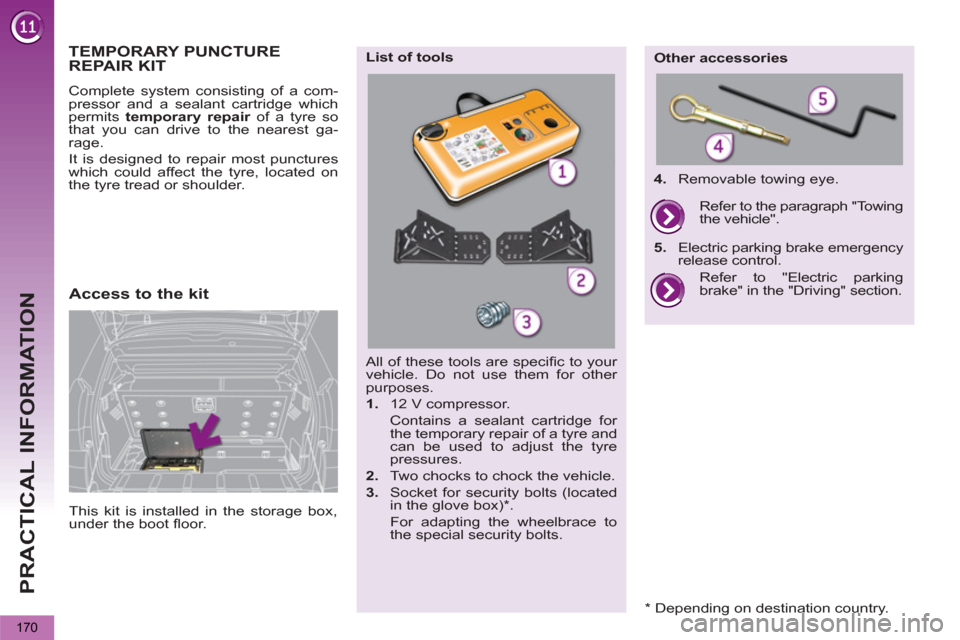
All of these tools are specifi c to your
vehicle. Do not use them for other
purposes.
1.
12 V compressor.
Contains a sealant cartridge for
the temporary repair of a tyre and
can be used to adjust the tyre
pressures.
2.
Two chocks to chock the vehicle.
3.
Socket for security bolts (located
in the glove box) * .
For adapting the wheelbrace to
the special security bolts.
List of tools
Other accessories
4.
Removable towing eye.
Refer to "Electric parking
brake" in the "Driving" section.
Refer to the paragraph "Towing
the vehicle".
5.
Electric parking brake emergency
release control.
TEMPORARY PUNCTUREREPAIR KIT
Complete system consisting of a com-
pressor and a sealant cartridge which
permits temporary repair
of a tyre so
that you can drive to the nearest ga-
rage.
It is designed to repair most punctures
which could affect the tyre, located on
the tyre tread or shoulder.
Access to the kit
This kit is installed in the storage box,
under the boot fl oor.
*
Depending on destination country.
Page 178 of 284
PRACTICAL INFORMATION
176
The tools are stowed in the boot.
Access to the tools
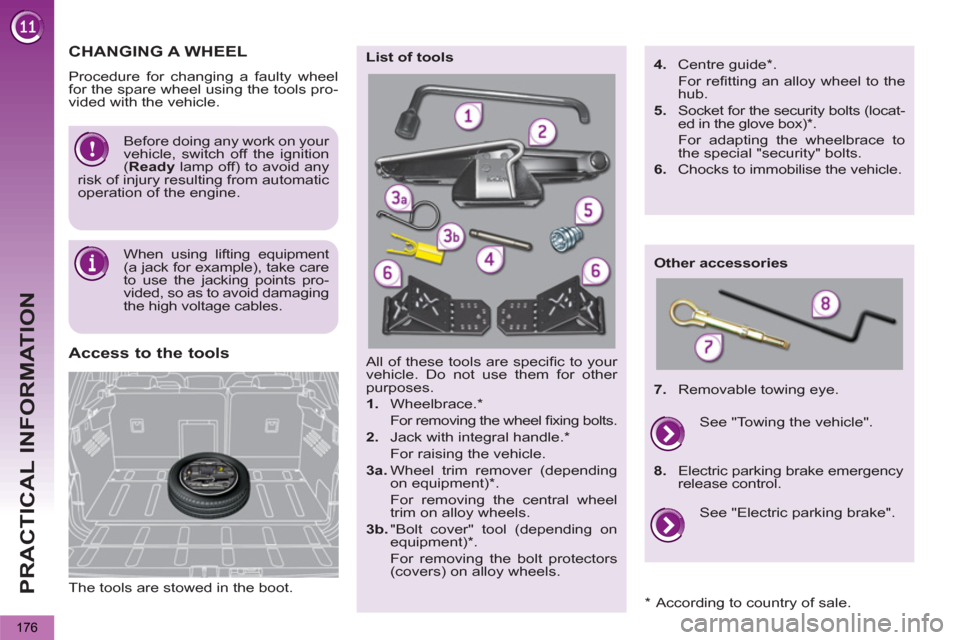
All of these tools are specifi c to your
vehicle. Do not use them for other
purposes.
1.
Wheelbrace. *
For removing the wheel fi xing bolts.
2.
Jack with integral handle. *
For raising the vehicle.
3a.
Wheel trim remover (depending
on equipment) * .
For removing the central wheel
trim on alloy wheels.
3b.
"Bolt cover" tool (depending on
equipment) * .
For removing the bolt protectors
(covers) on alloy wheels.
List of tools
Other accessories
4.
Centre guide * .
For refi tting an alloy wheel to the
hub.
5.
Socket for the security bolts (locat-
ed in the glove box) * .
For adapting the wheelbrace to
the special "security" bolts.
6.
Chocks to immobilise the vehicle.
7.
Removable towing eye.
See "Electric parking brake".
See "Towing the vehicle".
8.
Electric parking brake emergency
release control.
Before doing any work on your
vehicle, switch off the ignition
( Ready
lamp off) to avoid any
risk of injury resulting from automatic
operation of the engine.
When using lifting equipment
(a jack for example), take care
to use the jacking points pro-
vided, so as to avoid damaging
the high voltage cables.
CHANGING A WHEEL
Procedure for changing a faulty wheel
for the spare wheel using the tools pro-
vided with the vehicle.
*
According to country of sale.
Page 179 of 284
PRACTICAL INFORMATION
177
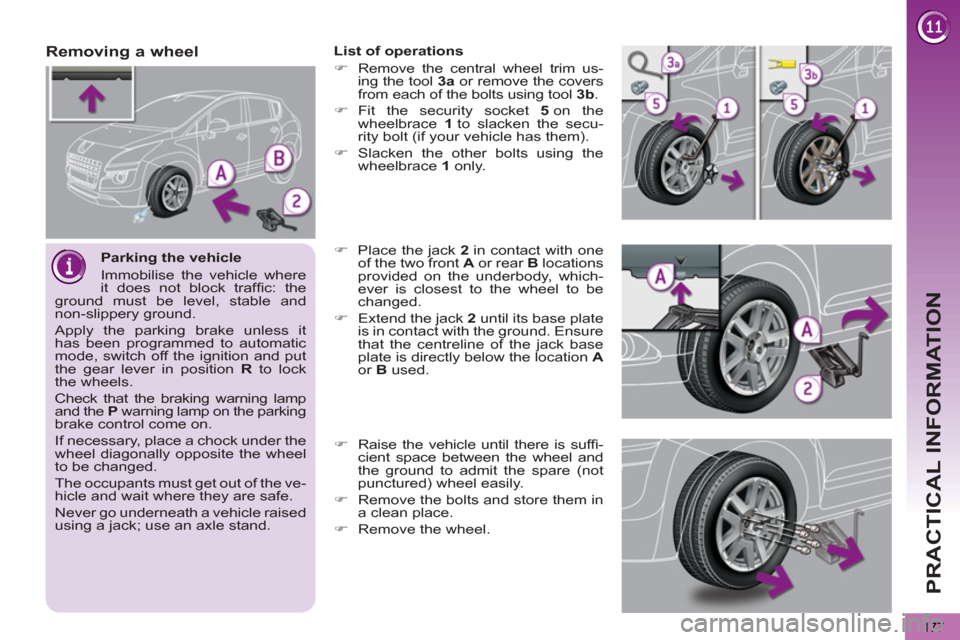
Parking the vehicle
Immobilise the vehicle where
it does not block traffi c: the
ground must be level, stable and
non-slippery ground.
Apply the parking brake unless it
has been programmed to automatic
mode, switch off the ignition and put
the gear lever in position R
to lock
the wheels.
Check that the braking warning lamp
and the P
warning lamp on the parking
brake control come on.
If necessary, place a chock under the
wheel diagonally opposite the wheel
to be changed.
The occupants must get out of the ve-
hicle and wait where they are safe.
Never go underneath a vehicle raised
using a jack; use an axle stand.
Removing a wheel
List of operations
)
Remove the central wheel trim us-
ing the tool 3a
or remove the covers
from each of the bolts using tool 3b
.
)
Fit the security socket 5
on the
wheelbrace 1
to slacken the secu-
rity bolt (if your vehicle has them).
)
Slacken the other bolts using the
wheelbrace 1
only.
)
Place the jack 2
in contact with one
of the two front A
or rear B
locations
provided on the underbody, which-
ever is closest to the wheel to be
changed.
)
Extend the jack 2
until its base plate
is in contact with the ground. Ensure
that the centreline of the jack base
plate is directly below the location A
or B
used.
)
Raise the vehicle until there is suffi -
cient space between the wheel and
the ground to admit the spare (not
punctured) wheel easily.
)
Remove the bolts and store them in
a clean place.
)
Remove the wheel.
Page 183 of 284
PRACTICAL INFORMATION
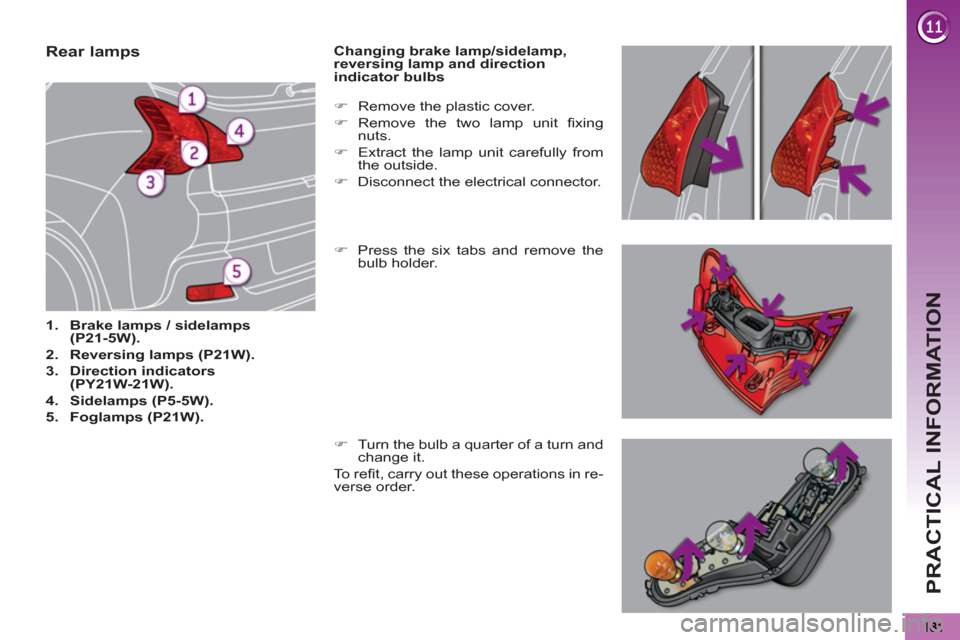
Rear lamps
1.
Brake lamps / sidelamps
(P21-5W).
2.
Reversing lamps (P21W).
3.
Direction indicators
(PY21W-21W).
4.
Sidelamps (P5-5W).
5.
Foglamps (P21W).
Changing brake lamp/sidelamp,
reversing lamp and direction
indicator bulbs
)
Press the six tabs and remove the
bulb holder.
)
Remove the plastic cover.
)
Remove the two lamp unit fi xing
nuts.
)
Extract the lamp unit carefully from
the outside.
)
Disconnect the electrical connector.
)
Turn the bulb a quarter of a turn and
change it.
To r efi t, carry out these operations in re-
verse order.
Page 184 of 284
PRACTICAL INFORMATION
182
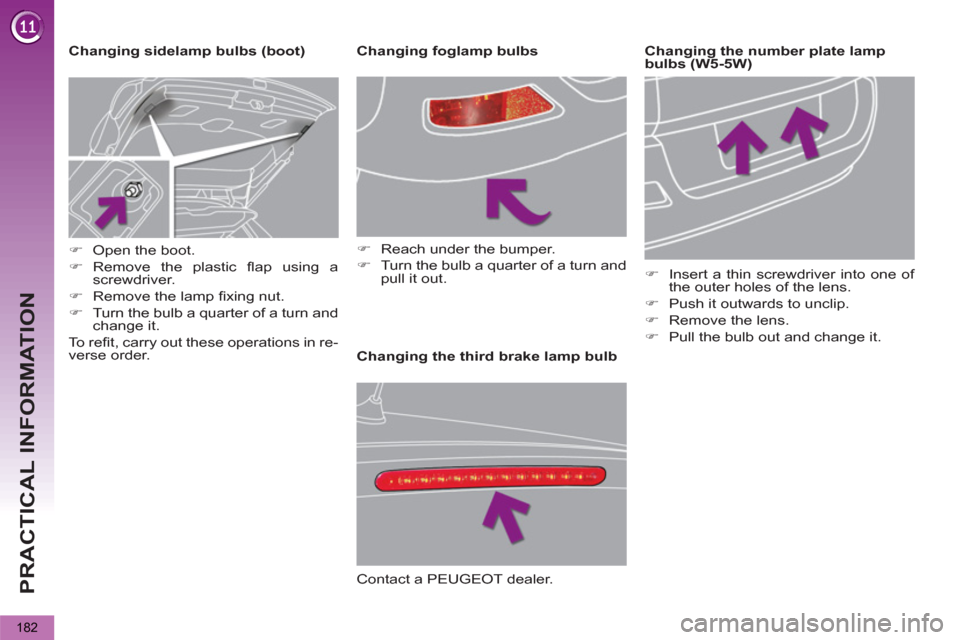
Changing the third brake lamp bulb
Changing sidelamp bulbs (boot)
Changing foglamp bulbs
)
Open the boot.
)
Remove the plastic fl ap using a
screwdriver.
)
Remove the lamp fi xing nut.
)
Turn the bulb a quarter of a turn and
change it.
To r efi t, carry out these operations in re-
verse order.
)
Reach under the bumper.
)
Turn the bulb a quarter of a turn and
pull it out.
Contact a PEUGEOT dealer.
Changing the number plate lamp
bulbs (W5-5W)
)
Insert a thin screwdriver into one of
the outer holes of the lens.
)
Push it outwards to unclip.
)
Remove the lens.
)
Pull the bulb out and change it.
Page 189 of 284
PRACTICAL INFORMATION
187
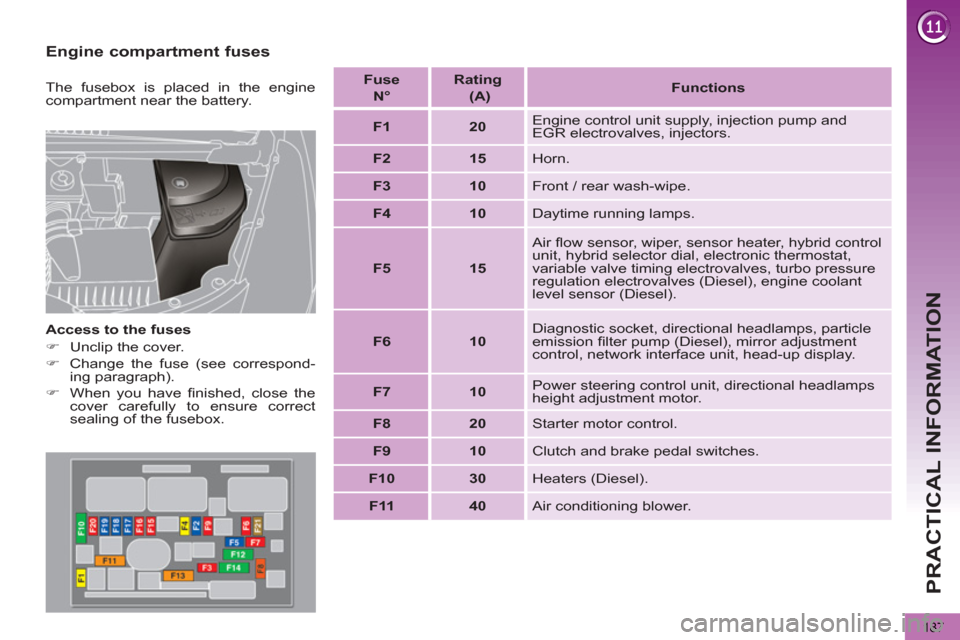
Engine compartment fuses
Access to the fuses
)
Unclip the cover.
)
Change the fuse (see correspond-
ing paragraph).
)
When you have fi nished, close the
cover carefully to ensure correct
sealing of the fusebox.
The fusebox is placed in the engine
compartment near the battery.
Fuse
N°
Rating
(A)
Functions
F1
20
Engine control unit supply, injection pump and
EGR electrovalves, injectors.
F2
15
Horn.
F3
10
Front / rear wash-wipe.
F4
10
Daytime running lamps.
F5
15
Air fl ow sensor, wiper, sensor heater, hybrid control
unit, hybrid selector dial, electronic thermostat,
variable valve timing electrovalves, turbo pressure
regulation electrovalves (Diesel), engine coolant
level sensor (Diesel).
F6
10
Diagnostic socket, directional headlamps, particle
emission fi lter pump (Diesel), mirror adjustment
control, network interface unit, head-up display.
F7
10
Power steering control unit, directional headlamps
height adjustment motor.
F8
20
Starter motor control.
F9
10
Clutch and brake pedal switches.
F10
30
Heaters (Diesel).
F11
40
Air conditioning blower.
Page 191 of 284
PRACTICAL INFORMATION
189
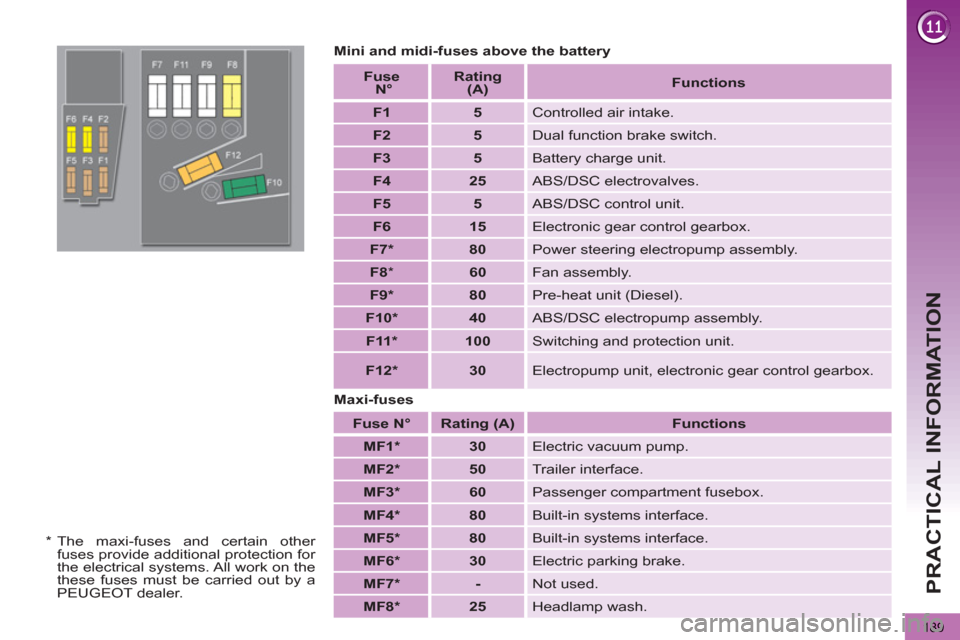
Mini and midi-fuses above the battery
Maxi-fuses
Fuse
N°
Rating
(A)
Functions
MF1 *
30
Electric vacuum pump.
MF2 *
50
Trailer interface.
MF3 *
60
Passenger compartment fusebox.
MF4 *
80
Built-in systems interface.
MF5 *
80
Built-in systems interface.
MF6 *
30
Electric parking brake.
MF7 *
-
Not used.
MF8 *
25
Headlamp wash.
Fuse
N°
Rating
(A)
Functions
F1
5
Controlled air intake.
F2
5
Dual function brake switch.
F3
5
Battery charge unit.
F4
25
ABS/DSC electrovalves.
F5
5
ABS/DSC control unit.
F6
15
Electronic gear control gearbox.
F7 *
80
Power steering electropump assembly.
F8
*
60
Fan assembly.
F9 *
80
Pre-heat unit (Diesel).
F10 *
40
ABS/DSC electropump assembly.
F11 *
100
Switching and protection unit.
F12 *
30
Electropump unit, electronic gear control gearbox.
*
The maxi-fuses and certain other
fuses provide additional protection for
the electrical systems. All work on the
these fuses must be carried out by a
PEUGEOT dealer.
Page 197 of 284
PRACTICAL INFORMATION
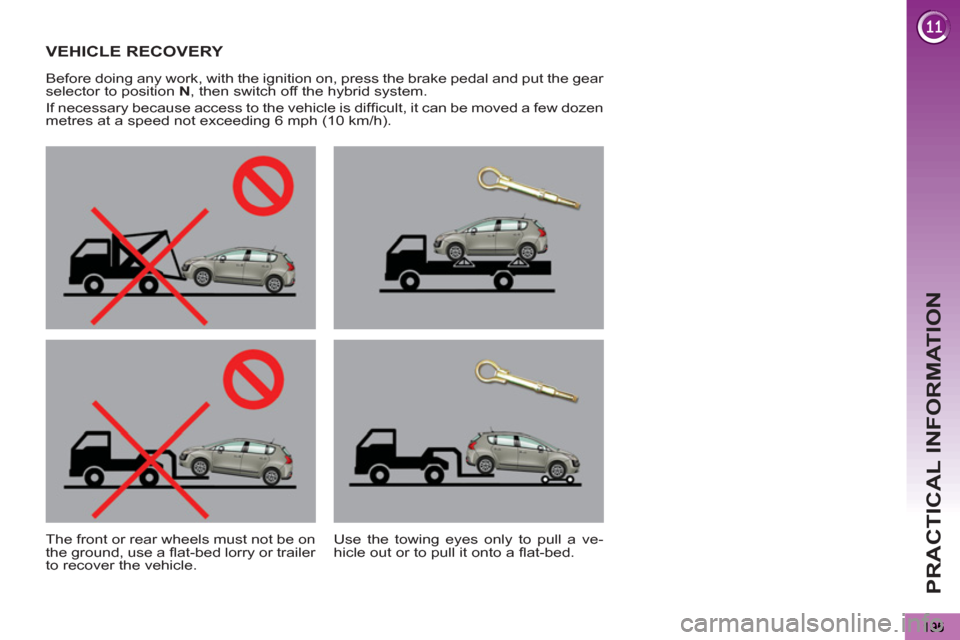
VEHICLE RECOVERY
Before doing any work, with the ignition on, press the brake pedal and put the gear
selector to position N
, then switch off the hybrid system.
If necessary because access to the vehicle is diffi cult, it can be moved a few dozen
metres at a speed not exceeding 6 mph (10 km/h).
The front or rear wheels must not be on
the ground, use a fl at-bed lorry or trailer
to recover the vehicle.
Use the towing eyes only to pull a ve-
hicle out or to pull it onto a fl at-bed.