lock SUBARU FORESTER 2004 Service Repair Manual
[x] Cancel search | Manufacturer: SUBARU, Model Year: 2004, Model line: FORESTER, Model: SUBARU FORESTER 2004Pages: 2870, PDF Size: 38.67 MB
Page 1518 of 2870
ME(H4DOTC)-60
MECHANICAL
Timing Belt Assembly
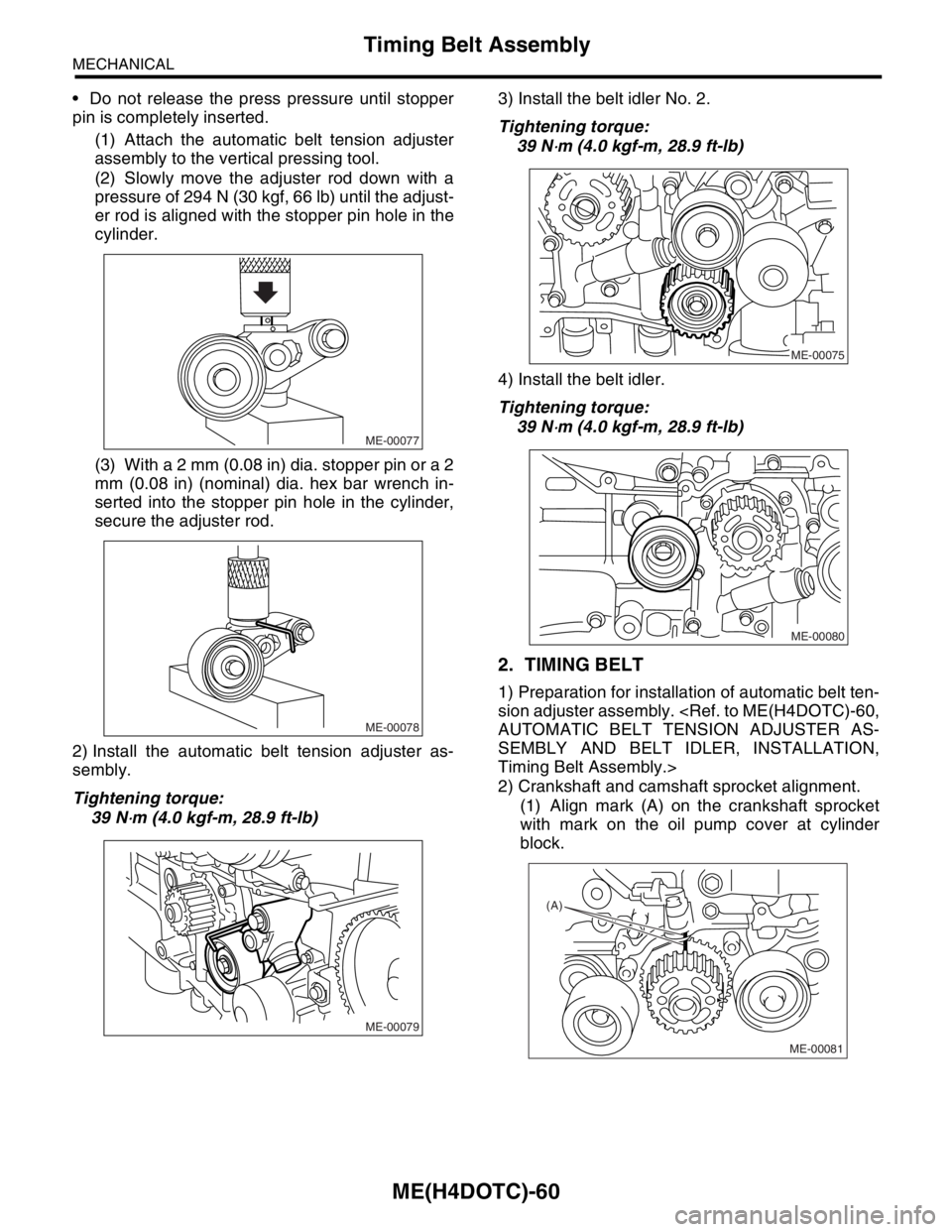
Do not release the press pressure until stopper
pin is completely inserted.
(1) Attach the automatic belt tension adjuster
assembly to the vertical pressing tool.
(2) Slowly move the adjuster rod down with a
pressure of 294 N (30 kgf, 66 lb) until the adjust-
er rod is aligned with the stopper pin hole in the
cylinder.
(3) With a 2 mm (0.08 in) dia. stopper pin or a 2
mm (0.08 in) (nominal) dia. hex bar wrench in-
serted into the stopper pin hole in the cylinder,
secure the adjuster rod.
2) Install the automatic belt tension adjuster as-
sembly.
Tightening torque:
39 N
⋅m (4.0 kgf-m, 28.9 ft-lb)3) Install the belt idler No. 2.
Tightening torque:
39 N
⋅m (4.0 kgf-m, 28.9 ft-lb)
4) Install the belt idler.
Tightening torque:
39 N
⋅m (4.0 kgf-m, 28.9 ft-lb)
2. TIMING BELT
1) Preparation for installation of automatic belt ten-
sion adjuster assembly.
SEMBLY AND BELT IDLER, INSTALLATION,
Timing Belt Assembly.>
2) Crankshaft and camshaft sprocket alignment.
(1) Align mark (A) on the crankshaft sprocket
with mark on the oil pump cover at cylinder
block.
ME-00077
ME-00078
ME-00079
ME-00075
ME-00080
(A)
ME-00081
Page 1519 of 2870
ME(H4DOTC)-61
MECHANICAL
Timing Belt Assembly
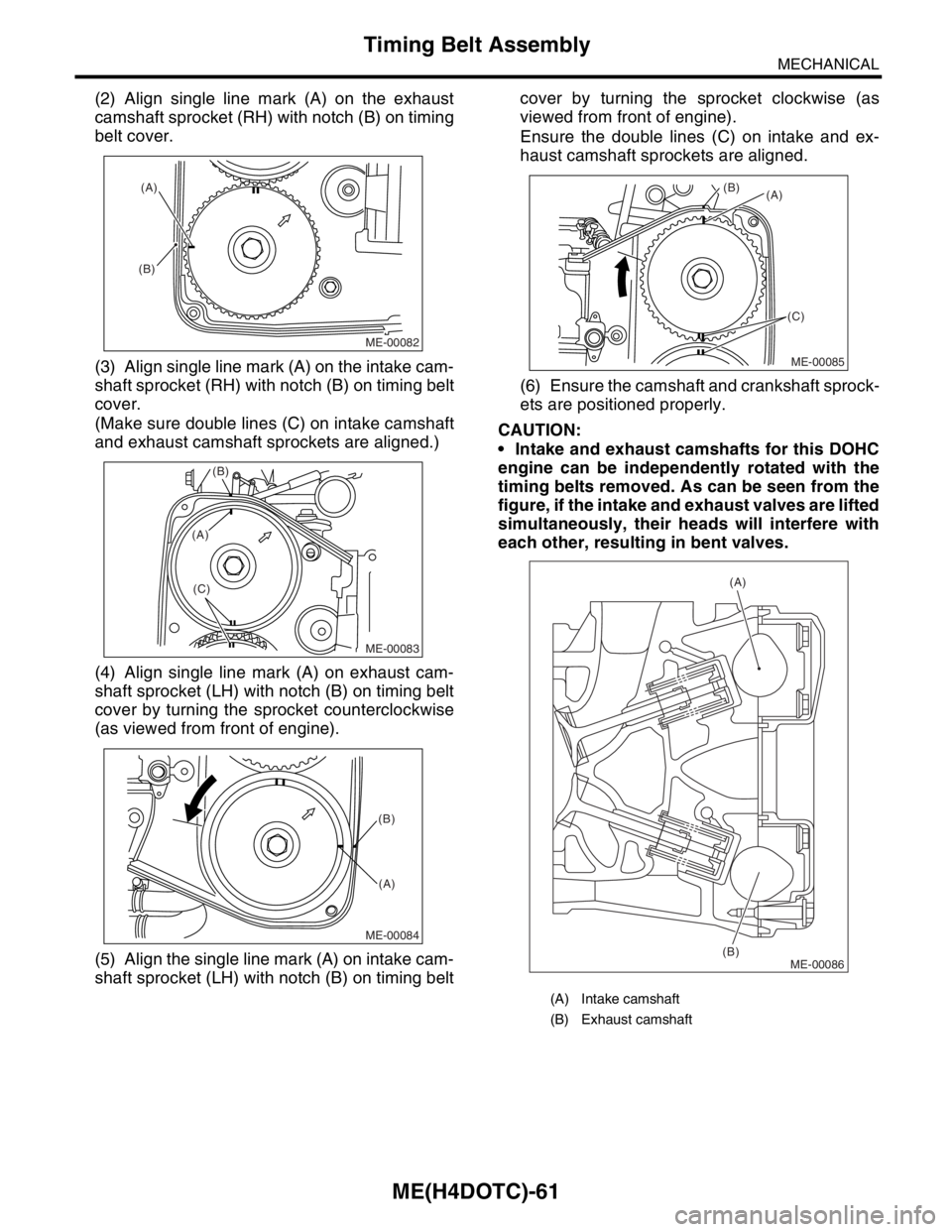
(2) Align single line mark (A) on the exhaust
camshaft sprocket (RH) with notch (B) on timing
belt cover.
(3) Align single line mark (A) on the intake cam-
shaft sprocket (RH) with notch (B) on timing belt
cover.
(Make sure double lines (C) on intake camshaft
and exhaust camshaft sprockets are aligned.)
(4) Align single line mark (A) on exhaust cam-
shaft sprocket (LH) with notch (B) on timing belt
cover by turning the sprocket counterclockwise
(as viewed from front of engine).
(5) Align the single line mark (A) on intake cam-
shaft sprocket (LH) with notch (B) on timing beltcover by turning the sprocket clockwise (as
viewed from front of engine).
Ensure the double lines (C) on intake and ex-
haust camshaft sprockets are aligned.
(6) Ensure the camshaft and crankshaft sprock-
ets are positioned properly.
CAUTION:
Intake and exhaust camshafts for this DOHC
engine can be independently rotated with the
timing belts removed. As can be seen from the
figure, if the intake and exhaust valves are lifted
simultaneously, their heads will interfere with
each other, resulting in bent valves.
ME-00082
(A)
(B)
ME-00083
(B)
(C)
(A)
ME-00084
(B)
(A)
(A) Intake camshaft
(B) Exhaust camshaft
ME-00085
(A) (B)
(C)
ME-00086
(A)
(B)
Page 1524 of 2870
ME(H4DOTC)-66
MECHANICAL
Cam Sprocket
16.Cam Sprocket
A: REMOVAL
1) Remove the V-belt.
2) Remove the crank pulley.
3) Remove the timing belt cover.
4) Remove the timing belt assembly.
bly.>
5) Remove the camshaft position sensor. (2.0 L
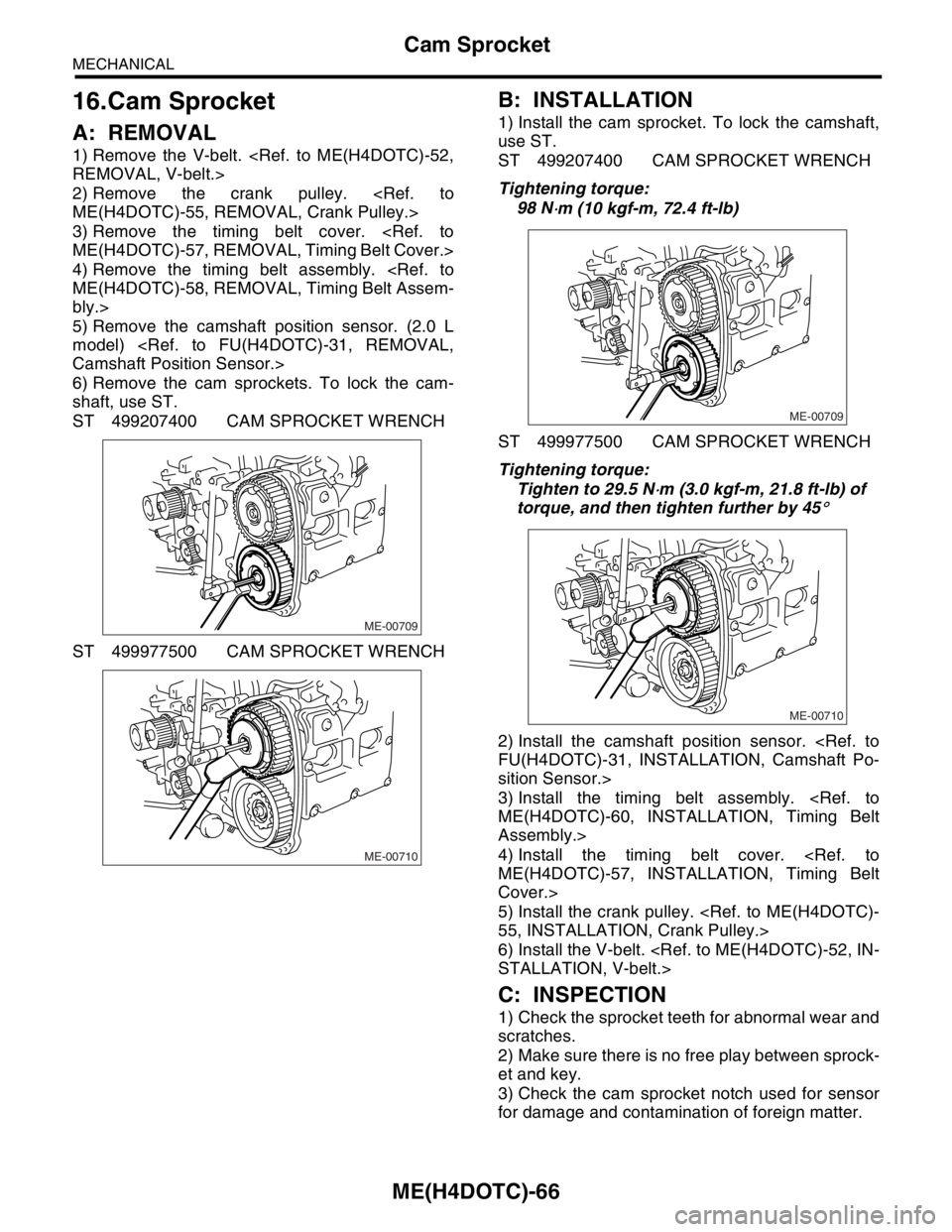
model)
6) Remove the cam sprockets. To lock the cam-
shaft, use ST.
ST 499207400 CAM SPROCKET WRENCH
ST 499977500 CAM SPROCKET WRENCH
B: INSTALLATION
1) Install the cam sprocket. To lock the camshaft,
use ST.
ST 499207400 CAM SPROCKET WRENCH
Tightening torque:
98 N
⋅m (10 kgf-m, 72.4 ft-lb)
ST 499977500 CAM SPROCKET WRENCH
Tightening torque:
Tighten to 29.5 N
⋅m (3.0 kgf-m, 21.8 ft-lb) of
torque, and then tighten further by 45
°
2) Install the camshaft position sensor.
sition Sensor.>
3) Install the timing belt assembly.
Assembly.>
4) Install the timing belt cover.
Cover.>
5) Install the crank pulley.
6) Install the V-belt.
C: INSPECTION
1) Check the sprocket teeth for abnormal wear and
scratches.
2) Make sure there is no free play between sprock-
et and key.
3) Check the cam sprocket notch used for sensor
for damage and contamination of foreign matter.
ME-00709
ME-00710
ME-00709
ME-00710
Page 1527 of 2870
ME(H4DOTC)-69
MECHANICAL
Camshaft
16) Remove the oil flow control solenoid valve as-
sembly, intake camshaft cap, and camshaft.
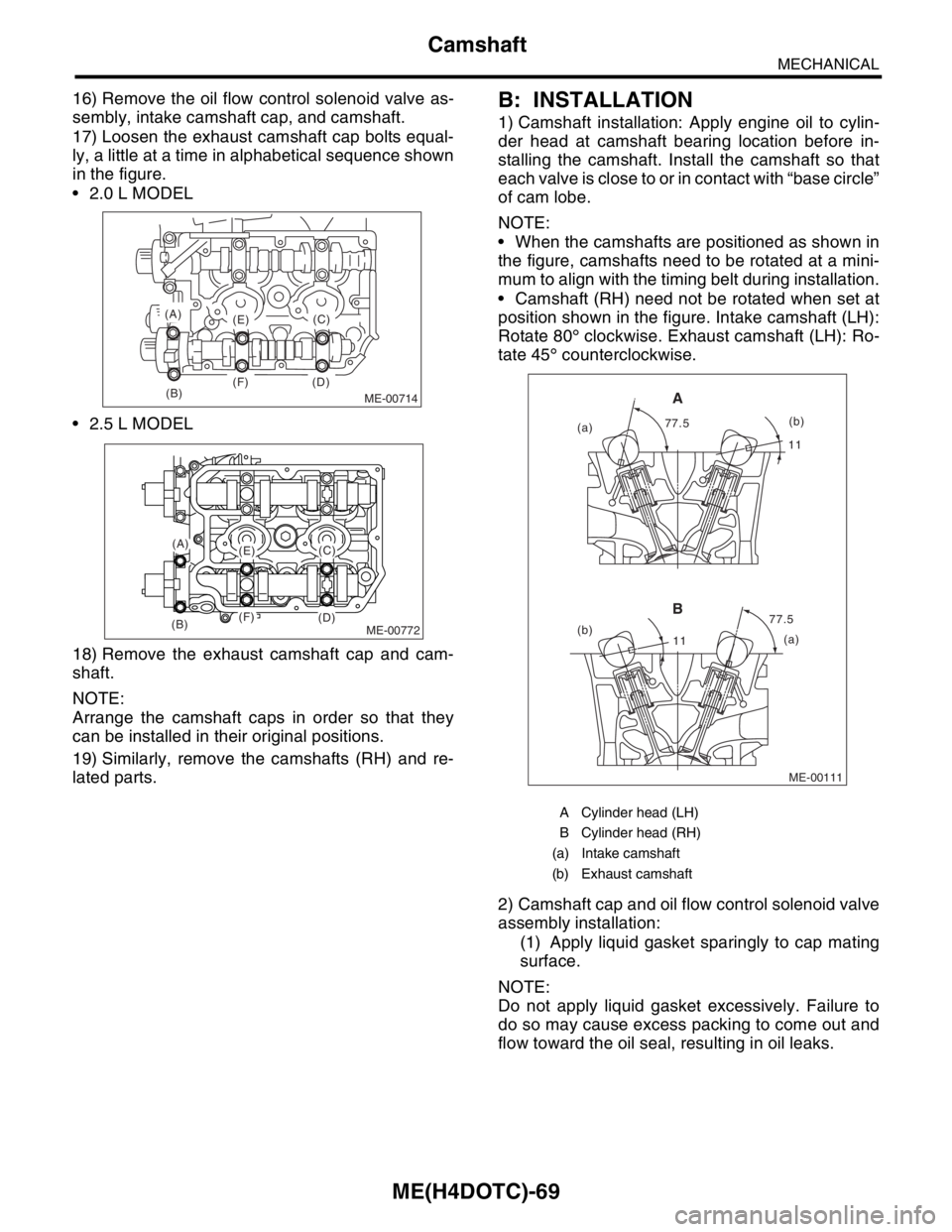
17) Loosen the exhaust camshaft cap bolts equal-
ly, a little at a time in alphabetical sequence shown
in the figure.
2.0 L MODEL
2.5 L MODEL
18) Remove the exhaust camshaft cap and cam-
shaft.
NOTE:
Arrange the camshaft caps in order so that they
can be installed in their original positions.
19) Similarly, remove the camshafts (RH) and re-
lated parts.B: INSTALLATION
1) Camshaft installation: Apply engine oil to cylin-
der head at camshaft bearing location before in-
stalling the camshaft. Install the camshaft so that
each valve is close to or in contact with “base circle”
of cam lobe.
NOTE:
When the camshafts are positioned as shown in
the figure, camshafts need to be rotated at a mini-
mum to align with the timing belt during installation.
Camshaft (RH) need not be rotated when set at
position shown in the figure. Intake camshaft (LH):
Rotate 80° clockwise. Exhaust camshaft (LH): Ro-
tate 45° counterclockwise.
2) Camshaft cap and oil flow control solenoid valve
assembly installation:
(1) Apply liquid gasket sparingly to cap mating
surface.
NOTE:
Do not apply liquid gasket excessively. Failure to
do so may cause excess packing to come out and
flow toward the oil seal, resulting in oil leaks.
ME-00714(B)
(A)
(E)
(F) (D)(C)
ME-00772
(A)(E)
(F)(B)(D)
(C)
A Cylinder head (LH)
B Cylinder head (RH)
(a) Intake camshaft
(b) Exhaust camshaft
ME-00111
1111
77.5 77.5
(a)
(b)
(a)(b)
A
B
Page 1533 of 2870

ME(H4DOTC)-75
MECHANICAL
Cylinder Head Assembly
19.Cylinder Head Assembly
A: REMOVAL
1) Remove the V-belt.
2) Remove the crank pulley.
3) Remove the timing belt cover.
4) Remove the timing belt assembly.
bly.>
5) Remove the cam sprocket.
6) Remove the intake manifold.
7) Remove the bolt which installs the A/C compres-
sor bracket on cylinder head.
8) Remove the camshaft.
9) Remove the cylinder head bolts in alphabetical
sequence shown in the figure.
Leave bolts (A) and (D) engaged by three or four
threads to prevent the cylinder head from falling.
10) While tapping the cylinder head with a plastic
hammer, separate it from cylinder block. Remove
the bolts (A) and (D) to remove cylinder head.11) Remove the cylinder head gasket.
NOTE:
Do not scratch the mating surface of cylinder head
and cylinder block.
12) Similarly, remove the cylinder head (RH).
B: INSTALLATION
1) Install the cylinder head and gaskets on cylinder
block.
NOTE:
Use new cylinder head gaskets.
Be careful not to scratch the mating surface of
cylinder head and cylinder block.
2) Tighten the cylinder head bolts.
(1) Apply a coat of engine oil to the washers and
bolt threads.
(2) Tighten all bolts to 29 N⋅m (3.0 kgf-m, 22 ft-
lb) in alphabetical sequence.
(3) Tighten all bolts to 69 N⋅m (7.0 kgf-m, 51 ft-
lb) in alphabetical sequence again.
(4) Back off all bolts by 180° first; back them off
by 180° again in reverse order of installation.
(5) Tighten all bolts to 49 N⋅m (5.0 kgf-m, 36 ft-
lb) in alphabetical sequence.
(6) Tighten all bolts 80 to 90° in alphabetical se-
quence.
(7) Tighten all bolts by 40 to 45° in alphabetical
sequence again.
NOTE:
Do not tighten the bolts by more than 45°.
(8) Further tighten all bolts (A) and (B) by 40 to
45°.
NOTE:
Ensure that the total “re-tightening angle” in the
previous two steps do not exceed 90°.
3) Install the camshaft.
4) Install the A/C compressor bracket on cylinder
head.
5) Install the intake manifold.
6) Install the cam sprocket.
ME-00122
(B)(C)
(D)
(E)
(F)(A)
ME-00122
(B)(C)
(D)
(E)
(F)(A)
ME-00123
(B)
(C)
(D)(E)
(F)(A)
Page 1537 of 2870
ME(H4DOTC)-79
MECHANICAL
Cylinder Head Assembly
3. VALVE GUIDE
1) Check the clearance between valve guide and
stem. The clearance can be checked by measuring
the outside diameter of valve stem and the inside
diameter of valve guide with outside and inside mi-
crometers respectively.
Clearance between the valve guide and valve
stem:
Standard
Intake
0.030 — 0.057 mm (0.0012 — 0.0022 in)
Exhaust
0.040 — 0.067 mm (0.0016 — 0.0026 in)
Limit
0.15 mm (0.0059 in)
2) If the clearance between valve guide and stem
exceeds the limit, replace the valve guide or valve
itself whichever shows greater amount of wear.
See the following procedure for valve guide re-
placement.
Valve guide inner diameter:
6.000 — 6.012 mm (0.2362 — 0.2367 in)
Valve stem outer diameters:
Intake
5.955 — 5.970 mm (0.2344 — 0.2350 in)
Exhaust
5.945 — 5.960 mm (0.2341 — 0.2346 in)
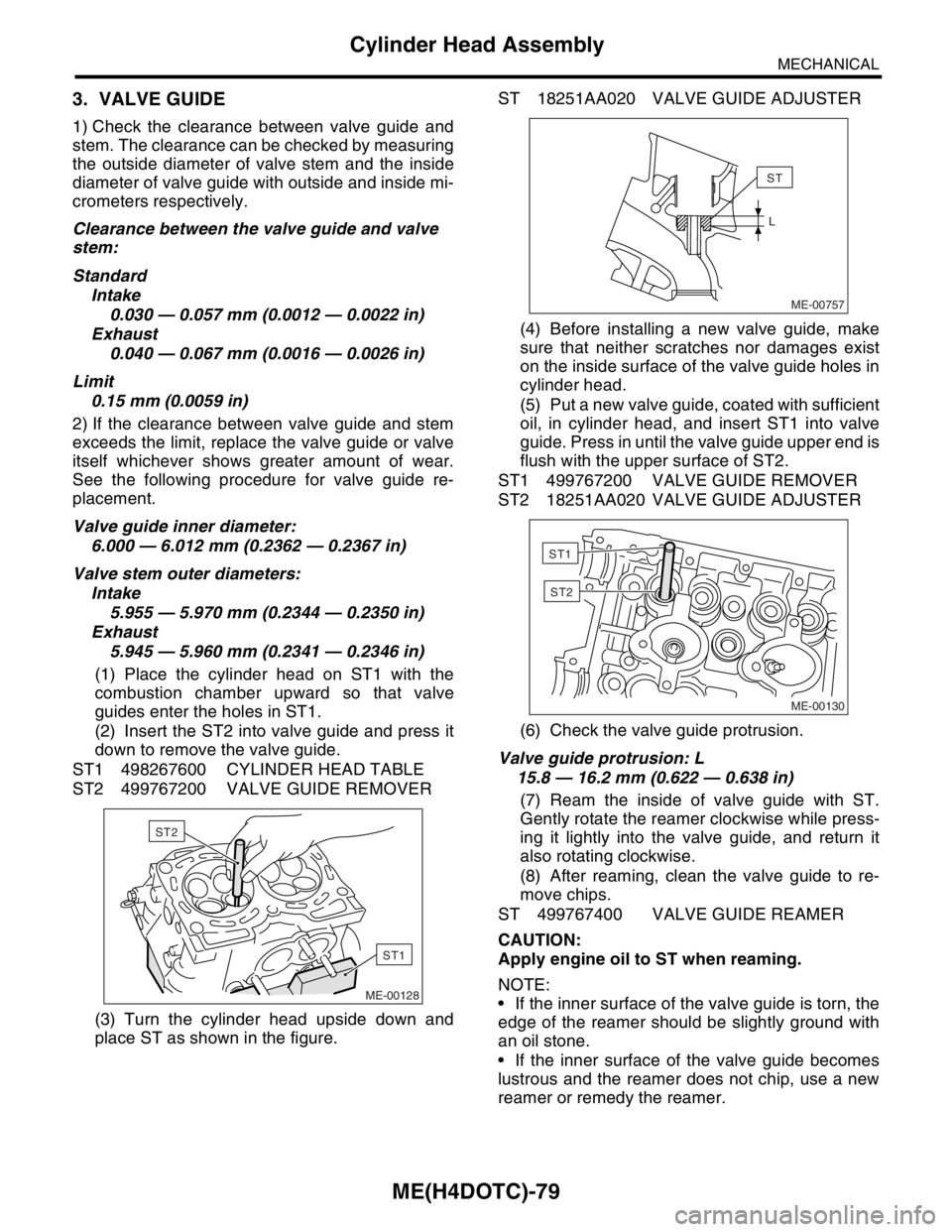
(1) Place the cylinder head on ST1 with the
combustion chamber upward so that valve
guides enter the holes in ST1.
(2) Insert the ST2 into valve guide and press it
down to remove the valve guide.
ST1 498267600 CYLINDER HEAD TABLE
ST2 499767200 VALVE GUIDE REMOVER
(3) Turn the cylinder head upside down and
place ST as shown in the figure.ST 18251AA020 VALVE GUIDE ADJUSTER
(4) Before installing a new valve guide, make
sure that neither scratches nor damages exist
on the inside surface of the valve guide holes in
cylinder head.
(5) Put a new valve guide, coated with sufficient
oil, in cylinder head, and insert ST1 into valve
guide. Press in until the valve guide upper end is
flush with the upper surface of ST2.
ST1 499767200 VALVE GUIDE REMOVER
ST2 18251AA020 VALVE GUIDE ADJUSTER
(6) Check the valve guide protrusion.
Valve guide protrusion: L
15.8 — 16.2 mm (0.622 — 0.638 in)
(7) Ream the inside of valve guide with ST.
Gently rotate the reamer clockwise while press-
ing it lightly into the valve guide, and return it
also rotating clockwise.
(8) After reaming, clean the valve guide to re-
move chips.
ST 499767400 VALVE GUIDE REAMER
CAUTION:
Apply engine oil to ST when reaming.
NOTE:
If the inner surface of the valve guide is torn, the
edge of the reamer should be slightly ground with
an oil stone.
If the inner surface of the valve guide becomes
lustrous and the reamer does not chip, use a new
reamer or remedy the reamer.
ME-00128
ST1
ST2ME-00757
ST
L
ME-00130
ST1
ST2
Page 1542 of 2870

MECHANICAL
ME(H4DOTC)
Page
1. General Description ....................................................................................2
2. Compression .............................................................................................31
3. Idle Speed .................................................................................................32
4. Ignition Timing ...........................................................................................33
5. Intake Manifold Vacuum............................................................................34
6. Engine Oil Pressure ..................................................................................35
7. Fuel Pressure ............................................................................................36
8. Valve Clearance ........................................................................................37
9. Engine Assembly ......................................................................................41
10. Engine Mounting .......................................................................................50
11. Preparation for Overhaul ...........................................................................51
12. V-belt .........................................................................................................52
13. Crank Pulley ..............................................................................................55
14. Timing Belt Cover......................................................................................57
15. Timing Belt Assembly................................................................................58
16. Cam Sprocket ...........................................................................................67
17. Crank Sprocket .........................................................................................68
18. Camshaft ...................................................................................................69
19. Cylinder Head Assembly ...........................................................................76
20. Cylinder Block ...........................................................................................84
21. Intake and Exhaust Valve .......................................................................115
22. Piston ......................................................................................................116
23. Connecting Rod ......................................................................................117
24. Crankshaft ...............................................................................................118
25. Engine Trouble in General ......................................................................119
26. Engine Noise ...........................................................................................124
Page 1543 of 2870
ME(H4DOTC)-83
MECHANICAL
Cylinder Block
20.Cylinder Block
A: REMOVAL
NOTE:
Before conducting this procedure, drain the engine
oil completely if applicable.
1) Remove the intake manifold.
2) Remove the V-belt.
3) Remove the crank pulley.
4) Remove the timing belt cover.
5) Remove the timing belt assembly.
bly.>
6) Remove the cam sprocket.
7) Remove the crank sprocket.
8) Remove the generator and A/C compressor with
their brackets.
9) Remove the cylinder head assembly.
sembly.>
10) Remove the clutch disc and cover. (MT model)
11) Remove the flywheel. (MT model)
12) Remove the drive plate. (AT model)
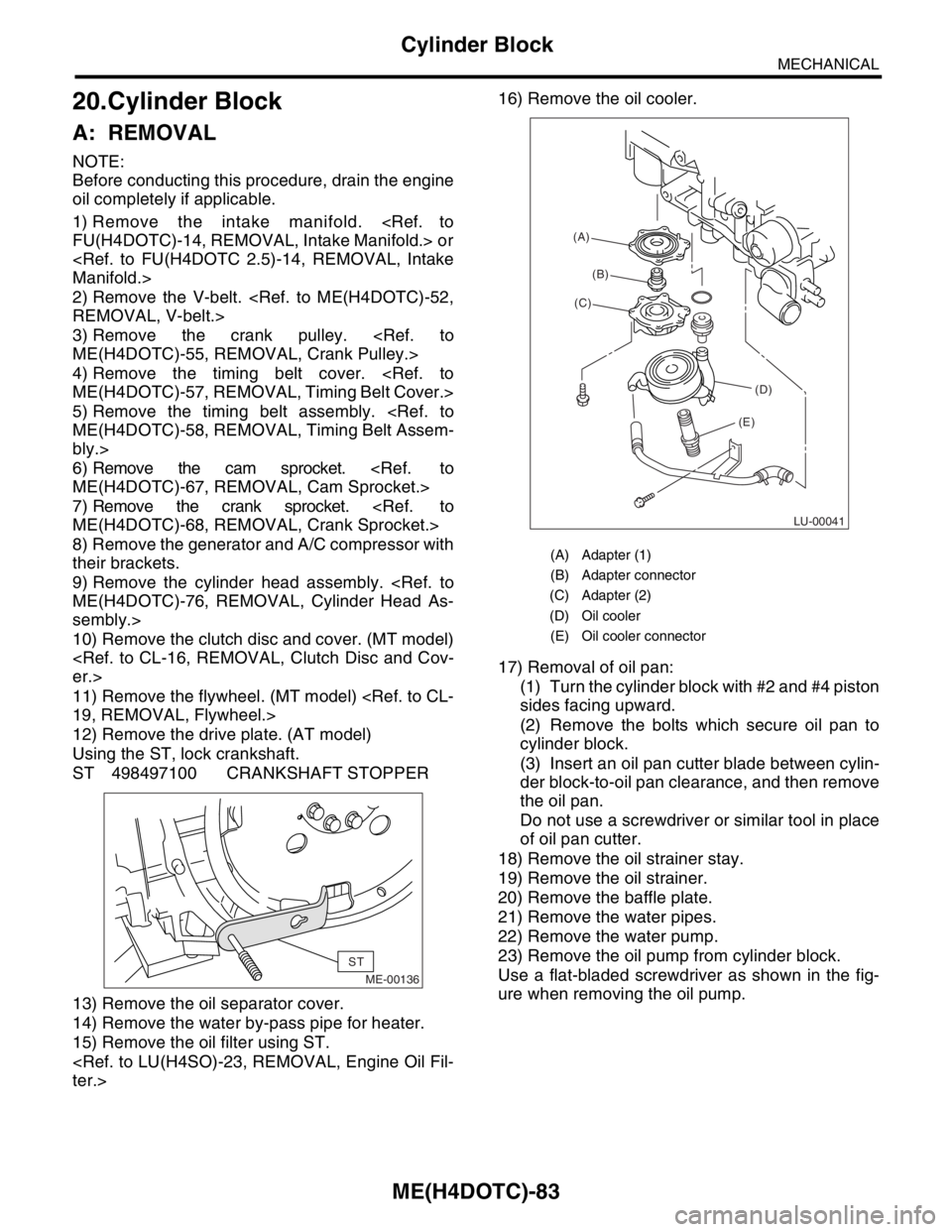
Using the ST, lock crankshaft.
ST 498497100 CRANKSHAFT STOPPER
13) Remove the oil separator cover.
14) Remove the water by-pass pipe for heater.
15) Remove the oil filter using ST.
17) Removal of oil pan:
(1) Turn the cylinder block with #2 and #4 piston
sides facing upward.
(2) Remove the bolts which secure oil pan to
cylinder block.
(3) Insert an oil pan cutter blade between cylin-
der block-to-oil pan clearance, and then remove
the oil pan.
Do not use a screwdriver or similar tool in place
of oil pan cutter.
18) Remove the oil strainer stay.
19) Remove the oil strainer.
20) Remove the baffle plate.
21) Remove the water pipes.
22) Remove the water pump.
23) Remove the oil pump from cylinder block.
Use a flat-bladed screwdriver as shown in the fig-
ure when removing the oil pump.
ME-00136
ST
(A) Adapter (1)
(B) Adapter connector
(C) Adapter (2)
(D) Oil cooler
(E) Oil cooler connector
LU-00041
(A)
(B)
(C)
(D)
(E)
Page 1544 of 2870
ME(H4DOTC)-84
MECHANICAL
Cylinder Block
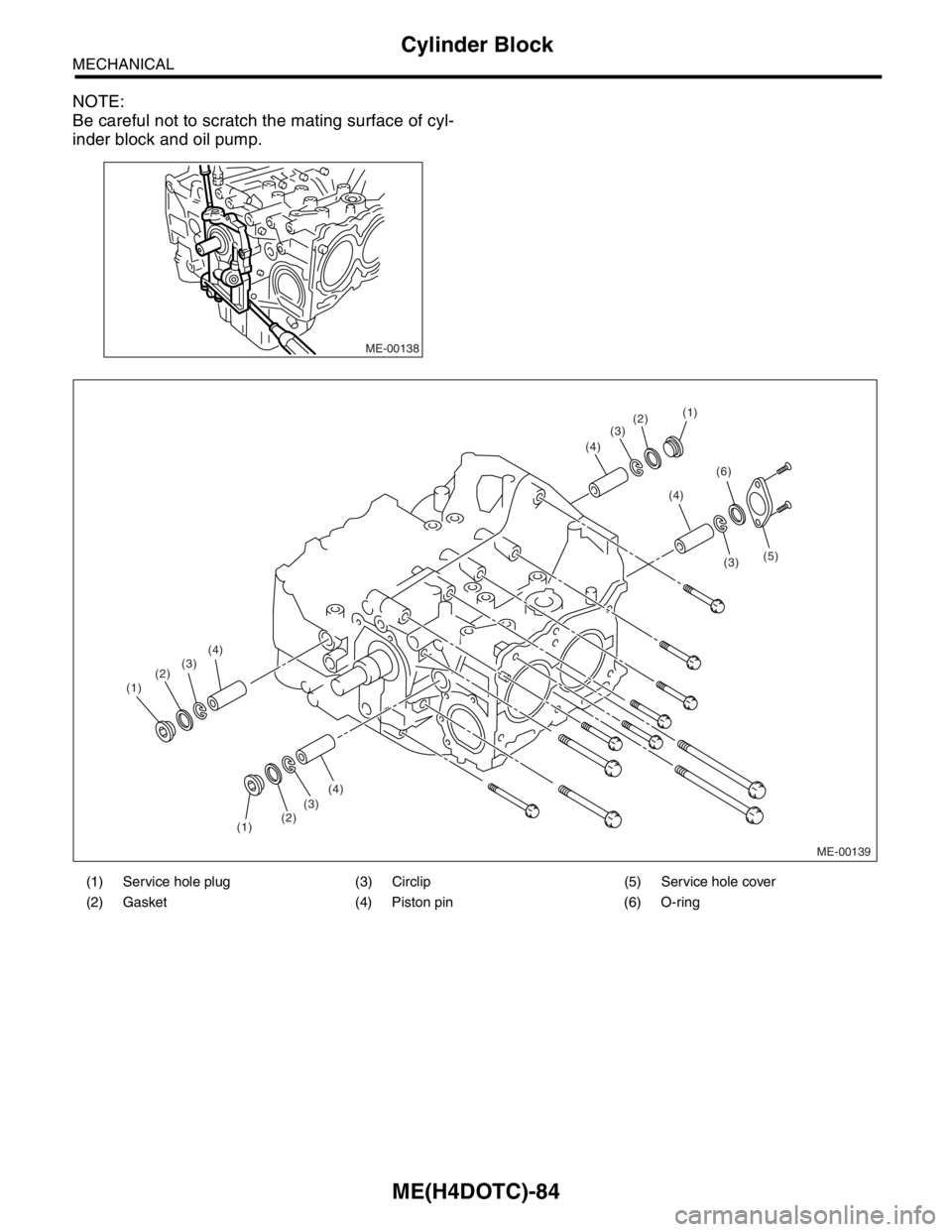
NOTE:
Be careful not to scratch the mating surface of cyl-
inder block and oil pump.
ME-00138
(1) Service hole plug (3) Circlip (5) Service hole cover
(2) Gasket (4) Piston pin (6) O-ring
ME-00139
(3)
(4) (2)(1)
(3)
(4)
(5)
(6)
(2)(3)
(2)
(1)(3)(4)
(4)
(1)
Page 1545 of 2870
![SUBARU FORESTER 2004 Service Repair Manual ME(H4DOTC)-85
MECHANICAL
Cylinder Block
24) Remove the service hole cover and service
hole plugs using hexagon wrench [14 mm (0.55
in)].
25) Rotate the crankshaft to bring #1 and #2 pis-
tons to botto](/img/17/57426/w960_57426-1544.png "SUBARU FORESTER 2004 Service Repair Manual ME(H4DOTC)-85
MECHANICAL
Cylinder Block
24) Remove the service hole cover and service
hole plugs using hexagon wrench [14 mm (0.55
in)].
25) Rotate the crankshaft to bring #1 and #2 pis-
tons to botto")
ME(H4DOTC)-85
MECHANICAL
Cylinder Block
24) Remove the service hole cover and service
hole plugs using hexagon wrench [14 mm (0.55
in)].
25) Rotate the crankshaft to bring #1 and #2 pis-
tons to bottom dead center position, and then re-
move the piston circlip through service hole of #1
and #2 cylinders.
26) Draw out the piston pin from #1 and #2 pistons
using ST.
ST 499097600 PISTON PIN REMOVER (2.0
L model)
ST 499097700 PISTON PIN REMOVER (2.5
L model)
NOTE:
Be careful not to confuse the original combination
of piston, piston pin and cylinder.
27) Similarly remove the piston pins from #3 and #4
pistons.
28) Remove the bolts which connect the cylinder
block on the side of #2 and #4 cylinders.29) Back off the bolts which connect the cylinder
block on the side of #1 and #3 cylinders two or
three turns.
30) Set up the cylinder block so that #1 and #3 cyl-
inders are on the upper side, then remove the cyl-
inder block connecting bolts.
31) Separate the cylinder blocks (LH) and (RH).
ME-00140
ME-00141
ME-00142
ST