sensor TOYOTA SIENNA 2007 Service Repair Manual
[x] Cancel search | Manufacturer: TOYOTA, Model Year: 2007, Model line: SIENNA, Model: TOYOTA SIENNA 2007Pages: 3000, PDF Size: 52.26 MB
Page 1423 of 3000

U151E AUTOMATIC TRANSAXLE – AUTOMATIC TRANSAXLE SYSTEMAX–57
AX
(d) Turn the ignition switch to the ON position.
(e) Turn on the tester.
(f) Select the item "DIAGNOSIS / ENHANCED OBD II / DATA LIST".
(g) According to the display on the tester, read the "DATA LIST".
HINT:
When DTC P0712 is output and OBD II scan tool or intelligent tester output is 150
C (302F),
there is a short circuit.
When DTC P0713 is output and OBD II scan tool or intelligent tester output is -40
C (-40F),
there is an open circuit.
Measure the resistance between terminal THO1 (THO) and body ground.
HINT:
If a circuit related to the ATF temperature sensor becomes open, P0713 is immediately set (in
0.5 second).
When P0713 is set, P0711 cannot be detected.
It is not necessary to inspect the circuit when P0711 is set.
(a) Connect the intelligent tester together with the CAN VIM
(controller area network vehicle interface module) to the
DLC3.
(b) Turn the ignition switch to the ON position and push the
OBD II scan tool or the intelligent tester main switch ON.
(c) When you use intelligent tester:
Select the item "DIAGNOSIS / ENHANCED OBD II /
DTC INFO / CURRENT CODES".
(d) Read the DTCs using the OBD II scan tool or the
intelligent tester.
Result
HINT:
If any other codes besides "P0711" are output, perform
troubleshooting for those DTCs first.
B
A
Tester Display Measurement Item/Range Normal Condition Diagnostic Note
A/T OIL TEMP 1ATF Temp. Sensor Value/
min.: -40
C (-40F)
max.: 215
C (419F)• After Stall Test;
Approx. 80
C (176F)
• Equal to ambient temperature
when cold soakIf the value is "-40
C (-40F)" or
"215
C (419F)", ATF temp.
sensor circuit is opened or
shorted.
Temperature Displayed Malfunction
-40
C (-40F) Open circuit
150
C (302F) or more Short circuit
1CHECK OTHER DTCS OUTPUT (IN ADDITION TO DTC P0711)
Result Proceed to
P0711 A
P0711 and other DTCs B
GO TO DTC CHART
Page 1424 of 3000
AX–58U151E AUTOMATIC TRANSAXLE – AUTOMATIC TRANSAXLE SYSTEM
AX
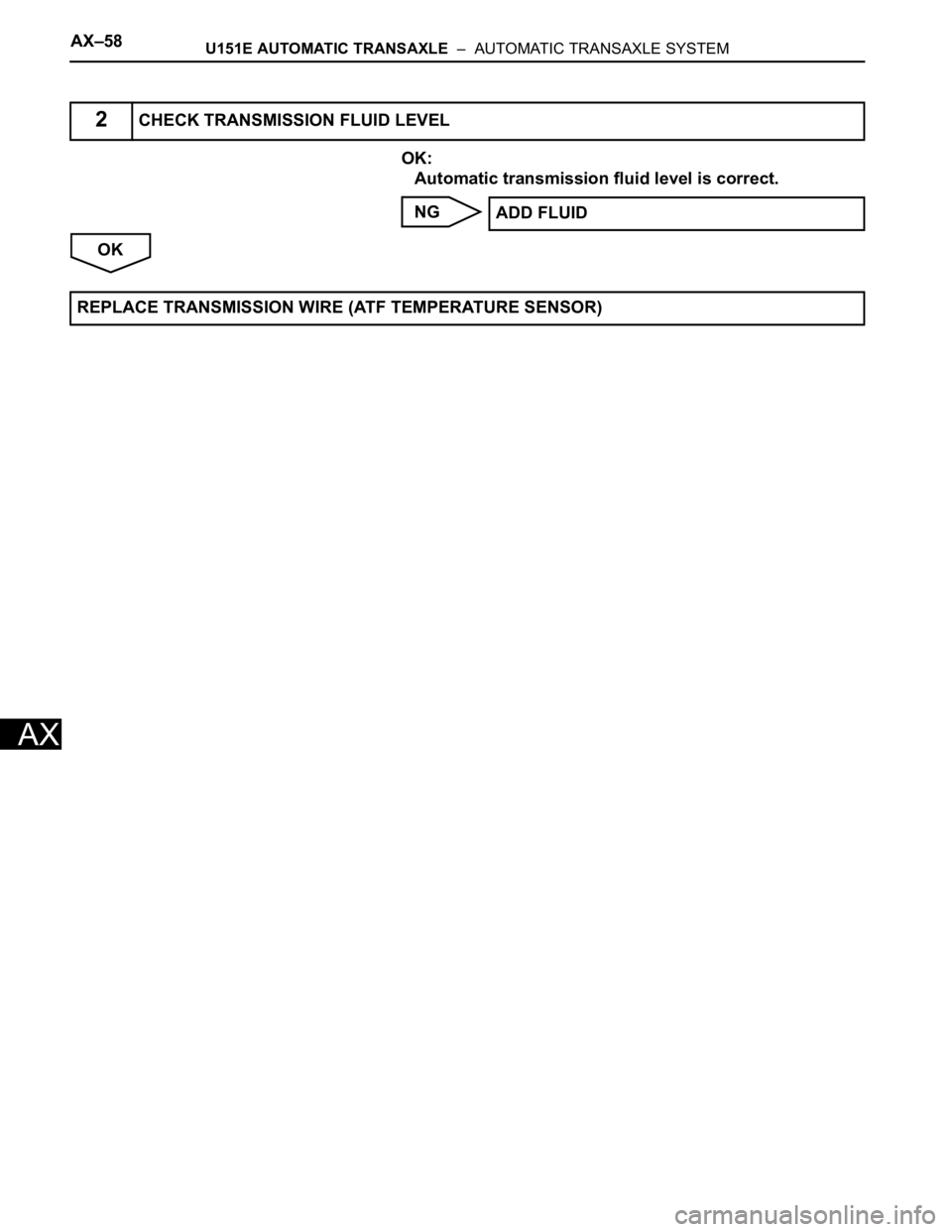
OK:
Automatic transmission fluid level is correct.
NG
OK
2CHECK TRANSMISSION FLUID LEVEL
ADD FLUID
REPLACE TRANSMISSION WIRE (ATF TEMPERATURE SENSOR)
Page 1425 of 3000
U151E AUTOMATIC TRANSAXLE – AUTOMATIC TRANSAXLE SYSTEMAX–59
AX
DESCRIPTION
This sensor detects the rotation speed of the input turbine. By comparing the input turbine speed signal
(NT) with the counter gear speed sensor signal (NC), the ECM detects the shift timing of the gears and
appropriately controls the engine torque and hydraulic pressure according to various conditions. Thus,
providing smooth gear shift.
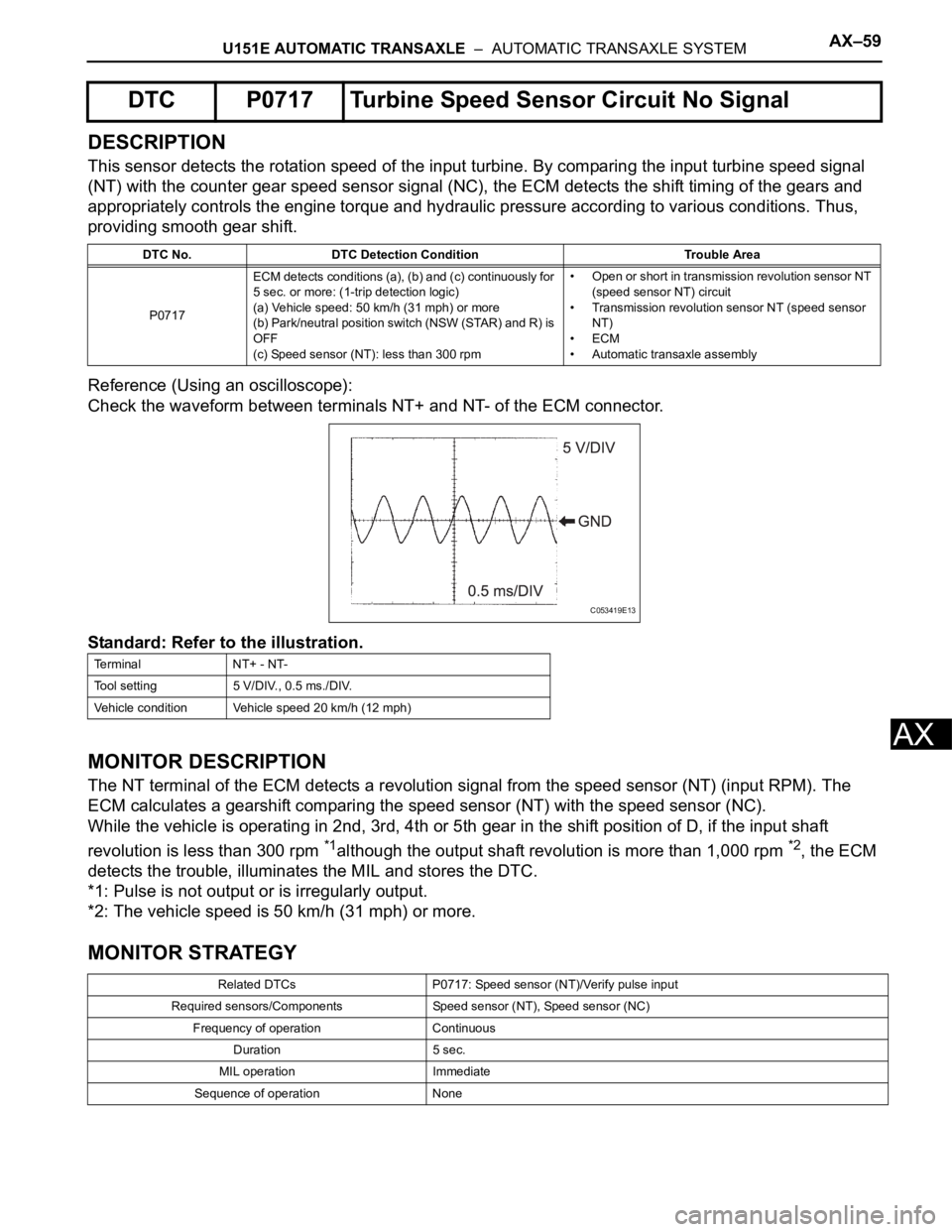
Reference (Using an oscilloscope):
Check the waveform between terminals NT+ and NT- of the ECM connector.
Standard: Refer to the illustration.
MONITOR DESCRIPTION
The NT terminal of the ECM detects a revolution signal from the speed sensor (NT) (input RPM). The
ECM calculates a gearshift comparing the speed sensor (NT) with the speed sensor (NC).
While the vehicle is operating in 2nd, 3rd, 4th or 5th gear in the shift position of D, if the input shaft
revolution is less than 300 rpm
*1although the output shaft revolution is more than 1,000 rpm *2, the ECM
detects the trouble, illuminates the MIL and stores the DTC.
*1: Pulse is not output or is irregularly output.
*2: The vehicle speed is 50 km/h (31 mph) or more.
MONITOR STRATEGY
DTC P0717 Turbine Speed Sensor Circuit No Signal
DTC No. DTC Detection Condition Trouble Area
P0717ECM detects conditions (a), (b) and (c) continuously for
5 sec. or more: (1-trip detection logic)
(a) Vehicle speed: 50 km/h (31 mph) or more
(b) Park/neutral position switch (NSW (STAR) and R) is
OFF
(c) Speed sensor (NT): less than 300 rpm• Open or short in transmission revolution sensor NT
(speed sensor NT) circuit
• Transmission revolution sensor NT (speed sensor
NT)
•ECM
• Automatic transaxle assembly
Te r m i n a l N T + - N T -
Tool setting 5 V/DIV., 0.5 ms./DIV.
Vehicle condition Vehicle speed 20 km/h (12 mph)
Related DTCs P0717: Speed sensor (NT)/Verify pulse input
Required sensors/Components Speed sensor (NT), Speed sensor (NC)
Frequency of operation Continuous
Duration 5 sec.
MIL operation Immediate
Sequence of operation None
C053419E13
Page 1426 of 3000
AX–60U151E AUTOMATIC TRANSAXLE – AUTOMATIC TRANSAXLE SYSTEM
AX
TYPICAL ENABLING CONDITIONS
TYPICAL MALFUNCTION THRESHOLDS
COMPONENT OPERATING RANGE
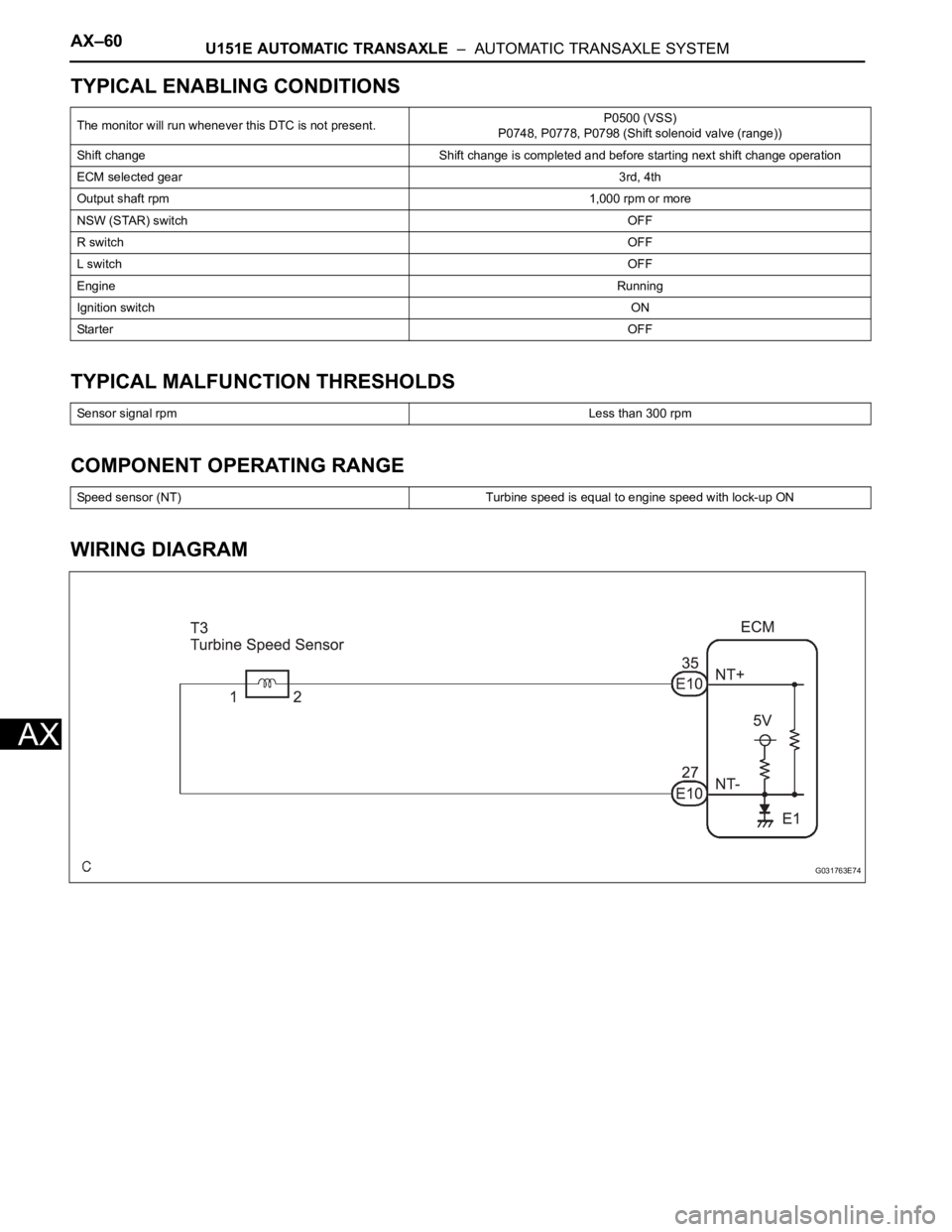
WIRING DIAGRAM
The monitor will run whenever this DTC is not present.P0500 (VSS)
P0748, P0778, P0798 (Shift solenoid valve (range))
Shift change Shift change is completed and before starting next shift change operation
ECM selected gear3rd, 4th
Output shaft rpm1,000 rpm or more
NSW (STAR) switchOFF
R switchOFF
L switchOFF
EngineRunning
Ignition switchON
StarterOFF
Sensor signal rpmLess than 300 rpm
Speed sensor (NT) Turbine speed is equal to engine speed with lock-up ON
G031763E74
Page 1427 of 3000
U151E AUTOMATIC TRANSAXLE – AUTOMATIC TRANSAXLE SYSTEMAX–61
AX
INSPECTION PROCEDURE
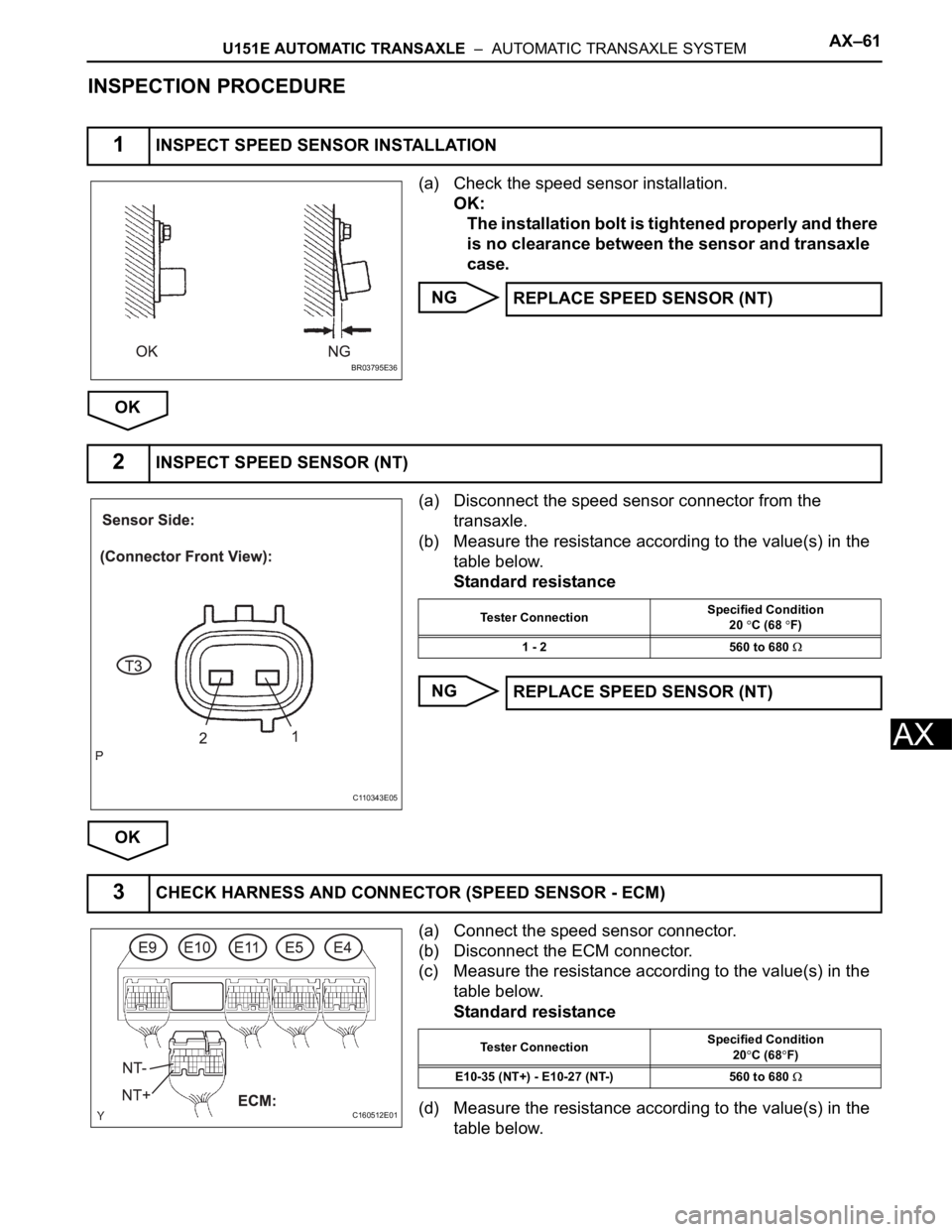
(a) Check the speed sensor installation.
OK:
The installation bolt is tightened properly and there
is no clearance between the sensor and transaxle
case.
NG
OK
(a) Disconnect the speed sensor connector from the
transaxle.
(b) Measure the resistance according to the value(s) in the
table below.
Standard resistance
NG
OK
(a) Connect the speed sensor connector.
(b) Disconnect the ECM connector.
(c) Measure the resistance according to the value(s) in the
table below.
Standard resistance
(d) Measure the resistance according to the value(s) in the
table below.
1INSPECT SPEED SENSOR INSTALLATION
BR03795E36
REPLACE SPEED SENSOR (NT)
2INSPECT SPEED SENSOR (NT)
C110343E05
Tester ConnectionSpecified Condition
20 C (68 F)
1 - 2 560 to 680
REPLACE SPEED SENSOR (NT)
3CHECK HARNESS AND CONNECTOR (SPEED SENSOR - ECM)
C160512E01
Tester ConnectionSpecified Condition
20C (68F)
E10-35 (NT+) - E10-27 (NT-) 560 to 680
Page 1429 of 3000

U151E AUTOMATIC TRANSAXLE – AUTOMATIC TRANSAXLE SYSTEMAX–63
AX
DESCRIPTION
The purpose of this circuit is to prevent the engine from stalling while driving in lock-up condition when
brakes are suddenly applied.
When the brake pedal is depressed, this switch sends a signals to the ECM. Then the ECM cancels the
operation of the lock-up clutch while braking is in progress.
MONITOR DESCRIPTION
This DTC indicates that the stop light switch remains on. When the stop light switch remains ON during
"stop and go" driving, the ECM interprets this as a fault in the stop light switch and the MIL comes on and
the ECM stores the DTC. The vehicle must stop (less than 3 km/h (2 mph)) and go (30 km/h (19 mph) or
more) 5 times for two driving cycles in order to detect a malfunction.
MONITOR STRATEGY
TYPICAL ENABLING CONDITIONS
TYPICAL MALFUNCTION THRESHOLDS
DTC P0724 Brake Switch "B" Circuit High
DTC No. DTC Detection Condition Trouble Area
P0724The stop light switch remains ON even when the
vehicle is driven in a STOP (less than 3 km/h (2 mph)
and GO (30 km/h (19 mph) or more) fashion 5 times. (2-
trip detection logic).• Short in stop light switch circuit
• Stop light switch
•ECM
Related DTCs P0724: Stop light switch/Rationality
Required sensors/Components Stop light switch, Vehicle speed sensor
Frequency of operation Continuous
Duration GO and STOP 5 times
MIL operation 2 driving cycles
Sequence of operation None
The monitor will run whenever this DTC is not present. None
Ignition switchON
Sta r t e rOFF
Battery voltage8 V or more
GO (Vehicle speed is 30 km/h (18.63 mph) or more) Once
STOP (Vehicle speed is less than 3 km/h (1.86 mph)) Once
Brake switch Remain ON during GO and STOP 5 times
Page 1430 of 3000
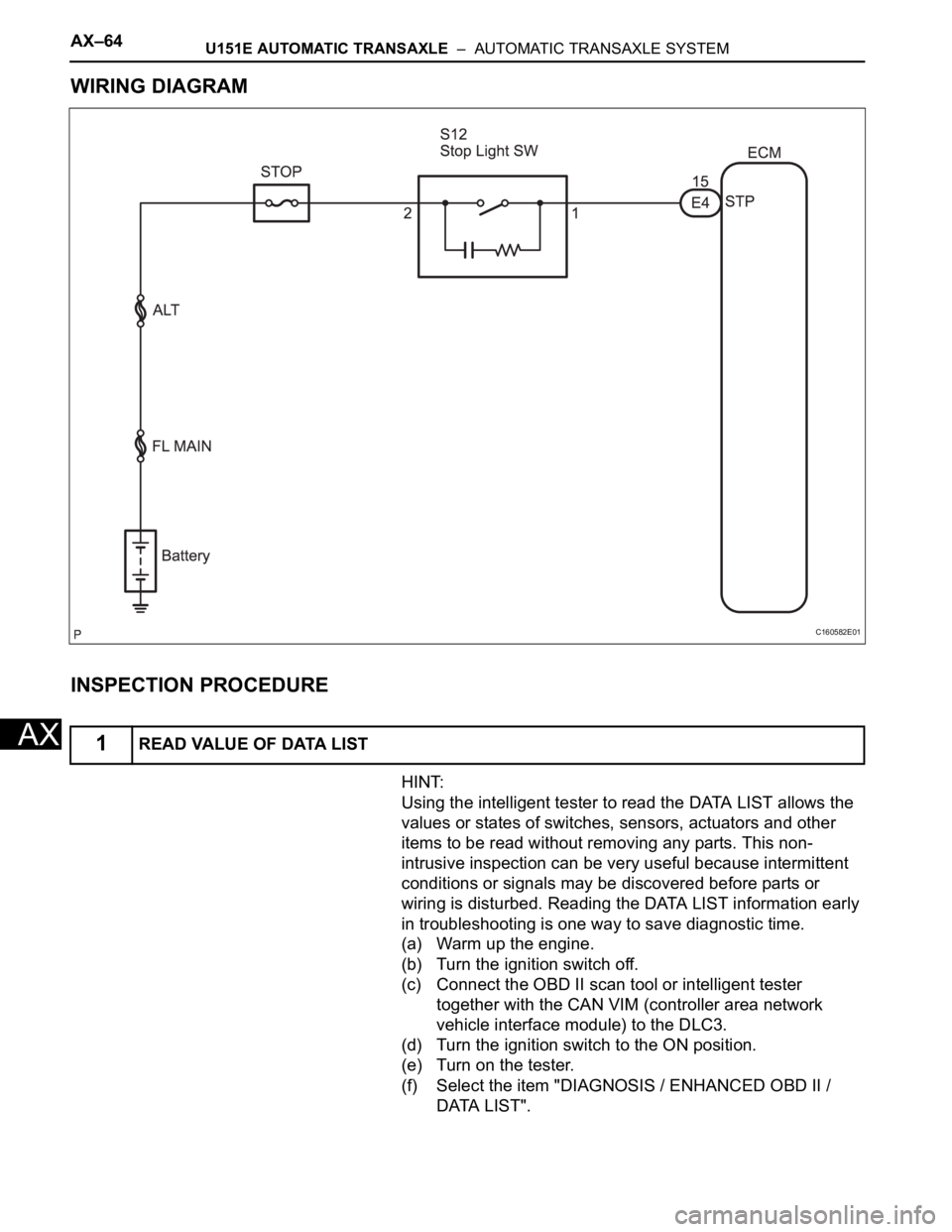
AX–64U151E AUTOMATIC TRANSAXLE – AUTOMATIC TRANSAXLE SYSTEM
AX
WIRING DIAGRAM
INSPECTION PROCEDURE
HINT:
Using the intelligent tester to read the DATA LIST allows the
values or states of switches, sensors, actuators and other
items to be read without removing any parts. This non-
intrusive inspection can be very useful because intermittent
conditions or signals may be discovered before parts or
wiring is disturbed. Reading the DATA LIST information early
in troubleshooting is one way to save diagnostic time.
(a) Warm up the engine.
(b) Turn the ignition switch off.
(c) Connect the OBD II scan tool or intelligent tester
together with the CAN VIM (controller area network
vehicle interface module) to the DLC3.
(d) Turn the ignition switch to the ON position.
(e) Turn on the tester.
(f) Select the item "DIAGNOSIS / ENHANCED OBD II /
DATA LIST".
1READ VALUE OF DATA LIST
C160582E01
Page 1433 of 3000

U151E AUTOMATIC TRANSAXLE – AUTOMATIC TRANSAXLE SYSTEMAX–67
AX
SYSTEM DESCRIPTION
The ECM uses the signals from the throttle position sensor, air-flow meter, turbine (input) speed sensor,
intermediate (counter) shaft speed sensor and crankshaft position sensor to monitor the engagement
condition of the lock-up clutch.
Then the ECM compares the engagement condition of the lock-up clutch with the lock-up schedule in the
ECM memory to detect a mechanical problems of the shift solenoid valve DSL, valve body and torque
converter clutch.
MONITOR DESCRIPTION
Torque converter lock-up is controlled by the ECM based on the speed sensor (NT), speed sensor (NC),
engine rpm, engine load, engine temperature, vehicle speed, transmission temperature, and gear
selection. The ECM determines the lock-up status of the torque converter by comparing the engine rpm
(NE) to the input turbine rpm (NT). The ECM calculates the actual transmission gear by comparing input
turbine rpm (NT) to counter gear rpm (NC). When conditions are appropriate, the ECM requests "lock-up"
by applying control voltage to the shift solenoid DSL. When the DSL is turned on, it applies pressure to the
lock-up relay valve and locks the torque converter clutch.
If the ECM detects no lock-up after lock-up has been requested or if it detects lock-up when it is not
requested, the ECM interprets this as a fault in the shift solenoid valve DSL or lock-up system
performance. The ECM will turn on the MIL and store the DTC.
HINT:
Example:
When any of the following is met, the system judges it as a malfunction.
• There is a difference in rotation between the input side (engine speed) and output side (input turbine
speed) of the torque converter when the ECM commands lock-up.
(Engine speed is at least 100 rpm greater than input turbine speed.)
• There is no difference in rotation between the input side (engine speed) and output side (input turbine
speed) of the torque converter when the ECM commands lock-up off.
(The difference between engine speed and input turbine speed is less than 35 rpm.)
MONITOR STRATEGY
DTC P0741Torque Converter Clutch Solenoid Performance
(Shift Solenoid Valve DSL)
DTC No. DTC Detection Condition Trouble Area
P0741Lock-up does not occur when driving in the lock-up
range (normal driving at 80 km/h [50 mph]), or lock up
remains ON in the lock-up OFF range.
(2-trip detection logic)• Shift solenoid valve DSL remains open or closed
• Valve body is blocked
• Torque converter clutch
• Automatic transaxle (clutch, brake or gear etc.)
• Line pressure is too low
Related DTCsP0741:
Shift solenoid valve DSL/OFF malfunction
Shift solenoid valve DSL/ON malfunction
Required sensors/ComponentsShift solenoid valve DSL, Speed sensor (NT), Speed sensor (NC),
Crankshaft position sensor (NE), Throttle position sensor (VPA1),
Mass air flow sensor (MAF), Transmission temperature sensor
(THO1), Engine coolant temperature sensor (ECT)
Frequency of operation Continuous
DurationOFF malfunction (A)
Continuous.
OFF malfunction (B)
1 sec.
OFF malfunction (C)
3.5 sec.
ON malfunction
1.8 sec.
Page 1434 of 3000

AX–68U151E AUTOMATIC TRANSAXLE – AUTOMATIC TRANSAXLE SYSTEM
AX
TYPICAL ENABLING CONDITIONS
All:
OFF malfunction (A):
OFF malfunction (B):
OFF malfunction (C):
ON malfunction:
TYPICAL MALFUNCTION THRESHOLDS
Either of the following conditions is met: OFF malfunction or ON malfunction OFF malfunction:
ON malfunction:
MIL operation 2 driving cycles
Sequence of operation None
The monitor will run whenever this DTC is not present.P0115 - P0118 (ECT sensor)
P0125 (Insufficient ECT for closed loop)
P0500 (VSS)
P0748, P0778, P0798 (Shift solenoid valve (range))
ECT (Engine coolant temperature) 10
C (50F) or more
Transmission range"D"
TFT (Transmission fluid temperature) -20
C (-4F) or more
TFT sensor circuitNot circuit malfunction
ECT sensor circuitNot circuit malfunction
Turbine speed sensor circuit Not circuit malfunction
Intermediate shaft speed sensor circuit Not circuit malfunction
Output speed sensor circuit Not circuit malfunction
Shift solenoid valve SL1 circuit Not circuit malfunction
Shift solenoid valve SL2 circuit Not circuit malfunction
Shift solenoid valve SL3 circuit Not circuit malfunction
Shift solenoid valve S4 circuit Not circuit malfunction
Shift solenoid valve SR circuit Not circuit malfunction
Shift solenoid valve DSL circuit Not circuit malfunction
Electronic throttle systemNot circuit malfunction
ECM selected gear3rd
Throttle valve opening angle4.5% or more at engine speed gear 1,900 rpm (varies with engine
speed)
ECM selected gear5th
Vehicle speed10 km/h (6.2 mph) or more
ECM lock-up commandON
ECM selected gear3rd, 4th or 5th
Vehicle speed25 km/h (15.5 mph) or more
ECM lock-up commandOFF
ECM selected gear3rd, 4th or 5th
Throttle valve opening angle7% or more
Vehicle speed25 to 60 km/h (15.5 to 37.3 mph)
Engine Speed - Input (turbine) speed 100 rpm or more
Difference between engine speed and input (turbine) speed Less than 35 rpm
Page 1439 of 3000

U151E AUTOMATIC TRANSAXLE – AUTOMATIC TRANSAXLE SYSTEMAX–73
AX
SYSTEM DESCRIPTION
The ECM uses signals from the vehicle speed sensor to detect the actual gear position (1st, 2nd, 3rd, 4th
or 5th gear).
Then the ECM compares the actual gear with the shift schedule in the ECM memory to detect mechanical
problems of the shift solenoid valves, valve body or automatic transaxle (clutch, brake or gear etc.).
MONITOR DESCRIPTION
The ECM commands gear shifts by turning the shift solenoid valves "ON/OFF". According to the input
shaft revolution, intermediate (counter) shaft revolution and output shaft revolution, the ECM detects the
actual gear position (1st, 2nd, 3rd, 4th or 5th gear position). When the gear position commanded by the
ECM and the actual gear position are not the same, the ECM illuminates the MIL.
HINT:
Example:
When either condition (a) or (b) is met, the ECM detects a malfunction.
(a) The ECM commands the 1st gear, but the actual gear is 2nd.
(b) The ECM commands the 2nd gear, but the actual gear is 1st.
MONITOR STRATEGY
TYPICAL ENABLING CONDITIONS
ALL:
DTC P0746Pressure Control Solenoid "A" Performance
(Shift Solenoid Valve SL1)
DTC No. DTC Detection Condition Trouble Area
P0746The gear required by the ECM does not match the
actual gear when driving (2-trip detection logic)• Shift solenoid valve SL1 remains open or closed
• Valve body is blocked
• Automatic transaxle (clutch, brake or gear etc.)
Related DTCsP0746:
Shift solenoid valve SL1/OFF malfunction
Shift solenoid valve SL1/ON malfunction
Required sensors/ComponentsShift solenoid valve SL1, Speed sensor (NT), Speed sensor (NC), Crankshaft
position sensor (NE)
Frequency of operation Continuous
Duration 0.8 sec.
MIL operation 2 driving cycles
Sequence of operation None
The monitor will run whenever this DTC is not present.P0115 - P0118 (ECT sensor)
P0125 (Insufficient ECT for closed loop)
P0500 (VSS)
P0748, P0778, P0798 (Shift solenoid valve (range))
ECT (Engine coolant temperature) 10
C (50F) or more
Transmission range"D"
TFT (Transmission fluid temperature) -20
C (-4F) or more
TFT sensor circuitNot circuit malfunction
ECT sensor circuitNot circuit malfunction
Turbine speed sensor circuit Not circuit malfunction
Intermediate shaft speed sensor circuit Not circuit malfunction
Output speed sensor circuit Not circuit malfunction
Shift solenoid valve SL1 circuit Not circuit malfunction
Shift solenoid valve SL2 circuit Not circuit malfunction