sensor TOYOTA SIENNA 2007 Service Repair Manual
[x] Cancel search | Manufacturer: TOYOTA, Model Year: 2007, Model line: SIENNA, Model: TOYOTA SIENNA 2007Pages: 3000, PDF Size: 52.26 MB
Page 1473 of 3000

U151E AUTOMATIC TRANSAXLE – AUTOMATIC TRANSAXLE SYSTEMAX–107
AX
DESCRIPTION
Shifting from 1st to 5th is performed in combination with "ON" and "OFF" operation of the shift solenoid
valves SL1, SL2, SL3, S4 and SR which are controlled by the ECM. If an open or short circuit occurs in
either of the shift solenoid valves, the ECM controls the remaining normal shift solenoid valves to allow
the vehicle to be operated smoothly (Fail safe function).
MONITOR DESCRIPTION
The ECM commands gear shifts by turning the shift solenoid valves "ON/OFF". When there is an open or
short circuit in any shift solenoid valve circuit, the ECM detects the problem and illuminates the MIL and
stores the DTC. And the ECM performs the fail-safe function and turns the other normal shift solenoid
valves "ON/OFF" (In case of an open or short circuit, the ECM stops sending current to the circuit.)
(See page AX-30).
MONITOR STRATEGY
TYPICAL ENABLING CONDITIONS
TYPICAL MALFUNCTION THRESHOLDS
COMPONENT OPERATING RANGE
DTC P0798Pressure Control Solenoid "C" Electrical (Shift
Solenoid Valve SL3)
DTC No. DTC Detection Condition Trouble Area
P0798The ECM checks for an open or short in the shift
solenoid valve SL3 circuit while driving and shifting
gears.
(1-trip detection logic)
– Output signal duty equals to 100 %.
(NOTE: SL3 output signal duty is less than 100 %
under normal condition.)• Open or short in shift solenoid valve SL3 circuit
• Shift solenoid valve SL3
•ECM
Related DTCs P0798: Shift solenoid valve SL3/Range check
Required sensors/Components Shift solenoid valve SL3
Frequency of operation Continuous
Duration 1 sec.
MIL operation Immediate
Sequence of operation None
The monitor will run whenever this DTC is not present. None
Battery voltage10 V or more
Ignition switchON
Sta r t e rOFF
Output signal duty100%
Output signal dutyLess than 100%
Page 1477 of 3000

U151E AUTOMATIC TRANSAXLE – AUTOMATIC TRANSAXLE SYSTEMAX–111
AX
DESCRIPTION
Shifting from 1st to 5th is performed in combination with "ON" and "OFF" operation of the shift solenoid
valves SL1, SL2, SL3, S4 and SR which are controlled by the ECM. If an open or short circuit occurs in
either of the shift solenoid valves, the ECM controls the remaining normal shift solenoid valves to allow
the vehicle to be operated smoothly (Fail safe function).
MONITOR DESCRIPTION
The ECM commands gear shifts by turning the shift solenoid valves "ON/OFF". When there is an open or
short circuit in any shift solenoid valve circuit, the ECM detects the problem and illuminates the MIL and
stores the DTC. And the ECM performs the fail-safe function and turns the other normal shift solenoid
valves "ON/OFF" (In case of an open or short circuit, the ECM stops sending current to the circuit.)
(See page AX-30).
MONITOR STRATEGY
TYPICAL ENABLING CONDITIONS
P0982: Range check (Low resistance):
P0983: Range check (High resistance):
DTC P0982Shift Solenoid "D" Control Circuit Low (Shift
Solenoid Valve S4)
DTC P0983Shift Solenoid "D" Control Circuit High (Shift
Solenoid Valve S4)
DTC No. DTC Detection Condition Trouble Area
P0982ECM detects short in solenoid valve S4 circuit 2 times
when solenoid valve S4 is operated (1-trip detection
logic)• Short in shift solenoid valve S4 circuit
• Shift solenoid valve S4
•ECM
P0983ECM detects open in solenoid valve S4 circuit 2 times
when solenoid valve S4 is not operated (1-trip detection
logic)• Open in shift solenoid valve S4 circuit
• Shift solenoid valve S4
•ECM
Related DTCsP0982: Shift solenoid valve S4/Range check (Low resistance)
P0983: Shift solenoid valve S4/Range check (High resistance)
Required sensors/Components Shift solenoid valve S4
Frequency of operation Continuous
Duration 0.064 sec.
MIL operation Immediate
Sequence of operation None
The monitor will run whenever this DTC is not present. None
Shift solenoid valve S4ON
Battery voltage8 V or more
Ignition switchON
Sta r t e rOFF
The monitor will run whenever this DTC is not present. None
Shift solenoid valve S4OFF
Battery voltage8 V or more
Ignition switchON
Sta r t e rOFF
Page 1480 of 3000
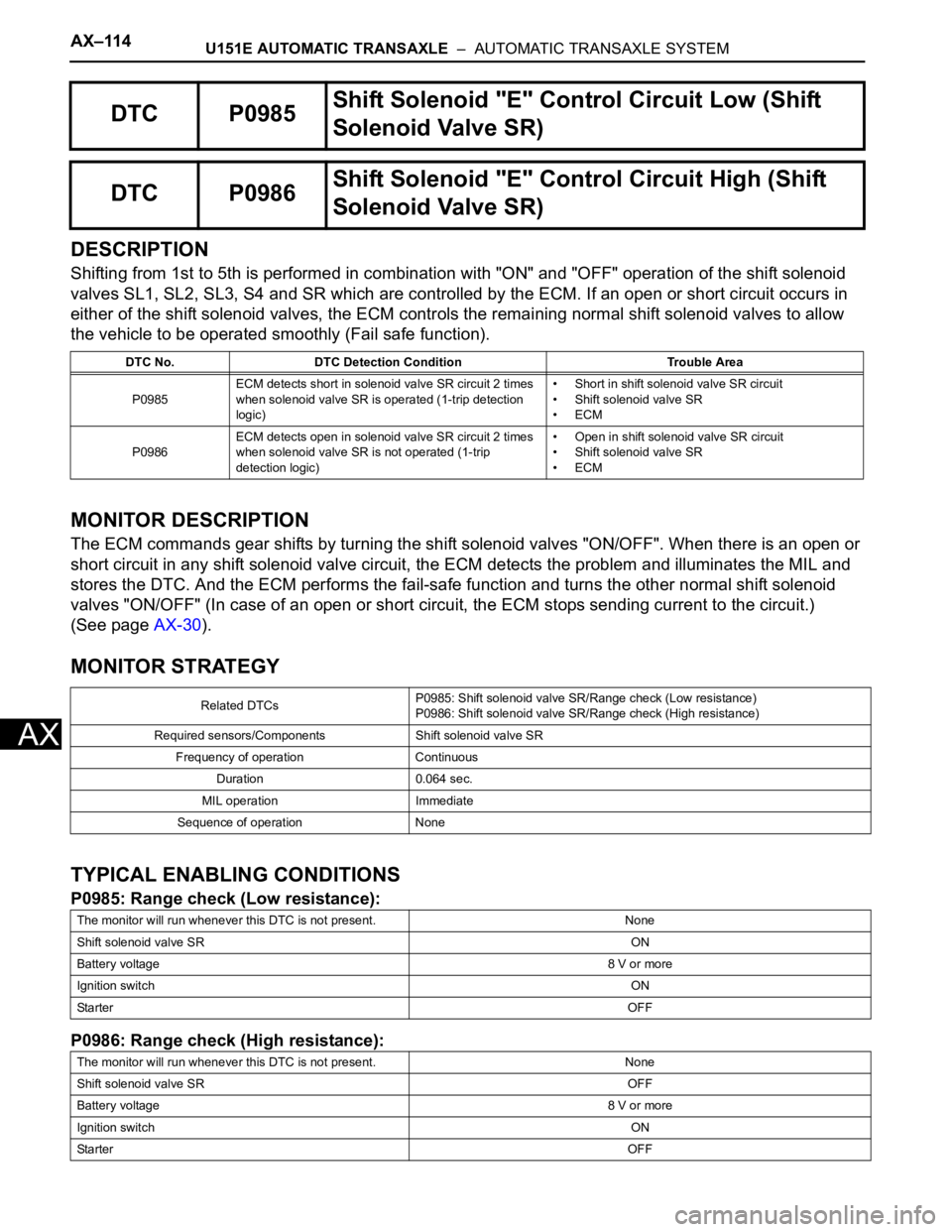
AX–114U151E AUTOMATIC TRANSAXLE – AUTOMATIC TRANSAXLE SYSTEM
AX
DESCRIPTION
Shifting from 1st to 5th is performed in combination with "ON" and "OFF" operation of the shift solenoid
valves SL1, SL2, SL3, S4 and SR which are controlled by the ECM. If an open or short circuit occurs in
either of the shift solenoid valves, the ECM controls the remaining normal shift solenoid valves to allow
the vehicle to be operated smoothly (Fail safe function).
MONITOR DESCRIPTION
The ECM commands gear shifts by turning the shift solenoid valves "ON/OFF". When there is an open or
short circuit in any shift solenoid valve circuit, the ECM detects the problem and illuminates the MIL and
stores the DTC. And the ECM performs the fail-safe function and turns the other normal shift solenoid
valves "ON/OFF" (In case of an open or short circuit, the ECM stops sending current to the circuit.)
(See page AX-30).
MONITOR STRATEGY
TYPICAL ENABLING CONDITIONS
P0985: Range check (Low resistance):
P0986: Range check (High resistance):
DTC P0985Shift Solenoid "E" Control Circuit Low (Shift
Solenoid Valve SR)
DTC P0986Shift Solenoid "E" Control Circuit High (Shift
Solenoid Valve SR)
DTC No. DTC Detection Condition Trouble Area
P0985ECM detects short in solenoid valve SR circuit 2 times
when solenoid valve SR is operated (1-trip detection
logic)• Short in shift solenoid valve SR circuit
• Shift solenoid valve SR
•ECM
P0986ECM detects open in solenoid valve SR circuit 2 times
when solenoid valve SR is not operated (1-trip
detection logic)• Open in shift solenoid valve SR circuit
• Shift solenoid valve SR
•ECM
Related DTCsP0985: Shift solenoid valve SR/Range check (Low resistance)
P0986: Shift solenoid valve SR/Range check (High resistance)
Required sensors/Components Shift solenoid valve SR
Frequency of operation Continuous
Duration 0.064 sec.
MIL operation Immediate
Sequence of operation None
The monitor will run whenever this DTC is not present. None
Shift solenoid valve SRON
Battery voltage8 V or more
Ignition switchON
StarterOFF
The monitor will run whenever this DTC is not present. None
Shift solenoid valve SROFF
Battery voltage8 V or more
Ignition switchON
StarterOFF
Page 1483 of 3000
U151E AUTOMATIC TRANSAXLE – AUTOMATIC TRANSAXLE SYSTEMAX–117
AX
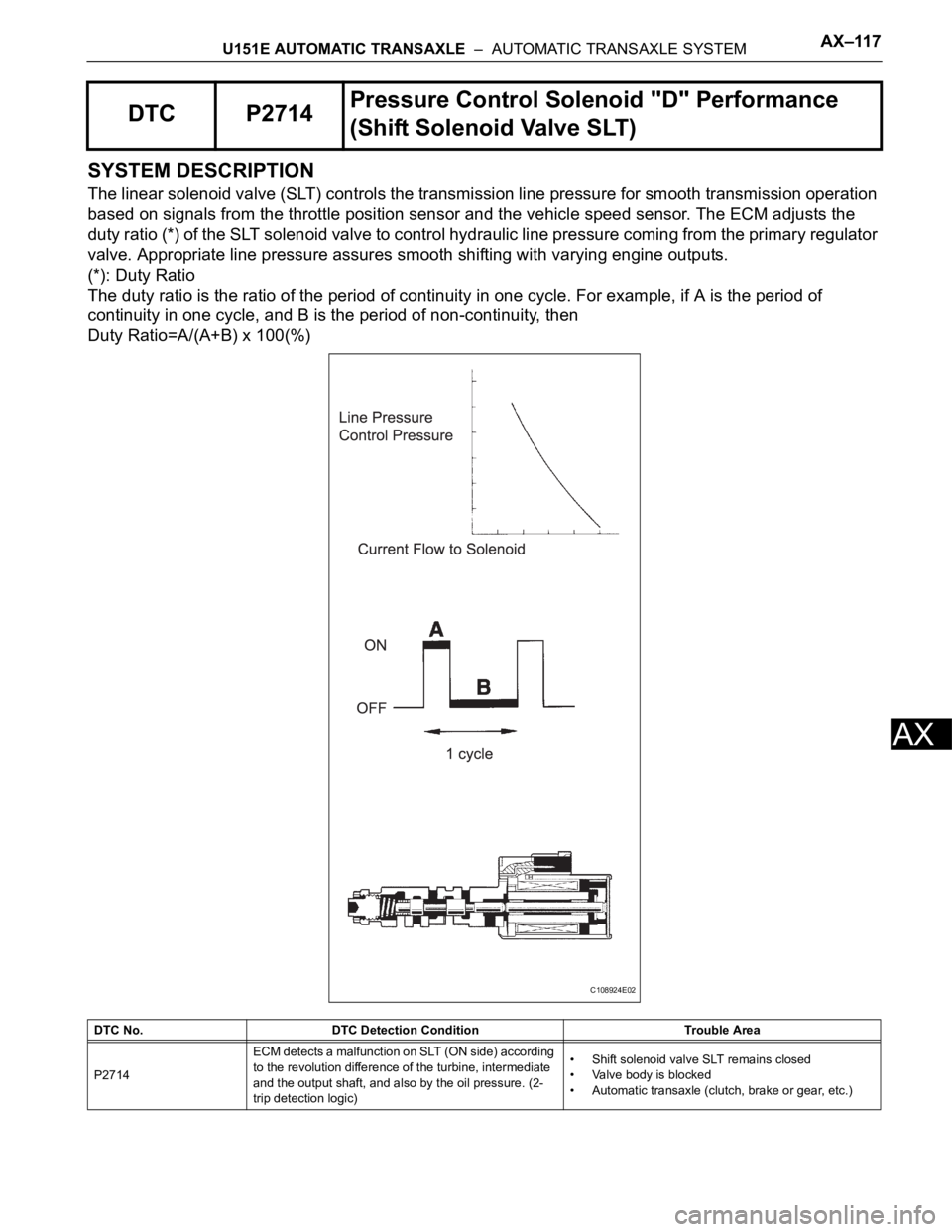
SYSTEM DESCRIPTION
The linear solenoid valve (SLT) controls the transmission line pressure for smooth transmission operation
based on signals from the throttle position sensor and the vehicle speed sensor. The ECM adjusts the
duty ratio (*) of the SLT solenoid valve to control hydraulic line pressure coming from the primary regulator
valve. Appropriate line pressure assures smooth shifting with varying engine outputs.
(*): Duty Ratio
The duty ratio is the ratio of the period of continuity in one cycle. For example, if A is the period of
continuity in one cycle, and B is the period of non-continuity, then
Duty Ratio=A/(A+B) x 100(%)
DTC P2714Pressure Control Solenoid "D" Performance
(Shift Solenoid Valve SLT)
DTC No. DTC Detection Condition Trouble Area
P2714ECM detects a malfunction on SLT (ON side) according
to the revolution difference of the turbine, intermediate
and the output shaft, and also by the oil pressure. (2-
trip detection logic)• Shift solenoid valve SLT remains closed
• Valve body is blocked
• Automatic transaxle (clutch, brake or gear, etc.)
C108924E02
Page 1484 of 3000

AX–118U151E AUTOMATIC TRANSAXLE – AUTOMATIC TRANSAXLE SYSTEM
AX
MONITOR DESCRIPTION
In any forward position, when the difference between the revolutions of the turbine, Intermediate and
output shaft exceeds the specified value (varies with Intermediate, output speed) determined by the ECM,
the ECM illuminates the MIL and store the DTC.
When shift solenoid valve SLT remains on, the oil pressure goes down and the clutch engagement force
decreases.
NOTICE:
If you continue driving under these conditions, the clutch will burn out and the vehicle will no
longer be drivable.
MONITOR STRATEGY
TYPICAL ENABLING CONDITIONS
ON malfunction:
ON malfunction (A):
Related DTCs P2714: Shift solenoid valve SLT/ON malfunction
Required sensors/ComponentsShift solenoid valve SLT, Speed sensor (NT), Speed sensor (NC),
Crankshaft position sensor (NE)
Frequency of operation Continuous
Duration 0.5 sec.
MIL operation 2 driving cycles
Sequence of operation None
The monitor will run whenever this DTC is not present. None
Transmission range"D"
TFT (Transmission fluid temperature) -20
C (-4F) or more
TFT sensor circuitNot circuit malfunction
Turbine speed sensor circuit Not circuit malfunction
Intermediate shaft speed sensor circuit Not circuit malfunction
Output speed sensor circuitNot circuit malfunction
Shift solenoid valve SL1 circuit Not circuit malfunction
Shift solenoid valve SL2 circuit Not circuit malfunction
Shift solenoid valve SL3 circuit Not circuit malfunction
Shift solenoid valve S4 circuit Not circuit malfunction
Shift solenoid valve SR circuit Not circuit malfunction
Shift solenoid valve DSL circuit Not circuit malfunction
Shift solenoid valve SLT circuit Not circuit malfunction
Electronic throttle systemNot circuit malfunction
ECM selected gear 1st
Temporary MAIN gear 1st or 2nd or 3rd or 4th
NT - NC x Temporary MAIN gear ratio
NT: Input (turbine) speed
NC: Intermediate shaft speed100 rpm or more at Intermediate shaft speed 1,000 rpm
Temporary U/D gear Low
NC - NO x Temporary U/D gear ratio
NO: Output speed300 rpm or more at Output speed 1,000 rpm
TT
TT: Turbine Torque900 Nm or more
NT 250 rpm or more
NC 250 rpm or more
NO 250 rpm or more
Page 1489 of 3000
U151E AUTOMATIC TRANSAXLE – AUTOMATIC TRANSAXLE SYSTEMAX–123
AX
DESCRIPTION
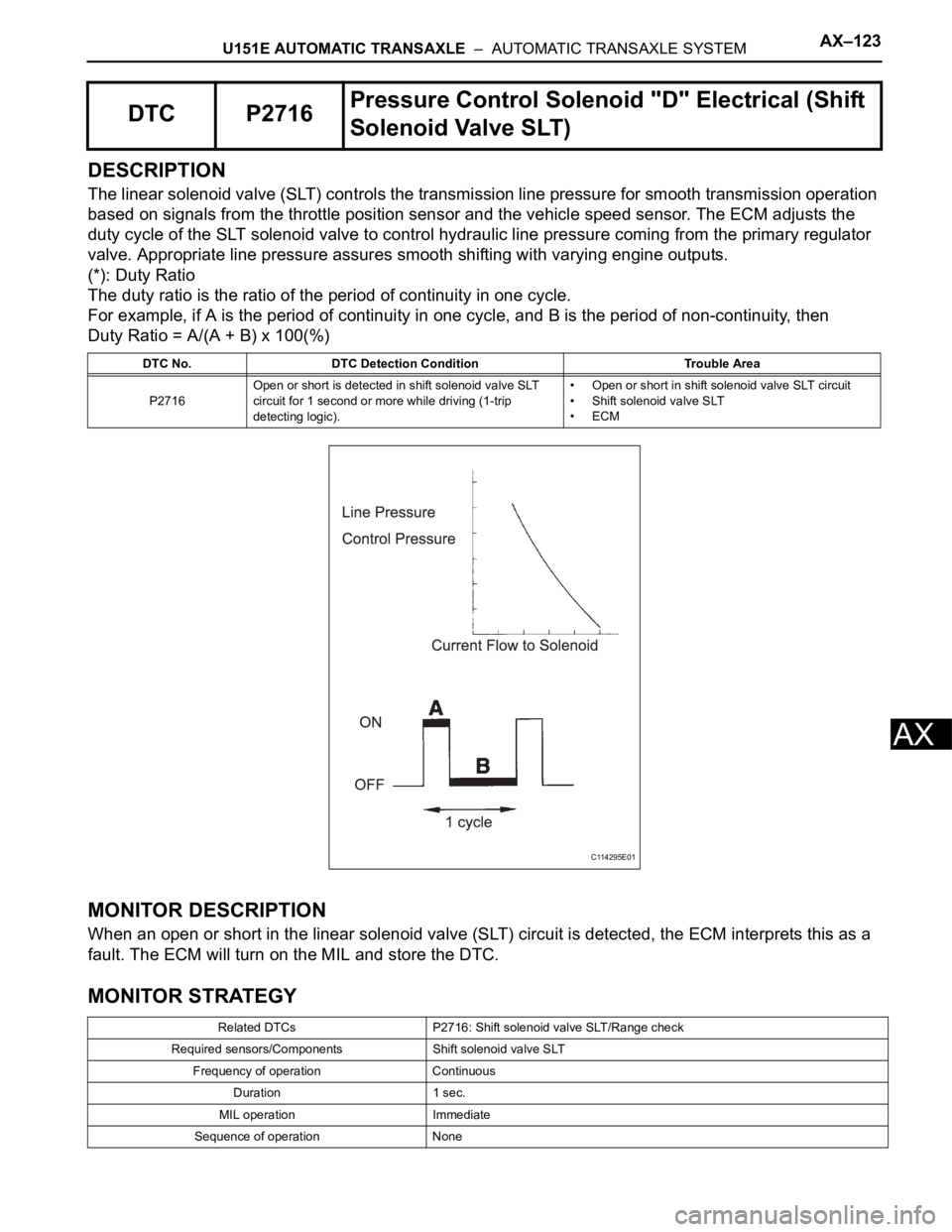
The linear solenoid valve (SLT) controls the transmission line pressure for smooth transmission operation
based on signals from the throttle position sensor and the vehicle speed sensor. The ECM adjusts the
duty cycle of the SLT solenoid valve to control hydraulic line pressure coming from the primary regulator
valve. Appropriate line pressure assures smooth shifting with varying engine outputs.
(*): Duty Ratio
The duty ratio is the ratio of the period of continuity in one cycle.
For example, if A is the period of continuity in one cycle, and B is the period of non-continuity, then
Duty Ratio = A/(A + B) x 100(%)
MONITOR DESCRIPTION
When an open or short in the linear solenoid valve (SLT) circuit is detected, the ECM interprets this as a
fault. The ECM will turn on the MIL and store the DTC.
MONITOR STRATEGY
DTC P2716Pressure Control Solenoid "D" Electrical (Shift
Solenoid Valve SLT)
DTC No. DTC Detection Condition Trouble Area
P2716Open or short is detected in shift solenoid valve SLT
circuit for 1 second or more while driving (1-trip
detecting logic).• Open or short in shift solenoid valve SLT circuit
• Shift solenoid valve SLT
•ECM
Related DTCs P2716: Shift solenoid valve SLT/Range check
Required sensors/Components Shift solenoid valve SLT
Frequency of operation Continuous
Duration 1 sec.
MIL operation Immediate
Sequence of operation None
C114295E01
Page 1493 of 3000

U151E AUTOMATIC TRANSAXLE – AUTOMATIC TRANSAXLE SYSTEMAX–127
AX
DESCRIPTION
The shift solenoid valve DSL is turned "ON" and "OFF" by signals from the ECM in order to control the
hydraulic pressure operation, the lock-up relay valve, which then controls operation of the lock-up clutch.
MONITOR DESCRIPTION
Torque converter lock-up is controlled by the ECM based on engine rpm, engine load, engine
temperature, vehicle speed, transmission temperature, and shift range selection. The ECM determines
the lock-up status of the torque converter by comparing the engine rpm (NE) to the input turbine rpm (NT).
The ECM calculates the actual transmission gear by comparing input turbine rpm (NT) to counter gear
rpm (NC). When conditions are appropriate, the ECM requests "lock-up" by applying control voltage to the
shift solenoid DSL. When the DSL is opened, it applies pressure to the lock-up relay valve and locks the
torque converter clutch. If the ECM detects an open or short in the DSL solenoid circuit, the ECM
interprets this as a fault in the DSL solenoid or circuit. The ECM will turn on the MIL and store the DTC.
MONITOR STRATEGY
TYPICAL ENABLING CONDITIONS
P2769: Range check (Low resistance):
P2770: Range check (High resistance):
DTC P2769Torque Converter Clutch Solenoid Circuit Low
(Shift Solenoid Valve DSL)
DTC P2770Torque Converter Clutch Solenoid Circuit High
(Shift Solenoid Valve DSL)
DTC No. DTC Detection Condition Trouble Area
P2769ECM detects short in solenoid valve DSL circuit (0.1
sec.) when solenoid valve DSL is operated (2-trip
detection logic)• Short in shift solenoid valve DSL circuit
• Shift solenoid valve DSL
•ECM
P2770ECM detects open in solenoid valve DSL circuit (0.1
sec.) when solenoid valve DSL is not operated (2-trip
detection logic)• Open in shift solenoid valve DSL circuit
• Shift solenoid valve DSL
•ECM
Related DTCsP2769: Shift solenoid valve DSL/Range check (Low resistance)
P2770: Shift solenoid valve DSL/Range check (High resistance)
Required sensors/Components Shift solenoid valve DSL
Frequency of operation Continuous
Duration 0.064 sec. or more
MIL operation 2 driving cycles
Sequence of operation None
The monitor will run whenever this DTC is not present. None
Shift solenoid valve DSLON
Solenoid current cut status Not cut
Battery voltage8 V or more
Ignition switchON
Sta r t e rOFF
The monitor will run whenever this DTC is not present. None
Shift solenoid valve DSLON
Battery voltage8 V or more
Ignition switchON
Page 1514 of 3000
U151E AUTOMATIC TRANSAXLE – TRANSMISSION WIREAX–131
AX
REMOVAL
1. DISCONNECT CABLE FROM NEGATIVE BATTERY
TERMINAL
2. REMOVE ENGINE UNDER COVER NO.1
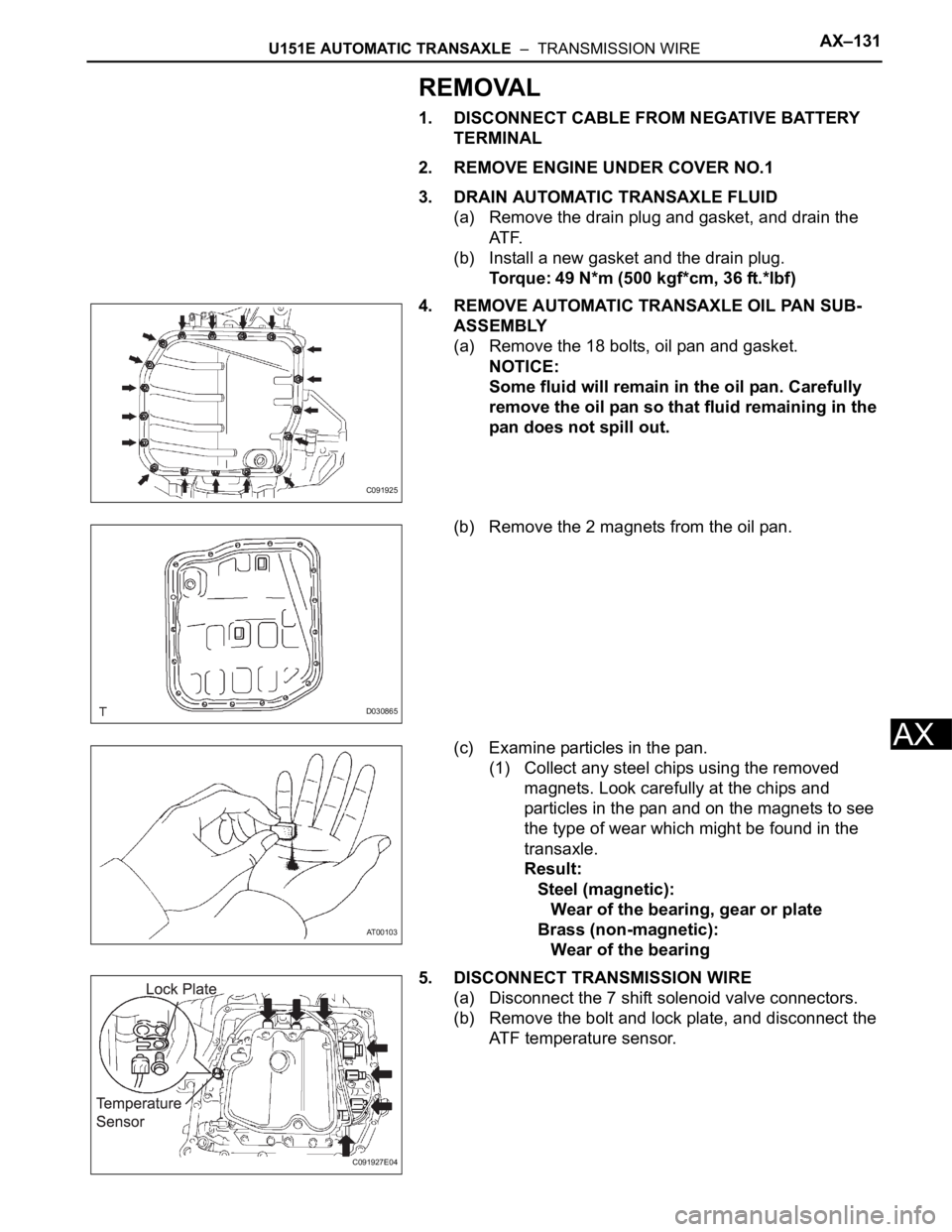
3. DRAIN AUTOMATIC TRANSAXLE FLUID
(a) Remove the drain plug and gasket, and drain the
AT F.
(b) Install a new gasket and the drain plug.
Torque: 49 N*m (500 kgf*cm, 36 ft.*lbf)
4. REMOVE AUTOMATIC TRANSAXLE OIL PAN SUB-
ASSEMBLY
(a) Remove the 18 bolts, oil pan and gasket.
NOTICE:
Some fluid will remain in the oil pan. Carefully
remove the oil pan so that fluid remaining in the
pan does not spill out.
(b) Remove the 2 magnets from the oil pan.
(c) Examine particles in the pan.
(1) Collect any steel chips using the removed
magnets. Look carefully at the chips and
particles in the pan and on the magnets to see
the type of wear which might be found in the
transaxle.
Result:
Steel (magnetic):
Wear of the bearing, gear or plate
Brass (non-magnetic):
Wear of the bearing
5. DISCONNECT TRANSMISSION WIRE
(a) Disconnect the 7 shift solenoid valve connectors.
(b) Remove the bolt and lock plate, and disconnect the
ATF temperature sensor.
C091925
D030865
AT00103
C091927E04
Page 1515 of 3000
AX–132U151E AUTOMATIC TRANSAXLE – TRANSMISSION WIRE
AX
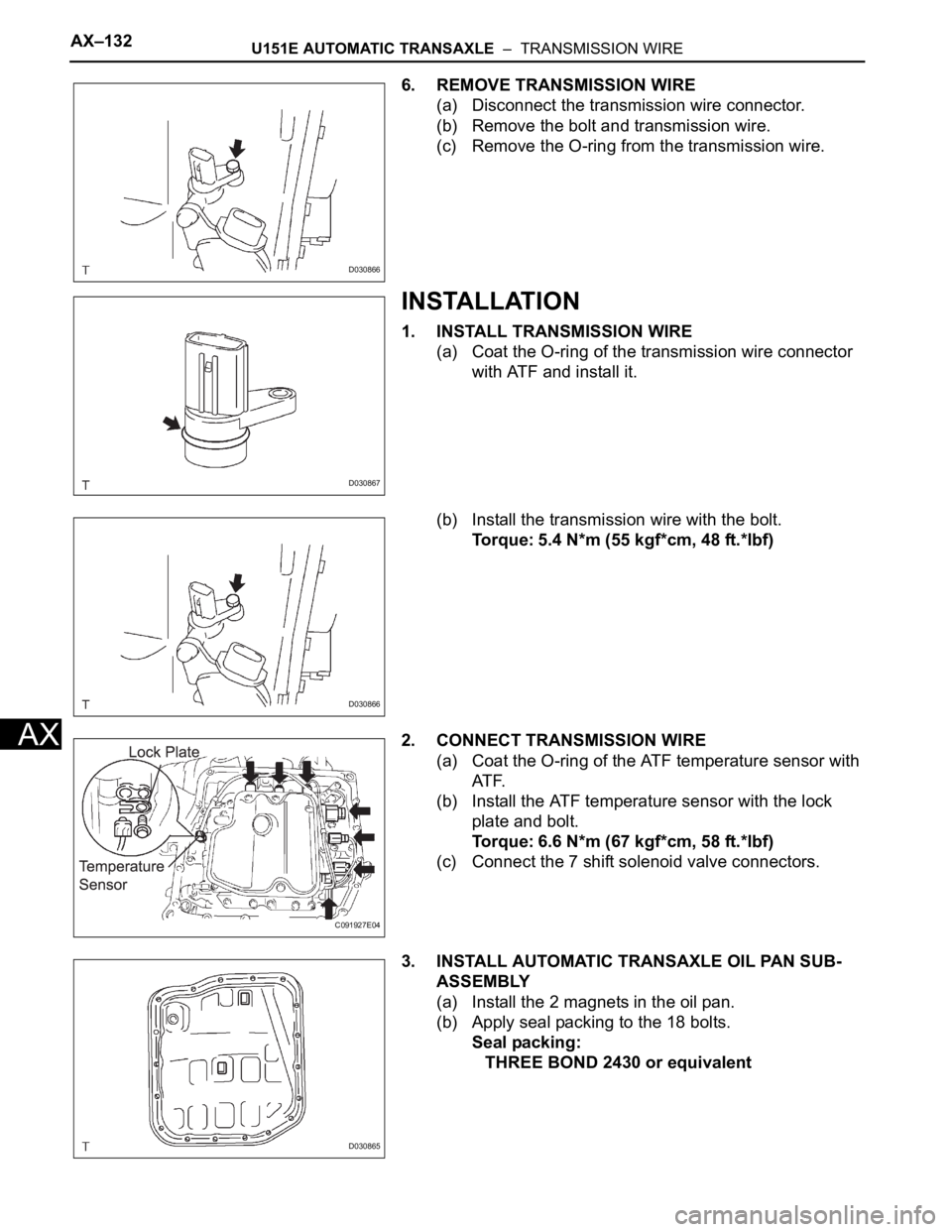
6. REMOVE TRANSMISSION WIRE
(a) Disconnect the transmission wire connector.
(b) Remove the bolt and transmission wire.
(c) Remove the O-ring from the transmission wire.
INSTALLATION
1. INSTALL TRANSMISSION WIRE
(a) Coat the O-ring of the transmission wire connector
with ATF and install it.
(b) Install the transmission wire with the bolt.
Torque: 5.4 N*m (55 kgf*cm, 48 ft.*lbf)
2. CONNECT TRANSMISSION WIRE
(a) Coat the O-ring of the ATF temperature sensor with
AT F.
(b) Install the ATF temperature sensor with the lock
plate and bolt.
Torque: 6.6 N*m (67 kgf*cm, 58 ft.*lbf)
(c) Connect the 7 shift solenoid valve connectors.
3. INSTALL AUTOMATIC TRANSAXLE OIL PAN SUB-
ASSEMBLY
(a) Install the 2 magnets in the oil pan.
(b) Apply seal packing to the 18 bolts.
Seal packing:
THREE BOND 2430 or equivalent
D030866
D030867
D030866
C091927E04
D030865
Page 1518 of 3000
U151E AUTOMATIC TRANSAXLE – AUTOMATIC TRANSAXLE SYSTEMAX–21
AX
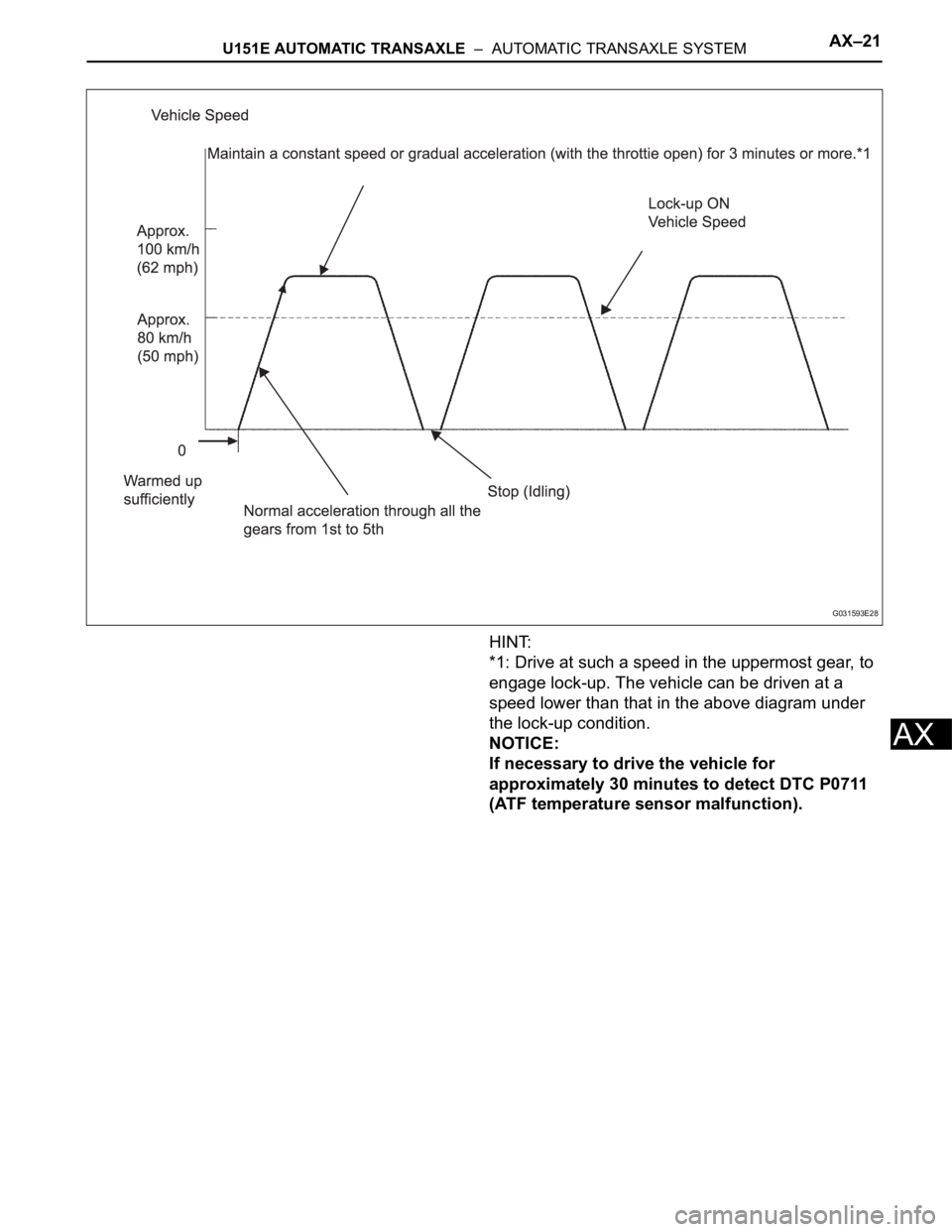
HINT:
*1: Drive at such a speed in the uppermost gear, to
engage lock-up. The vehicle can be driven at a
speed lower than that in the above diagram under
the lock-up condition.
NOTICE:
If necessary to drive the vehicle for
approximately 30 minutes to detect DTC P0711
(ATF temperature sensor malfunction).
G031593E28