ESP TOYOTA SUPRA 2022 Owners Manual
[x] Cancel search | Manufacturer: TOYOTA, Model Year: 2022, Model line: SUPRA, Model: TOYOTA SUPRA 2022Pages: 498, PDF Size: 104.06 MB
Page 299 of 498
297
5
5-1. MOBILITY
MOBILITY
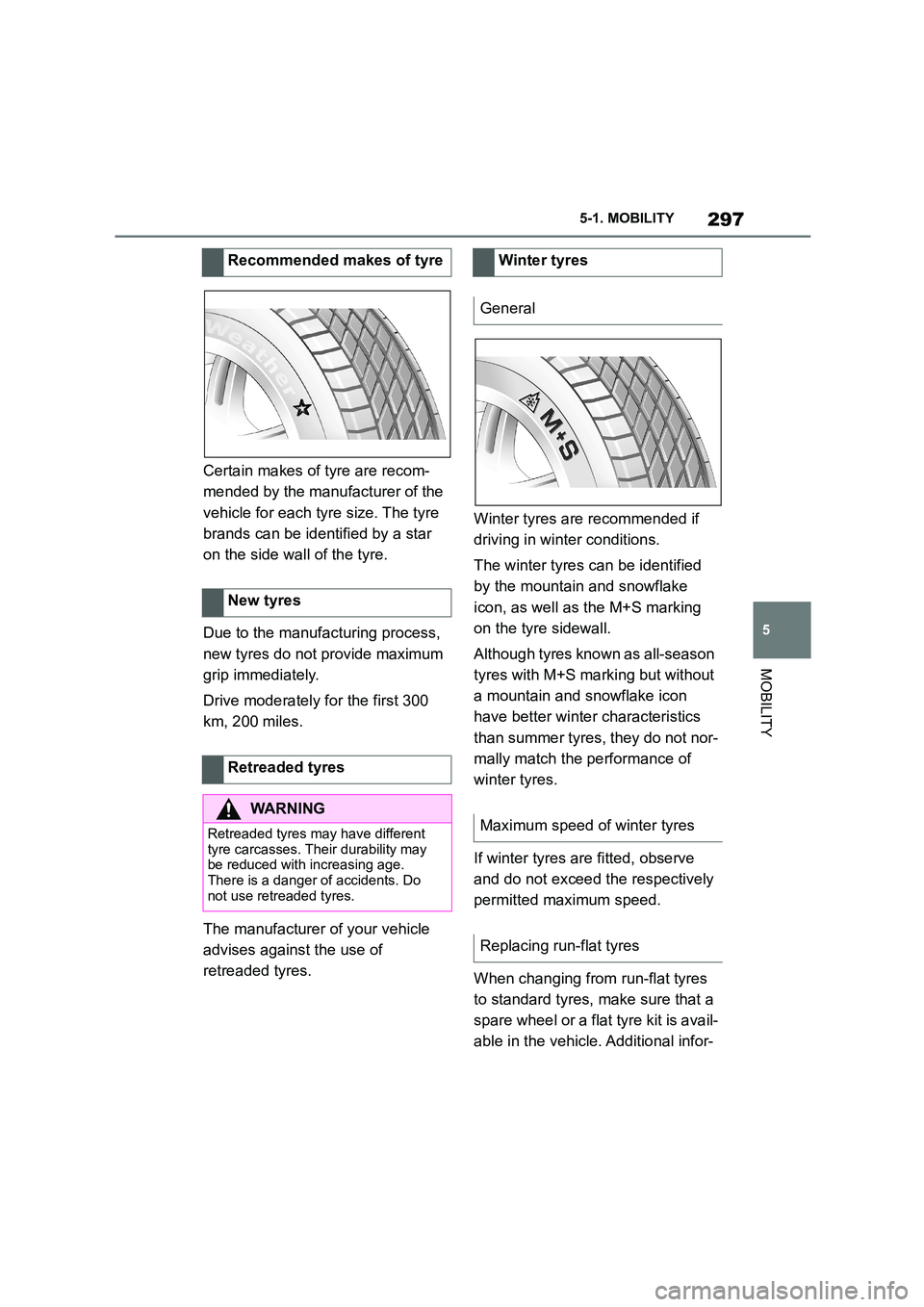
Certain makes of tyre are recom-
mended by the manufacturer of the
vehicle for each tyre size. The tyre
brands can be identified by a star
on the side wall of the tyre.
Due to the manufacturing process,
new tyres do not provide maximum
grip immediately.
Drive moderately for the first 300
km, 200 miles.
The manufacturer of your vehicle
advises against the use of
retreaded tyres.
Winter tyres are recommended if
driving in winter conditions.
The winter tyres can be identified
by the mountain and snowflake
icon, as well as the M+S marking
on the tyre sidewall.
Although tyres known as all-season
tyres with M+S marking but without
a mountain and snowflake icon
have better winter characteristics
than summer tyres, they do not nor-
mally match the performance of
winter tyres.
If winter tyres are fitted, observe
and do not exceed the respectively
permitted maximum speed.
When changing from run-flat tyres
to standard tyres, make sure that a
spare wheel or a flat tyre kit is avail-
able in the vehicle. Additional infor-
Recommended makes of tyre
New tyres
Retreaded tyres
WA R N I N G
Retreaded tyres may have different tyre carcasses. Their durability may
be reduced with increasing age.
There is a danger of accidents. Do not use retreaded tyres.
Winter tyres
General
Maximum speed of winter tyres
Replacing run-flat tyres
Page 321 of 498
319
5
5-1. MOBILITY
MOBILITY
1 Stow the emergency wheel and
the tools for changing wheels in
the bag.
2 Place the bag in the boot.
3 Hook the lashing straps onto the
lashing eyes.
4 Tie the lashing straps. Make
sure that it is seated correctly
and firmly.
This chapter describes all standard,
country-specific and special equip-
ment available for the model series.
It may therefore describe equip-
ment and functions which are not
installed in your vehicle, for exam-
ple on account of the special equip-
ment selected or the country
specification. This also applies to
safety-relevant functions and sys-
tems. Please comply with the rele-
vant laws and regulations when
using the corresponding functions
and systems.
Inserting the emergency
wheel
Engine compar tment
Vehicle equipment
Page 324 of 498
3225-1. MOBILITY
This chapter describes all standard,
country-specific and special equip-
ment available for the model series.
It may therefore describe equip-
ment and functions which are not
installed in your vehicle, for exam-
ple on account of the special equip-
ment selected or the country
specification. This also applies to
safety-relevant functions and sys-
tems. Please comply with the rele-
vant laws and regulations when
using the corresponding functions
and systems.
Depending on the region, many fill-
ing stations sell fuel that is adapted
to winter or summer conditions.
Fuel that is sold in winter facilitates
cold starting, for example.
For optimal fuel consumption, the
petrol should be sulphur-free or
have a low sulphur content.
Fuels labelled on the pump as con-
taining metal must not be used.
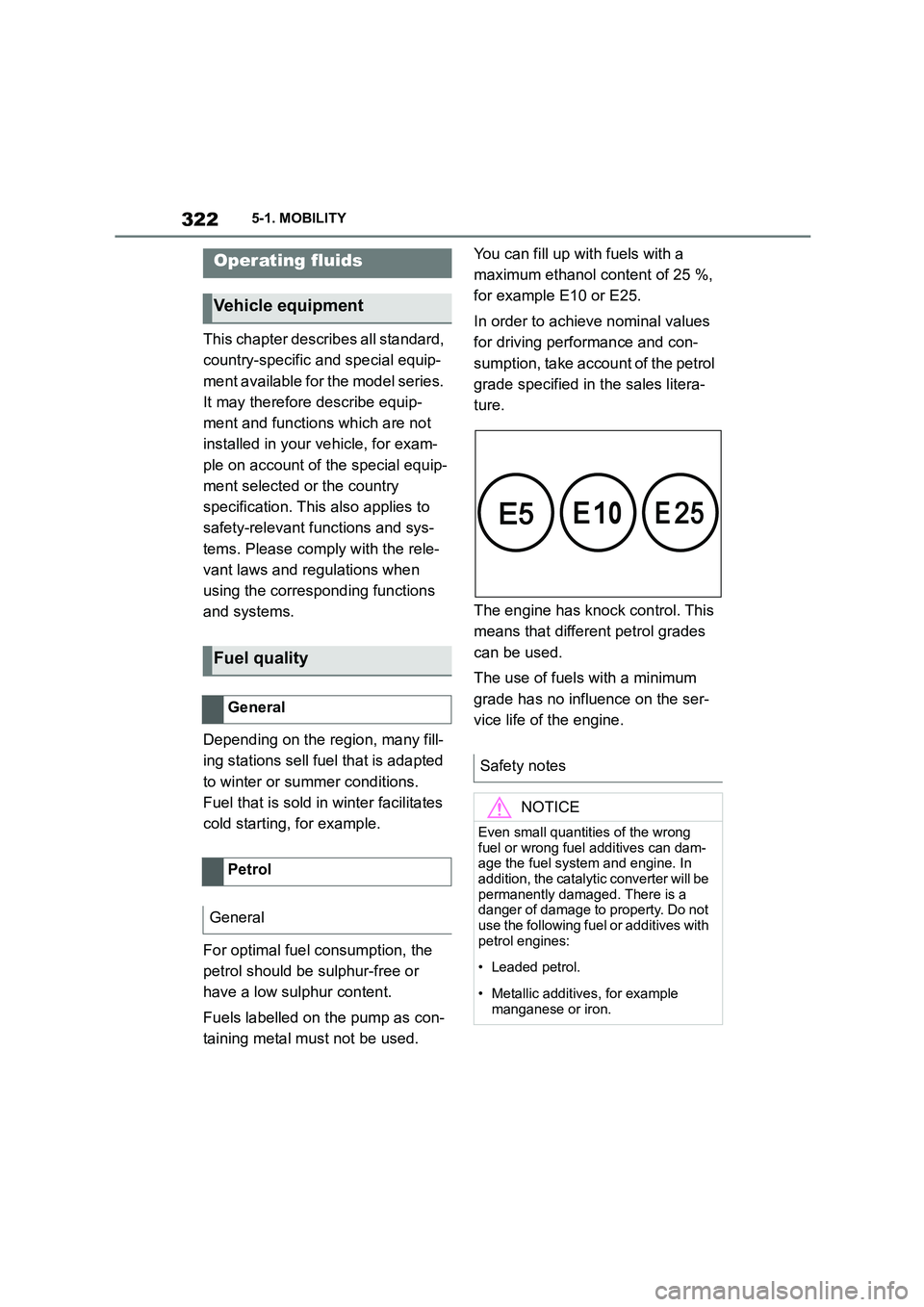
You can fill up with fuels with a
maximum ethanol content of 25 %,
for example E10 or E25.
In order to achieve nominal values
for driving performance and con-
sumption, take account of the petrol
grade specified in the sales litera-
ture.
The engine has knock control. This
means that different petrol grades
can be used.
The use of fuels with a minimum
grade has no influence on the ser-
vice life of the engine.
Operating fluids
Vehicle equipment
Fuel quality
General
Petrol
General
Safety notes
NOTICE
Even small quantities of the wrong
fuel or wrong fuel additives can dam- age the fuel system and engine. In
addition, the catalytic converter will be
permanently damaged. There is a danger of damage to property. Do not
use the following fuel or additives with
petrol engines:
• Leaded petrol.
• Metallic additives, for example
manganese or iron.
Page 332 of 498
3305-1. MOBILITY
This chapter describes all standard,
country-specific and special equip-
ment available for the model series.
It may therefore describe equip-
ment and functions which are not
installed in your vehicle, for exam-
ple on account of the special equip-
ment selected or the country
specification. This also applies to
safety-relevant functions and sys-
tems. Please comply with the rele-
vant laws and regulations when
using the corresponding functions
and systems.
The maintenance system indicates
what maintenance measures are
required and thereby assists in
maintaining the road safety and
operational safety of the vehicle.
The exact work required and the
maintenance intervals may vary
depending on the country specifica-
tions. Replacement work, spare
parts, operating materials and wear
materials are calculated sepa-
rately. Additional information is
available from a dealer of the man-
ufacturer or another qualified dealer
or a specialist workshop.
Condition Based Service CBS
determines the maintenance
requirement using sensors and
special algorithms which monitor
the conditions in which the vehicle
is used.
The system thus enables the scope
of the maintenance work to be
adapted to the individual usage
profile.
Information on service require-
ments, see page 170, can be
shown on the Control Display.
Periods when the vehicle is out of
use with its battery disconnected
are not taken into account.
In such cases, have any
time-dependent maintenance pro-
cedures, for example for the brake
fluid and, where applicable, the
engine oil and microfilter/activated
charcoal filter, updated by a dealer
of the manufacturer or another
qualified dealer or a specialist
workshop.
Maintenance
Vehicle equipment
Maintenance System
Condition Based Service
CBS
Principle
General
Periods out of use
Page 341 of 498
339
5
5-1. MOBILITY
MOBILITY
This chapter describes all standard,
country-specific and special equip-
ment available for the model series.
It may therefore describe equip-
ment and functions which are not
installed in your vehicle, for exam-
ple on account of the special equip-
ment selected or the country
specification. This also applies to
safety-relevant functions and sys-
tems. Please comply with the rele-
vant laws and regulations when
using the corresponding functions
and systems.
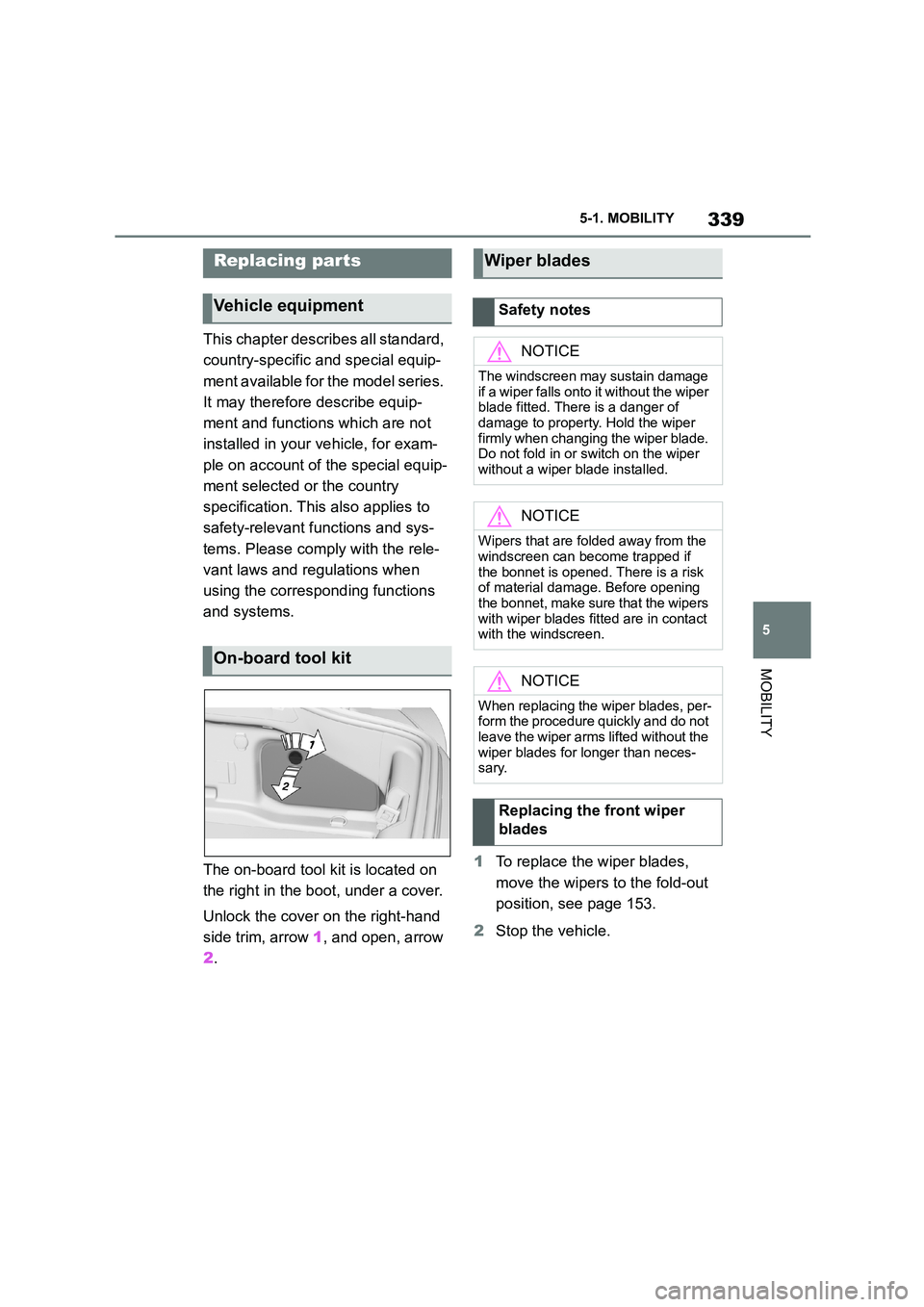
The on-board tool kit is located on
the right in the boot, under a cover.
Unlock the cover on the right-hand
side trim, arrow 1, and open, arrow
2 .
1 To replace the wiper blades,
move the wipers to the fold-out
position, see page 153.
2 Stop the vehicle.
Replacing par ts
Vehicle equipment
On-board tool kit
Wiper blades
Safety notes
NOTICE
The windscreen may sustain damage
if a wiper falls onto it without the wiper
blade fitted. There is a danger of
damage to property. Hold the wiper firmly when changing the wiper blade.
Do not fold in or switch on the wiper
without a wiper blade installed.
NOTICE
Wipers that are folded away from the
windscreen can become trapped if the bonnet is opened. There is a risk
of material damage. Before opening
the bonnet, make sure that the wipers with wiper blades fitted are in contact
with the windscreen.
NOTICE
When replacing the wiper blades, per- form the procedure quickly and do not
leave the wiper arms lifted without the
wiper blades for longer than neces- sary.
Replacing the front wiper
blades
Page 342 of 498
3405-1. MOBILITY
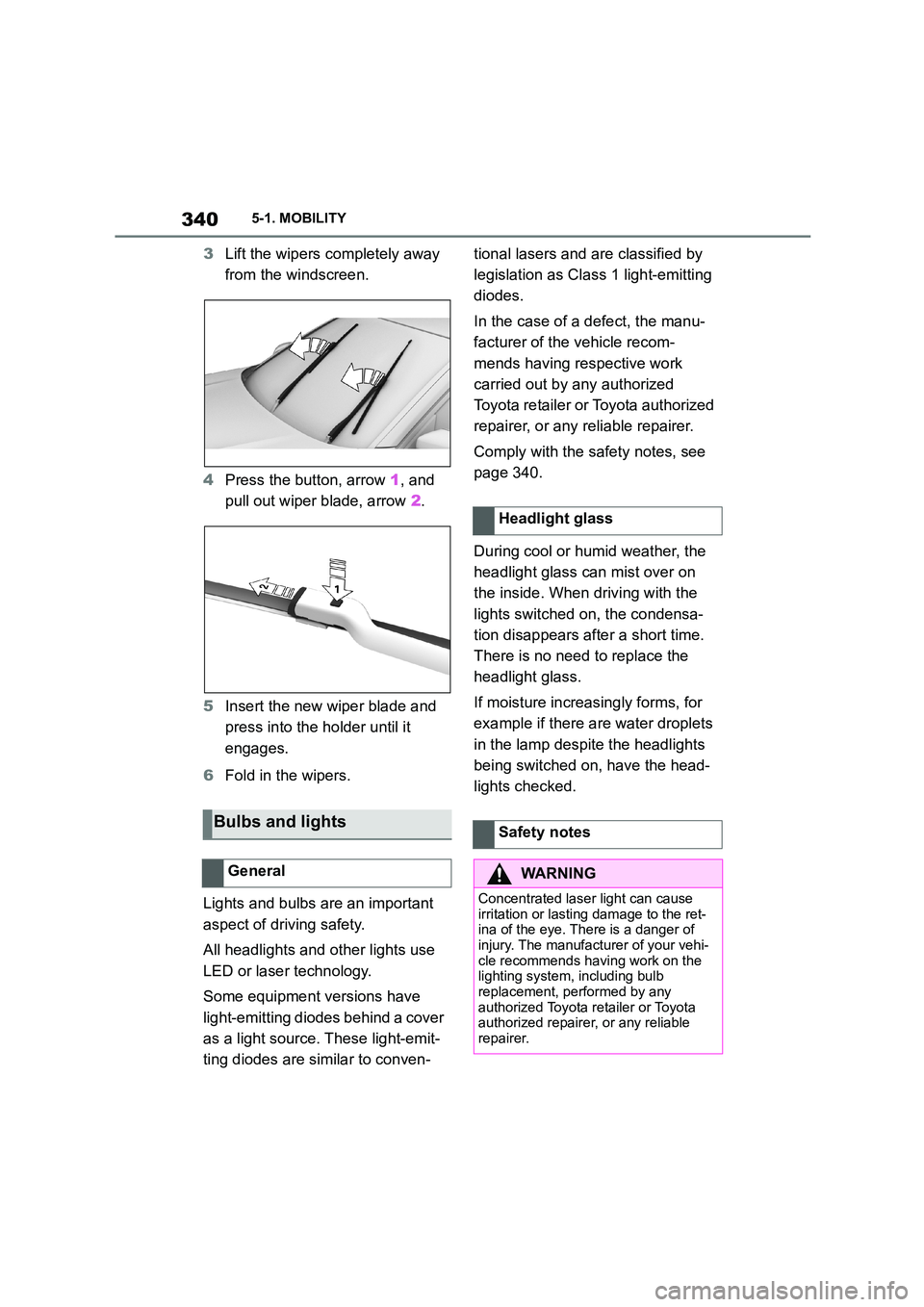
3Lift the wipers completely away
from the windscreen.
4 Press the button, arrow 1, and
pull out wiper blade, arrow 2.
5 Insert the new wiper blade and
press into the ho lder until it
engages.
6 Fold in the wipers.
Lights and bulbs are an important
aspect of driving safety.
All headlights and other lights use
LED or laser technology.
Some equipment versions have
light-emitting diodes behind a cover
as a light source. These light-emit-
ting diodes are similar to conven-
tional lasers and are classified by
legislation as Class 1 light-emitting
diodes.
In the case of a defect, the manu-
facturer of the vehicle recom-
mends having respective work
carried out by any authorized
Toyota retailer or Toyota authorized
repairer, or any reliable repairer.
Comply with the safety notes, see
page 340.
During cool or humid weather, the
headlight glass can mist over on
the inside. When driving with the
lights switched on, the condensa-
tion disappears after a short time.
There is no need to replace the
headlight glass.
If moisture increasingly forms, for
example if there are water droplets
in the lamp despite the headlights
being switched on, have the head-
lights checked.
Bulbs and lights
General
Headlight glass
Safety notes
WA R N I N G
Concentrated laser light can cause
irritation or lasting damage to the ret- ina of the eye. There is a danger of
injury. The manufacturer of your vehi-
cle recommends having work on the lighting system, including bulb
replacement, performed by any
authorized Toyota retailer or Toyota authorized repairer, or any reliable
repairer.
Page 344 of 498
3425-1. MOBILITY
The installed battery is designed
specifically for this vehicle. If an
inappropriate battery is used, oper-
ation of the Auto Start/Stop function
may be restricted in order to protect
the battery. Also, the battery may
deteriorate faster than normal and
the engine may not be able to be
restarted. Contact any authorized
Toyota retailer or Toyota authorized
repairer, or any reliable repairer.
The battery is operational. No spe-
cial precautions are required for
start-up.
Ensure the battery is sufficiently
charged to guarantee the entire life-
time of the battery.
Charge the battery under the fol-
lowing circumstances:
If the inspection glass on the top
of the battery is black.
If there is insufficient starting
capability.
The following condit ions can have a
negative effect on battery output:
Frequently driving short dis-
tances.
If the vehicle is not used for peri-
ods of longer than one month.
Only charge the battery via the
jump-starting connections, see
page 358, in the engine compart-
ment and with the engine switched
off.
Battery chargers developed espe-
cially for the vehicle and suitable for
the on-board network can be
obtained from any authorized
Toyota retailer or Toyota authorized
Follow the user manual.
Explosive gas mixture.
Do not seal any open-
ings on the battery.
When replacing the battery
Initial operation
Charging the battery
General
A red indicator lamp is dis-
played if the battery is flat.
SymbolMeaning
Safety note
NOTICE
Battery chargers for the vehicle bat-
tery may operate with high voltages
and high currents which can overload or damage the 12-volt onboard net-
work. There is a danger of damage to
property. Only connect battery charg- ers for the vehicle battery to the
jump-starting connections in the
engine compartment.
Jump-starting connections
Battery charger
Page 352 of 498
3505-1. MOBILITY
This chapter describes all standard,
country-specific and special equip-
ment available for the model series.
It may therefore describe equip-
ment and functions which are not
installed in your vehicle, for exam-
ple on account of the special equip-
ment selected or the country
specification. This also applies to
safety-relevant functions and sys-
tems. Please comply with the rele-
vant laws and regulations when
using the corresponding functions
and systems.
Breakdown Assist
Vehicle equipment
If a malfunction occurs
while driving
WA R N I N G
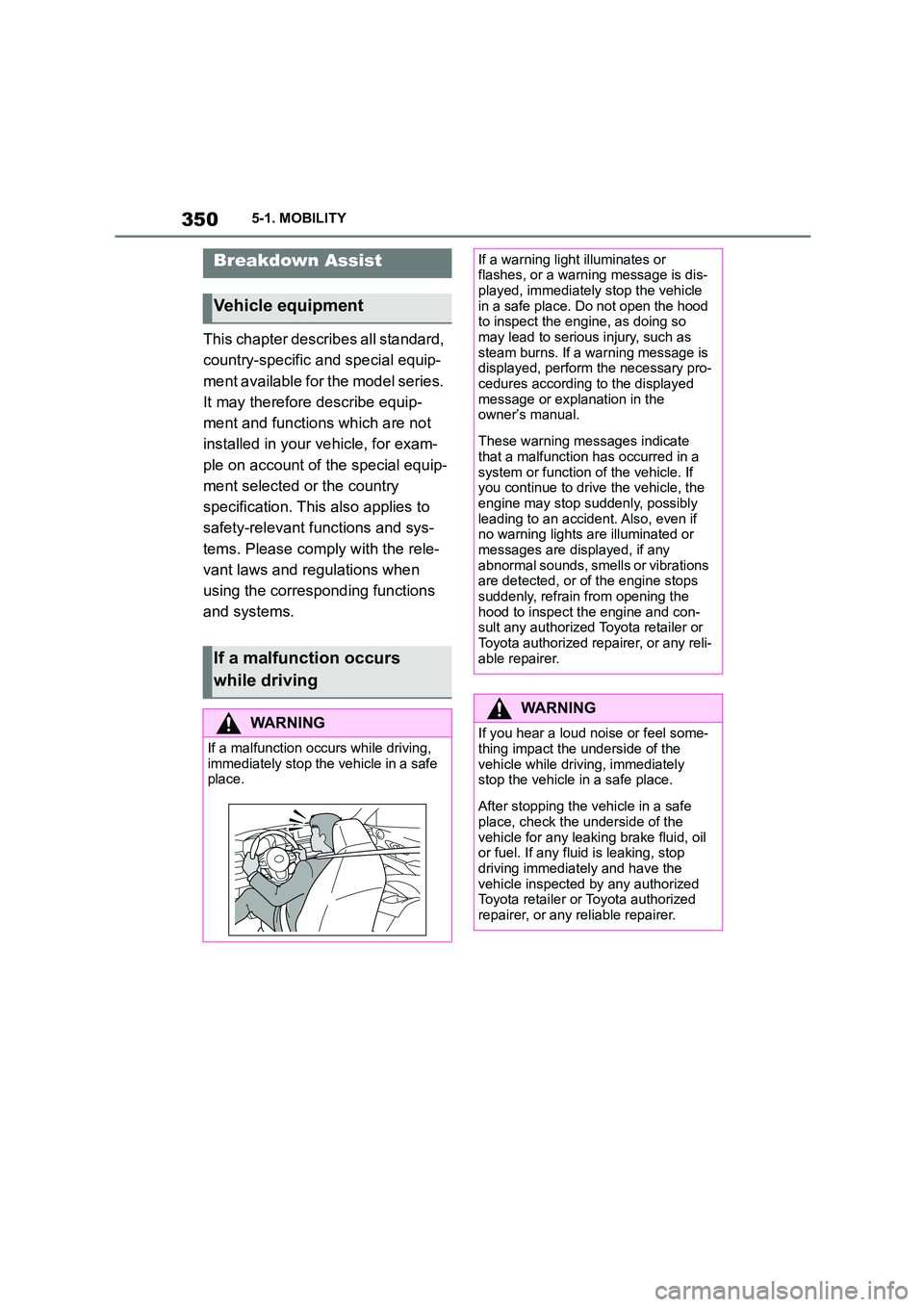
If a malfunction occurs while driving,
immediately stop the vehicle in a safe
place.
If a warning light illuminates or flashes, or a warning message is dis-
played, immediately stop the vehicle
in a safe place. Do not open the hood to inspect the engine, as doing so
may lead to serious injury, such as
steam burns. If a warning message is displayed, perform the necessary pro-
cedures according to the displayed
message or explanation in the owner’s manual.
These warning messages indicate that a malfunction has occurred in a
system or function of the vehicle. If
you continue to drive the vehicle, the engine may stop suddenly, possibly
leading to an accident. Also, even if
no warning lights are illuminated or messages are displayed, if any
abnormal sounds, smells or vibrations
are detected, or of the engine stops suddenly, refrain from opening the
hood to inspect the engine and con-
sult any authorized Toyota retailer or Toyota authorized repairer, or any reli-
able repairer.
WA R N I N G
If you hear a loud noise or feel some-
thing impact the underside of the vehicle while driving, immediately
stop the vehicle in a safe place.
After stopping the vehicle in a safe
place, check the underside of the
vehicle for any leaking brake fluid, oil or fuel. If any fluid is leaking, stop
driving immediately and have the
vehicle inspected by any authorized Toyota retailer or Toyota authorized
repairer, or any reliable repairer.
Page 353 of 498
351
5
5-1. MOBILITY
MOBILITY
WA R N I N G
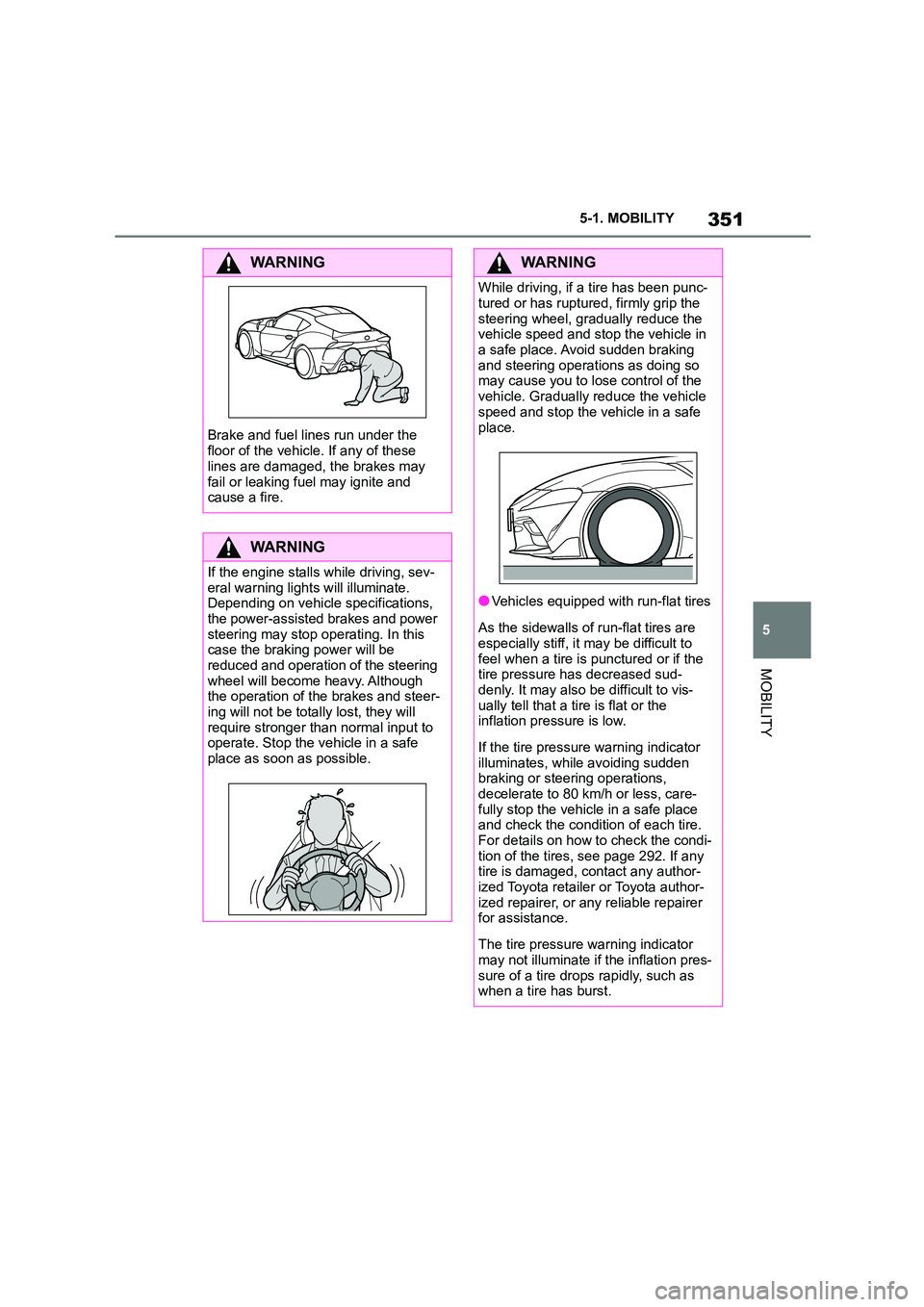
Brake and fuel lines run under the
floor of the vehicle. If any of these
lines are damaged, the brakes may
fail or leaking fuel may ignite and cause a fire.
WA R N I N G
If the engine stalls while driving, sev-
eral warning lights will illuminate. Depending on vehicle specifications,
the power-assisted brakes and power
steering may stop operating. In this case the braking power will be
reduced and operation of the steering
wheel will become heavy. Although the operation of the brakes and steer-
ing will not be totally lost, they will
require stronger than normal input to
operate. Stop the vehicle in a safe place as soon as possible.
WA R N I N G
While driving, if a tire has been punc-
tured or has ruptured, firmly grip the
steering wheel, gradually reduce the vehicle speed and stop the vehicle in
a safe place. Avoid sudden braking
and steering operations as doing so may cause you to lo se control of the
vehicle. Gradually reduce the vehicle
speed and stop the vehicle in a safe
place.
●Vehicles equipped with run-flat tires
As the sidewalls of run-flat tires are
especially stiff, it may be difficult to
feel when a tire is punctured or if the tire pressure has decreased sud-
denly. It may also be difficult to vis-
ually tell that a tire is flat or the inflation pressure is low.
If the tire pressure warning indicator illuminates, while avoiding sudden
braking or steering operations,
decelerate to 80 km /h or less, care- fully stop the vehicle in a safe place
and check the condition of each tire.
For details on how to check the condi- tion of the tires, see page 292. If any
tire is damaged, contact any author-
ized Toyota retailer or Toyota author- ized repairer, or any reliable repairer
for assistance.
The tire pressure warning indicator
may not illuminate if the inflation pres-
sure of a tire drops rapidly, such as when a tire has burst.
Page 356 of 498
3545-1. MOBILITY
Standby state is switched on.
Emergency call system is func-
tional.
If the vehicle is equipped with
automatic emergency call: the
SIM card integrated in the vehi-
cle is activated.
In certain circumstances, for exam-
ple deployment of the airbags, an
emergency call may be placed
automatically immediately after an
accident of corresponding severity.
An automatic emergency call is not
influenced by pressing the SOS
button.
1 Tap on cover flap.
2 Press and hold the SOS button
until the LED in the button area
is illuminated green.
The LED is illuminated green
when the emergency call has
been activated.
If a cancellation request is displayed on
the Control Display, the emergency call
can be cancelled.
If the situation permits, wait in the vehi-
cle until voice contact has been estab-
lished.
The LED flashes green when the
connection to the emergency
number has been established.
In the case of an emergency call, data
is sent to the public rescue coordination
centre in order to decide what rescue
measures are required. The data may
include, for example, the current posi-
tion of the vehicle, if this can be deter-
mined.
For information on data transfer and
storage, see page 16.
Even if you can no longer hear the res-
cue coordination centre through the
loudspeakers, the rescue coordination
centre may still be able to hear you
speak.
The rescue coordination centre
ends the emergency call.
The emergency call function may
be impaired.
The LED in the SOS button area
illuminates for appr ox. 30 seconds.
A vehicle message is shown.
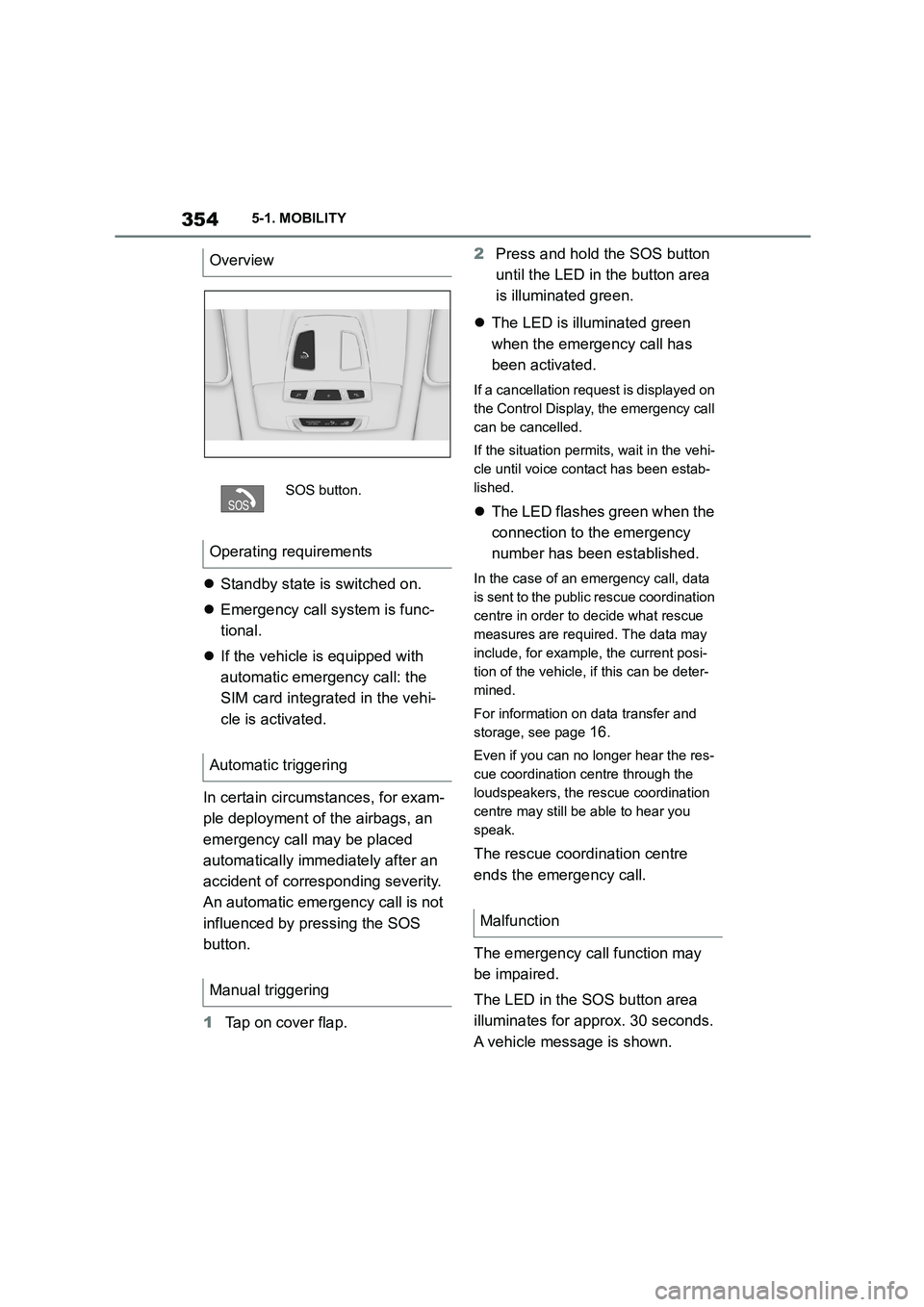
Overview
SOS button.
Operating requirements
Automatic triggering
Manual triggering
Malfunction