ESP TOYOTA SUPRA 2022 Manual Online
[x] Cancel search | Manufacturer: TOYOTA, Model Year: 2022, Model line: SUPRA, Model: TOYOTA SUPRA 2022Pages: 498, PDF Size: 104.06 MB
Page 277 of 498
275
3
3-1. CONTROLS
CONTROLS
This chapter describes all standard,
country-specific and special equip-
ment available for the model series.
It may therefore describe equip-
ment and functions which are not
installed in your vehicle, for exam-
ple on account of the special equip-
ment selected or the country
specification. This also applies to
safety-relevant functions and sys-
tems. Please comply with the rele-
vant laws and regulations when
using the corresponding functions
and systems.
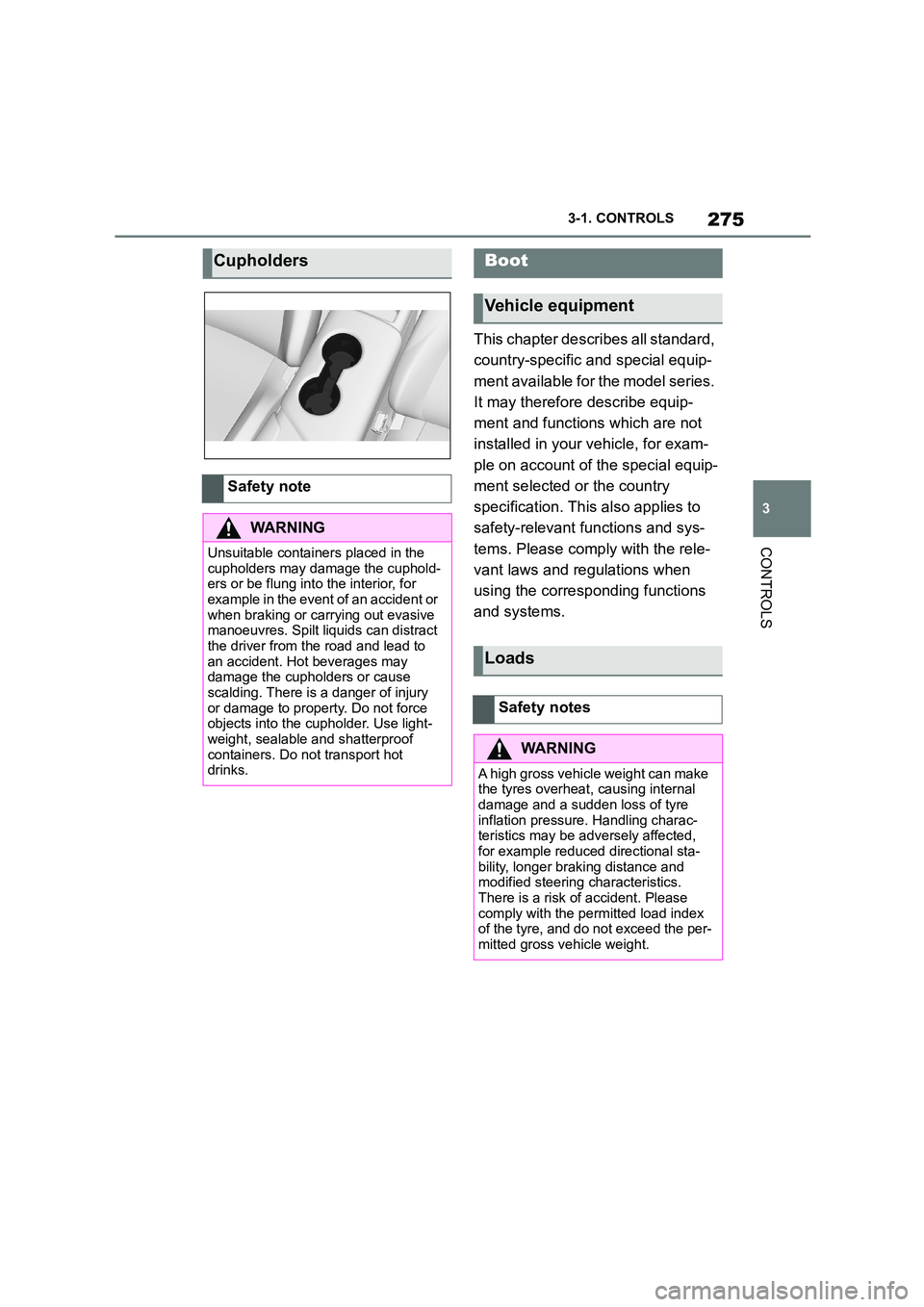
Cupholders
Safety note
WA R N I N G
Unsuitable containers placed in the
cupholders may damage the cuphold- ers or be flung into the interior, for
example in the event of an accident or
when braking or carrying out evasive manoeuvres. Spilt liquids can distract
the driver from the road and lead to
an accident. Hot beverages may damage the cupholders or cause
scalding. There is a danger of injury
or damage to property. Do not force objects into the cupholder. Use light-
weight, sealable and shatterproof
containers. Do not transport hot drinks.
Boot
Vehicle equipment
Loads
Safety notes
WA R N I N G
A high gross vehicle weight can make
the tyres overheat, causing internal
damage and a sudden loss of tyre inflation pressure. Handling charac-
teristics may be adversely affected,
for example reduced directional sta- bility, longer braking distance and
modified steering characteristics.
There is a risk of accident. Please comply with the permitted load index
of the tyre, and do not exceed the per-
mitted gross vehicle weight.
Page 282 of 498
2804-1. DRIVING HINTS
4-1.DRIVING HINTS
This chapter describes all standard,
country-specific and special equip-
ment available for the model series.
It may therefore describe equip-
ment and functions which are not
installed in your vehicle, for exam-
ple on account of the special equip-
ment selected or the country
specification. This also applies to
safety-relevant functions and sys-
tems. Please comply with the rele-
vant laws and regulations when
using the corresponding functions
and systems.
Moving parts must adapt to one
another.
The following notes will help to
maximise the vehicle's lifetime and
efficiency.
Do not use Launch Control, see
page 159, when running in.
Do not exceed the maximum
engine revs and speed:
With petrol engines, 4500 rpm
and 160 km/h, approximately
100 mph.
Generally avoid kick-down and driv-
ing under full load.
Engine and road speeds can be
gradually increased.
Due to the manufacturing process,
new tyres do not provide maximum
grip immediately.
Drive moderately for the first 300
km, 200 miles.
Driving precautions
Vehicle equipment
Running in
General
Safety note
WA R N I N G
New parts and components can
cause safety and Driver Assistance Systems to respond with a delay.
There is a danger of accidents. After
new parts have been installed or if the vehicle is new, drive moderately and
intervene at an early stage if neces-
sary. Please comply with running-in
procedures for the corresponding parts and components.
Engine, gearbox and differ-
ential
Up to 2000 km, 1200 miles
From 2000 km, 1200 miles
onwards
Ty r e s
Page 285 of 498
283
4
4-1. DRIVING HINTS
DRIVING HINTS
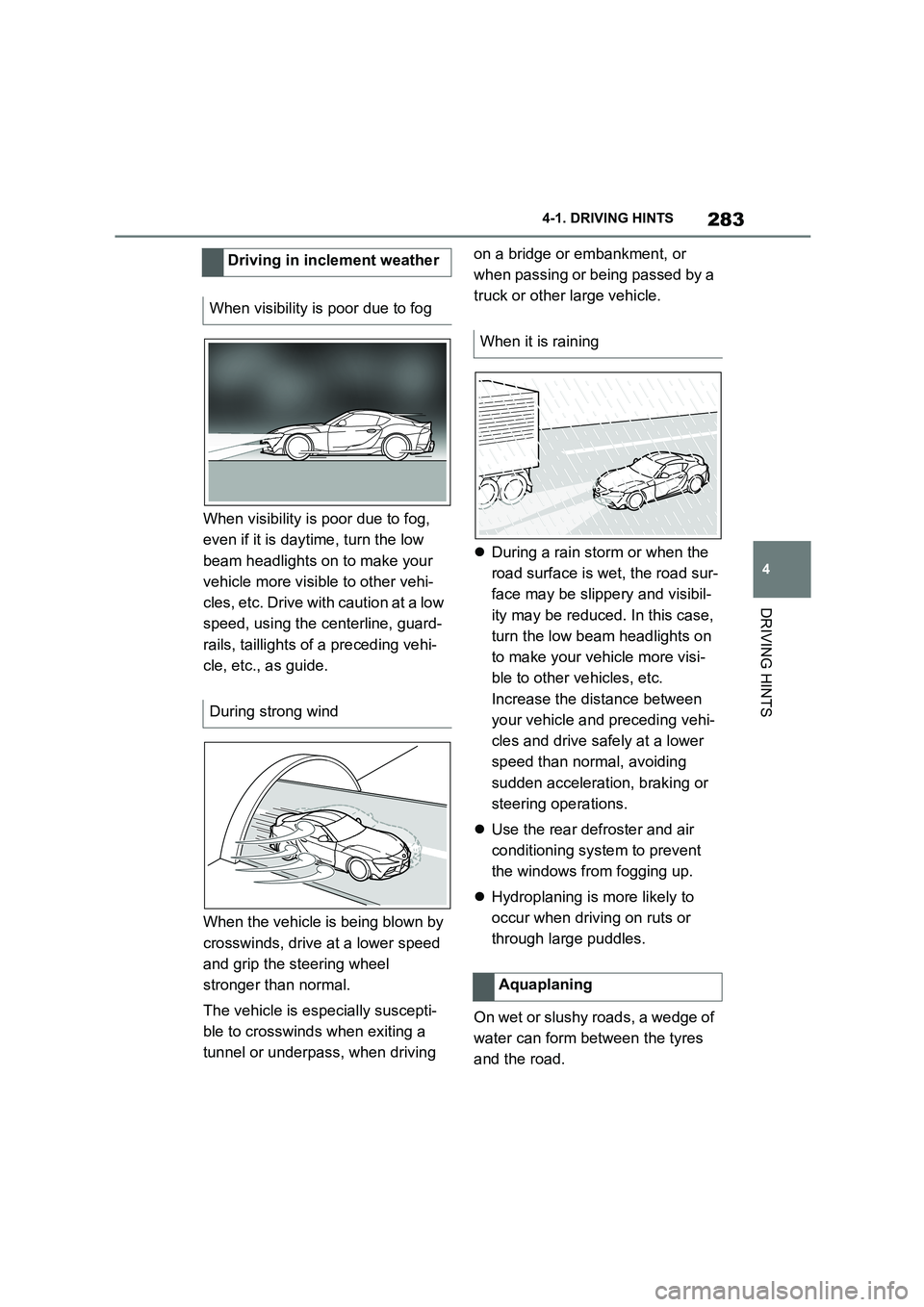
When visibility is poor due to fog,
even if it is daytime, turn the low
beam headlights on to make your
vehicle more visible to other vehi-
cles, etc. Drive with caution at a low
speed, using the centerline, guard-
rails, taillights of a preceding vehi-
cle, etc., as guide.
When the vehicle is being blown by
crosswinds, drive at a lower speed
and grip the steering wheel
stronger than normal.
The vehicle is especially suscepti-
ble to crosswinds when exiting a
tunnel or underpass, when driving
on a bridge or embankment, or
when passing or being passed by a
truck or other large vehicle.
During a rain storm or when the
road surface is wet, the road sur-
face may be slippery and visibil-
ity may be reduced. In this case,
turn the low beam headlights on
to make your vehicle more visi-
ble to other vehicles, etc.
Increase the distance between
your vehicle and preceding vehi-
cles and drive safely at a lower
speed than normal, avoiding
sudden acceleration, braking or
steering operations.
Use the rear defroster and air
conditioning system to prevent
the windows from fogging up.
Hydroplaning is more likely to
occur when driving on ruts or
through large puddles.
On wet or slushy roads, a wedge of
water can form between the tyres
and the road.
Driving in inclement weather
When visibility is poor due to fog
During strong wind
When it is raining
Aquaplaning
Page 288 of 498
2864-1. DRIVING HINTS
This chapter describes all standard,
country-specific and special equip-
ment available for the model series.
It may therefore describe equip-
ment and functions which are not
installed in your vehicle, for exam-
ple on account of the special equip-
ment selected or the country
specification. This also applies to
safety-relevant functions and sys-
tems. Please comply with the rele-
vant laws and regulations when
using the corresponding functions
and systems.
The vehicle has a wide range of
technologies for reducing con-
sumption and emissions.
The fuel consumption depends on
various factors, for example driving
style, road conditions, service or
environmental factors.
A number of measures, such as a
moderate driving style and regular
maintenance, can influence fuel
consumption and reduce the bur-
den on the environment.
Extra weight increases fuel con-
sumption.
Add-on parts on the vehicle can
adversely affect its aerodynamic
performance and increase fuel con-
sumption.
Open windows increase drag and
consequently fuel consumption.
Tyres can have diff ering effects on
fuel consumption figures. The tyre
size, for example, can influence
how much fuel a vehicle uses.
Check and, if necessary, correct the
tyre inflation pressures at least
twice a month and before setting off
on a longer journey.
Insufficient tyre inflation pressure
increases rolling resistance and
consequently fuel consumption and
tyre wear.
Do not warm up the engine with the
vehicle at a stands till, but instead
Saving fuel
Vehicle equipment
Reducing fuel consumption
General
Remove unnecessary loads
Remove add-on parts after
use
Close windows
Ty r e s
General
Checking tyre inflation pressure
regularly
Drive off immediately
Page 289 of 498
287
4
4-1. DRIVING HINTS
DRIVING HINTS
set off straight away, driving at
moderate engine speeds.
This brings the cold engine up to
operating temperature as quickly as
possible.
Anticipating the road situation and
adopting a smooth driving style will
reduce fuel consumption.
Avoid accelerating and braking
unnecessarily.
Keep an appropriate distance from
the vehicle ahead.
Driving at low engine speeds
reduces fuel consumption and
wear.
Pay attention to the shift position
indicator, see page 171, in the vehi-
cle, if fitted.
When approaching a red traffic
light, take your foot off the accelera-
tor and allow the vehicle to coast to
a stop.
On downward stretc hes, take your
foot off the accelerator and allow
the vehicle to roll.
The fuel supply is interrupted in
overrun mode.
When you stop the vehicle for
longer periods, for example at traf-
fic lights, railway crossings or in
traffic jams, switch off the engine.
The Auto Start/Stop of the vehicle
shuts off the engine automatically
during a stop.
Switching the engine off and on
again reduces fuel consumption
and emissions compared with a
permanently running engine. Sav-
ings can be made just by shutting
down the engine for a few seconds.
Functions such as seat heating or
rear window heating require a great
deal of energy and increase fuel
consumption, especially in city traf-
fic and stop-and-go traffic.
Switch these functions off if they
are not required.
Have the vehicle serviced regularly
to achieve optimal economy and
lifetime. Toyota recommends hav-
ing maintenance work carried out
Think ahead
Avoid high engine speeds
Make use of overrun mode
Switch off the engine if stop-
ping for longer periods
Stopping the engine
Auto Start/Stop
Switch off functions which
are not currently required
Have maintenance work car-
ried out
Page 292 of 498
2905-1. MOBILITY
5-1.MOBILITY
This chapter describes all standard,
country-specific and special equip-
ment available for the model series.
It may therefore describe equip-
ment and functions which are not
installed in your vehicle, for exam-
ple on account of the special equip-
ment selected or the country
specification. This also applies to
safety-relevant functions and sys-
tems. Please comply with the rele-
vant laws and regulations when
using the corresponding functions
and systems.
Before refuelling, observe the notes
on fuel quality, see page 322.
When refuelling, insert the filler
nozzle fully into th e filler neck. Lift-
ing the filler nozzle during refuelling
results in the following:
The fuel supply being cut off pre-
maturely.
Fuel vapour and fumes being
recovered less effectively.
The fuel tank is full when the filler
nozzle cuts out for the first time.
For Korea: Make sure that the fuel
tank cap is closed properly after
refuelling, otherw ise the emissions
warning lamp may illuminate.
Please comply with the safety regu-
lations displayed at filling stations.
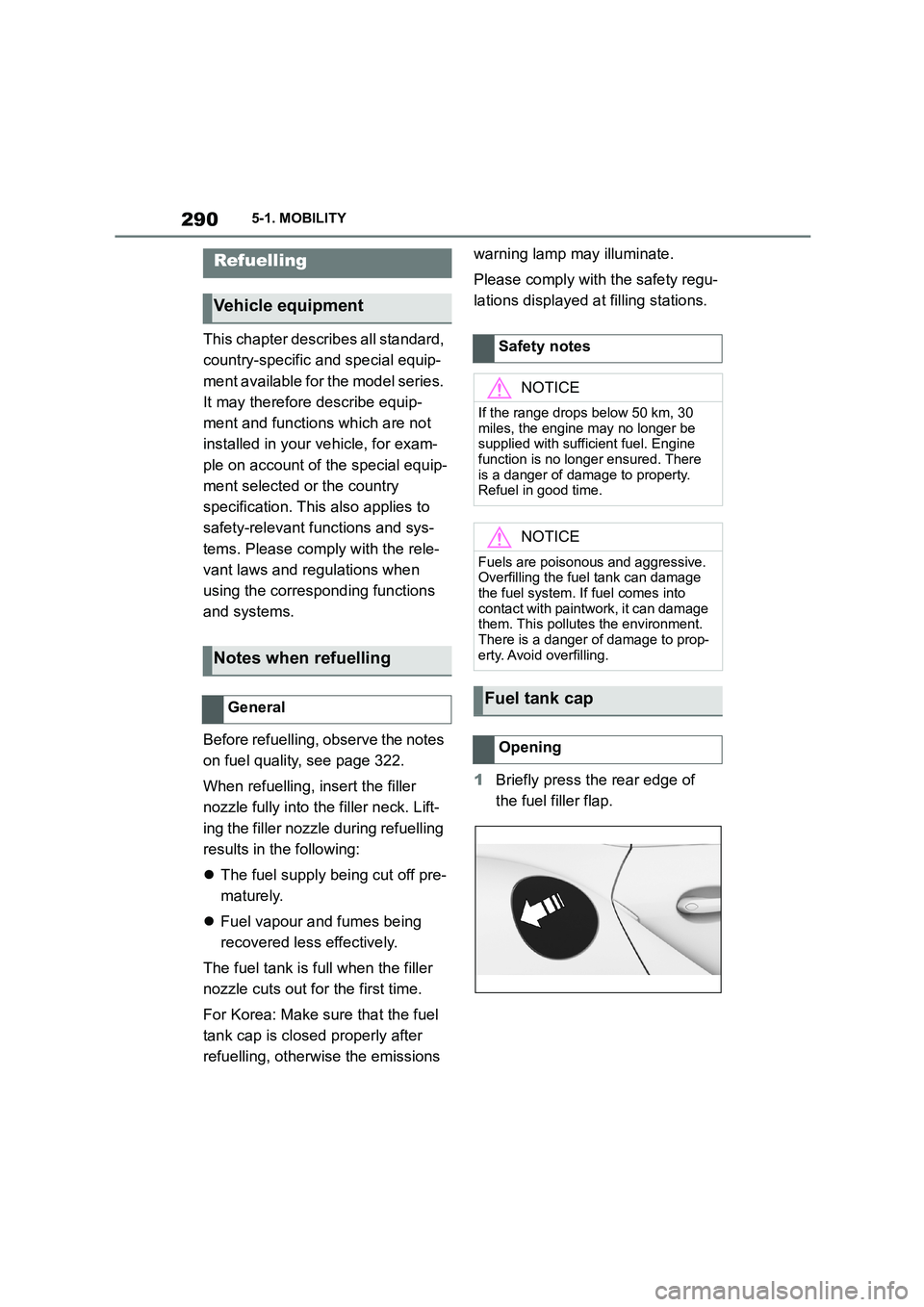
1 Briefly press the rear edge of
the fuel filler flap.
Refuelling
Vehicle equipment
Notes when refuelling
General
Safety notes
NOTICE
If the range drops below 50 km, 30
miles, the engine may no longer be
supplied with sufficient fuel. Engine function is no longer ensured. There
is a danger of damage to property.
Refuel in good time.
NOTICE
Fuels are poisonous and aggressive.
Overfilling the fuel tank can damage the fuel system. If fuel comes into
contact with paintwork, it can damage
them. This pollutes the environment. There is a danger of damage to prop-
erty. Avoid overfilling.
Fuel tank cap
Opening
Page 294 of 498
2925-1. MOBILITY
This chapter describes all standard,
country-specific and special equip-
ment available for the model series.
It may therefore describe equip-
ment and functions which are not
installed in your vehicle, for exam-
ple on account of the special equip-
ment selected or the country
specification. This also applies to
safety-relevant functions and sys-
tems. Please comply with the rele-
vant laws and regulations when
using the corresponding functions
and systems.
A tyre's condition and inflation pres-
sure influence the following:
• Lifetime of the tyre.
• Driving safety.
• Driving comfort.
• Fuel consumption.
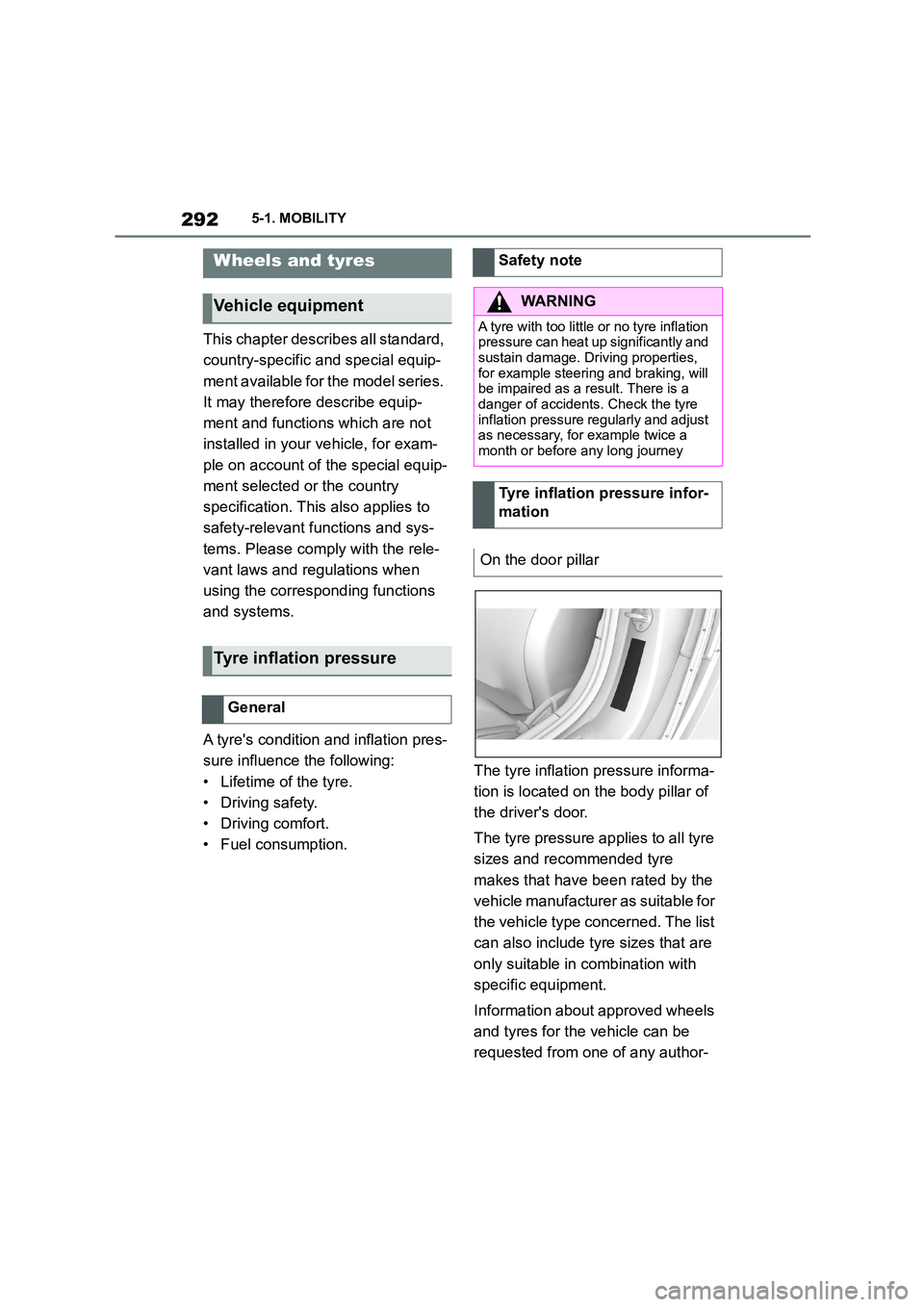
The tyre inflation pressure informa-
tion is located on the body pillar of
the driver's door.
The tyre pressure applies to all tyre
sizes and recommended tyre
makes that have been rated by the
vehicle manufacturer as suitable for
the vehicle type concerned. The list
can also include tyre sizes that are
only suitable in combination with
specific equipment.
Information about approved wheels
and tyres for the vehicle can be
requested from one of any author-
Wheels and tyres
Vehicle equipment
Tyre inflation pressure
General
Safety note
WA R N I N G
A tyre with too little or no tyre inflation
pressure can heat up significantly and sustain damage. Driving properties,
for example steering and braking, will
be impaired as a result. There is a danger of accidents. Check the tyre
inflation pressure regularly and adjust
as necessary, for example twice a
month or before any long journey
Tyre inflation pressure infor-
mation
On the door pillar
Page 295 of 498
293
5
5-1. MOBILITY
MOBILITY
ized Toyota reta iler or Toyota
authorized repairer, or any reliable
repairer.
The tyre inflation pressure appropri-
ate for the respective load condi-
tions should be used. For example,
if the vehicle is partially loaded, use
the tyre inflation pressure specified
for a partially loaded vehicle.
The current tire pr essure of each
installed wheel can be displayed on
the control display.
To ensure that they are displayed
correctly, the tyre sizes must be
stored in the system and must have
been set, see page 304, for the
mounted tyres.
The current tyre inflation pressure
value is shown on each tyre.
Tyres heat up while driving. The
tyre inflation pressure increases
with the temperature of the tyre.
Tyres have a natural, uniform loss
of tyre inflation pressure.
Inflating devices can display a pres-
sure that may be up to 0.1 bar too
low.
The tyre inflation pressure inscrip-
tions on the tyre inflation pressure
sign on the door pillar only relate to
cold tyres or tyres at the same tem-
perature as the ambient tempera-
ture.
Only check the tyre inflation pres-
sures when the tyres are cold, i.e.:
• If the vehicle has been driven a
distance of no more than 2 km,
1.25 miles.
• If the vehicle has not moved
again for at least 2 hours after a
journey.
Regularly check the tyre inflation
pressure of the emergency wheel in
the boot and correct the pressure if
necessary.
1 Determine the specified tyre
inflation pressures for the tyres
installed on the vehicle.
For Australia/New Zealand
WA R N I N G
The inflation pressures on the tyre
label are applicable only for tyres
explicitly mentioned on the label. Inflation pressures for tyres that may
be covered by the label – by size,
speed category and load rating/load index – but not explicitly mentioned
on the label may be different. Please
obtain adequate inflation pressures in accordance with the tyre manufac-
turer's specifications from your tyre
dealer.
On the Control Display
Checking the tyre inflation
pressure
General
Checking using tyre inflation pres-
sure inscriptions on the door pillar
Page 297 of 498
295
5
5-1. MOBILITY
MOBILITY
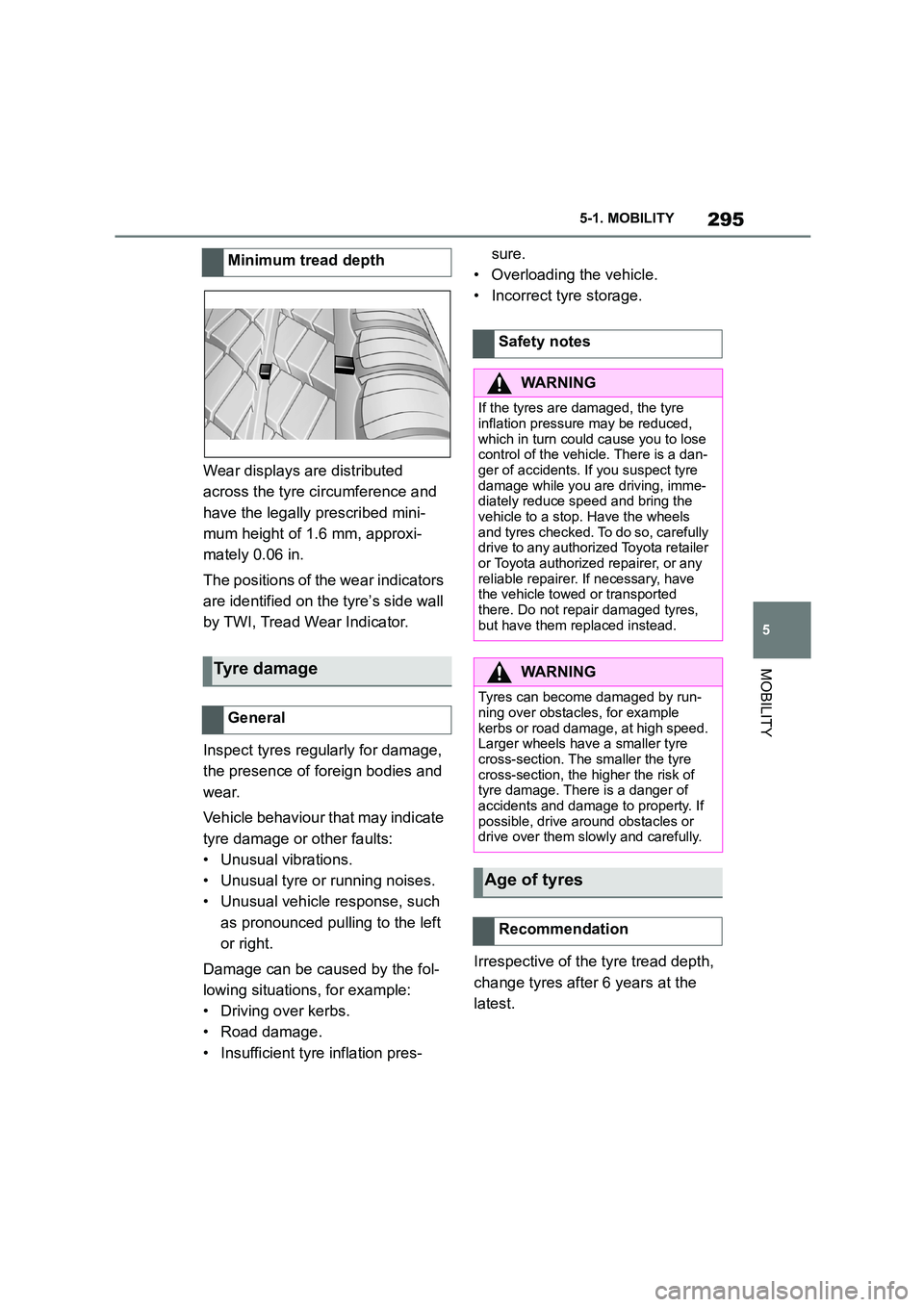
Wear displays are distributed
across the tyre circumference and
have the legally prescribed mini-
mum height of 1.6 mm, approxi-
mately 0.06 in.
The positions of the wear indicators
are identified on the tyre’s side wall
by TWI, Tread Wear Indicator.
Inspect tyres regularly for damage,
the presence of foreign bodies and
wear.
Vehicle behaviour that may indicate
tyre damage or other faults:
• Unusual vibrations.
• Unusual tyre or running noises.
• Unusual vehicle response, such
as pronounced pu lling to the left
or right.
Damage can be caused by the fol-
lowing situations, for example:
• Driving over kerbs.
• Road damage.
• Insufficient tyre inflation pres-
sure.
• Overloading the vehicle.
• Incorrect tyre storage.
Irrespective of the tyre tread depth,
change tyres after 6 years at the
latest.
Minimum tread depth
Tyre damage
General
Safety notes
WA R N I N G
If the tyres are damaged, the tyre
inflation pressure may be reduced,
which in turn could cause you to lose control of the vehicle. There is a dan-
ger of accidents. If you suspect tyre
damage while you are driving, imme- diately reduce speed and bring the
vehicle to a stop. Have the wheels
and tyres checked. To do so, carefully drive to any authorized Toyota retailer
or Toyota authorized repairer, or any
reliable repairer. If necessary, have the vehicle towed or transported
there. Do not repair damaged tyres,
but have them replaced instead.
WA R N I N G
Tyres can become damaged by run-
ning over obstacles, for example
kerbs or road damage, at high speed. Larger wheels have a smaller tyre
cross-section. The smaller the tyre
cross-section, the higher the risk of tyre damage. There is a danger of
accidents and damage to property. If
possible, drive around obstacles or drive over them slowly and carefully.
Age of tyres
Recommendation
Page 298 of 498
2965-1. MOBILITY
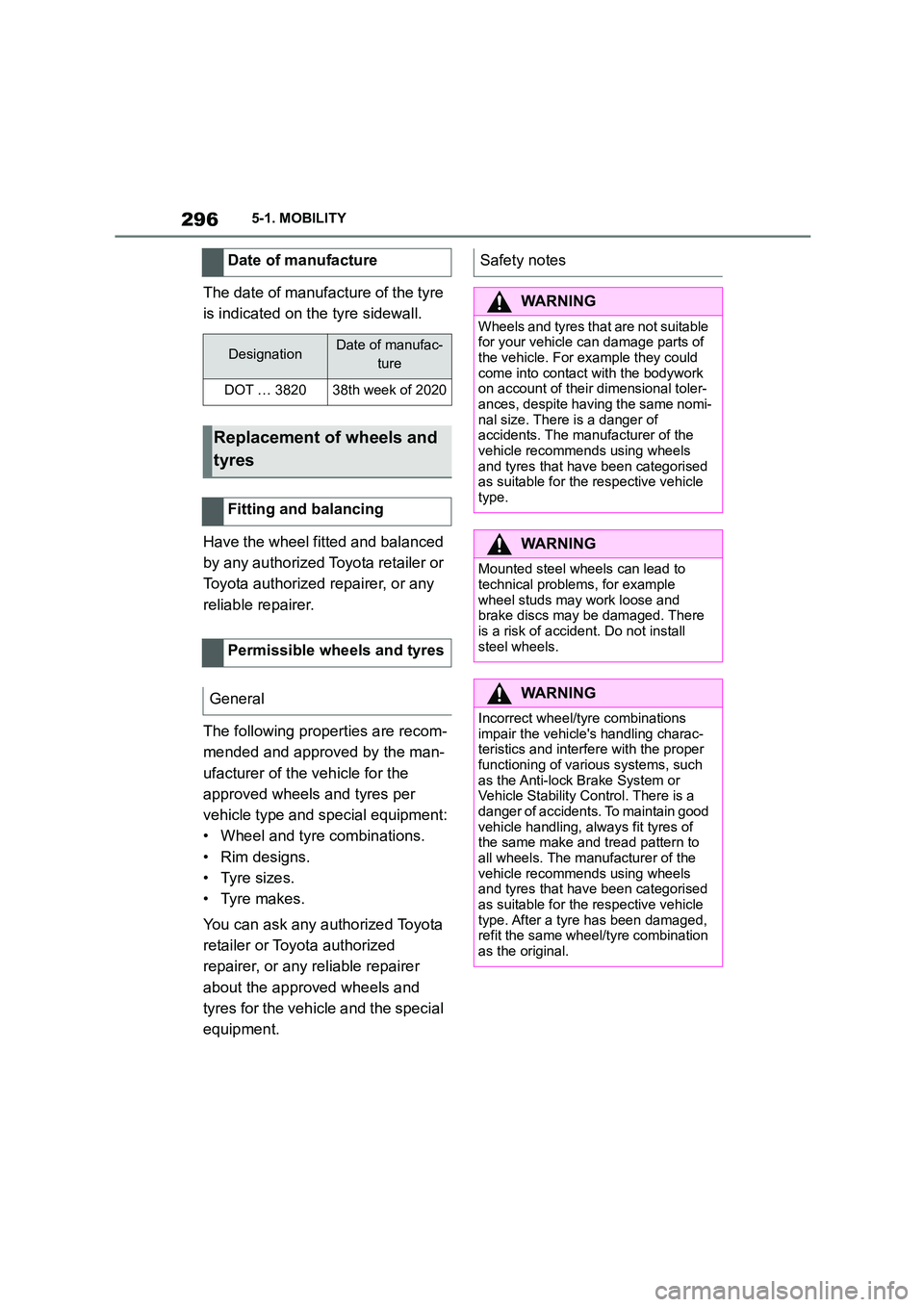
The date of manufacture of the tyre
is indicated on the tyre sidewall.
Have the wheel fitted and balanced
by any authorized Toyota retailer or
Toyota authorized repairer, or any
reliable repairer.
The following properties are recom-
mended and approved by the man-
ufacturer of the vehicle for the
approved wheels and tyres per
vehicle type and special equipment:
• Wheel and tyre combinations.
•Rim designs.
• Tyre sizes.
• Tyre makes.
You can ask any authorized Toyota
retailer or Toyota authorized
repairer, or any reliable repairer
about the approved wheels and
tyres for the vehicle and the special
equipment.
Date of manufacture
DesignationDate of manufac-
ture
DOT … 382038th week of 2020
Replacement of wheels and
tyres
Fitting and balancing
Permissible wheels and tyres
General
Safety notes
WA R N I N G
Wheels and tyres that are not suitable
for your vehicle can damage parts of the vehicle. For example they could
come into contact with the bodywork
on account of their dimensional toler- ances, despite having the same nomi-
nal size. There is a danger of
accidents. The manufacturer of the
vehicle recommends using wheels and tyres that have been categorised
as suitable for the respective vehicle
type.
WA R N I N G
Mounted steel wheels can lead to
technical problems, for example wheel studs may work loose and
brake discs may be damaged. There
is a risk of accident. Do not install steel wheels.
WA R N I N G
Incorrect wheel/tyre combinations
impair the vehicle's handling charac- teristics and interfere with the proper
functioning of various systems, such
as the Anti-lock Brake System or Vehicle Stability Control. There is a
danger of accidents. To maintain good
vehicle handling, always fit tyres of the same make and tread pattern to
all wheels. The manufacturer of the
vehicle recommends using wheels and tyres that have been categorised
as suitable for the respective vehicle
type. After a tyre has been damaged, refit the same wheel/tyre combination
as the original.