ECU DODGE RAM SRT-10 2006 Service Repair Manual
[x] Cancel search | Manufacturer: DODGE, Model Year: 2006, Model line: RAM SRT-10, Model: DODGE RAM SRT-10 2006Pages: 5267, PDF Size: 68.7 MB
Page 3500 of 5267
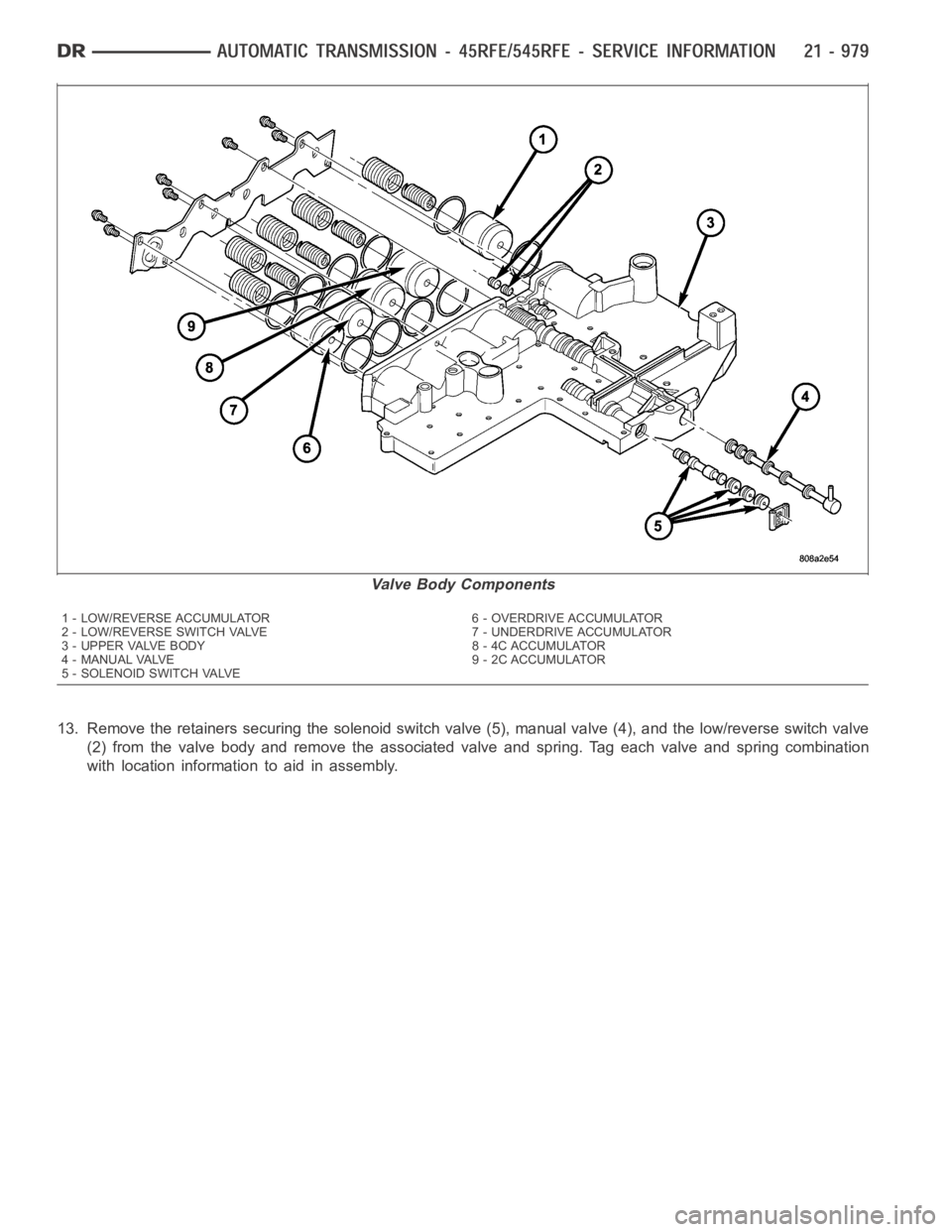
13. Remove the retainers securing the solenoid switch valve (5), manual valve (4), and the low/reverse switch valve
(2) from the valve body and remove the associated valve and spring. Tag eachvalve and spring combination
with location information to aid in assembly.
Valve Body Components
1 - LOW/REVERSE ACCUMULATOR 6 - OVERDRIVE ACCUMULATOR
2 - LOW/REVERSE SWITCH VALVE 7 - UNDERDRIVE ACCUMULATOR
3 - UPPER VALVE BODY 8 - 4C ACCUMULATOR
4 - MANUAL VALVE 9 - 2C ACCUMULATOR
5 - SOLENOID SWITCH VALVE
Page 3511 of 5267
Theory of Operation
The Transmission Temperature Sensor is used to sense when the transmissiontemperatureistoohotortoocoldto
operate overdrive and/or the torque convertor clutch. When the transmission sensor detects a temperature below 0°
C (32° F), overdrive and the torque convertor clutch are disabled. When thedetected temperature is above 127° C
(260° F), overdrive is disabled and 3rd gear with TCC is engaged, this strategy is used to increase transmission
fluid flow to help cool the transmission.
When Monitored:
Continuously with the ignition on and the engine running.
Set Condition:
The DTC will set after two consecutive trips in which the transmission oil temperature is greater than 5° C (40°
F) and the transmission oil temperature does not rise more than 8° C (16° F) after 20 minutes of run time with
a vehicle speed greater than 48 Kmh (30 mph). The DTC will also set if the engine temperature is greater than
38° C (100° F) with the transmission oil temperature greater than 127° C (260° F).
Possible Causes
OTHER TRANSMISSION DTC’S SET
INTERMITTENT TRANSMISSION TEMPERATURE SENSOR
TRANSMISSION TEMPERATURE SENSOR
Always perform the Pre-Diagnostic Troubleshooting procedure before proceeding. (Refer to 21 - TRANSMIS-
SION/TRANSAXLE/AUTOMATIC - 48RE - STANDARD PROCEDURE)
Diagnostic Test
1.CHECK IF THE DTC IS CURRENT
Ignition on, engine not running.
With the scan tool, read Engine DTCs.
Record the Freeze Frame data for the reported DTC.
With the scan tool, erase DTCs.
Turn the ignition off to the lock position.
Using the Freeze Frame data recorded earlier, try to duplicate the conditions in which the DTC originally set.
NOTE: It may be necessary to road test the vehicle to duplicate the originalset conditions.
With the scan tool, read Engine DTCs.
Did the DTC reset?
Ye s>>
Go To 2
No>>
Go To 6
2.CHECK FOR OTHER TRANSMISSION DTCS
Does the scan tool show any Park/Neutral DTCs?
Ye s>>
Refer to the Transmission category and perform the appropriate symptom(s).
No>>
Go To 3
Page 3535 of 5267
Theory of Operation
The Torque Converter Clutch (TCC) solenoid is used to engage the TCC which improves fuel economy.
When Monitored:
Continuously with the ignition on.
Set Condition:
This DTC will set if the Torque Convertor Clutch (TCC) can not achieve the desired engine RPM drop when
the TCC Solenoid is near the maximum duty cycle after three consecutive test failures.
Possible Causes
TRANSMISSION FLUID LEVEL LOW OR CONTAMINATED
WORN OR DAMAGED REACTION SHAFT, INPUT SHAFT OR INPUT SHAFT SEALS
BLOCKED OR LEAK IN THE TCC HYDRAULIC CIRCUIT IN THE VALVE BODY
TORQUE CONVERTER CLUTCH SOLENOID
TORQUE CONVERTER
Always perform the Pre-Diagnostic Troubleshooting procedure before proceeding. (Refer to 21 - TRANSMIS-
SION/TRANSAXLE/AUTOMATIC - 48RE - STANDARD PROCEDURE)
1.CHECK IF THERE ANY ENGINE DTCS PRESENT
Ignition on, engine not running.
With the scan tool, read Engine DTCs.
Is the DTC P0743 also present?
Ye s>>
Refer to the Transmission category and perform the appropriate symptom(s). (Refer to 21 - TRANS-
MISSION/TRANSAXLE/AUTOMATIC - 48RE - DIAGNOSIS AND TESTING)
No>>
Go To 2
2.CHECK TRANSMISSION FLUID LEVEL
Check the transmission fluid level.
Is the Transmission fluid level low?
Ye s>>
Inspect the transmission, cooler, and lines for leakage and repair as necessary. With the scan tool read
and record the Freeze Frame data for the reported DTC. Erase DTCs and test drive the vehicle to the
conditions in which the DTC originally set. Recheck for DTCs. If the DTC resets, follow the “No” path in
this test procedure and proceed to the next step.
If the DTC does not reset, test is complete, perform RE TRANSMISSION VERIFICATION TEST VER -
1 (GAS). (Refer to 21 - TRANSMISSION/TRANSAXLE/AUTOMATIC - 48RE - STANDARD PROCE-
DURE)
No>>
Go To 3
3.CHECK TRANSMISSION FLUID
Check the transmission fluid for contamination or a burnt condition.
Is the Transmission fluidcontaminated or burnt?
Ye s>>
Remove the valve body and inspect the components related to the Torque Converter Clutch. (Refer to
21 - TRANSMISSION/TRANSAXLE/AUTOMATIC - 48RE/VALVE BODY - REMOVAL) Check the valves
for sticking or binding in its bore, internal valve body leakage, or the TCChydraulic circuits plugged with
debris. Repair as necessary. If no problems are found in the Valve Body, replace the Torque Convertor.
(Refer to 21 - TRANSMISSION/TRANSAXLE/AUTOMATIC - 48RE/TORQUE CONVERTER-
REMOVAL)
Perform RE TRANSMISSION VERIFICATION TEST VER - 1 (GAS). (Refer to 21 - TRANSMISSION/
TRANSAXLE/AUTOMATIC - 48RE - STANDARD PROCEDURE)
No>>
Go To 4
Page 3563 of 5267
Theory of Operation
The Torque Converter Clutch (TCC) Solenoid is used to engage the TCC which improves fuel economy. The Over-
drive Solenoid is used to engage the gear change from third to Overdrive.
When Monitored:
Continuously with the ignition on and the engine running.
Set Condition:
This DTC will set if the expected engine RPM drop does not occur within 4 seconds of the gear change being
requested by the PCM three consecutive failed tests.
Possible Causes
FLUID LEVEL AND CONDITION - EXCESSIVE DEBRIS OR BURNT
3-4 SHIFT SOLENOID
INTERNAL TRANSMISSION FAILURE
Always perform the Pre-Diagnostic Troubleshooting procedure before proceeding. (Refer to 21 - TRANSMIS-
SION/TRANSAXLE/AUTOMATIC - 48RE - STANDARD PROCEDURE)
Diagnostic Test
1.CHECK IF THERE ANY TRANSMISSION CONTROL DTCS PRESENT
Ignition on, engine not running.
With the scan tool, read Engine DTCs.
Are there any TIPM TCM Power Control Circuit DTCs also present?
Ye s>>
Refer to the Transmission or Engine category and perform the appropriate symptom(s).
No>>
Go To 2
2.CHECK IF THE DTC IS CURRENT
With the scan tool, read Engine DTCs.
Record the Freeze Frame data for the reported DTC.
With the scan tool, erase DTCs.
Turn the ignition off to the lock position.
Using the Freeze Frame data recorded earlier, try to duplicate the conditions in which the DTC originally set.
NOTE: It may be necessary to road test the vehicle to duplicate the originalset conditions.
With the scan tool, read Engine DTCs.
Did the DTC reset?
Ye s>>
Go To 3
No>>
Go To 6
3.CHECK THE GOVERNOR AND OVERDRIVE PRESSURE
Turn the ignition off to the lock position.
Connect a 0 - 2068 KPa (0 - 300 PSI) pressure gauge to the Overdrive Clutch test port.
Connect another 0 - 2068 KPa (0 - 300 PSI) pressure gauge to the Governor Pressure test port. (Refer to 21 -
TRANSMISSION/TRANSAXLE/AUTOMATIC - 48RE - DIAGNOSIS AND TESTING)
Start the engine and allow the transmission temperature to rise to normal operating temperature.
CAUTION: Apply the parking brake.
Firmly apply the brakesand place the gear selector in Drive.
While observing the pressure gauges, with the scan tool, select 4th gear from the Gov and 3-4 Shift Valve Test.
Page 3590 of 5267
Theory of Operation
The Governor Pressure Control System is used to regulate the governor pressure which controls the shifts for first,
second, and third gear. The Governor Pressure Control System test verifies that the requested pressure and the
actual pressure are within a predetermined tolerance.
When Monitored:
While driving and the commanded governor pressure is equal to the pressurerequired for third gear.
Set Condition:
If the governor pressure sensor output is less than 407 kPa (60 psi) or greater than 621 kPa (80 psi) when the
requested pressure is 407 - 621 kPa (60 - 80 psi) for 2.2 seconds. This DTC will set if there are two trips of
five consecutive bad 2.2 second tests with the transmission oil temperature between 23.5 - 88° C (74 - 190°
F).
Possible Causes
OTHER TRANSMISSION DTCS PRESENT
(F856) 5-VOLT SUPPLY CIRCUIT OPEN
(F856) 5-VOLT SUPPLY CIRCUIT OPEN - INTERNAL
GOVERNOR PRESSURE SENSOR
VA LV E B O D Y
INTERNAL TRANSMISSION
POWERTRAIN CONTROL MODULE
TRANSMISSION - INTERNAL DAMAGE
Always perform the Pre-Diagnostic Troubleshooting procedure before proceeding. (Refer to 21 - TRANSMIS-
SION/TRANSAXLE/AUTOMATIC - 48RE - STANDARD PROCEDURE)
Diagnostic Test
1.CHECK IF OTHER TRANSMISSION DTCS ARE PRESENT
Ignition on, engine not running.
With the scan tool, read Engine DTCs.
Are any other transmission DTCs present?
Ye s>>
Refer to the Transmission category and perform the appropriate symptom(s). (Refer to 21 - TRANS-
MISSION/TRANSAXLE/AUTOMATIC - 48RE - DIAGNOSIS AND TESTING)
No>>
Go To 2
2.CHECK IF THE GOVERNOR PRESSURE IS ABOVE 3 PSI IN DRIVE
CAUTION: Apply the parking brake.
Start the engine and allow the transmission to reach normal operating temperature above 43° C (110° F).
CAUTION: Apply the brakes.
With the engine at idle, place the gear selector in Drive.
With the scan tool, read the Governor Pressure.
Is the Governor Pressure above 21 kPa (3 psi)?
Ye s>>
Go To 3
No>>
Go To 4
Page 3629 of 5267
Theory of Operation
The Transmission Temperature Sensor is used to sense when the transmissiontemperatureistoohotortoocoldto
operate overdrive and/or the torque convertor clutch. When the transmission sensor detects a temperature below 0°
C (32° F), overdrive and the torque convertor clutch are disabled. When thedetected temperature is above 127° C
(260° F), overdrive is disabled and 3rd gear with TCC is engaged, this strategy is used to increase transmission
fluid flow to help cool the transmission.
When Monitored:
Continuously with the ignition on and the engine running.
Set Condition:
The DTC will set after two consecutive trips in which the transmission oil temperature is greater than 5° C (40°
F) and the transmission oil temperature does not rise more than 8° C (16° F) after 20 minutes of run time with
a vehicle speed greater than 48 Kmh (30 mph). The DTC will also set if the engine temperature is greater than
38° C (100° F) with the transmission oil temperature greater than 127° C (260° F).
Possible Causes
OTHER TRANSMISSION DTC’S SET
INTERMITTENT TRANSMISSION TEMPERATURE SENSOR
TRANSMISSION TEMPERATURE SENSOR
Always perform the Pre-Diagnostic Troubleshooting procedure before proceeding. (Refer to 21 - TRANSMIS-
SION/TRANSAXLE/AUTOMATIC - 48RE - STANDARD PROCEDURE)
Diagnostic Test
1.CHECK IF THE DTC IS CURRENT
Ignition on, engine not running.
With the scan tool, read Engine DTCs.
Record the Freeze Frame data for the reported DTC.
With the scan tool, erase DTCs.
Turn the ignition off to the lock position.
Using the Freeze Frame data recorded earlier, try to duplicate the conditions in which the DTC originally set.
NOTE: It may be necessary to road test the vehicle to duplicate the originalset conditions.
With the scan tool, read Engine DTCs.
Did the DTC reset?
Ye s>>
Go To 2
No>>
Go To 6
2.CHECK FOR OTHER TRANSMISSION DTCS
Does the scan tool show any Park/Neutral DTCs?
Ye s>>
Refer to the Transmission category and perform the appropriate symptom(s). (Refer to 21 - TRANS-
MISSION/TRANSAXLE/AUTOMATIC - 48RE - DIAGNOSIS AND TESTING)
No>>
Go To 3
Page 3753 of 5267
Theory of Operation
The Governor Pressure Control System is used to regulate the governor pressure which controls the shifts for first,
second, and third gear. The Governor Pressure Control System test verifies that the requested pressure and the
actual pressure are within a predetermined tolerance.
When Monitored:
While driving and the commanded governor pressure is equal to the pressurerequired for third gear.
Set Condition:
If the governor pressure sensor output is less than 407 kPa (60 psi) or greater than 621 kPa (80 psi) when the
requested pressure is 407 - 621 kPa (60 - 80 psi) for 2.2 seconds. This DTC will set if there are two trips of
five consecutive bad 2.2 second tests with the transmission oil temperature between 23.5 - 88° C (74 - 190°
F).
Possible Causes
OTHER TRANSMISSION DTCS PRESENT
5-VOLT SUPPLY CIRCUIT OPEN - EXTERNAL
5-VOLT SUPPLY CIRCUIT OPEN - INTERNAL
GOVERNOR PRESSURE SENSOR
VA LV E B O D Y
INTERNAL TRANSMISSION
ENGINE CONTROL MODULE
TRANSMISSION - INTERNAL DAMAGE
Always perform the Pre-Diagnostic Troubleshooting procedure before proceeding. (Refer to 21 - TRANSMIS-
SION/TRANSAXLE/AUTOMATIC - 48RE - STANDARD PROCEDURE)
Diagnostic Test
1.CHECK IF OTHER TRANSMISSION DTCS ARE PRESENT
Ignition on, engine not running.
With the scan tool, read Engine DTCs.
Are any other transmission DTCs present?
Ye s>>
Refer to the Transmission category and perform the appropriate symptom(s).
No>>
Go To 2
2.CHECK IF THE GOVERNOR PRESSURE IS ABOVE 3 PSI IN DRIVE
CAUTION: Apply the parking brake.
Start the engine and allow the transmission to reach normal operating temperature above 43° C (110° F).
CAUTION: Apply the brakes.
With the engine at idle, place the gear selector in Drive.
With the scan tool, read the Governor Pressure.
Is the Governor Pressure above 21 kPa (3 psi)?
Ye s>>
Go To 3
No>>
Go To 4
Page 3802 of 5267
3. Lower vehicle.
4. Turn OD switch on.
5. Secure test gauge so it can be viewed from drivers seat.
6. Start engine and shift into D range.
7. Increase vehicle speed gradually until 3-4 shift occurs and note gauge pressure.
8. Pressure should be 524-565 kPa (76-82 psi) with closed throttle and increase to 690-896 kPa (100-130 psi) at
1/2to3/4throttle.Notethatpressurecanincreasetoaround965kPa(140psi) at full throttle.
9. Return to shop or move vehicle off chassis dyno.
PRESSURE TEST ANALYSIS CHART
TEST CONDITION INDICATION
Line pressure OK during any one test Pump and regulator valve OK
Line pressure OK in R but low in D, 2, 1 Leakage in rear clutch area (seal rings, clutch seals)
Pressure low in D Fourth Gear Range Overdrive clutch piston seal, or check ball problem
Pressure OK in 1, 2 but low in D3 and R Leakage in front clutch area
Pressure OK in 2 but low in R and 1 Leakage in rear servo
Front servo pressure in 2 Leakage in servo; broken servo ring or cracked servo
piston
Pressure low in all positions Clogged filter, stuck regulator valve, wornor faulty
pump, low oil level
Governor pressure too high at idle speed Governor pressure solenoid valvesystem fault. Refer
to diagnostic book.
Governor pressure low at all mph figures Faulty governor pressure solenoid, transmission
control module, or governor pressure sensor
Lubrication pressure low at all throttle positions Clogged fluid cooler or lines, seal rings leaking, worn
pump bushings, pump, clutch retainer, or clogged filter.
Line pressure high Output shaft plugged, sticky regulator valve
Line pressure low Sticky regulator valve, clogged filter, worn pump
AIR TESTING TRANSMISSION CLUTCH AND BAND OPERATION
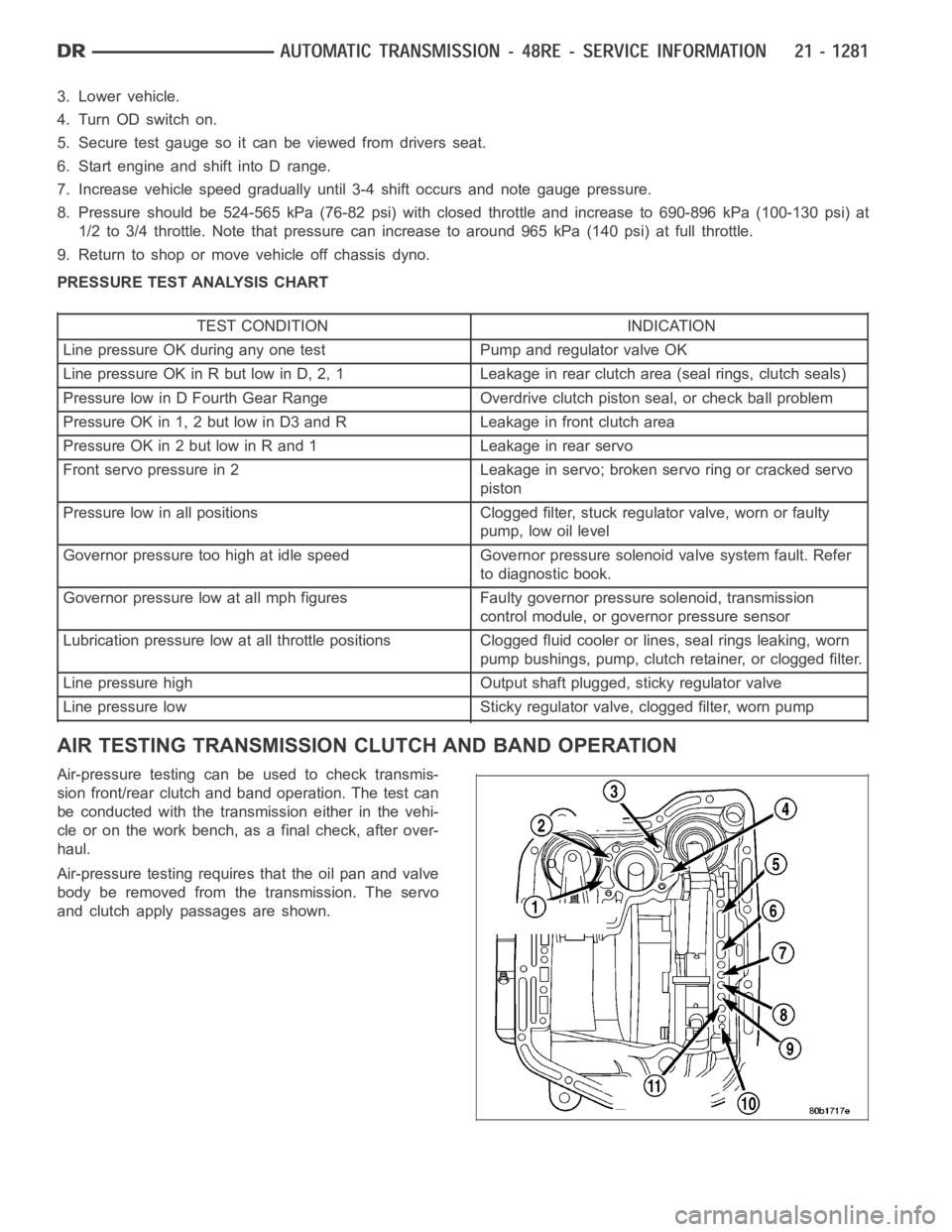
Air-pressure testing can be used to check transmis-
sion front/rear clutch and band operation. The test can
be conducted with the transmission either in the vehi-
cle or on the work bench, as a final check, after over-
haul.
Air-pressure testing requires that the oil pan and valve
body be removed from the transmission. The servo
and clutch apply passages are shown.
Page 3811 of 5267
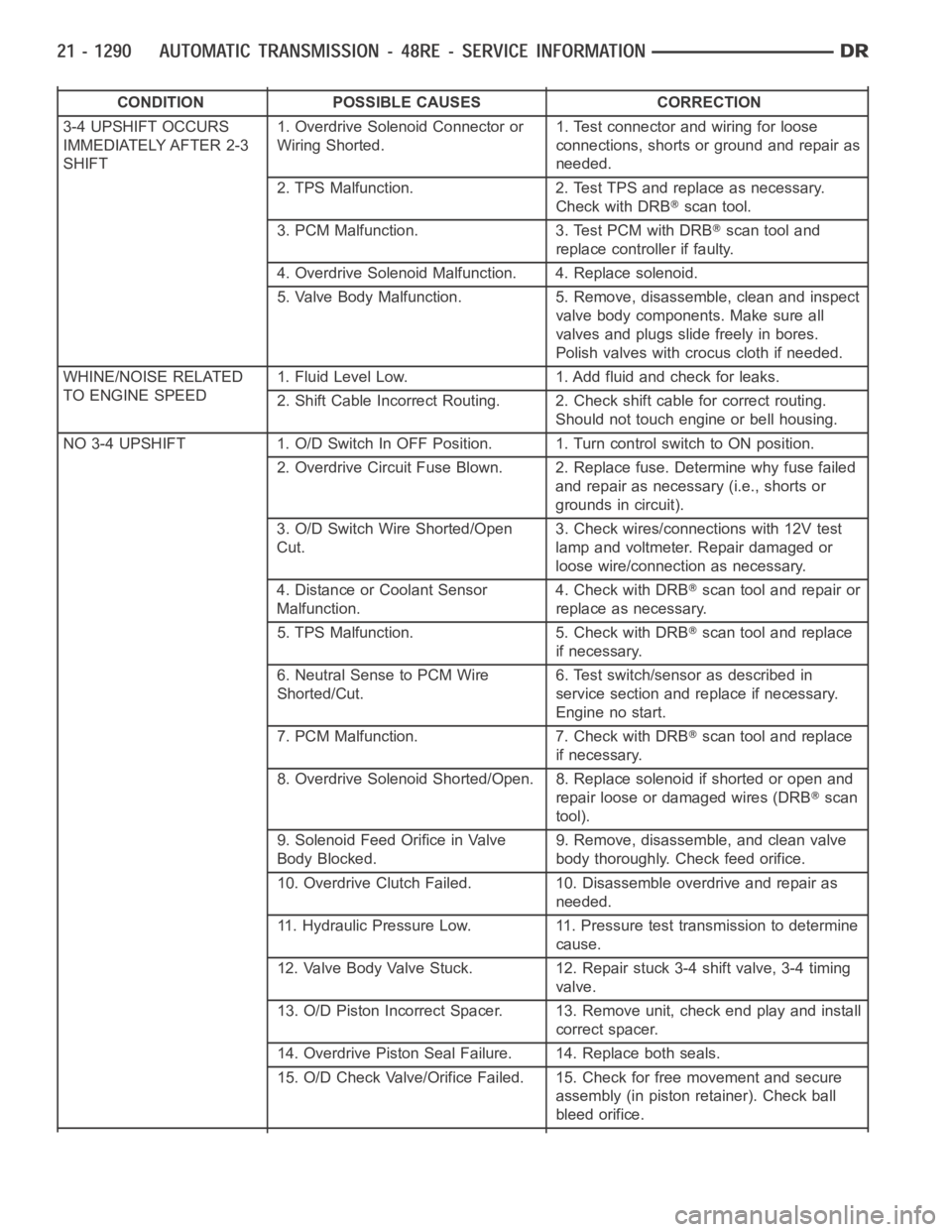
CONDITION POSSIBLE CAUSES CORRECTION
3-4 UPSHIFT OCCURS
IMMEDIATELY AFTER 2-3
SHIFT1. Overdrive Solenoid Connector or
Wiring Shorted.1. Test connector and wiring for loose
connections, shorts or ground and repair as
needed.
2. TPS Malfunction. 2. Test TPS and replace as necessary.
Check with DRB
scan tool.
3. PCM Malfunction. 3. Test PCM with DRB
scan tool and
replace controller if faulty.
4. Overdrive Solenoid Malfunction. 4. Replace solenoid.
5. Valve Body Malfunction. 5. Remove, disassemble, clean and inspect
valve body components. Make sure all
valves and plugs slide freely in bores.
Polish valves with crocus cloth if needed.
WHINE/NOISE RELATED
TO ENGINE SPEED1. Fluid Level Low. 1. Add fluid and check for leaks.
2. Shift Cable Incorrect Routing. 2. Check shift cable for correct routing.
Should not touch engine or bell housing.
NO3-4UPSHIFT 1.O/DSwitchInOFFPosition. 1.TurncontrolswitchtoONposition.
2. Overdrive Circuit Fuse Blown. 2. Replace fuse. Determine why fuse failed
and repair as necessary (i.e., shorts or
grounds in circuit).
3. O/D Switch Wire Shorted/Open
Cut.3. Check wires/connections with 12V test
lamp and voltmeter. Repair damaged or
loose wire/connection as necessary.
4. Distance or Coolant Sensor
Malfunction.4. Check with DRB
scan tool and repair or
replace as necessary.
5. TPS Malfunction. 5. Check with DRB
scan tool and replace
if necessary.
6. Neutral Sense to PCM Wire
Shorted/Cut.6. Test switch/sensor as described in
service section and replace if necessary.
Engine no start.
7. PCM Malfunction. 7. Check with DRB
scan tool and replace
if necessary.
8. Overdrive Solenoid Shorted/Open. 8. Replace solenoid if shorted or openand
repair loose or damaged wires (DRB
scan
tool).
9. Solenoid Feed Orifice in Valve
Body Blocked.9. Remove, disassemble, and clean valve
body thoroughly. Check feed orifice.
10. Overdrive Clutch Failed. 10. Disassemble overdrive and repair as
needed.
11. Hydraulic Pressure Low. 11. Pressure test transmission to determine
cause.
12. Valve Body Valve Stuck. 12. Repair stuck 3-4 shift valve, 3-4 timing
valve.
13. O/D Piston Incorrect Spacer. 13. Remove unit, check end play and install
correct spacer.
14. Overdrive Piston Seal Failure. 14. Replace both seals.
15. O/D Check Valve/Orifice Failed. 15. Check for free movement and secure
assembly (in piston retainer). Check ball
bleed orifice.
Page 3812 of 5267
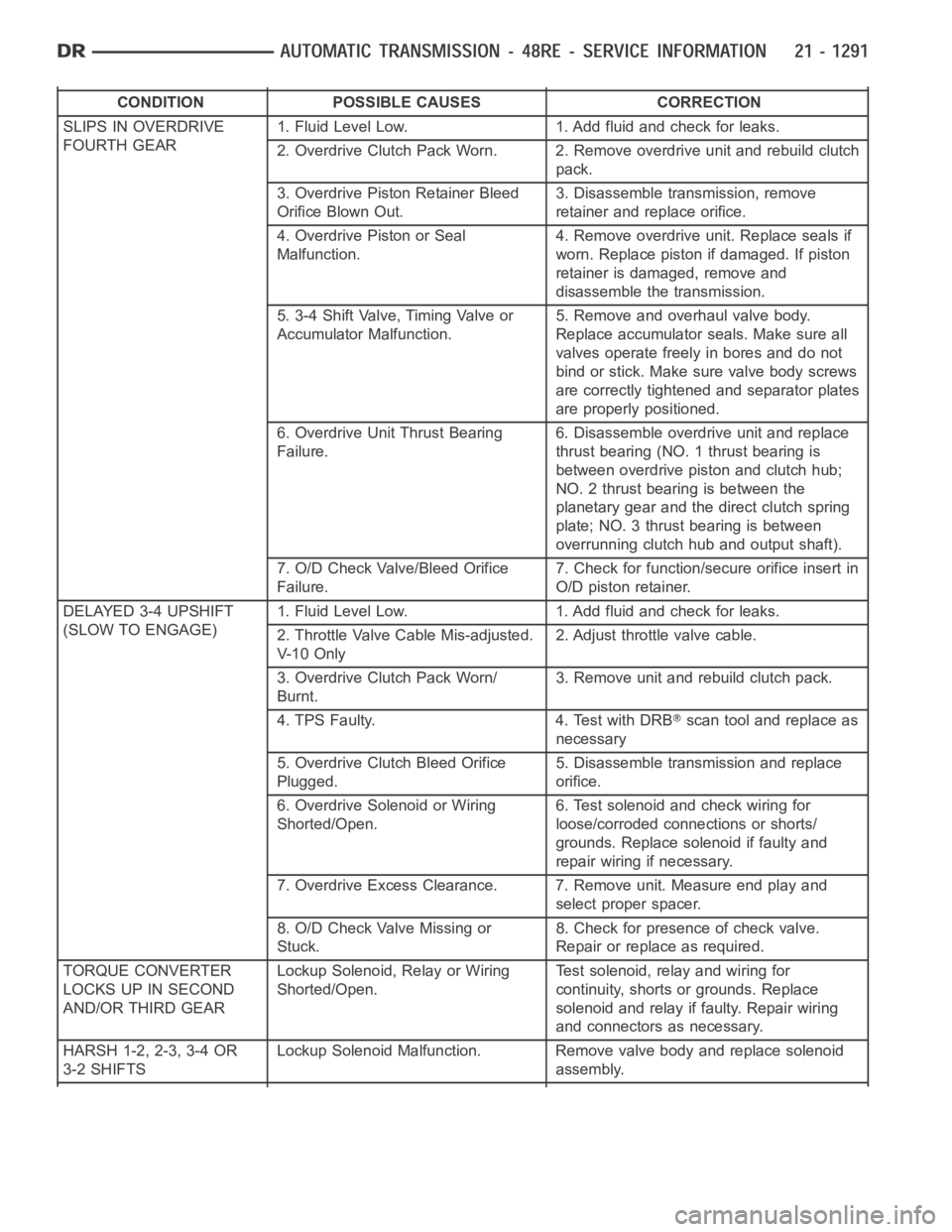
CONDITION POSSIBLE CAUSES CORRECTION
SLIPS IN OVERDRIVE
FOURTH GEAR1. Fluid Level Low. 1. Add fluid and check for leaks.
2. Overdrive Clutch Pack Worn. 2. Remove overdrive unit and rebuild clutch
pack.
3. Overdrive Piston Retainer Bleed
Orifice Blown Out.3. Disassemble transmission, remove
retainer and replace orifice.
4. Overdrive Piston or Seal
Malfunction.4. Remove overdrive unit. Replace seals if
worn. Replace piston if damaged. If piston
retainer is damaged, remove and
disassemble the transmission.
5. 3-4 Shift Valve, Timing Valve or
Accumulator Malfunction.5. Remove and overhaul valve body.
Replace accumulator seals. Make sure all
valves operate freely in bores and do not
bind or stick. Make sure valve body screws
are correctly tightened and separator plates
are properly positioned.
6. Overdrive Unit Thrust Bearing
Failure.6. Disassemble overdrive unit and replace
thrust bearing (NO. 1 thrust bearing is
between overdrive piston and clutch hub;
NO. 2 thrust bearing is between the
planetary gear and the direct clutch spring
plate; NO. 3 thrust bearing is between
overrunning clutch hub and output shaft).
7. O/D Check Valve/Bleed Orifice
Failure.7. Check for function/secure orifice insert in
O/D piston retainer.
DELAYED 3-4 UPSHIFT
(SLOW TO ENGAGE)1. Fluid Level Low. 1. Add fluid and check for leaks.
2. Throttle Valve Cable Mis-adjusted.
V- 1 0 O n l y2. Adjust throttle valve cable.
3. Overdrive Clutch Pack Worn/
Burnt.3. Remove unit and rebuild clutch pack.
4. TPS Faulty. 4. Test with DRB
scan tool and replace as
necessary
5. Overdrive Clutch Bleed Orifice
Plugged.5. Disassemble transmission and replace
orifice.
6. Overdrive Solenoid or Wiring
Shorted/Open.6. Test solenoid and check wiring for
loose/corroded connections or shorts/
grounds. Replace solenoid if faulty and
repair wiring if necessary.
7. Overdrive Excess Clearance. 7. Remove unit. Measure end play and
select proper spacer.
8. O/D Check Valve Missing or
Stuck.8. Check for presence of check valve.
Repair or replace as required.
TORQUE CONVERTER
LOCKS UP IN SECOND
AND/OR THIRD GEARLockup Solenoid, Relay or Wiring
Shorted/Open.Test solenoid, relay and wiring for
continuity, shorts or grounds. Replace
solenoid and relay if faulty. Repair wiring
and connectors as necessary.
HARSH 1-2, 2-3, 3-4 OR
3-2 SHIFTSLockup Solenoid Malfunction. Remove valve body and replace solenoid
assembly.