ECU DODGE RAM SRT-10 2006 Service Manual Online
[x] Cancel search | Manufacturer: DODGE, Model Year: 2006, Model line: RAM SRT-10, Model: DODGE RAM SRT-10 2006Pages: 5267, PDF Size: 68.7 MB
Page 2972 of 5267
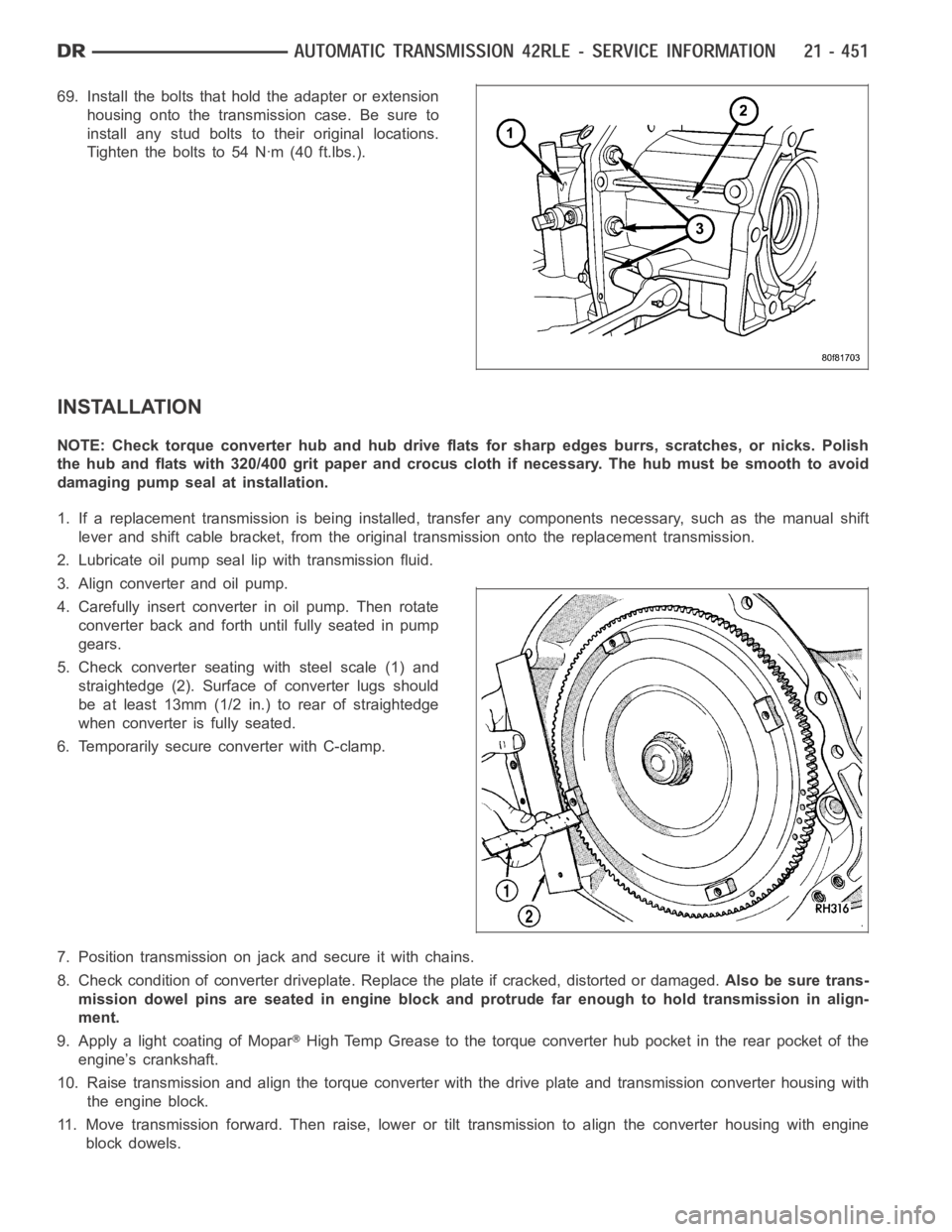
69. Install the bolts that hold the adapter or extension
housing onto the transmission case. Be sure to
install any stud bolts to their original locations.
Tighten the bolts to 54 Nꞏm (40 ft.lbs.).
INSTALLATION
NOTE: Check torque converter hub and hub drive flats for sharp edges burrs,scratches, or nicks. Polish
the hub and flats with 320/400 grit paper and crocus cloth if necessary. Thehub must be smooth to avoid
damaging pump seal at installation.
1. If a replacement transmission is being installed, transfer any components necessary, such as the manual shift
lever and shift cable bracket, from the original transmission onto the replacement transmission.
2. Lubricate oil pump seal lip with transmission fluid.
3. Align converter and oil pump.
4. Carefully insert converter in oil pump. Then rotate
converter back and forth until fully seated in pump
gears.
5. Check converter seating with steel scale (1) and
straightedge (2). Surface of converter lugs should
be at least 13mm (1/2 in.) to rear of straightedge
when converter is fully seated.
6. Temporarily secure converter with C-clamp.
7. Position transmission on jack and secure it with chains.
8. Check condition of converter driveplate. Replace the plate if cracked,distorted or damaged.Also be sure trans-
mission dowel pins are seated in engine block and protrude far enough to holdtransmissioninalign-
ment.
9. Apply a light coating of Mopar
High Temp Grease to the torque converter hub pocket in the rear pocket of the
engine’s crankshaft.
10. Raise transmission and align the torque converter with the drive plateand transmission converter housing with
the engine block.
11. Move transmission forward. Then raise, lower or tilt transmission to align the converter housing with engine
block dowels.
Page 3018 of 5267
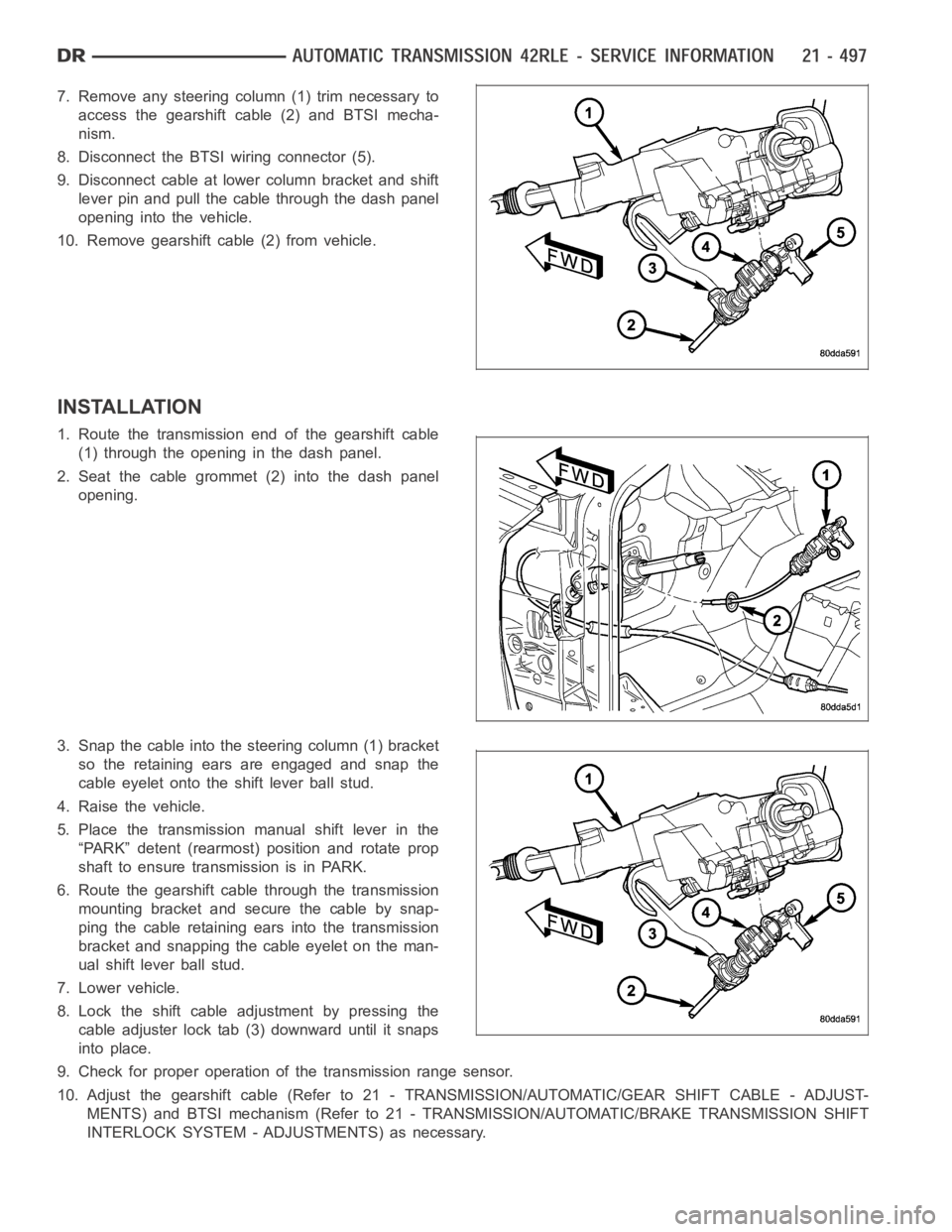
7. Remove any steering column (1) trim necessary to
access the gearshift cable (2) and BTSI mecha-
nism.
8. Disconnect the BTSI wiring connector (5).
9. Disconnect cable at lower column bracket and shift
lever pin and pull the cable through the dash panel
opening into the vehicle.
10. Remove gearshift cable (2) from vehicle.
INSTALLATION
1. Route the transmission end of the gearshift cable
(1) through the opening in the dash panel.
2. Seat the cable grommet (2) into the dash panel
opening.
3. Snap the cable into the steering column (1) bracket
so the retaining ears are engaged and snap the
cable eyelet onto the shift lever ball stud.
4. Raise the vehicle.
5. Place the transmission manual shift lever in the
“PARK” detent (rearmost) position and rotate prop
shaft to ensure transmission is in PARK.
6. Route the gearshift cable through the transmission
mounting bracket and secure the cable by snap-
ping the cable retaining ears into the transmission
bracket and snapping the cable eyelet on the man-
ual shift lever ball stud.
7. Lower vehicle.
8. Lock the shift cable adjustment by pressing the
cable adjuster lock tab (3) downward until it snaps
into place.
9. Check for proper operation of the transmission range sensor.
10. Adjust the gearshift cable (Refer to 21 - TRANSMISSION/AUTOMATIC/GEAR SHIFT CABLE - ADJUST-
MENTS) and BTSI mechanism (Refer to 21 - TRANSMISSION/AUTOMATIC/BRAKE TRANSMISSION SHIFT
INTERLOCK SYSTEM - ADJUSTMENTS) as necessary.
Page 3055 of 5267
SOLENOID-PRESSURE CONTROL
DESCRIPTION
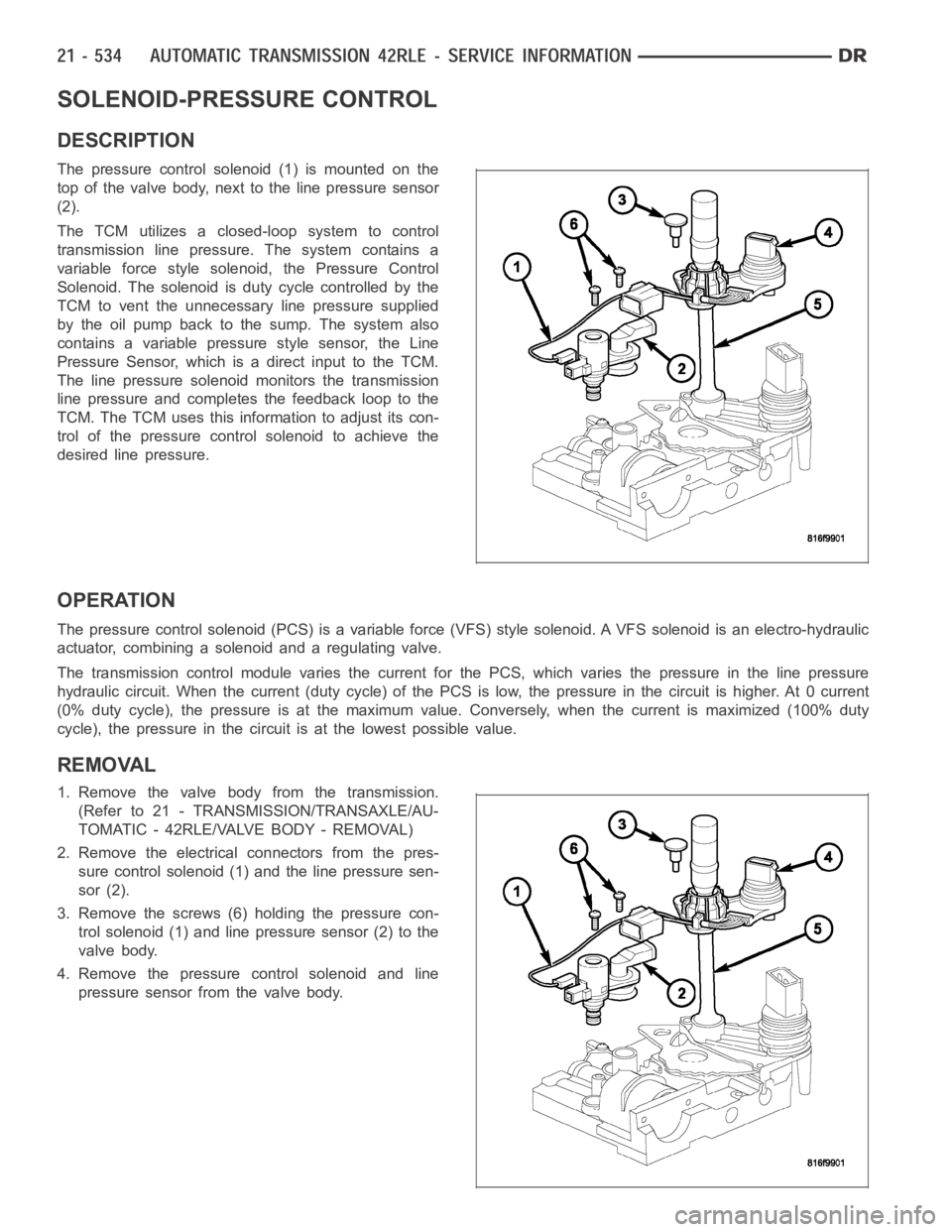
Thepressurecontrolsolenoid(1)ismountedonthe
top of the valve body, next to the line pressure sensor
(2).
The TCM utilizes a closed-loop system to control
transmission line pressure. The system contains a
variable force style solenoid, the Pressure Control
Solenoid. The solenoid is duty cycle controlled by the
TCM to vent the unnecessary line pressure supplied
by the oil pump back to the sump. The system also
contains a variable pressure style sensor, the Line
Pressure Sensor, which is a direct input to the TCM.
The line pressure solenoid monitors the transmission
line pressure and completes the feedback loop to the
TCM. The TCM uses this information to adjust its con-
trol of the pressure control solenoid to achieve the
desired line pressure.
OPERATION
The pressure control solenoid (PCS) is a variable force (VFS) style solenoid. A VFS solenoid is an electro-hydraulic
actuator, combining a solenoid and a regulating valve.
The transmission control module varies the current for the PCS, which variesthepressureinthelinepressure
hydraulic circuit. When the current (duty cycle) of the PCS is low, the pressure in the circuit is higher. At 0 current
(0% duty cycle), the pressure is at the maximum value. Conversely, when thecurrent is maximized (100% duty
cycle), the pressure in the circuit is at the lowest possible value.
REMOVAL
1. Remove the valve body from the transmission.
(Refer to 21 - TRANSMISSION/TRANSAXLE/AU-
TOMATIC - 42RLE/VALVE BODY - REMOVAL)
2. Remove the electrical connectors from the pres-
sure control solenoid (1) and the line pressure sen-
sor (2).
3. Remove the screws (6) holding the pressure con-
trol solenoid (1) and line pressure sensor (2) to the
valve body.
4. Remove the pressure control solenoid and line
pressure sensor from the valve body.
Page 3069 of 5267
TORQUE CONVERTER CLUTCH (TCC)
In a standard torque converter, the impeller and tur-
bine are rotating at about the same speed and the
stator is freewheeling, providing no torque multiplica-
tion. By applying the turbine’s piston and friction mate-
rial to the front cover, a total converter engagement
can be obtained. The result of this engagement is a
direct 1:1 mechanical link between the engine and the
transmission.
The clutch can be engaged in second, third, fourth,
and fifth (if appicable) gear ranges depending on over-
drive control switch position. If the overdrive control
switch is in the normal ON position, the clutch will
engage after the shift to fourth gear. If the control
switch is in the OFF position, the clutch will engage
after the shift to third gear.
The TCM controls the torque converter by way of
internal logic software. The programming of the soft-
ware provides the TCM with control over the L/R-CC
Solenoid. There are four output logic states that can
be applied as follows:
No EMCC
Partial EMCC
Full EMCC
Gradual-to-no EMCC
NO EMCC
Under No EMCC conditions, the L/R Solenoid is OFF. There are several conditions that can result in NO EMCC
operations. No EMCC can be initiated due to a fault in the transmission or because the TCM does not see the need
for EMCC under current driving conditions.
PARTIAL EMCC
Partial EMCC operation modulates the L/R Solenoid (duty cycle) to obtain partial torque converter clutch application.
Partial EMCC operation is maintaineduntil Full EMCC is called for and actuated. During Partial EMCC some slip
does occur. Partial EMCC will usually occur at low speeds, low load and light throttle situations.
FULL EMCC
During Full EMCC operation, the TCM increases the L/R Solenoid duty cycle to full ON after Partial EMCC control
brings the engine speed within the desired slip range of transmission input speed relative to engine rpm.
GRADUAL-TO-NO EMCC
This operation is to soften the change from Full or Partial EMCC to No EMCC. This is done at mid-throttle by
decreasing the L/R Solenoid duty cycle.
REMOVAL
1. Remove transmission and torque converter from vehicle. (Refer to 21 - TRANSMISSION/AUTOMATIC - 45RFE/
545RFE - REMOVAL)
2. Place a suitable drain pan under the converter housing end of the transmission.
CAUTION: Verify that transmission is secure on the lifting device or work surface, the center of gravity of
the transmission will shift when the torque converter is removed creatingan unstable condition. The torque
converter is a heavy unit. Use caution when separating the torque converter from the transmission.
3. Pull the torque converter forward until the center hub clears the oil pumpseal.
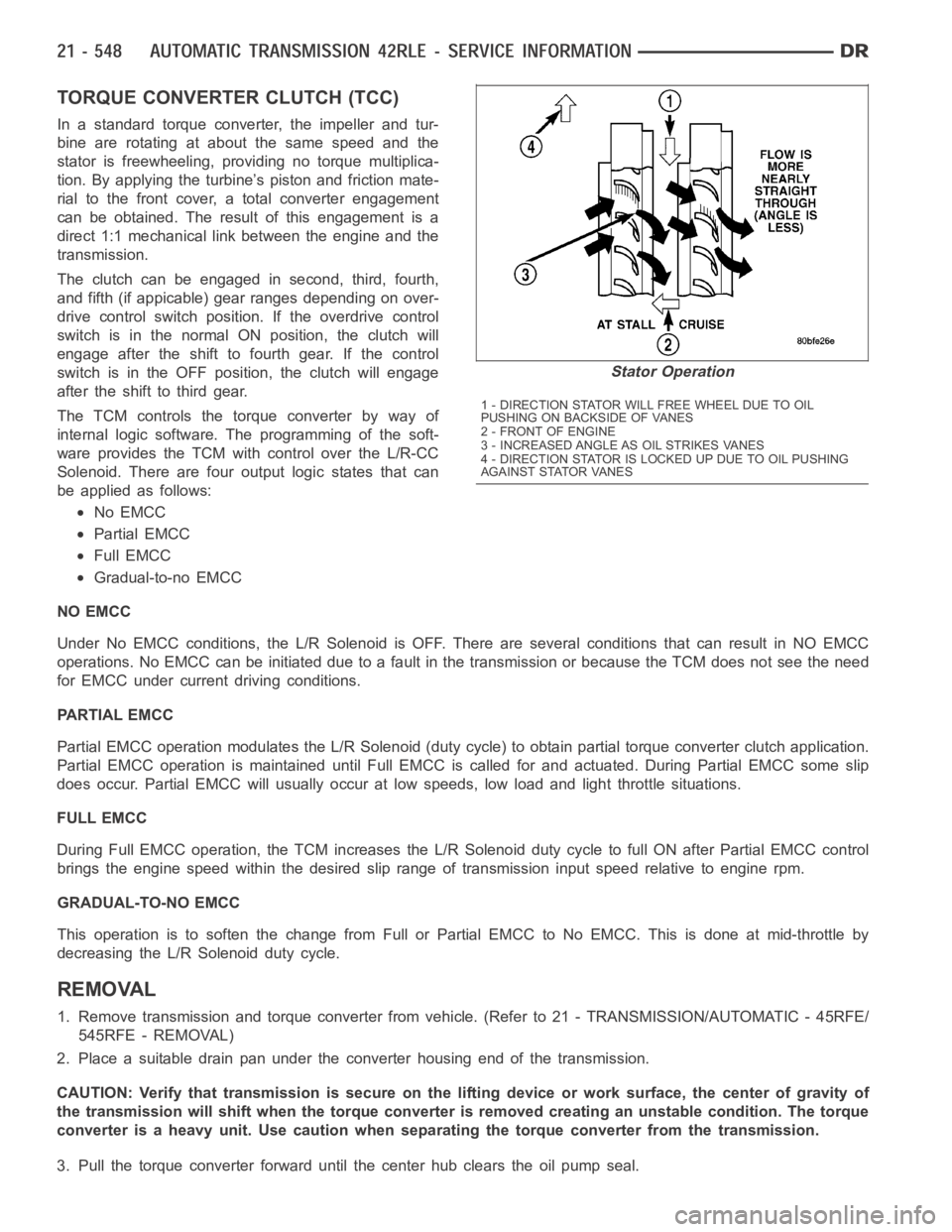
Stator Operation
1 - DIRECTION STATOR WILL FREE WHEEL DUE TO OIL
PUSHING ON BACKSIDE OF VANES
2-FRONTOFENGINE
3 - INCREASED ANGLE AS OIL STRIKES VANES
4 - DIRECTION STATOR IS LOCKED UP DUE TO OIL PUSHING
AGAINST STATOR VANES
Page 3070 of 5267
4. Separate the torque converter from the transmission.
INSTALLATION
NOTE: Check converter hub and drive notches for sharp edges, burrs, scratches, or nicks. Polish the hub
and notches with 320/400 grit paper or crocus cloth if necessary. The hub must be smooth to avoid dam-
aging the pump seal at installation.
1. Lubricate oil pump seal lip with transmission fluid.
2. Place torque converter in position on transmission.
CAUTION: Do not damage oil pump seal or bush-
ing while inserting torqueconverterintothefront
of the transmission.
3. Align torque converter to oil pump seal opening.
4. Insert torque converter hub into oil pump.
5. While pushing torque converter inward, rotate con-
verter until converter is fully seated in the oil pump
gears.
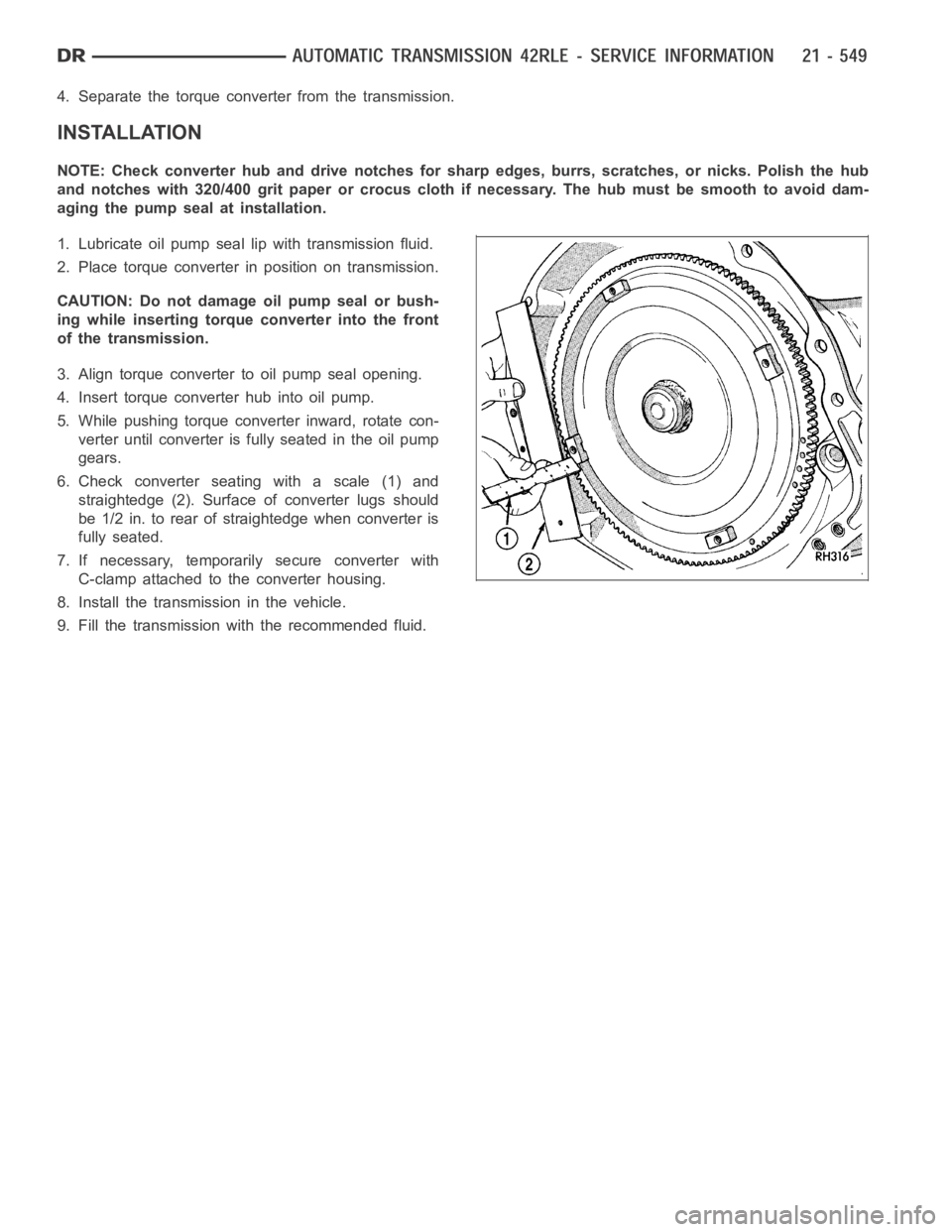
6. Check converter seating with a scale (1) and
straightedge (2). Surface of converter lugs should
be 1/2 in. to rear of straightedge when converter is
fully seated.
7. If necessary, temporarily secure converter with
C-clamp attached to the converter housing.
8. Install the transmission in the vehicle.
9. Fill the transmission with the recommended fluid.
Page 3095 of 5267
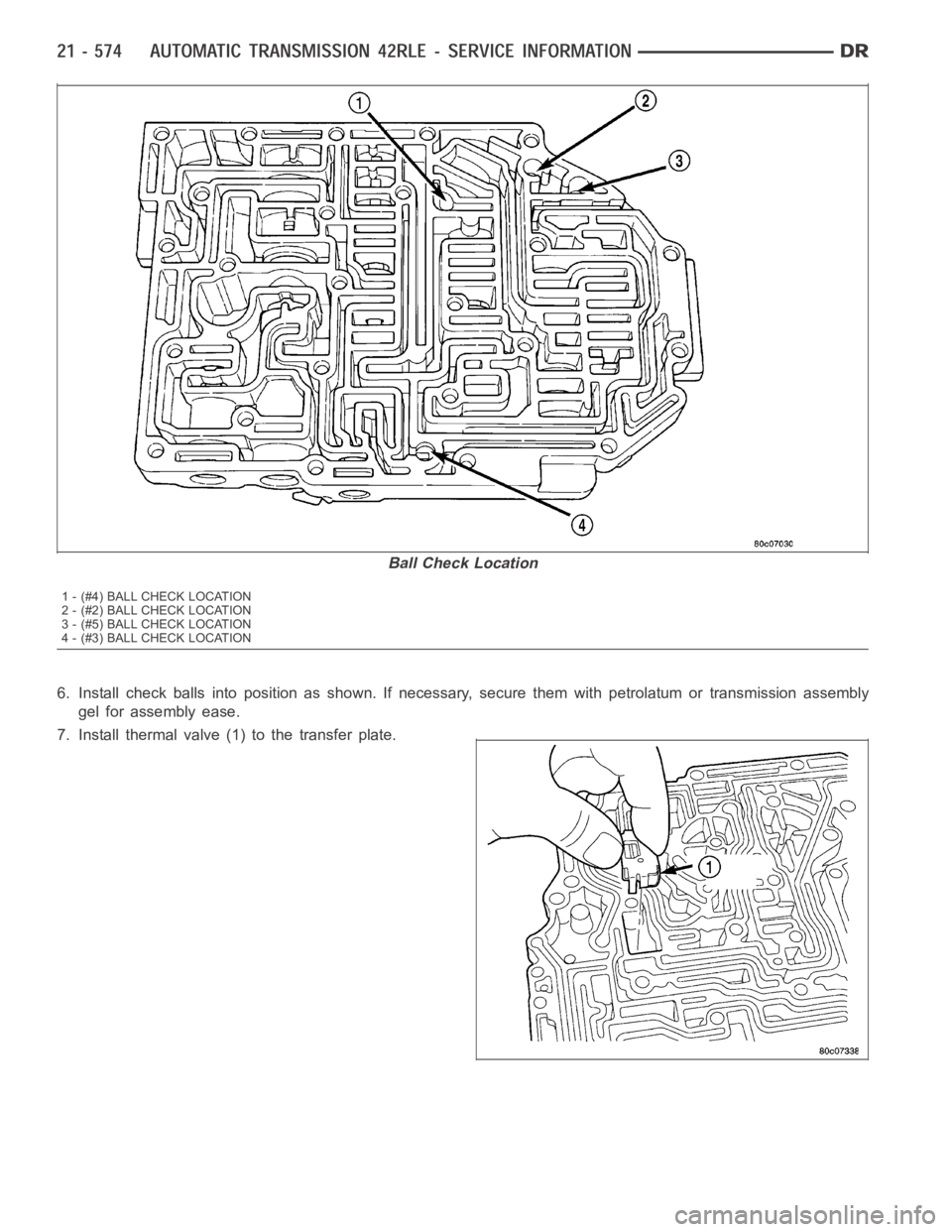
6. Install check balls into position as shown. If necessary, secure them with petrolatum or transmission assembly
gel for assembly ease.
7. Install thermal valve (1) to the transfer plate.
Ball Check Location
1 - (#4) BALL CHECK LOCATION
2 - (#2) BALL CHECK LOCATION
3 - (#5) BALL CHECK LOCATION
4 - (#3) BALL CHECK LOCATION
Page 3118 of 5267
P0613-INTERNAL TCM
For a complete wiring diagramRefer to Section 8W.
Theory of Operation
The internal Watchdog (WD) is a separate hardware circuit that continuously monitors the microprocessor. To insure
the proper operation of the Transmission controller the watchdog must receive a signal from the microprocessor
within a specific time window (14 msec ± 1 msec) to prevent a system shutdownafter a short delay (570 msec).
The microprocessor periodically tests the WD’s ability to provide this shutdown function using a three phase test;
1) Send the signal too late > 15 msec
2) Send the signal too early < 13 msec
3) Delay test < 590 msec
If the watchdog input signal arrives too early or too late, the Watchdog Fault line will go low and the watchdog delay
will start to time out. The delay will be reset by the correct timing of watchdog signal sent during subsequent oper-
ations.
The Delay Test checks the delay time out. The Delay Monitor line is pulled low, which forces the delay to start timing
out. At the end of the delay time the Transmission Relay will be turned off. The delay test, upon detection of the
relay turning off, will immediately turn the relay back on before shutdowncan occur.
When Monitored:
1) One time after the controller is reset (ignition turned to the RUN position) and every 60 seconds thereafter.
The Delay Test is executed after a reset only.
2) 2 seconds after an invalid test.
Set Condition:
If either of the following conditions occur 3 times:
1) The watchdog fault line remains high after the period has elapsed for thetoo early - too late watchdog test.
2) The Transmission Control Relay remains on after the watchdog delay expired.
Possible Causes
POWERORGROUNDCIRCUIT
POWERTRAIN CONTROL MODULE
Always perform the Pre-Diagnostic Troubleshooting procedure before proceeding. (Refer to 21 - TRANSMIS-
SION/TRANSAXLE/AUTOMATIC - 45RFE/545RFE - STANDARD PROCEDURE)
Diagnostic Test
1.CHECK THE WIRING AND CONNECTORS
Using the schematics as a guide, check the Powertrain Control Module (PCM)terminals for corrosion, damage, or
terminal push out. Pay particular attention to all power and ground circuits.
NOTE: Due to the integration of the Powertrain and Transmission Control Modules, the transmission part of
the PCM has it’s own specific power and ground circuits.
Wiggle the wires while checking for shorted and open circuits.
Check for any Service Bulletins that may apply.
Were there any problems found?
Ye s>>
Repair the power and/or ground circuits as necessary.
Perform 45RFE/545RFE TRANSMISSION VERIFICATION TEST - VER 1. (Refer to 21- TRANSMIS-
SION/TRANSAXLE/AUTOMATIC - 45RFE/545RFE - STANDARD PROCEDURE)
No>>
Replace the PCM per the Service Information. With the scan tool, perform QUICK LEARN.
Perform 45RFE/545RFE TRANSMISSION VERIFICATION TEST - VER 1. (Refer to 21- TRANSMIS-
SION/TRANSAXLE/AUTOMATIC - 45RFE/545RFE - STANDARD PROCEDURE)
Page 3177 of 5267
When Monitored:
Initially at power-up, then every 10 seconds thereafter. The solenoid circuits will also be tested immediately
after a gear ratio or pressure switch error is detected.
Set Condition:
After three consecutive solenoid continuity test failures, or one failure if test is run in response to a gear ratio
or pressure switch error.Note: This DTC is strictly an electrical fault and does not apply to any internal
transmission failures.
Possible Causes
RELATED TIPM TCM DTCS PRESENT
(T20) LR SOLENOID CONTROL CIRCUIT SHORT TO OTHER CIRCUITS
(T20) LR SOLENOID CONTROL CIRCUIT OPEN
(T20) LR SOLENOID CONTROL CIRCUIT SHORT TO GROUND
TRANSMISSION SOLENOID/TRS ASSEMBLY
POWERTRAIN CONTROL MODULE
Always perform the 45RFE/545RFE Pre-Diagnostic Troubleshooting Procedure before proceeding. (Refer to
21 - TRANSMISSION/TRANSAXLE/AUTOMATIC - 45RFE/545RFE - STANDARD PROCEDURE)
Theory of Operation
The Transmission Control System uses six electronically controlled solenoids that allow hydraulic fluid to be applied
to various friction elements (clutches), which enables the gear requested. The continuity of each solenoid circuit is
periodically tested. Each inactive solenoid is turned on for a few milliseconds, then off. Each active solenoid is
turned off for a few milliseconds, then on. This pulsing of voltage to the solenoid causes an inductive spike which
can be sensed by the Transmission Control System. If an inductive spike is not sensed by the Transmission Control
System during the continuity check, it is tested again. If the test fails three consecutive times, the appropriate Diag-
nostic Trouble Code (DTC) is set. If the solenoid test is run in response to agear ratio or pressure switch error, one
failure will result in setting the appropriate DTC.Note: This DTC is strictly an electrical fault and does not apply
to any internal transmission failures.
Diagnostic Test
1.CHECK FOR TIPM TCM DTCS
With the scan tool, check for other transmission DTCs.
Are there any TIPM TCM DTCs present?
Ye s>>
Refer to the Transmission category and perform the appropriate symptom.
No>>
Go To 2
2.CHECK TO SEE IF P0750 IS PRESENT
Ignition on, engine not running.
With the scan tool, erase all Transmission DTC’s.
Turn the ignition off to the lock position.
Remove the Ignition Switch Feed fuse from the TIPM.
CAUTION: Removal of the Ignition Switch Feed fuse from the TIPM will prevent the vehicle from being
startedingear.
WARNING: The Ignition Switch Feed fuse must be removed from the TIPM. Failure to do so can result in
personal injury or death.
Install the Transmission Simulator, Miller tool #8333.
Ignition on, engine not running.
With the scan tool, actuate the LR Solenoid.
Page 3181 of 5267
When Monitored:
Initially at power-up, then every 10 seconds thereafter. The solenoid circuits will also be tested immediately
after a gear ratio or pressure switch error is detected.
Set Condition:
After three consecutive solenoid continuity test failures, or one failure if test is run in response to a gear ratio
or pressure switch error.Note: This DTC is strictly an electrical fault and does not apply to any internal
transmission failures.
Possible Causes
RELATED TIPM TCM DTCS PRESENT
(T219) 2C SOLENOID CONTROL CIRCUIT SHORT TO OTHER CIRCUITS
(T219) 2C SOLENOID CONTROL CIRCUIT OPEN
(T219) 2C SOLENOID CONTROL CIRCUIT SHORT TO GROUND
TRANSMISSION SOLENOID/TRS ASSEMBLY
POWERTRAIN CONTROL MODULE
Always perform the 45RFE/545RFE Pre-Diagnostic Troubleshooting Procedure before proceeding. (Refer to
21 - TRANSMISSION/TRANSAXLE/AUTOMATIC - 45RFE/545RFE - STANDARD PROCEDURE)
Theory of Operation
The Transmission Control System uses six electronically controlled solenoids that allow hydraulic fluid to be applied
to various friction elements (clutches), which enables the gear requested. The continuity of each solenoid circuit is
periodically tested. Each inactive solenoid is turned on for a few milliseconds, then off. Each active solenoid is
turned off for a few milliseconds, then on. This pulsing of voltage to the solenoid causes an inductive spike which
can be sensed by the Transmission Control System. If an inductive spike is not sensed by the Transmission Control
System during the continuity check, it is tested again. If the test fails three consecutive times, the appropriate Diag-
nostic Trouble Code (DTC) is set. If the solenoid test is run in response to agear ratio or pressure switch error, one
failure will result in setting the appropriate DTC.Note: This DTC is strictly an electrical fault and does not apply
to any internal transmission failures.
Diagnostic Test
1.CHECK FOR TCM TIPM DTCS
With the scan tool under TIPM, check for TCM Power Input DTCs.
Are there any TIPM TCM Power Input DTCs present?
Ye s>>
Refer to the Transmission category and perform the appropriate symptom.
No>>
Go To 2
2.CHECK TO SEE IF P0755 IS PRESENT
Turn the ignition off to the lock position.
Remove the Ignition Switch Feed fuse from the TIPM.
CAUTION: Removal of the Ignition Switch Feed fuse from the TIPM will prevent the vehicle from being
startedingear.
WARNING: The Ignition Switch Feed fuse must be removed from the TIPM. Failure to do so can result in
personal injury or death.
Install the Transmission Simulator, Miller tool #8333.
Ignition on, engine not running.
With the scan tool, actuate the 2C Solenoid.
Did the 2C Solenoid LED blink on and off on the Transmission Simulator?
Ye s>>
Go To 3
No>>
Go To 4
Page 3185 of 5267
When Monitored:
Initially at power-up, then every 10 seconds thereafter. The solenoid circuits will also be tested immediately
after a gear ratio or pressure switch error is detected.
Set Condition:
After three consecutive solenoid continuity test failures, or one failure if test is run in response to a gear ratio
or pressure switch error.Note: This DTC is strictly an electrical fault and does not apply to any internal
transmission failures.
Possible Causes
RELATED TIPM TCM DTCS PRESENT
(T60) OD SOLENOID CONTROL CIRCUIT SHORT TO OTHER CIRCUITS
(T60) OD SOLENOID CONTROL CIRCUIT OPEN
(T60) OD SOLENOID CONTROL CIRCUIT SHORT TO GROUND
TRANSMISSION SOLENOID/TRS ASSEMBLY
POWERTRAIN CONTROL MODULE
Always perform the 45RFE/545RFE Pre-Diagnostic Troubleshooting Procedure before proceeding. (Refer to
21 - TRANSMISSION/TRANSAXLE/AUTOMATIC - 45RFE/545RFE - STANDARD PROCEDURE)
Theory of Operation
The Transmission Control System uses six electronically controlled solenoids that allow hydraulic fluid to be applied
to various friction elements (clutches), which enables the gear requested. The continuity of each solenoid circuit is
periodically tested. Each inactive solenoid is turned on for a few milliseconds, then off. Each active solenoid is
turned off for a few milliseconds, then on. This pulsing of voltage to the solenoid causes an inductive spike which
can be sensed by the Transmission Control System. If an inductive spike is not sensed by the Transmission Control
System during the continuity check, it is tested again. If the test fails three consecutive times, the appropriate Diag-
nostic Trouble Code (DTC) is set. If the solenoid test is run in response to agear ratio or pressure switch error, one
failure will result in setting the appropriate DTC.Note: This DTC is strictly an electrical fault and does not apply
to any internal transmission failures.
Diagnostic Test
1.RELATED TIPM TCM DTCS PRESENT
With the scan tool, check for TIPM DTCs.
Are there any TIPM TCM DTCs present?
Ye s>>
Refer to the Transmission category and perform the appropriate symptom.
No>>
Go To 2
2.CHECK TO SEE IF P0760 IS PRESENT
Turn the ignition off to the lock position.
Remove the Ignition Switch Feed fuse from the TIPM.
CAUTION: Removal of the Ignition Switch Feed fuse from the TIPM will prevent the vehicle from being
startedingear.
WARNING: The Ignition Switch Feed fuse must be removed from the TIPM. Failure to do so can result in
personal injury or death.
Install Transmission Simulator, Miller tool #8333.
Ignition on, engine not running.
With the scan tool, actuate the OD Solenoid.